45.2 F
Davis

Davis, California

Friday, January 9, 2026
Home Blog Page 903

An album review of Best Coast’s Fade Away

Kaleidoscopic melodies. Candid lyrics. Glorious reverb. Best Coast has done it again with its latest release, Fade Away, which hit stores on October 22. Through its seven songs, the mini-album recounts all too familiar feelings, but not without evoking the need to dance first.

The duo, composed of vocalist/guitarist Bethany Cosentino and multi-instrumentalist Bobb Bruno, evidently experiments with different musical styles in the EP. In comparison to previous works, Fade Away strays a bit from the band’s signature lo-fi sound. The EP tracks do not reminisce summer days, beach trips and 60s bliss. Instead, they seem nostalgic for the 90s in the way that they draw stylistic elements from post-punk, shoegaze and garage-rock in a produced manner.

Fade Away feels like the city: dense and fast-paced. Listening to each track is like passing through a crowded sidewalk and taking in every face, every voice and every sense of life. In retrospect, all is vivid; but you come to realize that every figure is a complex being. Similarly, each track is personal and genuine; it touches upon thoughts and feelings that have once haunted all of us at night.

What I find most admirable is the juxtaposition between the lyrics and music. Most tracks scream purely infectious pop, but all explore themes of vagrancy, heartache and coming-of-age. Take opening track “This Lonely Morning”: it’s the kind of song the protagonist of a John Hughes film would wake up to. Just the energy from the progressive guitar riffs and Cosentino’s vocals can make you feel ready to tackle the day ahead. But, take a closer listen and you’ll find that Cosentino’s lyrics unravel the struggles of a heavy heart. The following tracks, “I Wanna Know,” “Who Have I Become?” and “Fear of My Identity,” do just the same.

However, the mini-album, maintains a variety of style. The last three tracks — “Fade Away,” “Baby I’m Crying” and “I Don’t Know How” — brilliantly unwind from the rest of the EP’s motley melodies. These final songs drowns your senses in a hazy, psychedelic euphoria. In “Baby I’m Crying,” specifically, I found myself entranced by Cosentino’s swooning voice and the swaying sound of the guitar. Reminiscent to the style of Mazzy Star, “Baby I’m Crying” is what locked in the mini-album’s 90s feel for me.

Overall, the EP masterfully demonstrates Best Coast’s progress as a band, as well as musical talent. Even with experimental changes, the duo did not let its core sound fade — a quality often tricky to accomplish. Though the band’s vintage summer feel has slightly evolved, Fade Away welcomes listeners to an awesome start of something new.


This Week in Science and Technology

High School Student Discovers Skeleton of Baby Dinosaur

Announced by the Raymond M. Alf Museum of Paleontology at The Webb Schools this week, the smallest, youngest and most complete fossil skeleton of Parasaurolophus to date was discovered by a high school student. Three-dimensional scans of almost the entire fossil are available to the public online. Nicknamed “Joe,” the fossil is the most digitally-accessible dinosaur to exist.

Link: http://sciencedaily.com/releases/2013/10/131022091759.htm

Discovery of Joe the Dinosaur

Mind-Reading Technology Advances

A computer at UC Berkeley was trained to decrypt brain scans using algorithms. The computer was shown patterns of brain activity produced from various images and film clips. As it learns, it can view brain scans and correctly associate them with words describing what the participant is seeing.

 Links: http://scientificamerican.com/article.cfm?id=mind-reading-technology-speeds-ahead

Solar System With Seven Planets Discovered

Found by two independent teams of astronomers, KIC 11442793 sets the record for most planets orbiting around a sun other than our own. The system is located 2,500 light years from Earth. Much like the planets of our own solar system, the seven planets grow larger as the distance from their star increases; however, the system is much more compact than ours. Its furthest planet orbits at the distance Earth circles the Sun.

Link: https://sciencenews.org/blog/science-ticker/solar-system-seven-planets-discovered

Largest Alzheimer’s study reveals new associated genes

In the largest study of its kind ever conducted on Alzheimer’s disease, the International Genomic Alzheimer’s Project found 11 new regions of the human genome that were shown to be involved in developing the disease. The unique worldwide effort allowed for collaboration among 15 countries and interpreting the genetic data of 74,076 patients.

Link: http://sciencedaily.com/releases/2013/10/131027185319.htm

 Money grows on trees

In a study published in the journal Nature Communications, Australian scientists have discovered gold present in the leaves of some plants, indicating deposits buried many meters below. The researchers believe this will create a new way to find the precious metal in challenging locations.

Link: http://bbc.co.uk/news/science-environment-24628241

Light from farthest galaxy yet discovered reaches Earth

Researchers from the University of Texas in Austin have found a galaxy, called z8_GND_5269, 9 billion light years from our planet. It formed only 700 million years after the Big Bang, making it the closest yet observed galaxy to the era of the cosmic “dark ages.”

Link: http://nature.com/news/light-from-farthest-galaxy-yet-discovered-breaks-through-cosmic-fog-1.14017

Single electrons make waves

Researchers at the CEA Saclay nuclear research center have successfully lifted a single charged particle from a sea of electrons in a nanoscale circuit, creating an individual electron wave. This accomplishment may allow single electrons to carry quantum information.

Link: http://nature.com/news/single-electrons-make-waves-1.14015


Trying to understand: Wasting words

0

 “As humans, we waste the shit out of our words. It’s sad. We use words like ‘awesome’ and ‘wonderful’ like they’re candy. It was awesome? Really? It inspired awe? It was wonderful? Are you serious? It was full of wonder? You use the word ‘amazing’ to describe a goddamn sandwich at Wendy’s?! What’s going to happen on your wedding day, or when your first child is born? How will you describe it? You already wasted ‘amazing’ on a fucking sandwich.” –Louis C.K.

So why do people “waste” their words? When it comes to using the English language, I don’t think people understand that they often use words incorrectly, especially when describing a feeling using adjectives.

Employing idioms is a typical way to talk and express the way one feels, but our vocabulary as a general population has been narrowed down far too much. We incorporate a small percentage of words found in the dictionary into everyday life, often resorting to the more extreme ones like “awesome” and “wonderful” to convey an emotion.

Clearly people will understand what you mean when you use these kinds of exaggerated words, but to encourage precision, we should try to find words that more accurately describe a circumstance.

Without actually putting in an effort, people will find it hard to expand their vernacular. This is why I think it’s a great idea to implement a “Word of the Day” into your daily life. Instead of focusing on an “Outfit of the Day,” maybe people should be more concerned with language, seeing as it’s an important part of being a well-rounded member of society.

Not only do people generally lack an expansive vocabulary, but the words they do use are sometimes used incorrectly. Certain adjectives such as “magical” and “surreal” are commonly used in a magnified manner. The thing is that we don’t comprehend that a more accurate word can be used instead, because we often rely on colloquial speech.

Even if you have an extensive vocabulary, you’re going to fall victim to the misuse of words once in a while.

Not only do we misrepresent situations with the improper use of adjectives, but we also botch our sentences by incorrectly applying words like “literally.”

Did you really just literally destroy that person with your words? No, I think you mean you figuratively destroyed them.

“It was the best thing ever when he opened that jar of Nutella!” Really? Ok, so you’re basically saying that no moment from here on out will ever compare to when he opened that jar? It’s all downhill from here?

“That cookie was magical!” Seriously? How freakin’ so?

Think about it … this kind of miscommunication happens quite often, doesn’t it?

There’s a distinction between the connotation and denotation of certain words and phrases, but some people are unaware of how to differentiate between the right and wrong terminology.

The reason people misuse words, whether consciously knowing so or not, is because if accurate descriptions of a moment were given, then there would be no emphasis and people’s reactions wouldn’t be as strong.

If someone said “Wow, that cookie was of a satisfactory taste and now I feel the same as I did before,” instead of referring to the cookie as “magical,” would it produce the same effect? No.

People like using hyperbolic language and commonly overemphasize most things, but that makes for a more interesting conversation, I suppose.

There are oodles of words to choose from and everybody should start to have some fun with vocabulary! Build up an arsenal of words, refine your knowledge of the English language and create a superb repertory for future conversations.

SAVANNAH HOLMES can be found in the dictionary under “anomalous” or can be reached at skholmes@ucdavis.edu.

Football Preview: Cal Poly San Luis Obispo

0

Teams: UC Davis vs. Cal Poly San Luis Obispo

Records: Aggies, 3-6 (3-2); Mustangs, 3-5 (2-2)

Where: Aggie Stadium — Davis, Calif.

When: Saturday, Nov. 2 at 7 p.m.

Who to watch?

UC Davis’ away game winning streak came to a halt on Oct. 26, when the fifth-ranked Montana State Bobcats (MSU) defeated the Aggies 34-17. Hopefully, UC Davis will have better luck on their home turf as they prepare to take on the Cal Poly Mustangs for the UC Davis Parents’ Weekend on Nov. 2.

One Aggie who gave an impressive performance against the Bobcats is junior running back Gabe Manzanares. Manzanares finished the game with 179 yards rushing including two touchdowns against MSU.

With three games remaining in the season, the San Francisco, Calif. native has already accumulated 890 yards rushing ─ the most since Matt Masari went for 1,274 yards in 2003. Manzanares, who walked on to the UC Davis football team this year, has been a major contributor to the Aggies’ offensive success all season long.

Preview:

After their second back-to-back road game victory against the University of Northern Colorado, UC Davis traveled to Bozeman, Mont. on Oct. 26 to take on the ranked Montana State Bobcats in the hopes of continuing their away game success. Unfortunately, the Aggies came up short in a 34-17 loss at Bobcat Stadium in front of an intimidating crowd of 18,627.

The Bobcats pounced on the Aggies early in the game, leading 14-0 in the second period following a 10-play, 68-yard drive.

Despite the overwhelmingly large and boisterous crowd, senior quarterback Randy Wright communicated well with the offensive line and set the offense up to score. Wright moved the Aggies 69 yards to set up sophomore Brady Stuart’s 29-yard field goal and get UC Davis on the scoreboard, 14-3.

Junior Gabe Manzanares led the Aggie running game with 113 yards in the first half alone, while demonstrating impressive speed, strength and agility that gave the Bobcat defense difficulty all game.

Despite the strong Aggie defensive front, which forced Bobcat quarterback Darius McGhee to throw short second or third-read passes, MSU inflated their lead with 24 seconds left in the third quarter.

Down 34-10, UC Davis quickly advanced 75 yards in 13 plays and scored from a two-yard toss from Wright to senior receiver Tom Hemmingson, who became the first Aggie to catch 10 passes in a single game since he achieved this same feat in 2011.

But it wasn’t enough to take home the win.

The Aggies’ defense will have their work cut out for them with Mustang running back Kristaan Ivory, who is averaging 101 rushing yards per game with six rushing touchdowns this season. Cal Poly has a 5.2 yards per carry rushing average.

The Mustang defense has held their opponents to a 3.8 yard per carry rushing average this year. However, they have yet to face a top-tier running back like Manzanares.

The Aggies need to bounce back and play consistent football if they wish to emerge victorious this Parents’ Weekend against the Cal Poly Mustangs, who lost 17-13 to Northern Arizona on Oct. 26.

— Jordanna Baddeley


Inside the Game with Beverly Vatananugulkit

0

At the close of the fall season, the UC Davis women’s golf team had its ups and downs, finishing first in the Hoosier Fall Invitational on Oct. 20, before stumbling to a 12th place finish in the Stanford Intercollegiate on Oct. 27.

The No. 38 Aggies have been led by the strong play of Beverly Vatananugulkit, a junior English major out of Cerritos, Calif. Vatananugulkit was named the Big West Freshman of the Year two seasons ago and has earned All-Big West First Team honors twice.

Vatananugulkit found time in her busy schedule recently to sit down with Aggie Sports Writer Ryan Reed to talk about how she got into golf, her greatest accomplishments and what motivates her.

Okay, lets start from the beginning. How and when did you get into golf?
Vatananugulkit: So I swam as a kid, but my dad wanted me to get into golf. I tried it at age seven and started competing around eight, and that was when I won my first tournament so I was really stoked about that. From then on, I have just continued to play golf.

In high school you were a four-time All-Suburban league player and basically dominant. How was the transition to playing at the collegiate level against stiffer competition?
It was a difficult transition because you come from being a top dog to like “Oh wow, there is a lot of good players out there that you aren’t competing against” in my area. So that was kind of different for me. But, I remember my freshman year we won our first tournament, so I thought “Oh, maybe this is the same,” but then we went to other much tougher fields and I was like “there is a lot more work to put into it.”

And why did you choose UC Davis?
I came here mostly for coach Walker, our previous coach — she really convinced me to come here. Also the education. We are like a top-10 public school, right? So I thought that was a really good balance.

So even though you said it was tough, you were Big West Freshman of the Year and have been All-Big West First Team for two years. What would you say is your biggest accomplishment so far at Davis?
I think I definitely have improved in golf quite a bit. My mental practices during tournaments are so different from how I was as a junior golfer so that is really eye opening for me. I definitely think that is one of my greatest accomplishments, getting one step closer to being a great golfer.

So you guys won last weekend (Oct. 20), how would you describe the season thus far?
Individually, I played really well two weeks ago [Oct. 13] and I wanted to bring that back to last week, but it didn’t really carry over. If I can get myself back to that mental state and practice plan from before Washington, that would be great. The season started off pretty bumpy, but we are getting back into it. All of the players are working really hard and I am really proud of them.

What would you say is your best memory from your time at UC Davis?
I like to think back to when I won Big West. On the last hole, I hit my shot off of the fairway and I think it lipped out of the hole so I almost got an eagle. I was so nervous walking up to the green, because I was thinking “oh no, now I have to make that putt now. Why couldn’t it just go in?” That was really exciting for me.

What do you want to do after Davis?
That actually comes a lot with what I get out of golf for the next year or so, to see if I want to turn pro or not.

Any athletic role models?
Well, ever since I was younger it was always Tiger Woods, but now I don’t know about that one. But, Annika Sorenstam is definitely a great player and she retired at her peak, so that would be awesome if I could follow in her footsteps.

Okay, any non-athletic role models then?
I have always had my dad as my role model. Ever since he passed away, I have kind of kept [him] in my mind as my drive, to motivate.

Aggies tip off season against Lumberjacks

0

Teams: UC Davis vs. Humboldt State

Records: Aggies 0-0 (0-0); Lumberjacks 0-0 (0-0)

Where: The Pavilion — Davis, Calif.

When: Friday, Nov. 1 at 7 p.m.

Who to Watch:

As UC Davis heads into the 2013-14 season, the bulk of the production load will be placed on junior forward Sydnee Fipps. Fipps — who won first team All-Big West honors last year — will need to continue her growth in order for the Aggies to have continued success this year.

The junior will be expected to provide more than scoring — though her impressive 17.1 points per game average led the team last year — as her rebounding and leadership qualities will prove vital in the quest for a Big West title.

Fipps, as a junior, is one of only four upperclassmen on the team. Her leadership on the court will be necessary especially at the end of close games.

Fipps’ rebounding abilities, as evidenced by her team-high 5.1 rebounds per game, is crucial as the Aggies struggled on the boards last season. The Aggies finished last in the Big West in rebound margin, getting outrebounded by an average of 8.4 rebounds a game.

All in all, Sydnee Fipps is going to be the catalyst for any run which UC Davis has this season. Her scoring, rebounding and leadership are all needed for success against Humboldt State as well as the tough Big West conference.

Did you know?:

Sydnee Fipps was nominated for preseason all-conference honors. This was due to her outstanding performance in her sophomore campaign. She scored a total of 512 points on the season, which broke the UC Davis record for sophomore season point totals. Fipps also led the Aggies in scoring 21 out of the 30 games last season.

Preview:

As the Aggies begin their 2013-14 basketball season, there are many questions which the team needs to answer. Who is going to replace recent graduates Courtney French and Blair Shinoda in the starting lineup? Who is going to help Sydnee Fipps shoulder the scoring load?

These questions hopefully will be answered over the next few games. One person who possibly could step up and produce right away is sophomore Molly Greubel.

Greubel was a key player off the bench for the Aggies last season. She averaged 6.3 points per game, which was third on the team, only behind Fipps and French. With French graduated and gone, Greubel is the second-leading scorer of all UC Davis’ returning players.

The Aggies will definitely need her to have a more proactive role in scoring this year if they are to have any success. Her season average of 2.1 rebounds and 1.1 steals per game shows that she is willing to work hard on both sides of the floor.

UC Davis’ home and season opener will be against the Humboldt State Lumberjacks. The Lumberjacks went 10-18 last season which included an ugly 3-9 away record. This opening matchup will be just as much of a test run for Humboldt State as it will be for UC Davis.

The Lumberjacks only have two of their five leading scorers from last season returning. Seniors Kelly Kime and Elle Anderson averaged 8.7 and 6.9 points a game respectively. They will be asked to do a lot more against the Aggies in order for Humboldt State to succeed.

The Aggies tip off their season on Friday, Nov. 1 at 7 p.m. The game will be held at the Pavilion.

— Kenneth Ling

Men’s Tennis To Finish Fall Season At Pacific

0

Event: Pacific Tiger Invitational

Where: Hal Nelson Tennis Courts, Stockton, Calif.

When: Friday, Nov. 1; Saturday, Nov. 2; Sunday Nov. 3

Who To Watch:

Sophomore Adam Levie and freshman Alec Adamson made a semi-final run in doubles this past weekend at the ITA Northwest Regional held in Moraga, Calif. They took out three seeded teams along the way before losing in the semis 8-6 against the University of Washington’s eighth-seeded team of Emmett Egger and Jeff Hawke.

This is the second consecutive brilliant tournament for the Levie/Adamson pairing as they won the Flight A doubles bracket the weekend prior at the UCSB classic.

They have turned out to be quite the team and will look for more as they head into the Pacific Invitational.

Did You Know:

With the semi-final showing of Levie and Adamson in Moraga, the Aggies have now had at least one player make the semi-finals of an event at all three fall tournaments. This is an impressive feat that has come against the top of the line talent that the West Coast has to offer in the NCAA.

“I feel like we’ve competed pretty well in all three,” said coach Steidlmayer. “We’ve won several different flights.”

Preview:

The Aggies head to Stockton, Calif. on Nov. 1 to play in the Pacific Tiger Invitational. The field of teams this year will include Pacific, St. Mary’s, University of San Francisco, and also Stanford University.

This tournament is the Aggies’ last tournament this fall, so that should inject a little extra incentive and motivation into the team. Everyone wants to finish well and this tournament will provide ample opportunity for UC Davis to go out on a high note this season and come into the spring session feeling very confident in themselves.

“Getting better really is a good season,” coach Steidlmayer said. “The guys’ effort level has been good.”

This is certainly true of the men’s tennis team so far this year and is hopefully only the beginning for a blossoming young team.

— Vic Anderson

When the Aggies go marching-uh

1

As the California Aggie Marching Band-uh! takes the field to perform this weekend, you could be seeing them in a much bigger venue.

On Nov. 3, as the Oakland Raiders play host to the Philadelphia Eagles, Band-uh! has been given the distinct privilege to perform pre-game and at halftime at the Oakland Coliseum.

“It is a great opportunity for us,” said student manager Audrey Vorametsanti. “We are going to have thousands of people which is a lot more than our usual crowd, and we are also performing in a much bigger stadium.”

Band-uh! will not only be putting on a performance for the thousands of decorated Raider fanatics, but also for the many Bay Area police and firefighters in attendance.

The Oakland Raiders have teamed up with the organization Police and Fire: The Fallen Heroes for another year, in order to pay tribute to first responders from around the Bay Area.

In the Fourth Annual Oakland Raiders Police and Fire Appreciation game, members from multiple Northern California fire and police departments will be recognized in a special on-field ceremony.

“We have incorporated the Fallen Heroes organization into our show,” Vorametsanti said. “We will be playing ‘America the Beautiful’ while they do their salute to the police and fire personnel, in addition to a couple other songs during pre-game.”

Although Band-Uh! has had to rehearse for numerous events including the upcoming UC Davis vs. Cal Poly football game on Nov. 2, Band-uh! has taken the Raiders’ pregame and halftime show with the utmost importance.

“We have been practicing about 10 hours per week,” Vorametsanti said. “We had to memorize all of our drills and all of our music.”

While many of the band members are anxious for the upcoming game, band director Olin Hannum said this event is much more than just gaining public recognition.

“This event is more about the students being able to play in a stadium [Oakland Coliseum] that size and be in front of that many people,” Hannum said. “It is a bigger stage to perform on.”

As for the song list Band-uh! will perform on the big day, Director Hannum did not reveal much.

“The show is going to be Raiders-oriented,” Hannum said.

With Band-uh! preparing for a busy weekend, there will be several adjustments that will have to be accounted for as they prepare to play in the Coliseum.

“NFL hash marks are a bit different than college, so when charting the show, we had to account for that,” Hannum said. “But mostly, the difference is stadium size. Since the fans and cameras are way more elevated compared to Aggie Stadium, we [Band-uh!] can make a lot more [formations] on the field.”

Even with the field changes, Director Hannum views this as a big moment for the marching band itself.

“I think a lot of people in the Bay Area don’t know that we are the largest marching band in the UC system,” Hannum said. “Hopefully this will turn an eye in that the UC Davis marching band is pretty darn good.”

SHAUN MONCADA can be reached at sports@theaggie.org.

Cosmic Relevance: Spooky tradition

0

Today is Halloween, and it’s been one of my favorite holidays since I was a child.  And even though I love it so much, I realized that I know almost nothing about its origins.

So I investigated.

Halloween was originally known as Hallowmas, or Saint’s mass — a three-day observance and feast to honor the deceased and pray for Christian souls. As early as the 13th century, all regions of Europe had its own version of All Saint’s Day.

Equally important, the indigenous civilizations of North and Central America have been honoring their ancestors and rebirth in celebrations for around 3,000 years. When the Spanish arrived, their Christian influence hybridized the month’s practice into Día de los Muertos, a two-day period to honor the dead and respect the cycle of life.

So how did we get to our modern celebration?

In the colonies, Puritans held strong opposition to the “pagan” traditions of Halloween. However, with the influx of Irish and Scottish immigrants in the 19th century, Halloween slowly assimilated into mainstream culture. Its first mention in an American publication was in 1911, and by the late 1930s people from all socio-economic, religious and racial backgrounds were celebrating the holiday.

And it turns out, these observances hold direct connections to our own festivities.

From Ireland, we get the Jack-o-Lantern, hollow turnips lighting the way for lost souls, adapted to the American native pumpkin. From England, we received “souling,” an early version of trick-or-treating.  Children and the impoverished would go door to door, chanting rhymes and asking for “soul cakes,” baked for charity. In addition, from Mexican and Scottish customs, participants adorn costumes to either mock death, disguise oneself from evil spirits or create masked mischief. Lastly, Mexican tradition strongly encourages the locality to share with one another, everyone contributing to the shindig.

All in all, this period historically has centered around death, life and remembering our ancestors. So have we strayed from the true purpose of this ritual? When I asked some classmates what they associate with celebrating Halloween, the answers strongly suggested that the holiday has strayed.

Popular answers included “candy,” “pure fun” and “trick-or-treating.”  And when asked about their college celebrations, mostly one word was uttered: “partying.”

On one hand, it can be strongly argued that our secular society has lost the spiritual aspect of the holiday. Elementary schools facilitate dress-up, but omit conversations of ancestry and the universal subject of death.

Luckily, Día de los Muertos celebrations are on the rise, including processions in the Mission District of San Francisco and midtown Sacramento. These Festivals of the Altar are free and open to the public, and everyone is encouraged to bring flowers, candles and tokens for departed loved ones. In our fast-paced technological world, the organizers of the Mission procession encourage us to spend these days strengthening “our connections beyond our immediate concerns.”

Yet, Halloween still seems to unite us all. Far from its religious roots, children from all circumstances can dress up and join the merriment. I say it’s downright American; anyone can be anything.

Furthermore, in a world with school shootings, ever-increasing airport security and child predators, my hope is that this tradition continues to allow children to walk the streets safely in every neighborhood of the United States. That we can put aside discourses on high fructose corn syrup and child obesity, and trust our neighbors to give children candy. For one day the whole community can have fun together.


If you want to contact the dead with DANIEL HERMAN you can email him at dsherman@ucdavis.edu.


Stay Tuned: Smiling is golden

0

How many times have you shared a smile with a stranger? Think about it. Just today: when you bought your coffee and she told you to have a nice day, when you bumped into him on the sidewalk and you both mumbled apologies, when you crossed the road quickly because that driver insisted that you cross first. Each exchange contains a brief moment of eye contact and complimentary smile. Is this due to human nature? No. This behavior is cultural.

Whether because of our Hollywood-obsessed psyche or our enormous investment in perfected orthodontics, America is without a doubt, addicted to smiling. Americans will smile when we are happy, when we are uncomfortable, when we are see something funny or slightly interesting.

I come from a town where people going for their morning power walks will greet you with a big grin and a chipper, “Good morning!”

To me, this level of friendliness wasn’t excessive or grating, it was almost common courtesy. To the rest of the world, this exchange seems to equate to Disney On Crack. You just try to squeeze in a “Bonjour” to a French lady going for her morning power cigarette and you would be lucky to hold some brief, albeit hostile eye contact.

This inevitably has an effect on street performance.

Usually there is a little song-and-dance that goes along with the interaction between performer and audience. Some people are sitting near you and will hear a whole song; many more are passing you, catching only snippets of your songs as they go about their daily tasks. Usually the people passing will throw you a smile as you play. You take this for granted. It seems natural, second nature! Which makes it all the more unnerving when smiling is somehow subtracted from the routine.

When I was in Germany over the summer I took my guitar with me, for company if nothing else. The first few times I saw some interesting results. Like always, I had tried to find a relatively inoffensive place to play — a public park in the middle of the day. Strangely, the overwhelming reaction I got was uncomfortable.

I had made sure not to leave my case open or anything resembling a tip jar and yet, when I smiled at anyone, they hurried away as if I had asked for their firstborn child. It wasn’t unpleasant, just bizarre and invigorating. I had the power to make every passing stranger visibly nervous. Sometimes a passerby would breathe strangely loud through their nose as they walked quickly by, which I totally counted as acknowledgement. Not a single smile was seen.

Of course location is everything. When I visited a university town in Germany I got a much warmer response. Maybe too warm in some respects.

Again I had chosen a public park. Most of the populace gave me a wide diameter of space; if they did look at me it was hesitance bordering on suspicion. A young couple, however, approached and set up a blanket a little ways in front of me. I wasn’t acknowledged throughout this process but they could have chosen anywhere to sit so I figured they could be considered my audience.

Then they began to suck face about five feet from me and my bench. It would have been cute had it not been mildly gross, but hey, I’m a good sport so I serenaded their little picnic until they got up to leave and the guy thanked me — presumably for helping him get laid.

A while later an older couple approached as I was playing some Bob Dylan. They handed me a couple euros, which I graciously accepted.

“Danke!” I said, butchering the accent.

“Ah,” said the husband, picking up on my foreignness. “You speak English?”

“Yes!” I replied. “I’m from America!”

We began to talk about Bob Dylan and songwriting and the ’60s.

“You know,” I said after a while, “Street performing is different in Germany. People here seem nervous, they hardly make eye contact. You two are the first to approach me and start up a conversation!”

“Well we are not German,” they declared. “We are Swiss!”

“Ah!” I said, as if that explained everything.

Maybe it did. After a bit, they left, smiling as they waved goodbye.

Though I don’t consider myself one to get homesick, it was nice to come back to a country where passersby give you a gold-star smile for effort. We are addicted to smiling and we are nowhere near to finding a cure, and just the thought of it leaves me grinning.


For some great makeout music contact ELLY OLTERSDORF at elly.oltersdorf@gmail.com

Letter to the Editor: UC quality pushes workers to strike votes

0

The University of California’s union TAs, readers, custodians, hospital workers, technical employees and more are all holding strike authorization votes this week. Graduate student-workers are voting Nov. 4 to 6, service workers voted Oct. 29 and 30, and professional and technical employees have already voted 92 percent in favor to authorize a strike.

These union workers have been meeting with a series of Unfair Labor Practices from the UC — including intimidating striking service workers last spring and withholding information from TAs during their negotiations for a new contract. And all of these unions have emphasized the need to fight to defend the UC’s status as a top education and research university: smaller discussions so they can attend to undergraduate students, more competitive funding for graduate students to keep the UC a top research university, better patient care in UC hospitals, increased hours to clean campus buildings.

The call for a strike vote from UAW 2865, the union of UC readers and TAs, came last week in a meeting here at UC Davis in Wellman Hall, with representatives from every UC campus and dozens of rank-and-file Davis graduate student-workers participating. What does this strike vote mean? It means not that there will be an immediate strike, but that union officers are authorized to call a strike if circumstances merit.

With TAs increasingly expressing concerns that current large classes simply do not allow them to give their students the individual attention they will need, circumstances are already desperate. Voting is just a first step, but it demonstrates the severity of problems at UC.


Caroline McKusick

Anthropology Ph.D. student

Guide, UAW 2865 Student-Workers’ Union

The Left Nut: Socially Unacceptable

0

“We’ve got about 30 kids in this county that I’m at that are homosexuals. And it is sickening,” cries 14-year-old radio talk show host Caiden Cowger to thousands of listeners. “I’m going to tell you this, guys: President Obama and Vice President Biden are making kids gay!”

Some of you may find this appalling; others may not think this statement is so far-fetched. Cowger’s rant soon went viral, sparking heated discussion everywhere on the issue of gay marriage. Those on the left scathingly criticized him using epithets such as “dick” and “little asshole,” while those on the social right quickly jumped to his defense.

Cowger’s case is not an isolated incident, either. Every four years, presidential elections bring out the worst in people. Otherwise normal citizens begin calling each other names like “baby killer,” “woman hater” and “fag enabler,” not realizing that whomever they elect as the leader of our country has little control over abortion, women’s rights or gay marriage.

Now, a cynic might argue that I singled out Cowger to attack the right wing, but such is not my intention at all. He is entitled to his opinion, and, thanks to the First Amendment, free to broadcast it to the masses. I’m not necessarily criticizing him or anyone else for their views on homosexuality.

I’m criticizing them because they base their condemnation of the President on something over which he has virtually no control. For those of you still convinced that my bias is showing through, let me give you another anecdote.

Last election, my mother asked me who I would vote for, were I eligible to vote, with the addendum that Romney would ruin this country if elected. As a political progressive, even I found this pretty grossly naive, so I asked her how exactly he would do so.

Her instantaneous response went something along the lines of, “Well, he doesn’t like gay people!” I don’t know Mitt Romney personally, but I highly doubt that he hates all homosexuals solely on the premise of their sexual orientation. Even if he did, I have plenty of friends in support of gay rights who would still vote for him because they agree with him on fiscal and foreign policy issues, among many other things.

I told my mom that, while I would vote for Obama, it would be because, at the time of the election, he had cut the federal deficit by $312 billion and increased government spending at a slower rate than any president since World War II, not because of his magical ability to instantly legalize gay marriage and abortion in all 50 states.

As much as I supported Obama in the 2012 election, I would rather people not vote at all than vote for him without an educated stance on his positions. I have infinitely more respect for someone who votes Republican and has a carefully thought-out position that they can readily defend than for someone who votes Democrat because “Republicans hate women and minorities.”

Making prejudices about our opponents has caused party polarization, which in turn has caused politicians to become overly dogmatic in order to appeal to their constituents. We saw it with Rick Santorum’s short-lived presidential run last year: the bread and butter of his platform was conservative social policy, which made up most of his talking points.

His extremely polarizing persona, which relied heavily on his Christian morals, took almost all of the media attention away from his grossly incomplete fiscal policy proposal, which economists hated with near unanimity.

Yet this man won the Republican primary in three states and finished second in five others, over Romney, Gingrich and Ron Paul, all of whose proposed fiscal policies made up a large chunk of their platform. This is just one example of how some Americans care much more about social issues than economic ones.

My intent here is not to undermine the importance of social issues, but to stress that social policy change usually happens in state legislatures and rarely rests upon the shoulders of the federal government. So please, when voting for the leader of our country, don’t relegate their role to that of a mere social policy advocate. Instead, consider the practical effects this candidate would have on our country before you cast your ballot.


If you want to call ZACH MOORE a “little asshole,” email him at zcmoore@ucdavis.edu.

Minor Alcohol Preclusion Act: Don’t drink and walk?

0

In January 2012, the Minor Alcohol Preclusion Act (MAPA) was introduced to the Davis City Council. The act was proposed in light of community and council members’ concerns over underage drinking and neighborhood disturbances. City Council was scheduled to meet on Oct. 9, but will reconvene in 2014 instead to discuss the act.

The Davis Police can already make arrests for drinking-related conduct, such as public inebriation, possessing an open container and supplying minors with alcohol. There are also other local ordinances that attempt to curb “nuisance parties” and social gatherings that serve alcohol to minors.

If MAPA were enacted, the Davis Police would be able to charge minors with public inebriation if found with a blood alcohol content (BAC) of 0.02 percent or higher. What’s particularly unique about this act is that minors are allowed to drink in private, but can be subject to BAC tests and fines with probable reason if drunk in public areas.

Indeed, we do sympathize — and often, empathize — with our neighbors who have to suffer through the drunken rowdiness and eloquent conversations students yell at each other at 2 a.m. However, we do have some concerns with this proposed “solution.”

We know that those under the influence of alcohol are not the most functional group of people. If MAPA were to be passed, students may be more encouraged to drive home intoxicated instead of walk home, for fear of getting stopped and having their BAC tested.

A drinking culture is inevitable in a college town. Yes, the act would reduce the number of public disturbances, but does that encourage underage drinking in private settings rather than in public?

The City of Davis is made up of about 33,000 UC Davis students. Approximately 25,000 are undergraduates, meaning the majority of those students are under the age of 21. How will a police officer differentiate between minors and those of legal drinking age? We anticipate awkward moments.

Additionally, minors are not the only ones who create neighborhood disturbances. The act does not formally state what police officers are supposed to do with those of legal drinking age who cause disruptions in the community.

When City Council meets again, we’d like to see more defined criteria and expectations for MAPA, an emphasis on alcohol education in combination with enforcement and better student/community/police relations.

If the police can have our BACs, we’d like to have their backs, too.

Construction begins on SkyMine

The construction of a carbon dioxide (CO2) recycling plant in San Antonio, Texas will employ new technology to trap CO2 from power stations and industrial manufacturing processes before it is released into the atmosphere.

Using technology from Skyonic, construction began on the SkyMine demonstration plant on Sept. 30.

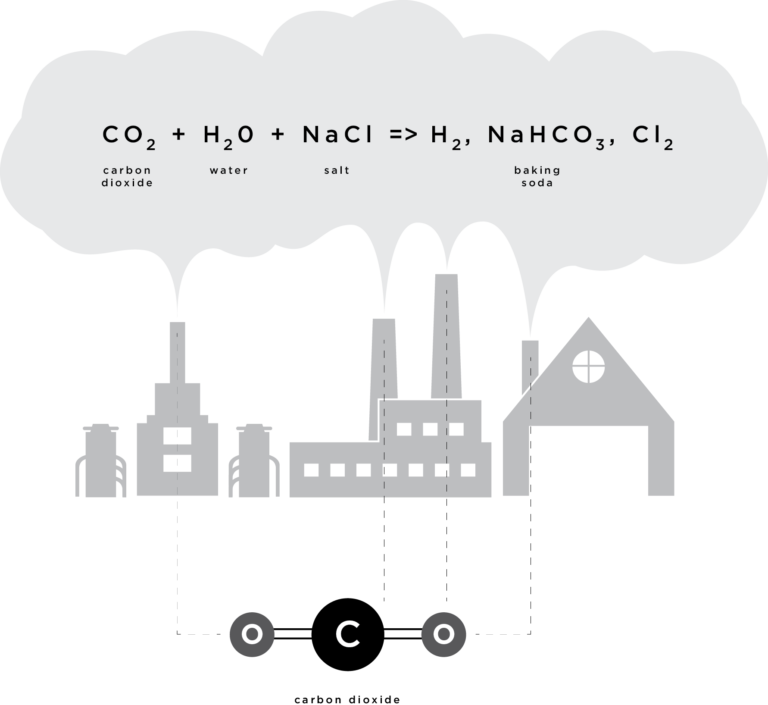
The technology utilizes heat in waste gases from industrial chimneys, which is then used to generate electricity. Then the carbon dioxide, sulfur dioxide, nitrogen oxides and heavy metals like mercury are scrubbed from the waste gases and stored. The CO2 enters absorption chambers where it is treated with sodium hydroxide (aka caustic soda ) made from salt and water. The chemical reaction that occurs is:

CO2 + H2O + NaCl —> NaHCO3 + H2 + Cl2

The byproducts of this chemical reaction are baking soda (NaHCO3), hydrogen gas (H2) and chlorine gas (Cl2), all of which have multiple commercial uses. Hydrogen and chlorine gases, for example, can be dissolved in water to make hydrochloric acid, which is frequently used as an industrial solvent.

Furthermore, the SkyMine scrubber technology is less costly and more efficient than the current technology being used in industry, which can cost hundreds of millions up front and millions more annually for maintenance.

“In North America alone, the market for carbonates, soaps [and] limestone products used in making paper, cement or fine chalks is worth $7.5 billion. Even if only about half of that is lucrative, we’ll be able to drive down the price of [the] carbon sequestration process to around $20 per ton. The market will deliver the most sequestration at the least cost to society,” said Joe Jones, CEO and founder of Skyonic.

However, William Casey, a professor of analytical chemistry, had some important comments about the project.

“There are a couple of points to note. They apparently aren’t scrubbing the CO2out of ambient air but putting their plant near a source of CO2, like a power plant,” said Casey in an email interview. “It is preventing CO2 from entering the atmosphere from combustion. This distinction is important because it takes much more energy to scrub the low levels of CO2 out of the atmosphere in the presence of so many other gases.”

Casey continues to explain that this reaction is atypical. Usually the reaction of carbon dioxide and water makes carbonic acid (H2CO3) that then dissociates to form bicarbonate (HCO3(-)). The reaction that Skyonic reports makes hydrogen gas, which is a powerful way to store energy, a detail that may be due to the reaction occurring at such high temperatures, utilizing the exhaust from industry.

Unfortunately, this technology alone will not curb climate change. The Skyonic plant in Texas is projected to be able to remove 83,000 tons of CO2 per year compared to the estimated 5.5 million tons that the U.S. produces annually.

“This is a good project and innovative in terms of the scale of CO2 mineralization that has not been done before. Industrial CO2 capture is an important part of the CCS story. However, given the scale of the climate change challenge (and the volumes of CO2 emitted from the power sector alone), traditional CO2 storage will be needed alongside projects like Skyonic,” said policy and communications manager at the Carbon Capture and Storage Association Judith Shapiro.

Regulations already exist requiring those in industry to filter sulphur and nitrous dioxides from their smokestacks. New EPA standards tighten restrictions on allowable emissions from power stations, a change that could drive up the demand for SkyMine, which is a relatively small and easily installed piece of equipment.

Capitol SkyMine is scheduled for completion in 2014, and if everything goes as planned, the plant is projected to capture 300,000 tons of CO2emissions annually.

Birdstrike Theatre starts season with first show

0


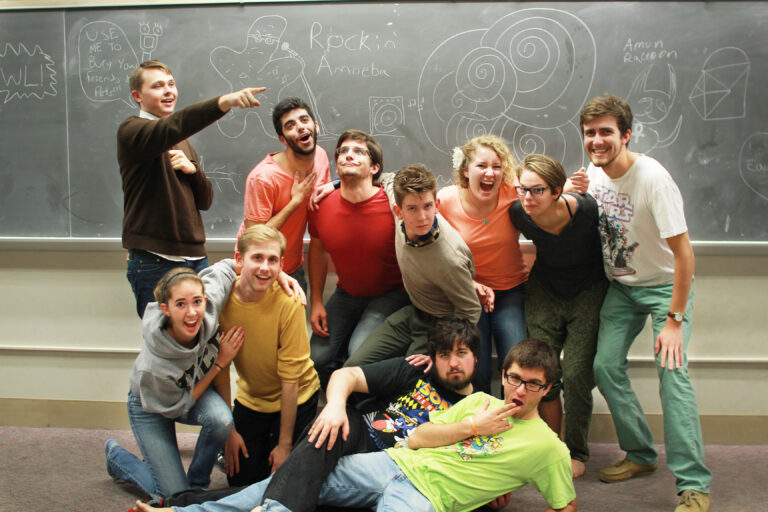
Birdstrike Theatre, UC Davis’ long-form improvisational group, will perform their first show of the school year on Nov. 1 in Kleiber 3.

“This show will be all live, unlike our quarterly ‘big shows,’” said Sarah Lloyd, a Birdstrike member and second-year chemistry major. “It will be 100 percent improv.”

The members of Birdstrike Theatre do long-form improv, which Lloyd mentions is different from the improv that is seen on “Whose Line Is It Anyway?” which is short-form improv.

“It’s not a type for comedy that allows for one-liners and jokes, but instead allows for situational and character-based humor,” Lloyd said. “We get into characters, and then the situations we get the characters into are funny.”

One example Lloyd gave was a scene in which she and another performer acted out a scene in which Lloyd’s character was discovered to be in love with marshmallows. Charlie Norton, a fourth-year evolution and ecology major, said that long-form improv allows for some interesting and funny scenes.

“Some of the best scenes are the ones where we all end up reading each other’s minds really well and come up with a cohesive idea,” Norton said. “When we end up on the same page and perform for an extended period of time it can get really good.”

Norton also said that Birdstrike incorporates the audience into their performances.

“Audience input really drives what we do on stage. We’ll do things where we interview the audience or we’ll use someone’s iPod. We’ll work with the audience to do whatever we can,” Norton said.

The members of Birdstrike Theatre are from various groups but share an interest in improv. Birdstrike Theatre President Omri Kruvi, a fourth-year landscape architecture major, joined the group in his first year in order to find a hobby.

“I discovered improv in high school and I enjoyed it a lot,” Kruvi said. “I had a good time and I wanted to meet other people who were interested in it as well.”

Lloyd also did improv in high school and was seeking an improv group at UC Davis.

“I found out about Birdstrike and saw they were advertising for auditions and workshops,” Lloyd said. “I went to one of the workshops, and ended up on the team.”

Previous improv experience is not required for joining Birdstrike.

“I joined in fall 2012 because I needed a hobby that wasn’t science,” Norton said. “I hadn’t done any improv before this. I tried it on a whim and managed to be somehow successful at it.”

Kruvi said Birdstrike is something that caters to a college audience, and people can expect something different every time.