55.5 F
Davis

Davis, California

Wednesday, December 24, 2025
Home Blog Page 906

Sacramento Fashion Week showcases kombucha fabric

2

Vegan leather? Edible clothing? This sounds like science fiction, but Davis resident Sacha Laurin is making this a reality.

Laurin, a cheesemaker, has created a kind of fabric from kombucha, a green tea fermented with a culture of bacteria and yeast. The fabric is durable and its texture is comparable to leather.

“It’s a sustainable, truly vegan leather,” Laurin said. “I can create a jacket in a week that would take a cow a lifetime to create.”

The inspiration for the kombucha fabric came from Suzanne Lee, a designer in London who Laurin claims is the only other person in the world who is working in this field. However, Laurin approaches this from the perspective of a scientist rather than a designer.
“All of the things I have done in my life have helped make this possible,” Laurin said. “My cheesemaking career provides a scientific background, my family was very creative and artistic, and my mother was a seamstress.”

The process involves placing a piece of bacteria culture in some kombucha in a plastic tub. This forms a mat from the kombucha, which can be treated like fabric once dried.

Laurin initially began producing jewelry from the kombucha, which she first sold at the Whole Earth Festival in May 2013. This caught the attention of Heather Caswell, the owner of Davis women’s boutique The Wardrobe, who was attracted to its look and feel.

“People are drawn to the jewelry,” Caswell said. “I think that people are impressed with how original it is in terms of the material. I think they really love that it’s being made local.”

Laurin caught a huge break when she entered the 2013 Sacramento Film and Music Festival’s Fashion Challenge and won the audience award.

“The challenge this year was to make a piece of fashion that was inspired by a poem by Edgar Allen Poe,” Laurin said. “I was given ‘The River,’ which was a lucky break because my stuff is aquatic anyway. Kombucha lives in water.”

Laurin’s winning design was a mermaid dress, which was something that Sacramento Fashion Week director Duane Ram had never seen before.

“As a whole, nobody has ever done or even seen something like [kombucha fabric] before,” Ram said. “It will be something different for Sacramento, so I really wanted to bring it to Sac Fashion Week.”
Laurin’s prize for winning the Fashion Challenge was to be featured as one of the designers at Sacramento Fashion Week, which has exposed her to an entirely different world.

“As an educational officer for the California Artisan Cheese Guild, I know the cheese world but I do not know the fashion world,” Laurin said. “I’m out of my element here, but people have told me that this is how it should be. I’ll need help to complete this, since I have 12 items to create by February and I’m a cheesemaker and mother of three children, but I’m positive I will find this help.”

In the end, Laurin is grateful for the experience.

“This is the most special thing I’ve ever done,” she said. “I’ve helped create a new fabric that could easily be mass produced. I want the world to know.”

To view more of Laurin’s kombucha jewelry, visit www.kombuchajewelry.com.
Elections Committee prepares for elections despite budget cuts

0

Funding for the Elections Committee (EC) during the 2013-14 budget period has been cut to $3,500 as opposed to the $6,000 budget from previous years. The EC is currently preparing for the November senatorial election.

ASUCD Budget Controller Eric Evans said that some of the money that previously went to the Elections Committee has been redirected to a new marketing department for ASUCD.

“Last year, the Elections Committee had a lot of money floating around,” Evans said. “Some of the previous marketing was not used efficiently.”

The EC was not the only ASUCD committee that had its funds cut this year. Those that did have funds cut agreed to defer their funding in order to finance the new marketing department.

Senate Bill 6, passed two weeks ago, allows the EC to decline placing sample ballots in The California Aggie should funding prove thin. Chair of Elections Eric Renslo commented on what the EC will be doing to advertise for the Fall 2013 elections even with the loss in funds.

“We are still going to run half-page ads in The Aggie,” Renslo said. “We don’t have enough money for a full page.”

Renslo also said that the committee is going to try to utilize polling stations and try to gain last-minute voters. Last year the committee was able to give out prizes, such as iPods and iPads, to people who voted.

“We have less money for prizes and even for t-shirts for our interns. It’s a lot tougher because of the lack of funding,” said Renslo.

Nick Dias, co-director of the new marketing department said that the department still aims to have raffles and prizes for voters, but on a smaller scale.

“We’ll still be doing a raffle at the poll stations,” Dias said. “We might have spin-the-wheel activities and we will be offering smaller raffle options. The prizes will be more immediate this way.”

During the Winter 2013 ASUCD elections, voter turnout was at 24.91 percent, the highest it has been since winter 2009. Renslo addressed what he thinks will help increase turnout for the Elections Committee this year.

“More candidates equal more votes because each candidate is working to increase voter turnout,” Renslo stated. “We’re also working with Creative Media to make advertisements targeted towards last-minute voters.”

Similarly, EC intern Helena Wong said she thinks voter turnout will increase if the they utilize all of ASUCD’s media sources.

“We need to help people get to know the candidate’s platforms so that there are no uninformed decisions,” Wong said.

Creative Media, the design and programming unit of ASUCD, now contains the new marketing department. Part of the advertising campaign that will be run by Creative Media and the marketing department for the elections committee will be to create an instructional piece for social media about the elections.

“This will give students an idea of where their funds go and it will bring awareness to ASUCD,” Dias said.

Dias said that the marketing department is also working to generate digital assistance for the Elections Committee. Last year their website was redesigned and this year it will be easier to vote online or from an iPod or iPad.

“It won’t be so hard and time-consuming to vote,” Dias said.

Evans said that Creative Media is already showing great results with advertising they have done in other areas and units, such as the Experimental College and KDVS.

“We are looking to the marketing department because they create great advertising that is as cost-effective as possible,” Evans said. “The marketing department will help grow the visibility of ASUCD on campus.”

Evans stated that he is especially supportive of the marketing department and Creative Media because of the similar, coherent design they put into the advertising for ASUCD units. Creative Media Director Alex Park said that the Elections Committee will also be advertised in a way to show that the elections and the candidates are part of ASUCD.

“We want to connect the units and the Elections Committee back to the ASUCD government,” Park said.

Renslo said that the goal for voter turnout this quarter is 15 to 20 percent. He hopes to keep up with the voter turnout of the past few years.

Park said that since this is the marketing department’s first time working with the Elections Committee, they will need to see what works in order to gain the most voter turnout and continue creating successful advertising for the Elections Committee in future elections.

“This is a starting point for us,” Park said.

Voting for the Fall Quarter senate elections happens on the seventh week of every Fall Quarter. This year, voting begins on Nov. 12 at 8:00 a.m. and ends on Nov. 15.

Quarterly report reveals slow start for ASUCD Senate

0

ASUCD Senate is performing maintenance on last quarter’s bills and hoping to dive back into writing legislation. Several roadblocks have slowed down Senate progress, resulting in only four enacted bills of the five that have reached decision. According to ASUCD senators, this quarter has started off slower than usual.

“We had a bunch of really contentious bills last spring, and now we’re kind of living in the aftermath. We’re fixing all the little issues … so we’re basically cleaning house and prepping for a new year of legislation and bigger bills,” said ASUCD Senator Ryan Wonders.

The biggest issue preventing Senate from staying on track has been the matter regarding a remodeling of the Memorial Union.

“We also haven’t really gotten into more of the nitty gritty stuff … we’re dealing with some bigger non-partisan issues about renovations and the future of the association in regards to our space,” Wonders said.

Five bills are still pending legislation but the other five have already been determined.

Bill 1

ASUCD President Carly Sandstrom introduced a bill to enact an operational budget of $713,920 for subsidies for the 2013-2014 fiscal year. A 9-2-1 majority vote allowed the bill to pass as amended.

Bill 2

Internal Affairs Commission recommended a bill to “reallocate $3,000 within the 2013-2014 Lobby Corps fiscal budget” to office supplies, transportation and for establishing two positions for an Assistant Internal Director and another Legislative Aid. The Assistant Internal Director would help the Lobby Corps’ legislative process run smoothly. An additional Legislative Aid would work together to conduct research and compare results to better legislation analyses. The bill was passed as amended by a 10-1-1 vote.

Bill 3

It was proposed to sing the Aggie Fight song at the start of every ASUCD Senate meeting. Bill 3 is the only one so far to not have been passed by a 3-8-1 vote. ASUCD Senator Maxwell Kappes agrees with the Senate’s decision to not pass it.

“I did not like that bill. As much as I have written bills that would be considered jokes, that bill just seemed entirely ludicrous and meaningless. We immediately failed it,” Kappes said.

Bill 4

Senator Felicia Ong introduced a bill to clarify ASUCD scholarship application dates, allowing application deadlines to be announced earlier in the quarter in order to increase the applicant pool. Applications are to be posted the Sunday of the fourth week of the quarter and the deadline to be Sunday of the sixth week. This would allow scholarships to be awarded sooner and specific dates would provide more time to advertise scholarships. This bill was passed by a 11-0-1 vote.

“This bill will definitely benefit all students. There’s no more grey area and definite dates will only further help us in preparing for applications,” said third-year business major Nate Villegas.

Bill 5

Introduced by Senator Ryan Wonders, Bill 5 proposes a change in name from ASUCD Unit City and County Affairs to City and Community Relations. The change would change to accurately represent their work after having to adjust their mission to reflect changes in the community. A majority vote of 11-0-1 passed the bill.

Arts Week

0

FILM

Yolo Film Society screening: Lost In Translation
Sunday, Oct. 27, 7:30 p.m., $2 recommended donation
Yolo Pleasure Dome, 1401 Pole Line Road
The Yolo Film Society will be playing Sofia Coppola’s second feature film, Lost in Translation. Starring Scarlett Johansson as an aimless college grad and Bill Murray as an unhappy movie star, the film explores themes of desolation, insomnia and existentialism.

Entertainment Council presents: The Conjuring
Wednesday, Oct. 30, 8 p.m., free
Rock Hall
Courtesy of EC, students can warm up for Halloween with a free showing of James Wan’s The Conjuring. The film focuses on the Perron family’s move into a demon-infested house. Following disturbing instances amid their home, the Perrons seek assistance from paranormal investigators, Ed and Lorraine Warren. The film is based on true events of the Warren and Perron family.

MUSIC

Jeremy Messersmith Supper Club Show
Thursday, Oct. 24, 8 p.m., $15, all ages
Third Space, 946 Olive Dr.
Jeremy Messersmith will be bringing his indie-pop sound to Davis. Because it’s the Supper Club Tour, he has one request of all guests: to bring food. Expect a night of infectious beats, delicious eats and sweet company.

Dank Ocean
Friday, Oct. 25, 9 p.m., free, all ages
Delta of Venus, 122 B St.
Dank Ocean is a Davis-based instrumental trio. The group will give attendees tastes of Jazz, Funk and Post-rock all in one evening.

Halloween Show
Saturday, Oct. 26, 7 p.m., $5 recommended donation, all ages
Chillanova, 802 Villanova St.
The evening will consist of local Davis bands dressed as The Hives, The Plot to Blow Up the Eiffel Tower, Sleep, Veruca Salt and a surprise artist. Prepare for an exciting night of garage rock and Halloween festivities. Food and drinks will be provided.

PERFORMING ARTS

MOMIX BOTANICA
Saturday, Oct. 26, 8 p.m., $12.50 to $54
Mondavi Center
Dance company MOMIX will be showcasing its latest work, BOTANICA, at the Mondavi. BOTANICA conveys the cycle of Earth’s four seasons through the combination of acrobatic dance, pragmatic puppetry, eclectic scoring and stimulating use of multimedia.

LITERATURE

The Circle of Thirteen by William Petrocelli
Friday, Oct. 25, 7:30 p.m., free
The Avid Reader, 617 2nd St.
Author William Petrocelli will be discussing his debut novel, The Circle of Thirteen. The book takes place back and forth in time, focusing on themes of poverty, politics, environmental issues and women’s roles.

The Book of Jezebel by Anna Holmes
Wednesday, October 30, 7:30 p.m., free
Avid Reader, 617 2nd St.
Author and creator of jezebel.com, Anna Holmes, will be discussing the recently published The Book of Jezebel. The book is an illustrated encyclopedia that focuses on pop culture, feminism and sex.

— Chloe Catajan

Immigration discussion comes to UC Davis

0

The Immigration Law Association and UC Davis School of Law held a conference on Oct. 11 called “Immigration Reform: What Next?” where two UC Davis students with personal experience in the matter were featured speakers.

Earlier this month, Gov. Jerry Brown signed several bills that provide support to undocumented individuals in California. Accompanying this legislation were nationwide rallies in support of congressional immigration reform, widespread political debate and dialogue on university campuses with many students and faculty advocating for change.

In June, the Senate passed a federal reform bill and four bills have been approved by the House Judiciary Committee as a piecemeal response.

At UC Davis’ conference, faculty, researchers and representatives from the public and private sectors gave analyses of the current federal reform and their potential impacts on society.

Richard Boswell, professor of law and associate dean for Global Programs at the UC Hastings College of Law, voiced his concern at the immigration conference about the proposed House legislation and the importance of undocumented youth in social policy.

“We [in the US] have a way of thinking about immigration that is focused on security and criminalization and I think we need to shift that paradigm,” Boswell said in a speech. “I think we are beginning to see that shift by the discussions coming from young people talking about their stories and shifting the way we think about immigration so we are not just addressing our fears but addressing our hopes.”

Gov. Brown’s legislation this month included the TRUST Act (Assembly Bill 4) which limits local law enforcement from transferring detainees to federal immigration authorities. Other bills allow undocumented immigrants to attain driver licenses (AB 60) and become licensed attorneys (AB 1024). One also allows for the penalization of a business that threatens employees based on their immigration status (Senate Bill 666).

This discussion has now reached the Executive Branch as illustrated in President Barack Obama’s first weekly address since the government shutdown on Oct. 19. He alluded to immigration being his second priority of business.

“We should finish the job of fixing our broken immigration system,” President Obama said. “It would grow our economy. It would secure our borders. The Senate has already passed a bill with strong bipartisan support. Now the House should too.”

One of the speakers at the conference was Steven Li, a fourth-year Asian American studies major at UC Davis who was originally born in Lima, Peru. He spent 66 days incarcerated and faced potential deportation in 2010.

His family, friends and teachers from the City College of San Francisco, where he attended school at the time, rallied for his cause which eventually led to a private bill introduced by US Senator Dianne Feinstein (D-Calif.) which delayed his deportation.

Even though Li qualified for both this and subsequent state and federal assistance through the California Dream Act of 2011 as well as President Obama’s Deferred Action for Childhood Arrivals (DACA) of 2012, his parents, who were initially from China, and his sister did not qualify and were deported in 2011.

“Even if undocumented youth [receive] some type of legalization or protection from deportation, such as DACA, there is still stress knowing that their parents can be deported at any time,” Li said. “Immigration is an issue that affects all communities regardless of someone’s gender or race.”

Li has since been an active member of ASPIRE, one of the first nonprofit undocumented support organizations for Asian and Pacific Islander students in the nation, created to raise awareness for immigration reform and headed by the Asian Law Caucus of San Francisco.

Li also hopes to see changes for undocumented students in the UC system.

“We need more scholarships for undocumented students to be able to get into the UC system,” Li said. “We need a counselor who is here to help undocumented students navigate academically, socially and financially throughout the UC campuses.”

Another aspect of proposed immigration reform entails visa policies for non-resident STEM (Science, Technology, Engineering and Mathematics) employees, and UC Davis student Amandeep Kaur, a Ph.D candidate in physics and graduate student assistant to the Chancellor, spoke on the matter.

“There is a lot of uncertainty when it comes to international students,” Kaur said. “After I graduate, as the current system is right now, within 90 days I have to find a job or else I have to leave the country. It adds a lot of pressure on students who cannot find a job but know they could contribute to the American economy.”

Kaur was inspired last year to advocate for international graduate students as a member of the Chancellor’s Graduate and Professional Student Advisory Board.

According to current UC policy, international graduate students are made to advance to Ph.D candidacy within two years, rather than the three years that their permanent resident counterparts are allowed. Once advanced, however, international students are able to waive their non-resident tuition fee for three years.

Kaur, with the aid of other task forces and advisory board members, was able to acquire 800 student signatures and 100 letters from faculty to support her petition to expand the three year waiver.

As a result of public forums and a meeting with Chancellor Linda P.B. Katehi in March, a startup fellowship fund of $250,000 from the Campus Central Fund was allocated for international students, who have exhausted their waiver but are continuing their studies, to help pay their tuition for two extra years.

From this experience of advocating for underrepresented communities on campus Kaur looks forward to playing a role in the government and working in education policy to encourage women to enroll in STEM majors.

“Coming from India and as a female, I’ve seen women struggle for their identity, and equality among men and women is one of my core values,” Kaur said. “My passion lies in leadership and service. I feel I am a part of this society and I want to give back to my community.”

Development in Davis driven by more than profit

0

Recent closures and openings in downtown Davis reveal that landlords value tenants who will be best suited to the community, in addition to bringing in income and boosting business.

The southernmost block of F Street is now host to a variety of businesses, such as Massage Envy and the AT&T store, as well as C.R.E.A.M.

These are not the only new businesses to enter the area. According to their website, The Melt, an eatery specializing in “Grilled Cheese Happiness,” is expected to open soon in Davis Commons. It will be located in the spot previously occupied by Ben & Jerry’s.

The Melt is a small chain with locations in the Bay Area and Los Angeles, with the upcoming Davis branch as the 15th site. Menu items include egg-in-a-hole breakfast sandwiches, salads, soups and of course, grilled cheese.

However, their interpretation of the grilled cheese is different than the simple childhood snack. Diverse ingredients such as fontina, aged swiss, aged cheddar, sourdough and homemade garlic bread provide creative variations on a classic.

While a number of new businesses are due to open in downtown Davis, others are closing down. Among those that will close are Tutti Frutti and Café Méditerranée, which will be shutting their doors in Davis by the end of the year.

The frozen yogurt chain will be vacating a property next to The Nugget on Covell Boulevard in East Davis. Café Méditerranée is located in a free-standing converted house on D Street, between First and Second streets.

Measure R

Finding a new business to occupy the property takes a certain amount of consideration. Property owners and brokers in Davis are motivated by both local ordinances such as Measure R (previously Measure J) and good business sense to find a tenant who will improve upon the neighborhood.

Mayor Joe Krovoza agreed that Measure R is an important law. It slightly limits commercial development, leading to more scarcity of property and firmer boundaries on business activity.

“That was the law’s original purpose [to discourage sprawl],” Krovoza said. “It is a significant factor in downtown development.”

It requires that there be a citywide vote whenever developers want to convert previously designated agricultural land to urban use.

Two regions the measure currently affects are Covell Village, a parcel north of Covell bordered by F Street and Pole Line Road, and Nishi Properties, a 44-acre property in South Davis sandwiched between Olive Drive, downtown Davis and Interstate 80. For now, both remain largely undeveloped.

Property expenses, location

Sarah Worley, economic development coordinator for the City of Davis, stressed that it is important not to attribute the closure of a business to a single cause, such as high rent.

“For businesses, many variables come into play during their development. For instance, start-ups focusing on product development might not worry about location, about foot traffic or being on the first floor [where customers can easily reach them],” Worley said.

Property expenses are another factor which businesses must consider. On Loopnet.com, a commercial property website which includes current listings in Yolo and Sacramento counties, one can access prices for leases.

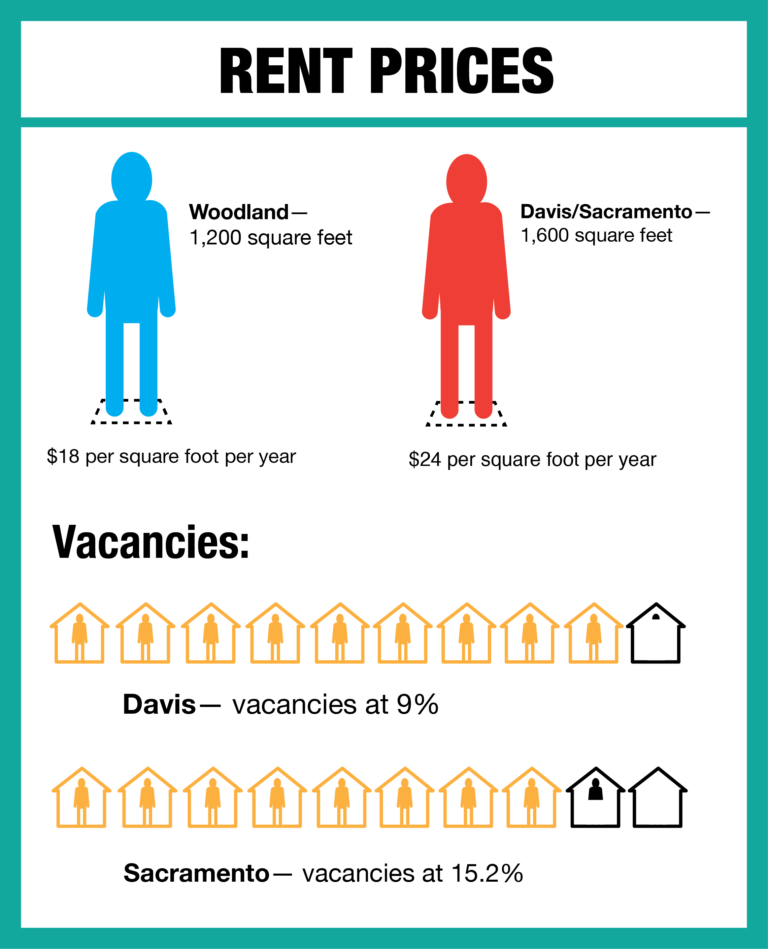
Downtown retail spaces in Woodland, Davis and Sacramento do vary slightly, with Woodland offering the lowest rental prices.

The Woodland Daily Democrat was housed in a building on Main Street which is now listed for lease — 1,200 square feet at $18 per square foot per year. In Davis, a 1,600 square foot retail space in the old Depot Building next to the Amtrak Station is going for $24/square foot/year. Midtown Sacramento rental prices are approximately the same as downtown Davis.

For especially well-located and attractive sites, the lease is often negotiable. Long term leases are generally less expensive, since property owners also value reliability in a tenant.

Landlords value community, income

Jim Gray and Nahz Anvary, senior brokers at Cassidy Turley Commercial Real Estate Services, are no strangers to the leasing process. They work with property owners, who usually fall into two categories: those who own the business located on the site and those who use the property to generate income through rent. The criteria property owners use when evaluating potential tenants vary.

“Landlords take a few things into consideration. One, is the business a good one for their property?” Gray said. “Two, will the business add to the qualities of the building and the surrounding neighborhood? Part of the landlord’s evaluation also takes previous business experience into account. After that, the landlords have to make a judgment about the potential success of the business.”

 When asked, Worley, Gray and Anvary all agreed that downtown Davis is in good shape.

Data from the Third Quarter 2013 Office Market Snapshot, gathered by Cassidy & Turley, corroborates the statement. Vacancies are at nine percent, as compared to 15.2 percent for the greater Sacramento region.

“[Davis doesn’t] have a huge inventory of empty space, the market is quite competitive,” Worley said. “Most vacant properties are filled quickly.”

Money isn’t the sole motivator behind allowing tenants to lease property in downtown Davis. Synergy with the neighboring businesses is crucial, and in the right circumstances, complementary businesses bring in more customers than they would independently. Property owners of the Hallmark Inn building took such consideration when signing Massage Envy and C.R.E.A.M. to their lease.

“Running a hotel, you think about these things,” Anvary said. “What would possibly make [a hotel] a better place than a massage and a snack next door?”

Davis City Council considers Minor Alcohol Preclusion Act

0

In 2014, the Davis City Council will meet again to discuss a city ordinance that will make underage drinking a chargeable offense. If the Minor Alcohol Preclusion Act is passed, it will be illegal for minors (under age 21) to have a blood alcohol level of .02 percent or greater in a public place.

A City Council meeting was scheduled on Oct. 9 to discuss the act, but now it has been pushed back until after Jan. 1. After the ordinance was proposed, there was some misunderstanding toward the ordinance, especially from the student population.

“Currently, we need probable cause to arrest a person [minor] for drinking,” said Darren Pytel, the assistant police chief for the Davis Police Department (DPD).

According to Pytel, the DPD can make arrests for drinking related conduct, including: having an open container, being drunk in public, supplying minors with alcohol and minors possessing an open container.

There is no way to charge a minor being inebriated unless they break one or more of the above laws. The Minor Alcohol Preclusion Act essentially fixes a loophole that has existed in the controlled substance system.

The Minor Alcohol Preclusion Act was brought up by the Davis City Council a couple of years ago, but no decision was made.

According to Pytel, while the City Council is ultimately responsible for deciding whether or not to pass the act, the DPD has to figure out a way to make it effective.

While the act will not completely remove alcohol-related problems in the community, such as vandalism and public disturbances, it should reduce the number of offenders.

Many residents in the City of Davis encourage the instatement of the Minor Alcohol Preclusion Act. Residents worry about keeping their communities safe as well as the safety of minors who are drinking underage.

“There is strong community support [for the act] due to alcohol-related issues,” Pytel said. “It’s still a work in progress.”

Due to the large student population of the City of Davis, issues stemming from underage students under the influence of alcohol are common.

“[Minors] are often impaired and obnoxious in residential areas of Davis,” Pytel said.

Families with young children who live in the City of Davis are especially upset by the conduct of some alcohol-impaired minors.

“Our kids have been woken up by students coming home from parties late at night,” said Nanette Walker, a resident of Davis. “It’s just not a good situation.”

There is also a lot of vandalism that occurs, which Walker believes is connected to underage alcohol consumption as well.

“We’ve had our house egged, and students leave trash on the streets. They also think that doing things [like] stealing signs is funny,” Walker said. “Then we [taxpayers and homeowners] have to clean up after them.”

Students were worried about what the act might mean to them, as shown by immense support on a Facebook page that encouraged students to go to the City Council meeting and voice their concerns.

Pamela Nonga, an ASUCD senator and a fourth-year political science and communication double major who created the Facebook page, believes that the most important part of the whole situation is keeping people safe.

“We need to make sure that we have a positive relationship between police and students,” Nonga said. “We want students to be willing to get help when they need it.”

Students also worry that if the act is passed in 2014, the amount of drunk driving in the city will increase.

“If people are worried about getting their BAC [blood alcohol level] tested while they’re walking home, they will be a lot more likely to get in the car and drive,” Meyer said. “Which is worse?”

A lot of misunderstanding about the act has circled in the community since students got wind of it.

“Friends told me that it meant that police would just randomly come up and test my blood alcohol level,” said Jarid Meyer, a second-year biochemistry major. “It felt like a huge invasion of privacy.”

According to Pytel, this is not the case. The police must have probable cause to do a blood alcohol test.

Meyer agreed with Nonga that no matter what happens with the act, students, police and residents of the City of Davis need to maintain a good relationship, in order to preserve everyone’s safety.

“[Alcohol poisoning] is a real issue, and should be taken seriously. Don’t avoid calling for help for a friend [that needs it] just because you’re worried about getting in trouble,” Meyer said.

While no decisions have been made about the Minor Alcohol Preclusion Act, it will come in front of City Council again at the beginning of 2014.

Welcome Center is first of its kind in UC system

0

On Sept. 26, the UC Davis Welcome Center opened its doors. Features of the Welcome Center include an interactive wall for campus resources and advising, as well as larger space devoted solely to attracting new students. According to Walter Robinson, executive director of undergraduate admissions, no other UC has a space like this.

The approved budget of the Welcome Center was $2.8 million. According to Julia Ann Easley, the UC Davis senior public information representative, the project was funded by campus funds such as short-term interest earnings. Easley claims the University did not use student tuition, student fees or state funds for the construction of the Welcome Center.

According to Clayton Halliday, the campus architect in design and construction management at UC Davis, the Welcome Center was built with excavated earth under the Graduate School of Management and Conference Center.

One of the larger installments in the Welcome Center is the interactive touch screen wall, which allows visitors to learn additional information about the University and email that information to themselves as they explore. This interactive touch screen wall cost $311,000, and the cost of installation and related work was $125,000.

“The interactive touch screen is a neat little feature to the Welcome Center because it allows students to look up information as far as majors, any organizations on campus, any clubs, student life, and get more information on all that,” said Stephanie Hartfield, Welcome Center tour manager.

The approximate annual energy consumption for the touch wall is 12,500 kilowatthours, and the approximate annual cost to provide the energy is $1,000. According to Easley, the campus has sufficient experts to ensure the touch wall is functioning properly after the one-year warranty period.

Before the Welcome Center, campus tours were previously dispatched from the Walter A. Buehler Alumni and Visitors Center. According to Hartfield, what differentiates the Welcome Center is that it provides advising in addition to tours.

Samantha Novan, the undergraduate events manager, claims the larger space enables smaller and more specialized tours to come through.

Lanette Bingaman, Welcome Center admissions manager, said that the one-stop  shop aspect of the Welcome Center will create a good impression of the university for visitors by saving their time and allowing them to enjoy their experience. She claims that this will potentially attract more students.

“I think it will attract more students with the ability to have a one-stop location so students can obtain admissions advising, campus tours, admissions presentations, pick up their literature, receive directions and maps all in one spot. That starts their image of UC Davis as they walk in the door,” Bingaman said.

According to Robinson, the main purpose of the Welcome Center is to serve as the front porch of the university.

“I think with the fact that you only get one chance to make a first impression, we want to make sure that the front porch of the university is in order. We want to make sure that it is impressive and that people walk away with a good feeling about their experience here,” Robinson said.

The Welcome Center is located right off the Interstate 80 and across from the Mondavi Center. According to Novan, due to the Welcome Center being one of the first facilities people notice after pulling off the freeway, it can be easily found and accessed.

“I believe going forward this will become their first stop no matter where they’re heading on campus for a map or for a quick question before they head out to campus. Our hope is that this is an easy-to-find location and that this also attracts new students,” Novan said.

According to Hartfield, the location of the Welcome Center also offers more convenience for schools with large groups.

“It’s a great location. We’ve got a lot of schools that come and visit. They’re able to drop off their students and it makes it a lot easier for tours to go in and out,” Hartfield said.

Robinson expects the new Welcome Center will be a popular facility on campus and successful in attracting new students to the university.

“I believe that this is going to become one of the most popular facilities for various groups, academic departments and programs. It’s already getting a lot of requests. It is a very high tech space. It is a very easy to find space. And I anticipate it’s going to get a lot of use,” Robinson said.

Image, body, botany in ancient South America

0

Lisa Trever, assistant professor in the History of Art Department at UC Berkeley, will be giving a lecture on Oct. 29 from 4:10 p.m. to 6 p.m. in Everson 157 to discuss her research on the representations of botany and the human body in ancient South American art.

The lecture will focus on her current field research project in Pañamarca, a mid-to-late Moche site (ca. 600 to 850 CE) on the north-central coast of Peru. The Moche civilization, which was agriculturally-based, is known for its ceramics, gold work and architecture.

“Unlike many other ancient Andean art traditions that tend toward abstraction and schematic representation of people, plants and animals, Moche art is very naturalistic. Moche ceramicists paid great attention to rendering natural forms with great subtlety,” Trever said in an email.

What fascinates Trever is that the cultures of ancient South America developed complex cultures and artistic traditions, without some of the characteristics that have been considered necessary for the rise of a complex civilization.

“There is no alphabetic or syllabic writing system in ancient South America. But this fact did not hinder achievements in the arts, metallurgy, engineering, agriculture or governance. Within these South American traditions, the visual arts perform a very important role,” Trever said.

In the past, scholars have drawn parallels between modern forms of visual documentation, such as photography, and the artwork of ancient civilizations. But Moche artwork served a different function than documentation. Instead, their artwork conveyed associations with corporeal sacrifice through botanical metaphors.

In the representation of human heads and bodies, potatoes and camotes (a type of sweet potato) are alluded to, suggesting a metaphoric connection between human sacrifice and agricultural methods for planting potatoes.

“Each fragment of a potato can be sown to produce a new plant. So, metaphorically, the sacrificial bodies might be considered to have the same potential to create new life through their fragmentation,” Trever said.

Trever, who received her Ph.D. in history of art and architecture from Harvard University, has worked on several archaeological projects in Peru over the course of the last 15 years. Her most recent fieldwork was for her doctoral research, which was a project to excavate, document and conserve mural paintings at Pañamarca.

“Lisa Trever comes to the Berkeley History of Art faculty as our first ever pre-Columbian and Latin American specialist. She is an experienced field archaeologist who has worked on Mayan and on Andean sites, and who already has some sensational discoveries to her name,” said UC Berkeley’s art history department chair Christopher Hallet in an email.

Because pre-Columbian art isn’t as thoroughly researched and studied as, for example, medieval art, historians and researchers believe there are many things that have yet to be discovered. In this still-virgin field of art history, Trever’s research has been described as both ground-breaking and innovative.

“We’re very excited to have Professor Trever speak here, because this topic has not been taught at UC Davis for more than a generation, and she is a rising expert in this field,” said UC Davis Professor Seth Hindin.

Hindin, who invited Trever to speak, believes lectures like these aren’t just for professors to learn what kinds of projects their colleagues are working on, but they’re also for students to see what the latest research is.

“It’s important for students to hear things that people on working on right now and maybe problems that haven’t even been fully resolved. Art history is a rapidly changing discipline like the sciences and what you find in your textbook or in published articles isn’t always the latest information,” Hindin said.

Halloween events near Davis attract community

During the month of October, various Halloween-themed events in and around the City of Davis are popular among students and community members. The Aggie has profiled some of the most popular activities below.

Dixon Corn Maze

The annual Dixon Pumpkin Patch and Corn Maze, known as “Cool Patch Pumpkins,” is one of the season’s most popular activities.

“This is the largest corn maze in the world, right here in Dixon,” said Matt Cooley, owner of Cool Patch Pumpkins. “It’s amazing to get lost in a corn field.”

Fifty-three acres of land are used solely for the wary maze-travelers and those trying to find the perfect pumpkin. Additionally, they host the Scarecrow Contest, and winners will get cash prizes and special privileges. Only 11 minutes away from Davis by car, this giant attraction draws in crowds from all over California.

Cool Patch Pumpkins will close at the start of November.

Haunted houses

A little to the north, at the Placer County Fairgrounds in Roseville, is the Callson Manor Haunted House. According to its website, they claim to be the most extreme Haunted House theme park in Sacramento.

A Haunted Tavern, Slasher Café, Asylum, Ghost town, Fire Show and Zombie Paintball are full of actors whose only job is to frighten and excite the expectant visitors. They will close on the day of Halloween.

Another classic and scare-inducing event to behold this Halloween season is The Haunted Fort — part of Sutter’s Fort State Historic Park, in Sacramento. Visitors will be led on guided tours through dimly-lit pioneer corridors.

“The event is meant to tell the bizarre, peculiar and creepy, but true tales of early Sacramento. They revolve around the Fort and could explain some of the reports of odd happenings and sightings at the Fort over the years,” said Lisa Mealoy, the executive director of Friends of Sutter’s Fort, in an email.

City of Davis events

There are also a variety of local events happening with support from the City of Davis.

“Everyone of all ages is coming down to celebrate. It’s all about community,” said Nina Gatewood, the marketing director and event coordinator for downtown Davis.

On Oct. 31 from 2 to 4:30 p.m., the City of Davis will host the Davis Downtown’s Annual Treat Trail, in which kids can trick-or-treat and receive candy from the small businesses of Davis.

“[This event is] to support the community and encourage people to come downtown to support small businesses, and small businesses give back in return,” Gatewood said.

The Varsity Theatre will be showing “It’s the Great Pumpkin, Charlie Brown” for free on Oct. 31 at 2 p.m., 2:35 p.m., 3:10 p.m. and 3:45 p.m.

“I can’t wait to see Charlie Brown at the Varsity! It was one of my favorites as a kid,” said Kelly Lima, a fourth-year biology major.

The Dia de Los Muertos Celebration in the City of Davis will span a great chunk of the downtown area on Oct. 31. The “Day of the Dead” (in translation) is an important holiday in Hispanic cultures, honoring family and friends and their deceased loved ones. Downtown Davis will celebrate this culture with traditional art, music, poetry and dancing in several different forums.

“El Dia de los Muertos was a huge success last year. It is more of a mature, educational celebration of the Hispanic holiday, tied in with Halloween to let people know about storytelling and family; people tend to like the artistic aspect,” Gatewood said.

Over 21 events

For those over 21 looking to have a wild and crazy Halloween, there are several club events happening in Sacramento the weekend of Oct. 25 to 27.

The Exotic Halloween Ball on Oct. 26 at Cal Expo is themed “Las Vegas Nightclub” and will feature Nick Cannon, Pop Rocks and other performers, with a glow party room and go-go dancers.

The Sacramento Sexy Costumes and Masquerade Ball on Oct. 25 at the Hilton Hotel Arden West is put on by the Professionals Guild as a way for residents of the surrounding Sacramento area to cut loose for the night. Prizes are given out for the best costumes.

The Vampire Ball is a more gothic celebration in Roseville at the Placer County Fairgrounds on Oct. 26, with the theme “Dark Shadows.” Inside this movie portrayal, patrons can experience a vampire interaction with actors, burlesque dancers, carnival foods, drinks and a huge dance floor.

Watts Legal

0

I hear UC Davis wants to implement a new free speech policy, supposedly to make sure another pepper spray incident doesn’t happen. But I read in the Davis Enterprise that there was some controversy at the public forum where the draft policy was discussed. What’s the problem?

Bryan B. Davis, CA

First of all, let’s clear up a misconception. This proposed “freedom of expression” policy does not protect free speech. It limits speech.

The First Amendment to the Constitution protects freedom of speech from government overreach. If we erased every law passed by our government other than the Constitution, all speech would be permitted. That’s because until a government acts to limit speech, there aren’t any bans on speech at all. Freedom is the default.

We don’t live in this default world, though. Governments have indeed limited speech, usually with justification. Most people would agree that the phrase “give me all your money or I’ll kill you” should not be uttered with sincerity, for example. Statements like that, when used with intent to deprive someone of their money, are banned by state and federal criminal laws. In the absence of a university policy, your speech is thus limited only by existing law — county ordinances, state law and federal statutes.

The only way the university’s speech policy could expand your rights to free speech would be to override these existing laws limiting speech. But a university can’t override federal law. So since the university’s policy cannot override real world laws, there’s nothing that the university could do to “expand” or “protect” free speech. It can only restrict it. All attempts at implementing speech policies will necessarily result in less speech, not more. (The primary exception would be if the university released all its valuable research into the public domain, free of copyright or patent restrictions).

Like most university speech policies, this one is particularly offensive to the First Amendment.

Here’s the first problem. This comes straight from the draft policy:

“All members of the University community should recognize that freedom of expression includes a responsibility to respect the dignity of others, to acknowledge the right of others to express differing opinions, and to maintain civility at all times.”

Have you seen Congress recently? Or talk radio? Freedom of expression does NOT include a “responsibility to maintain civility,” whatever that means. A “civility” requirement is unconstitutional on two grounds: it’s both void for vagueness, and because it’s overbroad. It’s vague because “civility” varies depending on the listener. No one can determine whether the administrator enforcing this policy watches R-rated movies or instead cringes at every “fuck,” “shit” or “damn” uttered in public.

It’s unconstitutionally overbroad because although this ban might prohibit genuinely unprotected speech (“your money or your life”), it would also bar speech that is definitely protected. The Supreme Court already ruled that statements like “fuck the draft” are protected speech in most contexts.

Next, the policy tries to “provide reasonable protection” for “involuntary audiences.” At the public forum, a student asked what this meant. Provost Hexter responded that it was supposed to help staff members who aren’t free to leave their jobs, who, in the past, have said they felt “threatened” by student protesters. There is no absolute right to be free from hearing offensive speech when you’re in public. If the protesters genuinely threaten the staff, then the staff should call the police — like I said, true threats are already banned by state law. But an employee working at the MU does not have the right to censor people on the Quad without a good reason. “Involuntarily” encountering unpopular beliefs is one of the risks we run living in a free society.

The policy also states that “expression guaranteed by the federal and state constitution does not protect speech or expressive conduct that violates federal or state anti-discrimination and other laws.” Actually, it does. The Constitution does protect speech that might violate laws; that’s the whole point of the Constitution. Unlike the university, the constitution can and does override federal and state law. If the university interprets an anti-discrimination law as banning speech that offends a certain ethnic group, for example, that interpretation of the anti-discrimination law would be unconstitutional.

And that brings me to my final point. The Davis Enterprise quotes Provost Hexter: “There’s no desire to control any speech based on its content, apart from hate speech. None whatsoever.”

Hate speech is protected speech. I know that makes people uncomfortable, but that’s what the Supreme Court says. Most famously, the Court held in National Socialist Party of America v. Village of Skokie (1977) that the Ku Klux Klan has the right to hold anti-Semitic rallies in public areas, even if those rallies are located in towns with a large population of Holocaust survivors. You can’t get much more hateful than that. If the university intends to “control” hate speech (again, a vague term), it’s going to find itself on the wrong end of a federal lawsuit in a hurry.

Of course, I’m assuming that the university actually intends to enforce this policy and punish students for disobeying it. If this is simply another version of the UC Davis Principles of Community (which are an unenforceable mission statement), then there’s no problem. Administrators have free speech rights, too, and they’re perfectly within their rights to write stories about a fictional world in which the First Amendment does not exist.

Muse of the week: The Sound of Peaks

0

Rich with a myriad of sounds and influences, local Davis band Summer Peaks will be releasing their first LP, Your Days, this November.

This new band was formed two years ago by friends Daniel Mandrychenko, Melina Duterte and Zachary Elsasser after many years of performing together in their high school jazz band.

Bassist Melina Duterte describes the conception of the band and how effortless it was to blend their individual influences.

“It wasn’t difficult getting into the groove, I mean, for example, if there were three guitars in a room we would pick them up and sing in harmony or something. It was just very natural. When we first started out it was definitely a jamming sort of thing to test the waters. Now we’re starting to find our sound since our tastes aren’t far out from each other,” Duterte said.

Summer Peaks have released two EPs over the past year. Their first eponymous release is a conglomeration of sounds that takes the listener through a cobweb of differing musical genres, from punk, to blues, to indie pop. The band describes their second EP, Some Are Songs, as a more cohesive effort than their first EP Summer Peaks.

Guitarist Daniel Mandrychenko comments on Summer Peaks’ ability to effectively collaborate together to produce songs that are not limited to any standard or genre.

“It’s different than other stuff that I’ve been a part of in that we don’t really set any stylistic parameters on the music. We just go song by song and whatever works best for the song being played, that is what we try to emulate,” Mandrychenko said.

Summer Peaks’ drummer, first-year music major Zachary Elsasser, describes the recording process of the new Summer Peaks LP and how it is different from that of their previous recording attempts.

“The first one was recorded by my brother but we didn’t have a mixer, which made our songs have a raw, unfinished edge to them. I didn’t mind it but I felt like we could have produced something different, something that sounded more cohesive. Our second LP was recorded at our guitarist’s house by our bassist. Basically we have been recording at our houses, but our new LP will be mixed and I think that our sound will definitely have some character, something that wasn’t there on our previous stuff,” Elsasser said.

With higher quality production, the new Summer Peaks LP yields a mature sound that speaks to their musical development over just two years. This young, rising talent among the Davis music scene will be furthering its musical endeavors this fall with the release of their first full length record.

To find out more about Summer Peaks and to stream their music, visit facebook.com/summerpeaksmusic.

Daily Cal

0

Thursday, October 24

Percussion Recital
12 to 1 p.m.
Yocha Dehe Grand Lobby, Mondavi Center
Listen to “What I Did With My Summer Vacation,” a free concert at the Mondavi Center.

Movie: Under the Same Moon
7 to 9 p.m.
International House, 10 College Park
Watch this bilingual English-Spanish film, which offers a powerful visual complement to the book Enrique’s Journey. The film follows a courageous nine-year-old Mexican boy who sets off across the U.S. border to find his mother in Los Angeles. Refreshments provided by the International House and the event is free.

Friday, October 25

Author Event: Circle of Thirteen
7:30 to 9:30 p.m.
Avid Reader, 617 2nd St.
Join William Petrocelli as he discusses his debut thriller about a future world threatened by terrorism and the women who can save it. The event is free.

Prelude to a Kiss
8 to 10 p.m.
Wyatt Deck, UC Davis Arboretum
Common House Productions and the Friends of the UC Davis Arboretum present this slightly dark, but touching comedy with a whirlwind romance. Tickets are $12 for adults and $10 for students and seniors.

Saturday, October 26

Farmers Market and Fall Festival
8 a.m. to 1 p.m.
Central Park
Celebrate the harvest with local food, a Kids’ Costume Parade, music and a kids’ science and craft activities. The event is free.

7th Annual Central Park Gardens Open House
9 a.m. to 1 p.m.
Central Park
Learn timely gardening tips, pick up free seeds and enjoy the garden. The event is free.

Heroes Run
9 a.m. to 11 a.m.
UC Davis Quad
Join the superhero-themed 5K around the UC Davis campus. All proceeds will benefit the ASUCD Scholarship and Endowment Fund. Heroes and sidekicks of all ages are encouraged to register at heroesrun.ucdavis.edu/heroesrun. Registration costs $20 to $40.

Prelude to a Kiss
8 to 10 p.m.
Wyatt Deck, UC Davis Arboretum
Common House Productions and the Friends of the UC Davis Arboretum present this slightly dark, but touching comedy with a whirlwind romance. Tickets are $12 for adults and $10 for students and seniors.

Sunday, October 27

Voice of the Woods
2 to 3 p.m.
Davis Art Center
Attend this spooky show of skits, stories, songs and shenanigans. Admittance is $6 for all ages, or $5 for those in costumes.

Prelude to a Kiss
8 to 10 p.m.
Wyatt Deck, UC Davis Arboretum
Common House Productions and the Friends of the UC Davis Arboretum present this slightly dark, but touching comedy with a whirlwind romance. Tickets are $12 for adults and $10 for students and seniors.

Monday, October 28

Provost’s Undergraduate Fellowship Info Session
4:10 to 5 p.m.
UR Center, 2300 Student Community Center
Learn about research funding opportunities for undergraduates through the Provost’s Undergraduate Fellowship. The fellowship provides funds for undergraduates to pursue research projects or other creative activities under faculty supervision.

Tuesday, October 29

Salsa Tuesday
9:30 to 11:30 p.m.
The Graduate, 805 Russell Blvd.
Attend dance lessons at the Grad with Cori from Barbara’s Dancing Tonight. The event is $6 and 18+.

Wednesday, October 30

Picnic in the Park
4:30 to 8:30 p.m.
Central Park
Shop the Farmers Market and enjoy live music from the Regal Beezers.

Author Event: The Book of Jezebel
7:30 to 9:30 p.m.
Avid Reader, 617 2nd St.
Join Anna Holmes, founding editor of Jezebel.com, as she discusses her new book that contains content from her site in an “Illustrated Encyclopedia of Lady Things.” The event is free.

News in Brief: Recent homicide cases to appear in court

0

In the past year, the City of Davis has seen a few significant cases of high-profile crime. These include the Daniel Marsh double homicide case, the more recent allegations against Alquelin Talamantes for the murder of her five-year-old daughter and the James Mings murder case — all due back to court in the upcoming weeks.

Daniel Marsh trial, Nov. 1 hearing

Davis resident, Daniel Marsh, 16, was charged by the Yolo Superior Court in his preliminary hearing on July 14 with two counts of first-degree murder. His charges were enhanced due to the use of a deadly weapon, special circumstance for multiple murders and heinous and depraved murder.

Marsh was found guilty of murdering elderly Davis residents Oliver Northup, 87, and his wife Claudia Maupin, 76, on April 13, 2013. He was 15 at the time of the crime.

Marsh will be appearing in court Nov. 1 for a ruling on 995 —  a defense motion to set aside preliminary ruling.

A 995 essentially means that the defendant doesn’t agree with the charges the judge has ruled. A new judge will review the transcript from the preliminary hearing and decide whether he denies or agrees with the initial motion made by the first judge. Marsh’s attorney filed the motion to review the special circumstances on the charges.

According to a Davis Police Department (DPD) press release, the murders were committed at the home of Northup and Maupin on 4000 block of Cowell Boulevard. During the course of the initial investigation, they found evidence of forced entry through a screen window.

Chief Deputy District Attorney, Jonathan Raven, explained the general procedure for these cases.

“In this case, it took a number of months to find the suspect [because] they didn’t have the leads immediately. The case broke when witnesses came forth,” Raven said. “We filed a complaint and he was arraigned — told his charges.”

Then Marsh was appointed a public defender for the preliminary hearing — a smaller trial before a judge where the prosecution meets a lower burden than for trial.

“In all likelihood the judge will say, ‘no I don’t believe the first judge made any errors,’ and they affirm his decision. I can’t say what’s going to happen,” Raven said.

Aquelin Talamantes Preliminary Hearing

Davis resident, Aquelin Crystal Talamantes, 29, has a preliminary hearing set for Nov. 14 at the Yolo County Superior Court for the murder of her five-year-old daughter, Tatianna Garcia.

Talamantes pleaded not guilty to charges to one count of first degree murder at her arraignment on Sept. 30. She is also charged with a count of assault on a child under the age of eight-years-old to produce great bodily injury resulting in death.

Alleged crimes took place Sept. 25 when Talamantes drove with her unresponsive daughter in the trunk from her home on Glide Drive to that of a relative. Garcia was proclaimed dead later at the local hospital.

“As of now, there’s not much new information regarding the Talamantes case,” said DPD Lieutenant Paul Doroshov. “Based on her preliminary hearing, I am sure facts will be uncovered.”

James Erlon Mings, assisted murder

James Mings is to be sentenced Nov. 7 at Yolo County Superior Court for a seven-year state prison sentence, waiving one year of custody credits for time served in the Yolo County Jail for the case duration. He is charged on counts of murdering an ailing Davis man.

“Students should realize that serious crimes can happen anywhere. [They] really need to be mindful of that and aware of [their] surroundings and always limiting [their] risks at a university,” Raven said. “It’s important, particularly if you make choices that reduce the risk and put you out of danger … It’s important to stay informed.”


— Gabriella Hamlett

This Week in Senate

0

Vice President Bradley Bottoms presided over the meeting, and Senators Liam Burke and Yee Xiong were absent.

The meeting started at 6:20, ten minutes later than posted.

Administrator of Diversity Education with the Office of Campus Community Relations Michael Villalobos announced the Neutral Observer Program, a new program set to launch in Winter Quarter. The program will provide a volunteer team of neutral observers to events, protests and demonstrations where a possibility for conflict exists. This staff will be community-owned and will consist of both students and staff.

CALPIRG Chapter Chair Donna Farvard announced the Global Frackdown, an anti-fracking event to take place on Saturday, Oct. 19th.

Paul Medved, a 1978 alumnus of UC Davis, gave a presentation about changes to Intercollegiate Collegiate Athletics at UC Davis. He urged Senate to hold Administrators and UC Davis Athletics Director Terry Tumey accountable for four team cuts in 2010 and rising debt.

The Senate then moved to a closed session to discuss a possible fee referendum for a new ASUCD building.