


54.6 F
Davis

Davis, California

Friday, January 2, 2026
Home Blog Page 969

Column: Living, asleep

1

Memory

Not too long ago, I decided to stop sleeping. I needed to get more stuff done.

The recent flood of midterms and papers had something to do with it. But more than that, I was rebelling against the seven-day segments that dictate our waking consciousness.

When I did sleep, I wasn’t waiting until tomorrow’s light. I was collapsing involuntarily, whether it was appropriate or not. These indiscriminate naps made being awake seem as odd as being asleep.

Lunchtime slumber made the morning feel like yesterday. I ate tacos for what must have been breakfast, at 2 p.m. At one point I was working from 9 to 5 — the other 9 to 5.

I was doing more, though maybe not doing better. I marveled at the effort it took to form sentences aloud, as did friends I met on campus.

In any event, I was certainly processing memories of my daily experience differently.

If sleep is a punctuation of our daily lives, then my own frantic existence must have been something like Morse code.

I was not rested, which made me feel unprepared, which made me anxious, which made me more unlikely to sleep. Though, this did lead to some memorable dreams.

Consider the following premise:

You are sitting, inconspicuously, in the back of class when your professor singles you out. Your responses on the written exam are without precedent.

She thrusts her hand, clenched tightly about your blue book, high above her head. This work is peerless, she exaggerates loudly. No one should be capable of this.

Faceless heads turn slowly toward you. You sheepishly arrange your features in a way you hope conveys modesty. You quietly congratulate yourself.

Your professor continues, about how in all her years and all that, she has never read anything quite like it. She harangues the class on the proper methods of studying, of diving into the material. You know, really getting into it.

Following more ceremony, your professor hands you your test. The corner of the blue book tells you, in big red numbers, why you are without equal. Your grade is less than zero percent.

Your written answers are so vile, so repugnant, and so absolutely wrong that they merit negative points. You must be dreaming. You are.

Thankfully, the test had not happened yet. I still had time to study — and I made damn sure I did. I made sure I slept too.

These familiar nightmares often deliver a message about our waking world, easily decoded through some amateur psychoanalysis. But maybe they can say more.

Dreams like these are anomalous — they stay with us. They’re so bizarre, or frightening, or otherwise remarkable that we remember them. Most other dreams fade soon after waking, or seem not to have happened at all.

It seems forgetting dreams is a necessary aspect of resting the mind. Deep, dreamless sleep establishes a neat boundary between the real and unreal, between days of the week, between light and darkness.

Trading this organization of our thoughts and memories for insomnia may lead to having tacos for breakfast at 2 p.m. That was a confusing, if delicious meal.

The very funny Dick Cavett once noted that we don’t really create our dreams either. Everything in them is new and surprising. This might be what makes nightmares so disruptive. We are not in control of the stories we live while asleep.

What we do control, to the extent our work allows us, is when we go to bed each night. It seems logical that anxiety and restlessness in the waking world lead to nightmares in sleep. We can avoid these interruptions by resting on a regular schedule.

Routine sleep offsets a very real cost of walking around half-awake. A recent study by Harvard found that sleep-deprived employees cost American companies approximately $63.2 billion per year. Putting in long hours may be working dumb, not working hard.

The waking world can be a challenging place. But spending too much time here may hurt us more than help us. It had me worried I got an F-minus on my geology exam. We have to acknowledge the obvious fact that taking a break is necessary. With that, I’m going to close my eyes.

SEAN LENEHAN still doesn’t know what he got on his exam. He can be reached at splenehan@ucdavis.edu.
Students play sports with cultural significance

0

Many Aggies have found ways to express their respective cultures or explore new ones while at Davis through club involvement. As sports often stem from different cultures, student-run clubs work to preserve, maintain and practice these traditions.

“I think its really important [to be involved in cultural clubs] because being in the U.S., we are in a melting pot,” said sixth-year environmental biology and German double major Sarah Kimpel. “If we are melting too much, we are going to lose our heritages. Cultural clubs are important for students to keep heritage important.”

Two organizations that partake in sports with a cultural significance are the Davis Culchies Hurling club and the Davis Racing Dragons.

The Davis Culchies Hurling club, started in 2010, practice and compete in the 3,000-year-old Irish Gaelic sport of hurling. This ancient field sport, still played competitively today in Ireland, is best described as a mix of several modern-day American sports.

“It’s like field hockey and lacrosse with baseball and soccer mixed in,” said Kimpel, the club captain. “It requires the skills of a lot of different things. You need to have a lot of agility and eye coordination because it’s considered the fastest field sport.”

A hurley, similar to a field-hockey stick but made of ash, is used to move the sliotar, or ball, in the game.

Played on a field as wide as a football field is and twice the length, hurling requires two H-shaped goals on either end of the playing ground. There is a net under the cross of the goals with a goalkeeper for each side, somewhat similar to today’s soccer. If a player scores in the net, they will receive three points and one point is received for any ball thrown over the net.

There are many ways the ball can move, including hand passes, kicks, pulls on the ground with the hurley, and in-air hits. Players can run with the sliotar in hand for a maximum of four steps, or run while bouncing or balancing it on the hurley. Goals cannot be scored by hand passes.

The club currently has seven members and is open to all UC Davis students and employees, not just people of Irish descent.

“We don’t have any formal process for joining,” Kimpel said. “Most of us are just ‘ir-ish.’ There is definitely no cultural heritage requirement. Right now we will just take anyone that can hold a stick.”

Since hurling season is in winter and spring, the team practices every Friday at 4 p.m. at Russell Field. The team generally plays anywhere from three to six games every year against UC Berkeley and Stanford University, among other occasional teams.

The game dates and locations are determined by the California Collegiate Gaelic Athletics Association (CCGAA), a location and age-specific organization under the umbrella program of the Gaelic Athletics Association.

Kimpel is part of the CCGAA board, a group of college students that help with hurling team development, community outreach and fundraising.

“We are helping other schools develop teams,” Kimpel said. “Over Memorial Day weekend, we are hoping to fly ourselves out to Purdue for nationals, where we can play against tons of teams on the East Coast.”

Apart from the competitive nature of the sport, Kimpel said there are many other positive aspects to being part of the team, like the influence of Irish culture on members.

“… Hurling is a nice way to get in touch with a cultural heritage. Even though it might not be your heritage, it is one to get involved with in general,” Kimpel said. “With hurling, you have the option to learn about a new culture, and maybe that will help you develop more of an identity.”

Another athletic club with a cultural influence is the Davis Racing Dragons, a group started in 2004 dedicated to the art of dragon boating.

“Dragon boating is a sport that originated in China over 2,000 years ago,” said third-year electrical engineering major and team head coach Ryan Chiang. “It’s essentially traveling in a large canoe that weighs about one ton, used in history for celebratory events. Over the years, it developed to be a more competitive sport, and people have been more dedicated to mastering the craft of paddling.”

A standard-sized dragon boat is designed to fit 20 people in 10 rows. Although seemingly similar to rowing, dragon boating requires competitors to paddle on both sides in the direction the boat is moving, as opposed to paddling in a backwards fashion.

Since the paddlers cannot see how far the finish is and are solely focused on paddling, there is a drummer in front of them to make calls for different types of strokes. In the back, a steersperson helps physically guide the boat with an oar, totalling the full boat capacity at 22 people.

The club currently has about 50 active members that compete against other dragon boat teams across the state.

“For our club, we don’t have tryouts,” Chiang said. “You just express your interest and we will show you the ropes. If you like it, you can join.”

The team attends about five competitions every season, from May through November. These competitions are also known as dragon boat festivals and are similar to swim meets, where many teams gather and race in heats.

“We usually do have two boats,” Chiang said. “[To decide who competes,] we evaluate every member based on their athletic experience and dedication to our practices. We have our primary boat and then a secondary boat, with the primary having more experienced members.”

In one specifically important race called the College Cup, the Davis Racing Dragons compete against all the other UCs, Stanford University, San Francisco State and San Jose State. Chiang said that the UC Berkeley dragon boat team is currently the team’s closest rival.

“The other races are very fun, but this college race specifically is very close to our hearts,” said Kristin Wong, third-year food science major. “Last season, we beat Berkeley. That sense of accomplishment that we did something with a specific group of people is something I will cherish a lot.”

All of the festivals are planned and held by the California Dragon Boat Association (CDBA), which is also responsible for opening up a racing facility in Alameda for four-hour Saturday practices. The CDBA makes sure that there are dragon boats, paddles and safety gear available to the team, and also takes care of boat maintenance and cleaning.

“We try to maximize our efforts [in Alameda] since there is no available body of water near us,” Chiang said. “We usually have conditioning sessions two to three days a week to maintain a high physical level.”

Along with water practices and conditioning, the team has weekly general meetings in Wellman Hall on Thursdays from 7:15 to 8 p.m. All club events are open to all UC Davis students.

Like any sport, dragon boat racing has a competitive side to it, but also acts as a social activity for students.

“Being apart of something bigger than yourself is what this sport really embodies,” Wong said. “This sport ties every kind of aspect of your life together because it connects to our emotional, relationship and physical levels. It embodies everything in my life and ties them together into this one group of people.”

Overall, whether it is the Davis Culchies Hurling club or the Davis Racing Dragons, diversity is everywhere on campus. For an athletically and culturally enriching experience, students are welcome to join one of the several international sporting clubs on campus.

“Whether it’s dragon boat or any other club, there is nothing to lose by joining,” Chiang said. “In any cultural club, there is usually a sense of strong community, not only bonding by what culture we are assimilating [toward], but just by being friends and going to the same college and sharing interests.”

RITIKA IYER can be reached at features@theaggie.org.

Not just a disease of the mind

Ole Andreassen, a professor at the UC San Diego School of Medicine, published an article on Feb. 7 in The American Journal of Human Genetics in which he definitively connected high rates of cardiovascular disease (CVD) with schizophrenia.

The news of the connection between these diseases is not new; it is a well-established fact that schizophrenic patients are two times more likely to develop cardiovascular disease than the general population — a correlation known as having high comorbidity. However, Andreassen helped pioneer a new technique in genetic analysis showing that several of the mutated genes active in one disease are also present in the other.

“I hope to change the way we view psychiatric disorders and make people realize that they are system disorders, affecting the whole body,” Andreassen said. “Unfortunately, that requires better understanding of the underlying mechanisms of the disorder … We have to realize that there is a high number of underlying genetic factors — not one schizophrenia gene.”

The primary research method Andreassen utilized involved genome-wide association studies (GWAS) in order to observe single nucleotide polymorphisms (SNPs). Researchers compared the genomes of subjects in a “healthy” control group with the genomes of patients suffering from CVD and separate patients with schizophrenia. There was an additional subgroup of patients with both CVD and schizophrenia.

Genomes are constructed of four components called nucleotides (A, T, C and G), which are arranged in specific orders that determine function.

“SNPs are small changes in the genome sequence, such that some people have the genotype AT, while others are TT, and others are AA,” said Chuck Langley, a professor of genetics at UC Davis.

Andreassen’s study looked at the SNPs of the research subjects and correlated regions of their genetic codes that were likely to harbor a mutated gene.

“The innovative aspect is the development of new statistical tools and applying them to the huge GWAS available, which is a true “genetic epidemiology,” Andreassen said.

His new method utilized these statistical tools in order to quantify the high level of comorbidity between CDV and schizophrenia, making it possible to identify locations of mutations that are common to both diseases.

A gene that affects multiple traits is known as a pleiotropic gene. Andreassen was able to identify 10 possible pleiotropic genes highly associated with schizophrenia and CVD. The same genes that are thought to cause schizophrenia are also responsible for affecting blood pressure, cholesterol, triglycerides, type 2 diabetes, body mass index (BMI) and waist-to-hip ratio (WHR).

However, though some of the same genes implicated in schizophrenia may be responsible for contributing to CVD, their presence alone does not necessarily account for the high rates of the CVD within schizophrenic patients. One possible explanation lies in the constant interplay between genes and external environment.

“The significantly higher rate of smoking among mental health consumers and the side effects of antipsychotic medications cannot be ignored as possible factors,” said Alyssa Parsons, a mental health worker at the Yolo Community Care Continuum. “What’s interesting about this situation is that nicotine does have beneficial effects on psychiatric conditions. For example, it reduces anxiety and irritability.”

However, a plethora of research has proven the multitude of detrimental health effects caused by smoking, not the least of which is CVD.

Furthermore, according to Parsons, a pretty big portion of the antipsychotics prescribed by psychiatrists cause massive weight gain, as well as a slew of other health problems. Plenty of research has also gone into connecting obesity with CVD.

Andreassen’s article proves that the factors connecting schizophrenia and CVD are genetically heritable; however, it is impossible to extricate this genetic heritability from the environmental factors common to most schizophrenic patients.

KYLE SCROGGINS can be reached at science@theaggie.org.

News in Brief: Brett Burns leaves position as ASUCD Business Manager

0

Brett Burns, the ASUCD Business Manager, will leave his position within the Association, as he has accepted a position as Senior Assistant Dean for Administration at the UC Davis School of Law.

Burns joined ASUCD in February 2012 as Business Manager, working with various members of the Senate table and Unit Directors to ensure financial stability within the Association, according to the ASUCD website.

Graduating in 1995, Burns is also a UC Davis alumnus, with a bachelor’s in sociology and economics with an emphasis in organizational management.

He was also involved in the development of the Activities and Recreation Center (ARC) and previously served as the Executive Director of Auxiliary Services.

“Since joining UC Davis in 1998, Brett has contributed his time and talent to improving student leadership, student governance and student success in a variety of capacities,” said ASUCD President Rebecca Sterling in a Feb. 19 email to members of the Association. “Brett’s contributions will be missed, but we are confident that his dedication to improving student success and UC Davis will continue in his new leadership role.”

Brett is likely to make his transition part-time in March, and will then begin working at the School of Law, effective April 1, according to the email.

Sterling and Burns are currently developing a process to select an interim manager and replacement. This will be announced shortly.

— Muna Sadek

Column: A matter of time

As an undergraduate scientist, amateur cyclist and chronic procrastinator, I concentrate a lot of my thoughts on the subject of time. I’m curious about many things related to time: the most pressing of these concerns is usually finding out where all of mine went and what to do with what little remains. President’s Day weekend is a particularly good example of this phenomenon in which I seem to blink, and then it’s Monday again. Otherwise, I usually consider things that are very impractical.

Stars are funny. They’re big, hot and for the most part, very far away. So far away that things like light take somewhere on the order of hundreds of thousands to billions of years to reach us. Just consider those distances, when it takes light less than a second to circumnavigate the globe.

It makes for something interesting: When we get sentimental, step outside and look at the night sky, we’re not just looking at a pretty arrangement of lights. We’re looking at a veritable intergalactic history lesson. We’re seeing, from one reference point, the state of affairs of things as they were in our neck of the universe before dinosaurs were a thing, before Earth was a thing, or even before our neck of the universe was a thing.

Some of these stars whose light we see today might not even exist anymore by the time their light reaches us.

This leads me to another bizarre quirk that’s widely accepted in some circles of physicists. The speed of light in a vacuum is constant. This is still the case even when we have a moving reference point. And now it gets weird.

While it’s easy to say, “Oh the speed of light is constant! That makes calculations on tests easier,” it’s still counterintuitive if you think about what speed is.

If we consider that we live in a universe defined by four dimensions, (x, y, z and time) then things can change their respective positions in the universe over a period of time and we get speed as a measure of this change. But let’s pretend we’re physicists and play around with some of these ideas.

Suppose you’re an observer. This shouldn’t be hard; it’s not wildly different from what you normally do. In this situation, you might be standing still, and a train goes by at 60 mph. A person on this train throws a ball at a speed of 10 mph in the same direction as the train’s motion. To you, the stationary observer, this ball moves at a stunning 70 mph. The situation is ordinary, but now I present another ordinary situation!

You are now hypothetically observing this ball from the train. If you had no knowledge that this train was moving, but observed the ball, you might logically perceive it as moving at 10 mph.

Okay, I’ve established that I can be really, really boring. Why does any of this matter?

If light behaved like this ball and moved with increased speed from a moving source, then some images from the same distance would reach the same stationary point faster or slower than others depending on if their source was moving.

Let’s pretend the speed of light is additive to a moving source’s speed.

If I were next to an intersection observing two objects about to collide, then things would appear different to everyone involved. If one of the objects was a car moving toward me and the other object was a motorcycle on a collision course with the car from a different road, but not any closer to me, then I’d see the car before I saw the motorcycle. The car would see the image of the motorcycle before I did, and to me, would maneuver to dodge for no apparent reason.

This is an oversimplification for demonstration’s sake, but it represents a qualitative example of why the behavior of light is at least worth some consideration.

Another example of why light’s behavior is hard to follow is as follows: suppose there’s a hypothetical aircraft traveling at half the speed of light. This craft is struck by lightning bolts simultaneously at both the front of the nose and the back at the tail. To an outside, stationary observer looking directly at the side of the plane, both bolts would hit the plane at the same time. However, to someone at the center of the plane, the light from the bolt that hit the nose would reach them quickly, while the light from the bolt that hit the tail would struggle to catch up. To the passenger, one bolt struck the plane before the other.

But if the speed of light isn’t changing as reference points move around, then what’s happening?

With the moving observer, we’re changing the distance that light must travel despite the fact that both lightning bolts started equidistant from the observer and radiated outwards at the same speed.

The idea is that for the speed of light to remain constant, either time or distance must change depending on the frame of reference of the observer.

The long and short of this is that in the universe, there shouldn’t be such a thing as absolute time or absolute distance because a moving clock will keep time at a rate different than a stationary clock. This keeps the speed of light constant for all frames of reference.

In all likelihood, for the amount that I still don’t understand, I spend far too much time thinking about time.

ALAN LIN is just profoundly confused himself and can be reached at science@theaggie.org.

Davis bikes to work the most, survey says

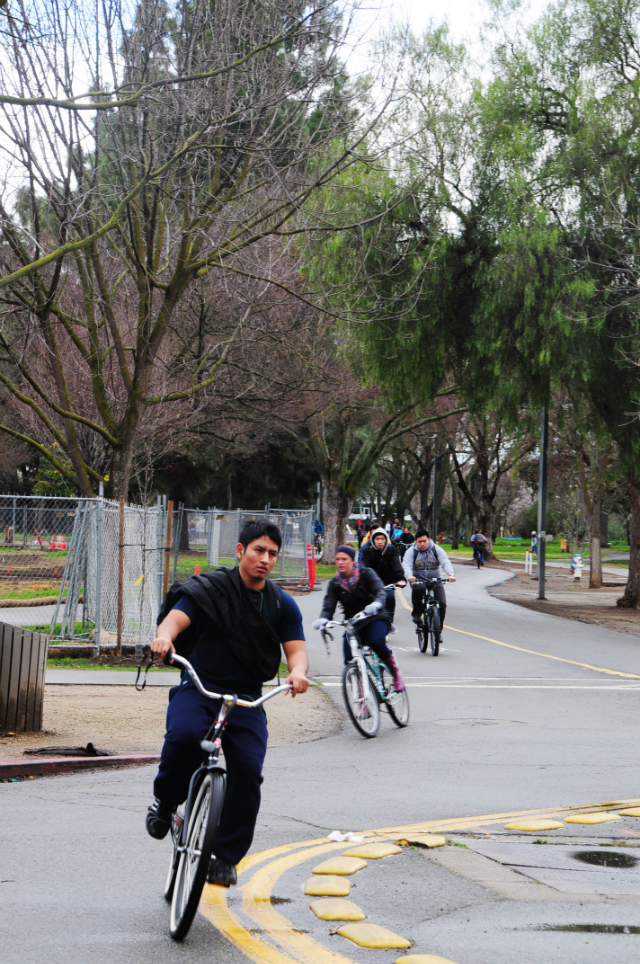
According to the U.S. Census Bureau’s 2011 Community Survey, approximately 16.6 percent of workers in Davis bike to work — the highest percentage of any city in the country.

The survey found that out of 29,663 workers, 4,923 are considered bike commuters, with a margin of error of 1,927. However, the survey only asked about a single method of transportation for the longest section of a commute, so it does not take into account those who utilize a bike for part of their commute or may only bike to work several days a week.

The survey also does not take into account students biking to campus, even if they are employed on campus and technically bike to work.

Nevertheless, the ranking is still a favorable one for Davis, home to the U.S. Bicycle Hall of Fame and often referred to as “The Bicycle Capital of the U.S.”

According to David Takemoto-Weerts, bicycle program coordinator at UC Davis Transportation and Parking Services (TAPS), a number of factors contributed to the development of such a bicycle-friendly culture in Davis. In the 1950s, Davis’ status as a small college town with flat topography, mild weather and a compact nature made bicycles a viable form of transportation for many residents.

However, bikes became a significant part of campus and community life starting in 1959, when newly appointed chancellor Emil Mrak began working toward his vision of a bicycle-friendly campus. Former Chancellor Mrak insisted that every building on campus feature bike parking in front of the building as opposed to in a less-accessible location. According to Weerts, many architects at the time were — and even today are — resistant to the idea of incorporating bike parking into the design of their buildings.

“That [bike parking] was very visionary,” Weerts said.

Gates were built around campus in 1967 to prevent vehicular traffic from traveling through campus, another cycling milestone under Mrak. However, Weerts also cited the importance of former UC Davis Professor Frank Child in developing the town of Davis into the bicycle-friendly city it is today.

In 1963, Child proposed that the roads be “striped” to eliminate conflict between increasing numbers of both motorists and cyclists. Although this was already common in European cities, Child’s idea, a novel and controversial one in the U.S., was instrumental in the development of something often widely incorporated into urban planning efforts today — bike lanes.

According to Weerts, the bike lane was essentially innovated in Davis, thanks to Child and many candidates running for Davis City Council in 1966, who ran on a “Pro-Bike Lane” platform.
In 1967, striping began on all arterial roads such as West Covell and Russell Boulevard. Changes were made to traffic laws and the vehicular code regarding the rights of cyclists and the rules they must abide by.

These efforts have contributed to Davis being one of the safest and desirable cities for bicycle commuters in the nation.

“Since 1987, only two bike fatalities have occurred in the City of Davis,” Weerts said.

There are numerous bike shops in Davis as well to suit the needs of bicycle commuters.

“We specialize in helping people get to and from work by bike, especially students,” said Dave Grundman, assistant manager at B&L Bike Shop. “That’s our core demographic.”

Grundman also noted the affordability of commuting by bike, making it a desirable option particularly for students.

“Whenever gas prices go up, we see a lot of people coming in looking to save on transportation costs,” Grundman said.

However, a number of other factors have still contributed to the decline of biking as a primary form of transportation among students, faculty and other Davis residents.

Davis bike commuting figures began dropping in 1990, due to increasing numbers of Davis workers commuting from outside of town because of the rising cost of housing and living in Davis.

Weerts cited the 1992 student referendum in which students voted to include the cost of Unitrans in their student ASUCD fees as a significant reason fewer students regularly used their bikes as a form of transportation. All trips on Unitrans were and are still free, and many students opted to take the bus as opposed to biking even for very short distances.

The perceived ease of commuting by bike in Davis is also relative depending on one’s own experiences.

“I’m a recent transplant from Alaska, so commuting down here is a breeze,” said Dave Coleman, service manager at Davis Wheelworks bike shop. “The coldest weather I’ve commuted in was -30, -50 [Fahrenheit] with the windchill. There were a lot of layers involved that day.”

According to Coleman, who commutes from Woodland, keeping an eye out for motorists is important regardless of the weather.

Safety issues are often the number-one concern of potential bike commuters, Weerts said.

“Know the rules of the road,” Weerts said. “Understand that they apply to bikes and learn how to ride in traffic.”

Weerts also emphasized the importance of understanding when it is appropriate to “take the roadway” while biking. On a road without a bike lane and a lack of space for a cyclist and motorist to safely travel side by side, such as at the intersection of Russell Boulevard and Fifth Street, it is legal and safer for the cyclist to move into the center of the lane.

Prospective commuters concerned about what type of bike is best for just commuting need not worry too much about investing in a fancy road bike, as these are often magnets for theft. A used bike from a bike shop is ideal, and the only sorts of bikes that should be avoided are those purchased directly from big-box stores such as Target or Wal-Mart, according to Weertz.

“We call those BSOs,” Weerts said. “Bicycle-shaped objects.”

MEREDITH STURMER can be reached at city@theaggie.org.

How to survive an asteroid impact

0

Last Friday, asteroid DA14 zipped by Earth at a record-breaking distance of about 17,000 miles from the Earth’s surface. That same day, a surprise meteor streaked across the sky and rained fireballs on Russia, causing a shock wave to blast windows, trigger car alarms and injure civilians. But in an alternate world, it was the asteroid that collided with Earth and ripped our planet of civilization.

Retired UC Davis professor Thomas Cahill published his first novel of a trilogy, Ark: Asteroid Impact, telling a story about a post-apocalyptic world. This science fiction begins in Davis and centers on Californians trying to survive the devastating effects of an asteroid impact and rebuild civilization.

“I’ve always been fascinated by the effects that asteroids have on the Earth and especially the extinction of the dinosaurs,” Cahill said. “And the question came to me, ‘What if the same thing happened now, but instead of dinosaurs, we have people who are clever enough to somehow survive?’”

Ark: Asteroid Impact was published in December of 2012, just in time for people to wonder what could have happened if a large asteroid had hit the Earth instead of the smaller meteor last Friday. The novel tells the story of a shattered civilization, wiping out most forms of plants and animal life on Earth. In order to portray a realistic post-apocalyptic Earth, Cahill said he based a fictional story on science.

“It’s fictional, but the science is solid,” Cahill said. “I tried to do the best science possible using results from the previous extinctions.”

Cahill has authored plenty of academic articles and book chapters. He retired from UC Davis in 1994 as a physics professor after joining the university in 1967. Cahill is still active in his field with his current research expertise in the impact of aerosols on climate change and from highways and rail yards.
Part of Cahill’s work has involved protecting the visibility at U.S. national parks and monuments through the aerosol network. He also helped evaluate air at the excavation project after 9/11 and has worked in nuclear physics and astrophysics.

“One of the most compelling things about Tom’s writing is, because he has the physics background, he actually goes in and makes sure the physics is as close to reality as possible,” said Sean Barberie, a fourth-year physics major.

Barberie has been working with Cahill for two years as a student-employee doing physics work focused on aerosol science.

To make the book even more realistic, Cahill said that every place the characters travel to are places he has been to, including Cheyenne Mountain. He said that this allows him to describe each place accurately and realistically. Starting in Davis, the novel begins with 20 UC Davis survivors, including physicists.

“As the book develops, you start having other groups, who have either by luck or skill, somehow survive, so you start seeing them put together a new society,” Cahill said. “And of course, the Earth is the new ark. The Earth is very badly damaged. It’s in an Ice Age right now. So you see them re-crafting the Earth.”

Cahill’s science-packed and realistic novel almost serves as a “Guide to Surviving an Asteroid Impact.” He begins with descriptions about a mine at 2,500 feet in Eureka, where the survivors take refuge.

“If you heard that an asteroid is going to strike, the first thing to understand is there will be tsunamis all around the world,” Cahill said. “The first thing is to get away from the ocean. The second thing you’ll learn is that when the thing strikes, it puts ash in the sky and that cuts down the sunlight, and the Earth gets very, very cold. So the second thing you have to survive is cold.”

Ark: Asteroid Impact is Cahill’s second novel, following Cahill’s first book published last October. Cahill said he started writing for fun after he retired, writing a few pages at a time and getting feedback from friends. He said that Ark: Asteroid Impact was published after much encouragement from friends.

“[The book] sounded good,” said Glen Erickson, a retired UC Davis physics professor. “It sounded like something that could do well. He asked me some questions about the astronomy, which I knew a bit more than he did. I know that he enjoys writing and I presume that he does a fairly decent job at it.”

Cahill began writing the novel about a year and a half ago, finishing last November. He said that he was inspired to write the book because of the growing scientific knowledge of the extinction of the worlds from previous events and his love of science fiction when he grew up as a boy.

“[Cahill] talks about it, and he would get excited about some parts he’s writing and explain it to me,” Barberie said. “It was good fun.”

The second part of the trilogy is scheduled to come out next summer, according to Cahill. Right now, Ark: Asteroid Impact is available in digital form and paperback.

“It’s fun to read,” Cahill said. “I kept [passing out copies] but eventually I was giving out a lot, so I decided to [publish it]. Fortunately, other people like it too.”

JOYCE BERTHELSEN can be reached at features@theaggie.org.

Police Briefs

0

TUESDAY
Inside job
Someone reported money missing from the office of the Davis Police Department on Fifth Street.

WEDNESDAY
Sugar-coating
Somebody left whipped cream bottles and death threat notes on a person’s property on Marina Circle.

SATURDAY
Science is B.S.
Someone was defecating in front of the UC Davis School of Medicine Neuroscience building on Newton Court.

Lifetime story
A woman reported that her husband was having transgender life changes, lost his apartment and has been staying in the 24-hour study room on campus, and is now missing on Pole Line Road.

SUNDAY
Eats shoots and leaves
A guy was walking in the street with a bamboo pole, talking to himself on Belmont Drive.

Chip on her shoulder
An unknown female got into somebody’s back seat at a stop sign, kicked the driver in the mouth and chipped his tooth, then left on foot on D Street.

Police briefs are compiled from the City of Davis daily crime bulletins. Contact EINAT GILBOA at city@theaggie.org.

Editorial: Rocking in the freeworld

0

KDVS 90.3, UC Davis’ freeform radio station, is taking steps toward opening up a downtown music venue. Adding such a space for audiophiles of all ages will greatly improve the music culture in Davis, and make weekends a lot more fun.

The radio station recently hosted an event in conjunction with the Davis Music Festival to test out the community desire. The concert, held in the old Dimple Records location on Third and F streets, garnered a lot of interest, according to KDVS General Manager Renner Burkle.

Though the logistics and event location are yet to be finalized, we support KDVS in their efforts, and encourage the community to provide patronage to such a space and support the ever-fluctuating arts scene in Davis. We want a downtown venue, even if it means paying a cover to watch a band called Cat Party.

(This location will be separate from KDVS’ new recording studio in South Davis, which also sounds really cool.)

KDVS is no stranger to putting on shows. Volunteers and employees of the station regularly host garage bands in their homes, inviting the community to headbang on family-heirloom couches. But most of these couches are in North and East Davis, meaning someone has to DD, or everyone has to bike in the cold.

We love these shows too, and a venue would in no way replace their significance. But sometimes while rocking out you just really need a bagel. Or pizza. Or some Indian food. Downtown has a lot more food than the Davis ‘burbs.

If you’re not already convinced, perhaps devoted audience members of music’s past will renew your faith. Davis regulars once flocked to Sacramento for the venue experience. Unlisted and untalked about, the late venue The Hub (R.I.P.) gave KDVS Presents the opportunity to reach out to greater audiences and give local bands more exposure than they may have had in their best friend’s living room.

Though the circumstances surrounding The Hub’s closure are mysterious, all small venues face the same struggles of cranky neighbors, expensive rent and an unsupportive community.

Let’s not allow KDVS’ new baby to turn into just another forgotten dream. Let’s commit as a community and campus to rocking out, hard, in a public space.

Call me

0

For some people, getting the physical intimacy they want out of a relationship, when they want it, is pretty easy. One call or text message, and your lover is on their way over for a quick bit of sexytime (or you’re on your way to their place, or to your secret love den, or what have you). Granted, sometimes you have to delay sex for commitments like class or work, but in terms of distance to cover before you can get down, you don’t have much to worry about.

However, other people find themselves in relationships where the object of their love and desire lives in another city, state or country. For those folks, there’s likely to arise a situation in which you’re all riled up but your partner is many miles away. If this describes a scenario you’re currently in, or may find yourself in in the future, then today’s column is for you. Because we’re going to go over a few ways to keep things sexy in a long-distance relationship.

The main option we’ll discuss is a classic: phone sex. Now, I don’t advise this as the first thing you do when you get on the line with your long-distance lover. You may be in the mood, but they may have just had an awful day and need to vent before they even consider anything sexy. One good approach is to send saucy text messages throughout the day, so that when the time to call rolls around you’ve both got sex on the brain.

Once you know phone sex is imminent, it’s a good idea to prep yourself. This includes the essentials, like charging your phone and making sure any toys you’ll use on yourself are clean and ready to go. But you also want to prep by making yourself feel sexy. So put on that pair of underwear that flatters your assets (or the shirt that makes you feel like a sex deity/socks that make you feel naughty/you get the point) and turn on the mood music.

Once on the phone, it’s okay to feel a little silly or nervous (especially if it’s your first time trying this). But, as I’ve said before, you want to embrace that silliness and then move past it. Just keep telling yourself that you are one hot, confident piece of what have you, and that you don’t give a damn what you look/sound like to some hypothetical observer.

If you’re stuck on what to say, try asking questions that set up a descriptive response. “What are you wearing?” works well (no, really), as do phrases like, “What are you thinking about?” or “What would you do to me if I were standing in front of you?”

If you’re the one being asked the questions, make your responses as vivid and detailed as you can (feel free to embellish as you think necessary). Once you get going, be as vocal as wall-thickness and proximity of roommates will allow, and don’t stop until you’re both satisfied.

If you’re craving a more visual way of connecting to your faraway love, there is the option of using things like Skype for video sex. The same tips apply to this activity that apply to phone sex, particularly the ones about dressing to make yourself feel confident and sexy. When setting up, pay attention to lighting to ensure that the image will go through clear.

A few caveats on Skype sex. First, make sure you have a very strong, reliable internet connection, or you’re going to be having sex that’s slow and stuttery. Second, there are attachments for Skype that allow you to record the conversation.

Now, if you and your partner talk it over and decide you want to record your sexytime for future use, that’s between you two. However, I would like to remind you that there is a special place in hell for those who record their sexual partners without their consent. If you think there’s even a chance your partner qualifies for that special hell, don’t have Skype sex with them.

I hope this column has given you some ideas on how to be sexy when you can’t be physical. Of course, these tips work great regardless of how close to the object of your desire you live. However, if you are far away from your love, these tips should keep your sex life going strong until the next time you can get your hands on each other.

SAM WALL really had to resist putting a “Firefly” reference in this column. Email sewall@ucdavis.edu for details.

Undergraduate to launch online shopping platform for Greeks

3

A loud truck blaring music pulls up outside the house where Mike Eidlin, a third-year economics and Japanese double major, sits with his friends. Girls in bikinis hop out, passing out free Monster energy drinks.

No, this isn’t your average frat party.

After Mike Eidlin did his research, he discovered it’s actually a little something sweet called product sampling.

“[Product sampling is when] the [company] gets the products into the potential users’ hands; it’s a very efficient form of marketing,” Eidlin said.

Eidlin, a member of Delta Sigma fraternity, decided to start his own company, GreekDrop, using this strategy of product sampling.

“We feature clothing, accessories, events, bicycles, hotels, but all [at] discounts. For people who want something familiar [to compare it to], think about Groupon or Gilt.com or JackThreads, but for Greek life members,” Eidlin said.

Liz Zimmer, a third-year mechanical engineering major and member of Kappa Kappa Gamma sorority, loves the idea of having an online catalog where Greek students can score deals.

“I will definitely use this site when it gets launched. My twin brother goes to UC Irvine and the only way I can visit him is if I fly,” Zimmer said. “When this site gets going I will definitely look into cheaper airline tickets so I can visit him more often.”

Until March, students like Zimmer can read and browse information about the online catalog on GreekDrop.com or their Facebook page, Instagram or Twitter.

Eidlin first incorporated GreekDrop in August, putting in his paperwork to the Secretary of State after researching from June through July on how to make the idea of deals on any and every products for Greek students a reality.

“I did my research and found out there wasn’t already something going on like this,” Eidlin said.

Eidlin then applied to a start-up accelerator in December called Davis Roots. Run by two UC Davis professors, including entrepreneurship specialist Dr. Andrew Hargadon from the Graduate School of Management, and a CEO, Davis Roots is going to help Eidlin officially launch his company this March.

“[They] take a small company that still isn’t really running yet, just an idea, and help them become established. They are going to give me office space in downtown, and that’s where I’ll have my interns or employees work at,” Eidlin said.

Currently the program is gearing up with clients and student customers in order to rev up a solution to the needed revenue cycle Eidlin explains.

“Right now, it’s a chicken-and-egg problem. We need users for them to buy our clients’ goods. We have our students who are users, and we have our clients who are brands. We can list all the brands we want, but if we don’t have people to buy them, then it’s not going to do us any good,” Eidlin said.

Eidlin currently has a team of students helping him fuel GreekDrop, and hopes to expand with more interns and employees.

Eliot Shohet, a first-year computer science major, works as Eidlin’s web designer and programmer.

“I met Mike through [the ASUCD entrepreneurship] competition and then after I presented my project, he contacted me,” Shohet said.

Shohet is one of many students who are helping to build GreekDrop before the official launch in March when Greek students will be able to order online from it.

Shohet is responsible for helping prepare the website for smooth running and making it ready for customers once March hits.

“[We want to] set up a site that’s easily scaleable, so that our site can know how to handle many servers,” Shohet said.

Eidlin has become busy with balancing school and GreekDrop, and admits that while it may be hard starting a business, he doesn’t regret the exciting experience.

“It’s always on my mind. I’m probably spending more time on GreekDrop than school, which is why I convinced my dad to let me defer next quarter so I will be able to work on this full-time,” Eidlin said.

Taking next quarter off and also having the summer to test GreekDrop’s productivity and success will allow Eidlin to see if he should continue with the company or return full-time to school, studying investments and finance.

While Shohet does not get paid, he does get experience as an intern, with the promise of pay once the company officially launches.

Eidlin, who was born in Tokyo to a Russian father and Japanese mother, grew up speaking Japanese fluently alongside English. He aspires to use his Japanese background to contact business clients in Japan and further spread the benefits of GreekDrop internationally.

For now, Eidlin looks forward to taking a break from his Japanese classes and focusing solely on reaching out to more clients and students for GreekDrop.

“Business opportunities are few and far between, and I don’t wanna ‘half-ass’ school and ‘half-ass’ business relationships, because there are gonna be people who are counting on me,” Eidlin said.

ALYSSA KUHLMAN can be reached at features@theaggie.org.


Editor’s Note: This article has been updated to reflect the correct spelling of Eliot Shohet’s name. 

Aggies sweep the Davis Challenge with 4-0 record

0

This weekend, the UC Davis women’s water polo team swept the Davis Challenge at home, defeating Cal Lutheran, Cal State Bakersfield, Sonoma State University and Pacific in the span of two days. Without a doubt, the Aggies performed superbly and were able to sustain their energy and momentum throughout the course of the four grueling matchups.

On Saturday, the 14th-ranked Aggies beat Cal Lutheran 16-3 and CSU Bakersfield 12-7. With that, UC Davis has improved to 5-5 for the season, breaking a five-game skid that included two losses against top-ranked Stanford.

Senior Carmen Eggert stole the show on Saturday with three goals on each end. Sophomore Jillian Wilding performed in her first meet on Saturday as an Aggie and did not disappoint in the least. Wilding posted seven huge saves against the Regals, then proceeded to match her career high of 12 against the Roadrunners. In the fourth quarter against CSUB, she stopped seven shots, including a 6-on-5 attempt.

Senior Alex Rawlinson and sophomore Elsie Fullerton both posted their first career hat tricks in the opener against Cal Lutheran. Senior Jessica Dunn and junior Hannah Curran chipped in with two tallies each. Eggert’s three goals were enough to overwhelm the Roadrunners and secure the win.

Sophomore Keelia Houston netted two goals in the first quarter, while senior Kathryn Bailey did the same in the second. Junior Erin Schlueter hit goals in each of the first and third frames.

The Aggies did not face much of a challenge against Cal Lutheran. The Aggies started off on a 3-0 start relatively early, as Dunn scored on a counterattack and assisted Eggert on a goal. Six different UC Davis players scored six goals in the second to take a halftime lead of 10-1.

Similarly, UC Davis never trailed in the win over CSU Bakersfield, with Houston’s two goals in the first quarter.

In addition, Eggert pushed the lead up to 11-6 in the final second of the third quarter on a short lob. As the clock winded down, freshman Courtney Weddle secured the win with a 6-on-5 strike from the weak side.

On Sunday, Houston scored six total goals, including a career-high four against 18th-ranked Pacific. In the afternoon, the Aggies defeated the Tigers 12-5 and Sonoma State 8-6.

Eggert scored two goals in each contest and Dunn totaled three goals and six assists. Schlueter netted a goal in each of the contests. With the Aggies’ goalkeepers sidelined, Wilding played every minute of the two games for the second straight day. Her performance was phenomenal, as she posted nine saves against the Tigers and seven against the Seawolves.

The Aggies were able to pull away from a tight 4-3 battle against Pacific. Dunn scored back-to-back goals in the fourth to help secure the victory.

However, in the game against the Seawolves, the Aggies took control very early on, only to see their lead diminish in the final period. Eggert and Houston each hit two first-half goals to put the Aggies up 6-3 at the halftime.

UC Davis held onto its lead despite three Sonoma State goals in the last quarter to maintain an undefeated record through the Davis Challenge.

The Aggies will play again this weekend at the UC Irvine Invitational where it will match up with several teams ranked nationally in the top 10.

— Veena Bansal

Aggies lead off season with three wins

0

After a doubleheader on Saturday, the Aggies bounced back to defeat Washington in Sunday’s series finale at Dobbins Stadium. Overall, the Aggies won three out of the four games to begin the season against a Pac-12 team.

Sophomore Nick Lynch led the Aggies with three RBIs and went 7-16 for an average of .438 over the weekend. Lynch, as well as a number of different players, contributed to the success in the three wins

Friday — UC Davis 8, Washington 4

UC Davis got its first win of the season on Friday against Washington when the Aggies piled on the runs early by scoring three in the first inning.

Senior Mike Mazzara doubled in two runs then later scored on a single by senior Kevin Barker in the first. The early burst set the tone for the rest of the game, as the Aggies never trailed after the frame.

Washington would answer by scoring two runs in the third, but the Aggies scored two runs in the fourth. In the sixth, Washington scored another two runs only to have the Aggies score two runs in the bottom half of the frame.

Both of Mazzara’s hits were doubles and he finished with three RBIs and a run. Junior Harry Stanwyck earned the win by pitching 5-1/3 innings and gave up four runs on eight hits. Sophomore Craig Lanza finished the game and had a solid outing. He allowed only one hit and gave up one walk in 3-1/3 scoreless innings.

Saturday — UC Davis 6, Washington 5 (Game 1)

The day’s first game went all the way to the later innings to be decided, as the Aggies broke the tie late in the game after surrendering a big lead.

Sophomore Evan Heptig had a big game and led the team with clutch hits, driving in four runs on two hits. With the bases loaded in the sixth, he hit his second double to center field to clear the bases and gave the Aggies the five run advantage.

Then UC Davis allowed three runs in the seventh inning and two in the eighth. With the game nodded up at five in the bottom half of the eighth inning, Senior Tino Lipson hit the ball off of third baseman Alex Schmidt’s glove for a single to score a run.

Sophomore Spencer Koopmans threw a quality game by going 6-1/3 solid innings of one run ball to get the win. He surrendered three walks, struck out six batters and gave up only two hits.

Saturday — Washington 3, UC Davis 2 (Game 2)

The Aggies struggled in the second game of the double-header and failed to manufacture enough runs in the shortened game of seven innings.

Coach Matt Vaughn and the rest of the team had a lot of time to prepare for this series, once the schedule was released months ago.

Junior Steven Patterson hit a bases-loaded single to right field to plate two runs, and that was all the offense could generate against a strong outing from Nick Palewicz, who threw five innings to earn the win.

Senior Ben Burke struggled with his command and walked three batters, but only gave up two hits in four innings.

“I’m real happy with them. We’ve pitched real well for the most part. We gave away some runs in that second game early and those were all runs we just gave them, but we’re doing a good job,” Vaughn said. “We could play better defense and I’m a little disappointed on how we finished that second game offensively.”

Saturday — UC Davis 7, Washington 5

Trying to make up for its last effort, UC Davis started the game with energy and it continued throughout the game. The Aggies scored a run in the first and fourth innings, then scored three runs in the fifth and two the following inning.

They collectively had 13 hits and Lynch had three of them, which contributed to driving in two runs.
Freshman Spenser Henderson recorded the win by pitching three innings and allowed two runs on four hits.

LUKE BAE can be reached at sports@theaggie.org.

News in Brief: Money stolen from Islamic Center

0

On Tuesday at around 1:50 a.m., the Islamic Center of Davis, located at 539 Russell Blvd., was burglarized.

According to a Davis Police press release, the suspect entered the mosque through an unlocked window and took money out of donation boxes. Footage from a security camera showed the suspect leaving to park a white vehicle on the west side of the center. The suspect re-entered the mosque and then exited, leaving in the white vehicle.

Police described the suspect as a white or Hispanic male, 5’10” tall, weighing between 160 and 175 pounds. He was last seen wearing a dark-colored baseball cap with sunglasses on top, a light-colored quarter zip sweatshirt, blue jeans, white tennis shoes with black laces and a black backpack. The vehicle is described as a white four-door sedan.

— Claire Tan

Rationality

0

If you’re a repeat reader of my columns, I think a thought has probably crossed your mind at some point or another: “Isn’t everything that this guy is writing about basically common sense?” I say things like: balance your money between saving up for a rainy day and splurging just to have a little fun once in a while, or eat in when it’s convenient and eat out with friends. It’s all so very basic and rational, especially from an economics standpoint.

But rarely do people ever behave rationally. At least from an economist’s point of view.

To give an example, take a pregnant woman who smokes cigarettes. To any normal person that thinks rationally in the conventional sense, what this woman is doing is completely irrational, no matter the circumstance. The smoking is not only harmful to her, but will also be detrimental to her unborn child as well. But from an economics standpoint, her behavior can possibly be seen as rational. As long as she is deriving the maximum utility at her desired price, then she is behaving rationally.

Economists define rationality (to put it simply) as doing whatever it takes to receive the most utility out of something. As I mentioned in a previous column, utility is just a measure of happiness. As in, people will do what makes them happiest/benefits them the most. Again, it seems like it would just be common sense, but all disciplines have to be built on a basic foundation, right?

But people never behave as rationally as economists believe. Thus, the models that are always made in textbooks always considerably downsize the scope of the world and narrow everything down into a very minimalistic and simplistic model. For example, a typical microcosm presented in economics would be a world in which there were only two stores that sold the same good and consumers were indifferent between both stores.

From there you can draw your demand curves, your supply curves, find your equilibrium point, etc. But only because it’s such a pared-down version of what the real world is like. There aren’t variables in economics that account for things like altruism or malice or jealousy.

Here’s another example of how something should go if people behaved rationally: Suppose that there are two people that have 100 $1 bills to split between each other. The caveat is that only one person gets to choose how it gets split, and if the other person disagrees with the split, then they both end up not getting anything. The way the scenario should play out, if all players were behaving rationally, is that the first person would allot $99 to himself and $1 to the other. The other would accept because the $1 would exceed the $0 he would have gotten had he declined.

But if you play this situation out with actual people, the results will almost never be that way. There will be cases where the people will split it squarely down the middle, or there will be cases where the deciding person will get a slightly bigger cut, but the other person will still make out with a decent amount. Or there will even be cases where the splitter will behave rationally and choose the appropriate split of $99 to one, but the other person will spite him/her and they will both end up with nothing.

I try to act rationally in my day-to-day life, but it’s difficult to adhere to at times. People are truly fascinating beings and our actions and behavior can’t really be mapped out on data charts and graphs.

With that said, take into consideration a little bit of what I just said. Think to yourself: “Am I behaving as rationally as I could?” as you’re on the precipice of downing that eighth gin and tonic. Will the ensuing hangover (and thus loss of utility) tomorrow be worth the utilities you’re gaining right now?

Actually, don’t think that way. It’s really dorky and lame and I don’t even think in terms of utility. But it is a somewhat interesting concept. I don’t know. I’m not behaving rationally right now as I’d rather play Halo than write up this column. But sometimes you’ve just got to behave irrationally and complete the things that you’re responsible for.

ANDREW POH suggests you sit in on a Game Theory lecture if you found what he talked about interesting. If you’d like to talk more about rationality, email him at apoh@ucdavis.edu.