In the spirit of Valentine’s Day, enjoy some historical love stories
By SABRINA FIGUEROA — sfigueroaavila@ucdavis.edu
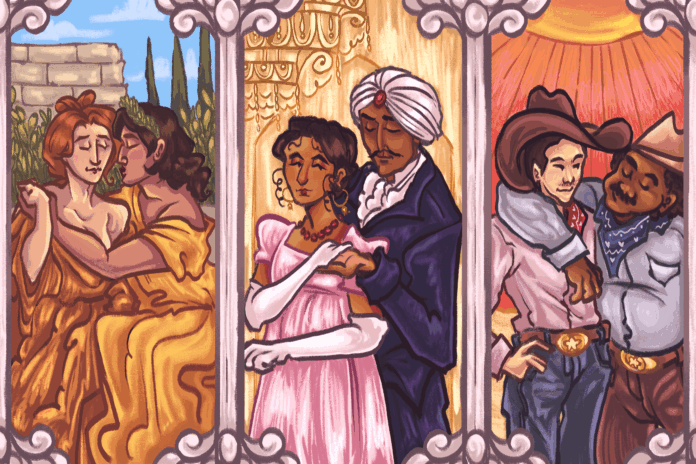
With Valentine’s Day quickly approaching, the season of love is officially here. While the constant barrage of romantic rhetoric can become draining, I’ve learned that the best way to enjoy this time is by appreciating that love exists and always has — it’s innately human.
Here are some of my favorite historical depictions of love that have shaken both my brain and soul:
Orpheus and Eurydice: This story starts with two mortals, Orpehus and Eurydice, falling in love. On their wedding day, Eurydice gets bitten by a snake and instantly dies. Devastated by her death, Orpheus travels to the Underworld, charming Cerberus (the three-headed guard dog) and Hades with his music — enough to make Hades agree to Eurydice’s return. However, Orpheus may return Eurydice to the mortal realm on one condition: He can’t turn around to look at her as he leaves. But, just as they are about to exit the Underworld, he turns around to make sure Eurydice’s there. With that confirmation, she is gone forever.
There are many interpretations as to why he may have done so, but the consensus is that it wasn’t because he didn’t love her — it’s the very opposite. Love makes us as hopeful as it makes us fragile and doubtful; this is one of those stories that, no matter how many times you hear it, still makes you think (and hope) that there’ll be a happy ending.
Achilles and Patroclus: During the Trojan War, Achilles and Patroclus were inseparable war “companions.” Their story begins when Achilles refuses to fight in the war — Patroclus is instructed to convince Achilles to rejoin the fight, but ultimately fails to do so. Instead, he asks him if he could borrow his armor to scare off the Trojans. Achilles agrees, but as Patroclus dons his armor, he is killed, leaving Achilles lonely and grieving. Achilles ends up rejoining the war for revenge, killing Patroclus’ assassin even though he’s been warned that he would die for committing such an act.
In a dream, Patroclus asks Achilles if they can be buried together — their bones and ashes mixed in the same urn — and in the end, that is how they spend their afterlife. While Homer never explicitly states they are lovers, many have interpreted their relationship to be romantic. No matter what, their relationship highlights the devotion and loyalty that love can bring — both in life and in death.
Popocatépetl and Iztaccíhuatl: Princess Iztaccíhuatl and warrior Popocatépetl fell in love. However, Iztaccíhuatl’s father disapproved of Popocatépetl, but allowed them to marry if he could return victorious from a war. Upon Popocatépetl’s leaving, Iztaccíhuatl’s father tricked her into thinking that her lover died in combat. Shattered by this, Iztaccíhuatl died of a broken heart. When Popocatépetl returned, he found her dead and was determined to find the most beautiful place to bury her, but he too died from a broken heart before he completed the task.
The gods, moved by their passion, turned them into volcanoes that can be seen in Izta-Popo Zoquiapan National Park in Mexico. This Aztec myth is a classic tale of love overcoming obstacles — whether that be disapproval or death, love is eternal and prevails. The fact that humans created a love story for two volcanoes centuries ago, two hearts forever beating for one another, gives hope for love in the future.
Elizabeth Bennet and Mr. Darcy: Whether it’s the original book or the countless “Pride & Prejudice” movie adaptations, the love story between Elizabeth Bennet and Mr. Darcy is popular for a reason. More realistic than many others and much less tragic, this story demonstrates how social classes — like race, age, gender and class — can play a part in our choice of a life-long partner.
But, while our beliefs may sometimes discriminate, love may not. What sticks with me the most here is that in the end, Ms. Bennet and Mr. Darcy’s relationship blooms out of mutual respect and understanding, despite previous, prejudiced beliefs. In truth, love is messy and odd, yet we fall into it regardless. It is love that forces us to keep trying to explore these complex connections we have with other people, which is half the fun.
Queen Charlotte and King George III: While the story was made popular by “Bridgerton,” the show did not fabricate the fact that Queen Charlotte looked after King George III while he descended into “madness.” Although I do not usually care for monarchs or their marriages (as many matches were simply strategic), I find their relationship to be incredibly sweet and loving. Despite how taxing it was to take care of an ill king, it was love that made Queen Charlotte stay — a case for many people, even today.
Overall, love is complex. I cannot tell you if everyone who ever encounters love will experience it the way the people in these stories have, but I can say that they prove that humans are innately romantic. Love and the happiness, tragedy and lessons that may come along with it are simple pleasures worth living for.
Written by: Sabrina Figueroa — sfigueroaavila@ucdavis.edu
Disclaimer: The views and opinions expressed by individual columnists belong to the columnists alone and do not necessarily indicate the views and opinions held by The California Aggie.