






Students protest ICE across the country
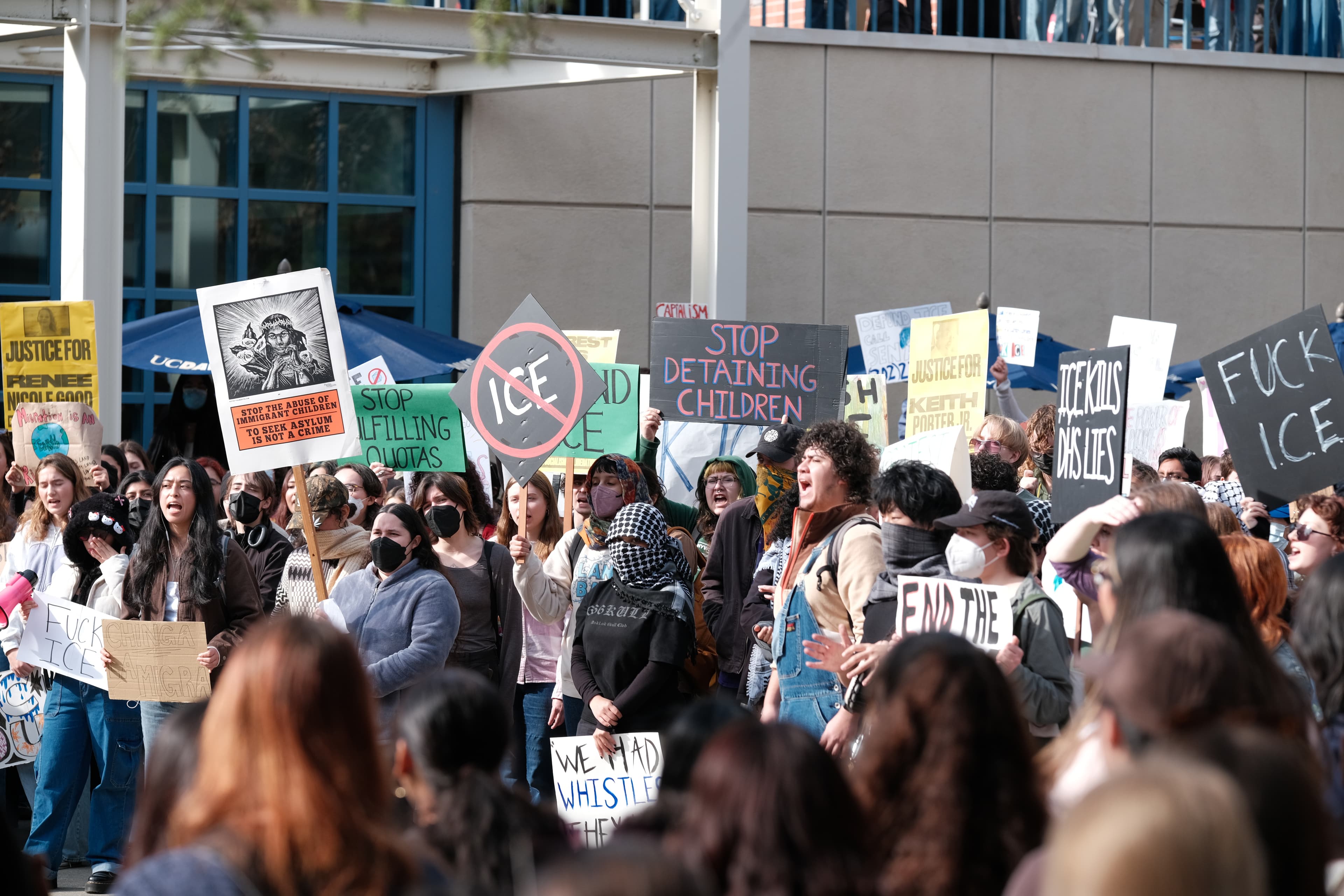
In cities throughout the nation, both high school and university students organized against escalated immigration enforcement
By GRACIELA TIU — features@theaggie.org
As United States Immigration and Customs Enforcement (ICE) operations are still active through cities across the country, students in and around these communities continue protesting by holding school walkouts, rallies, vigils, marches and strikes.
Many universities, alongside UC Davis, have hosted protests throughout the last several weeks; these universities include UC Los Angeles (UCLA), UC Berkeley, Purdue University, Cornell University and a substantial number of others. Notably, on Thursday, Feb. 5, faculty, staff and students at Columbia University blocked traffic to protest against ICE and demand that their university take action to protect international students, leading to the arrest of 12 protestors.
High school students across the country have also held their own protests, with high schools in Baltimore, Indiana, Iowa, New Hampshire, Madera, Calif. and Los Angeles, Calif. being a few of the many to publicly organize and condemn ICE presence in U.S. cities. Ananya Vyas, a third-year animal science major, explained her perspective on the national movement against ICE.
“I think the national protest going on in the country is very telling of the energy amongst the youth,” Vyas said. “It shows how we are using our rights and our voices — like a standing unit against something very real that’s facing our communities.”
Those leading and attending anti-ICE protests ultimately aim to show solidarity with communities and families affected by ICE, grieve the people that ICE agents have harmed or killed, advocate for organizational and national change and inspire others to do the same, according to attendees.
“I think that the protests that have been happening across our nation are really powerful,” Siobhan Maloney, a third-year environmental science and management major, said. “It gives me hope that the people in our country are standing up for their rights and freedoms, and that they are standing against the tyranny that we have been seeing from our government.”
Another reason these protests feel especially important for students is because of the hope that they bring to communities. Vyas described how seeing students of all ages come out and advocate for the rights of immigrants amid such a difficult period of time means a lot to her.
“The widespread school walkout protests on Jan. 30 stood out to me most, as it was organized and executed by young students,” Vyas said. “Seeing students — especially from my old high school — protest filled me with so much hope, as younger generations are helping lead this anti-ICE movement. Seeing so many people, even too young to vote, refuse to sit silently while so much violence is happening in our country makes me believe we can really make a difference.”
Jan. 30, a day of “National Shutdown” in protest of ICE, saw a large number of walkouts, marches and strikes across the country. UC Davis students also organized their own protest on that day, with many viewing it as an opportunity to fight for issues close to their hearts.
“I chose to attend the event the day that I heard about it because I viewed it as an opportunity to help bring change into our system,” one UC Davis student, who wished to remain anonymous, said. “When I hear about all the policies that have been implemented to separate hard-working families from each other, it makes me feel extremely upset.”
The student discussed how, during that protest, organizational leaders emphasized that staying connected with one another and sharing updates surrounding ICE agents can work as a helpful tool.
“They spoke about many important things, but the most crucial was ways to connect with your community to ensure safety,” the anonymous student said. “It’s so helpful to communicate with your neighbors, so I think they did a great job emphasizing that.”
The protests from Jan. 30 and the weeks beyond have promoted a sense of momentum in pushing back against ICE operations across the country. Students noted that a substantial factor of the success of the national pushback is remaining consistent with protesting efforts.
“Our primary source of raising awareness is creating conversation,” Vyas said. “Showing the people in leadership that we’re not just gonna let whatever’s happening keep on happening. I think it’s really important that we continue supporting these protests. Continue giving them our viewership by advocating for our rights, and having the media cover them. It is the most important, so we keep talking about it. The conversation doesn’t die out. It’s not just a trend.”
Written by: Graciela Tiu — features@theaggie.org