Political messaging and its presence in the arts
By VRITI SHAH — features@theaggie.org
Recently, it seems like everywhere one turns they are faced with a political opinion, argument or reference. Even after turning off the news, many are met with even more political conversations on social media and television, in music and literature, creating a feeling of inescapability.
Mainstream media held a major conversation on the controversies of politics during the 2026 Grammy Award Ceremony. At the red carpet, many well-known celebrities wore “ICE OUT” pins to show their condemnation of United States Immigration and Customs Enforcement (ICE) officers.
During acceptance speeches, many artists — such as Bad Bunny, Billie Eilish and Olivia Dean — used their time to further speak out against ICE.
“Before I say thanks to God, I’m gonna say: ICE out! We’re not savage, we’re not animals, we’re not aliens. We are humans and we are Americans,” Bad Bunny said during his acceptance speech after winning the Grammy for Album of the Year.
Other celebrities have opposed the mass exclamation of politics at the Grammy Awards Ceremony.
“If you do win an award tonight, don’t use it as a political platform to make a political speech,” Ricky Gervais said in an X post, according to the Hollywood Reporter. “You’re in no position to lecture the public about anything. You know nothing about the real world. Most of you spent less time in school than Greta Thunberg.”
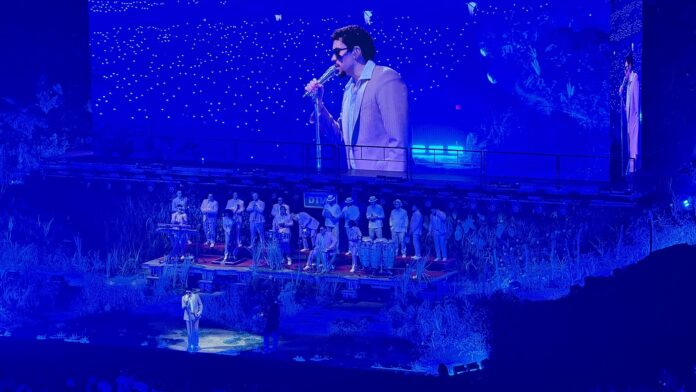
When Bad Bunny was chosen to perform at the Superbowl halftime show, he faced backlash. Even though Bad Bunny is from Puerto Rico — a U.S. territory — conservative critics argued that he shouldn’t perform at the Superbowl halftime show because he is “not an American artist.”
Conservative organization Turning Point USA (TPUSA) even created their own Superbowl halftime show that viewers could watch to boycott the Bad Bunny performance. The performance was called an “All-American Halftime Show,” featuring outspoken conservative and musician Kid Rock.
In contrast, during his halftime show, Bad Bunny performed his hit songs in front of a sign that said “the only thing more powerful than hate is love” — as a nod to the importance of kindness and togetherness amid turbulent times.
Sydney Sweeney — an actress most recently known for her American Eagle jean advertisement that sparked controversy for its apparent support for eugenics — stated that she, as an artist, has no place to comment on politics.
“I’m in the arts. I’m not here to speak on politics,” Sweeney said, according to Variety. “That’s not an area I’ve ever even imagined getting into. It’s not why I became who I am.”
While there is popular discourse on politics and its place in art, UC Davis students had their own varying opinions on the topic.
“I think art can be political,” Amirra Williams, a second-year psychology major, said. “I think it’s always been [used] as a means of expressing all [out]looks. Especially in the era of very high surveillance, […] dictatorship [and] people in power with the media.”
Others echoed the notion that the artistic reflection of politics has been around throughout history.
“I definitely feel like politics, and just generally, statements have been made throughout time and art,” Anika Karody, a fourth-year economics major, said. “Even if you go back to the Renaissance and way back when, they’ve definitely made statements before.”
Karody continued to describe how she has noticed politics coming up more frequently in art as she has gotten older.
“I feel like now people are making a lot more statements,” Karody said. “But also, I feel like it’s kind of always been there. I feel like even I am just now becoming more aware of it as I grow up.”
Whether political expression has been around us or if it’s just starting to arise in the media, Williams believes that politics within art can function as an important means of protest.
“I feel like art can be a good outlet,” Williams said. “It’s very easy to produce. So, I think, yes, [art] could be […] inherently political.”
Politics portrayed in art can be a form of protest; in fact, students like Sage Prudente, a fourth-year nutrition science major, believe that this conversation in the media is critical in political resistance.
“I think that art itself is resistance and an active resistance,” Prudente said. “So, I think a lot of the popular media now reflect[ing] that is great. I hope to see more resistance in our popularized [media] in [the] future.”
Artful resistance has often been an effective way for artists to portray their political opinions, according to Williams.
“I think that people use their voices in very different ways,” Williams said. “Whether that’s [from their] heart or whether it’s actively protesting [or] whether it’s actively posting. So I think that it’s more important now, given what’s going on in the world. I think that using art is even a better source because it’s very easy to be accessed, easily consumed, easy to make, easy [to] repost [and] share.”
Prudente continued to share how art in political conversations can be influential.
“I think it’s hard because politics and morals are tied together so closely,” Prudente said. “And I think art that has something to say and art that shows the artist’s morals is important. And I think right now, that’s inherently political.”
In an interview with the podcast Junkee, musician Lucy Dacus also expressed her thoughts on the inherent nature of politics within art.
“I think about it like, you aren’t asked whether you want to be born. You just are,” Dacus said. “You’re not asked what language you want to learn. You just learn whatever. And in that way, you’re born political. Art comes from people who are from political contexts, so of course it’s political — everything’s political.”
Written by: Vriti Shah — features@theaggie.org