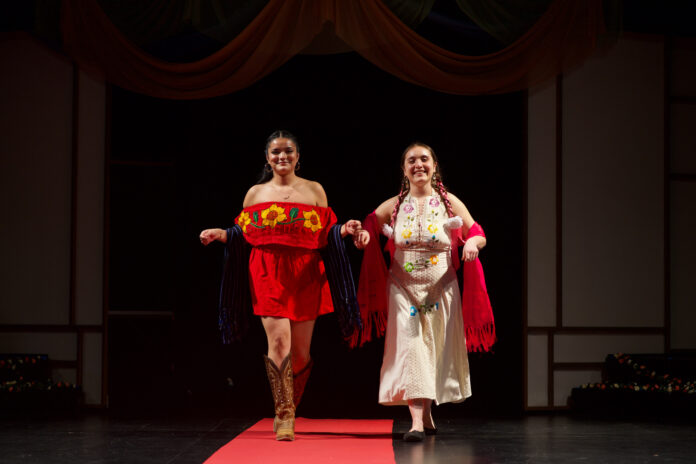
Student designers and participants showcased their cultural clothes on the CCC runway
By IQRA AHMAD — arts@theaggie.org
At the Cross Cultural Center’s (CCC) fashion show event, “Threads of Tradition,” students stepped into the spotlight wearing garments tied to ancestry, memory and everyday survival. From hand-embroidered dresses and Mexican huaraches to contemporary Chinese qipao layered with denim, to looks honoring Black American political movements, students shared pieces of culture embedded into fashion.
Roughly 50 people attended, filling the room with a chorus of cheers from friends, family members and classmates of the participants. The CCC team prepared the stage the day before, draping linen in green, blue and purple and stringing lights, colorful tassels and flowers across the stage beams. As the participants walked, the soundtrack jumped across genres, playing “At Dusk” by Faye Wong, “La Malagueña” by Mariachi Vargas de Tecalitlán, “The Smile” by Mehdi Saki and “The Revolution Will Not Be Televised” by Gil Scott-Heron.
Before the first walk, organizers read aloud the UC Davis land and labor acknowledgements. Then, the CCC staff invited the audience to celebrate the 10 student participants and their creations.
“As we prepare for the show, we wanted to let you know that you are more than welcome and encouraged to cheer, clap and show a lot of support and love for our amazing participants,” Asian and Pacific Islander (A&PI) CCC Community Coordinator Johannah Seah, a second-year Asian American studies and sociology double major, said. “They spent a lot of time curating, putting these outfits together and rehearsing.”
A&PI CCC Community Coordinator Chaedon Robinson, a third-year biotechnology major, directed the event and noted that “Threads of Tradition” grew from the center’s broader mission and values.
“Our motto at the CCC is to work toward a more liberated world,” Robinson said. “We want to work toward highlighting intersectionality across cultural knowledge.”
For Robinson, fashion is both personal and political — a daily practice of identity that can become communal when shared publicly.
“The purpose of this event was to highlight the artistry and storytelling of cultural garments, to provide a platform to feel confident while embracing their identities and cultures,” Robinson said. “I feel like fashion can be a really fun and easy way to incorporate your culture into your everyday life, and we also wanted to emphasize the cross-cultural aspect of the CCC by highlighting garments across all diasporas. I think it’s really important that we remain unified and remember that we are stronger together.”
Among the show’s participants were Mariana Munoz, a second-year psychology and Chicana/o studies double major, and Helen Madrigal Gonzalez, a second-year political science major, who walked together wearing garments rooted in Mexican textile traditions.
Munoz wore a cream-colored dress embroidered with vibrant florals, a style she described as connected to her ancestry.
“Traditional wear is beautiful, wearing it is like celebrating our culture,” Munoz said. “Our traditional wear has flower embroidery because our ancestors are very connected to land, to life and healing.”
Madrigal Gonzalez spoke to the personal importance the show held for her.
“Coming to college, I felt like my fashion was normal, basic,” Madrigal Gonzalez said. “Walking this runway was very special for me because I love wearing the traditional Mexican clothes.”
The two also pointed out details of their fashion that are heavy in meaning, such as their red bracelets worn for protection from the “evil eye,” as well as heirloom jewelry and family memories stitched into accessories.
“I really love arracadas,” Munoz said. “These earrings are passed down from my mother and they’re worn in fashion by this icon, Maria Felix. Even the shoes I’m wearing — boots — connect us to the land.”
Yi-Xuan Chang, a first-year community and regional development major, used layering to express her Chinese American identity. She paired a contemporary Chinese qipao, a garment popularized through the 1920s to 1940s in Shanghai Cinema and fashion magazines, with a long denim skirt.
“The denim feels more like a staple, everyday American fabric,” Chang said. “It was a fun way to represent being Chinese American.”
Chang noted that the event was an easy way to meet others and feel proud of one’s cultural clothing.
“Clothing is like a form of art,” Chang said. “It’s very comforting and feels good to see your culture represented somewhere, even if it’s just something as simple as part of your clothing. It’s nice to see something you resonate with and see it on a stage to be showcased and highlighted.”
Cinthia Ambriz Ortiz, a fifth-year human biology major, walked in a dress and huaraches from Michoacán, Mexico. She emphasized that both pieces were handcrafted, reflecting the skills passed down across generations.
“Being able to wear my cultural clothes makes me feel like I can emit confidence,” Ambriz Ortiz said. “It’s so powerful to me; I may not have been born there, like my parents, but they passed it on to me. I feel it in my soul, I feel very connected to my people, my land.”
Ambriz Ortiz also connected her outfit to broader campus belonging, explaining that events like this help students feel less alone.
“It really brings everybody together, to be able to learn about each other,” Ambriz Ortiz said. “It’s events like these where we learn about all cultures, and we learn about what others value, and oftentimes we find that we all value so many of the same things and we just represent it in different ways.”
Candance Gregoire Pierson, a fourth-year Native American studies and political science double major, wore an all-black outfit inspired by the Black Panther movement in honor of Black Futures Month. Gregoire Pierson paired her look with sunglasses and natural hair styling in tribute to Black American history and political struggle. She aimed to challenge stereotypes about revolutionary movements.
“I wanted to make sure I honored my history in my way,” Gregoire Pierson said. “I wanted to do something that represented Black America. […] A lot of people see the Black Panthers as violent [and] think the movement is radical and close-minded, when it’s really just us fighting for the equality that we deserve.”
Ava Jabbari, a fourth-year environmental science and policy analysis and planning and international relations double major, shared a modern take on traditional Iranian clothing. She fashioned her outfit to showcase a hood and shalwar (pants) to make a statement on how garments in Iran are used to prevent Iranian law enforcement from harassing women for their clothing.
“I wanted to invoke a feeling of political importance and raise awareness for what is happening in Iran,” Jabbari said. “I wrote ‘Free Iran’ across my cheeks to show that Iranians are fighting for their freedom — that many diasporas and people are urging for a free Iran. I hope this leads people to look it up and to ask questions, to educate themselves.”
Jabbari also touched on how the show reflected the stories of students on campus.
“‘Threads of Tradition’ perfectly displays the connection between contemporary fashion and traditional fashion, all the while highlighting student fashion designers and empowering culturally diverse voices,” Jabbari said.
The show also highlighted student designers, including Beni Sanchez, a fourth-year political science and Asian American studies double major, and Giang Ta, a fourth-year design major, who presented original pieces and artist statements that framed fashion as a living art and survival.
Sanchez, who modeled her own work, aimed to honor her Indigenous roots, resilience and what it means to her to carry a story on the body.
“I wore my hair like this because I wanted to show structure and that ancestry is something you can’t ignore,” Sanchez said. “The sun ray shape of my headpiece is intentional, to show you that hair is a kind of crown, a kind of weapon and a kind of return. I’m wearing a malong and chose a blue paisley print which becomes an omen of survival. This culture that I’m presenting to you guys isn’t a costume; I’m presenting culture as a process.”
Ta, introducing an Asian American luxury concept brand, framed design as a creative revolution, one that explores tradition while addressing cultural dissonance and the pressures that can shape diaspora identity.
“Gin and Giang is something that needs to happen,” Ta said. “There needs to be a renowned brand that represents the pinnacle of multicultural Asian American diaspora culture and the dream to ‘make it out.’ There needs to be a safe social space for creatives to thrive. We, as creatives, need to carve a new path for our people to evolve from the toxic connotations behind our cultures. Such is the one true mission of Gin and Giang. And I will fly and fall over and over again, chasing the light until I take us there.”
Robinson explained that the CCC’s work extends beyond signature showcases, pointing to the center’s many “pods” supporting different diasporas and identities, and events that often blend discussion with hands-on activities. In spring quarter, the center will host its annual Powwow, Danzantes del Alma showcase, Light Festival, La Gran Tardeada and Black Family Day.
Robinson also highlighted the CCC’s many resources, including a private study room and a community lounge with tables, whiteboards and projectors for study groups and meetings. Still, Robinson hopes the takeaways from ‘Threads of Tradition’ last beyond the fashion show.
“I hope that attendees and participants feel a sense of pride,” Robinson said. “People of color have always been encouraged to assimilate and homogenize themselves with what people deem as the appropriate American identity. But, I think now, especially right now, is essential to be proud of who you are and where you come from.”
Robinson added that this event’s purpose was to celebrate all cultures and create a space for everyone to be themselves.
“This event was a good reminder that we are stronger together,” Robinson said. “It’s good to remember that we should have each other’s backs and that we are supportive of each other. The show was a night full of pride, inspiration, creativity and authenticity to allow people to have a space to just be themselves. By creating a space to be ourselves, we aren’t just celebrating our cultures, we are honoring the very people who push this nation forward. It is through support for one another that allows us to thrive and make change in the world.”
Written by: Iqra Ahmad — arts@theaggie.org