57.9 F
Davis

Davis, California

Monday, December 22, 2025
Home Blog Page 100

What’s actually happening with daylight savings at the state and federal level?

A breakdown of the conditional policy on seasonal time changes


By ZOEY MORTAZAVI — features@theaggie.org


In March 2024, the biannual round of “Don’t forget to change your clocks!” comments commenced as usual. In California, there has been confusion surrounding the topic of daylight savings for quite some time, with constant back and forth in public opinion and legislation. 

While some do appreciate the change of daylight savings, there is also widespread frustration with the biannual time switch. Many UC Davis students have commented that they wish a motion would pass to finally establish a permanent standard time. 

“I definitely prefer when it gets darker later in the day,” Madeline Hass, a first-year environmental science and management major, said. “I always look forward to resetting the clocks in March, and I wish it would stay that way year-round. Plus, having evening or night classes and leaving them to see that it’s still light outside is really nice.” 

In November 2018, American voters passed Proposition 7, granting legislative power to change the daylight savings time measure, by an overwhelming number. This measure allowed the California State Legislature to change daylight savings time, either by establishing it year-round or abolishing it. 

Actual change to the policy requires a two-thirds majority of both the Senate and the State Assembly, as well as a signature from California’s governor, Gavin Newsom. Making the permanent shift to keep daylight savings time also requires congressional action, which has yet to take place.  

For many Californians, hope was sparked about ending these time changes through the Sunshine Protection Act of 2021 (S 623), which was approved by the Senate to consider daylight savings time the new standard time nationwide. Despite the Senate’s unanimous approval of this act, the House of Representatives chose not to approve it. 

Following the time switch last month, many at UC Davis, particularly female students, have reported that daylight savings time makes them feel safer living on a college campus. During winter quarter it gets darker much earlier due to the standard time switch — which takes place in November of every year — and students with classes after 4 p.m. are all forced to make their way home in the dark. 

“When the days start getting shorter, I’m always relieved when daylight savings comes along. For me, it’s primarily a safety issue; I grew up in a big city, and I’ve never enjoyed walking home alone in the dark,” Phoebe Anzalone, a first-year American studies major, said. “In the winter, it gets dark as early as 4 p.m., so I frequently end up out and about when there’s no light out. Daylight savings brings me more comfort in the winter months, since I don’t have to worry as much about getting home before an early curfew.”

In order for daylight savings time to become the permanent standard time, it requires both House approval and a signature from President Biden. This bill was meant to be passed as of Nov. 5, 2023, but did not receive the necessary approval. 

There has been much confusion since November; essentially, whether this change is going to be made is contingent on many moving pieces, all of which are currently pending. Whether or not we commence with the next time change in November of 2024 should be determined in the upcoming months. 

Daylight savings was initially established on March 19, 1918, when the Standard Time Act was passed. According to the American Navy, standard time zones were established in 1883 in the United States and Canada, but weren’t officially incorporated into US law until the act’s passing. The Standard Time Act also established daylight savings time, but this was controversial, thus leading to its repeal in 1919. It was re-established during World War II in 1942, and was referred to widely as “war time.” 

In 1966, the Uniform Time Act was put into place, setting standardized dates as to when daylight savings time would begin and end across the US. Federal law, as established through this act, allows for states to exempt themselves from observing daylight savings time by state law, but they may not resolve to be on permanent daylight savings time. Arizona and Hawaii currently use the permanent standard time, therefore refraining from switching their clocks biannually.

According to the National Conference of State Legislatures, more than 500 bills or resolutions have been proposed and considered during the last decade on this topic. Lawmakers have been torn over this issue for years, with many different acts and propositions being pushed forward to try and find a common ground.

There are many reasons that people hope to switch to daylight savings time for good. According to Harvard Health, continuing to change our clocks twice a year can result in various health consequences. Their study offers suggestions for people to prepare for time switches in advance, making preparations such as altering your bedtime preemptively, curbing alcohol or caffeine consumption and delaying parts of your daily routine. 

Students at Davis have also reported that time changes can change how they feel in terms of daily productivity. Many have expressed that daylight savings time makes the days feel longer, and therefore allows them to get more of their work done while the sun is still out. 

“I personally prefer having more daylight in the evening, since it allows me more time to get things done in the day without waking up super early,” Jenevah Harrison, a first-year English major, said. “I’m not someone who enjoys waking up early every day, so it’s nice that I can sleep in sometimes and not feel like the day is completely wasted. Overall, I think in this day and age it makes more sense to practice daylight savings since society functions much differently than it did in the past.”

Despite the constant back and forth of the time change debate, making a nationwide policy change requires a lot of moving parts. What may seem as simple as changing the clocks to give us more sunlight every day actually takes extensive legislative action, effort and time for national policy makers. 

Hopefully, whether or not the U.S. plans to establish a standard time nationally will be determined during this calendar year, if not within the upcoming months before the next scheduled time change in November. 


Written by: Zoey Mortazavi — features@theaggie.org
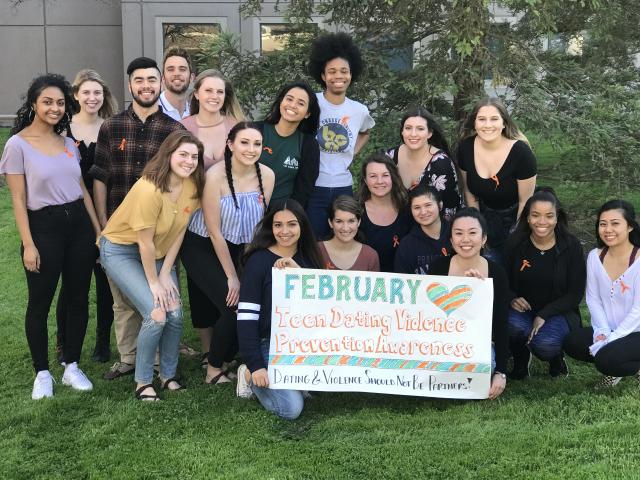
 

UC Davis CARE center, UC Davis AB540 Undocumented Student Center commemorate Sexual Assault Awareness Month with ‘Paint + Positivity’ events

These are the first of many events that the organization will be putting together throughout the month of April to advocate for sexual assault awareness and prevention


By BENJAMIN CARRILLO — campus@theaggie.org


On April 4 and April 8, the UC Davis CARE Center and the UC Davis AB540 Undocumented Student Center aimed to raise advocacy for Sexual Assault Awareness Month through their “Paint + Positivity” events.

One of the co-leads on this event, Kelsie Sladen, a training and education specialist for the CARE, spoke on the importance of this being the first event to start the month.

 “It’s always been that this event is meant to use art as a sort of healing mentality,” Sladen said. “It’s always been a very feel-good event, which is harder to create in a month as heavy as this one. Painting is nice to break the tension and focus on a nice community.”

Sladen then explained why CARE took a specific interest in Sexual Assault Awareness Month.

“We are a free and confidential resource for students that have been impacted by any type of sexual violence,” Sladen said. “The other part of what we do is prevention and education. It’s really important to bring about awareness and talk about what [students] can do to better support survivors. With awareness months like April, we really lead the way in starting events and have an event calendar on our website with not only our events but any events hosted on campus to support survivors.”

In addition to this event, the UC Davis CARE center specifically is hosting a myriad of other events throughout the month of April, all with the intention of raising awareness for sexual assault survivors.

Another Co-Lead of the event, Lea Harlev, a training and education specialist with CARE, described the initial reason for why painting was chosen as the first event of the month.

“The initial reason for this event was to create paintings for survivors to then see at our biggest event, “Take Back the Night,” which is happening April 9,” Harlev said. “We would use the paintings to decorate the space for [this event]. But over time, we’ve just wanted people to come and paint something they want to take home that is representative of self-love.”

Harlev continued on to speak on the significance of painting as a healing mechanism and the importance of having a sense of community between survivors of sexual abuse. 

“We try to offer alternative things to experience healing while also [creating] a community and [practicing] some self-care,” Harlev said. “There’s obviously counseling services and therapy offered through the school, but tons of students may not be ready for therapy or the lines are too long. We try to offer another method of healing that creates a safespace for students. 

Students looking to find more information on the events being held throughout Sexual Assault Awareness Month by CARE can visit their Instagram or website

Written by: Benjamin Carrillo — campus@theaggie.org 

Senate hears State of the Association by ASUCD President Francisco Ojeda

In his speech, Ojeda discussed both the challenges and successes from this academic year and announced that he will not be running for re-election


By RODRIGO VILLEGAS — campus@theaggie.org 


Senator Trinity Chow called the meeting to order at 6:12 p.m. and read the UC Davis Land Acknowledgement to commence the meeting.

The Senate then held several rounds of committee position and member confirmations for the Housing and Transportation Advocacy Committee (HTAC) and the Student Health and Wellness Committee (SHAWC). Each nominee introduced themself and answered various questions from the Senate regarding their respective positions. 

ASUCD President Francisco Ojeda then gave a State of the Association.

Ojeda began his speech by mentioning the impeachment through his presentation’s title slide, where he wrote “By: (STILL) ASUCD President,” and directly addressed it. 

“Thankfully, we were able to get back to work after the annoying and wasteful impeachment,” Ojeda said. “I hope, for the sake of the association and our mental health, we have moved on.”

He proceeded with his speech, where he discussed the new campus-wide accounting system implemented on Jan. 1, which has become a significant issue that has affected the entire association. The new system came with bugs that have caused delays in purchases within its units, and other campus departments are also struggling to understand the new system, according to Ojeda. However, he assured the Senate that the ASUCD HeadQuarters (HQ) office is actively working to better understand the system. 

He continued, highlighting other challenges ASUCD has faced, like finding storage and office space for Aggie Reuse, as well as successes, such as Planet Her, Housing Week and the Entertainment Council (EC)’s recent Brain Freeze concert. Additionally, he previewed events for the spring quarter, like Lawntopia. 

“I hear [the Entertainment Council] is competing with us, since we are holding budget hearings on the same day,” Ojeda said. “I hope they get lucky and have some five students join their concert, while the rest of the 30,000 undergrads hear budget hearings with us.”

He eventually transitioned to discussing ASUCD spring elections, mentioning that he is drafting a mass communication email to be sent on the first day of elections. Furthermore, he stated that he will not be running for re-election. 

Lastly, he ended his speech with one final statement before proceeding to thank everyone for their work. 

“I would like to end by saying that during the impeachment weeks, most of you were fortunate enough to be able to mark those as work hours and get paid for it,” Ojeda said. “Meanwhile, I was tasked with doing my job in addition to the impeachment hearings, with no pay at all. For those who were fortunate enough to receive that money, that’s what I call ‘good business.’”

Since Ojeda had to leave early, the Senate skipped over the questions for him.

Next, the Senate moved into public comments. The first comment criticized the Senate for their disorganization, pointing out their failure to publish the meeting agendas online and to correctly assign meeting minutes to the appropriate folder in Google Drive. 

The second comment advised senators to consider reallocating funds from the Office of the Transfer Student Representative and the Office of the International Student Representative to The Pantry next quarter. 

Afterward, Chow notified the Senate of her plans to introduce bills next quarter that impact how Senate meetings are conducted. 

“They are rough ideas right now,” Chow said. “Essentially, the goal is to make the Senate run smoother, faster, get people home earlier and be more transparent in general.”

The meeting then moved into a break.  

Once the meeting resumed, the Senate moved into the consideration of old legislation. 

The table started with a review of SB #50, a bill that allocates $751.54 to the Office of Senator Nur Ambaw to purchase athletic gear for the Memorial Union. However, Senator Nur Ambaw ultimately chose to withdraw the bill to give himself time to adjust the language of the bill and because he was not present for the meeting. 

Then they transitioned to SB #68, a bill to establish the Planet Her Committee as a committee under the Gender and Sexuality Commission.

Senator Jonathan Ng initiated a long discussion by stating his concern with the bill. 

“I talked to other UCs about how they run festivals like [Planet Her], and they told me that it’s all run through their entertainment board, and they allocate the budget to said entertainment board,” Ng said. “We create committees, then subcommittees and we go on and on. I don’t think that’s the direction we should be heading in when it comes to events.”

After a long discussion surrounding the bill, SB #68 passed. 

The Senate then considered SB #69, a bill to allocate $2,849.66 to the Pride Festival Unit for Drag Brunch, and SB #70, a bill to reform the violation point assessment and issuance process of candidates during ASUCD election, and both bills subsequently passed. 

The meeting then transitioned to a review of written reports before eventually moving to an open forum. During the open forum, a member of the public expressed their disappointment with a particular pastry sold at the CoHo. 

“I’m here to talk about cinnamon rolls,” the member said. “I’m coming to you all, as the big people on campus, to ask if you could transition from the cream cheese icing to something more vanilla-based, for the sake of the community.”

After a quick, lighthearted discussion, the meeting adjourned at 10:35 p.m.

Written by: Rodrigo Villegas — campus@theaggie.org

ASUCD Senate passes SB #55 to make campaign financing more equitable

The bill aims to make rules regarding ASUCD campaign financing more clear and efficient to increase voter turnout


By RIVERS STOUT — campus@theaggie.com


On Feb. 22, the ASUCD Senate amended and passed SB #55 after a lengthy debate between the senators. The bill was authored by Zachary Boggeln, the vice chairperson of the Internal Affairs Commission (IAC) to ensure that elections are “more transparent, equitable and efficient,” according to the language of the bill. 

The goal of the bill is to make elections more fair for running candidates who don’t have connections willing to give them significant donations.

“I [have] served on the elections committee for a year now,” Boggeln said. “I’ve also been one of four committee members to assess violation reports where fraud is suspected [in ASUCD elections], or if there is any reason to believe that any candidate or campaign at any point violated the rules that the association has set for a campaign.”

Boggeln described multiple reasons for the bill’s writing, including difficulties investigating possible instances of expenditure fraud or poor finance management in running senators’ campaigns. 

“The trouble was, and still is, that the expenditure reports are due immediately after the voting cycle has ended [on Friday night],” Boggeln said. “The elections committee has until Sunday at midnight to release the results.”

Within that two-day period, the committee has to go through all campaign expenditure forms and ensure that the campaigns followed the guidelines placed. This can be a tedious process, and to investigate an election with suspicious expenditures can be time consuming. 

“There was a problem with one campaign in which we couldn’t identify the source of the materials that were donated,” Boggeln said. “SB #55 was written to make that process easier for the elections committee to investigate.”

Boggeln went on to explain that the ambiguously constructed rules around campaign finance were hard to interpret and effectively act on. His bill was ultimately a way to make the rules more concise, allowing for better action to be taken when expenditure fraud is suspected, while hopefully making it more difficult and less likely to be committed in the first place.

When it was to be voted on, the bill created a controversy in the Senate. With much of the Senate already gone, a few senators debated at length about the bill’s content with the morality of material donations and how they can create an uneven playing field. The bill originally banned all material donations out of fairness in the elections and ease for the IAC, however, the majority of the remaining senators eventually decided to allow material donations provided by students under $10, with receipts included. 

“I liked it as it stood,” Senator Curtis Chen said. “I was surprised that it was a contentious bill because in my opinion, everybody is on the same playing field. When I ran, I didn’t spend any money besides the poster paper, and I feel like I had a pretty successful cycle. It was a good regulation on the election process and I’m glad that it passed.”

Chen then spoke on the benefit of the bill limiting donations and how it will likely have a positive impact on the elections. 

“Having a monetary advantage on other candidates is just unfair,” Chen said. “It’s more similar to how the U.S. [elections] are, but we’re students, [and] I don’t think we should be winning based on how much money we put into elections. We should be winning based on our ideals and the communities we represent.”

Chen expressed that he was satisfied with the bill passing, regardless of the amendments made to it. 

Reported suspicions of campaign finance fraud or other violations come from student voters, according to Boggeln. However, voter turnout in the last few years has been low, with the fall 2023 election cycle hitting just below 16%. It is difficult for the IAC to investigate cases of potential fraud with low turnouts. 

“Voter turnout is one of the things I wish to improve this cycle,” the newly elected ASUCD Elections Officer Sriya Batchu said. “My goal is more advertising. [The goal is to] get the word out there to different parts of campus that might not be as aware of elections and may not have much overlap with ASUCD in general.” 

Batchu hopes to increase turnout by putting posters up around campus, increasing the online presence of the elections, utilizing raffles to increase awareness, tabling and asking that ASUCD events promote the elections.

“We’re trying to target freshmen, because I know that from when I was a freshman, they don’t know much about ASUCD,” Batchu said. “While I’m sure many of them are somewhat aware, they maybe don’t have one-on-one interaction.”

When asked if the Elections Committee would employ any new tactics to increase engagement, Batchu said that they are going to expand on the strategies they have already used.

“Every election has been a little bit better than the previous one, in my opinion,” Batchu said. “ I’m hoping that in this cycle we can focus on more advertising and getting out there more.”

While the IAC has existed for a long time, Batchu’s position of elections officer was recently created. Until now, it had been primarily focused on organizing the logistics of elections and didn’t prioritize increasing the election’s voter turnout. 

SB #55 was ultimately an effort to make the elections more grassroots and make the ASUCD Senate a better democracy, according to Boggeln.

“I think this bill is great not because it asks people to look for big donors, [but to] look for voting students and convince them that not only should they vote for them, but they should give them 10 dollars to vote for them,” Boggeln said. “I think that will incentivize candidates to work really hard to craft a platform to appeal to students that’s meaningful, and also provide an opportunity for really qualified candidates to run a campaign.”


Written by: Rivers Stout — campus@theaggie.org

Measure N passes with supermajority of votes from the primary election

Following the March ballot, the parcel tax to help fund Davis Joint Unified School District is here to stay 


By MATTHEW MCELDOWNEY — city@theaggie.org


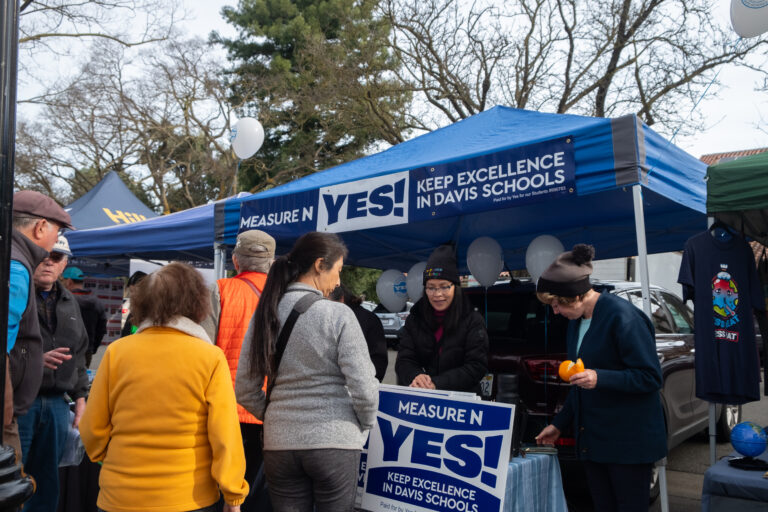
The results for Measure N, a parcel tax of $768 a year, were confirmed as of March 21, 2024. The measure passed with 68.24% of the Davis community voting in favor of Measure N while 31.76% voted against this legislation.

Measure N meets the two-thirds supermajority threshold to be passed and will not need to be renewed in subsequent elections like previous measures. In this way, Measure N is a more permanent continuation of Measure H, both of which intend to help supplement state funding for extracurricular programs and teacher salaries in the Davis Joint Unified School District. 

Evan Jacobs, a volunteer with Yes4Students and an advocate for Measure N, expressed optimism for the longevity of DJUSD teachers, athletics and music programs.

“By not having to vote on this every four to eight years, we can give the school district more security and certainty in planning its budgets,” Jacobs said.

Funding provided by the parcel tax would account for around 10% of the budget for the district. Jacobs believes that this amount of resources left hanging in the air leaves the job security of the teachers in question. Seeing how this need for supplemental funding has remained consistent over the past 40 years, Jacobs said he doesn’t foresee any reason for the continuous renewal of this parcel tax, even more so in coming years.

“The state has a really tough budget situation this year and across the state, school funding is going to be cut as a result,” Jacobs said.

Jacobs is concerned about the consequences that could arise if DJUSD were left to rely on this state funding. He believes that the way that teacher pay scales are calculated — based on certifications and seniority — means that rather than simply reducing individual pay, the district might be forced to lay off teachers qualified in instructing advanced placement or higher-level classes.

Jacobs also mentioned how the quality of DJUSD educators and programs make the city of Davis a more desirable place to raise families in. The property values for homeowners, the growth of the city and its local economy benefit from the pull of Davis schools and the families who for that very reason choose to settle down here. 

Thomas Randall Jr., treasurer for the NO PARCEL TAXES political action committee, was very skeptical of Measure N and had urged voters to express caution. 

“The economy is all out of balance right now but going to the citizens and wanting to tax more and more and more just creates a greater burden on the poor,” Randall Jr. said.

As the cost of living increases, Randall Jr. believes that exceptions from the parcel tax should be expanded for those on disability or welfare, on top of ones granted for seniors and those on fixed incomes. While the permanence of the measure could be seen as security, Randall Jr. feels as though this change could make it harder for voters to voice their concerns.

He also mentioned the concerns of parents like Beth Bourne, the Yolo County chapter chair of Moms for Liberty, who did not want to financially support an institution that teaches with alleged “anti-parent policies” or “gender-sexual ideology.”

Jacobs is more than satisfied with the results of the campaign and believes that it will benefit the Davis community in the long run. 

“It’s a wonderful result,” Jacobs said. “As a part of the campaign team, we have so much gratitude for the voters who chose to engage for or against, just being involved and active as a citizen is important.”


Written by: Matthew McEldowney — city@theaggie.org

Climate change is contributing to the spread of infectious diseases

A new study shows that altered weather patterns are responsible for changes in animal migration, leading to an increased spread of pathogens


By KATIE HELLMAN — science@theaggie.org


Climate change is responsible for a dramatic increase in extreme weather events, like droughts and heat waves, as well as natural disasters like hurricanes, flooding and wildfires. These issues are becoming more prevalent with every passing year as greenhouse gas emissions continue to rise.

Temperatures around the world have been increasing at alarming rates, according to a study published in JAMA. 

“Primarily due to greenhouse gases released via combustion of fossil fuels, global average temperatures between 2011 and 2020 increased to 1.1 °C (approximately 1.9 °F) above preindustrial levels and are estimated to increase to 1.5 °C (approximately 2.7 °F) by 2040,” the study reads.

Infectious diseases can be caused by a variety of organisms, including viruses, bacteria, fungi and parasites. They can also be transmitted to and from many hosts, like from animals to humans (zoonotic diseases) and from humans to other humans.

George R. Thompson, lead author of the study and professor at the UC Davis School of Medicine, elaborated on how these diseases spread.

“Numerous infectious diseases are dependent upon environmental conditions for growth or their normal life cycle,” Thompson said via email. “This is highly pathogen-dependent, as some live in soil [and] others [are] propagated by ticks, mosquitoes, etc. A changing climate impacts all of these potential mechanisms of spread.”

Serious diseases like Zika, malaria and dengue are vector-borne diseases, meaning they are caused by pathogens transmitted from animals like fleas, ticks and mosquitoes to humans. Since climate change is leading to altered rain patterns, short and warmer winters and longer summers, there are subsequent alterations in the time periods in which these vectors are active. The regions in which vector-borne diseases are diagnosed are shifting as well, with increasing rates of disease being detected further north and west than they have been previously.

Data has shown that these vectors have more time to infect people due to temperature shifts, according to an article by the Centers for Disease Control and Prevention (CDC).

Mild winters, early springs, and warmer temperatures are giving mosquitoes and ticks more time to reproduce, spread diseases, and expand their habitats throughout the United States,” the article reads. “Between 2004 and 2018, the number of reported illnesses from mosquito, tick, and flea bites more than doubled, with more than 760,000 cases reported in the United States.”

Weather pattern disturbances are also causing changes in the migration patterns of animals and significant habitat loss. As a result, wildlife territory has more overlap with human territory, creating increased opportunities for disease transmission.

Clinicians are being urged to increase infectious disease surveillance methods so that pathogens can be detected and dealt with before they significantly affect human health.

“Surveillance is largely dependent upon reporting to state/federal agencies,” Thompson said. “Newer methods use wastewater for pathogen detection and can hopefully provide notice when the incidence is rising.”

Written by: Katie Hellman — science@theaggie.org

Aggies fall short in Big West Conference Championships

Both men’s and women’s basketball suffer tough losses in finals and miss out on March Madness


By LUCIENNE BROOKER — sports@theaggie.org


As confetti rained down on the court at the Dollar Loan Center in Henderson, Nevada, both the UC Davis men’s and women’s basketball teams watched as their opponents celebrated a new win. After strong regular season showings from both teams, the Aggies had a fighting chance as they made it into their respective tournament championships. However, neither Davis team was able to clinch the Big West Conference Championship and subsequent NCAA playoff berth.

Every drop of blood, sweat and tears shed by the Aggies over the course of the season pushed them closer to March 16, 2024. On this day, both the men’s and women’s Big West Conference Championship finals were scheduled, with the women’s match tipping off at 3 p.m. and the men’s three hours later. 

The women’s basketball team had a tough road to the final. Coming into the playoffs as the No. 5 seed team in a tournament of eight teams, they had to compete in a first-round match instead of skipping straight to the quarterfinals. 

With a decisive 81-56 defeat of Cal State Fullerton, driven by an electric 29-point performance from fifth-year Evanne Turner, the Aggies moved into the quarterfinals. A narrow defeat of No. 4 seed Cal Poly kept their momentum going.

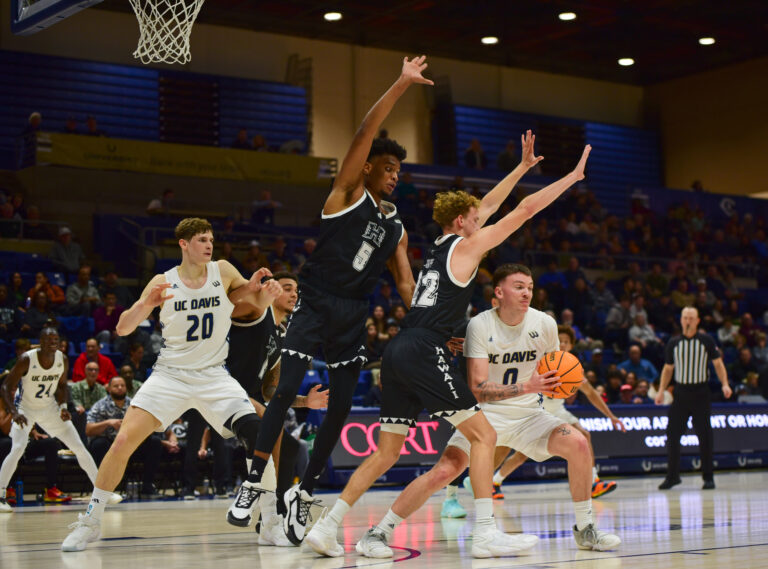
Their semifinal match-up was against long-time rivals and No. 1 seed University of Hawai’i. Having faced one another twice during the regular season, with each team winning once, the Aggies were looking for a tiebreaker win — and they found it.

Turner was once again a key player, converting a three-point basket in the final minute of play to give her team a 51-48 victory and put them into the final match-up. 

While spirits were high heading into the game against the No. 2 seed UC Irvine Anteaters, luck was not on the UC Davis teams’ side. The score stayed evenly matched for the first two quarters, but the Anteaters eventually took control, holding Davis to their lowest score this season. As tournament champions, UC Irvine advanced to the NCAA playoffs but lost in their first match. 

Despite the women’s defeat, Aggie basketball fans held on to hope that the men’s team would be able to bring UC Davis a victory in their final game. Coming into the tournament as the No. 2 seed, the men’s team was automatically placed in the semifinals, where they also defeated Hawai’i by three points. 

However, the similarities between teams continued as the men fell to Long Beach State in the final. Despite third-year Ty Johnson’s 30-point performance, UC Davis couldn’t overcome the strong Long Beach offense and lost 70-74. Although they held a narrow lead for most of the first half, Long Beach went on a final unanswered run in the last minute of play. Long Beach State, similarly to UC Irvine, went on to lose in the first round of the NCAA playoffs. 

Despite disappointing outcomes for the Aggie players and fans, both basketball teams had stellar seasons of record-breaking performances. To reach the final match of the Big West Conference Championships isn’t an easy feat, and both teams did so in style with plenty of exciting moments for fans and players to look back on. As for now, both teams will say goodbye to several key graduating players and begin to look forward to the 2024-25 season. 


Written by: Lucienne Brooker — sports@theaggie.org

Review: ‘COWBOY CARTER’ is Kntry, not Country

Beyoncé recently released her first country album, despite the backlash she’s faced from the country music community


By AALIYAH ESPANOL-RIVAS — arts@theaggie.org 


Amongst many people’s 2024 predictions, Beyoncé releasing a country album was not one of them. After announcing the release of new songs during a Verizon commercial at the 2024 Super Bowl, fans were shocked to hear two country songs. Following the release of the two singles, “TEXAS HOLD EM” and “16 CARRIAGES,” Beyoncé announced the album “COWBOY CARTER,” the second installation in her trilogy project to be released on March 29, 2024. 

“COWBOY CARTER” is Beyoncé’s eighth album, with 27 tracks that explore the criticism Beyoncé has received, the embracement of her heritage and calls to disrupt the traditional ideals people have when listening to country music. Similar to the first release in the trilogy, “RENAISSANCE,” Beyoncé has strived to go above and beyond expectations in both the house music genre and now country. While many may think this album came out of nowhere, according to a post on Instagram by Beyoncé, “COWBOY CARTER” has been five years in the making. 

“This album has been over five years in the making,” Beyoncé said. “It was born out of an experience that I had years ago where I did not feel welcomed… and it was very clear that I wasn’t.” 

Additionally, the album features multiple collaborations with other country music artists such as Dolly Parton, Willie Jones and Shaboozey. While “COWBOY CARTER” seems like a complete 180 for Beyoncé’s discography, the album proves her versatility as an artist, proving she is Kntry. 

“COWBOY CARTER” starts with “AMERIICAN REQUIEM,” a gospel-inspired song with accompaniment from instruments like the organ to the guitar and sitar. The song’s title serves as a hint of what’s to come in the album, as a requiem is a traditional Catholic mass held to rest the souls of those who have passed. 

With lyrics such as “For things to stay the same, they have to change again,” the song is a callout to the close-mindedness of the country genre itself and the warning that the album will bring forth change in ideas. The song becomes increasingly intense as Beyoncé cites those who said she was “too country” and yet not “country ‘nough,” as she discusses how hard she’s fought to be heard and create the project. As the song concludes, Beyoncé once again tells the listeners to bury the “big ideas” they have before the following songs.

Amongst the album’s diverse tracklist, Beyoncé drew back to many country influences and artists to extensively display the different mediums of country music, the history and the oppression Black country artists have received. An example of this is in the second track, “BLACKBIIRD,” a cover of the Beatles song that was created as a hopeful message during the civil rights movement. Beyoncé, joined by Tanner Adell, Brittney Spencer, Tiera Kennedy and Reyna Roberts, four other Black country music artists, the song takes on an even deeper meaning. 

Furthermore, the 10th track, “JOLENE” is a rendition of the same popular song by Dolly Parton, one of the most prominent female artists in country music. In Beyoncé’s rendition, the song turns into more of a warning instead of the begging tone the original has. 

In addition to music collaborations, the album also features interlude tracks from prominent names in the country industry, such as Dolly Parton, Linda Martell and Willie Nelson. The interludes serve as mini radio segments for her “Kntry” radio station in between certain songs, with the artist sharing their sentiment for Beyoncé’s dedication to the genre. \

Specifically, in “SMOKE HOUR II” with Willie Nelson, he says, “Sometimes you don’t know what you like until someone you trust turns you on to some real good sh*t.” With major names verbally supporting the album, it shows how respected Beyoncé is as an artist in multiple genres. 

While tracks like “16 CARRIAGES,” “PROTECTOR,” “MY ROSE” and “II HANDS II HEAVEN,” are on the slower side with some minor country influences, the album also includes tracks that tiptoe on other genres such as folk, pop and rock. Tracks such as “SPAGHETTI,” “YA YA,” “TYRANT” and “SWEET HONEY BUCKIIN’” emulate both country and hip-hop, giving the audience a taste of the Beyoncé sound they are accustomed to. 

Personally, I found “TEXAS HOLD EM’” to be my favorite track on the entire album, despite the backlash it has received in the media. The song is spunky, fun and a great tune to dance to while getting ready. The banjo and guitar notes work perfectly with Beyoncé’s vocals creating a Hannah Montana “Hoedown Throwdown-esque” sound. 

“COWBOY CARTER” ends with “AMEN,” a sort of bookend with “AMERIICAN REQUIEM,” another gospel song that discusses the fall of the idea of country music with her album. Notable lyrics include “Tell me, can you hear me now?” and “This house was built with blood and bones and it crumbled, yes, it crumbled.” 

“COWBOY CARTER” is an amalgamation of everything Beyoncé. From upbeat to sultry to country twang, the album reminds us that there are no limitations in any music genre. Barriers need to be pushed in order to be heard, and Beyoncé has just done that. Now, going on to her 27th year in her music career, Beyoncé has proven time and time again that she is a force to be reckoned with. While one may view this album as simply country, it serves entirely Beyoncé and Kntry.


Written by: Aaliyah Espanol-Rivas — arts@theaggie.org 

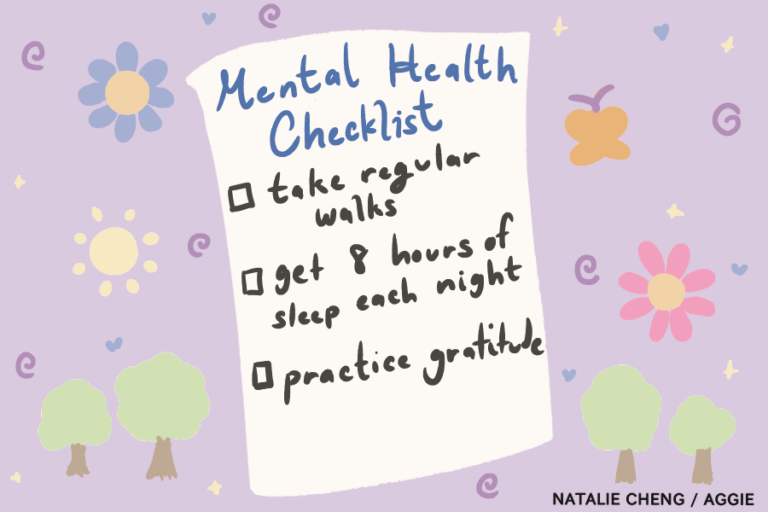
UC Davis students set mental health goals for quarter ahead, reflect on past wellness practices

Flowers aren’t the only things flourishing this spring


By JULIANA MARQUEZ ARAUJO — features@theaggie.org


As students prepare to shift their focus from spring break to spring quarter, they must also consider how to end the academic year strong without sacrificing their mental well-being. 

Aarushi Desai, a first-year English and psychology double major, said that it has been challenging to rekindle the same vigor from the start of the school year.

“I am honestly so tired,” Desai said. “I don’t know why this week has been so exhausting.” 

Kaitlyn Wicks, a third-year sustainable environmental design major, reasoned that students likely feel unprepared for the new quarter due to the short transition period between winter quarter and spring.

“I feel like I started off really stressed this quarter, just because spring break was so short, but I’m motivated for summer,” Wicks said. “I feel like I’m motivated to just get this year done with.”

Though it may be stressful, the start of a new quarter presents fresh opportunities to create a schedule or practice habits that work the best for you. However, to make the necessary changes to thrive, one must reflect on the past in order to move toward a better future.

Wicks and her friend Dani Ballard discussed their recurring struggle with time management and listed some methods that they planned to continue in spring quarter to avoid procrastination.

“The ability to balance, not letting things stack up and then having a mental breakdown, [and] trying to avoid the mental breakdown before it happens,” Ballard, a third-year sustainable environmental design major, said. “Not waiting for the pressure to build and then to be like, ‘Oh, I guess now I can do it, now that I’m stressed about it.’”

In the process of reflection, it helps to recognize the important factors of one’s day-to-day routine.

“Sacrificing time for your mental health is so important,” Ballard said. “I feel like I definitely sacrificed school stuff to prioritize myself — especially to work out. I’ll put that above anything.”

Other factors may not be as easy to adjust, but students still manage to find solutions to these disturbances.

“It was kind of hard for me to find time since I do commute, so I feel like coming here is so much more of a mental task, but I always set aside plenty of time for Animal Crossing,” Wicks said.

A short break is all it takes for most students to get momentary respite from a stressful situation or environment. It allows them to recharge and return with renewed energy, focus and clarity.

“We are the type of girls to take a little nap if we need a break,” Ballard said.

Desai described how important it was for her to recognize when she needed personal time to recharge.

“I tried to make time for my interests,” Desai said. “The best way I was able to unwind after a long day of classes and homework was to sit down on my bed and just watch a TV show. Doing that pretty regularly was really valuable for helping me calm down.”

When taking time off from any draining activity, students find it best to fully immerse themselves in their leisurely pursuits. Desai shared her desire to be intentional about how she spends her time outside of school. 

“I am able to go home pretty regularly, so when I do go home, I try my best to not worry too much about my classwork,” Desai said. “Obviously I have homework, but when I’m home, I’m going to try to focus on being home. I hang out with my dog and cuddle him and that’s just amazing for my mental health.”

After all, many students look forward to connecting or reconnecting with a friendly face. 

“One of my goals is just making friends and going out with people more because that’s really important to me, but I didn’t really have the chance to do that as much in previous quarters,” Desai said.

Social connections play an essential role in students’ mental health, but what students mainly struggle to balance is the academic rigor of college. 

Wicks and Ballard revealed that their upperclassmen status has forced them to consider other objectives regarding their education.

“Get as many classes in as you can — I feel like that’s where we are at,” Wicks said.

“Now that we’re juniors, all I think about is if I’m going to get Cum Laude, like, ‘What’s my GPA?’ ‘Is my mom going to be proud of me?’” Ballard said.

The pressure to perform well can be overwhelming, especially when students are so close to the finish line.
Apart from simply stressing over letter grades, students may also consider what their future will look like after finishing their academic journey at UC Davis and what information should be retained for their career goals. 

Wicks mentioned that she often asks herself: “Is the stuff we are learning in class going to be applicable to what we’re going to do later?”

These types of questions naturally form when students near the end of their time in college, but being in a classroom with peers who share the same sentiment allows students to face unknown challenges together.

“Knowing people in our major has been so helpful because if we’re stuck on something and not understanding [it], there’s always someone that you can feel comfortable reaching out to,” Ballard said. “This is such a competitive atmosphere that when you have those people that you don’t necessarily feel like you’re competing with, it’s super helpful.”

It can  be easy for students to forget their accomplishments when times get tough and the assignments seem unbearable. In these moments, Wicks, Ballard and Desai all said that taking deep breaths and repeating affirmations really helps ground them. 

“I am a smart, beautiful, capable woman,” Wicks said is an affirmation of hers.

“You made it this far; you can’t give up now,” Ballard often reminds herself. 

Desai takes a spiritual approach and puts her faith in the universe.

“I like to believe that there’s a rhyme and reason to everything that goes on, even if it doesn’t make sense in the moment,” Desai said. 

As spring quarter begins, it is important to recognize the value and necessity of putting effort into your mental wellness. Before assignments and exams get the best of you, take the time to think about your mental, physical and emotional priorities and what you can do to alleviate stress — if you’re looking for a place to start, it’s always best to simply take a deep breath in, and out. 


Written by: Juliana Marquez Araujo — features@theaggie.org

Culture Corner

The Art’s Desk Weekly Picks for Music, Movies and More


By SOFIA BOZZO — arts@theaggie.org 


Book: “Devotions” by Mary Oliver (2017)


On the heels of a cold, tumultuous and thoroughly exhaustive winter finals week, my mind craved tranquility, and what better way to achieve tranquility than with a nice book and a poolside seat? Over spring break I began “Devotions,” a book of selected poetry by American poet, Mary Oliver. The collection teems with illustrations of the natural world and the ways in which it impacts the human experience. The central thrust of the poetry within “Devotions” is charged with joy, hope and perspective, forcing introspecting with an outward regard for the natural world that surrounds us. Amidst the stress of the end of an exasperating winter quarter, and equally, the stress of the beginning of a new one, “Devotions” proved a thoroughly delightful and relaxing read, serving as a comforting reminder of the world around me. 


Movie: “The Secret Life of Walter Mitty” dir. by Ben Stiller (2013)


Don’t be fooled by the subpar rotten tomatoes score, this movie changed my life. I was nine years old when Ben Stiller first blessed the world with the self-directed “Secret Life of Walter Mitty,” and I’ve since come back to it throughout the most significant times of my life. The film follows a middle-aged man, initially paralyzed in his mundane job, searching for purpose and adventure. The film alternates between reality and fantasy as the main character, Walter, imagines himself amid intense adventure, ultimately making it a reality. I returned to this film again as school, sports and life became overwhelming and consumptive. The movie holds principles of courage and presents themes of faith, not only in the surrounding world, but in oneself. I return to this movie when my life feels monotonous, overwhelming or when I’m seeking some inspiration. For anyone who occasionally shares these feelings, “The Secret Life of Walter Mitty” is for you. 


Album: “Morning Phase” by Beck (2014)


If you’ve heard the name Beck, you might be imagining nineties break-beats and lyrical irony, yet Beck’s 2014 folk-rock album “Morning Phase” reflects his Los Angeles roots, harkening back to a sound heavily reminiscent of the sixties musicians of Laurel Canyon. If you couldn’t already tell, much of my artistic preference is dependent upon the change of season. I find this album reflects the feelings surrounding the shift from dim, somber winter, to the impending joyous spring. The album opens with a hauntingly beautiful string overture, ultimately fading into an upbeat folk ensemble as the second song begins. Beck constructs melodies to parallel the feelings intended within each song, never shying away from emotion and ultimately resolving with themes of morning, light and hope. If you haven’t already gotten into the prolific anthology of Beck, now is the time.


Written by: Sofia Bozzo — arts@theaggie.org 

Police investigating six suspects after assaults downtown

Two victims were assaulted by a group of people downtown, leaving one victim severely injured


By CHRIS PONCE — city@theaggie.org


On March 29, there was an assault on two individuals near 2nd and F Street, according to the city of Davis Police Department. The assault left one victim “severely injured” and “unable to provide needed information.” Due to surveillance footage from a nearby business, authorities have received footage of the assault and have determined there are six suspects. 

“At approximately 11:40 PM, two individuals were assaulted near the intersection of 2nd Street and F Street,” the city of Davis Police Department said on Facebook. “There were reported to be 5-6 suspects, some of whom were wearing masks. The suspects approached the two individuals and began to assault them, severely injuring one.”

In a later Facebook statement made on Thursday, April 4, authorities confirmed there were six suspects and released four clips from the nearby business that recorded the incident. The suspects wore hoodies and at least some wore face masks. The footage is not clear enough to determine the identity of any of the suspects. One clip shows one of the suspects chasing and punching one of the victims down 2nd Street until the victim falls to the floor. 

“Unfortunately, the video is not clear enough to provide a firm identification of the 6 suspects,” Davis Police Chief Darren Pytel said on Facebook. “It is evident they are wearing hoodies and at least some, if not all, have facemasks, which is consistent with a victim’s statement. Complicating the investigation, one of the victims was seriously injured and is unable to provide needed information.”

Davis police have not received more information about where the suspects came from or how they fled the scene. However, the footage shows them running westbound on 2nd Street. Additionally, authorities have not yet determined whether there was a motive behind the attack. 

“And, at this point, no clear motive has been identified to determine why this incident took place,” Pytel said in the statement. “The victims and suspects came from two different directions, and it is not yet known if they had engaged earlier in the evening.”

Police are currently investigating the crime and asking anyone who was downtown at the time of the assaults to contact them if they saw the suspects. Authorities are asking witnesses or anyone with footage to contact them by calling 530-747-5400 or emailing PoliceWeb@cityofdavis.org

“As more information becomes available, it will be shared with the community. In the meantime, a very active investigation is occurring,” Pytel said in the statement. “This was a particularly brutal crime and finding those responsible, and holding them accountable, is of the utmost importance.”


Written by: Chris Ponce — city@theaggie.org

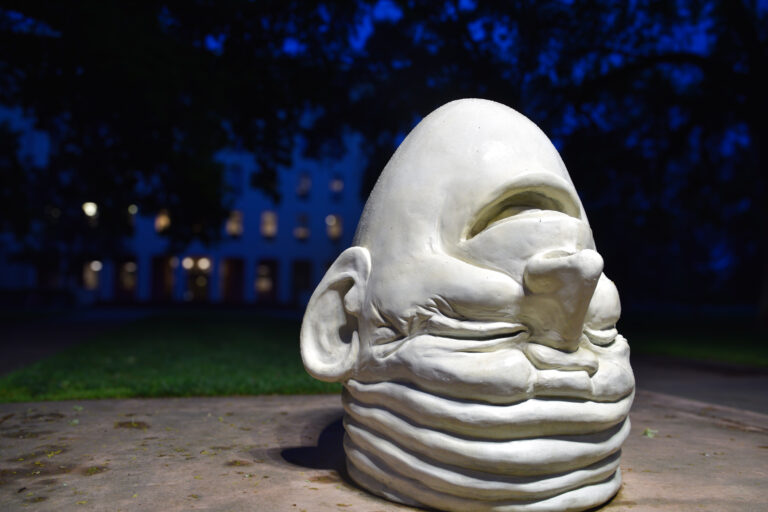
UC Davis community celebrates ‘Year of the Eggheads’

Events and campus-wide activities celebrate the 30-year anniversary of Robert Arneson’s Egghead sculptures


By MADISON PETERS — campus@theaggie.org


On April 4, UC Davis officially kicked off the celebration of the ‘Year of the Eggheads’ to commemorate the 30-year anniversary of having the Egghead sculptures on campus.

According to the new Egghead website, artist and former professor Robert Arneson was commissioned to create the Egghead sculptures in 1990. The website suggests that Arneson’s inspiration for the Eggheads came from his trip to the Boboli Gardens in Florence, Italy in which he observed small, Egghead-like sculptures. 

To celebrate the Eggheads’ birthday and Arneson’s legacy, the UC Davis community participated in a range of activities that took place throughout the day, including Egghead exhibits in the lobby of Shields Library, a campus-wide Egghead scavenger hunt and a jazz performance and poetry reading put on by the Music Department and select Master of Fine Arts (MFA) students.

Additionally, students enjoyed 30% off discounts on things from games at the Memorial Union Games Area to breakfast burritos with eggs at the Coffee House and new Egghead merchandise at the UC Davis Store.

For those who wish to learn more about the history of the UC Davis Art Department and Arneson’s works, the first part of a new documentary titled Unexpected Legends: Robert Arneson, Eggheads and Arts at UC Davis” is now available on the UC Davis Youtube account.

Chancellor Gary May opened the documentary by commenting on the significance that the Eggheads hold in the UC Davis Community.

“Robert Arneson’s Eggheads are a defining element of UC Davis,” May said. “They symbolize that we’re serious about all we do, but we are also comfortable being a little quirky, a little unconventional. The Eggheads represent our commitment to public art on campus. Not only do outdoor sculptures like the Eggheads enhance our environment, they encourage us to think critically, to appreciate our surroundings in new ways and leave us inspired by their artistry.”

The Manetti Shrem Museum participated in the celebration by unveiling a new Egghead display titled “Hatched: The Making of Robert Arneson’s Eggheads.” This display features a behind-the-scenes look at Arneson’s process of creating the Eggheads, and includes early clay models of the sculptures. Another photo display titled “Aggies with Eggheads” is also available in the museum lobby.

Sandra Shannonhouse, UC Davis alum, artist and widow of Arneson, spoke at the museum event and delved into Arneson’s intentions for some of the Eggheads. She revealed that some of them have a deeper, more political meaning such as the Eye on Mrak Egghead, which signifies “keeping an eye on authority,” a popular motto used in the 1960s and 70s.

Shannonhouse then elaborated on her experience as a student with the UC Art Department.

“[Taking art classes at UC Davis] changed my life,” Shannonhouse said. “[Those of] you who are students, take advantage of this university and get yourself out of where you think you have to be, or where your parents think you have to be and find yourself. Whether you are making art or doing something else, it all comes from [the heart]. Don’t lose that.”

Following the speech by Shannonhouse, Trevor Bradshaw, an MFA candidate for creative writing, recited a ballad dedicated to the Eggheads and their public perception.

Bradshaw revealed his interpretation of the Eggheads in relation to the Antonio Gramsci quote: “We are living in the time of monsters.”

“I thought it was interesting to think about the relationship of these various kinds of heads as a form of protest art,” Bradshaw said. “In my mind, I started to think of the Eggheads as a kind of playful monster, kind of like a Pokemon. Like any other monster, the Eggheads also function as a mirror. We project onto them our own fears since they show us what is monstrous about ourselves, such as turning a blind eye to suffering to better our careers or pursue knowledge in the name of profit, power or fame.”

This interpretation of the Eggheads as a form of protest art proved to hold some truth in that the night before the event, many of the Eggheads were vandalized by an anonymous party. The graffiti included objections to Gary May’s role on the Leidos Weapons board and pro-Palestinian sentiments.

However, the graffiti was removed before the morning of April 4, and no comments were made by any members of the UC Davis administration.

The event concluded at 7:30 p.m. with a ceremonial lighting of the Eggheads, in which many UC Davis community members gathered around the sculptures and wished them happy birthday.

Egghead celebrations will be continuing on throughout the next month, including special Egghead-themed menus being featured at the Dining Commons through April 12, and Egghead tours hosted by the Manetti Shrem Museum every Saturday and Sunday from May 4 through 24.

Dean of the College of Letters and Science Estella Atekwana spoke at the Manetti Shrem event about the overall importance of Arneson and the Eggheads.

“Arneson and his fellow artist educators, giants on whose shoulders we now stand, built a heaven for creatives here,” Atekwana said. “A place where artists are empowered and encouraged to test the boundaries of their creativity, and push beyond true greatness. That legacy continues to pay its dividends all around our campus today. Thanks to [Arneson’s] spirit and tenacity, we have become something far greater than some of our [counterparts], and we are reminded of our duty to carry on his vision every time we pass an Egghead.”


Written by: Madison Peters — campus@theaggie.org


Thank your barista

Latte art as the mark of excellent coffee craft


By MAYA KORNYEYEVA — mkornyeyeva@ucdavis.edu


You walk into your local coffee shop and order a hot latte, noting that the line isn’t long and the atmosphere in the cafe is relaxed and uplifting. You pay for your drink, stand to the side to make way for the next customer and patiently wait for your name to be called out. 

Once your order is up on the bar and ready for pick up — even if it took slightly longer than expected or you have grown cranky from your caffeine withdrawal — the sight of the beautifully rich espresso adorned with an intricate pattern of white foam makes your heart sparkle and your soul do a happy skip. It’s not just that the latte looks visually stunning; latte art is a telling sign of a well-crafted beverage — coffee honed to perfection.

The term “latte art” was coined by David Schomer in 1992 (alongside the infamously tricky yet successful pattern of the “rosetta”), and emerged into the commercial world at the turn of the 21st century. Latte art traces its roots back all the way to the first instance of milk being added to coffee in Austria (1697), where this revolutionary combination of ingredients became the predecessor of a whole new type of coffee beverage. 

Latte art is a technique that can only be achieved if a barista creates a perfect, unexpired shot of espresso — with a fine layer of crema on top — and steams their milk correctly. To produce that perfect ‘microfoam,’ the milk needs to be steamed so that it increases in volume by around 33%. This expansion of the milk is a result of tiny bubbles, which are dispersed throughout the milk during the steaming process and give it that characteristically sweet and smooth texture.

Without having a balanced shot of espresso and milk with microfoam, latte art is extremely difficult to achieve. For instance, espresso shots that have been sitting out on the counter for over 30 seconds begin to “expire” and lose their crema layer, which is the crucial canvas for a latte art design. If the milk is aerated too much it becomes overly bubbly and foamy, and if it is aerated too little then there’s not enough microfoam: both very difficult conditions to work with.

As latte art was originally a staple of the specialty coffee scene, being able to create a cup with a beautiful design is the sign of skilled craftsmanship, and beyond that, it is the mark of high quality coffee. The process of measuring out your coffee grinds, tamping and distributing the coffee and brewing with the correct ratio of water and pressure are all variables that require mathematical precision. If a barista doesn’t perform these steps correctly, a shot of espresso could be nearly impossible to adorn with latte art — even if the actual coffee used was of a high caliber. Same with the milk; an improper positioning of the steam wand, a mistake in the temperature or initial aeration can create irreparable damage to the quality of the final beverage.

Whenever I visit a coffee shop, I leave with a much higher appreciation for the cafe if the baristas are able to create latte art designs and pour coffee at such a high standard. The countless design possibilities, such as a rosetta, tulip, heart, fishtail, leaf, swan and many others, are all attainable through continuous, diligent practice. Nobody is perfect at latte art from the first time they touch a pitcher of steamed milk and a cup of espresso. Over time, muscle memory and guidance from a trainer help build the foundation for consistently impressive art.

Next time you visit a cafe that serves drinks with latte art, I encourage you to give an extra thanks or a thumbs up to the management and the barista. Not only did they take the time and effort to train this creative skill, but it also means that you got a great cup of coffee; with excellent craft, flavor and technique.


Written by: Maya Kornyeyeva — mkornyeyeva@ucdavis.edu


Disclaimer: The views and opinions expressed by individual columnists belong to the columnists alone and do not necessarily indicate the views and opinions held by The California Aggie.

Strides have been made since Cesar Chavez, but there is more to be done

As an agricultural school, we can’t turn a blind eye to the labor conditions of farmworkers

By THE EDITORIAL BOARD 

You may not have realized this since we didn’t get a day off, but Mar. 31 was Cesar Chavez Day. This day shouldn’t just be another date on a school calendar — it’s important to remember the meaning of holidays that recognize the work of union rights movements and to continue advocating for these causes. While there have been several improvements to the labor conditions of farmworkers, there is still a long way to go. 

The federal holiday recognizes the legacy of Chavez and his work in organizing California farm workers. In 1962, Chavez, along with Dolores Huerta, established the United Farm Workers (UFW) to fight for better treatment for these workers. 

In 1965, farmworkers who picked grapes were paid an average of $.90/hour and there were no portable toilets at the ranches. It also was and still is common for children to be working in the fields. 

The 1965-1970 Delano Grape Strike and Boycott was first started by Filipino-American grape workers who striked against their low pay and treatment. Chavez and the UFW officially joined the strike on Sept. 16, 1965, which is also Mexican Independence Day. 

Chavez took inspiration from movements started by Dr. Martin Luther King Jr. and Gandhi to take a nonviolent approach to the strike. In 1968, Chavez fasted for 25 days to bring awareness to the nonviolent nature of their movement. His hunger strike gained attention from Dr. King and Senator Robert F. Kennedy, who attended an event by the union.

“However important the struggle is and however much misery and poverty and degradation exist, we know that it cannot be more important than one human life,” Chavez said in a 1970 interview. The strike ended that year, after grape growers signed their first contract with the union which helped improve the conditions for union workers. 

The UFW boycott isn’t just a part of Mexican-American history – it is also an integral part of Californian and American history. Huerta is responsible for the popular UFW slogan “Sí, se puede” which means “Yes, it can be done.” Former President Obama credits this slogan for his popular campaign slogan “Yes, we can.” 

As Cesar Chavez Day recently passed, it’s important to understand that the labor problems farmworkers are facing aren’t just a part of history but also a part of an ongoing struggle. 

Today, the average life expectancy of farmworkers is 49 years due to their working conditions and often lack of health insurance. Farmworkers are also 35 times more likely to have a heat-related death than other labor jobs. 

Many farmworkers in California are migrants, with 7,000 of them living in migrant centers that offer seasonal housing to employees. Many of these workers and their families are affected by a law that forces workers to move 50 miles away from the centers when crops aren’t in season. According to an investigation by The Sacramento Bee, 69% of farmworkers with children say the 50-mile law has affected their children’s education. 

There are few labor protections for farmworkers and their children. During non-school hours children can work in the fields with their families as early as age 12. According to a Federal Report from 2018, more than half of children’s workplace fatalities were in agriculture. 

There is much at stake for migrant farmworkers in this year’s upcoming election, with presidential candidates who have vowed to end birthright citizenship, a campaign promise that violates the 14th Amendment. 

While farmworkers’ struggle for fair treatment is ongoing, there have been steps made to address these problems. Recently, Fresno Assemblymember Joaquin Arambula introduced legislation to overturn California’s 50-mile exemption rule and force migrant centers to remain open year-round. 

Like other U.S. holidays that are centered around groups that have historically faced oppression, Cesar Chavez Day is an opportunity to honor the strides made for labor rights that  also serves as a reminder that change is necessary. The Editorial Board hopes you take time to reflect about all the ways in which you are impacted by California farmworkers, many of whom help put food on your plate.  

Written By: The Editorial Board

Form, Content, and Palestine

Prof. Joshua Clover shares his thoughts.


Joshua Clover is a professor of English and Comparative Literature.


It is important to start with facts. Shares in a company called Leidos Holdings Incorporated hovered around $90 for much of last year. On October 6th, for example, they stood at $90.98. By Feb 21 of this year they had climbed to $124.49, a leap of about 37%. We’ll come back to that. 


A recent announcement for a campus initiative offering more than half a million bucks toward “Addressing Bias and Bigotry” begins, “The University of California is dedicated to combating antisemitism, Islamophobia and other forms of bias, bigotry and discrimination.” The pairing of antisemitism and Islamophobia (however imperfect the parallel, which features multiple disparities) has become a formula of the moment at colleges and universities across the country. Here in the UCs, one can hardly go a day without seeing it in an official expression of concern, a Chancellor’s press release about campus climate, a statement from a circumspect colleague. We saw it last week in the title of a campus event pointedly featuring two speakers — each clearly invited to address one of the paired injuries. 


It is not difficult to decipher how this phrase became a shibboleth. In mentioning both forms of bigotry, it performs concern for vulnerable parties on both sides. Such studied even-handedness is a core liberal virtue. More immediately, the formula avoids the suggestion that one group is receiving more protection than the other, which might run the University afoul not just of angry partisans but of Title VI, which obliges the university to protect all vulnerable groups that it identifies. 


“Antisemitism and Islamophobia” thus signals the formal equality that is the hallmark of a rights-based framework, wherein all parties are promised identical protection from a supposedly identical harm. This protection is similar to — and entangled with — the right to free speech, promised to all as a formal matter regardless of that speech’s content. Free speech has an exalted role around here; the Free Speech Café at the center of the Berkeley campus is just one example of its mythic status. The UC National Center for Free Speech and Civic Engagement, which supports UC scholars doing relevant research, opens its funding call, “Born at UC Berkeley in the 1960s, the Free Speech Movement changed the way Americans viewed the First Amendment. Today,” it continues, pointing us toward the flashpoints of the present, which is to say, antisemitism and Islamophobia, “a renewed wave of activism, controversy and backlash on college campuses is once again forcing institutions of higher education to grapple with questions of open expression and civic engagement.” In keeping with the conventions of formal equality, this paean to the FSM never mentions its content, its historical context. 


But that matters. It matters because it is a story of real asymmetries of force and violence so self-evident that the pretense of equality seems a cruel joke (and is, as in the renowned and rueful quip, “The law, in its majestic equality, forbids the rich as well as the poor to sleep under bridges, to beg in the streets, and to steal bread”). As many readers will know, the Free Speech Movement was not born from repression of “speech” in the abstract. Some students had spent the summer of 1964 taking part in Freedom Rides, a significant aspect in the Civil Rights Movement organized by the Congress of Racial Equality. That fall they and their friends set up tables on campus soliciting support for CORE. When the administration moved to suppress this via increasingly violent means, they were not suppressing “speech,” they were suppressing racial justice organizing. A plaque at the Free Speech Café commemorates Mario Savio, “whose passion, moral clarity, and democratic style of leadership inspired thousands of fellow Berkeley students.” They liked his style. No mention of, you know, the actual politics. This is what falls out of the story when it becomes one of formal equality, abstract rights. One might notice a bitter irony here. Just as racial justice politics were suppressed by the University in 1964, they must be suppressed again in the University’s official retelling. Taste the freedom. 


This bitter irony is with us today. The formal equality that invokes “antisemitism and Islamophobia” hides a content of imbalance, asymmetry, and bias. It is decisive. Here I do not mean the genocide currently being conducted by the Zionist entity in Gaza (that’s not me, that’s the International Court of Justice, which found the definition plausible even before the Flour Massacre) but something more local. 


We can certainly agree, I hope, that there is a long history of virulent antisemitism and that anyone who feels its weight might feel themselves threatened; this would be absurd to deny (among other things, you can’t tell people what they feel). I have experienced this myself. But it would be even more absurd to suppose that, here in the colleges and universities of the United States, the actual content of “antisemitism and Islamophobia” allows for any claim of equivalence. Such a position is ethically and politically vacuous. The actual content is wildly incommensurate, and the more we attend to actual repression and actual violence, the more asymmetrical the content becomes. 


Let us ask after concrete actions. How many Zionist student groups have been banned by universities? Is there any plausible equivalence between the many faculty disciplined, sanctioned, chased from their jobs for antizionism and those few who have suffered the same for their support of genocide or for their abuse of pro-Palestinian students? Who is the Palestinian Shai Davidai, allowed by administrators to harass and target students with frenzied persistence across months and seasons? Who, reaching back to last decade, is the Zionist Steven Salaita, fired and then blacklisted from American universities for their views? Who is the administrator forced to resign because they have not cracked down hard enough on antizionist students? Where is the pro-Palestinian alum who has paid for doxxing trucks to drive back and forth at the university entrance displaying names and pictures of students they have targeted? What are the names of the Zionist students shot while walking through town as were Hisham Awartani, Kinnan Abdalhamid, and Tahseen Ali Ahmad? 


None; no; no one; no one; no one; nowhere; and, I cannot name them as they are not to be found.


None of this is to suppose some conspiracy nor point to shadowy figures pulling strings. It is to reckon with actuality. It is to remember that our lives are not abstract and formal, though some might like them to be. Our lives are concrete, real, impossibly terrible and beautiful. We are the content of history, or part of it. We are obligated to describe this history adequately, to grasp its actuality with both hands. In our circumstance, formal equality does not guarantee equal treatment but helps preserve a shocking imbalance of force and violence; in pretending to an equivalence, it perpetuates an obscenity. 


So let us not appeal to abstractions. Let us end with a brief series of facts. Leidos Holdings is a defense contractor. They are headquartered in Reston, Virginia but have a division called “Leidos Israel”; they sell a great deal of military equipment and technology to the Zionist entity. Their own website details their work with the Ministry of Defense, Israel Aerospace Industries, TSG IT Advanced Systems, and the IDF. And they don’t just sell war tech, they profit from operating it as well. “As Leidos continues to manage this technology,” the website continues, “the team will have a front row seat from their headquarters in Be’er Sheva, capital of the Negev, as Israel makes the desert bloom.” It is always uncanny to encounter the phrase “make the desert bloom” in midst of a bombing campaign widely recognized as a war crime. 


More facts. Gary May, the Chancellor of UC Davis, sits on the board of Leidos, for which in 2022, e.g., he was paid $280,000 in cash and stocks. But stock values are volatile. As Reuters reported late last October, “U.S. defense contractor Leidos Holdings on Tuesday raised its full-year profit and revenue forecasts on the back of strong weapons demand amid rising geopolitical tensions.” I had to read that sentence twice to feel its weight.


On February 21, 2024, just three weeks ago,  two weeks previous to my writing this, Chancellor May sold 2745 Leidos shares, netting $341,725. A third of a ticket is a lot of money where I come from, even if it represents less than half of his Leidos stock sales from the last year. But the figure I am most interested in is $91,984.05. That is the increase in the value of those shares since October 6th. Again, these are simple, mathematical facts. In a single transaction, Gary May pocketed an additional 92 grand — considerably more than the median California household income for an entire year. He did so by arbitraging Leidos’ expanded weapons sales as they helped provision the annihilation of Gaza. We have a term for this. It is war profiteer. 


So this is the situation. We have a Chancellor overseeing discipline of students, staff, and faculty for stances they have taken on the genocide in Gaza while he profits from that genocide. It is in this moment that the fiction of formal equality collapses entirely. We are called to name that genocide, and the University’s role in its, just as we are called to name the racial justice work from which arose the Free Speech Movement, just as we are called to name the inequality, the asymmetry, the injustice that is the content of the present, just as the living are called to name the dead and to commit themselves, ourselves, again and again to liberation. 


This essay is indebted to Aaron Bushnell and an unnamed woman in Atlanta, whose courage I lack.