54.1 F
Davis

Davis, California

Tuesday, December 23, 2025
Home Blog Page 132

Extend humanity to peers in light of Israel-Palestine conflict

Amid recent world events, we urge the UC Davis community to balance action with empathy


By THE EDITORIAL BOARD


Content warning: This article contains discussions of violence and hateful speech, including islamophobia and anti-semitism.


The Israel-Palestine conflict has been ongoing for decades, with some arguing that its roots stem from far earlier. Violence in the area has affected civilians for as long as the conflict has been occurring. Recently, an attack on Israel by Hamas, a political and military organization governing the Palestinian territories in the Gaza Strip, prompted a worldwide reaction and an upwelling of resistance on both sides of the conflict.

Tensions overseas have increased polarization in the United States as well, and in some cases have led to a rise in both Islamophobia and anti-semitism. This has resulted in an unsafe environment for many across the U.S. Last week, a six-year-old Palestinian-American boy was fatally stabbed in Chicago, with the assailant also seriously wounding his mother. Authorities determined that the attack was a direct result of the mother and son being Muslim. The FBI and police departments across the country are also boosting security as a precautionary measure amidst concern over increased threats of violence against Jewish and Muslim people.

This uneasy atmosphere has localized onto our campus. UC Davis has a recorded string of recent anti-semitic hate crimes and in a since-deleted post on X, a UC Davis faculty member encouraged violence against “zionist journalists,” stating that “they have houses [with] addresses, kids in school” and “they can fear their bosses, but they should fear us more.” At a recent ASUCD Senate meeting, there were reports of heightened tension, with community members choosing to go off the record during the public comment portion of the meeting. According to External Affairs Vice President Celene Aridin, the administration also called for “higher security measures” because of Students for Justice in Palestine’s attendance at the meeting.

It is completely understandable that students feel passionately about this topic. The events of the past few weeks, as well as the long and complex history between Israel and Palestine, have been triggering and horrifying for those who have ties to the region, and even for those who don’t. The Editorial Board acknowledges how deeply these events affect members of our community and beyond. 

That being said, it is absolutely critical that those who wish to protest, mourn or otherwise express their opinions about recent events be able to do so in a safe manner. As students, we are in the unique position of having access to a wide range of sources on historical context, as well as the personal experiences of a diverse campus. In order to foster a safe space for all who are processing the deep-rooted events of the past few weeks, it is imperative that we extend humanity to each other and support our community through mourning — no matter our views. 

At this stage in history, the world is deeply and intimately intertwined. It is not an option to turn a blind eye to crises simply because they are not taking place on our doorstep. The U.S. government has a long history of providing funding for Israel’s defense programs. According to the U.S. Department of State, Israel has received $3.4 billion in funding for missile defense from the U.S. since 2009. Even those of us physically removed from the conflict are involved via our governing bodies, whether we agree with it or not. 

The Editorial Board encourages everyone to actively listen to those who feel most directly affected by this violence. Practice critical media consumption and don’t be afraid to change your opinion or adopt a more nuanced approach as more information develops.

The Editorial Board believes that violence against civilians is never something to be celebrated. No matter the ends, there must always be the utmost degree of respect and care given to innocent casualties who, like many of us, are likely to have complicated, nuanced thoughts and feelings. We encourage students feeling affected by developments from this issue to seek support via on-campus resources or community support systems.


Written by: The Editorial Board    

 

New Orchard Park housing complex adds more than 1,500 beds for students

The redeveloped complex was designed to provide affordable housing for students and meet the housing needs of students with families 


By KAYA DO-KHANH — campus@theaggie.org


On Sep. 5, students moved into the new Orchard Park apartment complex, which holds 1,500 beds. Located on the northwest corner of campus off of Russell Blvd, the 11 residential buildings and two community center buildings span for 19 acres. There are currently 980 students living in the complex.

“Today marks a milestone, not just for student housing at UC Davis, but another major step in the strong town-gown relationship,” Chancellor Gary May said at the Orchard Park opening ceremony on Aug. 16, according to a recent press release. 

 Five years ago, the university signed a memorandum of understanding with the city of Davis and Yolo County. This legal agreement outlined a number of goals and commitments to improve collaboration and leadership between the entities. One of the goals was to provide 15,000 campus beds by 2023. Since 2017, UC Davis has created more than 6,500 new beds, which surpasses the 2023 target. 

“We are proud of the collaboration with the City of Davis through the memorandum of understanding and attaining the target numbers captured within it,” Associate Vice Chancellor for Housing, Dining and Divisional Operations Michael Sheehan said via email. “We estimate that more than 40 percent of enrolled students based in Davis now have access to campus housing, and we’re working toward the goal of providing access for 48 percent.” 

The original Orchard Park complex closed in 2015 after 51 years of operation following a facility condition assessment, which determined that the original complex was at the end of its functional life, according to Sheehan. He said that the new redeveloped complex increases the density of housing on the land and room layouts for students. The new complex has 189 two-bedroom apartments for students with families and 1,100 beds available for single students with layouts ranging from studio, two-bedroom to four-bedroom apartments.

“Orchard Park was designed to meet the housing needs of students with family, single graduate students and single undergraduate students,” Sheehan said. “Also, the rents are significantly lower than comparable newly constructed apartments in Davis.” 

The family apartments lease for $2,320 a month, which is 31 percent lower than comparable newly built apartments in Davis, according to a recent press release. Similarly, a room in a four-bedroom apartment leases for $1,040 a month, which is 34 percent less than comparable new apartments in Davis.

“While tabling we’ve had people ask us for housing options for families, and Orchard Park has been one of our go-to’s,” ASUCD Housing Advising for Undergraduate Students (HAUS) Communications Director Andie Tarabzooni said. “We see Orchard Park as one of the best contenders for affordable family housing, considering the fact that since it is university run housing, it’s possible to have rent covered by FAFSA.”

Sheehan furthered that for the future of UC Davis housing, the university is moving forward with another new residence hall project with 600 to 900 beds, with a targeted opening of fall 2027. They have also started planning discussions for a new apartment complex.

Written by: Kaya Do-Khanh — campus@theaggie.orgv

Still don’t know what to be for Halloween? The Editorial Board can help

A guide to finding a sustainable costume on a budget

By THE EDITORIAL BOARD

It’s that time of year again, and dressing up for Halloween has never been more difficult. Back in the day, you’d simply inform your parents that your only desire was to dress up as a ladybug for the third year in a row. Magically, your costume would appear on Oct. 31st, and after a night of trick-or-treating, you would be in bed by 9 p.m, only to repeat this cycle for all of your childhood years.

As a college student, Halloween has evolved into a four-day bender, where every night requires a costume more creative than the last. Nowadays, the question, “What are you going to be for Halloween?” cannot be asked without expecting a detailed monologue response, outlining the several different group, couple and individual costumes that have been in the works since at least August.

But what if it’s a week before Halloween and you have nothing but a few ideas requiring loads of spending or online shopping? Even worse, the expensive accessories and niche costume pieces will likely end up in a heap in your closet at the end of Halloweekend, acting only to take up precious space in your miniscule college closet. At this point, being a ladybug for the fourth time might not seem so bad.

Halloween can get expensive, and for some, it doesn’t seem worth the time or money. But there are ways to make your costume of the night inexpensively and without investing in pieces that are never going to be worn again. Some of the best costumes are born out of desperation.

Here are some of our tips for constructing a Halloween costume on the fly, on a budget and sustainably:

Raid your (or your friend’s) closet

We may not be taught to peruse our closets with the eye of a costume designer, however, many overlook the endless possibilities that lay in our very bedroom. All it takes is a little searching online for an iconic outfit from your favorite movie or TV show, and finding the adjacent clothing pieces in your own wardrobe. When in doubt, sending a mass text to your friends asking if they have the missing items that you need is always a viable option.

For example, Jennifer Coolidge’s character Tanya McQuoid from “The White Lotus” has several recognizable outfits in the show. To match her energy in a costume, all you need is a long and flowy dress, a scarf to wrap around your head and a pair of big sunglasses. Have an apron and a white t-shirt? Congratulations, you will easily pass as Carmy Berzatto from “The Bear.” If you or any of your friends have an old school uniform laying around, this can be repurposed for the titular role of “Lady Bird,” if accompanied by a bright pink piece of plastic wrapped around your arm to signify her cast.

If you are trying to take a bolder approach, open yourself up to the idea of digging through that donation bag in the back of your closet. All the clothes that you don’t wear because you have ruled out that they are simply not fitted for any occasion. This could be that old sleep shirt you have and those pants or shorts you thrifted that ended up being too big. Voila, you have an Adam Sandler dupe. If this doesn’t satisfy your needs, go bolder. Find that pair of sunglasses that you never wear and use a white marker to make the acclaimed Souija Boy sunglasses. Don’t feel pressured to be sexy for Halloween. This is the opportunity to cosplay anyone without getting judged for the character you choose to play. Go bold.

Thrift for the win

Let’s say that you want to be Sue Sylvester from “Glee” or Ted Lasso from “Ted Lasso,” but no one you know has a tracksuit. Take a quick trip to any of the local thrift stores in Davis, such as Bohème, Goodwill, the Yolo County SPCA or the Aggie Reuse Store on campus, and you are bound to find the costume pieces that you couldn’t find in your closet. Thrift stores are also a great place to hit if you have absolutely no costume ideas at all. During Halloween season, most thrift stores have an entire costume section where you can buy used costumes inexpensively and sustainably.

Colors go a long way 

Dressing up as something with a signature color is an easy way to achieve a recognizable costume. Don’t know where to start? The first step can be looking for a color that is abundant in your closet and going from there.

If you have a lot of purple, for instance, dressing up as McDonald’s Grimace is topical and effortless. Similarly, a Blue Man Group (or Tobias Funke) costume only requires blue face paint and an all-black outfit. Orange? Pumpkin. Pink? Dolores Umbridge. Any color? Power Ranger, characters from “Inside Out” or M&Ms. Once you start thinking like this, options are limitless.

Group costumes

Group costumes are the best way to make it look like there was a lot of effort put into your outfits (even if there wasn’t). While these costumes might take a little more effort to coordinate, the payoff is worth it. They make for a memorable photo op, and it can be fun to let your costume remain a mystery until you are standing alongside a group of friends. With this, there are many group costumes that are simple enough to find from the closet of you or your friends.

TV show and movie casts make for creative group costumes. For a group that loves pink, dressing up as all of the different barbies from the movie, “Barbie,” is simple, coordinated and vibrant. For a throwback moment, assign each of your friends a character from “Gossip Girl” and pick out everyday clothing that matches the preppy outfits from the show. For an animated movie moment, figure out which chipmunk from “Alvin and the Chipmunks” most embodies the aura of each of your friends, and dress accordingly.

Dressing up in a group also makes the more simple costumes fun. Choosing a farm animal to embody for the night will look like less of a last-minute costume if all of your friends are doing it too. The first step is to get your friends on board, and the next is to put your closets together in hopes of finding something that works for everyone.

Don’t be afraid to go niche

It’s okay if absolutely no one knows what you are for Halloween. Sometimes, it’s more fun that way. Dressing up as the infamous “couch guy” from TikTok requires solely a red t-shirt and gray sweatpants, and while you may have a lot of explaining to do, this deep cut will make for a crowd pleaser. If you want to go down the nostalgic route, dress up as The Amoeba Sisters with a friend—all you have to do is wear pink and purple. Once again, this may not be recognizable on the spot, but will likely ensure that your costume does not match anyone else’s on Halloween night.

It’s okay to be a ladybug again 

Finally, it’s important to remember that reusing costumes is not a bad thing. If anything, it’s the most cost-effective and sustainable option out there. Halloween happens only once a year, and the chance that everyone remembers what you were two years ago is slim. If it was a hit before, it’s surely going to be a hit now.

Written by: The Editorial Board
Davis City Council approves resolution to temporarily improve lighting downtown

In the first city council meeting of the month, the council approved a temporary increase in decorative lightning downtown 


By HANNAH SCHRADER city@theaggie.org


During the city council meeting on Oct. 3, amendments to the city of Davis municipal code were proposed in order to incorporate more lightning in the downtown trees for decorative and safety purposes. After a discussion about logistics and demand for more lighting, the amendment was unanimously passed by the council.

The City of Davis Public Works and Utilities Operations Director, Stan Gryczko, talked about the urgency of the situation while presenting goals for the future of lightning downtown. Gryczko shared the possible paths the city could take to enhance lighting in downtown over the long term.

“Hopefully [by] early 2024 we’d be back in front of council with that resolution and discussion around what the permanent downtown decorative lighting will look like,” Gryczko said.

Gryczko also explained the goals and logistics of this amendment during the meeting. 

“We had to balance a number of goals as we got into this, certainly removing the wrap lightning that was harming the trees, minimizing impact to tree health with any future lightning that we might look to replace it with [and] providing ambiance and atmosphere in active downtown spaces,” Gryczko said. 

Davis City Manager Mike Webb discussed the community support for more lighting to address safety concerns.

“We’ve heard from the community time and time again, especially after recent tragic events, an interest in ensuring we minimize dark spots and dark places in the city and I will say the decorative lighting in the downtown has served a useful purpose in that sense of providing a little extra supplemental lighting,” Webb said.
Students have expressed concern about a lack of street lighting in Davis in the past. Despite support for improved lighting, the resolution still sparked debate. Colin Walsh, the vice chair of the City of Davis Tree Commission, spoke in opposition to the resolution because of how it may affect the trees.

“We just had a 20 year experiment at what it looks like when lights are put in our trees and frankly, the results are pretty bad for the trees,” Walsh said. “[…] I urge you not to allow lighting without a better plan.” 

Gryczko refuted Walsh’s claim that damage would be done to the trees when implementing the decorative lighting by reiterating the new strategy.

“The lights would not go up the previous way they were hung which absolutely damaged the trees,” Gryczko said. “No question, there’s no disputing that fact [that] there was not a program in place for the past 10 years to do that lightning properly. [We will] string some temporary lighting, which we’ve done [with] a couple [of] strands to date in a manner that is minimally harmful to the trees.”

Mayor Will Arnold called for a vote on the ordinance amendments after codifying a date on which the lighting would be removed, and the amendment passed.

Written by: Hannah Schrader  city@theaggie.org

Senate hears public comments about Israel-Palestine conflict at Oct. 12 meeting

Members of Aggies for Israel, Students for Justice in Palestine and other concerned students spoke at the meeting


By SYDNEY AMESTOY — campus@theaggie.org


Vice President Aarushi Raghunathan called the Oct. 12 senate meeting to order at 6:25 p.m. After roll call, she read the UC Davis Land Acknowledgement.

Up first on the agenda was the confirmation of new Ethnic and Cultural Affairs (ECAC) commissioners. There were seven applicants up for confirmation, with six being present over Zoom to answer the senate’s questions about their ideas for the future of ECAC. One applicant was not present. 

Senator Gaysinsky began the round of questions by asking the potential commissioners how they would make sure not to leave certain ethnic groups out when ECAC gets involved in politically charged situations as it has done in the past. 

“As a commission, we’re only able to represent our life experience as best as possible,” Emily Rehn, one of the potential commissioners, answered. “So I think when there’s especially charged issues when you’re holding the public forums, listening to peers [and] voices of students [to open] that up to try to understand more perspectives on the issue… Just trying to use our best judgment, and our little experience or the experience of other people that we know to make the best moral judgments we can.”

Other potential commissioners explained their goals when they become part of the ECAC.

“I just think [that] before we can start thinking about ways to support the community, we should first start to rebuild what we have already,” another potential commissioner, Mehalet Shibre, said. “For me, I’d like to see, potentially, a multicultural festival. I know that we have culturally specific festivals, but in order for people to experience essential cultures at once, I think that would be an interesting idea — to have a multicultural festival.”

After the rounds of questioning, the six present applicants were voted in unanimously. One participant was not present but was made a commissioner in a separate vote. 

The Academic Affairs Commission (AAC) commissioner confirmations followed. There were two applicants, both receiving recommendations from the AAC Chair Britney Cao. 

Mahir Yasar, one of the potential commissioners, ran on the idea of eliminating what he believes to be unethical accessibility practices within the financial aid system. Another potential commissioner, Spencer Smith, applied due to his interest in academic practices regarding students with disabilities. 

Both were unanimously voted into commissioner roles. 

There was a brief five-minute break for senators and officials to turn in their officer reports, but these reports were not shared during the meeting.

Next on the agenda was a brief presentation on the upcoming year by the Cross Cultural Center (CCC), given by Joe Martinez, the director of the center.

“If you could think for just 10 seconds, if you could imagine, for yourself, what a just and liberated world would be,” Martinez said. “What could that look like? …At times, it’s advocating for groups I don’t identify with. But if I’m an advocate, I’m more than an ally. I’m actually doing the work together with those folks. That’s how we can work together towards a more just world. So that’s what we’re trying to do.”

Martinez then spoke on the different events coming up in the next year that were in part sponsored through the CCC.

The Asian Pacific Island Community (APIC) Night Market has become a light festival, and is scheduled to take place on Nov. 18 from 3 p.m. to 7 p.m. On April 12, 2024, the UC Davis Powwow Committee, the Tecumseh Center and the Native American studies program will host a powwow in the Memorial Union quad. A powwow is a social gathering intended to provide the Davis community with a space to learn about and celebrate the traditions of Indigenous peoples, according to the Cross Cultural Center’s website. The Danzantes Del Alma (DDA) dance festival at the Mondavi Center will be held on April 27, 2024, and Black Family Day will be on May 4, 2024 at the east quad.

The meeting then shifted into public comments, which saw members of Aggies for Israel, Students for Justice in Palestine and several other concerned students arrive to speak with the senate on the violence that has occurred in the region.

Due to the influx of public speakers, Raghunathan made a motion to limit the public comments portion of the meeting to thirty minutes, with each speaker getting two minutes to share their thoughts.

“The past week has been absolutely horrifying,” President of Aggies for Israel Carly Klinger said. “And I do not just mean that for Jewish ministry people. I mean for everybody that has been affected by this. It has been absolutely gut-wrenching to watch civilians on both sides lose their homes, their families and their lives. With that being said, I would like to share my experience as a Jewish-Israeli student over the past week because I think it is important for those of you that do not share those identities to understand.”

Klinger went on to share her thoughts on how ASUCD should respond to the unfolding situation.

“I have been obsessed, checking my phone every thirty seconds to make sure that my family and my friends are alive, and that their family and their friends are alive,” Klinger said. “I’m here today to ask all of you in student government to please let those of us involved in this conflict handle it ourselves and to not get involved. It is so important that we as students are able to process this on our own. And while your solidarity is appreciated, it is key that if you’re not part of this, you stay out.”

Students advocating for Palestine also spoke to the senate on their thoughts towards how ASUCD should respond.

 “I want to note that this is not this is not just something that affects Palestinians in Palestine,” a member of Students for Justice in Palestine said. “Your Palestinian student body standing before you today is in danger. We see it on campus and we are seeing this nationwide. Our students are being doxed for advocating for Palestinians. Our allies are being doxed for advocating for Palestinians. I stand before you now in fear that I will be doxed and not be allowed to return to my homeland. I’m advocating for my rightful right to return under international law. And I want to note that you guys are failing at protecting your Palestinian students and their allies and you have been with your silence for decades.”

Due to people speaking out of turn and interrupting other speakers, Raghunathan ordered the end of public comments at 8:37 p.m. After the end of public comments, a break was ordered to allow the numerous speakers to leave the room.

The senate then moved into the status of previous legislation, with both SB #3 and #4 signed and passed. The consent calendar was also passed.

SB#2, which sought to add an additional required 10 hours of tabling to a senator’s schedule per quarter, was tabled. All other new legislation was tabled by the Internal Affairs Committee. 

Next, emergency legislation that concerned the upcoming Planet Her event, taking place on Oct. 20, was discussed. Due to the CoHo pulling out of catering at the last minute, Senator Dani Antonio needed additional funding to bring Costco pizza to the event. After some discussion, the emergency legislation passed and the funding was secured. 

Open forum followed, where senators discussed the public comments from their own perspectives. 

“I have studied this conflict for years,” Senator Gaysinsky said. “It is something I want to spend my life trying to solve. That is what I’m dedicating myself to. So if at any point anyone [in the senate] has questions, I have reading recommendations. I will talk to you if you have questions one-on-one. I have to admit I am Israeli — I have that point of view, and I have that bias. So please talk to Palestinians as well. You have to get both angles of this [and] you have to actually do your research.”

“I’ll be frank, prior to this meeting, the administration said that because Students for Palestine was coming to this meeting, we would need higher security measures,” External Affairs Vice President Celene Aridin said. “I don’t think it’s fair when you target either group singularly. I think it’s fair to say both groups are coming in and tensions are high… When you only target one side, you perpetuate a stereotype.” 

“I condemn the way the admin handled this, and I condemn that only one side is called out for being a security risk, when both sides were here to speak peacefully. People were crying, people’s families back home are buried under the rubble or being killed,” Aridin said. “It’s not fair that one side is being considered by administration when worldwide both sides are being harmed by third parties… It’s not fair, and frankly, I would say it’s racist to call only Palestinians security risks because it insinuates that we are harmful people. We as a whole are not harmful people. No side as a whole is harmful.”

After the open forum discussion, the meeting was called to a close at 9:43 p.m.


Written by: Sydney Amestoy — campus@theaggie.org 


UC Davis football team puts up a good fight against University of Montana

The Aggies lose to the Grizz with a final score of 31-23 


By MEGAN JOSEPH — sports@theaggie.org


On Oct. 7, the Aggies faced off against an out-of-state opponent, the Montana Grizzlies. The Aggies, having started their season off with an exciting win against Texas A&M University, were expected to put up a decent amount of touchdowns in the game. Although based on statistics Montana has had a better season, which made them the favored team, the Aggies held their own in the game. 

Third-year Miles Hastings, quarterback for the Aggies, threw a total of 359 yards and had a pass completion rate of 67.4 percent throughout the entire game. The San Marcos native showed his ability to think quickly under pressure, resulting in him scoring two touchdowns without turning the ball over to the other team. This is one of the best performances he’s had since the beginning of the season. 

On the receiving end of the field, third-year Chaz Davis caught the ball a total of five times which equated to 74 yards and one touchdown. After starting five times as a second-year last year, we should expect to see him out on the field catching a lot this season.

Although the game did not have the desired outcome for the Aggies, first-year Jordan Fisher had a great game. Considering this game marked Fisher’s first collegiate-level game, he kept up with the intensity of the Division I team and managed to help the Aggies score touchdowns. Fisher gained 57 yards over the course of the game for the Aggies — a difficult task to accomplish, especially as a first-year running back. 

The defensive side of the Davis team, led by third-year Josh Gale and second-year Rex Connors, also had some outstanding plays and tackles that stopped the Grizzlies from scoring more points. Gale played as a tight end for the game and had a total of four interceptions that earned the Aggies 71 yards in total. Connors, playing as a defensive back, had a total of 17 tackles that no player from the other team could stop. The Aggie defense and offense is definitely looking strong and stable for the games to come this season. 

The game started off strong with two touchdowns in the first quarter. Montana scored first with a 21-yard pass by their quarterback Clifton McDowell with 5 minutes and 51 seconds left on the clock. Davis countered with their own touchdown by third-year C.J. Hutton, who had a four-yard run into the end zone with 1 minute and 53 seconds left in the first quarter.

Going into the second quarter of the game, Davis showed their control of the field and used their home-court advantage. Within the first five minutes of the third quarter, the Aggies’ very own Chaz Davis scored off a one-yard pass from quarterback Hastings to put the Aggies ahead of the Grizzlies. Nevertheless, this lead did not last long and Montana countered with a touchdown from Aaron Fontes with only 5 minutes and 21 seconds left on the clock. To finish off the first half of the game, second-year Samuel Gbatu Jr. caught a 14-yard pass from Hastings and put the Aggies in the lead with 2 minutes and 15 seconds left in the second quarter.

Moving into the third quarter of the game, the Aggies were ahead of the Grizzlies at 20-14. Most of the third seemed to be at a standstill, with neither team scoring a touchdown until Montana broke away with Eli Gillman making an 85-yard run into the end zone. This touchdown happened with only 2 minutes and 32 seconds left in the quarter and proved to be a disaster for the Aggies as they could not tie the game again and make it to the end zone. 

Starting off the fourth quarter down a touchdown, the Aggies’ worry started to show in their gameplay. The Grizzlies used this to their advantage and snuck in a field goal, putting them over 10 points ahead of the Aggies. In response, the Aggies’ kicker, second-year Hunter Ridley, kicked a 42-yard field goal with 3 minutes and 58 seconds left in the fourth and final quarter. This made the ending score of the game 31-23 with the Grizzlies taking the win.

This game is just one minor setback for the Aggies as they have the rest of the season ahead of them.

Written by: Megan Joseph — sports@theaggie.org

First-year men’s golf athletes dominate Alister MacKenzie Invitational

0

Treed Huang joins small group of Aggies that have won individual victories in men’s golf


By MEGAN JOSEPH — sports@theaggie.org


Only traveling a couple of hours away, the UC Davis men’s golf team competed in the Alister MacKenzie Invitational on Oct. 9 and 10 in Fairfax, California. The tournament proved to have challenging competition with 13 other teams representing other schools. Nonetheless, the Aggies still showed their true talent and ability to stay calm under pressure. 

Representing the Aggies, first-year Treed Huang had an outstanding performance throughout the tournament, getting 21 birdies in total for both days. On the first day of the tournament, Huang carded two rounds of 66 and a round of 65 on the second day. Together these scores put him in the top ten Aggies of all time to receive the lowest single-round scores.

Huang also became only the third first-year Aggie to ever secure an individual win. Both these achievements by Huang were due to his focus and ability to keep his composure when it was his turn to hit. He has definitely found his rhythm in collegiate games fast for only being a first-year. However, with the season ending soon, we won’t see much from Huang until tournaments begin again in February. 

Another first-year Leo Metzger also had a remarkable performance in the tournament. On day one of the tournament, Metzger carded two rounds of 69 that tied him in 24th place with a total score of 138. He got a total of 11 birdies and one eagle over the two rounds, which is no easy task. 

Going into the second day, Metzger wanted to continue to impress his competition by hitting even or under par yet again for the third and final round. It’s safe to say he did that and so much more. Metzger tallied a total of 16 birdies and ranked ninth in his department which beat many other competitors’ performances. 

Ending the competition off on a high note, Metzger finished just short of the top 25 with one of his best performances. This shows just how cut-throat and intense the competition was.

In addition to these outstanding performances, we also saw two Aggie fourth-years shine on the green. 

Fourth-year Jacob Westberg had an admirable weekend performance, barely increasing his score every round. Westberg stayed steady and stable with his hits allowing him to card a 70 on the second day of the tournament. Westberg’s overall score out of all 54 holes tied him for 58th place. 

 Fourth-year Luca Carper had one of the best tee-offs that was seen all day. Carper birdied a 506-yard par five hole that had been challenging for almost all other competitors in the competition. Carper ended up carding a 72 on the second day that unfortunately wasn’t enough to put him in the top 50, but was still an achievement indicating his improvement. 

In the end, the invitational proved to have formidable competition for the Aggies that did not discourage them. Davis tied seventh among all 14 schools in the Aggie’s final tournament of the fall season. 

With no more tournaments coming up, the Aggies plan to focus and prepare for the new year tournaments that will start in February and could prove to be a difficult feat. Nonetheless, the team should be proud of their performance this weekend and all of the achievements they earned this season.


Written by: Megan Joseph — sports@theaggie.org 

Killer whales have been harassing and killing porpoises without intending to eat them

The whales are thought to exhibit this behavior as a sign of social play, hunting practices and mismothering behavior


By KATIE HELLMAN — science@theaggie.org 

A recent study published in Marine Mammal Science investigates why killer whales have been showing aggressive behavior towards porpoises without intending to eat them. 

We considered several hypotheses for this behavior, the most likely of which include a form of play with social or developmental benefits, practice hunting, and/or displaced epimeletic (mismothering) behavior for reproductive females,” the study reads.

The research is led by Sarah Teman of SeaDoc Society, a program of the UC Davis School of Veterinary Medicine, as well as Deborah Giles of Wild Orca.

Whales are intelligent animals known to enjoy participating in social behaviors, like playing with other species, as a means of exploring their surroundings and satisfying their curiosity. Confronting porpoises to the point of killing them, however, might signify that their behavior is a way to hone their skills needed to catch prey. They could also be showing epimeletic behavior, which females frequently display to care for perceived ill or injured creatures.

“Mismothering behavior — also known as ‘displaced epimeletic behavior’ to scientists — might be due to their limited opportunities to care for young,” Giles said in an interview with UC Davis. “Our research has shown that due to malnutrition, nearly 70 percent of Southern Resident killer whale pregnancies have resulted in miscarriages or calves that died right away after birth.”

Southern Resident killer whales are endangered, with their population currently hovering at around 75 individuals. Their main food is chinook salmon, a species that is also endangered. 

Teman, Giles and other researchers studied 78 events that had taken place between 1962 and 2020 where killer whales had been documented harassing porpoises. Although these incidents have been observed for decades, they appear to be increasing in frequency with alarming impacts on the safety of both porpoises and mariners.

Other populations of killer whales have exhibited similar playful behaviors; earlier this year, whales on the Iberian Peninsula came into physical contact with boats off the coast of Portugal and Spain, even sinking them at times. Although it’s possible the whales meant no harm, their behavior has posed threats to mariners’ safety and presents conflicts of interest regarding conservation efforts for the Iberian whale species.

“[Whales] are incredibly curious and playful animals and so this might be more of a play thing as opposed to an aggressive thing,” Giles told Live Science.

Written by: Katie Hellman — science@theaggie.org

A rainbow formed over Central Park as Davis community members rally in response to recent bomb threats that reportedly contained ‘anti-LGBTQIA+ rhetoric’

Activists, elected officials and residents came together to issue a joint statement


By MADELEINE YOUNG city@theaggie.org


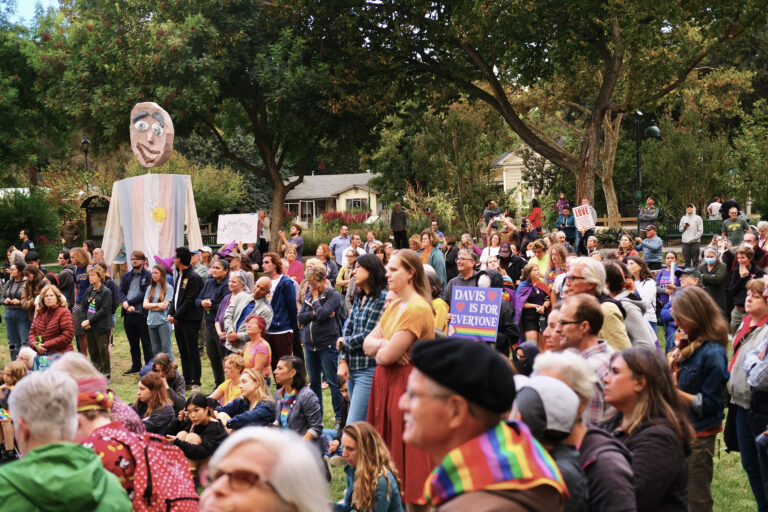
On Oct. 10, in light of several bomb threats that contained hateful messaging made to Yolo County public institutions, including the Davis Library and Yolo County schools, the Davis Phoenix Coalition (DPC) alongside Yolo County public officials, teachers, city councilmembers and more joined together in Central Park to issue a joint letter that stated “Yolo County is for everyone.”

As each speaker took the stage, the crowd of over 100 people waved pride flags and signs reading “Davis is for everyone.” People in the crowd took photos and looked to the sky as a rainbow formed above those demonstrating. 

Protests against expressions of LGBTQIA+ Pride, such as rainbow flags in classrooms and rainbow crosswalks on streets, have been occurring for months, according to the joint letter. The city of Davis has experienced five bomb threats since late August, some of which contained anti-LGBTQIA+ rhetoric. The letter states that “extremists” have attacked Yolo County public institutions through their protests. 

“They have spread prejudiced disinformation about the LGBTQ community to arouse outrage,” the letter states. “They have deliberately courted attention from extremist media and, in the wake of this publicity, our library and schools have received multiple bomb threats, each accompanied by vicious anti-LGBTQ language. They claim to want to protect children, but instead, our children have been put in danger.”

State Assembly Member Cecilia Aguiar-Curry spoke at the event about her pride in the Yolo County community despite the recent events.

“It worries me that there are people that have so much hate and so much prejudice, that they take it out on our community, putting fear into the lives of so many of our teachers, our librarians and ultimately our children,” Aguiar said. “The Yolo County I know is full of love. Davis is for everyone. Trans rights are human rights. These recent events do not reflect the Yolo County that I know.”

During the event, Kelly Wilkerson, a high school teacher and trustee for Yolo County community colleges, shared her experiences with having her information shared online. Wilkerson said that she had been doxxed by a local organization.

“I wanted to share with you what it’s like when a member of an extremist group [doxx’s] you, when they put your name and your face and your school location on social media [and] blast where thousands and even millions of people can see an out of context post,” Wilkerson said. “Then you pray. You pray that you and your family will be safe and you pray for your students’ safety. Ever since a tiny group of extremists have organized in Yolo County, I have not felt safe and many of my students no longer feel safe.”

Wilkerson continued by stating that these groups have held anti-transgender protests in front of Yolo County high schools, intentionally scheduled for lunchtime or at the end of the school day so students are forced to walk past them.

Congressperson Mike Thompson, who was not available to attend, prepared a statement that was shared by Yolo County Supervisor Lucas Frerichs.

“When we stand together as a united front we create a formidable barrier against divisive ideologies,” Frerichs said as he read Thompson’s statement. “Unity ensures that we foster strength through diversity and understanding. By building a sense of belonging and understanding among us we create an environment where extremist ideologies find no ground to grow. In unity we find strength and in resilience we find the power to overcome proving that together we can withstand any threat and build a safer, harmonious society. Our diversity is our strength and our unity is our power. Thank you all for your work to stand up to the hatred and divisiveness and please know that I stand with you.”

Mayor Will Arnold was another one of the speakers and he encouraged the audience to shout the “Davis is for everyone” chant.

“Here in Davis, we are unwavering in our commitment to these principles. We refuse to let division poison our community and shatter our unity,” Arnold said. “We stand firm together as a beacon of hope, love and inclusivity and we stand united with those who are under attack and in defense of our students, our teachers and our entire community. I am so proud to stand here with you.”


Written by: Madeleine Youngcity@theaggie.org

Yolo County Moms for Liberty members rally before Woodland school board meeting

The group spoke at the Woodland Joint Unified School District meeting 


By CHRIS PONCE — city@theaggie.org


Content Warning: This article contains discussions of transphobia.


On Thursday, Oct. 12, Yolo County Moms for Liberty held a rally in front of the Woodland Joint Unified School District (WJUSD) office to advocate for “parental rights” and protest against “gender identity” and “inclusivity training,” according to a flyer the group made. Following the rally, residents debated the rights of transgender youth during the school board meeting public comment section. 

A dozen residents, some members of Yolo County Moms for Liberty and some sympathetic to their cause, gathered in front of the school board office carrying signs that read, “Why are so many girls having double mastectomies?” and “Accepting biological reality is not hate.” Kathy, a person who attended the rally, grew up in Davis and has been a Woodland resident for four years. She preferred not to share her last name or if she was a member of Yolo County Moms for Liberty because she believes the group has been “demonized.”

“I wanted to support parents rights, parents being able to decide what their children are taught and some of the things that are being taught to children right now aren’t even scientifically accurate,” Kathy said as she explained why she attended the rally.

Kathy said that she is very pro-woman but has never identified as a feminist. She also believes that feminist issues are at odds with trans issues. 

“I don’t know where the feminists are, they’re erasing women,” Kathy said. “This transgender ideology essentially erases women because now men can do all the ‘women things’ and call themselves women by putting on a skirt, and not even sometimes that.” 

Kathy expressed that those who attended the rally’s goal is to protect children and that she is only concerned with people transitioning in their youth.

“My main beef is not with people who are transgender, please make this clear,” Kathy said. “I have no problem with transgender people. I have a problem with children being medicalized before they really are adult enough or have the capacity to understand what that means to their medical future.”

Laura Brubaker, a Woodland resident with children who attend WJUSD schools, addressed Yolo County Moms for Liberty at the meeting. Brubaker spoke about how Davis residents have been speaking at WJUSD meetings, misrepresenting the beliefs of the Woodland community. 

“I’m speaking today to draw attention to some things that, as a Woodlander, I find really upsetting,” Brubaker said during the meeting. “An extremist group called [Yolo County] Moms for Liberty has been using social media to encourage outsiders to call in and attend or WJUSD meetings and make public comments, intentionally not mentioning that they live in other places and do not have students in our schools [in] an attempt to misrepresent the interests of the Woodland community as a whole.”

Beth Bourne, chair of Yolo County Moms for Liberty, addressed the school board during her public comment. She listed several California school districts who have attempted to mandate that schools notify parents if their children are transgender. Bourne believes that the WJUSD needs to adopt a similar policy.

“You’ve heard from your teachers; they are promoting gender ideology, and they will secretly transition children,” Bourne said. “There’s no requirement that they tell the parents. And I know they’re laughing, but that’s the case. I encourage you to let parents have a right [to be notified if their child is transgender]; loving parents let their gender non-conforming kids grow up to be gay, lesbian, bisexual or straight with their body intact. Hate is telling a child that everything central to their physical being is wrong with them, that they were born wrong, that their healthy body needs fixing with surgeries and drugs. That is the abuse, that is the hate.”

Anoosh Jorjorian, director of Yolo Rainbow Families, talked about the Davis Phoenix Coalition’s work to combat bullying and hate crimes in Yolo County. Jorjorian thanked the WJUSD Trustees who signed the “Yolo County is for Everyone” joint letter and thanked those who spoke at the “Davis is for Everyone” rally held on Oct. 10. 

“We do not want to see these tactics of bullying, harassment and intimidation happen to educators in Woodland,” Jorjorian said. “The Davis Phoenix Coalition has a video about digital hygiene to help anyone who may be targeted by Moms for Liberty for being LGBTQ+ or LGBTQ+ allies, just as we have in Davis. We are ready to stand with Woodland teachers for safety, security and freedom of expression for all.”


Written By: Chris Ponce city@theaggie.org

Why the invention of the loading screen is particularly genius

Man-machine interaction, psychological time and the loading logo


By MAYA KORNYEYEVA — mkornyeyeva@ucdavis.edu


Have you ever opened a software, clicked download on an update or fallen off a cliff in a video game? Each such action results in a miniature pause on the screen that triggers a series of complex calculations within the inner workings of the computer, which is presented through the loading screen: a page that lets the user know that their device is still working while keeping the users’ attention and providing a form of entertainment. 

While this loading screen is often not given a lot of attention (or is outright ignored), I have always been fascinated with the wide range of colorful circles, dynamic animations and well-integrated graphics. Each and every browser or game has a unique waiting page, which performs an indispensable role in keeping users informed and entertained.

One of the first — if not the earliest — examples of a loading screen was used in the NCSA Mosaic, a discontinued web browser that was crucial in the popularization of the internet in the early 1990s. It featured a rudimentary loading interface that appeared when users clicked download on a file, and was the predecessor to the thousands of creative loading logos that were designed by web developers in the years following. As the World Wide Web (WWW) became more accessible and interconnected, two major types of loading designs were introduced: the throbber and the progress bar. 

The throbber, or loading icon, is a simple animated graphic element that shows activity in the computer or game program. Many famous throbbers include variations on the loading circle, with some form of spinning pattern that lets users know to stay on the page. On the other hand, progress bars are more linear and give a rough estimate of the remaining wait time. 

What I find particularly groundbreaking about the loading screen is its potential to be fairly interactive, with the goal of keeping the player present and happy. No one, including myself, likes to sit on a loading screen forever, and with our shortening attention spans companies are forced to get creative to retain an audience. 

Many video games took the idea of a loading screen and transformed it from an interruption into a seamless experience that gave small tidbits, fun facts or gameplay tips to the user. 

In Nintendo’s newly released “Zelda: Tears of the Kingdom,” players can see an artistic graphic design in theme with the game — alongside short messages with hints on how to prepare well for battle or face unfavorable weather conditions. The same can be said for “Minecraft,” which keeps players entertained with comments on interesting features of the game while presenting a progress bar and a panoramic view of the map in the Bedrock and Legacy loading screen versions. 

The decision between showing a progress bar and providing the user with a sense of time, or otherwise leaving a repeated activity indicator if no time estimate can be given, raises the question of how best to improve User Experience/User Interface (UX/UI) design in any given program. How do you keep the player from closing the page or giving up, thereby diverting their attention elsewhere? Is it kinder to leave them with a concept of time and provide some psychological comfort? 

These questions were explored in several studies, one of which focused solely on the importance of percent-done progress indicators in human-computer interaction. The findings supported the idea that such percent-done graphical techniques are imperative to keep in mind when engineering man-machine interfaces, and are a necessary and useful tool for most computer programs. The researchers were also able to determine that progress bars can make a program more attractive and effective, while throbbers have less of an effect. 

With all that in mind, loading icons are not only fun to watch and interact with — such as the famous Google dinosaur game — but they are constantly evolving with our improvements in technology. While they may seem deceptively simple at first glance, they truly play an essential role in almost any computer program.


Written by: Maya Kornyeyeva — mkornyeyeva@ucdavis.edu


Disclaimer: The views and opinions expressed by individual columnists belong to the columnists alone and do not necessarily indicate the views and opinions held by The California Aggie.

UC Davis Internship and Career Center invites students to further their career journeys at upcoming fairs

Both the Business and Public Service Career Fair and the STEM Fair at UC Davis will cater to students and alumni


By LYNN CHEN — features@theaggie.org


For college students, entering the post-graduation world may seem like a daunting task. Fortunately, the Internship and Career Center (ICC) at UC Davis is here to help students navigate their first steps.

On Oct. 18 and 19, the ICC will be hosting the Business and Public Service Career Fair as well as the STEM Career Fair that are open only to students and alumni. Each event will last from 10 a.m. to 2 p.m. and will take place at the University Credit Union Center.

Employers will come to the fair to recruit potential UC Davis students to their respective companies. 

“Rather than having students who have to go out and find these employers, we bring them to campus,” Executive Director at the ICC Marcie Kirk Holland said.

At events like these, students usually arrive dressed in formal business attire with polished resumes in hand. Some undergraduates research the attending companies beforehand in order to rehearse elevator pitches to these recruiters. 

The Business and Public Service Career Fair, like the name suggests, will feature employers from areas like finance, management consulting and marketing, but also fields like public policy, education and sustainability. On the other hand, the STEM Fair will have employers in interest areas like biomedical engineering, food science and agriculture.

Splitting the usual Fall Career Fair into two separate events is a new move by the ICC, according to Holland. 

“Traditionally, in the fall, [we] offer a fall career fair […] [however], there were so many employers interested in hiring Davis students that we couldn’t fit the demand of all the employers,” Holland said. “So we [looked] at how to maximize student access to the most employers possible and decided to split [the fair] into two days.”

However, Holland emphasized that students going to the Business and Public Service Career Fair may also find opportunities at the STEM Fair. Just because a company has a STEM mission doesn’t mean it can’t offer business-related positions. More importantly, Holland stressed the importance of students going to the fair in general.

“For many students, [applying for a job] is brand new to them, and it’s human nature to avoid things that are difficult and you don’t know [about], but avoiding looking for a job until you graduate has consequences,” Holland said.

“I don’t want to freak people out,” Holland said. “You look when you look, and it’s never too late, but the kinds of jobs that are available at career fairs in the fall are different from the kinds of jobs that will be available to students if they wait to do their job search after graduation in June.”

For many organizations, especially larger ones like Fortune 500 companies, as part of their strategy in university recruiting programs will have a set number of jobs that new college graduates can fill. These deadlines are usually in December.

As such, quarter-system schools like UC Davis are already at a disadvantage as they start university later than schools on the semester system. 

Some students have already engaged with recruiters early on through virtual career fairs that the ICC hosts before fall quarter begins. For others who did not attend virtually, the upcoming career fairs will represent a second opportunity.

Furthermore, even if students are unsure of what specific career positions they’d like to pursue, certain companies at the career fairs next Wednesday will offer management training programs for students.

These programs rotate interested students through cycles lasting from six months to a year to try out different roles within a company or industry. Once the programs are over, participants get to decide what is the best match for themselves within the company. 

A student may work in a finance rotation program at a bank, a position they were able to acquire in the fall through the ICC career fairs, according to an example by Holland. In contrast to students who applied for a job position at the bank in June after graduation, the student in the finance rotation program would be able to acquire a more desired job position. Thus, a student like this would be on a faster track for advancement within the company.

“There are jobs that tend to have a career trajectory to them,” Holland said. “[The jobs] include mentoring [as well as] the intent [to] hire the right people first and then see where they fit.”

“There are these really great opportunities for students, [but] not enough UC Davis students are taking advantage of these opportunities that we want them to have,” Holland said. “[These opportunities] can really set them well up for career success.”

The ICC has made several efforts to help undergraduates get a head start in their careers. Other than splitting the usual fair into two to aid students in accessing more employers, the ICC hosted a Career Fair Prep Week right before the two fairs. The week-long event included activities such as Resume Boost, lessons on preparing for the fairs and drop-in advising sessions for students looking for interview tips and ways to refine their LinkedIn profiles.

The ICC will also be tabling a booth at the upcoming fairs for students who don’t feel prepared for the events.

“On one hand, we want students to do their research on companies, have their resumes, dress well and all these things, but we don’t want students to think if they haven’t done all that they shouldn’t come,” Holland said. “There’s still value in coming.”

Holland encourages students to just explain their situations to employers — such as being in workout clothes — and express a genuine interest in the recruiters’ companies.

“We’ll have people at our ICC booth [during the fair] coaching students on how to be ready to go talk to an employer,” Holland said.

Holland also recommends those attending to find a company of the right fit. 

“Certain organizations have more name recognition but that doesn’t necessarily mean it’s the best match for somebody […] There are lots of small to mid-sized organizations that have really great opportunities for students, but [students] may have never heard of them before,” Holland said.

Additionally, it is best for attendees to set realistic expectations for themselves and not feel discouraged if certain interactions with some employers are not ideal. “If you have a less than positive experience with one, move on to the next one,” Holland said.

The ICC also posted an Instagram video detailing advice employers have for Aggies planning to be at the career fairs.

Lastly, for those who are hesitant or unsure of attending, especially undergraduates who have never attended a career fair before, Holland advised those to still attend the upcoming events to get a feel for the experience and explore potential future career options.

Despite mental obstacles that may deter some undergraduates from attending, many students have set their minds on being present at the career fairs.

Phoebe Chu, a third-year sociology organizational studies major, expressed her hopes of being able to use the ICC fairs to her advantage. 

“I think that if I really am able to find [companies] that I’m interested in, meeting with the recruiters in person definitely gives [me] some edge,” Chu said. 

Chu is interested in positions related to human resources and seeks to find an internship for next summer.

Mihini Jayasinghe, a third-year political science major and human rights and education minor, expects to explore the many opportunities the fair will offer her. Her current career plans are to apply to law school after college and become a lawyer specializing in child advocacy.

Jayasinghe will also be tabling for the Sacramento Valley College Corps, which has a focus on career outreach for fellow students. 

“I’m really interested in getting to walk around and seeing all of the different opportunities and employers that are available,” Jayasinghe said. “[There will] just be a lot of me being involved with the fair and also me being excited to see what’s happening there as well.”

Like Holland explained, “[For] most things, it’s just that first step that’s the hardest, right? And that’s why we have career fairs — to make the first step as easy as possible.”


Written by: Lynn Chen — features@theaggie.org


The Cherry Tea Collective club at UC Davis raises money and awareness for various charities through their art

0

An inclusive group of student artists, designers and writers self-publish a charity-based zine


By LYNN CHEN — features@theaggie.org


The Cherry Tea Collective is a charity-based art club that consists of artists, writers, poets, photographers and other creatives. Every school year, the club publishes a zine — a unique, self-published mini-magazine — on a theme that is usually related to a specific charity organization. Club members contribute artwork, writings and photos to appear in the zine, which is then sold to the school community.

Past themes and charity organizations the zines have raised awareness for include “Earth and Nature” for the Earth Day Network, “Bonds Between People” for The Trevor Project, “Dreams and Fantasy” for The Lunchbox Fund and “Oceans” for The Ocean Cleanup

Along with original merchandise, such as stickers that are designed by members, proceeds from the club go toward the charity of focus.

The process of publishing the zine requires lots of meticulous work and planning. During fall quarter, members vote to decide on a charity-focused theme for the upcoming year. In winter quarter, the club spends time producing and assembling creative content for the zine. Finally, after making final adjustments and printing the booklets, the club prepares to sell the zines on Picnic Day.

Throughout this extensive project, zine contributors may run into creative challenges.

“It is sometimes hard to create art for the theme […] It just really depends on, like, where your brain is at when you first get the prompt,” said Emma Lopez, a third-year aerospace engineering student and artist for the Cherry Tea Collective.

During the process, board members also need to stay on top of planning, delegating responsibilities and financing the club. Club President Mia Karlsson, a fourth-year molecular and medical microbiology major, has to think ahead for every quarter to prepare for events. 

“I need to keep track of the dates that all of the events are on, [decide] what we need to have ready before the events […] think about what we’re all going to say during the events, who’s going to work at the events […] plan meetings and write meetings,” Karlsson said.

The collective also needs to apply for grants from the Student Finance Council on time in order to fund itself properly and keep its members engaged.

“Generally, this is a very independent club,” Karlsson stated. “People work by themselves at home and then submit their work online to us, so it’s not a social club.”

Karlsson discussed the possibility of modifying the club to create an atmosphere that’s more interactive and social. 

“It would be nice if people could meet each other in the club,” Karlsson said. “So I’ve been trying to come up with ideas.”

Despite difficulties members and the club as a whole have faced, the Cherry Tea Collective has still fulfilled its role as a philanthropic organization, like the pun on “charity” its name suggests.

The club was able to make donations to the several charity organizations that made up the theme for Cherry Tea Collective’s zines, according to their Instagram. In 2023, the collective raised $394.49 for The Ocean Cleanup. In 2022, $1068.28 was given to The Lunchbox Fund. In the year prior to that, $552.53 was donated to The Trevor Project.

Members of the club found joining it to be a worthwhile and rewarding outlet for their creativity. 

When asked what inspired her to join the Cherry Tea Collective, Lopez said that it was the fact that the club enabled her to use her artworks for good.

“I love being able to give back to communities,” Lopez said. “I love being able to help out in whatever way I can. [I] don’t make much of an income […] to matter enough to donate, so being able to do something that I can create and [put] towards charity was really admirable [for the club to allow me to do that].”

Michelle Khuong, a fourth-year neurobiology, physiology and behavior major who works in public relations and is the secretary of the Cherry Tea Collective, said that she marveled at the creativity people were able to display in the zines.

“I think it’s great that we can compile all different kinds of art forms like photography, writing, and drawings and see the different interpretations of the theme for that year into one zine,” Khuong said via Discord direct messaging.

She herself joined the club to become more productive when making art and maintaining her creative flow. 

“I initially wanted to join the [club] because I was trying to overcome an art block at the time and wanted to find a smaller club that would motivate me to draw more and overcome my art block,” Khuong stated.

Karlsson also noted the creativity she finds in her members’ work. 

“I’m not tracking anyone in particular, but I do notice that people will try [to] experiment a little bit in different mediums,” Karlsson stated. “Someone [might] say ‘oh man, I’m not great at art, but I’m gonna try sewing.’” A member who said something similar ended up making a beautiful fabric-sewn piece with laces representing seashells, according to Karlsson.

“I hope that people see that the people [in the club] are creative, artistic and also caring about our communities,” Karlsson said. “We want to help make a difference through something beautiful.” 


Written by: Lynn Chen — features@theaggie.org


Spotlighting students in the UC Davis SEED Scholars program

0

The initiative has helped students with intellectual disabilities find community and acquire both life and job skills as they become independent


By AMBER WARNKE — features@theaggie.org


The Redwood SEED (Supported Education to Elevate Diversity) program is one of the newest disability programs at UC Davis. Designed to support students ages 18 to 23 with intellectual disabilities in life and job skills training, the organization began supporting its first students in 2021, with the oldest students in the program currently in their third year.

Students in the program live in on-campus dorms, are encouraged to join clubs and organizations and receive support from peer mentors. Ian Hutchings, a second-year SEED scholar, enjoys living on campus and the activities on campus. While he found it difficult at first to live so far away from his family, he enjoyed his experiences meeting new friends and participating in activities around campus.

 “It’s fun here, hanging out with friends,” Hutchings said. “I’ve gotten to know a lot more people here…I love hanging out at the MU with my friends and seeing the football games… I belong here.”

Ryan Fitch, a third-year SEED scholar, has similarly made new friends and branched out through the program. 

“I did miss my parents and brother Aiden, but it was actually really fun being here with my new friends,” Fitch said. 

While some students found it “nerve-wracking” to transition to life on a college campus, many students come to love and enjoy living and learning as a community, according to Roshan Khandhar, a first-year SEED scholar. 

“It was really scary, because it’s a big campus … the campus is about 5,300 acres,” Khandhar said.  Once he adjusted, however, he found that it became a place where “everyone [was] welcoming,” calling it “a fourth home and family for me.” Now, he wants people to know that “special needs people are not alone and whether it’s in a private or a public school, there is a program that can help them thrive…There’s always a place for them, they’re not alone.”

In addition to focusing on relationship building, which the program does through offering classes in social and life skills, SEED scholars can also expect to be introduced to a variety of job opportunities around campus at the beginning of spring quarter of their first year. 

As students adjust to their jobs, they move through what the program calls “Ladders of Opportunity,” which develop the stamina to work longer hours and more days during a student’s third and fourth years. Fitch works for Aggie Media as a photographer and used to work at UC Davis School of Veterinary Medicine as a videographer where he says they “gave me a checklist of things to do, so I did them.” His goal is to become a graduation photographer after he graduates.

Khandhar aspires to be independent and follow his passions in the future.

 “I want to live in my own apartment near my parents. Once I’m on my own, I will buy my own gym membership,” Khandhar said. Khandhar is preparing to become a physical trainer for people with intellectual disabilities in his future, having experience in swimming, basketball, golf, soccer, baseball and softball. 

Students in the SEED program take part in life-planning exercises, including brainstorming and preparing for future career choices. This is accomplished by assigning each year of students their own cohort, with whom they take “foundational, customizable courses as well as credit-bearing UC Davis courses in their areas of interest,” according to the UC Davis website’s information page on the program.

Over the course of four years, these programs, courses and opportunities can have a lasting impact on a student’s career potential. One 2020 study found that 59 percent of students with intellectual disabilities who went through a Transition and Postsecondary Program for Students with Intellectual Disability, which the Redwood SEED program is defined as, were employed a year after graduation. The same study contrasts that number with 19 percent of their peers who did not go through this program. Currently, only 263 of the nation’s more than 4,700 degree-granting institutions offer programs for students with intellectual disabilities, according to an article by The Atlantic. 

In addition to raising awareness of the SEED program and its benefits to people with intellectual disabilities, UC Davis students can help support the program by applying to work as mentors. The SEED program currently employs over 100 UC Davis students as mentors in five areas: academics, social inclusion, health and wellness, employment and residential housing. 

“There’s always a spot to help, to be a mentor in the program,” Hutchings said.


Written by: Amber Warnke — features@theaggie.org


New to campus? Here’s some advice to make the most of your first quarter

Students and teacher assistants offer insight into useful resources for incoming Aggies 


By LORENA ALVAREZ — arts@theaggie.org


While many incoming students were initially drawn to UC Davis’ tranquil and alluring campus, the transition into a quarter system, composed of three ten-week quarters, can be difficult. This is especially true for students who are unaware of the abundant resources available to them.

Melina Rodriguez, an associate instructor for first-year English composition and previous ENL 10B, 113A and 117 teacher assistant (TA) noted a TA’s role in a student’s academic experience. 

“[Being a teacher assistant is] about being accessible to help navigate and understand the material a bit more when the professor might not be able to really meet with [students] and give them as much one-on-one time or understanding of a lot of things,” Rodriguez said. “Because of the shortness of a lecture, time is really not in our favor sometimes, especially with the quarter system. So I think the TA is there to help supplement and support that learning process.” 

Rodriguez went on to comment on some helpful tips she has for balancing workloads, especially readings. 

“My biggest thing is also pacing yourself with the reading load — not overwhelming yourself thinking that you have to fully 100% understand every word in a chunk of something because you’re never going to get through everything if you’re freaked out about every single [word],” Rodriguez said.  

They continued by stressing that understanding the initial reading doesn’t determine a student’s success in the class. 

“I think the idea is that in class, as time goes on, you’ll be able to understand it more and more,” Rodriguez said. “So that first read-through is less important and less of a time commitment.” 

They also noted some advice they have for humanity students struggling to understand where their writing has failed to meet their professors’ expectations and how they can meet them going forward.

“Go directly to the professor, not just the TA to really clear up your anxieties around [grading]. And if that doesn’t end up helping, then I would say really pay attention to what kinds of things they are mentioning in class,” Rodriguez said. “What kinds of things are they drawing attention to in their feedback on your papers? And if these are all things that you’re not quite sure about yet, then I would say to focus on the big components of what usually go into English papers, like the argument itself [and] the use of evidence. If all of that seems to be working out, then it’s probably [more about] focusing on clarity.”

Rodriguez went on to note the resources available to help students through the writing process. 

“Writing is something that people assume you’re either good at or you’re not, but it’s really a very steady learning curve,” Rodriguez said. “[A helpful resource available to all students is] the Writing Center. The people there are always willing to help. TAs and professors are usually more open to explaining things more thoroughly than you might think,” Rodriguez said.
When asked what advice they would give first-years, Nathalie Moriarty, a fourth-year Ph.D. developmental psychology student and TA for developmental courses commented on time management, echoing a theme in the path to a successful quarter. 

“The best way to manage your coursework is to pace yourself, have reasonable expectations and be consistent. Cramming and dumping is not sustainable, especially in a ten-week quarter. Take hybrid courses if you can, because they are often well-paced and highly structured. Check Canvas often and plan assignment/study time intentionally and in advance,” Nathalie, who prefers to go by their first name, noted. 

They also commented on the sudden emergence into the unknown territory of campus and adulthood that many first-year students experience, noting all the resources readily available to them.

“This is their first taste of adulthood, and it’s in a college town where a huge proportion of the population is young people like them. Make friends with your roommates and classmates and get involved in other social events. Get to know your community advisors, TAs, professors and anyone else who might have advice for you,” Nathalie said. “Whatever your need is, there is a way to have it met — like [The Pantry], financial loans, resource sharing and many more.”. 

They went on to note the importance of being active participants even when there is change and uncertainty. 

“Embrace the changes, try new things, have fun — but don’t forget why you’re here,” Nathalie said. “So much of classroom success is dependent on a genuine motivation to learn and succeed. College will be much more difficult if you don’t participate actively in your own education.”

Shifting from academic advice, Jasmine Le, a third-year psychology major, commented on advice she has for living independently with other college students. 

“Take your time to figure out your priorities,” Le said. “It’s easy to get caught up in staying afloat at times, so it’s always nice to have general plans in mind to guide you through your day-to-day. 

Le recommended practicing “clear communication with roommates” and “[bringing] things up kindly to avoid fighting over little things.”

Entering a quarter system and transitioning into the unfamiliarity that comes with college can easily become overwhelming, but don’t worry: you’re not going through it alone. 


Written by: Lorena Alvarez— arts@theaggie.org