57 F
Davis

Davis, California

Monday, December 22, 2025
Home Blog Page 167

Chris’ Culture Corner

The Art Desk’s weekly picks for movies, music and more


By CHRIS PONCE  — arts@theaggie.org


Book: “Wild: From Lost to Found on the Pacific Crest Trail” by Cheryl Strayed (2012)


Truth be told, I have been wanting an excuse to talk about this book since I finished it. In fact, this might be a major reason for me taking over Culture Corner this week (that and my impeccable taste, of course.) But if my recommendation isn’t reason enough for you to pick up a copy of “Wild,” Strayed’s clear and easy-to-follow writing should be. Her style is welcoming for new readers and bookworms alike. “Wild” isn’t your typical hiking memoir either; instead, Strayed vulnerably tells the story of overcoming and accepting grief, tragedy and addiction. As Strayed recounts the story of her 1,000+ mile trek on the Pacific Crest Trail, she beautifully reflects on her life, accomplishments and, perhaps most interestingly, her mistakes. Her writing is so engaging that as you begin turning the pages of the book, you feel as if you are walking by her side on the trail — every step of the way. 


TV Show: “The Last of Us” (2023) 


Maybe it’s because of the Pedro Pascal thirst-trap TikTok edits on your “For You” page or because it’s currently one of HBO’s most-streamed shows, but either way, you are likely familiar with “The Last of Us.” The popularity of the show is well deserved, so if you haven’t had the chance to watch it yet, I hope this serves as a final push for you to do so. While “The Last of Us” is another zombie apocalypse show on the surface, the heart of the story is about what makes survival worthwhile in the first place. Performances by Bella Ramsey and Pedro Pascal bring the beloved characters from the video game that the show is based on to life. With only a couple of episodes remaining, now is the perfect time to binge the series (and play the original game while you’re at it). 


Movie: “Everything Everywhere All at Once” dir. by Daniel Kwan and Daniel Scheinert (2022)


Wow, just wow. Where do I even start with this one? There aren’t many movies like “Everything Everywhere All at Once,” which manages to tackle the concept of the multiverse through both philosophical and comedic lenses. But beyond being a philosophical trip through the multiverse, this movie is about family and the things we assign meaning to. You’d expect a movie like this to be full of dread and leave you feeling empty, but the beauty of the story is its portrayal of joy. The takeaway of “Everything Everywhere All at Once” is not that everything is meaningless; instead, the takeaway is that we get to decide what has meaning for us. The cinematography and editing are unmatched, and even more impressive considering how small the crew was and how quickly they filmed the movie. With the Oscars approaching, you’ll be hearing more about this movie if you hadn’t already, and luckily, the Davis Varsity Theatre is still showing it, so it’s not too late to see it on the big screen. You won’t regret seeing “Everything Everywhere All at Once,” and I’m willing to bet that once you do watch it, you won’t be able to shut up about it either.


Song: “Kids” by Current Joys (2020)


“Kids” is a song that will remind you of the youthful cluelessness we have all experienced (and might still be experiencing). It’s a touching perspective about the mistakes we make as kids. Instead of looking at adolescence through a critical lens, this song embraces the messy imaginative spirit of being a kid. It’s perfect to throw on during a car ride with friends, walking around campus with your headphones on or even just to unwind and relax to. If you like this song, I recommend listening to everything else Current Joys has to offer.


Written by: Chris Ponce arts@theaggie.org

Chancellor answers questions on housing, return of Turning Point USA at Feb. 28 special session of the Senate

He also noted that the UC Davis COVID-19 state of emergency has officially ended


By SONORA SLATER — campus@theaggie.org


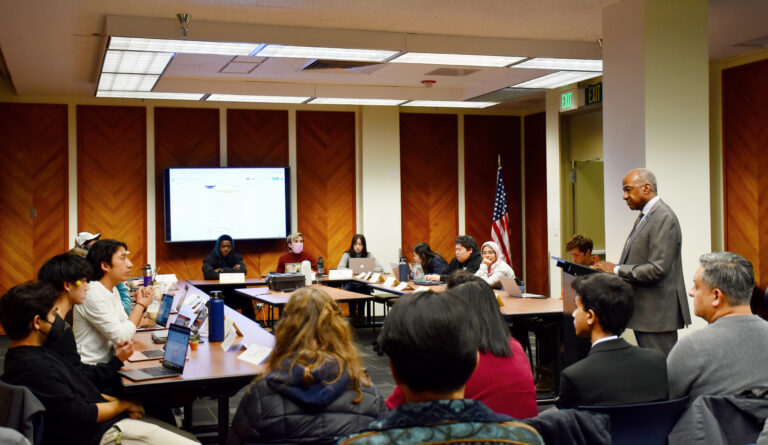
At 6:10 p.m. on Tuesday, Feb. 28, Vice President JT Eden called the special session of the Senate to order. He called roll, establishing quorum, and read the UC Davis Land Acknowledgement. 

The meeting then moved into a presentation by UC Davis Chancellor Gary May, which was the main purpose of the special session.

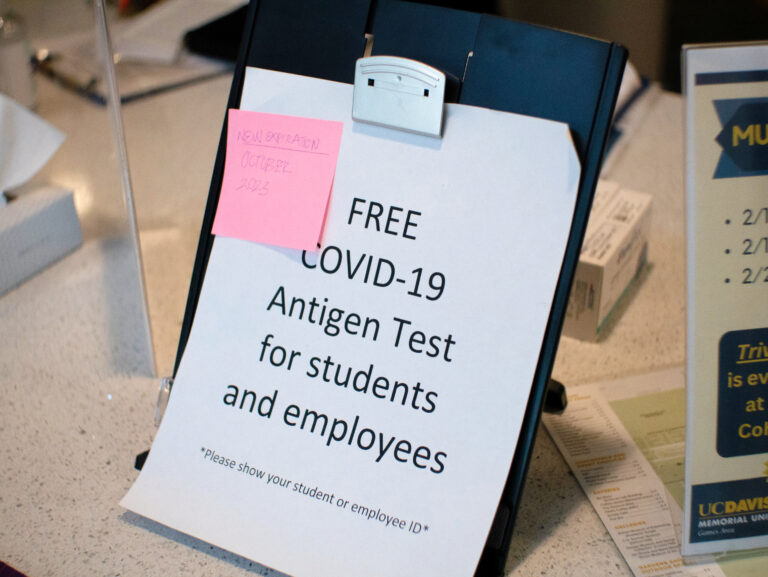
May first thanked the Senate for their recent work serving the UC Davis community before diving into his presentation. He began by noting that UC Davis had ended its COVID-19 state of emergency that morning, along with officially ending the campus’s daily symptom survey. He said that free antigen tests are still available at various places on campus, and community members are still encouraged to test if they experience symptoms. 

“No one is sad about any of this,” May said, referring to the end of the state of emergency. “The infections continue, but the impact is so much different than it was three years ago.”

He then talked briefly about the collaborative campaign launched in January by UC Davis and the city of Davis known as “Hate-Free Together,” which was launched in response to a series of hate incidents, with the goal of combating discrimination in the Davis community. 

May connected this to the larger issue of hate speech being discussed in the Davis community, making a brief statement about the upcoming speaker event hosted UC Davis’s chapter of Turning Point USA (TPUSA); the group’s last speaker event was canceled before the talk began after protests outside turned violent

“Hate speech is a complicated issue,” May said. “It’s protected under the first amendment — as a public institution, UC Davis is obligated by law to guarantee freedom of speech and expression, which is central to our higher education vision. In dealing with hate speech, I believe our best way forward is not to silence those whose opinions we find offensive but to rebut them, ignore them, condemn the hate and empower with something better.” 

Next, May talked about the university’s goal to be designated as a Hispanic-serving institution by next fall, which is defined as a higher education institution with 25% or more total undergraduate Hispanic or Latino student enrollment. According to May, UC Davis currently falls about 300 students short of this designation, with 24.7% Hispanic enrollment. He said that once it earns this designation, the university will be able to apply for certain grants. 

The final point of May’s presentation was focused on highlighting plans for the spring commencement ceremonies, which will take place at the Golden 1 Center for the first time. 

The floor was then opened to questions. 

Senator Priya Talreja asked for an update on the Fossil Fuel Free plan, and May said that a draft report will be available soon for feedback. Senator Gaius Ilupeju asked for May’s help with promoting the upcoming spring ASUCD elections in order to improve voter turnout, and May said he would be happy to collaborate with the Senate table for that purpose. 

Fujimoto asked about whether the university is looking to add more on-campus housing, following stories of students lining up overnight at leasing offices to sign a lease. 

“There are some activists in the city who want us to do more; they want us to build higher,” May said. “But if you go higher, it’s more expensive, so that’s not the solution we want to go with. We think that if we encourage more construction around the campus to push down prices, that’s probably better.” 

Transfer Student Representative Logan Ueno also asked about housing. Ueno specifically asked about a proposal to change the leasing period at The Green to just during the school year as opposed to a 12-month period.

Vice Chancellor for Student Affairs Pablo Reguerín, who was present at the meeting in the audience, said that the price point per month will increase because of this change, but that it is being proposed to better align the time when rent is due to when financial aid applies, and therefore decrease the net cost to students. In response to follow-up questions, he added that they will have “summer school housing” available and will work with reentry students or others who stay on campus over the summer on a case-by-case basis. 

External Vice President Celene Aridin asked May if the university is planning to turn the ARC into an on-campus voting center again for upcoming elections, and he said that they are. She also expressed complaints about the slow voting process at these centers, to which he said that he is happy to work with the county to try to make things more efficient this year. 

Next, May answered a question about the TPUSA event coming up, saying that while he of course supports protests on campus, there are also alternative forms of expressing disagreement with the organization’s views that students can take advantage of.  

“I think it will be a very effective and compelling message if that speaker comes and speaks to an empty room,” May said. “Nothing would please me more.”

Reguerín added that ASUCD could hold hlding alternative programming on the same day and time as the speaker event.  

“One approach is to have more expression, more voice, so for me, holding an alternative event is a phenomenal way to do it,” Reguerín said.  

May concluded his presentation and left the room. The Senate removed the quarterly reports planned for that night from the agenda and adjourned at 6:51 p.m. 


Written by: Sonora Slater — campus@theaggie.org

We can’t keep acting too late on climate change issues

Key climate takeaways from Utah’s Great Salt Lake


By EMILIE BROWN — emrbrown@ucdavis.edu


In early January, a new study by Brigham Young University (BYU) predicted that the Great Salt Lake just outside of Salt Lake City, Utah, is on track to completely disappear within five years.

The lake is a habitat for 10 million migratory birds, feeds millions worldwide through fertilizer and brine shrimp and generates $2.5 billion in economic activity every year. It also increases precipitation, suppresses toxic dust and supports Utah’s wetlands. The study showed that, without a coordinated conservation plan, we can expect widespread air and water pollution, numerous endangered species act listings, agricultural declines and health issues for people living near the lake as a result of its disappearance. 

In response to the report, the state of Utah almost immediately began efforts to conserve the lake and has developed a $500 million plan to conserve the Great Salt Lake. 

However, we’ve known that the Great Salt Lake was drying up for years and the effects that could have. As a climate-change-fueled megadrought has swept the West, the Great Salt Lake has suffered. Already, it has lost 73% of its water and 60% of its surface area. So why are we only taking serious action to conserve it now? Why are we only spending so much on it now? Why are news outlets and city councils only talking about it now?

We keep acting too late on climate change issues. This is just one of thousands of examples.

These days, it’s easy to say you care about climate change. Yet a larger and larger gap is growing between caring about it and acting to help stop it. 

It’s easy to say you’re going to cut back your single-use plastic use, lower your meat and dairy intake or recycle more. But unless the solutions are incredibly easy or the problems’ effects are so apparent we cannot ignore them, few of us take action in our day-to-day lives. For the Great Salt Lake, serious actions were only taken after the effects of the lake drying up were already starting to become a problem and the issue was impossible to ignore. Ice caps melt, wildfires rage, ocean levels rise. Scientists predicted this could happen if we continued on the same track. But only now that the damage has been done do we start to care.

While we can’t change the past, we can change how we think and act about climate change issues today. Instead of procrastinating, we need to start taking small actions now. Whether that is commuting via bike instead of a car, buying oat milk instead of cow’s milk or washing your clothes on cold instead of hot, we all make choices every day that impact the environment and we get to choose whether it’s a positive impact or a negative one. 

Start thinking about climate change as an issue that is happening now, and start thinking about your everyday actions as actions that can help fight it. 


Written by: Emilie Brown — emrbrown@ucdavis.edu


Disclaimer: The views and opinions expressed by individual columnists belong to the columnists alone and do not necessarily indicate the views and opinions held by The California Aggie.

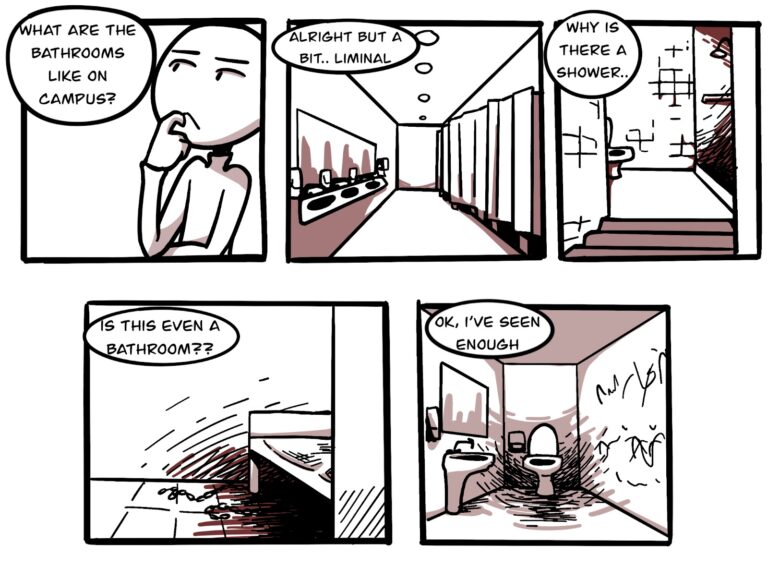
Bathroom hunting

Drawn by: Lidya Shcherbakova –– lvshcherbakova@ucdavis.edu

Disclaimer: (This cartoon is humor and/or satire, and its content is purely fictional. The story and names of “sources” are fictionalized.)

Construction set to begin on Bretton Woods Affordable Senior Apartments in North Davis but community is divided

The development promises to develop 150 affordable housing units for seniors in the city of Davis


By ANTHONY W. ZAMMIKIEL  — city@theaggie.org


The Department of Community Development & Sustainability is continuing to review the design application submitted for the Bretton Woods Affordable Senior Apartment Project, formerly known as the West Davis Active Adult Community, as the project is set to begin the construction phase.

“The proposed project will develop 150 affordable housing units for seniors,” according to the Development Projects section of the Community Development & Sustainability page on the city of Davis website. “The project includes two 75-unit residential buildings that will be 4-stories each and one freestanding 1-story community building.”

According to the applicant narrative and justification submitted to the department for the development project, the development will take up 5.64 acres of a larger 70 acre master-planned community development project. This comes after the Davis community voted to approve the plans in 2018. The development project will satisfy affordable housing requirements, with the 150 residential units including studios, 1-bedroom, and 2-bedroom units. 

The West Davis Active Adult Community development project was first proposed to the Davis City Council in 2018, and an amended development plan was approved after successive amendments to the original ordinance.

After being approved, the Davis community voted to affirm the decision within the vote for Measure L. According to the measure notice, all city ordinances require voter approval for projects that change the City General Plan’s land use designation. The development required a change of land use from agricultural to urban, so therefore needed voter approval.

However, the decision to approve the measure occurred before the state of California voted in the 2020 state election to approve California Proposition 19, which changed tax assessment transfers and inheritance guidelines by increasing the property tax rate for inheritance properties. This allowed for property owners above the age of 55 to receive an increase in tax benefits. The Bretton Woods Affordable Senior Apartment development supported Proposition 19 and included online resources describing the proposition, detailing how it helped to create more senior housing and why community members should support the proposition. 

However, the decisions to approve the initial development project and subsequently affirm the construction phase have encountered polarized responses throughout the Davis community. Barbara Williams, a Davis resident, expressed her appreciation for how the community understands the need for focusing on senior housing developments, and is prioritizing affordable housing.

“As someone who, if we are being honest, is just a little bit over the retirement age, I highly approve of the measures by the city in the previous four years to prioritize affordable housing for us seniors and allowing us more opportunities to continue living in this city, especially since we have our roots here,” Barbara said. “It is fortunate that I am in the position that I am in. However, I know too many people who have been pushed outside Davis because there are just not enough places for seniors to live here.”

Gigi Williams, another Davis community member, believes the city of Davis has become less anti-growth and argues that the city should not develop into the surrounding agricultural areas. Gigi is concerned that Proposition 19 has not been not applied equally to all California residents, and the Davis community is no exception.

“Let’s be honest here, Prop 19 and other similar propositions over the years concerning home ownership have historically benefited white Californians and there is a real storied history about people of color being blocked from home ownership in this state, either by implicit or explicit policies,” Gigi said. “Who are the people who are buying homes for the first time? They are Black, they are Latinx, they are Indigenous, they are largely people of color. And Prop 19 focuses on prioritizing these longtime homeowners instead of helping us folks out.” 

More information concerning the Bretton Woods Affordable Senior Apartments can be accessed under the Development Projects section on the Community & Sustainability Development page on the city of Davis website. The development plans include both the applicant narrative and justification submission and the development schematics. More information about the development process when the plans were originally submitted as the West Davis Active Adult Community can be located in the Approved & Pending/Under Construction section

Written By: Anthony W. Zammikiel  — city@theaggie.org

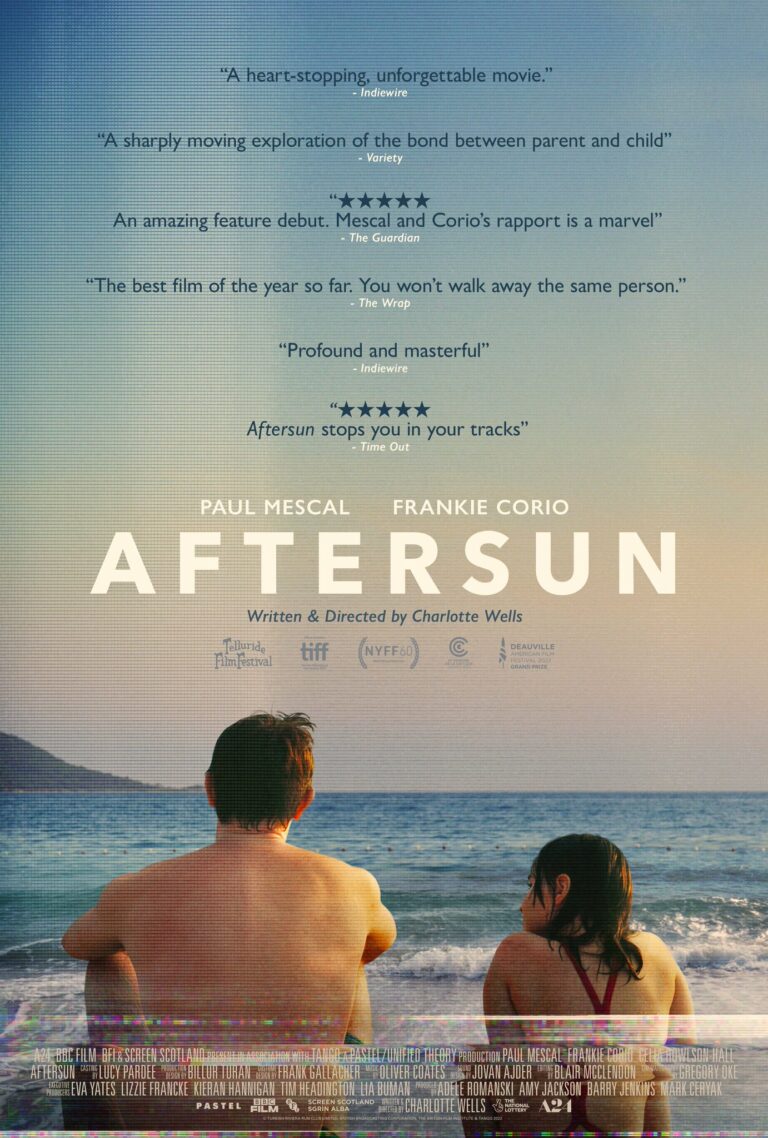
Review: Charlotte Wells encapsulates the lens through which we view parental figures in ‘Aftersun’

The nostalgic cinematography allows the audience to see the innate complexity of  parent-child relationships


By ANA BACH — arts@theaggie.org


Aftersun,” the directorial debut from Charlotte Wells, is an A24-produced film that premiered in theaters on Oct. 21 of last year. Frankie Corio plays narrator Sophie, through whom we see a story almost entirely made up of flashbacks of a vacation to Turkey she took with her father Calum when she was 11. The film is shot through Sophie’s perspective as an adult, looking back through camera recordings of the trip, which brings up recollections of the vacations’s niche details and experiences. Throughout, she reflects on what her father was going through at that time while she experiences similar feelings in her adult years. 

While the film is ambiguous, providing little context about Sophie and Calum’s relationship outside of the trip, the mental health struggles that Calum is dealing with or what happened to him when they returned from Turkey, but that background isn’t really necessary. If anything, the vagueness of the film makes the underlying themes more malleable to anyone watching, allowing viewers to fill in the gaps and add anecdotes to find personal relevance within the storyline.

The film does a beautiful job of capturing nostalgia through texture and composition. The natural light, color scheme and hazy nature of the old camcorder clips give the film its special backbone and unique character. Even the more simple moments captured on screen have an extreme beauty about them that resembles the way memories imprint in our minds; specific but mundane moments, like skin glistening in the sunlight or the feeling of someone you love’s hand applying lotion to your sunburn, turn into emotionally rich memories. 

The distinct texture in this movie produces the foundation for the dichotomy between the moments captured on camera and the memories that Sophie remembers. The texture that comes from memory is so vivid as the saturation comes more to life, especially since Sophie is reliving these experiences that she formed as a child. The moments of flashback have ab undertone of euphoria, created by warm-toned light and increased saturation. The filming and editing styles contribute significantly to the plot of the movie — so much so that it is just as valuable as the characters and their dialogue.  

Throughout the film, it is made clear that Calum is battling depression and other emotional turmoil. One part specifically shows an 11-year-old Sophie recording him and asking where he thought he would be 20 years down the line when he was her age. At first, he is hesitant to respond but eventually admits that he is surprised he even made it to 30 and struggles to see himself at 40. 

The film also shows the complex relationship that a father like Calum has with a child who expresses negative emotion. In a moment where the two of them are sitting in a hotel room, Calum asks Sophie how she feels after the day. She says, “I don’t know. Don’t you ever just feel like you’ve just done a whole amazing day, and then you come home and feel tired and down and feel like your bones don’t work? They’re just tired, and everything is tired. Like you’re sinking.” 

Upon hearing this, Calum spits at the mirror in front of him. He is hypersensitive to the idea that his daughter is, or might in the future, experience the same emotional turmoil he often does. 

Another important moment in the movie occurs when Sophie and Calum are talking by the pool. Sophie says, “I look up to the sky, and if I can see the sun, then I think about the fact that we can both see the sun. So, even though we’re not actually in the same place, and we’re not actually together, we kind of are in a way, you know? Like we’re both underneath the same sky, so we’re kind of together.” 

The sun seems to be the thing that unites them most in their current relationship, but it is also one of the farthest things from all of us. This moment alludes to the fact that even though Sophie and her father no longer have a relationship in present day, they are still connected.

“Aftersun” reminds younger that parents are also experiencing a phase of life for the first time and helps them to feel empathy and understanding for parental figures. There is an inner child that perhaps never leaves us, even as we age into adulthood, and I think it is extremely powerful to see that portrayed on screen. Wells has created a movie that reminds us that just as we all live under the same sun, we likely share many of the same experiences. 


Written by: Ana Bach — arts@theaggie.org


Commentary: When did we begin to overcomplicate writing?

Writing should aim to be understood by as many people as possible — not sound “advanced”


By SARAH HAN — arts@theaggie.org


When looking back at books we read as children, the writing feels dramatically simple. The sentences are easily understandable by children and adults alike. On the contrary, research papers seem to be inflated with advanced vocabulary and technical jargon, some of which feel unnecessary. 

Indeed, the type of audience has to do with this difference: children’s books are tailored towards younger audiences who may have a limited vocabulary compared to adults. Adults, on the other hand, have a vast pool of knowledge that enables them to understand more complex pieces of writing. However, while some pieces require more nuanced vocabulary, some seem to employ this language for no other reason than sounding advanced.

Take “I ravenously scarfed down food with unmeasurable tenacity,” for example. This was one of the sentences I wrote for a paper in my class. A child, unless they can understand these words, probably cannot grasp the message right away. Admittedly, it takes some time for me to dissect all the words and figure out what this sentence means. 

A clearer way of sending my message across would be to write “I was really hungry.” Indeed, this sacrifices some of the imagery communicated in the previous version, but it succeeds in bringing the message across without confusion. 

Imagery, detailed language or another literary tool should not be the first priority when  writing, unless you know for sure that the audience will be able to fully understand it. Instead, communicating your message to as many people as possible should be the number one goal. Knowledge is a powerful tool, especially in today’s age of disinformation, so making sure that the largest number of people can grasp the meaning of your written communication is more important now than ever.  

Of course, this does not mean that you should always write in the simplest way; there are times when it’s preferred to write with hyper-descriptive words. In fact, I think “advanced” words are suitable when you are describing a setting or environment. For example, a journalism article that features an expert may require more technical language to extensively and saliently tell the reader what the topic is about. The point is more that I don’t think you should overcomplicate your writing for the sake of appearing “smarter.”

For example, “the dark, gloomy sky” can probably reach a wider audience than “the night was dark as obsidian.” For one, people might not know that “obsidian” is a dark and opaque volcanic rock. And while this description definitely intensifies the darkness of the sky, that message might not get across to most people, whereas “the dark, gloomy sky” might be more widely understood because all the words are more commonly known and understood.

I think a good rule of thumb when writing your essays, research papers or even lighthearted blogs is to ask yourself: could a five-year-old understand my writing? Or if that seems too elementary for the topic: could someone who knows nothing about the subject I am writing about grasp the message? These two questions can challenge you to let the message shine rather than the actual words. How do you think I did in sending my message across?


Written by: Sarah Han — arts@theaggie.org

Commentary: A case for cleaning your room

Your room can be a reflection of who you are


By RUMA POUDELL — arts@theaggie.org


As college students, many of us are frequently moving into new spaces. Whether it be a dorm room, apartment or house, these areas often become reflections of who we are and where our headspace is. 

Regardless of your living situation, one piece of advice that can lead to healthier, more successful days is making your bed first thing in the morning. While it’s a simple habit, it holds value. Cleaning up your room and leaving less clutter promotes a clearer mental framework for your conscious to reside in as you physically reside in your room.

If you’re surrounded by mess, it’s most likely going to leave you feeling a bit antsy. This can bleed into other areas of your life, making you less productive or functional. And it goes the other way around too; if your headspace and organizational skills are a bit out of tune, it may manifest into the physical realm as a messier room. So although your mom probably isn’t reminding you to clean your room anymore, she might have been onto something, and it’s a good idea to do so for your own sake. 

After cleaning up, decorating can be a fun, affordable way to bring joy to your space and show your style. Nesting your room is an extremely personal and therapeutic process; it is also why each of our rooms is unique, despite being constructed of similar walls and floors. 

For example, I love my cousin’s room arrangement. It features green bedding, wooden and gold decorations, a swing and white furniture. Despite how much I like her decorations and set up, I could never see myself living in it because it’s so different from me and my personality. While her decoration is simple and dainty, my room is way moodier. I have dark brown and black furniture, artwork and memorobelia like bus tickets covering my walls, colorful decorations and many plants. 

If you don’t know where to start in your decorating, there are lots of existing styles which you can draw inspiration from.

One popular style among Gen-Z is bohemian decoration, more commonly known as “boho.” Associated with free-spirited artistic movements and dating all the way back to the 1800s in France, modern variations of this style includes lots of patterns, greenery and wood accents. 

Specific popular decor items that can be found in many younger people’s spaces include LED color-changing strip lights that you can stick to the corners of your walls, expressive tapestries and lots of plants. Candles are also a popular way to add some sensual, pleasant-smelling elements that double as visual stimuli. 

Places like Amazon, Target and Ikea, as well as local thrift stores sell a wide variety of decorations at inexpensive prices, and lots of decor can actually be crafted, so decorating your room to your own personal taste is possible to do at a relatively low cost. 

In the process of cleaning and decorating your room, you may even find a creative outlet or way to express yourself to visiting guests. Keep your room tidy for your own sake — and have fun with decorations while your’re at it.


Written by: Ruma Poudell — arts@theaggie.org


A Change of Pace Foundation holds 40th annual Davis Stampede community marathon

Despite the rain, runners from across Northern California traveled to Davis for the races


By ALEX UPTON  city@theaggie.org


On Feb. 26, A Change of Pace Foundation held the 40th annual Davis Stampede marathon at Playfield Park in South Davis. Other than the marathon, there was also a 5k, 10k, half-marathon and family- and dog-friendly 2k run. Despite the rainy weather conditions, runners from across Northern California showed up for the event.

A Change of Pace Foundation is a non-profit organization that encourages a healthy lifestyle, according to its website. Based in Davis, the foundation hosts marathons in Davis and partners with events across Northern California and the West Coast, using their advanced chip technology to time events. Their mission statement is to “encourage, educate and motivate kids to inspire life-long habits towards a healthy lifestyle.”

Many local Davis families showed up for the event. James Escobedo, a sophomore from Da Vicini High School, was there to support his dad on his 53rd birthday. 

“Ten years ago he was told he could never run again after he hurt his knee, but he’s powered through it and is just doing smaller marathons now,” Escobedo said. “We’re really proud of him.”

Jennifer Baker, a human resources manager, came out to Davis from Roseville to run. While she said that the California International Marathon held in Sacramento is her favorite race, Baker enjoyed the Stampede and looks forward to running it again next year, hopefully with better weather. 

“It was fun except for the rain,” Baker said. “I don’t mind the rain, but I would prefer if it wasn’t [raining].”

Runners of all levels were welcome at the race. Avery Lajeunesse, a law student at UC Davis, ran the 5k after his girlfriend signed him up. He is not a runner but said he was happy to participate. 

“[The race was] more difficult than I would’ve liked it to be, but I finished so that’s cool,” Lajeunesse said. “That’s all I wanted to do today.” 

Alicia Rodriguez came down from Galt with her partner and his son. Rodriguez, an avid marathon runner, ran the 5k as a cool-down from her last marathon in Texas. Her partner and son ran the family 2k together. 

“I’m recovering, so I wanted to hit and run the 5k to kind of get back into it,” Rodriguez said. “It was great, I’m glad I came.”

Aside from the Davis Stampede race, A Change of Pace Foundation also puts on other races throughout the year. Alexis Johnson has worked as the race registration coordinator for the company for over a year. She registers participants and manages any problems runners may come across. When talking about her favorite race to run, Johnson said, “There’s a moonlight one, and you get a beer at the end so that one’s really fun.”

A Change of Pace Foundation runs the moonlight race annually. This year it’s on July 15, and registrations are now open. The event is held at night with a post-race party that includes beer, snacks and music. More information on the race and how to register can be found on the A Change Of Pace website. 

Written By: Alex Upton city@theaggie.org 

I thought quicksand would be a bigger deal

Looney Tunes failed me


By CARMEL RAVIV — craviv@ucdavis.edu


As a kid, I was always wary of wet sand because I was convinced it would be quicksand. I thought that stepping in it would cause me to start slowly descending into a suffocating death. The worst part about a quicksand death, I thought, would be the waiting. I hate waiting. I would probably tell the sand to hurry up and kill me already. Wet sand wasn’t the only thing I was cautious of — I was also always on the lookout for skunks, because if one of them sprayed me, I would have to take a tomato sauce bath, and I hate tomatoes.

But then I grew up and realized — just because I saw it on Looney Tunes doesn’t mean it’s going to happen. Likewise, just because my middle school teacher told me to get my act together, because lollygagging isn’t tolerated in high school, doesn’t mean it’s true. 

Because then you get my economics teacher. The kind of teacher who talks way too much about his divorce and leaves the classroom during a test to get Starbucks (I hate you Mr. Klark). I ended up learning more about economics from the vending machine and rationing supply from “Clash of Clans.” 

Turns out, high school wasn’t as serious as I made it out to be. While some teachers weren’t ideal, they also weren’t Ms. Trunchbull; they didn’t chuck me across the yard if I turned in homework late. I look back now and really wish I didn’t stress out about high school so much.

Even so, I still catch myself feeding those same worries in college. Every time I register for classes, I look at the packed schedule, less-than-ideal discussion times and low “Rate My Professor” score that are all ensuring I’ll have a stressful and inconvenient quarter. 

But then the quarter starts, and it turns out that it’s okay to miss a lecture here and there. And then there’s a friend from my dorm building in my class, so I have someone to mess around with, making the time go by. To top it off, the professor that has gotten hexes put on their first-born child in the “Rate My Professor” reviews isn’t even all that bad. There’s no point in getting anxious and apprehensive about what’s to come, because once it does, you’ll deal with it head-on and realize you’re more capable than you thought.

It’s easy to make things a bigger deal than they actually are. It’s easy to spend your entire life afraid of quicksand or talking to your crush or doing something you’ve never done before. 

It’s important to realize that some things will only bother you as much as you let them. Though there will always be some things you can’t control, you can redirect your energy toward the things that you can control — the things that have value. Let things happen as they happen and trust yourself that you’ll make it work.

So next time you see some wet sand, jump in it, because it won’t kill you. You’re not likely to encounter a skunk anyways, so go ahead and avoid tomato sauce if you really hate it. Life is too short to make everything a big deal.


Written by: Carmel Raviv — craviv@ucdavis.edu

Disclaimer: (This article is humor and/or satire, and its content is purely fictional. The story and the names of “sources” are fictionalized.)

New rules will change how professional baseball is played

The MLB has implemented new rules for the upcoming season, including a pitch clock, shift restrictions, bigger bases and more


By PATRICK FIGUEROA— sports@theaggie.org


For the 2023 Major League Baseball (MLB) season, fans are going to see a very different on-field product comparison to previous years. The MLB Joint Competition Committee voted in favor of implementing new rules for the upcoming season, including shift restrictions, bigger bases, a pitch clock, a permanent “ghost runner” and limits on position players pitching

MLB Commissioner Rob Manfred spoke about the new rules in a press conference

“Our guiding star in thinking about changes to the game has always been our fans,” Manfred said. “What do our fans want to see on the field? We’ve conducted thorough and ongoing research with our fans, and certain things are really clear — Number one: fans want games with better pace; two: fans want more action, more balls in play; and three: fans want to see more of the athleticism of our great players.”

Manfred also mentioned that the new rules have been tested and refined in the minor leagues in recent years. He estimates that they were tested in about 8,000 Minor League games last season, which is the equivalent of three-and-a-half MLB seasons. 

The introduction of the pitch clock is supposed to improve the game’s pace. The amount of time allotted to throw a pitch will vary depending on the in-game situation: 15 seconds with no runners on base and 20 seconds with runners on base. If the pitch clock expires before the pitcher throws a pitch, then the umpire will automatically call a ball. In addition, hitters need to be in the batter’s box and ready to hit with eight seconds left on the pitch clock. Failure to do so will result in an automatic strike. 

MLB found that the pitch clock decreased the length of the game by 25 minutes in the minor leagues. For a league in which the average game length has increased by half an hour since 1972, the pitch clock will hopefully be able to return game length to what it once was. So far, during the 2023 spring training, the average game length is two hours and 39 minutes — a 22-minute decrease from the previous year’s spring training. 

Also related to the new pitch clock rules, pitchers will be limited to two disengagements — a pick-off move to tag a runner on base or to step off the mound — during each at bat. Exceeding the limit will allow any runners on base to advance to the next base (e.g. a runner on first base can freely move to second base). In addition, hitters will only be allowed to call one timeout during the at-bat. MLB found that this rule increased stolen base attempts by 26%. 

New regulations regarding infield shifts are also being introduced. Prior to this season, MLB defenses could implement various types of shifts, which are instances when three infielders line up on one side of the field because hitters are more likely to hit in that direction. When a shift is implemented, there are generally fewer balls in play, and “three true outcomes” baseball — plays ending in a strikeout, walk or home run — increased significantly

MLB is introducing shift restrictions to help increase the amount of balls put in play. At least one infielder must be positioned on each side of second base when the pitch is released, and infielders are also prohibited from going into the outfield before the ball is in play. MLB found that shift restrictions increased batting average, lowered strikeouts and gave players the opportunity to show off more athleticism. 

First, second and third bases are also increasing from 15-by-15-inch squares to 18-by-18-inch squares. Larger bases are designed to decrease the distance between each base and encourage players to steal bases more frequently. In addition, MLB found that the change decreased injury events near the bases by more than 13%. 

The automatic “ghost runner” in extra innings has also become a permanent rule for the regular season; implemented in 2020 to preserve player health and safety in the postseason, the ghost runner rule meant that there would be an automatic base runner on second base once the game went to extra innings. This was found to decrease the likelihood of marathon games that reach 13 or more innings. For instance, during the 2022 MLB season, only 11 games reached the 13th inning in comparison to 37 games in 2019. 

The last change is that position players can only pitch in games under certain circumstances: when the game is in extra innings, a team is trailing by at least eight runs or winning by at least 10 runs in the ninth inning. Prior to this season, position players could pitch at any point in which their team was down by six runs. This resulted in an MLB record 132 pitching appearances by position players last season. MLB managers took advantage of this rule to help relief pitchers stay fresh and healthy, but it compromised the level of play in some games. The new rule will encourage teams to keep up competition throughout the entire game.

So far in spring training, the biggest controversy about the new rules has surrounded the pitch clock. Fans were upset when the Boston Red Sox vs. Atlanta Braves game ended in a tie because of a pitch clock violation by the hitter. While the result does not affect either team’s record since it was a preseason match-up, it was a reminder that both players and fans will have to adjust to the new rules in the upcoming season.

With the implementation of new rules, MLB is ushering in a new era of baseball with a faster pace of play and more action. Fans wonder how this season will play out, but there is only one way to know: playing ball. 


Written by: Patrick Figueroa — sports@theaggie.org


UC Davis ends COVID-19 state of emergency

The university put an end to its pandemic public health policy on Feb. 28


By KAYA DO-KHANH — campus@theaggie.org


On Feb. 28, UC Davis ended its COVID-19 state of emergency alongside the state of California, according to a letter from Chancellor Gary May on Feb. 17. The campus also ended its ​​Interim Public Health Policy 290-01, which was aligned with county, state and federal guidance to prevent the spread of COVID-19 on campus, in addition to ending the daily symptom survey. 

“While we still have infections in our community, the impact on our lives is much different from when the pandemic started three years ago,” May said in the letter. “Disease prevention has shifted in that time from public health requirements to individual responsibility.”

Additional rules that will end with the ceasing of Public Health Policy 290-01 include requiring the reporting of positive COVID-19 cases, restrictions on events for visitors or volunteers and “Campus Ready” signs and floor markings.

Regardless, the letter strongly encourages community members to continue to report positive cases of COVID-19 and to take tests when necessary. 

The university announced that by Feb. 28, students and staff should also be up to date on booster shots or submit a declination form in Health-e-Messaging. Students can schedule free appointments for Pfizer vaccinations and booster shots at the Student Health and Wellness Center through the Health-e-Messaging portal. 

The free distribution of rapid antigen test kits will continue through the end of the academic year at the Memorial Union information desk, student residence halls and the front desks at the ARC and Shields Library.

“Contrast those dark early days of the pandemic with today’s COVID-19 reality: we have learned a lot about the SARS-CoV-2 virus; antigen tests are widely available and provide results in 15 minutes; safe and effective vaccines are available; safe and effective oral treatments are available; and we have enough PPE for healthcare workers along with high-quality masks for the general public,” Yolo County’s health officer Dr. Aimee Sisson said in a recent press release. “We are in a very different place than we were in March of 2020, and one where it is appropriate to end the COVID-19 emergencies.”


Written by: Kaya Do-Khanh — campus@theaggie.org


A 21-question survey doubles detection rate of psychosis symptoms

The UC Davis Health study showed significant improvement in the detection of psychosis compared to those screened using only clinical judgment 


By KATIE HELLMAN — science@theaggie.org

In a recent study conducted by UC Davis Health and published in the Journal of the American Medical Association (JAMA) Psychiatry, completing a 21-question survey more than doubled the rate at which young people were able to be correctly identified as having an increased risk of psychosis compared to those who did not take the questionnaire prior to their medical visit. Though the survey did not reduce the time between the initial presentation of symptoms and the beginning of treatment, it marked a significant improvement in psychosis detection. 

“In this cluster randomized clinical trial, a population-based technology-enhanced screening plus clinician education identified more individuals with psychosis spectrum disorder than clinician education alone,” the study reads.

The study consisted of information from the surveys, which were taken on tablets by people in 10 community clinics and four California school sites. Some individuals were subject to active screening of psychosis symptoms, where people between 12 and 30 years of age filled out the PQ-B (Prodromal Questionnaire, Brief Version) before an appointment with a mental health care provider. 

Cameron S. Carter, the senior author of the paper, is a professor of psychiatry and psychology and the director of the UC Davis Health Imaging Research Center and the Behavioral Health Center for Excellence. He discussed the benefits of applying a questionnaire in the detection of psychosis for patients. 

Screening for suicide risk and depression and anxiety has been very successful in primary care,” Carter said via email. “Very brief screens (e.g. PHQ 9 [Patient Health Questionnaire 9] for depression) have been incorporated into the medical record as part of routine health assessment. I see a future, when we have a slightly more efficient screening tool, when the same approach with a psychosis screen will become standard in mental health and general medical settings.”

Questions that were asked in the questionnaire included, “Do familiar surroundings sometimes seem strange, confusing, threatening or unreal to you?” and “Have you seen things that other people can’t see or don’t seem to see?” If an individual received a score of 20 out of 105 or above on the test, they were offered a referral to an early psychosis clinic.

Tara A. Niendam, the first author of the study and the executive director of the UC Davis Health Early Psychosis Programs, explained the functionality of the questionnaire.

“We can use [the questionnaire] to detect unusual experiences or thoughts that individuals may be having and how much those thoughts distress them,” Niendam said. “That’s really what signals to us as clinicians that something requires attention.” 

Other participants in the study received treatment as usual, meaning they were screened using clinical judgment without incorporating the questionnaire. Participants were referred to an early psychosis clinic if deemed appropriate by clinicians.

“By doing [the questionnaire] universally, we are not relying on clinical judgment or the person’s level of comfort in reporting it,” Niendam said. “We’re getting past some of those issues as well as stigma, which means being afraid of disclosing the things that they’re experiencing for fear of judgment by others.” 

Results from the study revealed that the detection rate of psychosis spectrum disorders for participants who were actively screened was about doubled. The rate was reported to be 5.6% compared to 2.6% in those who did not take the questionnaire. 

Even though the active screening methods provided earlier detection, there was no statistically significant difference in the duration of untreated psychosis. This is most likely due to delayed access to the mental health system in the U.S, according to the study.

Psychosis is typically more severe if it takes longer to treat symptoms after their initial onset, according to previous studies. The National Institute of Mental Health states that approximately 100,000 new cases of psychosis are diagnosed each year in the U.S. and it typically begins when a person is in their late teens to mid-twenties.

Both Niendam and Carter hope earlier detection of psychosis symptoms through questionnaires like the PQ-B can promote earlier treatment of psychosis before it becomes too severe. Carter also said that psychosis is not as rare as many people think it is.

“When we look at incidence rates in our community, they can range anywhere from 81-272 [cases] per 100,000 [people],” Niendam said. “A better way to think about it is that in Sacramento County, over 1,000 people are having the onset of psychosis every year.”

The Early Psychosis Programs at UC Davis Health offer a free online screening survey for those concerned about themselves or others experiencing signs of psychosis.

“Many students, if they’re experiencing these symptoms, are worried about what it means for them,” Niendam said. “There’s hope; don’t be afraid to ask for help if this is something you’re experiencing.”

Written by: Katie Hellman — science@theaggie.org

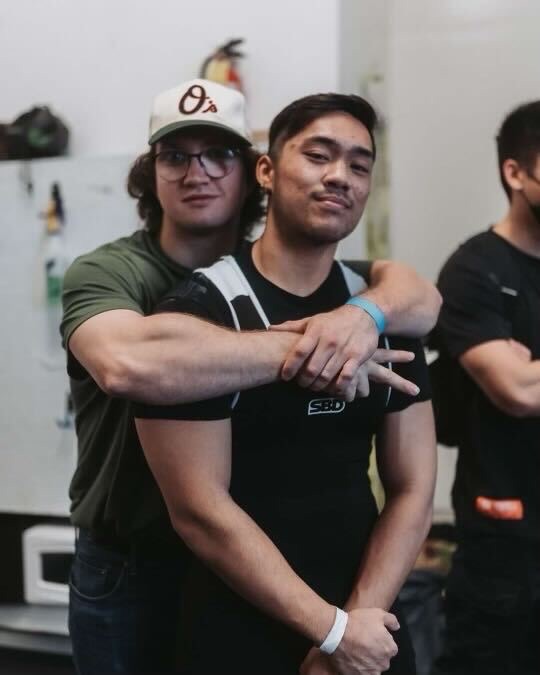
Aggie Barbell humanizes an intimidating sport

Club members discuss resources, culture and stigmas in powerlifting


By REBEKA ZELJKO — features@theaggie.org


Everyone’s journey to powerlifting looks different. But for many at UC Davis, the community that Aggie Barbell has created seems to be a common thread.

Aggie Barbell is a student-led powerlifting club that was established in 2014. “Aggie Barbell Club has something to offer for everyone, no matter your experience level,” according to their website.

“For those who treat lifting as a lifestyle and have years of experience, we offer the opportunity to add another dimension to your training,” the website reads. “For those who are new to lifting and don’t know where to start, we offer workshops to guide you along your fitness journey.”

Trent Hurtado, a fourth-year political science major and student coach, started powerlifting during his time at UC Davis.
“I got into lifting about two years ago, but I usually like lifting by myself,” Hurtado said. “I’m really stubborn and close-minded with my schedule, but Aggie Barbell is a good way to kind of break away from that and get more involved with my friends.” 

Hurtado said the club offers a sense of support in a sport that can be intimidating to many people.

“It was a cool opportunity to combine the social aspects with my hobby,” Hurtado said. “And [it] will cheer you along and offer you moral support, be a bit of a rock.”

An experience shared by many gym-goers is the initial difficulty of getting involved in the sport. Erica Chau, a third-year cognitive science major, said that her feelings of intimidation were reduced by joining Aggie Barbell. 

“My interest in powerlifting happened around my first year when I started going to the gym,” Chau said. “I always wanted to power lift, but I was very intimidated and inconsistent with going to the gym. But once I began to learn more about the sport, I became more committed when I made friends with people at the ARC and from Aggie Barbell.”

Chau said the community created by Aggie Barbell encouraged her to pursue her interest in powerlifting and also gave her a support system.

“I met the members at the ARC and befriended them one by one, and they said that I’m basically in the club,” Chau said. “I’m glad I’m a part of the club because it allowed me to be more serious about the sport while having fun with my friends.”

Alli Ngo, a third-year biological sciences major, said that her involvement with the club has contributed to her progress in her social life and self-confidence.

Before joining, I basically only talked to my roommates, but now I have this whole group of friends,” Ngo said. “When I first started lifting, I was super intimidated. I would go at hours when it was super crowded, and I was worried people would be staring at me or judging me. But people really just mind their own business. Like when I go, I look at other people not because I’m judging, but I’m admiring them. I’m like, ‘Wow, she is really strong.’”

Hurtado said the intimidation at the gym is normal and more common than many people think.

“When you go to the ARC and see massive dudes in cut-off tank tops, it’s easy to understand why people are nervous to go to the gym,” Hurtado said. “But in reality, a lot of people luck their way in. Not to diminish any of their hard work, but nobody is as sure of what they are doing, and they all lack a bit of confidence, and that’s okay.”

Ngo gave some advice for people who want to get into lifting but are intimidated by the gym. 

“Make your routine at home, so you know what you’re going to do at the gym,” Ngo said. “There’s a lot of great resources online, and even here. Aggie Barbell does a lot of beginner-friendly workshops for people who are interested in learning about lifting.”

Hurtado said joining a powerlifting community like Aggie Barbell provided him with new ways to track improvement in his performance.

“It is also a little fun to get competitive with it,” Hurtado said. “As much as they say to focus on yourself, it is fun to be like, ‘I’m catching up with that guy.’ It’s just fun to move forward because the progress is pretty objective.”

In powerlifting, progress can be seen pretty objectively by increasing weight or repetitions of a certain movement. But Hurtado stressed that though seeing progress is exciting, it is important to remember that is not linear. 

“Over the summer, I squatted 500 just for a single, and there was a bit of an accident because the bar slid down my back, and it put a lot of pressure on my left hip,” Hurtado said. “After that, I could hardly squat like 10% of my squat for the rest of the summer. It took a long time to get over, but now I’m doing [500] for sets of eight, so it’s cool to think you don’t stay in one place forever.”

Making progress, no matter how big or small, also often translates into confidence, according to Chau.

“Powerlifting has positively impacted my life because it helped me build confidence in myself and my strength by seeing how much progress I’ve made since when I first started,” Chau said. “Powerlifting requires a lot of time and dedication, and it’s very gratifying to see myself stick with it so far.”

For Ngo and many fellow powerlifters, lifting has changed their lives for the better.

“To me, powerlifting makes me realize how strong I really am,” Ngo said. “It’s really turned my life onto a different path.”

Written by: Rebeka Zeljko — features@theaggie.org

You don’t have to have it all figured out

Losing yourself is the path to self-discovery


By YASMEEN O’BRIEN — yjobrien@ucdavis.edu


As my graduation date approaches, I’ve been feeling pressure to get my life in order. But every time I take a step back to think about it, I realize that the whole point of being a college student is to experiment and discover my identity. I was hesitant to write this piece at the risk of sounding cliché, but I decided it’s helpful to hear this, even if you’ve heard it before.

As college students soon to enter the “real world,” it’s common to feel a sense of confusion about who we are, what we’re doing and how the world works; the list goes on and on. We wonder who we’re supposed to be, which, in our society, is defined by what we do for work. This pressure to plan out our lives can suffocate us, and it’s important to give ourselves the space to figure it out. This is where losing yourself comes in.

So, what does it mean to lose yourself? It means not knowing who you are yet or everything you like and don’t like and owning the fact that you’re still learning. It means to do all kinds of experimenting; to try new things and take risks that may feel “out of character” but excite you. It means making decisions that don’t pan out the way you thought they would and learning from them. It means making mistakes. It means feeling confused and unsure about how your future will fall into place.

I recently went through a period of feeling lost, which I know is not uncommon. I was experiencing confusion about what I wanted to do with my life and was hard on myself for wasting time and changing my mind. 

I thought I wanted to be a doctor, but after two years of studying biology, familiarizing myself with the process of becoming one and deeply understanding the work they do, I came to the conclusion that it wasn’t for me. It didn’t excite me. The more I learned, the more I couldn’t picture myself in that profession. I was afraid of my parent’s reaction and upset that I was unable to stick to my plan.

One day, I realized I had been focusing too much on the negatives of being confused. It was important to embrace the confusion. It was okay that I changed my mind. It was natural; necessary even. I hadn’t wasted time because I discovered my true calling and learned so much in the classes I took. I don’t have any regrets.

I have come to learn that losing yourself is really the only way to discover who you are. Life experience is the best education you can get, and losing yourself in the search for your identity, in love, in your studies and even physically can teach you valuable lessons. But it can be difficult to do this, and it’s easy to feel inadequate when you don’t “figure it out” and meet the expectations of yourself and others.

Allowing yourself to take a step off the beaten path gives you the experiences that shape who you are. It gives you a chance to make your own decisions — albeit with some trial and error — and find out what you truly like and dislike. Losing yourself in college also allows you to feel your emotions deeply — which is not an easy task, but an incredibly important one. 

This brings us closer to ourselves and one step closer to leading a fulfilling life, in which we set boundaries for ourselves and respect them and feel strong in our identity and comfortable enough to open ourselves to others.

Additionally, remember that losing yourself is always temporary. You will find your way back. It’s important to remember that, as young people, our identities are supposed to change as our lives change. That’s how you grow. Odds are you’ll come out of a period of growth as someone stronger, more in touch with your needs and desires and more empathetic — kinder to others and yourself. 

So really, losing yourself is how you find yourself. You have to lose yourself, in many ways and many times. Each time, you’ll connect with yourself in a new and important way. I think that’s one of the purposes of the human experience. It’s confusing not to feel grounded, like the Earth has been swept from under your feet, but I think this lack of feeling grounded gives us the ability to find what grounds us. Enjoy this journey.

So take a class that interests you outside of your major, go for a walk with no destination or take a chance on someone. Give yourself the opportunity to marvel at something, to take a leap of faith, to try something completely new, to lose your way. That is the greatest gift you can give yourself.


Written by: Yasmeen O’Brien — yjobrien@ucdavis.edu

Disclaimer: The views and opinions expressed by individual columnists belong to the columnists alone and do not necessarily indicate the views and opinions held by The California Aggie.