57.2 F
Davis

Davis, California

Monday, December 22, 2025
Home Blog Page 168

The Aggies suffer tough last-minute loss against the Gauchos in conference play

Following the loss, UC Davis closed the season with a big win against Long Beach State to secure a slot in the postseason quarterfinals


By CAROLYN (CARI) FENN — sports@theaggie.org


Despite a strong start by the UC Davis men’s basketball team against UC Santa Barbara at the University Credute Union Center, the Gauchos pulled ahead in the last few minutes to win the game 89-86. This is the fourth game at home this season that the Aggies have lost at home.

Following the altercation that occurred at the Aggies’ last game against the Gauchos, it was expected by many that the game was going to be a match-up to watch. With fans filling most of the seats in the stadium, everyone was eager to see if the Aggies could defeat the Gauchos, who are in first place in the Big West Conference.

The Aggies started the game off strong, obtaining a 10-point lead within the first eight minutes of the game. Despite holding a solid lead for the majority of the half though, the Aggies were not fully in control of the game, and the Gauchos made a gradual comeback throughout the first two quarters, going into halftime just one point behind the Aggies at 37-36. At this point, though UC Davis still clung onto the lead, the momentum had clearly shifted in UCSB’s favor. 

Some highlights of the first half by the Aggies include strong defensive plays. UC Davis  was able to keep UCSB second-year point guard Ajay Mitchell to zero points for the entire first half. Mitchell has averaged 15.9 points per game this season and is known for his strong shooting. But even with Mitchell shooting 0-5 from the field and 0-1 from the three-point line, the Gauchos held their own offensively, going on a 16-6 scoring run that kept them in the game. 

With such a tight game so close going into the second half, it was clear that the next 20 minutes were going to be an intense battle. 

To start the second half, the Gauchos gained a quick three-point lead — their first lead of the game. The Aggies responded with a 15-point run though, securing a comfortable 12-point lead against the Gauchos. 

Players coming in off of the bench at the start of the half were the leading contributors to the Aggies’ scoring run. Second-year guard Robby Beasley alone scored six of the 15 points with back-to-back three-pointers. Third-year guard Ade Adebayo also had a dunk that fired up the crowd.

This rally by UC Davis got the 2,113 fans packed inside the University Credit Union Center chanting and cheering throughout the arena. 

Despite the Aggies developing a generous lead, bringing the score to 52-40, the Gauchos made another comeback. The UC Davis defense was no longer able to hold back Mitchell and his teammates, and the Aggies’ lead evaporated in a matter of minutes. With just about eight minutes remaining in the match, the game was tied 61-61.

“When we got up by 12, that’s when you need to step on the throat and pull away, but we got rushed and we let them back in it,” UC Davis Head Coach Jim Les said.

In the last eight minutes of play, the Aggies’ scored 25 points. Most of these were by third-year guard Elijah Pepper, second-year guard Ty Johnson and Adebayo, who had 12, five and six points, respectively. 

But despite the Aggies’ best offensive efforts, their defense appeared to fall apart in the fourth quarter. UC Davis kept fouling Mitchell, giving him the opportunity to score seven points from free throws alone.

While the Aggies lost their lead earlier in the half, they were holding their own against the Gauchos, keeping the game to a one- or two-point difference in the final minutes of regulation. However, the increased number of fouls called against the Aggies, such as the ones called for Mitchell, ended up contributing to the loss.

With just a minute remaining, the Aggies took the lead back with a layup by Adebayo, making the score 81-82. This lead was short-lived though, as a  personal foul was called against Adebayo, giving Mitchell the chance to score two free throws, taking the lead for the Gauchos once again, 83-82. 

The lead went back and forth down to the last 20 seconds, when the Aggies were down by just two points, 85-83. They had just enough time to make a play, but, two personal fouls called on third-year guard Kane Milling sent the Gauchos’ two leading scorers of the night, Mitchell and fourth-year guard Josh Pierre-Louis, to the free-throw line. Combined for four points, they secured the lead 89-85 with just 12 seconds remaining.

UC Davis’s missed free throws and lackluster defense in the final minutes cost them the game, which ended with a score of 89-86.

“You can’t do that with a good team. It puts a lot of stress on your offense when you give up 89 points on your home floor,” Les said.

While defensive mistakes in the fourth quarter cost the Aggies the game, there were still players that had great performances throughout. Pepper not-so-shockingly had the most points scored on the team with 30, but Johnson and Adebayo were also strong offensive contributors,  adding 13 and 10 points, respectively.  

Even though this loss was a tough one for UC Davis players and fans, they still have a chance to do well in the postseason. Close losses and strong efforts against top Big West competitors prove that they can hang with the top teams in the conference. Though UCSB is ranked first in the conference and the Aggies are ranked seventh, the Aggies played a hard-fought battle against the Gauchos, never giving them a comfortable lead. If they are able to clean up the mistakes they made toward the end of the second half, they have a chance of making a long playoff run this season. 

“We have to execute and pay attention to details, and we have to learn how to play with a lead,” Les said postgame.

A few days later on March 4, UC Davis closed out the season with a win against Long Beach State at home. They defeated The Beach in a double-overtime thriller, 93-92. With the win, the Aggies secured the sixth seed in the Big West Conference and a slot in the quarterfinals. Up next, UC Davis will travel to Henderson, Nevada and play the third seed in the Big West postseason on March 9 at 8:30 p.m.


Written by:Carolyn (Cari) Fenn — sports@theaggie.org
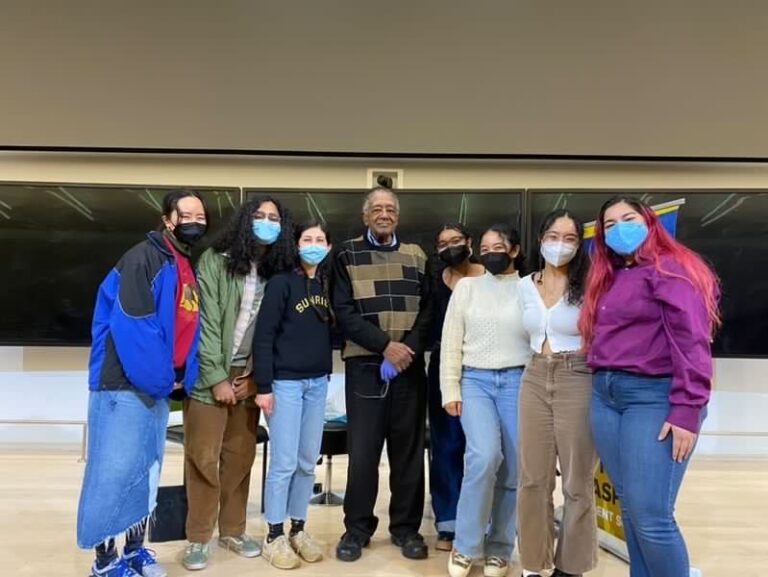
 

Black Panther Party co-founder Bobby Seale spoke at California Hall for Black Futures Month

The historic civil rights leader continues his legacy with words of inspiration for Davis students


By DANIELA DULA MEJIA — features@theaggie.org


“It [was] absolutely surreal,” said Dionica Bell, the director of the African American Retention Initiative and the Center for African Diaspora Student Success (CADSS). “How often do people get to say that the things they grew up learning about and the moments that changed the trajectory of our stories [are] sitting across from you.”

On Thursday, Feb. 23, 86-year-old co-founder of the Black Panther Party (BPP) Bobby Seale spoke to a crowd in California Hall. The BPP was an international group that was originally formed in 1966 in Oakland, California. Seale and Huey P. Newton, the other co-founder, worked to protect Black citizens from police brutality and to create programs such as the BPP’s free breakfast program that is still in place today.

Seale was invited to speak as the keynote speaker as part of this year’s two-day “BFM Signature Event.” Attendees came from as far as Fresno, California, to listen to him talk.

Black Futures Month is a campus-wide celebration that is held each year for the entire month of February. According to the UC Davis Diversity, Equity and Inclusion website, “Black Futures Month is a shared vision of the trajectory for Black life on the UC Davis campus [and] beyond. During the month of February, we are committed to remembering, celebrating [and] learning from Black History.”

Each week, different campus centers held community events. The Women’s Resources and Research Center (WRRC) hosted Black Femme Magic Week from Feb. 13 to 17. The LGBTQIA Resource Center and the Cross Cultural Center (CCC) also hosted events including “Reimagining Black Love: Film Screening & Artist Talk.” CADSS was in charge of programming for the final week.

Bell said she specifically wanted Seale to come because she hoped it would “reconnect [students] to today’s social justice movement” after the COVID-19 pandemic put a pause on many students’ lives. Bell said she wanted students to feel energized and also remind students about how capable they are of changing the world at any age.

“I thought what better way than to find a piece of our history around social justice during Black Futures Month,” Bell said.

When Seale and Newton started the BPP, they were both students at Merritt College. Seale said during the event that he also started a Black History reading group after college which he hosted with about 12 others at the time. 

“When the Black Panthers started, they were all in their 20s,” Bell said. “MLK, Bobby and Huey were all right on the other side of college. I thought if they could achieve that at such a young age, how inspiring would it be for our students right now.”

Seale is still an active member in his community in the Bay Area and announced future plans to work on housing inequity in the East Bay, as well as his involvement with youth programs and grant writing. Bell also reminds us that if “the Black Panther co-founder is still working, the rest of us can not rest on our morals.”

After the event, students in California Hall reflected on the words and the impact Seale’s legacy continues to have on them. Sriram Srinivas, a second-year plant sciences major, said they believe the BPP is an important part of history. 

“So much of our liberation comes from the work and conception that the Black Panther Party created and the work they did,” Srinivas said. “I’m really grateful, and I want to learn more about the work they did, so I can see what I can do now.”

Another student, second-year American studies major Emi Morrujo, said she, as a Chicana student, has a personal connection to the Black Panthers and Bobby Seale. 

“A lot of the Chicano movement brought their points and drew from the Black Panther Party,” Morrujo said. “So I feel like a lot of the liberation that I get today in society comes from the Black Panther Party.”

Having Seale come to campus and speak was a historic moment that will be solidified in the minds of many students for years to come. As Seale mentioned at the event, there is still more work to be done. Seale said in his speech that students should remember to “love, respect and care for [their] community,” as well as promote change. 

“A big part of my life is always trying to reconnect with that era, that generation, to learn from them,” Kwame Hargrove, a first-year history major, said. “Both their successes and failures and how I apply my own consciousness of what I think is right or wrong, with political action, social change and things like that.”

It is important to remember that everyone has an obligation to stand up against oppressive forces, according to Bell. 

“Folks [should] keep in mind there is work to be done and that we need accomplices to get that work done,” Bell said. “It is not on the Black students to fix the institution. It is not on the Black faculty to fix the institution and the Black staff and administrators, although all of them are working. It is the work of the institution and its entirety — the students, the faculty and the administration.”

Written by: Daniela Dula Mejia — features@theaggie.org

Paul’s Place abre para dar la vivienda y servicios para las poblaciones sin refugio y en riesgo

El innovador Vertical Home Village en la calle H espera usar viviendas conjuntas y recursos de servicio para enfrentar la crisis de vivienda en Davis


Por MADELEINE YOUNG – city@theaggie.org

Traducido por JOSÉ HERNANDEZ

Read this article in English.


El 7 de febrero, Paul’s Place, un innovador proyecto de casa de cuatro pisos en Davis, abrió con la meta de dar viviendas permanentes y transicionales para miembros de la comunidad sin refugio y en riesgo. La instalación es propiedad y es operada por la Comunidad Davis de Comidas y Viviendas e incluye cuatro camas de refugio, cuatro oficinas de personal, una cocina, un comedor, lavandería, cinco baños, un centro de recursos y una sala para la comunidad. 

El Director Ejecutivo de la Comunidad de Davis de Comidas y Viviendas William Pride explicó cómo surgió la idea y como Paul’s Place fue desarrollado. 

“Paul’s Place fue una idea que surgió en 2016 y 2017,” Pride dijo. “Teníamos una instalación en la ubicación donde Paul’s Place está ahora que hemos estado usando por muchos años y está sumamente deteriorada y a la misma vez, había discusiones porque Sutter Health en Sacramento había empezado una iniciativa que se llama el programa ‘Getting to Zero’ y ellos iban a poner mucho dinero [para] financiar programas de desarrollo para ayudar a las personas sin casa y otras personas necesitadas. A través de esas comunicaciones, nos surgió la idea de reemplazar lo que ya teníamos allí con una instalación que se llama Paul’s Place.”

Paul’s Place no es simplemente un programa de vivienda transicional y permanente, pero también da diferentes recursos y programas para los residentes, haciéndolo el primero de su tipo en Davis. Pride explicó algunos de los servicios que ofrece Paul ‘s Place.

“Combina un par de diferentes programas todos en el mismo edificio, no solo departamentos,” Pride dijo. “Es un refugio, un centro de recursos y un programa de vivienda transicional reservado exclusivamente para personas sin hogar en la comunidad de Davis y los alrededores del Condado de Yolo.”

El Alcalde de la ciudad de Davis, Will Arnold abordó el proyecto recientemente terminado durante el Discurso del Estado de la Ciudad el primero de marzo. Arnold mencionó que este proyecto podría ser el plano para proyectos futuros que tienen el objetivo de ayudar a los desamparados y a las poblaciones en riesgo. 

“Una pieza clave de nuestro portafolio de vivienda es encontrar maneras de dar hogares para aquellos con más necesidad de un techo para vivir,” Arnold dijo, “Yo estaba muy orgulloso de poder hablar y participar en la inauguración de Paul’s Place. Es una nueva casa vertical pequeña que incluye servicios de emergencia y vivienda de apoyo, patrocinada directamente por la ciudad de Davis. Será algo que nunca se ha hecho de esta manera en ningún lado y podría ser un modelo de cómo unimos vivienda, refugio y servicios para la gente que más lo necesita.”

Paul’s Place recibió financiación de múltiples fuentes privadas incluyendo Sutter Health y Partnership Healthplan de California, así como también ayuda del gobierno local durante todo el proceso de construcción. 

“La ciudad contribuyó aproximadamente con un millón de dólares en fondos de American Rescue Plan Act para superar el obstáculo con su financiamiento,” el Administrador de la ciudad Mike Webb dijo en el Discurso del Estado de la Ciudad. 

Funcionarios de la ciudad y el condado se reunieron para comprometerse a crear Paul’s Place en 2017 después de reconocer la necesidad de financiación adicional para crear soluciones para la crisis local de vivienda. Cinco años después, el proyecto está completo finalmente.  

“Obtuvimos mucho apoyo de la comunidad por ser un programa que a la ciudad le gustaría ver que sucediera,” Pride dijo. “A través del proceso, tuvimos una gran cantidad de apoyo de la comunidad y político de la ciudad lo cual nos llevó a tener una gran apertura con casi 200 personas celebrando. No estoy seguro si he visto un programa para personas sin hogar donde una comunidad venga [para] celebrar. Así que fue agradable ver a esa gente de Davis reuniéndose en torno al problema y asegurándose de su finalización. 


Escrito por: Madeleine Young — city@theaggie.org

Traducido por: José Hernandez

Women’s tennis sweeps Montana State Bobcats

UC Davis wins four straight matches on Saturday despite bad weather conditions


By EVA MACHADO — sports@theaggie.org


The UC Davis women’s tennis match was in danger of being canceled on Saturday, March 4 due to bad weather conditions; rain pushed the original starting time of the match back to 4 p.m.

 But despite an unsure start to the day, the Aggies still came out with a strong start and finished with four straight victorious matches to win the contest. This win extended the Aggies’ winning streak at home, which began on March 2 against the University of Montana Grizzlies, who they beat six sets to one. 

Of the six UC Davis singles players, two shut out their opponents. Second-year Arianna Stavropoulos and third-year Carly Schwartzberg defeated their Bobcat opponents in straight sets. These wins set the stage for the Aggies’ dominance over the Montana Bobcats. 

Stavropoulos dominated her competitor, winning her first set 6-1 and her second set 6-2. Stavropoulos’s power showed throughout her sets. Her serves were strong and she held a consistent lead over her opponent.

Similarly, Schwartzberg had the clear upper hand in her sets, shutting out her competitor in the first set and winning 6-1 in the second set. Schwartzberg appeared determined and focused throughout her sets — beginning with powerful smashes and serves that carried through the entire match.

This strong singles play as of late has UC Davis tennis trending upward in the current season’s standings. Fourth-year Yana Gurevich and third-year Michelle Zell also put out strong performances, bringing in the next two points UC Davis needed to defeat Montana State.

Gurevich won in three sets, taking the first and third sets. She lost to her opponent in the second set, but managed to come back with a punishing lead in the third and final set to win it 6-2. 

Zell ended the match day a win in a tie-breaker at the end of her second set, 7-1.

First-year Kaia Wolfe and third-year Olive Maunupau did not have the opportunity to finish their sets, as the Aggies’ had already taken the contest after four straight wins. Wolfe and Maunupau both played strong games, winning one set each before their sets were left unfinished. Wolfe started strong, winning her first set and holding the lead throughout her second set while Maunupau had one win and one loss at the stopping point. 

Thanks to Saturday’s win, UC Davis has a record of 5-7 going into Friday’s game. The Aggies will finish out their homestand on Friday, March 10 against the Hawai’i Rainbow Warriors, where they will look to continue their winning streak.


Written by: Eva Machado — sports@theaggie.org

‘REFUGE’ highlights a universal need for belonging

David Adam Moore and Victoria Tzykun designed the interactive performance as a testament to stability   


By CLARA FISCHER — arts@theaggie.org


Prompted by the ongoing war in Ukraine, the UC Davis Department of Theatre and Dance presents “REFUGE – an immersive theatrical installation.”

The performance, created by Granada Artists-in-Residence David Adam Moore and Victoria Tzykun, is composed of various scenes depicting life in a war-torn country, and the many complex emotions that come with this. Moore emphasized the more general theme of the performance, stating that “… the focus of this work [is pointed] not on the depiction of the current situation, but on a central question raised by the Russian invasion of Ukraine: What is home?” 

 The setup of the performance contributes significantly to this theme, as the audience is transported into the setting itself. Viewers are ushered through hallways and across the main stage to view a series of scenes meant to emulate the experiences of refugees and others affected by wartime. At various points, actors even weave through the audience and break the fourth wall to interact with the crowd. Through these tactics, viewers feel intimately connected with the work and can begin to grasp the gravity of what is being represented. 

Of course, this innovative screenplay wouldn’t be as impactful as it is without convincing performances by the cast. As Moore states, “[Working with a live situation] brings a deeper level of responsibility and engagement for student performers tasked with creating characters who embody the experience of millions of refugees from many times and places throughout human history.” 

There is a lot of talent on display during this production, and it aids in bringing across the highly charged subject matter. The actors, singers and stagehands accountable for transporting the audience into the scenes being presented all do a fantastic job at their respective roles.

On top of impactful performances by the cast, the innovative stage design adds dimension to the experience. When first entering the set, audience members are guided through a long, dark hallway with various everyday items suspended overhead while actors recite testimonies about their meanings from behind the curtains. This gives the production a chilling undertone from the start and sets up the immersive aspect from the beginning. Other impressive design elements include a bed that actors switch in and out of seemingly out of thin air and a symbolically choreographed dance routine utilizing floating beams of light. 

It’s abundantly clear that this difficult subject matter was handled with care and concern.; from the themes to the execution by cast and crew, this show comes at an opportune moment in modern history to give thought to universal questions concerning belonging, displacement and what makes a place a home.        

“REFUGE” will be playing March 2- 5 and March 9-10 in the Main Theater at Wright Hall, with showtimes at 6:30 p.m. and 8:30 p.m. Tickets are available on the Department of Theatre and Dance’s website.

Written by: Clara Fischer — arts@theaggie.org

What’s up with Marvel?

The disappointing trend of one cinematic flop after another


By MAYA KORNYEYEVA — mkornyeyeva@ucdavis.edu


Disclaimer: This article contains spoilers for “WandaVision,” “Loki” and “The Falcon and the Winter Soldier.”


I would argue that the release of the first “Iron Man” was a pivotal moment in the blockbuster film industry. Before then, I had always seen comic books as niche areas of entertainment that the general movie-goer wasn’t particularly interested in. Fast forward to 2019, the epic fourth and final installation of the Avengers series hit the screens and garnered a whopping $2.8 billion at the box office. 

People who had never seen a single Marvel movie came to watch, as did fans of all ages. It seemed that everyone was packing into the theaters to view this cinematic spectacle, and boy did it not disappoint. With a 94% Rotten Tomatoes Tomatometer score and an audience score of 90%, “Avengers: Endgame” was a triumph of superb acting and state-of-the-art CGI. I, like many others, expected Marvel to only get better from there — with graphic imaging being revolutionized practically every day and a breadth of new characters to introduce, up was seemingly the only direction to go. 

Then Disney+ launched. At first glance, this was a Disney fan’s dream; the entire collection of Disney animated movies, the Marvel Cinematic Universe (MCU), Star Wars and National Geographic were at their fingertips. Take another look, and the motivations behind such a development also become apparent — money, of course. An online streaming platform seemed like the perfect place to launch a brand new image of the MCU as an interconnected world of behind-the-scenes documentaries, cartoons and shows, and make some money off of viewers in the process. Hint: this is where it all goes downhill. 

I don’t deny that I was excited for the first Marvel TV series, “WandaVision,” as well as the “Loki” series and “What If?” I was genuinely curious as to how Marvel would adapt their storytelling to fit an episodic format. For me, though, watching “WandaVision” was a bit of a mixed experience. I loved the way the directors and producers adapted a sitcom style to depict an unnerving alternate universe of Wanda’s own creation — the motifs used to deal with loss and derealization were unique and refreshing. What wasn’t was the introduction of Agatha as a villain and witchcraft as a legitimate part of the MCU. 

And it didn’t stop there. With “Loki” came the idea that the all-important infinity stones were being used as paperweights at the TVA, and “The Falcon and the Winter Soldier” introduced a plot of a strange and illogical post-blip world. Over the next several years, Disney funded more and more shows that quickly oversaturated the MCU and lowered the quality standard for their films. 

Suddenly, I stopped being interested in their new shows, mainly because it became increasingly difficult to keep up with all of the new Phase Four installations. It was as if the tracks that the “Marvel Train” was riding on suddenly lifted off the ground and split into a thousand different directions. There was also a significant dip in the quality and directing of Marvel movie sequels; a few prime examples include “Thor: Love and Thunder” and “Ant Man: Quantumania,” which garnered 63% and 47% Rotten Tomato Tomatometer scores respectively. 

Now I, and many original Marvel fans, are longing for a return to the pre-Disney+ era. The nostalgia and character building of the first original “Captain America,” “The Avengers” and “Iron Man” series created movie experiences that deeply resonated with viewers and presented them with exciting visuals and well-written films. More importantly, I can contentedly watch the Phase One and Two Marvel movies over and over again, never getting bored. 

While “Black Panther: Wakanda Forever” has given me hope that a return to such an MCU is not an unattainable dream, that hope remains slim as long as Disney’s profit-oriented approach holds the reins. What Marvel Studios desperately needs is to stop stretching its budget thin and instead dedicate sufficient resources, time and talent to developing high-quality movies that don’t muddle and confuse pre-established storylines. Fans are already turning their backs; now is the time to recapture their interest and stop them from walking away for good. 


Written by: Maya Kornyeyeva — mkornyeyeva@ucdavis.edu


Disclaimer: The views and opinions expressed by individual columnists belong to the columnists alone and do not necessarily indicate the views and opinions held by The California Aggie.


Double trouble: climate change and deforestation imperil the mammals of the Amazon

A combination of disruptive ecosystem factors could lead to savannization 


By LILLY ACKERMAN — science@theaggie.org 


A new study from UC Davis has found that deforestation and climate change in the Amazon Rainforest will have negative effects on a large portion of the region’s terrestrial mammal species. 

According to the study, ecosystem disruption in the Amazon will lead to increased savannization along its southern and eastern borders in the future. Savannization refers to the conversion of forest habitats into open plains. 

“In the largest tropical forest on Earth, the Amazon, rising temperatures and lengthening of droughts alone could jeopardize ecosystem integrity and lead to expansion of tropical savannahs,” the study reads. 

Daniel Rocha, the lead author of the study who researched this phenomenon while getting his Ph.D. at UC Davis, explained why habitats that are converted from forest to “cerrado,” or savannah, through savannization are less able to support life than natural plains. 

“These open habitats will resemble cerrado areas, but without the associated biodiversity, because it is the result of a forest degradation process,” Rocha said via email. “Deforestation, uncontrolled fires, selective logging and other direct forest degradation factors act in synergy with climate change and accelerate the ‘savannization’ of Amazon forest.”

 The study focused on savannization’s effects on medium to large terrestrial mammals, including peccaries, jaguars and pumas, in the southern Amazon. Some of the mammals studied are generalists, meaning they could live in forest or savannah habitats, while others are exclusively forest- or savannah-dwelling species. 

The authors used camera trap surveys to assess the mammals’ habitat and to determine how each species responded to nearby savannah habitats. 

Rocha found that savannization and deforestation were expected to impact forest-dwelling mammals. However, somewhat unexpectedly, analysis of the generalist species also showed an impact.

“Surprisingly, most habitat generalist species (i.e., able to use both forest and cerrado) prefer to use forested areas when they have both habitats available,” Rocha said. “This indicates that to some extent they will also be affected by future ‘savannization’ in the Amazon.”

This finding contributed to the conclusion that the majority of the southern Amazon’s mammals are expected to be negatively impacted by savannization. The only species that showed a neutral or positive response to savannization were those that already exclusively inhabiting savannah habitats.

“Some cerrado-specialist mammals will probably benefit from [savannization], like the pampas deer,” Rocha said. “But overall, forest associated and generalist species will be exposed to non-preferable habitat, which can lead to lower survival rates, smaller population sizes and reduction in species distribution range.”

The results of this study reveal a critical risk for the mammals of the Amazon rainforest, the largest biome in Brazil and an important part of the global ecosystem. Combinations of climate change and human-induced deforestation make conservation a more challenging issue for the southern Brazilian Amazon, according to the study.

“If climate-driven savannization causes many of these species to lose access to preferred habitat, this will reduce the ability of protected areas to safeguard wildlife populations,” Rocha said. “The results of this study suggest that these potential effects should be considered when assessing potential climate change effects on these species.”


Written by: Lilly Ackerman — science@theaggie.org


More than 60 community members publicly oppose bill at March 2 Senate meeting

The bill, which would require antisemitism training for the Senate table, received backlash following concerns about anti-Palestinian sentiments held by the organization that would provide the training


By RACHEL GAUER— campus@theaggie.org


Note: Some sources are anonymous for the safety of the Palestinian students who commented during the meeting.  


Vice President JT Eden called the meeting to order at 6:14 p.m. on Thursday, March 2. Following roll call, he recited the UC Davis Land Acknowledgement. 

Next, the Senate heard a presentation from Associate Vice Chancellor Cory Vu. Vu highlighted Aggie Mental Health resources and gave updates regarding the process of hiring new members of their team. 

“We have about seven counselors left that we need to hire, but once we get all of them hired I think we will be in very good shape in terms of access here on campus,” Vu said. Vu also spoke about a current project called Health 34, which plans to launch in the fall. Vu is working with the UC Davis Fire Chief Nathan Trauernicht to create an emergency service that is specific to mental health crises. 

“Imagine if you have a friend or roommate or anyone that you know who is in distress,” Vu said. “Instead of calling 911 for the police to come and assist, you can call a seven-digit number, and when you call them, a team will arrive which will consist of paramedics, EMT students trained by the fire department and a nurse navigator.”

Next, the Senate heard a presentation from recently elected Davis City Councilmember Bapu Vaitla. Vatila responded to Senator Stephen Fujimoto’s questioning regarding how the city can improve the current housing crisis.

“We will do our best as a city to ask the university for more, but also we have very little leverage,” Vaitla said. “We gain leverage if students organize themselves and ask for the same things — if they ask the city and ask UC Davis.”

Next, the Senate confirmed three new STEM committee members: second-year human development major Julia Miller and second year Wildlife, Fish, and Conservation major Grace Gabel, and another who wished to not have her name included. After questions from members of the Senate, all three members were confirmed.

Following the confirmations, Chairperson Yoanna Soliman presented the STEM quarterly report. The committee is currently working on onboarding its new vice chairperson by the end of this quarter. 

Next, the Senate heard the Disability Rights Advocacy Committee’s (DRAC) quarterly report, presented by Chairperson Ryan Manriquez. Manriquez spoke about new mats that could help accommodate disabilities in areas on campus with uneven ground during outdoor events such as Picnic Day and Sunset Fest.   

Next, the Senate heard from the Judicial Council. Chairperson Amanda Clark and the committee’s newest member, fourth-year political science major Gustavo Pichardo Villaseñor, presented their committee’s quarterly report. They discussed the committee’s expectations and reviewed what it does and the tasks it carries out in relation to the Senate’s passage of bills. 

Next, the Environmental Policy and Planning Committee gave their quarterly report, presented by Chairperson Mackenzie Field. Field highlighted the Cool Campus Challenge, is a competition between UC Berkeley and UC Davis that will take place between April 3 and April 28. 

“It’s going to be an inter-campus sustainability challenge where participants record their sustainable actions and we will keep track of points,” Field said. 

After a short break, the Senate resumed, moving into the introduction of new legislation. Following the introduction, they reviewed the consent calendar. The consent calendar was passed, and SB #74, SB# 78 and SB #82 all passed unanimously without objection. 

Next, the Senate discussed SB #72, a bill introduced by Senator Jacob Klein that would require antisemitism training for the Senate table. The bill received widespread criticism, and a letter emerged opposing SB #72 that received almost 300 signatures. Many students and community members who opposed this bill joined the meeting in person and via Zoom. 

First, Senator Klein provided his comments surrounding the bill and the backlash it received. 

“SB #72 would require the Senate table to attend an antisemitism training conducted by the Academic Engagement Network, or AEM,” Klein said. “The main complaint in the letter is in regards to AEN as an organization. The UC Davis Office of Diversity, Equity and Inclusion (DEI) recommended that we use AEN.” 

The Senate then opened the floor to public comments concerning the bill. 

First, the current Muslim Student Association president, who is also a former ASUCD senator, shared her perspective on the bill.  

“I believe that having antisemitism training for the table is vital and is something that should have been implemented a long time ago,” the student said. “I am concerned, however, with the language in SB #72 in that it identifies AEN as the organization responsible for conducting the training. On its website, AEN takes an explicit stance on the boycott, divestments and sanctions (BDS) movement.”

Next, the Students for Justice in Palestine president outlined the bias they believed is present in the AEN mission statement

“The organization […] clearly appears to be more concerned with the efforts of criticizing Israel and Zionism rather than actually combating antisemitism on campus,” the student said. “In total, this organization mentioned Israel seven times, ‘zionist’ twice, and ‘antisemitism’ only once in their entire mission statement.” 

The vice president of Students for Justice in Palestine also commented on the views expressed by the executive director of the AEN organization.  

“The executive director of AEN, Miriam Elman, is a known zionist advocate who has written for right-winged platforms,” the student said. “Elman’s bio on the AEN website is replete with her experience oppressing Palestinians and Palestinian activists across the country. There is no mention whatsoever of Elman’s experience fighting antisemitism, making her and her organization unqualified to lead students on this campus to address [antisemitism]. 

Following the public comments, Senator Zeph Schnelbach voiced his opposition to the bill. 

“I cannot endorse a training that I, one, have not seen […] and two, is conducted by an organization in which the very name has brought an unprecedented amount of students to our meeting tonight,” Schnelbach said. “We as a table can also not ignore the voices that have been brought to us today by the almost 300 people who have signed that letter.” 

Next, Senator Klien, the author of SB #72, responded to the comments.

“Based on the overwhelming opinion that I am hearing today, I am very much amenable to changing the [training] to a different organization,” Klein said. “I was under the impression that I was going through the proper channels by consulting with the office of DEI. I appreciate the number of people who have shown up today. I strongly apologize if any of my conduct has offended or hurt anyone.”

Following Klein’s statement, the Senate moved into voting. The Senate voted 11-1 to table SB #72 indefinitely, meaning the bill will no longer be considered and an updated bill, recommending a different organization to provide the training, will later be reintroduced. 

Next, the Senate introduced SB #73, which would lower the number of signatures required for an UC Davis student to become a candidate in ASUCD elections in order to encourage more competitive elections and higher turnout. The bill passed 7-0-4, and the Senate then moved into open forum.

The meeting adjourned at 2:24 a.m. on Friday, March 3. 

Written by: Rachel Gauer — campus@theaggie.org

We are what we consume

Entertainment isn’t just entertainment anymore but a vehicle of self-expression; here’s why that’s a problem


By GEETIKA MAHAJAN — giamahajan@ucdavis.edu

It’s 2023, and your identity is an accessory. No — it’s the amalgamation of everything you’ve watched, read and listened to in the past month but only if you’ve posted about how much you loved “The Menu” or how you were in the top 5% of Harry Styles listeners on Spotify. Wait, no, actually, what you perceive as your own individual identity was actually created and handed to you by a virtual algorithm that pigeonholes a broader market into neat little groups of consumers.

Okay. Sorry for all the confusion; it’s actually all three of those things, in that order. It’s 2023, and identity is an inescapable farce and an Apple product that everyone but you seems to have. The truth is, though many cultures propagate the idea of an innate self — the soul, the mind, who we truly are — that we must unearth, there is no scientific or psychological evidence to support the claim that anything about our identities is congenital. 

What most people would define as their identity has been, for the most part, malleable. This is not a new phenomenon; at 18, I am not the same person that I was when I was eight, and the same goes for my mother and her mother before her. What distinguishes our present moment from the past is the constant cycle of virtual input informing the construction of our identity and the need to advertise this aforementioned identity to others so that we can finally “feel seen.” Thus, the malleable identity stopped being a vehicle for self-improvement and became an ouroboros of consumption. 

Today, there are an infinite number of ways in which we can disseminate information about ourselves. Likewise, there are an infinite number of ways in which we consume information about others. Spotify Wrappeds posted on Instagram, live-tweeted reactions to the newest season of whichever HBO show has caught everyone’s attention and book reviews on TikTok; we are constantly exposed to what those around us are listening to, watching and reading.

This is not the issue though. Obviously, there’s nothing wrong with discussing your opinions about a piece of media or even extolling your love for a certain movie or author. But people are not consuming entertainment for the sake of being entertained anymore. “Liking” or “disliking” is an afterthought — the primary concern is what the consumption of this piece of media says about us. 

The content becomes a part of the consumer, in a way that was completely alien before the explosion of social media. Before that explosion, people would listen to certain artists because they liked their music. Now, it seems as though people listen to artists because some intrinsic part of their identity is tied to the artist themselves — because Taylor Swift fans are mirrorballs and children who crave academic validation, because Phoebe Bridgers fans really do have emotional motion sickness and are currently ghosting their therapists. The content is not just entertainment but a facet of your identity, and you can present it to the world and feel like you are revealing a fundamental truth about yourself. 

This is a problem for various reasons, the first being that media was not created to be consumed in this way. Most forms of entertainment — a novel, a film or album — began as a means of artistic expression. When what is essentially a piece of art is co-opted by the masses to appropriate as a facet of identity, it stops being art and becomes a trend, due to the aforementioned malleable nature of our identities and the framework under which this media is produced and consumed en masse. 

I already mentioned that our identities are not static. This means that parts of our identities are always shedding and shifting; an album that resonates with us today may not have the same effect in a year’s time. The inevitability of us losing interest in these forms of media, combined with how virality allows most media to snowball in popularity, means that artists now face a constant cycle of hyper-attention followed by amnesia from the general public. 

This alone would not be an issue, were it not for the fact that media production operates under a robust capitalist framework that seeks to maximize the attention and the money that the public is willing to expend. As long as a genre or artist is popular, they will continue to attempt to replicate whatever it was that caught the public’s attention in the first place, leading to inauthenticity. Eventually, it may no longer be recognized as art any more than a mass-produced IKEA lamp is, because it has been produced solely for the purpose of consumption by the public. 

When people begin to tie their identity so securely to some external work, they may even begin to view the artist themselves as an extension of themselves. From this, numerous other issues arise, namely the inability to critique the artist or their work, because criticism of either is obviously tantamount to criticism of the devoted consumer. This is why people online are calling Taylor Swift “the first ethical billionaire.” There never has been, and never will be, such a thing as an ethical billionaire. The phrase is an oxymoron. But to the average Swiftie, (and I am one so please do not doxx me!) Taylor Swift needs to remain a good person because they themselves have made her music such a key aspect of their identity that any immorality on her part would be practically synonymous with them committing the crime. Right?

Obviously, no. We have a false perception that our identities are the sum of the externalities we consume — a belief that’s really only circulating so that corporations know what to sell to us. We think that we need to present these aspects of our identity to be “seen” by those around us — also a lie, one to perpetuate this idea that connection can be facilitated through mutual consumption. 

There are a lot of feedback loops at play, creating this seemingly never-ending cyclical process in which people continue to search for identity in content. There are no beneficiaries, at least not among the consumers, but it isn’t as if we can just stop. It’s not just about what we’re eating, but how and how much and how we’re talking about what we eat — a process that, considering how the era of social media is practically embryonic, is far too embedded in online culture.


Written by: Geetika Mahajan — giamahajan@ucdavis.edu

Disclaimer: The views and opinions expressed by individual columnists belong to the columnists alone and do not necessarily indicate the views and opinions held by The California Aggie.

Commentary: reduce waste by ‘shopping your closet’

The philosophy behind returning to what is already hanging in your closet before you go thrifting


By ADHITHI ANJALI — arts@theaggie.org


In the effort to create a more sustainable world, many people have made a definitive attempt to turn away from fast fashion as a means of achieving their stylistic aspirations. As the “#ThriftTok” tag on TikTok and its over two billion views convey, more and more people are seeing thrifting as a way to meet their needs and participate less in fast fashion consumerism. 

But, exactly how is thrifting challenging a consumerist desire to acquire new clothing in order to keep up with increasingly rapid fashion cycles? According to a 2022 “Resale Report” conducted by ThreadUp, a popular and fast-growing resale site, the U.S. secondhand market is expected to reach $82 billion by 2026. This rapid expansion of the secondhand market shows that though thrifting may address the labor and environmental concerns of consumer culture, it will not solve the inherent problem of overconsumption. 

Turning back to that old adage, “Reduce, Reuse, Recycle,” thrifting conquers the latter two, but the first might be better addressed by reforming your own habits. This is where the idea of “shopping your closet” might come in as a useful philosophy — fostering both environmental awareness and your own creative forces.

Essentially, the idea of “shopping your closet” is about putting the clothes already in your closet to new use. The main purpose is to reduce consumption and challenge the desire to purchase a new piece of clothing, whether it comes from Depop or a department store. 

Instead, you may find outfits or a style that you want to explore and look to your closet to find pieces that can capture the essence of that inspiration. Shopping your closet is a mindset that encourages creativity not driven by the new, but instead by what you thought was old.

Sarah Pando, a fourth-year environmental policy analysis and planning major, works as the co-unit director at the Aggie Reuse Store. Pando reimagines one piece of clothing as a myriad of others, whether that means cutting it up, screen printing it, patching it or just wearing it in an unconventional way.

“When I see a piece of clothing, I don’t just see one way of wearing it, I see multiple,” Pando said. “This pushes me to repurpose the clothes that I’m not wearing. There are so many microtrends, what’s ‘in’ and ‘out’ changes so fast.” 

By shopping your closet, you can create a personally timeless wardrobe that fits your needs, outside of the world of fashion cycles and microtrends. By pulling out those old clothes, you can remind yourself of previous versions of style and see how they can be incorporated into your own ever-evolving definition of yourself. 

Beyond the creative aspect, it should be recognized that to shop and dress sustainably ultimately means reducing our consumption. Pando explained that “another issue is that people think thrifting is the solution, but we still have textile waste.” 

Only 14.5% of clothes in the U.S. are recycled or reused, and the rest contribute to landfill waste or are exported to other countries. Even of clothing donated to thrift stores, upwards of 80% of donated clothing is left unsold according to Maxine Bédat, author of “Unraveled: The Life and Death of a Garment.” 

Thrift stores are not an unproblematic dumping ground for fast fashion excess. While they serve an incredibly important purpose in extending the life of already-in-use garments, in order to target the issues posed by the fast fashion industry, one of our primary aims should be to reduce all consumption. This can have far-reaching effects, from limiting environmental pollution and textile waste to labor violations.

Though replacing a worn item or even treating yourself to something new is sometimes necessary, before you make a purchase, try to ask yourself if you can find a similar piece in your existing wardrobe. Ideally, shopping your closet will remind you of the clothes that you might have forgotten at the bottom of the pile and prompt you to experiment before you feel the need to buy.

Written by: Adhithi Anjali — arts@theaggie.org

Paul’s Place opens to provide housing and services for unsheltered and at-risk populations

The Innovative Vertical Home Village on H Street hopes to use joint housing and service resources to address the Davis housing crisis 


By MADELEINE YOUNG city@theaggie.org

Lea este artículo en español.


On Feb. 7, Paul’s Place, an innovative four-story home village project in Davis, opened with the goal of providing permanent and transitional housing for at-risk and unsheltered community members. The facility is owned and operated by Davis Community Meals and Housing and includes four emergency shelter beds, four staff offices, a kitchen and dining area, laundry, five bathrooms, a resource center and a community room. 

Executive Director of Davis Community Meals and Housing William Pride explained how the idea came about and how Paul’s Place was developed.

“Paul’s Place was an idea that kind of formed back in 2016 and 2017,” Pride said. “We had a facility at the location where Paul’s Place is now, that we’ve been using for many years and it became really rundown and at the same time, there [were] discussions happening because Sutter Health in Sacramento had started an initiative called the ‘Getting to Zero’ program and they were going to put a lot of money [to] fund developing programs to help homeless people and other folks in need. Through those communications, we came up with the idea to replace what we already had there with a facility called Paul’s Place.”

Paul’s Place is not only a transitional and permanent housing program, but it also provides different resources and programs for residents, making it the first of its kind in Davis. Pride explained some of the services Paul’s Place offers.

“It combines a couple of different programs all in the same building, not just apartments,” Pride said. “It’s a shelter, resource center and a transitional-housing program set aside exclusively for people who are homeless in the community in Davis and surrounding Yolo County.” 

City of Davis Mayor Will Arnold addressed the recently finished project during the State of the City address on March 1. Arnold said that this project could be the blueprint for future projects that aim to help unsheltered and at-risk populations.

“A key piece of our housing portfolio is finding ways to provide housing for those most in need of a roof over their heads,” Arnold said. “I was so proud to be able to speak and participate in the opening of Paul’s Place. It’s a new vertical tiny home village that includes emergency services and supportive housing, supported directly by the city of Davis. It’s going to be something that has never quite been done this way anywhere and this could be a model for how we unite housing, shelter and services for folks most in need.”

Paul’s Place received funding from multiple private sources including Sutter Health and Partnership Healthplan of California, as well as local government aid throughout the building process. 

“The city contributed approximately a million dollars in American Rescue Plan Act Funds to get it over the hump with its financing,” City Manager Mike Webb said at the State of the City address. 

City and County officials originally came together to commit to creating Paul’s Place in 2017 after recognizing the need for additional funding to create solutions for the local housing crisis. Five years later, the project is finally complete.

“We got a lot of community support as being a program that the city would like to see happen,” Pride said. “Throughout the process, we’ve had loads of community and political support from the city which led to us having a grand opening with almost 200 people celebrating. I’m not sure I’ve ever seen a program for homeless folks where a community comes out [to] celebrate it. So it was nice to see the people in Davis rallying around the issue and ensuring its completion.” 


Written by: Madeleine Youngcity@theaggie.org

Campus prepares for TPUSA event on March 14

UC Davis police, ASUCD and other organizations prepare as TPUSA founder Charlie Kirk is set to speak at the U Center next week


By SYDNEY AMESTOY — campus@theaggie.org


Content warning: this article contains discussions of transphobia, homophobia and racism that might be disturbing to some readers.


The UC Davis Police Department (UCDPD), ASUCD and campus community members are preparing for Turning Point USA (TPUSA) to return to campus on March 14 for a speaker event with the organization’s founder Charlie Kirk. The presentation, which will be held at the U Center, comes after protests outside of the last TPUSA event on Oct. 25 escalated, causing the event’s cancellation. 

TPUSA, a registered student organization, is a conservative student group with a mission to “identify, educate, train, and organize students to promote the principles of freedom, free markets, and limited government,” according to their website. Previously, the group has been criticized for bringing in guest speakers who have made statements that some students believe go against the UC Davis Principles of Community. The Oct. 25 event hosted Stephen Davis, who previously said that “systematic racism isn’t real.” 

Kirk, the planned speaker for the March 14 event, has been criticized for previous statements that are anti-trans and anti-LBGTQ+, such as calling those who identify as LGBTQ+ a “social contagion.” Kirk spoke at UC Santa Barbara on March 1, where he called the East Palestine, Ohio train derailment a “war on white people.”

According to Julie Ann Easley, a media specialist for UCDPD, campus police have plans in place for the event regarding security. This includes capping attendance of the event at 1,000 and requiring evidence of registration to attend.

“In preparing for the student event, the campus has been working with the student organizers to create an environment where freedom of speech can be exercised, including for those wanting to protest the speaker,” Easley said. “UC Davis has developed a comprehensive safety and security plan and is staffing appropriately for public safety needs.”
At the last TPUSA event, UCDPD was not deployed despite escalation; instead, private security stepped in according to the Oct. 25 press release. According to the press release, campus police were not deployed because the situation was de-escalated without any serious injuries. 

ASUCD is also preparing for the upcoming event by scheduling alternative programming at the same time as the event. According to ASUCD President Radhika Gawde, a finals study session will be held from 5 p.m. to 9 p.m. that night. 

ASUCD has been working closely with campus not only in our efforts to provide alternative spaces for students on March 14 but also to ensure that students remain safe if choosing to protest or attend the event,” Gawde said. 

After the last TPUSA event, ASUCD released an official statement condemning the counter-protesters who arrived on campus, stating that they stood in solidarity with those who protested TPUSA’s presence on campus.  

After the incidents at Oct. 25 event, UC Davis reiterated its commitment to freedom of expression for all students and expressed regret that the event could not continue, according to a press release.

“We understand that student groups following all campus policies are allowed to bring speakers to campus given the University’s obligations under the first amendment,” Gawde said. “It would be imprudent for members of ASUCD to be involved in conversations that might infringe upon the first amendment right of students even if the values of a group are inconsistent with those of the UC Davis Community.”

Flyers calling for protests to Kirk’s arrival put on by unofficial student group Cops Off Campus have already been posted around campus, according to the group’s Twitter page.

“[The UC Davis police] recognize there is the potential for conflict in settings where individuals are especially passionate about differing points of view,” Easley said. “We are prepared to do our best to de-escalate potential incidents.”


Written by: Sydney Amestoy — campus@theaggie.org

The decline in enrollment in the humanities is a tragedy for education

As the number of students in the hard sciences grows, we must remember the timeless benefits of the humanities


By THE EDITORIAL BOARD


If you are a UC Davis student, the odds are you’re probably a STEM major — nearly 60% of undergraduates at Davis are pursuing a degree in STEM. In fact, between the 2010-2011 and the 2016-2017 school years, the number of STEM degrees awarded in California increased by 55%. Studying the hard sciences can lead to innovations and new technologies that help improve life and many of these subjects promise financially stable career paths, so the emphasis on STEM is understandable. However, this has led to a decline in the number of students studying the humanities and consequently universities offering humanities courses, which makes getting a well-rounded education more difficult for all college students. 

The number of students majoring in English across the U.S. has declined by a third between 2011 and 2021, and last year only 7% of Harvard freshmen planned to major in the humanities. More recently, Marymount University, a private school in Virginia, disbanded many majors in the humanities such as English, history, philosophy and sociology. While this specific case involves a small private university, it still serves as a reminder of the growing decline of these fields of study. 

Skills taught in STEM courses seem to be more of a priority than writing, critical thinking and communication, which are often taught in humanities courses. This makes sense because careers in STEM fields tend to make higher wages directly out of college. We aren’t expecting you to completely disregard the realities of the housing and job markets, but it is a tragedy for education to devalue the humanities, which help everyone, regardless of major, to develop skills that are applicable to every field.

From those studying biochemistry to engineering, every student needs to learn how to write and communicate well to become successful in whatever field they pursue. Most jobs will require employees to write papers, reports and dozens of emails, and the writing experience that humanities courses provide is essential for students to excel in their future careers.

Critical thinking is another skill that is further developed through the study of the humanities. For example, majoring in English requires you to dive into readings and evaluate different authors’ texts. Developing a level of critical literacy is important when consuming any form of media — regardless of whether it is for work or not. 

Majors in the humanities also teach students how to formulate strong arguments, solve problems and assess evidence. In philosophy classes, you learn the reasoning behind commonly believed theories and how to better argue your own. History classes can help you practice understanding, contextualizing and interpreting evidence. 

Studying the humanities also helps improve both oral and written communication skills, which will allow you to thrive in all areas of your life and will be especially helpful in a competitive job market. These types of majors and classes that are seen by some as “useless” provide benefits and skills that will last your whole life.

Universities should do more to promote enrollment in humanities courses and support the students who choose to major in these subjects. One way to do this is to provide more resources on the career options for students in these majors. Additionally, universities should encourage or even require all students to take more humanities courses.

STEM careers are becoming increasingly valuable in our society, and the money and jobs available in these fields are enticing to students. However, as STEM becomes more popular, the value that the humanities provide should not be forgotten. 


Written by: The Editorial Board 

The education of TPUSA

By JOSHUA CLOVER — jclover@ucdavis.edu


Seven Januaries ago, Milo Yiannopoulos, a far-right grifter with a special animus for trans people, was chased off the Davis campus before a talk; a couple weeks later he received the same treatment at UC Berkeley. Between those two events, Richard Spencer, a far-right grifter and Hitler enjoyer, took the blow that made Nazi-punching a thing. But it was the closing of campuses to his presence later that year that helped push him off the public stage. This is what resistance looks like.

  Charlie Kirk is a far-right grifter who fronts Turning Point USA, an organization of Hitler enjoyers with a special animus for trans people. Kirk recently insisted about trans people that “someone should have just took care of it the way we used to take care of things in the 1950s;” he means lynching. Leading TPUSA figure Candace Owens’ misgivings about the Führer concern, well, overreach. She thinks genocide is fine within your own borders. TPUSA’s association with the Proud Boys, an officially designated hate group of “Western chauvinists,” is well-documented; they were last seen on the Davis campus serving as the TPUSA’s armed wing,  i.e. pepper spraying students. Photographs taken just this week show regular TPUSA speaker Stephen Davis posing with the very Proud Boys who attacked students that night. 

  TPUSA propagates the belief that universities are “a scam” devoted to indoctrinating students. They expend considerable effort targeting professors whose politics they don’t care for, threatening them with job loss and more direct violence (with a special focus on non-white teachers). They are, that is to say, profoundly hostile to education.

  A few days before spring begins, Charlie Kirk is scheduled to speak here at Davis on the invitation of the university’s own TPUSA chapter. Gary May, hand-wringing so hard he’s likely to break a wrist, intones that the university, a state institution, is obligated to host any speaker invited by a campus group. Free speech, First Amendment, marketplace of ideas, you know the line.

  Such an argument is not terribly compelling: admirable people have defied all kinds of unethical laws in pursuit of liberation, from Rosa Parks to the Atlanta Forest. We like to name holidays after them. An honorable person, a humane person, a person who cared about the well-being of the community, would not hide behind ethically repugnant laws. Are we truly to imagine then that Gary May would, for example, sign off on a recruitment event led by someone who called for ethnic cleansing or openly eugenicist violence? Surely he would not. And if he did, he should be removed from his position.

  But let’s stay with the thought experiment. Let us suppose a speaker of such vitriolic white supremacy that they advocated for the political position of the Buffalo supermarket shooter; of the Charleston Emanuel AME Church shooter; of the Christchurch mosque shooter; and of the Danish bomber and shooter who killed 77 and whose manifesto called for the deportation of all Muslims from Europe. Mass murderers all. And, as many scholars of the far right have noted, these figures are patently not some coincidence, some ceaseless series of lone wolves. They share a linked and deadly project following the same script. Each one of these and many more were set in fatal motion by their version of the “Great Replacement Theory.” This is the perfervid delusion that acts as the coordinating principle for murderous white nationalism: that the white race is under demographic threat as part of some global conspiracy and that white people must arm themselves to fight against imagined dark hordes crashing upon the nation’s borders.

  Perhaps you are saying, ‘But it’s just Charlie Kirk in his button-down shirt! He’s no frothing white nationalist! He says he doesn’t even know what the Great Replacement Theory is!’ Hmmm. Here he is on his own podcast a year ago, demanding that the U.S. is facing an “invasion,” and that we must arm a citizen militia, “put’em on the border, get it done.” A vast conspiracy is intent, he insists, on “diminishing and decreasing white demographics in America. We’re gonna say that part out loud.”

  The claim is… textbook. That’s who Charlie Kirk is: a Great Replacement Bro. And still, Gary May is sticking to his line.

  The thing is, the line does not actually exist. I asked a friend on the Harvard Law Faculty if there was settled law on this score. They directed me instead to an exchange between eminent legal scholars Erwin Chemerinsky and Robert Post. The former, a Berkeley professor, holds that hate speech is protected speech and the First Amendment says so; hateful speakers cannot therefore be barred on those grounds from speaking at a public university. Maybe so.

  The latter, a distinguished law professor at Yale, thinks quite the contrary. With an eye on exactly the situation before us, he writes about universities that “Unless they are wasting their resources on frolics and detours, they can support student-invited speakers only because it serves university purposes to do so. And these purposes must involve the purpose of education.” Charlie Kirk is a frolic and a detour, my new favorite expression for fashy twerps. Post’s position is clarion: “There is no 1st Amendment right to speak on a college campus.”

  Again, maybe so. I am not a legal scholar. But these people are. Specialists, even, regarding this particular constitutional law question. And the point is: they disagree. It’s a contested matter. There is no settled law that dictates what has to happen next. For Gary May to pretend that there is, and that he is acting under some legal compulsion rather than making a specific choice that he could make otherwise, constitutes an act of pure dishonesty. Signing off on Charlie Kirk is not a requirement; it’s Gary May expressing his preference through his acts, regardless of what he or his press office says.

The Great Replacement Bro is coming here to recruit on March 14, on behalf of an organization openly hostile to education as it exists, and hostile to UC Davis education in specific. There is no moral defense for this. And the hand-wringing legalistic requirement… doesn’t exist. It is worth recalling that confronting Yiannopoulos and Spencer would, it was widely said at the time, play right into their hands, granting them free publicity, free clicks. We know now that the ethical and uncompromising decision to chase them off campus was instead part of a sequence that effectively ended the political careers of both. History is educational that way. And this is a university after all. Perhaps it is time to teach Charlie Kirk a lesson.


Written by: Joshua Clover — jclover@ucdavis.edu


Joshua Clover is a professor of English and Comparative Literature at UC Davis.

Disclaimer: The views and opinions expressed by individual columnists belong to the columnists alone and do not necessarily indicate the views and opinions held by The California Aggie.

Graduating senior class plans to install mental health awareness mural

The mural will serve as an opportunity for the class of 2023 to leave their mark on campus and to encourage mental health advocacy


By LILY FREEMAN — campus@theaggie.org


Aggies Helping Aggies — also known as the UC Davis Student Foundation — in partnership with Aggie Mental Health, has challenged members of the class of 2023 to make a donation of $20.23 to fund their “Murals for Mental Health” project. According to the initiative’s Crowdfund website, Murals for Mental Health is this year’s opportunity for the UC Davis graduating class to leave a lasting mark on campus through the installation of a public art mural that promotes mental health awareness

Barry Nguyen, a fourth-year biochemistry and molecular biology double major and the president of Aggies Helping Aggies, described the project.

“Every year, we launch a senior class challenge, where we challenge the graduating class to donate to a cause that they are passionate about,” Nguyen said. “This year, we are partnering with Aggie Mental Health to tackle the issue of poor mental health.” 

According to Nguyen, the mural is set to be painted on the Sprocket bike and pedestrian tunnel, located near the intersection of the ARC and the University Credit Union Center, which thousands of students pass through daily.

Chelan Tolentino, a third-year economics major and the finance and allocation chair of Aggies Helping Aggies, talked about her passion for mental health awareness.

I’ve seen how the COVID[-19] pandemic affected students,” Tolentino said. “Like many of my peers, my mental health declined drastically due to the pandemic. Mental health is super important, as it affects our overall health greatly.”

Tolentino went on to explain why working on the Murals for Mental Health project has been important to her.

With this project, I’d like to raise awareness on mental health and how it makes such a difference in someone’s life,” Tolentino said. “Personally, art helps draw me into a part of my mind that sort of allows me to forget about the stressors in my life. It’s relaxing in some way. Through this mural, I want students to receive the message that we’re all in this together and that they’ll be able to find support and comfort.”

Shannon Yi, a third-year food science major and the marketing and stewardship committee chair of Aggies Helping Aggies, shared similar thoughts.

“To me personally, the Murals for Mental Health project represents the acknowledgment and initiative to support the mental well-being of our UC Davis community and beyond,” Yi said. “Similar to how taking in my surroundings gives me a breath of fresh air from stress and pressure, taking in the beauty of this public art mural would also be a calming presence.” 

According to the Crowdfund website, Aggies Helping Aggies has worked to raise $3,500 for the creation of the mural. Senior class donations are being accepted through Feb. 28, after which Aggies Helping Aggies will begin to take the next steps toward the final design process and painting of the mural. As of February 26, the initiative had raised $1,096.

Nguyen concluded with his final thoughts on the impact he hopes that the mural will have on students.

“We hope this mural will serve as a therapeutic instrument for students going through poor mental health and normalize mental health discussions,” Nguyen said. “It will bring awareness to such a prevalent matter plaguing not only UC Davis students, but students nationwide.” 


Written by: Lily Freeman — campus@theaggie.org