54.1 F
Davis

Davis, California

Tuesday, December 23, 2025
Home Blog Page 223

Unseasonably warm weather spurs excitement, climate anxiety

UC Davis students discuss unusually warm winter quarter’s effect on mental health

By SOPHIA PLACHE-CREECH — features@theaggie.org

February and March have felt unusually warm in Davis this year. Usually during winter there is an uptick in people affected by Seasonal Affective Disorder (S.A.D.), since S.A.D. symptoms coincide with weather patterns, especially cold or rainy ones. This winter quarter seems to have been warmer than previous years, and the 72 degree weather during winter quarter is a welcome surprise for many students, like second-year Claire Kwok.

“I’m happier if I have sun and I can go on a walk and be outside,” Kwok said. “I think sunlight is generally good for everybody. I know two of my friends are really dependent on being outdoors and being in bright places.” 

Montana Olson, a third-year psychology major and an Each Aggie Matter (EAM) Mental Health Ambassador, said that this is in part due to the psychological ways weather affects us. They explained that vitamin D intake has been found to have a direct effect on mental health. It can be obtained through sunlight, but during the winter, Montana said that people often become deficient in vitamin D due to lack of sun exposure. They suggested that those who feel they become vitamin D deficient in the colder months try to get it in other ways. 

“I used to take vitamin D supplements when I wasn’t getting enough sunlight, and I think it was helpful,” Olson said. 

Kwok said that in addition to the warmer temperatures, it has been easier to get outside this winter quarter because last year, she said she didn’t have the energy to get outside after being on Zoom all day. 

“We’ve been able to go to classes and get that bit of sun,” Kwok said. “In a way, that recharges your battery because you can be exhausted from doing nothing.” 

Kwok said that in addition to being in person, she felt that this year, the weather didn’t seem as cold or rainy, which helped her mood. 

“There are two ends to the spectrum on how it affects mental health,” Kwok said. “You can appreciate the warmer weather, but then, you think, ‘Why is it so warm already? It’s just March, and we’re already wearing shorts and tank tops.’”

Olson also said that they are concerned about how warmer weather will affect the climate in the future.

“I was just reading an article about what the world would look like in 100 years,” Olson said. “We’re just warming up slowly and water levels are rising.” 

Kwok and Olson both felt that it’s important to educate themselves on environmental issues like climate change but also stressed the importance of taking breaks in order to prioritize mental health. Kwok suggested taking advantage of the warmer weather Davis is experiencing and enjoying the nature in the area.

“Getting outside is really nice. Go on a camping trip. I went on one last weekend where we could be unplugged and just take a break to be in nature and appreciate what we have right now.” 

UC Davis students can schedule individual counseling sessions with the Student Health and Wellness Center by calling 1(530)752-0871. For additional on-campus resources, visit the Healthy UC Davis or Aggie Compass Basic Needs Center websites. 24-hour confidential counseling and referral information for Yolo county is available at (530)756-5000.

Written by: Sophia Plache-Creech — features@theaggie.org
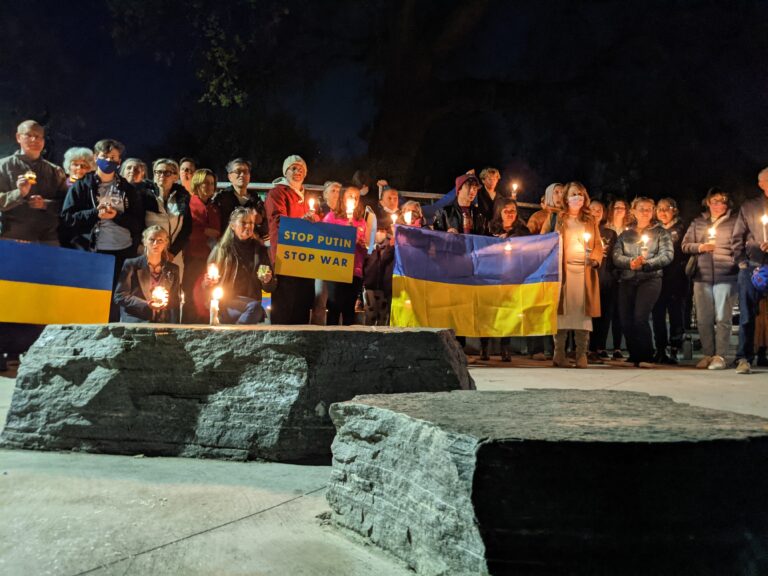
Organizers across Davis hold candlelight vigils supporting communities in times of war

Local Davis organizers hold vigils at Central Park to show their support for the people of Ukraine 

By CHRIS PONCE — city@theaggie.org

Content Warning: war, violence

On Feb. 24, Russian President Vladimir Putin ordered an invasion into Ukraine labeled as a “military operation.” In the wake of the war, the Ukrainian people are fighting back or fleeing from their homes and seeking refuge. More than one million Ukrainians have fled the nation, and the death count continues to rise. This invasion has affected people across the globe, and as the war continues, organizers across Davis have made a statement. 

Community organizers Dannelle Larsen-Rife and Deardra Larson responded to the invasion by taking local action. They have been organizing candlelight vigils throughout March. The first vigil was held on Thursday, March 3, but fewer than 10 people attended. This turnout didn’t discourage them as they organized another vigil a couple of days after, and the crowd increased to 30-40 people, according to Larsen-Rife. As word of mouth spread, the turnout continued to grow.

Larsen-Rife spoke on how she and her friend were inspired to unite the community. 

“I looked at my children and family and just thought about, you know, if we stay silent, these things just keep happening, that we need to come together,” Larsen-Rife said. “We need support, we need to offer support. And so I reached out to my friend Deardra and said, you know, I think I want to do a candlelight vigil.”

The third vigil titled “The Light of Love for Ukraine” was held Sunday, March 6 and started at 6:30 p.m.. The event was located in Davis Central Park. Candles were given to those in attendance as the crowd grew. Ukrainian flags and flowers were placed on the stage.

The organizers invited people from the crowd to speak, allowing for everyone’s voices to be heard. Deardra emphasized the importance of the vigil and how vital it was for members of the community to support one another in these trying times. 

Many of the speakers had a Ukrainian or Russian background. One of the opening speakers shared messages from her family and those she knew in Ukraine. 

“The civilians were rapidly evacuating from occupied cities — women, children [and] old people,” the speaker said. “And they were shot, just a column of civilians were shot. Many died, others were wounded. They’re killing civilians. It feels like they, meaning Russian invaders, are not even people.” The speaker continued, saying their contact in Ukraine was apologetic: “Apologies, my entire being, my entire soul is screaming. Our city is holding on.”

Another speaker talked about how they had family in both Ukraine and Russia and have been communicating with them frequently. The speaker said a family member of theirs from Ukraine told them, “I just didn’t have enough time with my grandchildren to enjoy.”

Julia Metzler, a speaker from the vigil and an Ukranian immigrant, spoke about Davis’ sister city, the Ukranian city of Uman. Metzler emphasized that Davis helped her feel “connected” to Ukraine. She has lived most of her life in Davis with her mother and calls this place home. Metzler commented on her family’s perspective in Ukraine. 

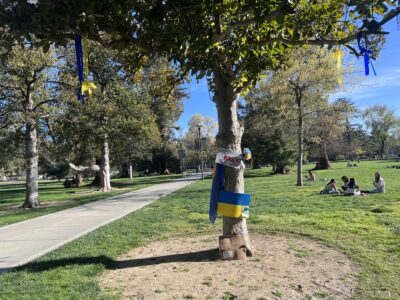
UC Davis tree near Memorial Union covered in homage to the Ukrainian flag to show support for Ukraine in its ongoing war with Russia.

“My family members have mixed emotions,” Metzler said. “Some of which really think that Ukraine’s going to pull through, and they’re just there using the air-raid sirens to go down to their basements and take cover.” 

Metzler also shared information about her other relatives in Ukraine who are worried about their futures because of the war.

“I have other family members who feel like they can’t leave Ukraine,” Metzler said. “They have young children. They have husbands that they don’t want to leave behind. They don’t know what they’re going to do in terms of jobs when, if, they do end up seeking solace in a different [country] or seeking refuge in a different country. So they feel like they don’t have an option of leaving, if the war does end up directly on their doorstep. So it’s definitely some mixed emotions over there.”

The vigil ended with a moment of silence for the war and the following devastations. The organizers plan to host more vigils throughout the month and are fundraising for people in Ukraine. Donations for urgently needed helmets and vests can be made at Helmets & Armory Vests for the European Defenders, and other aid information can be found at Ukraine Aid Information & Resources on Facebook.

 During the vigil, Metzler quoted an English translation of the Ukrainian National Anthem: “Ukranians’ glory and freedom haven’t died yet. Luck will still smile on us, brother Ukranians. Our enemies will die as the dew does in the sunshine, and we too, brothers, will live happily in our land.”

Written by: Chris Ponce — city@theaggie.org

UC Davis Koret Shelter Medicine Program chosen by Gov. Newsom to lead animal shelter initiative

Gov. Gavin Newsom signed budget legislation which includes $45 million for the Animal Shelter Assistance Program to be administered by UC Davis 

By KAYA DO-KHANH — campus@theaggie.org


The Koret Shelter Medicine Program (KSMP) at the UC Davis Center for Companion Animal Health has been chosen by Gov. Gavin Newsom to direct a five-year project aimed at improving the lives of at-risk animals and providing support for shelters statewide. 

Newsom signed budget legislation for the project known as the Animal Shelter Assistance Program in 2021, which includes $45 million, an augmentation of $5 million allotted earlier in the year. The program was enacted to stand by the state’s policy goal that “no adoptable or treatable animal is euthanized,” according to the Animal Shelter Assistance Act.

“What’s really important is that the shelter medicine team has always been very accessible and inclusive in their consults with animal shelters and really works with groups on solutions,” said KSMP California State Director Allison Cardona. “It shows that the state of California recognizes that work and trusts us to be stewards of this funding.” 

The Animal Shelter Assistance Act states that the program should provide resources based on assessments and training to prevent animal cruelty as well as administer a grant program to aid shelters in the implementation of best practices. 

“The University of California houses the nation’s premier animal sheltering research, service, and teaching program,” Article 6.4 of the Animal Shelter Assistance Act states. “The shelter medicine program at the University of California, Davis promotes a welfare-centric, life-saving approach to the management of animals in shelters, focused on prevention and grounded in science.”

The program serves as a way to track the stability of animal shelters and connect them to others in the state, according to Cardona. 

Grant opportunities and applications are listed on the California For All Animals website. Along with the application, there is a questionnaire for shelters that will indicate where the greatest need is within the state. 

An online launch party was held on Feb. 14 to accompany the opening of the first round of grants. Newsom made a special online appearance in support of the launch and thanked the UC Davis team for leading the initiative. 

“Four years ago we pledged that all California communities would have the resources they need to ensure that no healthy or treatable animal dies in a shelter,” Newsom said in the online launch party. “I’m really proud that California is following through on these promises, and I’m confident together we can meet the goal of finally becoming a no-kill state.” 


Written by: Kaya Do-Khanh — campus@theaggie.org


Senators heard quarterly reports, discussed the mask mandate, passed emergency bills

SB #62, #59, #24, #58 and #60 passed unanimously 

By SYDNEY AMESTOY — campus@theaggie.org

Vice President Juliana Martinez Hernandez called the meeting to order at 6:15 p.m. on Thursday, March 3 and read the land acknowledgment. 

The Club Finance Council (CFC), a program that provides grants for student organizations through the Center for Student Involvement (CSI) then gave a presentation on its work this quarter and its future goals. The CSI Grants Student Manager Huda Saleh and the CSI Campus Activities Coordinator Joseph Martinez, discussed their operations and how they have helped registered student organizations apply for and receive grants. This quarter, the CFC budget has increased to allow them to give more money — up to $3,000 — to create a new website and expand their advertising. 

The council has had 64 applications from various registered student organizations over the past two quarters, and it has allocated $14,008 to these clubs for many reasons, including travel costs. According to Saleh and Martinez, the best way for registered student organizations to reach out to the CFC is through the Aggie Life website.

Next, a representative from the UC Davis School of Law came to speak on behalf of the 700 law students at UC Davis and the Law Student Association (LSA). The speaker, Ethan Christianson, asked for collaboration between ASUCD and the LSA in regards to issues such as the lifting of the mask mandate, parking and a lack of student housing, especially for graduate students.

President Pro Tempore Radhika Gawde expressed interest in extending this collaboration to legal advice for ASUCD. 

“That would be immensely helpful in strengthening both of our advocacy, if we didn’t get threatened with a lawsuit every time we tried to do something,” Gawde said.

Then there was a presentation given by UC Davis student Calvin Wong, who provided an update on his push to eliminate SASI and CEI, two student fees that go toward funding UC Davis Athletics. He sought support from ASUCD in regards to having a referendum to eliminate these fees on the spring quarter ballot after receiving conflicting information from the administration. This included an email that cited a specific guide to having a measure listed on the ballot, which contradicted a previous email from a different member of the administration. 

The Senate table then moved on to instating new members of several different ASUCD committees and commissions. This included three new members of the Internal Affairs Commission (IAC) and three new members of the Academic Affairs Commission. All were voted in unanimously.

Commission Chair Kabir Sahni and Vice Chair Jaisey Joseph then provided the IAC’s quarterly report. This quarter, the commission introduced 12 new pieces of legislation and advised on 76% of all legislation. 

The Disability Right Advocacy Committee also gave its quarterly report and shared future plans on making the ASUCD Gardens more accessible and Americans with Disabilities Act (ADA) compliant.

The Research and Data Committee then gave its quarterly report, highlighting the recent surveys done by the committee during the quarter. These surveys include the food insecurity survey, the transfer student experience survey and the ASUCD student worker survey, which is ongoing. The committee has two planned surveys for spring quarter: the environmental justice survey and the equitable access survey. Next quarter, the committee also seeks to hire a new chair and to write an official handbook.

The Picnic Day Committee then gave its quarterly report, which focused on the limited budget for this year’s Picnic Day. The unit is currently recruiting 220 volunteers and still needs about 90 more. There will be fewer t-shirts sold at Picnic Day as compared to previous years, along with other merchandise such as hats and stickers.

Campus Center for the Environment’s quarterly report included recent work done at the ASUCD garden, such as clearing debris and refurbishing overgrown pathways. The center will also bring back compost runs on campus, in which compost bins will be biked around campus by an employee from the center. 

The Sexual Assault Advocacy and Awareness Committee (SAAAC) gave its quarterly report on current projects, such as their collaboration with the Gender and Sexualities Commission, an Instagram account meant to educate students on UC policy toward sexual assault and Title IX. SAAAC has current plans to reach out to fraternities in particular. 

Finally, the Office of the Transfer Student Representative (OTSR) gave its quarterly report following the unanimous confirmation of a new student employee. The OTSR spoke of its collaboration with the Research and Data Committee on the transfer student survey from winter quarter, as well as its staff being able to attend the National Institute for the Study of Transfer Students conference.

After a brief 20-minute break, the Senate regathered and held a small dialogue session on the upcoming end to mask mandates on campus on March 19. Some senators and chairs brought up the idea of having ASUCD affiliates keep their mask mandate, but the idea was dropped in favor of encouraging the student population to continue to wear masks. It was then brought up that Unitrans, which as a form of public transportation, must follow federal guidelines.

International Student Representative Kevin Zhou brought up the unique problems international students may face during the pandemic during the mask mandate discussion. According to Zhou, they may have received different kinds of non-mRNA vaccines, and some may not be fluent in English which could create a language barrier if they were to go to the hospital for COVID-19. 

“We are here to receive a higher education, not a higher infection rate,” Zhou said.

After this brief debate, the table discussed two emergency bills, SB #62 and SB XX. 

SB #62 was raised by the Picnic Day Committee in regards to an error made in their budget last year in regards to money set aside for hats. The bill, which was passed unanimously, saw $34,000.99 allocated to fixing this deficit.

SB XX was raised by Senator Dennis Liang and Senator Gaius Ilupeji to suspend ASUCD Bylaws Section 14, which defines the Elections Code. This was spearheaded by the current Cow for Mascot movement on the ballot, which Liang and Ilupeji believe could encourage more participation in voting. None of the acts defined in the bill received necessary approval after lengthy debate, and the bill was tabled indefinitely. 

“Voting to end an elections code is so unethical, and so beyond wrong, that that should be enough for you to vote against it,” Gawde said.

After the emergency bills, the Senate moved on to other bills, including SB #59, which seeks to eliminate a task force in the ASUCD executive branch delegated to funding events for the executive staff. The bill was passed unanimously. 

SB #24 seeks to commit to full electrification of heating and cooling on campus, transparency between the community and campus government and having all student leadership operations become fossil fuel free. The bill passed unanimously.

SB #58 seeks to change the one time allocation fund for unit directors from $500 to $1,000. The bill was passed unanimously.

SB #60 seeks to change the balance in the IAC’s ability to edit bills and the anonymity of senators to address IAC concerns. The bill passed unanimously. 

The meeting was adjourned by Martinez Hernandez at 12:13 a.m.

Written by: Sydney Amestoy — campus@theaggie.org

Petition to end masking at Activities and Recreation Center dropped after university announced new mask requirements

A Change.org petition created by third-year Hayden Keller gained 187 signatures against indoor masking as of March 4

By KRISTIN TRENT — campus@theaggie.org


Third-year nutrition science major Hayden Keller created a petition addressed to Chancellor Gary May proposing an end to the indoor mask mandate at the UC Davis Activities and Recreation Center (ARC). The petition states that mask restrictions at the popular exercise facility should be lifted because wearing masks impacts exercise performance. As of March 4, the petition, published on the website Change.org, has 187 signatures. 

Masking risks to students during exercise were emphasized over risks to contracting COVID-19 and its variants. 

“Not only does wearing a mask make it harder to inhale the amount of air needed to perform at your desired level, it is proven that surgical mask increase resistance and strain to airflow, which can pose a much more severe threat to students over contracting a virus that is once again compared to a common cold,” the petition states.

On March 3, the university announced that effective March 19, masks will no longer be required in most indoor settings on campus. Students and staff will still be required to test every 14 days while unvaccinated individuals must still be tested every four days. Some places like public transit and clinical settings will still require masks. 

Since the announcement, Keller has decided to drop the petition.

Although this decision was made weeks after Yolo County has already lifted the mandate, it is better late than never,” Keller said. “This petition’s greatest achievement wasn’t assisting with the dropping of the mask requirement, but with letting students know that they aren’t alone, and they shouldn’t be afraid to stand up for what they believe in.”

Dr. Cindy Schorzman cited a number of reputable officials that helped inform the decision to continue mask mandates through winter quarter despite California’s indoor mask mandate expiration including UC Davis Health infectious disease experts and public health officials. 

“This decision is in line with advice from the Yolo County Public Health Officer, Dr. [Aimee] Sisson, who continues to recommend masks indoors until the case rate falls into the moderate transmission range,” Schorzman said.

According to Shawn Yew, a fourth-year student, masks are a way for students to protect themselves and others as the pandemic continues.

“In my personal opinion, I think [wearing masks] is good for students,” Yew said. “Wearing a mask is a very useful method to keep away the spreading of the virus. So I would say that wearing a mask is not a big deal and it can give you […] protection against the latest virus.”

Second-year Asian American Studies student Chelsea Vang also commented on masking’s ability to protect others.

“We still have people that are suffering from this virus, and so I’m really glad we have the rules regardless of how low our cases are or even if our cases have gone to a point that people are good to go outside without a mask on,” Vang said. “I personally think it should be a requirement that all students wear a mask because wearing this mask doesn’t only mean protecting other people within the space that you’re in, but it’s also going to protect anyone you [later] interact with.”


Written by: Kristin Trent — campus@theaggie.org


Pandemic increases awareness, safety measures for Great Ape Conservation

Closely related to humans, gorillas tend to be more prone to respiratory infections from humans 


By MONICA MANMADKAR — science@theaggie.org


With the closing of zoos and other public attractions, respiratory infections and illness have decreased significantly in their gorilla population. The mountain and eastern lowland gorilla populations’ respiratory health has greatly improved since the start of the pandemic, according to an article by the Gorilla Doctors, an organization dedicated to saving mountain gorilla populations by using veterinary medicine and science.

Research has shown that gorillas can get respiratory infections from humans since they tend to be closely habituated to humans, either for tourism or research. When the pandemic began, there was a cessation in tourist visits to gorillas in Rwanda for most of 2020. Even when the tourist visits resumed, new protective measures were enforced by the Gorilla Doctors for both the tourists’ and the gorillas’ safety, with stricter enforcement of human-gorilla “social distancing” rules. 

“It was a logical step to ask if the reduction in human-gorilla contact during the two years of the pandemic was related to a concurrent reduction in the frequency of respiratory illness in the habituated groups,” said Dr. Kelly Stewart, a retired primatologist from UC Davis who studied mountain gorillas, via email. “The data strongly suggest that this is the case. We can say this thanks to the regular health checks on the gorillas by the veterinary program conducted during the pandemic.”

Since zoos closed during the pandemic, the annual average of respiratory illness outbreaks in gorillas fell from 5.4 to 1.6 outbreaks. Although SARS-CoV-2 has not yet been detected in any gorillas, it is important to keep the safety measures in place to protect the Great Apes, said Stewart.

Moreover, Stewart explained how data collected by veterinary and behavioral research programs have produced results that urge the continual protection of these gorillas. This research has helped confirm that humans can pass the disease to wild gorillas and has showcased action items that can help mitigate the risk. 

The recent analysis suggests that maintaining an appropriate “social distance” and masking up has an effect on reducing the risk of human-gorilla transmission of any airborne disease. Although veterinary research formed the best practices for gorilla tourism, the tourism industry has pressured National Park services to relax regulations to promote a more enjoyable, realistic tourist experience. The research has shown that this is not worth the risk.

“With summer coming up and tourists heading to zoos more often than last year, it is still important to protect these gorillas and continue wearing masks,” said Dr. Kirsten Gilardi, the executive director and chief veterinary officer for Gorilla Doctors and the director of the Karen C. Drayer Wildlife Health Center at the UC Davis School of Veterinary Medicine. 

Gilardi noted how research and the pandemic’s effect on the gorilla population’s health should be kept in mind when visiting zoos. It is necessary to conserve these animals and ensure their health through protective measures, like maintaining a 10-foot distance. With the omicron variant, Gorilla Doctors recommend that these changes should be made permanent to protect these endangered animals. 

Written by: Monica Manmadkar — science@theaggie.org

A conversation about coffee culture

Coffeehouses have been important spaces for promoting social equality, but still have work to do in being truly inclusive 


By SUN YIE — arts@theaggie.org 


Starbucks, Peet’s and Philz are a few names that students have grown to know and love in their fixations with coffee, perhaps to a degree where they can not function in their classes without their usual dose of espresso shots. Coffeehouses are places of innovation, enlightenment and the occasional caffeine-fueled meltdown provoked by exam anxiety. They are open to children and elders alike, thereby advertising themselves as welcoming hosts of a creative and open environment.

Coffeehouses prided themselves in transcending the imposed boundaries between social classes in 17th and 18th century England, according to Tom Standage’s “A History of the World in 6 Glasses.” Yet coffeehouses were not necessarily welcoming spaces for everyone. Coffeehouses were considered places to conduct not only business, but also places to hold political and philosophical discourse — exclusively for men. 

Coffeehouses were, however, revolutionary in their accessibility for men of all social classes. According to Standage, they were considered a great equalizer, as a “dish of coffee” was worth a penny, so even men of lower socioeconomic status could participate and contribute in these public spheres. Men who would later become acclaimed historical influences, like Isaac Newton and Jonathan Swift, would also frequent these establishments to promote scientific and philosophical conversations. 

Because Englishmen realized coffee was an appropriate substitute for alcohol, it became a valued commodity, with coffeehouses obscuring the popularity of alehouses and alcohol. Before coffee, ale was England’s choice of beverage, but alehouses were noisier and less pragmatic to conduct business and maintain productive conversations in. During their transition from dependency on alcohol to dependency on caffeine, Englishmen ushered in a society of sobriety, which caused a few scholars to then consider coffee as an ultimate panacea for society’s ailments, even considering it as a potential cure for miscarriages.

Women of the upper class were not welcome in coffeehouses, despite their numerous protests. In “A Woman’s Petition Against Coffee,” published in 1672, women addressed their concerns about the effects that caffeine had on their husbands and other men, citing men’s habit of gossiping about women. This comparison might have been drawn to effeminize them in order to turn them away from their caffeine fixation. However, their efforts proved to be fruitless, according to Standage’s “A History of the World in 6 Glasses,” as men continued to frequent these establishments. 

Given the globalization and modernization of coffee and coffeehouses, coffeehouses now are far more inclusive spaces than before, according to Mark Pendergrast’s book, “Uncommon Grounds.” Through the thorough and lively discourse shared among colleagues, regardless of gender, it is clear that no one thinks twice when they see a woman in a coffeehouse, nor do they find it strange when women participate in academic discourse with men. 

Lisa Tran, a fourth-year computer science major, and Ryan Chang, a fourth-year mechanical engineering major, both said they enjoy participating in conversations about their classes over a cup of coffee at the CoHo or Starbucks. 

“I see both women and men [in coffeehouses] struggling over classwork and it’s always best to do that over a cup of coffee,” Tran said. “I feel like coffeehouses bring us together in a way that other public spaces don’t, and when I talk to my peers, I’m not thinking about their gender and I can say they don’t see me in that way either. We’re equal peers, regardless of gender.”

Chang echoed similar sentiments as Tran.

“Yeah, I mean, I feel like we’re all in this together,” Chang said. “You say coffeehouses weren’t available to women back then, but this is 2022 so for that to be true in the present seems a little ridiculous to me.”

In this sense, many do not view coffeehouses any longer as gendered spaces, but whether they are now truly inclusive to everyone is still to be considered. After the arrest of two Black men for “trespassing” at Starbucks in 2018, the coffee chain faced backlash. Kevin Johnson, the CEO of Starbucks, issued a personal apology to the two victims in 2018 and subsequently claimed to ensure that store managers would undergo more training, especially against unconscious bias. After their accusations directed against the two Black men, Starbucks announced they would be closing “more than 8,000 company-owned stores” for a day to conduct racial bias education across the country to prove their commitment to their new diversity training. 

Starbucks is a well-known chain of coffeehouses which people from all walks of life frequent and, as such, it is a place that should seek to foster a sense of community by dismantling prejudices levied against underrepresented groups, according to Pendergrast. Starbucks’ responsibility to create space for all communities can be traced back to coffeehouses in 17th and 18th century England, which sought to reduce the disparities of social classes between men, despite its inaccessibility towards women. However, the treatment of these two Black men makes clear that coffeehouses are not yet equitably accessible and thus need to make more cognizant efforts to connect to their communities

Coffeehouses’ exclusivity has evolved to reflect pressing modern issues today. In 17th and 18th century England, women were the main group shunned from coffeehouses, and their protests were dismissed for a while. 

Likewise, Black people struggle to be included in these spaces that promote equity as a public business, evidenced not just by the arrest of the two Black men at Starbucks but also in more covert ways. In an Instagram post, user Cydni Patterson explained the feeling of her family being “monitored” and unwelcome by her cafe managers. Additionally, in his Medium article, “Coffee Shop Racism,” Alfredo A. Weeks IV detailed his experience with racial profiling and exclusion at coffee shops, discussing “the stares” he feels and the barista “eyeing him,” further demonstrating undertones of hostility and microaggressions against Black people in coffeehouses.

Benefits of yoga are much more than physical

The ancient practice teaches mindfulness in place of the Western fitness mentality

By CORALIE LOON — arts@theaggie.org


Since the westernization of yoga in the late 19th century, yoga has become a popular form of exercise that inevitably relates to themes of cultural erasure and whitewashing. However, it also offers an important alternative to mainstream workout culture through its emphasis on mindfulness and on fostering a deeper mind-body connection.

According to a Forbes article, 7% of people list exercising as a New Year’s resolution and 20% of people list “losing weight.” Based on popular advice and sentiments shared on the internet, fitness culture often values goal setting, monetary investment and the monitoring of calories, traits which to some could be off-putting. 

In many ways, yoga challenges these Western notions of mental and physical health that rely on a future-oriented mindset and self-scrutiny.

Yoga originated in India around 5,000 years ago. Its name is derived from the Sanskrit word “yuj,” which is mentioned in the Vedas, the oldest religious texts of Hinduism. Yoga comprises one of the six schools of Hindu philosophy and is often considered a “sister tradition” with Buddhism, a religion and philosophy based on meditation and the alleviation of suffering from material desires. Since its development, yoga has taken many different forms, offering various approaches to the same basic principles.

Akshat Patel, a third-year cognitive science major, helps lead “Yoga of the Heart” (@yoh.davis on Instagram), a student organization that started during the beginning of the COVID-19 pandemic. They practice Bhakti yoga, “which is yoga that is centered around love,”  Patel said. “In our culture we practice something that is called devotional service, which means serving other people.”

“We invite students and we guide them through meditations. We also serve them food and we serve the community in many ways,” Patel continued.

For Patel, Bhakti yoga is an important part of his spiritual community and routine: “There’s a term called ‘sadhana’ which is your daily spiritual practice, and it’s something that is a spiritual muscle and you have to exercise it and work it out daily,” Patel said.

Part of the American adaptation of yoga, however, has been characterized by a de-emphasis of its spiritual and meditative aspects in favor of the physical aspect (or “asana,” the third limb of yoga). But the other limbs of yoga, including “pranayama” (breathing) and “dharana” (focused concentration), are just as important to understanding yoga’s full-spectrum ability to heal the body and mind.

Still, Western versions of yoga maintain ties to their roots and offer many people a way to combine an interest in spirituality with fitness goals. Ashley MacLean​​, a fourth-year clinical nutrition major, teaches Buti yoga, which was created in 2010 and combines vinyasa flow with cardio and dance, at the Activities and Recreation Center. According to MacLean, the term “buti” is a Hindu word that means “a cure that has been hidden or kept secret.”

While the practice allows participants to get their sweat on, it also focuses on connecting to and listening to your body. “If you’re running you’re just running, there’s no mind-body connection. If you’re biking, same sort of thing. Yoga gives you that connection one step farther with your body,” MacLean said.

Of course, yoga has plenty of physical benefits: increased flexibility, strength, improved sleep and better posture, just to name a few. But it also offers much more.

Aleshia Rose, a third-year communication major, started doing yoga as a first-year to quell her anxiety. “It helps me stay fit in a healthy way,” she said. “It helps me focus on my breathing, and I have a lot of issues with breathing… I think it makes me a better person.”

Because yoga and meditation encourage one to be observant and in-touch with the present moment, these practices naturally counter the forward-focused mentalities prevalent in mainstream workout culture. Instead of focusing on what goals or milestones will be reached, yoga offers an experience that is equally rewarding in the here and now, and cannot be measured by calories or pounds.

MacLean’s advice for those interested in yoga was to simply give it a try and not force it to click right away: “Yoga comes to you. It’s there for you when you need it.”


Written by: Coralie Loon — arts@theaggie.org


Yolo-Solano Air Quality Management District’s Don’t Light Tonight advisory program keeps Yolo County’s air healthy during winter

Local air quality management programs maintain low levels of fine particulate matter and ozone in the atmosphere with the help of forecasting

By LEVI GOLDSTEIN city@theaggie.org


From November through February, Yolo-Solano Air Quality Management District (AQMD) issues a Don’t Light Tonight advisory, which asks residents of the district to not light wood-burning stoves or fireplaces on days when air pollution is expected to be high. 

Yolo-Solano AQMD was jointly established in 1971 by the Yolo County Board of Supervisors and the Solano County Board of Supervisors, according to its website. The District includes all of Yolo County and part of Solano County, including Rio Vista, Dixon and Vacaville. 

Local air quality management districts, of which there are 35 in California, operate below state-level air quality management, or the California Air Resources Board, according to Executive Director of Yolo-Solano AQMD Mat Ehrhardt. 

“Air quality management districts […] are tasked with managing the oversight of implementation of the Clean Air Act at the local level as well as encouraging public outreach and involvement in protecting the air quality,” said Stephanie Holliday, the Yolo-Solano AQMD Administrative Analyst and Public Information Officer. “So our local mission here […] is basically to protect human health […] from the harmful effects of air pollution.”

Yolo-Solano AQMD partners with Sonoma Technology (STI), an environmental consulting firm. STI measures air pollution and performs air quality forecasting across the U.S., according to Chief Executive Officer Leo Chinkin. STI also helped develop AirNow.gov, a real-time air quality data site. 

For Don’t Light Tonight, the District issues a warning in advance when, the next day, the Air Quality Index (AQI) will be above 78, or 25 micrograms of particulate matter per cubic meter, according to Ehrhardt. 

“It’s a regular weather forecast, but then we’re applying what’s going to happen with the pollutants over a region,” said Jeff Beamish, a meteorologist at STI. “Basically we’re trying to find those pollutant sources, figure out where they’re going to be heading, how the weather is going to impact them and come up with an AQI forecast.”

AQI was developed by the U.S. Environmental Protection Agency (EPA) as a unitless index for particulate matter and ozone levels in the atmosphere, according to Chinkin. 

“The AQI is designed by the EPA to be a short-term indicator to help the public make decisions about protecting their health,” Chinkin said. 

The forecasts are based on an average hourly concentration. Each pollutant has its own AQI value; whichever value is highest is broadcasted. According to Beamish, ozone is usually higher in the summer, so particulate matter is the primary concern in winter. 

“The amount of sunlight that is available during the day plays a very key role in the ozone developments,” Beamish said. “It’s typically why ozone is the main driver behind pollution during the summer months versus the winter, because the days are longer during the summer.”

During winter, cold temperatures can trap air particles closer to the ground, according to a press release published by the Yolo-Solano AQMD on Nov. 1, 2021. 

Wood smoke contains fine particulate matter (PM 2.5), which is especially unsafe because it can travel more easily to the heart and lungs than particles of larger size. A high concentration of fine particles in the air can cause respiratory problems for children, the elderly and those with existing health conditions. Long exposure over time can lead to even more health problems, Beamish said. 

Don’t Light Tonight is meant to maintain lower levels of particulate matter in the air to reduce the health risks for residents in the district.

“The impact of people not burning can keep AQI values maybe five to 10 AQI lower than what we’re forecasting,” Beamish said. “The action of not burning […] when we issue the Don’t Light Tonight advisory for Yolo and Solano counties has a huge, huge impact.”

Holliday also believes it’s a matter of courtesy. 

“By encouraging residents to not use their fireplaces, you can have a very real impact on your neighborhood, so not just yourself but the people that live around you,” Holliday said. 

To know when a Don’t Light Tonight warning has been issued, residents can sign up for EnviroFlash, the District’s free email and text notification service. They can also check the District’s social media, visit their website or call (530) 757-3787 to listen to a recorded message. 

STI also forecasts for Sacramento Metropolitan Air Quality Management District’s Check Before You Burn program, which also runs from November through February, according to Beamish. Unlike Don’t Light Tonight, Check Before You Burn prohibits wood burning by law when a warning for high AQI has been issued. 

Yolo-Solano AQMD also has a summer program, Spare The Air, where from May through October, residents are advised not to use their automobiles on days when smog levels are high. 

“Gasoline vapors combining with sunlight can increase ozone levels during the summer months,” Beamish said. “Instead of fueling your tank at 4 p.m., doing it at 9 p.m. can really make all the difference in the world.”

Beamish believes that these local programs demonstrate that the actions of individuals really can help better the environment. 

“The main takeaway from it is people can make a difference in air quality in their region just by a simple act of not lighting wood on fire,” Beamish said. 

Written by: Levi Goldstein — city@theaggie.org

Beyond the COVID-19 dashboard: UC Davis provides exposure, filtration, ventilation datasets

The UC Davis DataLab and Facilities provide tools to examine UC Davis public information

By KATHLEEN QUINN— campus@theaggie.org

Since the beginning of the pandemic, the UC Davis COVID-19 dashboard has been a source for up-to-date information about testing, cases and isolation. Although, additional regularly-updated datasets provide a more complex view of the effects of the pandemic on campus.

Ventilation and filtration data

UC Davis maintains a live Airtable dataset that can be downloaded and shows the current ventilation and filtration system on campus. 

Josh Morejohn, the energy manager for UC Davis, works with a team of engineers and data scientists to maintain this Airtable dataset

“It was a matter of putting the information in a place where people could access it,” Morejohn said. “A lot of our students worked on that database because it was a matter of pulling different information from different sources and putting it into one place in an organized way.”

Though UC Davis facilities have maintained ventilation and filtration systems for their own use, information about these systems was made public soon after the start of the pandemic. 

“As soon as the pandemic hit, that was one of the campus’s main requests,” Morejohn said. “Our Vice Chancellor Kelly Ratliff was very interested in trying to give people information because they wanted to know what kind of systems served their buildings.”

This data was aggregated by UC Davis Facilities and visualized by Kathleen Quinn of The California Aggie. This visualization only shows known filtration; unknown filtration has been excluded.

According to the Airtable data, UC Davis has only one building whose heating, ventilation and air conditioning system has a high-efficiency particulate air or “HEPA” filter; however, the university has also installed over 50 portable HEPA filters which are noted on the dataset as “air purifiers.”

Ventilation systems can either have recirculated air, use 100% outside air or a mixture of the two. Outside air helps to avoid the spread of airborne contaminants, including viruses, indoors according to the EPA. According to Morejohn, the portable filters served as an extra precaution in rooms without 100% outside air.

This data was aggregated by UC Davis Facilities and visualized by Kathleen Quinn of The California Aggie. This visualization only shows known ventilation; unknown ventilation has been excluded.

At the top of the list for exposure are general assignment classrooms: classrooms that are used for multiple disciplines and may change from quarter to quarter. Consequently, Morejohn said that these classrooms were the focus of data collection.

This data was aggregated by the UC Davis DataLab and visualized by Kathleen Quinn of The California Aggie. Worksites with no exposure up to March 2 are not included.

Wellman Hall, which tops the charts in exposure for the campus at 46 incidents of reported exposure since Jan. 1, 2021, has a MERV rating of 13 or better, a high rating for air filters, and is ventilated with 100% outside air, which is preferred.

Though this filter cannot catch particles as small as COVID-19, it does capture larger particles that the virus might attach to such as pollen or dust, according to the EPA

Dining halls are also one of the most exposed areas on campus. 

“This last quarter, with the omicron variant, we prioritized the dining commons because that’s where people were not masked when they’re eating and that was a concern,” Morejohn said.

As the pandemic evolves, the focus on the filtration system may change, as it can be used in multiple ways, according to Morejohn.

“It’s not only good for COVID virus mitigation, but it’s also good for smoke mitigation,” Morejohn said.

COVID-19 exposure data

As of Jan. 1, 2021, with the passage of AB-685’s COVID-19 imminent hazard provision, the state of California has mandated that all private and public employers inform employees of known workplace exposures. This information is provided daily in an email and includes the location and estimated dates of exposure. 

COVID-19 exposure data for the UC Davis campus is publicly available through the UC Davis website, but the information is deleted every 14 days.

Michele Tobias, a geospatial data specialist at UC Davis, worked with students and researchers at the UC Davis DataLab on a case study using COVID-19 exposure data to create an interactive data visualization that shows the buildings on campus affected over time.

“It was really a good tool to help us better visualize the data and understand what patterns that may or may not be going on, in what was originally a tabular data set,” Tobias said.

The data used was aggregated by the UC Davis DataLab and visualized by Kathleen Quinn of The California Aggie.

According to the data, the largest peak in UC Davis exposure sites was on Nov. 30, 2021 with 38 exposures. Each building with a known exposure may report separately, so this number does not necessarily reflect 38 separate individuals but instead multiple people who migrated from building to building.

In Tobias’ view, a map is an easy way to understand where exposures to COVID-19 are occurring. 

“We felt it was better to represent the data as similar to how it was originally presented without doing a lot of interpretation or analysis on it,” Tobias said. “The goal of the map itself was to present the tabular data in visual form.”

Since the data provided is stored openly in GitHub, it provides an opportunity for the public to use the data in different ways.

“This particular interactive map we made was built on curiosity: what if I built this differently? What do I learn from it?” Tobias said. “Those are the kinds of things [that] if you have open data then the community can also explore it, and maybe we can come up with something useful.”

Tobias said part of her job is to teach people different tools and data visualizations on many different topics using open datasets. 

“Making it all open so people can see how we did it and maybe adapt it — is part of what we do, part of our philosophy at DataLab,” Tobias said. 

Written by: Kathleen Quinn — campus@theaggie.org

UC Davis Mind Institute discovers potential marker for risk assessment, early diagnosis of autism

The NHIP, or the neuronal-hypoxia-induced placental-associated gene, is vital to reducing risks of developing autism spectrum disorder (ASD) by protecting early fetal brain development 

By BRANDON NGUYEN — science@theaggie.org


According to the Center for Disease Control and Prevention, one in 44 children are diagnosed with autism spectrum disorder (ASD). Currently, there is no molecular test that can directly assess and provide a complete diagnosis of ASD during pregnancy or for children under three years old. 

In a recent study conducted by the UC Davis MIND Institute, scientists uncovered a gene on human chromosome 22 that had never been studied before and could provide a molecular marker for assessing a child’s risk of ASD following birth. Dr. Janine LaSalle, the principal investigator on the study and a professor of microbiology and immunology at the UC Davis School of Medicine, studies epigenetics, a field that incorporates both environmental stressors and genetics that can affect DNA expression. The LaSalle lab focused on methylation of DNA as a marker for changes in the epigenome.

“The uniqueness of the placental landscape of DNA methylation could be fingerprints of the genes that had been expressed, maybe differentially,” LaSalle said. “Because you can’t know at birth what’s happening to genes in the fetus’ brain, you want to know what happened previously because we are taking samples of placenta after birth. Transcription is great if you want to know what’s going on in that tissue […] when you capture it, but the reason why we study methylation is because if you want to know something about the past, methylation is a much better marker for that.”

The neonatal epigenome can uniquely and accurately reflect past interactions between genetic and environmental factors during early development in the womb. The placenta has recently become a promising surrogate tissue of focus in studying genes linked to fetal brain function, as it is often discarded following birth. By studying changes in the methylation of genomes, or methylomes, LaSalle hoped to uncover a potential gene marker for autism in placental tissue. 

Dr. Yihui Zhu, the first author of the study and a postdoctoral in LaSalle’s lab, described the gene they uncovered on chromosome 22 through sequencing the methylome in 204 placental samples. 

“We found that the NHIP, or neuronal-hypoxia-inducible placenta-associated gene is active in the brain, responsive to oxidative stress and influences expression of other known genes associated with autism,” Yihui said. “When we overexpressed the gene, we found that placental tissue underwent many rounds of cell division, so the gene’s function is involved in inducing cell division. In most pregnancies, the placenta experiences some inevitable levels of stress, and we think that NHIP is there to minimize the effects of excessive oxidative stress.”

Oxidative stress is an imbalance in free radicals and antioxidants throughout the body that can result from environmental stressors such as air pollution and pesticides. Hypoxia is one form of oxidative stress during which tissues experience a state of low oxygen levels which can lead to cell and tissue damage. By inducing cell division in response to oxidative stress, NHIP enables placental cells to increase contact with maternal blood vessels to reestablish sufficient oxygen levels important for early brain development. 

Researchers at LaSalle’s lab found that, in the placental tissue of children diagnosed with autism and placed in the “with ASD” group, NHIP expression levels were lower than those of children who were placed in the “typically developing” group.

Dr. Antonio Gomez, a postdoctoral at LaSalle’s lab and second author of the study, explained why NHIP is a pivotal first step toward providing behavioral risk assessments for earlier intervention.

“By the time that a child is age three, and they have been diagnosed with autism, we have a big window of birth to three years of age in which we could have offered medical treatments or educational interventions to facilitate a child’s development,” Gomez said. “If we find that NHIP and potentially other genes are truly linked markers of autism diagnosis once a child is born, we can analyze the placenta of every child and confidently say this child has a risk for potentially developing autism. And now that we know that the child has only been born for a few weeks, let’s do some sort of intervention, so that we can help lessen the detrimental effects of autism or potentially even avoid it altogether.”

With the discovery of NHIP as a potential gene fingerprint for assessing the risk of ASD in newborns, LaSalle echoed sentiments of optimism, highlighting how the effects of ASD can be better mitigated with early medical and behavioral intervention. 

“If you can figure out the risk based on the mother’s and father’s genetics, then you can intervene with known behavioral interventions, but I’m also potentially excited about NHIP,” LaSalle said. “If it’s truly protective against oxidative stress in its function that we concluded in our study, we could potentially give NHIP exogenously as a medicine. We still have a long way to go [before that’s feasible], but [it has] potential as a factor that could be added for […] gene therapy in the future.”

Written by: Brandon Nguyen — science@theaggie.org


Students share their experiences studying abroad during COVID-19

Two UC Davis students discuss the perks and challenges of going abroad during the pandemic


By JALAN TEHRANIFAR — features@theaggie.org


Almost 16% of students at four-year universities study abroad at some point during their college education, but because of the COVID-19 pandemic, many programs offered at UC Davis and through University of California Education Abroad Program (UCEAP) have been canceled, postponed or altered in the past three academic years.

UC Davis students were able to resume education abroad in the fall of 2021, but some students’ experience studying abroad during a pandemic has been quite different. Sophie Mares De Juan, a third-year international relations and sociology double major, studied in Brussels, Belgium last fall. She was there for six months, taking courses and participating in an internship at an international research office.

“While I was there, [during] the first months, [COVID-19] didn’t exist almost,” Mares De Juan said. “I went there, and one of the things they required was to be vaccinated. When I got there they didn’t ask me much and briefly checked my vaccination card.”

 Mares De Juan said that when the omicron variant of COVID-19 began circulating in late November, she had to get used to the European Union’s mitigation strategies, which were slightly different from those of the U.S. She explained that to access non-essential indoor spaces, she needed a “COVID Safe Pass.”

“In order to get a pass, the government needed to approve your vaccines,” she said. “It was a weird situation because it was only implemented in Brussels at first. It was a situation that no one knew had to deal with for international students. I did not get a QR code [COVID Safe Pass] because I was an international student. I had to go to France and get a QR code, and then come back to Brussels and use it.”

Despite the challenge of adapting to changing restrictions, Mares De Juan said that studying abroad during COVID-19 was positive in some ways. She said that quarantining in a house together with her five roommates while they navigated getting COVID Safe Passes was a bonding experience that brought them closer together. 

Other students, like first-year human development major Rozalie Svecova, plan to complete their entire degree abroad at UC Davis. Svecova is originally from Prague, but chose to come to UC Davis because she wanted to experience life in a new place like California. She said that when she first arrived on campus in fall 2021, some students questioned her decision to move to Davis from Prague.

“When I got here a lot of people were surprised that I left Prague to come to America, especially during a global pandemic, but I guess it’s the same way Americans dream of traveling Europe, just the other way around,” she said. 

Svecova said that when COVID-19 first began, she was worried she would not have a chance to attend college abroad.

“I knew I wanted to study abroad from the beginning of high school, but when quarantine and everything else happened during my junior year, I thought my chances at studying abroad were over,” she said. 

Svecova said she was very excited to apply and commit to UC Davis, but that moving to Davis last summer was somewhat difficult, since COVID-19 cases were high at the time. 

“I didn’t want to expose my parents to COVID so I ended up moving here all on my own and had to navigate coming to not only a new school, but also a new country by myself,” she said.

She also said that she was unable to visit her family between fall and winter quarter due to the omicron variant surge.

Despite the difficulty dealing with the pandemic during her college moving process, Svecova is glad she made the decision to study abroad for college and is hopeful that pandemic-related struggles will ease with time.

“It’s been hard dealing with [COVID-19] while so many new things are happening in my life, but overall, I’m glad I chose to study here and have no regrets attending UC Davis instead of going to college local to my hometown,” she said.


Written by: Jalan Tehranifar — features@theaggie.org


Aggie Square holds groundbreaking ceremony in Sacramento

Phase one of the project will commence in the spring

By SHRADDHA JHINGAN — city@theaggie.org


On Feb. 16, a groundbreaking ceremony was held for Aggie Square in Sacramento, according to an article from UC Davis. Over 200 people were in attendance for the event.

“Aggie Square is where university, industry and community come together to create opportunities for everyone,” Aggie Square’s website reads. “This planned innovation hub on UC Davis’ Sacramento campus — the result of joint exploratory working group established by Sacramento Mayor Darrell Steinberg and UC Davis Chancellor Gary May — will be home to research programs, private industry partners, classrooms, student housing, and public-facing programs that engage local communities and entrepreneurs.”

Aggie Square was the result of a collaboration between UC Davis, project developer Wexford Science & Technology and the City of Sacramento. The groundbreaking ceremony revolved around the theme of collaboration, with Mayor Steinberg and other elected officials attending to celebrate the event, according to the article.

“This journey has taken a village and it’s really exciting today to have so many of our partners and supporters here with us,” Chancellor May said during the groundbreaking ceremony. “Probably the most important partner I’ve had for these five years has been Mayor Darrell Steinberg and the City Council Members Schenirer and Guerra who support him.”

Chancellor May added that in addition to Mayor Steinberg, Senior Vice President Doug Woodruff of Wexford Science and Technology, various elected officials and people in support of UC Davis also attended.

Steinberg expressed similar sentiments. He highlighted the benefits of the Aggie Square project, such as creating new jobs for the community. 

“I’m proud that our city has partnered with both UC Davis and our community to make Aggie Square a reality,” Steinberg said according to a UC Davis Health article. “We are creating an economic center with thousands of new jobs, and the people in our neighborhoods will be the primary beneficiaries. Aggie Square stands as an example of what is possible.”

In 2020, UC Davis stated in a video that experts in the fields of business, policy, healthcare, education and agriculture would be working together to introduce new ways of creating eco-friendly, accessible and healthy food systems. This was announced to be a collaborative effort with Alice Waters, founder of The Edible Schoolyard Project and owner of Chez Panisse. Waters highlighted how food has the ability to unite people.

“Food can be so powerful in reaching people and bringing them together with other people — how we can change the world,” Waters said in the video.

According to the UC Davis Health article, phase one of the Aggie Square project will begin construction this spring. Phase one of construction entails a Lifelong Learning Building, which contains space for public programs and classrooms. There will also be another two buildings for technological, scientific and engineering purposes. 

Undergraduate students also have the option to spend a quarter at Aggie Square by participating in a program called Quarter at Aggie Square, which started in Fall 2020. Students will have the opportunity to learn about different fields, which include biomedical engineering and educational and health equity, according to the Quarter at Aggie Square website.

“Quarter at Aggie Square lets you engage with Sacramento in a way that enhances your education with practical experience and community engagement,” the website reads. “Spend a quarter with a small group of fellow students and dedicated faculty in a focused learning environment that includes classes and an internship or research.”

Mayor Steinberg highlighted how Aggie Square was ultimately the result of a collaborative effort. In addition, Steinberg stated that Aggie Square could be an example for the rest of the country. 

“[…]We did it together, and we did it in the right way,” Mayor Steinberg said in the groundbreaking ceremony video. “We did it with the community, we did it in collaboration and we did it in a way that will be a model for the rest of the country.”

Written by: Shraddha Jhingan — city@theaggie.org


Unitrans bus arrival predictions system affected by AT&T 3G network shutdown

Until the new system is running, students will not be able to see live bus arrival times but can refer to the Unitrans website for bus schedule information

By ANGELINA ANGELO — campus@theaggie.org


Due to the nationwide AT&T 3G network shutdown, the Unitrans Nextbus live tracking system, which provides real-time bus arrival predictions, is no longer available to students and Unitrans bus drivers. Not only is this shutdown affecting Unitrans, but it is also impacting transit agencies across the country. Well over 5,000 students rely on this system daily, according to Jeffrey Flynn, the general manager of Unitrans. 

This outage is not ideal for students who are busy juggling their personal, social and academic lives,” said Luck Vuong, a fifth-year civil engineering major and the student Unitrans route supervisor manager. 

Vuong recommends that students take an earlier bus, arrive at the bus stop one to two minutes earlier than the arrival time on the bus schedule and reach out to bus drivers with concerns.

Bus drivers will stick to the set schedule, but unexpected delays and traffic may still occur. In order to provide accurate bus arrival predictions with the new AT&T network, Unitrans will need to acquire replacement parts to reset its system. 

“[Unitrans] is waiting on replacement parts, which are currently delayed one to three months due to supply chain issues,” Flynn said. 

Unitrans managing staff is actively seeking out solutions for the time being, according to Flynn. 

“We are testing bridge systems in the next weeks in an attempt to find a temporary solution for students,” Flynn said. 

Students can find bus schedule information on the Unitrans website and on paper schedules, which are available on the buses or at the bus terminal boxes.

Justin Medrano, a fourth-year pharmaceutical chemistry major and the student Unitrans operations manager, shared similar sentiments with Flynn. 

“We are trying our hardest as supervisors and as drivers to make service as reliable as possible,” Medrano said. “We ask that the public bears with us. We are as much in the dark as [students] are right now. We understand it’s frustrating not to be able to look at a map and see where the buses are at in real time, and [we] are working toward solutions.”


Written by: Angelina Angelo — campus@theaggie.org


UC Davis Women’s Basketball split final two home games of the regular season

Aggies fall to Long Beach State Down the Stretch; Cierra Hall, Sage Stobbart and Kayla Konrad close their careers at home with a bang securing the win to close the season


By MARLON ROLON — sports@theaggie.org


 Following a four-game road trip, the Aggies returned back to the University Credit Union Center for the first time since Feb. 12. Sitting at sixth place in the Big West Conference — an unfamiliar spot in the standings — UC Davis lost to Long Beach State, who sat in third, 65-60. 

Since 2016, the Aggies have finished the season as the No. 1 seed in the Big West conference; however, that streak will come to an end as they head into the postseason as the underdogs. 

“Yeah, it’s different; obviously for the last five years, we’ve been the No. 1 seed,” UC Davis Head Coach Jennifer Gross said. “Whatever comes our way, we’re going to just approach it with the best attitude and the most preparation that we can.” 

Winners of five straight regular-season conference championships prior to this season, the Aggies will embrace the underdog role heading into the tournament. The season has had its ups and downs. Their highest moments came when they traveled to Oregon and broke the Ducks 44-home non conference game win streak on Dec. 1. Then on Dec. 19, they defeated Gonzaga for the first time within the program’s history. 

“Sometimes from the one spot there’s a lot of pressure on you, all the expectations are ‘you’re going to come out and steam roll everybody;’ this is the first time where we’ll kinda be in that underdog role and we gotta find a way to grab on to that role and try to be the team that upsets some teams,” Gross said. “We’re capable of that, when we’re playing well we can beat anybody in this conference.”

Their lows came on Feb. 1, against UC Riverside, a team they hadn’t lost to at home since 2016. Then on Feb. 26, they suffered their first loss to UC Santa Barbara since 2017. The trials and tribulations of the journey can make or break teams; however, the defending champions have proven they can beat anybody when they’re playing their best basketball. 

The experience UC Davis has is what makes this team dangerous despite their 14-12 (8-8 in conference) record. They are led by the second leading scorer in the conference, senior Cierra Hall who is averaging 15.2 ppg and senior Sage Stobbart, the reigning Big West Defensive Player of the Year, is leading the league with 2.1 blocks per game. Lastly, at the forward position, senior Kayla Konrad is averaging 8.2 ppg — her veteran presence on the defensive end makes her part of the big three. The trio came into the Big West together in 2017 historically leading the Aggies to two NCAA tournament berths; they are considered the center pieces to their championship run.

UC Davis faced off against the No. 1 ranked defense in the conference in Long Beach State. The Aggies started the game on a 7-0 run and eventually led by a margin of 11. It was all Evanne Turner in the first quarter, scoring eight points while going 2/3 from downtown. Hall and Konrad pitched in five points each to put the Aggies up 20-12.

During the first quarter, the Beach struggled to put up points inside the paint, scoring two of their 12 points on the inside, however their defense forced five turnovers leading to five points. Long Beach played with pressure defensively as they had all season, leading the conference with the most steals and came up with three to stay afloat during the opening quarter. 

“They played a lot of different defenses and they’re constantly switching between zone and man and pressure and trapping, so they’re trying to create a frenzied atmosphere so our game plan was just to break the pressure, stay composed and keep it simple against their zones,” Gross said.

Turner opened the second quarter with a three pointer to take a commanding 11-point lead. The Beach kept missing shots but their active hands on the defensive end kept forcing the Aggies to make bad decisions leading to eight turnovers throughout the quarter. The defense was beginning to take a toll on the Aggie offense.

Still in the second quarter, the bench for Long Beach was key in their comeback, scoring 14 points. They took their first lead of the game, 34-32 with 59 seconds remaining. The visiting team eventually was awarded free throws off a foul that saw them go up by four points. 

On the other hand, the Aggie defense could not create any opportunities coming up with only one steal. Stobbart and Hall had a rare, quiet quarter, combining for zero points. Their bench did not contribute much with only three points. UC Davis’ offense was outscored 12-24 to close the quarter. 

“There were just too many times where we fell into their pace, and we just couldn’t seamlessly get into our offensive actions,” Gross said. 

The Aggies looked alive in the third going on an 8-0 run, six-points came off three’s by first-year Sydney Burns and a jumper from Hall put the Aggies up by four, 40-36. However, Long Beach senior Justina King scored four points off a turnover and a foul to tie the game at 40. The Aggies were having trouble containing King inside the paint, sending her to the free throw line once again for free points. The Beach scored eight points off turnovers in the quarter.

Since the 7:38 mark of the third quarter, no other Aggie scored besides Konrad, who put up six straight until the last 59 seconds. At that point in the game, Stobbart went to the line for two, making one to put UC Davis ahead 47-46. In the next possession, second-year Kianna Hamilton-Fisher hit a quick three over Konrad, silencing the home crowd in the process. With 30 seconds left in the third period, the home team held on to the ball and let the clock wind down to the final seconds when Hall drew the defense and kicked the ball out to Burns who shot a one handed floater over two defenders at the buzzer to end the third in a tie at 49 a piece. 

Both teams played great defense in the fourth quarter, and the Aggies led 57-51 in the last five minutes. Just as the home team began to get comfortable, the Long Beach defense would not go away, utilizing full court pressure forcing eight turnovers throughout the quarter. UC Davis held onto the lead until the last 38 seconds. Then, Hamilton-Fisher drained a three to go up by two. Eventually, Long Beach pulled away, stealing a win on the road, 65-60. 

UC Davis’ turnovers and missed free throws hurt them throughout the game. They shot 7-13 (54%) from the free throw line, turned the ball over 26 times and their bench was outscored 27-7. Three Aggies finished in double figures as Konrad led the way with 15 points and eight rebounds, followed by Burns’ 12 points and six assists and Evanne Turner’s 11 points. Both teams split the season series 1-1. The Aggies pulled out a win in Long Beach on Jan. 29, winning by 10 points. 

“It came down to obviously too many turnovers. If they’re going to score it has to be in the half court. They do such a good job at scoring off the turnovers,” Gross said after the game. “The first game we went down to their place we did a much better job of that and obviously the score was in our favor because of it.”

Gross was asked if the defensive pressure and quick swipes were an issue throughout the contest, “I think that was one of the problems we didn’t adjust that well,” she said. “There were stretches where we did and were very aggressive against it. Against that kind of pressure you have to be willing to attack, you have to be willing to take a few risks.”

After a two-day break on March 5, UC Davis honored Hall, Stobbart and Konrad before tip-off as they played their last home game as an Aggie. The party didn’t end there, as the Aggies punctuated their season by defeating Cal State Fullerton by 28 points, thus securing Gross’ 200th win of her career. She is the fifth head coach in conference history to achieve such a feat. 

“I’ve been very fortunate to coach some amazing teams here and some fantastic student athletes. Our staff is the longest tenured staff in the country. We’ve been together longer than any other staff in division one so it’s a testament to my entire staff and the players that we’ve coached,” Gross said. “Those milestones are special because you get to look back and say ‘wow, I’ve gotten to coach some amazing people and some amazing teams’. For me that’s kind of what it is: recognition. I’ve had a pretty awesome job here at UC Davis coaching some amazing people and getting to work with really great staff.”

Hall finished with 19 points, eight rebounds, Stobbart added 13 points with nine rebounds and Konrad contributed with 11 points along with three steals in their last dance at the University Credit Union Center. 

“They’ve helped elevate the program in so many ways,” Gross said about the three graduating seniors. “They came in as freshmen, and they bought into this concept of wanting to be part of something special, and every year, they’ve done something that the team before hadn’t done. They were part of teams that won Big West championships, they were part of teams that helped us get to our first NCAA tournament,” 

“This year they were part of a team that went and beat top 25 Oregon on the road and beat Gonzaga, a mid-major power so it’s been really cool to see them just every year do something special and raise the bar for our program,” Gross said. “You can’t replace kids like that who have done so much for the program. All we can do at this point is try and give them back everything that we can and help them leave a legacy for the future Aggies.”

Since the Aggies secured the sixth seed in the Big West Conference, they’ve earned a first round bye in the Big West Conference Tournament. In the quarterfinals, they will face off against a recent familiar foe, third seed Long Beach State at the Dollar Loan Center in Henderson Nevada. It’s win, or go home. 


Written by: Marlon Rolon — sports@theaggie.org