55.5 F
Davis

Davis, California

Tuesday, December 23, 2025
Home Blog Page 222

Project managers provide updates on UC Davis’ ‘Big Shift’ toward energy efficiency

The construction project replaces central heating system components on campus

By KRISTIN TRENT — campus@theaggie.org


Undergoing project renovations since spring of 2020, the Big Shift is a major on-campus construction project near the UC Davis Quad. The project was proposed in accordance with the 2010 UC Davis Climate Action Plan, aiming to reduce campus greenhouse gas emissions. It is expected to cost the university $55 million, according to Associate Director and Big Shift Project Manager Dan Golde. 

“The careful, independent study demonstrated that the wisest choice fiscally was to move from steam to low-temperature hot water, which is expected to save the campus significant expenses in fuel, water and maintenance costs over the project’s lifespan,” said Joshua Morejohn, the energy manager for UC Davis.

Once the project is completed, Morejohn estimates the campus’ carbon footprint could be reduced by as much as 40%. 

Specifically, the project involves installing two heat distribution exchangers to replace the inefficient technology. As a result, supply and return piping will also need to be replaced, totaling to four miles of tubing which connect the heat supply to campus buildings. Within campus buildings, the pre-existing systems will also need to be exchanged to connect property to the new technology.

 The Climate Action Plan identifies the central heating and cooling system as one of the university’s largest emitters of greenhouse gas. The old steam powered system relied on fossil fuel to generate heat via steam which requires natural gas. The new system relies on hot water instead, heated by electricity. The Big Shift’s website explains that the steam reliant heating and cooling system installed 75 years ago on campus is inefficient, losing 30-50% of generated heat. 

Due to the project’s large size, areas of campus will be renovated at different times to keep campus operations up and running. 

“Right now the bulk of the work is occurring in the East Quad and Shields Ave area, bringing hot water to Shields Library and the group of buildings to the east of the Quad,” Golde said. “The final two lateral pipelines to be installed during spring quarter will be at [the] Chemistry and Sciences Lab Building. These pipelines were saved for last, as the mechanical systems in these two buildings will be converted from steam to hot water in subsequent construction projects, making them a lower priority for this phase.”

The campus will create detours for students, staff and faculty in the upcoming months to avoid construction areas. The Big Shift’s website has a detour map that lists current closures and detours for convenience. The website also features an interactive map that lists active, upcoming and completed construction. 

“I encourage everyone to leave extra time to get around campus,” Senior Communications Manager Katie Hetrick said. 

As a result of the construction, buildings are marked with signs that say “dress in layers.” Most recently, Hart Hall has displayed these signs at its entrance, warning students and staff of temperature changes they may experience during modification to the building’s heating system.

“There are many factors that affect how quickly this transition takes place,” said Big Shift Building Conversion Project Manager Alan Suleiman. “The mechanical rooms in our buildings are complicated mazes of pipes so building conversion timelines vary. During this time, occupants will be without heat and in some cases, hot water, while the contractors complete the connection.”

After components of the system are exchanged, the next step will be surface restoration which includes concrete and landscape crews, according to Golde.

“The landscapes along North Quad, MU Bookstore and Young Hall courtyards were just recently restored and are looking great – the fence around the fresh sod grass will be down just in time for Picnic Day,” Golde said. “The crews are moving on to new areas and we are looking forward to seeing the balance of the areas impacted by the project all restored by mid-summer.” 


Written by: Kristin Trent — campus@theaggie.org
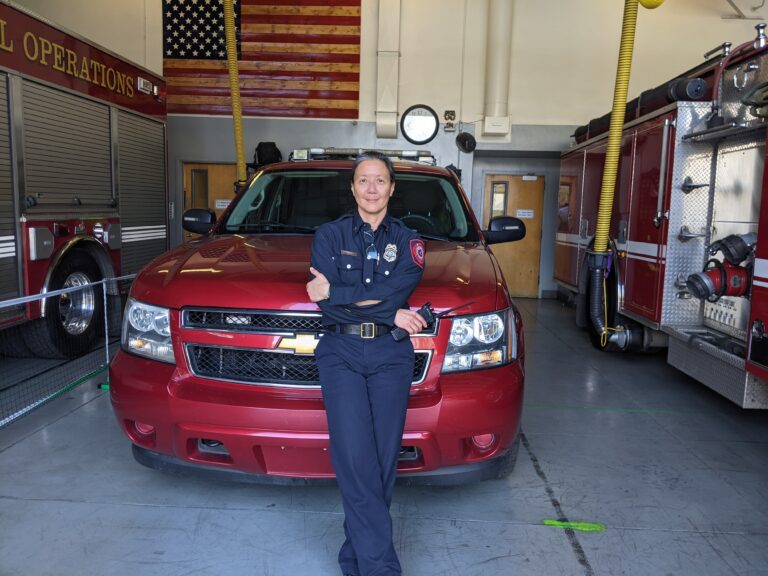


Davis Fire Department’s elects new Battalion Chief, Emily Lo

Lo is the first female Asian American Battalion Chief in the Davis Fire Department

By SOFIA BIREN — city@theaggie.org

Emily Lo, who has been working at the Davis Fire Department for 31 years, was promoted this year to Battalion Chief, making her the first female Asian American Battalion Chief in the City of Davis. She moved to the U.S. from Taiwan in 1981, and as a high school athlete, she liked basketball and any sport that involved a ball and running. It was her athleticism that led her to be a firefighter. 

She had just graduated high school and was at junior college when a friend had suggested she look into becoming a firefighter. He said it might be the perfect fit for her since she was already very athletic. She took an entry fire class at the community college she attended and has been involved in the fire service ever since. 

When asked about how she feels about her new position she makes it very clear that although she is the first female Asian American Battalion Chief in the City of Davis, she is not the first woman to hold that position. Rose Conrad, the first female Fire Chief in the State of California, was the one who promoted Lo to Captain and is still Lo’s mentor. Although Lo feels comfortable in her new position, she said she does feel some responsibility. 

“I am keenly aware of the position that I’m in,” Lo said. “My experience in the Davis Fire Department has only been positive, and although I am not the first woman to step in these shoes, I know that I am the first Asian woman in this position, and I don’t take that lightly.”

Lo’s impact on the Fire Department is widespread. Her subordinates feel comfortable joking around her, and she has a sense of humor with them as well. She says that working at the Fire Department is like having another family. 

“We call it our ‘fire family,’’’ Lo said. “We spend around a third of our lives with each other, so we know each other really well. They’ve seen my children grow up, and I see their children grow up.” 

Her dedication to service is evident when she’s around her “fire family.” At a training exercise she takes the role of spectator, but whenever any of the firefighters has a question she not only answers it but makes sure to do so with a sense of humor. She gives pointers as they are tying support lines around trees, she holds phones that are in danger of falling out of pockets and she makes sure her firefighters are on top of everything. She deliberately plans training exercises of scenarios that are not very common. She does this so the Fire Department does not fall behind on skills that can be forgotten if they are not practiced often.

Aside from being Battalion Chief, she is also the treasurer of the Davis Firefighters Union and is part of the Women’s Commission Mentoring Program, an organization that mentors aspiring female firefighters. 

Lo says that being a woman in the fire service is not anything special, nor should it be. She admits that being a woman in the fire service is a different experience, but she is very careful to express that although she was a woman that started her career in the ‘90s, she did not experience any specific hardships per se.

“I feel like it is very difficult to say that I was treated differently because I am a woman,” Lo said. “To loosely quote Elizabeth Warren, ‘If I said I didn’t win the primary because I’m a woman, people are going to say that I’m playing the victim, but if I say I was treated differently, then I’m going to upset the other 50% of the population.’” 

Lo’s impact is already evident in the city of Davis. 

“It’s really exciting to have women in such prestigious positions. It makes me feel like my hard work will pay off,” Ashlynn Jones, an aspiring firefighter in Davis, said.

Written by: Sofia Biren — city@theaggie.org

Cartoon: Interview with a Davis biker

Drawn by: SEANNE JAVIER –– sajavier@ucdavis.edu 

Disclaimer: (This cartoon is humor and/or satire, and its content is purely fictional. The story and names of “sources” are fictionalized.)

New water usage ordinance added to Davis municipal code

Urgency ordinance has the potential to be permanently codified

By RACHEL SHEY — city@theaggie.org

On Feb. 22, the Davis City Council voted unanimously in favor of new water usage restrictions. To reduce wasting drinkable water, washing buildings or sidewalks with potable water is now prohibited.

City Councilman Dan Carson said that the drought situation looks dire. Since the rainy season this year has been unusually dry, citizens of California must be mindful of water usage in these coming months.

“We’re trying to send a message to the public that they have to be very smart with their water use because honestly, things look grim right now, in terms of this being, once again, an unusually dry rain season,” Carson said. 

The new ordinance will be enforced mostly by citizen complaints. Citizens will be able to report misuse of water to the city — for instance, if they observe a sidewalk being washed with fresh water — via a mobile application called My Davis, according to Carson. 

“We don’t have roving law enforcement officers, but we certainly have city staffers doing their work around the city, their eyes are open to watch out for problems and violations,” Carson said. “The main way we hear about concerns is if someone reports them to us.”

Currently, these new restrictions are part of an urgency ordinance, but the council is considering incorporating them into a permanent part of the city code.  

“After having adopted this emergency ordinance, our staff will now go through the normal process of seeing whether these measures should be permanently adopted as part of the city ordinance that prohibits wasteful use of water,” Carson said.

City Conservation Coordinator Dawn Calciano said that enforcing these restrictions will begin with an education process. For the most part, water is wasted due to ignorance; easily rectified situations, such as a break in a sprinkler system, are often unnoticed.

“It typically starts with a door hanger, and then a follow up door hanger,” Calciano said. “We do have environmental resource staff who go through the whole process and look for water waste and also respond to any water waste concerns that community members have. It starts with an educational process, particularly with sprinklers, because we encourage people to run them through the night, they don’t always know there’s an issue or break in the sprinkler system.”

Due to the rains, Davis has successfully transitioned to using mostly surface water from the Sacramento River in the water supply. As the summer progresses, the ratio will likely shift to about half surface water and half groundwater, according to Calciano.

“It does vary each month,” Calciano said. “Through the winter months, we were 99.6% Sacramento River water and only about 0.4% groundwater, but throughout the summer months, we were only about 50% surface and 50% groundwater. As we had rain in the fall, the amount of surface water increased, and we’ll probably start to see it drop down again throughout the summer.”

Carson said that the city cannot enforce these rules by turning off the water. The city does not have the power to turn off water for households, so losing access to water is not something that city residents have to be worried about. The city is aware that a lot of water wastage is due to ignorance rather than wilful misuse.  

“We’re not allowed under state law to turn people’s water off,” Carson said. “The main reason for that is that it’s a safety and health issue.”

Calciano said that Davis residents significantly reduced their water usage over the winter months. This was likely because abundant rainfall reduced the need for irrigation. 

“We appreciate all the efforts that the Davis community has made, as we saw much improvement in water use in November and December,” Calciano said.

Written by: Rachel Shey — city@theaggie.org

Culture Corner

The Arts Desks’ weekly picks for movies, books, music and television shows 

By SIERRA JIMENEZ — arts@theaggie.org

Book: “The Lord of the Rings: The Fellowship of the Ring” (1954) by J. R. R. Tolkien 

We’ve all seen the film series “Lord of the Rings”, or at least have heard of the popular line, “You shall not pass” at least once in your life. If not, you must be living under a rock like Gollum… Oh wait, you wouldn’t know who that is. Looks like it’s time to pick up the original novel and immerse yourself into the alternative fantastical world of Middle-earth. The descriptive nature of the language engulfs the reader into this magical realm and makes it seem as if they were in the mystical world themselves. From the constructed language of Elvish with its own linguistic rules to the unusually detailed map, which charts out every nook and cranny of the different lands of Middle-earth, Tolkien is an absolute genius for putting together this story. Every word and every detail has a larger meaning. In a recent course I took, Literature of Fantasy & the Supernatural (COM 7) with Professor Michael Subialka (highly recommend by the way), we looked in-depth at the way Tolkien created this uncanny, almost-real alternate world that follows its own rules, which the reader must follow to partake in the journey of the ring. Simply by reading this book, one may not realize the amount of effort and attention to detail Tolkien spent to make this world a fantastical reality, allowing the reader to live alongside Frodo Baggins as he journeys out of the Shire. 

Movie: “Walk the Line” (2005) dir. James Mangold

With the resurgence of country music and fashion in mainstream culture, “Walk the Line” is a must-see. This classic country film beautifully captures the life of Johnny Cash. Renowned actor Joaquin Phoenix immaculately embodies Johnny Cash’s life and character with an effortlessly astounding performance, and Reese Witherspoon stars alongside him as June Carter. Both actors performed all the songs without being dubbed and learned how to play their respective instruments (guitar and auto-harp). If you listen to the soundtrack for this movie and the original songs, the resemblance is uncanny. Both Phoenix and Witherspoon incorporated the southern drawl and spunk from the original voices of Cash and Carter as if they had their vocal chords. The acting in the film evoked the passion, frustration and love Cash and Carter both had for each other — along with all the roadblocks in between. No matter how many times I watch the film, I am still in awe of Phoenix’s skillful performance of drug addiction and withdrawal, as well as the lengths he goes to to show the audience how the hurdles of addiction affect the things and ones you love. From the soundtrack to the phenomenal acting skills, this is a classic with a great history and story of American music culture. 

TV: “Workaholics” 

This raunchy, super random comedy may feel like too much for some people, but for me, the overexaggerated frat-boy energy is perfect for taking a break from reality and getting a good laugh in. This sitcom centers around three juvenile men who work at a telemarketer firm and reminds me of an even more explicit, amplified version of “The Office.” The characters Adam DeMamp, Blake Henderson and Anders Holmvik are spin-offs of the actor’s real names — Adam DeVine, Blake Anderson and Anders Holm as their absurd characterization of themselves. These goons are the epitome of adult children, slacking off at work and partying all night. If you’re like me and can’t get enough of this show, the inseparable bunch reconvened for a podcast called “This is Important”, (available on Spotify) where you get the same insane energy from the lads but in podcast form that is perfect for a nice road trip. I guarantee it will keep you awake. 

Song: “Test” by Swam

“Test” is Swam’s, a local Davis band, current hit song on Spotify — the single will most definitely swim through your head after one listen. Short and sweet, the song is only 1:48, and its soft, smooth melody gives off a calming energy despite the anxiety-ridden connotation of the word “test” for us college students. Perhaps the band’s name is subconsciously paralleling this thought, but this song in comparison to their other songs reminds me of free flowing, calm water. Creative and unique, the words ripple through your body, sending a sensation of ease. A nice break from the relentless go, go, go of university life, Swam is a breath of fresh air, giving students confidence that you can enjoy — a chance to take a break from constant studies to dabble with hobbies, holding enjoyment over success. Take a gander and support a local band composed of our fellow students!

Written by: Sierra Jimenez — arts@theaggie.org

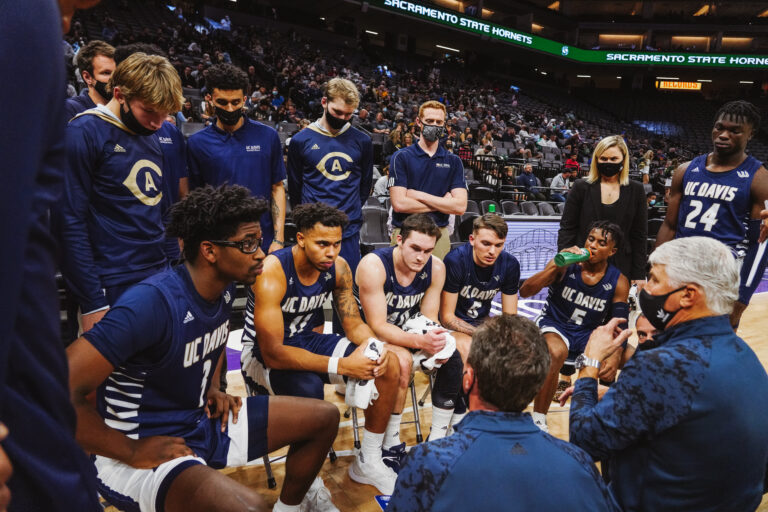
UC Davis Men’s Basketball falls in Big West Tournament Quarterfinals

After beating Cal Poly in the First Round, a second half run by Cal State Fullerton ended the Aggies’ season.

By OMAR NAVARRO— sports@theaggie.org

Ending the season against the eventual Big West regular season champion Long Beach State and second-seeded Cal State Fullerton, the UC Davis Men’s Basketball team knew they would have great tests of measurement heading into the Big West Tournament. Going down to the wire with Long Beach State, they lost 65-68 on a go-ahead three with one second left. In the regular season finale, the Aggies once again fell by a score of 59-62 in Fullerton. 

“We went on the road and went against No. 1 and No. 2 and to lose on a three at the gun and probably shot ourselves in the foot with a lead at Fullerton, I think we came away, although disappointed with the result, confident in who we were and how the margin of the top teams in this league is really small,” Head Coach Jim Les said with regard to their last two regular season games.

The two losses meant the Aggies had to play an extra game in the tournament, and as the seventh seed, they played No. 10 Cal Poly in the first round. 

From the newly opened Dollar Loan Center in Henderson, NV, the Aggies looked to punch their ticket in the Big West Tournament Quarterfinals against the Cal Poly Mustangs. The Aggies fell in their only meeting back on Jan. 15 in San Luis Obispo, 74-82, and did not play them again after the game in Davis was canceled.

After the opening tip, it was clear that this game would be back and forth. Regardless of records or seeding, the tournament always brings excitement and intensity. The Mustangs opened the scoring with a three pointer, before the Aggies responded with four points of their own thanks to All-Big West Second Team guard Elijah Pepper and star forward Caleb Fuller. Exchanging buckets through the first 10 minutes, neither team held more than a three point lead. 

The Aggies were finally able to gain some separation with about eight minutes left in the half, as Fuller and junior forward Christian Anigwe got some shots to go leading to a Mustangs timeout. Fuller had eight of the Aggies’ 17 points, being aggressive and driving it to the paint — as did the rest of the team. Fourteen out of the first 17 points came from inside the painted area, and it was clear what the formula was for the UC Davis squad.

Still, Cal Poly never folded, answering back and not letting the Aggies get away by taking advantage of the defensive lapses on the UC Davis side. At the break, the score stood at 27-24 — 22 of them coming inside the paint for the Aggies.

“I thought in the first half, we didn’t get to what we know we are communication-wise and playing team defense,” Fuller said postgame. “We knew the one thing we needed to do if we were going to win this game was to connect on defense.”

Fuller led the team with 10 points and added three rebounds as well. Pepper added six points and four rebounds of his own, but All-Big West First Teamer and star guard Ezra Manjon struggled in the first half, shooting 1-6 from the field. Still, it was a slow, tough defensive game that made it difficult for both teams to score easy buckets. 

The second half was more of the same, as the first points weren’t scored until 90 seconds went by on a Mustangs layup. The Aggies responded to that with three straight made shots by Manjon who made his slow start a thing of the past. Yet, Cal Poly continued to pressure the Aggies and kept it close as they approached 10 minutes left in regulation. With the game tied at 43, with 5:34 remaining in the game, UC Davis would outscore Cal Poly 20-10 for the remainder of the game to go on and win 63-53. 

Manjon finished as the leading scorer after a hot second half with 17 points in addition to three assists. Fuller finished with 16 points and eight boards and Pepper finished with 14 points and nine rebounds. As a team, the Aggies shot 40% from the field and had 11 turnovers but forced 17 Mustang turnovers. Cal Poly’s junior Trevon Taylor had an impressive game for the Mustangs with 20 points and eight rebounds, but their 4-19 shooting from beyond the arc as a team was too much to overcome. 

“Really proud of this group, especially in the second half,” Les said postgame. “They made big plays on both ends of the floor, they made the hustle plays, came up with the 50/50 balls and we knocked in free throws to close the game out.”

The win in the first round meant a chance at revenge against #2 Cal State Fullerton. Having had a game already in the books, UC Davis hoped their activity would be an edge that can put them over the top. 

The first five minutes were similar to the game they played in the regular season — intense. Down 7-8, a three pointer by Caleb Fuller sparked a 7-0 run that saw great paint defense and a fast pace leading to easy buckets. However, a 7-0 run of their own gave the Titans the lead back, as both teams continued to battle on the glass and on the defensive end. 

Tied at 19 with 7:23 remaining in the game, Cal State Fullerton finished the half outscoring UC Davis 18-8. The Aggies shot 3-14 in the final seven minutes of the first half while the Titans were 6-10 from the field in that same time frame. Caleb Fuller once again led them with 10 points, but the team as a whole shot 31% from the field in the first half. That, coupled with no free throw attempts led to the deficit. The end of the half was a brutal way for the Aggies to close, but similar to their game in the regular season, they hoped to come out strong in the second half. 

Anigwe got the scoring started in the second half just 13 seconds in, but the tough UC Davis shooting night continued. An 8-0 run after that by Cal State Fullerton pushed the Aggies’ deficit to a game-high 16, prompting a timeout by Coach Jim Les with 17:52 left in regulation. 

Following the timeout, UC Davis would strap down on defense, holding the Titans scoreless for over six minutes. Great perimeter defense and shutting down the paint allowed this scoreless drought to continue over a long period of time. But, despite holding Fullerton to no points, the Aggies only mustered eight points in that timeframe. They were able to get it down to single digits, but after a three pointer by the Titans broke the scoreless drought and brought their lead back up to 11, the Aggies would never make it single digits again. Cal State Fullerton would go on to win by a final score of 73-55. 

“I got to give a lot of credit to Coach [Dedrique] Taylor and Fullerton. I thought they played extremely well,” Les said after the loss. “Scored the ball well, contested a lot of our offensive opportunities. That’s a good basketball team.”

Caleb Fuller would lead the way in scoring for the Aggies in his final collegiate game for UC Davis with 13 points, four rebounds and three blocks. 

“If I could go four years back, I’d make the exact same decision,” Fuller said after the game. “I love playing under Coach Les. I’ve grown as a basketball player, and most importantly, as a man. I’m getting a little emotional speaking about it, but he knows I love this guy, and I love playing for this team.” 

Pepper would be the only other player in double digits with 12 and led the team with nine rebounds. Shooting-wise, UC Davis struggled from the field in both halves as Fullerton made it difficult for them to get easy shots, finishing at 21-66 (31.8%) and 6-25 from three. The tough shooting day was difficult to overcome when the Titans shot 11-19 from beyond the arc and had the edge in the fastbreak point department. 

“We did not play our best,” Les said. “And not playing our best against a good basketball team that was playing at a high level had us fighting uphill all night.” 

UC Davis finished the year with a 13-11 record overall and 5-6 in conference. With eight games canceled this season — all in conference — the team faced a lot of adversity but were able to make the most of it. With the loss of Fuller, Cameron Ba and B.J. Shaw, the Aggies will look to Manjon, Pepper, Anigwe and other big pieces to use their experience as they look to get UC Davis back to the top of the Big West and back into the NCAA Tournament.

Written by: Omar Navarro — sports@theaggie.org

Review: ‘The Batman’ proved us wrong

Remakes can make old films new and superhero movies can be good

By ANGIE CUMMINGS — arts@theaggie.org

Like many, I went into “The Batman” for the primary purpose of seeing the unlikely pairing of Edward Cullen and Zoe Kravitz fight people in all-black outfits. Much to my surprise, I came out of the theater with my not-very-positive opinion of superhero movies thrown up in the air.

“The Batman” (2022) is at least the 10th (relevant) feature-film iteration of the DC Comic character — this is of course excluding the countless cartoon and video game versions of Batman. Because of this fact, it was fairly hard to be optimistic that this movie would provide anything but another brooding white guy in a plastic suit and his latex-clad, femme fatale Catwoman strutting down the streets of Gotham. 

Robert Pattinson provided us with an altogether fresh (yet greasy-looking) version of a young and incredibly reclusive Bruce Wayne, which not only made his whole burdened vigilante schtick make a lot more sense but is apparently incredibly faithful to the comics this film was based on (I personally didn’t know this when watching but it seems to be very appreciated by comic fans). Pattinson’s awkward and borderline paranoid version of Bruce Wayne melds so perfectly with his nocturnal, morally ambiguous alter-ego, making the ultra-suave, playboy bachelor Bruce we have been seeing for the past 20 or so years of seem oddly disjointed from who he is with the mask on. Rather than being a thriving, handsome philanthropist, the 2022 Bruce Wayne looks like he needs a few weeks of sleep (and a shower) and needs to put sunglasses on to shield his sensitive hermit eyes from the morning sun — he’s relatable (I’m slightly joking). 

Opposite this perfectly pathetic Bruce Wayne is Zoe Kravitz’s mind-blowingly sultry yet badass rendition of Catwoman. From her consistent thigh-high lace-up leather heels to her many perfectly-set wigs, Kravitz delivers big on the one thing all Catwomen must do — slay the visuals. Of course, it’s 2022, so being a pretty face is not enough (sorry), but no worries there for Kravitz because she brings her signature cool-girl sarcastic tone along with Selina Kyle’s (Catwoman’s real name) emotional backstory. Major kudos to the creators of this film for having a female vigilante with an actually fully formed character behind all the high kicks and little smirks; it really isn’t something you see every day. 

Perhaps the only solid critique I’d have for this film is the letdown of the “chemistry” between the “bat and the cat.” By the looks of all the press tours and photoshoots, and the general hype around the film, you’d think there might be a danger due to the high voltages of electricity between the co-stars… but that was sadly not the case. Although the scenes Pattinson and Kravitz shared were in no way teeming with passion and chemistry, the two characters definitely complimented each other well (not to mention their matching pointy-eared masks). 

While we may have been put through close to an “A Star is Born” (2018) level of co-star chemistry, it seems this could have all been a (very successful) marketing tactic. Because in all honesty, it wouldn’t even make sense for this version of Batman to be capable of having chemistry with anyone, let alone perhaps the hottest woman he’s ever spoken to (and maybe the only one he’s ever kissed). 

There’s no discussion of chemistry in “The Batman” without talking about Riddler (played by Paul Dano) and Batman’s “anti-chemistry.” There is absolutely no doubt as to how they feel about each other — Batman absolutely despises Riddler, and Riddler is Batman’s number one stan even though he wants Bruce Wayne dead. Even though Dano notoriously gets beat up in the majority of films he’s in, the Riddler remains untouched… perhaps the most annoying thing he could have achieved. 

The one breakout star of the film that I truly was not expecting (and who I truly hope to see a lot more of in the next one) is Colin Farrel in full-body prosthetics as the Penguin. Not only was this loud-mouth mobster the best form of Italian-American representation I could personally ask for, but he was hands-down the funniest person over the course of this three-hour gloom fest. I’m not usually a fan of excessive prosthetics on actors that completely change their appearance (looking at you, Jared Leto in “House of Gucci”) but shout out to the special effects makeup team here because it was truly so seamless. Penguin, I’m rooting for you to cause much mayhem and destruction in the imminent sequel — he really didn’t have much of a chance to shine past the role of comic relief in this one. 

Last, but certainly not in any way least, I must give some major praise to the soundtrack. Nirvana’s “Something In The Way” (1991) has now essentially become an emblem of the movie, with an entire TikTok trend revolving around users brooding with a dark filter and this song playing as they delineate the ways they are the Batman in their own lives. This of course is due to it being an amazing song that is exactly something this version of Bruce Wayne would play through all hours of the night. The rest of the soundtrack captures every bit of the film just as that one does Bruce — complete with both an amazing original score by Michael Giacchino and a top-tier selection of new and old songs. This includes pulsating club music each time we see the sleazy Iceberg Lounge, some classic sappy love songs (including the iconic “Volare” by Dean Martin) to bring in some fun contrast to the dark (and violent) scenes they backed, and riveting classical music to connect everything in between. It’s a wholly entertaining three hours of a pasty emo man brooding around town, fighting crime, solving riddles and either fighting or working alongside his cool new friend Selina. 

Written by: Angie Cummings — arts@theaggie.org

Campus Rec, Dining Services, External Affairs Commission gave quarterly updates during March 10 Senate meeting

SB #64, SB #63, SB #64 and SB #66 passed unanimously

By ANGELINA ANGELO — campus@theaggie.org

Vice President Juliana Martinez Hernandez called the meeting to order at 6:18 p.m. on Thursday, March 10. Following roll call, she recited the UC Davis Land Acknowledgement. 

Campus Recreation Director Deb Johnson gave a presentation on upcoming spring programming events as well as updates on past issues identified from student surveys. 

“We are focusing on anything we can to enhance mental health for students on campus,” Johnson said. “This year, we have focused on destigmatizing weight. Last year 46% of our Aggies were uncomfortable in their own bodies.”

During the presentation, Johnson also shared that Campus Recreation offers CPR and first aid training for students in partnership with the fire department and provides referrals for food support and assistance through CalFresh. 

Next, Darren Schluep, the food service director for the CoHo, provided a quarterly report. He shared that due to the lack of student staffing, profit margins were down during the winter quarter. He said he expects these numbers to balance out with better staffing and expanded operating hours in the near future. 

The Senate table then moved on to Student Health and Wellness Committee (SHWC) confirmations. Senator Ambar Mishra moved to confirm Jasjeet Kaur. Senator Radhika Gawde seconded the motion, and Jasjeet Kaur was confirmed as an SHWC committee member.

Next, the External Affairs Commission (EAC) provided a quarterly report. Maahum Shahab, the EAC chair, shared the new projects that the committee is working on. 

“We are working on our social media presence, and we are working on a strategy to create more campus engagement on our social media,” Shahab said. “We are also working on growing our commission. Our vacancies will be up in the next week.”

Next, William Wang, the director of the internal affairs for the Office of the International Student Representative, provided a quarterly report. 

“As a team, we have been heavily invested in outreaching,” Wang said. “We are actively building connections with Deutschklub [German Club], French Club, Japanese Club, Taiwanese Student Association, Chinese Student Associations and others. Our goal is to make sure that we know that we are here and that they have our support.”

After the short break, each elected officer and ex-officio provided weekly reports. 

Following the reports, the table moved into Public Announcements. There was a reminder of the deadline on March 11 to change classes taken for a grade to Pass/No Pass. Martinez Hernandez also shared that there will be stricter attendance and absences for Senate members in the future.

During Public Discussion, President Ryan Manriquez brought up the mask mandate lifted on March 19. He shared that in his view public health officials do not foresee a surge in positive cases and that the spike in January was primarily due to the omicron variant. 

“They do not have a variant they are currently, or even moderately, concerned about,” Manriquez said. 

He shared that he recommended that UC Davis keep the mask mandate for two weeks after spring break and then reevaluate if masks are necessary. Manriquez also shared that COVID-19 testing protocols and symptom surveys will stay in place through the end of the year.

In the meeting with Chancellor Gary May in the upcoming weeks, senators will discuss concerns with hybrid-online learning. In light of the meeting, senators and chair members debated solutions for recording lectures and the COVID-19 policy changes for the spring quarter. 

All legislation from the Senate meeting on March 3 was passed according to a report from Manriquez.

SB #64 was introduced as emergency legislation due to budgeting issues for KDVS and line-item transfers and allows for budget revisions. The bill passed unanimously. 

SB #63 was revisited. Gawde shared that changes to this specific legislation are in place to limit ASUCD meeting time, allow for more public access and make a more effective agenda. The bill passed unanimously after extensive discussion and presentation of an example agenda. SB #65 also passed unanimously. This bill clarifies the process and communication within committees in ASUCD.

SB #66, which establishes the Donation Drive Committee and approves funding, was passed unanimously after a lengthy discussion. 

Meeting minutes from March 3 were approved unanimously. 

The meeting was adjourned by Internal Vice President Martinez Hernandez at 10:36 p.m. 

Written by: Angelina Angelo — campus@theaggie.org

UC Davis’ Big West reign ends in semifinals

UC Davis championship run comes to an end, marking the end of a dynasty 

By MARLON ROLON — sports@theaggie.org

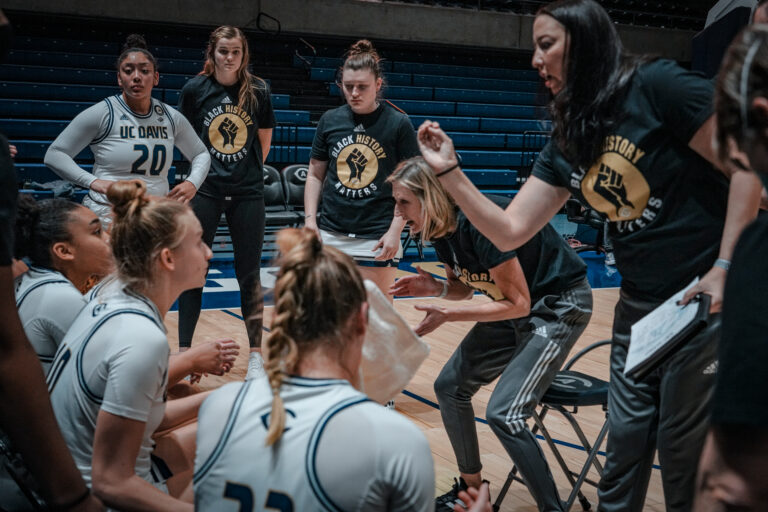
A rollercoaster of a season for UC Davis Women’s Basketball came to an end in overtime during the semifinal round of the Big West Tournament against UC Irvine 75-84. 

“When you pour yourself into something and you put your heart and soul into it, it’s devastating when you don’t come out on top; we’re just a bit heartbroken today,” UC Davis  Head Coach Jennifer Gross said following their playoff exit. 

The sixth-seeded Aggies went into the tournament to face third seeded Long Beach State, an opponent they had lost to a week prior. 

After having split the season series 1-1, UC Davis had a tall mountain to climb against Big West Defensive Player of the Year Maddi Utti and the high pressure defense that formulates around the Beach. 

Quarterfinals

The Aggies were ready for the relentless pressure — their championship experience proved to be too much for Long Beach, beating them 55-45 in the quarterfinals of the tournament. 

The game was a defensive battle for the most part, but UC Davis started the game strong, knowing what to expect from the Beach. Aggies’ sophomore guard Evanne Turner was pivotal in the first half, scoring 12 points —  all from the three-point line. Her confidence to shoot the ball was evident, as she shot 4-6 from three in the first two quarters. 

Although the Aggies led by seven in the first half, Long Beach forced them to 12 turnovers with their full court pressure. However, the Davis defense held their own, holding the Beach to shoot 0-9 from beyond the arc in the first two quarters.

Long Beach would not go down without a fight. They cut the deficit to two, 36-34 mid-way in the third quarter. That wouldn’t last long, as fourth-year Sage Stobbart hit a big three to stop momentum. 

In the fourth quarter, Turner proved to be too much, hitting a three-pointer from the corner to pull away. Cierra Hall closed the show by hitting her free throws, beating Long Beach 55-45 to advance to the semi-final. Turner finished with 19 points and Hall followed with 14 points. 

“I’m really proud of our team. It was a hard-fought win against a very good team, and it took 40 minutes of intense focused defense and composure against a lot of pressure,” Gross said after the game.

Semi-finals 

With little time to celebrate, UC Davis faced off against No. 2 UC Irvine. The Anteaters defeated No. 7 Cal State Fullerton 80-68 earlier in the tournament. During the regular season, Irvine defeated UC Davis, 76-59; in their second meeting, UC Davis beat the Anteaters, 66-51. However, the rivalry goes beyond this season. Previously, in 2019, the Aggies beat UC Irvine in the championship game to advance to the NCAA Tournament. 

The game was as advertised — it came down to the last play of regulation with the game on the line. Turner got a good look, shot a three at the buzzer, the ball bounced off the rim forcing overtime as UC Irvine would eventually pull away with the win, 84-75. 

How it happened 

The Aggies committed five turnovers during the opening quarter, but Hall would keep the game close in the first quarter, scoring six points to keep the Aggies within striking distance down 10-13. 

In the second quarter, UC Davis was held scoreless for the first two minutes, and once again, it was standout senior Hall who scored the much needed basket to end the scoreless drought. Irvine would immediately respond with two straight three’s from first-year Nikki Tom and graduate student Naomi Hunt, making it 21-15.

The Aggies were having trouble shooting from long range the entire second quarter — the defensive pressure from Irvine made them uncomfortable. The Anteaters held UC Davis to 12.5% shooting from three. The strategy was obvious: force the Aggies to commit turnovers and contain Turner from getting open looks from the three point line. UC Irvine led 31-22 at halftime while getting 14 points from the bench. 

UC Davis came out of the half looking like a different team. Turner made eight points, including two three’s in two minutes. After UC Irvine responded with a layup, Lena Svanholm for the Aggies made a three to cut the deficit back down to five only for UCI to hit a three a play later, making it 43-35. 

Being down by eight with 2:45 left in the third, it was Cierra Hall time. Hall scored five points in one minute igniting a 7-0 run. After a made free throw by Irvine, Svanholm closed the quarter with a huge three putting the Aggies up by one, 47-46. The momentum swung. UC Davis caught fire, shooting 80% from the three-point line throughout the third quarter. 

The fourth quarter was a slugfest as both teams displayed high intensity after trading buckets and following several lead exchanges through mid-quarter, the Aggies led 59-54. UCI’s redshirt first-year Kayla Williams tied it with five straight points. 

A few plays later, Hall drove to the basket for a layup getting tangled in the process connecting on a three-point play to put the Aggies up 64-61. Stobbart fouled Hunt with 31 seconds remaining, but Hunt missed her first free throw and made the second. UC Davis called a timeout with possession and were on the cusp of playing for their third-straight championship appearance.

However, the Anteaters never stopped believing. Hall looked for Turner off an inbound pass, Turner was double teamed and lost possession of the ball leading Williams to drive it into the paint to tie the game at 64 with 16 seconds left. 

“We were trying to get the ball to Evanne who’s a great free throw shooter; credit to Irvine; they made a good play. We lost the handle on it, and they came down on it and got a bucket,” Gross said. 

With one last shot, Turner got a great look from beyond the arc and failed to convert the go ahead win at the buzzer. The Aggies would go on to lose in overtime, 75-84. 

“I was really proud of how we competed today,” Gross said. “We had a shot to win it, credit [to] UC Irvine they played a really good game, they played hard, both teams wanted it, it just came down to one possession.”

Turner finished with 22 points, Hall ended her career with a double-double, 20 points and 14 rebounds, Stobbart matched her fellow fourth-year with a double-double, 15 points and 10 rebounds.

Being so close to the championship game, Hall, Stobbart and Konrad left their hearts on the court and gave tremendous effort in their final game for UC Davis. Tears were shed as they hugged each other. This was the end of a dynasty for UC Davis. 

“To see them come in here and help raise the bar for our program is unbelievable. Those are three special individuals, and I’m so proud of them and their careers,” Gross said. 

The trio won four straight regular season championships together, two Big West Tournament championships and played in two NCAA tournaments. Their careers are decorated with personal accolades such as Defensive Player of the Year, Conference Player of the Year, Big West Tournament MVP and All Conference Team shared between them.

Gross had high praise of her star player Hall following the post game press conference.

“Cierra Hall who’s won everything you could win and been to the [NCAA] tournament, won championships, she still came back,” Gross said. “It wasn’t like she had something to prove, she was the Big West Defensive Player of the Year, the Big West Player of the Year, she won four championships. She still came back; she came back for her team, she came back for her teammates to leave a legacy to help them learn what it takes to teach the younger ones. That’s what being an Aggie is all about, that’s what Aggie pride is.“

Season in Review

UC Davis had an up and down season, having consistency issues for the most part. They finished the season with a record of 15-13, 8-8 in conference play. Four of their games were canceled due to COVID-19. 

The Aggies were competitive all season, and they lost seven games in the final minutes of regulation. On Nov. 13, Saint Mary’s beat UC Davis in the final seconds of play by a score of 52-50. Then on Jan. 8, the Aggies lost a close one to UC San Diego by three, 56-59. They then traveled to Fullerton on Jan 27., losing by four, 65-69. Then against UC Riverside on Feb. 1, they led the majority of the game only to collapse in the final minute losing by two, 59-61. 

The Aggies then traveled to Hawaii on Feb. 3, in a game where they led the entire game they fell apart in the fourth quarter and lost by seven points, 50-57. On Feb. 26, UC Davis went up against UC Santa Barbara, in the final possession of the game down three, the Aggies would fail to convert on a three pointer to ultimately lose by three, 62-65. The last loss of the regular season came against Long Beach on March 3, a game they led the majority of the fourth quarter but could not hold onto the lead; they collapsed again and would go on to lose by five, 60-65.

“This season was full of adversity, sometimes when there’s losing and some adversity, teams can start to fall apart. We as coaches have seen that where teams start pointing fingers and placing blame and that just never happened with this group; this group stayed together,” Gross said.

The high points came on Dec. 1, against powerhouse Oregon. The Aggies upset the Ducks on the road, securing a 64-57 historic win, and snapping a 44-game non-conference home win streak. Another major win came against Gonzaga at home on Dec. 19. Being down 19 points, UC Davis stormed back to upset Gonzaga, 69-66, for the first time in program history. On Jan. 29, UC Davis would steal a convincing win on the road against top ranked Long Beach State, 68-58. The last major victory of the regular season came on Feb. 12 against UC Irvine, another top ranked team, beating them 66-51. 

UC Davis enters the offseason without their championship core — Hall, Stobbart, Konrad — who are all graduating fourth-years. This marks the end of an era and the start of a new one.  

“They’re going to be tough to replace, we’re definitely going to miss them,” Gross said.

Written by: Marlon Rolon — sports@theaggie.org


Student sculptures turn the Arboretum into a temporary outdoor museum

The Arboretum’s sculptures also make a case for the value of public art

By CORALIE LOON —- arts@theaggie.org

Last winter quarter, students in ART 151 (Intermediate Sculpture), led by instructor Robin Hill, were told to create public sculptures answering the question: What do you care about? For a few weeks, the Arboretum became an outdoor gallery where strangers could witness a vast, visual collage of student experiences.

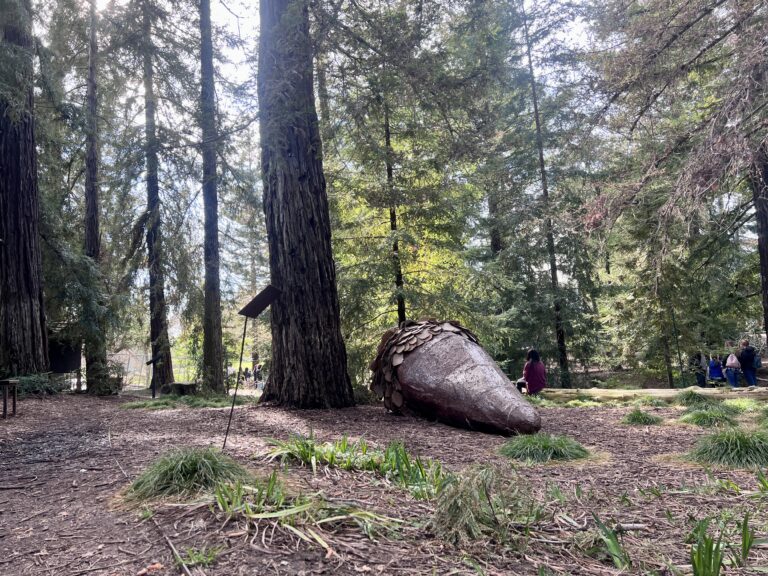
One of the largest pieces was “Harbinger,” a 4’x4’x9’ acorn created by Kathleen Mackey, a third-year art studio major and Sacramento City College transfer student. Mackey was inspired to create the giant acorn after being taken on a tour of the redwood grove and finding out that they were eventually going to be replaced by oak trees.

“I was so bummed to see that it was going to be gone, and I kind of went through a sense of grief,” Mackey said. “I started thinking about grief and how close it feels lately; it feels like everyone’s had a loss lately. I wanted a piece that sort of was a commentary on that, that gave people the space to think about what they have in the moment.”

For Mackey, the physical construction of the acorn was cathartic of her inability to create large pieces during the COVID-19 pandemic. Having the freedom to go big and integrate art with nature was something that characterized the other artists’ sculptures as well.

Kimiko Young, a fourth-year Spanish and education/art double major, created “Invisible Pain,” a sculpture of an oversized hand attached to a hollow tree stump. The hand, pierced with nails and sharp pieces of wire, powerfully captures Young’s experience with Peripheral Neuropathy (PN), which she describes as nerve damage to the hands and feet that can extend to other parts of the body.

For Young, this project was about making the invisible visible. 

“I wanted to give a visual representation of what my pain with experiencing PN looks like to people who don’t feel it and who can’t see it,” Young said, “because I get these symptoms such as numbing, tingling, burning, pinching, stabbing and tightness, and none of it is visual.”

Young’s goal of highlighting invisible disabilities was also shared by artist “eeuphomia” (@eeuphomia on Instagram), a third-year art major. Their piece, “Picnic Day,“ featured two ghosts having a picnic made up of monster-like fruit with oversized eyes and teeth.

“My art focuses on trauma,” eeuphomia said. “I thought I could talk about eating disorders, just because it is a taboo topic, and it’s kind of a funny way to introduce it because everyone goes there to eat a snack or hang out.”

For this piece and others like it, being in a public place such as the Arboretum is central to conveying a message about invisible pain.

“Having it in a public space, I feel like it reaches more people just because pedestrians walk there,” eeuphomia said.

Mackey also reflected on the value of public art. 

“I think the wonder that people feel when they don’t expect to be confronted with art can be a really special thing,” Mackey said. This “wonder” can make art even more memorable or meaningful, since it seems to seek out the viewer rather than the other way around.

One piece that confronts the viewer in this way is “Need Balance, Please Advise” by Marissa Brooks, a third-year molecular and medical microbiology major and transfer student. Brooks, who views life balance as an area of struggle, said her inspiration came from realizing she was not struggling alone. 

“There’s got to be more people, especially when they come to the Arboretum. A lot of people are looking for a break,” Brooks said.

Her project, composed of a chair and desk covered in small toys, books and a poignantly-placed scale, invites the spectator to sit down and write in a journal, answering the question: What do you have on your plate?

To Brooks, the interactive aspect has been the best part. 

“There’s a story in there about somebody’s struggle with cancer, and even just somebody wrote ‘I miss you dad.’ I wasn’t expecting it to be so connected,” Brooks said. “It’s funny to be on a campus as large as Davis and be in these classrooms, and some of them have 300 people in them, but to also feel so disconnected from everybody. So this really gave them a space to come together.”

For a few weeks, this collection of student-made sculptures did just that. The pieces were removed from the Arboretum on March 8, but photos and discussions of the pieces can be found on Instagram under the hashtag #ucdart151winter22.

Written by: Coralie Loon — arts@theaggie.org

Unitrans celebrates 54th birthday with vintage London double-decker buses

Unitrans provided free rides throughout Davis and a parade of its modern and vintage buses

By KAYA DO-KHANH — campus@theaggie.org

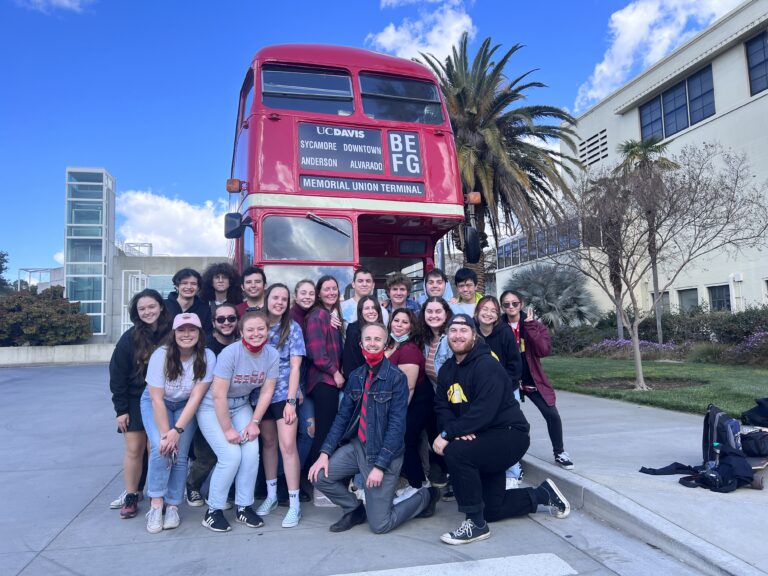
On March 4, Unitrans celebrated its 54th birthday with festivities including free rides throughout Davis during the day and a bus parade with the newly fixed and painted vintage double-decker buses from London. This marked the first time since the start of the pandemic that the vintage double-deckers have been in service.

“We generally don’t celebrate our birthday,” Unitrans General Manager Jeffrey Flynn said. “Fifty-four is kind of an odd birthday to celebrate, but I think that what me and my students and career team of leadership people thought was that this winter quarter has been hard on everybody, and we needed something to celebrate and feel good about.”

The first Unitrans London double-deckers were in service on Feb. 28, 1968, after they were purchased by ASUCD. The transit system currently has four vintage double-deckers, three of which were available to ride for a free lunchtime shuttle service between the MU and downtown for the celebration. 

“It was so lovely seeing so many generations of buses together at one place,” Unitrans Human Resources Manager Celia Murillo said via email. “It was especially nice seeing all of the generations of Unitrans employees that the event was able to gather.”

For the new year, Flynn said that Unitrans needs more student drivers. The job listing is available on the ASUCD vacancy website.

“We hope that for the fall of 2022, we can start reintroducing a lot of the services that we have been forced to cut because of our staffing shortages,” Flynn said. “We’re trying to hire enough drivers to get ready for fall quarter.”

Murillo, who was hired as a transit conductor in the fall of 2019 and is now working as the human resources manager, said that Unitrans provides a unique working environment.

 “People that want to service the community (in such an important realm that is public transportation), students who swap the books for a shift in a jumpsuit to fix a bus, the stories you hear while being a part of a driver circle — the students really make this company,” Murillo said via email. “The job itself is a super rewarding one, no matter which part of it you work for.” 

Written by: Kaya Do-Khanh — campus@theaggie.org

Fair labor concerns for UC Davis construction projects prompts protests

Group claiming to be associated with Carpenters Local Union 46 sets up signs and grim reaper statue at MU and Silo Market

By LEVI GOLDSTEIN city@theaggie.org

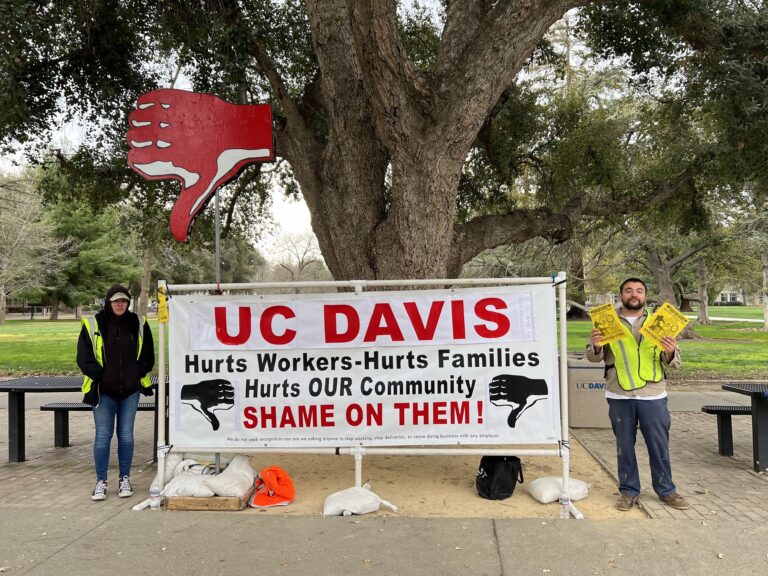
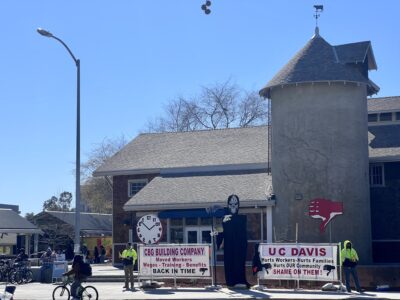
Beginning the week of Feb. 20, individuals wearing yellow construction vests claiming to be associated with Carpenters Local Union 46 have set up signs and handed out fliers at Memorial Union (MU) and Silo Market. A large grim reaper statue accompanies them.

The fliers read, “UC Davis and CBG Building Company are using wage rates from 2018 to pay workers right now on their Orchard Park project and it is SHAMEFUL!” and “Trashing wages and benefits hurts workers, families and our community!” They list Chancellor Gary May’s phone number and address, prompting all who support their cause to contact him to “ask to stop the roll back.” 

The group also printed on the fliers stating: “We do not seek recognition nor are we asking anyone to stop working, stop deliveries, or cease doing business with any employer.” 

According to Ryan Schlesinger, the Senior Project Executive on the Orchard Park project, CBG Building Company is a general contractor for construction projects across the U.S. such as student housing, third party multi-family developments and military housing. They employ multiple subcontractors in different construction trades on the Orchard Park project, for example, The Raymond Group and TK Elevator

According to Schlesinger, CBG is not in control of workers’ employment compensation. 

“Each of our individual subcontractors, they are the ones responsible for wages and benefits paid out to their employees in accordance with all the requirements set forth for this project,” Schlesinger said. 

UC Davis Construction protest at UC Davis Silo (Benjamin Cheng/Aggie)

According to Laura Zaner, the Vice President of Corporate Communications and Marketing at The Michaels Organization (TMO), the developer of the Orchard Park project, those requirements are set by the California Department of Industrial Relations. Zaner said that TMO does not know of the protests. 

“We have not heard or received any direct commentary from an on-site construction worker being unsatisfied,” Zaner said via email.

Schlesinger also mentioned that CBG is not in contact with any unions. 

The Orchard Park project, set to finish in 2023, is a student housing development comprised of 613 units, with 11 resident buildings, two community centers and one maintenance facility, according to Schlesinger. The Michaels Organization is partnered directly with UC Davis on the development. 

Carpenters Local Union 46 and the protestors declined multiple requests for comment. 

Written by: Levi Goldstein — city@theaggie.org

Novel engineered antibody reduces transmissibility of SARS-CoV-2

UC Davis researchers targeted furin to block activation of spike protein, the key to the coronavirus’ infectiousness

By BRANDON NGUYEN — science@theaggie.org

Vaccines have tremendously reduced positive cases of COVID-19 since their implementation, but researchers at UC Davis Health have been looking into areas where the vaccines could be improved. Though they provide immunity, one area that is still of concern is that vaccines do not directly reduce the virus’ transmissibility, even among those who are vaccinated. 

Dr. Jogender Tushir-Singh, an associate professor in the UC Davis Department of Medical Microbiology and Immunology and senior author of the study, designed and engineered, with the help of his lab, a novel antibody called FuG1, which can reduce the transmissibility of SARS-CoV-2.

“One thing that differentiates SARS-CoV-2 in 2019 versus SARS-CoV-1, which came in 2003 to 2004, is that, while they’re very similar in their genomes and spike protein sequence, SARS-CoV-2 has acquired these furin sites,” Singh said. “So I thought if these sites are unique to SARS-CoV-2, why don’t we just target these sites which will be a good criteria to reduce its pathogenicity?”

Furin is a protease, a protein that acts like molecular scissors to cleave proteins into smaller components. Oftentimes, furin cleavage is used to activate proteins, and SARS-CoV-2 is one of many viruses that takes advantage of the host’s furin to activate its spike proteins by cleaving it. 

Dr. Tanmoy Mondal, the first author of the study and a postdoctoral researcher in Singh’s lab, underscored furin’s role in making the coronavirus highly transmissible. 

“The virus exploits the host’s furin to easily transmit from cell to cell,” Mondal said. “When the virus makes the spike protein, the whole protein cannot infect anyone. But after cleavage by furin, the spike protein now has its infectious function, and this added activation step is what makes the virus highly transmissible.” 

However, the inhibition of furin is not straightforward, as furin is still needed in daily cellular activities. Thus, specificity in the engineered antibody is crucial to its efficacy. 

Furin is found throughout the human body and is needed for the normal functioning of many biological processes,” Singh said. “Stopping furin from doing its job causes high body toxicity. That is why the standard furin inhibitor drugs are not a clinically feasible option.”

Singh and Mondal achieved this specificity in their engineered antibody by having “two faces” on the antibody: one that can target the spike protein and one that disrupts furin interaction with the spike protein.

As host cell-enriched furin-mediated cleavage of SARS-CoV-2 spike protein is critical for viral entry and chain of the infection cycle, the solution described here [in this study] of an antibody Fc-conjugated furin competing peptide is significant,” the study, published in Microbiology Spectrum, reads. “The proposed furin competing strategy confers a broad-spectrum targeting design to impede the production of efficiently transmissible SARS-CoV-2 viral particles. In addition, the proposed approach is plug-and-play against other potentially deadly viruses that exploit secretory pathway independent host protease machinery to gain cellular entry and subsequent transmissions to host cells.”

With FuG1 as a potential antibody to be added to current antibody cocktail treatments, Singh expressed optimism toward the reduction of transmissibility in not only SARS-CoV-2 but also other viruses and pathogens that rely on furin cleavage. Currently, Singh’s lab is working on testing the antibody in mouse models with the hope that the antibody will eventually reach the clinical stages to be implemented into medical treatments for human patients. 

“Our approach is a two-pronged approach, and so even if an antibody loses its effectiveness in binding due to a virus gaining mutations over time, the furin component can still work,” Singh said. “We hope that, compared to these current short-term antibodies that target spike protein and ACE2 receptor interaction, what we have engineered can be a little bit better and be more cost-effective. As long as newly emerging SARS-CoV-2 variants do not interfere with FuG1 antibody binding, it is highly likely this sort of strategy would interfere with viral transmissibility and can be applied to other pathogens that rely on furin cleavage.”

Written by: Brandon Nguyen — science@theaggie.org

Campus shows support for those affected by war in Ukraine

Various organizations on campus including the Slavic Association have been fundraising for those affected

By SYDNEY AMESTOY – campus@theaggie.org

As the crisis in Ukraine continues to unfold, student associations and campus institutions have organized initiatives to assist students who are directly affected by the war and to educate community members about the conflict.

The Slavic Association, a group dedicated to students of a Slavic background or from a Slavic country such as Ukraine, has been tabling at the Memorial Union to raise awareness and funds for those affected by the Russian invasion.

“We’re doing fundraising almost from every single different direction,” Daniel Ivashin, a fourth-year molecular and medical microbiology major and the president of the Slavic Association, said. “Here at the Memorial Union, we have a club Venmo for organizing funds that we’ll be sending out to a few different humanitarian organizations that we’ve verified and selected.”

According to Alina Kodova, a mathematical and scientific computation major and a new member of the Slavic Association, students who have visited the association’s table in front of the Memorial Union have been supportive.

“You can tell they’re being empathetic not only to Ukrainians, but also to us and other students at UC Davis,” Kodova said. ”You can see that they genuinely want to support.”

The association also plans to hold fundraisers in partnership with local Davis restaurants, such as Ali Baba and RareTea. 

The Nadezhda Clinic, a student clinic for Russian-speaking students, has also been assisting the Slavic association in fundraising and gathering supplies.

“[The Nadezhda Clinic] is currently organizing a supply drive where you can actually donate medical and humanitarian supplies on campus,” Ivashin said. “It’ll be at the Memorial Union, and there’s going to be different donation bins scattered across campus.”

The Slavic Association has also planned a vigil to show support for Ukraine.

“We want to have a candlelight vigil just for people affected and the people that have passed away during this conflict,” said Sasha Paredes, the event coordinator for the Slavic Association.

The association established a memorial tree at the Memorial Union where students can leave flags, flowers and signs of support.

“It’s kind of like a collective community space for people to grieve and come together,” Ivashin said.

Beyond student organizations, the campus has provided informational lectures about the current conflict, including a lecture by both the Department of History and the UC Davis Humanities Institute regarding the history of Ukrainian-Russian relations. The lecture, hosted by Jamie Fisher, the head of the Humanities Institute, and various professors, is available for free on the UC Davis Humanities Institute YouTube channel

More information on the Slavic Association, the club’s future plans and fundraisers and their Venmo for current donations can be found on the association’s Instagram and Facebook page.

Written by: Sydney Amestoy — campus@theaggie.org

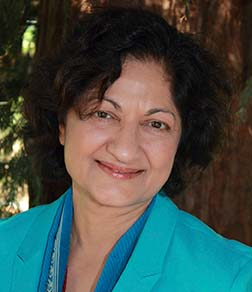
Satya Dandekar elected to join an honorable leadership group for microbiology

The American Society of Microbiology invited Dandekar to join the American Academy of Microbiology for her impactful scientific contributions

By MONICA MANMADKAR — science@theaggie.org

Satya Dandekar, a professor of microbiology and chairperson at the Department of Medical Microbiology, has been selected to join the American Academy of Microbiology among 65 others. Elected through a highly selective process, fellows are chosen based on their scientific achievements and contributions to medical microbiology. 

Fascinated by the ability of viruses and microbes to overpower the immune system and cause disease, Dandekar sought to learn more about pathogens and their infectious mechanisms. Throughout the years, her research has been focused on understanding how the immune system responds and encounters pathogens and prevents disease. 

“[At my lab], we investigate viral infections and mucosal immunity with specific emphasis on HIV/AIDS,” Dandekar said. “We found that HIV attacks immune cells in the gut very early during the infection and has a devastating impact on the tissue and its antiviral immune response and within a few days to weeks, the virus damages the gut epithelial lining and impairs the barrier defenses against infections.”

Currently, Dandekar’s lab is investigating novel strategies for achieving rapid repair and renewal of virally inflamed and functionally impaired guts. They hope that the new approach will provide a way for creating multistep HIV eradication methods. She recently co-authored a paper regarding this new approach.

Dandekar has also received the Deans’ Award for Excellence in Mentoring from the School of Medicine. Additionally, she is a fellow of the American Association of the Advancement of Science (AAAS). She has served as a member of the NIH National Institute of Allergy and Infectious Diseases Advisory Council, where she received a prestigious MERIT award for her HIV research. 

With Dandekar’s leadership, the UC Davis Department of Medical Microbiology and Immunology has become a pioneer in the field of mucosal infections and immunity, ranking 20th for NIH research funded medical microbiology and immunology departments. Dandekar added how UC Davis had provided a nurturing environment for her to develop into a productive researcher and leader and has inspired her to do better.

“This award is very well-deserved,” said Sumathi Sankaran-Walters, associate adjunct professor at the Department of Medical Microbiology and Immunology at the School of Medicine and a colleague of Dandekar. “She has been such a great mentor and guide over the years, and I am constantly amazed by what she accomplished.”

Looking to her future at the Academy, Dandekar hopes to contribute more to the Medical Microbiology and Immunology field and learn from her peers. 

Written by: Monica Manmadkar — science@theaggie.org