58.7 F
Davis

Davis, California

Sunday, December 21, 2025
Home Blog Page 227

Device developed to detect hypoxia in fetuses helps prevent unnecessary cesarean sections

TFO device measures a fetus’s oxygen saturation levels non-invasively 

By MONICA MANMADKAR — science@theaggie.org


According to data published in Clinical Obstetrics and Gynecology in 2016, 60% of cesarean sections (C-sections) that are conducted due to potential hypoxia are unnecessary. Fetal hypoxia is a condition where the fetus is not delivered enough oxygen to continue growing. 

Researchers at professor Soheli Ghaisi’s laboratory in the computer science and electrical engineering department have built a device to detect hypoxia in fetuses which can help decrease the number of unnecessary C-sections. The device measures the babies’ blood oxygen content through a non-invasive method. 

“The birth of his youngest daughter started the idea for this device and research,” said Begum Kasap, a Ph.D. student working on this project at the Ghaisi lab. 

The transabdominal fetal pulse oximeter (TFO) is used similarly to ultrasound transducers and generates a graphical user interface to calculate the oxygen saturation content, Kasap explained. Researchers are currently testing the efficacy of this device in pregnant female sheep. 

“There is always a need to test the device in-vitro to evaluate the function of the device in large-animal studies,” said Dr. Aijun Wang, a professor in the department of biomedical engineering. “This is one of the reasons that testing with ewes was a better model since there is as large of a physiological difference.” 

In order to calibrate the oxygen saturation system, the researchers draw blood from the anesthetized ewes’ fetuses to compare the TFO’s oxygen data to the actual oxygen saturation. This research and procedure strictly follow all mandates approved by the UC Davis Institutional Animal Care and Use Committee.  

“Within the 13 studies that we’ve done since 2019, we were able to calculate the oxygen saturation with about a 10% mean absolute error,” Kasap said. 

Testing of the TFO is extremely important for not only the improvement of the device but also for its integration into hospitals. The device has been tested on a small sample of healthy near-term pregnant patients. Although the researchers achieved 6.3 beats per minute (bpm) mean absolute error, they would want to have less than five bpm mean absolute error before sending the device for clinical application, Kasap said. 

Looking at the future, Wang detailed how the research group hopes to get U.S. Food and Drug Administration approval for the device and improve it overall. For example, they would want to account for differences in skin color to serve a larger demographic. 

To do so, Ghaisi, Kasap, Wang and the other researchers will continue conducting testing in both animals and humans to gather more data for the device’s overall improvement.  


Written by: Monica Manmadkar — science@theaggie.org



Review: Super Bowl LVI’s nostalgic halftime show

A break from pop-centered artists, hip-hop prodigies take the stage, representing ‘90s music and Black culture


By SIERRA JIMENEZ — arts@theaggie.org


The Super Bowl halftime show — one of the biggest musical performances of the world, and an iconic American staple — puts pressure on the performers to go above and beyond expectations from years past. We all remember Beyoncé’s queen energy at Super Bowl XLVII in 2013 and dynamic duo Shakira and Jennifer Lopez’s hip shaking performance at Super Bowl LIV halftime show in 2020. Will this year’s show go down in history the same way? 

Compared to halftime shows in the past, which seemed to cater towards a younger audience showcasing artists like The Weeknd, Lady Gaga, Bruno Mars and Katy Perry, this year’s hip-hop legend headliners, Dr. Dre, Mary J. Blige, Eminem, Snoop Dogg, Kendrick Lamar and 50 Cent, were most popular in the ‘90s or early 2000s. 

Generation Z, including myself, have an appreciation for older hip hop tunes we would listen to with our parents on the drive to school, but older generations were exhilarated to hear something other than modern pop music on the halftime stage, dancing in front of the screen in reminiscence (we’ve all seen the Tik Tok videos). 

The show began with Dr. Dre, elevated into view with the foreseeable but classic “Da, da, da, da, da / It’s the motherf*****’ D-O-double-G” starting off with the legendary Dr. Dre and Snoop Dogg song, “The Next Episode.” Snoop Dogg, wearing the colors of the Golden State, joins Dr. Dre atop the grandiose float resembling a large white mansion with convertibles parked out front. The set, a cliché Los Angeles image with city lights projected on the ground below and rooms filled with the stars surrounded by beautiful women, was fitting for the location of the SoFi stadium in Inglewood, CA and the stomping grounds for the SoCal locals Dr. Dre and Snoop Dogg themselves. 

The camera then transitioned to 50 Cent, who transcended gravity by appearing in one of the stage’s rooms upside down. He performed “In Da Club” as if he was actually in da club instead of the middle of a football field. Mary J. Blige, atop the float in a captivating blinged-out fit, slayed her R&B classics, “Family Affair” and “No More Drama” showing off her incredible musical pipes by hitting all sorts of vocal runs. 

Kendrick Lamar then rises out of a box to begin his beautifully executed portion of the performance with a blend of his songs “m.A.A.d city” and “Alright” while dancing in fluidity with the background dancers and funny enough, not making eye contact with the camera whatsoever (which I found comical). The performance then transitions to Eminem and Dr. Dre’s “Forgot About Dre.” 

Exploding out of the set, Eminem levitated on stage with Dr. Dre on the ivories and rapper Anderson .Paak on drums, jamming alongside Eminem, ending the set with the “Still D.R.E.” performed by Snoop Dogg and Dr. Dre himself. 

Despite these renowned names in rap music performing legendary nostalgic hits, I was disappointed in comparison to performances in the past. It seemed as though the physical set — the mansion moat — had the most time and effort put into the performance and not so much the performance itself. 

Despite my personal views, the 2022 Super Bowl drew the biggest viewing in five years, according to the New York Times, with an average of 112.3 million viewers tuning in on television and streaming. The halftime show itself averaged 103.4 million viewers, a seven percent increase from The Weeknd’s performance last year.  

With a $13 million budget from the NFL, Dr. Dre matched The Weeknd by spending $7 million out of pocket on the performance, according to CNA Luxury, capping this year’s halftime show at $20 million. While this year’s show cost more than The Weeknd’s in 2021, I felt as though the performance didn’t quite match the enormous amount of money put into it. 

The dancers were sporadic and there seemed to be no continuity between performers. Where were all the matching outfits? Where was the flashiness of fire, lights and coordination of dancers? The performance was, dare I say, messy? Kendrick Lamar’s bit was the most put-together out of the whole performance, and Eminimen’s appearance was the most extravagant part of the show. 

For viewers who were looking for the spunk and pazazz from previous halftime sets like Lady Gaga atop the peak of the stadium or the geometric lion Katy Perry wrangled, this performance was subpar in presentation to shows in the past. Although I found the overall performance less than desirable, I appreciated, and will not overlook, the messaging and sentiment of the show’s presentation. 

Amidst the recent political climate, perhaps this year’s halftime show was focused more on racial awareness and Black celebration than your typical flashy pop-driven halftime show. In the history of the Super Bowl halftime shows, this year’s performance will be the first time hip-hop took center stage, according to New York Times. An overwhelmingly Black genre, hip-hop has its roots in rebellion and expression of discontent from its origin in the Bronx, NY and lower income communities of color. Dr. Dre, “gangsta rap pioneer,” according to Discover Music, was an ideal lead for this year’s halftime show.  

Grappling with racial controversies in recent years, the NFL likely wanted to represent Black artists to showcase diversity. This recognition of Black artists was a long time coming; it took deliberate racial controversy to bring these artists to center stage at the halftime show in which everyone across the country tunes in. 

Controversy, from Eminem’s kneeling in solidarity with Colin Kaepernick — though the NFL is reported to deny Eminem permission to do prior to performance — to Dr. Dre’s lyric “still not loving the police” in his song “Still D.R.E,” according to Vanity Fair, and not to mention Snoop Dogg’s allegedly “gang-related” bandana jumpsuit, this year’s halftime show was a balance of celebration and protest. 

Whether the actual performance was considered “good” or not, it was an important cultural shift in NFL and American history as a statement to the racial discrimination in the fabrics of American culture and politics. Black artists were finally given a spotlight and those who grew up on ‘90s rap were able to reconnect with the oldies but goldies. 


Written by: Sierra Jimenez — arts@theaggie.org


Yolo County to transition to the California Voter’s Choice Act Model

0

By this year’s June election, Yolo County will adopt a voting system that aims to make voting more convenient

By SOFIA BIREN — city@theaggie.org


The California Voter’s Choice Act (VCA) was passed in 2016 to modernize voting in the state . The model outlined in it requires that ballots be mailed out 28 days before Election Day. Voters can then submit their ballots by mail, in a drop-box or in a voting center that is open ten days prior to election day, according to the California Secretary of State website

As of 2020, 14 counties have adopted the model outlined in the VCA. Yolo County will be part of the 12 counties who will be adopting the VCA this year in time for the California Primary Election on June 7. 

In a press release, Yolo County stated they are “working on fully transitioning to the model of conducting elections under the California Voter’s Choice Act.”

Prior to this, Yolo County adopted a modified VCA model during the 2020 Presidential Election and the Gubernatorial Recall Election in 2021, according to Yolo County Chief Election Official Jesse Salinas. 

In the modified VCA model, voting centers in Yolo County were only open for four days, rather than the full 11 days in the official VCA model. Salinas said that Yolo County planned to adopt the VCA model in 2022, but the pandemic forced officials to adopt measures which would make voting in the Nov. 2020 election easier and safer. 

“We were trying to redesign the model for the November election, and that’s why we transitioned into this model,” Salinas said. “Because we can do a VCA-like model but we can’t stay open the 10 days prior, […] we were trying to make it a more reasonable amount.

The November 2020 Election saw a record increase in voter turnout in UC Davis and Yolo County. In the 2016 presidential election, Davis student turnout was 43%, but in 2020 the turnout rate was 75.7%. This prompted UC Davis to win the Best in Class Award in the ALL IN Campus Democracy Challenge.

The effectiveness of the VCA-like model was also clear in Yolo County according to Salinas.

“Of all registered voters we typically have a 76% turnout rate,” Salinas said. “In the November 2020 election, we had an 83% turnout rate.”

Salinas said he is proud of the increase in voters because it shows that although the county did not use a full VCA model, the turnout rate has been the highest it has been when compared to data from the past 30 years. In comparison, the state of California had an overall voter turnout rate of 70.8% which is the highest it has been since the 1952 election. 

The push for more convenient elections is coming to realization with the Voter’s Choice Act. In a press release, California Secretary of State Shirley N. Weber stated this model will “provide eligible voters more convenience and flexibility.” 

In part of this push to make elections more convenient for voters, the Yolo County Elections Office partnered with grocery stores in the county, most notably Nugget Markets in Davis. According to Salinas, Nugget Market had such a positive experience with the drop-boxes that they plan on making their stores in other counties available for drop-boxes in future elections. 

During the November 2020 election, over 50% of voters in Yolo County used a drop box. In addition to drop boxes, the VCA calls for readily available voting centers during an election. Under this model, one vote center is required for every 10,000 registered voters. At a voting center, voters can register to vote, receive assistance in another language and drop off their ballots up to 10 days before the election.  

More information about the Voter’s Choice Act is available on the Yolo County Elections Office website and on the California’s Secretary of State’s website


Written by: Sofia Biren — city@theaggie.org


In-person jury services resume after temporarily shifting online due to rise in COVID-19 Omicron cases

0

The public health officer provides updates on Omicron variant in Yolo County

By SHRADDHA JHINGAN city@theaggie.org


After a one month hiatus due to the rise in COVID-19 Omicron cases, jury trials recommenced in Yolo County on Feb. 7. When the pandemic first hit in 2020, the Yolo Superior Court shifted to remote operations on Zoom for the majority of court hearings, according to a press release published on Feb. 2. 

“The technology allowed us to keep our court working without endangering public health,” Daniel Maguire, the presiding judge of the Yolo Superior Court, said in the press release. “Remote appearance has been a tremendous success — it has proven popular with judges, lawyers, litigants, witnesses and court observers, and the Yolo Court plans to keep it as an option even when the pandemic ends.”

Though court operations could be held online, jury trials need to be held in-person, although there may be breaks again during peaks of COVID-19 cases, according to the press release. 

“Jury trials can’t wait until the pandemic ends — the accused have speedy trial rights, victims need closure, civil litigants must have their day in court, and cases must be heard while memories are fresh and witnesses are available,” Maguire said in the press release. 

There are also various actions being taken to keep people safe amidst the COVID-19 pandemic. To “streamline litigation and settle cases,” the Yolo Superior Court has been working with their “justice partners” when possible.

They also have close ties with the Conflicts Counsel, the District Attorney, the Public Defender and the private bar, which the Yolo County Bar Association represents. These entities aim to settle cases so that jurors do not need to be summoned. 

However, because not every case can be settled without summoning jurors, there are various precautions in place. For example, masks are mandatory in the courthouse and there are social distancing policies for each courtroom and the jury assembly room. 

“We have a modern and spacious courthouse, with high-capacity ventilation systems,”  Maguire said in the press release. “And we have judges and staff committed to keeping our jurors safe and keeping the wheels of justice moving.”

John Fout, the public information officer for Yolo County, said that masking is recommended and stated the best way to prevent the onset of COVID-19. 

“Our Health Officer, Dr. Aimee Sisson, strongly recommends everyone mask until we reach a moderate community transmission level of < 7 cases per 100,000,” Fout said via email. “Vaccination and boosters remain the safest, most effective prevention to COVID-19.”

As a result of the pandemic, there was a new development “in jury service: remote appearance for hardship screening,” the press release said. When an individual gets a jury summons they will first be screened in a virtual courtroom, though they can also visit in person if they would like.

Yolo County District Attorney Jeff Reisig said that the pandemic also had an impact on the criminal justice system beyond just jury services. For instance, hearings could be delayed.

“Covid restrictions impacted the rights of all involved in the criminal justice system,” Reisig said via email. “The California Supreme Court issued special orders which resulted in delayed hearings for those accused and victims too. The remote nature of many proceedings infringed on the relationship between lawyers and the parties. It was not ideal in any analysis.”

However, there has gradually been a return to in person services, which has many benefits, according to Reisig.

“As the Covid restrictions lessen, our staff has returned to a more normal approach to the job,” Reisig said. “In person appearances are a vital part of our adversarial system. We are looking forward to a full return to normal for all.”

Ultimately, as the pandemic continues to evolve, jury service will continue as it is essential but there will be measures in place to prevent COVID-19, according to the press release.

“Jury service is an important act of public service; indeed, it’s the closest thing we have to direct democracy, and it is a bedrock aspect of our justice system,” Maguire said in the press release. “It can’t stop during a pandemic, but the Yolo Superior Court and our justice partners are committed to making the experience as safe and efficient as possible.”

As more and more services return to in-person operation, Fout explained the importance of following public health guidelines. In January, the case rate was 242 per 100,000 when the Omicron variant peaked, and as of Feb. 17, it is 43.8 per 100,0000.

“While that is good news, transmission levels remain high,” Fout said. “We recently adopted the state of California’s new masking guidance, allowing vaccinated people the option to choose to mask or not in some public settings.”

Fout added that masking is still mandatory in nursing homes, schools, detention facilities or jails, public transportation and congregant living facilities. In addition, “the Omicron surge showed two positive effects not seen in prior variants.” 

The first positive effect Fout mentioned was that the rise in cases did not lead to a proportionately higher rise in hospitalizations, meaning that the healthcare system was not overburdened as a result of the new variant.

“Second, Omicron is the first variant with milder severity,” Fout said. “We also have vital prevention with filtered masks and vaccination. The positives explain our change in masking guidance and signal learning to live with the virus. Finally, Yolo County will have fewer mandates and more recommendations for residents.”


Written by: Shraddha Jhingan — city@theaggie.org


A tornado of trades for the NBA’s trade deadline

0

A summary of the biggest trades this year

By GABRIEL CARABALLO — sports@theaggie.org


It was a calm Thursday morning when suddenly the NBA world began to buzz. The headline read: “Nets trade James Harden to Sixers for Ben Simmons.”

That’s right. Ten-time All-Star and former NBA MVP James Harden was traded from the  Brooklyn Nets powerhouse to their Eastern Conference contender Philadelphia 76ers. It was a  trade with enormous magnitude that could flip the Eastern Conference on its back.  

The Nets sent Harden and veteran forward Paul Millsap to the Sixers in exchange for three-time All-Star Ben Simmons, veteran center Andre Drummond, shooting guard Seth Curry and two future first-round draft picks. It was probably the biggest trade of the year, especially since Harden was traded to the Nets at the beginning of last year.

“Everybody got what they wanted,” Kevin Durant, a Nets star player, said.

Coming from now two-time teammate of Harden and an advocate for his arrival in Brooklyn, this showed in what state the situation was in. Durant does have a point, however. The Sixers lost a 40% three-point shooter in Curry, which will only add to the Nets’ explosive offense. By adding another ball handler and a great defensive player in Simmons, the Nets also gained another boost to their offense and defense, while the Sixers added Harden to play in tandem with their star center Joel Embiid. 

“Philly was my first choice,” Harden said during his press conference. 

Adding more fuel to the fire, it seems as though Harden can’t wait to get into the lab. Harden has never played with an all-pro center; some could consider his time with Dwight Howard, but others think Howard wasn’t his former self. Nor was Embiid when it comes to guards in their careers. Together, they could add a deadly pick and roll to their game plan. 

With this monstrous trade out the way, people thought it’s all over. But, people only found earthquakes around the league, as the Western Conference had been shaken up by the deadline with many teams making new acquisitions. 

Starting off, the Portland Trailblazers sent shooting guard C.J. McCollum, along with forwards Tony Snell and Larry Nance Jr., to the New Orleans Pelicans. In return, the Blazers acquired guards Nickeil Alexander-Walker, Josh Hart, Tomáš Satoranský, Didi Louzada and three future draft picks. 

The Blazers broke up what some considered to be one of the “most dangerous backcourt duos” and ended an era that saw them fall short of the NBA Finals. The Blazers added much-needed play-makers and rotation players to support their star point guard Damian Lillard. The Pelicans received a high caliber shooting guard in McCollum, as well as rotation forwards to support their stars Brandon Ingram and Zion Williamson. However, Williamson is currently out and is not expected to return for quite some time. 

Satoranský and Alexander-Walker were traded in a three-team deal with the Utah Jazz and San Antonio Spurs. The Jazz received Alexander-Walker, and the Spurs obtained Satoranský. This left the Blazers with injured shooting guard Joe Ingles from the Jazz and guard Elijah Hughes. Either way, all teams were able to round out some of their rough edges. 

Speaking of “rough edges,” the Sacramento Kings caused some havoc during the trade deadline by sending talented guards Buddy Hield and Tyrese Haliburton, along with veteran center Tristan Thompson, to the Indiana Pacers. In exchange, the Kings received All-Star forward Domantas Sabonis alongside guards Justin Holiday and Jeremy Lamb. 

Deciding to put their faith in point guard De’Aaron Fox, the Kings acquired the talented Sabonis to pair with him. The Pacers put their faith in center Myles Turner and are surrounding him with a play-making guard and a lethal three-point shooter, adding some much-needed balance to once frontcourt and backcourt heavy teams. 

The last big trade that caused ripples in the NBA’s landscape came by way of the Dallas Mavericks and the Washington Wizards. Dallas sent forward Kristaps Porziņģis and a future draft pick to Washington. In exchange, the Mavericks received point guard Spencer Dinwiddie and forward Davis Bertans, breaking up the tandem of star point forward Luka Dončić and Kristaps Porziņģis. 

The Mavericks added play-making support with Dinwiddie, shouldering some of Dončić’s responsibility to move the ball. They are also securing a center to take minutes from the now-traded Porziņģis. The Wizards receive one of the NBA’s “unicorns” — a seven-footer who can go to the hole and shoot the ball from a distance efficiently. Porziņģis presents an inside threat and can hopefully co-exist with forward Kyle Kuzma. Both these teams added players that could benefit their futures. 

The storm subsided, and all the teams received their player care packages. Some hope to heal for the future, while others plan for an immediate comeback. The trade deadline is over, and, nearing the second half of the season, all we know is that there’s going to be some great basketball as we approach the playoffs.

Written by: Gabriel Caraballo — sports@theaggie.org


Ongoing clinical trial at UC Davis Medical Center is optimizing a new form of immunotherapy for cancer patients

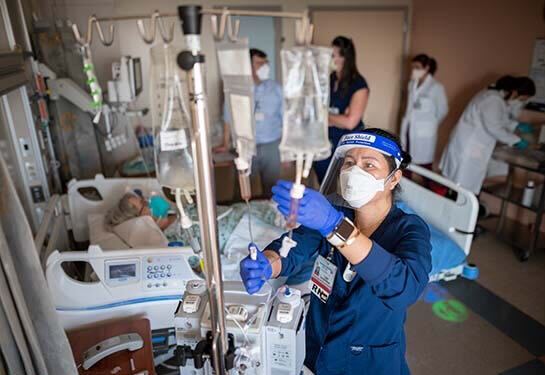
Chimeric Antigen Receptor T cell therapy (CAR T cell therapy) re-engineers patient’s immune cells to target and fight cancer

By BRANDON NGUYEN — science@theaggie.org 


UC Davis Health is one of the few institutions in California and the only University of California campus that is producing Chimeric Antigen Receptor (CAR) T cells as an immunotherapeutic weapon to help patients fight lymphomas and blood cancers. CAR T cell therapy, an immunotherapy that extracts a patient’s T cells and genetically re-engineers them to target cancer cells, is currently under clinical trial at the UC Davis Medical Center. 

Dr. Joseph Tuscano, a professor of medicine at the UC Davis Comprehensive Cancer Center and co-investigator of the clinical trial for developing this therapy, described the science behind this immunotherapy rising in popularity.

“CAR T cell therapy is an immunotherapy where we try to fix the patient’s immune system by removing the T-killer cells in the body and then genetically modifying those using a virus called lentivirus that will go in and change the DNA,” Tuscano said. “So what is done is that the T cells are harvested from the patient there, and are modified to carry these new genes that code for a new receptor that is on the surface of the T cell. This receptor is able to target a protein or ligand that’s on the surface of the cancer cell.”

This receptor on the genetically modified T cell is called the Chimeric Antigen Receptor, from which the therapy derives its name. With newly built-in receptors on the patient’s T cells, its binding to the targeted cancer cells leads to the T cells’ activation and proliferation into an army of immune cells that can now fight the tumor. 

The immune system plays a very important role in the eradication of cancer and, in fact, most of us are probably developing cancer when we’re very young,” Tuscano said. “And our immune system, using a method that we term ‘immune surveillance,’ identifies cancers and eradicates them all through our lives. So why do we develop cancer? It’s because our immune system fails as we age from exhaustion or from factors like environmental factors, genetic factors, medications, viruses and all kinds of reasons for our immune system to no longer be effective.”

The retraining of a patient’s T cells is not cheap, costing up to $500,000 for a patient to receive CAR T cell therapy if the cells were transported to and modified at a third-party commercial lab. This contributes to inequitable health care which is a concern addressed by the goals of this clinical trial. 

Dr. Jan Nolta, the director of the UC Davis Stem Cell Program and Gene Therapy Center, explains the importance of making this therapy attainable by genetically modifying the patient’s T cells on the UC Davis campus itself. 

Giving more patients equal access to CAR T cell therapy is important because we’re in the business of saving lives,” Nolta said. “I hope this could become a frontline therapy soon, as I am a cancer survivor myself, having gone through chemotherapy and everything. So I think making this form of immunotherapy accessible by retraining and growing these T cells in our labs would drastically bring the costs of cancer treatment down for these patients.”

Nolta coordinates the transfer of patients’ T cells from the UC Davis Medical Center to the Good Manufacturing Practice (GMP) Facility for the ongoing clinical trial. Being one of the few institutions that can re-engineer the T cells on campus can reduce the transportation costs incorporated in otherwise commercial products, reducing the overall cost from $500,000 down to even $50,000 for each patient treated. 

Once the CAR T cells are grown to become a large population of cancer-fighting cells, they are ready to be infused back into the patient. However, prior to this infusion, the patient must undergo “lymphodepleting condition,” which is a type of chemotherapy that makes more room for the CAR T cells to expand as they conquer and destroy the targeted cancer cells.

Dr. Mehrad Abedi, a UC Davis oncologist and primary investigator of the clinical trial, discusses the importance of phase I of the clinical trial. 

Our Phase I trial at UC Davis allows us to get more innovative about how we do CAR T cell therapy,” Abedi said. “For example, because we can transform the T cells on site, we have better control over the quality of the product. We feel this is the best way to ensure the CAR T cells continue to grow over the lifetime of the patient, providing a constant army of re-engineered T cells ready to attack any cancer cells that show up.”

However, with every treatment, there are some drawbacks, which Tuscano discusses the clinical trial is trying to minimize to become an optimal form of therapy. 

“There are side effects from the initial chemotherapy, and then, T cells become activated following infusion so you have a very active or overactive immune system, and that overactive immune system can be harmful sometimes,” Tuscano said. “In the process, it releases these hormones called cytokines that cause a lot of what we call morbidity or sickness in the patient. This is called cytokines release syndrome or CRS, which then can result in drops in blood pressure, neurologic complications called cell-associated neurologic syndrome, where you can have seizures as well.”

Aside from the high release of cytokines and potential neurological complications, a weakened immune system from CAR T cells attacking not only the cancer cells but also normal B lymphocytes in a patient, can predispose them to infections. 

“Fortunately, we’ve become very good at identifying and treating these side effects early, so that they’re relatively mild,” Tuscano said. “We monitor the patients very closely and carefully to prevent them from resulting in further health complications for the patient.”

With the rise of CAR T cell therapy as an option to potentially become a frontline therapy for cancer patients one day, UC Davis is also expanding the therapy in other clinical trials to potentially cure solid tumors and cancers.

“We are already expanding into solid tumors. There’s clinical trials actually right here at UC Davis looking at solid tumors like liver cancer, ovarian cancer and other cancers,” Tuscano said. “We’re hopeful that if we find the right targets that it will be effective for solid tumors as well, but it’s also being used for other diseases like other autoimmune diseases, skin diseases and infectious diseases as well. It’s a very exciting time and just the idea of being able to take the cells out of the body, genetically modifying them and putting them back is also a big step toward the implementation of gene therapy for many, many diseases.”

Written by: Brandon Nguyen — science@theaggie.org

Culture Corner

The Arts Desk’s weekly picks for television, movies, books and music

By JACOB ANDERSON — arts@theaggie.org


Movie: “Tangerine” dir. by Sean Baker (2015)

Sean Baker’s grimy, hilarious, iPhone-shot romp follows two transgender sex workers, one of whom is determined to find the woman whom her pimp/boyfriend had slept with during her brief stay in prison. The film is bright and filthy the whole way through, capturing the complicated and sometimes funny, often depressing lives of its characters. Sean Baker depicts Hollywood in all its debauched, 100-degree charm, treating the characters with compassion in such a way that never detracts from the comedy.


While Baker’s later films are arguably better, and the flat, grainy tone of iPhone footage can be somewhat distracting, “Tangerine” is still a fantastic watch that perfectly marries empathy and comedy.


Book: “I Used to be Charming” by Eve Babitz (2019)

In the final release before her death in December of this last year, the mordant and ever confident Eve Babitz also captures Hollywood. For her, though, it’s a frantic place full of Jim Morrisons and Francis Ford Coppolas and writers of sensational and skeevy erotica. Over a span of 40 years, Babitz’s nonfiction charts Los Angeles as the rock bars decay and a sleeker 2000’s culture rises to prominence through essays on dating celebrities and playing nude chess and a startlingly long piece about the fashion brand Fiorucci. In many ways, the opposite of her contemporary and frequent point of comparison Joan Didion, Babitz lived a life of uninhibited and unskeptical joy, and this last collection completes the impossible deed of summing up that life in 400 pages.


Album: “First Utterance” by Comus (1971)

The short-lived, psychedelic folk (among other classifications) band Comus received almost no recognition for the release of their first full-length album, “First Utterance,” but the album has since developed into something like an underground notoriety. And for good reason: The music is terrifying and skillful, sporting 10-minute, jaunty tracks about folklore creatures that kidnap and eat virgins that sound like the hymns of a medieval-themed cult. Clamoring tambourines, violins that sound like they’re about to burst apart and uneasy vibrato from shrill people make the music sound endless and threatening. Despite being sort of upbeat, this is the music one would compose to accompany a human sacrifice.


It’s fascinating, yes, but there’s clear artistry behind the spectacle, inspiring awe in the same volume as incipient terror. The band never saw commercial success for obvious reasons, but this release has still managed to arrest the minds and amygdalas of many despite its unorthodoxy.


TV Show: “Gunbuster” (1988)

This classic mecha anime from the ‘80s, which has been referenced and ripped-off in so many contexts across so many cultures and mediums that it’s unlikely they all know what they’re paying tribute to. This TV show has aged tremendously: elegant animation, a great story and one of the most memorable endings from anime of this era. The show’s director, Hideaki Anno, would of course go on the make the infinitely more famous “Neon Genesis Evangelion,” but while that show has at least one part (spanning seven or eight episodes in the show’s beginning and middle) that seems excessively dry compared to the rest of the show, Gunbuster remains fantastic the entire way through — and at only 6 episodes, it’s easily watchable in an afternoon. This is one of the best animated works of the ‘80s and I have a hard time believing anybody could watch it and have a bad time.


Written by: Jacob Anderson — arts@theaggie.org


‘Come together in solidarity right now’: Founder of Culture C.O.-O.P. Sandy Holman talks to The Aggie about racial justice education, activism

Holman hosts weekly discussions and “The Cost of Darkness” documentary viewings sponsored by the Yolo County Library

By LEVI GOLDSTEIN city@theaggie.org

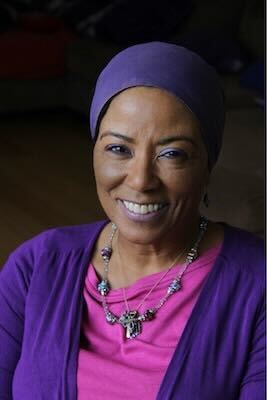
Activist, educator and author Sandy Holman spoke with The California Aggie on Friday, Feb. 4. She described the process that she and her organization, The Culture C.O.-O.P., designed to create lasting change in systems that perpetuate racism and imparted guidance for self-care and resilience for fellow activists. Holman also provided insight into the politics of Black History Month and racial justice initiatives. 


Below is a transcript of the interview that has been edited for length and clarity.


Q: How did you get into anti-racism work, and why is it important to you?


Holman: That’s a long story, but the short version of it is that a long time ago, when I was young, I realized that people had tremendous fears around differences and race in particular. There’s only one race, the human race. But a lot of our history, globally and in this country, has been based on a caste system where white people are on the top and African diaspora, or Black people, are on the bottom of that caste system. That combined with global white supremacy, eugenics, the treatment of First Nation people — the genocide of them — as well as chattel slavery and the enslavement of African diasporic people set a foundation for everything that we’re seeing today in the world. Every movement that you see today — the LGBTQIA movement, the women’s movement, the disability movement — all of them have their origins in those two original sins of what was done to First Nation people and African diasporic people. All of that has infiltrated every aspect of our society, from the individual, to the community, to the organizational, to the systemic, to the globe. It is having a catastrophic impact and cost to humanity, especially people of color, or people who are put in vulnerable situations just because of who they are, what they represent and what they look like. So all those years ago, my understanding wasn’t as nuanced as it is now, but I realized we had a lot of hate based on what you look like, based on Black skin or dark skin or difference, and I wanted to do something about it. So [I worked] in schools and eventually [started] my own organization, The Culture C.O.-O.P., and the sister organization, United in Unity, with the mission of promoting systemic change, inclusion, equity, cultural competency, literacy and quality education for all, because I feel that everyone, regardless of your discipline or focus, needs to have the ability to think analytically and understand historical constructs, policies, practices, ways of being and structures that have advantaged or privileged white people over other cultures and why we’re seeing all the inequities we see today. 


Q: Tell me more about your organization, The Culture C.O.-O.P. How do you create change and cultivate understanding?


Holman: Creating change is a relative thing, especially when dealing with issues of -isms and racism in particular. We believe that in order for things to be changed, they have to be approached systemically and not all the Band-Aid approaches that you’re seeing where people are doing diversity events, or they’re doing unconscious bias trainings — all things that are important, by the way, but in and of themselves are not going to change anything. We believe that you have to approach things systemically and go a lot deeper. For example, “The Cost of Darkness,” the showing that we’re doing with the [Yolo County Library] and the [Yolo County Health and Human Services Agency], is trying to point out to people that it really does take tough work to dismantle these huge structures that perpetuate the status quo of what we’re seeing to this day. We focus on economics and education, politics, media, healthcare, white supremacy, Blackness, the criminal justice system. We’re trying to get people to create groups, where each person has their niche, or their specialty, but they come together as a pod to address things systemically, because what happens in economics affects what’s happening in healthcare, what happens in healthcare affects what’s going on educationally, what happens educationally affects what’s going on in the criminal justice system. For example, they predict prison beds based on reading scores in second and third grade. All these things interconnect. They’re not an island unto themselves, and they create a compounded institutional impact on people of color, on what we’ve referred to as poor people — people who don’t have a lot of money — and those who are different. 


We all need to look at our systems, our environments and our spaces, and we need to do a scan, from the micro to the macro, every aspect of it, that may be perpetuating things that we say we want to do away with. The hard work is digging deep and having a plan where you look at things even a year at a time and beyond. You come up with a strategy after you’ve identified everything that’s not helping in an organization or a community. You put in interventions based on historical knowledge of what the root causes of a problem are, and you come up with solutions to address those problems. Then you try them all out, and at the end of the year, you say what worked and what didn’t, and then you throw out all the things that didn’t work and put in things that will work better. You keep doing this until you start to see a dent in systemic change. Again, that’s very difficult. It’s hard to measure a lot of the time, and, I’m being very honest with you, few people are willing to do this systemic work. 


We do get indicators, though, of success. When individuals are exposed to the true information and the root causes of what we’re experiencing in each of our institutions, they are often more likely to come up with better interventions and strategies and not just shoot-off-the-hip, Band-Aid approaches or celebratory kinds of things. Again, all those things are beautiful and important, but they don’t get to the heart of the matter. That’s why, in 2022, quite frankly, we’re still dealing with this zoo in the room, and not just the elephant in the room anymore — it’s a zoo. We’re at a tipping point, I believe, because we constantly make two steps forward, but then we crush it. We’re seeing a backlash today in our country. [The banning of] diversity studies, ethnic studies, critical race theory — all this is fueled by fear and the desire to continue to have privilege and control power at the expense of others. This is really serious stuff. It really requires serious thought and learning and working collectively to systemically approach change. 


Q: What is the purpose of the weekly discussions and “The Cost of Darkness” documentary showings?


Holman: It’s like an advertiser, because obviously four weeks is not enough. It’s not our whole paradigm. We have a paradigm. The documentary is part of a paradigm for transforming individuals, communities, systems and beyond. The documentary is one of eight tools that are a part of that paradigm. It’s a key part of it, but it’s only one tool. There are ongoing presentations that go with it. We have PowerPoints, paper and other things that go with it. The goal is ultimately to create a mindshare among people so that they understand root causes, historical happenings and structures that have built what we’re seeing today. It’s not the deficit of some cultural group; it’s the systems that were built by design to do what we’re seeing today, and they’re working quite well. This is just a tip-of-the-iceberg introduction, because quite frankly, I’m being honest, people are willing to pay just a skosh more attention because it’s Black History Month. Whether it’s Black History Month, Latinx Month, First Nation Month, LGBTQIA Month, during these months — which should be 365 days throughout the year part of a curriculum and approach — we take advantage of the fact that some people might be willing to pay a little bit more attention. This “Cost of Darkness” showing is dipping our toes in the water and trying to get people to expand, to begin their journey, individually, organizationally, community-wise and so forth and beyond. They’re not going to finish after four weeks and be ready to go out and do all they need to do. In fact, we have to do all this in parallel now, because we’re in the red zone. We can’t afford to wait until people get totally acculturated to the foundational aspects of learning to take action. It’s too late to do that. They need to do it in parallel as they’re taking action because we’re in a very, very dire situation as a country and beyond. That’s what we’re doing — dipping their toe in the water to get them to think much deeper about these issues, not just going to restaurants of different cultures, buying relics of different cultures or learning the language, even, which is a little bit better. Again, all beautiful things. But [we’re] going deeper into the historical interconnections of culture, what’s been done to cultures and what needs to be deconstructed as a result of dominant culture and white supremacy. That’s a lot more painful and a lot scarier for people, which is why we need people who are willing to do it. 


Q: How does someone get involved in making change after they’ve gone through the process of education?


Holman: I honestly have most hope with young people. I’m not giving up on people my age. I’ve been doing this for over 35 years. But it’s young people that give me the most hope. Originally, when I developed this paradigm, it was to happen over a year period in parallel with action. So people would be learning, and then I wouldn’t be getting all the kickback as much because they would understand things better, and they would be given assignments to actually take action in their communities or their organizations. I reduced this down to a three-month experience, and that’s why I say these guys are just getting a tippy-toe, although it’s deeper than most of them will ever get because of what they learn from the documentary experience. Hypothetically, in an ideal world, people would go through this paradigm for transforming individuals, communities, systems and beyond, and the assignments they would be getting would require them to interact with real people, real situations and so forth. Also, after developing a whole list, a road map of sorts, for whatever issue they were trying to address, they would connect with other people who were addressing other aspects. Maybe my thing would be education, so I would connect with someone who is trying to address economics, and we would connect with someone who is focusing on the criminal justice system, and we would connect with someone who is focusing on media, and we would connect with someone who is focusing on politics, looking at all of our institutions. Our documentary covers the eight of them. And we work together as a pod — maybe in the Davis community, maybe on campus, whatever our space is — and collectively identify a few top things that we thought were harming people, and we would start there. [With] all the knowledge we would learn from this paradigm and experience, from coming together and dealing with the tough stuff, from creating brave spaces and not just safe spaces, we would act. That’s what would happen. 


With these issues, you can’t be safe. People are going to get their feelings hurt and be upset and not like what they’re hearing, so I believe in brave spaces. Over time, we would start to put dents in systemic structures that, hopefully, cumulatively, would make it easier for the next generation. This stuff is going to take a minute. Systemic change, in an ideal way, takes a minimum of three years. If you don’t have the will of people to do it, if you have saboteurs, and all the things that we do have built into the system, it’s many more years than that, which is why things have not moved. Obviously, certain things have moved tremendously, but others have not. You see, we fall back into old ways. It’s a process. Really, it’s a lifetime journey. But we need to, and we can if we have the will, make faster change. Now, we’re at the point, I feel, that the consequences of not doing so are at their highest levels. It’s been that way for many years for people of color and marginalized groups, but we’re in a place now where it’s even going to affect the dominant culture a whole lot more than it has in the past. That’s what I would say to that. You know you’re making a difference when you’re at least trying. Even if initially you don’t see any difference that it’s making, it doesn’t give you an excuse to stop trying. This is a case where we have to. And we know some things that work. So let’s do it. First, educate ourselves. I’m hoping people come, particularly young people. I would love them to come. I was so happy to see a few high school students. I think I saw one college student. A professor had shared. But, oh my gosh, I would love it to be filled with college students, or young people in general, because they get it, and they’re young, and they want a better world. Again, not saying older people don’t, but it’s a little more difficult. 


Q: If you and your work could have one impact on the world, what would you want that to be?


Holman: To encourage people to love themselves and others and to share power and resources in the world. That’s my legacy statement. That’s what I want on my tombstone, or my crematory stone, since I’m not going to get buried in the ground. Everyone should have one. It drives everything that I do: to encourage people to love themselves and to share power and resources in the world. In a nutshell, so much of what we’re seeing is based on the need to control power, money, people and to hoard more than our fair share of resources in the world. I’ve always thought it was interesting the way the world was designed. Most of what we’ve referred to as third world countries have most of the natural resources, and most of what we refer to as first world countries — which, I hate the terms, because they’re pejorative, and that’s a whole nother session — have the capabilities to process those resources. I feel that it was designed that way for us to have to interact with each other and cooperate. But that would be my dream, is people loving themselves, because you’ve got to love yourself. Otherwise, you don’t have the chance to love someone else, especially a different person — to love yourself and others and to share power and resources in the world. Because that would change a lot of things in itself. 


Q: How do you feel about Black History Month?


Holman: I’ve often been asked the question, why is there a Black History Month? Why is there Mexican History [Month]? Why is there Black Mixed History [Month]? Why are there all these different months? White people don’t get a month. And I say, that’s because you guys get the whole year. Our curriculum and our society are structured to perpetuate you empowering yourselves and having privilege. “White History Month” is all year long. All cultures should be celebrated all year long. It shouldn’t be the tokenism that goes with these months. However, having said that, these months are critical, because if we didn’t have them, there wouldn’t be any or very much focus on those other groups. 


Often, it’s during these months that you find those groups, if it’s their month, being represented. They try to offer a ton of activities because they know people might tolerate it a little bit more. Right now, even as we speak, they’re restricting schools from reading Black history books and things like that. We’re having this backlash. Even in this month, a lot of people are not even being allowed to honor Black history or African diasporic history. It’s going to be the same for the other groups, too. It’s a sad thing that we have not [incorporated] all of the major cultures in this country into our curriculums at school, into our institutions, into our everything. It’s mostly white folks for anything. I don’t think white people are bad people, by any stretch. But the power structures and historical structures are set up so that they are more likely to control the political process, the economic process, the educational process and the criminal justice process. Although you have some people of color here and there, on the by and large, it is controlled by white folks, even this concept of being allowed to focus on a group in a particular month. 


I’ll take this month, for sure, but “The Cost of Darkness” wasn’t designed just to be shown this month. It was designed to be used throughout the year to get people to feel like they really have a chance, maybe begin the journey of making a difference. And it’s critical to do it. So yes, let’s have these months, because it gives us permission to be who we are, because of how things are set up from an oppression perspective. But how sad that it is not honored throughout the year for all the groups in a much more in-depth way that is affirming to all people. There’s a reason why young people of color start school with high self-esteem on average, and by the time they graduate, don’t feel as good about who they are and what their culture represents. It has everything to do with how we’re educating them and the perpetuation of Eurocentric learning versus pluralistic learning, for example. That’s why I do take advantage of this Black History Month, or what we call the Black quarter, because we have Martin Luther King [Day] in January, and then we have Kwanzaa right after Christmas. But really, there should not be no Black quarter, no brown quarter. There should be throughout the year incorporation of all these things. In the year 2022, the fact that we’re seeing a backlash where they’re banning books in schools, banning ethnic studies, banning teaching all of this, all under the guise of it being unpatriotic, when really it has so much more to do with hate and fear, is sad. 


Q: If you had one last call to action, one thing to say to allies of the Black community and allies of all marginalized communities, what would that be?


Holman: Come together in solidarity right now. Not doing more than your share so you won’t burn out and be overwhelmed by all of this. But come together in solidarity. Choose your focus. Unite with others who have a different focus and create a cluster for approaching systemic change. And never, ever, ever give up. Beyond being an ally, you need to be an accomplice, which is a lot deeper. An accomplice treats these things as if they are happening to themselves, not to some other cultural group where you’re just being the good do-gooder, trying to help out so you can make yourself feel good. An accomplice treats all of what’s happening as if it was happening to themselves. So come together in solidarity. Cluster with people focusing on different institutional problems. Educate yourself. Never give up. Don’t burn out. Take breaks. And be an accomplice, not just an ally. 

Written by: Levi Goldstein — city@theaggie.org

The Supreme Court must protect abortion rights

Anti-abortion advocates in the U.S. should not use religious beliefs to justify stripping people of the freedom to choose

On Monday, Feb. 21, Colombia decriminalized abortion, making it possible for women across the country to exercise control over their bodies and their lives. This historic decision follows closely after Mexico’s Supreme Court ruling in September 2021, which declared it unconsitutional to criminalize abortion. These rulings are a sign of long-overdue progress  toward both basic human rights and the separation of personal, religious views and public policy in both countries.

While citizens of these countries celebrate newfound freedom for people with uteruses, those in the U.S. face a future that may involve just the opposite: Roe v. Wade, the 1973 Supreme Court decision that federally protects the right to get an abortion, is at risk of being weakened or overturned in the near future. 

After hearing arguments on a recent Mississippi law that bans abortions after 15 weeks of pregnancy and challenges Roe v. Wade, several conservative Supreme Court justices expressed criticism of the 1973 decision, indicating the likelihood that they’d rule to overturn it. After 49 years in effect, the ruling that promised individual rights and bodily autonomy is now up in the air, leaving anyone who may get pregnant uncertain about whether their freedom of choice will be intact by the year’s end. 

Many, however, are already experiencing an infringement of their constitutional right to an abortion. The Mississippi law is currently in effect while the Supreme Court deliberates, as is a Texas law that bans abortion after six weeks  — before many women know they’re pregnant — and makes no exception for rape or incest. The Supreme Court has decided not to intervene due to a “unique enforcement mechanism that gives state officials no role,” where it’s up to the public to enforce it through civil lawsuits. Despite these laws contradicting the precedent set in Roe v. Wade, they are actively preventing pregnant people from accessing medical care that is well within their current rights. 

But those rights are just that: current. Should the court overturn Roe v. Wade, the effects seen in Texas and Mississippi would only spread. Over half of U.S. states are expected to ban abortion if the ruling is overturned, jeopardizing millions of people’s ability to access comprehensive reproductive care and family planning. If policies as severe as those in Texas are legalized elsewhere, the already incredibly traumatic experiences of rape and incest could be compounded by the inability to end unwanted pregnancies for even more people.

No matter the reason, humans deserve the right to control what happens to their body. The decision to have an abortion is not easy, and the stress of not even having the option only imposes a greater psychological toll on people facing unplanned or otherwise unwanted pregnancies. 

Abortion wasn’t always so entrenched in politics, or even a centerpoint of Republican ideology. In fact, when abortion became a political issue in the 1960s after feminist groups’ advocacy, Republicans were in favor of its legalization, seeing as it aligned with their ideals of small government and individual rights. It wasn’t until the 70s, when the Republican Party realized that they could tap into the religious, anti-abortion voting base, that they took a stance against it to garner support in the polls. 

At its core, the fight against abortion is performative, and rooted in the unassociated goal of gaining power. It’s disheartening and disturbing to consider a future where millions of people in this country are forced to have children because a personal decision that has no place in government became a political tool.

The 50 year-old political associations between the Republican party and anti-abortion religious groups raises an important issue in the abortion debate, one that Justice Sonya Sotomayor put simply when responding to the case for the Mississippi law: “How is your interest anything other than a religious view?” 

The separation of church and state requires that the U.S. government cannot prefer religion over non-religion, nor one religion over the other. If the notion that abortion is immoral is based on certain religious beliefs that life begins at conception, then why are these ideas being used as arguments to make laws or overturn Supreme Court decisions? 

These aren’t new questions, or particularly new points, for that matter. But that, in and of itself, points to the discouraging backward direction this country seems to be going in with the challenges to Roe v. Wade. This is the same right that decades ago was fought for, using similar arguments — that religious views shouldn’t dictate laws or policy; that abortion is personal, not political; that it is a human right. 

As other countries around the world take strides towards protecting bodies and choice, states in the U.S. have begun an attack on those rights that may result in the dismantling of abortion services as we know them. Rather than backtrack and fulfill only certain religious groups’ desires, it is imperative that the Supreme Court uphold Roe v. Wade in order to preserve the right to maintain control over one’s own body and life choices. 

If you or someone you know is in need of abortion services or other reproductive health care, please see the resources below:

Planned Parenthood Woodlandhttps://www.plannedparenthood.org/health-center/california/woodland/95695/woodland-health-center-2375-90130

Women’s Resources and Research Centerhttps://wrrc.ucdavis.edu/resources/health

UC Davis Student Health and Counseling Serviceshttps://shcs.ucdavis.edu/health-and-wellness/sexual-well-being

Written by: The Editorial Board

Aggies hold off Roadrunners after two-week layoff

Big nights from the trio of Elijah Pepper, Ezra Manjon and Caleb Fuller lead the Aggies to an 81-79 win

By OMAR NAVARRO — sports@theaggie.org

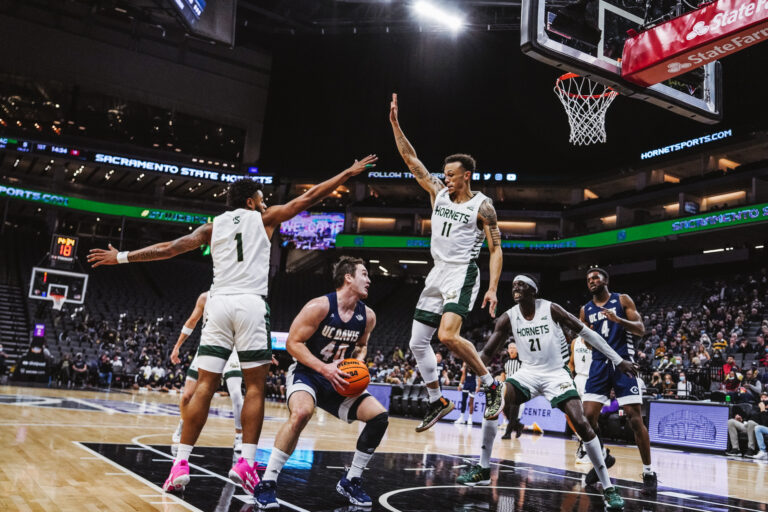
After having their road games against UC San Diego and UC Irvine and home game against Cal Poly canceled due to COVID-19 protocols, the UC Davis Men’s Basketball team returned to action Saturday to face the Cal State Bakersfield Roadrunners inside the University Credit Union Center. 

The first matchup between the two teams was originally scheduled for Jan. 13 in Bakersfield, but COVID-19 issues within the Roadrunners program led to its cancellation. With Big West Conference games running low, UC Davis looked to continue to rack up wins and have some momentum heading into the tournament. 

Having won two straight heading into Saturday night’s contest, the Aggies looked to continue the streak against the Roadrunners who were 1-9 in conference play. Still, it was not an opponent to take lightly as they had been in close games prior, just unable to close it out. After the opening tip, it became clear that this game would be a physical one. Trading buckets to open the game, Cal State Bakersfield’s senior forward Shawn Stith went on a personal run, scoring the first seven points for the Roadrunners as well as drawing two quick fouls on the Aggies’ junior forward Christian Anigwe.

The fouls forced head coach Jim Les to sub out Anigwe less than two minutes in to avoid getting into even more foul trouble. Les inserted the 6’11” first-year Francesco Borra to combat the size of Stith. After Bakersfield ran out to a 9-3 lead, UC Davis stormed back with a quick 5-0 run to cut the early deficit to one.

The Aggies took their first lead almost five minutes into the half, as a pair of jumpers by star guard Ezra Manjon gave them a 12-11 lead. After a response by the Roadrunners, the Aggies proceeded to go on a 9-1 run behind some fast pace and extra passes. The ball movement began to pick up for UC Davis and it led to some great open looks that they converted. 

As would be the story all night however, Cal State Bakersfield continued to hang around. Stith continued to dominate the paint and play physical against an Aggies team that lacked some size. Aside from Stith however, the Aggies did a great job at sniffing out postups and communicating on screens. This tenacious defense allowed them to stay in the lead after a two-and-a-half-minute scoring drought midway through the first half. 

A five minute stretch that began around the 10-minute mark of the half saw Bakersfield reassess themselves in the game as free throws and points inside the painted area boosted them up to a 30-25 lead. They also switched to a full-court press after making shots, putting pressure on the Aggies as they crossed halfcourt and set up their offense. 

The final five minutes of the half saw the same physicality as the first 15 — but now both teams were in the bonus. With teams exchanging free throws, Bakersfield would prove to be the team to take advantage of the slower pace. With 1:29 remaining in the half, a three pointer by second-year guard Kaleb Higgins gave the Roadrunners a 39-34 lead. Following a missed dunk by Manjon, he proceeded to score a layup and some free throws to make the half time score 39-38 in favor of the visiting Cal State Bakersfield.

As a team, the Aggies shot 12-24 from the field in the first half but only 1-6 on threes. Bakersfield didn’t shoot any better, only going 14-34 and 1-8 from three. But, six Aggie turnovers turned into nine Roadrunner points, and it allowed Bakersfield to still hold the lead despite shooting worse. Manjon led the Aggies with 13 points with forward Caleb Fuller right behind him with 10 points and three rebounds. On the other side, Stith had more than half of the Roadrunners points with 20 points and four rebounds.

To start the second half, Anigwe was back in for UC Davis after only playing a little under two minutes in the first half due to foul trouble. Five points by Bakersfield’s first-year guard Dalph Panopio extended the Roadrunners’ lead to five. To make matters worse, Anigwe picked up another foul and was subsequently subbed out once again in favor of Borra with three fouls.

A back and forth began to occur on the floor, as neither team gave the other any breathing room. Hard, physical play made up the start of the second half with Bakersfield clinging on to their lead that failed to grow more than five. An offensive putback by the Aggies finally tied things up at 50 with a little over 15 minutes remaining in the second half. A three pointer by the Roadrunners was answered back by an Elijah Pepper three for the Aggies — a sign of life from the outside. 

A free throw by Caleb McGill at the 12:38 mark gave the Aggies the lead for the first time in over 13 minutes of gameplay. The switch to the zone defense by UC Davis proved to be effective as they were finally able to slow down Stith after his first-half tear. Still, others on the Bakersfield like Higgins, Panopio and senior forward Justin McCall began to pick up the Bakersfield offense. 

At the midway mark of the second half, Panopio and McCall began to come alive as the Roadrunners held a five point lead. With the offense sputtering at times, the Aggies turned to some of their more experienced players, as Manjon, Pepper and Fuller began to step up. A midrange jumper by Manjon was followed by five quick Fuller points that let the Aggies regain the lead, 61-60. The Roadrunners called timeout and looked for answers. 

The answers wouldn’t come for Cal State Bakersfield as UC Davis never lost the lead for the final 8:27 of the game. Re-entering the game with four fouls, Bakersfield hoped that Stith would find a way to continue his tear from the first half. But, almost immediately after entering the game, he was called for another foul that would end his night.

Even after Stith fouled out, the Roadrunners kept on fighting. Their guard Higgins continued to attack and scored seven straight points for Bakersfield. On the UC Davis side, Manjon and Pepper scored the next nine for their squad as each possession was played with intensity. With 2:01 remaining in regulation, the Aggies led by six after a dazzling Manjon jumper that electrified the crowd. A three pointer by Higgins kept the Roadrunners hopes alive, but the final minute or so proved to be a free throw battle that the Aggies would hold on to win, 81-79. 

Elijah Pepper finished as the Aggies leading scorer with 24 points and perfect 12-12 from the free throw line as Manjon was right behind him with 23 points to go along with five rebounds and three assists. Caleb Fuller had 18 of his own as the trio combined for 65 of the 81 UC Davis points. As a team, the Aggies shot 29-35 from the free throw line — an important stat as each was necessary to pull out the win. Although they were only 4-13 from three and never able to get it going against the Bakersfield defense, 32 points in the paint allowed the Aggies to win their third straight game. 

UC Davis improved to 11-7 on the year and 4-3 in conference play. With all the cancellations in conference play, that leaves them with only four more games to play. Currently in the sixth spot in the Big West Conference standings, the Aggies will face off against UC Santa Barbara (2/24) and Cal State Northridge (2/26) for their last home games of the season. 

Written by: Omar Navarro — sports@theaggie.org

UC Davis leads research in accelerated wheat-breeding

The $15 million project will train a cohort of the next generation of plant breeders

By SONORA SLATER — science@theaggie.org

Bagels, crackers, pancakes, pizza, pasta and cereal all have one thing in common: wheat. These popular foods, among others, are the reason why wheat products account for nearly 20% of what people across the planet eat every day.

Between population growth and changing weather patterns, the wheat crop will face challenges keeping up with demand in coming years — but wheat breeders at UC Davis, in collaboration with other researchers across the country, are working to help the crop keep up.

UC Davis is leading a five-year, $15 million research project that, according to a recent press release, will seek to accelerate wheat breeding “to meet […] new climate realities” and simultaneously teach “a new generation of plant breeders.”

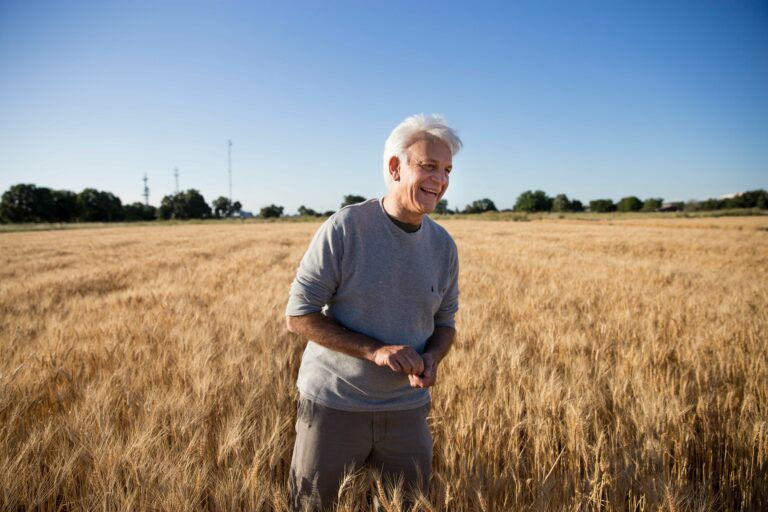
Jorge Dubcovsky, a distinguished professor in the Department of Plant Sciences who is leading the grant research, said that traditionally, wheat breeding involves walking through the fields plot by plot and taking detailed notes to inform the next genome cross. However, the accelerated breeding will take advantage of drone technology.

“[The drones] have spectral cameras where you can see the plants in different wavelengths,” Dubcovsky said. “You can estimate the amount of nitrogen, water content and biomass. You can get a massive amount of information from each plant.” 

According to Dubcovsky, all this data is being sent to a centralized database in Texas, which will store information about all of the breeding programs in the U.S.

Amir Ibrahim, a wheat breeder and a professor at Texas A&M who is involved in the project, explained why their program was chosen to act as the central hub.

“The strength of Texas is automation,” Ibrahim said. “We have a platform, so we have the ability to process data in a fast way and in a very efficient way. […] For us to make progress in the face of climate change, we have to increase efficiency and the scale of doing things. This is just a tool that will allow us to do more.” 

Dubcovsky elaborated on how this will contribute to increased efficiency and accelerate the wheat breeding process.

“With all that information, you can use statistical techniques to link which regions of the genome are associated with which traits, and you can start selecting based on the genotype,” Dubcovsky said. “What that allows you to do is predict performance, and you can select even before you see those plants, and before you make crosses with those plants. So it allows you to make the selection process of the new lines and new crosses a lot faster.”

Jackie Rudd, a wheat breeder and a professor at Texas A&M who is taking part in the project, described the traits the breeders are looking for when they’re selecting genotypes.

“It’s really about the growth rate, and that adds to yield, but it’s also about efficiency,” Rudd said. “The water-use efficiency and nitrogen-use efficiency is just extremely valuable. And it’s something that we’ve always worked on, but we can see more of that with the drone too.”

Rudd elaborated on how this ties into changing weather patterns.

“That efficient use of resources really is looking at climate change,” Rudd said. “When we can do things more efficiently, we’re going to come up with something better faster.”

In addition to emphasizing accelerated breeding, the project will also focus on training a cohort of plant Ph.D. students in modern breeding techniques and technologies, according to the press release. 

“I’m an old guy; I’ve been around for a long time,” Rudd said. “We want to know that what we’ve learned throughout our career is not going to just go away. And so to work with students is just a joy. Their excitement, their enthusiasm about everything, everything’s new to them and it’s just fun to be around — they teach me a lot too!” 

Dubcovsky highlighted the real-life experience that the training will involve.

“These are active breeding programs,” Dubcovsky said. “It’s not that you read it in a book — you go to the field, you work in the planting, you work the harvest, you walk the rows, you learn how to look at the plants, you learn how to look at the images from drones, you learn how to use that to breed. So you are immersed in the real breeding program that is releasing commercial varieties into the real world.” 

He also spoke on why this project is important today.

“People tend to continue reproducing and continue eating,” Dubcovsky said. “If you want to continue eating and you want to fit another three billion people in the next 20 years, you’d better be very good at breeding. If not, there’s not going to be enough for everyone.” 

Dubcovsky offered some final thoughts on why the public should be paying attention to breeding research.

“We all think that food is guaranteed, but no,” Dubcovsky said. “Food depends on a lot of people who work very hard to produce that food, and on a lot of people who work hard to make sure that production keeps pace with the needs of our population. A lot of people today don’t think about food because we have enough. But when we don’t have enough, that’s the only thing that you will be thinking about.” 

Written by: Sonora Slater — science@theaggie.org

#AggieMOOvement hopes to make a cow the official UC Davis mascot

0

A student-led petition is urging UC Davis to replace Gunrock the mustang with a cow in an effort to create unique identity for the school 

By ALINA ISSAKHANIAN — features@theaggie.org

A group of students led by Mick Hashimoto, a third-year applied statistics and economics double major, have proposed the #AggiesMOOvement, an effort meant to streamline the university’s identity by replacing the current mascot, Gunrock the mustang, with a cow. 

Hashimoto’s goal for this change is to create a more unique and unified identity for UC Davis, since he said that many students, like first-year philosophy major ThuyAnh Truong, already associate the university with cows.

“Coming to Davis for the first time, I was actually confused to hear that the mascot wasn’t a cow,” Truong said. “Cows are so synonymous with Davis that it seems fitting they’d be our mascot too.”

Hashimoto is pushing for the change primarily because he feels that the student body lacks school spirit, in part because they don’t feel a connection to Gunrock as the mascot. 

“With athletics as well as with a lot of other things, we lack a lot of school spirit,” Hashimoto said. “So for me, to change the mascot is to be able to […] have everyone get behind one thing that can help us feel a tighter sense of community here in Davis.” 

Hashimoto believes that UC Davis should have a unique mascot that matches the identity of the school, like how UC Santa Cruz has a banana slug and UC Irvine has an anteater.

“In freshman year, I was coming into orientation and I saw the cows by Tercero, and it kind of hit me: ‘Oh, we’re living in a cow town,’” Hashimoto said. “I think it’s a really cool connection that I had with the cows. A mustang is such a basic mascot — nationwide, there are many schools that are Mustangs — so it doesn’t really give Davis a unique identity even though we’re really unique.” 

The movement has gained support from many students who agree with Hashimoto, including third-year psychology major Ambika Vaidya. 

“I think it’s a great idea, as students have shown more school spirit [in connection] with the cow than the horse,” Vaidya said. “Although Gunrock is an amazing mascot, students have made cows more of a symbol for the school — cows are a major part of the campus and the school’s general atmosphere.”

Some students have expressed fears that changing the mascot to a cow would erase Gunrock’s history at Davis. ASUCD Senator Celeste Palmer said during discussion at a senate meeting on Feb. 3 that remembering the context in which Gunrock became UC Davis’s mascot should not be forgotten.

“It’s important to remember the actual history of this mascot,” Palmer said in the meeting. “Gunrock was an actual horse who lived at UC Davis. He was a thoroughbred, not a mustang, and he was brought by the U.S. cavalry to breed at UC Davis. This is an interesting story that actually makes it very unique.”

Gunrock is named after an Army Thoroughbred stud horse that was placed at UC Davis for civilian use in 1921. At Davis, Gunrock the Thoroughbred helped make a lasting impact on the school’s and state’s agricultural and veterinary advancements. After Gunrock died in 1932, to honor his impact, the students of UC Davis voted to name their chosen mascot of a mustang after Gunrock. 

Other students, like third-year microbiology major Courteney Davis, don’t feel strongly about this history. 

“Things are only a tradition because no one has changed them,” Davis said. “That’s what makes a tradition a tradition; [it] doesn’t mean it’s special.”

Hashimoto said that he doesn’t feel that the history of Gunrock the horse is relevant to much of the student body anymore. He said that, in terms of cohesiveness, a mustang doesn’t fit and that during the first few weeks of the #AggiesMOOvement, he had students reach out to him, not knowing what an “Aggie” was.

“If you don’t even know your school mascot or the distinction of your school name, is there any attachment to that for anyone?” Hashimoto said. “I really don’t think there is, and so by making our mascot a simple cow — because I think we are already attached to the cow anyway — it would be easy to convince the student body.” 

Hashimoto spoke with ASUCD senator Dennis Liang, who said that in 1993, UC Davis students actually voted to change the official mascot to a cow, but it never happened because an initiative to carry out the transition was not put in place. 

Hashimoto said he believes that this time could be different. He said that the MOOvement, which gained over 1,000 followers on Instagram in less than a week, is expected to do well during spring quarter’s ASUCD elections. Given its popularity and growth in the last month, Hashimoto expects that having this movement on the referendum for this spring’s elections will yield a large voter turnout for campus elections this spring, and he hopes that through this, the student body can be accurately represented. His goal is to get around 10,000 people to vote, about a third of the school’s population.

Hashimoto is also advertising the MOOvement through merchandise like stickers that he hides around campus for students to find, and tote bags, which he said will make their debut at the farmers market this spring. While he is confident in his efforts, Hashimoto said that even if the mascot does not become a cow, he would still consider the MOOvement a success because of how many students it has brought together. 

“I think changing the mascot to a cow would heighten the passion and enthusiasm of the community as we could have a mascot that we all identify with and rally around,” first-year physics major Andrew Birch said. “It matches with the campus spirit and culture, and changing the mascot would only increase those two things.”

Written by: Alina Issakhanian — features@theaggie.org

A look into the upcoming 2022 Templeton Colloquium

The annual event will feature four experts in early 20th-century West Asia and include a discussion on the intersection of art history and the representation of marginalized communities in the press

By ANGIE CUMMINGS — arts@theaggie.org

UC Davis’ Department of Art History will be hosting its annual Templeton Colloquium, titled “Of Satire and Bigotry: Press Culture, Women’s Rights, and Liminal Modernity in West Asia,” on Friday, Feb. 25 at 4 p.m. The talk will be held in person at the Manetti Shrem Museum, and a livestream will be provided for those who cannot attend. 

Made possible by the generous support of UC Davis alumnus Alan Templeton, this colloquium has been held since 2011 and brings together scholars from different institutions and fields of historical art research, providing the UC Davis community with a free and public lecture that tackles contemporary issues in art history. 

The event is organized and moderated by a different faculty member each year, and this year, UC Davis Professor and Chair of the Department of Art History Talinn Grigor has assembled an interdisciplinary team of four experts on the first half of the 20th century in West Asia to discuss, “current issues of women’s rights, minorities’ rights and the intersection of art history,” Grigor said. 

These complex issues will be examined through the lens of different forms of representation in the press, including satire and caricaturization, as well as the differences between newspapers or artists belonging to historically marginalized communities and mainstream outlets. Each of the speakers will cover one of these different angles within the overarching topic, giving voice to new conversations concerning these issues. 

While this lecture is still based in the art-historical method of examining images and objects from a specific time and place of interest, these representations in the press are an entry point for an incredibly multi-faceted conversation that spans sociological, traditional, historical and cultural studies of West Asia. In order to gain something from this information-rich lecture, you only need to have some interest in the intersection of marginalized communities’ and women’s rights and representation in mass culture.

The first talk will be held by Yasemin Gencer, an art historian with a focus on the “visual culture and print media” from the late Ottoman to early Republican periods of Islamic art. In her talk titled “Modernity, Image, and Liminal Identities in the Early Turkish Republican Press,” Gencer will provide valuable insights on the state of underrepresented identities during the transitional period in which Turkey developed its own nationalism after the end of the Ottoman Empire. 

Next, Houri Berberian, who co-authored an upcoming article with Professor Grigor on modernity and the representation of Armenian women in Iran, will discuss “Bogeymen and Birch Brooms: Pictorial Modernity, Satirical Newspapers, and the Armenian Women of Iran, 1920–58.” Berberian is a professor of history and the Chair and Director of the Armenian Studies Program at UC Irvine. She will specifically focus on “how communities mold the image of the modern woman in their own image,” Grigor said. 

The third talk will be conducted by Camron Michael Amin, a professor of art history from the University of Michigan, Dearborn. Amin will discuss “Satire and Bigotry in Iranian Press Culture” and will explain a different side of the representation of marginalized communities in Iran, as his focus is on press written in Persian. Amin’s talk will provide insights on marginalized voices in the press in contrast to the depiction of these communities in the mainstream media. 

Finally, Nadia von Maltzahn, an art historian whose research revolves around cultural and artistic practices in West Asia, will present “A Thoughtful Exaggeration: Lebanon’s Early Independent Period through the Eyes of Diran.” Currently working on projects about the development of a “professional field of art in Lebanon,” von Maltzahn will generate a discussion of the famous Armenian-born caricaturist, Diran Agemian, and will shed light on the conception of a national identity in Lebanon and marginalized voices during this process. 

Written by: Angie Cummings — arts@theaggie.org

Humor: My roommate’s emanating a seriously bad vibe, dudes

Stop declaring your independence from me, Marcus

BY ANNABEL MARSHALL — almarshall@ucdavis.edu 

Guys. Dudes. Bros. Etc. I think there’s something off with my roommate. Like, the vibes are seriously off. No jokes. 

We used to be fine. But recently he’s been acting weird. He said he wants me to stop jumping off the fridge and cannonballing onto the couch every morning. But that’s just how I like to start my day. Plus, it saves time to keep the couch in the kitchen. That’s just basic math.

Like, being a STEM major is already a red flag. But he’s taking a coding class “just for fun.” I don’t think he understands what “fun” means, ‘cause he didn’t want to join in when we were having a competition to see who could eat a whole onion the fastest. He’s from Britain.

Also, last night I woke up and he was slowly turning a steak knife in his fingers, the moon reflecting off the blade. And, like, I’m an empath, so I felt like something was off.

Lately, I’ve noticed he’s become pretty pale. Like, I can see the contents of the refrigerator even when he’s standing right in front of it. Granted, the only thing in our refrigerator is Dijon mustard and four grapefruit White Claws. But that still seems like a warning sign. Again, he is British, so maybe he just hasn’t been in the sun in a while.

One time I saw him trying on this big powdered wig and ranting against the Federalists. And I’m pretty sure Halloween isn’t for at least another couple of months, so that could be something.

I don’t wanna be, like, rude or whatever, but I’m starting to think he’s the evil ghost of Thomas Jefferson. I talked to some guy from the internet in Venezuela who said he had a similar problem with Hugo Chavez haunting his outdoor shed. 

Honestly, I’d be fine with it if Jefferson wasn’t such a bummer. I asked him if he wanted to do anything later and he said he wanted “to indulge in the rich fields of nature, where alone I should have served as a volunteer if left to my natural inclinations and partialities.” I don’t think we have that in Davis.

He sent me a “Busting Ghosts” kit and told me to refer to it only by that precise name; otherwise, the copyright police would come after me and French braid my intestines. I’m hoping I can just blast ol’ Tommy with the fancy rocket launcher thing without unleashing the full rage of a haunting Founding Father. I think I can get him on the first try ‘cause my frat went to paintball last week and I shot all of the pledges in the forehead at least twice. As long as he doesn’t see it coming.

Guys, the room just became freezing cold. I think he might have been listening to me. If I die, tell Joe Burrow I love him.

This concludes the official Yolo County transcript of Peter Chapman’s voicemail to the ESPN complaint line. The police are unsure why Chapman contacted ESPN, but friends of the victim have indicated that is the only number he knows by heart.

Written by: Annabel Marshall — almarshall@ucdavis.edu 

Disclaimer: (This article is humor and/or satire, and its content is purely fictional. The story and the names of “sources” are fictionalized.)

Column: Pesto to the rescue!

How making unconventional pesto fixed my food waste problems — and how it can help fix yours, too

By NADIA ANEES — nsanees@ucdavis.edu 

I first learned that pesto was something I could make by myself, in my own kitchen, when I was a freshman in high school, and it flipped my world around. I’d been a big pesto fan but viewed it as a little delicacy I would only enjoy when going out to delis or restaurants. 

Almost everyone I know can relate to the inevitable problem of their produce going to waste before they finish it up, which keeps them from buying large quantities of fresh produce like vegetables and leafy greens. I’m here to convince you to look into making non-traditional pesto as a solution to your food waste habits.

Pesto has its origins in Genoa, Italy — specifically in the Liguria region. Authentic pesto is made by hand using a mortar and pestle and a minimal list of high-quality ingredients: basil, toasted pine nuts, olive oil, salt and either parmigiano reggiano or grana padano cheese. It is traditionally paired with specific shapes of pasta and is enjoyed just like that. 

However, if we’re not making authentic pesto like an Italian grandmother might, pesto can be a very versatile and forgiving condiment to make and utilize at home — especially when that time comes around when you have too many greens on hand and not enough time. It can be made in a pinch with just a food processor or a blender. 

I like to imagine the components of pesto as a three-part pie chart consisting of the green, golden and brown groups. Different herbs or leafy greens, and even cruciferous vegetables like broccoli, can be perfectly used for the “green” part of this sauce. This is where you can get crafty when your spinach, kale, broccoli or even avocado is about to go bad. Typical nuts you may have around, such as cashews, walnuts or almonds, can be substituted for the pine nuts, making up what I call the “brown” group. Lastly, garlic, parmesan cheese and olive oil make up the “golden” group — I would highly suggest using the same golden group ingredients whether you’re making a pesto with about-to-wilt greens or the traditional way. Regardless of what you use in the green group, the golden group of ingredients is where you get amazing flavor. 

Simply throw your ingredients from each of the color groups listed above into a food processor and blend until smooth. With that, you have pesto! You can use it in sandwiches, pasta, rice or salad bowls, or you can eat it as a dip with vegetables or chips. Not only does it add some color and flavor to your meals, but it also saves you from throwing away vegetables that you wouldn’t get to eat otherwise.  

I hope you don’t let the danger of wilting greens keep you from buying the produce items that keep you nourished and well. If buying produce doesn’t fit within your budget, you can pick up leafy greens at the Pantry Monday through Friday from 10:15 a.m. to 5 p.m. or on weekends from 10:15 a.m. to 1 p.m. Making pesto is one of my favorite ways to alleviate my food waste issues, but there are also a myriad of other ways that the internet can help you solve your own food waste problems.

Written by: Nadia Anees — nsanees@ucdavis.edu

Disclaimer: The views and opinions expressed by individual columnists belong to the columnists alone and do not necessarily indicate the views and opinions held by The California Aggie.