56 F
Davis

Davis, California

Wednesday, December 24, 2025
Home Blog Page 294

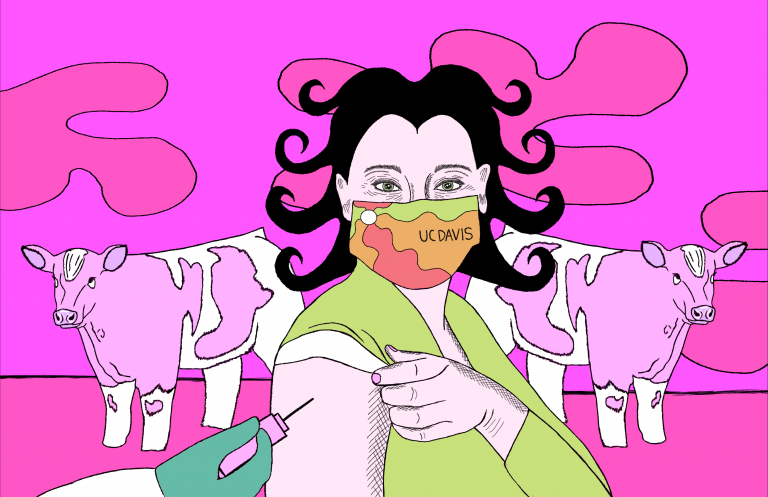
Students share why they plan on receiving the COVID-19 vaccine

0

According to three UC Davis students, everyone should be vaccinated when possible and put their trust in the science behind the vaccine

As the COVID-19 pandemic continues into 2021, society is still struggling to contain the virus. Although cases are still rising, a step toward potential change began on Dec. 14, 2020, with the first administration of the COVID-19 vaccine in the U.S. Amid the nationwide rollout, the choice to take the vaccine is becoming a more pressing issue. 

A study released on Dec. 3 revealed that 60% of Americans plan on receiving the vaccine when it becomes available to them. As the conversation continues, three UC Davis students shared why they believe taking the vaccine is the right choice. 

Jane Casto, a second-year gender, sexuality and women’s studies and political science: public service double major, has decided to receive the vaccine when it becomes available. In response to the recent statement released by the UC President confirming in-person courses in fall 2021, Casto suggested that getting the vaccine is essential for the safe return of in-person classes. 

“If instruction is going to absolutely be in-person, we’re putting everybody who is […] high risk in severe danger if we don’t get the vaccine,” Casto said. “And I don’t think there’s any sufficient evidence that [the vaccine will] be problematic for people, or be something that’s legitimately dangerous.”

Especially given this context, Casto shared her trust in science to deliver a safe vaccine to the public. 

“When it comes to something like the vaccine for [the] global pandemic, I absolutely do put my faith in the scientists who came up with that vaccine, especially given the gravity of the situation,” Casto said.

While she is hopeful for the future, she emphasized the importance of continuing to sustain safety protocols. People who receive the vaccine could still experience an infection, and scientists encourage a continuation of social distancing after vaccination because they have not determined if a vaccinated individual could still spread the virus.

“I’m definitely hopeful for the future in terms of our potential to go back to normal,” Casto said. “What I would hope is that people can understand that we’re not going to get there as quickly as we may hope for, but it’s going to be something that we end up getting later.”

Thor Emblem, a second-year aerospace engineering major, is also planning on being vaccinated when possible. 

“I don’t want to get the virus,” Emblem said. “I believe that [the virus is] real and that it’s actually potentially fatal, and I trust that the vaccine is safe.”

Beyond his trust in the data supporting the vaccine, Emblem shared his views on the importance of getting the vaccine to ensure the safety of others. 

“Some people have legitimate reasons why they can’t get vaccines,” Emblem said. “So not getting a vaccine lowers herd immunity for those who can’t get it and makes it even more likely to contract the illness. Not only is it not dangerous [to receive the vaccine], but it’s actively endangering other people to not get it.”

After the pandemic struck, Emblem moved back home and left his job at UC Davis. For Emblem, the pandemic has had negative financial and social impacts, and he looks forward to returning to normalcy. 

Safa Sareshwala, a second-year sociology and human development double major, received the first dose of the COVID-19 vaccine in early January. Sareshwala works at the UC Davis Testing Center and was cleared to receive the vaccine during Phase 1 as a frontline worker. 

“I thought it was a good opportunity to serve my community and also get the vaccine, not only for personal benefits [but] also so I can continue to serve my community,” Sareshwala said. “It’s just for the betterment of everyone.”

As a younger member of society, she was grateful to get the vaccine. 

“I was actually honored because I’m only 19, one of the youngest people to get the vaccine so far,” Sareshwala said. “So it feels good. I didn’t have any major symptoms or anything like that. Just the normal sore arm and a small headache, but it went down in about 48 hours, which is normal.”

As Sareshwala continues to face exposure to the virus, she comes closer to reaching immunity as she is set to receive her second dose on Feb. 5. She encouraged those who are unsure about whether they should receive the vaccine to commit themselves to learning more in order to make an informed decision. 

“I would suggest doing your own research, dedicating some time to read about the vaccine, educating yourself about the process of how vaccines are made,” Sareshwala said. “And then after that, I guess you just have to put your trust in the officials. Everybody has a job, and it’s their job to make us feel safe. So we just have to trust them.”
Written by: Nora Farahdel — features@theaggie.org


Culture Corner

0

The Arts Desk’s weekly pick of movies, tv shows, books and music

Movie: “The Most Hated Family in America” dir. by Geoffrey O’Connor (2007)

The Westboro Baptist Church has been picketing funerals for decades, drawing completely understandable ire and generally making fools of themselves under the classic assumption that no publicity is bad publicity. However, due to their highly insular and antagonistic behavior toward outsiders, few have managed to actually capture the true nature of those involved. Louis Theroux manages to put together a pretty compelling portrait of the Kansas family that populates one of the most infamous hate groups still present today. The self-deception and thinly veiled sadness of those involved comes through consistently despite Theroux’s occasionally obnoxious demeanor and a fairly lean runtime. This thing should probably be hyperlinked in the Merriam-Webster entry for cognitive dissonance.

Book: “The Loser” by Thomas Bernhard (1983)

Bernhard provides one of the most haunting depictions of competitive neuroticism ever written. A nameless narrator, standing in the door of an inn, recalls his attempt to become a professional pianist alongside his friend Glenn Gould. Gould’s virtuosity is so earth-shattering that it instantly sends both the narrator and his friend into a years-long death spiral out of sheer naked inferiority, leading to Gould’s suicide—all in a single unbroken 40,000 word paragraph. Just about every page has a line that demands to be reread or re-reread. Bernhard’s control of language is unrivaled and seems to display the very same innate power he ascribes to Gould. Infinitely memorable and sad, “The Loser” is a winding, monstrous reminder that when we meet the very best, we have to give up.

Album: “Codename: Dustsucker” by Bark Psychosis (2005)

Moody and subtle, “Codename: Dustsucker” is a sprawling soundscape of abandoned cities and mistuned pianos, all aimed towards the same point way off on the horizon. It’s atmospheric, beautiful and sometimes unsettling. I would not recommend giving this one a listen while walking home at night. (I tried and it wasn’t a good time.) There’s nothing specifically scary about it per se, but there’s probably never been a more cohesive musical depiction of living in a fallout shelter, and no album containing a track titled “The Black Meat” is gonna be entirely comforting. It’s excellently produced and creates a mood you won’t experience anywhere else. Give it a listen if you get the chance.

TV Show: “The Wire” (2002)

Hey, it’s “The Wire!” You know, that show your dad likes. So, bad news—it’s really good. Yes, it’s largely scenes of 30-something alcoholics and drug dealers repeatedly having the worst day of their lives, but it’s also impeccably written—it’s realistic and enthralling and unbelievably satisfying, not to mention really not boring at all, despite what the cultural representation of the show might have you believe. Season five gets just a twinge goofy, with McNulty fabricating the existence of a serial killer to rouse an increase in police budget and somehow getting away with the whole thing, but besides that, “The Wire” is consistently amazing and certainly worth the time investment.

Written by: Jacob Anderson — arts@theaggie.org

Yolo.Boutique features local products via an online store

0

As the pandemic continues, local businesses face financial challenges

When the pandemic first hit, Carla Wroten, the owner of Steady Eddy’s Coffee House in Winters, CA, and her husband realized that there was an opportunity to sell items online. Thus, they started Yolo.Boutique, a virtual marketplace that features local products from Yolo County. 

“My husband and I have owned the coffee shop named Steady Eddy’s Coffee House for seven years and business has been steady but when the pandemic hit, we realized we could boost our coffee sales and sell other local products as well online,” Wroten said via email. 

The store is organized by Yolo County cities and features items from other vendors across the county. The items are reasonably priced and can be delivered within the local area, picked up at Steady Eddy’s or shipped, according to Wroten. All costs are taken care of by a handling fee of 10%.

The online store features a variety of shops and brands from Woodland, Davis and Winters, including FIT House, a Davis workout studio that offers a variety of classes and sells apparel through Yolo.Boutique. Co-owner of FIT House Blanche McNaughton explained via email how her business is involved with Yolo.Boutique. 

“We don’t have an online option for customers to purchase any of our retail products so we tried Yolo.Boutique,” McNaughton said via email. “It’s super easy […] and allows for us to start selling online right away.”

McNaughton explained that the ongoing pandemic has taken an incredible toll on local businesses. 

“Our community is a third of what it was last year, but they need us more now than ever,” McNaughton said via email. “As this pandemic drags on, FIT House is determined to continue doing whatever it takes to see this through so that someday we can reopen the doors to our beautiful indoor studio and welcome our community back inside […].”

Public Health Director for Yolo County Brian Vaughn explained how students can continue supporting local Yolo County businesses during the pandemic. 

“Students can get takeout, not meet up with other students or friends, continue to wear a mask whenever they are outside their home and maintain social distance when out in the community,” Vaughn said. “The more they play their part to reduce infections, the quicker we will be able to get through this surge.”

Wroten added that residents interested in supporting local businesses can do so in numerous ways: “Order to go, shop online, buy gift cards from us and continue supporting local restaurants, shops and places of business that also support the community,” Wroten said via email.

Ultimately, McNaughton stressed how crucial it is that the community continues supporting local businesses. 

“Now’s the time to shop local,” McNaughton said via email. “If not today, we may not be here tomorrow.”Written by: Shraddha Jhingan — city@theaggie.org

UC Davis researchers determine structure of photoreceptors allowing plants to sense blue light

0

The Shabek Laboratory focuses on researching plant signaling pathways and molecular responses to light

UC Davis researcher and professor Nitzan Shabek and his laboratory were examining cryptochrome-2, a blue-light receptor, from the plant Arabidopsis thaliana when they determined part of its crystal structure, according to a study published in the journal Nature Communication Biology. The part of the molecule that they identified undergoes a structure change when it reacts with light particles, meaning that it transforms from a structure with one unit to four attached units, also known as a tetramer.

         Shabek—an assistant professor at the College of Biological Sciences in the Department of Plant Biology—completed his postdoctoral at the University of Washington in Seattle. He originally focused his studies in cellular and molecular biology before gaining an interest in structural biology, which led to his current studies in plant molecular pathways.

         He founded the Shabek Laboratory in the summer of 2018, where he and his team focus on researching plant signaling pathways and studying plants at the molecular level when they react to light.

         “We are investigating at a molecular level, but also an organismal level how plants can sense their environment,” Shabek said.

         In a recent paper by the Shabek Laboratory, researchers mutated plant genes to learn more about how plants sense blue light. They found that when the genes were mutated, the plant did not respond to blue light.

         To determine the structure of the gene that underwent a change from one to four units, a protein was purified and crystallized so that a particle accelerator from the Advanced Light Source X-ray facility at the Lawrence Berkeley National Laboratory could shoot an X-ray beam through the crystals. The results would make it possible to form a calculation that gives the coordinates of where every atom is in space and ultimately the structure.

         Samuel Deck, a junior specialist and lab manager at Shabek’s Laboratory, assisted with part of the project, including identifying when a plant is in a photoactive state.

         “We took the crystals and were able to look at them with a spectrophotometer, and by the characteristics we could identify the oxidation or reduction states of the [flavin adenine dinucleotide (FAD)] which is a key component molecule in the protein,” Deck said.

         Researchers decided to use an insect cell expression system to make enough proteins for crystallography, instead of the more common bacterial expression system. Though the Shabek Laboratory tried using a bacterial expression system, E.Coli did not produce an active state protein and it was not well behaved, so the insect cell expression system was used instead. 

         “It was definitely a difficult and expensive process,” Shabek said.

         Shabek’s main protein structure was compared to many other protein structures. He was surprised that small changes were visible during the comparison, which otherwise would have been overlooked by viewing the main protein structure alone. These changes determined whether a protein was non-active or photoactive.

         “It’s amazing to see what is causing a response in plants,” Deck said. “You could see the small details and that’s what really surprised me.”

         Deck stressed that it is important to educate the public on these types of processes and how they are applied in science. One of the goals of the laboratory is to provide the fundamentals for understanding the pathways of plants to any individual who is curious.

         When looking at the molecular level, it is possible to see the implications of how the whole organism works, according to Shabek. Organisms such as plants are able to sense their environment and react immediately. For example, it is simple to acknowledge at the phenotypic level that trees lose their leaves in fall. It is the molecular mechanism that causes this to happen that needs to be investigated.

         A crucial aspect of exploring the question of how plants sense light is to study how they sense different spectrums of light. The variation in how they react in the dark versus in the light, as well as what sensors detect specific colors of light, need to be taken into consideration.

         The Shabek Laboratory is currently interested in looking at the cryptochrome mode of action and gaining a structure level understanding of its interactions with other proteins. The lab also plans to work with hormone signaling pathways in plants and to explore how different organs in the plant communicate with other organs and the environment.

         The process of proteins getting destroyed in a regulatory manner in the cell is being examined by the laboratory as well. When a protein is done performing its function, it will need to be removed or it will continue with the same function, which can implicate disease. The lab is interested in how the plant system recognizes the protein and destroys it.  

Written by: Francheska Torres — science@theaggie.org

MLB sees a cold stove this offseason

0

Uncertainties surrounding Major League Baseball’s future is just one of the many factors of this slow offseason

What was once an exciting time for fans of Major League Baseball (MLB), the offseason has become a drag. With elite talents hitting the free agent market more often in baseball than any other sports, the “hot stove” would come at a perfect time and create levels of excitement for the upcoming season. But, as has been with recent years, the hot stove has been turned off and has become ice cold.

Although it’s been years in the making, many are still surprised to see major free agents in baseball moving closer to signing in February than in November or December. Teams have been more reluctant to spend less compared to the beginning of the century, where major contracts were being given out left and right. Now, amid an ongoing pandemic and some teams experiencing losses of over $100 million compared to previous years, it’s no wonder the league’s top stars haven’t gotten paid.

Coming into the offseason, Trevor Bauer, George Springer, J.T. Realmuto, D.J. LeMahieu and Marcell Ozuna were the top players available. The only one to sign was LeMehieu, who inked a six-year $90 million contract to stay with the New York Yankees. The rest await the slow moving market, not knowing if they will get the value they would have in previous years. As a result, we have begun to see some moves that we would otherwise not see in the past. 

Trades like those for former Cy Young winner Blake Snell, runner-up Yu Darvish and former All-Star Josh Bell have been the highlight of the offseason so far. The common theme with them and players being traded is control. Having the control based on their contract seems to be what teams have been chasing, as the financial uncertainty would rather have them going after cost-efficient players. On the other hand, the teams trading these stars signal that they are in fact trying to cost-cut. The pandemic has hit some owners hard, and saving any money they can has been the focus of a lot of these clubs. Players of their caliber are rarely available by trade and usually reach the end of their contract, which is why it is not normal to see these moves. 

It is unknown whether fans will be allowed into the stands, and to what capacity. As we saw in the National League Championship Series and the World Series, it is possible to hold a percentage of fans at a stadium. However, given that the state of the country is uncertain at the moment, there is no assurance that teams will have any fans once again. With fan attendance being a major factor of the revenue and a projected $640,000 being lost each empty game, owners are left in a situation where only a few are willing to host a contending team this upcoming year. 

The frustration is not only from the fans perspective, but also the players’ whose livelihood depends on it. 

“MLB offseason [has] become the worst in terms of action and keeping fans excited,” said Chicago Cubs free agent infielder Jason Kipnis. “Also, when the hell are we starting this year? Feb? March? It’d be nice to let us know maybe.”

As MLB continues to struggle in growing their audience, their upcoming TV deal has come at an unsuitable time. With some teams altering their video markets and simultaneously facing the pandemic, the deal could be substantially less than projected, contributing to the financial losses the league may face. With a TV deal supplying a large portion of a league’s revenue, the impacts may not only be felt this year, but also possibly further in the future.

“There are still lots of free agents of varying skill levels floating on the open market,” said Jon Erikkla of Fansided. “Every fan will see in due course where their club’s ownership falls on the spectrum. We know the teams who have already struck their moves and are building for today. We have serious suspicions about who will be saving for a rainy day and putting off competing.” 

Again, this is not a new issue. Free agency had been slowly progressing toward  where it is today. The pandemic, however, has sped up that process, bringing us to the current conditions. The reluctance to spend is a result of the unknown that awaits the owners of baseball clubs. It is quite possible that fans may be allowed to a certain capacity this year, but the question is how much. With no answer coming soon and the new season set to start soon, we may begin to see penny-pinching changes that will last a couple of years and affect free agency. 
Written by: Omar Navarro — sports@theaggie.org

Combating the Freshman 150

0

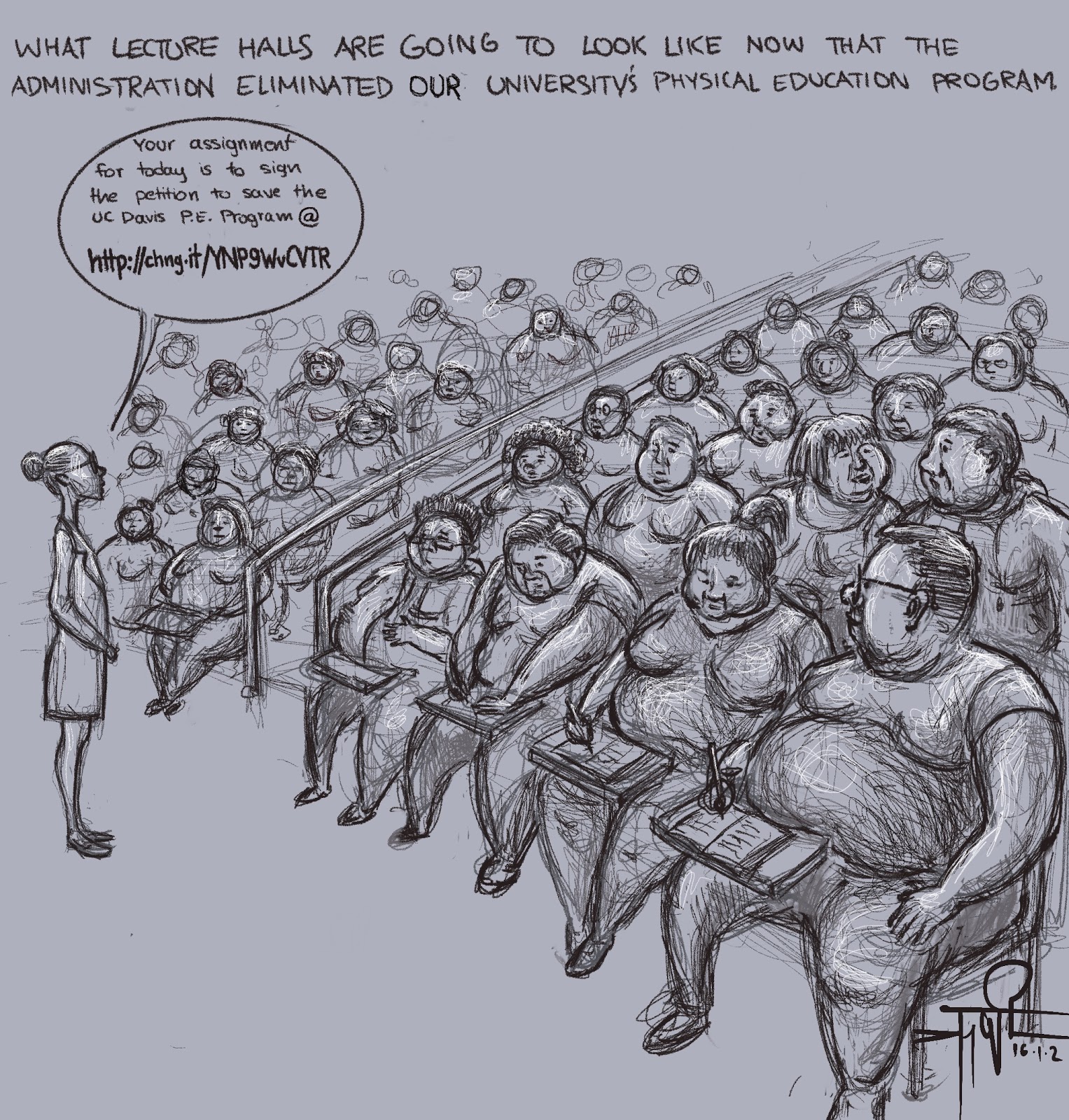
Title: Cartoon

Headline: Combating the Freshman 150

By RUSHI TAWADE –– rntawade@ucdavis.edu 

Drawn by: Rushi Tawade –– rntawade@ucdavis.edu Disclaimer: (This cartoon is humor and/or satire, and its content is purely fictional. The story and names of “sources” are fictionalized.)

The Editorial Board looks forward to an administration with deliberate plans to fight our country’s most pressing issues

0

 Biden-Harris administration must take strong steps to tackle environmental and public health crises

The first 100 days of President Joe Biden’s term appear very promising if Biden and his administration are able to achieve what they set out to do. On the issue of COVID-19, Biden outlined a plan to vaccinate 50 million Americans in his first 100 days that includes expanding the population of people eligible and increasing the number of vaccination sites as well as the supply and distribution of vaccines. Understanding the effectiveness of masks, Biden also strengthened federal mask mandates—requiring them in federal buildings and for public transportation and air travel.

Biden hopes to get a $1.9 trillion stimulus package passed in Congress with funds dedicated to Americans who are unemployed, food insecure and in danger of being evicted. A $15 minimum wage is among the many points outlined in the plan—a much needed increase, since the federal minimum wage has been $7.25 since 2009. The plan also includes billions of dollars in aid to schools and universities so that they are able to safely reopen.

We have witnessed the consequences of climate change only worsen in the last year: 2020 tied for the warmest year on record and California surpassed records of acres burned due to increased wildfires that have been clearly linked to climate change. We are hopeful about a president who will implement policies to actually combat climate change. On his first day in office, Biden signed an executive order recommitting the U.S. to the Paris Climate Accords, and he rescinded a permit for the Keystone XL Oil Pipeline—a project which would increase environmental risks

Many of Biden’s ambitious plans will require cooperation from Congress, and with a razor-thin majority in the Senate, Vice President Kamala Harris will have to serve as a tiebreaker on issues opposed by all Republicans and supported by all Democrats that only require a simple majority to pass. 

Harris’ position is so much more meaningful than her pivotal role in the Senate, however. She is the first woman—and the first woman of color—to serve as vice president. It is difficult to put into words what this means to American women and American women of color. If nothing else, this representation at least helps in visualizing the possibilities for many women who do not have role models who look like them in positions they aspire to attain.

Biden’s cabinet is diverse and filled with highly-qualified members: Gen. Lloyd J. Austin III will be the first Black American to lead the Defense Department; Deb Haaland will be the first Native American appointed to a cabinet position; Katherine Tai will be the first woman of color to serve as the U.S. trade representative. 

This new administration brings hope, not just for present circumstances but also for what the future may look like—a future that is more likely to exist with the proposed action being taken to combat climate change. It also brings a reminder that our political leaders must be held accountable. 

Compared to the constant scandals and turmoil of the Trump administration, we recognize that it is easy to idealize Biden and Harris. Although we are impressed with many of the plans Biden has put forward, scientists have called for stricter environmental regulations and others have said 100 million doses of the vaccine in the first 100 days is not enough

While we remain cautiously optimistic that the administration will accomplish its goals, we need to hold Biden and Harris accountable throughout their time in office to ensure that their actions reflect their campaign promises. 

Written by: The Editorial Board

UC Davis Health Novavax vaccine trials prioritize high-risk populations including minority groups

0

UC Davis Health Novavax vaccine trials prioritize high-risk populations including minority groups 

As UC Davis Health begins phase three of testing the Novavax vaccine, researchers are prioritizing participants from communities that have been severely affected by COVID-19 for their clinical trial, including Latino, African American and Native American populations, according to a recent press release. Loralyn Taylor, a lecturer in the public health science department at UC Davis, expressed how the pandemic has not only brought to light already existing health disparities faced by minority groups, but has also increased their severity.

Taylor explained how social determinants of health—such as education, economic stability, access to healthcare, culture and where one lives—are the driving forces of health disparities. For example, from an economic stability standpoint, Taylor stated certain populations are at higher risk for contracting COVID-19 based on where they work. Service industry workers, who tend to be minorities, are often forced to work and unable to social distance. She added that in her hometown of Napa, CA, many outbreaks of COVID-19 occur among farm workers because they must work in the vineyards and often live in close quarters with others in farmworker housing. 

“We already have these inequities and disparities in our country, and COVID-19 has really amplified that and is showing us how much those determinants matter, and how much historically they’ve already affected health and are continuing to affect health,” Taylor said.

In addition to one’s workplace, other factors that put minority groups at risk are a lack of access to healthcare, tendency to live in multi-generational homes and chronic health conditions. Taylor expressed how it is important to consider how intersectionality plays a role in the health outcomes of these groups. For example, a person of color who is young and healthy likely experiences the pandemic differently from a person of color who is older and has a chronic health condition.

“People aren’t just their race,” Taylor said. “They’re also their age and their socioeconomic status and their health status. So, I think thinking about that too and the intersectionality of how those compete together in the COVID-19 pandemic is important.”

Prachi Verma, a fifth-year global disease biology major and co-director of social services at Bayanihan Clinic, added that these social determinants of health can be thought of as symptoms of the systemic inequities and structural racism that currently exist in society. Although she believes it is hard to see the direct impact this inequity has on patients, studying health disparities can help one realize the larger umbrella under which these issues exist. 

“When things like systemic oppression, racism, the diversity of patients and inequity aren’t addressed, it promotes the idea that structural inequities have no impact on health and a patient’s access to health,” Verma said.

Through her social service work in Bayanihan Clinic, Verma has learned the value of listening to patients’ stories of how different factors, such as lack of transportation or stable housing, impact patients’ health and access to healthcare. She explained that by recognizing the history of the Filipino community and understanding the role this history plays in a patient’s living situation or income, the clinic strives to provide treatments catered to specific patients. For example, if it is known that a patient has financial challenges, the clinic’s staff make an effort to find cheaper prescriptions that the patient may be able to afford. 

Verma believes that understanding structural inequities, diversity and cultural humility are all important in order to ensure patients receive culturally sensitive and relevant care. 

“Without understanding the diversity in communities’ cultures and history and experiences and circumstances, patients don’t receive the care that’s relevant to their specific situation, and then overall care and overall outcomes are ineffective and unsuccessful,” Verma said. “Then lower quality of care can reinforce mistrust in healthcare and medicine, and then that in turn can lead to patients avoiding seeking healthcare and then that leads to further inequities and it just becomes a cycle.”

Statistics increasingly show minority groups disproportionately being affected by COVID-19 compared to white people. According to a recent article by National Public Radio (NPR), the Centers for Disease Control and Prevention (CDC) recently released data that Latino, African American and Native American populations are being hospitalized at rates 4.5 to 5.5 times higher than non-Hispanic white people. 

Taylor expressed that when looking at these statistics, it is important to consider the proportion of the population that has COVID-19 in comparison to the number of people of that race that live in the country. In the same article by NPR, data shows non-Hispanic white people contribute to 61.1% of the population and 51.1% of COVID-19 deaths while African American and Hispanic populations, which contribute to 12.3% and 17.8% of the U.S. respectively, each account for 21.1% of COVID-19 deaths. 

“I have to believe that [these statistics are] both a result of things that have come about like being forced to work or needing to work and not being able to work from home, and preexisting conditions or those social determinants of health that put them at greater risk,” Taylor said.

Despite the health disparities these minority populations are facing, Taylor described how these groups have historically been left out of many treatments. She commended UC Davis for acknowledging that such disparities exist and that these populations should receive front-of-the-line prevention. 

“Minorities and people who experience health disparities are less likely to get access to healthcare—less likely to get access to new treatment,” Taylor said. “So putting them at the front of the line is great in the sense that you’re trying to bypass that historic disparity of them not having access.” 

In order to address these health disparities, Taylor expressed the importance of educating oneself using reputable sources and speaking up when it is apparent that something is inequitable. Verma added that a large part of action and advocacy is awareness. She encourages students to uplift the voices of marginalized community members and listen to their stories to better understand the systemic and structural inequities they face. Taylor also advocates for change at the state and federal level to make sure healthcare can be accessible to all. 

“We need to make sure people have access [to healthcare],” Taylor said. “The big problem we’re seeing in the U.S. is especially in these rural communities, they may not have access to a health provider. Just because we give them health insurance doesn’t mean they can then access it. So I think affordable and accessible healthcare will really help with health inequities.”

Written by: Michelle Wong — science@theaggie.org


Women participation in Olympic sports have evolved across the world

0

 Across the globe, women have challenged societal norms in sports, but some countries are tougher than others 

Today, men and women are allowed to compete at elite levels in sports or any physical pursuits. But, this wasn’t always the case for women. Olympic organizers thought that if women were included it would be impractical and unaesthetic. Society agreed with the organizers and restricted women’s participation until the early 1900s. From then on, the presence of female competition became revolutionary. It was a long battle to get to the present day, but the triumphs from the past cannot go unnoticed. 

In Australia during the colonial times, women encountered regulations as to when and where they could participate in sports, whether it’d be for fun or for competition. Sports like croquet, among others, were encouraged for women to participate in so that they wouldn’t challenge the gender norm. Women were also not allowed to swim in the proximity of men, therefore they were banned from access to public swimming pools, beaches, and were forced to wear loose clothing. 

In the year 1900, the first female lawn bowl and golf teams were formed. In the 1930s, other sports such as track and field for women were introduced. From the 1970s and onward, male and female-only sports began to merge. Now that cricket has grown into popularity in Australia, the Australian Cricketers Association (ACA) sign a contract that all men and women would receive equal pay, a monumental step in the progression of equal rights in sports.

In Russia, Amateur Sportsmen and Victorian Football (Soccer) Clubs were created in the 1880s. Although these sports were preserved for men, women did take an active part in professional sports. Gender roles were strictly enforced until 1903, when the country  added equality in education, civil and political rights and sports. 

Despite the ruling, women have ignored the dismissing from male leaders about their participation in “harmful” sports—soccer, ice hockey, judo, weight lifting, water polo and long-distance running. For example, in the 1980s, Soviet women held four national judo championships and a world judo championship, and as many as 15,000 women were registered in judo clubs. 

“The idea of a healthy lifestyle, which does not mean giving up anything in your life but taking on something sporty and cool, has become very popular in Moscow,” said Alexandra Boyarskaya, who helped set up one of the first running clubs in Moscow. “It’s a big shift from five years ago.” 

Today the female sports community across Russia is taking action to inspire and motivate girls to pursue a sport. The difficulty women face is that this cultural shift is challenging social norms such as how women use public spaces and helping to reverse gender discrimination that exists in the country.

Even though some countries support women to engage in physical activities, Iraqi women are constantly battling gender norms, in sports and outside of it. Some people in the country believe that it is inappropriate for women to participate in sports and their negative attitudes towards women are usually reflected when women play sports. Because of the stigma on gender in Iraq, women choose not to take part in physical activities. 

This is quite apparent in the opinion expressed by Nihad Mohamed Qais, a 22-year-old student at the Faculty of Art / Arabic Language. “I don’t like women’s participation in sports. It is not a civilized phenomenon. Therefore, I will not allow my sister or a female relative to participate in sports or to join an athletic club or faculty,” Qais said

Some women support the interaction of females with sports, while men do not. One particular supporter is Dhikra, a 20-year-old young lady who lives in Iraq. “I do encourage women’s engagement in sports, provided that they do their exercises in the absence of men so that they will feel at ease, at least concerning wearing the sports uniform.” Dhikra said. “I believe that religious considerations are the main reason behind the families’ objections to their daughters joining faculties of sport”.

These days, countries from around the world are on the rise to helping promote the empowerment of women and young girls. Both professional and recreational sports are changing cultures to embrace more activities, healthier lifestyles and encouraging others to do the same. Women are overcoming social, political and religious barriers to assert their right to sporting life and participating in activities they were barred from before.

Written by: Katherin Raygoza — sports@theaggie.org

Why is Trader Joe’s such a fan favorite?

0

An authentic aesthetic, private brand and friendly employees have granted Trader Joe’s a cult following

When you hear the name “Trader Joe’s” what often comes to mind is a moderately sized, old-timey grocery store with eerily similar-looking employees in different colored Hawaiian shirts and a casual atmosphere. 

The first Trader Joe’s shop was established in 1967 in Pasadena, CA by Joe Coulombe who launched a small chain of convenience stores around the Pronto Market area of Los Angeles. As of April 2020, there are 504 Trader Joe’s stores in 42 states with annual sales of over $14 billion

Knowing that customers enjoyed a variety of foods with the average American having an increasingly diverse palate, Coulombe began to introduce foods from all over the world under the Trader Joe’s private brand. Introduced in 1970, the first of these products was granola, then considered a novelty item. Between 80-85% of the food items at a Trader Joe’s food are from their private brand. 

The chain store is famous for its small-town shopping vibe and highly curated selection of high quality, affordable food items, fresh produce and a medley of frozen dishes from cuisines around the world—from Indian chicken tikka masala to Chinese steamed pork soup dumplings to the tried-and-true American classic Mac ‘n Cheese. Seasonal products are often sought after, like the fall-inspired Pumpkin Biscotti, wintertime favorite Peppermint Bark and Thanksgiving-inspired Turkey Pot Pie. Trader Joe’s even has its own beer and wine label. 

If you’ve been to Trader Joe’s, it’s obvious why many people prefer to shop there. The employees are taught to engage with customers, always offering smiles and helpful directions when a shopper cannot find what they are looking for.

Its friendly staff and calm atmosphere has made it a popular shopping destination for UC Davis students. As Anika Patel, a third-year computer science and engineering major, put it, “[The] friendly employees always make me feel welcome. [Trader Joe’s] consistently has the lowest prices so they are the best economical option in Davis, [… and] they offer unique products I really like.”

Elizabeth Hershey, a fourth-year English major, also appreciates the kind Trader Joe’s staff. “[The] staff as well typically are more friendly than Safeway and Target,” Hersey said. 

It comes as little surprise that Trader Joe’s has acquired a cult-like following with a loyal customer base and as a popular shopping destination for college students thanks to its plethora of frozen meals and affordably priced food items. 

When asked what the appeal to Trader Joe’s was, Shambhavi Mishra, a fourth-year biochemistry and molecular biology major, answered, “Trader Joe’s has really unique snacks. They have a wide variety of foods you won’t find anywhere else. They don’t sell basic or mainstream brands. They sell their own Trader Joe’s brand and have their own unique stuff.”

Trader Joe’s also offers a social experience. “[It’s] always super fun to walk down the aisle. I like to talk to friends about recs. [It] has become a super mainstream thing in social media where people even do Trader Joe’s hauls,” Mishra said.

Not only that, Trader Joe’s also boasts its own social media fan pages such as @traderjoeslist, an unaffiliated Trader Joe’s food item finds page with over 1.5 million Instagram followers.

By emphasizing unique ingredients and having branding that feels authentic, Trader Joe’s is able to give each customer a unique shopping experience. In addition, the Trader Joe’s shopping model is not convenience-based, in which one click of a button can do all the shopping you need, but rather promotes an environment in which shopping is fun and interactive.  

The classic aesthetic of the grocery store—Hawaiian tiki designs, wood paneling, fake palm trees and cute, hand-written item signs with dad jokes—contributes to the excitement of shopping there.

“I feel like Trader Joe’s has a younger crowd. Sounds silly, but [it] gives me a nature-outdoorsy hippie vibe, especially in Davis,” Hershey said. 

The effort Trader Joe’s puts into store appearance makes all the difference. “In my brain it’s a chain store, obviously. It is always exactly the same,” Hershey said. “What makes it feel different is they do all their own branding. [It] makes it feel more like a homey, smaller grocery store. [Its] the branding that really sells it—small signs made out of construction paper. It’s just not like regular stores.”

Whether Trader Joe’s is your go-to grocery store or a treasure-cove of uncommon food items that you can bond with friends and family over, it has become increasingly ingrained into popular culture. There are numerous recipe pages, food-bloggers and Instagram accounts dedicated to Trader Joe’s with loyal customers always curious about the next binge-worthy food item.

Simply put, Trader Joe’s might just be a grocery store, but it has become a curated shopping experience that customers keep coming back for. 

Written by: Muhammad Tariq — arts@theaggie.org

UC Davis extends COVID-19 vaccinations to patients

0

 UC Davis Health is now offering vaccinations to some patients 75 and older and hopes to expand to more priority groups soon

On Jan. 12, UC Davis Health began vaccinating patients less than a month after they first administered shots to their healthcare workers. UC Davis Health has been on the faster side of administering vaccines, vaccinating 12,000 employees and 400 patients as of Jan. 15 according to Steve Telliano, their assistant vice chancellor of strategic communications. 

“[Jan 14] will be the one month anniversary of receiving our first vaccines,” Telliano said. “We have done 12,000 employees in the month since we’ve received vaccines, and that’s the schedule which we expected to be on. It’s pretty aggressive and our vaccine clinic was open 16 hours a day to make that happen.” 

Even though much of the vaccine that has been distributed is still waiting to be used due to slow rollouts by individual hospitals across the country, UC Davis Health is having the opposite problem. Telliano said that what they need is more doses.

“Our plan is to further expand in terms of locations when we get more vaccine doses,” Telliano said. “Really, what’s limiting us at this point is the number of doses of vaccine that we have. If we get more, then we’ll be able to open more locations and do more patients.”

As of now, only patients over 75 with certain existing comorbidities are eligible for the vaccine. According to a press release put out by UC Davis this week, these prioritized patients are ones who have heart disorders, sickle cell disease, diabetes, cystic fibrosis or a history of cancer or strokes. 

Soon, the center hopes to expand to all patients over 75 and patients over 65 when they receive more doses and are able to open more vaccination sites. Telliano is hopeful that once they are able to vaccinate these at-risk groups, they will be able to drastically reduce the number of COVID-19 deaths. 

“What we do know for certain is that the more people we vaccinate, the more illnesses we prevent,” Telliano said. “Especially if we start vaccinating down to 65 and older, we will be able to prevent the majority of the deaths that have happened. Almost three out of four deaths from COVID-19 have been people 65 and older, so if we can really move quickly and vaccinate that group quickly, we can really head off the deaths from COVID-19.”

He also shared that students who have UC Davis Health coverage will be able to receive their vaccination through the center when their tier is eligible. Dr. Cindy Schorzman, who is in charge of co-leading the COVID-19 UC Davis campus vaccination, said that other students at UC Davis will also be eligible to get the vaccine through UC Davis’ Student Health and Counseling Services (SHCS).

“We will offer vaccinations to all registered students when [they are] allowed by public health guidelines based on this tiered approach and subject to vaccine availability,” Schorzman said. “Student employees will be eligible at the same tier as other campus employees when essential on-campus personnel become eligible.”

Telliano said that the reason UC Davis has been so successful in getting vaccinations out quickly is because of the nature of the health center.

“This is what UC Davis does,” Telliano said. “Our role in the healthcare system as UC Davis is to be disaster and emergency response experts. We have the ability to address emergencies and disasters because that’s what we plan to do.”

Telliano explained that as the pandemic progressed, the center created similar action plans for eventually getting vaccinations.

“We knew vaccines would be coming because that’s how the pandemic would end, and we’ve known for a long time there would be vaccines and we would need to move quickly to administer those vaccines,” Telliano said. “So we’ve been planning for months how we would do this and do it safely so when the vaccines arrive we would be ready to go.” 

Tellianio explained that UC Davis Health is making vaccination such a priority because vaccination is imperative to ending the pandemic.

“In a global sense, the way that we’re going to stop this pandemic is to get everyone vaccinated,” Telliano said. “The sooner the better because the sooner we get everyone vaccinated, the sooner we’re going to end this pandemic.”

Given that vaccination is key in reducing the spread of COVID-19 and ending the pandemic, Telliano urged everyone to get the vaccine when it becomes available to them. For people worried about taking the vaccine, Telliano explained that the vaccine’s safety has been thoroughly tested.

“It’s very well researched,” Telliano said. “In fact, it was researched here at UC Davis […] and we’ve also taken it ourselves. Healthcare providers, and the healthcare workers who will be providing the vaccine, have taken it themselves so that they can show that it’s safe, but also so that they can be well to assist patients.”

He also said that the hospital itself is a form of “proof” that the vaccine works to prevent infection. Since the center began vaccinating last month, the weekly number of employees being out of work with COVID-19 each week has decreased by over 50%. Telliano said that he expects the number to drop even further in the coming weeks as the healthcare workers receive their second dose of the vaccine and become fully protected.

Telliano said that since the vaccine rollout began, many healthcare workers are beginning to feel hopeful that the end of the pandemic is in sight.

“The healthcare workforce and people that I’ve talked to that are coming out of the vaccine clinic are just incredibly happy that this is now available,” Telliano said. “Both from a personal standpoint, in that they know it’s extremely unlikely that they will be spreading the disease […], but also that we’re nearing the end of this pandemic, because as we all know it has been terribly depressing. To see that we are beginning the end chapter of this pandemic has been really great and has reinvigorated a number of our healthcare workers.”

Written by: Katie DeBenedetti — features@theaggie.org

Greater Sacramento region’s ICU capacity dropped to 9.4% as of Jan. 13

0

Davis mayor explains local ICU beds could fill up with patients from around the region 

As of Jan. 13, the Greater Sacramento region’s intensive care unit (ICU) capacity dropped to 9.4%, which could affect the number of ICU beds available in Davis and Yolo County in the future.

City of Davis Mayor Gloria Partida explained her concern for Davis regarding the number of hospitalized patients during this surge of the COVID-19 pandemic.

“When a city or a county is out of beds, they will start sending people to the surrounding areas,” Partida said. “Even though we are doing a good job with our numbers, we will still be impacted by the surrounding areas.”

Sacramento County licensed clinical social worker Darina Kellom described that people must fight off pandemic fatigue in order to flatten the curve. 

“We’re all feeling the effects of pandemic fatigue,” Kellom said. “A lot of people are just emotionally, physically, mentally over it and they want to live a normal life, but I think we cannot do that unless we take this seriously.”

In an effort to limit the spread of COVID-19, the City of Davis and UC Davis worked collaboratively to create the Healthy Davis Together program. According to its official website, this program would “[…] facilitate a coordinated and gradual return to regular city activities and reintegration of UC Davis students back into the Davis community.”

Partida added why she thought it was especially important to test asymptomatic people frequently.

“I recently read a report that said half the infections are coming from asymptomatic people, and this is specifically what we are testing for with our Healthy Davis Together program,” Partida said. “There are a lot of people who are going around who think that they’re not sick because they don’t have any symptoms, but they’re able to infect other people.”

Public Relations and Media Relations specialist for Kaiser Permanente Northern California Chyresse Hill provided an official statement from Kaiser Permanente via email about the importance of adhering to safety guidelines. 

“We encourage everyone to protect themselves, their families and others by adhering to State and County orders, wearing a mask, maintaining physical distance, practicing hand hygiene, avoiding crowds and monitoring yourself for any COVID-19 symptoms,” the statement reads. “Following these measures is crucial now to stop the rising tide of these infections.”

Kellom remarked on the necessity of the current safety measures in place to limit the spread of COVID-19.

“In the short-term, it may be hard and challenging for us because we all want to live normal lives, we all want to travel, we all want to go dine and celebrate and be with one another,” Kellom said. “In continuing and encouraging people to wear masks and socially distance—it’s going to protect us in the long term.” 

Kaiser Permanente’s statement further detailed their plans and priorities regarding COVID-19. 

“Our priority is the safety of our members, employees and the communities we serve,” the statement reads. “Like most health care providers, Kaiser Permanente is seeing an increase in COVID-19 hospitalizations, significantly above our previous peak in June. We have maintained a continuous state of readiness for additional COVID-19 patients since our initial preparations in the Spring.”

Kellom described that at the hospital she works for, staff is continuing to do their best to provide for patients and families 

“On a day-to-day basis, we are trying our best to take care of the patients and their families and to support them,” Kellom said. “We’re just putting our heads down and working as hard and as best as we can.”

Kaiser Permanente’s statement further detailed their precautionary measures regarding California’s Blueprint for a Safer Economy.

“Kaiser Permanente is contributing to California’s Roadmap for reopening the state which includes increased hospital capacity to address a surge of 35% above normal capacity, and we have the ability to increase our hospital bed capacity,” the statement reads. “Additionally, we have planned for an additional increase in staff above and beyond the normal winter season by securing travel nurses. We have planned for additional capacity for both ICU and Medical/Surgical needs.”

Kellom emphasized the importance of appreciating life as it is now in order to cope with the pandemic. 

“When I go to work, the patients that we see don’t get to see their family,” Kellom said. “We have a very closed visitor policy. This whole past year has really helped me recognize how important my family is—just being able to enjoy the simpler things in life like coming home and having dinner with your family.” 

Partida added a final note of encouragement regarding the vaccine and eventual return to normal. 

“I’m very hopeful with the vaccine being on the board now that we are going to be able to return to our normal lives—hopefully by the end of this year,” Partida said. “I know it’s been very difficult for people. It’s been very taxing, but I’m very proud of the work that people have done to take everyone’s health into consideration.” 

Written By: Jelena Lapuz city@theaggie.org

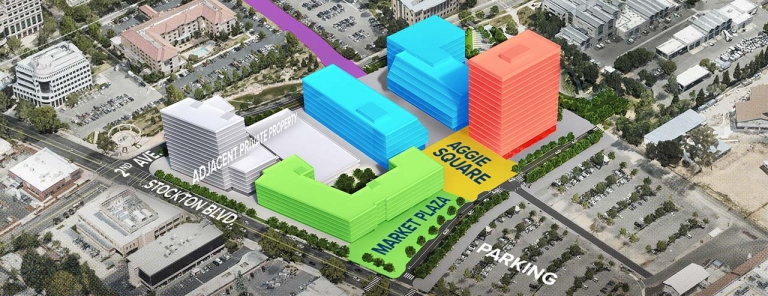
Lawsuits claim UC Davis’ Aggie Square project brings gentrification and environmental impacts to Oak Park neighborhood

0

The university is planning to move forward with its schedule for design and construction of Phase 1 despite the lawsuits, according to a UC Davis administrator

Sacramento Investment Without Displacement (SIWD), a local community group, and UC employer union AFSCME 3299 have filed lawsuits against the UC Davis’ Aggie Square project being built in the Oak Park neighborhood in Sacramento. 

The lawsuits filed against the UC Board of Regents claim that the Aggie Square project, a $1.1 billion investment from UC Davis, is in violation of the California Environmental Quality Act (CEQA) through its failure to properly mitigate air pollution and housing displacement. The project is being designed as an innovation hub that will bring forth new research facilities for students and employees. 

“We don’t seek to stop or delay Aggie Square,” said Erica Jaramillo, a board member of SIWD and long-term resident of Oak Park. “We only seek to ensure that it’s the best project it can be for UC Davis, our city, for our community. We’re seeking to ensure existing residents, predominantly low-income communities of color, equitably reap the benefits that the project can bring. We want to make sure that the residents that are currently here who aren’t making a lot of money right now, especially because of the pandemic, are going to be prioritized.” 

AFSCME 3299’s lawsuit states similar concerns about the Aggie Square project, with some UC employees being directly impacted by it. 

“AFSCME Local 3299 represents more than 3,000 Sacramento area workers, including hundreds that live in the neighborhoods that will be most directly affected by the proposed Aggie Square development,” Todd Stenhouse said, the spokesman for AFSCME 3299, via email. “Aggie Square’s Supplemental EIR fails to comply with the CEQA statute in a number of substantive ways—including (but not limited to) its failure to analyze or address the housing, health and transit needs of the families that will inevitably bear the brunt of this development’s impacts on air quality, traffic congestion and housing affordability.”

Despite the lawsuits, Matt Dulcich, the UC Davis director of environmental planning and local government directions, stated in an email that the university is planning to move forward with its schedule for design and construction of Phase 1. Dulcich referred to UC Davis’ compliance with the CEQA and its completion of the environmental review of the impacts of the project and said that UC Davis cannot comment on the legal aspects of pending litigations. 

Mayor Darrell Steinberg of Sacramento, who has been collaborating on the project with UC Davis, along with Sacramento Councilmembers Jay Schenirer and Eric Guerra, released a joint statement criticizing the SIWD lawsuit, commenting on the lawsuit’s potential delay on the project and calling it both, “unfortunate and, ultimately, unproductive.” 

“There is no community benefits agreement without a project. Five thousand union construction jobs and 3,500-5,000 ongoing jobs, many of which will be reserved for local residents, will be lost without a project,” the statement reads.

Kevin Ferreira, the executive director of the Sacramento-Sierra’s Building and Construction Trades Council, also commented on the lawsuit in the same statement. 

“This lawsuit sends a direct message to thousands of would-be workers that it is better for them to receive unemployment checks than to have a job that pays living wages and benefits,” Ferreira said. 

Jamarillo, however, said claims like Ferreira’s are meant to scare people and the aim of the lawsuit is to ensure UC Davis follows state laws.. 

 “The narrative that the city is putting out is fear, saying that this is going to threaten that investment from happening, this is going to threaten people’s opportunity for jobs,” Jamarillo said. “That’s not what this is about, the litigation is holding UC Davis accountable for [failing] to follow state rules.”

In addition to more jobs, Aggie Square is also planning to develop more than 700 housing units, 400 of which are planned to be affordable. 

“That’s breadcrumbs,” Jamarillo said. “We have over 11,000 [estimated] unhoused people here in Sacramento […] who are being violently swept by law enforcement with the city. If we’re not adequately equipped to provide housing for them, we’re not equipped to give housing to people who are not even here yet.”

She stated that, with the project bringing new jobs and housing, it is estimated that over 7,000 new residents will be joining the surrounding area. With more people coming in than housing being built by UC Davis, she said she worries housing demands will displace existing residents. 

Despite the City of Sacramento, UC Davis, SIWD and other community groups being in communication of developing a community benefits agreement, Steinberg announced they will no longer collaborate with those involved in the lawsuit, but continue to be in communication with other local groups and residents. 

“The recent comments made to the press by the city […] and refusing to work with us any longer are unfortunate,” Jamarillo said. “Our concern is also, why is the mayor, who works for us, for Sacramento, being the spokesperson for UC Davis?” 

Alberto Marcado, another SIWD organizer and resident of Oak Park, also expressed concern on how the Aggie Square project will impact the community. 

“I’m interested in making sure this is not going to affect local residents like myself, because it is something that UC Davis has done with other projects,” Mercado said, mentioning that despite UC Davis Medical Center being the local community hospital, it does not always accepting Medi-Cal, despite many of the local residents who use it as their primary health insurance. 

Mercado, who has been a resident of Oak Park since 1997, said he has seen the on-going effects gentrification has had on his community over the years. 

“It was a community where you saw a lot of communities of color: You saw Hispanics, African Americans, Asians—it was very diverse,” Mercado said. “In the last 10 years, a lot of our neighbors have lost their homes due to a lot of financial difficulties and values of homes [increasing]. Now what we’ve seen is a lot of white people have come in there because they have more money and secure jobs and so they’ve been displacing communities of color to the point where on my street, we are one of the only ones of color living there.” 

Written by: Annette Campos — campus@theaggie.org 

Professors reflect on how they’ve adapted to be sensitive to students’ needs during remote learning

0

Faculty discuss the challenge of conducting school online and the changes they’ve needed to make to be more accommodating

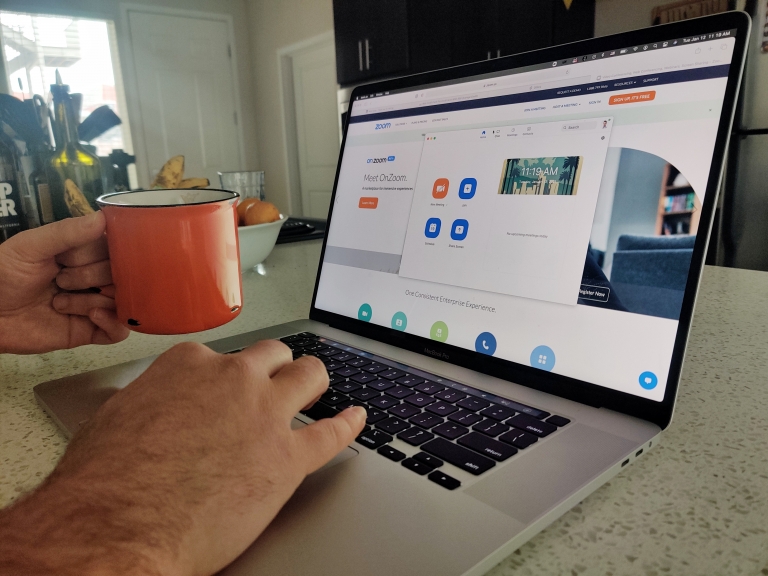
Over the last two quarters of instruction, professors have needed to make changes to their style of teaching as well as be especially observant of and responsive to their students’ needs. 

While teaching over Zoom, Noah Guynn, a professor of French and comparative literature, has sometimes questioned the impact he has on his students. 

“I think I reach my students, but I don’t always know.” Guynn said. “There have been specific moments where I’ve been really worried that I did the wrong thing or said the wrong thing. And it’s just not easy.”

Upon doing some research, Guynn initially decided that he would give his students the option to keep their camera off during class.

“Stanford in particular had a very informative website saying, ‘This is why requiring students to turn their cameras on is incredibly hard on students and especially students who are already vulnerable,’” Guynn said.

After a quarter of teaching this way and noticing that many students chose to keep their cameras off, however, Guynn decided to request that students turn their cameras on to increase engagement and help them adjust to this style of learning.

“My guess is that students will get more comfortable with it if they are asked to do it,” Guynn said. “And that they’ll become more comfortable with one another as a result. One thing I noticed for sure is that students who are visible are definitely performing better academically.”

Although Brian Trainor, a psychology professor, wants students to turn their cameras on, he hopes that by not requesting this of them, they will feel more at ease. 

“I am teaching a much smaller class this quarter, and I’m hoping that more people will have cameras on, at least when we’re interacting,” Trainor said. “And so I know that’s a touchy thing, whether people have cameras on. So I’m mostly focusing on trying to make people feel comfortable.”

Guynn speculated that some students decide to keep their cameras off because they don’t feel adequately prepared for class, but he values open communication with his students. 

“I’m happier knowing that students trust me to say, ‘I didn’t have time, and so I’m not prepared, but I want to be here to benefit from the conversation,’” Guynn said. “I’d rather know that they’re not prepared so that I can anticipate what needs to be done and […] know this is not the person to call on.” 

According to Guynn, when he receives emails from students giving reasons for not being able to turn work in on time, it’s often clear to him that the reasons are fabricated.

“It’s often painfully obvious, and I never say anything because even contrived excuses more often than not are based on something real that the student doesn’t really want to share,” Guynn said.

According to Trainor, when he received emails from students giving reasons for not being able to turn in work, he was forgiving because he recognizes the complexity of many students’ lives. 

“Basically this quarter if they told me something, I just took their word for it,” Trainor said. “I’ve seen a lot of crazy stuff that happens to students, like so many of our students are first in their family to go to college, working jobs, taking care of their parents or siblings.” 

In an attempt to be more available to students, Guynn gave out his home number at the beginning of Fall Quarter, which he later found to be a mistake. 

“During [COVID-19], certain kinds of rules and boundaries are actually more important than usual because [it’s] very reassuring that there’s a certain expectation,” Guynn said.

According to Tobias Warner, a professor of French and Italian, something he’s done to be more accommodating in general, but especially for international students, has been breaking longer lectures into 10-15 minute segments with corresponding quizzes.

“It’s a little bit easier in the sense that I’ve chosen to just do shorter lecture videos and online quizzes and have those be the delivery of some of the course content so students can really, no matter where they are, engage with the material,” Warner said.

Trainor also decided to make his lectures shorter with more concentrated material.

“This quarter I’m just trying to [focus on] cutting back on content,” Trainor said. “Doing less material and making it better.”

Guynn feels that not every decision he made over the course of this last quarter was beneficial to his students, one of them being holding class on Election Day.

“I felt terrible,” Guynn said. “It was the biggest failure of the quarter for me on Election Day.”

He initially believed that it was in his students’ best interest for him to continue with instruction as he normally would on Election Day, but later sensed that it caused them an unnecessary burden.  

“They just looked so overwhelmed and upset and just […] emotionally and intellectually and probably physically exhausted,” Guynn said. “I apologized in the next class and just said, I’m really sorry. I thought that that was the right thing to do, and it clearly wasn’t.”

Warner noted that professors have seen the effort students are putting into their educations despite how challenging it can be.

“Faculty are really impressed with how hard students have been working in often really challenging circumstances for them to engage in and be present,” Warner said. “It’s certainly challenging for us to teach you all as well.”

Warner believes that students and professors are doing everything they can to maintain connections despite conducting school and learning remotely.  

“We’re all in this situation for some time longer, it seems, so we’re all doing our best, faculty and students, to try to find ways to connect and keep that teacher-student connection going,” Warner said. “That’s why we’re all here—to learn and to share that passion for the material.”
Written by: Lyra Farrell — features@theaggie.org

Yolo County places Moderna vaccines on hold due to allergic reactions, no vaccines from lot were administered

0

New vaccine shipments set to arrive in Yolo County this week

On Jan. 18, Yolo County announced that a batch of Moderna vaccines were placed on hold after a recommendation from the state’s top epidemiologist Dr. Erica S. Pan. This recall was due to several allergic reactions to the vaccine in San Diego.  

The official Yolo County website provided a statement regarding this hold. 

“A Moderna lot number (41L20A) has been placed on hold by the [California Department of Public Health] due to higher than average allergic reactions,” the website reads. “[…] Yolo County did receive some vaccines from this lot but none were administered.” 

Yolo County Public Information Officer Jenny Tan provided further information regarding this batch of vaccines. 

“We did receive 1700 doses that were from that Moderna lot and they were going to be used as second doses,” Tan said. “We have put those doses on hold, and no one in our county was administered vaccines from that lot, so our residents don’t have to be worried.”

An article published by Evan Webeck in the Daily Democrat detailed the cause for this recall. 

“An abnormally high number of people experienced anaphylactic shock, a severe allergic reaction that requires immediate medical attention, after receiving a shot of the Moderna vaccine at one San Diego vaccination site […]” Webeck writes in the article. “While the number was fewer than 10, the cluster of negative reactions prompted the California Department of Public Health to pause the administration of some 330,000 doses from the batch, which had been distributed throughout the state, until an investigation was complete.” 

Tan further explained how Yolo County asked the state for more doses out of caution, and new shipments from the state would be arriving this week. They must also rework their schedule for distribution depending on the number of doses available in the upcoming shipments. 

The official Yolo County website reassured that the welfare of the community is the county’s top priority. 

“This lowers the number of available vaccines in our county and may delay vaccine distribution,” the official website reads. “We apologize for the potential delay but the health and safety of our residents is our utmost concern.” 

Written By: Jelena Lapuz