53.5 F
Davis

Davis, California

Tuesday, December 23, 2025
Home Blog Page 319

Students must adhere to COVID-19 guidelines as Fall Quarter begins

Eased restrictions on indoor businesses means greater social responsibility from individuals

As we return to Davis, the Editorial Board urges all students to do so safely and responsibly in accordance with all public health directives to protect our community against the spread of COVID-19. 

On Sept. 30, Yolo County eased restrictions for select businesses to open indoors after the county met required red tier metrics for two weeks. Movie theaters, restaurants and places of worship are now able to open indoors with a 25% maximum occupancy. Our county is trending in the right direction, but with at least 23,000 students expected to return to Davis and its surrounding communities, it is on all of us to maintain that trend. 

Since entering the country last winter, COVID-19 has killed over 200,000 people countrywide and infected over 800,000 in California alone––more cases in one state than almost any other nation. As students return to school across the country, we find ourselves lucky enough that UC Davis is listening to the state, Yolo County and its own public health experts to create guidelines for a safe, modified return to campus.

UC Davis implemented detailed safety protocols and a comprehensive plan to gradually return to in-person instruction on campus. As students and community members, we need to do the same––both on and off campus. We must listen to our health experts at the state and local levels and follow the protective measures they advise. 

Health experts predict that a second wave of COVID-19 in the coming months will be even worse than what we’ve already seen. To mitigate the death toll and case numbers of COVID-19 in the coming months, we must follow all safety protocols, including the flu shot that is required by the University of California. As enticing as it may seem, and no matter how stressed we may be, do not risk going to a party or a non-socially distanced gathering with individuals outside of the household. The benefits of parties and gatherings do not outweigh the massive risks associated with a COVID-19 outbreak. 

There are an abundance of safe alternatives to partying or unsafe gatherings. Zoom makes it easy to connect with loved ones all at once. Video games can provide the space we need to stay in touch with friends. And physically distanced events like hiking or biking can be just as fun under proper precautions and with a mask.

Adhering to safety protocols for months has been––and will continue to be––challenging. This challenge is only exacerbated by those who do not follow public health directives. Going to a party, not wearing your mask or ignoring symptoms has devastating effects on our ability to flatten the curve and protect our community. It is important to remember that certain groups are more highly impacted by this virus than others, including some students.

It may still be difficult to come to terms with the possibility that this school year be completely online, regardless of our actions. The responsibility to prevent the spread of COVID-19 still lies on all of us as Aggies and Davis community members. 

We cannot have a “normal” return to campus without the unified actions of all students (both on and off campus), staff and faculty. The worldwide consequences of the coronavirus cannot be understated; we recognize that these are unprecedented times not limited to the UC Davis or Davis community. We all play an essential role in the fight to mitigate the catastrophic effects of this pandemic. 

Written by: The Editorial Board

Jambul Akkaziev, former University Writing Program lecturer, sues UC over allegations of discriminatory practices

1

Akkaziev cites disparate treatment of foreign-born UWP lecturers, dismissal of concerns around ESL readings 

Former UC Davis lecturer, Jambul Akkaziev, has sued the University of California for discrimination after being dismissed from his position as a lecturer for the University Writing Program (UWP) in 2019. 

Before suing, Akkaziev previously filed complaints against UWP with the UC Davis Chief Compliance Officer, Wendi Delmendo, and with the Harassment and Discrimination Assistance and Prevention Program (HDAPP). 

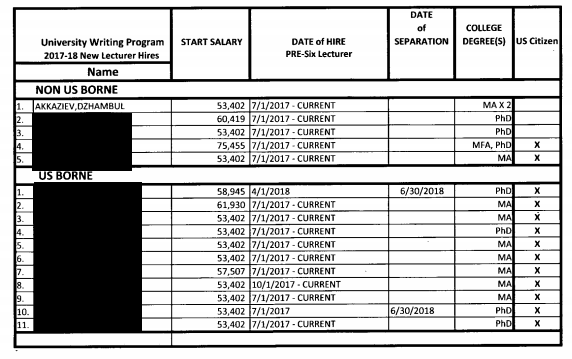
A UC Davis document that Akkaziev acquired through a public records request assisted by the Department of Fair Employment and Housing (DFEH) lists the 2017-18 new UWP lecturer hires, with all names blacked out except for Akkaziev’s; it also lists the citizenship status of each lecturer hire.


Document image provided to The Aggie by Jambul Akkaziev. 

After being hired in 2017, Akkaziev filed his first complaint with HDAPP given that the hiring paperwork asked if he was a U.S. citizen—which could be used as evidence of an employer’s intent to discriminate against an individual based on their national origin. The DFEH found reasonable cause to believe that violations of Title IX occurred to some regard and sent Akkaziev a right to sue notice on April 5, 2019.

Akkaziev, despite asking Delmendo how the list was put together, never received a response.

“How can you tell if somebody was born in the US or wasn’t?” he asked. “Is it based on their name? Is it based on their accent? Why would anybody do that?” 

The Aggie reached out to UCOP for comment and was told via email that “It would not be appropriate to comment on this active and pending lawsuit.”

Akkaziev taught in the English as Second Language (ESL) component of UWP, and while teaching UWP 23 (Advanced Academic Reading and Writing Multilingual Students) wrote to his then-immediate supervisor, Elaine McCollom, and Dana Ferris, then-director of the ESL program, with concerns that the assigned readings incited “a certain degree of resentment” from Chinese students in class due to their “perceived message of American cultural superiority.”

Readings for one class midterm included a CNN opinion article, “In China, ‘Everyone is Guilty of Corruption’”, in which one high-tech Chinese businessman said, “Your business can’t survive a day if you are not corrupt.”

“Most of my class are Chinese students who are just sitting there, reading this about themselves—they just stepped off the plane and came to this new country and are studying at this university,” Akkaziev said. “That was essentially one of the most painful moments in terms of my teaching career, because I had to tell my students that I did not choose these readings.”

Another reading, an excerpt from Raymond A. Schroth’s “The Plagiarism Plague”, does note that plagiarism isn’t just a “foreign import” but also has a section called “The China Syndrome,” which attributes the “phenomenon” to cultural differences, such as the “Chinese pressure to conform,” deference toward a professor and understanding of term papers as a regurgitation of information.

Akkaziev wanted to add a fifth reading, a New York Times summary of the U.S. Supreme Court exonerating former Virginia Gov. Bob McDonnell of corruption and bribery to present a more expansive, less anti-Chinese narrative of corruption.

In McCollom’s email response, which Akkaziev provided to The California Aggie, McCollom responded by saying that in looking for course readings, she couldn’t avoid “the Chinese issue” because of the large number of Chinese international students in the U.S. and that academic ethics were a problem with students coming out of China. 

She also said she didn’t think adding that fifth would fit the topic of the exam, “Are human beings inherently corrupt?”

“We particularly want students to look at those issues [ethics and corruption] within their own societies and countries,” she wrote. “As long as open discussion is allowed and different opinions can be voiced, the university is, in many ways, a place for students’ worldviews to be challenged.” 

Ferris, in her email follow-up to McCollom and Akkaziev, suggested that the readings could be good for Chinese international students to have “a heads-up about the issue” and others’ perspectives on it. 

When McCollom introduced the midterm readings, she said in her email, she explained that the Paper 1 readings had been written by and for Americans, but the midterm readings provided the opinion of someone in China.

“One of them said, ‘Oh, then this will be worse!’ and, again, they all laughed,” she wrote.

Some students in Akkaziev’s class, however, weren’t laughing—at least, not according to four anonymous student responses evaluating Akkaziev’s UWP 23 class, which he provided to The California Aggie.

One respondent noted that once Akkaziev saw the reading materials discussing Chinese corruption, he “gave us [the students] respect.”

“He [Prof. Akkaziev] stands on the side of students,” said one student’s response. “When he found the articles were offensive to Chinese [students], he talked to other instructors directly. He is the first instructor I believe who really care[s] about students.”

“Racist readings centered around the Asian community,” one comment said.

“Hope [to] change some biased reading[s] in future — the topic is kind of sensitive, so please provide some more objective materials,” another student wrote.

Akkaziev said that regardless of beliefs on the Chinese political system, it was important to ensure his students weren’t feeling denigrated, attacked and insulted. 

“To criticize Chinese politics, that’s not the point,” he said. “Saying Asian people are corrupt, that Asian people are shifty—those are cliche racist tropes that have been used for centuries. Why is this happening in this program?”

While Ferris said she couldn’t comment on Akkaziev’s pending litigation and on UWP personnel matters, she clarified in an email to The Aggie that the supervisors of UWP 1 and the UWP ESL program provide suggested readings for consistency across multiple sections of the same courses.

This quarter, for UWP 7M (Multilingual Writing), readings with student experience content—as designated in a spreadsheet Ferris provided to The Aggie—include “America, Say My Name” from Viet Thanh Nguyen and “SERU Survey Report: International Students’ Experiences and Concerns During the Pandemic”, conducted by Igor Chirikov and Krista M. Soria. 

“Generally speaking, our program philosophy is that lecturers are professionals and capable of choosing and designing their own material,” she said. “We change suggested readings regularly — at least every year and often from quarter to quarter.”

Akkaziev relied on the common ESL curriculum to teach his courses, though according to an UWP Personnel Committee letter from 2018 recommending Akkaziev’s reappointment for 2018-19, he adapted based on student need—for example, the committee pointed out, he “incorporated more explicit grammar instruction” to supplement the curriculum.

Despite the personnel recommendation, Akkaziev said he was told Ferris had a target on his back after he raised concerns about the ESL curriculum.

UWP lecturer, L1 (kept anonymous given that they could potentially be deposed during the lawsuit), told Akkaziev during a private conversation, that “Dana hates you.”

“Do not cross Dana (esp. with criticism of anything),” L1 also told Akkaziev. “You might get black-listed.”

Out of his 11-person lecturer cohort, Akkaziev, along with five other lecturers—four of whom, including him, were people of color, and three of whom, including him, were immigrants—was not reappointed for the 2019-20 school year, which led him to file another complaint with HDAPP asking for an investigation into disparate treatment of non-U.S. born lecturers. 

A professor in UWP, P1 (similarly kept anonymous given potential deposition), sent Akkaziev an email in June 2018 stating that no foreign-born lecturer that they knew of had reached continuing status in UWP since the program became an independent unit in 2014.

When Akkaziev filed the complaint through HDAPP, he also sent the email to his UWP colleagues and other UC Davis administrators. Delmendo reviewed the concern and said after preliminary review, she had not discovered evidence suggesting a discriminatory motive for the non-reappointment, adding that the list of US born and non-US born lecturers existed only because it was requested by the DFEH.

The Office of the Campus Counsel, in its Frequently Asked Questions, says that UC Davis is only responsible for providing “existing documents and records”.

“It is not appropriate for you to litigate your personnel grievance using mass email distribution to departmental colleagues,” she said, pointing Akkaziev toward UC-Academic Federation of Teachers (UC-AFT) Local 2023, the union local representing Davis lecturers and librarians.

Akkaziev, in his email response, said it was unfortunate that statement was a “thinly veiled, verging on illegal” attempt to silence him in sharing public information and asked Delmendo to follow up on a variety of issues, including whether she would continue review of the report and if tacit bias was addressed in hiring decisions. 

She did not respond to him, but said in a separate email to The Aggie that she disagreed with Akkaziev’s characterization of their communications, given that the university was “generally not permitted to disclose such documents.”

Section 6254(c) of the California Public Records Act, says that disclosure of “personnel […] files” is not required, given that it would constitute an “unwarranted invasion of personal privacy.”

Without a response from Delmendo, Akkaziev filed a grievance with UC-AFT in conjunction with Tarone Bittner, field representative for UC-AFT Local 2023.

UC-AFT President Mia McIver said in an email statement to The Aggie that filing a grievance is a protected activity and UC management cannot punish union members for filing.

“However, at UC management’s insistence […] an allegation of discrimination grieved under Article 4—Non-Discrimination in Employment is forwarded to the campus’s Title IX/Equal Educational Opportunity office for investigation,” McIver said.

For Akkaziev, that meant his grievance went to HDAPP, where he communicated with Danesha Nichols, Director of UC Davis Office of Harassment and Discrimination about the non-reappointments evidencing “disparate treatment and targeting” of lecturers of color, LGBT+ lecturers, non-Christian lecturers and immigrants. 

He pointed to an example of one female, non-Christian lecturer of color and one male, Caucasian lecturer who had both not been recommended for continuing lecturer status, in which the latter received continuing status and the former did not.

Nichols, in her email, closed the case by citing that in UWP demographics, there was no evidence of discriminatory hiring practices and noting that it seemed like the basis for non-reappointments was due to reduced need for ESL lecturers based on enrollment fluctuations. She noted that some non-reappointed lecturers were white.

“As with academia in general, there is a need to cultivate a more diverse and inclusive community and I am of the understanding that the UWP continues to make this a priority,” Nichols wrote in Oct. 2019. 

As of Sept. 2020, of the 87 lecturers and professors listed on the UWP site, 5 are people of color, meaning over 93% of UWP professors are white. There are no Black lecturers or professors.

In contrast, 23% of UC Davis undergraduate students, as of Fall 2019, are white. At UC Davis, all students—barring those who pass the Upper Division Composition Exam—must take an upper division UWP class. 

“And this is in California — how can you look at this and say ‘This is okay, this is normal?’” Akkaziev said.

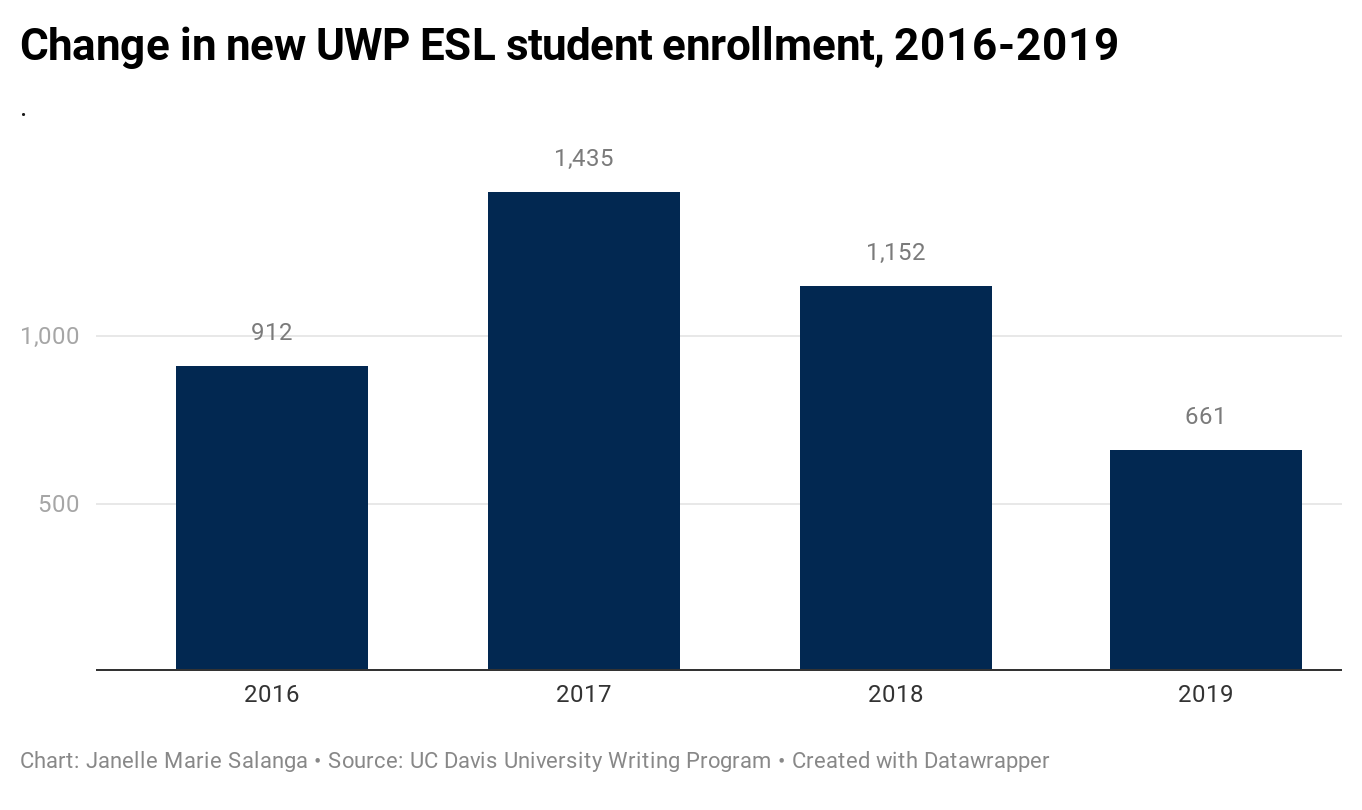
With regard to enrollment, Ferris said in her email to The Aggie that enrollment in ESL UWP classes has fluctuated over time.


“The reasons for the drop are a little complicated,” Ferris wrote. “Part of it is the Trump effect — international student numbers […] in the U.S. dropped for each of the first couple years he was in office. Another factor was that in 2017, the UC Regents put a cap on each campus as to how many non-resident students they could enroll, and this can be observed in the drop of numbers in 2018 and 2019.” 

She also said that while the program had planned for 128 ESL sections for 2019-20, when enrollment and placement was finalized, only 54 sections were necessary. 

Still, Akkaziev said to Nichols that while he didn’t dispute the need for reduced ESL classes, he was “astounded” that three of the six non-reappointed lecturers in his cohort were people of color who had more experience or more advanced degrees in the field than their white counterparts.

Nichols never replied. On the UC-AFT side, McIver shared that once a formal grievance is filed, UC management attempts to hold itself accountable through both hearing evidence and deciding if they have committed a violation.

“If no resolution is achieved in the three-step grievance process, we have the right to arbitration, in which a neutral third-party arbitrator hears evidence from both sides and issues a final judgment,” she said in the email.

Bittner said he and Akkaziev dropped the grievance they filed, since Akkaziev decided he would rather go to court than use arbitration to resolve the dispute. 

Akkaziev, now represented by Sacramento employment attorney Calvin Chang, said he wants to be paid the same salary and benefits other lecturers in the program were afforded and hopes the department can move forward with increased fairness and transparency.

He said the Spring Quarter before he was not reappointed for summer, he received emails from Ferris telling all lecturers that everyone would get reappointed; his contract was supposed to be renewed on July 1, but he received an email on June 24 telling him he was no longer re-appointed.

“I asked Dana what the criteria were for deciding to get a reappointment,” he said. “She said, ‘I’m not in a position to tell you this information’ [in an email].” 

When asked by The Aggie, Ferris said via email that pre-six lecturers, lecturers with their contracts renewed annually instead of every three years, like post-six or continuing lecturers, are reviewed each year by the UWP Personnel Committee. 

While the Committee provides a recommendation for a reappointment decision through discussing and evaluating a lecturer’s student evaluations, observation report, cover letter, CV and teaching materials, Ferris said, they don’t make the final decision.

“The UWP submits the report to the Dean’s office,” Ferris said. “Final reappointment decisions are made by the Dean’s office, and they’re contingent on budget and enrollment considerations and departmental/programmatic needs in addition to the performance review.”

Akkaziev said the point of the lawsuit isn’t to get more pay than other lecturers or to receive other special treatment. Though he said he would like to be reinstated because of how much he enjoys working with students, he said that it’s not his end goal—it’s a UWP culture more considerate of international students’ experiences and not discriminatory toward lecturers who are not cis, straight, white Christian men.

“If I was to be reinstated, I want to have that be under a changed environment and program culture,” he said. “I love working with students, I love teaching, I love my job. I’m not asking for privilege, but of course, you don’t want to feel like you’re treated by administrators as a second-rate, second-class citizen. We can’t just let people get away with things like this.”

Written by: Janelle Marie Salanga — campus@theaggie.org 

Correction: The original version of this article used the spelling ‘Farris’ instead of ‘Ferris,’ did not clarify Ferris’ response as being via email, called the 11-person lecturer cohort an internship cohort and said that Akkaziev was not reappointed in 2018-2019 instead of 2019-20. The article has been updated to correct these errors.

UC Davis chapter of Alpha Epsilon Pi to operate independently of the university after registration revoked due to hazing

0

Fraternity raises concerns about “lack of due process” in disciplinary process

The Davis chapter of the Alpha Epsilon Pi (AEPi) fraternity has decided to operate independently of the university as of this school year, said Noah Stark, president of Davis AEPi, in an email statement last week. 

AEPi’s registration was revoked in Spring Quarter 2020 due to incidents of hazing, Kristen Dees, director of the Center for Student Involvement (CSI), said via email. The revocation will last until 2025, and AEPi is no longer listed as a chapter on the UC Davis Office of Sorority and Fraternity Life website.

In her email, Dees said that UC Davis recommends students refrain from joining organizations with revoked or closed registration. 

AEPi has since been told to cease their operations at UC Davis, Dees added.

The news, which was also posted on the fraternity’s Instagram, comes after a record number of UC Davis fraternities—Sigma Mu Delta, Delta Sigma Pi and Zeta Psi—had their registration revoked for five years due to hazing incidents in February 2020.

The hazing in those three revoked organizations, described by anonymous sources, included physical punishments like push-ups, planking and consuming “unknown [concoctions] of mixed drinks” as punishment for failing to memorize or recite certain items. One pledge referred to the “physical and mental strain” of the rushing process. 

In the article, an executive board member from one of the fraternities complained about a lack of transparency in OSSJA’s investigative process, while acknowledging that they understood why the identities of those making allegations would be kept confidential. 

Another pledge said they did not think they had committed any acts of misconduct, since pledges can “drop out [of the process] at any time they want” and were already aware of what it would be like. 

At the time that the February article went to print, AEPi had not yet had its registration revoked, but was being investigated by OSSJA, as were the fraternities Theta Tau and Sigma Lambda Beta. Stark declined to comment on the contents of the article. 

“Our multiple, wrongful dealings with OSSJA [Office of Student Support and Judicial Affairs] affirm that there are improper safeguards to protect student organizations – as we plead to OSSJA Director and Associate Vice Chancellor of Student Affairs in appeal – and that a lack of due process and inadequate bias training has permeated throughout the school’s judicial body resulting in partisan results to the detriment of minority communities, Greek communities and student communities at large,” wrote Stark on behalf of the fraternity. 

He also described OSSJA’s investigations as “unscrupulous” and asserted that AEPi was “wrongfully punished.” 

AEPi’s statement said that OSSJA’s disciplinary actions mimicked a national trend of Greek organizations “being subject to uneven as well as unjust penal bodies,” adding that fraternities and sororities’ right to operate independently of universities had been legally upheld by the “highest court in the land.” 

Freedom of association—first recognized in a 1958 U.S. Supreme Court Case which struck down an Alabama law requiring the release of a list of NAACP members—continues to be affirmed in judicial decisions in the United States, and is largely viewed as an extension of First Amendment rights.

The statement also highlighted the precautions that AEPi is taking during COVID-19, in accordance with university regulations. 

It suggested that UC Davis assist students and community members in fighting the disease rather than “brazenly [choosing to allocate] time and money towards persecuting Greek life.” 

“As always, we will continue building the next generation of Jewish leaders, which is and has been our foremost goal – and is more vital now than ever,” the statement said.

Written by: Rebecca Binh-Wallace — campus@theaggie.org 

The mental health stigma in sports

1

Vulnerability and sports rarely mixed in the past, but the outlook is positive

In sports, athletes are taught from a young age to have short-term memory. Forget a bad play or a bad game and move forward. Ignore the problem. Strictly from a sports perspective, it is a great mentality to have because the last thing someone would want to do is overthink a split second decision. It is something that should stop at sports—this method works for a game or a season, but not for the reality of life. 

Mental health is a crucial issue in the world, and for athletes it is no different. But, the sad truth is that when an athlete reaches a certain level in their profession, there are expectations: to lead a team, to be strong and not to let emotions get the better of them. Those same expectations lead some into greatness and lead some into their downfall. 

For Dallas Cowboys Quarterback Dak Prescott, the spotlight is always on him. As the star and leader of “America’s Team,” he is immensely popular and is closely watched by the media. For years, being the starting quarterback for the Dallas Cowboys has been a prized position. While it may not translate on the field at times, whoever is the starting quarterback of the Cowboys will have a large focus on them. They are expected to lead, not just on the field, but off. 

That is where it gets tricky. While the perks of being “America’s QB” are great, one can only wonder about the pressure. Every move is watched, and any instance of what people see as “weak” will be unfairly criticized.

This past spring, Prescott’s brother, Jace Prescott, took his own life. According to Prescott, this, coupled with prior family tragedy and the ongoing pandemic, led him to seek help for depression and anxiety. 

“All throughout this quarantine and this offseason, I started experiencing emotions I’ve never felt before,” Prescott said. “Anxiety for the main one. And then, honestly, a couple of days before my brother passed, I would say I started experiencing depression. And to the point of, I didn’t want to work out anymore. I didn’t know necessarily what I was going through, to say the least, and hadn’t been sleeping at all.”

Many of Prescott’s peers admired his vulnerability and how he was willing to share something as personal as that. 

But, this praise was accompanied by discussions epitomizing the negative stigma that to this day still surrounds vulnerability in sports and professional sports in particular. 

“[Quarterback is] the ultimate leadership position in sports. You are commanding an entire franchise and they’re all looking to you to be their CEO, to be in charge of the football team,” said Fox Sports’ Skip Bayless on an episode of his show “Skip and Shannon: Undisputed.” “Because of all that, I don’t have sympathy for him going public with ‘I got depressed’ and ‘I suffered depression early in COVID to the point that I couldn’t even go work out.’ Look, he’s the quarterback of America’s team.”

Bayless was met with heavy criticism by colleagues and players alike. For how important mental health is, especially at this time, his comments were dangerous. He reinforced an ideology that has surrounded sports, and men, historically: have no feelings. 

“Shame on [Skip Bayless]. Are you kidding me? This is why we have a stigma against mental health, suicide, and depression,” tweeted San Francisco 49ers defensive tackle Soloman Thomas. “[Dak] being vulnerable is showing unbelievable strength and leadership. He’s impacting so many lives. Dak’s a true leader for speaking about his real emotions.”

The support of his peers and many others was a great sign, but the comments made show that there is a long way to go regarding the mentality surrounding mental health—not just in the NFL, but in all sports and all over the world. 

The topic of mental health has been one that has rapidly made its way to the attention of professional sports. After then-Toronto Raptors star DeMar DeRozan revealed he had depression and anxiety back in February of 2018, he hoped that his conversation would help others speak out as well. 

“It’s one of [those] things that no matter how indestructible we look like we are, we’re all human at the end of the day,” DeRozan told The Toronto Star. “We all got feelings. [Sometimes] it gets the best of you, where times everything in the whole world’s on top of you.”

DeRozan’s comments made people reflect. He was an All-Star, successful NBA player and yet that did not make him immune to mental health issues. His comments were well-received and the following month, inspired by DeRozan, Cleveland Cavaliers forward Kevin Love released his own article on The Players Tribune titled “Everybody Is Going Through Something.” 

“If you’re suffering silently like I was, then you know how it can feel like nobody really gets it,” Love wrote. “Partly, I want to do it for me, but mostly, I want to do it because people don’t talk about mental health enough. And men and boys are probably the [furthest] behind.”

Both DeRozan and Love continue to be outspoken about mental health and have inspired many. It even inspired the NBA, as the Player’s Association created the Mental Health and Wellness Program for players in May 2018. It allowed players to seek help and treatment as well as counseling outside of the team psychologists. 

In 2019 the NFL also launched its own mental health initiative and leagues across the world are beginning to do so as well. What was once a touchy subject has rightly become an issue that stays near the forefront of conversation. Athletes’ platforms will only continue to grow and it is a positive sign that a long overdue conversation on mental health has begun. It can help other athletes, and also other people across the world, speak out.

“Before I can lead I’ve got to make sure that my mind is in the right place to do that,” Prescott said. “I think that’s important to be vulnerable, to be genuine [and] to be transparent. I think that goes a long way [when] your voice is being heard by so many and it can inspire.”

Many in the media have made controversial statements over the years and will continue to do so. But, this is more than controversial. This involves life and a real issue in the world today. 

Mental health is not a debate topic.

The stigma is dangerous and must be changed. The support Dak Prescott, Kevin Love and DeMar DeRozan have received for being outspoken is something that shows potential. Potential to possibly one day put an end to that dangerous belief that showing emotion is a type of weakness, on or off the field. Hopefully, this can show more people that there is no downside to speaking up. It’s huge to speak up, athlete or not, because you may just inspire someone who was feeling the same way. 

Written by: Omar Navarro — sports@theaggie.org

From the FSM to COLA: A history of labor organization at the UCs

0

Former union organizers recall their experiences representing UC employees

Holding signs reading “pay us enough to live here” and “COLA 4 all,” graduate students began participating in strikes for cost of living adjustments (COLA) in Dec. 2019. The protests began with a grade strike at UC Santa Cruz (UCSC) and continued in the spring with in-person protests set to the beat of drumming and chants. The movement sparked a series of solidarity protests at other UC campuses, including UC Davis.

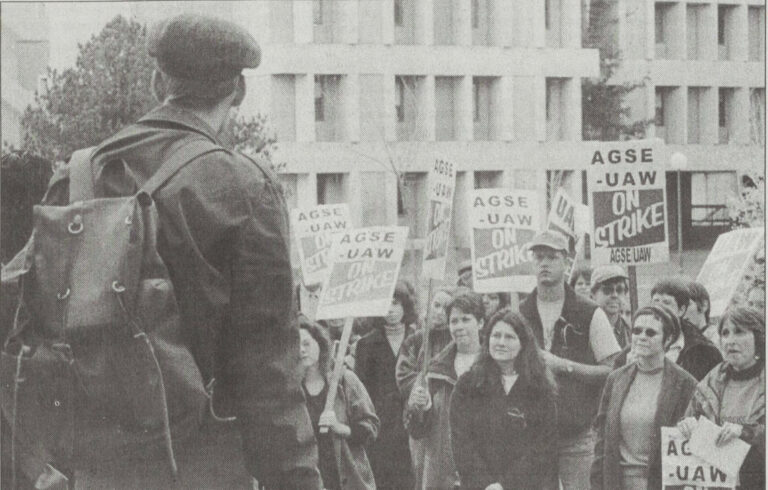
Referred to as “wildcat strikes,” graduate students worked outside of the student union, United Auto Workers (UAW) 2865, as striking is prohibited for graduate student employees while their UC contracts are in effect. On Feb. 28, 54 teaching assistants (TAs) were dismissed and 28 were not appointed at UCSC for withholding grades. After an escalation of the protests including a UC-wide May Day strike, the university rehired 41 students on Aug. 11. 

According to Brian Malone, a former UCSC graduate student and organizer for UAW from 2008 to 2014, the discrepancy between the cost of living and salary for UCSC TAs posed problems when he was a student. 

“I still live in Santa Cruz, and it is really hard to live here,” Malone said. “It was really hard to live here when I was a graduate student. What they paid me was not sufficient to really have a kind of life here.”

Anna Muraco, an organizer from 1997 to 1999 and former UC Davis graduate student, experienced issues with housing insecurity.

“When I was a graduate student, there was no way I could live off of my TA salary and any financial aid I received, so I took out loans,” Muraco said. “I’ll be paying off my graduate and undergraduate loans until I retire.”

The UC system negotiates with 14 unions that represent more than 79,000 employees. UC Berkeley employees formed the American Federation of State, County and Municipal Employees (AFSCME) in 1948. Two years later, Berkeley custodians held the first strike in UC history and achieved the first employee benefits package at the UCs. 

The union then expanded to include clerical and technical workers, guards and patient care workers. AFSCME is currently the largest UC employee union, representing over 25,000 employees.

Graduate students also began organizing at Berkeley. Amid the wide-scale protests against the oppression of free speech during the Berkeley Free Speech Movement (FSM) in the 1964-1965 school year, graduate students formed the first graduate employee union. 

Labor organizations for both unions spread to other UC campuses, bolstered by the passage of the Higher Education Employee-Employer Relations Act (HEERA) in 1979 that extended collective bargaining rights to state college and university employees. 

Following HEERA, AFSCME members won the first statewide union contract in 1984. 

HEERA also provided more opportunities for student workers, and Berkeley graduate students established the first UC TA labor union, the Association of Graduate Students Employees (AGSE), in 1983.

The first UC-wide graduate student strike occurred on Dec. 1, 1998, during finals week, after a culmination of efforts over 15 years to gain union recognition. Muraco, who was involved in the strike, stated that the UCs had not officially recognized the UAW as the representative for unionized graduate students until the 2003-2006 contract, as a result of this strike across all eight campuses. 

That same year, AFSCME also became officially united when their 22 campus groups formed the statewide AFSCME Local 3299.  

Although the 1998 strike proved effective, it consequently increased faculty workload. In Maruco’s experience, it can be difficult to navigate the tensions between organizing and maintaining long-term relationships with professors. 

“If we withheld work while we were TAs, the professors teaching the class were directly affected,” Maruco said. “Even though many supported the unionization efforts, in theory, it was difficult to manage the reality of withholding labor.”

Graduate students held a second UC-wide strike on Sept. 24, 2009, in response to a 20% budget cut, a 32% increase in student tuition and a 4-10% pay reduction. 

Malone became involved in labor organization in 2008 to push back against the cuts and was elected unit chair of the Santa Cruz branch in early 2009. 

“There were significant cuts on each campus,” Malone said. “There were double-digit tuition increases, and it was a really unsettled time.”   

Organizations participating in walk-outs and protests at UC regents meetings culminated in state-wide action on March 4, 2010, driven by both undergraduate and graduate students, including a campus shutdown at Santa Cruz.

AFSCME also held numerous system-wide strikes, the most recent on Nov. 13, 2019. The strike included workers from several UC medical centers and resulted from the alleged outsourcing of jobs by the UC system.

“We won’t stand to have our jobs contracted out and lose the things we’ve fought so hard for in the past,” said Matthew Mussar, a UC Davis Medical Center employee, in an interview with The California Aggie last year. 

Striking was the most effective method to gain bargaining leverage, according to Sara Smith, a former UCSC graduate student who was involved in UAW from 2004 to May 2014. 

“Our most powerful tool was our ability to stop business as usual,” Smith said. “The university simply couldn’t function without us. That gave us power.”

As a contract negotiator for the union, Malone also found that strikes provided a significant advantage. According to him, the UC would often settle with the union before scheduled strike dates.

“Those strikes […] they were a pressure point,” Malone said. “The UC hated them. You can negotiate all day, you can try to appeal to the heartstrings of the labor relations negotiators, you can make whatever arguments you want, but the thing is those people aren’t making the calls. If you are just sitting in the room with the UC labor relations people, you have no leverage.”

Similar to previous strikes, the wildcat strikes this year grew out of contract grievances, specifically around minimal changes in wages to compensate for increased housing costs. 

“It was not a surprise to me that Santa Cruz graduate students were feeling really on the edge of being able to even live here,” Malone said. “That kind of financial desperation seemed really familiar to me.”

Members of AFSCME also had wage disagreements with the UC, relating to the cost of living. The union ultimately came to a tentative agreement on Jan. 22, achieving a 3% annual wage increase for all workers as well as a 2% wage increase based on experience. 

As a result of frustration with UAW and failed 2018-2022 contract negotiations, students acted without union support which, according to Smith, was historically unique.

“Workers went on strike outside of contract negotiations and won their jobs back,” Smith said. “That is rather historic, and provides inspiration for calling more wildcat strikes in the labor movement.”


Written by: Sophie Dewees — features@theaggie.org

Your guide for where to buy eco-friendly masks

Five options for your fashionable, yet environmentally friendly needs 

In the middle of a pandemic it may be difficult to stay focused on other life-threatening situations currently going on. Nevertheless, it is crucial to keep doing so. Pollution from the coronavirus has severely impacted the environment. Now, clean up crews are finding plastic hand sanitizer bottles, gloves and disposable masks polluting the oceans, according to The Guardian

With issues like Target selling masks in plastic bags and disposable masks being thrown out on the street, the most environmentally friendly option is to use reusable masks. The CDC recommends the use of reusable face masks with two layers that fit snugly around the side of your face, making sure there are no gaps. The CDC also asks individuals to refrain from using N95 masks or any masks used by healthcare workers to avoid a shortage. 

The best environmentally friendly option is a reusable mask, but that still does not guarantee that the masks themselves are eco-friendly. So here are five eco-friendly brands that sell masks online, because the less face-to-face interaction, the better. 

Tonlé

Tonlé creates clothing and accessories through a zero-waste process. They use leftover materials from companies that have thrown them out. Their fabrics consist of deadstock, cut-waste and textiles from remnant markets where their team visits weekly in order to find the perfect fabric for their design process. While most large factories use cutting machines, and therefore waste excess fabric in the process, Tonlé cuts most of its products by hand. All of Tonlé’s dyes are non-toxic and 80% of dyes come from ingredients like soy milk and lemon, according to their website

Tonlé’s masks come in packs ranging from 3 to 50, with a price range of $24 to $225. Their maks have three layers of quilted cotton, including a layer for a filter. Their ear straps are now made of cloth ties instead of elastic. Masks are shipped in poly bags to ensure the sanitation of each mask. 

Tentree

With the slogan “Protect the planet, protect your community, protect yourself,” it’s only reasonable to expect Tentree to give back and care for the environment as much as any tree hugger out there would. For every product you buy, Tentree plants ten trees. Every piece of apparel that a customer buys comes with a unique code for your ten trees which gives you the ability to register the code and track the trees to see where they will be planted. They have a guarantee that the trees will be planted within six months of the purchase. They have planted over seven million trees in various countries including Mexico, Madagascar, Indonesia and Nepal. 

Tentree’s masks have two layers of fabric and they include a space for a filter, though the filter is not included with purchase. Their masks come in a pack of three and are available for $20. Masks are made of eco-friendly materials such as hemp, organic cotton and recycled polyester. 

United By Blue

United By Blue has worked to create sustainable materials in their apparel for the past 10 years. United By Blue is a certified B corporation meaning they are legally required to consider their impact on not just on the environment, but also on the people within the company and the people that make the products. B corporations employ certified performance, are held legally accountable and partake in public transparency. 

United By Blue is selling a pack of three masks for $20. For every pack purchased, one mask will be donated to Chosen 300, a ministry that aids the homeless in Philadelphia. Their masks include a double layer of fabric, with the availability for a filter, but the filter is not included. Masks are made from deadstock fabric, which includes Hemp, organic cotton and recycled polyester. The company is based in Canada, but according to their website, they produce their masks in factories around the globe in countries including China and Turkey. The company displays numerous certifications of their products being ethically made (both environment friendly and ethically sound) on their website with certifications including the Global Organic Textile Standard and Fair Wear. 

For Days 

For Days uses sustainable materials and has a loop system with the SWAP program. Anything sent back to For Days gets recycled and for a cheaper price, shoppers can swap out anything at any time they’d like. Every item available on For Days is 100% recyclable. This company is zero waste and all scraps are recycled into new products. 

A three pack of masks are $20 and a five pack is $25. The masks are made of a double layer of 100% cotton. 

Whimsy + Row 

Whimsy + Row uses locally sourced and upcycled materials for their products. They recycle every piece of scrap that is left over throughout their design process and use those scrap pieces for small accessories such as bandanas. With the even smaller bits left over they give the excess scrap to another company that will make use of the pieces, leaving minimal amounts in landfills. The local factories also allow the company to visit when needed ensuring that their workers are treated well and maintain an ethical work environment. The brand also provides an eco-friendly shipping experience for their customers. They use 100% recycled materials from EcoEnclose, a source for eco-friendly packaging. 

Masks range from $10 to $28 with different styles on their website. Some masks include three layers, two of which are cotton and one is a filter of polypropylene. There is also an option to add in an additional filter for the mask. The mask is made of 100% deadstock cotton and hand washing is recommended. For every mask bought from Whimsy + Row, they donate one to Los Angeles communities in need such as the Downtown Women’s Center and Union Rescue Mission. 

It can be difficult to support ethical brands when the necessary resources aren’t available to do so. Products upwards of $20 plus shipping costs sometimes isn’t a viable option, especially in the middle of a pandemic. The next best option is to make a DIY mask with recyclable materials. Creating a mask not only reduces the excess plastic and pollution produced by shipping, but it also kills some time, which tends to be immensely needed during these days. 

Written By: Itzelth Gamboa — arts@theaggie.org

Local nonprofits focused on helping kids provide childcare, free lunches

0

Nonprofits adapt to help children during pandemic, receive support from community

The COVID-19 pandemic has affected numerous lives in the Davis community, resulting in an increased demand for services provided by nonprofits. Local organizations such as Yolo Crisis Nursery, Winters Farm to School and Progress Ranch have continued to provide services, but changed their models to suit shifting needs. 

Yolo Crisis Nursery offers to “provide safe, temporary care for children up through age 5,” its official website reads. 

Executive director of Yolo Crisis Nursery Heather Sleuter noted how the need for services like Yolo Crisis Nursery grew during the pandemic.  

“We got a shift in the need of the Crisis Nursery when the pandemic hit,” Sleuter said. “Families were losing their jobs, daycares were closing and essential workers were needing to go to work but didn’t have anywhere to put their kids.”

Yolo Crisis Nursery began to see different types of needs from families, some more extreme than before the pandemic. They took in babies born to families who had contracted COVID-19 or had other COVID-related issues. She also explained that Yolo Crisis Nursery would do anything and everything they could to support families such as “giving them resources, referrals—anything that they’re needing for security.” 

Despite financial difficulties, Sleuter emphasized the importance of nonprofits to the community.

“We’re here for the children and the families in our community during this really hard time,” Sleuter said. “The Crisis Nursery will continue to stay open and serve all children and families in Yolo County and our community.”

Winters Farm to School is “dedicated to improving the health and long-term well-being of students in the Winters Joint Unified School District,” its official website reads. 

Cathy Olsen, the treasurer of Winters Farm to School and food service director of Winters School District, explained how the Winters Farm to School program began when she took inspiration from a similar program in Davis. 

“I saw that Davis has a great farm to school program and thought Winters should have one as well,” Olsen said. “We put out the call for the community if they were interested in it, and we had a great response.”

Olsen described the three main services offered by Winters Farm to School before the pandemic: locally-purchased farm produce, an open summer feeding program and a school garden that allowed for garden-based learning. 

Additionally, they partnered with Yolo Food Bank to set up a farmer’s market for kids. Large bins of produce would be delivered once a week and a coordinator would then distribute the produce with the help of volunteers. The kids would receive fake money and a shopping bag to “buy” produce for their family. 

Although campuses remain closed, the school lunch program has continued to provide meal assistance to children via drive-through. Since the pandemic began, Winters Farm to School served about 3,500 meals a week and 80,000 meals in total. 

In regards to the future of Winters Farm to School, Olsen expressed hope that the program will continue because of support from the community. 

“If our supporters continue to provide the support, we’ll be able to continue our work,” Olsen said. “I think the support of a nonprofit for a community like this has changed the health of the community.” 

Progress Ranch, a Davis-based nonprofit, provides “high quality mental health services to boys ages 6-14 who […] are unable to function in a normal home environment,” its official website reads. 

Wendi Counta, the executive director of Progress Ranch, explained how Progress Ranch housed six boys in two different houses, and that most of the boys had been in the foster care system for a while. Due to COVID-19, family visits and time spent outside became limited. The boys struggled with the transition to spending most of their time inside.

“It’s had a huge impact on their mental health, which is already difficult for them,” Counta said. “They’re with us because of mental health issues so this just compounds it even more.”

Before the COVID-19 pandemic, Progress Ranch took several precautions against common medical ailments such as the common cold or flu. Now, Counta described the need to take even further precautions by investing in more personal protective equipment (PPE) because they wanted to ensure that both the kids and the staff felt safe.

Despite the challenges of school closure and social distancing, Counta believed they were able to find a good balance between online learning and new, creative ways for the boys to have fun at home. 

“Even if it continues, we’ve found ways to make it work,” Counta said. “The success of this really relies on the community and the support they’ve given us—and continue to give us.”

Written By: Jelena Lapuz — city@theaggie.org

Local COVID-conscious businesses receive Certificate of Compliance under Yolo County’s Green Check Program

0

Barber shops, hair salons able to commence indoor operations while adhering to health, safety guidelines

Yolo County recently announced a COVID-19 Green Check Program “for local businesses to apply for that recognizes and endorses businesses that are in compliance with the Yolo County and State COVID-19 health and safety requirements and guidelines,” according to a press release from Yolo County published on Aug. 27. 

The aim of the program is to keep the public informed of establishments that comply to COVID-19 guidelines, encourage people to be COVID-19 safe and “publicly recognize local businesses that are helping to reduce the spread of COVID-19 among staff and customers,” according to the press release.

Businesses will need to complete an application stating that their establishment complies with COVID-19 guidelines, such as having personnel training, measures for preventing unneeded contact and maintaining social distancing, having requirements for face coverings and more. 

Businesses that are certified as being compliant to COVID-19 guidelines will get a certificate from Yolo County that contains the words “Certificate of Compliance” and a green check mark. 

“This signage means that the County has identified the business as following the guidelines and requirements set forth by the estate of California and Yolo County to help keep the public safe during the COVID-19 pandemic,” the press release reads. 

Additionally, businesses will be featured on Yolo County’s website at the Green Check Program page.

One business that received the Certificate of Compliance is Tea List. 

Dalia Al Hafidh, owner and manager of Tea List, explained what measures are being followed in order to comply with COVID-19 guidelines.

Al Hafidh described that all employees take daily symptom checks, wear face masks and have gloves and instructions to change the gloves after each sale or task. Employees also disinfect payment portals, shop surfaces, pens and other frequently-touched surfaces with sanitizers.

Al Hafidh also explained what the process of applying for the program was like.

“We were recommended by someone and we applied for it and Yolo county Code inspection visited us and we were granted the approval,” Al Hafidh said via email.

The process of applying for the program is listed on the program’s website. The first step involves reviewing the “COVID-19 protocols to see if you meet all the criteria,” according to the website. Next, “fill out the 1 page application by either printing and emailing it to EOCLogistics@yolocounty.org OR completing the online application.” The application is available in four languages.

Yolo County will then review the application and email the certificate, which can be displayed “in a visible place, window, or door at your business.” 

A complete list of all businesses that received the Certificate of Compliance can be found on the program’s website.

Starting Aug. 31, Yolo County is also allowing barbershops and hair salons to carry out indoor operations while following social distancing protocols, guidance from the State of California and face covering requirements, according to another press release from Yolo County.

“The State of California revealed on Aug. 28 a new tiered framework titled ‘Blueprint for a Safer Economy’ for reducing COVID-19 in the state with revised criteria for loosening and tightening restrictions on activities,” the press release reads. 

Yolo County is currently in the “most restrictive” tier due to being on the State’s County Data Monitoring List before this framework was introduced.

Ultimately, despite the challenges presented by COVID-19, businesses are trying their best to remain open while adhering to COVID-19 guidelines. 

“It was and still [is] very hard,” Al Hafidh stated via email. “We are trying our best to stay in business.”

Written by: Shraddha Jhingan — city@theaggie.org

Unhealthy air conditions due to wildfires may cause long-term health effects

Climate crisis induces hazardous air quality across California

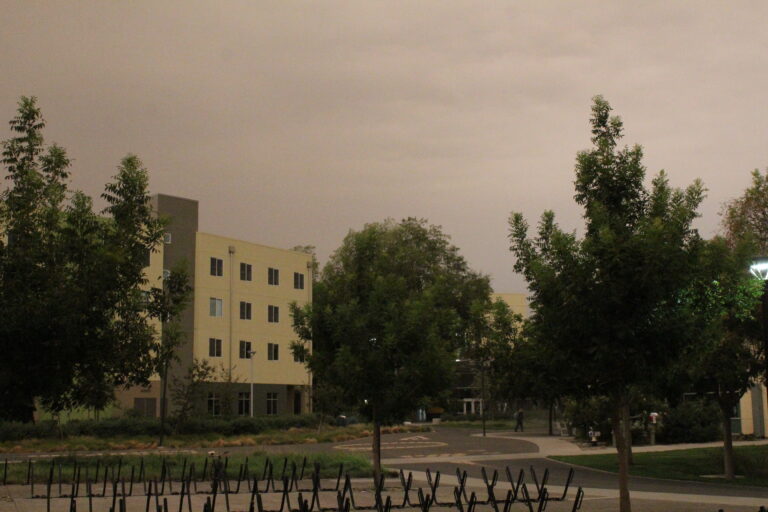
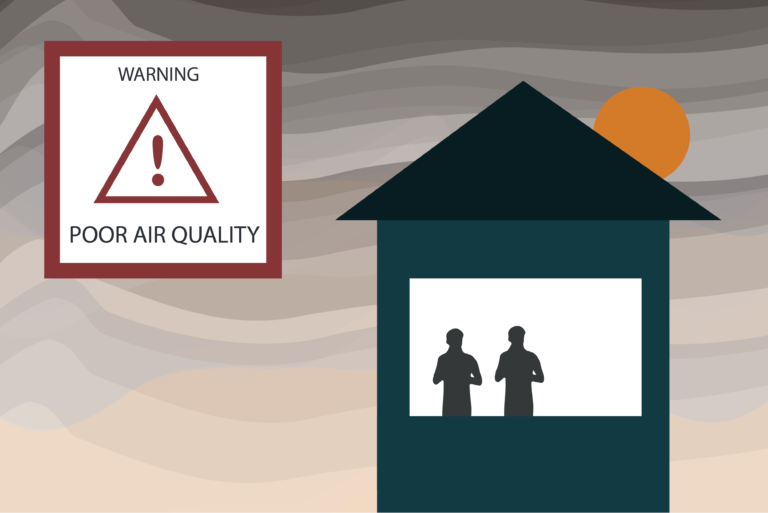
As wildfires ravage California, decimating homes and habitats, smoke blankets the state. This past month, multiple counties—including Solano and Yolo Counties—sent out alerts of unhealthy air quality. As the Air Quality Index (AQI) rose above 200, it became dangerous for everyone, not just those in sensitive groups, to go outside. 

Exposure to poor air quality can have serious health consequences. Short term effects include, but are not limited to: asthma-like symptoms like eye irritation, runny nose, chest pain, sneezing, sore throat, coughing and shortness of breath, according to Nicholas Kenyon, a professor and chief of the division of pulmonary, critical care and sleep medicine.

While scientists continue to study the exact consequences of smoke inhalation, the short-term effects of California’s multiple acute episodes of poor air quality may have negative long-term impacts on public health, according to Kenyon.

“We will outlive these short-term events for a few days a year,” Kenyon said. “But if you’re growing up in the Davis area and we have a month of exposure to this wildfire smoke while your lungs are developing, it’s very possible that it affects you long term.”

Smoke inhalation provokes especially negative impacts on individuals with pre-existing health conditions such as asthma, cardiovascular disease and chronic obstructive pulmonary disease. Elderly people, children and pregnant women are also at high risk. These individuals can suffer from asthma attacks, acute exacerbations of their underlying illness, heart attacks or strokes, according to Kent Pinkerton, a professor in the department of anatomy, physiology and cell biology at the school of veterinary medicine and a professor in the department of pediatrics at the school of medicine. 

“Our greatest concerns are for specific susceptible groups and certain ages,” Pinkerton said. “Exposure of particles and gases could exacerbate or enhance [their] conditions.”

Helene Margolis, an associate adjunct professor in the department of internal medicine at the school of medicine, said her greatest concern is the impact of poor air quality on pregnant individuals. If these people endure prolonged exposure to smoke late in their pregnancy, they can undergo preterm birth.

Air pollution from wildfires includes both gases and particles of buried materials. Exposure to particulate matter that is smaller than 2.5 microns (PM 2.5) has caused the most fatalities, according to Anthony Wexler, a distinguished professor of mechanical and aerospace engineering and director of the Air Quality Research Center. These small particles can easily enter the deepest parts of the respiratory tract—the alveoli—where gas exchange occurs. 

This smoke primarily contains combusted vegetative material; however, more dangerous materials like rubbers, plastics and metals are burning too, since these wildfires have swept through developed land.

“The basic composition is similar to smoking,” Wexler said. “The concentrations are not as high, but [we are] doing it 24/7, which will have long term consequences.”

During unhealthy air conditions, the best way to protect oneself is to remain indoors. If one must go outside, Kenyon does not recommend exercising; raising one’s respiratory rate increases the intake of poor quality air into their lungs. As of Sep. 20, the air quality had improved to moderate conditions, but as California’s fire season continues through October, it is possible for the AQI to rise again.

During unhealthy conditions, individuals who leave their homes should wear N95 masks which provide a tight seal against the nose and mouth as well as proper filtration. N95 masks—which also prevent the spread of COVID-19 droplets—prevent 95-99% of particles from penetrating the mask, according to Pinkerton. Since the emergence of COVID-19, however, N95 masks have not been readily available.

“Not all the coverings we are using right now for COVID-19 would necessarily be very effective in protecting from smoke or bad air quality,” Pinkerton said. “You really need protection and to not use a facial cloth mask, which only protects from 60% of particles in the air at best.” 

Earlier this summer, reducing the spread of COVID-19 prompted many individuals to spend much time outdoors, however, the widespread wildfires have presented a further complication towards attempting to safely escape one’s home. 

“It’s amazing how resilient people are in terms of managing what’s going on,” Kenyon said. “There are obviously some discrepancies in terms of recommendations that we’ve been facing with both wildfires and COVID …. we’re telling people to go outdoors for COVID to get out of closed environments, but of course, with the wildfires trying to stay indoors.”

While more research needs to be conducted before conclusions are drawn, scientists are speculating that exposure to wildfire smoke increases one’s susceptibility to infections, according to Margolis. 

“One of our biggest concerns is that [exposure to] air pollution from the wildfire smoke potentially … increases susceptibility to the virus,” Margolis said.

A correlation of this type has been seen with influenza and a similar could be witnessed with COVID-19, according to Kenyon. 

Additionally, there is a concern that if an individual contracts COVID-19 after being exposed to air pollution, the disease is more severe, according to Margolis. 

“It’s a pretty scary picture in terms of health,” Margolis said.

California will continue to suffer from wildfires and poor air quality as the climate crisis becomes more severe. In order to combat this issue, people need to decrease their dependence on fossil fuels, according to Wexler. 

“We have to vote for people who are going to take this seriously and who are going to help us transition to renewable energy sources,” Wexler said. 

Margolis hopes that the youth who grow up experiencing wildfires and poor air quality will be the ones to spark change—their health and safety depend on it. 

“We know not everyone has lived up to the responsibility of taking care of this planet and keeping it safe, but I think more and more people are becoming aware,” Margolis said. “Don’t give up. Join forces. You have an extraordinary voice and … you are powerful.”

Written by: Margo Rosenbaum — science@theaggie.org

Davis experiences unhealthy air quality, reducing restaurant outdoor dining, waitstaff hours

0

Avoid smoke inhalation health effects by reducing outdoor activities when possible

Northern California wildfires have resulted in poor air quality in the city of Davis, which has experienced consistently unhealthy air since early September. 

The air quality index (AQI) in Davis reached a high of 191 on Sep. 12, according to the U.S. Air Quality Index. The Environmental Protection Agency explains that this number is unhealthy for all groups, with a greater risk for those in sensitive groups. 

“Everyone may begin to experience health effects when AQI values are between 151 and 200,” its website reads. “Members of sensitive groups may experience more serious health effects.”

The Yolo-Solano Air Quality Management District website details how people can avoid harm from smoke inhalation, including staying indoors, knowing your risk level and checking and cleaning air conditioner filters. 

Unhealthy air quality has also further complicated Davis business models, which had previously shifted to being outdoors in order to better accommodate social distancing. 

Davis Chamber of Commerce Executive Director Cory Koehler said that poor air quality caused a decrease in outdoor dining, but a rise in delivery and take-out.

“Once the fires hit and the air quality got worse, sales went down in terms of outdoor dining, but restaurants are seeing an uptick in people taking out and in deliveries,” Koehler said. “I think once the air gets better, we’ll probably see an uptick in outdoor dining again.”

Co-owner of Crepeville and Burgers and Brews Derar Zawaydeh explained that although there are more delivery and take-out orders, high fees from food delivery apps greatly reduce profits for the restaurant. 

“The delivery that we do is through food delivery services,” Zawaydeh said. “They’re O.K., but the fact that they charge so much—for both the customer and the business—it doesn’t help a whole lot. They’re charging between 20 and 30% of the value of the ticket, so we still make a little bit of money, but the amount of profit is definitely reduced.”

In addition to relying more on delivery and pick-up, Koehler described how many restaurants are offering promotional deals to appeal to more customers. 

“For restaurants, they’re marketing a lot—they’re doing a lot of campaigns to encourage people to come in, order and pick up their food,” Koehler said. “So I think that’s what they’re going to have to shift to, if the fire season remains bad. And we’re just at the beginning of the fire season, so we could see this for a while.”

Zawaydeh added that less customers dining outdoors has reduced the amount of wait staff necessary, although he tries to give everyone at least some hours.

“Labor is based on the business,” Zawaydeh said. “We do our best to give staff as many hours as we possibly can, but certain times we are forced to send them home early. We try to give all of them at least some hours because all of us have our own expenses. I would hate to lay off people because of the poor air quality, which I’m hoping is temporary.”

As of Sep. 15, the air quality index in Davis dropped to 102, according to the U.S. Air Quality Index. This places air quality into the Unhealthy for Sensitive Groups category.

Despite the poor air quality and ongoing pandemic, Zawaydeh is grateful for the Davis community and hopeful for the future, which includes reopening Crepeville. 

“We have been blessed with a great community here in Davis that has shown a lot of support for our business, and we are trying to open Crepeville now,” Zawaydeh said. “Hopefully that will happen in the near future.”

Koehler expressed confidence in the Davis business community, which he says continues to adapt in order to stay afloat. 

“People are adjusting,” Koehler said. “The businesses in Davis are resilient—they’re doing a lot to hang on.”

Written by: Eden Winniford –– city@theaggie.org

Hardest championship of all time?

0

With no fans, this championship may prove to be the hardest ever to win

The NBA playoffs have been a treat for fans worldwide amid the COVID-19 pandemic. The NBA league office put a tremendous amount of time and effort into the bubble concept which has proved to be successful, as there have been no positive tests inside the NBA Disney campus, even after the arrival of players’ families. Not to mention, the basketball being played in the bubble has given everyone an opportunity to witness something different—NBA basketball with no fans.

When the initial games tipped off in late July, there was an adjustment period for fans, as the lack of crowd noise was a bit awkward. Over time, and especially when the playoffs kicked off, crowdless basketball became a new normal for those watching at home and those playing in the bubble. The league has tried to give the would-be home teams an advantage by pumping in crowd noise, playing the music they would usually play in the stadium, changing the courts to match the team and letting their home PA person conduct business as usual. But at the end of the day, it makes little difference for the teams, as the bubble is simply a neutral site with no beneficiary.

“It’s nice to have the backgrounds and all that other stuff but, to be honest with you, I can’t even hear any of it or really pay much attention to it after maybe the starting lineups are announced, which are odd anyways because there’s nobody clapping,” Boston Celtics coach Brad Stevens told CBC. “It is unique.”

The circumstances surrounding the resumption of the NBA season, in short, threw away the home-court advantage that teams were fighting for all season. This year’s playoffs were simply determined by whoever was the better team without the interference of outside factors. The amount that the absence of fans affects the pressure on certain players and teams remains to be seen, but the lack of traveling and having games every other day will truly test the NBA’s best. This begs the question: will this year’s championship be the hardest ever to win, or will it be an exception?

For starters, the season was paused in March with teams having roughly 20 games remaining. With a little over a month left before the playoffs began in April, the sudden stop froze everyone. Although some had the luxury of lavish home gyms and the ability to stay in shape, many did not. With only a three-week training camp, three scrimmage games and eight regular-season games, the fight for teams to return to form after a four-month pause was a tough one. 

Physical factors aside, athletes are usually accustomed to a particular routine that has gotten them to the position they are today, and being in the bubble without the ability to leave has weighed heavily on a number of players. 

“It’s the toughest championship run for me personally. From the circumstances of just being in here,” said Los Angeles Lakers superstar forward Lebron James. “Not with my family, not in my own bed, I’m not in our own practice facility. I’m not preparing to be at Staples [Center] tomorrow with our fans. I’m not with a lot of things that’s essential to my everyday regimen. So that’s what’s different.”

For the first two months, players were not allowed to bring anyone into the bubble because the NBA tried to limit the amount of people on the campus. With the beginning of the second round that changed, but the time spent in the bubble on their own proved to be a mental struggle for many players. 

“I underestimated mental health, honestly. I had anxiety, a little bit of depression,” Los Angeles Clippers star Paul George told the media after his Game 5 matchup against the Dallas Mavericks. “This is really hard being in here. It’s not easy. All day it’s just basketball. It’s hard to get away from it.” 

“I know exactly what Paul is going through,” Los Angeles Lakers guard Danny Green added later. “You have nothing to do but look at your phone and social media all day. All they are doing is bullying you.”

Being locked away from the outside world and separated from loved ones is a factor that was not considered enough when the plan of the bubble came to fruition. That coupled with the expectations and pressure to perform can be a lot to carry. Throughout the pandemic, mental health has been a battle for a lot of people—athletes included. People often forget that athletes are humans and are not just there for entertainment. The bubble concept overall has been successful, but all these issues contribute to a difficult time for players. 

Looking at it as a whole, it seems like whoever hoists up the Larry O’Brien trophy in October will be touted as the greatest championship team ever given the circumstances. But, not all agree with that sentiment. 

“Any team that wins this year, there’s an asterisk. They’re not going to get the respect,” NBA Hall of Famer Shaquille O’Neal said back in May. “What if a team that’s not really in the mix of things all of a sudden wins with a new playoff format? Nobody is going to respect that.”

The comment by O’Neal sparked debates on whether this year’s championship will be accepted like those in the past. But, the players seem to be opposed to the Hall of Famer’s opinion. 

“It’s going to be the toughest championship you could ever win,” said reigning MVP Giannis Antetokounmpo. “The circumstances are really, really tough right now. So whoever wants it more is going to be able to go out there and take it.”

“I think this might be certainly the most worthy of all world championships in the NBA because of all the things that every team is going to have to navigate and overcome to be able to be crowned a champion,” said Miami Heat head coach Erik Spoelstra. 

The successful run of the NBA in its Orlando campus and its ability to make the best of an unpredictable time in the world is something that has been applauded. This is the new reality of sports in the year 2020 and for the near future. The difficulties that this specific NBA champion will go through will be one that may never be seen again. From routine, inactivity, lack of motivation, mental health and much more, the winner of this championship will almost certainly have to overcome more than those in previous years and will be tested in more ways than just physical. Only time will tell how this championship will be viewed in the future, but for now it’s important to realize that life and basketball in the bubble is not as easy as it sounds and this year’s winner will have conquered a new kind of challenge. 

Written by: Omar Navarro — sports@theaggie.org

Voting center locations announced in Yolo County, following safety guidelines

Despite pandemic, voter turnout predicted to remain similar to previous years

This article was updated on Sept. 17 to reflect that the Harper Junior High School VAC was changed to Montgomery Elementary School.

In a press release published on Aug. 18, 2020, Yolo County announced “proposed Voter Assistance Centers (VACs) and Ballot Drop-off (BDB) locations to be used in the upcoming November 3, 2020 General Election” in accordance with Senate Bill SB 423 and guidance from the California Secretary of State Office. 

There will be 12 VACs and BDBs in Yolo County, according to the press release. The VACS include the Davis ARC Center Ballroom, Montgomery Elementary School, Patwin Elementary School, the Veterans Memorial Center, as well as others in Esparto, West Sacramento, Winters and Woodland.

Additionally, the BDBs include locations in both Nuggets Markets, City Hall and Westlake Market, alongside others in Yolo County. A full list of the VAC and BDB locations and hours can be found in the press release or on the Yolo Elections website

Yolo County Assessor/Clerk-Recorder/Registrar of Voters Jesse Salinas explained how the COVID-19 pandemic has impacted voting in an email interview. 

“COVID-19 has significantly impacted our society at large and also the world of elections,” Salinas said via email. “The current pandemic has placed significant restraints and concerns on voting and how election administration will be adjusted, not only for the upcoming election but for years to come.”

UC Davis Lecturer of Political Science Dr. Isaac Hale also explained how voting may be different this year due to the impacts of COVID-19. According to political science research, states that use all-mail voting, such as California and Oregon, result in having higher turnout rates, Dr. Hale explained.

“I think that COVID-19 will absolutely affect voting,” Dr. Hale said via email. “In the U.S., election administration is largely left up to each state, so the way it plays out will vary. Here in California, voters are automatically being sent mail-in ballots. As such, turnout in California will probably not be decreased as a result of COVID-19.”

Salinas also explained the voting procedures for the upcoming election, such as being able to vote from home.

“Every active registered voter in California will be sent a Vote-by-Mail ballot in advance of the November election (Vote-by-Mail ballots will be sent Monday, Oct. 5, 2020),” Salinas said via email. “Voters will be able to vote from the comfort and safety of their own home.”

  In order for there to be “added vote-by-mail transparency,” voters can track their ballots via “Where’s My Ballot,” sign up for automated notifications or USPS Informed Delivery to know when their Vote by Mail ballot may be arriving.

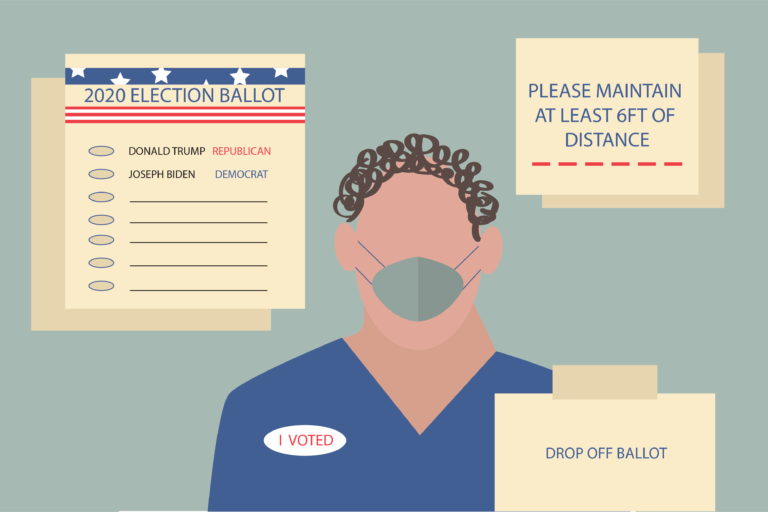
Furthermore, return postage is paid for and ‘“I voted” stickers will be sent with the ballots, according to Salinas. Additionally, there will be 12 VACs from Oct. 31, 2020 to Nov. 3, 2020.

Social distancing and safety guidelines will also be implemented in VACs and BDBs to help reduce the spread of COVID-19. 

  According to the CDC guidelines for voting, there should be measures and guidelines in place such as wearing masks, social distancing, disinfecting surfaces and crowd management. 

“Containment and prevention efforts are the primary concern of all preparation activities for the upcoming November election,” Salinas said via email. “The Yolo County Election Office’s goal is to deliver a safe voting experience for all participants – employees, voters, volunteers and observers. The Elections Office has been working in direct partnership with the Yolo County Health & Human Services Agency (HHSA) and the Secretary of State’s Office to safeguard the well-being of all participants in the upcoming election.”

According to Salinas, there will be “rigorous sanitation practices and Personal Protective Equipment (PPE) to limit potential exposure and spread of COVID-19 in all VACs is a top priority.”

Voters should be prepared by checking their registration status, making a plan for in person voting or returning their ballot and staying informed through reliable sources such as the Yolo County Elections, Salinas advised. 

In addition, Salinas’ message to voters is that home is the safest place to vote from. The Elections Office has 17 days after Election Day to receive the ballots, provided they are postmarked by Nov. 3. Voting procedures will also be conducted with integrity, with signatures on returned ballots being checked against voter registration signatures, and official ballots only being printed on certified paper.

Dr. Hale also noted that it is unclear whether changes to the US Postal System would affect voting-by-mail, such as mail-in-votes not being received in time.

Ultimately, despite the challenges presented by COVID-19, voters will still be able to cast their votes, and health and safety measures will be implemented to help mitigate the spread of COVID-19.

Written by: Shraddha Jhingan city@theaggie.org

After fires tore through Big Basin State Park, some coast redwoods remained, resilient and durable as ever

Physical features like thick bark, tall crowns helped redwoods survive fire in California’s oldest state park

Firefighters have made great strides in containing the SCU, LNU and CZU complex fires, but Californians face a new challenge: returning to burned areas and processing the destruction of homes, infrastructure and outdoor spaces in their communities. For those fond of the Santa Cruz mountains, this means coming to terms with the widespread damage at Big Basin State Park, a historic site full of towering redwoods and views of the Pacific Ocean. 

The historical buildings that burned down in the fire included the park headquarters and the main lodge. Many other essential buildings like the ranger station, park residencies and campground bathrooms were also destroyed. The wastewater plant for the park did survive, whose “continued functionality is an essential element to rebuilding the park in the future,” according to a California State Parks news release

As for the park’s treasured coast redwoods, some of which are between 1,000 and 2,500 years old, the extent of the damage remains uncertain. On Aug. 28, the California State Park System announced that the Father of the Forest and the Mother of the Forest, the two largest trees in the park, appear generally healthy, but that the fire damage to other older redwoods is varied.

“Old-growth stands in the vicinity of the entrance road and lower campgrounds appear to have experienced a range of fire intensities, with the upper crowns of some trees burned while other trees remained unburned,” the press release read. “Additional assessments still need to be done to understand the health of these trees.”

Many still remain hopeful for the recovery of these trees, as coast redwoods are known for being fire-resistant and very durable. Malcolm North, a research scientist with the National Forest Service and associate professor in the department of plant sciences, described how the coast redwood’s bark is built to protect the tree from forest fires. 

“They have very thick bark once they get to a reasonable size,” North said. “Like any tree, when they’re below about 25 years old or so, they’re pretty sensitive to fire. Particularly, the larger and older the tree gets, it develops a really thick bark which insulates it very well.”

He added that the coast redwood’s incredible height is a benefit to the tree in these situations.

“Coast redwood is the tallest tree in the world,” North said. “It tends to lose it’s lower limbs as it gets taller which gives it a good separation from the flames burning on the surface of the ground.”

Andrew Latimer, a professor in the department of plant sciences, mentioned that a redwood’s survival is also dependent on how high the fire burns into the canopy. If the fire has not reached the crown of a redwood, the tree has a pretty good chance of survival; even if the fire does reach that high, redwoods are able to resprout from their base.

“It depends on how intense the fire is,” Latimer says. “In some cases, fire will reach up into the crowns of redwoods and burn off all their leaves. Typically what happens in a really intense fire like that, the main stem dies but the redwoods are able to resprout from their base, so the old trunk will be dead and a bunch of new trees will sprout around it.” 

Though coast redwoods have physical and adaptive features to resist fires, the redwood trees in some Californian systems benefit from occasional fires. North noted that fires can kill other less fire-resistant vegetation, which reduces the competition for resources, and can reduce foliage that fuels more intense fires. 

“If you don’t thin out the smaller trees, eventually they can grow tall enough to become ladder fuels, which means the fire leaps from the surface into smaller or intermediate trees that then literally ladders up into the crown and the overstory of the tree,” North said. “At that point, even a redwood or a giant sequoia may be killed by the fire because burning the overstory crown of the tree can often be lethal.” 

According to Latimer, two causes of high-intensity fires are the availability and build-up of fuel in the forest, and longer fire seasons in California that create dry conditions primed for fire—the latter of which can be linked to changing temperatures due to climate change.

“Overall in California’s forested environments, there is an interaction between fuel build-up from past land use practices—fire suppression, planting trees densely, logging the big trees—that produces these high fuel loads and continuous fuel conditions that carry fire well,” Latimer said. “With longer fire seasons—longer periods of time when the fuels are dry enough to carry a fire—those two things together lead to bigger fires, more of them, and fires that in some places burn more intensely than they did in the past.”

Though the link between fuel build-up and more intense fires is unclear in some California ecosystems, California is working to increase the number of prescribed burns in areas that benefit from them during favorable weather conditions. Several U.S. National Forests in the Sierra Nevada Mountains have begun adopting policies encouraging prescribed burns and allowing fires that have started in isolated areas to burn naturally without immediate extinguishment. 

While officials work to better manage fires throughout the state, the California Park Service noted that though the immediate future of some coast redwoods at Big Basin remains uncertain, the trees are truly resilient.

“Even trees that look completely incinerated can recover fully, given time,” the press release read. 
Written by: Madeleine Payne — science@theaggie.org

Undergraduates, graduates and professors’ research efforts impacted by COVID-19

0

COVID-19 ramp-up and ramp-down plan implemented to ease transmission and infection

As the campus transitions away from in-person operations, research at UC Davis is shifting, with undergraduate, graduate students and professors aiming to minimize COVID-19 transmission and infection. 

The Office of Research—in collaboration with the UC Davis leadership team, the University of California Office of the President and officials from other UC campuses—has developed guidelines “to help the campus research community limit the impact and potential risk associated with COVID-19,” according to their website.

These directives are outlined and summarized in the COVID-19 Research Ramp-Up Plan, revised on Aug. 24. 

The document delineates four overarching phases for ramp-up or ramp-down plans: Phase 1 and 1x, Phase 2, Phase 3 and Phase 4. 

“We are still in Phase 2, which gives priority to time-sensitive research activities in addition to essential research included in Phase 1,” said Prasant Mohapatra, vice chancellor for research, via email. “We hope to progress to Phase 3 soon, but that is completely dependent on progress in containment of the virus in our areas.”

Phase 2 has been effective since June 1, and allows approximately one-third of research personnel to be on-site any time, with a focus on time-sensitive research activities. 

Examples of such research projects include “seasonal data collection such as field and agricultural work, time-sensitive human subject research studies, experiments close to completion, or deadline driven [projects] whose pause or deferral would lead to delays or loss of research results,” according to the document.

Phase 3 emphasizes the gradual restart of research, implying around two-thirds of research personnel can be on-site at any time. 

Overall, Mohapatra said that he advises individuals conducting research to “be patient and practical” while still searching for feasible opportunities. Mohapatra also said he anticipates the impact of COVID-19 on research on campus to vary depending on the type of research and where it is conducted.

“Researchers conducting field work may have limited impact,” Mohapatra said. “But those that had typically operated in small indoor [spaces] with many people will have to adapt the most to comply with the instructions.” 

He said that activities like data analysis, proposal development and manuscript preparations can be done outside of the lab space. 

“The top priority is the safety of our researchers, staff and subjects,” Mohapatra said. “Our objective is to enable all UC Davis research to resume as soon as possible while maintaining adherence to public health guidance and maintaining appropriate hazard mitigation strategies. 

Undergraduate researcher support

For many undergraduates, research is a key component of their UC Davis experience. 

“At the current moment, we know that in-person research will be very limited and not available for a majority of our undergraduate students,” Associate Director of the Undergraduate Research Center Elizabeth M. Nuñez said, via email. “The best thing undergraduate students can do is contact faculty members directly to determine the status of their research and if there is an option to join a research lab/team/project.” 

The Undergraduate Research Center (URC) is committed to providing support to undergraduate students in navigating this process, Nuñez said. 

“Our most important goal is to make our center and team accessible to all undergraduate students at UC Davis and ensure they feel supported during these unprecedented times,” Nuñez said. “The way we accomplish this goal is to listen to our students and make sure that we are offering programs, services and overall support that assists students [to] achieve their research goals.”

After receiving an increase in summer advising requests, the URC decided to spearhead a Discovery Café Advising Series that is “aimed at supporting students, through information sharing” and “in finding research opportunities during these unprecedented times,” Nuñez said. 

So far, there have been five Discovery Café sessions, during which more than 300 students have attended. This program makes information more accessible to students. Recordings of these sessions are also available for students who were not available to attend. 

The 32nd annual Undergraduate Research, Scholarship and Creative Activities Conference will also be held this year. 

“It’s too early to tell what format it will be in, but Aggies can rest assured that we will have a 2021 conference,” Nuñez said. “This year, our Aggie scholars showed us that, whether in person or virtual, they are committed to contributing to the research culture at UC Davis and the URC intends to support this important Aggie tradition.”

Despite the lack of an in-person research experience, they said the conditions imposed by COVID-19 provided another opportunity for students.

“This new format of research also brings lots of opportunities, such as learning a new and innovative way of conducting research,” Nuñez said.

Graduate student concerns

The UC Davis Office of Research has provided a set of guidelines to address student concerns that may have resulted from the COVID-19 research ramp-up. Like the sentiments expressed during the town hall, the guidelines state that graduate student researchers should be as communicative as possible with their work group and primary investigator.

Associate Dean of Graduate Students and Postdoctoral Scholars, Ellen Hartigan-O’Connor, hosted a graduate student town hall on Aug. 19 to hear student concerns.

Hartigan-O’Connor reminded students of the nature of graduate school outside of the classroom, mentioning the value of networking and connections formed between peers, professors and research. 

“You have to be recreating these networks and strengthening these networks now,” Hartigan-O’Connor said. “The networks in the folks that you have around you to help you work through different kinds of challenges you face.”

Hartigan-O’Connor offered examples of networks to graduate students: major professors, students who are more advanced in the program, on-campus resources, graduate studies, graduate chair and/or graduate advisors, students in your cohort and graduate coordinators. 

She told students to reach out and maintain these connections virtually. While these networking conversations come naturally during in-person interactions, Hartigan-O’Connor said, maintaining networks requires more deliberate effort.

“You can email us directly,” Hartigan-O’Connor said. “And you can make Zoom appointments. We’re here to hear what you’re worried about and try to help you think through your concerns as well.”

Anthropology Ph.D. Candidate Neetha lyer addressed concerns regarding qualifying exams given students’ inability to conduct preliminary research for their proposals.

“If you don’t have preliminary research, that’s fine.” Iyer said. “Actually, most people who take their qualifying exam don’t have preliminary data when they’re presenting.”

Iyer also said that the questions students may ask in their proposal or qualifying exam are likely to change following their qualifying exam. According to Iyer, students are advised to think and establish questions they would be asked after accumulating preliminary data.

Committees are understanding and more lenient given the unusual circumstances, Iyer said, and said students should reach out to their committee and PI’s.

Slande Erole, a Ph.D. candidate in political science, said that communication was key for researchers. Brainstorming alternative ways to move forward with a project, he said, could lift the burden off students.

“Advisors may suggest that students transition research methods from mixed methods research to qualitative research,” Erole said.

If labs are not deemed essential and therefore not authorized for in-person operation, the Associate Dean of Graduate Programs Duncan Temple Lang said that students should explore other data options and research avenues or wait for their lab to be deemed essential to resume. 

“But as we ramp-up and things get better in terms of the number of infections, more and more labs will be open.” Lang said. “There are many labs that are open because they have time-sensitive experiments going on.”

More detailed information about changes to graduate school research and requirements can be found here

Written by: Aarya Gupta, Hannah Blome — campus@theaggie.org

“Riverdale”: television’s counterculture masterpiece

Maybe YOU’RE cringe. Ever think about that?

*”Riverdale” spoilers ahead*

Perhaps my brain has melted from constantly consuming media for six months, but out of the countless TV shows isolation has coerced me to watch, none have impacted me quite like “Riverdale.” Over the course of three weeks, I watched every minute of all 76 episodes “Riverdale” has to offer. In those 58 hours, I experienced the rawest emotions I have felt in months, ranging from bewilderment to true euphoria. Ultimately, I came to the conclusion that “Riverdale” is the best current television has to offer. (I am being serious).

If you were in high school in 2017, you understand the sheer force of “Riverdale’s” success. The CW show exploded in popularity when the network struck up a deal with Netflix to make it available to stream just days after its finale aired. With this accessibility, young fans took notice. Those were the golden days when the yellow sleeved outfits of the Riverdale High School cheerleader costumes took over Instagram feeds every Halloween and detailed debates on who killed Jason Blossom took place in school hallways—but those days were short lived.

Despite its huge debut, the public’s perception of the show quickly switched from admiration to embarrassment. “Riverdale” is easily the most ridiculed show on the air. We get it. You think it’s cringe. You think it has bad writing. You think the actors are bad. Yes, from the outside looking in, the convoluted storylines and nonsensical one liners are somewhat repelling. It’s hard to admit, but before I watched, I too thought “Riverdale” was cringe. As someone who has dedicated over 58 hours of her life to this show, I now see the obvious difference between “Riverdale” fans and haters. The latter lack the awesome critical thinking skills and close reading prowess it takes to truly comprehend the depth of the show. 

Yes, sometimes it is hard to ignore the countless character flaws and blips in logic. Yes, there are many aspects that are so ludicrous that they hinder the viewer’s watching experience. (The names for example: Papa Poutine? Tall Boy? Midge Klump?). But a very smart viewer will do away with the simplemindedness of dismissing it as cringe and hone in on the real truth: it is entertaining enough to ignore its faults.

A common insult is to negatively compare it to its source material. Yes, the show is nothing like the comics. Who cares! I read them all the time when I was a kid and every single one was something along the lines of: “Archie broke his foot and now Betty and Veronica are fighting to see who gets to bring him soup! Oh no, Jughead spilled mustard on Betty’s dress and now she can’t go to the dance!” Why would you watch boring teens do stupid stuff instead of watching cool new Betty explore her serial killer genes while Veronica manages her speakeasy and Cheryl talks to the the two-year-old non-decomposed corpse of her brother? Why?

“Riverdale’s” strongest asset is its ability to fearlessly dive head-on into nonsense. For instance, Archie got mauled by a bear in the cabin where he lives alone after escaping from prison at age 17. Veronica’s dad makes a political power ploy resulting in a mass seizure that leaves the town quarantined. Cheryl is haunted by a doll that possesses the spirit of the triplet she absorbed in the womb. And somehow there is still time to fit in a musical that no one has ever heard of. Really, nothing is off limits. Each episode presents another world of possibilities.

Coronavirus tragically stole our last three episodes of season four, robbing us of prom, graduation and a presumably thrilling conclusion. Production on season five was halted indefinitely, but just last week, Instagram stories of flights to Vancouver followed by news articles confirmed that filming is back on (with a three times a week COVID test mandate.)

Once you let go of your preconceived notions and accept the fact that it’s not supposed to be realistic (never was!), you understand that “Riverdale” is different from other teen shows. True unfiltered campiness shines in every episode so much that it starts to seem a little brilliant. It boasts a genuinely talented cast and crew and characters you become connected to. When you let yourself enjoy “Riverdale” despite its flaws, you open yourself up to a world of entertainment.

Written by: Livvy Mullen — arts@theaggie.org