59 F
Davis

Davis, California

Thursday, December 25, 2025
Home Blog Page 336

Gifting Stimulus Program aims to support local businesses during COVID-19 pandemic

Goal to infuse $100,000 into Downtown Davis businesses

On April 22, the Davis Downtown Business Association (DDBA) launched the Gifting Stimulus Program, which “aims to infuse $100,000 into downtown Davis businesses,” according to a press release

The program’s goal is to support local businesses during the COVID-19 pandemic, whether the businesses are open or not, by creating additional revenue for businesses that are members of DDBA. Additionally, the program aims to encourage customers to continue supporting local businesses, such as the ones that are safely and legally open, and to support Downtown Davis once the stay-at-home mandate has been lifted. 

As of the date of this article, though, the Gifting Stimulus Program closed “due to stimulus funds being exhausted,” according to Downtown Davis’ website

Through the program, consumers could purchase up to $50,000 of gift cards or certificates. The purchase of gift cards was then matched by additional stimulus money provided to Downtown Davis businesses, up to $50,000. 

Brett Maresca, the executive director of DDBA, explained the process of matching purchases of gift cards with extra stimulus money for businesses in an email interview.

“Businesses will receive the money for your gift card/certificate purchases plus a match, dollar for dollar, as stimulus money,” Maresca said. “For example, if you purchase a $50 gift card for your favorite downtown business, you will receive the $50 gift card and the business will receive $100 from Davis Downtown (the $50 gift card purchase value + $50 stimulus donation match). Each Davis Downtown member business is eligible to receive up to $1,000 in matched stimulus funds.”

Maresca noted that the gift cards or certificates have to be purchased through DDBA’s web portal for the program in order for businesses to obtain the matching donations.

The impact of the COVID-19 pandemic on businesses has been “shocking and scary,” Maresca said.

Ken Bradford, the co-owner and general manager of Ken’s Bike-Ski-Board, explained the impact on businesses.

“Many businesses were force[d] to close, by government orders,” Bradford said in an email. “Ours was less affected — we provide some essential services — but it has changed the staff available to work, the procedures we use to keep them safe, and the services we can provide at this time.”

Having fewer people than normal in Davis has also had an impact on businesses.

“Not knowing when things will be back to normal, or if an outbreak will occur again in the months ahead bringing more mandates is extremely worrisome,” Maresca said. “Most UC Davis students having left town has also made a huge impact, and if that carries into the fall it will be a much longer road to recovery for businesses whether or not all restrictions are lifted.”

Even though businesses may or may not be closed currently, they still have obligations such as rent, utilities and employees, according to Bradford. 

“We can use the cash now to pay the bills — and deliver the services later (it’s also a promise by the Gift Card purchaser, to come see us when we re-open),” Bradford said. 

Maresca also explained how the cash will be able to assist businesses during a period of uncertainty. 

“The cash provided by both customers and the matching stimulus fund infuses much needed money into our downtown businesses,” Maresca said. “It can help them pay rent, employees, product and supplies, or other expenses of theirs during the shelter-in-place mandate.”

Not only will the program help businesses cover costs, but it will also show businesses the support from their community. 

“In addition, this program has helped boost the morale of our business owners as they see the community rallying behind them and showing their love and support,” Maresca said. “I feel this is just as important if not more than the money itself.”

Bradford also highlighted ways the public can help support local businesses.

“Let your favorite businesses know you can’t wait to do business there as soon as they’re allowed to re-open,” Bradford said. “Ask if they offer dropship, curbside or local home delivery of your favorite stuff, even if their storefront isn’t open (don’t automatically think of Amazon, continue to “buy local” even when that looks different).” 

Ultimately, the Gifting Stimulus Program hopes to garner community support for local businesses and help them in a period of uncertainty. 

Written by: Shraddha Jhingan — city@theaggie.org 

Two “Roadmaps” to COVID-19 recovery show how and when the state, county will reopen

As Gov. Newsom eases some state restrictions on shelter-in-place, Yolo looks to county guidelines for reopening

Some non-essential Yolo County businesses may be able to reopen — with modified practices — as of May 8, as the state moves toward the second phase of California’s “Pandemic Resilience Roadmap.” The plan outlines a set of criteria state officials will use to determine how and when to ease COVID-19 shelter-in-place restrictions on businesses and other organizations. Yolo has released its own corresponding “Roadmap to Recovery,” detailing the restrictions and guidelines county officials will follow to determine when and how the county will reopen. 

A draft of Yolo’s Roadmap to Recovery was released on April 23 and was later supported by the Board of Supervisors in their April 28 meeting. A dedicated page on the county website describes the Roadmap as a “living document,” with its guidelines meant to adapt over time as new information and developments arise. 

There are three “guiding principles” that county officials will use in order to determine when business and activities are eligible for reopening. 

“1) Allowable activities shall only include those not prohibited by the California Shelter in Place Order; 2) Allowable activities can be easily modified or require no modification to incorporate social distancing in the activity; and 3) Allowable activities shall minimize the use of shared or communal property or equipment,” the page reads.

The Yolo Roadmap webpage ranks non-essential businesses and activities in terms of risk, which, in turn, corresponds with how soon they will likely be allowed to reopen. A handful of low-risk outdoor recreation activities have already been approved for reopening including golf, hunting, archery and fishing. On April 30, drive-in religious services and construction were approved to reopen, according to a county press release. Other low-risk items not yet included at this time of writing include curbside pickup for retail businesses and childcare services. 

The April press release emphasized that all local restrictions are downstream from California’s shelter-in-place order — meaning that counties can only be “more restrictive than the State Order, not less” when it comes to reopening. 

Gov. Gavin Newsom announced in a May 4 press release that California would begin “Stage Two” of California’s own four-stage roadmap to reopening on May 8. During Stage One, the state focused on “Safety and Preparedness Measures:” building out testing, virus tracing, PPE and hospital surge capacity. During this time, the state also encouraged essential businesses to focus on making their workplaces as safe as possible.

Newsom’s office released a state “Report Card” on May 4 that indicated that California was on track to meet the criteria for moving on to Stage Two. The second phase involves the slow reopening of certain low-risk businesses and activities — provided they can accommodate safety guidelines as outlined by the state. The state release mentions that bookstores, clothing stores, florists and sporting goods stores will be able to reopen “with modifications” — which likely will include curbside pickup for all of them. 

While florists can be considered a low-risk business though, The New York Times conducted data suggesting that bookstores and sporting goods stores “are in the top quartile of risk,” showing that there are possible differences in risk between stores that would open during the same phase. 

Not all Stage Two businesses will be able to reopen right away, however, according to the release. Offices, malls and seated restaurants will open during Stage Two of the plan but were not eligible to reopen on May 8. Schools are also under part of the second stage but will remain closed for the foreseeable future, according to the release. 

“As the Governor noted last week, the state is working with school districts and the California education community to determine how best and safely to reopen,” the release read. “That continues to be the case – this May 8 announcement does not move up this timeline.”

It may be some time before the state moves on to Stage Three, during which higher-risk workplaces — including hair and nail salons, gyms, movie theaters and in-person religious services — will be allowed to reopen. The fourth and final stage marks the full end of the stay-at-home order, and the reopening of concerts, conventions and live-audience sports. Stage Four will follow the development of COVID-19 therapeutics, according to state guidelines.  

Both county and state roadmaps highlight the importance of widely available testing to guide the easing of restrictions at a local level. Counties must meet state guidelines for testing, treating and tracking the number of cases in order to progress through Stage Two, according to Newsom’s release. On May 1, county officials announced the opening of two new state COVID-19 testing sites in Yolo County beginning May 5. 

Both roadmaps emphasize the dynamic and tentative nature of the reopening process. In the press release for the Roadmap to Recovery, the county said that it was prepared to close reopened activities again if they appeared to worsen the spread of the virus. 

“There is flexibility in this Roadmap to move forward and release additional services or business (if indicators show improvement) or backwards (if indicators show regression),” the release read. 

Newsom expressed a similar sentiment in his April 28 press conference.

“If we pull back and we modify our stay-at-home order too early — if we see an increase and surge in cases, hospitalizations and spread — then we have to have the ability to toggle back,” Newsom said. “We have to have the ability to adjust. We have to have the ability to fix it.”

Written by: Tim Lalonde — city@theaggie.org

UC Davis Medical Center no longer taking personal protective equipment donations after reaching goal

Students, professors across UC work to get masks to communities

The UC Davis Medical Center said on April 28 it was no longer taking personal protective equipment donations (PPE) after reaching its goal, barely a month after campus departments and units were told they could donate PPE to UC Davis Health through Distribution and Logistics. 

The center credited the accomplishment to its donors, including its international partners, Peking University First Hospital in Beijing and The First Affiliated Hospital Sun-yat Sen University in Guangzhou, China, which donated 400 surgical masks and 16,250 boxes of N95/KN95 masks, respectively. 

Shu-qin Ding J.M., the director of the Office of International Affairs at The First Affiliated Hospital Sun-yat Sen University, said in her letter sent along with the equipment that during the pandemic, the thoughts of her and her colleagues were with their friends in the U.S.

“We will always stand together with you to fight the pandemic,” she said in the letter. 

Other donors included the College of Agricultural and Environmental Sciences, the first campus donor to the center. The college donated 2,400 face masks, 700 N95 respirators, 200 isolation gowns, 57,000 gloves and other needed items.
College students and faculty have been collecting or making masks for their communities and for health workers as mask shortages become more common and more counties advise using face coverings when leaving the house. 

Jennifer Romero, a fifth-year pharmaceutical chemistry major, is a volunteer in charge of donations for Sacramento Street Medicine, an organization that aims to give resources, food and services to unsheltered people. In light of the pandemic, that now includes masks and information.

“Some of them aren’t really informed about what’s going on, because they don’t have ready access to the Internet,” she said. “They’re detached from the real world. It’s a tough time for them right now.” 

While Sacramento Street Medicine aimed to donate masks this past Saturday, they were only able to provide food to people experiencing homelessness. 

Romero attributed the struggle to get materials to fabric shortages.

“Most of us don’t have sewing machines, and Joanne’s is running out of materials,” she said. 

To continue making and distributing masks, theatre departments throughout the UC system have been using existing materials from their costume shops. 

Costume designer and UC Davis Theatre and Dance graduate student Tasa Gleaon said in a press release that she had made around 60 face masks for family and friends. 

The theatre arts costume shop at UC Santa Cruz coordinated with UC Santa Cruz’s Environmental Health and Safety Department to make 750 shaped fabric masks and 50 neck gaiters. Any extra masks the costume shop’s manager and assistant produce after the project’s needs are met will be sent to the UC medical centers, according to a press release from the university. 

At UC Riverside, theatre employees aim to make at least 750 washable face masks that will be free for essential employees. Costume shop assistant Maria Hong said in a press release that sewing — unlike the pandemic — is something she can control.

“If I can help, even in this small way, I am happy to do it,” Hong said. “I am hopeful the masks will help keep someone safe.”

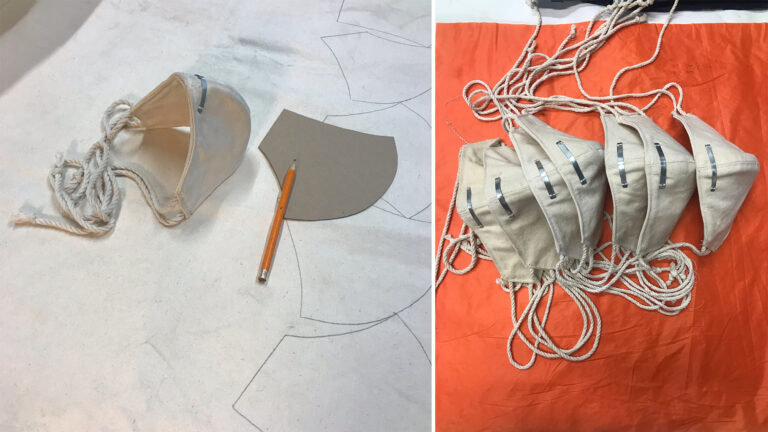
Like Hong, Robin Hill, an art professor at UC Davis, is using her existing skills to make masks. Hill’s masks have gone as far as New York. 

Hill said she has been making masks for about three to four weeks and works from the perspective of being an artist who works with what she has on hand. 

“My first mask was made from an artist canvas with flexible metal banding,” she said. “I posted on Instagram that I had made this mask and if anyone wanted one, they could direct message me.” 

So far, she has made 20 masks, selling them at $10 each with 100% of the proceeds going toward the Yolo County Food Bank.

“What I say about my practice and what I’m doing is that I am turning old studio materials into food for hungry neighbors,” Hill said. “It feels good to feel like I’m doing something other than just sheltering in place for my own and others’ protection. I have something to contribute and can help in my own way.” 
Written by: Janelle Marie Salanga — campus@theaggie.org

First-of-its-kind virtual UC Davis Pride Month centers on solidarity, community

LGBTQIA Resource Center celebrates theme of Nourishing Stories throughout May

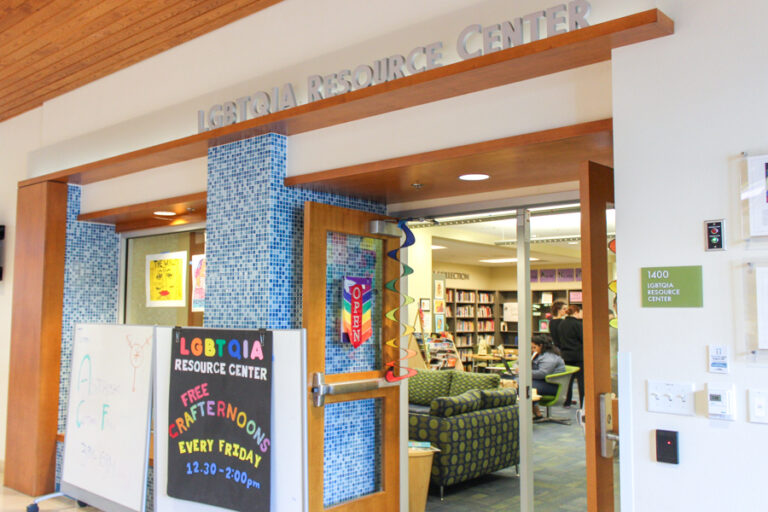
For the first time, UC Davis’ annual Pride Month is being held entirely online with interactive programming sessions and virtual opportunities to connect. Events are organized to bring empowerment, visibility and knowledge to the LGBTQIA+ community, all under this year’s theme: Nourishing Stories. 

The LGBTQIA Resource Center (The Center) has been planning for months, organizing innovative events and programs held exclusively online during the month of May. Participants are taking part in online events with guest speakers, virtual movie nights, sex education seminars and virtual dance parties. 

Crystal Knight, the assistant director at The Center, reiterated the description and goals of the month’s Nourishing Stories theme.

“Through our narratives, we can collectively build and sustain a community that provides nourishment for each other’s needs and lived experiences,” Knight said.

While some events can more easily adapt to an online platform, others traditionally depend on community gathering as a vehicle to spread empowerment and solidarity. One of the month’s most popular events, Out on the Quad, encourages LGBTQIA+ individuals to take up space and physically be “out” and outside. This event is usually co-organized with the Women’s Resources and Research Center (WRRC), and this year is no exception.

Joel Gutierrez is a fourth-year gender, sexuality and women’s studies and American studies double major who works as a community coordinator at The Center. Gutierrez and others have been working to adapt in-person events to an online platform, acknowledging both the limitations and value of finding new ways to celebrate.

“Out on the Quad can’t be what it’s supposed to be this year, and it can’t even be on the Quad,” Gutierrez said. 

Despite the month’s events taking on new dimensions, Gutierrez commented on the need and value of creating events for community members to take part in.

“There’s something really different I think about going to an event and sharing an experience with people and having an intention around it,” Gutierrez said.

At the event, set to take place on May 15, community members will have the opportunity to share stories, #OutFits and other examples of self-expression while enjoying a virtual dance party with a live DJ.

“Our intentions are to create a celebration of our community that centers music, laughter, positive energy and willing dancing in your living room,” the event description states.

Instead of working to recreate past years’ events, organizers worked to adapt the functions of events and programming, acknowledging how the ongoing pandemic is likely impacting community members. 

“We have a lot of different weeklong ways to get involved,” said Baani, a fourth-year cognitive science major who also works at The Center, who asked for their last name to be withheld. “Every Monday, a new journaling prompt is being released that people can complete either for their own grounding or if they tag us, they can be entered into a weekly raffle.”

Baani clarified that the structure of the raffle will allow for more ways than just journaling to enter.

“We changed the structure of the raffles so that winners will be announced at the end of the month and each submission of a doodling prompt, journaling prompt, or low energy alternative journaling prompt will be considered an additional entry in the raffle,” Baani said via email.

Due to the challenges of life during the COVID-19 pandemic, videos, instead of live-streaming all events, are providing flexibility for those wishing to participate. Social media posts similarly allow participants to take part in events and programs at their pace. 

Pride Month is one of the first month-long programming events to shift to an entirely online format at UC Davis. Looking forward, if social-distancing measures continue, Pride Month may serve as a guideline for other campus organizations aiming to adapt in-person events to an online platform.

Written by: Ally Russell — campus@theaggie.org 

UC Davis research finds strong links between emerging infectious diseases, threatened animal species

Primates, bats among groups with higher viral transmission rates

There are newly discovered links between emerging infectious diseases and endangered or threatened species of animals, according to research from the One Health Institute within the UC Davis School of Veterinary Medicine.

Researchers are studying the rates of viral transmission from animals to humans and are particularly interested in zoonotic diseases that come from wildlife, as opposed to domesticated species. 

“We began this study about five years ago because we were really interested in which wild animal species in particular were most likely to be a source of zoonotic disease for humans,” said Christine Johnson, a professor of epidemiology and ecosystem health within the One Health Institute at UC Davis. 

In order to isolate particular species for the study, researchers examined data showing major zoonotic viruses that had spilled over from animals to people over the years. They then looked at which species had the highest rates of disease transmission for these viruses and combined their data with other data from the International Union for Conservation of Nature.

“We found that domesticated species had, of course, shared a lot of viruses with people,” Johnson said. “We knew that they’re really globally abundant. We were very interested in what wildlife species were sharing viruses with people. We found overall that there are about 58 species that are described as being very common [disease transmitters]. These are highly adaptable species that moved in with people and have essentially set up house [in humans].”

In addition to identifying common species with higher rates of disease spillover to humans, the research pinpointed major reasons for increased viral spillover in many species. 

“The other major finding we had was that species that were declining because of habitat loss in particular, or species that are living in marginal habitats, had more zoonotic viruses and were sharing [these] viruses with people,” Johnson said. 

The study also identified a few main processes that facilitate disease spillover for wildlife declining in abundance.  

“The exploitation of wildlife through hunting, capture and the wildlife trade typically involves very close contact between wild animals and humans, which facilitates disease transmission,” said Pranav S. Pandit, a postdoctoral scholar at the EpiCenter for Disease Dynamics, via email. “Viruses jump species when there is close enough contact to enable transmission between an infected animal and a susceptible person.” 

Animals in close contact with humans can share viruses through respiratory droplets, as well as through contact with animal feces, urine or blood. Marketplace environments provide optimal conditions for spreading diseases between diverse species due to their high density of animal and human populations. 

“In order for a zoonotic pathogen to spill over from a wild animal to a human, it has to have two things,” said Tierra Smiley Evans, a faculty member at the UC Davis One Health Institute. “It has to have the biological innate ability to infect a new host, and it also has to have the opportunity to come in contact with a human.”

Beyond these marketplace environments, research highlighted certain species of animal vectors that play a critical role in disease transmission from animals to humans. Among all the wildlife species living in close proximity with humans, data showed that primates are one such example of a high risk species. 

“Primates have a lot of genetic similarity to us,” Johnson said. “Being that closely related, it’s easy for us to get pathogens [from them].”

In addition to highlighting the importance of primates in viral transmission, data has revealed that rodents and bats were common disease vectors in the past and played a large role in the emergence of COVID-19. 

“Some species of wildlife, especially rodents, have also increased in abundance and have adapted very well to human-modified habitats,” Pandit said. “The widespread presence of these species, especially those that have adapted to sheltering with people or depending on people for food, means a higher likelihood of interaction with humans which facilitates disease transfer.”

Bats play a critical role in earth’s ecosystem and make up a large portion of mammals, one in five, according to Johnson. Because they are flying mammals, they have developed unique adaptations over time. These animals willingly take up residence in marginal habitats close to humans, where they are forced to redistribute because of habitat degradation and destruction.

Both the SARS viral spillover in 2002 and the MERS virus were linked to bats, and scientists suspect that Ebola viruses also originated in bats. 

“The exact origins of SARS-CoV-2 is yet to be determined, but some evidence suggests that it came from bat species, and the spillover might have occurred around the live animal market in Wuhan,” Pandit said. “Our research has already identified these activities as high risk for spillover of diseases from animals to humans, but to identify the exact source of SARS-CoV-2 there needs to be large scale surveillance of suspected bat reservoir hosts and suspected mammalian intermediate amplifying hosts.”

Although we know that these mammals are widespread disease vectors, they also have extremely beneficial effects on the environments in which they live. 

“There’s a lot of really dangerous pathogens that have come from bats, but bats are [also] a really important part of the ecosystem,” Johnson said. “They’re really important for pollination [and] they eat insects. I think we need to understand better ways to keep ourselves safe and watch out for bats.”

Written by: Dina Gallacher — science@theaggie.org

Testing of COVID-19 skin patch vaccine begun by Verndari Inc. in collaboration with UC Davis

UC Davis Mouse Biology Program collaborates with biopharmaceutical company by conducting animal trials

Imagine being able to receive a vaccine through the mail in the form of a transdermal patch instead of an injection at the doctor’s office. Verndari Inc., a biopharmaceutical company dedicated to modernizing vaccine development and delivery, is currently making advances toward this possibility with the help of UC Davis facilities. The company recently announced that they will begin testing their patch delivery system in collaboration with UC Davis’ Mouse Biology Program in the first steps of developing a potential COVID-19 vaccine.

Daniel Henderson, the chief executive of Verndari Inc., initially began testing his designs for the Verndari’s VaxiPatch, a skin patch vaccine delivery system. The skin patch vaccine, for the flu, was a collaboration with UC Davis’ Department of Bioengineering in 2016. 

“We hope it can really transform the way we think about vaccines because if we could make them room temperature stable, we could ship them all over the world,” Henderson said. “If we make it something that is easy to apply, [it’s] potentially something we could self-apply.”

After developing flu vaccines to apply to the microneedles on the patch, preclinical testing began with the Mouse Biology Program. This led to promising results in early December of 2019. As COVID-19 became a more prominent threat, the company switched its focus from developing a flu vaccine to addressing the pandemic issue at hand. 

The Mouse Biology Program’s role in this preclinical testing consists of looking at the vaccine’s ability to move from the transdermal patch into the body, according to Kristin Grimsrud, the associate director of vivaria and veterinary care at the Mouse Biology Program. In addition, they will be making sure the body can recognize the antigens part of the vaccine and build antibodies against it. They hope to optimize the technology of this patch vaccine in order to achieve the same, if not better, results compared to an injectable vaccine. 

Grimsrud explained that the FDA requires these animal trials prior to human clinical 

trials in order to show the vaccine’s safety and efficacy. In other words, animal models are a tool used to make sure there are no adverse effects associated with the vaccine and that humans will be able to benefit from it. 

“Before you move [the vaccine] into the human, […] you need to work in multiple animal models, which takes time, to show that not only were you able to show that it’s safe, but that in the event that that individual got infected, it stopped the infection from causing a clinical disease or at least reduced the clinical symptoms,” Grimsrud said.
Once the rat models prove the vaccine’s safety and efficacy, larger animal models, such as non-human primate (NHP) models, will be used to demonstrate the vaccine’s ability to prevent severe diseases. The California National Primate Research Center (CNPRC) helps with providing these NHP models.

“Vaccine immunogenicity and efficacy outcomes in NHPs are more likely to predict outcomes in humans relative to small animal models, making the NHP model a very powerful model for studies centered around COVID-19,” said Smita Iyer, an assistant professor and core scientist at the infectious disease unit at the CNPRC, via email.

The CNPRC has the rhesus macaque, or NHP, model of COVID-19 along with the animal approval protocols in place and ready to start testing once Verndari Inc. is satisfied with the results of the rat studies, according to Iyer. In the meantime, the Mouse Biology Program is taking an active role in collaborating with Verndari Inc. by brainstorming prototypes and offering intellectual insight rather than solely conducting tests, stated Grimsrud.

“We really like that nice partnership and friendship we’ve built with [Verndari Inc.] over the years, and we’re just really proud of the work they’ve achieved,” Grimsrud said. “Often we don’t get to talk about what we do in animal research and so it’s exciting that we actually do get to talk a little bit about what we do and have others know about it as well so they can value the animals that have contributed to the research as well.”

Written by: Michelle Wong — science@theaggie.org

Corporations continue to exploit workers during pandemic

Support workers every day, not just May 1

On May 1, the UC Cost of Living Adjustment (COLA) movement and UC Academic Federation of Teachers were among more than 80 graduate and university labor organizations that participated in International Workers’ Day demonstrations. As UC campuses have transitioned to online instruction and have suspended in-person operations in light of the COVID-19 pandemic, graduate students continued their call for livable wages and joined lecturers — who also face job insecurity as they currently work without a contract — in bringing attention to the threat of future staff layoffs.

These actions were set against the backdrop of a larger, nationwide strike at a number of companies — including Amazon, Target, Trader Joe’s, FedEx and Instacart — that took place on the same day. Strikers fought for hazard pay and stricter health and safety measures at their places of work, imploring people to boycott these companies while the strike was ongoing. They want, and deserve, to be properly protected and adequately compensated by their wealthy employers for the essential services that they are still performing.

The Editorial Board is in solidarity with the COLA movement, university lecturers and all workers who chose to take action on May 1. We urge everyone to support the workers who are keeping our education and essential services viable — especially as the country continues to feel the effects of the coronavirus. It’s inconceivable that employers are not providing workers with the bare minimum — financial security and workplace safety — needed to perform their jobs without risking their lives.

The pandemic has taken the lives of over 80,000 people living in the U.S., and the resulting economic slowdown has put tens of millions of Americans out of work. It has exacerbated the profound societal issues that stem from a broken health care system and a culture of worker exploitation. 

Millions of the country’s unemployed are expected to lose their health care coverage as a result of being removed from their previous employer’s plan. And because the country has neglected to invest in a comprehensive plan for Medicaid expansion, almost a third of those people will be forced to go without any insurance because they do not qualify for Medicaid where they live.

Had American workers been compensated with wages commensurate with the growth in earnings that top executives have experienced over the past several decades, it would have been much more feasible for many of those who lost their jobs during this crisis to save up enough cash to get by. But as wages have remained stagnant, American workers and the unemployed are left especially vulnerable during an extreme economic downturn.

But even those who are still employed at this time are being forced to risk contracting the virus without any additional compensation while facing backlash from the wealthy corporations — like Amazon — that employ them. Claims of a shortage of protective gear, lack of sanitation and inadequate paid sick leave policies have driven warehouse, delivery, store and gig workers to speak out against their employers and participate in the May 1 strike. 

We encourage everyone to push for fair labor practices and livable wages, and to find alternatives to using the services of companies that aren’t providing their workers with them. Whenever possible, buy from independent stores instead of Amazon and tip gig workers directly in cash instead of through the app. We all must do our part to help those who are helping us during this difficult and trying time.

Written by: The Editorial Board

Change your perspective with a sad movie

We could all use a good cry

From a very young age, I’ve had a strong distaste for sad movies. I distinctly remember watching my mom and sister cry during classic sad movies and wondering why they enjoyed them so much. I, on the other hand, only watched “Marley & Me” once in my childhood and immediately vowed to never watch it again — I still haven’t. There’s an enormous list of movies I refuse to watch, and every single one of them is a sad movie. If I have a choice between laughing and crying, I will always pick laughing. 

I am a “Friends” and “Gilmore Girls” fan through and through. On any given day, you can bet I am watching at least one of those shows with a cup of coffee in my hand. If you had asked me a couple of weeks ago to switch out my shows and coffee for a sad movie and some tissues, I would’ve said no. But after reading an article by Mind Body Green, I have changed my answer. Because, as it turns out, watching sad movies that pull at your heart strings and make you cry can actually be beneficial. 

Sometimes, in our fast-moving lives, we tend to get caught up in all the things we don’t have or how unlucky we think we are. The shirt we’ve been wanting is sold out or we can’t go to the concert we’ve been looking forward to and it feels like the end of the world. Then, you watch a movie like “The Pursuit of Happyness” and suddenly your misfortunes seem so small. You realize that if the worst thing to you is a sold-out shirt, then you have it pretty good. 

It’s easy to go through life with tunnel vision of only your problems. We often assume that if our lives are good and happy, then everyone else’s must be too. Sad movies bring a whole new perspective right into your living room. They make you realize that while you are fighting with your siblings over shoes, there are kids around the world fighting for their lives. 

Although usually introduced to us by teachers and not always appreciated for its artistic value, “Schindler’s List” is meant to teach us more than a history lesson. The horrific truth of the movie develops our empathy for people whose lives are riddled with tragedy. This is not to say that if you’re feeling down, you should sit with a bowl of popcorn and watch “Schindler’s List.” Instead, I’m saying that when we’re faced with the truth of heinous events, we often change our perspective. 

Sad movies can provide a sense of emotional release. I’m not one to pour out my emotions during movies. That is, until I watched “Five Feet Apart,” an exceptional movie about a heartbreaking love story that incorporates the loss of a friend. Sometimes, we have experiences in our lives that require us to disconnect our emotions in order to keep going. When we are finally ready to work through those emotions, we may have a hard time reaching them. Watching sad movies can be a cathartic experience that helps you connect with those emotions and work through them. 

Watching sad movies is not the only way to make you feel better, nor is it something that should be done regularly and in place of professional help. Rather, it’s just one of many emotional releases that can be both therapeutic and inexpensive. After you read this, I hope you find yourself, like me, less afraid to watch a sad movie. Cuddle up with your favorite blanket, maybe some friends and just let your feelings out. 

Written by: Kacey Cain — klcain@ucdavis.edu

Disclaimer: The views and opinions expressed by individual columnists belong to the columnists alone and do not necessarily indicate the views and opinions held by The California Aggie

The Beginner’s Guide to Loving Dolly Parton

Pour yourself a cup of ambition and let’s get to it

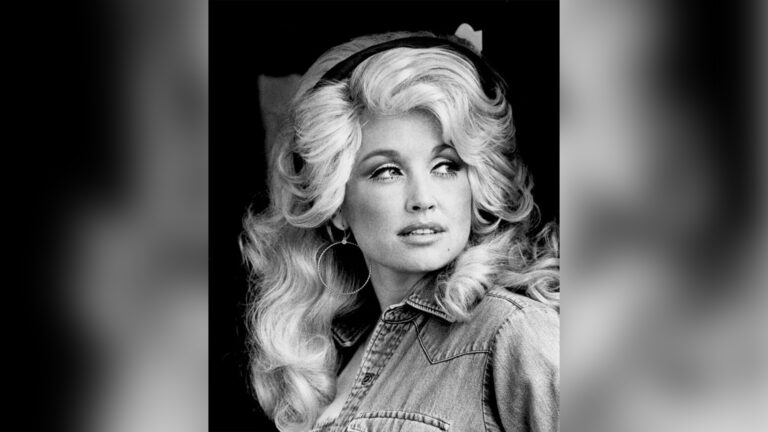
I’ll start with what the reader should take away from this article: Dolly Parton is iconic. Dolly Parton is the queen of country music. And I say this with the confidence of a relatively new fan — I only really began to dive into her music and familiarize myself with her canon beyond “Jolene” and “9 to 5” during Fall Quarter of 2019. Her songs now frequently appear on my quarterly-made playlists, and they seem to play on repeat. Her songs instantly perk my mood, and even her heart-wrenching love songs have the ability to make a sad situation feel, at the very least, warm. 

The key to Dolly is the passion evident in each of her songs. There is power rooted in her vocals, which is able to expand on the simplicity of concepts characteristic of country music and instill the emotions of pure joy, deep heartbreak and nostalgia for simple moments. 

Dolly deserves modern recognition for her pioneering as a female country singer and her continued success since the 1960s. Indeed, my love for Dolly partially stems from her often unacknowledged feminist content. It’s essential to note that Dolly does not consider herself a feminist, as she admitted in the WNYC podcast “Dolly Parton’s America.” Yet, even if she doesn’t consider her music to hold such a sentiment, that’s not to say that one could not still find such appeal. 

She is a force to be reckoned with within a music genre dominated by machismo; she demands respect in a variety of ways. She calls out mistreatment from men, and she calls out inequality. She celebrates her womanhood. While there are plenty of other female country musicians with much more explicit calls for gender equity — like Loretta Lynn’s “The Pill” — the popularity of a female singer who can embed discreet notions of female power is worthy of praise.

There is something to be said for an artist who is able to appeal to an audience intertwined in mid-20th Century gender ideals while presenting them a new perspective to consider. It’s important to recognize and contextualize her music within both the social norms in which she was singing as well as her own musical intentions. Ultimately, Dolly is not a freedom fighter. I would not equate her to the ranks of figures like Gloria Steinem, for example. Nonetheless, she should be praised for her effort to raise a new point of view and acknowledged and respected for the contributions that hold a feminist twang: love for others and reflection. 

I can understand the intimidation of attempting to familiarize oneself with such a long-standing artist with dozens of albums. And I must admit, I have only begun to scratch the surface of her discography. My taste in country music gravitates toward folk, a consequence of my old-fashioned cowboy familial roots. I was taught to appreciate musicians like Marty Robbins, Johnny Cash and Hank Williams. Therefore, I have gravitated less toward Dolly’s modern tracks and more toward her earlier ones. Two of her albums, “Hello, I’m Dolly” and “Jolene,” serve as both a foundational introduction to Dolly Parton as well as my favorite albums of her to date. 

Let’s start with “Hello, I’m Dolly,” her 1967 pilot album. The album is goofy and endearing. In “I Don’t Want to Throw Rice,” she describes wanting to throw rocks instead of rice on the wedding day of the woman who stole her man. In “Something Fishy,” she sings of concern that her boyfriend is cheating on her during his so-called fishing trips. I can’t help but giggle at some of the absurdity of a young Dolly’s expressions of fear and jealousy. A similar sense of adolencence is illustrated in the album’s opening track “Dumb Blonde.” She rails at an ex-lover who calls her a dumb blonde upon confronting his infidelity. She responds with the ultimate comeback: “And you know if there’s one thing this blonde has learned, blondes have more fun.” Go get ‘em, Dolly. 

While still a little silly, the undeniably catchy track sets an early precedent for the type of confidence and individuality Dolly exudes in her music. Yes, much of Dolly’s image of fame has centered on her appearance — an oversexualization created for and by the male gaze. What differentiates Dolly, and what makes me respect her as an artist, is the control she embraces from the attention she receives. It’s her blonde hair, it’s her body. She sources a sense of independence and outspokenness from her physique. She even claims this power more directly in the ballad “I Wasted My Tears.” Indeed, in her hypnotic vocals of the second verse, she claims “I wasted my time when I spent it with you.” The beauty of this album stems from knowing the maturity that is soon to come in her budding career. 

By 1974’s “Jolene,” Dolly had grown up: her music was even more raw, her song writing more complex. Musically, it’s more somber. The innocence of her first album had departed, replaced with clear evidence of significant heartbreak. Of course, arguably her most popular song, “Jolene,” is a perfect example of such: expressing fear her husband will leave her for a woman with “ivory skin and eyes of emerald green.” Yet the album reaches deeper in songs like “When Someone Wants To Leave,” “Living on Memories of You” and “Lonely Comin’ Down.” 

One of her best songs is also in this album: “I Will Always Love You.” In fact, Whitney Houston’s famous rendition was a cover of this Parton original. In each song, Dolly describes the dramatically painful moments of relationships ending with digestible simplicity. The pain of an unreciprocated love, the physical pain one experiences during heartbreak, nostalgia for when times were good. She doesn’t overcomplicate her emotions or describe them as lofty. Dolly is so appealing because she doesn’t try to be more than what she is, she doesn’t seem to take her song writing so seriously to the point where it misses the connection and intimacy she hopes to establish with her listener. Her impressive vocals and accurate lyrics do the work.  

There is a sense of nostalgia in the album as well. In “River of Happiness” and “Early Morning Breeze,” she uses imagery of serene moments in nature as points of reflection. She views these experiences of scenic isolation as meditative  — finding the beauty that is rooted in heartbreak, the deep connection one must find within themselves as they experience the increasing complexity of love that comes with age. I find this album to be a coming-of-age album for the artist, displaying her own maturation and guiding us through ours. Dolly doesn’t let us forget that she too shares the same emotions we feel.

I urge you to take the dive into Dolly Parton. She has been the artist who taught me the value of learning to love dancing by yourself while you get ready in the morning. 

Written by: Caroline Rutten — arts@theaggie.org

From the streets of Watts to a hip-hop empire

The ascent of Anthony “Top Dawg” Tiffith and his generational group of artists

Anthony “Top Dawg” Tiffith is a familiar face in the Watts neighborhood of Los Angeles. He seemed to be everywhere in the community, from swap-meets to block parties to funerals. To many kids in the neighborhood, he was a paternal figure doling out advice and reprimanding kids when they slipped up. Tiffith comes from a background shaped by the Los Angeles gang scene. In 2004, at the age of 30, he decided his life was destined for change. Drawn to the artistry and business side of music, Tiffith founded a neighborhood record label — a space to cultivate budding talent and shepherd artists away from trouble.

In order to grow his label, Tiffith added Terrence “Punch” Henderson — part-time IKEA supply manager and part-time record producer — to the project. The nascent label’s first target was Johnny Reed Mckinzie Jr. a.k.a Jay Rock, a talented but unrefined twenty-year-old emcee with a rugged baritone from Tiffith’s Watts neighborhood. Tiffith surprised McKinzie at the barbershop, offering to pull him off the streets and put him in the studio. Mckinzie obliged and Top Dawg Entertainment was born. During the early days, TDE was built on ensuring the success of Jay Rock, eventually signing a co-deal with “Warner Brothers Music” to produce Jay Rock’s debut album “Follow Me Home.” Around this time, Tiffith also stumbled upon a once in a generation talent. 

Dave Free — a teenage disc jockey from the local high school — knew that Tiffith was the key to the music industry. In a brash and bold act that would end up changing not only the DNA of T.D.E. but of hip-hop forever, Free posed as a tech repairman to fix Tiffith’s computer to show off a mixtape from one of his close friends — a shy, but unabashedly confident 16-year-old going by the moniker “K.Dot.” Free slipped on the tape and began mindlessly tinkering with the computer to stall. Tiffith was struck by the tape and sensed the kid on the tape was cut from a different cloth. Tiffith added Free as a co-founder and struck a deal with Kendrick Lamar Duckworth — now the T.D.E. poster boy, and debatably greatest MC alive.

From a notoriety standpoint, T.D.E. didn’t truly take off until the formation of the Black Hippy group. The supergroup became the first to have all four members featured on the hip-hop publication XXL’s Top 10 Freshman Class and catapulted T.D.E. into the big leagues. Black Hippy, all in their early 20s and from Los Angeles County, is composed of Jay Rock from Watts, Kendrick Lamar from Compton, Schoolboy Q from South Central LA and Ab-Soul from Carson. Although Black Hippy never released a collective project, they frequently feature on each other’s albums and tour together. Combining heads gave them an opportunity to build off of each other musically and develop a lasting brotherhood. Their kinship has served them well, keeping them grounded and focused amid showbiz’s blinding limelight. 

As of recent, T.D.E. has taken a distinctive shift into rhythm and blues, signing talented up-and-coming artists like SZA and SiR. SZA’s album 2017 “Ctrl” made a name for her in the mainstream as the best young R&B artist. SiR, on the other hand, has flown under the industry’s radar but has nevertheless produced some of the more soothing, down-to-earth, groovy albums of the past two years with the 2018 record “November” and the 2019 composition “Chasing Summer.” These new artists take the pressure for the label off of Kendrick and Black Hippy and add to the palette of sound the label can deliver. These new influences work wonders for all involved as the hip-hop/rap side of the label collaborates and feeds off of the R&B side. This is evident in the more fluid, multi-dimensional tracks produced by the label like SiR’s “Hair Down” featuring Lamar as well as the critically acclaimed “Black Panther” soundtrack, whose creation was led by Lamar and Tiffith and features 7 T.D.E. artists. 

Top Dawg Entertainment has risen from relative obscurity in the early 2000s to one of the most dominant labels in the industry — often being referred to as the new Death Row Records, Suge Knight’s infamous record label that produced Tupac’s “All Eyez on Me” and Dr. Dre’s “The Chronic.” When discussing the work T.D.E. has done to cultivate such a list of artists, those close to the record label refer to it as a family. T.D.E. always locally sourced artists — eight of the 10 are from Los Angeles County. T.D.E. puts its artists in the driving seat; giving them space to become inspired.  While speaking with Complex magazine, T.D.E. co-founder Terence Henderson discussed letting the music shape the business process, not the other way around. 

“The goal was to always touch people, so whatever came out of that was cool,” Henderson said. “We were going against the grain of what was popular. We did that every time.”

After 22 studio albums, two compilation albums, six extended plays, 17 mixtapes and more than 10 million records sold in the U.S. alone, T.D.E. and Tiffith are still bound deeply to their roots. In the wake of the devastation of the coronavirus pandemic, Tiffith paid for the rent of over 300 Los Angeles families from the Watts neighborhoods Imperial Courts, Jordan Downs and Nickerson Gardens.

At the Legacy Leaders Spring Gala in Watts honoring the work of Tiffith, his son Brandon spoke on behalf of his father, reflecting on his father’s journey, his ambitions and his community.

“As a kid growing up in Watts, I always wanted to be a leader in this community,” Tiffith said. “Being able to reach out to community members in this area and being able to show kids what’s past these projects has always been my goal.”

T.D.E. is currently home to the pioneers of the hip-hop industry — bringing home Watt’s first Grammy Award winner under Jay Rock as well as the hip-hop world’s first Pulitzer Prize for literary excellence to Kendrick Lamar. Under the guidance of Tiffith, T.D.E. has brought honor and pride to the Watts community, and it’s safe to say he’s accomplished and exceeded his goal.

Written by: Andrew Williams — arts@theaggie.org

Police Logs

Wait, is that a bear hopping my neighbor’s fence?

April 23

“Ongoing issue with loud chickens.”

April 24

“911 hang up. ‘Just checking to make sure phone could dial.’”

April 25

“City code violation. 2 females exercising in the park.”

“Trapped coiled snake under a bucket on her back porch.”

“Female came inside and opened up milk, then wanted it for free.”

April 27

“Called on 911 and asked ‘Are we having fun yet? No!’ and then disconnected the line.”

April 28 

“Customer refusing to leave drive thru.”

April 29

“He saw a brown bear walking in front yard of neighbor’s residence and hopped fence into backyard.”

“Neighbor is kicking in and breaking respondent’s fence — upset over tree trimming.”

“Door Dash knocked on door and startled family.”

Exploring Adele’s canon through the ages

How “19,” “21” and “25”  compare 

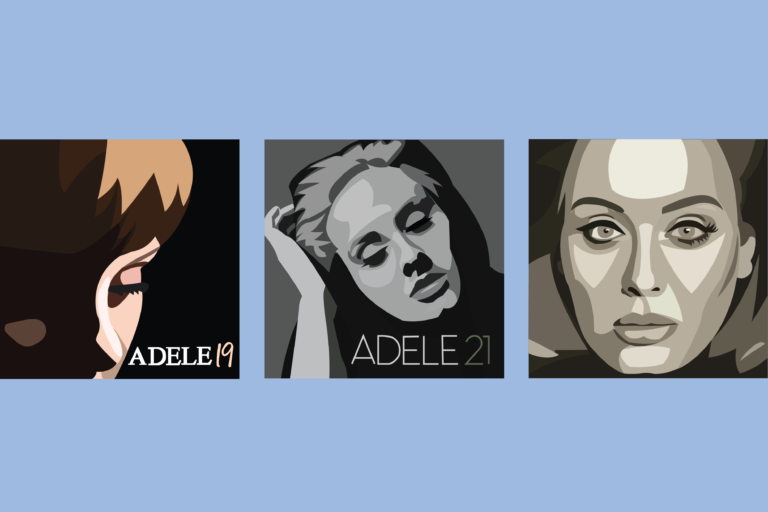
Adele has the ability to make the world stop and listen. She has a grasp on her own voice that is unheard of in contemporary pop. Over the course of her incredibly successful career, she has released only three albums, each titled by the age she was when she wrote them. In honor of her rumored upcoming release, let’s see how well the albums hold up when they’re compared to each other.

3) “25”

Adele’s most recent album is not bad by any means, it just falls short compared to its predecessors (Adele, if you’re reading this, I love you and I’m sorry). “25” follows her established themes of heartbreak and youth with a new added element of growth. Its lead single “Hello” won three Grammys and was on the radio for months. Unlike its sister singles, it simply does not have the longevity. After hearing it on the radio three times a day and in every store I set foot into, those ominous piano chords cause my brain to immediately shut down. The following singles, “When We Were Young,” “Send My Love (to Your New Lover)” and “Water Under the Bridge” are all incredible additions to the Adele songbook, but this album’s real gems are hidden between its singles. 

The tenth track, “All I Ask,” feels like this album’s “Make You Feel My Love.” The ballad, co-written with Bruno Mars, showcases her vocals like we’ve never heard before. Surprisingly, it is one of her catchiest songs (it makes for really great belting material). Her vocals are accompanied solely by sweeping piano melodies. You can tell that when she was in the studio she was thinking, “Yeah this one’s gonna make ‘em sob, innit?”

The lightly-produced folk track “Million Years Ago” communicates a yearning for her old self. It fits perfectly in the album and showcases an intense fear of fame that wasn’t apparent in any of her previous songs. It is also extremely painful and relatable for a college freshman (“Miss my friends, I miss my mother”).

“River Lea” is like no other Adele song. It’s hard to communicate the way the track makes you feel; I would equate it to going all the way around on a swing or whatever Ophelia was feeling in the painting “Ophelia.” It has a supernatural element emphasized by the backing gospel vocals. The haunting lyrics paired with the build of the production culminate into the best song on “25” and one of the best she’s ever released.

Though its singles don’t match up to her previous work, “25” holds some of Adele’s best tracks. More than anything else, it proves that she is an artist with incredible introspective ability and the capability to keep making hits in the face of change.

2) “19”

You can hear her accent on this album, and it’s funny to hear her say “fink,” so we’re already off to a great start. The fact that Adele wrote “19” at 19-years-old is both impressive and terrifying — both because of the lyrical quality and because she sings with the soul of someone who has definitely lived more than two complete decades. Overall, it is experimental in ways that “25” failed to be and includes some of her best, most underrated singles.

Unlike “25,” “19” is carried by its singles. One of her funkier songs, “Cold Shoulder,” propelled her to fame when she performed it on “Saturday Night Live” in 2008. The track is produced by Mark Ronson, and you can tell. Taking into account the quick beat and belting vocals, I honestly believe that, with a little work, it could be the new cup song.

If you are ranking Adele songs in how fun they are to sing along to, “Chasing Pavements” may take the top spot. I cannot understand anything she says in the first 30 seconds, but it only adds to the wonderful mystery of the song. It is soulful and balances her powerful building vocals with an orchestra-like production. Perhaps no song better illustrates the feeling of looking out the window of a car when it’s raining.

“Make You Feel My Love” establishes itself as the strongest track on the album. 

Only backed by piano and light violin, her voice is out in the open. There is a rawness that she froze in time — it lets the listener apply the lyrics to their own heartbreak. Until recently, I did not know the song was a cover (apologies to Bob Dylan and his fans, but his version is way worse). She truly makes the song her own. I listened to her version while writing this, and the only word that came to mind was “pain.” 

With solid singles and unique production, “19” set the foundation for the career of one of the greatest vocalists we have ever seen.

1) “21”

“21”…where do we even start? I feel like I don’t even have to explain how iconic this album is. Adele strayed from the hopelessness that guided “19” and opted for an upbeat take. This was perhaps her greatest career decision. “21” is the best-selling album of its decade and three of its singles peaked at number one on the Billboard Hot 100. The entire album is well produced, and no track feels out of place.

“21” had five singles released over the course of one year: “Rolling in the Deep,”  genuinely one of the greatest songs of all time; “Someone Like You,” the iconic, emotion-drenched ballad; “Set Fire to the Rain,” which has the overwhelming ability to make me feel like I’m in The Hunger Games; “Rumor Has It,” featuring mesmerizing pounding drums and undeniable catchiness; and, finally, the unforgettable vocal masterpiece that is “Turning Tables.” My hands are shaking from typing the song names… I cannot comprehend this much power being on one album. They create the greatest combination of singles ever.

Even the lesser-known songs have the ability to be singles. “He Won’t Go,” “Take It All” and “Don’t You Remember” all have the magnetic quality the songs listed above have, but are less popular only because they were never prompted to single status.

In addition to having the best singles and side tracks, “21” includes the best song Adele has ever released: “One and Only.” The feeling that the six minutes of “One and Only” instills in listeners is unlike any of her other songs. This could be attributed to its stellar melody and vocals or its larger-than-normal production, but it really boils down to her intention. In a behind-the-scenes interview about “21,” Adele described the track as “the first happy song I had ever written.” It’s addicting, intoxicating and fun. With the overall quality of each and every song, It is undeniable that “21” is her strongest piece of work

Adele has made headlines recently for her divorce, with rumors swirling about her having to pay her ex-husband massive amounts of money. This obviously stressful and painful situation is not an opportunity for our own gain. That being said, I am incredibly excited for how much emotion this upcoming album will hold. (Once again, Adele, if you are reading this, we have built up three years of emotions and will eat up whatever you put out). In the end, every song she has released is incredible, just put her discography on shuffle. Here’s to 30!

Written by: Livvy Mullen — arts@theaggie.org

Recipes in quarantine: Cowboy Corn Chowder

An easy addition to a summertime meal

There are three things that get me excited about summer: watermelon, grilled zucchini and corn on the cob. As the days get longer and the sun shines a little stronger, evenings seem endless. People gather on the front porch and munch on buttered corn. Everyone gets to put their elbows on the table and just chomp down. Suddenly they are comfortable and laughing, and the barriers to conversation are easily brought down by the light-hearted nature of the food. 

When I was in fourth grade, I went on a school trip to a gold rush camp. At this camp, all of us pouty 10-year-olds had to pretend we were back in 1849 and make dinner. We worked with our instructor to make cornbread, and after waiting what seemed like decades, it was ready. Almost 10 years later, I still remember that cornbread, the sliver of butter that sat atop it and how amazing it tasted. 

That cornbread was just one example of how corn creates classics that I think are as enjoyable now as they were for miners during the gold rush. For this week’s recipe, I imagine that a rustic Matthew McConaughey cowboy-type would enjoy it in the middle of the desert after riding on horseback all day. Tired and sore, he would set up camp and begin to make this recipe. Somehow, he would have all the ingredients on this list (as well as an open fire and a pot) and would make cornbread to pair as a side. As it cooked, he would look at the fading sky and feel exactly how I did when I ate that piece of cornbread in fourth grade: absolute bliss. 

Melissa Thayer, a third-year environmental science and political science double major, found this corn chowder recipe to be an easy addition to a summertime meal. Filled with potatoes, carrots and corn, it fills you up with warmth and happiness. It can also easily be made vegan with a substitution of plant-based milk and vegan butter. When remaking this recipe, I found that I had no milk in the fridge and no immersion blender. Surprisingly, almond milk worked well and the blender ended up not being that important in the end. By just mashing the softened carrots and potatoes, the chunks were still present in the end result. Enjoy!

Cowboy Corn Chowder

4–5 large yukon gold potatoes, cubed

2–3 white carrots, chopped

1 medium onion, chopped

1 green pepper, chopped 

3 garlic cloves, minced

4 cups vegetable broth

4 tablespoons butter

½ teaspoon dried thyme

1 teaspoon paprika

1 teaspoon cayenne pepper for additional heat 

1 teaspoon dried parsley

1 ¼ teaspoon salt, or to taste

2 cans of corn

1 cup of milk 

To thicken further: 3 teaspoons all-purpose flour. 

Sauté the onion, pepper and garlic in butter at medium heat until everything is nice and soft in a large pot. Add in the carrots and the potatoes as well as the spices. After a couple of minutes, add in the broth and leave it at a slow boil until the carrots and potatoes are soft, about 10 minutes. Once soft, lower to a simmer and use an immersion blender to blend about ¼ of the soup. 

Once it begins to thicken, add 3 teaspoons of flour to ¼ of the milk, whisking it separately into a smooth mixture. Once smooth, add the mixture and the remaining ¾ milk to the pot. And of course, add the corn. 

Written by: Athena Aghighi — features@theaggie.org

A grim future for once powerful department stores

Social distancing measures, economic shutdown hurting an already struggling industry

Before the prevalence of online shopping, department stores were a staple of American consumerism. But recent trends in the retail industry prove that the popularity and presence of today’s department stores are a thing of the past.

The economic shutdown due to COVID-19 has put department stores in a precarious position, but this is just another chapter in a string of unfortunate events. Early last year, Forever 21 filed for bankruptcy, finding itself unable to keep up with the prevalence and popularity of online shopping. So did many other brands, including long-time American luxury department stores like Barneys New York. Not only have retailers lost business to online shopping, but they still have to deal with heavy costs including rent. For some companies, such as Toy “R” Us, the troubles go beyond that. In 2018, Toys “R” Us closed or sold all of its stores in the U.S. The trouble for them began when competing department stores like Walmart began selling toys in their own stores. That, coupled with massive amounts of debt and e-commerce, spelled out the inevitable end for Toys “R” Us. 

Department stores have a long history and an important place in the story of global consumerism. The very first department store in history, Harding, Howell & Co’s Grand Fashionable Magazine, located in London’s St. James district, is considered to be the precursor to the modern department store. In the U.S., these powerful “palaces of consumption” for middle- and upper-class consumers gained prominence by the 19th Century. Stores like Marshall Field in Chicago and others across the world were in large ornate buildings with grand, enticing windows, extending an invitation to the American consumer. 

However popular these stores were, their survival always depended on their ability to adapt to the cultural and economic patterns of the time. Vicki Howard’s “From Main Street to Mall: The Rise and Fall of the American Department Store” examines how these patterns in American society have propagated the evolution and eventual collapse of these stores. From the changing landscape of American cities to the emergence of chain and discount retail, online shopping and the recent economic shutdown are just another challenge for department outlets. 

The coronavirus pandemic has raised concern over the future of department stores across the world. The already struggling industry has seen an 8.7% drop in monthly sales for March of 2020, which is unlikely to improve in the coming years. 

“The department stores, which have been failing slowly for a very long time, really don’t get over this,” said Mark A. Cohen, the director of retail studies at Columbia University’s Business School, in an interview with The New York Times. “The genre is toast, and looking at the other side of this, there are very few who are likely to survive.”

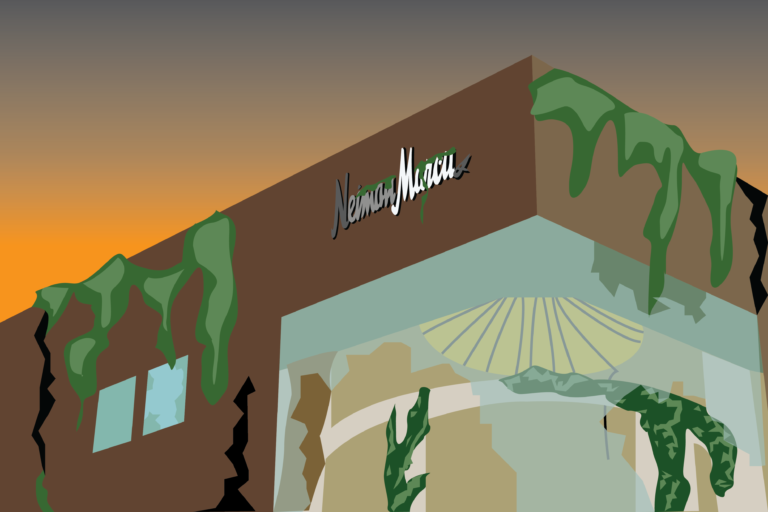
In mid-April, Neiman Marcus filed for bankruptcy partly due to the economic fallout from the shutdown. Many other department stores like Nordstrom Inc. and Macy’s Inc. are fighting to ensure the same won’t happen to them, but the future is bleak. The pandemic, however, was not the decisive factor in the demise of Neiman Marcus, one of the most iconic department stores. Like many others, Neiman Marcus struggled to keep up with the shift to online shopping as well as the emergence of discount retail chains. 

Most recently, J. Crew announced that it was filing for bankruptcy. The temporary store closures are just an added pressure to an already crumbling industry. 

In February, in an attempt to create a more sustainable business model, Macy’s made plans to cut about 125 stores nationwide and 2,000 corporate jobs — a common trend among many stores for some time now. Recent job loss from the pandemic has only made business and job prospects more dire, signaling the end of department stores as we know them.

 It’s hard to see what a future without department stores will look like. Many of us will be able to survive without going to department stores, but those whose jobs depend on the survival of the retail industry may not. It’s hard to know what will become of department stores in the thick of a global pandemic and recession. What is certain is that both the livelihoods of many and our relationship with consumerism, fashion and even sustainability will change dramatically. In the long term, this trend may correct itself, but the uncertainty of what the next few months holds is a scary thought.  

Written by: Simran Kalkat — skkalkat@ucdavis.edu 

Disclaimer: The views and opinions expressed by individual columnists belong to the columnists alone and do not necessarily indicate the views and opinions held by The California Aggie

Give Day breaks new records amid campus closure, stay-at-home order

UC Davis receives $2.5 million in gifts, donations 

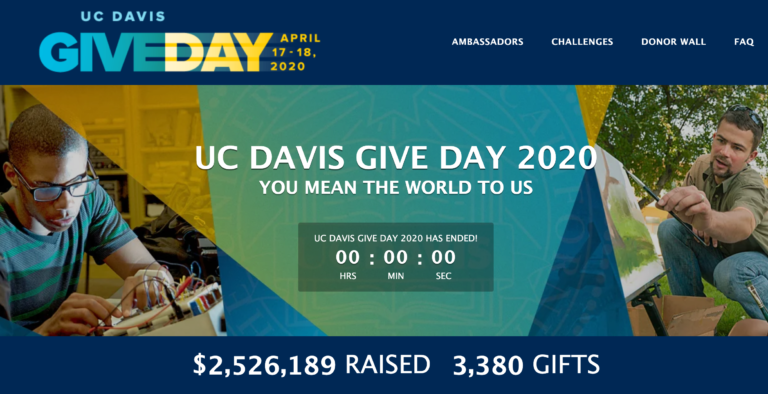
Despite the move to remote instruction, the campus being placed on suspended operations and a statewide stay-at-home order, UC Davis broke records with its most successful Give Day to date. On April 17 and 18, UC Davis raised $2,524,539 and received 3,374 gifts from donors. 

Give Day and Picnic Day usually coincide in a weekend of events and activities to highlight the accomplishments of UC Davis’ schools, centers and departments: with Give Day’s goal to raise money from donors who could be alumni, philanthropists or even current students. This year, following the cancellation of Picnic Day, Give Day moved to an entirely online platform. 

To help incentivize potential donors and help stretch the value of each individual donation, Give Day featured 150 challenge gifts.

“Challenge gifts make contributions of any size go further by ‘unlocking’ larger amounts put forth by community donors,” according to the Give Day webpage

Dana Allen, the assistant vice chancellor of Alumni and Affiliate Relations and executive director of the Cal Aggie Alumni Association at UC Davis, worked with a network of parents, alumni, students, retirees and emeriti to help set challenges and raise Give Day funds.

“I worked to help our team within Alumni and Affiliate relations promote challenges as well as individual giving,” Allen said.

To help encourage donations, the Alumni Association of Directors set its own challenge and helped raise an additional $2,500.

For many challenges, a greater number of individual donations helped unlock matched funds set by different challenges and donors.

In light of the ongoing COVID-19 pandemic, donors had the opportunity this year to give to several emergency funds to provide assistance to students in need as well as medical professionals. The Pantry, the Aggie Compass Basic Needs Center and the Student Emergency Relief Aid Fund are a few of the resources helping provide students with accessible food, housing and basic needs during the epidemic. Units like The Pantry rely on donations to fund more than 90% of their operations, according to their Give Day webpage

Ryan Choi, the unit director of The Pantry, commented on the amount of gifts received on Give Day.

“This year, the Pantry and Aggie Compass Basic Needs Center shared a joint Give Day Challenge: The 2020 Murphy Basic Needs Endowment Challenge,” Choi said. “The Murphys pledged $10,000 for every 20 gifts donated during the give day campaign.”

With the help of donation matching and challenges, The Pantry gained $30,000 from 72 donors and the Murphy Challenge. 

Written by: Ally Russell — campus@theaggie.org