57.3 F
Davis

Davis, California

Wednesday, December 24, 2025
Home Blog Page 337

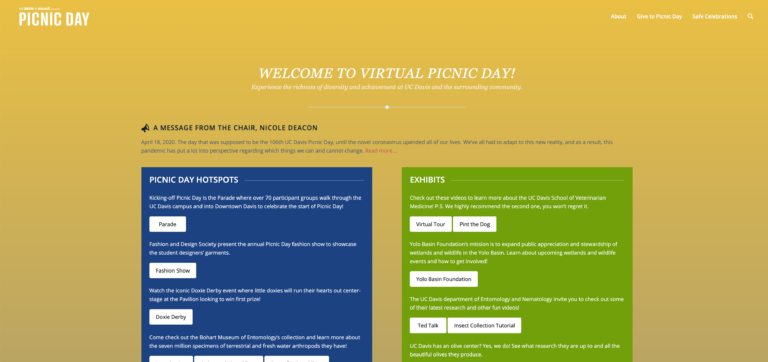
Picnic Day goes digital

How the time-honored UC Davis tradition adapted to the COVID-19 pandemic

In its over 100-year history, Picnic Day has never been held virtually — that was the case, however, up until Saturday, April 18, when Picnic Day celebrations went digital for the first time ever due to the COVID-19 pandemic. 

With events like a virtual “Doxie Derby,” and a celebration of previous Picnic Days, this virtual take on the quintessential UC Davis tradition was far from traditional. Picnic Day Chair Nicole Deacon discussed the event.

“You don’t need to be on campus to be together,” she said, reflecting on this year’s virtual Picnic Day. 

This year’s virtual celebration had 5,400 unique attendees, according to Deacon, and they sold 345 shirts ー with proceeds going to the UC Davis Medical Center. 

“I think the importance of flexibility and being able to think of new solutions is really important,” she said. 

Many groups on campus celebrate their achievements through Picnic Day demonstrations. This year, there was not enough time for these groups to transition to online mediums. 

“We actually did reach out to [groups] that had submitted applications and were going to be on Picnic Day, but people weren’t going to be able to [prepare] unless they got together, and we canceled everything during the major prep time for participants,” Deacon said.

Some organizations and alumni were able to put events together, nonetheless. The groups were told that participating in this year’s virtual event was encouraged, but optional.

“There was really only one interactive virtual experience,” said Rosalina Burton, a third-year transfer student, who attended the virtual events. “Given the circumstances, it’s understandable.”

This year, rather than showcasing different campus groups, the virtual celebrations were more of a reflection on previous Picnic Days. 

“Even though we’re in quarantine, there were still people celebrating,” Burton said, emphasizing that, though canceled, Picnic Day still holds a spot in many students’ minds. 

Alumni also participated in virtual events, making a virtual Doxie Derby using scale models and string. Students and alumni alike continued to celebrate, both by attending the virtual online event or via social media activities — many students reminisced about previous Picnic Days by uploading videos or pictures from previous years.

Though not traditional, Deacon and Burton both agreed that this year’s virtual Picnic Day was a success. 

Next year’s Picnic Day takes place on April 17, 2021. 

Written by: Alex Weinstein — campus@theaggie.org

Greatest Of All Time?

“The Last Dance” inspires The Aggie to examine the GOAT debate

Sports debates of all kinds seem to exist in a never-ending cycle. When it comes to the debate over the greatest player of all time, that cycle is even more incessant. 

The GOAT (greatest of all time) debate is brought up every so often when generational players achieve the incredible. Debate is a part of human nature, but there’s something to be said about these debates in sports that can be, at times, frustrating, fatiguing and trivial. 

Centered around the career of Michael Jordan, the newly released ESPN documentary “The Last Dance” has once again revived basketball’s GOAT debate. It has also inspired The Aggie to take a look at this debate, as well as that of all the major sports, to examine who is in the running for GOAT in each respective competition.

Out of all sports, hockey seems to have the easiest answer to the GOAT question. Some older fans may argue in favor of Bobby Orr, but his career only lasted 10 seasons, so there remains a lot of “what-ifs” surrounding his legacy compared to others. 

Others may say Gordie Howe, whose 32-year professional career and outstanding achievements rewrote the hockey record book from the end of World War II to the Cold War. But in the end, the near-unanimous pick for greatest hockey player of all time is Wayne Gretzky. His nickname is “The Great One” for obvious reasons, and if you were to look at almost every hockey record book, his name will either be at the top or somewhere near it.

 It is almost impossible to recreate the dominance that Gretzky maintained throughout his career. In a sport where the Art Ross Trophy, given to the player with the most points in a season, is a highlight of many players’ careers, Gretzky won it 10 times — four more than the next player. He holds the top two spots in most goals in a season, with 92 and 87 respectively. He won the Hart Trophy (given to the NHL’s most valuable player) nine times in his career. 

Perhaps Gretzky’s most unbreakable mark is accumulating 200 points in three consecutive seasons. No other player has done that even once and he did it four times in five seasons. The rest of this article could be filled with just his records, which is why the GOAT debate in hockey is almost nonexistent. 

When it comes to soccer, there is a battle of the ages. From Pele in the late ’50s to Diego Maradona in the ’80s to Lionel Messi and Cristiano Ronaldo today, the soccer debate goes far beyond dominating the game. 

Soccer has an interesting GOAT debate due to the nature of the game. It is nearly impossible for just one player to win a game, as there are 11 players and several different positions that are all important to a team’s success; it’s not just those who score the goals. But a lot of these debates rely on measured statistics, so since defenders and goalkeepers aren’t the ones scoring the goals, they are often overlooked. 

Whether that’s unfair or not, that pretty much leaves the debate to Pele and Maradona. While Messi and Ronaldo may seem like they belong in this conversation, their careers are not yet over and more can be added to their resume. So for now, they will be left off. 

In terms of records, it is hard to find someone more dominant than Pele. The most goals ever, most World Cup wins ever (three), FIFA player of the century, the list goes on. Many call him the most important player ever because his dominance brought many eyes to the sport and increased its global popularity. 

The one knock on Pele will always be something that he was unable to control and that is the level of play. With his career occuring in an era when the competition was not as ramped-up as it is today, many see this as an asterisk. It is unfair, but being that his career was so long ago, it is hard to see his resume ever being held as high as it should be. 

When it comes to Maradona, his ability to create magic at his feet (or hand) was an incredible thing to watch. What many call the best individual World Cup performance ever, his 1986 run for the trophy will forever be remembered as a “one-man team”. He was able to lift up any team by himself and in a sport that requires a lot from all 11 players on the pitch, Maradona seemed to be the one player in history who has managed to single-handedly turn around a team. Both players’ accolades speak for themselves, but in this GOAT debate, it all depends on what you value. 

Baseball is probably the hardest sport in which to single out one player. With so many different positions, skill-sets and the stark contrast between offensive and defensive greatness, it’s difficult to say definitively which player had the greatest impact on the game. 

Because home runs and offense is often considered the “fun” part of baseball, pitchers are usually left out of the GOAT debate. They are crucial to the game and without them, there would be none. Nonetheless, they often have their own category for greatest player ever — pitchers like Walter Johnson, Randy Johnson, Cy Young are among the best to ever throw the ball.

When talking about baseball’s greats, it is almost certain you have to mention Babe Ruth. The most popular name in his sport, the numbers of “The Great Bambino” were, in his time, otherworldly. A .513 weighted batting average (wOBA), 197 weighted runs created plus (wRC+), and 206 OPS+ puts him at the top of each category, according to FanGraphs. His 164.8 wins above replacement (WAR) is the best ever and his dominance came from more than just hitting. He was also a pitcher with a career 2.28 earned run average (ERA). 

A case could also be made for Barry Bonds, whose numbers are also some of the best of all time. But in the end, his steroid allegations overshadow what was otherwise an all-time great career. We’ll never know when or if he did use illegal substances, but it seems like no matter how much he denies it, his GOAT argument will always have an asterisk. 

Another player you can make an argument for is Willie Mays, who is possibly the greatest all-around baseball player ever. He ranks third all-time in WAR and was a force at the plate and in center field. Baseball is hard to make a case for someone new due to the nature of the game. Not being able to have a direct impact on every play makes the debate more of a numbers game than anything else. 

Like baseball, the many different positions in the game of football makes it hard to choose just one player. But there is one position in football that seems to hold the most power: the quarterback. That’s why when you talk about the GOAT in football, you’ll often end up with a quarterback. 

The most obvious pick is Tom Brady, whose six Super Bowls, countless clutch moments and three league MVPs speak for themselves. It is hard to find a more accomplished player than Brady, who will soon be continuing his career with his 21st NFL season. Brady is often measured against Joe Montana, the four-time Super Bowl champion quarterback and Hall of Famer, for the title of the greatest quarterback ever. But despite Montana’s greatness, some argue that his case for GOAT is diminished due to his 49ers teams that were loaded with superstar players and one of the greatest coaches ever. 

That said, there are a lot of arguments to be made for position players like Lawrence Taylor, a linebacker who is widely regarded as the greatest defensive player ever and Jim Brown, a running back who changed the sport and is one of the best ever at his position. 

But none can truly compare to that of Jerry Rice, who to many is football’s GOAT.  Over his illustrious 19-year career, Rice is the all-time leader in receiving yards by a large margin, a three-time Super Bowl champion and the NFL’s all-time leader in all-purpose touchdowns. There has been no player at any position that was able to dominate as much as Rice did and it will be interesting to see if anyone ever will. Because of that, it is not crazy to say the greatest player in football history was a wide receiver in a league dominated by quarterbacks.

Though the likes of Kareem Abdul-Jabbar, Kobe Bryant, Wilt Chamberlain, Magic Johnson and many more could be included in basketball’s GOAT debate, over the years, it has come down to just two players: MJ and Lebron. 

Almost every statistical category, career accolades and all other forms of measurement have been used in this debate, leaving everyone even more deadlocked on their personal opinions. You could go into detail about the obvious choices like finals records, MVPs, other individual awards, playoff performances and so much more. 

The truth is, it is almost impossible to touch Jordan’s perfect 6-0 NBA Finals record, just like it is almost impossible to match Lebron’s streak of leading his team to the Finals for eight straight years. For everything you could bring up about Jordan, you can match it with something equally impressive from Lebron. The heavyweight bout between these two can go blow for blow, without ever achieving a unanimous decision. While things can change if Lebron can win a championship or two more, it is clear that figuring out the GOAT in basketball is the same as in every other sport.

The debate is a battle of generations, not facts. Above all, it is a matter of personal feelings and to put the bias aside is a near-impossible task. The reason it is so hard to come to an agreement is that people like to hear, but not listen. In sports, when someone has an opinion, it is difficult to change it.

No matter what you say or do, it is almost impossible to convince somebody about something that they have made their mind up about. If you were to engage with a fellow sports fan about your differing opinions, it will almost certainly end in the same place you started. That is why this endless cycle of the debate will continue on as long as there are sports to be played. 

The idea that someone has to be named the greatest comes from sports itself, as there always has to be a winner. But sports fans were brought up to each have their own allegiance, so to believe that you will be able to convince somebody otherwise is to fall into the never-ending abyss that is the GOAT debate. 

Written by: Omar Navarro — sports@theaggie.org

Commentary: A love letter to gluten freeks

It’s not just another health fad

To my fellow gluten freeks:

When I was diagnosed with celiac disease during my senior year of high school, I thought my life was over.

As a carb lover, wheat had been a substantial part of my diet my entire life, meaning that most of my favorite foods were chock-full of gluten. So to learn that something I held so dearly to my heart was no longer up for consumption? Devastating. 

But as difficult as the adjustment period is for those diagnosed late in life, the discovery of this condition is only the beginning. 

If it hasn’t been made clear, the gluten freeks I am addressing are my companions who are denied the joys of gluten. Whether a life-long gluten-free friend, or a recently diagnosed member of team celiac like myself, our inability to eat the protein found in wheat, barley and rye makes us all a little freeky

When you tell people about your dietary restriction, you realize how terrible everyone is. For starters, people either think we’re dramatic or pity us so much that it’s awkward. Raise your hand if someone has told you how badly they wished you could just try the delectable glutinous goody they’re eating. Ah, man. That must be so hard for them, wishing gluten on us hopeless causes. 

The most frequent disappointment is how little basic nutritional information people possess. Most people don’t actually know what foods contain gluten and, because of this, I’m often questioned on my meal choices. I’ve been asked if I can eat sushi (rice doesn’t have gluten), interrogated about the french fries I eat weekly (potatoes don’t have gluten, thank God) and I’ve even been queried about my decision to eat ice cream — I know we know this, but to the non-gluten-free person still reading: Dairy. Does. Not. Have. Gluten. 

But this, like the pity parties, really isn’t that bad. Just like the fact that you can’t eat bread or pastries or pasta or cake or fried chicken or soy sauce or indulge in the late-night pizza orders and donuts that the teacher brings in on special school days. 

Worst of all is the bad name associated with “gluten-free.” In recent years, gluten-free eating has become a health fad, reducing our intolerance to a lifestyle choice rather than, in some cases, a life-threatening disease. This tie to dietary restrictions driven by choice paints those of us actually allergic to gluten as just another health-crazed bunch, diminishing our sad truth. The fitness world’s obsession with a non-glutinous diet has rendered gluten-free the veganism of allergies, surpassing the lactose intolerants by a longshot.

It’s also worth noting that a gluten-free diet isn’t inherently healthier than a glutinous one; replacing bread or pasta with a gluten-free alternative doesn’t do much. The “healthy” (or calorie restricting) way to be gluten-free is through elimination of most carbohydrates from your diet, not just removing the gluten itself. But frankly, anyone who doesn’t eat gluten on their own accord is suspicious, don’t you think?

I will concede that the popularity of the gluten free diet has benefited us in some ways. If it hadn’t become so popular among the fitness freaks, would we have the option for gluten-free bread when we go out to eat? Probably not. 

My gluten-free comrades, you know this struggle all too well. The confusion about our diet and the appropriation of our allergy or the disease that comes with the territory — there’s no way around it, not today anyway. And as much as I wish we didn’t have to give up the precious food group taken for granted by most of the world, we are better because of it. We go into the world empathetically, happy to hear of others’ obstacles without letting preconceived notions blur how we see them. Perhaps more importantly, we know not to define them by their disease, struggle or shortcoming. We see things clearly, without the haze of gluten on our lenses.

All that said, being gluten free sucks. We grow accustomed to this lifestyle: not being able to eat anything at an event, avoiding Italian restaurants altogether — sure, but I am reminded of something I can’t eat almost daily. Though the sting is less potent every time, it’s still there. 

So, to all the gluten intolerants reading, don’t forget who you are or where you came from. We won’t be reduced to a health trend because some yuppies thought they’d hop on the bandwagon under the false assumption that gluten-free toast is any healthier. We all know they’re eating gluten left and right, never acknowledging how hard it would be to eradicate it entirely.

Remember how strong we are — it takes some grit and determination to succeed as a true glutenless eater, curbing the temptation of some of the most delightful foods in existence. And know that we always have this community. The day they find a cure may come, but we will never forget this struggle that formed a bond stronger than the binding agent in bread dough (it’s gluten).

Much Love, 

Your friend and fellow gluten freek

Written By: Allie Bailey — arts@theaggie.org

UC Davis student’s “Pony Up Press” brand offers stationary, jewelry, original pieces

Student artist blends love for engineering, art, animals

Second-year design major Audrey Chamberlin runs her small arts and crafts business by focusing on what she loves: quirky animals that spread love to all. Her small business, Pony Up Press, is a Davis-based business that sells prints, earrings, notebooks, stickers and more, all designed by Chamberlin herself. 

Her business name represents something she loves. 

“I love ponies! Who doesn’t?” Chamberlin said in an email interview. “Not only is it a reference to something that I love, but the phrase “pony up” means “give me money.” I don’t mainly mean it that way, but it is a funny little fact.”

Chamberlin founded Pony Up Press this year after making a pair of earrings back home in New York. Her prices range from $2 for stickers and pins to $50–60 for original, commissioned pieces. And Davis residents are in for a bit of a treat: By sending her a quick message on Instagram or emailing her, she offers delivery and contactless pickup.  

“I am entirely self-taught,” Chamberlin said. “I’ve taken art classes, but what I got from them was mainly experience and portfolio additions.”

While Chamberlin is proud of her work and loves to delve into different art mediums, she admits that her relationship with art in high school was a bit rocky. 

“Once I made it to high school, I did stop doing art for a while,” Chamberlin said. “There was only one art teacher in my very small school and she didn’t like my art very much, not sure why. I was probably pretty stubborn at the time and we just didn’t mesh well.”

She came to UC Davis as an aerospace engineering major and not only stuck with it for over a year, but did quite well.  

“I was on a team that was awarded a grant from NASA and was flown to Virginia to present on a project that I found incredibly interesting,” Chamberlin said. “But once I got back, I still wasn’t happy. I felt like I had succeeded in my field, but I still wasn’t satisfied. That’s when I decided to go back to art. I’m still very wary of studio art classes, but design was perfect.”

Chamberlin found that industrial design is her ideal blend of engineering and art. 

 “I was able to create technical drawings, use CAD and 3D printing, and I knew how to present a product successfully to a big client,” Chamberlin said. “My history with art has been a little tumultuous, but in the end I think I’m settling somewhere that’s right for me.” 

Chamberlin sold her first piece when she was a senior in high school. She had a design internship with The Highlands Foundry, a design company that sells handmade, one-of-a-kind apparel. 

“I ended up making a patchwork scarf made of vintage kantha cloth and West African mud cloth,” Chamberlin said. “Almost as soon as the scarf was posted online it was sold for nearly $100. That gave me a lot of confidence and I still think about it to this day.”

Although her first sale was back in high school and her small business didn’t start up until early this year, she is excited about her future with Pony Up Press.

“Twice now I have gone to West Coast Craft, a crafting and art show in San Francisco,” Chamberlin said. “I was so jealous of all these people that had made their job their art and design, such as Big Bud Press, Mokuyobi Threads and Gentle Thrills. It also feels good to have people interact with and be excited about things that you have made, all by yourself.”

Chamberlin has collaborated with multiple artists for new pieces. One of her recent collaborations was with an embroidery shop called Contrarium. Pony Up Press and Contrarium worked together to raffle off a one-of-a-kind tiger patch. The proceeds went to the Mayor’s Fund to Advance New York City, helping the people of New York with food and medical supplies during the coronavirus pandemic.

“I am a New Yorker myself, having grown up right outside the city,” Chamberlin said. “In my tiny hometown, which only has a population of about eight thousand, has over a hundred cases. So donating to a fund in New York was very important to me.”

Her favorite pieces to make are the Japanese Chin Sticker sheets available on her website. 

“I have a Japanese Chin mix at home, and she’s just about the most ridiculous dog I’ve ever seen,” Chamberlin said. “However, not many people know about this funky breed! I had such a good time drawing her that I decided to make a series of stickers.”

Along with feelings of gratitude to her mother, Chamberlin gives credit to her father as her number one supporter.

“If I could give him a title, it would be CES (Chief Executive Support),” Chamberlin said via email. “He is a very genuine, kind person and has always encouraged me to follow whatever idea I have. Every now and then I get an email from him along the lines of, ‘Look at this cool thing!’ in the hopes something he sends is going to inspire me. It often does!”

Although she loves running a small business and being a full-time student, Chamberlin admits that it can be difficult. And with the shelter-in-place order, she had to cancel multiple events that she had lined up in the upcoming months. 

 “It’s very hard to run a business and be a student,” Chamberlin said. “I know other people that run even more serious businesses than I do (such as Less Acosta of Flower Dangles), and I have a lot of respect for them. It’s pretty much like having a full time job and the hours are ‘whenever you have the time.’”

Running Pony Up Press demands more than just creating merchandise. Chamberlin must also update her website, send out packages and work on commission pieces — and the work doesn’t cease when she has two essays and a stool made of cardboard due on Friday.

Chamberlin is hopeful that one day her business will be her source of income, but in the meantime, she struggles to invest in her business as much as she would like to. 

Chamberlin continues to sell her funky art through her website and is looking forward to adding in new items such as acrylic keychains, scarves and oversized scrunchies — a special sneak peek of what’s to come just for The California Aggie’s readers. 

“I would love to one day be able to live comfortably from my own business, but that may be a little further down the road than just five years,” Chamberlin said. “In the meantime, I hope to keep growing so I can get there one day!” 

Written By: Itzelth Gamboa — arts@theaggie.org

Online communication: Here’s how Aggies are staying in touch during the pandemic

A look into the different online platforms that students are using to keep in contact

Due to the COVID-19 pandemic, online platforms have largely taken the place of in-person communication as individuals maintaining social distancing are unable to see their friends and family in person. Whether it is to catch up with friends or attend a lecture, online communication has maintained connections during these trying times.  

FaceTime, a video-chatting application available on Apple products, mimics the face-to-face communication that is no longer possible during quarantine. Alex Cohen, a first-year neurobiology, physiology and behavior major, sees great value in Facetime and its ability to maintain relationships in a real and personal way. 

“I really just prefer FaceTime over texting,” Cohen said. “I’ve always had this mantra about those types of things just because it’s more personal and you can actually sense how someone is, how they’re actually feeling and actually connect with them in a real way. You can always send a quick, five-second text, but calling somebody and checking up on them or FaceTiming them, I feel like that’s way more personal and much necessary in this day and age.”

For others, a simple text proves to be an important outlet of communication. Not only can texting be used as a way to catch up, but iMessage also provides games through GamePigeon like Cup Pong and 8 Ball that foster interaction from miles apart. 

Kai Uchio, a first-year environmental science and management major, uses text messages to quickly check in on his friends from Davis while he quarantines at home.

“Obviously, I’d rather see the people in real life, but I always like texting them just to catch up on small things,” Uchio said. “I definitely think the communication helps and it’s nice to still be in communication with my friends, especially the ones that aren’t here like all of my Davis friends.”

Some students have found even more creative ways to stay in touch. Aaron Ehsanipour, a third-year psychology major, uses Xbox One to virtually stay in touch with friends while having fun. 

Zoom, another video-chatting platform, has become the public’s new classroom and route of communication between students and teachers. Due to social distancing, professors are now holding live lectures and discussions on Zoom. On this platform, students can video chat and use the chat box to send messages. Although Zoom has become the backbone of online education, most students don’t use it outside of an academic setting. 

Houseparty, yet another video-chatting platform, has made a comeback during these times. Houseparty allows multiple people to chat in different rooms and even allows users to play games. There has been a 1072% increase in downloads, according to a Business Insider article. In an update on April 2, the Houseparty team shared their happiness in being a platform that can bring people together during a tough time: “We’re humbled to bring people together during this unprecedented time for everyone around the world. As we physically distance ourselves for the common good, online human connections are more important than ever before.”

Whether it is Facetime or Xbox One, the world has managed to communicate and keep relationships intact despite great distances. Regardless of what platform is used, students like Ehsanipour emphasize how important it is to stay connected with the people in their lives. 

“Maintaining these connections are important because we all have to be together during this unprecedented time,” Ehsanipour said. “Some days I feel down and others my friends feel down, but when we call each other and let each other know that we are all feeling the same anxiety then it calms everyone down.” 

Written by: Nora Farahdel — features@theaggie.org

Will COVID-19 block third-party ballot access?

The current pandemic is revealing critical flaws in the American electoral system

Howie Hawkins. Jacob Hornberger. Don Blankenship.

Yes, these are real names. But do you know who they are? They are the current leading nominees for the respective Green, Libertarian and Constitution parties.

 If you’re a political junkie, you are probably familiar with Blankenship. The former West Virginia coal mining executive has experienced occasional cameos in national headlines: first, for a trial concerning a mine explosion that killed 29 people in 2010 and later, for a bizarre 2018 Senate run where he declared himself “Trumpier than Trump” and ran ads referring to Senate Majority Leader Mitch McConnell as “Cocaine Mitch.” To a lesser degree, you may also be familiar with Hawkins, the environmental activist who co-founded the Green Party just over two decades ago.

But for most Americans, these names are simply more faces in the crowd. 

The national appeal of a viable third-party candidate has increased in recent weeks by the possible entry of two figures with significant name recognition: Justin Amash and Jesse Ventura. Amash, a current U.S. representative from Michigan and frequent critic of President Donald Trump, announced the formation of an exploratory committee aimed at seeking the Libertarian Party nomination. Likewise, former professional wrestler and Minnesota Governor Jesse Ventura, who has his own complex relationship with Trump, recently voiced his interest in a potential 2020 Green Party run. It is a given that neither candidate will command major support on a national stage, but the general consensus is that they could potentially siphon enough voters to prevent Biden victories in a number of swing states.

Currently, third-party advocates are engaged in a number of legal battles aimed at gaining ballot access come November of 2020. In Illinois, the Greens and Libertarians are engaged in a court case aimed at removing all petitioning requirements for ballot access while a similar lawsuit by the coalition in Georgia aims to reduce the minimum number of signatures necessary. 

Meanwhile, the country’s two biggest parties share a vested interest in limiting third-party ballot access. As a result of political polarization, both parties are severely limited by the number of active electors up for grabs, meaning that any significant conversion of swing voters could have devastating effects on their path to the White House.

For Democrats, this issue is especially pronounced. Historical precedence shows that they have the potential to be severely damaged by a strong third-party run. In particular, Jill Stein’s 2016 Green Party campaign won more votes in Pennsylvania, Michigan and Wisconsin than Trump’s margin of victory in those states. Although it’s hard to say whether Stein’s absence would have allowed for a Clinton victory, it certainly played a role in the outcome.

Third-party candidates in 2020 are far less of a risk for Republicans, but there is still a chance that their presence on the ballot could sway a number of states. After leaving the Republican Party and becoming a registered Independent, Amash voted for Trump’s impeachment, earning notoriety as a strict non-partisan ideologue. Now a Libertarian, Amash’s recondite political ideology may simply be too niche for widespread national appeal. 

Rather, Amash could steal more Libertarian-minded voters in Michigan from Trump, a vital state to the president’s re-election path. Lawsuits by the Libertarians and Greens in states like Georgia and Arizona could also put the little known, socially conservative Constitution Party on the ballot, potentially bringing the furthest politically right of Trump supporters with them. The threat seems negligible at first, but when you consider just how close the margin of victory is likely to be in these states, it is a threat worth considering.

Irrespective of the morality of voting for a third party in 2020, the entire scenario at hand reveals a number of fundamental albeit obvious flaws in the American electoral system. Most blatantly, it reveals the fragility of the two-party system. It’s a system so fragile and riddled by establishment influence that it promotes candidates uninspiring enough to allow for a few thousand disaffected voters to sway the entire election. Furthermore, the dilemma posed by the lack of ballot access for third parties is part of a broader issue concerning politics in the era of COVID-19. From issues over voter disenfranchisement to a highly politicized debate over the entire logistics of ballot-casting, the predicament has revealed just how unprepared the American electoral system is for a crisis of this magnitude. 

In this regard, the battle for third-party ballot access is merely a further indictment of a wildly myopic voting system. Instead of merely arguing over the merits of granting increased access to third-party candidates this fall, we should approach this problem with a degree of introspection, questioning just how we managed to get to this debate in the first place.

 Written by: Brandon Jetter — brjetter@ucdavis.edu 

Disclaimer: The views and opinions expressed by individual columnists belong to the columnists alone and do not necessarily indicate the views and opinions held by The California Aggie

Yolo County is state leader in sheltering homeless during pandemic

County’s homeless outreach efforts during social distancing provide model for rest of state, official says

Yolo County is “punching above its weight class” when it comes to sheltering the homeless population under Gov. Newsom’s Project Roomkey plan, according to Davis Homeless Outreach Coordinator Ryan Collins. 

Collins delivered a report at the Yolo Board of Supervisors’ April 14 meeting, detailing the successes and challenges of the county’s homeless outreach efforts during the COVID-19 pandemic. Collins told the Board that Yolo was currently sheltering a much higher percentage of its homeless population compared to other California counties. 

“At the time of its announcement, I think approximately 870 individuals were sheltered individually statewide as a part of Project Roomkey, and Yolo had 110 of them,” Collins said. “I think that number is closer to 180 today. For a county of about 220,000 people in a state of 20 million people, that makes Yolo County punching about 25 times above its weight class in this effort.”  

Project Roomkey is a state initiative seeking to shelter homeless individuals in local hotel and motel rooms while shelter-in-place orders remain in effect. Project Roomkey intends to prioritize the “medically vulnerable” among California homeless populations — homeless individuals over the age of 65 or with underlying health conditions — as well those who have been exposed to COVID-19, but do not require medical attention, according to an April press release from the governor’s office. 

The goal of the program is three-fold, according to the release: protecting a vulnerable population from infection, reducing the density of individuals in homeless shelters and easing pressure on local hospitals during the pandemic. 

“Homeless Californians are incredibly vulnerable to COVID-19 and often have no option to self-isolate or social distance,” Newsom said in the release. “By helping the most vulnerable homeless individuals off the street and into isolation, California can slow the spread of COVID-19 through homeless populations, lower the number of people infected and protect critical health care resources.”

Collins told the Board that part of Yolo’s success under Project Roomkey was due, in part, to a head start — the county had enacted similar programs before and had served as a model for other counties’ efforts. Collins pointed to Yolo’s “Bridge to Housing” program, which sheltered 65 homeless individuals from West Sacramento in 2014, according to a county report

“[Project Roomkey] is similar to what we did with Bridge to Housing in 2014, 2015,” Collins said. “So I think we had some of our playbook written, and that helped us get into a lead on this.”

There are daily deliveries from local food banks to the motels around Yolo where participants are sheltered, Collins said, as well as CalFresh eligibility workers available to help enroll those sheltered. Healthcare workers from Communicare are providing in-person visits for individuals with high levels of medical needs. Yolo’s Project Roomkey initiative has been working well, in part because of a dedicated on-site staff that offers supportive services and outlines expectations for participants. Collins said. 

“We are deploying on-site staffing teams at the motels,” Collins said. “So it’s not ‘Hey, here’s your roomkey, good luck, do whatever.’ It’s ‘Hey, here’s your roomkey, here’s some information on how this is going to work right now.’” 

Collins indicated that while leasing motel rooms might be cost-prohibitive to continue after the pandemic, the success of Project Roomkey might provide a model for future support and outreach services for the county’s homeless population. 

“There are surely lower-cost interventions that we can continue, with maybe even lower levels of staffing but similar models of volunteers, cheap affordable modular levels of housing, of just providing opportunities [to] people to get on the grid and connected, for anyone who wants out of those circumstances,” Collins said.  

Supervisor Don Saylor agreed, praising the efforts of Yolo’s homeless outreach coordinators.

“I’m hoping one of [the] things that we take out of this dark time for us all is lessons learned on how to deal with issues like this — like homelessness — into the future,” Saylor said.  

Written by: Tim Lalonde — city@theaggie.org

UC Undergraduate Experience Survey now open with new questions on COVID-19 impacts

2020 survey measures campus climate, academics, accessibility of resources to support students, food and housing security 

This year’s UC Undergraduate Experience Survey (UCUES), one of the biggest UC student surveys, is now open to all undergraduate students. The survey, conducted biennially across the system since 2004, has questions covering campus climate for diversity and inclusiveness, activities and skills, food and housing security, academics and the effects of COVID-19 on students’ learning experience. 

The survey also gauges academic and personal development, availability of channels to express complaints, financial burden, mental health and summer session offerings. 

Assistant Director of UC Davis Institutional Analysis Erika Jackson said the rest of the analysis team will spend the summer reviewing the 2020 UCUES results and share their findings with administration, campus leaders and students.

“The data is always used in Undergraduate Program Review to help programs understand students’ perceptions, but we are really starting to integrate the data into many more conversations about campus climate, research opportunities, availability of support services and more,” Jackson said. 

Specific to this year’s coronavirus pandemic, the UCUES is also gathering data on concerns about how COVID-19 has affected student learning in terms of reliable internet access, appropriate study space, learning support services and effective learning in a remote instruction environment. The survey also asked how the pandemic has impacted graduating on time, paying bills, feelings of isolation, access to healthcare and meeting basic needs.

“We will share results to the COVID-19 questions with colleagues in Information and Educational Technology (IET), Undergraduate Education, Student Affairs and more to ensure that everyone is aware of what challenges our students are facing during these uncertain times,” Jackson said. “These offices have been working around the clock to help provide access to computers for students who need them, help faculty make remote instruction as effective as possible and provide services remotely, like tutoring which may be more important than ever.” 

Additionally, this year’s survey has new questions about housing security and summer sessions. Jackson noted that adding new questions and topics will provide more context around these issues for experts who study housing and food insecurity, as well as help better understand how to make summer session offerings attractive and productive for students. 

“Knowing why students aren’t currently utilizing summer [sessions] can help us better design our offerings in the future,” Jackson said. “Utilizing summer sessions can be a great way for students to ensure that they graduate in four years, but only if the courses they need are offered, in formats that are conducive to learning over the summer.”

In previous years, the data collected from UCUES has led to the implementation of new campus resources and initiatives to better support students. 

“Every student has a voice and UCUES has produced positive change on the campus,” Chancellor Gary May said in an email to undergraduate students. “Years ago the ASUCD established The Pantry after student advocacy and UCUES data revealed the need.” 

Jackson explained that The Pantry may be the best example of a unit created directly because of UCUES data. The data also generally provides a more broad understanding of the campus’ strengths and weaknesses overall, which helps campus leaders understand where to focus resources and attention at a variety of levels.

“Individual departments use these data, broken down at the major level, to see how effective their program is compared to their college and university,” Jackson said. “Units working with specific populations of students can cut the data by race or ethnicity, first generation status, gender and more to see where their students are thriving and where they need to focus attention. We are working to have more and more leaders across campus utilize the results of this survey to make the most possible use out of the time and efforts students put into sharing their feedback with us.” 

Written by: Graschelle Fariñas Hipolito — campus@theaggie.org

The world of Wes Anderson: Exploring, ranking films of a modern auteur

A completely objective, definitely correct ranking of Anderson’s films

Believe me, I’m sure Wes Anderson has heard it all before. I’m positive he has been told he makes movies exclusively for hipsters, people who hang out in trendy coffee shops where they shoot film and frequently restart the French course on Duolingo. I’m sure he has caught wind that people brace themselves to hear his name when you ask a person wearing a Fjällräven Kånken to name their favorite movie. I am sure he is aware of his status in our cultural landscape, and I am even more sure he does not care.

 Why? Because the man is the definition of an auteur: someone who has enough talent and vision to hone a style that is all their own. Indeed, his filmography is varied, but all his films carry the same playful edge to them. What follows is a completely objective, definitely correct ranking of his films. 

9. “Isle of Dogs” 

It’s not that “Isle of Dogs” is bad per se, it’s just that there are so many more vibrant Anderson films that “Isle of Dogs” just feels like a bit of an afterthought. “Isle of Dogs” is a fun romp, with a bunch of animated dogs, through dystopian Japan. Using Yoko Ono as a plot device is kind of genius, but this definitely sits at the bottom of the rankings. It misses the magnetic qualities of his other films — half the fun of a Wes film is seeing the uncomfortable but hilarious body language of the characters he writes. An ensemble voice cast and painstakingly high-effort visual style give it points, but not much. If there was ever an Anderson flick you could skip, this is it. 

8. “Bottle Rocket” 

Ah, and here is where we will begin to get controversial. “Bottle Rocket” was Anderson’s first film, released in 1996. Again, not by any means a bad film, “Bottle Rocket” feels like a bit of an origin story for Wes — utilizing some of his favorite players, the Wilson brothers, he weaves a narrative of offbeat adventure with plenty of laughs. Because it was his first film, “Bottle Rocket” is missing some trademark elements that put Anderson on the map, mainly his visual language, one that permeates the screen in later works. Still, “Bottle Rocket” will always be a fun Saturday matinee. 

7. “The Darjeeling Limited” 

Released in 2007, “Darjeeling” was firmly in the realm of Anderson’s signature style: beautiful colors, layered characters and symmetrical camera work, not to mention the music too. A tale of three brothers trying to reconnect, it’s a tender meditation on family ties, heavy on both dialogue and the infighting that stems from it. India is a vibrant, beautiful country, and Anderson’s direction shows you that in pretty much every shot — even the interiors, which have as much going on as the characters do. 

6. “The Life Aquatic with Steve Zissou” 

Inspired by the exploits of Jacques Costeau, Bill Murray plays the titular Captain who sets off to find the shark that killed his best friend. A story of revenge juxtaposed with a father trying to reconnect with his son, “Zissou” is a visual feast for the eyes. There’s a reason so many people don the red cap and baby blue jumpsuit for Halloween. The sonic aspects, however, are the best part of this film. Seu Jorge as Pelé dos Santos covers David Bowie tracks with a gentle bossa nova leaning, ones that pop up in the film during moments of levity. That, along with the classic rock soundtrack, propelled “Zissou” into greatness. 

5. “Fantastic Mr. Fox” 

Never have I wanted to transport myself into a world of stop-motion animated anthropomorphic animals until I saw “Fantastic Mr. Fox.” George Clooney and Meryl Streep provide the voices of the titular fox and his wife Felicity with an almost timeless cadence to them. This is one of the funniest Wes flicks, abound with zingers, although most of them are either animal puns or jokes that might as well be. The humor makes up one half of the magnetism of this film, with the other being the sheer beauty of the visuals. Textures pop off the screen, from the corduroy of Mr. Fox’s jacket to the fur on a Badger’s exterior (played by Bill Murray). This is a real treat, one that is deeply rewatchable. 

4. “Moonrise Kingdom” 

A gorgeously curated experience, “Moonrise” is the first Anderson film I had the pleasure of seeing not on a big screen. And in many ways, that is how it should be seen. Intimate and tender, “Moonrise” is a tale of young love, almost a Romeo and Juliet-esque story, save the whole star-crossed lovers thing. Star performances across the board, but the kids are really what make it: Jared Gilman and Kara Hayward as Sam and Suzy incredibly and believably depict pre-teen romance, sexual initiation and most of all, first love. The bright, warm color palettes only add to his most youthful flick yet. Influences from the likes of Francois Truffaut and Agnes Varda are apparent as well, from the soundtrack to the sharp, incisive dialogue of our two juvenile lovers. 

3. “Rushmore”  

I saw “Rushmore” on a second date, a sort of “bias test” in the world of modern romance. I absolutely loved it, and my date… was less than enthused. I couldn’t understand it! “Rushmore” is the lovingly crafted, witty tale about Max Fischer, an overachieving highschool student who falls in love with a new teacher. Sprinkle that in with Bill Murray as Blume, Fischer’s best friend and eventual romantic rival, and you have a recipe for success. A story about love, and ultimately letting go, this is arguably the most fun of Wes Anderson’s filmography, even if it sometimes feels like the most grounded, with no crazy visuals or mesmerizing color schemes. I never saw the girl from the aforementioned date again. But I try to see “Rushmore” whenever the opportunity arises.

2. “The Royal Tenenbaums” 

There is something about cinema that no other medium can capture. The mix of audio, visual and emotional aspects all get thrown into a jar, shaken up (sometimes roughly, sometimes softly) and whatever comes out of that jar is what we, the audience, see on screen. “Tenenbaums” nails everything from its depiction of childhood excellence to the familial dynamics of a (deeply) dysfunctional group of people brought together only by blood. The chemistry between the actors is something rarely seen in film — it seems as if every actor has known each other their entire lives, as if they really are the family of Tenenbaums depicted on screen. The beautiful cinematography Wes is known for is here, but so are his best forays into dialogue and relationships. More than anything, this is a tale of redemption. 

1. “Grand Budapest Hotel” 

What happens when a director fully realizes the vision they have? What does it look like when they sail past limitations, both technical and creative? Well, it may very well look like “Grand Budapest Hotel.” This is Wes Anderson concentrated and firing on all cylinders: an all-star cast, sublime symmetry in the camerawork and a world that is expertly crafted, down to the smallest details. Indeed, this vision of an early 20th Century Eastern European hotel is a story of love, loss and the wacky misadventures of M.Gustave and Zero, played expertly by Ralph Fiennes and Tony Revolori respectively. Good cinema is, plainly, enjoying yourself while watching a movie. Great cinema, however, is feeling lucky enough to even have the privilege of watching artistry at work. Poetry in motion, “Grand Budapest” is a staunch example of the latter. 

Written by: Ilya Shrayber — arts@theaggie.org

Does classical music deserve to die?

A genre of the past doesn’t have to be dated 

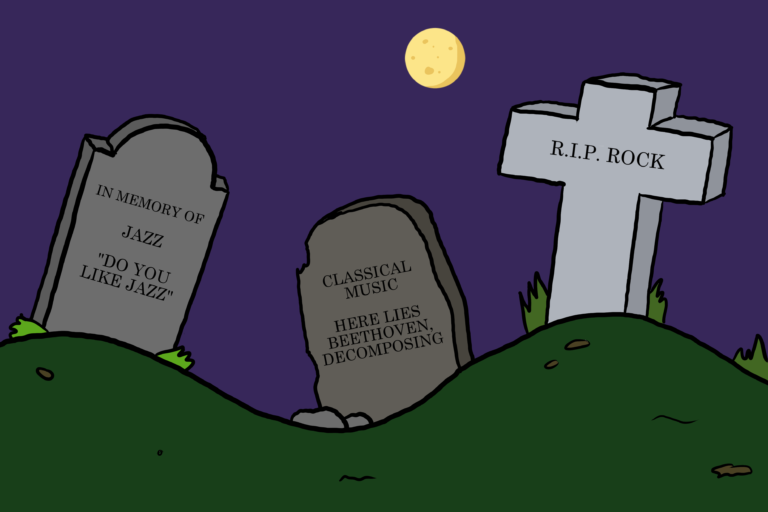
What do we think of when we hear the term “classical music?” For many, the term evokes images of powdered wigs and sparkling grand pianos. The senses recall scenes of sterile concert halls and the potential energy that radiates off the stage just before the first flick of a conductor’s baton. 

As a former “music kid,” classical music was always part of my childhood. Preschool piano lessons, middle school band classes and high school orchestra rehearsals were significant in my upbringing. For me, music was a lifestyle. There were moments in high school where I likely read more music notes than actual words. 

Californian music education was the most rigorous I’d seen in my entire life. I bought into the culture of these programs, and it changed my perspective on the classical community as a whole.

Classical music often reads as a very high-brow art form. It’s a part of our culture that we feel must be saved for the highest and mightiest of society. It’s this feeling that creates a stigma around the classical community and begs the question: Does classical music deserve to die?

It’s hard to convince anyone that an entire genre of music should be obsolete. People within the classical community are very passionate about their music. But this doesn’t change the fact that there are some valid arguments in favor of classical music extinction. 

The term “classical” is an issue in and of itself because it’s alienating. Merriam-Webster defines classical as “of or relating to music of the late 18th and early 19th centuries characterized by an emphasis on balance, clarity, and moderation.” If a new listener or player doesn’t fit into this “classical” mold, then it’s like they shouldn’t be there. Gatekeeping is, unfortunately, an inherent part of this genre of music.

This alienation is not just found within the term “classical,” but also within the culture surrounding it. The fact that the phrase “classical music” is so often associated with high-class figures is no mistake. 

Economically, many orchestras survive off the patronage of donors as well as high ticket prices. I felt the implications of “donor status” in my high school: reserved seats and a spot of favoritism for families who donated a considerable sum of money. These dynamics exist in the lower rungs of the classical community (high school orchestras) and follow musicians into their professional careers.

The genre is but one part of the problem, however. Music education is flawed. It is rooted in a strict dogma that produces sterile musical robots over unique musicians who implement individual perspectives on musical forms. 

In formal music training, you are taught that there is a level of individual expression in all performances. Regardless of the piece, your interpretation is your own and it is unique from all other renditions.

Sure, you decide to widen your vibrato. Maybe you’ll add your own little crescendos here and there. You’re encouraged to practice “good musicianship” and play music with your own creative flair. But at the end of the day, you’re really just interpreting within the acceptable realm of classical training and nothing more. This is what makes classical music antiquated in ways that other genres are not. 

Rap and pop are constantly evolving. Subgenres and new voices seem to appear every other day. Classical musicians are subject to a rigid set of repertoire –– so rigid that they often play the same piece twice for concerts. 

With so much emphasis on the past, it’s hard to see how classical music will play into our futures. The continuation of classical music lays squarely upon the shoulders of young people and those who shape their understanding of music.

Music education is often approached in the way history classes are taught: learn a concept, understand the context and apply it. The difference between classical music and history is that history is completely fixed in the past. Music is fluid and should be taught as such. 

Pianist Gabriela Montero is a prime example of this. Montero is an improvisational classical pianist who takes motifs from classical works and applies them to a longer form of her own improvisational work. Sometimes, she even does this in the style of other classical artists

This ability to simultaneously reproduce different styles and employ one’s own influence can only spell greatness for the future of classical music and will create a space for it to thrive in a world that is careening toward the future. 

Classical music doesn’t deserve to die. What it does need is a fresh coat of paint: A new approach that is more accepting of free form and imagination as opposed to its current desire to preserve the past.

Written by: Isabella Chuecos –– ifchuecos@ucdavis.edu 

Disclaimer: The views and opinions expressed by individual columnists belong to the columnists alone and do not necessarily indicate the views and opinions held by The California Aggie

Local food-assistance organizations implement home delivery, drive-throughs to confront growing need

As economic downturn continues, organizations focus on safely feeding people

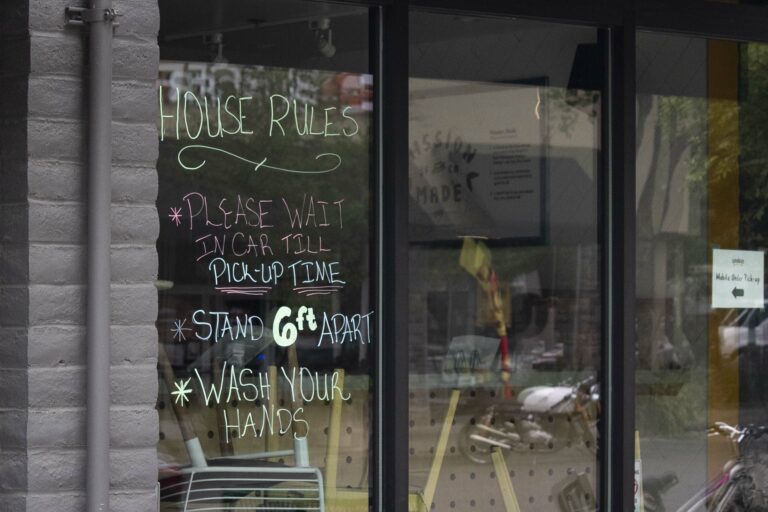
As lockdowns continue to flatten the curve of COVID-19, the economic strain on workers worsens. In the wake of both a health and social needs crisis, the Yolo County Food Bank and Davis Short Term Emergency Aid Committee (STEAC) have both confronted the growing need for food while adhering to social distancing standards.

Executive Director of Yolo Food Bank Michael Bisch explained in a press release that there has been an increase in food assistance among people seeking aid for the first time. 

“In the five weeks since the shelter-in-place order, we’ve experienced a 30% increase in requests for food assistance, primarily from community members seeking our assistance for the very first time,” Bisch said in the press release. 

Yolo Food Bank Director of Philanthropic Engagement Joy Cohan listed the ways the food bank has changed in a short period of time, including mandating facemasks and implementing drive-through locations.  

“We essentially had to radically adapt and expand our entire service delivery model in a few days’ time,” Cohan said. “We’ve had to adapt our traditional food distribution for social distancing purposes. That has included how the food is dispersed, how people line up for the food — requirements around gloves and facemasks. It’s also been transitioning some locations to drive-up distribution models.”

On top of changing services, STEAC Executive Director Liane Moody explained that recruiting new volunteers was another challenge her organization faced.

“We run the local food closet in Davis, and most of our volunteers were over 65,” Moody said. “When the crisis hit and the shelter-in-place orders were put down, we had to both recruit new volunteers and change the way that we provided services so that we could keep volunteers and clients safe.”

The food bank faced a similar need for more volunteers and succeeded in attracting over 700 volunteers, who helped to launch new programs, including a large-scale effort to home-deliver food. 

“We began our emergency home-delivery program,” Cohan said. “It has now expanded to about 2,300 households throughout the county each week. It is serving about 5,000 individuals in their households.”

STEAC has adapted to the current climate by changing to outdoor pick-ups and increasing the number of weekend lunches it offers to Davis Joint Unified School District students.

“We’ve become much more of a pick-up model now,” Moody said. “We also deliver food to students for the weekends. We’ve even upped the amount, so we take bags every Friday for people who are picking up their lunches at the schools to help during the weekends.”

Even after the immediate health crisis has passed, the food bank’s new programs and increased services will most likely continue to expand for some time. 

“Parts of these new service delivery models will be maintained and our service will be permanently changed as a result of this,” Cohan said. “We are foreseeing that when the literal health crisis is over, due to the economic downturn, we’re going to be serving more people for some time, if not permanently. We’re going to have people who lost jobs, or their businesses have now failed, who are going to be availing themselves to food bank services.”

Moody echoed similar sentiments, saying STEAC expects increased demand in the future. She also said safety requirements like gloves and masks might also outlast the immediate crisis. 

“As the financial crisis goes on, we expect that more and more people will need support,” Moody said. “We also expect there to be a need for these higher precautions for a while, so we do expect that we’re going to need to keep with the changes to our model to keep everyone safe for as long as necessary.”

Written by: Eden Winniford –– city@theaggie.org

Aside from temporary COVID-19 suspension, UC looks to keep SAT/ACT requirements in admissions process

UC Assembly of the Academic Senate unanimously approves task force recommendation for the continued use of SAT/ACT in admissions

UC Academic Senate Chair Kum-Kum Bhavnani sent a letter to UC President Janet Napolitano on April 18 reporting unanimous support from the Assembly of the Academic Senate for the continued use of the SAT and ACT in UC admissions for at least the next five years. 

The Assembly voted 51-0, with one abstention, in support of the recommendations from a report written by a six-member subcommittee of the 18-member UC Standardized Testing Task Force (STTF), first founded in 2019. 

In pursuit of admitting students who will succeed at the UC and be representative of the population of California, the report gave six key recommendations. Among these recommendations was the expansion of eligibility in the local context — which currently admits to the UC the top 9% of students from participating high schools — and the development of a new UC assessment system to “assess a broader array of student learning and capabilities than any of the currently available tests.” The task force plans for this new assessment system to ultimately replace the use of the SAT and ACT in admissions.

Other recommendations include a review of the components that determine the statewide eligibility index, increased research about factors that contribute to disproportionate representation, a study and expansion of academic support resources for students and further analysis of current standardized tests.

Using data collected by the UC of systemwide admissions and student outcomes, the STTF found that standardized test scores are an equal or better indicator of undergraduate grade point average, retention and degree completion than high school GPAs. 

The STTF also found “mean differences in standardized test scores between different demographic groups are often very large, and many of the ways these tests could be used in admissions would certainly produce strong disparate impacts between groups,” according to the report. 

They also, however, found that admission practices compensated well for these large differences in test scores, likely due to the use of comprehensive review and the practice of assessing each student in the context of their school. In the end, the task force concluded that UC admission practices do not fully make up for the disparities that exist between different races and classes. 

“That’s the fundamental problem in this state — that the schooling that students receive is so incredibly unequal, depending on their socio-economic background, race and other things, that some schools prepare students very well to take these tests and other schools don’t do so at all,” said Patricia Gándara, a member of the STTF. “And it’s not the student’s fault. ”

This sentiment has been echoed across the state as calls for the UC to drop the SAT and ACT in admissions have grown. Many claim that standardized tests discriminate on the basis of race, wealth and disability. 

“So in fact, the SAT as an admissions criteria is really just a proxy for wealth and majority status,” said Interim Legal Director of the Equal Justice Society Lisa Holder. 

Holder was one of several who signed on to a letter sent to the UC Regents in October of 2019 demanding the removal of the SAT and ACT from the UC admissions process.

“The UC is not reaching its own mandate, and, more importantly, the UC is violating the equal protection laws of California which require that all Californians, regardless of race, gender, and disability status, have equal opportunity to access public colleges as long as they are high performing students, and are hitting all of the important benchmarks of excellence in secondary school,” Holder said.

Holder fundamentally disagrees with the STTF report and questions both the validity of the data used in the report and, in turn, the conclusions of the task force. Additionally, Holder takes issue with the report’s recommendation to expand eligibility in the local context, as data has shown that the only UC campus which admits these students is UC Merced, and the vast majority chose not to attend.

Sarah Reber, an associate professor of public policy at UCLA shares this stance. Of those students who qualified for eligibility in the local context in 2018, about 12,500 of them ended up with an offer to UC Merced alone. Only 168 chose to enroll. Reber said it is important to understand that expanding eligibility in the local context is “not going to do anything to enhance diversity.” 

“We should be looking for other solutions if that is our goal, and I think it should be our goal,” Reber said. 

A piece written by Reber, UC Davis professor Michal Kurlaender and UC Berkeley professor Jesse Rothstein, suggests that for eligibility in the local context to be truly impactful, each campus should guarantee admission to some percentage of top students from every California high school. 

Reber also took issue with the task force’s easy dismissal of other assessment options, such as the Smarter Balanced Assessment Consortium exam (SBAC), a test already administered at all public California high schools. Using the SBAC in UC admissions “would create an alignment between what the higher education system says students should be doing to show that they’re college ready and what K-12 is signaling about what [students] should be doing,” Reber said.

Another benefit of using the SBAC is that it is administered to all students during school and free of charge. 

The reality of the STTF report, according to Gándara, is that many of those on the task force were skeptical of the equity of SAT and ACT, but recognized that a replacement would take years to develop.

“We endorsed the recommendation because included there was the idea that we would be pursuing a better kind of assessment [in the meantime],” Gándara said. 

Additionally, Gándara explained that even though the task force agreed on the final report, there was a fundamental difference in opinion between the task force members about whether student success once at a university should be an overriding concern. The report claims that the SAT and ACT are the best predictors of performance.

“There was considerable concern on the part of a number of the committee members that we needed to be looking at how we equalize opportunity and how we create an admissions process that is most fair and equitable for all students,” Gándara said. 

The SAT and ACT are not just used in admissions.

“Standardized test scores are also used to report to the state to show that we require higher standards for non-resident students that are admitted to UC compared to California residents,” said UC Davis Professor and task force member James Griesemer.

Beyond comparison between in-state and out of state students, SAT and ACT scores are also used as placement exams and used to show proficiency in some subject areas. They are also used in longer term analysis of student groups in the UC, helping to provide more resources.

At the prospect of getting rid of the test entirely, Griesemer posed a question: “How much risk should we take in making things worse rather than better in the short to medium term by just getting rid of the test?”

The report issued by the STTF hopes there is a more nuanced answer.

“If standardized test scores must be compensated in order to achieve the entering class sought by UC, that is reason to question whether it is necessary to use the tests at all, and/or whether it is possible to design an alternative instrument that does not require such compensation,” the report said.

Written by: Jessica Baggott — campus@theaggie.org

Economic impacts of COVID-19 may last up to four decades

Study on effects of past pandemics provides insight into post-COVID-19 economy

The novel coronavirus pandemic is affecting nearly every aspect of life in the U.S., shutting down businesses and forcing people throughout the country to shelter in their homes. Many hope for an end in sight to the disruptions caused by the pandemic, especially for the economy, but a study conducted by UC Davis economists Òscar Jordà, Sanjay Singh and Alan M. Taylor indicates long-term changes. 

Through analyzing the long-term effects of 12 pandemics, starting in the 14th Century, the study sought to understand the commonalities across the economic impacts of these pandemics. The data, collected by economic historians, measured the economic performance of cities, regions and countries.

“We found recently available data sets that go back to the 14th Century just before the Black Plague and they stretch up to now,” Singh said. “We were able to use those data sets that have a lot of information and contain information on returns of investments.”

Noticing a lack of research focused on multiple pandemics and their long-term effects, the researchers felt that a long-term analysis would be beneficial to better understand the economic impact of pandemics. 

“A lot of work has looked at a single pandemic, and they have investigated how people have reacted and how policy has changed for a single pandemic, but are at most up to five years after the pandemic,” Singh said. 

Given the current pandemic, this research helps predict what can be expected for the economy in the decades following the coronavirus.

One of the key findings was the change in the real rate of return, or the annual percentage of profit earned on investments, adjusted for inflation. Their study discovered that the real rate of return fell during pandemics and continued to fall until it reached its lowest point after 20 years. Four decades after each pandemic, the real rate of return went back to its natural rate. 

The observed drop in the real rate of return is linked to changes in consumer behavior after a pandemic. 

“Due to loss of savings, people will want to increase their savings and will want to be more risk-averse,” Singh said. “That would mean there is excess saving in the economy relative to people demanding them, which causes the returns to fall.”

This finding gives important insight into the role of the government during pandemics. Due to the decrease in real rate of return, there is fiscal space, which the World Health Organization defines as “the budgetary room that allows a government to provide resources for public purposes without undermining fiscal sustainability.”  

“An implication of our study is that the government has this extra fiscal space,” Singh said. “So if the government borrows a lot right now to tackle this pandemic, and our analysis shows that pandemics result in a decline in interest rate, the government will not have to pay as high interest rates.”

This is a key lesson that can guide the government’s actions to fight the pandemic. An increase in government spending will not hurt the economy due to the predicted decrease in real rate of returns. 

Additionally, without government spending, the coronavirus could result in even more economic damage. It will be necessary for the government to provide support to deal with this emergency, according to Economics Professor Alan M. Taylor.

“While people cannot work due to lockdowns, the government is trying to keep businesses and households from collapsing in the short run, since a cascade of bankruptcies could be very economically damaging, as many viable firms could be destroyed without replacement,” Taylor said via email. 

Economics Professor Chrisptoher Meissner agrees, saying he believes governments actively working to control the coronavirus will end up helping the economy after the pandemic.

“The policy we take in terms of protecting the population is not going to harm the economy in the long run,” Meissner said. “Places that take more action now to save public health may even do better to come out of this all.”

Written by: Alma Meckler-Pacheco — science@theaggie.org 

Social media can predict case count of COVID-19 ahead of official reports

Online posts give researchers insight on people with COVID-19 symptoms  

Defined as social media posts clearly mentioning symptoms or diagnoses of COVID-19, “sick posts” on the Chinese social media site Weibo are able to predict the daily number of COVID-19 cases up to a week ahead of official statistics, according to a study conducted by UC Davis faculty in the department of communication. 

Wang Liao, an assistant communications professor, explained that this study utilizes people’s tendencies to seek help in uncertain situations in order to make sense of the public’s use of social media in pandemic conditions. 

“We need to communicate,” Liao said. “We shout out and scream when there is uncertainty or risk in the environment. That kind of instinct or human nature is probably the very reason behind this kind of study or why it would work.”

Since this is a novel virus, there is no current system in place efficient enough to collect true signals from the population regarding who is infected with the virus, according to Jingwen Zhang, an assistant professor in the Department of Communication. The only way to determine who is infected is if the patient decides to report symptoms to a local clinic or hospital — which already causes a delay, as patients have likely been experiencing symptoms prior to their visits. 

Early on, China did not allow doctors to inform patients infected with COVID-19 about their conditions, which led to widespread uncertainty about why people were getting sick, Zhang explained. This controversial move spurred much activity on Chinese social media, with users expressing concerns and seeking help. 

Although this is not the first study to use social media for disease surveillance and prediction, what differentiates this research is isolating true signals of disease by sifting through noise on social media, Liao said. Rather than relying on keyword searches, which would include posts about COVID-19 in general, the team focused on posts that included specific diagnoses and symptoms which then served as better indicators for predicting daily cases.

According to both Zhang and Liao, because of the noise prevalent on social media and the multitude of people contributing to the platform, people should be mindful of the information they consume. Zhang recommends relying on the accounts of familiar organizations for accurate information.

“Social media is where people find information and misinformation, where people seek and receive support, where people connect with their friends and family, where government and health authorities can effectively communicate with their constituents about preventive measures and public policy, and where scientists and public health agencies can find data to inform their response efforts,” said Cuihan Shen, an assistant professor in the Department of Communication, via email.

Although its study focused on a social media platform in China, the team believes that this epidemic surveillance modeling would prove to be similar with American social media platforms, such as Twitter, but with a few differences. Zhang expects there to be some cultural variations, as Eastern Asian cultures may be more reluctant to talk about diseases and death on a public platform compared to Western cultures. 

Liao also said the differences in the trajectory of the pandemic in China and the U.S. may contribute to variations in the predictive power of social media. The team will be exploring how topics discussed online evolve with the timeline of the pandemic and different forms of misinformation in the next steps of its research.

 “Fundamentally, it’s about human psychology, disclosing your problems to others,” Liao said. “We’re social animals and we look for help when we are in trouble and we communicate those helping messages to others. Because of that kind of fundamental human motivation, I would say that the pattern we found in Chinese social media would apply and also be found in social media in the United States.”

Written by: Michelle Wong — science@theaggie.org

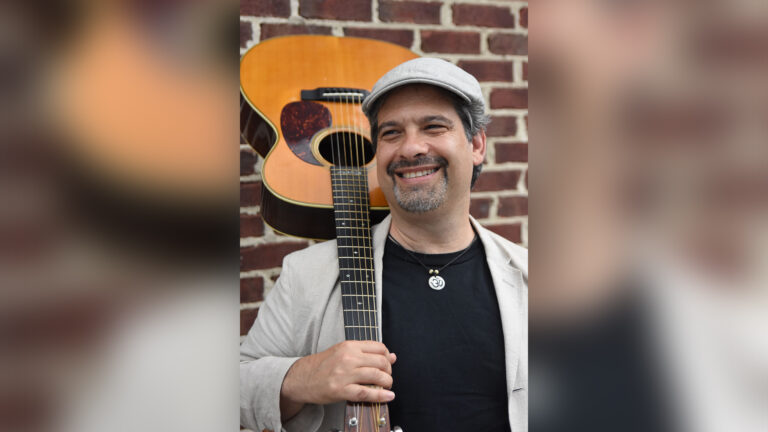
UCD alumnus and musician Dave Nachmanoff discusses his new routine sans-live performances

The meaning of live performance: Nachmanoff talks about how his career as a musician has been impacted, shares personal opinions on live-streaming

UC Davis alumnus Dave Nachmanoff is a folk singer-songwriter who primarily collaborates with British singer-songwriter Al Stewart, but has performed alongside a range of other musical artists in many settings over the years, including Alison Krauss, Steve Forbert and the band Firefall. His tours have been put on hold or canceled altogether due to the virus, and the live performance aspect of his music is currently nonexistent. 

Nachmanoff has considered joining in on the prevalent wave of livestreams among other artists, but as someone who “loves playing up close and personal with people,” he grapples with the idea. 

“I do a lot of house concerts normally, and to me, the idea of playing in front of a camera or a phone camera or something with nobody there, not seeing their faces and not having that kind of energy that you’d get in the room from people being there just seems so different and doesn’t really appeal to me very much,” Nachmanoff said. “I know a lot of musicians are livestreaming, and certainly if I didn’t have the studio and I didn’t have this other work that I could be doing, I’d probably be scrambling to get the livestream thing going.”

Nachmanoff currently works from his home studio, where he writes custom songs upon request and collaborates with musical artists online. He uses tracks that get sent back and forth so each artist can add their own recorded material. 

“I realize that I’m extremely fortunate because I do have the studio and I already have been doing this kind of work before,” Nachmanoff said. “It just wasn’t the only thing I was doing, so that’s sort of the big change.”

He admitted that the stress he feels due to the outbreak could be contributing to the difficulty he faces in performing for an online audience. 

“I feel badly that I’m not livestreaming, simply because I feel like for the people that do like my music […], some of them might enjoy getting the chance to hear it,” he said. “But I just haven’t been able to really get myself kind of psyched up to do it, and I think it’s partly just that this whole crisis has been so disturbing and devastating that I just don’t feel like getting in front of a camera.”

Although Nachmanoff is not currently performing in front of a live audience, he said he enjoys “helping people with their songs” and producing for others.

“Because I have the studio work that I’m doing, I’m so grateful and happy that I actually have work to do, so at the moment that’s really what’s energizing me [and] keeping me going,” he said. “It’s not the same as the touring work I do, but it’s another side of my music and something that I do enjoy working on.”

Nachmanoff suffered from a hematoma on his vocal cord in 2018, which both rendered him voiceless for a period of about six months and prevented him from recording. During this time, he used a text box on his computer to communicate with his clients. 

“I didn’t realize until I had this vocal injury how much I depended on my voice, because almost all the work that I did involved either singing or talking or both,” Nachmanoff said. “I learned that even though it was difficult, because I play a lot of instruments and have a studio, if I can find different ways of working.”

That year, clients came to record with him.

 ‘I would literally use a text box on my screen, on my computer, and type instructions to them instead of talking to them,” he said. 

This period of using text to communicate helped him prepare for the changes in communication caused by COVID-19.

“Obviously, with the remote clients, I can just send emails back and forth and talk about the music and what we’re doing and everything,” Nachmanoff said. “2018 was kind of helpful in a strange way. Even though it was really hard, it sort of proved to me that I could manage without my voice, at least for a while. And it also sort of showed me that I can manage without touring if I have to.”

The musician looks forward to the day he’ll be able to engage with a physical audience again, but he recognizes the potential he has for creating music within his home. 

“I love to perform, and I love performing for real people in a room, and hopefully some day that’ll happen again,” Nachmanoff said. “But I know that even without that, I can still be making music and doing what I do.”

Written by: Lyra Farrell —  features@theaggie.org