54.2 F
Davis

Davis, California

Friday, December 19, 2025
Home Blog Page 34

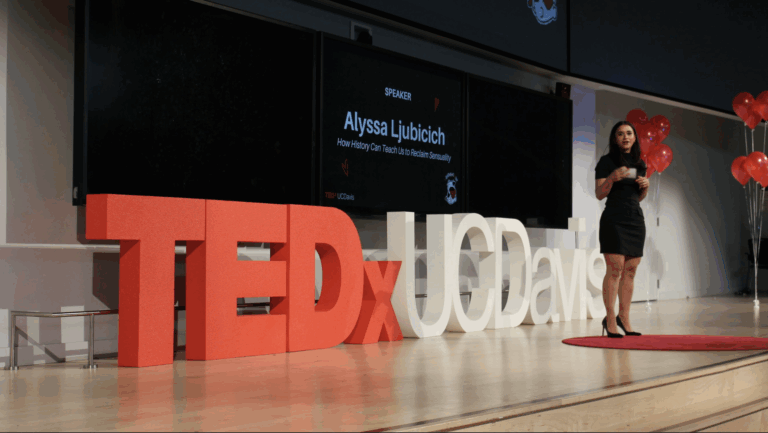
TEDxUCDavis charts inspiring stories for April 26 event

Students and members of the TEDxUCDavis team spoke on their experiences and stories to be shared


By EVELYN SANCHEZ — features@theaggie.org


TEDxUCDavis has been a student-run organization hosting TEDx conferences since 2012 and has played an important role in delivering inspiring stories to the community at Davis. This year’s theme, UncharTED, offers the chance to hear stories from a variety of speakers from different backgrounds, like Leigh Bardugo and Sonya Hassan-Carey, to deliver unique perspectives on facing uncertainty and the unknown. 

Shriya Nagulapally, a fourth-year astrophysics and music double major and the current director of the speaker’s team, spoke on her experience in organizing the event.

“As the speaker’s director, I essentially onboard seven speakers for the conference and work with them to develop their talk into a 10- to 12-minute speech,” Nagulapally said. “We finalize it, make sure they’re getting their visuals and essentially prepare them to give a Ted talk.”

After reviewing 133 applications and narrowing the pool down to 10 interviews, the final lineup of speakers this year ranges from musicians to writers, medical students and company founders.

AJ Bleyer, a speaker for the conference, is a founder and executive producer of his own commercial production company, Advent Films. Bleyer has filmed commercials for brands like Red Bull, Riot Games, Ferrari and Porsche and is also one of the youngest directors to be accepted into the Director’s Guild of America. 

“I’m sharing how the collapse of my dream career ended up being the best thing that ever happened to me,” Bleyer said. “Sometimes the detour is the path, and what feels like a failure might actually be the beginning of something better than you ever planned.”

As Bleyer reflected on the road that led him to such success, TEDx offered him the chance to share his insight with students in a similar position.

“Being selected to give a TEDx talk is a huge honor for any speaker, but getting to do it at UC Davis means a lot to me,” Bleyer said. “College students carry so much pressure to have everything figured out, and this talk is the one I wish I could’ve heard during a time when I felt directionless. I’m proud to now be in a position to offer that perspective, and I’m especially excited to connect with students who might really need to hear it.”

Another event speaker, Hassan-Carey, founder of The Animation Lounge, will be speaking on how the advent of Artificial Intelligence has impacted her career growth and her own secret ingredients for resilience in an ever-changing world. Hassan-Carey has done notable work as a lead animator on beloved classics like “Princess and the Frog,” “The Emperor’s New Groove,” “Winnie the Pooh” and “Looney Tunes.” 

In addition, Leigh Bardugo, author of the young adult fantasy series “Shadow and Bone” and “Six of Crows,” as well as adult fantasy series “Ninth House” and novel “The Familiar,” also spoke on her creative process and how worthwhile work isn’t effortless and how discomfort is a key part of the artistic process. 

Jae’da Clark, a second-year art studio and design double major, shared their experience working on the marketing and design team. 

“It’s been very inclusive,” Clark said. “I have worked on stickers and the logo for the shirt. I’d say that the teamwork aspect, especially in the design part of the club, has been very rewarding.”

Last year’s TEDxUCDavis conference’s theme was WholehearTED, following messages of gratitude and wholeheartedness. This year’s theme focuses on exploring and reaching uncharted territory, with the iconography of the event featuring maps, compasses and navigation symbols. 

“The sponsorship team has worked on securing all the money for the club and the event,” Helen Aguirre, a fourth-year economics major and member of the sponsorship team, said. “That means securing grants and any sponsors that we have.”

So far, the TEDx sponsorship team has secured sponsors like Poppi, Good Molecules, Hoppy, Red Bull, Vinyl Disorder, Visit Davis, Visit Yolo County and more.

“We have a very diverse range of speakers,” Aguirre said. “So I feel like any person from any background can identify with the speakers. It’s going to be a lot of fun because we are going to have free food, free stuff and a raffle.”

Being held at California Hall on Saturday, April 26, 2025, the event began promptly at 10 a.m. and had a series of speakers and performances cycling through until 4 p.m. 

“TEDx isn’t just a lecture series — each session is short, to the point and deeply intentional,” Bleyer said. “If you’ve never been to one, this is your chance to walk away with at least one new insight that could genuinely shift your thinking — or even your life direction.”

If you missed out on the chance to secure tickets for UncharTED, more information on future events can be found on TEDxUCDavis’ Instagram page, @tedxucdavis. 

Written by: Evelyn Sanchez  — features@theaggie.org

The young, passionate and progressive New York City mayoral candidate

Zohran Mamdani’s inspiring campaign is a huge breath of fresh air


By CALEB SILVER —chsilver@ucdavis.edu 


The race for the next mayor of New York City, though the election isn’t until November of this year, has been unpredictable, hope-inspiring and sort of hilarious.

The short list of the important characters include the incumbent mayor, passionate liar and convicted criminal on charges of bribery and fraud, Eric Adams. He is rerunning — not as a Democrat, like he did the first time — but as an Independent, which he announced shortly after the Trump administration’s Department of Justice (DOJ) dropped Adams’ bribery and fraud convictions. There is also disgraced former New York Governor Andrew Cuomo, who currently leads all candidates by polling with 39%. In his decade in office, he oversaw some progressive marriage equality and gun control legislation; However, he also sexually harassed at least 13 women

Politico reports that “the Justice Department found Cuomo ‘repeatedly subjected’ women in his office to non-consensual sexual contact, ogling and gender-based nicknames. Top Cuomo staff ‘were aware of the conduct and retaliated against four of the women he harassed.’”

The last important person to consider in the race is Zohran Mamdani, who is currently polling behind Cuomo and is an openly socialist candidate who is staunchly pro-Palestine and is by far the most unique runner in the race. 

Mamdani feels like a breath of fresh air from the moderate, pro-Israel, criminally convicted Democrats like Adams and Cuomo. His campaign strategy is also unique. He is extremely technologically savvy and he appears to actually understand how social media, video editing and short-form content creation works. His videos are punchy, entertaining and to-the-point. Perhaps this is the case because he is further left than the other candidates, or more likely it’s the case because he is younger and not an institutionalized Democrat. His $8 million in donations come in small amounts from a large swath of New Yorkers across the city — further proving his appeal to actual people living in New York. His supporters are not politicians, corporations or the country of Turkey; He just feels like a real person. 

I truly believe that candidates like Mamdani are the answer to the existential question facing the Democratic party post Trump’s victory last November. Even if his politics don’t fully align with mine, his passion, frustration, hope and problem-solving are all conveyed very tangibly. In The Guardian’s profile of him, they discuss his hunger strike, which went on for a grueling 15 days, to protest the unjust loans that targeted cab drivers who need to purchase medallions. This marks one of two times he was arrested (the other instance was for protesting rent spikes of rent-stabilized tenants).

Mamdani might also be unique because he clearly lays out his plans as a prospective mayor of New York, and they seem to be pretty directly correlated to an increased well-being of the population. These plans include, but are not limited to, free and more-effective buses, freezing the rent for all stabilized tenants and lowering the cost of groceries by removing tax and rent requirements on a chain of city grocery stores. 

Mamdani is receiving more donations and support than expected. I’m not sure he’ll win, and, honestly, I am not very optimistic about it. What I do know is that his policies could work to address the real issues facing New Yorkers and Americans alike and that they are, unsurprisingly, popular. Governing with a left-leaning populist agenda is frowned upon by Democrats, who either have to admit to themselves that they won’t be able to make close ties, connections and receive donations from large corporations or that they sincerely believe it isn’t a winning strategy — Mamdani is clearly proving that it could be. 


Written by: Caleb Silver — chsilver@ucdavis.edu


Disclaimer: The views and opinions expressed by individual columnists belong to the columnists alone and do not necessarily indicate the views and opinions held by The California Aggie.


Review: ‘Mickey 17’ has more to offer than multiple Mickeys

The film runs the gamut of modern human experiences with a ceaseless air of gallows humor until it finds light in its last moments


BY JULIE HUANG – arts@theaggie.org


“Mickey 17” is many things. For one, it is directed by Bong Joon Ho, the South Korean director most famous for “Parasite,” his 2019 film that could be described as a darkly comedic, psychologically unsettling thriller that is also a clear critique of the stratified nature of capitalistic societies. This description of “Parasite” fits just as well when applied to “Mickey 17.” In fact, this 2025 release may be even more heavy-handed than its predecessor in its pursuit of relevant social commentary. 

The film’s protagonist, Mickey Barnes, played by Robert Pattinson, is an unfortunate pushover of a young man whose opportunistic and backstabbing friend Timo (whose surname is never given, really giving the audience a sense of how deep their friendship is) convinces him to start a foolish business venture that fails, causing them to end up on the run from murderous loan sharks with chainsaws. 

Through Mickey’s tragically pathetic backstory, the film has already clued you in on what kind of familiar world he lives in — one where money is everything and lacking it is akin to being handed a death sentence. Perhaps realistically, Mickey does not face these circumstances with grace, and Pattinson’s squeaky voice for his character is truly impressive in its ability to induce pity. 

Hoping to escape his sad fate, Mickey signs up for a space expedition to colonize a faraway ice planet named Niflheim. This expedition is headed by a charismatic leader played by Mark Ruffalo, a failed politician named Kenneth Marshall, whose character is very clearly satirizing the current president of the United States. The Marshall spirit means everything to the members of the expedition, who are extremely enthusiastic about colonizing a distant planet all in the name of their favorite leader. 

On the other end of the spectrum, Pattinson’s character has unwittingly signed up to be the lowest of the low. He is an “Expendable,” a worker whose contributions to the expedition effort take the form of willingly dying over and over again, each time being restored as a clone of himself with his memories updated to a database. The science behind the cloning technology is waved away even in the movie universe — scientific curiosity is not once privileged at any point in the film. 

Instead, “Mickey 17” revels in putting its protagonist in a series of awful, stomach-dropping situations over and over for the first half of the film, hammering home how truly expendable Mickey is viewed as by the rest of his callous community. (As one can guess, he dies 16 times and is embodied by his 17th clone by the movie’s beginning).

Mickey’s perceived worth is shown to be tied up completely in his ability to die and produce research results for the scientists aboard the spaceship, regardless of how much pain it causes him. It is as if the film is turning to the audience and asking, “Wouldn’t it be messed up to treat human beings as unfeeling commodities?”

The only regular reprieve that Mickey has is the romantic relationship he starts with Nasha Barridge, a member of the ship’s security force who becomes his tether throughout all the personally meaningless pain that he suffers by rote. Nasha is beautiful and secure, whereas Mickey is perpetually distressed, and their relationship turns out to be one of the most straightforward sources of stability in the entire film. 

Unlike the romance, the rest of the film is chaotic and dizzying as tonal shifts puncture the atmosphere that one starts getting used to every half-hour or so. The already outlandish premise becomes hopelessly bloated with plot threads as the film consistently leaves some scenarios feeling incomplete in order to chase new ideas. Two-thirds of the way through, “Mickey 17” has more or less dropped the intrigue surrounding clones, deciding that it has exhausted that concept after portraying some outrageous interactions that include attempted murder and sex, in that order.
The film instead devotes its last major arc to exploring a dynamic between colonizers and the Indigenous inhabitants of the land they are hoping to colonize, adding a critique of the imperialistic extraction of natural resources to its repertoire of scathing social commentary. The only segment of the film that does not lean into dark comedy is the ending, which wraps up the conflict more neatly and relatively peacefully than you might expect. 

By the end, Mickey is finally allowed to grasp the possibilities of his future as the film closes his story on an alien planet, in new and tender circumstances familiar to anyone who has had to start anew without completely giving up everything. For once in its runtime, “Mickey 17” draws a parallel to reality in a way that illuminates the hope that comes with living. 


Written by: Julie Huang — arts@theaggie.org 


University of Florida, University of Connecticut pull out the NCAA Basketball Championship win

The end of the 2024-25 college basketball season


By DIEGO CERNA — sports@theaggie.org


Following a very exciting 2024-25 college basketball season, the National Collegiate Athletic Association (NCAA) men’s and women’s basketball championship games were held on April 6 and 7.

On April 6, the No. 2-seeded University of Connecticut (UConn) Huskies faced off against the No. 1-seeded University of South Carolina Gamecocks. The game was a blowout, as the Huskies cruised to their victory with a final score of 82-67. UConn continues to be one of the most dominant and successful teams in college basketball history as they comfortably lead all NCAA Division 1 schools in national championships for women’s basketball with a total of 12 wins.

Paige Buekers has been UConn’s star throughout her collegiate career, finishing the season with a fairytale ending. She was the No. 1 pick by the Dallas Wings during the draft on April 14. 

Buekers held an emotional embrace with Head Coach Geno Auriemma after taking the court for the final time in her career at the end of the fourth quarter. This is Auriemma’s 11th championship with the Huskies, his most recent championship in 2016 with New York Liberty’s star center Breanna Stewart.

UConn’s Azzi Fudd was named the Final Four Outstanding Player, finishing with 24 points, five assists and five rebounds in the championship game. 

On April 7, the No. 1-seeded University of Florida Gators faced the No. 1-seeded University of Houston Shastas in the men’s national championship game. 

This is the first time four No. 1 seeds faced off in the final four. Houston faced the No. 1-seeded Duke University in the semi-finals and mustered an incredible comeback in the final minutes of the game. Houston, being down by 14 points in the second half of the game, finished on a 9-0 run to end the game. 

Florida was also in a tight semifinals game against the No. 1-seeded Auburn University Tigers. Florida’s star fourth-year guard Walter Clayton Jr. played a great game, scoring 30 points. 

This was only the second time in NCAA men’s basketball history where all No. 1 seeds ended up making it to the final four, the only other time occurring during March Madness in 2008. This also happened to feature the youngest coach to ever lead in a championship game, Florida’s Todd Golden, and the oldest Head Coach, Kelvin Sampson. 

The Shastas took control of the first half, having a six-point lead at halftime. Following halftime, the Shastas pushed their lead to as much as 11, having a 93% chance to win according to ESPN’s game flowchart, with 14 minutes left in the second half. However, the Gators chipped away possession after possession.

 Down 65-63, Houston had the ball with the final possession and shot clock off. On a blown possession, Houston guard Emanuel Sharpe raised up for a three-pointer off a screen, but Clayton contested nicely, making Sharpe throw the ball into the ground in a panic. This led the game to end in a loose ball, with neither team getting a shot off. 

“You gotta get up a shot,” Sampson said about the final possession at the press conference after the game. “You gotta do better than that.” 

This is the Gators’ third basketball championship in university history. The most recent championships came when they were back-to-back champions in the 2006-08 seasons. Those teams were coached by former National Basketball Association players Corey Brewer, Joakim Noah, Marreese Speights and Boston Celtics’ center Al Horford. They were led by the Bulls’ current Head Coach, Billy Donovan. 

Overall, this season proved to be very successful for some teams and players and unsuccessful for others. Hopefully, next year’s season will prove to be even more exhilarating as teams are now set to take some time off before training begins.

Written by: Diego Cerna — sports@theaggie.org

And the crowd is…yearning?

Exploring how the art of longing for someone can make our lives better


By SABRINA FIGUEROA — sfigueroaavila@ucdavis.edu


I’ll admit it: I’m a hopeless romantic. It comes from years of watching romantic comedies and listening to love songs where stories of couples coming together play out — or don’t. No matter the end result, they usually explore the longing desire to be with someone or a genuine appreciation and care for someone. 

After reading and watching “Pride and Prejudice” and “Atonement” (nobody does period-drama better than Kiera Knightly) in high school, my life was forever changed. These stories raised my bar for romantic relationships, so imagine my frustration when I stepped into the modern dating scene. 

Maybe I’m around the wrong people, but I’ve noticed that a common reaction to anything surrounding dating — or caring about others in general — has been to completely detach yourself from any kind of feeling. Hook-up culture and the rise of horrid dating apps have reinforced this, and they may even be the cause of many college “situationships” (if you’re in one right now, STAND UP!). The flirtatious, sometimes tension-filled start of romantic relationships, genuine crushes that leave you feeling giddy or even the experiences of pining after someone are so rare now. Even worse, the bar for what makes those fun beginnings is so low that it’s in hell. 

The truth is that I’m sick of it. I had a friend who told me she had to act nonchalant with people she had a crush on and people she wanted to be friends with; otherwise, it’d feel like she was chasing, not attracting. News flash: She did not feel great after those interactions because nobody got the hint that she wanted to form a connection with them. But if you don’t show you care — either in a big way or a small way — you can’t expect people to read your mind. 

Yearning is still around, we just don’t seem to show it. The point is to do just that, even if you get rejected or broken up with. It can manifest even after those things happen, but the key is to acknowledge and express it even so. It may come off as hatred, sorrow, adoration — any strong emotion — and that’s okay. 

To feel is inherent to our nature, and we shouldn’t have to act like it’s not. It’s scary and odd at times, but if you allow yourself to wallow or even act on it, it will pass. Maybe something good will even come out of it. 

We wouldn’t have gotten most songs on Jeff Buckley’s album “Grace” if it weren’t for his heartbreak or the feelings he had for someone. Thank God he was chalant. We also wouldn’t have “Bags” by Clairo if she had simply acted like she didn’t care after whatever happened with the person she wrote the song about. Some of the most relatable, soul-crushing art and life lessons can come from yearning, caring, love and romance — both past and present. 

Perhaps if more people brought this feeling back to the dating sphere, all of our bars would rise and some of our relationships would be more fulfilling. We could allow it to turn into real romance or love if we let it, instead of pushing it down. Wouldn’t it be better to genuinely feel and be wanted — both yearning for someone and someone yearning for you — than be in a “Will they, won’t they?” (they won’t) situation forever? It may be that I’m just too much of a hopeless romantic, or maybe it’s society that isn’t enough of one.


Written by: Sabrina Figueroa — sfigueroaavila@ucdavis.edu

Disclaimer: The views and opinions expressed by individual columnists belong to the columnists alone and do not necessarily indicate the views and opinions held by The California Aggie.

My elementary school taught me how to ride a unicycle

The pros and cons of non-traditional schools


By MOLLY THOMPSON – mmtthompson@ucdavis.edu 


I grew up attending school on 14 acres of hilly, renovated farmland. I went to art and music classes in a repurposed dairy barn with one corner full of drums and recorders, one with long, stained wooden tables, wide rugs in the center and unicycles and stilts piled along the back wall. I learned algebra in “the math cabin” which was poised at the long, winding entrance to the “redwood grove” and I started each language arts class sitting cross-legged on the floor of the “rug room” in a brief, guided meditation. 

Each morning at 9 a.m., when the bell was rung by hand, myself and my 60 peers would gather at “the circle”: a ring of benches made by laying roughly cut wood slabs on top of stumps (we could take the slabs down and lean them against the stumps to make an arena in which to play “ga ga ga”). At recess, we’d run into “the willows” — a lush grove of trees and blackberry brambles in which we’d carry out the most elaborate scenarios of make-believe politics and scandal: no concrete, no physical education, no loudspeakers, no buses, no standardized curriculum, no hall passes and no computers. 

When I transferred to public school in sixth grade, I felt like a small-town girl in the big city for the first time (New York City? Never heard of it. My concrete jungle was Valencia Elementary School). I wasn’t used to an automated bell system, I’d never called my teachers “Mrs.” or “Mr.” before and I couldn’t touch-type. I ended up fitting in well (I wasn’t completely inept), but it was definitely a bit of a culture shock. Both types of education have their benefits, but they also have their drawbacks. So, as someone who’s experienced both sides of the coin, I feel qualified to compare them.

One thing that Orchard School (which I attended from kindergarten through fifth grade) got right is that they truly emphasized the facilitation of socialization. While we go to school with the primary goal of academic learning, equally important are the social lessons we inherently learn through the process of education itself. At Orchard, academics weren’t the priority. We had four classes each day, each one hour long and each with a short recess period in between. Yes, we had recess between every class. The priority was gaining independence, learning how to form and foster relationships, understanding nature and the environment, emotional development and teamwork. I learned how to read and write and do basic geometry, but I also learned how to be an effective leader, a good friend and to trust the natural world. 

Orchard also gave me some opportunities I never would have otherwise had. We had alpacas, chickens, a pig and a full garden on campus — grade levels would take turns caring for them, which instilled in us a pretty solid sense of responsibility and self-sufficiency. As students, we helped stage and rehearse our own plays in drama class. We had a small archery range, where the older students could take elective classes or go practice shooting during recess. 

During my last year, I taught my own baking elective (under supervision) to a sizable cohort of my peers. I was able to switch between classes and grade levels on my own schedule (we had combined classes with two grades each, so I ended up doing my second-grade work in first grade and formally skipping second grade, then completing sixth grade a year early and repeating it at Valencia — it’s complicated). Essentially, Orchard allowed for much more flexibility and adventure than public schools offered. 

What can be difficult, though, is that the rest of the world doesn’t operate with those same priorities as the specific environment you’ve grown accustomed to. The work day never starts late because the principal lost track of time and forgot to ring the bell. You don’t always get a combined hour of break for only four hours of work or class. In high school and college, you receive objective grades rather than annual qualitative evaluations. While the kind of alternative education at Orchard can yield a lot of benefits that are often overlooked by conventional schools, it can also fall short when it comes to preparing kids for later schooling and the working world.

That became evident when I switched to Valencia Elementary for sixth grade. In the end, I did just fine. I acclimated quickly, settled into a group of friends and passed all of my classes without too much turmoil. But I was definitely in for a rude awakening when I was suddenly faced with homework every day, online assignments and the Accelerated Reader (AR) test. I’ll never forget being asked to stand up and say the Pledge of Allegiance on the first day (nobody told me about that!), I had to sort of lip sync it and mumble the words — I had no idea how it went and it was embarrassing. 

While Valencia was much more detached, strict and rigorous than Orchard, it had its own advantages. I learned how to succeed in a system that was much more synonymous with most of the world — organized schedules, hard deadlines, assigned seats, objective grades and more general rules of conduct. I finally memorized my times tables, learned to type on a computer, opened my first Google Doc (it took a few tries; I typed my first assignment in my Notes app on my iPad mini) and learned how to navigate Google Classroom. I got used to the specific genre of authority that elementary school teachers command, took the bus every day and found my place in the playground hierarchy. The experience, as a whole, definitely helped me assimilate to life as most of America knows it. 

Before Valencia, I had never been subjected to most of the classic American elementary school experience. That means I’d never had to run the mile, and I really took umbrage with that when I finally had to face it. It’s honestly a wonder that I even survived — at Orchard, we didn’t have physical education. Instead, we had circus arts. Yes, instead of running, we learned how to juggle, walk on stilts and ride unicycles. So if nothing else, Orchard gave me that skill (I can still ride a unicycle). Maybe it didn’t teach me how to write an essay or do regular multiplication (I can still only do the lattice method), but, at the very least, I have a fun fact that will serve me in every ice breaker for the rest of my life. 

At the end of the day, both systems have benefits and drawbacks. I’m lucky because I got to have both, and I can definitely thank both experiences for the skills I have to this day. Orchard School taught me who I was and how to exist as a prominent member of a very diverse community; Valencia Elementary taught me how, as that person, to succeed in the conventional academic scene. I truly am who I am because of both, and I wouldn’t change that for anything.


Written by: Molly Thompson — mmtthompson@ucdavis.edu 


Disclaimer: The views and opinions expressed by individual columnists belong to the columnists alone and do not necessarily indicate the views and opinions held by The California Aggie 

Was the season two finale of ‘Severance’ worth the wait?

A spoiler-free review of the thriller show’s most-talked-about episode 


By BELLA PETERSON — arts@theaggie.org 


The season one finale of “Severance” is one of the most iconic that television has seen in a long time. “Severance” left its audience shocked and in search of answers after its initial finale. Being left on a cliffhanger after a show’s finale is certainly not a new thing for fans, but what the audience of “Severance” wasn’t anticipating was having to wait three years before getting any answers. So…after all that time of waiting, it’s time to finally answer the question: Did season two of “Severance” deliver?

While watching the finale, the question of how this episode was going to make the finale anywhere near as iconic as the season one finale was recurring. What will be the big question they leave us with? Throughout this season of “Severance,” we were able to see many more answers come to light, but at the same time, with more answers came more questions. It felt like the show took its time this season: to unfold the characters we didn’t know that well in the previous season and the company, Lumon, in terms of being “the big evil” of this story.

There were definitely some mixed reactions from this choice after getting a whole episode dedicated to the original face of Lumon, Harmony Cobel, in the show and her history with Lumon. This decision allowed the show to build a storyline that didn’t leave viewers completely in the dark. When a show cements itself as one of mystery in science fiction, we always complain that we want answers — and this is what the show did. It may not have been every answer we were searching for, but the show allowed us a little peek inside the minds of characters that build the structure of what makes Lumon work.

As we enter the finale, we see an internal conflict with our main protagonist, Mark S. “Severance” really takes the trope of “man against himself” to a whole other level. There was an ever-present struggle to make sense of the motives of each character, making it difficult to decide who to “root for.”

 The finale brought up a lot of ethical questions: whether you should help the very person responsible for trapping you within this prison — despite knowing only one of you can get their happy ending; whether you can even trust him to begin with. Whose wants are selfish in this situation? Is anyone truly in the wrong for wanting what they do? 

Additionally, the pacing of the finale did such an amazing job of keeping the audience on the edge of their seats and not allowing for one moment of peace. As the episode came to its final moments, there was anticipation. There were these hopes for the show but instead, watching the conflict that had been unfolding burst into an upsetting result. Even so, viewers can’t necessarily feel angry at the choice that was made. Just like season one, we are left wondering the fate of the characters that we have grown to care about. The audience can only hope the wait won’t be as long as the last time. 

Written by: Bella Peterson — arts@theaggie.org

Two major UC labor unions to strike systemwide over unfair labor practices on May 1

UPTE-CWA 9119 and AFSCME Local 3299, representing 50,000 workers combined, are striking for the fourth time this academic year


By KHADEEJAH KHAN — campus@theaggie.org


University Professional and Technical Employees-Communications Workers of America (UPTE-CWA) 9119 and American Federation of State, County and Municipal Employees  (AFSCME) Local 3299 are holding a one-day strike on May 1 across all University of California campuses over unfair labor practices and the UC’s systemwide hiring freeze. It marks the unions’ fourth strike this academic year.

AFSCME, representing over 37,000 service, patient care and skilled crafts workers, released a press statement on April 15 alleging that the UC has failed to bargain and provide notice about the hiring freeze, despite current understaffing. 

“Amidst UC’s buying spree of new hospitals, its illegal hiring freeze and denial of certain benefits to workers at newly acquired facilities, will only serve to make these problems worse, and will jeopardize the quality of services our patients and students depend on in the bargain,” the press statement reads. “Ultimately, UC is trying to save money in all the wrong ways—by taking away resources from workers—and that’s why our members will exercise their legal right to strike on May 1st.”

The unions plan to picket at the UC Davis Medical Center in Sacramento. Unlike past strikes, they will not picket at La Rue Road and Hutchinson Drive on UC Davis’ campus.

AFSCME has filed two new unfair labor practice (ULP) charges with the state’s Public Employment Relations Board. The first charge alleges that the UC’s lack of notice and failure to bargain over the hiring freeze violates state law and legal precedent. The second (ULP) charge follows the UC’s decision that denies employee benefits to workers absorbed by the UC’s acquisition of six southern California hospitals. In their press release, AFSCME noted that new employees from these acquisitions have been offered benefits. 

UPTE-CWA, representing research and technical workers, released a press statement detailing how some campuses will choose to apply the hiring freeze to decisions about reclassifications, promotions and equity increases for current employees. 

“After UPTE submitted a cease and desist and demand to bargain, the University explicitly refused to undo the hiring freeze so we could bargain,” the press statement reads. “UC has also committed additional unfair practices like denying pension credit to workers at the hospitals it has acquired without bargaining, leaving these new workers behind, even as UC expands its market share.”

On April 30, the UC released an updated statement regarding the strikes. 

“The University of California has consistently come to the table in good faith in an effort to collaborate with AFSCME and UPTE to negotiate mutually beneficial contracts,” the statement reads. “We are disappointed by the union’s continued choice of striking as a negotiation tactic. These strikes cost union members a full day of pay, and they cost the University system millions of dollars. This is especially harmful considering the current economic and fiscal uncertainty in higher education and nationally. We are hopeful for meaningful progress with both unions so that we can turn our attention to the state and federal funding concerns.”

The UC provided information regarding the hiring freeze.

“The University of California instituted a hiring freeze following financial uncertainties announced by President Drake on March 19, joining many higher education institutions nationwide taking similar measures,” the statement reads. “The hiring freeze applies to future hires only; it does not impact the employment status of current UC employees. Each UC location is implementing the freeze based on its specific needs, financial situation and pre-existing protocols.” 

The UC’s statement continued by further discussing the hiring freeze and negotiations.

“The University has informed stakeholders, including AFSCME and UPTE, that the hiring freeze doesn’t alter commitments under collective bargaining agreements or established policies,” the statement reads. “UC officials have told AFSCME and UPTE they’re willing to discuss any identified negotiable impacts, although the UC believes the parties’ collective bargaining agreements already cover these effects. The unions have not responded to UC’s offers to meet.”

Additionally, a fact sheet regarding the UPTE negotiations was provided to The California Aggie from Senior Director of Labor Communications Heather Hansen from the University of California Office of the President. The sheet includes background information, UC offers, UPTE requests, operational needs and unfair labor practice charges.

Patient care will not be impacted by the strike, according to UC Davis Health Public Affairs. For the duration of the strike, Latitude Restaurant, The Gunrock and the Meal Card Office will be temporarily closed. 

Written by: Khadeejah Khan — campus@theaggie.org

Aggies defeat the Idaho Vandals in the Senior Day match

Strong performances in doubles and singles play secured the win for Davis


By COLINA HARVEY — sports@theaggie.org


On April 17, the UC Davis women’s tennis team took on the University of Idaho Vandals on their home court. As it was their last home game of the season, they honored three fourth-year team members who will not be returning the following season.

The three honorees were Claire Galerkin, a fourth-year managerial economics major, Daisy Maunupau, a fourth-year cognitive science major, and Solia Valentine, a Master of Business Administration graduate student.

Before the game kicked off, the team took time to honor the fourth-years with speeches and flowers. Each fourth-year gave a speech, as well as Head Coach Sara Jackson and Assistant Coach Matthew Foster-Estwick. The heartfelt speeches were a testament to the tight-knit nature of the team, making the final home match of the season even more significant.

The match started with three simultaneous doubles matches. On court one, Co-Captain Maunupau partnered with Mika Ikemori, a second-year psychology major. Together, the duo competed against Idaho’s Valentina Rodas and Naomi Schraeder.

Maunupau and Ikemori dominated the match, with Maunupau hitting an ace to win the first game. They only allowed Idaho to win one game before reaching six games and winning the set.

On court two, Valentine teamed up with Polina Marakhtanova, a first-year cognitive science major, to face Idaho’s Ida Johannson and Lena Beckx. They also made quick work of Idaho, conceding only two games and clinching the doubles point for the Aggies.

Galerkin and Kaia Wolfe, a third-year aerospace science and engineering and mechanical engineering double major, competed against Idaho’s Diana Khaydarshina and Hanna Koprowska on court three. They also prevailed against their opponents, completing the Aggies’ sweep in doubles play.

UC Davis had the advantage going into singles play, but the match was far from over, with six points up for grabs in the singles matches.

Ikemori, Maunupau, Marakhtanova and Valentine competed in singles play along with Penelope Wong, a first-year environmental engineering major, and Maya Youssef, a third-year political science major.

The first to finish was Marakhtanova, who swiftly took down her opponent, Schraeder, in two sets, giving up only two games total.

Next to finish was Valentine, who decisively defeated her opponent, Koprowska, in the first set, winning 6-1. In the second set, Koprowska fought back, sending the set to a deuce. Valentine persevered and won the second set, securing the match for the Aggies.

Youssef ultimately clinched the match for the Aggies when she defeated Rodas in three sets, taking the score to 4-0.

Maunupau and Wong struggled in their matches, with Maunupau losing in three sets and Wong losing in two sets. Fortunately, their teammates had already sealed the deal. Last to finish was Ikemori, who managed to win her match after being bested in the second set.

Ultimately, the Aggies prevailed, ending the match with a score of 5-2.

The Aggies will head to the Big West Championship in San Diego from April 24 to 27. The Aggies struggled in conference play this season with a record of 3-6. As the eighth seed of 10 teams in the Big West Women’s Tennis Championship, the Aggies will have a chance to prove themselves to their conference.

They will take on the fifth-seeded UC San Diego in the first round of the weekend-long tournament. Early in the season, they fell to UCSD in a close 3-4 match. While they took the doubles point, they were only able to win two of their singles matches. The rematch provides an opportunity for UC Davis to go against UCSD and have a favorable outcome in their upcoming games.


Written by: (Colina Harvey) — sports@theaggie.org

Let’s Explorit: Davis science non-profit with an uncertain future

The Explorit Science Center faces financial challenges and is turning to the community for help


By IHA RASTOGI — science@theaggie.org


Founded in the 1980s by Davis residents who wanted to bring UC Davis-level rigor to scientific education in local schools, the Explorit Science Center is in danger of shutting down as early as this upcoming summer.

Throughout the decades, Explorit has reached hundreds of thousands of people through its dedicated camps and school programs. The non-profit’s website cites connections to 17 different California counties, all of which operate science programming through donations. By hosting several activities for schoolchildren and their families to participate in, including public exhibits, workshops, an astronomy club and even a Science Exposition in the past fall. The center offers numerous opportunities to directly engage in the same science concepts often taught passively in school textbooks.

Glen Lusebrink, a retired schoolteacher who now serves as a board member for Explorit and a volunteer, particularly enjoys the Family Science Night tradition.

“An Explorit team loads a van with plastic tubs full of hands-on science activities and drives to a school sometimes up to an hour away from Davis,” Lusebrink said. “They transform the school’s multi-purpose room into a pop-up science museum. Fossils, earthquakes and reptiles are all part of the experience — and you might even get to hold a Madagascar hissing cockroach.”

During the rocky stretch of surviving the pandemic where all in-person programs were suspended for over 18 months, Explorit staff and board didn’t sit still.

“We have seen growth in both our public visitation and school program participants every year since re-opening after [COVID-19],” Program Director Emily Anderson said via email. “Studies report most science-learning occurs outside of the formal education setting. People, young and old, need places to ignite curiosity and self-directed exploration. Explorit provides those experiences.”

Explorit is actively seeking donations and advocates to fuel its mission.

Board President of Explorit and UC Davis Professor Ken Kaplan advises that making donations through the Explorit website in time for the “Big Day of Giving” on May 1 or reaching out to a board member to get personally involved are excellent ways to support the center.

“Everyone can help ‘Save Explorit,’” Anderson said. “Ask people you see at the farmers market if they’ve heard of Explorit, and encourage them to visit during our open hours. Talk to leaders, school principals and science teachers — spread the word.”

Kaplan emphasized the importance of educational centers like Explorit for local communities.

“In a time when we find it hard to agree about the very facts that describe our world, isn’t investing in the next generation of citizens and thinkers one of the most important things we can do?” Kaplan said.

Written by: Iha Rastogi — science@theaggie.org

Bring back hats!

We need to resurrect the valuable art of hat-wearing


By MADISON SEEMAN— meseeman@ucdavis.edu


Walking through the streets of Davis, I’m assaulted by the tragic absence of hats. Sure, there are a few brave little baseball caps and a beanie or two in the winter, but these are underwhelming in the face of our largely hatless society.

Hats used to be everywhere. My friends and I frequently watch old movies, dazzled by the unusual shapes and patterns of hats for every occasion, every mood — some horrendously ugly in the most charming way. My personal favorite is Rosalind Russell’s hat in the 1940s movie “His Girl Friday” — it’s so whimsically nonsensical!

Hats — which are nearly as old as humanity itself — used to be a crucial part of the everyday American outfit ecosystem, a key indicator of social status, the subject of scandals, the center of idioms. For decades it was an embarrassment to leave the house without one.

Now, everywhere I look, I see naked heads: hair up, down and everywhere but in a hat. What was once scandalous is now the status quo. So, where have all the hats gone?

Some blame World War II, some blame John. F. Kennedy. I blame cars.

In the 1950s, the average American’s transportation was shifting away from public transit toward the automotive. The government funded public projects to construct interstates and establish highways and suburbs, with the personal automobile taking center stage.

Hats — which had, in part, functioned as protection from the elements — became redundant in the face of the enclosed interior of the car. Cramped cars sometimes even made a hat more difficult to wear, unless the driver was keen on bumping their head on the ceiling.

This, paired with a wave of climate-control technology in buildings and a changing view of social class following World War II, slowly replaced the hat’s previous functions both as protection and as a status symbol. Kennedy only cemented that trend when he refused to wear a hat for his inauguration, and, by the early 1960s, hats had mostly disappeared from daily life.

As much as I appreciate my car, air-conditioning and relatively more integrated social classes, I have to admit I miss hats. Sure, baseball caps — the hat of the everyday man — have stuck around. And yes, fedoras experienced somewhat of a moment in the early 2000s and bucket hats had their own turn in the spotlight around 2020. But hats used to be a staple, a language, an art. Let’s leave the class baggage behind: what I wouldn’t give to see an earnest bowler hat on the heads of my peers.

Hats communicate intention. A sunhat for vacation, a fishing hat for a day out on a boat. If I see someone wearing a ski mask — which I do count as a hat, despite the name — I assume he’s either skiing or robbing a bank.

More than function, hats have character! A grand flashy hat for a derby, a thick, long hat for cold weather and a floppy nightcap with a ball at the tip for bedtime; There’s a hat for everyone. There are hats for the little hotel bellboy, berets for the hipsters out there and fedoras for avid Reddit users. Even the bow, which is not a hat, is a step up from the unadorned head.

You don’t have to go full top hat; we can enjoy hats in a modern way. But, just as fashion goes in cycles, it seems odd that hats, which have such potential for personal expression, haven’t quite made it back into circulation beyond a few small trends and the simple cap.

Finally, more than all of that, hats are fun! There are so many outfits out there that don’t even realize they’re missing a hat. It’s a statement piece, effortless intrigue — the cherry on top of any successful outfit.

Try a trilby, don a deerstalker, bring back bowler hats; Next time you’re going out on the town, consider topping off your fit with a hat. They’re functional, they’re fashionable and they need to come back!


Written by: Madison Seeman— meseeman@ucdavis.edu


Disclaimer: The views and opinions expressed by individual columnists belong to the columnists alone and do not necessarily indicate the views and opinions held by The California Aggie.


There’s a new bus in town

Watch out, ladies


By ALLISON KELEHER — adkeleher@ucdavis.edu


In a not-so-far-away land, dubbed the “Pad,” there slept many Unitrans buses through the night. Not a single bus was stirring, not even the Z line (he’s a heavy sleeper).

You see, these buses need their sleep because their days start bright and early. To make matters worse, they have to spend over 12 hours a day carting around smelly undergraduate students. So, the least we can do is let them get some beauty sleep.

One morning, the buses woke to the sound of an alarm, which startled everyone and prompted them to get ready for the day. The buses entered their rhythm as they whirred to life and organized themselves into their assigned bus lines. The Memorial Union (MU) buses tend to stick together away from the Silo buses, since they see each other most often. Then, they all filed into line and sped off on their routes.

It seemed like every other day to the buses, but they were in for a surprise — some may say a bombshell. Today was the unveiling of the Yolobus route addition to the Silo. This bus was set to travel between the Silo and the UC Davis Medical Center in Sacramento. In comparison to the Unitrans routes, this was way more dangerous and exciting.

When the Silo buses rolled onto campus, they were astonished to see a bright, shiny, blue relative at their bus stop. The Yolobus was parked, standing in all his glory, with a brand-new sign marking his spot. The Silo buses halted in their tracks to admire this newcomer. The Yolobus stood regally and didn’t even turn his wheels to acknowledge the Unitrans buses arriving. He didn’t care.

The natural leader of the Silo buses, the J line, stood tall at the front of the fleet of buses to assess the new arrival. The Yolobus was navy blue, with tinted windows and an adult driver. Much more dignified than the Unitrans accommodations. The Yolobus knew this, too, because he didn’t care to give the Unitrans buses a glance. Not even the J.

This angered the J, because he was used to a certain level of respect from his fellow buses. In his day-to-day life, the J faces a high amount of foot traffic and stress from undergraduate students; However, it’s all worth it because he gets to come home to the Pad and get some respect from his bus family. So, this new Yolobus was ruining things for his ego.

Since the Yolobus wasn’t acknowledging any of the buses, everyone filed into position, keeping one eye turned toward the Yolobus to monitor the situation. This was a quiet day, because everyone was afraid to say something. So, the Unitrans buses entered their driving rhythm and set out to complete the noble job of transporting thousands of students around Davis, California.

Later that night at the Pad, everyone was talking about the new arrival, without worrying about being overheard.

“The girls are obsessed with the Yolobus!” one of my sources at the Pad said. “They’re calling him Yolo.”

You heard it here first. Yolobus is the bad boy on campus. He’s different, misunderstood and all of the girls are going to fix him.


Written by: Allison Keleher — adkeleher@ucdavis.edu

Disclaimer: (This article is humor and/or satire, and its content is purely fictional. The story and the names of “sources” are fictionalized.)

The rich don’t wait in lines

Coachella isn’t that fun when you don’t have the money for it 


By JHANA RHODES—jsrho@ucdavis.edu


Coachella 2025 has officially wrapped after two weeks of iconic performances featuring some of the most talented artists in the world. Lisa and Jennie from Blackpink, Lady Gaga, Megan Thee Stallion, Charli XCX and Green Day were some of the many talented artists that performed at Coachella this year. Amidst the absurdly overpriced refreshments, dust devils and a surprise guest appearance from Bernie Sanders, what really made this year’s festival truly unforgettable were the glaring disparities in social and economic dynamics amongst the VIPs and everyone else.

The rift was clear: While the wealthy, celebrities and influencers ate $1,000 dinners at Nobu and enjoyed the privileges of non-existent wait times, the rest of us common folk spent what felt like an eternity in lines for everything from entry to the campsites to the showers and even to the stinky porta-potties. This great divide in the Coachella experience shows us that the status symbol the music festival claims to be remains unattainable for many. In fact, it shows us that universal access to hedonistic pleasure is, unfortunately, a myth.

Hedonism is a philosophical concept that defines the pursuit of pleasure as the most important goal in life. In other words, this means seeking out experiences (physical or mental) that you enjoy while avoiding what causes worry or pain. Because we are talking about Coachella, this could mean seeking out a wide range of experiences, such as paying for a $649 general admission (GA) ticket to experience sensory pleasures such as good music and delicious and diverse food options, to more emotional pleasures like seeking social connections, excitement or joy. Since 1999, Coachella has had various vibrant art installations, interactive activities and musical performances. It has marketed itself as the golden standard for a good period of time.

Coachella’s promise of hedonistic pleasure is quickly debunked when you realize that to truly enjoy your experience, you need to be rich, a celebrity or an influencer. If you’re not any of those, you better hope to be on a first-name basis with one of the artists. While a few of the privileged attendees stay in palm spring villas and are invited to various air-conditioned brand events and star-studded pre-parties, the remaining 60% of ticket holders who purchased a GA ticket by using a payment plan (nothing wrong with that!), were sleeping in makeshift tents, packed in like sardines in a crowded GA standing area.

Of course, anyone looking for a little more luxury can purchase a VIP festival pass for the small price of $1,399. And, if you don’t want to wait over four hours in traffic to enter the campgrounds, you can always stay in an Airbnb or hotel, with prices ranging upwards of $300 (depending on the accommodation). And don’t even get me started on how much you have to pay when you get hungry.

With all of the astronomically inflated costs, it’s become apparent that attendees on a budget are forced to pick which experiences they value more: food, shelter or music. The more money and influence you have, the better your experience will be at Coachella, whether it’s access to exclusive opportunities, improved amenities or a better viewing experience. In cases like this, money really does buy happiness.

Coachella’s cultural prominence comes from its star-studded line-up, abundant celebrity attendance and its virality on social media. However, this air of exclusivity only adds to the economic exclusion we see year after year at Coachella. While Coachella is a great festival to experience at least once, if you don’t have the money for it, you’ll have a different experience than those in the VIP sections.


Written by: Jhana Rhodes— jsrho@ucdavis.edu 


Disclaimer: The views and opinions expressed by individual columnists belong to the columnists alone and do not necessarily indicate the views and opinions held by The California Aggie.

Pop-Tarts for muscle growth

Since when was there so much protein in the ice cream aisle?


By MOLLY THOMPSON – mmtthompson@ucdavis.edu


“Try our new protein donuts!” proclaims the advertisement on my Instagram feed, followed by another showcasing protein-packed cereal, protein-fortified lattes, protein-filled Pop-Tarts and protein-enhanced tortilla chips. Nowadays, grocery stores are filled with protein-forward products — the social media landscape has become overrun with innovative snacks aimed at helping people meet their daily protein goals and protein has become the focal point of every healthy recipe on TikTok.

Needless to say, increasing protein intake is the current diet trend. This cultural hyperfixation is no different than any other fad diet we’ve seen over the past century (or more) — it’s another way to glorify thinness and feed into diet culture. It’s no better than the Special K diet of the early 2000s or the low-fat fad of the 1990s.

But like many other health trends in the era of body positivity and size inclusivity, it’s disguised. It’s unacceptable to outright state that smaller bodies are more desirable than larger bodies or that people should change the way they look to appeal to the norm in our current zeitgeist. So instead, the regimens are repackaged as “wellness” techniques.

Protein is important for our health — that’s indisputable. Along with fats and carbohydrates, protein is one of the essential macronutrients our bodies need to survive. Of course, we should make sure we’re eating enough of it, just as we should with fats, carbohydrates and micronutrients like vitamins and minerals. The issue only comes into play when we glamorize protein as the only acceptable macronutrient and, in doing so, continue to demonize the others. Fat and carbs have both historically been regarded as “unhealthy” at various points, especially within the fitness industry. But protein, which plays an especially important role in muscle development (along with many other areas of the body) is valued above the others.

The obsession with protein is just another way to control food intake and body size. The idea that a “protein pastry” is better than a regular Pop-Tart just continues to reinforce the idea that certain foods are morally superior to others because of how they supposedly make you look. Protein products are marketed as “better” than their conventional counterparts when, in reality, they simply serve a different purpose. They play a different role in your diet, but that doesn’t mean the traditional versions of the foods are inherently bad because they lack protein.

But the existence and prevalence of these protein products make us feel like we should choose these alternatives. It’s diet culture, once again. Protein is no longer just a macronutrient — to many, it’s become equated with weight loss or muscle growth, both of which are longtime pillars of the diet and fitness industry.

It’s important to focus on ensuring we get enough protein in our diets; I’m not denying that protein is important for daily bodily functions, but it’s become an obsession. Experts say that most Americans get enough protein from their regular diets without having to consume protein-fortified foods — if it is unnecessary for basic health, it’s diet culture, which is no more than yet another way to control and glorify a specific physique. Just like every other body trend, the focus on protein-fortified foods will be replaced just as easily as it came.


Written by: Molly Thompson — mmtthompson@ucdavis.edu 


Disclaimer: The views and opinions expressed by individual columnists belong to the columnists alone and do not necessarily indicate the views and opinions held by The California Aggie

ASUCD Senate meeting delayed due to miscommunication within Senate table

A lack of senators present at the April 24 meeting caused confusion in quarterly reports and legislation


By AALIYAH ESPAÑOL-RIVAS — campus@aggie.org

The ASUCD Senate heard a quarterly report and a proposed resolution at its April 24 meeting, called to order at 6:33 p.m. after technical delays and miscommunication between senators over whether the meeting was to be held at all.

Only three of 12 senators were physically present at the meeting: Mia Cohen, Zack Dollins and Amrita Julka. Six others joined the meeting through Zoom: Senators Siddharth Jasthi, Nanki Kaur, Lexi Raben, Solana Rodriguez, Dhilena Wickramasinghe and Jenna Younes.

At the start of the meeting, which was scheduled to begin at 6 p.m., ASUCD Internal Vice President Aaminah Mohammad expressed frustration with the elected officials present for an setting up the meeting earlier and instead waiting for her arrival.

“It is the responsibility of the people here to set up the [Senate] meeting,” Mohammad said. “It is a joint responsibility. You guys can’t just sit around waiting for me to come and set up the meeting when I have a mandatory class that ends at 6 p.m.”

Julka agreed with Mohammad’s sentiment and attributed the shortcoming to the lack of officials present.

“I think the confusion was just in the fact that literally nobody was here [in person],” Julka said.

Mohammad responded to this comment, voiced her disappointment with those who did not give prior notice of their physical absence.

“That is kind of disappointing,” Mohammad said. “It is your job, the one thing you’re supposed to do. Thank you to everyone who is actually here and is doing their job, it means a lot. And thank you to those who told me beforehand they couldn’t make it. But for everyone else, this is lowkey ridiculous.”


Quarterly Reports:

While originally slated to hear two reports, due to miscommunication and the absence of senators at the scheduled meeting start time of 6 p.m., members of Creative Media and Aggie Studios were incorrectly told that there would be no Senate meeting.

The Senate instead heard only one quarterly report from Picnic Day. Picnic Day 2025 had a high turnout and successfully introduced the “Picnic Day Pitstop” on Russell Field, according to Chair Mina Sarmah and Vice Chair Rishita Dwivedi.

For next year, they hope to speed up the hiring process, reach out to Greek life organizations for volunteering, bring back food booths and have smaller hotspots around campus to split foot traffic. In the long run, they hope to improve local sponsorship, increase sustainability and expand opportunities for more students to join their team.


Legislation: 

Senate Bill #75, seeking to allocate $607.50 to the Office of Senator Julka for ASUCD Study Jams on April 30 and June 4, was withdrawn during the meeting.

The table then considered Senate Resolution (SR) #11, introduced by Dollins. The resolution seeks to “demonstrate association-wide support for the funding of the Botanical Conservatory on campus,” in light of its possible shut-down due to University of California-wide budget cuts set to occur next year.

External Affairs Commission Chair Henry Rosenbach raised concerns about the resolution, explaining that he felt no real call to action was expressed.

“The resolution has a wonderful cause,” Rosenbach said. “But it just lacks action. I think it would benefit from a bit more digging and more actual solutions proposed. We need concrete solutions, especially if we’re gonna be sending this to chancellors and deans.”

SR#11 was then tabled for the following Senate meeting.


Open forum: 

Following legislation and approval of past meeting minutes, the Senate moved into open forum.

Cohen took a moment to recognize April 24 as Holocaust Remembrance Day, sharing her family’s history, as well as her feelings about antisemitism at the Senate table.

“Today is a really hard day for Jewish students,” Cohen said. “It is Holocaust Remembrance Day, which marks a horrific period where millions of Jews were killed. If my great-grandparents hadn’t left the ghetto and come to America less than a century ago, I would not be here today. They never heard back from anybody. It frightens me to see the antisemitism, especially at this table. I don’t want to relive what my ancestors had to go through, it is unacceptable.”

Younes then asked senators to spread the word about a newly launched project that allows registered student organizations to fundraise in the Coffee House.

The meeting was adjourned at 7:25 p.m.


Written by: Aaliyah Español-Rivascampus@theaggie.org