55.5 F
Davis

Davis, California

Tuesday, December 23, 2025
Home Blog Page 401

UC Davis Equestrian Team heads out of state to launch new season

0

Off to the races

One of the up-and-coming programs at UC Davis is the women’s equestrian team. The Aggies are entering their second official NCAA season and the team consists of 27 riders who compete in Western and English style competitions all around the U.S. against other high caliber teams. The women of the equestrian team have been working harder than ever as they enter this new season with high hopes and a full roster. 

“Fifty percent of our team is brand new, with freshmen and transfers,” said head coach Jessie Weisinger. “I am really looking at the returners for leadership and guidance. We are kind of a unique team in that we are super united in the way that we started [the team] last year.” 

The team welcomes 13 new faces to the roster, including nine freshmen, who seem to be impressing the team’s older riders.

  “In both the horsemanship and the reigning, we have some really exciting freshmen coming in,” said senior western rider Bobbie Piddock. “Freshmen Kendal [Scheiner] and Macey Newkirk are such great riders and have a lot of passion for the sport. Malena [Palmer] is the only freshman starting on the horsemanship side this weekend. She is a beautiful rider and works really hard.” 

Senior jumping seat rider Stephanie Don also weighed in on the new group.

“For Hunt Seat, sophomore Laura Wise has been working really hard, and she really stepped it up on the scrimmage on Friday,” Don said.  

On Sept. 27, the Aggies had a promising Blue and Gold scrimmage where every team member was able to ride and show how hard they have been training.

“We have only been practicing for three weeks leading up to [the scrimmage],” Weisinger said. “We learned a few things about some of our new horses that came in.”

“Everyone was able to ride and practice the format of the meet, everything went really well at the scrimmage,” Don added. “There are a lot of talented girls this season.” 

This season, there are new changes as the squad gets more time to train and welcomes more competition. Last season, the team only competed in six official meets before the NCEA championships in April. This year, the Aggies have a full slate of eight official meets, including an added Fall schedule. 

“Last year we had such a small team, only 19 girls,” Piddock explained. “This year it is all about keeping that positive foundation that we had last year. Keeping those good vibes and great energy, we all got along so well and worked so hard.”

The Aggies will face some brand new competition as they are now included in the newly formed East Coast Athletic Conference (ECAC). They have great excitement about meeting strong programs such as Auburn, UT Martin, South Dakota State, SMU and Lynchburg. The program hopes to qualify for the ECAC championship in March, as it would be an important step in its preparation for Nationals come April. 

The squad plans to reach their goals and move past their competition with full force with the help of their powerful leadership. Don and Piddock plan to be role models for the younger squad members by “leading by example,” according to Piddock. At the same time, they must inspire the team’s other athletes display the same level of leadership, Don added. 

The Equestrian team has high hopes for this program as they want to keep carrying on the positive energy this close-knit team brings every day — in addition to their primary goal of winning a National Championship. 

  “We have really established we are all here for each other and care about each other,” explained Don. “I really want the incoming riders and returners to really carry on that tradition of being there for each other and really having a heart for the sport.” 

This season’s journey began in Waco, Texas over this past weekend, where the Aggies took on both Baylor and Delaware State. 

“We all want the dub against Delaware and Baylor,” Piddock said. “Individually, I think we all just want to go out there and lay out a penalty-free ride, and that is one of the most important parts. Just going out there showing and improving what we are going to be in this new Division 1 equestrian era.”

While the team was ultimately defeated in its first meet against Baylor, it was able to secure two points in the contest. One point came from freshman rider Macey Newkirk in the raigning event and the other from senior rider Sabin Marquardt, who scored an impressive 76 in the fences event.

The Aggies then ended up tying their meet against Delaware State, where Marquardt and Newkirk were again able to win a point in each of their respective events. Don and freshman rider Ella Longo also won their points in the fences event to contribute toward the Aggies’ total point total of eight.

The team will now get set to face Oklahoma State at home on Oct. 26, and then battle Fresno State on Nov. 15, before a two-month break. With positive leadership and hard work, the future of UC Davis Equestrian is bright, and only just beginning. 

  Weisinger hopes that the team continues to have fun while performing well. 

“We work hard, we practice, but at the end of the day you have got to have some fun doing it,” Weisinger said. “Or else, why are you doing it?”

Written by: Frankie Veverka — sports@theaggie.org

Christian French dives into music industry “Head First”

“bright side of the moon” tour comes to an end after 22 shows

After previously touring in San Francisco with Chelsea Cutler and Quinn XCII, 22-year-old Christian French made his third appearance in the City by the Bay, this time headlining his own tour, “bright side of the moon.” French performed his 18th show of the tour at the Rickshaw Stop on Oct. 1, with his best friend Austin (ASTN) as his opener.

The show, like many others on the tour, was completely sold out. French described how surreal it was to headline his first tour and have fans come specifically to see him.

“Going into this, I tried to not have any expectations just because that only leaves for getting let down,” French said. “And so I just went into it with the least expectations that I could and it’s blown my mind — it’s insane, this is my first headlining tour. I’ve just never had people singing the words to all my songs like they have, I’ve never had fans coming to a show for me, it’s always been me being the opener and being like, ‘I promise I’m cool, guys.’ So it really frees up just to be your authentic self 100% because it’s a show for you.”

French opened his set with “Superstars,” one of his singles from last year, before diving into “Head First” and then “Fall for You,” his debut single with producer Triegy. The room was filled with a tremendous energy as French sang 14 songs with another one of his singles with Triegy, “By Myself,” as the encore. His setlist also included two new, unreleased songs — during one, French asked the crowd to put away their phones and just be together and enjoy the moment.

Both on and off tour, French personally responds to messages on social media from fans.

“It’s definitely time consuming [to respond to DMs, tweets, etc.], but not the type of time consuming where I’m like, ‘Sh*t, I gotta go through my DMs,’” French said. “If I didn’t want to go through my DMs, then I just wouldn’t, it’s as simple as that. I do it because I want to and I just think it offers that extra connection that a lot of people are looking for these days. People are looking for that more genuine side of artists these days […] it’s not just about music, it’s about more than that, it’s about the person that the artist is.”

While many fans are blown away that he would respond to them, French considers this to be normal and said it was something he had always done. His goal is to create a more personal connection with his fans and spread a positive message.

“My whole message with my music is just spreading as much love and positivity as possible, and just paying that forward into responding and letting people know that I’m just a normal dude from Indiana talking back to them,” French said. “To me, it’s not like a weird thing. It’s funny to me when fans are like, ‘Oh my god, he responded!’ because I’ve always done that and I will continue to do that until I can’t anymore. I just do it because I love doing it.”

After the show, French took the time to personally meet every single one of his fans — something he had done after all of his shows on this tour. Many fans brought him gifts, wrote him letters or asked him to sign things.

“I’ve gotten so many notes [from fans] that I’m really excited just to put on my wall when I get home and just make sure I remember all of those feelings and all of those letters,” French said. “It kind of goes off the Instagram thing — a lot of the fans that I have been talking to for a couple months or even a couple years I’m finally seeing in person and making that connection, and it’s just really cool. And it’s really cool when people come up and are talking about how my music has affected their life or has had a positive impact on them, and so that’s really all I can ask for as a musician. If I had something to say to [my fans], I’m just a normal kid from Indiana who’s passionate about music and working hard.”

Over the course of his month on tour, French has learned to have a more overarching, comprehensive view, rather than stressing out about the little things.

“[I learned] to not be so hard on yourself — it’s really easy to be this very tunnel-vision type of mind, and if you don’t have a very good show you’re like, ‘I suck as an artist,’” French said. “It’s really easy to jump to conclusions and make assumptions about yourself, [but] when you take that step back — for me at least, I was here a year ago opening for Chelsea Cutler, and now I get to headline a show here, it’s just really cool — keeping things in perspective is really important. I’ve learned a lot the past couple of tours on how to keep my head above water and not getting stressed out or falling into a hole of anxiety, because that really will take you down so quick on tour.”

French explained that taking care of his body is of utmost importance to him — he doesn’t drink or smoke on tour. In between shows, French tries to relax by reading or listening to podcasts, occasionally writing down an idea for upcoming music. He said, however, that tour mode was very different from writing music mode for him, and that he would rather fully devote his time and energy to enjoying all aspects of touring instead of stressing himself out by trying to write music.

As a newer artist, French has been building up his fan base, becoming more well known across the country. Boston was one of the biggest capacity shows and has been one of his favorite memories of the tour.

“The last couple songs were just an energy that I’ve never felt anything like on stage — everybody was on the same wavelength and everybody was just there to have a great time,” French said. “And it wasn’t like anything else from the outside world was affecting anybody; we were all having a really good time in the moment, and that’s just how I want every show to feel. That show meant a lot to me and made me feel like I was doing the right thing. That was another show where a lot of fans were just coming up, telling me how my music has had a positive impact on their life, so just that whole night was something I’ll never forget.”

Only 22 years old, French recognizes that there is always an opportunity to improve, and said that rather than looking at mistakes, he looks on the bright side and views occurences on tour as a learning experience.

“I wouldn’t say that there’s anything I wish I would’ve learned [prior to tour] just because I’m a big believer that everything happens exactly how it’s supposed to,” French said. “And if there’s something that has to happen this tour that wasn’t really that great, it’s a learning experience, it’s the opportunity for growth. I think it just comes down to really learning from everything that we haven’t done as great as we could have and continuing to progress.”

Written by: Kaelyn Tuermer-Lee — arts@theaggie.org

New LSAT format prompts mixed reviews from students

Digitalization of the test allows for additional test dates, reduces paper waste

The Law School Admission Council (LSAC) announced that the Law School Admission Test (LSAT) would change to a digital format in Oct. of 2018 — this was partially implemented in July of 2019 and fully implemented for the most recent Sept. 21, 2019 test. This change came with the news that there would be an increase in opportunities to take the exam — in previous years, there were only four annual administrations and now there are nine. 

Glen Stohr, a Kaplan LSAT instructor for over 20 years and the company’s senior manager for instructional design, openly supports this switch, saying it comes as a huge benefit to test-takers. 

“That’s really helpful for students,” Stohr said. “In the old world, if you decided in June, ‘I’m not sure I’m ready for this,’ then you had to wait until October, and that’s a big decision to make. Now, if you think, ‘I’m not 100% ready for June, but I’m going to be ready for July or September,’ that is a lot better.”

Stohr also emphasized that some testing accommodations, including printing tests with larger fonts for visually impaired test-takers, could be resolved by virtue of having features such as the ability to change the font size on the tablet. 

The new digital organization comes with one obvious benefit which everyone might be able to agree upon: it’s more environmentally friendly. Over 130,000 people took the LSAT between June 2018 and March 2019, which resulted in a hefty amount of paper waste. 

“I’m sure that one of the things that makes [nine test administrations] possible is the change to digital,” Stohr said. “With paper and pencil, you had to print and ship tens of thousands of booklets, had to collect tens of thousands of papers back. The tablets are reusable, of course, which is environmentally good too. You’re not just printing up tens of thousands of booklets on paper.”

Stohr says it is important to reassure test takers that the content of the exam itself remains unchanged and that the time students spent studying paper exams or using a pencil and paper did not go to waste. 

Second-year philosophy major and prospective lawyer Susmita Bagchi does not foresee any detrimental effects associated with the changed format. She plans to take the test in the summer of 2021, using personal textbooks and prep courses to study. 

“I don’t think the [digitalization] will really affect me as a test taker for the logic games and most other questions,” Bagchi said. “I feel like the biggest impact it would have is on the essay portions.”  

Jamie Cliff, a fourth-year psychology and sociology double major, disagrees. Cliff, who is also president of the pre-law association at UC Davis, took the first ever fully-digital exam last month in September. She says she prefers the old format and said her experience was not ideal.

“At my test location, the proctors were unprofessional and laughing,” Cliff said. “It took them an hour to get everything set up. And they were saying, ‘We’ve never administered it this way before,’ which I get, but don’t tell everyone that. And it’s frustrating that you have a stylus for the screen and then a separate pen for a piece of paper. I am very much a tactile person, so I like to be able to touch and feel paper and books. It worked well, but I would just prefer the old-school way.” 

Cliff did admit, however, that the change may not entirely be for the worst. 

“But, people hate change always,” Cliff said. “Change is a constant, and people are always going to complain about it.”

Second-year law student and pre-law advisor Montserrat Garcia-Juarez said the LSAT was a challenge when she took it because it was unlike any standardized test she had taken before. She thinks that the change in the test-taking experience might be difficult or troublesome.

“I’m all for saving paper,” Garcia-Juarez said via email. “But I can foresee difficulties arising, just since technology is not infallible.”

Cloe Le Gall-Scoville, the coordinator for pre-grad and pre-law advising services, added that she has heard about some problems surrounding the first test since the shift.

“I have heard from a couple of students who took the Sept. 21 test, as well as from other pre-law advisors, that there have been technical difficulties,” Le Gall-Scoville said via email. “Students should be prepared for issues to arise during the first few all-digital LSAT tests.”

Third-year history major Hamza Ahmadzai realized that he was interested in pursuing law after a summer internship as a court runner at a law firm. He plans to take the LSAT either in the summer of 2020 or 2021, but he is also open to taking a year off to complete another internship and study more for the LSAT in order to be a more competitive applicant to law schools. He says he doesn’t see many issues with the digitalization.

“I believe the biggest benefit is that test results will be returned to the test takers much quicker than with the traditional paper and pen method,” Ahmadzai said. “The only drawback that I can see is that the test may be more difficult for people who were not raised using computers, smartphones and other digital [devices]. I do like the change to a digital format because I will be able to receive my test results quicker, but only time will tell regarding the overall consensus of the new test format.” 

Even before the July test, LSAC released a digital practice tool, and Stohr had some of Kaplan’s top teachers — who score in the 95th to 99th percentile every time they take the LSAT — independently try out the tool to compare strategies and tactics. He compiled some of that information into an ebook, which highlights the importance of preparing for the test with digital tools to help with the test-taking experience. 

“I think the most important thing for students, in terms of the digital test, is just that on test day, you’re not thinking about how the test is administered,” Stohr said. “You’re just thinking about the test content. And so, having trained or having already decided, ‘I want to make the font size bigger, I’m going to use the yellow highlighter for this,’ and having that sort of comfort of testing, you’re not thinking about the tablet, you’re just thinking about the test.”

Written by: Anjini Venugopal — features@theaggie.org 

For the sake of the environment alone, moderates AND progressives must unify behind the Democratic nominee.

No matter who it is. No matter what.

Like many American progressives, I believe our country is in desperate need of many fundamental changes. And I agree with the progressive principles that inform the policies that have been proposed as potential solutions to the many problems we face, especially pollution and environmental degradation.

It remains to be seen whether Democratic voters will nominate a moderate or a progressive to face President Donald Trump. Unfortunately, there is a sentiment among the optimistic and idealistic young progressives that it would reflect badly upon them to vote for the Democratic nominee if it isn’t the “wokest,” “least problematic” and most progressive candidate who would institute the most sweeping changes to American society. In other words, that centrism and incremental change isn’t worth it when radical change is needed. Uh… isn’t this where we got into trouble last time?

Idealism is good, but the Trump administration’s destructive environmental policies alone would make it silly for disillusioned progressives to sit out another presidential election just to spite the centrists. Even though some of the Democratic candidates might be “worse” on the environment than others, they are all astronomically better than Trump, and they will halt or reverse the worst environmental actions Trump has taken. They all actually take environmental issues seriously, unlike Trump and his ilk. They would not weaponize environmental policies for retaliatory purposes against their critics, claim that windmills cause cancer, mock people like Greta Thunberg (twice) or accuse energy-efficient light bulbs of spontaneously giving them orange clown face.

So, for the sake of the environment, we are obligated to make the pragmatic choice and vote for the Democratic candidate. No matter who it is. No matter what. Pragmatism does not imply abandoning idealism — they are not mutually exclusive. But we are at a point where maintaining our lofty idealism necessitates being more pragmatic in the short term.

Some might argue that the only pragmatic thing we can do to save the planet is to implement massive policies like the Green New Deal or only elect leaders who won’t ever extract more fossil fuels. In the long term, that’s probably true. But rhetoric like this in the short term oversimplifies aspects of pollution and climate change and makes us forget about the million and one less sexy environmental problems Trump has created or exacerbated. These are problems that an incoming Democratic president could meaningfully address. 

Over the last year, the New York Times has compiled a list of 85 rules (and counting) that Trump has, or is planning to weaken or undo. Trump has slashed the EPA budget and staff and marginalized scientists within the department. Trump revoked California’s right under the Clean Air Act to make more fuel-efficient cars. Trump reversed a ban on plastic water bottles in national parks, even though evidence proved the effort reduces litter. Trump stopped funding efforts to reduce carbon emissions in poorer countries. Trump delayed a rule that limits toxic discharges from power plants into public waterways. Groundwater protections at uranium mines are going away. Coal companies can now dump mining debris into local streams. Trump rejected a ban on chlorpyrifos, “a pesticide linked to developmental disabilities in children.” Lead ammunition and tackle can be used on federal lands again. It is now harder to take climate change into account when protecting endangered species

Trump loosened safety regulations enacted after the Deepwater Horizon explosion and oil spill. The 2017 tax bill opened up the Arctic National Wildlife Refuge, a pristine wilderness, for oil drilling. Trump proposed drilling in most of the nation’s coastal waters as well. There are no longer water pollution rules for fracking on federal or Indian lands. And mines don’t have to prove that they can pay to clean up future pollution. The radioactive waste “problem” was “solved” by downgrading its danger. The EPA wants levels of rocket fuel in our drinking water that are 10 to 50 times above safe levels. Trump revived Pebble Mine in Alaska, which President Barack Obama’s EPA already determined would devastate the prolific salmon fisheries of Bristol Bay. An EPA “math trick” allows power plants to “reduce air pollution” (on paper). Trump rolled back Obama’s Clean Water Rule, which protected streams that provide drinking water; the administration sneakily manipulated the cost-benefit analysis so that all potential economic benefits of the rule were simply ignored. Hilarious.

There is a difference between eliminating a few redundant regulations and swinging a wrecking ball. Many Trump supporters are for deregulation, but I don’t remember them chanting for more poison in their water at Trump’s MAGA rallies. These actions just make it easier and cheaper for corporations to vandalize natural habitats and poison animals and humans.

All this just to “own the Libs” and “satisfy” some dirty industry CEOs? 

Oh, and Trump’s pointless trade war has likely helped drive the massive fires in the Amazon, as farmers and ranchers clear more land to satiate China’s demand for soybeans, which they previously sourced from the U.S. 

This is why the 2020 election must be a referendum on Trump’s pernicious environmental policies. It can’t just be about whether the Democratic candidate is “inspiring” or “woke” enough.

For the progressives who see my suggestions as settling for less, well, it isn’t. Bill Maher explained it best on his show, recently saying, “You say you want a revolution? Well, you know… You gotta get elected first. We’ll get to the revolution, but remember, put on YOUR oxygen mask before assisting your child.”

Written by: Benjamin Porter— bbporter@ucdavis.edu 

Disclaimer: The views and opinions expressed by individual columnists belong to the columnists alone and do not necessarily indicate the views and opinions held by The California Aggie.

ASUCD office brings student issues to the state Capitol

Office works on food, housing insecurity issues

A student-run office under the ASUCD executive branch that works to represent the needs of UC students on the local, state and federal levels is currently undergoing a period of change and expansion. 

The Office of the External Affairs Vice President (OEAVP) was previously known as the Office of Advocacy and Student Representation, or OASR. The name change came in the fall of 2018 with the passage of an amendment to the ASUCD Constitution and is now going into effect. While the function remains the same, OEAVP will join other UCs by having elections for the External Affairs Vice President instead of appointments. Adam Hatefi, a fourth-year political science and technology studies double major will be the last appointed EAVP. 

According to Jesse Steshenko, the Communications Director for OEAVP, “we are the only group that can claim to speak on behalf of the student body as a whole.” 

Previous successes of the office include partnering with California Assemblymember Rebecca Bauer-Kahan (D-Orinda) on a bill designed to reduce water usage on California farms by providing farmers with funding to transition to more sustainable irrigation systems. Hatefi wrote the bill and was then able to bring it to Bauer-Kahan’s attention. She agreed to author the bill, which passed in the Assembly but not the Senate. It will come back this year for another chance to pass. 

The group also advocates for other bills, such as SB24 and SB461. SB24 would make abortion care accesible at California public universites. The bill has passed the Senate and Assembly and now waits to be signed by Governor Gavin Newsom. SB461 would extend Cal Grants to students participating in summer school. 

“Students are more likely to graduate and graduate much faster if they take summer sessions, so we’re really trying to push for an expansion in summer Cal Grant,” said Ilma Syed, the Legislative Director of OEAVP.

Through his position, Hatefi — who was granted asylum in the United States — testified for a bill that would allow others who are granted asylum and live in California to receive Cal Grant benefits. This opportunity to interact with members of the state government is not unique to Hatefi as the EAVP. The senior staff of the office hopes that UC Davis will lead the UCs in lobbying efforts at the Capitol, due to its proximity. Students can volunteer to go to the Capitol and lobby representatives about bills and they will be trained to do so. 

“This year I’m hoping to make us the hub for legislative activity,” Hatefi said.

Other bills the office is working on gaining the support needed for a legislator to introduce them include one to expand mental health services on campuses and one that would move the civics class required in high school to an earlier grade — before the age students are legally allowed to drop out. 

OEAVP also works on non-legislative projects, some of which are specific to UC Davis. One of their current projects is UCweVote, which aims to register as many students as possible. During move-in weekend, their efforts registered over 400 students. Ben McDougall, in charge of this effort as the OEAVP Organizing Director, said they could continue registering students at “all the major events.” Hatefi emphasized the importance of a strong voter base in order to succeed with the office’s legislative goals. 

During the next year, OEAVP hopes to continue to grow. It is in the process of hiring the rest of its staff, including legislative aide, chief of staff and legislative analyst. Other priorities for the office include food insecurity, environmental issues, discrimination and housing insecurity.  

“We get to do the work that people usually need years and years of experience before they get to do,” Hatefi said. “We get to determine the bills and the policies that we push for.” 

Written by: Andrea Esquetini— campus@theaggie.org 

PG&E fails Californians, again

Power shut-offs by PG&E necessitates awareness, preparedness

It’s wildfire season in California and, unsurprisingly, the Pacific Gas and Electric Company (PG&E) has yet again caused trouble for the state after deciding to shut off power and electricity in 34 counties for an unspecified amount of time. These Public Safety Power Shut-Offs will last anywhere from several hours to several days — leaving many Californians insufficiently prepared.

Fueled by climate change, dry winds sweep through the state, causing the utility monopoly to shut off power in a proactive attempt to prevent its equipment from sparking potential wildfires from windblown powerlines. PG&E equipment malfunctions have previously wreaked havoc on the state, as in the case of the 2018 Camp Fire that decimated the town of Paradise, left 85 dead, burned over 150,000 acres and sent the company into bankruptcy. Instead of instituting an overhaul of its infrastructure to ensure this would never happen again, PG&E has instead opted to leave millions of Californians without power. 

The shutdown, which went into effect in some areas of California early Wednesday morning, has already proven to be a huge nuisance for many and a potentially dangerous event for some of California’s most vulnerable populations. Officials have warned affected residents to drive carefully as traffic lights may be out, store sensitive medicine in cool places and stock up on water, food and gas — though parts of the state have already seen gas and generator shortages. PG&E has already said it will not reimburse individuals or businesses for losses caused by the outages, which seems a callous act of penny-pinching.

This unprecedented event should not be the new normal. If the company truly cares about keeping communities safe as it says it does, it will invest the time, energy and effort necessary to implement systems that can withstand strong winds — without any fear its shoddy equipment might cause another one of the deadliest fires of this decade.

The timeline of events related to these shutdowns brings additional cause for alarm at both a local and campus level. Initially, there were conflicting news reports about whether or not Davis would be affected by the outages and students were left largely uninformed, without updates or WarnMe alerts from the university. A tweet from the official UC Davis Twitter account stated that power on campus would not be affected, but if conditions changed the university would notify the campus community through WarnMe.

Thus far, the City of Davis does not appear to have been affected by the current shutdown, but the Editorial Board strongly believes the university should be proactive in its communication with the campus community in times of uncertainty such as this. Many students are unprepared for long-term power outages and do not know how to prepare for ones that could last several days, like the outages in Berkeley

Any updates or guidance from the university at this time would have been appropriate. For students to stay informed and receive the most recent updates from nearby public safety departments, they might consider using the notification system Nixle, which sends relevant messages to users who text their zip code to 888777.

Additionally, the campus community should be aware that health experts are advising Californians to stay inside, as the conditions may carry smoke and dust from the Briceburg Fire near Yosemite National Park to other parts of the state, effectively increasing exposure to particle pollution for those outdoors. Taking proper precautions to protect and prioritize your health is an essential act, especially because living with more frequent occurrences of hazardous air quality is our new reality. 

Climate change is no longer looming over our heads — we’re in the midst of a global climate calamity. We must acknowledge that the winds that are causing these fires are a direct result of climate change, this sad reality necessitates strong and decisive action from our leadership and serious investments from companies such as PG&E.

Written by: The Editorial Board

Global climate strikes pick up momentum in Davis

Youth in Davis organizes city-wide climate strike 

High-school students, their families and the community at large organized a climate strike in Davis on Sept. 20 as part of a wider range of global climate strikes which started to gain traction once Greta Thunberg, a young climate activist, initiated a call to action to combat climate change. The strike in Davis began at the public library and the group then headed to Central Park. 

Amber Crenna-Armstrong, a senior at Davis High School, was inspired by Thunberg to organize this climate strike. 

“I learned about the strikes going on from Greta Thunberg’s Instagram page and thought it was a perfect opportunity for Davis to have a strike of its own,” Crenna-Armstrong said. “My mom and I did a lot of outreach to organize the strike and were able to meet a lot of good people. I was the main youth leader and organizer for the strike, and I’m really grateful and proud of those who participated.”

The strike also featured educational services to help spread information about climate change and green living, such as promoting ways that individuals can change their lifestyle to help the environment through means of biking to school or work. The strike lasted until 2 p.m. and ended with a speech by Crenna-Armstrong regarding the importance of taking action against climate change.

“We had a booth for voter registration,” Crenna-Armstrong said. “We also had food and a booth for people to take a personal pledge to help combat climate change.” 

From Central Park, the strikers continued on to Davis Unified School District and then to Davis Town Hall, where the participants presented a letter to city leaders, according to The Davis Vanguard

“The youth of Davis, following the lead of people all over the world, are declaring that we have a climate emergency on our hands,” the letter read. “Our precious planet is dying and everyone is being affected by it. We are writing this letter to you, the leaders of our community, demanding that you lead the change.”

The Sept. 20 climate strike inspired another, separate strike which occurred at the UC Davis campus on Sept. 27. 

“I’ve been an environmentalist all of my life and heard about the climate strike that happened on Sept. 20, but I was out of town at the time so I wanted to organize one for UC Davis,” said Megan Phelps, a third-year environmental science and management major and an organizer of the UC Davis strike.

Crenna-Armstrong discussed her reasoning for organizing the strike, saying she thinks climate change is a dire situation and a concern for future generations. 

“I really care deeply about other people and I also want myself, my children and my grandchildren to have a future,” Crenna-Armstrong said. “That is why we are going to continue striking every Friday. We want to utilize the power of the strike and show that this is not the end but only the beginning.”

The Sept. 20 climate strike in Davis was meant to promote awareness, contributing to larger discourse surrounding climate change, according to the participants’ letter

“Davis is a very environmentally aware city, and we are grateful for that,” the letter read. “However, we are not talking enough about these issues in school and some kids don’t even know what’s going on in our world. Not enough is getting done in our country and our world about these catastrophes and so we need cities, districts, states and countries to start doing more to lead the change.”

Written by: Taylor Martinez — city@theaggie.org

Additional details released about 2020 undergraduate commencement exercises

Each of the four colleges to have majors split across all three ceremonies

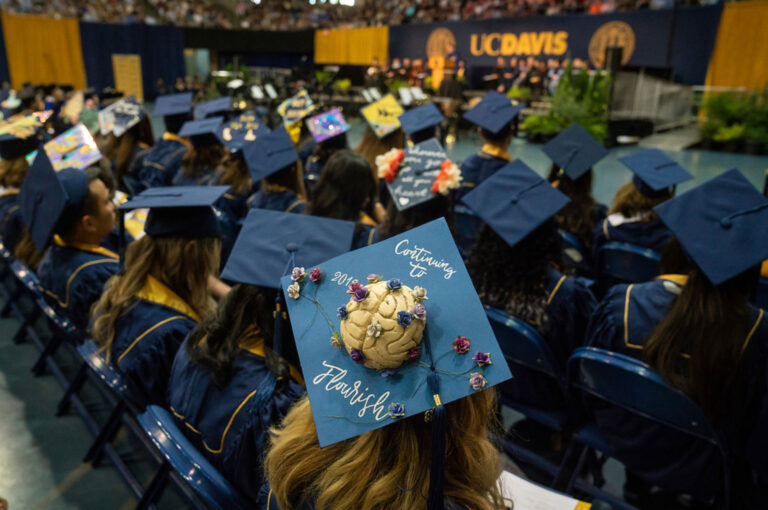
After its initial announcement in Spring Quarter 2019 that UC Davis would be transitioning away from its traditional model of seven undergraduate commencement ceremonies, the university has revealed more details about Spring Quarter 2020’s commencement exercises.

The three commencements are set for Friday, June 12, Saturday, June 13 and Sunday, June 14. Since the ceremonies will now take place outdoors at the UC Davis Health Stadium (formerly Aggie Stadium), the commencements will begin at 8:00 a.m. and conclude at 10:30 a.m. to avoid the high heat of the afternoon in Davis.

Whereas in previous years, the university held seven commencements, with each commencement consisting of students from a single college, next year’s three ceremonies will each consist of majors from each of the university’s four colleges.

This means that the College of Letters and Science, for example, will have its students spread across all three ceremonies, and students will walk across the stage with students from each of the other three colleges.

These revamped ceremonies will also be much larger than in previous years. Each commencement will feature 2,500 graduates and the stadium will be outfitted with additional bleachers for a total of 10,000 friends and family members. Each student will receive four tickets each and overflow, non-ticketed seating will be available in the air-conditioned ARC Pavilion, where each ceremony will be simulcast.

While in the past students were able to petition for additional tickets beyond those initially allotted to them, organizers are still working on details to see if this will be the case again.

“At this time I can’t confirm the ticketing process for Spring 2020 commencements at Aggie Stadium,” said Whitney Smith, the director for Ceremonies and Special Events at UC Davis, via email. “We are still considering possible options of adding additional seats to the field and utilizing the grass area for seating to potentially have ‘extra’ tickets to offer.”

As was previously detailed last spring, the goal of this shift is multi-pronged. First, the university is hoping to present a unified view of UC Davis — graduation ceremonies will no longer be college-specific, but will “put more emphasis on UC Davis as a whole, as one of the leading public universities in the nation,” according to UCD News and Media Relations. Second, the university hopes to attract more high-profile commencement speakers because of the larger potential audience.

Written by: Kenton Goldsby — campus@theaggie.org

When music drives movies: exploring the work of Damien Chazelle, Edgar Wright

Music, movies — why choose? 

Music has long been the Robin to many a feature film’s Batman. Standing in as an emotional primer and catalyst for movies, music draws sadness, builds suspense and emphasizes triumph. The most memorable of our favorite scenes are often accompanied by iconic film scorers including John Williams of “Star Wars” and Ennio Morricone of “The Good, The Bad, and the Ugly.” 

Recently, in certain feature films, the roles of music and movies have become enmeshed, harnessing music to drive the plot. If you are interested in jump-starting a foray into musically driven films, the films below are an excellent start. They exhibit an array of musical and cinematic expertise, in broad ranging genres from romance to thrillers.

One director whose meteoric rise has fueled a newfound interest in this genre of music-driven movies is Damien Chazelle, a French-American former music student turned movie director. One of his more well-known works is “La La Land,” the 2016 musical drama featuring the enchanting couple of Ryan Gosling and Emma Stone. “La La Land” tethers its plotline to the musicality and musical aspirations of its core protagonists. Although it’s a musical, it doesn’t exude the abruptness of its musical numbers, blending them subtly within the structure of the plot. The entire movie is motivated and driven by Chazelle’s unadulterated love for music. The melodic and soothing rhythms of jazz undergird the production, making subtle references to famous artists and to the genre’s decline from popularity in recent days.

Chazelle’s breakout 2014 film “Whiplash” is an ode to the raw power of jazz and the fastidious work ethic that fuels it. The film starkly contrasts “La La Land,” focusing on some of the socially eroding consequences of obsession. Inspired by his own life as a musician, Chazelle channels the energy of jazz and its immersive impact on the main character Andrew Niemann’s disposition and relationships. 

Like a drummer to a band, Justin Hurwitz’s scores are the heartbeat to both the film scores. In “La La Land” he guides the movie with heart-fluttering tunes like “Planetarium” to play off the dreamy themes of the film, while in Whiplash he cultivates the score with adrenaline-pumping and sweat-inducing songs like “Caravan” that constantly keep the audience on the edge of their seats. Rather than using the scores as a supplement, they become the film’s backbone, as pivotal to the plotline and creative direction as the acting.

Another example of a recent movie featuring music that may be slightly more underplayed but just as vital to the movie is “Baby Driver.” Directed by Edgar Wright, “Baby Driver” follows the life of Baby — a quirky, baby-faced getaway driver — and his attempt to break free from a life of crime. In order to offset tinnitus in his ears, Baby goes everywhere with headphones glued in his ears. 

Using songs like “Brighton Rock” by Queen and “Easy” by the Commodores, Baby’s playlists function as the film’s engine. A prescient clip from the film occurs during the second car chase scene. Right as the heist is about to begin, Baby has to start the song “Neat, Neat, Neat” by The Damned over to sync the actions to his soundtrack. This brief action plays on two different dimensions. It demonstrates that music is bound to Baby’s mindset and subtly breaks the fourth wall when Baby restarts the song to sync perfectly to the upcoming action. In “Baby Driver” scenes, film and music become harmonious, neither one overpowering the other. To a certain degree, Wright’s scenes mirror highly contextualized, visceral music videos.

Being a lover of both music and movies, I view this form of film as a perfect creative storm. The style has become an evolutionized cousin of the musical, holding music front and center, while transforming the film’s layout to fit with broader modern palettes. With talented directors like Damien Chazelle leading the charge, it will be fascinating to track the progression and evolution of these music-centric films.

Written By: Andrew Williams — arts@theaggie.org

Gov. Newsom signs SB 206, igniting new push for student-athlete compensation

0

Fair Pay to Play Bill becomes law

After much talk and anticipation, California Governor Gavin Newsom signed Senate Bill 206 on Sept. 30, allowing college athletes in the state to profit off of their own name, image and likeness starting in 2023. The formal signing of the bill was completed on HBO’s “The Shop,” hosted by NBA star Lebron James.

“I don’t want to say this is checkmate, but this is a major problem for the NCAA,” Newsom said on the show. “It’s going to initiate dozens of other states to introduce similar legislation, and it’s going to change college sports for the better by having now the interest, finally, of the athletes on par with the interests of the institutions. Now, we’re re-balancing that power arrangement.”

Newsom added that many university presidents and athletic boosters in the state of California contacted him and urged him to veto the bill but he felt strongly that “the state needed to address the racial, gender and economic injustices ingrained in college athletics.” 

This bill has the potential to change college athletics and the NCAA as we know them, as discussed in The California Aggie two weeks ago. Not only was the NCAA against the bill, but many schools in California tried to pressure the Governor into vetoing it. Now, the NCAA has to prepare for change, whether they wanted it or not. 

The NCAA apparently believes that “changes are needed” in order to support student-athletes, but that “improvement needs to happen on a national level through the NCAA’s rules-making process,” according to a statement released by the organization on Sept. 30. 

“Unfortunately, this new law already is creating confusion for current and future student-athletes, coaches, administrators and campuses, and not just in California,” the statement continued. “As more states consider their own specific legislation related to this topic, it is clear that a patchwork of different laws from different states will make unattainable the goal of providing a fair and level playing field for 1,100 campuses and nearly half a million student-athletes nationwide.” 

The NCAA was not alone in showing its displeasure, as the PAC-12 Conference also released a statement that same day. 

“The Pac-12 is disappointed in the passage of SB 206 and believes it will have very significant negative consequences for our student-athletes and broader universities in California” the statement reads. “Our universities have led important student-athlete reform over the past years, but firmly believe all reforms must treat our student-athletes as students pursuing an education, and not as professional athletes. We will work with our universities to determine next steps and ensure continuing support for our student-athletes.”

From now until the time the law goes into effect in 2023, California and the NCAA will have to work together to reach a consensus on how to move forward. The NCAA might get to a point where it will have no choice but to succumb to the pressure and change its own rules, as several other state legislatures have recently introduced, or plan to introduce, similar legislation dealing with student-athlete compensation. As of Oct. 2, this total is up to as many as nine states, including Pennsylvania and New York, according to Sports Illustrated. Florida Representative Kionne McGhee (D) filed a bill shortly after SB 206 was announced. If passed, the bill would go into effect July 1, 2020, which is currently the soonest date of any state.

Although 2023 is still a ways away, recruitment of student-athletes can begin years before they enroll in the school. The fear of the NCAA is that California now has a greater advantage and, starting in 2023, will attract the best recruits in the country who want to get paid.

Every major change has its beginnings. For Fair Pay to Play, it seems to have its beginning in the state of California.

Written by: Omar Navarro  — sports@theaggie.org

Culture Corner

The Arts Desk’s weekly picks for movies, books, music and television shows.

Movie: “Election”

Ryan Murphy’s “The Politician” premiered on Netflix last week, but for those who have already binge-watched the series and need some more intense student elections in their life, I present to you, “Election.” This 1999 Alexander Payne-directed dark comedy is an underrated Reese Witherspoon classic. Witherspoon plays Tracy Flick, an incredibly above-average high school student with her eyes on the prize: Class President. One of her teachers, played by Matthew Broderick, doesn’t think she deserves to win and sets out to sabotage her, underestimating how far someone with unbridled ambition will go to win. 

Television: “Tuca and Bertie”

Lisa Hanawalt, the lead designer of “Bojack Horseman,” created a wonderfully weird, colorful world and a powerful female friendship in “Tuca and Bertie.” Cancelled after only one season by Netflix, this show follows two bird women, Tuca and Bertie (voiced by Tiffany Haddish and Ali Wong), as they navigate the world together. Let it be noted that the world is not just birds; their neighbor is a tall, mysteriously sexy plant with a thing for turtles. Tuca is a now-sober care-free toucan who is learning to live on her own after Bertie, an anxious, aspiring pastry chef, decides to move in with her architect boyfriend Speckle. At the root of the show are two best friends dealing with everything life throws at them. While they grapple with heavy topics, the birds deal with them in a powerful yet hilarious way. Case in point: when Bertie is catcalled, her breast (voiced by Awkwafina) is so offended, she jumps off of Bertie’s body in protest. 

Book: “Gone Girl” by Gillian Flynn

Out of all of the mystery thriller “chick lit” I read by the pool this summer, Gillian Flynn’s “Gone Girl” stood out the most. Most famous for the title character, Amy Dunne’s “cool girl,” monologue, Flynn’s characters weave a web of lies that are just believable enough. The narrative switches between Amy and her husband Nick, both out-of-work writers who have relocated from New York City to Nick’s childhood home. Their once-perfect marriage quickly (or rather, incredibly meticulously) disintegrates as the couple deals with Amy’s mysterious disappearance. Flynn keeps the reader guessing with an expert command of unreliable narration and plot twists. 

Album: “Whack World” by Tierra Whack

When I texted my roommate asking what came to mind when she thought of Tierra Whack, she replied, “Dope weird funny rapper lady” and “good at freestyle,” which I think is the most accurate way to describe the creative and eccentric Philly-based rapper. Whack’s debut studio album “Whack World” was released in 2018. Most interesting about this album is that each song is one minute long, but they all have the power to stand alone. Whack also released an accompanying music visual for the album. Whack raps like a true poet, her flow mimicking spoken word. During her Freshman Cypher as part of the XXL 2019 Freshman Class, Whack cuts the beat and free-styles, which is just one instance of her ability to break from the norm. You can hear the emotional labor she puts into her song. On the album, “Hungry Hippo” is a standout, but my favorite of hers is “Only Child,” a single released in 2019. 

Written by: Liz Jacobson — arts@theaggie.org 

Yosemite Hall first new Cuarto dorm since 1965

1

Building on track to achieve LEED gold certification

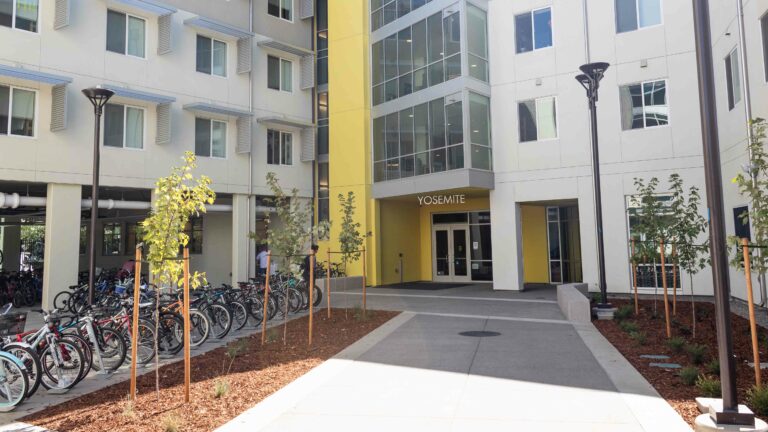
After two years of construction, the Cuarto residential area finally opened its newest dorm up to the class of 2023: Yosemite Hall. The hall was intended to redevelop Webster Hall, which originally opened in 1965 and was torn down in 2017. This project aimed to increase the number of beds available to students and build a service center for all the residents of Yosemite Hall. 

The Cuarto residential area is home to over 1,000 students and was designed to create an environment that fosters interaction and provide a unique suite-style of living, as opposed to traditional dorm halls. The design of Yosemite Hall was influenced not only by the Mogavero Notestine Associates, but also from an online survey that was conducted in 2015 with the past residents of Cuarto and Davis community members. 

Yosemite Hall has a total occupancy of 390 students who are housed in both double and triple configurations — similar to many of the other dorms throughout campus. Each suite, however, does have its own bathroom. In addition, the hall offers an exclusive courtyard for residents to enjoy as well as the Cuarto computer and mail center within the first floor of the hall. 

Associate Vice Chancellor of Student Affairs for Housing, Dining and Divisional Operations Mike Sheehan detailed the purpose behind the design of Yosemite Hall as well as the new services incorporated within the building. 

“We intentionally didn’t put living rooms into the mini-suites,” Sheehan said. “Instead we created community living rooms located throughout the floors. This results in a greater efficiency of square footage while also providing more space for group work and individual study space.” 

Sheehan said Yosemite Hall is currently tracking to achieve Leadership in Energy and Environmental Design (LEED) gold certification, an internationally recognized achievement that certifies environmentally efficient buildings. 

“The entire buildings is electric, no gas,” Sheehan said. “Therefore, the [buildings’] carbon footprint is reduced. Additionally, there is a solar thermal system as part of the building to provide pre-heating for domestic hot water.”

Cuarto is different from the Segundo and Tercero areas because it offers a more personal dormitory experience; instead of separate bedrooms and a communal bathroom, it pairs two or three bedrooms with their own bathroom, resembling an apartment. 

Hannah Bireschi, a second-year environmental science and management major, was a former resident of Emerson Hall. Bireschi described her experience in Cuarto. 

“I really enjoyed living in a suite-style dorm,” Bireschi said. “I feel that it really prepared me for living in an apartment this year.” 

Although living in a suite-style dorm has its perks, Bireschi also spoke about the social environment of Cuarto, saying it seemed “a lot quieter than other dorms.”

“My suitemates and I got along really well, but we didn’t make many connections with other people on our floor, which is something I noticed a lot of others did more,” Bireschi said. 

Sheehan addressed the improvements made in terms of facilitating social engagement among the residents of Yosemite Hall. 

“Yosemite will be home to the Student Organizations, Community, Involvement and Leadership (SOCIaL) program,” Sheehan said. SOCIaL is for you if you are interested in joining student organizations on campus and growing as a leader. SOCIaL will help you determine which academic, advocacy, arts and entertainment, community service, identity-based, fraternity or sorority, health and wellness, international, professional, recreation/sports or religious/spiritual student organization is right for you.”

Yosemite Hall is only the first of several new buildings Aggies will be seeing this academic year — here are the other on-campus construction projects for the next two years:

  • Fall 2019 — the campus will open Latitude, a new dining facility in the Tercero residential area
  • Fall 2020 — already under construction, The Green at West Village will add 1,000 beds in apartments for transfer and continuing students
  • Fall 2021 — the next phase of The Green at West Village will add 2,300 beds in apartments for transfer students and continuing undergraduates
  • Fall 2021 — construction on Shasta Hall, located in the Cuarto dorm area and meant to replace Emerson Hall, began this summer with the goal of opening a year early with 800 residence hall beds for new freshman students

Written by: Sneha Ramachandran  — features@theaggie.org

Students and Davis residents participate in Global Climate Strike to advocate climate justice

“System change, not climate change!”

Over 7.6 million citizens around the world came out and marched in solidarity for the Global Climate Strike on Sept. 20, 2019 — this was the largest climate mobilization in history, according to the Global Climate Strike website.

Students and members of the Davis community, however, postponed their on-campus activism until the following Friday, on Sept. 27. While a climate strike was held in the city of Davis on Sept. 20, the on-campus strike was delayed as UC Davis did not officially start school until Sept. 25.

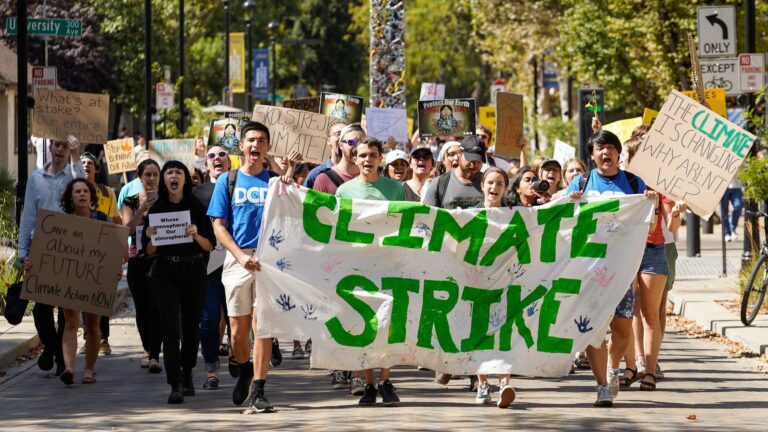
UC Davis’ Zero Waste and Sustainability club, Climate Reality Campus Corps, Climate Strike club and Young Democratic Socialists of America organized their own Global Climate Strike in the quad on Sept. 27. Students were encouraged to protest for climate justice and bring their own sustainable posters.

“We would have done it last week had school been in session,” said Megan Phelps, chair of the Climate Reality Campus Corps, in an interview with UC Davis Strategic Communications.

Fifteen minutes before the event, the quad was still considerably empty. There were a few dispersed students sitting under the shade, eating lunch and finishing homework. 

Five minutes before the rally, a woman and child showed up with posters. Another student also walked into the quad, poster in hand. The turnout looked empty. Then, three minutes before the start of the rally, a large crowd of about 75 people, including UC Davis students and community members, formed on the east quad. Multiple photographers were also present to capture the event.

Rachel Lucine, a first-year environmental science and management major, explained the student body’s motivation for activating. 

“We came out here today to show our support for the climate strike and to show our support for planet Earth and prove that standing up and going to these rallies and showing our support does make a difference,” Lucine said. 

Like other activists, Lucine was holding a sunflower. A fellow rallier was passing them out to the crowd. 

“I think [the sunflower] means that this beauty was produced by our planet, and if we don’t protect it, it’s not going to last,” Lucine said. 

Ralliers held up posters with messages reading, ‘Remember paradise!,’ ‘History has its eyes on us’ and ‘Solidarity with the bananas.’

“My poster says ‘VOTE’,” said Steve Nyholm, a member of the Davis community. “I think it’s the most important climate change action that we can do. We can vote for elected officials who put legislation in place to help our whole society address climate change.”

Five minutes in, the crowd began chanting mantras such as “Action! Action! Action now!” “There’s no planet B!” and “Stop burning our future!” More students became aware of the event on the quad and joined in.

The strike continued in the quad until noon. Protesters then began marching downtown, toward Central Park. The procession stretched from the edge of campus at the Social Sciences Building to the Memorial Union. The four people leading the walk held a banner that read “Climate Strike.”

As the protesters regrouped in Central Park, they were joined by other community members already in the park. A semi truck driving by honked at the crowd in a show of support. The strike continued on in this new location — motivational speeches were given by passionate individuals. A few people in the crowd yelled expletives about the current president, which were quickly dismissed by the organizers. Within the crowd, talk about whether or not protesters were registered to vote was audible. 

Nearing the end of the event at 12:30 p.m., there was one last speech. The speakers urged global citizens and Davis community members alike to stand in solidarity and take action to reduce the effects of climate change and preserve the earth for future generations. 

Written by: Linh Nguyen — features@theaggie.org

Cartoon: Did you know?

MARIO RODRIGUEZ / AGGIE

Aggies lose heartbreaker to North Dakota

0

UC Davis drops third straight in 38-36 road loss

The UC Davis football team lost its third consecutive game and fell to 0-2 in Big Sky play with Saturday’s 38-36 gut-wrenching loss at North Dakota. 

The Aggies battled back from a forgetful first half performance that put them behind 28-14 at the break, and came within seconds of walking out of the indoor Alerus Center in Grand Forks, ND with their first conference victory of the season. There was no shortage of drama in the final few minutes, but the visitors came up painfully short. 

“I was really proud of the resolve we showed, and I really enjoyed our temperament, togetherness, and patience despite not starting well,” said UC Davis head coach Dan Hawkins. “We just battled and were a little more of ourselves in this game than the previous game. I was happy that we returned to that level.”

Saturday’s loss drops the Aggies’ record to 2-4 on the season and puts them in the cellar of the Big Sky conference, along with two other teams also winless in conference play. But it was a far cry from last week’s 45-20 drubbing at home to Montana, a game in which Hawkins thought his team “got cautious, played tight and stopped smiling or having fun.”

With just over five minutes remaining in regulation and the Aggies trailing 35-28, senior quarterback Jake Maier led the offense down the length of the field and orchestrated a 10-play, 80-yard scoring drive. Faced with a 4th-and-goal situation from the 2-yard line, Maier tossed up a jump ball to senior tight end Wes Preece, who outmuscled the defender in front of him and leaped up to make the catch in the corner of the end zone. 

To nobody’s surprise, UC Davis head coach Dan Hawkins elected to attempt a two-point conversion instead of settling for the game-tying extra point with 2:06 left in the fourth quarter.

On the two-point try, Maier ran a play-action fake and rolled out to his right before finding junior wide receiver Khris Vaughn open in the back of the end zone, giving UC Davis its first lead of the day, 36-35.

A costly mistake on the ensuing kickoff, which landed out-of-bounds, gave the Fighting Hawks good field position and a head start on their eight-play drive into field goal range. With 57 seconds left on the clock, North Dakota nailed a go-ahead 46-yard field goal.

With all three timeouts still remaining, UC Davis had a legitimate opportunity to drive down the field and set up a game-winning field goal attempt. A pair of 17-yard completions to sophomore running back Ulonzo Gilliam and Preece got the drive up and running, and it looked like the Aggies would give senior kicker Max O’Rourke a makeable field goal attempt well within his range.

Then, at the worst possible moment, a pair of damaging penalties pushed UC Davis completely out of field goal range. On a manageable third-and-four play from the North Dakota 30-yard line, the Aggies were called for a false start, setting up a longer third down attempt that they failed to convert.

O’Rourke trotted out to attempt a career-long 52-yard field goal, but the kick was blocked by North Dakota amidst penalty flags and a whistle from the referee, who called a “delay of game” penalty on UC Davis. Subsequently, the Aggies had no choice but to bring the offense back on the field for a lengthy fourth-and-14 situation, where Maier’s pass fell incomplete to end the game. 

In his weekly press conference on Monday, Hawkins took the blame for mishandling the situation and failing to make a definitive decision on whether to attempt a field goal or keep the offense on the field. Normally, senior kickoff specialist Matt Blair is the go-to guy for long field goals beyond O’Rourke’s range, but Blair was unavailable at the time due to an injury to his holder, sophomore wide receiver Carson Crawford.

UC Davis looked like a completely different football team in the second half, compared to the first 30 minutes of play where the Aggies were outgained 381-176 in total yards of offense. But the Aggies refused to give up easily and seemed determined to atone for their early struggles in all three phases of the game. 

The UC Davis defense completely flipped the script in the second half, showing a renewed confidence and continually forcing the North Dakota offense off the field in a flash. With the exception of the home team’s final game-winning drive, North Dakota never possessed the ball for more than six plays, giving the Aggie offense ample time to mount a comeback. 

“The thing that pleased me the most was our approach to it,” Hawkins said. “They were communicating, talking and problem solving. We know its a long game and we can score points, so don’t panic and just hang in there. Our approach was much better than the week before.”

Unfortunately, costly penalties and a few more uncharacteristic turnovers — a common theme in last week’s blowout loss to Montana — doomed the Aggie offense at the end of the day.

Preece simply could not be guarded in the third and fourth quarters, hauling in all three Aggie touchdowns and using his sizable frame to create separation downfield and break free from defenders. 

The Aggies received the opening kickoff of the second half and instantly found paydirt three plays later, thanks to a 40-yard catch by freshman tight end Blake Thorpe and a wide-open 31-yard touchdown pass to Preece. 

Midway through the third quarter, UC Davis turned the ball over for the first time when a quick screen pass slipped through the hands of freshman wide receiver Orlando Ornelas and right to a North Dakota defender. The Fighting Hawks only had to march 13 yards to tack on another seven points, extending the lead to 35-21.  

Early in the fourth quarter, senior linebacker Eric Flowers came up with a clutch interception, setting up the offense in enemy territory with a great opportunity to tie the score. On the very next play, Maier noticed single coverage downfield and took a deep shot to the end zone, but was picked off by a diving North Dakota defender. 

The Davis defense did its job and forced a quick three-and-out, but Maier was picked off again on the next drive. On a long 4th-and-14 inside Fighting Hawk territory, Hawkins opted to go for it instead of punting, so Maier desperately heaved an ugly interception that was returned 58 yards to the Aggie 21-yard line.

Once again, the defense rose to the occasion and quickly forced a missed 37-yard field goal, paving the way for the late go-ahead touchdown drive. 

Through the first six games of the season, Maier has already thrown nine interceptions, which is one shy of his season-long totals in both 2017 and 2018. Most of the turnovers have come in tough road environments, as Maier fired two interceptions at San Diego and three more at North Dakota State.

“I don’t think he’s a guy that’s blatantly careless with the ball,” Hawkins said. “He’s had some errant interceptions the last few weeks, but also some that are not always his fault. It’s going to happen when you throw the ball as much as we do.”

The senior signal caller had to operate without star junior wide receiver Jared Harrell, who’s been sidelined with injuries the past two weeks, as well as junior running back Tehran Thomas who did not play on Saturday. 

Nonetheless, Maier still threw for over 350 yards and four touchdowns, connecting with 11 different receivers and making enough plays to put his team in a position to win. He leaned on one of his favorite targets, Crawford, who led the team with five receptions and 88 yards before leaving with a shoulder injury.

For a second consecutive game, UC Davis was unable to establish an effective rushing attack, managing just 3.1 yards per carry on 26 attempts. Gilliam scored on a two-yard touchdown run in the first half, but was largely contained by the North Dakota defense for most of the afternoon. 

On the flip side, the Aggie defense continued its struggles in stopping the run, yielding 187 yards and 5.3 yards per attempt. UC Davis has given up at least 174 yards on the ground in five of the first six games. Improving in this area of the game will be a major point of emphasis for the team as it moves forward into the rest of the Big Sky schedule. 

The Ags will have their hands full with next week’s opponent, Cal Poly, who utilizes a run-first offense that’s averaging over 255 rushing yards per game.

A pair of long flights to North Dakota in the past three weeks have surely taken some sort of toll on the players, whether they want to admit it or not. The Aggies undoubtedly have to play better and clean up the mistakes, but this year’s schedule has done them no favors. 

“It’s amazing how every game has been something different — how we travel, where we travel, the weather, inside or outside, night or day,” Hawkins said. “But that’s also life. As you looked at the schedule before it played out, you knew it would be a tough battle every week.”

Fortunately for UC Davis, the team only has one more long flight remaining, a trip to face Southern Utah in two weeks. The Aggies will be glad to return home to UC Davis Health Stadium this Saturday for a rivalry showdown against Cal Poly, with the Golden Horseshoe trophy on the line.

After that, the only road travels remaining are a pair of short journeys to Portland State and Sacramento State. 

With two conference losses already, UC Davis has put itself in an extremely tough position to defend its Big Sky title. In the past 13 years, the winner of the conference has never lost more than one league contest.

“Do we have the capability of going to the National Championship? Yes, we do,” Hawkins said. “But it’s not that far of a drop to that next rung. We shouldn’t really be battling expectations or rankings. It should just be getting up and being the best version of ourselves.”

Regardless, there will be more than enough opportunities for redemption in these final two months of the season, when UC Davis hosts top contenders Montana State and Weber State and travels to Sacramento State.  A total of four Big Sky teams made the FCS playoffs last year, including three in the top eight, so a second consecutive playoff berth is not out of the realm of possibilities for UC Davis.

“Other than the Montana game, I’ve been really pleased with how our guys are playing, fighting and battling,” Hawkins said. “We’ve been playing good football against good football teams, so it just comes down to that slim margin of error.”

The Aggies still control their own destiny and have time on their side, but the team must start piling up wins in a hurry if they want to save their season.

Written by: Brendan Ogburn — sports@theaggie.org