55.5 F
Davis

Davis, California

Tuesday, December 23, 2025
Home Blog Page 402

Athletes have a right to be compensated, UC Davis should lead by example

SB 206 a virtuous step toward ethical compensation for student-athletes

On Sept. 30, California Governor Gavin Newsom signed Senate Bill 206, the “Fair Pay to Play Act,” into law, making California the first state to officially legalize student-athlete compensation. The law, which will take effect on Jan. 1, 2023, allows student-athletes attending any four-year college or university within the state to profit off of their own name, image and likeness (NIL) without the threat of their scholarship being revoked.

The new law directly opposes to the National Collegiate Athletic Association’s rules that prohibit student-athletes from making money off of their NIL. California has over 50 NCAA-affiliated schools, including UC Davis, that could be on the receiving end of retaliatory actions that the NCAA has threatened to take. These threats range from millions of dollars in fines to a ban on California schools from competing in national sporting events. 

For the NCAA to come out completely against SB 206 is as unethical as it is foolish. The NCAA, a non-profit that rakes in upwards of $1 billion in annual revenue thanks to the student-athletes it governs, still considers maintaining the amateurism and “fairness” of college sports its top priority. Several California schools, including Stanford — home to one of the state’s more successful NCAA programs — disapprove of the legislation. Stanford, a school that paid its head football coach over $4.3 million in 2018, believes that allowing its student-athletes to be compensated would “present serious challenges” to institutions such as itself. 

This law does not force the NCAA or any of its member schools to pay a dime out of their own pockets to student-athletes. Yet, since SB 206’s introduction in the state legislature in February, there has been a mountain of criticisms levied against it, including how it may compound the problems that exist in the athletics recruiting process. That’s exactly why the law as passed does not go into effect for three years. There is time for California and the NCAA to work together and make any changes both parties may deem necessary. It also leaves time for other states to consider similar legislation and join the Golden State at the bargaining table. 

It will ultimately fall on the NCAA to work with states on this critical issue for college athletics. But for now, the NCAA is largely unwilling to move forward until its working group on NIL — commissioned three months after SB 206’s introduction — releases its report at the end of this month. Regardless of what the working group recommends, it is past time for the NCAA and its member schools to allow the individuals they profit from the basic right to be paid for the notoriety that they have so rightly earned, especially as these student-athletes continue to sacrifice their time, energy, bodies and livelihoods.

The UC Davis athletics department has taken tremendous strides in the realm of enriching the lives of its student-athletes. It should set an example for other universities and throw its support into athlete compensation. Under Athletic Director Kevin Blue’s leadership, the department has pioneered Aggie EVO, a program dedicated to helping Aggies build the professional skills necessary to succeed after their playing days are over. This effective program is a testament to the department’s commitment to supporting its student-athletes. But these athletes don’t just need help cultivating a lucrative financial future, they need money now to help pay for the many other critical expenses that an athletic scholarship may not cover — especially when that all-important scholarship can be revoked at any time. The Editorial Board urges UC Davis, and schools nation-wide, to seize this opportunity to put their money where their mouth is and advocate for the student-athletes from whom they profit off of.

Written by: The Editorial Board
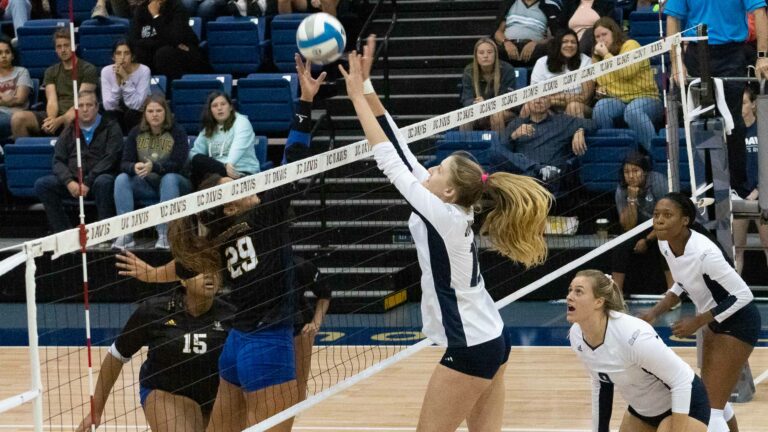
Women’s Volleyball commences Big West play with two strong victories

Aggies look to continue run into heart of conference slate

Heading into the Sept. 29 game against UC Riverside, the UC Davis women’s volleyball team looked to regain last year’s impeccable form, which they displayed during a season-long, seven game win streak. The previous game against UC Irvine was the inaugural game of league play, with the two teams displaying how difficult it can be to win league games. Fortunately for the Aggies, they came out triumphant with a 3-2 victory. 

In the nailbiter — in which Davis came from behind to win — senior outside hitter Lauren Matias finished with a match-high 18 kills on the night, propelling the Aggies to their first league victory of the year. The win was rejuvenating for the team, as they had lost the last three games of league play to end last season. 

“I didn’t say too much,” said Head Coach Dan Conners about the comeback. “I talked to a couple of the leaders on the team and they were responsible for the change in the direction in that match. I tried to stay as consistent as I possibly could the entire match, reinforcing that we’re a good team, that we should believe in ourselves, and continue to focus on one point at a time, but credit that group for helping us turn the tide.” 

Given that the Aggies were able to keep their composure throughout the entirety of a heated match with UC Irvine and prevail, it was unsurprising to many when the Aggies dismantled UC Riverside in the following game. 

In the second set, UC Riverside called an immediate timeout after UC Davis jumped out to a quick 5-0 lead. But even after the break, the Highlanders continued to struggle to stop the Aggies as UC Riverside’s coach was forced to call the team’s second and final timeout of the set. 

UC Davis was able to capitalize on the Highlanders’ distress, winning the second set 25-13 and later taking the third set 25-17 to complete the 3-0 match victory. 

“We played very efficiently in that match,” Connors said. “I think that was a match in which we were able to stay very consistent with our style of play throughout the entire contest: high-pace, attacking, aggressive, putting a lot of pressure on opponents. I think that was nice to see. We’ve been able to do that at times, and then we have backed off. I thought it was nice to have a full match where we put forth that effort the entire time.” 

The Aggies had their work cut out for them entering the weekend, with a double-header scheduled against UC Santa Barbara and Cal Poly. Both teams had proven to be lethal this year, boasting impressive records throughout both non-league play and in league play thus far. Before Friday’s contest, UC Santa Barbara had posted a record of 13-1 throughout the first half of the season. The following day, the Aggies took on a Cal Poly team that went 10-5 in pre-season. 

“It’s going to take being in the moment, being aggressive, playing our style, getting after it, pressuring them consistently throughout the match,” Connors said before the road trip. “Not letting distractions be at the surface when we’re performing. It’s about what we’re doing right now, in this moment, and staying in tune to that. I think every weekend we play is a big weekend, so what’s in front of us right now is the biggest weekend of the year.” 

The two-game trip did indeed prove a challenge for the Aggies, as they were swept by UC Santa Barbara on Friday and then suffered a narrow 3-2 loss to Cal Poly on Saturday. After dropping the first two sets of the contest against the Mustangs, UC Davis battled back and won the next two to force a fifth set, but ultimately lost 15-10 in that final frame.

Despite the two-match skid, it has been a largely successful first 17 games for the Aggies, and Connors is optimistic about the squad’s chances going forward.

“We’re a very young, inexperienced team that is gaining experience and we are not where we want to be by any means,” Connors said. “I talked to the group earlier this season about when we’re going to peak, and it’s probably going to be the latter half of conference. So, to be playing the way that we are playing now is nice, but we’re ready for any bumps in the road that may come up and we’re going to continue to work to grow and get better.”

Of course, the success of any team comes down to its players performing on the court, and Connors sees the high potential that this year’s group possesses.

“Lauren [Matias] has done a really good job of just being that steady player on the floor for us and has been complimented by Jane [Seslar], who has been really solid for us,” Connor said. “As far as players emerging? Defensively, I think Josie [Ough] has really asserted herself, I think Mahalia [White] has done a great job of having a year off and coming back to find her groove, and both Leonie [Strehl] and Demari [Webb] have done a good job of stepping into the role that they’re playing.”

Connors also highlighted players who contributed to the depth of the team.

“Shira [Lahav] has become more comfortable in her role, running our passing line and our defensive effort,” Connors said. “Ally [Reyes] is an outstanding passer who has stepped in and Perri [Starkey] has emerged as a great passer and good defender, so it’s nice to have that deep bench and have some players you can go to.”

Essentially, Conners is more than pleased with his team and their chemistry, including their ability to work together and improve as a team.

“Our players who may not see a lot of time in matches are doing a great job of pushing the starters in practice and increasing the level in practice so that we are pushed to get better every day,” Connors said. “I think everybody has been really putting in a great effort to contribute to the product that we see on the floor during competitions. They’re doing a great job of supporting each other and supporting the direction we want to go.”

This season has been the best start the program has had since they started 16-1 in 2011 and the first undefeated opening games the team has had since 2012. UC Davis ranks among the top 50 teams in the NCAA in aces (No. 46 with 88), while sophomore middle blocker Josephine Ough ranks No. 47 in the nation at 1.25 blocks per set overall this year. Matias enters the week ranked among the top 100 hitters in the NCAA in points (No. 75), points per set (No. 89), and kills (No. 87), while ranking just outside the top 100 in kills per set (No. 102). Sophomore setter Jane Seslar enters the week ranked No. 40 in the nation with 529 assists and No. 71 with 9.98 assists per set. 

UC Davis was picked to finish sixth in the race for the Big West Conference title according to a vote of head coaches, but this team has proven to be more than capable of proving them wrong. 

Written by: AJ Seymour — sports@theaggie.org

Review: El Patio

Latest Mexican food chain pales in comparison to its competitors.  

The vacant space on the corner of E and 2nd Street has been filled by El Patio, a Tex-Mex food chain. Casual dining is always appreciated in a college town, but this establishment’s take on Mexican cuisine might be too relaxed to make a name for itself among its competitors. 

El Patio’s ambiance makes for a good first impression. Upon entering the restaurant, I first noticed the clean and welcoming interior. Customers are seated under a rustic, wooden gazebo with Spanish music playing in the background. There is also an option to sit by the windows, which give a full view of 2nd Street. I was able to watch the chaos of a Friday afternoon in downtown from within the decorated, well-lit restaurant, which was rather relaxing. 

A convenient location and good ambiance, however, can only take a restaurant so far. El Patio provided a temporary menu for its first few weeks of service, as many developing establishments do. But even for a temporary menu, it was pretty sparse. There were no explicitly vegetarian options, and modifications had to be requested by the customer. 

The menu also lacks healthy options. They do not carry black beans, carrying only pinto and refried beans. There was also only one salad option: an uninspired chicken salad. Again, this was a temporary menu, so this issue may resolve itself. The health-conscious customer, however, might be better off avoiding El Patio completely. 

A friend and I ordered the Super Burrito and meatless tacos. The food was prepared at a concerningly quick speed and was served on cafeteria trays. The burrito was bland at best, but the tacos were particularly unimpressive. The pinto beans, which had not been drained of their fluid, were slapped onto the tortilla carelessly, creating a soggy mess of a lunch.  

Chips come on the side of every meal. Although served warm — a nice touch — they still tasted like store-bought tortilla chips. The salsa bar only offered two types of salsa.
Frankly, the chain doesn’t stand up to its competitors in Davis. Americanized Mexican food can be found in many locations in Davis. There are two Dos Coyotes locations and a La Piñata in town, and El Patio doesn’t have the unlimited soda machines or salsa bar that compares to these establishments.

El Patio is the perfect dining option for anyone within walking distance of 200 E Street who needs a relaxing place to sit and escape the heat. Besides that, people are better off taking their wallets and appetite elsewhere. 

Written by: Alyssa Ilsley — arts@theaggie.org

Humor: Unitrans L line out of service due to student’s fears of “Taking L’s”

Why take the L when you can take the W? 

The L line has finally dropped out of service after weeks of sudden fear-induced desolation. 

As the stressful and rather spooky season of midterms creeps up on us, students can often be seen confiding in bizarre superstitions to survive the ill-fated quarter. For many, this means refusing to take 13 units, avoiding walking under ladders, blowing a kiss every time Gunrock trots on by — you know, the usual. Since the beginning of the new Fall Quarter, however, students have begun avoiding the Unitrans L line like the plague in hopes of not “taking any Ls.” 

Third-year Unitrans driver Bill Sawyer says no one has stepped foot on his bus in weeks. The number of riders began decreasing more each day until there were none at all, according to Sawyer. “Even the turkeys won’t get on the bus. What do they even have to lose?” 

At this point during the interview, Sawyer promptly pulled out his phone to check his Google calendar and let out a gasp. “I forgot about Thanksgiving.” 

Sawyer has been driving for Unitrans for the past two years and says he has never encountered such a strange phenomenon. “Usually, as a driver, I worry about overcrowded buses and being late to each stop. Now, I’m always on time!” 

Since the perceived boycott, Unitrans has decided to remove the L line completely and consequently add more W buses with the tagline “take the W!” 

“I used to take the L line to get to campus, but now I just walk. It’s a four hour walk every day from my apartment, but it was definitely worth the B- I got on my midterm last week,” said chemical engineering student Xiaonan Chen. 

“My friend said I could be using those extra four hours to study. Then she got a D on her quiz,” Chen added, shrugging with a cheeky grin. “That’s all I have to say.” 

The L line, which once ran through Pole Line and Loyola Drive, no longer remains in service. The various bus stops have been removed entirely, with the expectation of boosting the GPAs of UC Davis students. 

As the saying goes, “I’m not superstitious… but I am a little stitious.” In other words — it’s better to be safe than sorry during these trying, grade-dropping times. 

Written by: Julietta Bisharyan — jsbisharyan@ucdavis.edu

Humor: Freshman artfully dodges past romance in the Dining Commons

“We snapchatted for a few weeks after, then he ghosted me.”

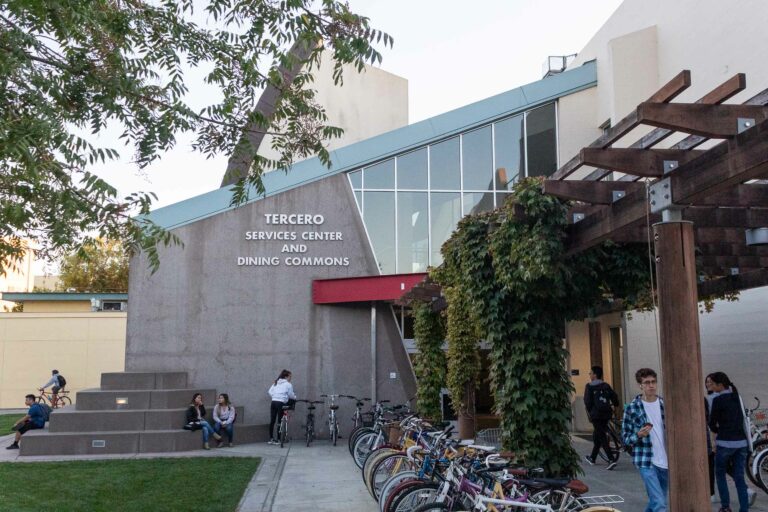
In the Tercero Dining Commons this morning, first-year biological sciences major Katie Smith found herself in the unfortunate position of going to breakfast at the same time as her ex-romantic flame, Trevor Anderson. 

Whilst in line to use the waffle machine, Katie told reporters she saw Trevor enter the dining hall flanked by several of his fraternity brothers. Suddenly feeling self-conscious about her culinary choices and the fact she was by her lonesome, Katie reportedly dashed over to the lowly cereal bar. She resolved instead to eat the remnants of Lucky Charms, mixed with slightly stale Cheerios and lukewarm almond milk. 

She took a seat in the corner, facing the wall, constantly checking over her shoulder to see if Trevor had materialized behind her yet. He made a beeline for Go Live with his faithful crew, preparing to attack a breakfast burrito. Katie swore, however, that they made a millisecond’s worth of gut-wrenching, soul-crushing eye contact. 

“We hooked up the first week when we met at Fall Welcome,” Katie told reporters outside of Redwood Hall later that day. “We snapchatted for a few weeks after, then he ghosted me.”

When Katie noticed Trevor and his friends advance towards the seating area where she had just taken refuge, she took her bowl of barely-touched cereal and headed to dish return, even though her stomach was still growling. 

“Is this how it’s going to be for the rest of the year?” She expressed gratitude, however, that he lived in Old Tercero while she dwelled in the newer building, Redwood. 

After she fled the scene, she opted to buy an egg sandwich and an extravagant Naked Juice at the Tercero market with her dwindling balance of Aggie cash. 

Reporters from The California Aggie reached out to Trevor Anderson but received no response. 

Written by: Kelsey Stewart — kcstewart@ucdavis.edu 

Andrew Luck’s retirement reminds us of the darker side of the NFL

In a league that does too little to protect players, Andrew Luck found his happiness taken away by constant rehabilitation, injuries

Andrew Luck’s sudden retirement from the NFL reflects the darker implications of a sport that humans are not meant to play. A Stanford graduate and generational talent, Luck is the most fascinating NFL figure of the past decade. As shocking as Luck’s retirement may be, it is commonplace in a sport’s league that makes billions off its players, but doesn’t make player health and safety a priority. Just look at the sudden retirements of Calvin Johnson and Rob Gronkowski –– both players who retired in their prime within a year of their 30th birthday due to constant injuries.  

What made Luck so fascinating was how human he was in a league that lacks fascinating and visible stars. He even started a book club in his locker room and a book club podcast because he loves a good story. He’s the quarterback who congratulates defenders on good hits, even though during his career, he was hit 60 more times than any other player. In a sport so violent, Luck was a force of relentless optimism, until the sport he loved no longer allowed him to be. 

The loss of Luck to the league will no doubt have a major effect on the Colts’ win-loss record. But it will also affect locker rooms around the league — as one of the most gifted players in league history retired because the game physically and mentally destroyed him. 

“For the last four years or so, I’ve been in this cycle — injury, pain, rehab, injury, pain, rehab — and it’s been unceasing … And I’ve felt stuck in it,” Luck said. “And the only way I see out is to no longer play football. It’s taken my joy of this game away.”

And who’s responsible for this pain? Is that just the nature of the sport? Does it suck the joy and happiness out of life? It is a multitude of factors that led to this situation. 

The first to blame would be the Colt’s former general manager, Ryan Grigson, who surrounded Luck with a dismal supporting class during the first five years of his career. Grigson’s inability to protect his franchise superstar led to Luck taking blow after blow, with a weak offensive line in front of him. 

The second factor to blame is the league itself. In a recent article, Calvin Johnson exposed the ineptitude of both his former organization and the league. “It’s not about the welfare of the players,” Johnson said. “It’s just about having that product.” Luck’s situation is almost exactly the same. Player safety is a major issue for the league. With any sport there is a chance of injury, but in the NFL players are physically throwing their full body weight at opposing players with forces of over 1,600 pounds. NFL quarterbacks like Luck are asked to take countless hits of that nature play after play, game after game. 

After the news of Luck’s retirement leaked to the media during a meaningless preseason game, fans booed Luck as he walked off the field for the last time. Luck’s retirement has been considered as treason by media and fans. In any other profession, if a 29-year-old were to retire because their job was constantly tearing their bodies apart and putting them out of work, leaving that job would seem like the only choice. But this is the NFL, a sport where standing up (or kneeling down) for what you believe in will get you blacklisted by the league and fans alike. 

The reaction to Luck’s retirement by Indianapolis fans highlights the inappropriate sense of entitlement among NFL fans that is far too common today. How do you boo a guy who dedicated his health to your organization and city? At the end of the day, Luck owes the fans nothing — for them to boo a man who lost the love of the game and the happiness it brought him is the worst kind of reaction. Fans should celebrate the winning years, records set and football magic that Luck brought after being drafted to their team, following one of the worst seasons in history. 

His decision is not cowardice, it’s courageous. Granted, that decision is much easier when you’ve already made over $100 million in your career, but to walk away from the fame and the accolades is brave. 

Luck can do any number of things now. He can travel and study the architecture of the world, he can try his hand at commentating or he could read all the books for which he never had the time. He’s free now and about to be a father —  he won’t have any problem staying busy. 

Written by: Calvin Coffee — cscoffee@ucdavis.edu

Police Logs

Intense bike arguments, terrible parking

September 21

“Reporting party attempted to take pictures of [a] trailer parked in the area, X exited and started yelling at reporting party and is now following.”

September 22

“Subjects being loud with apartment door open.”

“Vehicle parked in a ‘Zip Car’ stall and it’s not supposed to be.”

“Reporting party came back to apartment today to find mail on front doorstep and front door glued shut.”

September 23

“Vehicle parked in wrong direction.”

“Squirrel with its leg caught in the fence, reporting party attempted to help it but didn’t want to get too close.”

September 24

“Known subject threw an envelope which struck an employee during a confrontation.”

“Open line… sounds like male in an argument about a bike with someone else in the background.”

“Sold books online.”

September 25

“Vehicle was stopping at green lights, pulling over swerving, stopping in [the] middle of [the] roadway.”

“Reporting party noticed a male who stands in the area and watches people.”

PG&E to shut off power in 34 counties at midnight

Strong winds, humid weather create risk for wildfires

The Pacific Gas and Electric Company (PG&E) will be shutting off power in 34 counties across Northern and Central California, including Yolo County, citing strong winds which pose wildfire threats. While the City of Davis will not be affected — according to the most recent reports at the time of publication — many other cities will not have power starting tonight, Oct. 8, at midnight and lasting until about 4 a.m. Full power restoration at that time, however, is not confirmed and outages could potentially last several days.

Evan Duffey, a PG&E meteorologist, said “strong, dry gusty winds will be combined with low, relative humidity levels and lead to dangerous fire weather,” in a media briefing released on Twitter. 

“The national weather service has issued extensive red flag warnings in the northern California geographic area, [considering] this a high-risk situation,” Duffey said. “By all metrics, this is forecasted to be the strongest offshore wind event since October 2017. Conditions being forecasted historically have led to catastrophic wildfires.”

Sumeet Singh, the vice president of the Asset and Risk Management and Community Wildfire Safety Program at PG&E, said outages may continue to last given the weather, according to a media briefing released on Twitter.

“We want our customers to be aware, that based on the large number of outages, it could take several days to fully restore power after the weather passes and the safety inspections can begin,” Singh said. “The first step that we take as part of restoration after such an adverse event is to inspect every inch of our overhead electrical asset base to ensure there’s no damage.”

Keith Stevens, a public information officer for PG&E, addressed concerns about how the website is not currently working due to increased traffic, according to a media briefing released on Twitter. 

“In regards to the website, we know there’s been some issues with that this morning and this afternoon,” Stevens said. “We did take the precaution yesterday to double the size of our database to be able to accept all the people that were coming to our website. We still have a very slow response to the website — we’ve had about seven or eight times the normal traffic to our website. Again, we apologize.”

Written by: Stella Tran — city@theaggie.org 

Emergency grants soon to be available to UC Davis students facing homelessness

UC secures $3.5 million to address homelessness, basic needs among students 

New funds have been secured to provide UC students with access to rapid rehousing grants. The aid, in the form of grants and resources, aims to address students in immediate crisis as well as those at risk of homelessness.

This past July, California Governor Gavin Newsom’s new state budget allotted $3.5 million for rapid rehousing grants to be distributed across the 10 UC campuses.

Funds are projected to be transferred to UC campuses in November. Until then, UC Davis’ Aggie Compass Basic Needs Center is in the process of utilizing existing funds to provide aid to students facing homelessness or who are in imminent danger of losing their housing. 

With funding provided by UC’s Mortgage Origination Program (MOP), Director of Aggie Compass Leslie Kemp has begun implementing strategies from the rapid rehousing model, which works to get students back into housing as soon as possible, to prepare the center for November.

Following the rapid rehousing model, Aggie Compass is leading the vanguard to help identify students in need, provide immediate assistance in terms of short-term housing and sometimes ensure access to food, while also connecting students with resources going forward. 

Aggie Compass faces the dual issue of providing assistance to students in immediate crisis, while also working to provide resources for students that help them secure longer-term housing.

“It’s not all grants,” Kemp said. “What we’re looking for is immediate help for students in immediate crisis — both food and housing crisis — and then also once we get those students out of crisis, then we have a large amount of students at UC Davis who we would say are at risk. We want to keep them from falling into the crisis category, and that’s where food programs come in — all these programs that are both education and immediate resources.”

Today, homelessness among students often takes nontraditional forms including couch surfing, living in one’s car and intermittent homelessness.

In addition to grants that will now benefit students, Aggie Compass has hired a professional staff member in order to help students navigate the rapid rehousing process. 

At UC Davis, the exact number of students currently experiencing homelessness or in imminent danger of homelessness is unclear. Within the last few years, Aggie Compass is aware of around 200 students who have experienced homelessness at some point, according to Kemp. Estimating the number of homeless students today remains an issue that the center hopes to gain more insight on moving forward.

Partnering with the City of Davis, Aggie Compass plans to engage in more outreach efforts to identify students currently experiencing homelessness.

In 2018, around 250,000 students experienced homelessness in California, according to a report published by the United States Interagency Council on Homelessness. This figure far exceeds those of any other state, with New York having the second highest rate with around 150,000 homeless students.

As leasing companies and landlords raise rent prices in Davis, and as the UC considers tuition hikes every year, many UC Davis students are classified as either housing insecure or at risk of homelessness.

Alexis Ramirez, a former ASUCD Senator and recent UC Davis graduate, previously served as the adopted senator of Housing Advising for Undergraduate Students (HAUS). Ramirez acknowledged the increasing financial pressures college students face.

“Whether it be textbooks or tuition, these costs have only exponentially risen, especially when measured next to current wages,” Ramirez said. “It should be a priority to reverse this. This can come in many forms: lowering tuition, offering more financial aid and ensuring that school administrators are not co-opted by publishing companies.”

Students spend $2,000 on non-tuition costs, including food and housing every month, according to research from the 2018-19 Student Expenses and Resource Survey conducted by the California Student Aid Commission. Of students sampled, 35% said they experience very low food security and 33% are housing insecure.

Executive Director of the California Student Aid Commission Marlene Garcia commented on the study’s findings.

“We at the Commission are listening to students,” Garcia said in the report. “We cannot ignore study after study, including our own, showing that something has to change so that we can help all California students succeed.”

Written by: Ally Russell — campus@theaggie.org

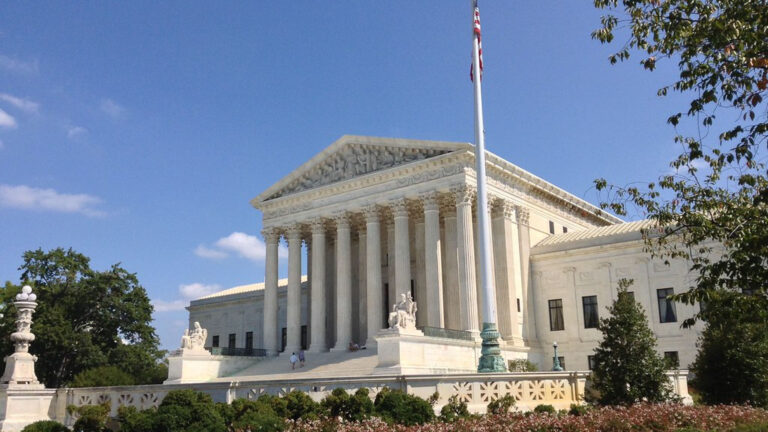
An end to life tenure for Supreme Court Justices? A UCD law professor argues it’s possible

Expert in legal history, constitutional law discusses plausibility of a life tenure overhaul

Imagine if a seat on the Supreme Court opened up every other year — meaning each president serving a four-year term would have the opportunity to appoint two justices in their career and each Supreme Court justice would serve an 18-year term instead of being granted life tenure.

Might instituting staggered 18-year terms insulate the justices from politics, encourage the selection of older, more experienced candidates and lessen the stakes associated with selecting a new justice? UC Davis Law Professor Carlton F.W. Larson thinks so, saying this hypothetical scenario could become a reality within our lifetime.

“I do think the current situation is not sustainable,” Larson said. “Tinkering with the Supreme Court is always tricky — … if it looks like a partisan thing, I don’t think there’s any way that it happens. But if you could get bipartisan buy-in, and one way you might do it is say, ‘This plan will take effect starting 20 years from now,’ and that way nobody really knows what particular justices it will affect or who the president will be, you would be able to deliberate about it more in a less partisan manner.”

Larson, who has been a constitutional law and legal history professor at the UC Davis School of Law for the past 15 years, is one of 63 professors from universities across the country who signed a petition released this past July that calls for an end to life tenure on the Supreme Court. Other signatories include professors from other UC law schools, but Larson is the only law professor from UC Davis to sign on.

The petition doesn’t propose an alternative solution to life-tenure — that scenario is Larson’s own hypothetical proposal — but it does take a strong stance against life tenure, stating that “continuing to concentrate power in the hands of a few individuals, who sit for many decades with almost no oversight and little incentive to compromise, is no longer good public policy, if it ever was. A court seen by most Americans as a political actor, whose very legitimacy is routinely questioned, and whose appointment process has devolved into farce, is in need of fixing.”

In more concrete and relevant terms, Larson related this discussion to the recent confirmation of Supreme Court Justice Brett Kavanaugh. 

“Given how few seats there are … and the fact that people can be expected to live a lot longer now, it allows the composition of the court to turn either on pure serendipity when someone happens to die or it allows the justices to, in essence, pick their own successors by strategically timing their retirement,” Larson said. “Justice Kennedy chose to retire when there’s a Republican president and Republican Senate and that essentially guaranteed that he’d be replaced by someone like Kavanaugh. Now, if he had been settled for an 18-year term, then he would have had no ability to time the end of that.”

The debate over life tenure isn’t a new discussion, Larson said, but it has cropped up again given recent developments. 

“It was certainly exacerbated by the Scalia vacancy, … Democrats were very frustrated with the failure to give a hearing to Merrick Garland and then the appointment of Gorsuch and Kavanaugh,” Larson said. “That’s coupled with a sense among many people that Trump is not legitimately the president and therefore his appointments don’t have legitimacy either. But I think even setting that aside, there’s been a general sense — probably starting way back with the Robert Bork hearing in ‘87 and to some extent with Clarence Thomas — that judicial confirmation nominations have become intensely polarized and it’s hard to imagine now a justice who would be a president of one party and confirmed by a senate of another party.”

There’s a dispute among law experts over whether an overhaul of life tenure would require a Constitutional Amendment, which would severely complicate the plausibility of instituting a new precedent. Ultimately, this topic is a discussion Larson said is worthwhile — it’s a discussion he has with his law school students and it is an issue toward which he feels strongly.

“The general idea that life tenure has become something where the benefits are significantly outweighed by the costs is something I’ve felt for a long time,” he said.

Written by: Hannah Holzer — features@theaggie.org 

The role of professors in understanding modern-day undergraduate pressures

Bridging the gap

The ever-changing and unpredictable nature of college culture — especially in the past several decades — brings each generation of college students an entirely new set of challenges and expectations. As a result, today’s college student faces a unique set of demands, far different from those faced by their professors. This disconnect may lead to a lack of understanding between the groups. 

Christopher Wallis, a professor in the English department at UC Davis, graduated from Saint Michael’s College in 2004. In his opinion as an educator, today’s undergraduate education is framed more as an avenue toward monetary success and advancement in the workforce. Wallis said that although this aspect of education is important, it’s only a fraction of what the undergraduate experience has to offer in terms of personal growth. 

“Of course, job-specific training is a key function of a college education, but it’s not the only one,” Wallis said. “Sometimes this utilitarian thinking can overshadow other, equally important functions, such as social/diversity awareness or developing critical thinking skills for a more nuanced understanding of our worlds.”

Wallis noted that this focus can be detrimental to students’ mental health. He said anxieties associated with today’s measurements of success could potentially impact the well-being of students, but added these are also challenges that many professors may not be able to empathize with. 

“The pressure to achieve consistently high marks certainly impacts students’ mental health,” Wallis said. “Professors who overload their students are just a part of the problem. Without systemic changes and ideological shifts, I worry that these pressures will only increase.”

English professor Frances Dolan graduated from Loyola University, Chicago in 1982 and said that the most significant difference between her experience and the experience of students today are the distractions associated with social media and modern technology. 

“I think my students have more distractions than I did — I used a manual typewriter in college and did not have a cell phone, computer or email,” Dolan said. 

Dolan said, however, that these added distractions can also serve as a considerable advantage for today’s undergraduates.

“Students now have an astonishing wealth of information at their fingertips,” Dolan said. “The challenge is to make the most of the technologies available, while still developing the muscles and skills you need to focus and concentrate and to maintain mastery of those resources.”

Today’s students are not the only ones who have confronted a unique set of battles. Wallis said his college experience was largely impacted by 9/11, a tragedy that many of today’s undergraduates struggle to wrap their heads around.

“Sept. 11 occurred at the beginning of my sophomore year, and so much of my college experience was shaped by this event and its aftermath,” Wallis said. “At first, it was hard to concentrate on classwork since we were all grieving the loss. Over time, though, we learned about coping strategies and techniques for self-care.”

Wallis said his professors were vital in helping him and his peers cope with this event. 

“Professors regularly integrated the topic into our classes, which helped us to see more readily the relevance and urgency of our studies,” Wallis said.  

There is an undeniable generational and cultural divide between students and professors. If each group made more of a conscious effort to understand and empathize with the other, this gap could shrink — and, according to Dolan, this intention must come from students as much as from professors. She said that, while some professors have unrealistic expectations of students, a majority of perceived academic stress is self-inflicted. 

“Communicate with your teachers,” Dolan said. “If you are struggling, let them know and ask for help. Make time to stop by office hours. If you have a problem with a deadline, speak up. The student who speaks up helps everyone in the group and helps me do my job better.”

The disconnect between students and professors is apparent, but it may not be as large as some students perceive it to be. Students may not admit this, but their professors — even their least favorite ones — struggled through their undergraduate career just as they are doing now. Therefore, professors have accumulated tools and resources that may benefit students. 

“I recommend a planner that can provide a daily, weekly and monthly view of what needs to be accomplished,” Wallis said. “Also, have a plan for when things go wrong because they will, inevitably.”

Dolan believes it is important for students to recognize that they are not all that different from their professors, adding that understanding this is the first step in bridging that gap between educators and undergraduates. 

“Remember you are not alone,” Dolan said. “We are all nervous worriers — including your teachers. The more we all admit it to one another, the better.”

Written by: Miki Wayne — features@theaggie.org

Culture Corner

The Arts Desk’s weekly picks for television, movies, novels and music

Television: Catch 22

When I heard Hulu was creating a show based off of one of my favorite books, “Catch 22” by Joseph Heller, I was somewhat apprehensive. How could one of the most nuanced, satirical anti-war books of our time be translated into a mini-series? It seemed as though “Catch-22” was written deliberately to be a convoluted nightmare for screenplay writers. Regardless, I gave it a shot and was not disappointed. With George Clooney at the directing helm, the series reflected the book’s same comically absurd and delightfully entertaining humanist critique of war and the ridiculous bureaucracy that backs it. Yossarian, a B-25 bombardier played by Christopher Abbott, embodies the pessimistic realism of the original and makes a perfect centerpiece for the series. As he and his buddies make a ruckus of the Italian island Pianosa, they confront outlandish characters, bamboozling logic and heartbreaking truths. Although I would recommend reading the novel first, the series is a great way to reconnect with Heller’s timeless masterpiece.

Movie: “Whiplash”

Want to get your blood pumping, undergo catharsis and be thoroughly entertained all in one go? Look no farther than “Whiplash.” Released in 2014 and directed by Damien Chazelle, Whiplash creeped into the critical spotlight, earning a handful of Oscars and a nomination for Best Picture (though it should have won). “Whiplash” follows the journey of drummer Andrew Niemann, played by Miles Teller, a first-year jazz student with a relentless work-ethic and an obsession with becoming etched into musical history as “one of the greats.” The movie centers on Niemann’s physically and mentally abusive relationship with Terrence Fletcher, the school’s studio band teacher, played by Oscar-winner J.K. Simmons. As their relationship unfolds, and as Fletcher pushes him to a breaking point, Niemann sees his relationship with the outside world crumble when his life becomes consumed by an addiction to greatness. 

Book: “Factfulness”

During times of misinformation, sensationalist stories and alarmist rhetoric, reading “Factfulness” is a necessity. Author Hans Rosling, esteemed professor of health at Karolinska Institutet in Sweden, breaks down the trajectory of some of society’s most important metrics from child mortality rate, interstate conflict and women’s education. “Factfulness” examines the long-term patterns of global health and the tools needed to uncover the truth about our growingly complicated world. It urges the reader to be critical, do their own digging and come to their own conclusions. In closing, it may inject its readers with some much needed optimism. Our situation may be a little better than one might assume, despite what we may think by relying on nightly cable news or a Facebook newsfeed.

Album: “Sleep Through the Static”

“Sleep Through the Static” is the fourth studio album by Jack Johnson, the easy breezy singer-songwriter Hawaain native. This gem of an album helped me through the turbulent times of adolescence and I have been indebted to it ever since. To me, it has everything that’s great about Jack: his easy-going insightful lyrics are crystal clear, touching on everything from love to despair to the perils of climate change. Crisp guitar and piano riffs add accompaniment to a voice that has the quality of a deep, warm embrace. Some of my favorite tunes on the album include “If I had Eyes” and “Losing Keys.”

Written by: Andrew Williams — arts@theaggie.org

UC Davis student helmet usage still lags behind nationwide statistics, despite Helmet Hair Don’t Care pledge

Free bike helmets for pledge signers are currently out of stock, will be back Oct. 14

The Helmet Hair, Don’t Care (HHDC) campaign took its roots at UC Davis in the fall of 2016, when Student Health and Counseling Services (SHCS) partnered with the University Honors Program to address the phenomenon of students not wearing bike helmets. The HHDC pledge is sponsored by SHCS, Transportation and Parking Services (TAPS) and the Bike Barn and provides participants with a free helmet. 

The pledge asks students to always wear their helmets, stating: “As a UC Davis student, I pledge to always wear a bike helmet on every ride, even on short trips, because my brain is more important than helmet hair.”

SHCS Health Promotion Specialist Shantille Connolly compared national helmet use statistics to those at UC Davis. 

“When the program started, 7.9% of students were wearing bike helmets ‘mostly or always,’” Connolly said via email. “The national average usually ranges from 33-35% […] The main barriers identified were peer use, appearance and access.”

Since the pledge began, there has been a 48% increase in helmet usage on the UC Davis campus. As of winter 2019, 11.7% of students wear helmets — partly in thanks to Connolly, who not only plans the HHDC campaign, but also manages the pledge program. 

“[My job] involves developing campaign designs, marketing and promoting bike helmets, coordinating logistics for the pledge program and planning events that positively recognize students for wearing bike helmets,” Connolly said. 

Jack Rogers, the Bike Barn’s business manager, remembers the HHDC program from when he was a first-year student at UC Davis. His role involves “a little bit of everything” — demanding focus on administrative duties, working on repairs and helping customers.  

“The Bike Barn is the easiest place to get helmets through the HHDC pledge,” Rogers said via email. “We have signage posted both in and outside about the pledge that helps spread the message to both customers and passersby. We often hand out helmets to customers who purchase bikes from us and over this past move-in weekend we handed out over 200 helmets from Friday through Monday.”

Connolly believes that the low helmet usage rate on campus — lower than the national average of 38.3% and the UC system-wide average of 43% — is largely because people feel that biking on campus and in the city is “safe.” Davis was recognized as the most bicycle-friendly city in the country by the League of American Bicyclists, and was also the first city to be presented a platinum ranking as a Bicycle Friendly Community in 2006.

“UC Davis is very bike friendly with designated bike paths and a closed campus,” Connolly said. “In short, campus is built for bikes. However, there are thousands of bikes on campus everyday (TAPS estimates at least 20,000 per day), and collisions are bound to happen.” 

Second-year computer science and engineering major Nathan Wong agrees, saying that it makes no sense to not wear a helmet. 

“There’s no downside,” Wong said. “If I don’t wear [a helmet] and if I get into a crash, I might be more hurt than if I’m not wearing one.”

Wong thinks one reason students forgo helmets is due to the inconvenience of carrying around a helmet. He said, however, this can be easily remedied by locking the helmet and bike up together. 

“When [students] are on campus, it just feels like you don’t need a helmet as much,” Wong said. “We’re all college students. We’re teenagers and in our early twenties. We’re all stupid [and] a little bit more reckless.”

Rogers, on the other hand, thinks the ubiquity of biking in Davis is the reason students opt to go helmet-less. 

“Since people ride multiple times a day and go months or years without having an accident, they come to believe that it will never happen to them,” Rogers said. “This reasoning tends to ripple out, and when incoming students see other students not wearing helmets, they follow along and think that they don’t need to either. However, accidents still happen every day on campus and brain injuries can cause serious damage.” 

Coyla Munson, a first-year PhD candidate in the department of chemistry, said she wears a helmet to prevent “getting stuck in the hospital” after a collision. She said she enjoys the feeling of the breeze in her hair that comes with riding without a helmet, but at the end of the day, safety is her priority. 

“After getting an undergrad [degree], you want to protect your big asset,” Munson said. “Also, don’t be fooled: as soon as you get out of this city, you will be hit by a vehicle.”

Munson said students can mix things up with colors and designs, making helmets a fashionable safety accessory — and in a worst case scenario, an identifying feature.

“I like brightly colored helmets,” Munson said. “So if my head does pop off, it can be located at a destination near my body.” 

The SHCS agrees that helmets are necessary to prevent head injuries and that safety should be of the utmost priority to students. 

“Students invest a lot of money in their education at UC Davis and a bike accident involving a head injury could be detrimental to their academic career,” Connolly said. “Wearing a bike helmet can prevent an injury from occurring so a bike crash won’t impact a student’s academics.” 

Students interested in signing the HHDC pledge can visit the SHCS website. Free bike helmets are currently out of stock but will be available again beginning Oct. 14 at the Bike Barn. 

Written by: Anjini Venugopal — features@theaggie.org 

Electric buses to come to UC Davis in 2020

Buses to take students to West Sacramento, Downtown Sacramento 

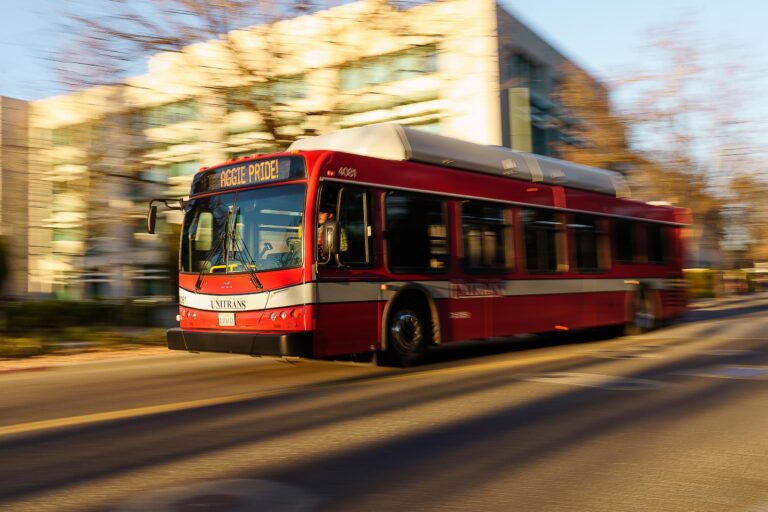
Students can expect an expansion to the existing bus service from campus to the Davis Medical Center in Sacramento as early as Spring 2020. The buses will be electric and replace the existing service that operates hourly. 

Electrify America, a subsidiary of Volkswagen, will be providing 12 buses for the expansion, an upgrade from the two that are currently in use. The university originally announced that the buses would be operational in late 2019. 

“The effort has always had an ambitious schedule and is currently ahead of our overall expectations,” said Matt Dulcich, the director of environmental planning for UC Davis, via email. “Ordering and manufacturing of the California built vehicles has proceeded as quickly as possible and past announcements may have reflected outdated project details.”

Volkswagen founded Electrify America in response to the company’s emissions scandal where it was found that it had intentionally programmed its diesel engines to activate their emissions controls only while being tested, in order to meet American emissions standards. 

The buses will facilitate the larger plan to increase the connection between UC Davis and Sacramento. Eventually, the buses will also go to Aggie Square, the “innovation hub” that is planned to be built on the UC Davis Sacramento campus. The new development is meant to create opportunities for students, researchers and alumni in the city. 

With many employees and students already commuting between the two cities, the goal is that the new buses will decrease the number of single occupancy vehicles on the road. They will help with the UC’s system-wide commitment to emit net zero greenhouse gases from its buildings and vehicles by 2025 — a goal unique to the system. 

The buses are part of Electrify America’s Green Cities Initiative meant to increase access to zero emission vehicles in metropolitan areas across the country. Sacramento was the first city chosen for the initiative. The company is investing $44 million to launch initiatives like the electric buses.

Will Berry, the fleet and operations manager at Electrify America, said via email that “no official launch date for the service was ever announced.” The service would be operational “by Q4-2019,” or Oct. 1 2019, according to the website of the marketing campaign for the company’s green city investments.

Written by: Andrea Esquetini— campus@theaggie.org

City of Davis declares fiscal emergency to avoid ‘dramatic’ loss of tax revenue

Tax measure allows city council to call special election

The Davis City Council voted unanimously to declare a fiscal emergency in their Sept. 3 meeting in an effort to avoid what city staffers warned would be a “dramatic” loss of sales tax revenue. The declaration allows the city to call a special election in March 2020 to put the renewal of the city’s 1% sales tax towards a city-wide vote. 

A staff report from city officials encouraged council members to approve a resolution declaring a fiscal emergency in order to call for a special election. In the report, city officials warned of a future gap in the city’s tax revenue if the city’s current 1% sales tax was not renewed. This multi-month gap in revenue could cost the city millions, the report stated.   

“The loss of the $2.2M anticipated to be collected from January 1-March 31, 2021 would require the City Council to determine how to reprioritize among critical city services, reducing or cutting numerous City programs including public safety (Police and Fire); maintenance of city roads, sidewalks, bike paths and parks; and community programs, such as recreation for youth and seniors,” according to the report. 

Declaring a fiscal emergency does not necessarily signal an immediate financial crisis for the City of Davis, according to Assistant City Manager Kelly Stachowicz. Rather, she said, the declaration is a pro forma “procedural move” by the council, meant to avoid a potentially dire financial situation in the future.

“The declaration was done for a very specific reason — to address a chain of events that happened that have required us to move our general election [from March] to November [2020],” Stachowicz said.

The chain of events began in July, when the city received a demand letter from Rexroad Law Firm alleging that the city’s current election system — an at-large electoral system — violated the California Voting Rights Act, disenfranchising minority populations in municipal races. 

“Davis does not appear to dispute our allegations that the City has been conducting at-large elections, and that those at-large elections have resulted in racially polarizing voting and dilution of minority voting rights,” wrote Rexroad. 

The letter threatened legal action if the city did not switch to a district-based system by its next scheduled city council election, originally slated for March 2020.

The city council disagreed with the premise of Rexroad’s lawsuit but worried about the financial implications of the legal battle. A city staff report, dated Aug. 13, echoed these concerns, asserting that fighting Rexroad’s lawsuit would be costly with little chance of success. 

“Should the City Council decide not to pursue a move to District elections, the City would be exposed to litigation and required to pay legal fees not only for the City’s defense, but potentially for the plaintiffs’ costs as well,” the report read. “To date, no city has prevailed on the merits in a lawsuit challenging the California Voters Rights Act, so Davis’ costs would likely exceed $1 million.”

In order to comply with the letter’s demands, the council was forced to reschedule the March 2020 city council municipal election to November of that year, Stachowicz said. 

General taxes, like the sales tax up for renewal, are typically required to share a ballot with city council member races in municipal elections, according to Stachowicz. Still, if the 1% sales tax renewal vote is also pushed back to November, this would create a multi-month gap in city revenue collection, she said. 

“If we were to wait and have the sales tax at that November date, then [the tax] wouldn’t be able to be in effect until spring — probably April or so — of 2021,” Stachowicz said. “Meaning we would lose about a quarter’s worth of revenue generated by that tax — that’s over $2 million. That would then put us into that financial emergency.”

The Sept. 3 report advised the council to declare a fiscal emergency, which in turn allows them to conduct the tax renewal vote during an election without city council races.  

In response to the report, the council unanimously approved the fiscal emergency resolution, according to the city website

Written by: Tim Lalonde — city@theaggie.org