57 F
Davis

Davis, California

Monday, December 22, 2025
Home Blog Page 426

Is vertical farming a solution for feeding our growing cities?

More sustainable methods of farming needed as populations increase, people migrate to cities

With the world’s population estimated to reach 9.8 million people by 2050, is vertical farming a viable option for feeding our rapidly growing cities while keeping us from committing climate suicide?  

City life is in demand. According to the United Nations, 3 million people all over the world are moving to cities every week, and this number is expected to keep increasing. The UN predicts that, in 15 to 30 years, two-thirds of the world will be living in cities.

The U.S. is no different — we love our cities too. Today, 82% of Americans live in medium or large-sized cities, and this percentage is expected to spike in the future as well. Where we get our food to feed these growing cities will play a major role in whether we achieve our climate goals under the Paris Agreement or not.

According to experts, up to 23% of our global greenhouse gases can be traced back to agriculture and land use. That’s almost a fourth of our total greenhouse gas emissions. But that only accounts for production: food then needs to be transported to the big cities, and in many cases, that means taking big diesel-emitting 18-wheelers across the country, or exporting food out of the country altogether.

California’s agriculture industry is huge. We have 77,500 farms producing more than 400 different commodities, and we produce two-thirds of the nation’s fruits and nuts. We export one-fourth of our total food production to other countries. And all this comes at a carbon price we might not be able to afford as the food demand for our hungry cities increases.

A simple solution to reduce our food mileage — the distance food travels from production to consumption — is to grow food near our cities. But an even better solution could be to grow food right inside our cities.

Vertical farming is the act of growing food in vertically-stacked layers indoors year-round by controlling light, temperature and water, often without the use of soil. Two of vertical farming’s biggest perks are its climate control mechanisms and potential to make production more efficient.  

As climate change gets worse, many places where we’ve been able to grow food for years will start experiencing unprecedented problems. Rain seasons, drought years, flash floods and irregular weather patterns can become less predictable. Habitable areas for insects will change as well, which could introduce pests and disease to new areas. The ability to grow food indoors, and without soil, gets rid of these future uncertainties.      

Growing food indoors without concerns about climate or soil means extreme-weather Chicago, congested New York and even dry Las Vegas can become independently sustainable food producers, grow food year-round and feed themselves locally.

Soil-free agriculture will eliminate any use of pesticides and herbicides, which would make consuming food much healthier. It also alleviates the problem of dealing with the declining health of our soil. According to the UN, half of the soil usable for agriculture has been lost in the past 150 years, leaving us with only 60 more years of viable soil.  

Vertical farming also brings potential for solving our current and projected water issues in California. By using hydroponic system technology, water is constantly recycled and uses 98% less water per item than traditional farming. Adopting this technology would be greatly beneficial for our future, considering that California’s agricultural sector uses 40% of our water.

Vertical farming also means potential economic profit for farmers. With 3.5 million workers maintaining the fields in the U.S., labor comes at a price. But vertical farming can automate most of its production, meaning that more businesses can afford to jump into the market and bring the cost of food down.

  Ecologically, vertical farming can  help the land harmed by deforestation and desertification to regenerate and return to its natural state. This would allow many species to retake their natural habitats and help slow the alarming rates of extinction.

While vertical farming has the potential to solve a lot of our current and future problems, it’s still very early in its development, and there are many questions we don’t know the answers to. Will the food grown under LED lights be as nutritious as the food grown under the sun? Is the carbon footprint of substituting the sun’s energy with LED lights sustainable? Where will the energy to run these vertical farms come from?

Vertical farming is not the answer to all of our problems and is not a technology meant to replace conventional farming altogether. But it can allow for our growing cities to take some load off farms and become more self-sufficient.

I am optimistic that this technology will keep improving and, with innovation and the free market, create new and more sustainable methods for bringing food from our farms to our mouths.

Written by: Daniel Oropeza — daoropeza@ucdavis.edu

Disclaimer: The views and opinions expressed by individual columnists belong to the columnists alone and do not necessarily indicate the views and opinions held by The California Aggie.


Senior Art Shows

The Basement Gallery features student work throughout Spring Quarter

The first round of the spring Senior Art Shows began on April 8 in the Basement Gallery. These shows allow art studio students of senior standing to showcase their work and share it with the community.

The first round of shows featured fourth-year art studio majors David Gonzalez Silva, Charlotte Saylor, Michelle Pang and Jennifer Hua. Each artist displayed work that best highlighted their style and artistic talent.

Silva’s displayed works included sculptures made of several different mediums including plywood, sawdust and ceramic materials. He is willing to take risks in his art in order to achieve a rustic and natural look in his pieces.  

Silva’s work highlights his passion for the natural world and its ecosystems. While taking an entomology class years back, Silva discovered a passion for insects and has included aspects of this passion in his art ever since.

“I tend to gain inspiration from the insect word,” Silva said “That’s really what my recent work is about — expirimenting with materials and actual insect forms and seeing what I can find in those structures,” Silva said.

Silva’s knowledge of entomological forms and life is evident in his style and he has mastered the use of many different materials and mediums.

UC Davis Professor of Art Robin Hill nominated Silva for the Outstanding Senior Award within the art studio major. Silva also works as a curator for the Basement Gallery and will continue to be involved with the rest of the senior showcases.

Meanwhile, Saylor’s display included several oil paintings and mixed media portraits. Her paintings are vibrant and expressive with strong brush strokes.

“[My style originated from] growing up, seeing painters like Van Gogh and seeing the paint rise from the canvas, so when I can I love going really thick with my brush strokes so you can really see that it’s oil paint; it’s beautiful,” Saylor said.

Saylor tends to focus on portraits and the human figure in her art.

“I love working with people,” Saylor said. “Portraits are my thing, mostly just because I love people-watching.”

One of Saylor’s favorite pieces on display was a mixed media drawing titled “Madonna with the Long Neck Re-envisioned.” This 60 by 84-inch drawing was inspired by Saylor’s love of art history and the time she spent studying abroad in Italy.

“My professor knew I wanted to work really big so he encouraged me to just go for it,” Saylor said about the piece. “I put it on the wall and had to stand on a stool to make it.”

The drawing took weeks to finish but the time and effort Saylor put in is evident in the eye-catching and extravagant final product.

Pang also highlights the human form in her art and in the works she displayed. Her untitled oil painting depicted two dream-like figures in an embrace. Pang demonstrated a skillful understanding of value and contrast in this phenomenal piece.

She also had several screen prints hung up that looked remarkably professional. They depicted characters and scenes from a heist story that Pang is currently writing.

“I would say that I tend to create very illustrative art,” Pang said. “My art mostly focuses on people, and their relationships with themselves and with others.”

Pang was inspired after taking her first printmaking class at Davis.

“Something about the medium really captured me,” Pang said. “Both of the printmaking professors that I’ve had, Noah Breuer and Graham McDougal, as well as my painting professor, Shiva Ahmadi, have been a huge inspiration to me here at Davis.”

Pang appreciated her experience being a part of the senior showcases.

“It was pretty cool to look through all the work that I’ve done since coming to Davis in preparation for putting up the show,” Pang said. “I think that I’ve developed and improved a lot as an artist since I’ve come here, and I’m happy with how the gallery came together.”

Hua had several beautiful oil paintings on display as well. She wanted to depict her growth and evolution as an artist through her displayed pieces.

“Throughout the years, I’ve made art that felt dramatic and lighthearted or whimsical,” Hua said. “I would describe my style as feeling free and unwilling to be restricted to anything.”

Hua drew a lot of inspiration from art history in her work. Her piece “Still Life Picnic” includes aspects reflective of Renaissance style artwork.  

Hua was grateful and proud to be part of the senior showcase.

“I think part of me feels mostly relieved and proud that I was able to showcase some of my artwork,” Hua said. “When I found out about senior art shows three years ago as second-year student, I had been waiting and hoping I could do the same too. The senior showcase in Spring is always a great source of inspiration and motivation.”

The Basement Gallery will be holding the Senior Art Shows through June 7. The Basement Gallery is located in the Art Building.

Written by: Alyssa Ilsley — arts@theaggie.org

Bike City Theatre Company educates next generation of bicyclists

Local company presents “Light the Way: A Bike Safety Musical” at Davis school assemblies

When Bike City Theatre Company Artistic Director J.R. Yancher sought sponsorship for “Light the Way: A Bike Safety Musical,” he said that people first asked him, “Are you doing it for the college students?” Upon learning that the show was for children, they added that “[the college students] need it more!”

While Yancher admitted that people weren’t wrong about the need for bike safety education among college students, Bike City Theatre Company’s recent bike safety musical was created specifically for an audience of elementary-aged Davis bicyclists.

The show toured all eight Davis Joint Unified School District elementary schools between April 18 and April 26 in order to encourage children to bike safely to school. It will also be offered to schools in surrounding areas next fall, and there will be performances open to the public this summer.

Its story takes place in 1894 and follows Annie Londonderry’s 15-month bicycle trip around the world. With songs like “El Casco,” which instructs, “Don’t be a clown — protect your crown!,” the show goes over bike safety essentials such as wearing a helmet, understanding intersections, signalling and using bike lights.

Casted with five UC Davis students, the 40-minute long original work was sponsored by Nugget Markets and Davis Kids Klub and was also made possible through Safe Routes to School funding. As the Caltrans website explains, Safe Routes to School is an international movement that aims to combat “preventable childhood diseases, worsening air quality and congestion around schools, and missed opportunities for children to grow into self reliant, independent adults” by encouraging and enabling more children to walk and bike to school.

In Davis, Loretta Moore and Rachel Hartsough — who are the Safe Routes to School coordinator and program manager, respectively — chose to commission Bike City Theatre Company for the bike safety musical for Safe Routes to School after they saw the company’s production of “Gutenberg! The Musical.” Working alongside Moore and Hartsough has been Jennifer Donofrio, the city’s bike and pedestrian coordinator.

The city has previously sponsored other bike safety education programs — “This is How We Roll,” from Los Angeles’ Shows That Teach, and “Rock the Block,” from Alameda County’s Bay Area Children’s Theatre — but Moore said that the local aspect of Bike City Theatre Company caught her interest.

“They had a good understanding of what Davis bike culture is,” Moore said. “Actually, J.R. went to elementary school in Davis, so that really helped us feel that he had a good understanding of what it is like to bike to school as a kid in Davis.”

The fact that the company is local also allowed the city to be more involved in which specific messages were communicated to the students. Writers and actors from Bike City Theatre Company took the city’s bike education class, and Moore, Hartsough and Donofrio gave feedback on the script as it was developed.

When Moore attended the performances, she said she enjoyed seeing the students’ receptions of the musical’s messages.

“[Students have] been really engaged with this program,” Moore said. “It’s very good.”

Yancher also saw this engagement and said he received positive comments from teachers.

“One of the sixth grade teachers gave us an A+,” Yancher said. “All the students were really happy, and they were walking out singing the songs — which is what we wanted, because all the safety tips [were] in the songs to try to get it in their head. So if it’s there, we succeeded.”

Yancher said that working with UC Davis students was another beneficial aspect of the production.

“I was happy to have them,” Yancher said. “They were awesome and positive and super into the project. We use UCD people all the time.”

Actor Jordan Brownlee, who played multiple parts in the musical and is a third-year cinema and digital media major at UC Davis, echoed these sentiments.

“I really enjoy working with everybody here,” Brownlee said. “We all come to rehearsals with a positive attitude, we all want to get the work done and we all want to put on a really great show.”

Brownlee said that though it was difficult to memorize the script and practice different dialects, the determination of those involved made the production eventually seem seamless.

“Ultimately in the last couple months, it’s come together very nicely,” Brownlee said.

Both the theater company and the city have ideas for what’s next. Yancher hopes that with more community support, the company will be able to send a new educational show to the schools on a yearly basis, with each show covering different subject matter instead of only bicycle safety.

For Moore, the goal of the bike safety musical is that it will travel beyond Davis.

“What really is important to the city of Davis is when we spend money on active transportation — these grants — we are developing these things not just for our city, but to be shared throughout the United States,” Moore said. “The goal is to develop these things with our Davis expertise on biking and share those with other regions.”

One additional vision of Yanchers and Bike City Theatre Company is to also bring a bike safety production to UC Davis.

“Lots of freshmen come in, and a lot of them have never been in a town like this where it’s so bike heavy,” Yancher said. “And they’re zipping through intersections without stopping and stuff like that, […] and so I’m hoping that in the next year or so, we can do something for the UCD students.”

Until then, the public performances of “Light the Way: A Bike Safety Musical” will be shown from June 1 to 2 at a Davis elementary school. Once it is determined, the exact school will be announced via posters around Davis.

“We intended it to be enjoyable for adults and children,” Yancher said.

Written by: Anne Fey — city@theaggie.org

ASUCD Senate tables spending bills pending further review

Senate holds Allyship training, passes resolution to support California Senate Bill 24

The April 18 Senate meeting was called to order at 6:15 pm by Vice President Shreya Deshpande. ASUCD President Justin Hurst was absent.

The meeting began with Senate pro-tempore elections with senator Andre Spinoglio being elected.

Next was an allyship training by the Gender and Sexuality Commision. During this training the members of GASC explained to the Senate and the commision chairs how they can be allies to the LGBTQIA+ community. They went into detail on various topics such as misgendering, how to become educated on these issues and ways to ensure that individuals are always respectful to those in the community.

Then, the consideration of old legislation took place. There were a few legislative pieces that were discussed between the senate, the chair and the authors of the bills. SR #11, which is intended to recognize the commitment of the late former ASUCD Business Manager, Janice L. Wimmer Corbett, was the first to be discussed. It passed with no objections.

SB #73, a Senate Bill to allocate $1,417.55 for the yearly supply of menstrual hygiene products in male and female CoHo Restrooms, was tabled in order to allow GASC and other commissions the time to review the bill before putting it up for a vote.

SB #76, a bill to allocate $347.30 for the ASUCD Excellence in Education award and its reception put on by the Academic Affairs Commission, was also tabled and referred to the Business and Finance Commission for further review.

There was an update on the status of previously passed legislation.

Next the floor was opened for public discussion. Members of the External Affairs Commision and the ECAC gave a short presentation on Assata Shakur in response to comments made at the previous Senate meeting. After the presentation, Deshpande commented on the tensions which took place during the previous meeting. They spoke about the need for communication and the need to have difficult conversations in order to solve problems.

During the public discussion, other topics were also discussed, such as housing troubles that are plaguing students. During this time, Senator Tony Chen wanted to consider his new bill as emergency legislation. Members of the Senate, however, deemed the legislation to not be an emergency, so the new bill will be introduced next meeting.

The Committee on Committees needed a new adopted senator, and Senator Sean Kumar volunteered for the task.

After public discussion, the Senate moved to review further legislation. SR #12, a Senate resolution to support California Senate Bill 24, was discussed and passed with no objections. California Senate Bill 24 would require certain public universities to provide medical abortions on their campuses. A longer version of the resolution is planned to be presented at a future senate meeting.

Next were public announcements. The senators and the commision chairs took this time to make announcements. They spoke about various issues ranging from the upcoming 5K run to the fact that April is Sexual Assault Awareness Month.

Once the public announcements were finished, elected officer reports were given. These reports contained updates as to what the past week looked like for elected officials and what their future plans are for their offices.

The minutes for the previous meeting were approved.

The meeting adjourned at 8:28 p.m.

Written by: Alexis Lopez  — campus@theaggie.org

East Africa Protected Areas

Researchers find protected areas in East Africa do a good job of preventing human encroachment

The Serengeti National Park in Tanzania is home to some of the most incredible natural spectacles on earth. Every year in Serengeti, millions of wildebeests and zebras undertake the planet’s only remaining great migration of mammals. The park also has the largest population of lions anywhere in the world. Serengeti, alongside other protected areas in East Africa, are an important bastion of wildlife and biodiversity. Unfortunately, East African protected areas have a bad reputation.

“We hear lots of terrible conservation stories about paper parks, poaching and deforestation within park boundaries,” said Jason Riggio, a postdoctoral scholar with the Museum of Wildlife and Fish Biology at UC Davis who studies East African protected areas.

Despite this reputation, a study published in January tells a hopeful story about one aspect of these protected areas. Jason Riggio and other scientists from UC Davis used satellite imagery to analyze how effective East African protected areas were at preventing human encroachment.

“What we found in East Africa, at least in terms of deforestation and habitat loss, is that these countries were doing a really good job at protecting their protected areas,” Riggio said.

Safeguarding biodiversity, the variety of species on earth, is a pressing topic. Global biodiversity is rapidly declining due to a variety of factors, and biologists are concerned that the drop poses a major threat to the planet. East Africa is one of the most biodiverse regions, but also one of the most threatened. Preventing human development in the rangelands of animals is a crucial step in protecting the biodiversity of the region. As the population of East Africa grows, the pressure on the last remaining wildlands will increase which is why the effectiveness of protected areas in preventing development is important. Unfortunately, protected areas have a problematic history in East Africa.

“These protected areas were originally set up as game reserves so that colonial hunters could go there and shoot big game; big trophies,” said Andrew Jacobson, an author on the paper and assistant professor of the Environment and Sustainability at Catawba College. “Given that history, there are still some social challenges with protected areas in that region.”

Adding to concerns, East African protected areas were not necessarily designed to maximize protection of biodiversity. Modern ecological considerations, such as a focus on protecting endemic species or species found nowhere else in the world, were not used.

“Most of the protected areas weren’t set up with the goal of protecting 10% of the habitat type, or covering all these endemic species,” Riggio said. “They were really set up because someone said hey there are gorillas over here, let’s protect that, look there’s lions and elephants over there let’s protect that.”

The researchers were interested in examining the effectiveness of the protected areas because of these challenges. To investigate, they meticulously traced the edges of human development surrounding the protected areas using satellite imagery from Google maps. Then they compared the official protected area boundaries with their traced borders. Their results were encouraging.

“Roughly only 6% of the land area of protected areas in East Africa had been lost to land conversion,” Riggio said. “In strict protected areas, the most restrictive forms, like National Parks, that was less than 2%.”

The researchers also wanted to know how well the protected areas covered the ranges of endemic species. They compared their map of the protected areas with pre-existing range maps, and found that, despite concerns about how the areas had been set up, they did a really good job of covering the ranges of species unique to East Africa. The research also suggested some places new protected areas could potentially be set up.

Although the study is encouraging, it only looked at one aspect of the effectiveness of protected areas. Key issues like poaching and park management were not considered. In addition, the research did not discuss the unique land needs of the animals which inhabit the protected areas. According to Douglas Kelt, a professor of Wildlife Ecology at UC Davis who was not involved in the project, the paper is a first step in a much larger effort.

“Understanding the extent to which existing protected areas actually protect the diversity of habitat types is a very important first step in understanding how well we are protecting the biodiversity in these habitats,” Kelt said. “A critical second step is “linking” the actual size of protected areas to the real needs of the associated biota.”

Kelt noted that a recent study in Science found that the human pressure at the borders of protected areas cause animals to concentrate in the center which can exacerbate severe droughts by reducing the quality of soil in the area. The study in Science demonstrates that, just because protected areas are doing a good job at keeping humans from expanding into wildlands, does not mean that the protected areas are adequately serving the animals they purport to protect, or that humans are not having a negative influence on animals in those areas. All of those issues warrant further study as researchers scramble to figure out how to best preserve the remaining biodiversity on earth.

Regardless of these limitations, the protected area boundary research provides proof that protected areas can work even in areas of the world with difficult challenges.

Written by: Peter Smith — science@theaggie.org

Nightmare in the City of Angels

A season filled with expectations leaves Lakers looking for answers

On the afternoon of July 1, 2018, Klutch Sports agency released a statement announcing that Lebron James had signed a four-year, $154 million contract with the Los Angeles Lakers. Almost immediately, the NBA universe was turned upside down as the league’s biggest star had once again left his hometown of Cleveland and joined one of the biggest markets in the world.

Lakers fans across the world rejoiced. Six years removed from their last playoff appearance, fans believed the Lakers might be able to put an end to the drought by adding arguably the league’s best player.

But this young Lakers squad had 35 wins and missed the playoffs in the previous season, so many still doubted the team’s chances to make a full turnaround. Those doubts only increased when veterans Rajon Rondo, Lance Stephenson, JaVale McGee, and Michael Beasley were signed by the team later that summer, all of which were head-scratching moves as each of these players had a reputation for either having an abrasive attitude or being highly prone to mistakes. Lakers President of Basketball Operations Earvin Magic Johnson was well aware that this team was different from many of James’s past teams — which mainly featured several additional players who could spread the floor and shoot the three — but nevertheless claimed to have found a new way to compete with the two-time defending champion Golden State Warriors: toughness and playmaking.

“You’re not gonna out-Golden State Golden State,” Johnson told ESPN. “Everybody’s talking about the Lakers don’t have shooting. Oh, we have shooting. But we saw all the teams in the playoffs that had shooting; they got beat”.

When the season came around, the Lakers lost their first three games and did not reach .500 until the second week of November, when the team was 6-6. In December, the team seemed to have built up some chemistry and began to roll. By the time they played their big game against the Warriors on Christmas Day, they were 20-14 and sat in 4th atop the Western Conference.

On Christmas Day, the Lakers played arguably their best basketball game of the season. They held the Warriors to 50 points in the first half of play and led by 15. All seemed to be going well until mid-way through the third quarter when James fought for a loose ball and came up injured. He left the game and was later ruled out indefinitely with a strained groin. While the Lakers won the game 127-101, all eyes were on James’s injury. He had been healthy during his whole 16-year career, and seeing him go down with his first major injury was worrisome for the Lakers, who now had to hold on until Lebron returned.

They did the opposite of that, starting 1-5 in the first six games without James. The team could not find their rhythm and was losing crucial games which kept them further away from the tight Western Conference playoff race. In mid-January, however, the Lakers began to win games, stringing together wins in four of their next six games, including a huge win against the Oklahoma City Thunder thanks in large part to the play of Lonzo Ball — who arguably played some of the best basketball of his young career.

Things finally began to click without Lebron. That was until a severely rolled ankle against the Houston Rockets eventually ended Ball’s season and sent the Lakers into another losing stint that pushed them to a 26-25 record. But hope rebounded for L.A. as James returned in a win against the Clippers on the final day of January. Each of the last 28 games would be important if the Lakers wanted to get themselves back in the playoff race. But of course, it wouldn’t be the Lakers without drama.

New Orleans Pelicans all-star power forward Anthony Davis asked for a trade from the team in mid-January, and it was rumored that his preferred destination was the Lakers. It’s believed that the Lakers’ final offer for Davis included as many as six players and four draft picks, but the deal was not completed for unknown reasons. Even though the deal fell through,  the negotiations still had an effect the Lakers and the team’s younger players who heard their names in trade talks for the first time. Their play began to suffer and so did the team’s, and the trade-rumor turmoil eventually became the final straw in the team’s downfall.

The Lakers would go on to lose 19 of their last 28 games and were eliminated from playoff contention for the seventh straight season on March 22. Brandon Ingram missed the final 18 games of the season with a deep venous thrombosis in his arm, a career-threatening injury that he is expected to fully recover from before the upcoming season. Kyle Kuzma missed the majority of the Lakers’ final games with an ankle injury. And James was finally shut down for the season with six games remaining, shortly after it was confirmed that he would be missing the playoffs for the first time since 2005.

Once the season officially ended, Head Coach Luke Walton and the team mutually agreed to part ways, but not before Johnson surprised everyone by stepping down from his position without telling anyone in the organization.

What was largely expected to be an exciting season in L.A. turned out to be a dumpster fire of injuries, drama, and dysfunction. But the Lakers now appear to have bigger problems. As they search for a new head coach and President of Basketball Operations, summer and free agency is approaching. The Lakers have cap space for another big name player, but will anyone want to join the team? Whoever is hired for these vacancies will likely play a big role in whether or not the Lakers sign a co-star for James. This summer could end up being one of the biggest offseasons in Lakers history.

With a 34-year-old superstar in James, the time is now for the Lakers to make moves and try to win titles. He isn’t getting any younger, and this is likely his last window of playing at a high level. The pressure is on, and the margin of error is thin. Failure to win with arguably the greatest player of all time could be another stain for this historic franchise that is trying to escape the depths of mediocrity.

Written by: Omar Navarro — sports@theaggie.org

UC-AFT union bargains over new contract

Lecturers seek longer job contracts, more security from university

The University of California American Federation of Teachers (UC-AFT), a labor union that represents lecturers and librarians working at the UCs, is bargaining with the University of California Office of the President over a new contract for lecturers and other non-tenure-track faculty.

The latest bargaining session occurred last week at UC Davis, where 88 union members and supporters were present. An additional 63 members and supporters arrived at 11:30 a.m. to watch the session in a show of support.

Katie Arosteguy, a continuing University Writing Program lecturer and member of UC-AFT, expressed concern over UCOP’s demand for closed bargaining sessions — a request that isn’t new for UCOP, who insisted on closed bargaining sessions during their negotiations with the UC Student-Workers Union Local 2865, a labor union representing undergraduate tutors and graduate student workers.

“Today, we really wanted to try and show up in numbers just to demonstrate that we’re paying attention,” Arosteguy said. “They did not want to have open bargaining sessions, so we wanted to show up to just demonstrate that we’re paying attention and that we care about getting a fair contract and that we want them to bargain in good faith with us. We were pretty disturbed to hear them say that they don’t want students to be present, or reporters or student reporters, so we pushed back on that.”

Mia McIver, the president and chief negotiator of UC-AFT and pre-continuing lecturer in Writing Programs at UCLA, described the bargaining session as positive. The union presented three proposals to UCOP, while UCOP presented two proposals to the negotiators. McIver said both sides “had a good discussion about all five of those proposals.”

The union’s main goals include the reimbursement of moving expenses for new faculty who have to make extensive living adjustments and making sure non-tenured faculty, who have been terminated due to long-term illnesses or injuries, have due process rights and severance compensation.

“We also passed a proposal of academic calendars,” McIver said. “If UC admin is thinking about increasing or reducing the number of days of instruction or if they are considering adding Saturdays and Sundays as instructional days, we want to be part of that discussion before those changes go into effect. We think that’s an issue both for understanding how that’s going to affect students’ education and access to education. Also, we want to make sure we understand how that affects our own workload.”

The UCOP will respond to these proposals at the next bargaining session, scheduled to take place at UCLA on May 16.

McIver expressed disappointment over proposals submitted by UCOP, including the claim that UCOP cannot guarantee that faculty hired near the start of a term will have access to instructional resources, such as email.

“Without those things, we don’t have a roster of who’s in our class, we can’t contact students, we can’t send out a syllabus, we can’t order textbooks, we can’t upload assignments and readings, so that’s very problematic for us,” McIver said. “It’s very disappointing to hear administrators who have power over that say that they don’t have power over that.”

Another newly proposed contract term from UCOP aims to replace in-person orientations for new faculty with online orientations.

“We think that there’s just no substitute for in-person contact that helps make faculty understand what this job is, what the resources that are available to assist with teaching, what is needed to know to work with and support students on a given campus,” McIver said. “Also, we think faculty deserve to have a conversation with their union representative and to understand what rights and responsibilities they have that are associated with our negotiated contract.”

Matt Oliver, a UWP lecturer at UC Davis and member of the UC-AFT bargaining team, stressed his desire for equality between non-tenure-track faculty, like lecturers, and tenure-track faculty.

“The university doesn’t really acknowledge us as faculty, they’ve kind of put us in the staff category,” Oliver said. “Every year, my library card expires, and they have to confirm I’ve been rehired. Whatever resources they make available to faculty are not available to me; tenure-track faculty have access to child care. I don’t.”

Oliver also discussed the fact that many lecturers are hired as part-time workers. Part-time lecturers don’t have access to long-term disability insurance offered by the UC, cannot participate in the UC retirement system and are subject to medical separation at the university’s discretion, according to Oliver.

“I’d like to see some kind of language that indicates lecturers should be full-time unless there’s a special need to do otherwise,” Oliver said. “Typically, at places like LA and other schools, there are multiple part-time people — none of whom get the benefits — and it seems to me sort of a shady kind of backdoor move that I’d like to see addressed. If you know you need someone to teach the classes, hire somebody and invest in that person.”

Since lecturers are often hired close to the start of a term and many of their contracts are renewed each quarter or each year, they have limited job security.

“I am in my fifth year of what we call pre-six, which means I’m on an annual contract,” Oliver said. “I don’t know if I’ll be hired again next year — I probably will, but it’s one of those things.”

Oliver said he would like the university to notify non-tenured faculty whether or not they will have a job for the coming year by February or March of the proceeding school year.

“I won’t know if I have a job next year until June at the earliest — sometimes it’s been July,” Oliver said. “It seems that that’s not very polite. I understand if I don’t do my job well, I should be discontinued, but if you let me know early enough to find another job, it seems that that would be the polite thing to do.”

In addition to earlier re-hiring notifications, Oliver also said he would like to see longer contracts offered from the UC.

“We take on the expenses of moving here because the UC needs someone to teach a course, but if we don’t know one quarter later or a year later whether or not we have a job, it puts us in a dicey situation,” Oliver said.

Written by: Sabrina Habchi — campus@theaggie.org

Violence has overtaken our screens and no one seems to question it

Why does violence hold such mass-market appeal in our entertainment culture?

A few weeks ago, I replayed one of my favorite games of all time: “Uncharted 2.” It’s the game that fully introduced me to what video games could be –– a masterful way to tell stories in a fun and engaging way. I tried to keep in mind an often-heard criticism about the main protagonist: Nathan Drake is essentially a mass murderer, killing hundreds of enemies throughout the game. “It’s just a video game,” I would tell myself. But is that a valid excuse?

Throughout my playthrough, my admiration for the game remained unchanged — it was as enjoyable as it was before. But, a constant question remained: Why is violence the default gameplay objective in the industry? And why does violence hold such a large stake in our mass media culture and entertainment as a whole?

A quick Google search of violence in video games will lead you to an unending debate over whether or not violent video games cause violent behavior in young people. However, what I find more interesting is the overwhelming frequency of violence (guns, brawling, violent acts) as the default for gameplay. Why are developers and gamers so comfortable with killing?

The 10 best-selling games of last year reveal how dominant violent games are in the video game market. Eight of the top 10 games from 2018 featured violence as the main form of gameplay. This phenomenon isn’t just limited to video games — eight of the top 10 movies from 2018 featured violence as well. But it certainly feels more prevalent in the interactive experience that games provide.

Mowing down hundreds of enemies seems routine for the majority of video games. And sure, most enemies will kill you if you don’t kill them first — that’s the conflict game designers always give us. But that’s part of the issue, too. Why are game worlds designed so that killing is often the core mechanic? Many older games like “Tetris” and “Pong” featured zero violence. But, as graphics and gameplay capabilities advanced, games became more violent — or at least seem more graphic in comparison. As games like “Contra,” “Mortal Kombat” and “Call of Duty” have found success, the default mode of conflict has turned to killing.

Where does this obsession and attraction to violence come from? Is violence just the easiest way to create conflict? Is it all necessary? Do we as consumers really demand this much violence?

Maybe the answer lies in the success of non-violent games. Independent games like “Journey,” “Gone Home” and “The Witness” tell compelling stories with engaging game mechanics and without violence. AAA developers — the big-budget industry giants like Ubisoft and EA — seem hesitant to breach into this genre of gameplay on a large scale. Yet these non-violent, independent games found success on a smaller level both critically and financially.

Ultimately, in all forms of entertainment, violence is used to build up adrenaline, conflict and consequence. The ultimate consequence in these games is death. But the infliction of pain in digital death is so often lost in our depictions of violence. Violence is simply the easiest way to create conflict — it’s immediately recognizable. Kill a hundred enemies in a video game or in a “John Wick” killing spree, and they will simply slump to the floor.

We need to reassess what our entertainment-obsessed culture favors and why we watch and play the games we do. I love “Game of Thrones” and “Star Wars” as much as anyone, but I have to ask myself why violence is such an attraction. Certainly there’s a space for it, and many depictions of violence are handled appropriately. What I think about video games time and time again, however, is whether this frequency of violence is really necessary.

When I play games, I usually play them for the story they tell and the characters I meet. My favorite part about games is not the hundreds of people I have to kill in between cutscenes — it’s the cutscenes themselves, simply because they advance the game’s plot more directly.

Reflecting upon the overwhelming frequency of violence in video games, I find myself wanting new experiences that aren’t fixated on running-and-gunning. Diversifying the palate of available AAA games with more varied experiences of gameplay and story can only be good for the industry and for gamers. Often the violent AAA games are so big, violent and boisterous that it’s hard for new gamers to enjoy those experiences, whereas independent games like “Journey” and “Gone Home” offer remarkable, quality experiences at a lower cost for developers and gamers.

Written by: Calvin Coffee — cscoffee@ucdavis.edu

Disclaimer: The views and opinions expressed by individual columnists belong to the columnists alone and do not necessarily indicate the views and opinions held by The California Aggie.

Accessibility and conservation

“Accessibility” often feels like an obvious reason to develop roads on public land — but isn’t quite as straightforward as we think

Yosemite Valley is more of a small city than a wilderness these days. The seven-square-mile valley sees more than 4 million visitors annually and houses over 2,000 seasonal employees; it has five lodges and hotels, and the park website warns against hours-long waits getting around the valley by car during the summer.

The numbers alone tell a story that stands in stark contrast to John Muir’s 1899 description of the area: “Nearly all the park is a profound solitude. Yet it is full of charming company, full of God’s thoughts, a place of peace and safety amid the most exalted grandeur and eager enthusiastic action, a new song […] with sermons in stones, storms, trees, flowers, and animals brimful of humanity.”

The writing and activism of Muir and others has brought the Valley both national protections and international fame, making it one of the most visited national parks in the U.S. and a prime example of one of the biggest dilemmas the park system faces: how to simultaneously manage, protect and share the land. A huge part of this dilemma is the question of access.

“Accessibility” is something of a buzzword, popping up in debates about how to use and develop public land in ways that are hard to argue with. Besides allowing companies like DNC Parks & Resorts, the hotel company that does business in Yosemite Valley, to profit, developing roads and trails allows a far wider range of people to access preserved areas than keeping the areas totally wild. This encourages people to engage with and care about our public land, and it’s intuitive that people are more willing to fight to protect land when they have a personal connection to it. Similarly, it’s ridiculous to argue that only people who are physically fit and able have the right to access public land, which is often understood as the practical outcome of not developing parks for easy viewing.

There are ways, however, to increase citizen access without building infrastructure.

Last summer, I worked for a company called Splore, which is based out of Moab, Utah, and takes people with disabilities rafting on the Colorado and Green Rivers. The company has been around since the ‘70s, and some of the trips that Splore offers wind through truly remote areas. This means sometimes putting people with severely limited mobility on class 3 or 4 rapids in the backcountry, where rescue is complicated. To some people, that sounds irresponsible. Maybe it is. But on one of the first trips I worked, there was a man with paraplegia whose favorite part of the day was the biggest rapid. His ear-to-ear grin made me wonder how much “accessibility” is wrapped up in tightly-held beliefs that people with disabilities “shouldn’t” put themselves in danger or make themselves uncomfortable. Since when was rafting supposed to be safe or comfortable for anyone? How often does the argument that we need these things for “certain populations” really underestimate the people who fall under those labels?

One of my biggest takeaways from the experience was the realization that “accessibility” is much more nuanced than we give it credit for. People don’t need a road to walk or roll on; they need the support of people who have the knowledge, skills and sometimes technology necessary to safely navigate wild spaces. These skills and support systems can be actively invested in and maintained to give people access, rather than relegating people without the knowledge to read a trail map or the ability to navigate a trail in their everyday wheelchair to the sidewalk.

It’s true that some disabilities can add more discomfort or danger to backcountry endeavors than is reasonable. But when it comes to natural spaces, building infrastructure fundamentally changes what you are preserving. The idea that building infrastructure makes those quiet, remote, peaceful places “accessible” is a misrepresentation. Rather than increasing access to remote areas, infrastructure just makes places into not the backcountry, and often discourages people from stepping outside of it.

There’s a balance to be struck. I don’t think a mistake was made in developing Yosemite Valley — the role the Valley plays in our world as it is now is a good one, bringing love and publicity to the park system. But the quiet liveliness of the Valley as Muir experienced it is gone. It’s been destroyed, if you want to be dark and honest about it. I’m not saying it’s a “bad” thing; I’m saying we have to make sure there are still quiet, profound places in the world, and make sure to both protect them by not allowing them to be built over and share them as best we can with anyone who wants to see them.

Written by: Anna Kristina — akmoseid@ucdavis.edu

Disclaimer: The views and opinions expressed by individual columnists belong to the columnists alone and do not necessarily indicate the views and opinions held by The California Aggie.

Rare disease? There might be a mouse for it.

UC Davis Mouse Biology Program embarks on gene variant projects to model rare diseases

When children are born with a rare diseases, their families may also navigate multiple care providers in search of a diagnosis. Often, genetic testing remains healthcare’s last resort.

The UC Davis Mouse Biology Program is celebrating its 20th anniversary with the Kids First Variant Project and Mutant Mouse Resource and Research Centers Variant Project, which investigates genetic variations found in human patients using mice.

When a patient experiences symptoms of unknown causes, doctors can ultimately refer them to a clinical geneticist. From there, the clinical geneticist can analyze a patient’s whole genome in search of likely factors causing their rare disease, such as variants of unknown significance (VUS) or genes of unknown significance (GUS).

“Human genetics and the relationship to disease is complicated because there are other factors involved, including complex genetic background, diet and the environment, which adds variability between people,” said Brandon Willis, the manager of the UC Davis Mouse Biology Program’s Murine Genetic Engineering Laboratory. “Our mice are isogenic [having similar genotypes] and have standardized care, so we can look into several VUS to determine whether they may be causative for rare diseases in a robust and low variability model system.”

Clinicians and researchers nominate variants for study to the UC Davis Mouse Biology Program.

“UC Davis is one of the few places that has a consortium of resources to produce guiding diagnostics targeted to individuals,” said Kristin Grimsrud, the associate director of Vivarium and Veterinary Services at the UC Davis Mouse Biology Program and project lead for the Human Disease Variant Modeling in Mice Project.

The Murine Genetic Engineering Laboratory searches for and identifies genes within the mouse genome matching the human gene of interest. From there, the Murine Genetic Engineering Laboratory uses CRISPR gene editing to create precise mutations within mouse embryos. CRISPR uses a guided template to pinpoint the gene of interest, cutting DNA with a protein to introduce a template containing the human variants and sealing the mouse genome with a human variant to investigate.

“Before we edit the mouse genome for the target variant using CRISPR, we also engineer silent mutations where you change the CRISPR recognition sequence,” said Taylor Ngo, a second-year genetics major. “That way, the CRISPR protein doesn’t cut the site again while only producing the desired change at the protein level.”

The Murine Vivarium Professionals superovulate female mice, harvesting their eggs for sperm fertilization.

“The Murine Targeted Genomics Laboratory can inject fertilized mouse eggs or use electroporation, which weakens the outside zone of a zygote to temporarily allow the CRISPR protein, guided template and other reagents inside to create edits,” said Joshua Wood, the Associate director of Laboratory Operations at the UC Davis Mouse Biology Program and project lead for the Kids First Variant Project. “Mouse zygotes are implanted into female mouse recipients.”

Sperm is cryogenically preserved by the Murine IVF and Cryo Laboratory to rederive mouse strains in the future.

The Murine Vivarium Professionals monitors the zygotes as they develop. After the engineered mouse pups are born, small samples of their ears or tails are taken to verify genetic editing.

The Murine Genetic Engineering Laboratoratory screens mouse pups for having one copy of the edited gene, then they are bred until they produce mice carrying both copies of the gene variants, modeling rare human diseases. The Phenotyping Center monitors each engineered mouse, investigating how human genetic variants shape the health of the mouse.

“Our mice are treated like patients, we target our tests towards phenotypes that would be present in human rare diseases,” Grimsrud said. “If a little boy had difficulty gripping a fork, then we would have the engineered mouse tested for grip strength and see if the mouse could grip a bar.”

The Mouse Biology Program’s optimized engineering and phenotyping processes allow it to efficiently operate, collaborating with UC Davis faculty and researchers across the country and internationally. Over the past 13 years, the Mouse Biology Program’s Knockout Mouse Project has saved United States taxpayers approximately 570 million dollars. They strive to continue this trend in the Kids First Variant Project and Mutant Mouse Resource and Research Centers Variant Project, saving tax dollars while investigating rare genetic conditions.

“If there are developmental delays during embryonic development that could lead to global impacts,” Grimsrud said. “One of the genes we are looking into is CHAMP1, which is involved in early development. For children, it can lead to challenges in fine motor skills, speech and noise sensitivity. These children don’t interact well with others.”

At the moment, the Mouse Biology Program has successfully engineered seven mouse strains with human gene variants.

“A secondary goal is to potentially use these mice to test therapeutic interventions right away in the mouse, hopefully, to promote similar therapies based on a patient’s needs,” Willis said.

Written by: Foxy Robinson — science@theaggie.org

Gaspar Noé: The Enigma of a Controversialist

Despised by some, beloved by many

The scar that Gaspar Noé has left on the history of film is one of pain and beauty. He is the son of the famed Argentine painter, writer and intellectual Luis Felipe Noé. He is the father of the drug-induced, sexually charged, visceral films “Irréversible,” “Enter The Void,” “Love” and “Climax” and a friend of the atypical moviegoer. Noé has built a career around controversial films — most of them featuring literally explosive sex scenes, taboo relationships and drug frenzies. To watch a movie by Noé is to come as close to taking every drug on the planet, then having sex and then dying, all without taking a break from eating popcorn.

Noé’s films are the epitome of an NC-17 rating. And anyone can watch his most explicit movie “Love” on Netflix, not to be confused with the Judd Apatow’s Netflix original “Love.” Confusing the two would be an awkward mishap since Noé’s “Love” opens with a three-minute scene of a couple engaging in foreplay. This is not a typical Hollywood sex scene — we see everything.

“Love” centers around an American film student Murphy, his girlfriend Electra and their third-party, no-strings-attached lover Omi. They engage in threesomes, ultimately resulting in Omi getting pregnant. Since Omi is pro-life, the birth of her child, whom she names Gaspar, contributes to the nasty breakup of Murphy and Electra.

Although the plot of “Love” may seem relatively tranquil, the cinematography is far from it. One should anticipate full on sex scenes to ayahuasca-induced visions of sex, i.e. a fixed view camera angle of human organs engaging in the act. Being that the film is set on a non-linear timescape, it bounces back, forth, left and right from Murphy’s point of view as he traverses his most painful and pleasurable memories while in love. The audience is left in tears at the end of the film, feeling like they too have finished falling in and out love.

“[The] whole thing that makes the process of finding love [is] like an addiction to some kind of weird chemical that your brain is releasing, and you get addicted to serotonin and dopamine, endorphins,” Noé said to Indiewire. “I just wanted to portray sexual passion as much as possible.”

“Love” is focused on incising a visceral feeling within the audience — something connected to its title surely. With his other films that same gut feeling arises. With “Climax,” which is set around a group of dancers who take LSD and kill each other (but have sex first), the same sorts of camera angles and controversial moving images leave the viewer questioning whether or not they’ll be having inadvertent acid flashbacks once the movie ends. And with “Enter the Void,” which is based on a DMT experimentalist living and dying (then reliving as an aura) in Tokyo, the psychedelic visuals and first-person point of view shots depict what it’s like to live in the neon city while consuming the world’s most potent hallucinogenic drug.

For some viewers, these scenes may reveal the secrets of love, drugs and death without ever having to experience such chaos themselves. But for those who’ve lived these scenes firsthand in their own lives, these films can be triggering. Bouts of depression and anxiety may follow if the films mirror the viewers’ own personal experiences.

While speaking about “Love,” Murphy says about his filmmaking aspirations, “I want to make movies out of blood, sperm and tears […] the essence of life.” The audience can hear Noé’s voice projecting through Murphy’s in this scene, since his films are built upon the mortal platform of these fluids.

In one of his early films, “Carne,” he shoots his opening scenes within an operating slaughterhouse, showing the gruesome reality that takes place in animal agriculture. Not to mention the live birth that also happens in full effect early in the film. There is also the ultra-disturbing ten-minute rape scene in “Irréversible,” which has split audience members down the middle. Some say that it’s too much; others say it’s an explicit and emotional portrayal of a reality which serves as an awakening to the horror of rape. This topic itself is worthy of an entire article.

But for films that seem so human, why the controversy? Maybe it’s the fact that Noé directs some of his films with the help of cocaine or strips down to the nude for a cameo. Maybe it’s the light he sheds on the demonization of nudity in Western culture, or perhaps it’s the fact that Noé thrusts his audience into intensely real experiences that are intentionally ignored by the masses on screen, even though they are felt in real life.

Though some audience members may not consider Noé to be their cup of tea, the critics drink him up. His films have won over fourteen international awards, some coming from the most respected benefactors. He has won two Cannes Film Festival awards, and “Love” (which aired in 3D) was the official film selection at the festival in 2015. The Cannes stamp of certification deemed it to be a legend in film.

Noé believes that to be the best means to learn and to tell stories by way of film. Possibly, this is why he hates “Star Wars” and speaks openly about sneaking out the backdoor when he is forced into watching any superhero film. The king of the weird only seeks the weird — his top influences revolve around filmmakers and photographers like Stanley Kubrick who created “2001: A Space Odyssey.”  Noé went on to describe the movie “2001: A Space Odyssey” as his first psychedelic trip as a child, equating the film to as powerful as a drug. Given his attraction to the intensity of such cinematic experience, fans can infer the other substances that influenced the concepts of his films and their cinematic direction.

“Just like Murphy, the lead character of [“Love”], I’ve spent my whole life obsessed with this ultimate masterpiece, which is beyond cinema,” Noé said to the New York Times. “For years, this movie was a psychedelic maze to me. Then it turned into a puzzle, an object of desire, of addiction […] When you fall in love, you turn blind to the rest of the world. This movie almost turned me blind to the rest of cinema.”

Much like Kubrick, this is the brilliance of Noé: creating unforgettable experiences for the audience, albeit enjoyable or uncomfortable. When pressing play on one of his films, the viewer is not merely agreeing to sit through a movie, they are enlisting in an adventure, which they will carry with them until they, too, enter the void.

Written By: Clay Allen Rogers — arts@theaggie.org

Trump administration ends Cuban baseball deal

Obama-era deal allowing Cuban players to sign directly with MLB clubs reversed

Earlier this month, the Trump administration moved to terminate a deal with the Cuban Baseball Federation that allowed Cuban players to sign directly with Major League Baseball teams. The move is a reversal of a deal drawn up by the Obama administration.

When explaining the rationale behind the decision, the Trump administration argued that the previous deal was a “violation of trade laws” due to the fact that the Cuban federation was a part of the Cuban government. Various Cuban sports corporations, including its national Olympic committee, have insisted that they are completely separate from the government in Havana; however, the President’s administration has rejected all of the sports corporations’ attempts to claim independence.

Under the Obama administration’s plan, if a major league team wished to sign a Cuban player, the team would have to pay a “posting fee” to the Cuban Baseball Federation, which legally allows the individual player to leave Cuba and return back to the country whenever they wish. This is the exact system that the United States still uses to sign South Korean and Japanese baseball players.

The now-terminated arrangement also placed a limit on which players were allowed to be signed, citing that Cuban players over the age of 25 and with six years of playing experience were eligible to be signed by a MLB team; players younger than the age minimum were required to gain permission from the Cuban Baseball Federation in order to play for an American team.

“The U.S. does not support actions that would institutionalize a system by which a Cuban government entity garnishes the wages of hard-working athletes who simply seek to live and compete in a free society,” said Garrett Marquis of the National Security Council. “The administration looks forward to working with MLB to identify ways for Cuban players to have the individual freedom to benefit from their talents and not as property of the Cuban state.”

U.S. National Security Adviser John Bolton tweeted a statement that preceded the deal, saying, “Cuba wants to use baseball players as economic pawns — selling their rights to Major League Baseball. America’s national pastime should not enable the Cuban regime’s support for Maduro in Venezuela.”

A statement defending the old deal was released by the MLB, saying that the league “stand[s] by the goal of the agreement, which is to end the human trafficking of baseball players from Cuba.”

While Cuba has produced players that have proven to be vital icons to the American major leagues, many of these players have come forward to testify to the horrors they experienced when they left their country. Many have been forced to leave Cuba illegally, and, in a lot of cases, these players were smuggled over the border by human traffickers and “disreputable” agents, often crossing rough waters on speedboats.

Following the Trump administration’s announcement, Chicago White Sox’s first baseman, Jose Abreu, claimed that he is still harassed by those who smuggled him over to the U.S. Aroldis Chapman, a pitcher for the New York Yankees, expressed that he thinks it is “bad in the sense that [Cuban ballplayers] can’t come [to America] anymore in the formal, legal way that was planned.”

Earlier this April, Cuba released a list of 34 players who were authorized to sign with MLB teams under the old deal. However, these players and many more will now have to find alternate routes if they hope to play professionally in the U.S.

Written by: AJ Seymour — sports@theaggie.org

Not an afterthot

Third-year communication major Daniel Rajabi shares his thoughts after interaction with woman holding “Hell is hot, don’t be a thot” sign

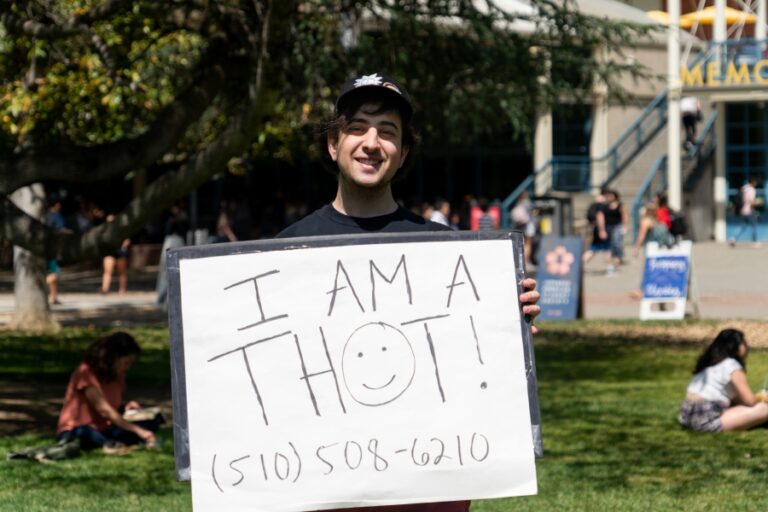
In a now-viral tweet from the first day of Spring Quarter, a short video clip recorded at the Memorial Union shows a woman holding a sign reading, “Hell is hot, don’t be a thot,” and a student next to her with his own sign reading, “I am a thot,” along with his phone number. That student is third-year communication major Daniel Rajabi.


Rajabi described the events leading up to his appearance at the MU. He said he was walking to class when he heard a lot of screaming and profanities being thrown around and noticed that one of the organizations tabling close to the woman was a sorority.

“This is what really caught my attention,” Rajabi said. “Not only were they just kind of like ‘Who is this lady?’ but they were looking off to the side, and you could tell that they were a little bit scared and a little bit worried.”

It was in part due to their reaction that Rajabi went to the bookstore and bought a poster to make his own sign, proclaiming that he was, in fact, a thot.

“I thought, you know, [screaming is] really no way to have dialogue, because it’s pretty obvious that [a dialogue] is what everybody wanted,” Rajabi said, “It was just a screaming contest for the sake of a screaming contest.”

Because his handwriting is “really bad,” he asked the members of the sorority who were tabling if anyone had good handwriting and if they’d be willing to write his message for him. They agreed. It was Rajabi’s idea to add his phone number to the bottom, and since the tweet of him went viral, he has been texted over 800 times and called about 50 times from people as far away as New York.

“I actually responded to every single one of them,” Rajabi said. “And I’m still in communication with about 30 or 40 of them, maybe more.”

In addition to this digital communication, people at UC Davis have stopped him and asked if he’s “that guy from Twitter” and if they could take pictures of or with him. But some of these interactions goes beyond his poster declaring that he’s a thot.

“[A couple of them] started opening up to me a little bit about the kinds of stuff they’re dealing with,” Rajabi said. “Not necessarily that level of persecution, but especially the Muslim students, because I am [Muslim] myself, [they tell me] what they may be dealing with and how they were happy that they felt I stood up for people who are getting persecuted in some kind of way, shape or form.”

When Rajabi was at the MU on April 1, he said that students starting cheering, and when the woman with the poster saw him, she took a double take.

“She goes, ‘You’re a thot?’ and just kind of screams it as an accusation,” Rajabi said. “But you know, I clearly had the sign, and I was like, ‘Yes, yes I am.’ She goes, ‘You’re going to hell,’ and I was like, ‘Yes, I am.’”

That day, Rajabi stayed at the MU for about an hour. He said that eventually, she started smiling and lightened up a little. Rajabi says that he thinks that was in part due to the students’ change in attitude as well.

“People eventually began actually talking to her,” Rajabi said. “And nobody’s mind was changed, don’t get me wrong. Nobody was like, ‘Okay, that’s why I’m going to hell’ and she wasn’t like, ‘Okay, I guess you’re not going to hell’ — that was absolutely still the case. But they were calmer, their blood pressure was lower. And it seemed like everybody was at least heard and listened to, you know, just not convinced, though.”

He described his experience with the woman as “pretty fun.” He has seen her since, and they know each other’s names and have had a few conversations. He asked her about her strategy and she told him a little bit about her motivation.

“She says, ‘Oh, I know, this is not a good thing to say. And I know it’s a sinful thing for me to do. It’s very hypocritical. However, the reason why I do it is because we’re trying to get as many eyes on us as possible, so that we can then project our image of what we think is right onto them. And then that way, we can potentially catch more people and do more good on the overall,’” Rajabi said. “So they’re thinking big picture.”

On the content of her message, Rajabi evidently disagreed, as over 923,000 people who have viewed the tweet have seen. He adds that he disagrees with her plan, and that it doesn’t seem like it’s going to be very effective in the long run by having people look at her in a negative light.

The responses that he received inspired him to create a club, which he plans to call the Smile More Campaign.

“People are very serious when it comes to discussions about most social justice events, religious events [and] activism events,” Rajabi said. “And what’s lacking is not necessarily […] we’ve got enough people that say, dialogue is missing, and this and that are missing and […] I feel like what’s missing [are] some smiles and laughter and happiness. Just because you’re talking about something rough, doesn’t mean that you have to feel terrible while you’re doing it.”

Rajabi hopes to help the “overall dialogue of negative interactions around and even outside campus” with this club.

“We’re floating around a bunch of ideas,” Rajabi said. “We’re hoping to turn it into something great.”

Written by: Anjini Venugopal — features@theaggie.org

Housing first for LGBTQ youth

LGBT Community Center provides shelter

The Sacramento LGBT Community Center will open a 90-day shelter to help young LGBTQ youths who are homeless or displaced. The shelter is intended to focus on this community’s specific needs.

Krystal Peak, the community engagement and marketing specialist for the Sacramento LGBT Community Center, elaborated on how the center came about.

“We’ve been around roughly since 1984, at least in any sort of organized capacity,” Peak said. “Then we became the Gay and Lesbian Center, and a few years ago, in 2013, we did business as the Sacramento LGBT Community Center. It’s been different names, different iterations.”

Peak added that the Sacramento LGBT Community Center developed its model after many other centers around as well, hoping to bridge gaps and provide more for the LGBTQ community.

“There are multiple LGBT centers around the country and beyond that had really has taken an interest in creating housing for youth and for those in their senior years,” Peak said.  “The New York LGBT center, the LA LGBT center and a few others have either added onto their center space to create housing opportunity space or have found nearby properties to provide that resource usually for low income or assisted living. We’ve seen larger metropolitan areas use this model so that folks are able to find more housing opportunities, especially in the LGBTQ community.”

Councilman Steve Hansen explained how housing became a primary struggle for many members of the LGBTQ community.

“The specific impacts of homelessness on LGBT youth are profound,” Hansen said to The Sacramento Bee. “As youth come out, their families kick them out, and they struggle to figure out where to go. In talking to LGBT youth of color and transgender youth, they are buffeted by multiple layers of prejudice and barriers. This is a way to empower them for a productive and happy life.”

Peak also noted that those in the LGBTQ community often face a lack of familial structure.

“There’s usually unconventional family structures or a lack of family acceptance or family resources, [and] often LGBT centers are able to step in and create a better community structure,” Peak said.

Pixie Pearl, the assistant director of housing for the Sacramento LGBT Center, explained how the center was able to fund for its housing project.

“We actually have a grant through the California government office and emergency services, which is renewable for four years, and the city of Sacramento actually did a match with the support of Councilmember Hansen and Mayor Steinberg, so they matched the funds we got to support and we also have private donors,” Pearl said.

Peak indicated that tackling the housing crisis is crucial.

“In Sacramento, there is such a strong grassroots LGBT community, and what’s been lacking has been hard resources like housing,” Peak said. “Hopefully, if this program proves to be successful, we will be able to expand and offer more resources and really provide that enriching community space that a lot of folks in the area have been hoping for — it’s something we’re really excited to do, we’re really hoping that it becomes a success, and hopefully we can grow it year over year.”

Pearl also noted that there are other programs to help ease the housing transitions for youths. Some of these programs operate with harm reduction and housing first models.

“Right now, we have an up and running program transitional learning program for 18- to 24-year-olds for 18-24 months,” Pearl said. “We also have a STEP program — short term transitional housing program. We’re hoping to get that going end of May, beginning of June. This is a low barrier — if you’re struggling with relationships or addictions, we’re approaching a harm reduction way where we can address those needs and do a housing first model.”

Pearl emphasized the importance of a low barrier program, meaning that most individuals can attain the housing they need.

“I see a lot of things, I see that having a low barrier program is going to be vital,” Pearl said. “Maybe those folks who are struggling with relationships aren’t able to get into housing. While we’re opened to everyone, we do have a focus for LGBT as we know there’s 40% of youths who are facing homelessness, who identify with our community. We hope to give specific services that are trained so that people can be validated with who they are so that they can feel safe.”

Written by: Stella Tran — city@theaggie.org

Administration should establish task force for faith-based input

Recent acts of violence against religious groups prompt urgent need for administrative attention

On April 27, the last day of Passover, Lori Gilbert Kaye was fatally shot after a gunman opened fire on the Chabad of Poway synagogue in Poway, Calif. Gilbert Kaye sacrificed her life in an act of protection of her faith and community, jumping in front of Rabbi Yisroel Goldstein to protect him. In addition to this tragic death, three other members of the synagogue were injured. This attack was undoubtedly fueled by anti-Semitism; the shooter posted a racist and anti-Semitic letter to 8chan, a website for discussion groups and image boards, just before the attack. The Poway synagogue shooting fell on the six-month anniversary of the Pittsburgh synagogue shooting, which claimed 11 lives on Oct. 27.

Faith-based attacks run rampant in the world around us. On Easter Sunday, three Christian churches in Sri Lanka were bombed. On April 23, a man injured eight people in Sunnyvale, Calif. after driving his car into a crowd while targeting a family he presumed to be Muslim. And on March 15, 51 people were killed in the Christchurch mosque shootings in New Zealand. The first half of the calendar year is filled with major holidays for several faiths, and what is usually a time of love and celebration has become a time of fear.

Religious students at UC Davis find themselves in a predicament in the face of these tragedies. In a time of doubt and hopelessness, they are organizing their own vigils and creating their own safe spaces while simultaneously grieving for their communities. From 6 to 7 p.m. on May 1, the evening on which Yom Hashoah (Holocaust Remembrance Day) began, six Jewish student organizations came together to host a vigil for Chabad of Poway on the Quad.

Several universities are just now beginning to see how religious students need support from faculty and staff, and they are implementing changes. On April 30, it was announced that a new law will require professors in the state of Washington to accommodate religious holidays. UC Berkeley recently said it will accommodate those celebrating Ramadan, and Chancellor Gary May recently announced the same for students at UC Davis via a Facebook story.

Even as progress is made, a need remains clear: College students deserve campus resources and support from their administrations to deal with situations that often escape what mere words can describe. The Editorial Board asks the university to recognize that many students, such as those of the Jewish community just days ago, are actively experiencing discrimination and feelings of danger. Knowing how to deal with this subject matter is obviously intensely difficult — but fostering open communication with these communities of faith is the starting point to support these groups. Since May’s investiture as chancellor, task forces have been established on the subjects of housing, food insecurity and mental health. The Editorial Board urges the administration to institute something similar to get feedback from religious students. While the University Religious Council meets five times a year for two hours (in a closed setting), this small time commitment placed on just a handful of religious leaders is not nearly enough to gauge the full scope of the spiritual well-being of the campus community. A task force to dig deep into what it means to be a student of faith (or no faith) at UC Davis is the only way the administration can know the breadth of experiences that form students’ lives.

Written by: The Editorial Board