58.6 F
Davis

Davis, California

Monday, December 22, 2025
Home Blog Page 44

Davis City Council, UC Davis, Yolo County meet to discuss local issues

The organizations discussed increasing affordable housing and building mental health programs for students and community members


By RORY CONLON  — city@theaggie.org


The city of Davis, UC Davis and Yolo County gave updates on campus housing and the Crisis Now program during their Feb. 25 meeting.

Two representatives from each of the three organizations meet annually to discuss issues in the Davis community and progress toward shared goals at the university, city and county level. These meetings build and maintain connections between the university and the surrounding city, according to UC Davis Chancellor Gary May.

“Conversations like the ones we’ll have this evening are a vital part of the effort to ensure our town and gown relationship remains a model for other communities,” May said. “Whether it’s our efforts to combat discrimination [through] the ‘Hate Free Together’ initiative, our partnership in building a more sustainable community or strengthening our transportation partnership, every challenge we face is more manageable when we face it together.”

In September 2018, UC Davis, Yolo County and the city of Davis agreed to a memorandum of understanding (MOU) that informed the school’s Long Range Development Plan (LRDP). Four main goals were identified, according to the LRDP Memorandum of Understanding webpage.

The terms of the MOU include a commitment to build more housing for students as well as a guarantee to house 100 percent of any new student enrollment growth on campus,” the webpage reads. “The MOU also includes the development of joint transportation plans and traffic improvement projects, the elimination of master leases in the City of Davis and the formation of a stronger town-gown partnership through a variety of collaborative activities.”

In 2018, the blended vacancy rate for the city of Davis fell below 1%, leading to a severe shortage of affordable housing for students. However, Lucas Griffith, the UC Davis executive director of campus planning and sustainability, said that the school has exceeded goals for providing more housing to students in 2025.

“In 2025, we built a significant amount of housing or beds on campus,” Griffith said. “The vacancy rate has increased to four percent.”

Griffith said the university has also met its goals for accommodating enrollment growth.

“Since the passage of the LRDP, we have grown enrollment by 2,600 and we have built over 6,000 new beds,” Griffith said. “So, we have provided more beds than our total enrollment growth.”

Aggie Square, a new innovation campus in Sacramento, opens in May of 2025 and is set to house nursing students and medical students. Additionally, a new housing development called the Segundo Infill Housing Project is scheduled to go into construction in spring 2025 and will add 500 beds.

Michael Sheehan, the UC Davis associate vice chancellor for Housing, Dining, Campus Recreation and Divisional Operations, said the rent escalation rate, which measures how much the rent is raised from year to year, has also dropped.

“The other key metric is that escalation rate of 1.6%,” Sheehan said. “It’s levelled off from the previous rate, which was considerably higher — I think it was 8% last year. [It’s] another sign that we’re finally having the impact that we desire on the market.”

When Yolo County Supervisor Lucas Freirichs asked how the university is making housing more affordable for students, Sheehan noted that properties at The Green at West Village and Orchard Park are coming in below market rate.

“We’re actually below market rate in a majority of those spaces at Orchard Park by as much as 11%,” Sheehan said. “Those are public-private partnerships with the non-profit, [Orchard Park]. There are caps for annual escalation, so our gap will continue to grow over time.”

Sheehan pointed to funding and design choices that made lower prices possible.

“[These two properties] were both funded with tax-exempt bond funding because we partnered with a non-profit,” Sheehan said. “We designed them very efficiently with an offsite, panelized system.”

Representatives at the meeting then transitioned into discussing the Crisis Now program. Yolo County Administrative Officer Dirk Brazil introduced the program.

“In the past, most of our emergency response for mental health and substance abuse emergencies have been siloed, whether it’s police, fire, what have you,” Brazil said. “This in front of you now is a combined effort to get out of those silos and move in a more coordinated fashion.”

Brazil said two components of Crisis Now, the 24/7 Access/Crisis High-Tech Call Center and the 24/7 Crisis Response and Co-Responders, have been put into place. The third component, a Receiving/Sobering Center, has still not been completed.

Of the $3 million needed to build the center, $850,000 will come out of federal funds earmarked by Congressman Mike Thompson. City Manager Mike Webb said the rest of the money will be supplied by the cities of Davis, Woodland and West Sacramento.

“Davis’ contribution for that, in terms of one-time dollars, is about $900,000 total,” Webb said. “I won’t speak to the status of Woodland or West Sacramento, but they’re going through a similar exercise.”

The meeting was opened up to public comment on the issue of Crisis Now.

Kimberly Mitchell, a Davis resident, submitted a policy brief with recommendations for how to improve the program. Her first recommendation was to expand the hours and availability of co-responders.

“We have mental health clinicians that respond with the city of Davis police department and other public safety agencies,” Mitchell said. “They work normal business hours, nine to five. Still, who’s responding to mental health emergency calls at night or on the weekends is the police department. We need to expand [the availability of clinicians], and we need to have clinicians responding to mental health throughout the county, including at UC Davis.”

Mitchell also made two other recommendations.

“The second [recommendation] is that crisis intervention training needs to be extended to all first responders, not just police — so that includes dispatch, fire and [emergency medical services],” Mitchell said. “The third recommendation is that we need to work towards having a crisis stabilization unit in Yolo County. A crisis stabilization unit is a level above a mental health receiving center — a crisis stabilization unit is a [psychoeducational center] and it’s able to take all levels of psych patients.”

Mayor Bapu Vaitla supported Mitchell’s recommendations. He asked Jenny Tan, the city of Davis Director of Community Engagement, to forward Mitchell’s policy brief to the city’s county and University of California partners.

Vice Mayor Donna Neville supported the construction of the Receiving/Sobering Center as an alternative to those in a mental health crisis going to the ER.

“You want to be in a place that’s safe, where there’s trauma-informed care, where you will get care from people who are specially equipped to help you,” Neville said. “That is why the Receiving Center is so important for medical reasons and psychological reasons. It’s also fiscally a better approach than taking people to the ER, which has its own suite of expenses.”

Neville, who serves on the Yolo County division of the National Alliance on Mental Illness, said that 75% of all mental illnesses emerge by the age of 25.

“There’s a critical period in life [of the three years] until you reach 25 when mental illnesses emerge,” Neville said. “It’s so important to have good preventative care, response care and clinical care during those periods.”

Neville invited UC Davis to collaborate with the city in efforts to address mental health. Clare Shinnerl, the vice chancellor of UC Davis Finance, Operations and Administration, said the university has met with the interim fire chief to learn more about city programs.

“One of the next steps we’ve decided is to try to create a gap analysis, like, ‘What are we doing?’ versus ‘What are you doing?’” Shinnerl said. “We [also] run a Health 34 program 24/7 for our students.”

Councilmember Gloria Partida thanked the university for its support.

“I’m glad to hear that the university is helping us with housing students and in a number of other ways, including mental health,” Partida said. “I think we as a community feel a responsibility to the young people that are part of our city for four years, five years, however long they’re here. If we can work together, it is something that will benefit all of us and our future.”


Written By: Rory Conlon — city@theaggie.org

 

A tale as old as time

Have all of the stories already been told?


By MOLLY THOMPSON – mmtthompson@ucdavis.edu


On the surface, our modern media landscape might seem like it’s full of new ideas and fresh stories. But in reality, we’re essentially rehashing the same classic themes time and time again, with the occasional twist.

There’s a theory in the world of literature initially coined by Melanie Anne Philips and Chris Huntley, which posits that there are only seven basic plots all stories can be traced back to. Essentially, every story is based on the same set of frameworks. Whether or not it’s actually true is arguable; In a way, these frameworks are sort of analogous to horoscopes or personality tests — if you look hard enough, you can probably find what you’re looking for. But, for the sake of the theory, here are the basic plots.

The first is titled “Overcoming the Monster,” where the hero must brave the lair of an anti-hero that’s threatening them and their community, defeat it and return victorious. Examples include everything from the classic “Beowulf” (the story of a hero who vanquishes the monster Grendle) to “Harry Potter and the Sorcerer’s Stone” (in which Harry overcomes the malicious Lord Voldemort).

The second, “Rags to Riches,entails a down-on-their-luck protagonist overcoming the odds and reaching their full potential of greatness, in one way or another. The obvious example of this is the ever-present “Cinderella” (which tells the story of a downtrodden maiden who rises to fame and fortune when she falls in love and marries a prince), but it can also be found in many other stories. This one is especially common in fairy tales — “The Frog Prince” (in which a prince is cursed to remain as a frog until a good princess truly accepts him) is another good example and extends to the Disney movie based on the tale, “The Princess and the Frog,” as well.

Next on the list, “The Quest” tells of a hero who sets out on an obstacle-ridden journey to reach a great prize. Classically, “The Odyssey” (Odysseus’ journey home after the Trojan War) is the poster child of this trope. However, modern examples can even include “Finding Nemo” (a fish’s journey to bring his captured son home).

Fourth is “The Voyage and the Return,” where a hero enters an unfamiliar and often enchanting new world that becomes threatening, to the point that the hero must escape and return to the safety of their home. “Alice in Wonderland” (the story of a young girl who falls into a magical realm that she must figure out how to escape from) showcases this, as does “The Wizard of Oz” (also the story of a young girl who falls into a magical realm that she must figure out how to escape from).

The next trope is “Comedy,” which describes the tale of a community divided by the lack of self-awareness and selfishness, who eventually become united by love and the discovery of common ground. Shakespeare’s popular play “A Midsummer Night’s Dream” (the story of four Athenians running away to the forest and falling into a love triangle and other shenanigans) is a comedy, as is the 2001 film “Bridget Jones’s Diary” (the story of a girl whose life upends when she becomes the center of a love triangle).

Fittingly, “Tragedy” is the subsequent plot framework. In a tragedy, the protagonist commits a fatal error and ends up falling from grace. Romeo and Juliet (two star-crossed lovers who end up dying as a result of their inability to live without each other, along with plenty of miscommunication) is a quintessential example of the tragedy trope. The play “A Streetcar Named Desire” (about a woman who loses her grip on reality as she’s unable to get what she most desires) is also a good example.

Finally, the seventh plot is “Rebirth.” In one of these stories, the anti-hero holds the hero hostage until they can be freed by the living act of another character. The ancient Greek story of Eros and Psyche (in which the goddess Aphrodite curses Psyche to fall in love with an unworthy man, but she ends up falling for Eros, who’s invisible the whole time) is exemplary of this trope. The classic tale of “Beauty and the Beast” (in which Belle is trapped by the Beast, until she eventually falls in love with him and breaks his curse, allowing him to return to his human form) also follows the rebirth pattern.

Naturally, these tropes build on each other over time. “Cinderella” might be an example of the “Rags to Riches” trope, but it also provides its own base for future stories. Many films (ie. “Ella Enchanted” or “A Cinderella Story”) are spin-offs of “Cinderella” which is itself a spin-off of the “Rags to Riches” story. Books like Marissa Meyer’s “Cinder” also retell the classic story with a modern twist, but at its core, it uses the same basic framework.

These stories prevail for a reason; They’re widely applicable and broad enough to encompass a variety of situations that carry mass appeal but are still human enough to be timeless. The same set of core structures, while they have their similarities, are still decorated in different ways so that they don’t become tired. That’s the beauty of it; it’s a cycle of inspiration and innovation.

There’s more to the story though. Even the original authors of the theory point out two more plots that they don’t emphasize because of how rare they are, though they do exist. The retelling of common themes permeates deep into our canons of ancient and modern literature and, as time goes on and art develops the throughlines, they become ever more intrinsic. Every story owes its weight to those that came before it, not just to its creator. In this way, the whole world of literature is as ancient as humanity itself — quite literally a tale as old as time.


Written by: Molly Thompson — mmtthompson@ucdavis.edu 


Disclaimer: The views and opinions expressed by individual columnists belong to the columnists alone and do not necessarily indicate the views and opinions held by The California Aggie

ASUCD holds budget hearings for 2025-26 school year amid projected deficit

The ASUCD is facing a roughly $200,000 difference between expected income and expenses

By VINCE BASADA — campus@theaggie.org


The ASUCD entered several days of budget hearings from March 6 to 9, ultimately approving cuts to several units and committees but not completely bridging the gap between projected incomes and expenses.

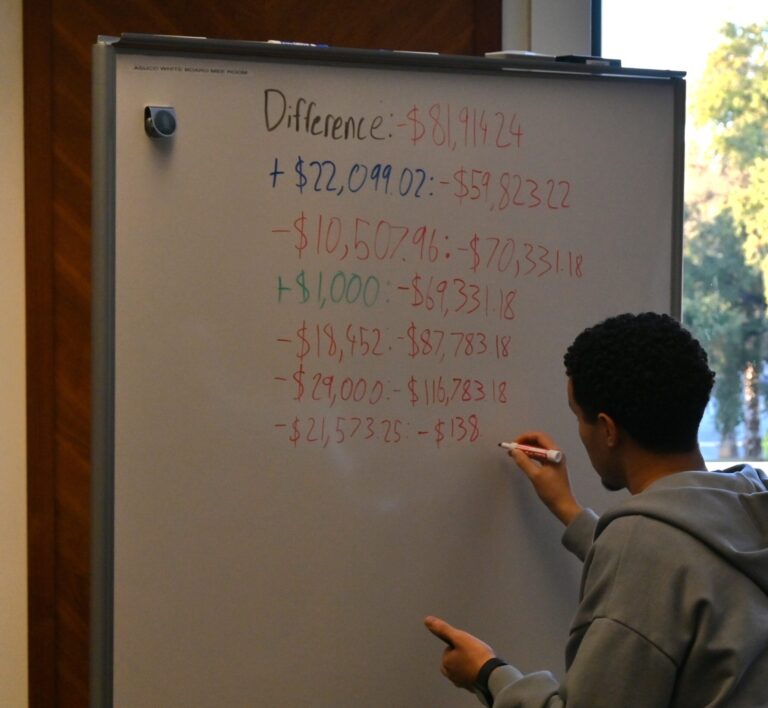
As of time of publication, ASUCD’s projected income for the 2025-26 academic year (AY) is $18,162,968, with an extra $5,639,078 expected from student fees. Total projected expenses, including salaries and wages, is $24,003,878. The result is a difference of $201,832. 

The difference at the end of the first day of budget hearings was roughly $164,000, meaning that it had increased by some $37,000 by March 9.


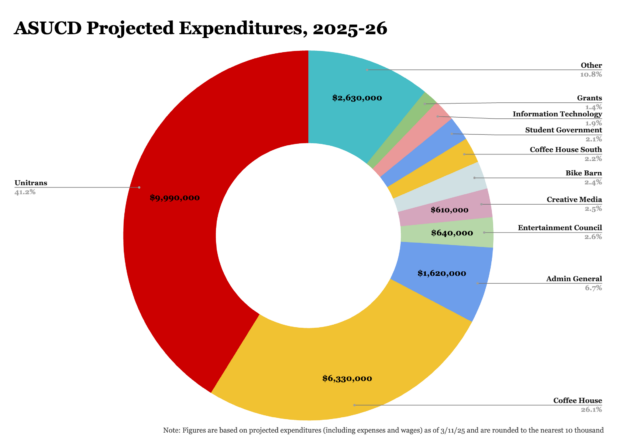
An interactive pie chart of projected expenditures for AY 2025-2026 made by The California Aggie here

Editor’s Note: This pie chart is taken from the currently approved unit expenditures, the final numbers present are not the final data provided by ASUCD. Numbers are subject to update and change pending budget finalization. 


The proposed budget presented by ASUCD President Gaius Ilupeju, who also serves as the ASUCD’s chief executive officer, included several austerity measures. One reason for the cuts was a decrease in allocation from student services to the ASUCD, resulting in a tighter budget going into the next year, according to ASUCD Controller Mostafa Rasheed.

Other justifications cited during the hearings included lower-than-expected profits from the Coffee House and Unitrans, low advertising revenues from The California Aggie — which is managed independently from the student government but relies on student funds — and other reductions in income streams.

Cuts made include the elimination of the Planet Her Committee, responsible for planning the female empowerment event first held in 2023, and the Aggie Mentors Committee. Expenses for the PRIDE unit were also reduced, now down to $12,500 from $20,250 in academic year 2024-25.

Unit directors and committee chairs from Picnic Day to The Pantry advocated throughout the several days of hearings for budgets they believed would best suit the needs of their organization, to varying levels of success. The amendments and changes to the proposed budget are administered by the 12 voting student senators, alongside the International and Transfer Student Representatives, as per the ASUCD Constitution. Budgets for each ASUCD unit and committee are ultimately determined by these student officers, with some exceptions for certain independent units.

ASUCD acts as both an employer of and the governing body for the undergraduate student population, with roughly 1,000 employees across its ranks. The highest budgeted units for the upcoming school year are Unitrans (allotted $9.9 million), the Coffee House (CoHo) ($6.3 million), ASUCD’s General Administration ($1.6 million) and the Entertainment Council ($640,000).

Current projected expenditure for Student Government is $516,884, plus an extra $90,000 allotted to the Senate Reserves. Additionally, the Executive Branch, including the offices of the President and Internal Vice President, is budgeted $118,000.

One measure in the proposed budget that was controversial amongst the table was the elimination of pay for students serving as members on student government committees (e.g. Undocuscholars Advocacy and Aid, STEM, Aggie Arts).

Discussion in favor of committee members’ pay was led by Internal Affairs Commission Chair Amanda Clark, Senate Pro Tempore Dhilena Wickramasinghe and Senator Amrita Julka, among others. 

“As one of the two people [in the Senate] who actually has been in a committee, [committee members] do so much more work than most of the people on the [Senate] table right now,” Wickramasinghe said. “[For] people in commissions and committees, there’s so much more work than the three hours that they’re being allocated for”.

Committee member pay was ultimately secured, with a comment from Ilupeju that sacrifices would have to be made elsewhere to offset the change.

Concerns were also raised over the instability and lack of grants, given the current presidential administration, provided to ASUCD for events and other programs — especially those designed for women and people of color.

“There are less grants available in order to put on all these events,” Gender and Sexuality Commission (GASC) Chair Tristen Dillard said. “We need Senate support.”

There were new budget items in this year’s budget, including funding for the newly created Vital Emergency Shelter and Transitional Assistance (VESTA) sub-unit, tasked with managing a new transitional housing shelter at Russell Park in association with Aggie House. VESTA, part of the Housing Advising for Undergraduate Students unit, was allocated $51,842 for staff. The budget also allocates $80,000 for rental of the new Russell Park facility.

The prospective budget was released two days before budget hearings on March 4, three days later than required by ASUCD bylaws — as noted by several unit directors and senators throughout the meetings. In an email to ASUCD leaders, Rasheed, the ASUCD’s chief financial officer, apologized for the delay and attributed it to “significant accounting challenges.”

Budget hearings have typically been held in the last weeks of spring quarter but were moved up earlier this year to comply with university policy. Parts of the budget will likely be reviewed and reopened through the end of the year, including approval of the budgets of KDVS and The California Aggie. Both units were sent back to the Campus Media Board, the university’s independent governing body responsible for administration of those units, for further changes.

“There is still a possibility of fixing the [ASUCD] budget if needed in spring quarter as this was a very early proposal,” Rasheed said in a statement to The Aggie. “We will see as the quarter progresses.”

The final budget will be formally adopted during the first Senate meeting in fall quarter 2025 as part of Senate Bill #1. The ASUCD budget for the AY 2024-25 can be found on the ASUCD website


Written by: Vince Basadacampus@theaggie.org

The successful, the worthless and the artificially intelligent

Exploring how society perpetuates the manifestations of its own fears about AI 


By VIOLET ZANZOT— vmzanzot@ucdavis.edu


Artificial Intelligence (AI) — it does your homework, makes your workouts and explains whether you should “text them back” or not. It feels limitless, and if you do happen upon what feels like a limit, you can tell it to do it better, to be more succinct, more accurate, more precise — to sound more human. 

In fact, AI is better than a human; It has all the answers, and you don’t have to worry about ChatGPT’s feelings.   

Today, I am not here to talk about AI in an operational sense. To be perfectly candid, I can only use a computer for exactly what one would use a DVD player, a piece of paper or a book of facts. That is to say, my personal knowledge and interest in technology do not extend further than watching television shows and movies, writing, reading and looking random things up. 

I would much rather discuss the “people” side of AI and the conversation surrounding the integration of this way of knowing into our society, specifically in the world of education. Why are educators so afraid of AI? Is it, perhaps, not the fault of the student or the technology? Does the real fear manifest as a result of the very people who create it? 

I think yes. The reason we should be wary of AI is not because students could use it as a crutch but because they could use it as a wheelchair. More importantly, we should be cautious that the reason students may rely on this support is not because they are lazy, but because there is an increasing pressure for success. 

“By whatever means necessary” — that is the mantra instilled in today’s anxious world. While that may not be the vocabulary used by educators, the expectations within education emphasize quantity over quality: quantity of correct answers, rather than quality of correctness. 

The two concerns with AI I find to be most demonstrative of this point are the fears about cheating and the loss of critical thinking skills — of course, these go hand in hand. Academic dishonesty operates in ever new and exciting ways in the wake of the AI revolution. Because of the way AI is able to answer questions and reproduce language, no field of study can avoid the potential replacement of student work by AI-generated content.

The phobia of forgery, plagiarism and inauthentic work has greater implications that all point to a fear of “cognitive offloading.” Cognitive offloading is the idea that AI will replace critical thinking. Despite the benefits of AI increasing efficiency and accessibility, is it worth it if we lose cognitive skills in the process?

I think that question is derived not from problems with AI, but from the foundational structure of success that exists in our social system, which is, more importantly, built into our schools. From the very beginning, we are taught the ABCs. We are taught grades. We are taught success. We are taught failure. 

I like how Gustav Ichheiser phrases this concept — he describes the notion that “the norms of success in our society require that those individuals [who] ‘ought’ to attain success are competent and worthy, and, to formulate it negatively, the incompetent and unworthy should be denied success.” He details the American system of success, which forces a need for either accuracy or failure. 

When you incorporate a tool that can help create accuracy and precision into a society that finds worthiness in those who can be accurate and precise and awards them with success, are we not bound to abuse this system for the sake of getting ahead, especially considering that  “ahead” is where we find value? 

I am not here to argue about the wonders of AI. Not to say that there aren’t any, but it certainly is not my wheelhouse, nor do I find it to be deeply captivating. It is important to me, and hopefully to you, that we recognize the “dangers” of AI may be more about our confrontation with our own society’s perception of worth and success rather than a fear about its technological capacity. Perhaps we should worry less about the ways in which people can manipulate technology for personal gain and more about why people feel it is necessary to do so to begin with.  


Written by: Violet Zanzot— vmzanzot@ucdavis.edu


Disclaimer: The views and opinions expressed by individual columnists belong to the columnists alone and do not necessarily indicate the views and opinions held by The California Aggie.

ASUCD Senate increases student pay at Nov. 26 meeting

Senate Bill #22 unanimously passed, leading to a $1 per hour pay raise to most ASUCD employees


By VINCE BASADA — campus@theaggie.org


ASUCD Internal Vice President Aaminah Mohammad called the Nov. 26 senate meeting, held over Zoom, to order at 6:10 p.m. She then read the UC Davis Land Acknowledgement.

With several senators absent due to prior commitments and other difficulties joining the Zoom, the table moved to pass the consent calendar of legislation while a quorum was present.

Senate Bill (SB) #20, allocating $90 to the Office of Senator Sabah Nabiha for a transfer student event, and SB#21, implementing accessibility requirements for ASUCD websites and social media pages, both passed unanimously.

The table also approved a resolution to urge the US Forest Service to enact the National Old-Growth Amendment, protecting old-growth trees from logging and commercial exchange without issue.

Continuing legislative discussion, the senate unanimously passed SB#22, increasing the hourly wages of most ASUCD workers by 50 cents. It allocates $151,844.12 for the wage increases for the upcoming winter and spring quarters, to take effect in January 2025.

Alongside a previous budget allocation, the passing of SB#22 means that the majority of ASUCD workers will experience a $1/hour raise starting in 2025.

Senator Max Gouvalaris stated a concern after the bill’s passing that the focus of the senate had been on worker retention and not on worker appreciation.

“I think the vast majority of the discussion [over SB#22] was extremely misplaced,” Gouvalaris said. “We are here to support our workers. I’m incredibly alarmed by the tone-deaf nature of [the] dialogue on this bill.”

ASUCD President Gaius Ilupjeu reassured him that the bill’s focus on retention was done to take advantage of university policies that allow ASUCD to increase wages in order to keep workers and express appreciation of the work of all student employees.

“This [raise] is not something we had to do, but we felt that we had to,” Ilupeju said. “Our underlying intention is always to do right for our workers.”

Ilupeju also said he had tried to push through a $2 to $3 wage raise, but was limited by University of California policy.

The senate also passed SB#15 to update personnel bylaws to match current internal practices.

Quarterly reports from the Aggie Reuse Store, the Aggie Arts Committee and the Campus Center for the Environment were reviewed by the table before completing ex-officio and elected officer reports.

The meeting was adjourned at 7:32 p.m.


Written by: Vince Basadacampus@theaggie.org

Michael Hernandez brings ‘Latinx Storytellers’ to Mondavi Center

UC Davis Department of Music presents their annual Concert Bands series


By ELIZABETH BUNT — arts@theaggie.org


On Wednesday, March 5, the Mondavi Center hosted saxophonist Michael Hernandez as a featured soloist alongside the UC Davis Concert Band and Campus Band, directed by Pete Nowlen and Garrett Rigsby respectively.

Led by Hernandez, the bands played a selection of eight pieces, each from different composers. The highlight of the program was the penultimate composition, “Eyes to Look Otherwise” by Juan Sebastián Cardona Ospina, which was both dedicated to and commissioned by Hernandez. This concerto was inspired by a painting, “The Song of Creation” by San Francisco-based artist Tino Rodriguez.

Currently based in the Bay Area, Hernandez has been described as one of the finest soprano saxophone artists of the present generation. He has been heard in concert halls throughout Germany, Switzerland, Poland, France, Holland, Austria, Italy, the United Kingdom, Canada and the United States.

Hernandez has also held residencies at dozens of music festivals, including Bravo! Vail Valley Music Festival, Hot Springs Music Festival, National Music Festival, Music in the Mountains, Taneycomo Festival Orchestra and the Festival of New American Music. When he isn’t touring, Hernandez is a music professor at San José State University and is the principal saxophonist for the Santa Cruz Symphony.

Hernandez’s most recent project — which made an appearance at the Mondavi Center concert — is entitled “Latinx Storytellers.” This is a multi–sensory performance described as part concert, part installation and part gallery that focuses on the voices of Latinx artists, their art and the stories of the artists who inspire them.

The program tackles topics such as U.S.-Mexico border relations, sex trafficking, LGBTQ+ rights, the HIV/AIDS epidemic, xenophobia and climate change, as well as the concept of artistic inspiration and what it means in today’s society. In compiling these compositions, Hernandez has collaborated with prominent Latinx composers to try to capture all of the facets of storytelling through combinations of music, spoken word, film and other artwork.

​​“In storytelling, the listener imagines the story [and] creates the vivid, multi-sensory images, actions, characters and events — the reality — of the story in his or her mind, based on the performance by the teller and on the listener’s own past experiences,” Hernandez said. “The completed story happens in the mind of the listener, a unique and personalized individual. The listener becomes, therefore, a co-creator of the story as experienced.”

Hernandez plans to perform the “Latinx Storytellers” project at several more universities this spring. If UC Davis students missed the Mondavi Center performance and would like to see Hernandez in action, he is scheduled for a number of performances in San José in the upcoming months. The locations and dates for these shows can be found on the Michael Hernandez website. 


Written by: Elizabeth Bunt — arts@theaggie.org 


Aggies prevail in hard-fought battle against University of Hawaiʻi at Mānoa on Senior Night

UC Davis women’s basketball secures the last home game of the season, winning 74-66


By COLINA HARVEY — sports@theaggie.org


On March 1, the UC Davis women’s basketball team took on the University of Hawaiʻi at Mānoa Rainbow Wahine. As it was their final home game of the season, the game was deemed Senior Night, honoring the team’s graduating fourth-year players.

The Rainbow Wahine have been putting on impressive performances this season, making them a competitive matchup for the UC Davis Aggies. Up until Feb. 27, when they were beaten by UC Riverside, the Rainbow Wahine were on a 14-game winning streak, including a win against the Aggies on Jan. 23.

However, the Aggies have also had a lot of success this season, taking many victories and even going on an eight-game winning streak.

The Aggies got off to a shaky start as the game began, and despite the effort, the players struggled to score. For nearly five minutes, the Aggies remained scoreless while Hawaiʻi racked up 10 quick points.

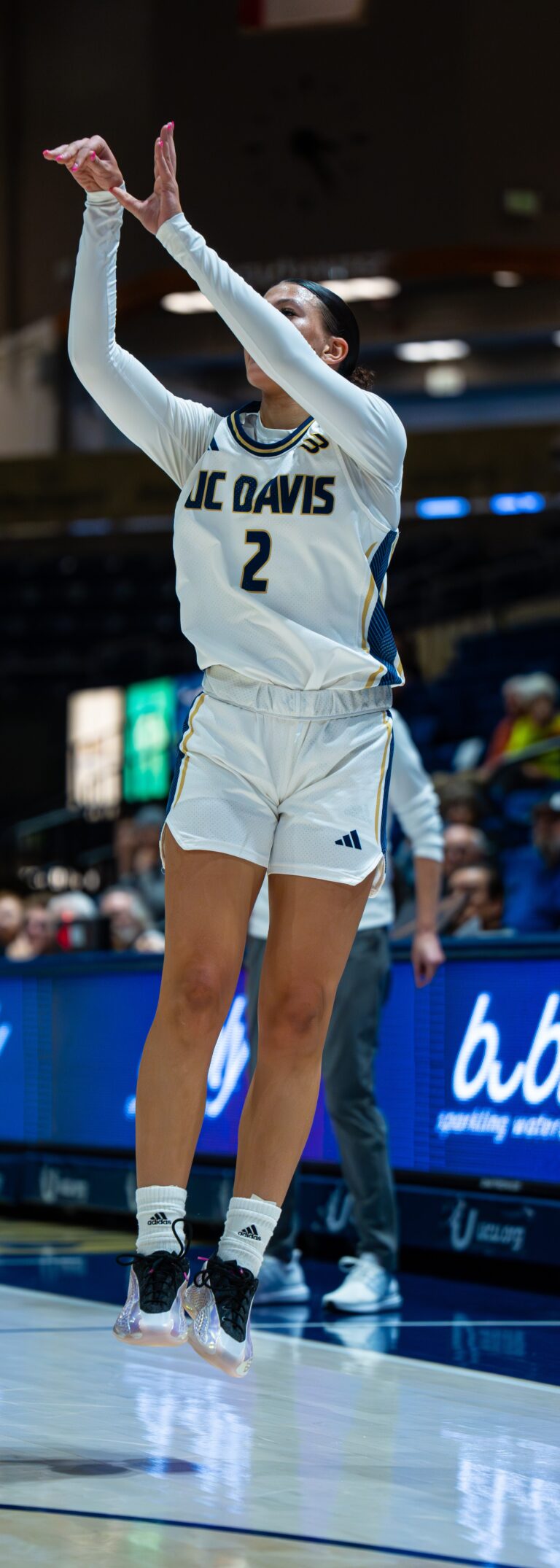
Nya Epps, a third-year undeclared major and guard, finally ended the scoring drought with a three-pointer. Another three-pointer from first-year Ryann Bennett put the Aggies right back in the game. Even though the Aggies failed to net many of their shots in the first quarter, they showed good off-ball hustle and movement.

On Hawaiʻi’s last possession of the first quarter, the Aggies played strong defense and ran out the Rainbow Wahine’s shot clock. This defensive performance allowed the Aggies to only trail by two going into the break.

In the second quarter, a three-pointer followed by a layup by Avery Sussex, a first-year undeclared major and guard, took the Aggies to their first lead of the game. The two teams traded points for a while with the score staying very even. However, for nearly six minutes in the quarter, the Aggies failed to make a single basket. This allowed Hawaiʻi to make a nine-point run and lead by 10 at halftime.

Going into the second half, the Aggies were determined to close the point deficit. Right out of the gate, Megan Norris, a fourth-year political science major and center, netted a three-pointer from the corner of the court. A pair of layups from Epps left the Aggies just three points behind Hawaiʻi.

Sydney Burns, a fourth-year international agriculture development major and guard, began to heat up in the third quarter, as a steal followed by a layup on the other end of the court tied the game. Burns made a mid-range jumper on the next play, allowing the Aggies to gain the lead.

The crowd’s excitement grew when Norris made a three-pointer, putting the Aggies ahead by five points. UC Davis’ momentum grew in the third quarter, as the crowd became more and more engaged. However, the Rainbow Wahine managed to come back, turning the deficit against the Aggies by 10 points.

Tova Sabel, a fourth-year psychology major and guard, and Burns were the stars of the fourth quarter, both making clutch plays. Sabel shined early with a steal and seven points in the first six minutes of the quarter.

Then, Burns took over the court for crunch time. With three minutes to go, Burns stole a Hawaiʻi inbound and hurled it down the court to Epps for a game-tying score. She then went on to bank in a two-pointer and tip a crucial rebound to Norris.

With the game tied at 60-60, Hawaiʻi fouled Epps on a layup, and she made the free throw. Hawaiʻi fought back with a two-pointer on the other end.

Then, Sabel made a three-pointer as the shot clock ran down, increasing the lead to four points for the Aggies with less than one minute to go. In the last 30 seconds, Burns was fouled. The Aggies narrowly held their lead, thus making these free throws crucial. Burns made both, effectively winning the game for the Aggies. The game ended with a score of 74-66.

Beating the No. 1 seed in the Big West Conference on Senior Night was a triumph for the Aggies. In addition to Burns and Sabel, Mazatlan Harris, a fourth-year animal science major and forward, and Bria Shine, a fourth-year neurobiology, physiology and behavior major and guard, were also honored as graduating players. The women’s basketball team will have two more games in the regular season and will then head to Henderson, Nevada on March 12 for the Big West Conference Championships.


Written by: Colina Harvey — sports@theaggie.org

Object Permanence 101: Hiding a problem does not make it disappear

How state and local efforts to forcibly remove encampments and enforce Proposition 36 fail our unhoused communities


By TARA ROMERO— tcrome@ucdavis.edu


On July 26, 2024, California Governor Gavin Newsom enacted Executive Order N-1-24, which allows and encourages local law enforcement to forcibly evict unhoused people from their encampments.

“It is imperative to act with urgency to address dangerous encampments, which subject unsheltered individuals living in them to extreme weather, fires, predatory and criminal activity, and widespread substance use, harming their health, safety, and well-being,” the executive order reads.

Newsom is quick to blame the “dangerous encampments.” Yet, all of the problems that he lists are not limited solely to encampments. As a result of limited resources and government aid, unhoused people are more vulnerable to extreme weather, fires, sexual and physical violence and the effects of addiction. Encampments are not to blame for California’s continuous neglect of unhoused people’s basic needs and human rights: What is to blame is state and local governments’ failure to properly allocate funding and resources to provide adequate food and shelter to our most vulnerable population.

Encampments can actually be a place for community among unhoused people who don’t have access to shelters. While homeless shelters do put in a lot of work to provide temporary housing to the unhoused community, many shelters have limited beds along with restrictions against people who have been incarcerated or those who use drugs.

In spite of this, Newsom is cracking down on encampments. In opposition to Newsom’s order, Ann Oliva, chief executive officer of the National Alliance to End Homelessness, responded with her own statement:

“The evidence is actually very clear: forced encampment evictions are ineffective, expensive, and non-strategic,” Olivia said in a press release.

A Research and Development (RAND) study in 2023 also revealed how encampment removal temporarily lowers the unhoused population in a given area for roughly two to three months but has no long-term effects. In August, The Associated Press released a video of Newsom himself cleaning up a Los Angeles encampment.

“I want to see results,” Newsom said in the video. “I don’t want to read about them. I don’t want to see the data. I want to see [change].”

Newsom claims he wants to see results, but the truth is that he simply does not want to see unhoused people. The act of removing encampments does not actually solve the problem, it only moves unhoused people out of the public sight. In other words, Newsom does not care whether unhoused people actually get off the streets — he cares that it looks as if they did.

On Feb. 24, 2025, Newsom announced that he would begin holding local governments accountable for their use of state funding for the homeless — by threatening to withhold funding to increase pressure on local officials to remove encampments.

Now, mayors across the state, from San José to Los Angeles, are pushing back against Newsom’s encampment enforcements. Matt Mahan, the mayor of San José, argued that “clearing encampments only works if we have places for people to go” and said that “every city must have equal resolve in expanding shelter and in-patient treatment beds.”

As of late, the city of Davis has been fairly quiet about their stance on Newsom’s orders. However, Davis’ official protocol is to first send the city’s Homeless Outreach Team to engage with an encampment in order to offer services, then to partner with Davis Police for crisis assessment and lastly to have the Davis Police “maintain public order and enforce the law” — meaning the forced removal of an encampment.

Despite being labelled as a “progressive college town,” there is a lot of local anti-homeless sentiment among the Davis Police Department and certain small business owners in the Downtown Davis Business Association (DDBA).

In a February 2025 article from the The Davis Enterprise, Davis Police Chief Todd Henry provided a statement.

“There’s this general sense of it not being safe, especially during nighttime hours,” Henry said. “If they qualify for [Proposition] 36, we’re definitely using the law.”

Here, Henry points to unhoused people as the reason for this unsafe atmosphere.

Prop. 36 was passed this last election cycle, turning petty theft and drug usage back into a felony. These two statements imply that the Davis police are intentionally targeting unhoused people with their enforcement of this law.

DDBA President Kevin Wan explained how the DDBA wants to “[tackle] the challenges of crime and homelessness” because “our very livelihoods depend on an attractive and safe downtown.”

“Downtown safety and cleanliness are two of the biggest priorities for me and the DDBA in general,” DDBA Executive Director Brett Lee said.

Both of these appear to be unassuming statements at first glance, but it’s important to remember whose “safety and cleanliness” they are talking about. When they say “safety,” they mean the average Davis resident; They do not mean the unhoused population who are more vulnerable to violence, weather and displacement than anyone else in town.

Similarly to Newsom, Wan and Lee’s priorities are not to actually provide support to our most vulnerable population. They would rather the town appear “attractive and safe” than encourage the local government to make it safe for unhoused people.

Davis’ use of law enforcement against the unhoused population, alongside Newsom’s push to evict encampments, violates our most vulnerable community’s basic human rights.

Genuinely, I believe Newsom is a lost cause. No matter how many experts tell him that removing encampments is not the solution, he will stand firm. This is why I encourage you all to speak up to our local government in solidarity with our unhoused community in Davis. Tearing apart encampments and criminalizing homelessness is not the solution. I encourage Mayor Bapu Vaitla to stand with the San José and Los Angeles mayors against Newsom’s N-1-24 ordinance and to prioritize providing every unhoused person, including those who have been previously incarcerated and are current drug users, with shelter. We cannot let our own Davis community members be removed or incarcerated just to make the town “look good.”


Written by: Tara Romero— tcrome@ucdavis.edu

Disclaimer: The views and opinions expressed by individual columnists belong to the columnists alone and do not necessarily indicate the views and opinions held by The California Aggie.

The mysteries of self-interacting dark matter and why it matters

Guest speaker Jackson O’Donnell from UC Santa Cruz shares the ongoing research on dark matter studies


By EKATERINA MEDVEDEVA — science@theaggie.org

You, me and everything that we are used to seeing around us is made up of matter. So is the gas and celestial bodies in outer space, like stars; In fact, we are partly made up of “star stuff” as a result of the long processes of star life cycles and the formation of the universe as we know it.

However, all of this regular matter, also called baryonic matter, that we can “see” (or rather detect directly) makes up only 5% of the content of the universe. A much larger portion — about 27%, according to the European Organization for Nuclear Research (CERN) — consists of so-called dark matter, the nature of which is still mostly shrouded in mystery. Unlike baryonic matter, dark matter does not emit electromagnetic radiation.

“Researchers have been able to infer [its] existence […] only from the gravitational effect it seems to have on visible matter,” the study reads.

While the standard cosmological model (also known as ΛCDM) that postulates the existence of cold dark matter (CDM) has been successful in making predictions about our universe on large scales, there remains a lot of discrepancies on the small scale level. This has spurred additional extensions of dark matter studies that consider different variations on its properties.

In late February, a guest speaker from UC Santa Cruz — Jackson O’Donnell, who is a physics Ph.D. student — gave a talk at a UC Davis cosmology seminar about ongoing work in self-interacting dark matter (SIDM) research.

“In ΛCDM, we say that cold dark matter is an ideal gas,” O’Donnell said. “So if [it is made up of] particles, those particles just fly by each other and they only interact through gravity. With the self-interacting dark matter, [we are] saying that if two dark matter particles fly close enough to each other, they can bounce off of each other. So, the large scale structure of the universe stays exactly the same, because in most of the universe the dark matter is thin enough that [its particles] are never going to interact with each other anyway. [Instead, SIDM] really [shows effects] inside of Halos of dark matter, where there’s enough of it [for them] to possibly bounce off of each other.”

One of the things that the ΛCDM model fails to explain, which SIDM can make up for, is the existence of supermassive black holes very early on in the universe. These have been confirmed by observations from several telescopes, including the James Webb Space Telescope (JWST). This problem is aggravated by the fact that intermediate-mass black holes are scarcely observed in the universe, which creates a gap in our knowledge regarding how lightweight black holes (which are relatively well-studied) and how supermassive black holes form.

A study led by M. Grant Roberts, a doctoral student at UC Santa Cruz, explored “the possibility that a fraction of the cosmological dark matter could be ultra-strongly self-interacting, [which] would imply that gravothermal collapse [occurred] at early times in the cores of dark matter halos, followed by accretion,” resulting in formation of supermassive black holes.

“The dark matter self-interaction is a necessary component because the dark matter particles need a way to scatter off one another, much stronger than just gravitational interactions,” Roberts said. “This scatter causes the dark matter to bunch up in the very inner central regions of the galaxy, which allows them to collapse into supermassive black hole seeds.”

While this study considers SIDM on dwarf galaxy scales, on the other side of the spectrum, O’Donnell’s talk at UC Davis primarily was concerned about constraints on dark matter self-interaction in galaxy clusters. The quantity of interest that is constrained is the cross section of self-interaction, measured in centimeters squared per gram, which in simple terms describes how close the dark matter particles have to be to interact with each other.

“The current constraints are very different on these small scales and big scales, [which] naively seems inconsistent, but could actually make sense if there is a simple velocity dependence, [where if] dark matter particles are flying by each other slowly, they’re likely to interact and they don’t need to be quite so close to bounce off of each other,” O’Donnell said. “But if they’re moving fast, it could be that they have a lower cross section, [so] they need to almost exactly hit each other to interact.”

For these types of studies, strong gravitational lensing (where light gets bent due to a curvature of spacetime created by a massive object on its path) turns out to be an extremely powerful tool, as it allows researchers to measure the mass enclosed in a particular lensing region, allowing them to learn about the amount of dark matter contained within it.

“We have more [Integral Field Units] (IFU) data, [which is a kind of] spectroscopy where you get spatial and spectral information,” O’Donnell said when describing the future prospect of his work. “My advisor and I had a night of observing on one of the Keck telescopes back in September and we used an instrument called [Keck Cosmic Web Imager] (KCWI), which [UC Davis Department of Physics Professor] Tucker Jones’ group […] helped us out a lot with that. So, we have data on a few more strong lensing galaxy clusters sitting around waiting for us to do a similar analysis on.”

Besides SIDM, there are many other extensions — such as axion dark matter, warm dark matter and others — that offer unique potential explanations for many phenomena in our universe that for now remain unknown, which nevertheless offer an exciting outlook on the future of astrophysics.


Written by: Ekaterina Medvedeva — science@theaggie.org


Davis City Manager Mike Webb accepts position as county administrator of Yolo County

After nearly three decades of working for the city of Davis, Webb will now serve the whole of Yolo County 


By OLIVIA HOKR — city@theaggie.org


On Feb. 21, the city of Davis announced that City Manager Mike Webb accepted a new position as county administrator of Yolo County (CAO).

Webb graduated from UC Davis with a degree in environmental policy analysis and planning and kick-started his career as a planning intern with the city. Since then, he worked his way into the roles of planning technician, assistant planner, associate planner and principal planner.

In 2013, he became the director of community development and sustainability. Webb served as the assistant city manager beginning in 2015, and just two years later, he was appointed city manager and held that position for eight years.

“After being with Davis for nearly three decades, it was certainly a big decision and one that I did not take lightly,” Webb said. “The fact that the role was specifically here in Yolo County was the single largest contributor to my decision to pursue it. I have forged so many partnerships and relationships countywide over the years — the opportunity to serve the broader Yolo community and continue to build upon those partnerships in new ways was one I could not pass up. I am very excited to serve Yolo County in my new capacity as CAO.”

The city manager is the chief executive officer of the city. Their job is to provide administrative direction to various city departments, oversee the management of the city, coordinate the activities of the city’s departments and serve as the city’s primary representative to other government agencies and private organizations. The position of CAO is comparable to a city manager in terms of administrative leadership and executing policies.

Webb described some of the key aspects where the jobs differ.

“The differences are in the scale and scope of those responsibilities,” Webb said. “At the county level, you have a geographic area of over 1,000 square miles compared to about 10 square miles for the city. The services at the county level are more expansive as well. While counties provide a very similar level of government services and infrastructure to the rural areas as cities, counties also deliver a whole suite of additional services and programs county-wide, including health and human services, agriculture, assessor/clerk-recorder/elections, libraries, law and justice, airports, landfill and environmental health, to name a few.”

During Webb’s time as city manager, he accomplished a variety of projects that benefited the community. The city’s press release shared a list with a few of his major achievements.

“[Webb] led the team to oversee the entitlement and development of a multitude of commercial and residential projects,” the press release reads. “[This included] thousands of market rate and dedicated affordable housing units and new neighborhoods, and commercial projects such as DMG Mori, University Research Park and Target, to name just a few.”

Davis’ mayor, vice mayor and councilmembers all expressed admiration and appreciation for Webb’s commitment to the community. Donna Neville, the current vice mayor and city council member for district three, was among those commending Webb’s work.

“Mike Webb has been an exemplary city manager,” Neville said in the press release. “His depth of knowledge, his long history with the City of Davis and his strong but compassionate management style have all served the City well. We will miss him greatly, but [we] look forward to seeing him excel in this new position.”

Josh Chapman, the councilmember representing district five and former mayor, shared similar sentiments.

“City Manager Webb has been a dedicated employee and leader for the City of Davis with resilience and fortitude,” Chapman said in the press release. “We appreciate his years of service and wish him all the best in his new role as County Administrator for Yolo County.”

Kelly Stachowicz has served as assistant city manager since 2015. Effective March 31, Stachowicz will take on the position of interim city manager while the city council searches for a permanent replacement. Webb will begin his new position with the county on March 31, 2025. He shared some final regards to his colleagues and his city.

“While I am very excited about my new role and what I will bring to the Yolo team, I will dearly miss my Davis colleagues, many of whom I have worked with for decades,” Webb said. “Our Davis staff team is truly fantastic, and the community is fortunate to have them working for the good of Davis each and every day. Davis is also fortunate to have a city council who cares deeply for the community and the organization. While I will miss the people dearly, I am not going far, and I look forward to working with them in my new capacity.”


Written by: Olivia Hokr — city@theaggie.org


National parks and park workers are under threat amid recent presidential administration actions

Students and faculty discuss the ramifications of Trump’s recent actions against national parks


By JENEVAH HARRISON — features@theaggie.org


As the busy season for national parks approaches, concerns are rising over the impact of recent government actions on park preservation and management. 

The Trump administration’s decision to cut approximately 1,000 National Park Service employees in February 2025 has sparked debate about the future of these treasured landscapes. Critics argue that these cuts are part of a broader strategy that threatens the integrity of America’s natural spaces.

Jill Laufer, a UC Davis Ph.D. candidate, believes that the move is less about efficiency and more about creating instability. 

“[It is a] ploy to generate headlines — a nanny state for chaos,” Laufer said. “Trump’s overall motive for this act is most likely to encourage citizens to come together to protect the national parks and remove government interference altogether. However, the politics of it is chaos — to seem like they’re doing something — and essentially burn it down.”

Laufer points out Trump’s attempt to limit the amount of federal workers as a ploy to minimize the government and increase his own power, which has been frequently discussed during his past and current presidencies.

This decision from Trump could potentially also lead to more dangerous parks, which Austyn Gaffney discussed in an article for the New York Times. 

“Among those whose jobs were eliminated were river and wilderness rangers, scientists who help keep forests healthy to minimize fire danger, analysts, attorneys and administrators,” the article reads. “Many were trained to assist firefighters, possessing skills that are required each summer as climate change causes bigger and more severe fires.” 

Without these essential roles of workers in our national parks, Gaffney argues that the safety of visitors could be affected. This will likely include unsupervised activity resulting in an increase of accidents due to an overall lack of park maintenance and supervision. 

Kalen Hale, a first-year environmental policy analysis and planning major, also voiced concern over the implications of these layoffs. Hale emphasized the essential role national parks play in environmental sustainability and local economies.

“National parks are the preservation of the natural environment, and [they] can greatly support the surrounding land and soil due to insects, animals, pollen and so much more,” Hale said. “Considering all of the national parks in America, it is valid to say that they greatly support the world’s climate.”

Beyond environmental concerns, the layoffs raise pressing questions about park maintenance and visitor education. 

“To put it simply, if workers of any kind are fired, how will things be able to run? They simply can’t, at least not smoothly,” Hale said. 

Without proper staffing, Hale said that parks could suffer from increased litter, vandalism and degradation, ultimately harming biodiversity.

“With less and less care and less and less upkeep, species [of] animals, insects, plants and fungi will be lost, and ultimately, climate change will get worse,” Hale said. 

Hale also highlighted the personal impact of these cuts, reflecting on how national parks serve as crucial escapes from urban life. 

“It can be hard living in a city without nearby, convenient natural seclusion, especially because I feel like I crave it all the time,” Hale said. “National parks aren’t close and convenient to me to feed my hunger for nature, though I know that it feeds others. Even if I didn’t care about nature, why would I want to take that away from somebody, especially if it’s their job?”

The impact of these decisions extends far beyond individual livelihoods and visitor experiences and could potentially exacerbate environmental degradation at a time when climate concerns are already at an all-time high

Marco Rivas, a second-year biology major, expressed his concerns about the long-term effects of reduced staffing on conservation efforts.

“National parks protect so many endangered species, and without enough staff to monitor and maintain their habitats, we could see serious declines in wildlife populations,” Rivas said. “It’s frustrating to see policy decisions that don’t consider the bigger picture.”

As national parks brace for the influx of visitors this upcoming summer, the loss of staff could have serious consequences for both conservation efforts and public enjoyment. The debate over these cuts highlights a broader tension between our country’s focus on economic policy and environmental stewardship, which many argue could leave our national parks in serious jeopardy.  


Written by: Jenevah Harrison — features@theaggie.org

Creating nanoislands for platinum catalysts

UC Davis researchers invent a new method for maintaining the efficiency of platinum catalysts


By EKATERINA MEDVEDEVA — science@theaggie.org


If you have taken an introductory chemistry course before, then you have probably heard of catalysts — compounds that lower the amount of activation energy needed for a reaction to occur by offering an alternative pathway. As a result, the process is faster and more energy-efficient. 

Catalysts are essential in a diverse range of industries that involve working with chemical reactions: petrochemicals, pharmaceuticals, food production, energy — you name it. 

“Approximately 90% of all commercially produced chemical products rely on [catalysts],” an article released by Topsoe, a large Danish company specializing in catalysts and other technologies aimed at decarbonization, reads. 

So, the more efficient the catalysts are at their job, the better it is for everybody. Recently, a UC Davis research group led by Professor Bruce Gates in the Department of Chemical Engineering conducted a study that resulted in the development of a nanoscale confinement strategy for platinum (Pt) cluster catalysts. 

The study is co-authored by a postdoctoral UC Davis fellow, Yizhen Chen, and Jiankang Zhao of the School of Materials and Energy at the University of Electronic Science and Technology of China, Chengdu, People’s Republic of China. This research significantly improved the efficiency of the platinum cluster catalysts under harsh conditions of reducing hydrogenic reactions “at temperatures of ≤600 °C and atmospheric pressure.”

“Most catalysts that are used to make industrial products are solids and a lot of them are used at high temperatures, so they have to have ‘stability,’” Gates said. “Usually, 99% plus of [the catalyst] is [composed of] material that’s not very expensive but has a lot of internal surface area due to being porous, like Swiss cheese. These tiny pores provide platforms or sites for the expensive component in a catalyst, [one type of which] are noble metals [such as] platinum, palladium and rhodium. Platinum costs about $1,000 per ounce, palladium costs about the same and rhodium costs much more. So, the catalyst design needs to be getting the biggest bang for the buck from the expensive components.”

The biggest problem with noble metal catalysts that the team addressed is that they are prone to moving around on the porous support and sintering, or agglomerating, into larger particles under practical reaction conditions, which may involve temperatures of up to 800°C. This results in a reduction of their surface area for interacting with reactants, which, in turn, causes a drop in efficiency of the reaction. 

“We devised a confinement strategy that anchors each [atom-precise low-nuclearity Pt] cluster onto an individual cerium oxide (CeOx) nanoisland, forming isolated nanoreactors that are highly dispersed on a high-surface-area porous silica (SiO2) support,” the research brief reads. “This design prevents cluster migration and aggregation under harsh reducing conditions.”

The experiments for the different parts of the study, such as determining the structure and function of the new catalysts as well as testing them under hydrogenic catalysis, were done in numerous places, including the laboratories of Bainer Hall at UC Davis and the Stanford Linear Accelerator Center (SLAC) laboratory.

“The key experiments were done by [our] colleagues in China,” Gates said. “[This study] is a collaborative work involving [a lot of] people and many different institutions. That’s how [a lot of] science gets done these days — it’s networking, it’s teamwork, it’s figuring out who can bring what skills to the party and then trying to coordinate the work so that everybody is on the same page, communicating effectively and collecting the information needed to move the science forward.”

The study continues to be developed, primarily by researchers in China who have been involved in this groundwork.

“We have been working with catalysts that are similar to the ones described in the publication, but modified in ways that change their properties,” Gates said. “We’d like to think that the work in that publication and in the publication that preceded it in the journal Nature opened some valuable new territory. Now I think it’s fair to say that the follow-up work is consolidating and defining the new territory better.”

Written by: Ekaterina Medvedeva — science@theaggie.org

UC Davis women’s beach volleyball’s victorious weekend

The Aggies won three of four home games on Feb. 22 and 23


By LUCIENNE BROOKER — sports@theaggie.org


After a long off-season, the UC Davis women’s beach volleyball team returned to the court on Feb. 22 for the first of their four games that weekend. Coming back from their loss to the University of Hawai’i at Mānoa at the Big West Beach Volleyball Championship last April, the UC Davis Aggies were looking to start the new season off with a string of wins. 

Their first matchup in the doubles competition saw them face off against the University of Utah. Utah opened the competition with a bang, taking the first matches without much resistance. However, the Aggies fought back to take the third match, with Alexandra Leal, a second-year environmental engineering major, and Kate O’Steen, a third-year human development major, clawing their way to victory. They won the third match with a score of 25-23 in the first set and 21-16 in the second. 

However, this victorious win didn’t last long. Utah regained their advantage and won the remaining two matches, making the final score 4-1, the only match won by the Aggies from Leal and O’Steen. Although it wasn’t the start to the season the Aggies wanted, they had to regroup quickly for their next game that afternoon against the Santa Clara University Broncos.

UC Davis was able to learn from their mistakes during the morning game and came out strong against the Broncos. Tabitha Mitchell, a fourth-year animal science major, and Lindsay Heller, a fourth-year communications major, took to the court first and swept Santa Clara away, taking both sets by large margins, 21-10, 21-15.

The Broncos took the second match, but the Aggies found the advantage again in the third match with the Leal and O’Steen pairing, with a final score of 21-18, 17-21, 17-15. They added to this margin of victory in the fourth match as Skye Smolinski, a second-year design major, and Mia Olen, a fourth-year environmental policy and planning major, won in three sets, 22-24, 21-18, 15-3. While Santa Clara won the final point, the Aggies held on and claimed their first win of the season, 3-2. 

There was little time to celebrate this victory, as they took the court again the following day in the afternoon, facing off against the San José State University Spartans. Heller and Mitchell got things started again, where they were able to win the first two sets right away, 21-16, 21-17. This game mirrored the previous one against Santa Clara closely, as the Aggies again failed to win the second match but ultimately prevailed to win matches three and four, with a final point score 3-2. Leal and O’Steen were victorious again, as were Smolinski and Olen.

For the final match of the weekend, the Aggies took on the Broncos again and defeated them by the same score of 3-2. The Mitchell and Heller pairing and the Leal and O’Steen pairing were winners once again, but this time, Smolinski and Olen narrowly lost to their opponents in the fourth match. However, Juliana Chapman, a second-year life sciences major, and Kaitlyn Smyth, a second-year computer science major, stepped up and gave the Aggies the win in the final part of the match, 21-17, 21-17.

Next up, the Aggies will head to University of California, Berkeley to participate in the Battle for the Bay. Matchups include UC Berkeley, University of the Pacific, Saint Mary’s College and San José State University. After the strong start to their season, they will be looking to continue to rack up wins and improve their ranking early on. 


Written by: Lucienne Brooker — sports@theaggie.org

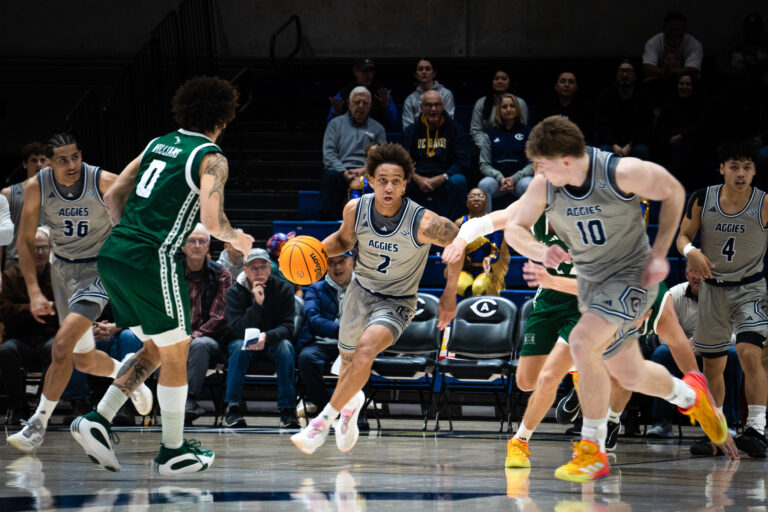
Aggies fall to Cal State Bakersfield in late-season home game

Missed free throws and late-game fouls resulted in the Aggies’ defeat


By COLINA HARVEY — sports@theaggie.org


On Feb. 20, the men’s basketball team faced off against the California State University, Bakersfield Roadrunners in one of their last home games. With the Big West Championships rapidly approaching, every game could help the UC Davis Aggies achieve a higher seeding position. 

The last three home games of the season are set to be tough for the Aggies, as they are pitted against the top three teams in the Big West. However, the game against Bakersfield, who has struggled this season in conference games, did not predict an Aggie defeat. 

Despite this, the Aggies were not able to clinch the victory and were defeated 66-71. The win was within reach for the Aggies, and they ultimately lost due to unforced errors rather than the Roadrunners’ performance. 

The Aggies had a strong start, with Connor Sevilla, a second-year undeclared major, and Carl Daughtery Jr., a third-year human development major, making two three-pointers each in the first 10 minutes. However, the Roadrunners fired back with three-pointers of their own, many coming from Marvin McGhee III. The Aggies led by as much as seven points early in the game, but a three-pointer from McGhee with 11 minutes to go in the half gave Bakersfield the lead.

Additionally, Bakersfield’s CJ Hardy sustained an injury after about seven minutes of play, resulting in bleeding on the court that had to be cleaned up and a long break from the game. As the Aggies began to struggle following the unplanned pause, it is a possibility that it interfered with the players’ momentum.

Despite the early lead from UC Davis, the last 10 minutes of the first half were even. On the last possession by the Aggies, TY Johnson, a fourth-year communications major, assisted a layup by Pablo Tamba, fourth-year communications major, cutting Bakersfield’s lead to one.

Free throw shooting that was not up to usual standards by the Aggies was a contributing factor to Bakersfield’s lead going into halftime. Despite getting to the line seven times, the team was only able to score two free throws. Additionally, McGhee was on fire in the first half and accounted for almost half of the Roadrunners’ points, with a total of 14. 

The second half did not have an encouraging start for the Aggies. A turnover by Johnson, a pair of missed three-pointers by Sevilla and a foul by Niko Rocak, a graduate student in the Master of Business Administration program, after falling for a pump fake were some of the plays that allowed Bakersfield to create the divide. Within the first six minutes, the Roadrunners increased their lead to seven points. 

Another series of unfortunate plays damaged the Aggies’ chance even more. Within two minutes, the Roadrunners got a buzzer-beating tip-in, Tamba and Daughtery Jr. both committed turnovers and Tamba faced a powerful block from Bakersfield while trying to drive the lane. 

With less than 10 minutes to go, two big three-pointers from Leo DeBruhl, a fourth-year sociology major, gave UC Davis-supporting attendees hope that a comeback was imminent. However, Bakersfield responded with a couple of three-pointers of their own.

Johnson then hit a pair of clutch three-pointers. Unfortunately, he was fouled on the second and failed to convert the free throw. DeBruhl was also fouled on a made layup and was similarly unable to make the extra point. 

With 90 seconds to go, Bakersfield led by eight points. At this time, the Aggies overcoming the deficit was unlikely, but a step-back three-pointer by Sevilla put a UC Davis win back in the realm of possibility. 

With less than a minute to go, Tamba made a two-pointer in the paint and was fouled, which turned it into a three-point play. Then, a turnover by Bakersfield gave the ball back to the Aggies, resulting in a clutch corner three-pointer by Johnson. This cut the score gap to one with 53 seconds to go. 

In order to win, the Aggies needed to play strong defense on the Roadrunners’ next play, preferably without fouling, and get the rebound. Unfortunately, the Roadrunners got the offensive rebound off of a missed shot and were then fouled by Tamba. 

The Roadrunners made both of their free throws, something that had been difficult for the Aggies to do throughout the game. With the Bakersfield lead back up to three, DeBruhl drove the lane on the other end. He was blocked by Bakersfield, with Johnson fouling on the Bakersfield rebound. 

Again, the Roadrunners netted both free throws, raising the lead to five with only 18 seconds to go. Johnson rushed to the other end of the court in an attempt to decrease the point deficit, but it was not enough for the Aggies to claim the win. 

Ultimately, the Aggies lost this late-season matchup 66-71. A big portion of this loss can be attributed to the Aggies’ uncharacteristically poor free throw shooting. While Bakersfield shot 82.1% from the line, Davis shot only 40.9%. The team made only nine free throws compared to Bakersfield’s 23.

Late-game fouls also hurt the Aggies, as they allowed Bakersfield to up their lead in the moments where it counted the most. Excluding a few bouts of explosive scoring late in the game, there was no Aggie player who put up a truly impressive performance. 

UC Davis went on to face the University of Hawai’i at Mānoa on March 1 and lost 70-78, but the team is set to play UC Irvine and UC San Diego. Following a losing streak, these tough matchups will likely test the Aggies, but an improvement in gameplay in the last few matchups will allow the Aggies to finish out the season strong. 


Written by: Colina Harvey — sports@theaggie.org

Can You Gig it?: Whole Earth Festival hosts house concert to promote festival in May

Students attending WEF’s house concert shared their thoughts about the event


By EVELYN SANCHEZ — features@theaggie.org


The lights were vibrant, streamers ran around the trunks of trees and the crowds were plentiful by the second hour. Fundraising through dance, live music, screen printing and supporting local vendors, The Whole Earth Festival (WEF) put on a house concert on March 1 to not only welcome the warm air but rally excitement for their upcoming titular event on May 9 to 11.

The event asked for a donation of $10 to 15 on a sliding scale, though no one was turned away for a lack of funds. 

Rohini Murali, a fourth-year human biology and psychology double major, was one student who attended the WEF house concert. 

“I really like the vibe,” Murali said. “Everyone seems really fun and it feels like an inclusive environment. It’s such a good idea to have live music.”

Three bands were featured throughout the night: Moonbloom, Carabeza, illbie and Your Tax Dollars at Work, alongside intermittent shows given by the Pole Dance Club at UC Davis. Carabeza even featured merchandise at the event, in which the lead singer carved out a stamp and collectively imprinted the design on each shirt. 

Katherine Krinsky, a fourth-year English major and one of the co-directors for WEF, offered some behind-the-scenes information.

“For this event, my co-director and I, and some of my staff members, first find a yard we want to use,” Krinsky said. “We ask [vendors] if they want to table, recruit the bands and have the opportunity to table and publicize WEF.”

It was also WEF’s first time hosting a show at The Secret Garden, a local venue in Davis. Krinsky noted her coincidental initial joining of the WEF team. 

“I joined WEF kind of by luck,” Krinsky said. “I had some friends applying for staff and because I liked working with kids, I [thought] it would be fun to do Kids Space. I had been to the festival before once [in] my freshman year — happened upon it, loved it and then decided it would be cool to join staff.”

Krinsky started with managing the Kids Space in her second year and managed the logistics section her third year, now managing the entire event alongside her co-director. Krinsky hopes that WEF can host one more house concert before the festival in May.

Ailani Corona, a third-year design major, was present at the event as a vendor. 

“This is the first house concert I’ve sold anything at,” Corona said. “I heard about [WEF] through my wonderful roommates but also Professor [James] Housefield as part of his lecture. I applied for [WEF] main events, and they emailed me about this event and […] asked me to come in.”

Corona is experienced in painting on glass or paper but has leaned toward selling her crocheted products, as she has been able to accommodate college students’ interests with more ease. 

“I’ve been selling things since I’ve transferred,” Corona said. “But before that, I’ve been selling for three years, and I’ve been crocheting since [my] senior year of high school.”

Selling a large assortment of handmade crocheted animals and objects, an audience favorite being her tiny crocheted conchas, the Latina-owned small business can be found on her Instagram account, @artsy_ailani.

The 56th Whole Earth Festival, with the theme “Earth to the People,” will be held at the UC Davis Memorial Union Quad from May 9 to 11. 

Completely student-run and in association with ASUCD, the zero-waste event is popular among students not only for their festival but also for publicity events. These events work to fundraise for WEF and give back to the community of Davis for continuing to support the environmental cause. 


Written by: Evelyn Sanchez  — features@theaggie.org