57.2 F
Davis

Davis, California

Monday, December 22, 2025
Home Blog Page 452

Soil may save our climate

California scientists win major grant to study how to decrease greenhouse gasses using soil amendments.

Whether it’s building giant solar farms, constructing public transportation or putting a price on carbon, most proposed solutions to global warming involve cutting carbon dioxide emissions. The California Collaborative on Climate Change Solutions, or C4S, is a group of researchers from UC Davis and other California universities who believe that reductions alone will not be enough to prevent the worst effects of climate change; they argue that humans must actively remove carbon dioxide from the air. On December 21st 2018, C4S won a 4.7 million dollar grant from the state of California to explore how soil amendments like compost, biochar and certain rocks can help pull carbon dioxide out of the air.

The current global warming crisis is caused by humans interrupting the natural balance between the carbon in the earth and in the atmosphere. Humans have rapidly released a large amount of earth-bound carbon by burning fossil fuels, the carbon remnants of living organisms that decomposed in soil long ago. The researchers at C4S want to use different methods to reverse the process and counter the rapid release of carbon dioxide by accelerating the earth’s ability to capture greenhouse gasses from the atmosphere.

“One of the ways to mitigate climate change is to increase the amount of carbon that is stored in the ground,” said Sanjai Parikh, an associate professor of soil chemistry at UC Davis.

The researchers will study how the addition of certain types of crushed rocks to soil can increase the amount of carbon that soil can store.

According to Benjamin Houlton, the director of the John Muir Institute at UC Davis, rock weathering has played an important role in controlling the amount of carbon dioxide in the atmosphere throughout earth’s history. In the early days of the planet, the level of carbon dioxide in the atmosphere was much higher than it is today. Rock weathering gradually led to a decrease in the amount of carbon in the air.

“CO2 is in the air, it goes into the water, when it dissolves in the water, it forms carbonic acid,” Houlton said. “That carbonic acid then starts to attack the rocks, break them down and that CO2 is now converted into things like carbonates which are another kind of rock, like limestone. That’s how the CO2 in the planet has come down over time.”

The best type of rocks for this process are silicate rocks. These silicate rocks actively pull carbon dioxide out of the air, but human activity is releasing carbon so quickly that climate buffers cannot work fast enough. Houlton and his fellow C4S researchers want to expedite the carbon sequestration action of silicate rocks by crushing them, increasing their surface area and adding them to soil. The researchers have found that the rocks also provide important minerals and nutrients that improve soil quality and increase crop yields.

Biochar, organic matter which is transformed into char under high heat, is another promising soil amendment. The char is a very stable form of organic carbon that can stay in the ground for extended periods of time and benefits soil.

In addition, Whendee Silver, a professor at UC Berkeley and a co-principal investigator on this latest grant, has shown some success using compost to help farms and rangelands retain and absorb carbon.

All of the potential soil amendments provide benefits to soil. These benefits are critical because they may make soil amendments a more feasible solution to remove greenhouse gases from the air. Many other ideas have been proposed, including man-made machines that directly capture carbon dioxide. However, there are concerns that these other methods are too expensive or that no one will pay for them. Soil amendments are cheaper to implement than many other carbon-capture ideas, and they may provide economic benefits by increasing the productivity of farmland, which could further offset the costs.

The C4S team will use the grant money and build on prior research to further demonstrate that soil amendments work and can be inexpensive enough to actually be used. The researchers plan to test the individual soil amendments and combine them together to study whether they can work together to provide added benefit.

Scientists involved in the project will use the new funds to set up test sites across California. Patty Oikawa, a professor at California State University, East Bay, is managing one of the test sites. Her team will use their portion of the funding to do research on the efficacy of using compost to turn rangelands into carbon sinks.  

“We plan to apply compost to three acres of rangeland on CSU East Bay’s Concord campus and monitor ecosystem-scale fluxes for three years,” Oikawa said.

Oikawa plans to monitor the site with special sensors that help determine whether an area of land is absorbing or releasing carbon dioxide. Her data from the East Bay test site, alongside the data from the other sites, will help paint a better picture of how effective these soil amendments can be. The project will last three years, and upon completion, the group hopes to demonstrate the feasibility of soil amendments in reducing carbon and providing benefits for farmers. For now, the C4S team is working quickly, because climate change is moving fast.

“No molecule of CO2 is unimportant right now,” Houlton said.

Written by: Peter Smith – science@theaggie.org

Getting into the swing of things

Meet UC Davis men’s tennis freshman and Barcelona-native, Nil Giraldez

When asking the UC Davis men’s tennis freshman Nil Giraldez about his style of play on the court, he’ll say he’s a fighter. He’ll fight for every point, fight for every ball, fight for every centimeter of advantage he can get over his opponents. Of course, every tennis player gives all they got to win the point, but there’s something different about this self-described fighter, who hails from Barcelona where his dad put a racquet in his hand at the age of four.

When the men’s tennis team hosted University of Nevada-Reno earlier this year, Giraldez appeared to have all but lost his first set when he was down 4-1. But he slowly inched his way back and took the first set from his opponent, 6-4, letting out the occasional celebrational “Vamos!” along the way. He proceeded to win his match in straight sets.

Although it’s not apparent from his on-court attitude, Giraldez is relatively quiet. He has only been in Davis for a month, as he started attending classes at the beginning of Winter Quarter. Even though his teammates say he’s struggling a little with English — it isn’t his mother tongue — it is never a struggle to understand what he’s saying.

In a sport where the upper echelons are largely dominated by non-U.S. players, tennis has declined in popularity in the U.S. It’s partly due to the failure of the United States to produce exciting players, apart from the Williams Sisters, since the days of the Andre Agassi-Pete Sampras rivalry.

Spanish players have been much more exciting to watch in recent history. Players like Carlos Moya, Tommy Robredo, Juan Carlos Ferrero, David Ferrer and of course, the King of Clay, Rafael Nadal.

Growing up, Giraldez idolized Nadal and his never-say-die attitude on the court but tries to model his play after another dominant tennis superstar, Novak Djokovic, who just won his 15th grand slam title.

While UC Davis is no stranger to international students — they made up 14 percent of the undergraduate population in the 2017-18 academic year — Davis is not exactly a destination for overseas athletes. What was one of the reasons Giraldez chose UC Davis?

“Having a team,” Giraldez said. “In Spain, when you go to college you can’t combine tennis and studies and you don’t have any kind of team. [Here] It’s like family, you know, that’s one of the reasons I came here.”

When Giraldez started playing tennis, he was pleased with his coordination on the court.  Giraldez recalled that he “played it quite well,” and as he got older he started playing better and training more.

In Spain, tennis is played on a clay court. The ball on a clay court, bounces higher and slower, fostering that trademark style of play seen commonly in Spanish tennis players. Slower points, longer rallies, generous use of topspin and overall defensive-minded play.

The drop shot — a trick shot where one player will fake their groundstroke and, with a deft touch, slice the ball so that it barely clears the net — is more of a weapon on clay where both players play further away from the baseline. It sounds like a good shot in theory but often backfires on players.

On hard courts, traditional for tennis in the U.S., this slower style of play is harder to pull off. Points are faster, groundstrokes more aggressive and players approach and attack the net more.

This style of play, while not a significant hindrance for Giraldez who has beaten six out of seven singles opponents so far this season, has required some adjustments.

“I have to adapt to this,” said Giraldez when the Aggies played UNR earlier in the season.

“I’m trying to make my serve a weapon,” he added, noting that the serve on clay courts is typically used as a tool to start controlling the point, rather than creating an opportunity to attack.

Just taking a look at his record thus far, it wouldn’t seem that there is a pressing need for him to change. His coach agrees.

“You’ve got 10 years of training behind you playing on clay, so you’re not jumping to doing hard court tennis, nor should he,” said men’s tennis Head Coach Eric Steidlmayer.

Sophomore Dariush Jalali said it’s been fun having another Spanish speaker on the team.

“Nil speaks Spanish, I know some Spanish. It’s fun to talk trash about the other teammates in Spanish and practice my bilingualism.”

Davis is a long way from Barcelona, Spain, and Thamma says Giraldez got a bit of culture shock.

“It’s totally different, but I’m okay,” Giraldez said.

The harsh Winter Quarter weather hasn’t made a good impression on Giraldez either, who like many when they first move to California, expected mild weather year round.

Above all, Steidlmayer noted that having an international player, like Giraldez or Tommy Lam — a Hong Kong native who played for the men’s tennis team and graduated from UC Davis last year — provides the team with a different worldview.

“It’s pretty cool for all our guys to get to know somebody from a different country and to have that kind of different perspective,” Steidlmayer said.

Everything kind of happened at once for Giraldez, being thrown into competition right away along with training and academics, but he is handling it all well, according to Steidlmayer.

“It’s pretty challenging taking a writing class and writing a five-page paper in English when Spanish is your first language,” Steidlmayer said.  

Being a long way from home and only finishing the visa process in December, Giraldez has seemed to have found his home on the court — his tenacity and international perspective are emblematic of the UC Davis culture with which he is now ingrained.

Written by: Bobby John — sports@theaggie.org

Feb. 7 Senate meeting: 11 Senate Bills pass

Senator Brandon Clemons’ absences topic of concern

The Feb. 7 ASUCD Senate Meeting was called to order by Vice President Shaniah Branson at 6:10 p.m. Senators Simran Kaur, Atanas Spasov and Brandon Clemons were absent.

The meeting began with quarterly reports from Entertainment Council and the Office of the External Vice President Affairs’ (OEAVP). A highlight of the OEAVP’s report included the addition of $5,000 in funding for a Davis Community Cooperative (DCC) program related to combating hunger.

Additionally, the DCC has aided in the development of a Senate bill entering California legislature.

The bill, which should be introduced by Feb. 22, will help small family farms make the transition from traditional irrigation methods to drip and other modern irrigation methods which increase efficiency and reduce costs.

“We have a lot of farms big and small [in Yolo County] and people who work on agricultural policy,” said Adam Hatefi, a fourth-year political science major. “Crops that would be affected [by the subsidy] would be the six most water-heavy crops, one of which is used for grazing.”

Kyriakos Psaras, a fourth-year political science major with a pre-law focus, was sworn in as chair of the Transfer, Re-Entry and Veterans Committee.

“As a transfer student myself, I didn’t really feel ASUCD had much of an impact on transfer students,” Psaras said. “I never felt I should get involved until later when I thought I should give back to the school. Transfer students are usually older and already know what they like so they don’t really fit in with freshmen and sophomores. Being involved with this allows me to help them interact with one another.”

Tayesha Watts and Jonathan Chen were sworn into the Academic Affairs Commission. Both Watts and Chen indicated that they hope to boost outreach to underrepresented and marginalized groups at UC Davis.

“I applied because I saw it as a way to be a voice for marginalized communities on campus and help them better pursue academics,” Watts said. “A lot of emotional support is needed to help black students in STEM. A lot is put on them including mental and emotional toll.”

Chen focused on the need for sensitivity training for faculty and staff.

“I believe everyone has implicit biases and faculty should be trained to go against those biases,” Chen said. “I feel like there are a lot of things aside from academics that people have to deal with. We should do something to be able to account for those.”

Three students were sworn in as Gender and Sexuality Commission commissioners. Some issues that the new members plan to focus on is increasing access to gender-neutral bathrooms on campus and making classroom experiences more accessible for those with disabilities. The new commission members are prioritizing intersectionality and allyship in their new ASUCD positions.

The Senate approved numerous items of old legislation. All that passed were approved without objection.

Senate Bill #36 allocated $1540.44 for battery replacement and installation on vehicles used to transport compost materials for the Campus Center for the Environment (CCE).

Senate Bill #37 changed the interviewing structure for members of ASUCD Senate committees.

Senate Bill #39 brought the bylaws in line with recent changes to the constitution.

Senate Bill #40 reimbursed Entertainment Council for rented sound equipment.

Senate Bill #41 allocated funds for sound equipment for the upcoming ASUCD Town Hall.

Senate Bill #42 removed the Food Security Task Force Committee from the bylaws, citing concerns about its efficacy since its topics are being addressed in other areas of the Senate.

Senate Bill #43 removed the Judicial Council Oversight Committee in accordance with recent changes in the constitution.

Senate Bill #44 removed mentions of the mentorship program for ASUCD Senators, which some say has been ineffective.

Senate Bill #49 removed mentions of the Student Services and Fees Administrative Advisory Committee from the bylaws.

Senate Bill #50 allocated funds for refreshments at the upcoming ASUCD Town Hall.

Senate Bill #52 created the Davis Housing Discrimination Committee within ASUCD.

Senate Bill #45, which recommended the removal of slates from the bylaws, did not pass due to concerns that it would decrease already low voter turnout among members of the student body. The bill failed with four senators voting in favor, five against and three abstaining because of their absences.

Senate Bill #46, which would allow for unlimited deferments during confirmation hearings, was tabled.

Under new legislation, Senate Bill #53, which would establish the Public Opinion Task Force Committee, was introduced into the ASUCD Senate.

Senator and ex-officio reports were given. During public discussion, Branson expressed concerns about Senator Clemons’ repeated unexcused absences and tardiness to ASUCD meetings.

The meeting adjourned at 11:33 p.m.

Written by: Rebecca Bihn-Wallace — campus@theaggie.org

Davis Police Accountability Commission hosts first regular meeting

0

PAC discusses new independent police auditor, develops community outreach plan

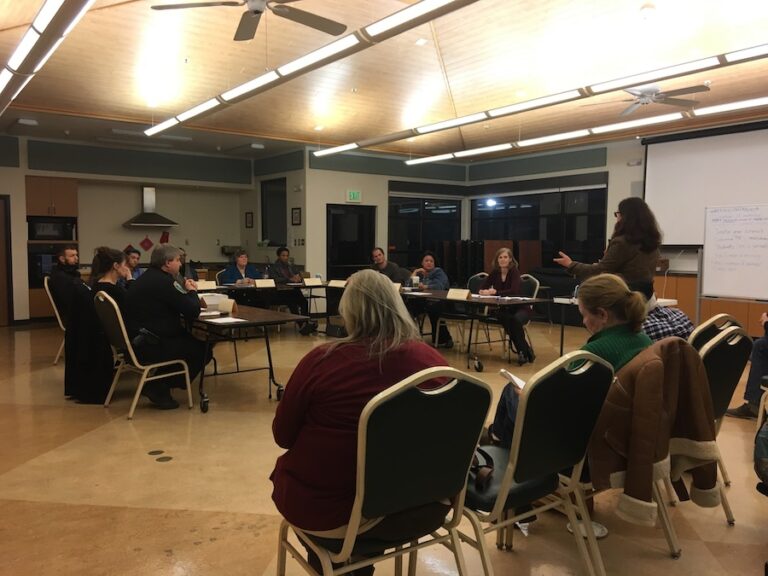
On Feb. 7, the City of Davis’ Police Accountability Commission conducted its first regular meeting. The commission discussed the police department’s strategic plan, the new independent police auditor and the commission’s future community outreach plan. Police Chief Darren Pytel also gave the commission an overview of the Davis Police Department’s current state.

PAC consists of nine members and one alternate. One of the members, Jonathan Laraque-Ho, represents ASUCD. PAC has been in the works as a component of the city’s developing police oversight plan since April of 2017. The commission was finalized in fall of 2018.

“There had been concerns of years, if not decades, about use of force in the PD here in Davis and the particular relationship that the police had with people of color in the community and people with disabilities, particularly the homeless as well,” said Dillion Horton, the PAC vice chair.

Although this was PAC’s first regular meeting, the commission had conducted a special meeting on Jan. 31. During its special meeting, the commission members received their orientation and were able to become familiar with each other.

“The first meeting wasn’t a regular meeting, so we kind of think of the meeting that happened [on Feb 7.] as the first real meeting,” Horton said. “The first meeting, we had an orientation from the city staff on what our role would be relative to the [DPD] and the police auditor.”

The meeting began with public comment. Yolo County District Attorney Dean Johansson spoke about how PAC has been a goal in the community for a very long time.

“Back in 2005, 2006, this was what people dreamed of, is having a commission like [PAC],” Johansson said. “And there are many that aren’t going to be here that fought very long and hard for what [the commission is] now a part of.”

Along with the formation of PAC, the city hired Michael Gennaco, a new interim independent police auditor, in 2018. On Feb. 5, he was officially hired for a more permanent position. Gennaco is based in Southern Calif. and is under contract. He is not an official city of Davis employee.

“The council had on our agenda […] a section of a more permanent police auditor,” said city assistant manager Kelly Stachowicz during the meeting. “Because that was just approved [Feb. 5], he is not here this evening. He will start coming to these meetings next month.”

While Gennaco was not present at the first meeting of the commission, he will be present for all future PAC meetings. During this time, he will be able to meet with the commission members and the Davis community.

Afterward, the commision had a brief introduction to DPD’s strategic plan for 2017-2019. While PAC may not be able to change the plan, its input and criticisms of the plan may affect the new plan that the DPD is drafting for 2020.

One of the responsibilities of PAC, according to the referendum establishing PAC, is to develop a community outreach plan. During the meeting, PAC began discussions of this plan. In the future, PAC plans on conducting its meetings throughout Davis in order to reach different communities and wider demographics.

“We’re going to need [to] meet some of these people where they are,” Horton said. “I think we are going to have to make a direct outreach to communities of color and what I like to call constituencies of concern [in order to make] sure that they know that the organization exists and what our role is and what we can help them do if they reach out to us.”

During the meeting, Pytel also talked about the current state of the DPD. According to Pytel, there are a high number of vacancies in the DPD. In a typical year, the DPD has two or three vacancies; now, there are currently seven.

“One of the questions that I asked the chief [about] was if there was a really strong feeling about the anti-police nature of some of the conversations that have happened in Davis over the last few years that [have made] officers in the DPD feel unwanted or unwelcome in the city,” Horton said. “Not that we were unaware of that, but I think that the chief’s comments kind of brought that dynamic into sharp release maybe more so than we expected.”

While the meeting went over the scheduled amount of time, according to Horton, there were many aspects of the meeting that he considers a success.

“The first meeting generally went well,” Horton said. “I think the meeting went well in terms of the public comment. I think it went well in terms of we handled the outreach plan early on. And I was also glad we had an opportunity to talk to the chief. I think really it was good that we had the chance to have a conversation about the 2019 strategic plan, which I think informed some of the questions that we had for the chief for when he arrived later on in the agenda.”

The PAC will meet on the first Thursday of every month at the Davis Senior Center. Those interested in attending a meeting can find more information on the City of Davis website.

Written by: Hannan Waliullah — city@theaggie.org

Review: Generation Wealth

Greenfield analyzes the new American Dream

Documentary filmmaker Lauren Greenfield spent her career attempting to understand America’s obsession with wealth and status. I was first introduced to Greenfield through her 2012 documentary “Queen of Versailles,” which followed the Siegel timeshare tycoon family attempting to build the largest home in America. The film turns into a riches to rags story as they ultimately face bankruptcy in the construction process. “Queen of Versailles” and other films of Greenfields, like “Thin,” which follows four teenagers and their battles with eating disorders, all share a common denominator: why do we as a society obsess over materialism or our outward display? Greenfield attempts to get to the root of that common thread and expose it in her 2018 documentary, “Generation Wealth.”

“Generation Wealth” introduces the viewer to an assortment of characters, all of whom share an obsession with wealth and status. We meet cigar-puffing Florian Homm, the German businessman and investment banker who frequently dodges the FBI on charges of fraud; a “Toddlers and Tiaras” star; adult film actress and ex-girlfriend of Charlie Sheen Kacey Jordan; Suzanne, the work-obsessed New York City hedge fund executive; and, of course, the many stiff faces of one-too-many plastic surgeries.

Throughout these narratives, Greenfield explores layering sectors that display America’s toxic materialism — its general obsession with wealth, the commodification of the female body, the lengths to which we go to gain and display our acquired wealth and more. Indeed, many of these interviewees have been interviewed by Greenfield for her earlier work, revisited for the sake of the documentary. The documentary is then almost 25 years in the making and an overarching collection of Greenfield’s work. Such a filmmaking feat is worthy of praise, and the longevity of the project further legitimizes its ideas.

The film argues that the American Dream has changed from a righteous desire to work hard and gain wealth to one of exuberance and aesthetic display. Wealth is therefore no longer simply capital gain but becomes the centerpiece of what gives our society and selves value. Our basic human psyche responded accordingly; our morals, values and behaviors altered.

The challenge of the various niches presented throughout the film, however, is the questionable ability to follow the thought process of the filmmaker. Greenfield balances on a fine line between the creatively explorative and far-fetched. There are times in which the viewer questions how the various interviews connect to the overall thesis of the documentary, and of which at times diminishes the film’s investigative power and credibility. One interviewee claims our American society is on the brink of collapse with its focus on wealth, similar to the fall of Ancient Rome. While not a completely ruled out theory, the sensationalism found in various points of the film makes the viewer scratch their head.

Yet the silver lining of the documentary falls in Greenfield’s autobiographical approach, which is an uncommon strategy in this type of film. She ties her family history into the context of the film, and interviews her sons and parents in the process. Yet even she herself is not exempt from analysis and even criticism. By the end of the film, she questions her obsession with her line of work and love for filmmaking. Her desire for more — making more films — mirrors the inherent qualities of the American desire for wealth and status. She, too, is part of this culture.

One scene is specifically powerful in this case. As Greenfield interviews her son on the idea of legacy, her husband takes the camera to film her and ask the same question. She stutters, attempts to grab the camera and is finally forced to answer the question. She is confronted with introspection and finding her place within her own anthropological study. Without such strategy, the extreme cases she presents would seem inapplicable to the average Joe. She brings herself back down to earth, reminding the viewer that no one is exempt from materialism. Not even the omnipotus, theoretically neutral filmmaker.

The film ends on a rather optimistic note. Each of the interview subjects forgoes their obsession with wealth, acknowledging the destruction it has caused them, and advocates for moral preservation of what really matters: love and the people we care about. Greenfield too recognizes that she continues to live in the materialist Los Angeles culture of which she criticizes. Nonetheless, culture can be changed and contextualized; knowing this seems to be the first step toward change. While seemingly lofty, a little cliché and a slight let down to the viewer at first watch, it’s obvious that the concluding sentiment has not been deeply embedded into our collective culture. This documentary would not exist if it had.

Written By: Caroline Rutten — arts@theaggie.org

Davis College Democrats used student contact info inappropriately to campaign for BASED, source says

Information on over 800 students gathered for 2018 June primaries used nine months later to campaign for school election

The inappropriate use of student contact information by Davis College Democrats (DCD) in efforts to encourage students to vote for the BASED slate in the 2019 ASUCD Winter Elections has escalated into a situation outside of ASUCD’s purview, and is now being handled externally.

The Elections Committee today determined no violation points can be assessed because there was no violation of the ASUCD Bylaws or the constitution. The committee sent the case to Student Judicial Affairs for further evaluation.

“While there may be implications regarding federal election laws, there are no systems in place within the Association to lead to further action taken by the committee,” Elections Chair Rodney Tompkins said.

In June of last year, as part of its efforts to register students to vote in advance of the 2018 primaries, members of DCD asked students to sign a pledge card. In doing so, students would receive notifications from DCD to be reminded to vote on Measure J, the Nishi housing project, on the June Ballot, according to a source with knowledge of the situation.

The source says DCD collected the names, emails and phone numbers of over 800 students for its “Yes on J database.” DCD then used that information, nine months after it was collected, to reach out to students and encourage them to vote for BASED in the recent ASUCD elections.

“Individuals whose information was collected by consent on these pledge cards […] was only to use for Measure J, as that is what the card said and what individuals who signed it were told,” the source said.

DCD publicly endorsed only BASED candidates on its Facebook page. According to the anonymous source, DCD — and specifically the group’s Executive Director Aaron Latta — worked as the main communications team for BASED, directly assisting with outreach efforts.

Latta did not respond to requests for comment at the time of publication.

The source also stated that Justin Hurst and Shreya Deshpande, who ran on the BASED slate and were today elected ASUCD’s newest president and vice president, authorized the use of this information.

Neither Hurst nor Deshpande responded to requests for comment at the time of publication.

Screenshots of texts allegedly sent by DCD were obtained by The California Aggie.

“Hi! I’m with DCD and was wondering if you’ve voted in the elections,” the text reads. “If not DCD has endorsed BASED candidates and you can vote here: http://elections.ucdavis.edu.”

The source said a friend of a friend received the screenshot and was “concerned and confused because she had not given anyone from DCD her number or information.”

“Over the next 30 minutes to an hour we heard more reports from students stating that they had received suspicious texts and emails from DCD that they had not consented to,” the source said, including attachments of four different screenshots of texts appearing to have been sent by DCD to UC Davis students.

The source said they reached out to an ASUCD employee who is also a member of DCD about the concerns that student contact information had been used inappropriately. The ASUCD employee contacted then reached out to DCD’s Latta who “confirmed to this individual that he had used information from the Yes on J database to contact these students,” the source said.

The source, who was able to access the Yes on J database themselves, reached out to a few of the individuals on the list and received confirmations from every person they contacted that they had received a text or email from DCD since the start of the election.

According to the Federal Communications Commission, “political campaign-related autodialed or prerecorded voice calls” which include text messages, are not allowed without the contacted party’s “prior express consent.” ASUCD elections are, of course, not federal elections, so FCC requirements do not apply. And, as aforementioned, no Bylaws were specifically broken. Nevertheless, concerns remain.

“These individuals consented just to have their information used for the purposes of reminding them to vote on Measure J and not by DCD and Based nine months later for a school election,” the source said.

This is a developing story. It will be updated as more information is made available.

Written by: Hannah Holzer — campus@theaggie.org

Editor’s note: An earlier version of this article stated that Aaron Latta worked as the main communication director for BASED outreach efforts. This is incorrect. DCD independently endorsed BASED candidates, but was not officially affiliated with the slate. The Aggie regrets the error.

ASUCD election results, Econ now STEM major, NBA All-Star game recap : Your Weekly Briefing

Happy Friday Aggies,

We’re switching it up a bit — welcome to your very first weekly briefing. My name is Grace Simmons and I will be your confidant, keeping you up to date on the latest at UC Davis and beyond. And without further ado, let’s dive in!

Photo of the Week

JUSTIN HAN / AGGIE

ASUCD Election Update The BASED slate secured all but two ASUCD Senate seats.

Justin Hurst and Shreya Deshpande secured president and vice president, respectively.

The six students elected to the Senate are: Anna Estrada, Shondreya Landrum, Sahiba Kaur, Rebecca Gonzalez, Victoria Choi, and Andre Spinoglio.

And lastly, the Unitrans Undergraduate Fee Referendum passed with a 60 percent overall ‘yes’

For Campus News — Nicholas Chavez, who had been squatting in the Art Building, was arrested Feb. 21 on charges of felony vandalism. Chavez was initially arrested last Fall Quarter for allegedly sexually assaulted fourth-year art studio major Stephanie Lee, but was released due to confusion surrounding Lee pressing charges after she had confirmed his identity at the police station.

In other campus news, economics has been reclassified as a STEM major. Hey, we get it, you guys deal with numbers. Who’s for it? International students — this switch will now allow the extension of visas post graduation by three years. More on this.

And finally, eight new microwaves have been installed in the CoHo. This comes nearly two years after student leaders proposed a solution to the lengthy lines behind the once two microwave station at peak lunch hours. Zapping wait times and last night’s pasta in one fell swoop.

Features

ALEXA FONTANILLA / AGGIE

#MeToo founder Tarana Burke spoke at Sacramento State on Feb. 7. The event was organized by the UNIQUE student-run entertainment group at Sac State in honor of Black History Month and in support of the Me Too movement. Community involvement was the focus of the talk, encouraging dialogue about sexual violence and sexual assault. Read the full article.

Arts

JAMIE CHEN / AGGIE

“Roma” — the award nominated film is the first of its kind in the Oscar sphere to grace both the big screen and your Netflix suggested page. The Netflix release followed its theater premiere by three weeks, pioneering a strategy of distribution. Though this has created considerable buzz, and notably so, arts writer Josh Madrid recommends you see it on the big screen. Read the full review.

Sports

ALLYSON KO / AGGIE

NBA All Star Game — Team LeBron came out on top, taking Team Giannis 178-164 this past Sunday from Charlotte, North Carolina. Kevin Durant scored a whopping 31 points and captured his second All-Star game MVP— are you shocked?

“All-Star weekend returns basketball to its purest form and most human principles, yet annually falls just days after the trade deadline — perhaps the most ruthless, non-human considerate period in a professional season,” writes Carson Parodi. Read the full article.

Science

JEREMY DANG / AGGIE

Spill the Tea — Jan. 24, the fourth annual Global Tea Initiative for the Study of Tea Culture and Science commenced at the UC Davis Conference center. Alongside UC Davis faculty were guest speakers from Hong Kong, Sweden and Japan to discuss issues surrounding tea and health. “Gut microbiota. Kombucha. Epigenetic changes in women.” Michelle Wong writes. Read the full article.

Have a laugh:Humor: Congress approves federally-funded “Border Wall Tycoon” video game to appease Trump

Editorial: “Where we’re going, we need better roads”

That’s all for this week, make sure to tune back in next Friday.

—Grace Simmons

Guest: Chancellor May fails our university community through problematic investments

Gary May sits on the board of Leidos, a defense contractor that profits off of war

UC Davis is no stranger to controversy. Under the leadership of Chancellor Linda Katehi, our university was accused of everything from denial of human rights and free speech to attempting to cover up the resulting press fallout. Katehi also saw immense criticism for her involvement with outside boards from which she reaped hundreds of thousands of dollars — all of which likely played a role in her decision to resign.

It’s worrying, then, that despite protests against Katehi’s membership on the boards of educational institutions and textbook publishers, our current chancellor’s membership on the board of the defense contractor Leidos Inc. has largely flown under the radar.

In 2015, Chancellor Gary May received $288,280 for serving on the Leidos board, more than Katehi received for her involvement from two of her three most prominent board positions at DeVry University and textbook publisher Wiley.

In an interview with the Editorial Board of The Aggie late last year, May responded to a question about his board membership by stating that “board service is an indicator of thought leadership,” and comparing himself to a colleague who sits on the Intel board yet teaches at UC Berkeley. In that same interview, when asked about whether or not Leidos profits off of war, he stated that “the company does not necessarily benefit from war,” and called the assertion that it does “crazy.”

Unfortunately, by comparing himself to someone who sits on the board of Intel and insisting that the company’s defense work isn’t war-related, he glosses over Leidos’ highly problematic activities.

Leidos, the ninth largest defense contracting corporation, holds contracts with Homeland Security, the NSA, Border Patrol, the Department of Defense and other national security and defense agencies. These contracts are less innocent than Chancellor May says. Among them is one with the Army Expeditionary War Development program. The program mostly consists of weapons and technology development to make invasions of foreign countries less challenging. For this, Leidos received a significant share of the nearly $1 billion earmarked for the project.

Leidos additionally led the development of the ACTUV, also called the “Sea Hunter,” an unmanned, nearly undetectable submarine designed to destroy enemy vessels. Similarly, it has developed systems for training Apache helicopter gunmen to shoot at targets, and systems to train and test soldiers for combat.

Leidos used to be known as Science Applications International Corporation, but in 2013 the company split in two. SAIC kept the original name, while its parent company became Leidos. Even though the original purpose of SAIC was to serve the government’s IT needs, it quickly reinvested itself into intelligence.

Now, both SAIC and Leidos are two of just five companies that hire almost 80 percent of private sector employees working on U.S. intelligence contracts, making them part of a quickly narrowing intelligence monopoly.

SAIC has an uncomfortably close relationship to the NSA; according to journalist and intelligence expert Tim Shorrock, “The agency is the company’s largest single customer and SAIC is the NSA’s largest contractor.” Prior to the company’s split, SAIC became famous for its involvement in a failed project to track the emails and calls of foreign nationals.

Leidos, too, isn’t innocent: John Hamre, a former corporate leader who held the same title and a similar salary as Chancellor May, co-penned a report in 2015 vehemently defending the NSA’s right to spy on American citizens to prevent national security and terrorist threats. In terms of surveillance development, much of Leidos’ work focuses on biometric technologies. Biometric technologies, including the ones Leidos is working on, are used for facial identification, fingerprint recognition, DNA identification and identification through scanning of the eye.

Backing these contracts is significant lobbying. Leidos has in the past been one of the NSA contractors serviced by law firm Steptoe & Johnson to lobby government agencies and politicians. It also runs its own political action committee, investing the billions it receives in intelligence and military contracts into mostly Republican candidates.

In the 2018 midterm elections, Leidos contributed about $331,000 to Republican candidates, including the campaigns of Ted Cruz and Marsha Blackburn. Leidos also contributed to the campaigns of a number of senators who supported President Donald Trump’s Muslim immigration ban, such as Roy Blunt, Lamar Alexander and Cindy Hyde-Smith. Seventy-three percent of the $274,000 they contributed to candidates in 2016 went to Republicans, and it was 74 percent in 2014.

The company also contributes to the campaigns of a large amount of Democratic candidates. Of the 241 Democratic and Republican members of Congress that voted to extend NSA spying and expand intelligence operations earlier this year, 94 received campaign contributions of at least a thousand dollars for their 2018 election campaigns.  

None of this even touches on the amount of research and development Leidos conducts into border surveillance systems, by its own account taking advantage of Trump’s immigration policies, or Roger Krone standing behind Donald Trump as he signed a tariff on Chinese goods — a strategy criticized for bringing far more harm to the American economy than good.

This is the company that Chancellor May sits on the board of. May says he is “disappointed to receive this kind of stigma,” and that he hopes to turn it around. He waved off involvement in one of the largest military contractors in the U.S., a company that has a hand in everything from development of military technology to domestic espionage. His assertion that Leidos does not profit off of war is directly contradicted by ample evidence that Leidos develops weapons, military vehicles and systems to train soldiers to attack and kill our “enemies” more efficiently. Or the fact that Leidos made almost $1.9 billion in 2016 servicing military IT technologies, many of which have been used in overseas deployment in Iraq and Afghanistan.

Two years ago, UC Davis divested from companies using prison labor due the industry’s problematic and racist nature. May should follow this example and divest himself from the problematic and racist war industry. He may not believe that his position is unethical, but it’s time he reconsidered his moral standings.

The writer is a second-year international relations and Middle East/South Asia Studies double major at UC Davis.

Written by: Jesse Kireyev

Disclaimer: The views and opinions expressed by individual columnists belong to the columnists alone and do not necessarily indicate the views and opinions held by The California Aggie.

To submit a letter to the editor, please email opinion@theaggie.org.

Trump’s campaign wasn’t a PR stunt or a serious presidential campaign — it was a serious PR stunt

These distortions of narrative give a disadvantage to Mueller, who is bringing facts to a PR fight

America’s inability to agree on the seriousness of Trump’s ties to the Russian government stems from one thing: that the American media and public have simultaneously never and always been right about Trump’s motivations for running for president.

After Trump first declared his candidacy three-and-a-half years ago, the general consensus was that he wasn’t actually serious about wanting to be president. He couldn’t be serious. Most people thought it couldn’t be more than a publicity or marketing stunt, a ploy for the Trump brand to get free advertising from every media outlet.

In the beginning, this narrative prevailed in the political and media establishments, both left and right. This narrative isolates Trump’s personal business interests and, more generally speaking, his narcissism, as the central motivations of his presidential bid. Yet, as Trump began winning polls, primaries and eventually, the Republican nomination, this original narrative shifted almost entirely to the narrative that he was indeed serious about the whole wanting-to-be-president thing, and that he should be treated accordingly.

However, the media’s desire for simplistic narratives and its inclination to shed “unnecessary” nuance caused the original narrative to be virtually abandoned, leading many to deduce that the narratives of “businessman Trump” and “public servant Trump” are mutually exclusive. They aren’t. Both have always been true, and America’s incapacity to perceive both simultaneously is having dangerous ramifications. On a side note, it is quite ironic that in abandoning the narrative of “businessman Trump” with respect to his own personal business dealings, many still said that they wanted someone who could “run the country like a business.”

While the original narrative allowed people to take Trump less seriously, to underestimate him and to feel disconnected from him, the second narrative eliminates Trump’s narcissistic, self-serving nature. Viewing Trump as a serious candidate helped fuel the notion that he was being selfless by walking away from his business (he didn’t actually fully divest from his businesses, hence the emoluments clause lawsuit). This narrative allows one to frame his decision to run for president as a sort of “community service” for America. On the campaign trail, he frequently said things to the effect of, “I don’t have to be running,” “I’m losing a lot of money doing this,” and “I’m leaving a great life to do this because I love America.”

Trump’s supporters seem fully convinced by both this and Trump’s 2017 declaration that Special Counsel Robert Mueller would be crossing a “red line” by investigating Trump’s business dealings and finances. Mueller crossed that line. Trumpers didn’t like it.

I’ve had interesting arguments with people who agree that Mueller has no jurisdiction to look into Trump’s finances. They’ve said that Trump’s businesses are in no way related to his presidential campaign, that Mueller is grasping at straws by looking at Trump’s finances and that Trump shouldn’t have to disclose his tax returns, those are ‘deeply personal’ documents.

Many people who subscribe to what I’ve been referring to as the “second” narrative don’t think it’s possible that Trump’s businesses could have any connection to the Campaign’s alleged collusion with the Russian government.

Yet, we know that Trump pursued a deal to build Trump Tower Moscow through at least June 2016, despite saying that he didn’t. We know that he signed a letter of intent in October 2015 to move forward with Trump Tower Moscow. We know that in November 2015, Trump’s former consigliere Michael Cohen was in contact with a Russian operative who offered “political synergy” and “synergy on a government level.” We know that the idea of giving the penthouse to Russian President Vladimir Putin was floated. We know that all of these things were lied about over the course of the presidential campaign, leaving Trump at risk of being compromised by the Russian government.

Given this evidence, it’s probable that Trump was running as neither a PR stunt nor as a serious presidential candidate — rather, he was running a serious PR stunt to advance his businesses. If you eliminate Trump’s business interests as a potential motivator, it makes it easier to say that collusion didn’t happen or that it isn’t even a crime. But in reality, collusion is just a soft word for conspiracy to defraud the United States of America, which is a crime.

Perhaps the primary goal of Trump’s presidential campaign was to lend prestige to his brand during the Trump Tower Moscow negotiations. This supports the theories that Trump never thought he’d actually win the election and that his campaign as a whole may have just been a fraud, a ruse, a manipulation of the American people that could finally turn his decades-long dream of Trump Tower Moscow into a reality.

With Mueller’s investigation seemingly coming to close, the battle over learning the truth about Trump’s ties to Russia could rest on PR strategies rather than the facts, all because we Americans have been too impatient to reconcile two competing narratives of Trump’s motivations, too myopic to realize that these ideas can both be true at the same time. Really, America?

Written by: Benjamin Porter — bbporter@ucdavis.edu

Disclaimer: The views and opinions expressed by individual columnists belong to the columnists alone and do not necessarily indicate the views and opinions held by The California Aggie.

BASED sweeps majority of open ASUCD positions

Justin Hurst, Shreya Deshpande new president, vice president

The BASED slate swept the 2019 ASUCD Winter Elections, with all but two spots filled by candidates who ran on the slate.

Fourth-year evolution and international relations double major Justin Hurst and third-year cognitive science and sociology double major Shreya Deshpande, who ran as the BASED slate’s executive ticket, won the positions of president and vice president, respectively.

The six students elected to the Senate table are third-year sociology and Chicana/o Studies double major Anna Estrada, third-year political science and cognitive science double major Shondreya Landrum, third-year managerial economics major Sahiba Kaur, fourth-year international relations major Rebecca Gonzalez, second-year English major Victoria Choi and third-year managerial economics major Andre Spinoglio.

Estrada, Landrum, Kaur and Gonzalez ran on the BASED slate while Choi and Spinoglio ran on the Unite! Slate. The BASED slate received 59.02 percent of the total votes.

The Unitrans Undergraduate Fee Referendum, which required 20 percent of the undergraduate student body vote in addition to a 60 percent overall ‘yes’ vote, was successful.

The total voter count was 10,465 students, or 35.64 percent of students. A total of 9,589 voted in favor of the referendum, or 91.63 percent of students.

Written by: Deana Medina — campus@theaggie.org

Prominent writer Cherríe Moraga speaks at Manetti Shrem Museum

Writer gives talk as part of “Xixanx Futurity” exhibit

Esteemed and internationally-recognized poet, feminist, essayist and playwright Cherríe Moraga spoke at the Manetti Shrem museum as part of the “Xixanx Futurity” exhibit on Feb. 14. Students, faculty and community members were present for the talk titled “Cherríe Moraga in Conversation,” a conversation between Moraga and Susy Zepeda, an assistant professor of Chicano/Chicana studies at UC Davis.

The “Xixanx Futurity” exhibit confronts intergenerational dialogue and attention rooted in understanding the past while working toward the future, a focus that Moraga, also a professor of English at UC Santa Barbara, has written about since before she began her professional career. The talk offered further insight into the magnitude and importance the current exhibit holds.

Moraga’s professional life began in 1981 with her co-editorship of the groundbreaking feminist anthology “This Bridge Called My Back: Writings by Radical Women of Color.” She is also a founder of  “La Red Xicana,” a social justice activist “network of Xicana activists committed to indigenous political education, spiritual practice, and grassroots organizing.”

Attendees of the event extended beyond the designated speaker area, with only standing area left at the back of the room. As people continued to walk in and listen to Moraga speak, students working at the Shrem greeted and welcomed guests.

Various levels of familiarity as well as personal and academic backgrounds were reflected in the questions that members of the audience asked Moraga after her conversation. Questions ranged from a Ph.D candidate who referenced a specific, controversial work of Moraga’s to a student who asked about Moraga’s role in accomplishing her Xicanx activism.

Moraga answered all of the questions thoughtfully. She received snaps and cheers from the audience when she stated, “this is theory in the flesh,” and “when I walked out of my house, I walked into the Xicanx movement.”

Christina Boyar, a fourth-year cognitive science major, remarked on the difficult topics Moraga navigated through. Boyar felt Moraga offered thorough and candid insights on topics ranging from deeply personal spiritual experiences to the power of art and systems of oppression in both formal institutions and social justice movements. Boyar said this made for a “dynamic, deeply interesting discussion.”

Jaxon Grandchamp, a fourth-year psychology major, said “it was an interesting conversation between three strong women.”

Written By: Rosie Schwarz — arts@theaggie.org

Campus news reporter Deana Medina also contributed to this report.

Why everyone both loves and hates Joe Rogan for all the wrong reasons

The strengths — and shortcomings — of “The Joe Rogan Experience” are not the obvious ones

Despite the massive success and cultural influence of his podcast, “The Joe Rogan Experience,” I must admit that until last summer, I had no idea who Joe Rogan was. Not a clue, I’d never heard of the guy. Since I’ve always tried to be as culturally literate as possible, I consider my previous obliviousness regarding Rogan to be a great failure on my part. So whoops, my bad.

Since unintentionally stumbling upon his YouTube clips about six months ago, I’ve learned more about Rogan and his audience and have carved out a little space for him in my media diet. As a result, both the positive and negative aspects of him and his show became more apparent. Yet, as I developed my reasoning for liking and disliking certain things about Rogan, I became increasingly perplexed by some of the less-nuanced reasons that others have for either loving or hating him.

Some of the more centrist, libertarian and even alt-right sects of Rogan’s audience probably love that he tends to not align perfectly with any specific political or ideological school. His aura of impartiality, however, extends far enough that he has given a platform to various types of controversial figures, something that fans love and that critics, especially on the left, condemn. Leftists may also find fault with Rogan’s criticisms of political correctness, his perceived hyper-masculine attitude and his casual, un-journalistic style.

His criticisms of political correctness, however, are completely reasonable. And arguing about his sit-downs with controversial people is merely a distraction. Instead, we should discuss  how the podcast’s pseudo-intellectual atmosphere, Rogan’s lack of knowledge on certain issues and his radical levels of open-mindedness (which I’m not necessarily saying are bad things) often lead him to draw false equivalencies and perpetuate fatally flawed narratives.

But when people hate Rogan just because he can be contrarian and love him just to spite the squares and anti-contrarians, we lose sight of his main virtue: he is an excellent conversationalist. There’s something universally appealing about good conversation. I love listening to good talkers talk, which is why I continue to listen to clips from his show, even if I disagree with what’s being said or how they’re said. Americans are often too quick to disregard views and attitudes that don’t align with their own.

Despite being classically liberal on most issues, Rogan’s “un-woke” persona is fueled not just by his anti-PC rhetoric, but also by his status as a bit of a macho he-man. Some potential listeners may think he has nothing else to offer other than being an idiosyncratic representative of the testosterone-driven MMA culture that helped shape him. The fact that his podcast studio is a parody of a man-cave doesn’t help much either.

On the other hand, the macho he-men within Rogan’s listenership may also place too much weight on everything Rogan says since he’s “one of them.” Seeing someone you can relate to in an influential position makes it easy to inflate the value of what they are saying. This is especially true for those people out there who are tired of being talked down to by NPR and want to feel more like they’re just bullshitting with their friends. While there’s nothing wrong with preferring the more casual setting, it’s important to remember that Rogan is not a journalist, nor does he consider himself one, saying, “I talk to people. And I record it. That’s it.”

Thus, I would call Rogan’s show a platform for stimulating and entertaining conversation, not journalistic interviews. Nonetheless, his relatability and genuine curiosity work in tandem to create a product that feels like a good alternative to mainstream media, even though it is not. As stated before, one of my biggest problems with Rogan is his tendency to blame both sides (Republicans and Democrats) equally for the nation’s biggest problems, even when evidence firmly suggests otherwise. For example, Rogan, while no Trump fan, talked up some of the crazier Hillary conspiracies. Due to his lack of a stable ideology, Rogan often falls into the trap of making false equivalencies under the guise of reasonableness — what Bill Maher recently called, “a dumb-person’s idea of what a smart person would say.”

This tendency to be so seemingly unbiased or open-minded beyond a reasonable doubt has led Rogan to often invite controversial people on his show, including pseudo-scientists, conspiracy theorists and provocateurs. Notably, Rogan was criticized for having Alex Jones on his show and not grilling him about his comments on Sandy Hook, later claiming that he didn’t know enough about what Jones had said (perhaps that information didn’t make it through the cloud of marijuana smoke that lingers around Rogan). After learning the true nature of Jones’ Sandy Hook rhetoric, Rogan finally condemned Jones, prompting Jones to “declare war on him.” This shows the problems that arise from Rogan’s failure to adequately prepare for hosting controversial guests.

While the “free speech right” may love that Rogan gives a platform to people like Jones, today’s left is more likely to say that it’s reckless. I urge that latter group to consider a few points before being so adamant. First, it’s not a radical opinion to think that the Alex Joneses of America should have a platform to speak. It’s only radical to actually believe anything they say once they’re on that platform. For years, I’ve wavered on whether I think Jones should be banned from platforms or not. On one hand, folks like Rogan may be “legitimizing” people like Alex Jones. The fact that this exposure exists places an obligation on sensitive, curious and thoughtful people to listen. Not because you want to entertain their ideas but because you want to understand how they think and how they appeal to their audience. And because it’s damn interesting.

So while there are valuable lessons to be gained from listening to Rogan’s show, they aren’t at the surface level. You have to dig a little deeper. You shouldn’t listen to his show to learn facts; you should listen to learn how different types of people think about what you already know to be facts. It’s a wasted opportunity to approvingly nod along with what he says and remember what points to repeat to your friends and frenemies later. To get the most out of the show, you need the patience to listen carefully and to consider how different people’s perspectives represent certain parts of American culture.

Unfortunately, the on-the-go nature of podcasts is not especially conducive to patient, reflective and sensitive listening, and I don’t know if the majority of Rogan’s audience actually has the patience for that type of patience.

Written by: Benjamin Porter — bbporter@ucdavis.edu

Disclaimer: The views and opinions expressed by individual columnists belong to the columnists alone and do not necessarily indicate the views and opinions held by The California Aggie.

What it’s like to be a Unitrans driver

0

Unitrans drivers speak on what they love about their jobs

The Unitrans buses driven by undergraduate students are a distinctive campus feature and are described to prospective students as such, but to UC Davis students, seeing the distinctive red buses soon becomes a regularity. According to Bob Black, ASUCD President from 1966 to 1967, the first time a bus ran was on Feb. 28, 1968 during a time of war. Students wanted to show “how [they] could build stuff and run things” because they, “the draftees, wanted a say, wanted a voice and wanted the vote.” 51 years later, Unitrans carries over 20,000 riders a day, from first-year students wanting to go to Target to older students heading back to their apartments after the day’s classes.

Unitrans is managed by ASUCD and hires new employees once or twice a quarter. Weston Snyder, a third-year history and international relations double major and the Unitrans operations manager and route supervisor commuted to school his first year, and having his car meant that he didn’t need to take the bus.

“I really wanted to drive the double decker bus,” Snyder said. “I saw them driving around campus all the time, driving around the city. I didn’t really know anything about Unitrans […] but I just knew I wanted to drive, so I applied for a job and ended up getting it.”

He applied for the job in January 2017 and, after being accepted, had to undergo training. Employees have a background check and a pre-employment drug screening before they start additional training. Since a Class C license — what most drivers need to drive a car — is not sufficient to drive a Unitrans bus, training starts with drivers going through a classroom-like tutorial to prepare them for the Class B permit test.

According to third-year wildlife, fish and conservation major Mario Mayo, having a Class B license is primarily about the technical features of the vehicle. There are other factors to be aware of, however.

“Based on what other drivers have said and things that I’ve looked up, [Class B drivers] do get penalized more […] if we’re pulled over,” Mayo said. “Even if we’re driving our own vehicle and they see that we have a Class B [license], there could be a larger fine or whatever it may be. That’s something to know […] since we have a Class B, they assume that we’re more responsible and that we should be driving a little bit safer.”

After passing the permit test, there is phase training, which consists of 15 phases in which drivers work with experienced student drivers. Then, they take the three-part DMV test in a Unitrans bus, which includes a pre-trip inspection of the vehicle, a skills test and a road test. After obtaining the Class B license, employees become route trainees, who are taught Unitrans policies, the routes themselves and how to drive safely and operate a vehicle with passengers in it. Getting the license itself doesn’t require passengers to be in the vehicle. For Mayo, it took about two and a half months before he became a solo driver.

Unitrans drivers take shifts in order of seniority, and all shifts are decided prior to the start of the quarter. Each driver has to take a few weekend shifts and take some early morning or late night shifts.  

Snyder also said that passengers aren’t necessarily aware of everything the drivers have to focus on, including animals and, particularly during winter quarter, the weather.

“Unitrans management tells us that passenger safety is the number one priority,” said third-year geology major and Unitrans driver LeAnne Page. “Which is [why] buses often run late in the rain — because it’s sometimes necessary to drive slower in the rain.”

Page applied to be a Unitrans driver because it paid more than working at the Coffee House and because she loved driving. She described driving a bus as “the coolest thing possible.”

“If you need a job on campus, it’s definitely an option,” Mayo said. “We hire a lot […] and it’s like a good community, especially if you don’t feel like you have one on campus. It’s a good place to start for sure.”

When asked about their favorite part of being a Unitrans employees, both Snyder and Mayo said that it is definitely the community that they’ve formed with co-workers.

“It’s nice [that] we form that little community,” Mayo said. “All the drivers get together before the buses depart, and everyone’s just super nice and friendly, and they’re always willing to help you out. If you don’t know anything, there’s going to be someone to help you. […] I definitely have my closest friends at Unitrans, and it’s really nice that we can build friendships that way.”

Despite the fact that Unitrans buses are a key fixture at Davis, many students don’t know too much about what goes into it.  

“I think a lot of people don’t recognize a lot of the work that gets done just to keep Unitrans running,” Snyder said. “Like, for instance, I’m a supervisor and five days a week. […] Supervisors come in at five in the morning and start getting the buses ready, getting all the paperwork ready for the day and then there’s still going to be someone there working, not the same person obviously, but there’s going to be someone working all the way past midnight that night.”

Written By: ANJINI VENUGOPAL — features@theaggie.org

Calling all tea lovers

An interest in teapots grew into the Global Tea Initiative for the Study of Tea Culture and Science

Gut microbiota. Kombucha. Epigenetic changes in women. These are just a few of the topics that were discussed at the Global Tea Initiative (GTI) for the Study of Tea Culture and Science‘s fourth annual colloquium held on Jan. 24, 2019. The theme for this year’s conference was “Body, Mind, Spirit: Issues Surrounding Tea & Health,” featuring speakers from Hong Kong, Sweden and Japan in addition to UC Davis faculty.

According to Katharine Burnett, an associate professor of art history and the founding director of the GTI, the colloquium changes every year, but what made this year’s program unique was the involvement of more members from the tea industry. A morning session was dedicated to UC Davis students where they could listen to a panel of experts and learn about internships within the field. In addition, the event’s partners and sponsors from the tea industry hosted tea tastings for attendants to sample.

The afternoon portion of the program was filled with various academic talks given by professors and members of the tea industry. One of these speakers was Ping Chung Leung, an emeritus professor from the Chinese University of Hong Kong, who spoke about the scientific values of tea and how to enhance such values. He stated that one single plant could be made into a healthy beverage with various flavors and clinical values just by changing the way the tea is processed.

“I hope people would be more aware of the true value of tea and start comparing tea with coffee, and realize that all aspects of tea, health support, commercial value, etc., have been underlooked,” Leung said.

Her main area of research being gut microbiology, Yu-Jui Yvonne Wan, a professor and vice chair for research for the department of pathology and laboratory medicine, decided to look into EGCG, a polyphenol abundantly found in tea. Upon further research, Wan delved into how this supplement can shift the gut microbiota and subsequently our metabolism. While she stated that tea is often labeled as an antioxidant, she hopes that people will better understand how it can also shift our microbiota and, in turn, benefit our health.

“When we eat, definitely eat healthy, eat a balanced diet,” Wan said. “Everybody understands that, but then the underlying mechanism is we should eat to feed gut bacteria and find out what kind of food bacteria usually like and to support healthy bacteria to grow. So we don’t want to feed ourselves, we want to feed the gut microorganism [that] live in the guts.”

Weronica Ek, a researcher in the department of immunology, genetics and pathology at Uppsala University, focused more on how tea consumption could lead to epigenetics changes that could potentially prevent diseases. By participating in the colloquium, Ek stated that she gained a broader awareness on various aspects of tea, ranging from its form as an enjoyable hot beverage to its cultural and social aspects.

While the GTI is now an initiative endorsed by the UC Davis administration, the seed of this project was Burnett’s interest in tea pots. On being appointed director of the East Asian studies program on campus, Burnett had been striving to raise the profile of the program and came across an opportunity to apply for a research grant which would allow the humanities and arts to be brought together with the scientific field. Through this opportunity, Burnett met up with Darrell Corti, the owner and proprietor of Corti Brothers, and brought along her tea pots because of their prior conversation.

“[Corti] picked it up and he looked at it and […] then he said ‘Katharine, what I don’t understand is why doesn’t UC Davis study tea?’,” Burnett said. “And I went, ‘Ah, what a great question! Why doesn’t UC Davis study tea? UC Davis should study tea.’ Here’s an opportunity to bring tea together, the people who can study tea from the social and cultural perspectives together with the sciences. It’s natural for UC Davis. Let’s make this happen.”

This conversation led to the creation of All Things Tea, a faculty research cluster consisting of 12 faculty and librarians, which transformed over time into becoming the GTI. This initiative is now transitioning into becoming the Global Tea Initiative for the Study of Tea Culture and Science which will be the world’s first and only comprehensive research institute to study tea in its entirety through all dimensions and disciplines, according to the GTI website. The GTI also began spreading their influence throughout campus, offering a first-year seminar on global tea culture and science, and developing a curriculum for an undergraduate minor in the field. The GTI is also discussing possible research partnerships globally, which would open up possibilities for research collaborations and student and teaching exchanges.

Burnett stated that while there is a lot of information published about tea, much of it is anecdotal or a myth. Burnett also pointed out the need for these statements to be scientifically proven. Aside from the scientific aspect of tea, she also finds the cultural and societal aspects of it to be very important such as its ability to bring people together.

“It’s been fascinating to me to see how important local tea cultures are to people and how people, wherever you are, think that their tea culture is the best,” Burnett said. “Well, I think that’s wonderful. And it’s wonderful because then you can have a conversation and between people who may think that are very different, but discover that as much as their practices may appear superficially different, they really share more than they can anticipate.”

As a research scholar, Burnett stated that tea opens up new ways of thinking about culture at varying levels, from elite to day-to-day. Catherine Nguyen, a research analyst and industry liaison of the GTI, stated that while she didn’t initially know much about tea, she gained a lot of new knowledge by working with the project.

“I definitely had a lot of misconceptions about [tea] until I started talking with more industry members and just members of the tea community,” Nguyen said. “One of the misconceptions I had was that it was not a young people’s drink. But, you know, there’s a lot of different products aimed towards different people and a lot of my misconceptions about tea were shattered once I got into it. There’s a lot to learn.”

Continuing their annual tradition, the GTI will be host a two-day symposium on Jan. 16 and 17 of 2020 in collaboration with the Robert Mondavi Institute for Wine and Food Sciences. The event’s theme is based on a Tang Dynasty text from the eighth century where “Mr. Wine” and “Mr. Tea” debate their respective benefits. Burnett stated that while each have their own cultural and agricultural components that make them distinct, the two beverages also have similarities that bring out their special properties. She suggested thinking about tea and wine in similar ways, such as examining flavor, aroma, connoisseurship, chemistry and mixology.   

“[Because of] this debate that tea and wine have always been brought together as comparatives […] and because they’re so many remarkable similarities between these two beverages even though one has alcohol and the other doesn’t, but there are very interesting ways of thinking of them that I think, that we think will help people better understand each and shed light on each in ways that we aren’t accustomed to thinking about them,” Burnett said.

Written by: Michelle Wong — science@theaggie.org

Urgency ordinance tackles housing loophole

0

“Mini-Dorms” up for review

The Davis City Council considered tackling “mini-dorm” construction through an urgency ordinance. Before the ordinance, people could get away with having more bedrooms on their properties as long as they noted that the rooms would be dining rooms or other rooms. In reality, though, many of the extra rooms have served as bedrooms.

Due to the urgency of the situation to handle housing expansions that dodge through the loophole, Mayor Brett Lee explained that City Council must move forward with an urgency ordinance.

“A normal ordinance typically takes 30 days to go into effect,” Lee said. “First, we would vote on the ordinance, and it would come back for a second review and vote, whereas the urgent ordinance will allow it to go into place right away.”

Gloria Partida, the mayor pro tempore, elaborated that the council would like to have the ordinance go into effect as soon as possible.

“The ordinance is urgent because we would like to have this go into effect soon enough to capture projects that will be coming forward that meet these requirements,” Partida said via email. “We previously had a project come forward that was very large in size compared to its neighbors and because it met all of the remodel requirements the city had to issue a permit and could not review the project for some of the things the neighbors had issue with. Such as window placement, number of bedrooms etc. Because this is an urgency ordinance meaning it would go into effect immediately it requires 4/5 vote. A regular ordinance which would need to come back for 2nd readings and gives the opportunity for members to change their votes requires 3/5 vote and takes longer to go into effect.”

Lee added that people got away with having extra bedrooms by coining different names for the rooms.

“The reason why there was a need for an urgency ordinance was because we literally had someone who had a 1800-square-foot home with four bedrooms, and they doubled the size of their parcel,” Lee said. “Rather than calling the rooms bedrooms, they magically had an extra living room and extra dining room, as well as additional bathrooms. When you look at the plans, it’s clear that they’re not going to be used as living rooms or dining rooms — they’re actually used as bedrooms.”

Lee included that for those who still want home expansion, nothing would change if they stayed within the limits.

“If somebody wants to expand their home — as long as they’re not expanding more than 40 percent — then everything stays the same,” Lee said. “If they want more, then there’s additional review by staff to see whether the expansion fits within the neighborhood in terms of the existing design.”

In addition, the City of Davis indicated that the ordinance would be able to solve other neighborly concerns as well.

According to The Davis Enterprise, the city staff noted that, “The urgency ordinance is drafted in a manner to address the majority of the situations that cause neighborhood concern without unduly burdening all new residential construction and additions.”

Partida suggested that the ordinance will also benefit neighborhoods so that they will become more aware and ready for changes within their community.

“The purpose of this ordinance is so that neighborhoods do not have drastic changes to their neighborhoods and so that neighbors can be made aware of proposed changes to homes in their neighborhoods that they be affected by,” Partida said. “All neighborhoods will be under this ordinance. The mini-dorm referred to the fact that we were addressing construction of projects that seek to add multiple rooms that may exceed the number of bedrooms allowable without a plan review process.”

Lee expanded on how the ordinance will fix problems with the loophole, giving more review to those who want to have “mini-dorms” or extra living space for renters.

“The way the regulations were before was that technically it was not going beyond the 5-bedroom limit, so the plan was approved,” Lee said. “But now, when you’re going to greatly increase the square footage of parcel or your building, then we take that into consideration. For folks who want to do an addition, it doesn’t add any difficulty for the people who want to create ‘a mini-dorm’ in a residential area, but it triggers an additional review.”

Lee also stressed that the ordinance does not mean to disfavor students.

“It’s not meant to be anti-student — this is not saying people can’t have student rentals,” Lee said. “This is not trying to make it more difficult for students to rent rooms or homes. What this is designed to do is to prevent people from taking an existing single-family home designed for single families and turn it into a rooming house design with 10 to 20 people living in a typical home. We approved a lot of apartment complexes that are more student-oriented, and so I think that this is not meant to be more difficult for student renters.”

Written by: Stella Tran — city@theaggie.org