57 F
Davis

Davis, California

Monday, December 22, 2025
Home Blog Page 453

UC Davis researchers discover nitrogen-fixing corn

Indigenous corn in the Sierra Mixe can fix atmospheric nitrogen, diminishing the need for fertilizer

Similar to many areas where commercial corn is grown, the mountainous region of the Sierra Mixe in Southern Mexico lacks nitrogen in the soil. In this region, a particular type of corn grows and feeds an entire community — without the help of any fertilizer. Traditionally, it is necessary to add fertilizer to the soil in order to provide the corn plant with the nitrogen it needs to grow. But in the Sierra Mixe, this isn’t the case.

Although there has been speculation for decades that this corn might be able to naturally fix its own nitrogen from the atmosphere, researchers at UC Davis have finally been able to gather conclusive evidence supporting this rare and bizarre phenomenon.

The Sierra Mixe corn species has thick, red and tubular aerial roots bathed in mucus, which contain microbes that are most likely able to fix nitrogen for the plant. Most other regions where corn is grown do not contain these nitrogen-fixing microbes. Modern scientific methods have been key in proving information on what has been speculated for the past 30 or 40 years.

“It primarily involves the use of stable isotopes,” said Alan Bennett, a Ph.D. professor of plant sciences at UC Davis. “Nitrogen exists as either N14, which is the most abundant form, or N15, because the ratios of N14 and N15 are different in the air than in the soil. You can look at the ratios of N14 to N15 in the plant and determine whether that nitrogen came from the air or from the soil.”

Since the nitrogen found in the corn is found in ratios similar to that of the air, this provides evidence for the fact that this corn is getting its essential nitrogen from the atmosphere — something many people in the Southern Mexican region have hypothesized for decades. Metagenome sequencing is the other key component of testing the nitrogen fixation in the plant.

“We had known about this corn for a long time but we really didn’t have a good way to study it,” Bennett said. “It wasn’t until metagenome sequencing became a possibility that we started working on the corn. It was really a technical breakthrough in sequencing that made everything else possible.”

The UC Davis team is still in the beginning processes of testing whether this corn has the capabilities to be commercialized.

“Through conventional plant breeding (not GMOs) we could transfer this trait into conventional corn in, say, Iowa,” Bennett said. “This could translate to farmers applying less fertilizer.”

Fertilizer is known to cause numerous environmental problems, so this could be a major step forward in protecting the environment.

“Nitrogen (in fertilizer) has detrimental water quality effects and detrimental effects in terms of it creating hypoxic zones,” said Michael Kantar, a professor in tropical plants and soil sciences at the University of Hawaii at Mānoa.

Hypoxia results in eutrophication, which is caused by algae blooms fueled by an influx of nitrogen from fertilizer in runoff water from farms.

“Commercialization is a really long process,” Kantar said. “The questions we have to ask include what this crop yields in comparison to large scale productions and even whether or not it tastes good.”

The potential of commercialization is accompanied by ethical questions as well. For example, is it fair to study and then commercialize a crop that a small community has been cultivating for centuries? In order to solve some of these questions, the team at UC Davis has coordinated with the Mexican government.

“There’s a treaty on biodiversity and part of that is the Nagoya Protocol, saying that governments own their genetic resources and in order to get access to those resources, we need to have an access and benefit sharing agreement,” Bennett said. “So we developed an agreement that said UC Davis can study the corn and even commercialize it, but if we do commercialize it then any economic benefits that come back to the university will be shared with the community.”

Commercialization through crossbreeding of the Sierra Mixe corn is also expected to help regions suffering from a lack of nitrogen in the soil and inability to access fertilizer, potentially helping with food security. Despite the possible benefits, there are complexities associated with commercialization.

“There tends to be a lot of scientists that hope that the improvement of a single crop will change the circumstances for thousands or millions,” said Kristin Mercer, a professor in the department of horticulture and crop science at Ohio State University. “However, the situation is usually more complicated than that and involve histories of colonialism and dysfunctional development. That said, regions with low access to agricultural inputs or suffering from nutrient pollution could certainly benefit from maize that fixes nitrogen.”

Ultimately, the corn is still in the beginning stages of being tested for commercialization, but the discovery of a corn being able to fix its own nitrogen is unique nonetheless.

Written by: Jessica Montross — science@theaggie.org

Checking in: NBA All-Star break 2019

0

NBA All-Star weekend a refreshing break from the business of basketball

The NBA All-Star game kicked off this past Sunday from Charlotte, North Carolina amidst an electric atmosphere at the Spectrum Center, Team LeBron defeated Team Giannis 178-164. Kevin Durant finished with 31 points and seven rebounds, capturing his second career All-Star game MVP. Flashy dunks, step back threes and lots of smiles told the All-Star game’s typical story but was highlighted by a refreshing level of competition among the two teams.

In what is a concerted effort by the NBA to breathe life back into the sputtering All-Star weekend, this year’s marquee contest from The Queen City marks the second consecutive year the league allowed team captains to handpick their squads from a pool of eligible players. This new format puts players’ pride and bragging rights on the line, but is always boldly underlined by the fact that this sport is designed to be fun.

For a brief moment, the grueling 82-game NBA season comes to a refreshing pause — where competition is temporarily suspended and beefs can be squashed. The new format brings fans back to the driveway, back to the playground, only this time as spectators to a court flooded with the world’s most skilled hoopers.

All-Star weekend returns basketball to its purest form and most human principles, yet annually falls just days after the trade deadline — perhaps the most ruthless, non-human considerate period in a professional season. Players’ names float out in the NBA air, their abilities levied by the 30 general managers who use the deadline to shuffle rosters, offload contracts and bolster their rotations toward a playoff push.

Dallas Mavericks forward Harrison Barnes became the embodiment of deadline cruelty when he was traded to the Sacramento Kings during a game against the Charlotte Hornets last week. It’s rare that trades happen in this fashion, but they can, and it’s a reminder that most players in the NBA are disposable and can be considered business pieces as opposed to people. Nobody is safe, but the Barnes trade was hardly the most notable deal at this year’s deadline.

Teams in the volatile Eastern Conference fortified their rosters with bigger-name trades, while GM’s in the Western Conference remained relatively quiet with the exception of a few minor deals. The most noise throughout the deadline came from Magic Johnson and the Los Angeles Lakers, who ultimately struck out on trading for New Orleans Pelicans star Anthony Davis despite reportedly offering the Pelicans multiple young players, draft picks and salary cap relief.

The Los Angeles Clippers sent Tobias Harris, Boban Marjanovic and Mike Scott to the Philadelphia 76ers in exchange for Landry Shamet, Wilson Chandler, Mike Muscala and four future draft picks. Harris is certainly the gold of the trade for the Sixers, who are hoping his improved three-point shooting and defensive prowess will be enough to push the team over the hump as they make a push for the Conference Finals.

The Sixers also acquired Orlando Magic forward Jonathon Simmons and a 2020 first round pick in exchange for point guard Markelle Fultz. Since being drafted first overall by the Sixers in 2017, Fultz has only played in 33 games due mostly to the inexplicable disappearance of his shot. Many are labelling the college phenomenon as an NBA bust, but the Magic are banking on the 20-year-old benefitting from a fresh start.

The Toronto Raptors dealt Jonas Valanciunas, C.J. Miles, Delon Wright and a 2024 second round pick to the Memphis Grizzlies in exchange for veteran center Marc Gasol. The Raptors are hoping that Gasol’s craftiness in the low-post will complement the perimeter play of Kyle Lowry and Danny Green. His ability to spread the floor should also give Kawhi Leonard more space to attack the basket and create for his teammates. Additionally, Gasol brings significant playoff experience, something the Raptors say will help them come April.

The Milwaukee Bucks traded Thon Maker to the Detroit Pistons as part of a three-team deal with the Pelicans that landed them three-point specialist Nikola Mirotic. Mirotic is averaging a career-high 16.7 points per game and shooting a formidable 36.8 percent from deep so far this season, converting 2.7 attempts a game — tied for ninth in the league. More importantly, he is a quasi-proven playoff contributor, something the Bucks need if they really want to make noise in the East.

In the 2018 Western Conference Semifinals against the Golden State Warriors, Mirotic was a constant threat, shooting 43.1 percent from beyond the arc. Milwaukee is hoping that his shooting will stretch opposing defenses and increase their offensive spacing, allowing the Bucks to play 6’11” Giannis Antetokounmpo at point guard for more minutes. And in an era of basketball dominated by the guard, it seems Mirotic may be the unlikely key to unlocking Antetokounmpo as a legitimate MVP candidate.

So far this season, Antetokounmpo is averaging 27.2 points, 12.7 rebounds and six assists per game. Currently, he’s ninth in the league in shooting at 58.1 percent from the field (first among ball-dominant players), but more importantly has led Milwaukee to an NBA-best 43-14 record at the break. But the NBA remains infatuated with big numbers, and at this point no player is putting up bigger ones than James Harden.

Harden is scoring at a rate unseen since the dominant days of Wilt Chamberlain, leading the league with 36.6 points per game, 31 straight (and counting) in which he has dropped 30 or more points. Despite a rough start to the season, and injuries to Chris Paul and Clint Capela, Harden’s play is keeping the Rockets afloat — and relevant — in the highly competitive Western Conference.

The trade deadline and All-Star break will be in the rear view when the NBA resumes regular season action on Thursday. Back to business.

Written by: Carson Parodi – sports@theaggie.org

Appreciating Roma

Do streaming services fall short of movie theaters?

It’s Friday evening, and movie posters shine brightly  — almost saying, “Watch me!” as moviegoers wait in line for their tickets. The familiar pore-clogging scent of buttered popcorn can’t be masked by even the strongest perfume but the popcorn itself pairs well with a refreshing Coca-Cola. After taking a photo of your ticket stub for your Instagram story, you await the full cinematic experience — a feeling the couch at home can’t quite recreate.

Oscar-winning director Alfonso Cuarón, in “Roma” depicts the intricate and unspoken divide between class and family in 1970s Mexico in the midst of political conflict. The film was released on Nov. 21 in select theatres and was released on Netflix shortly after on Dec. 12. That being said, I recommend watching the film in theatres.

The black and white film captures outstanding images of the life of Cleo, portrayed by Yalitza Aparicio. These images can’t be fully appreciated on a small screen. The richness of the film production captivates the audience in a multitude of settings. The cinematography provides stimulating camera angles that are constantly moving, producing an effect as if the audience is watching through their own curiously gazing eyes. The natural landscape of Central Mexico, the bustling of the city and the serenity of the beach are presented in their respective majesties.

The size disparity between the movie screen and a laptop screen is the most obvious experiential disparity. The images in the film are like a “Where’s Waldo?” book because there is so much to take in, which makes the theatre the more immersive experience. Laptops don’t encourage immersion because one can pause and rewind after getting distracted on their phone.

The surround sound in theatres completes the experience, bringing the characters’ emotions that much closer.

I agree, Netflix has its advantages. It’s well-suited for on-the-go viewing or binge-watching at home for the entire weekend, but all great things have their limits. Sometimes, a night on the town to the big screen is in order. In terms of cost effectiveness, Netflix is more bang for your buck, but quantity isn’t always better than quality.  

“Roma” is a quintessential example of why the cinema is not going anywhere. Films like this are worth paying to see in theaters because they foster an appreciation for film that is only achieved in a setting designed for film watching. Next time, trade the comfort of your couch for red reclining seats and greasy popcorn.

Written by: Josh Madrid – arts@theaggie.org

Undergraduate research: “Play the Knave”

0

An interactive research opportunity for aspiring teachers

In an institution where STEM is highly touted, it can be easy to forget the leaps and bounds that are made in other fields. The liberal arts in particular have made incredible advances in the research conducted by various members of the English department.

Play the Knave is an interactive platform that allows students and professors to teach Shakespearean literature through visual and performative methods. Students tackle the dense texts by acting out the various plays that have made Shakespeare a household name. Through this program, students can teach Shakespeare at any grade level to either introduce the illustrious playwright or to dive deeper into his work and explore its rich history.

Dr. Gina Bloom, the interim English department chair, has worked closely with Play the Knave and was essential to its coming together. Through her teaching internship program, she allows students the opportunity to work with Play the Knave and take the first steps toward teaching with the aid of technology.

“I have undergraduates, mostly English majors, but some from other departments, who work with me to bring Play the Knave into local schools,” Bloom said. “Students who are involved are learning how to use Play the Knave in classrooms, develop lesson plans that go online for future teachers to use and other things of the nature.”

The program is shared with local schools of all grade levels, ranging from early elementary to high school grade levels. Bloom believes that these kinds of interactions are great for younger kids who are excited to play and act with avatars, while also being a strong tool for upper grade-level students that seek a deeper understanding of Shakespeare.

“[Teachers and students] are really enjoying it,” Bloom said. “Students love it because it engages them in Shakespeare in a way that they don’t tend to be engaged in. Teachers like that it gets students up, performing the lines and speaking the language. It motivates everyone to get engaged.”

After nearly six years of development and perfecting, Bloom’s main goal is to get the program in the hands of as many teachers as possible to begin experimenting at a larger scale. With the help of students, the current recorded results show the beginning of the widespread implications of what the program can bring to the classroom.

“[The teaching goals] really depend on what the students are working on,” Bloom said. “We teach close reading skills by having the students read the language and determine what type of movement their avatar should make. There is a lot of digital literacy skills and how you can interact with technology and make it a collaborative partner.”

Bloom also recognized that the platform can be used in other subject matters and that its purpose is malleable in its early stages.

“What I would really like to see is teachers around the country using this and having it be a feature of teaching that can be used in many different ways,” Bloom said. “A lot of teachers I have been talking to are interested in using it for other subjects. I have a history teacher who is very excited to use this as part of a history lesson.”

Play the Knave offers exciting innovations that allow Shakespeare to be transformed and used in many different settings and is not limited to English classes.

As part of the research process for Play the Knave, Rachel Cowen, a fourth-year English major, developed her own lesson plan for an eighth grade classroom. In her lesson plan, Cowen and her colleagues explored how performance affected the learning ability of students. She created an experience that “allowed students to work cooperatively together to create a cohesive scene.” Some students were given the ability to choose their own characters and roles, while others were assigned specific roles to play. As students interacted with one another and watched their peers perform, Cowen found that students “felt it helped them pay more attention to the language of the scene,” which attributed greatly to the students’ understanding of the play. More of Cowen’s research, along with the work of other Play The Knave members, can be found on Play the Knave’s official website.

While this is only one example of liberal arts research, it is one that can be adapted to fit any discipline and any teaching goal. Students and faculty can work together to create an experience that draws students in and encourages interaction through performance instead of reading. Creating this atmosphere can have great implications for how students interpret and approach important subjects within academics.  

Written By: Vincent Sanchez — features@theaggie.org

Tarana Burke speaks at Sacramento State

0

Me Too movement founder discusses the importance of community support for survivors

On Thursday, Feb. 7, over 1,000 individuals gathered at the Sacramento State University Union Ballroom to listen and support the Me Too movement founder Tarana Burke. This event was organized by UNIQUE, a student-run entertainment group based at Sacramento State, in support of Black History Month and the Me Too movement.

Tarana Burke was born in 1973 in the Bronx, New York and has dedicated her life to social activism and establishing a dialogue about domestic violence and sexual assault. In her speech, Burke shared the origin of the movement and the personal experiences that prompted her to speak up about these issues. Burke emphasized the importance of the community in supporting survivors of sexual assault and called the audience to begin a dialogue about sexual violence and sexual assault.

Melissa Muganzo, the Sacramento State Pride Center coordinator and a UC Davis alumna, interviewed and introduced Tarana Burke prior to her appearance. As a community and youth leader, Muganzo understands first-hand the importance of the community in addressing sexual assault.

“[Burke] makes sure people understand that sexual violence and sexual assault are community problems, and it is going to take the community to fix them” Muganzo said.

Many remember the Me Too movement by the hashtag #metoo, which went viral in October 2017. While Burke celebrates the widespread recognition brought on by this internet trend, she is discouraged by its lack of permanence in the media. A “trend” implies a fleeting nature, and Burke stressed that the issue of sexual assault is not temporary and will continue to be a global issue.

“As Burke said, the hashtag is a great resource for tracking numbers and galvanizing, but at the end of the day it is about the grass roots groundwork that is being done,” Muganzo said.

Sacramento State fourth-year sociology major Hadiyah Owens agreed with Muganzo, arguing that the Me Too movement must remain relevant, especially in a social media-run society.

“It is all about doing the work on the ground, not just saying or retweeting something,” Owens said. “It is about being there, being active and making a difference.”

Owens believes that Burke’s presence at Sacramento State is a step in the right direction for campus culture.

“Sac State is starting to become a much more progressive campus and having speakers like Burke really unites the whole community under the same understanding that these are important conversations to have,” Owens said.

The strength of the Sacramento community became apparent when Sacramento community activist Mone’t Ha-Siri sought guidance from Burke. Ha-Siri is a black rights and women’s rights activist and the founder of the Black Arts Matter movement based in Sacramento. While Burke was taking questions, Ha-Siri called out to Burke, asking how to continue fighting for justice while not feeling supported by her community. Burke told Ha-Siri to stand in the back of the room so she could be sought out by those looking to fight injustice in the Sacramento area. Shortly after, there were crowds of people standing with Ha-Siri.

“People came up to me and told me they were in my corner,” Ha-Siri said. “I feel reinvigorated after having felt silenced, unheard and invisible for so long.”

As a Sacramento native, Ha-Siri feels that college students have a significant role to play in bettering their communities. Having events like this on college campuses, Ha-Siri believes, is an important reminder for young people to take responsibility and action.

“Many of the people here are people who can vote, can make policy changes and can truly decide what the future is going to look like,” Ha-Siri said. “We need to make these changes now, and this is the generation that is going to do it.”

Owens believes that having activists speak on college campuses makes information more accessible and students more inclined to support a movement.

“I think when people know where movements come from, they are more inclined to do the work,” Owens said.

Throughout her speech, Burke continually emphasized the importance of community in supporting survivors. She cautioned the audience against trying to change minds but rather prompted them to join together and unify with like-minded individuals. In doing so, Burke argued those who care about protecting their communities are also protecting themselves. Muganzo, Ha-Siri and Owens all believe that this event is what Sacramento needed to spark a dialogue about sexual assault and to unify members of the community.

“Tarana Burke lit a fire across the world and gave a voice to survivors,” Ha-Siri said. “However, in order for a global shift to happen, we need to start with our own communities.”

Written by: Miki Wayne — features@theaggie.org

UC Davis Baseball Season Preview

The Aggies look to show improvement in 2019

With spring rapidly approaching, the UC Davis baseball team is ready to take a step toward its 2019 season led by Head Coach Matt Vaughn. After posting a 18-35 overall record last year, the Aggies hope to bounce back as they return some of their top hitters from 2018.

Sophomore shortstop Tanner Murray wants to improve off of a very impressive freshman season where he batted .333 with 64 hits and 22 RBI’s. He earned the Big West Freshman Field Player of the Year as well as a spot on the All-Big West Second team.

Murray will likely be a big piece for the Aggies going forward as will senior infielder Cameron Briggs. Briggs finished third on the team last year in batting average with a .296 as well as 42 hits and seven doubles in 44 games.

As for sophomore infielder Joseph Myers, his second year brings a lot of excitement as well. After posting a .328 batting average to go along with 40 hits in just 39 games, he also earned a spot on the All-Big West Second Team.

On the mound, senior lefty Chris Brown will be the veteran presence in the rotation. He comes off of a year where he posted a 5.14 ERA in 14 starts to go with 35 strikeouts. He also tied his teammate, sophomore right-hander Jared Sasaki, with four wins.

Sasaki earned his way into the rotation and started in 13 games. He finished the season with a 4.34 ERA and 33 strikeouts in 76.2 innings. Fellow right-handed sophomore Brett Erwin appeared in 20 games out of the bullpen and became an All-Big West Honorable Mention.

To round out the rotation on the mound, senior right-hander Blake Hannah looks to build off his 2018 campaign in which he started 12 games and had 22 strikeouts in 35.2 innings.

This year’s key players will have to elevate their game after the loss of big players like Ryan Anderson, who led the conference in batting average and the team in RBI’s, finishing as an honoree of the All-Big West First Team. Ryan Hooper, Alex Aguiar and pitchers Matt Blais and Connor Loar all graduated as well, meaning that there remain several spots on this year’s team that will need to be filled.

After last year’s big wins over St. Johns and Oregon, the Aggies look to have more statement wins this year. They play four games versus teams in the national top 25 rankings this season. One of those games will be at Stanford, who was 12th in the national preseason rankings. Last season, the Aggies barely lost 3-2 at Dobbins Stadium to Stanford, so they will look to make a statement when they travel to Klein Field on April 16th.

The other opponent in the top 25 happens to be a team in the Big West Conference, Cal State Fullerton. The Titans are ranked 25th and were the coaches preseason poll pick to win the Big West once again. UC Davis travels to Fullerton for a three game stretch in May. Other notable opponents include Pac-12 conference teams Arizona State and Utah, where the Aggies will travel this season as well.

After finishing eighth in the Big West Conference last year, the Aggies are expected to finish in that same spot this upcoming year according to the coaches preseason poll. UC Davis wasted little time in its attempts to prove the doubters wrong, as the start of the 2019 season came with a doubleheader sweep. After getting rained out Friday, the Aggies were victorious in both games against the University of Northern Colorado on Saturday.

In the first game, the Aggies got a couple of great pitching outings from Erwin and senior lefty Chase Lyford in an 11-2 win. Erwin started the game and went for five innings, giving up only one earned run on four hits to go along with four strikeouts. In his relief came Lyford, who pitched the rest of the way while only giving up one run on three hits. After taking the lead 2-1 in the 3rd inning, the Aggies never looked back, as they scored nine more runs and finished the game with 11 hits.

In the second half of the doubleheader, the Aggies were in a jam in the top of the 2nd inning, already down 1-0. The bases were loaded with one out, until a double play by sophomore infielder Kyler Arenado limited the damage and ended the top half of the inning. The first homerun of the season for the Aggies came right after Arenado’s key defensive play, when Briggs hit the first of his career to left field in the bottom of the 2nd. The game remained a tight battle until the 4th inning, when a double by senior outfielder Garret Kelly brought home two runners, followed by a steal and balk that brought him home as well. The Aggies scored five more in the following inning to go on and win 9-2.

“Obviously when you win two, very happy with it. Especially after the past two weeks it’s been raining and the tarp has been coming on and off,” Vaughn said. “For our guys to come out here ready, it was big deal.”

When asked about his thoughts on his team this year moving forward, Vaughn did say it was early, but he felt good about his team.

“We feel like we’re a lot better this year and we’re going to play that way.” Vaughn said. “The guys have done a great job working towards it and you just gotta make progress everyday. It’s a good start but one day at a time.”

The Aggies finished off their series against Northern Colorado with a 12-0 win on Sunday. After a quick one-gamer at home against Nevada on Tuesday, the Aggies now head to Tempe, Arizona for a three game series against Arizona State this weekend.

Written by: Omar Navarro — sports@theaggie.org

Humor: Liam Neeson proves he’s not racist by vividly recalling a racist moment in his life

“If you’re black, I will find you and I will kill you”

As if Black History Month couldn’t get any better, it looks like the 66-year-old star of “Taken,” Liam Neeson, mistook his press interview with The Independent for a Catholic confessional when he told the world he once looked for a random black man to murder.

“And I did it for maybe a week. Hoping some black bastard would come out of the pub and have a go at me,” he said.

These were the exact words that came out of Neeson’s babbling mouth when the interviewer asked him how his week was going.

“Black bastard” was spat with a hard “B” almost as if he wanted to replace that word with n— never mind. The funny thing about the random confession is that this thrilling event happened at a time when social media wasn’t yet invented, meaning that the “mayonnaise legend” could have lived the rest of his life without social media detectives catching on. Clearly, Neeson’s particular set of skills includes self-sabotage and racial profiling.

Can you imagine being black and walking past Liam Neeson in the 80s, in Northern Ireland, of all places? The two or three black people in Northern Ireland probably assumed that Neeson was on that good-ole Irish heroin, and that he must have mistaken them for his dealers — because all black men were drug dealers, just like all black men were rapists, just like all black men look alike according to Neeson’s angered thought process.

On the bright side, Neeson seems to be using this particular set of skills to produce great movies like: “Taken 1–10: Which One of These Black Bastards Kidnapped My Daughter???”; “The Commuter: Which One of You Black Bastards Do I Have To Beat Up to Solve This Mystery????”; and “Cold Pursuit: The Intoxicating Pursuit of The Black Bastard.”

To play white devil’s advocate, if Neeson confessed his bastard-hunting story on a platform like the “Oprah Winfrey Show,” while also crying and drinking tea from a flask, he would probably be forgiven and be allowed to act in as many revenge movies as he pleases. Instead, he decided to have a “That’s-So-Raven” moment into the past at a press interview on a random Tuesday — all after he glanced at the TV and saw Trevor Noah speak about how bad that kiss with Viola Davis was.

Written By: Hilary Ojinnaka — hiojinnaka@ucdavis.edu

(This article is humor and/or satire, and its content is purely fictional. The story and the names of “sources” are fictionalized.)

Where we’re going, we need better roads

Future California climate conditions require better infrastructure

The recent three-day weekend allowed many students the annual opportunity to travel throughout California on short-lived vacations, but most students were unable to go anywhere outside of Davis. This was due to highway closures and roads being physically unable to handle weather conditions from the current Pineapple Express and atypical conditions of snow in the Bay Area and now Southern California with snowfall in Malibu, Pasadena, West Hollywood, Northridge, San Bernardino and Thousand Oaks. In fact, the Los Angeles Times reported that there was technically more snow in Redding than in Boston, as of Feb. 15.

While the weather itself is instilling fear in many Californians unaware of how to handle excess rain or newfound icy conditions, a topic of great concern is the lack of reliability of California highways and infrastructure. Since most all California roadways were not designed with the effects of climate change in mind, land erosion and flooding have caused road closures across the state. Photos of roads halfway destroyed in landslides emerged across news sources as evidence of the weak roads weaving our state together.

Not only does outdated infrastructure cost people their weekend getaways or the convenience of a two-hour drive to the mountains in exchange for an eight-hour road trip, but it also costs billions of dollars. When 2016-2017 caused severe flooding, landslides and coastal erosion, the total cost of highway damages was $1.2 billion. Of those damages, $390 million were in the Bay Area. Caltrans is currently assessing regions of California to find out which areas need to be prioritized for infrastructure projects.

California desperately needs to modernize its transportation in the wake of the climate catastrophes of 2019. This means not only looking to electric vehicles and more public transportation, but also modernizing seismically-unsound roads on which we depend for work, school and, yes, even pleasure.

This means being smart about where we make changes. State Senator John Moorlach of Orange County, for example, proposed having two highways adopt “no speed limit” lanes in order to make transport more efficient. This is just as dangerous, however, as having roads falling from beneath drivers. The prioritization has to be in climate and safety, not just in getting to work faster.  

As highways are being “washed away” in Riverside, the time to start improvements is now. Due to damages, state routes are being shut down for over two months. Simply repairing these damages is costly and lengthy. We need to think intelligently about what kind of structures will be able to withstand the conditions that come with climate change and force new kinds of weather on inexperienced Californians.

The longer we wait for roads to fail, the higher the bill rises. As of Feb. 20, $14 million has already been committed to repairing roads affected this past week, and more are sure to need repairs with the weather that is predicted. But in the long run, we need logic in line with a future riddled with rain and snow. Infrastructure policy needs to align with the instability that comes with climate change.

Ultimately, we are a crowded state with many residents and tourists that thrives on reliable forms of travel and commute. Being unable to access areas of California is not only dangerous, but can be avoided. We cannot remain satisfied with our own false sense of security in hopes of a return to sunny yesterdays. We cannot simply tell people to “just please stop coming up here.

Written by: The Editorial Staff

Economics major reclassified as STEM degree

Switch will allow international students the option of visa extension

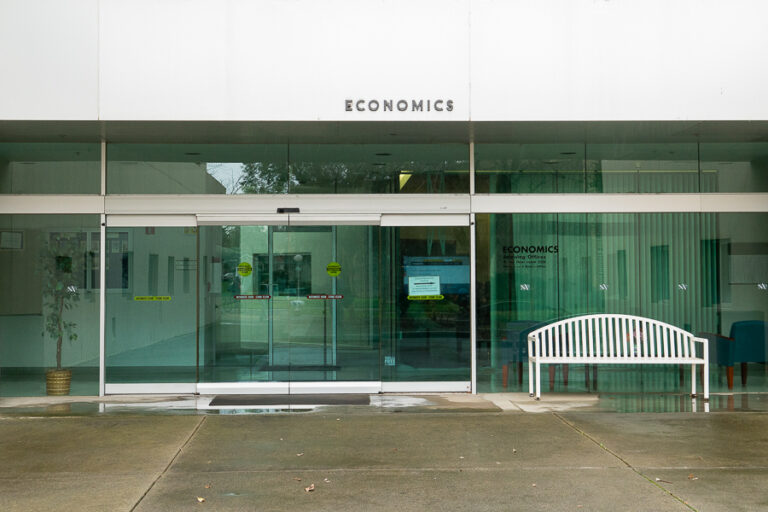
UC Davis has reclassified its undergraduate economics major as a STEM degree, reflecting a trend that brings the university in line with top institutions such as MIT, Columbia and Yale.

The economics degree, though technically still recognized as a Bachelor of Arts, requires students to take courses that test their knowledge of mathematics, data analysis and more. This new classification as a STEM degree is thought to better reflect the content of the major.

Several members of the department view this switch positively, including Dr. Athanasios Geromichalos, an associate professor in the Department of Economics.

“This is very good news for the department and the major,” Geromichalos said via email. “This change reflects the increasingly technical content of our major, which includes required courses in mathematics, statistics, and econometrics and upper-division classes that rely heavily on quantitative skills.”

Another advantage of the change is that it will allow international students the opportunity to obtain a three-year extension of their visas after graduation.

Geromichalos noted that “these students will not only obtain a high quality degree, but also possibly some working experience in the U.S. after graduation.”

The U.S. Citizenship and Immigration Services website describes a program called Optional Practical Training (OPT), which allows students with an F-1 visa to be temporarily employed for up to 12 months after graduation. It notes, however, that if students earn a degree in certain STEM fields, they have the potential to qualify for an additional 24-month extension.

Classifying economics as a STEM major will allow international students the opportunity to apply for the additional two years in the United States, as opposed to the standard one year for non-STEM degrees.

As far as the process of reclassification goes, Dr. Giovanni Peri, the Department Chair for the Department of Economics, says it has been smooth thus far.

“We had to essentially show that economics has evolved into a deeply quantitative type of major and discipline,” Peri said. “In fact, we have increased the amount of math and statistics done, and the quantitative classes in economics, such as 100A, 100B, 102 and 140, have become more and more prominent in the major.”

This news, though exciting for the department, may come as frustrating for individuals who are already far along into an alternate STEM major. UC Davis students pursuing a degree in the field of economics have a choice between a Bachelor of Arts in economics or a Bachelor of Science in managerial economics.

Some opt for managerial economics because of the perceived prestige they feel is associated with a B.S. title. Labeling the regular economics major as a STEM degree, however, gives it the weight that many feel a B.S. seems to bear.

“I’m pretty frustrated I guess, because I really wanted to major in economics but wanted to graduate with a B.S.,” said Olivia Jones, a third-year managerial economics major. “I feel like a STEM degree is essentially the same thing, and I definitely wish I knew this was coming for the economics major before I fully committed to managerial economics.”

Although managerial economics is a B.S., it has yet to be recognized by the university as an official STEM degree. After news of the reclassification of economics emerged, many managerial economics students took it upon themselves to express their frustration with a petition titled “Make Managerial Economics major at UC Davis a STEM major!”

The petition’s main argument makes the claim that without a STEM title, international students majoring in managerial economics are not eligible for the additional visa extension, even though the major is technically a B.S. The supporters also assert that the nature of the major is primarily STEM, and thus should be reclassified as such.

The petition was signed by 40 individuals, and the most recent update shows that the plea gained recognition from the department, which is taking the appropriate actions to make the change.

Written by: Claire Dodd — campus@theaggie.org

Eight new microwaves in the CoHo reduce waiting time

No more CoHo microwave lines

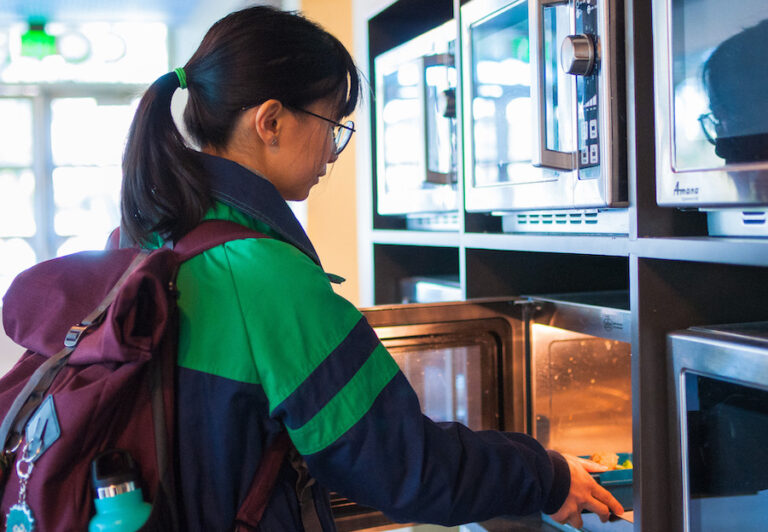
Eight new microwaves were recently installed in the UC Davis CoHo, significantly reducing wait times for students who bring lunch from home. Several students have mentioned their satisfaction with the new installation and have indicated the benefits and ease of mind that the new microwaves bring.

The project, which was over a year in the making, originally began in 2017 when student leaders approached CoHo Director Darin Schleup and MU Director Janna Tolla to discuss the need for new microwaves. Schleup said the two microwaves that were previously offered weren’t sufficient to meet student demand.

It can be difficult to understand what the majority of students truly need and want, but when multiple students reached out asking for additional microwaves, Tolla said it was a sign that the project would be beneficial for the population.

“It came up to us in several different ways — that way we know that it matters to the student population at large,” Tolla said.

Finding an appropriate location for the additional microwaves was one of the major problems that popped up even before the process began. Tolla and Schleup realized that the original spot did not have the electrical capacity to hold all the new microwaves, prompting them to search for a new location.

“We worked with campus unions and the Memorial Union team to fund the construction of the casework [cabinetry] and pulling of the electrical to support the addition of six more microwaves,” Schleup said.

In response to the length of time needed to complete the project, Tolla said that although it may have felt like a long time from the student perspective, “we were pretty pleased with the process.” With campus projects, regardless of what the project is, there are always steps that need to be completed behind-the-scenes.

“We didn’t hit any major snags that would have caused us to be delayed,” she said.

Schleup also said that the project “was ultimately completed in a very professional manner by the facilities team here on campus.”

Overall, Schleup and Tolla said they are satisfied with the finished project.

Second-year cognitive science major Elizabeth Chaves expressed how the microwaves have made “life easier” when bringing lunch to campus.

“The new microwaves are nice,” she said. “It gives you ease of mind that you won’t have to wait a long time or ultimately eat your food cold, which is very nice.”

Written by: Alexis Lopez-Perez — campus@theaggie.org

ASUCD no longer member of UC Student Association with no plans to rejoin

UCSA cites $15,000 fee in decision to no longer recognize ASUCD as member in good standing

The UC Student Association has voted to no longer recognize ASUCD as a member in good standing with the association until ASUCD pays the full amount of the $15,970.78 debt it owes UCSA in full. ASUCD President Michael Gofman and External Vice President Edgar Masias-Malagon said ASUCD was not consulted in this decision, a claim UCSA officials deny.

UCSA has also suspended ASUCD’s attendance privileges at UCSA’s four annual conferences, “including the upcoming 2019 Student Lobby Conference, unless payment of past due invoices are received before the first registration deadline,” a UCSA press release states. ASUCD’s privileges will be re-established once the full payment is received.

Although the debt will be paid back in full, according to Masias-Malagon, ASUCD will not rejoin UCSA in the foreseeable future. UCSA advocates and lobbies on behalf of all UC students and is comprised of student leaders from different UC campuses.

Masias-Malagon estimated the membership fee for UCSA was around $40,000, an amount ASUCD is unable to pay. ASUCD, unlike other UC associations which are funded primarily by student fees, with money flowing into savings and expenses, is run more like a “traditional business,” Gofman said.

“They don’t have a CoHo, they don’t have Unitrans, they just have money flowing in,” he said. “We have to balance our income flows. Most of our expenses are salaries because we have so many student workers. Our budget overall may be significantly larger than most other UC’s if not all of them, but in terms of how much of that money is moveable, it’s the smallest.”

UCSA, informed of ASUCD’s financial restraints, gave ASUCD a 90 percent waiver. So instead of a $40,000 membership fee, ASUCD’s fee was reduced to $4,000. That amount, however, does not include the fees of attending UCSA conferences.

According to the press release sent by UCSA announcing its decision and detailing ASUCD’s debt, the outstanding $15,970.78 debt owed is comprised of the 90 percent subsidized yearly dues, $4,400 of registration fees from the UC Student Lobby Conference and $3,960 of registration fees and $3,612.18 of lodging fees at the UC Student Organizing Summit.

“UC Davis has failed to pay or respond to requests about payment for the small portion of their total share that ASUCD representatives previously promised to pay,” the UCSA press release stated. “We regret to have to take interventive measures at this time, but can no longer responsibly cover ASUCD’s financial commitments.”

Masias-Malagon said the full amount owed would be processed and paid to UCSA by Feb. 15. An email that same day from UCSA President Caroline Siegel-Singh said that ASUCD “has arranged to pay back three of the four invoices but is still attempting to continue to negotiate down their 10% dues contribution.”

The press release from UCSA sent to The California Aggie and others on Feb. 10 was the result of a decision made at the mandatory monthly board meeting which took place at UC Santa Barbara on Feb. 9. Masias-Malagon said no UC Davis student was able to go because of “midterms, papers or conflicting events occurring that weekend representative.” He said he  messaged UCSA’s executive director the day of the meeting, saying the money would be received in full by Feb. 15.

While Masias-Malagon said UCSA’s decision to essentially censure ASUCD was done in a “really shady way” in his opinion, and while Gofman said the decision came as a complete surprise, Siegel-Singh said ASUCD “was notified several times since August of this year that there were outstanding debts.”

“The ASUCD representatives chose not to attend the mandatory monthly board meeting […] without any notice that they would not be there,” Siegel-Singh said. “It was unfortunate that ASUCD reps missed this meeting because a mid-year budget review including what to do about outstanding debts was on the agenda. Had they noticed their absence in advance, we may have been able to make arrangements to include them in discussion.”

Masias-Malagon acknowledged that UCSA was not notified. From his perspective, he thinks one reason why the decision was made so hastily was because UCSA was trying to make an example out of ASUCD to other UC campuses that might also have outstanding debts. Siegel-Singh said, however, that ASUCD “is the only association still in debt for over 90 days.”

“We did feel that it was important for students to know why they would not be able to participate in upcoming statewide conferences like the Student Lobby Conference (SLC) and Students of Color Conference (SOCC) if ASUCD does not arrange to pay all of their debts,” she said, explaining why a press release was sent out regarding the decision.

Although ASUCD will again be in good standing once the money is received by UCSA, ASUCD’s constitution does not allow UCSA to be recognized as a partner if it falls into bad standing and voting rights are lost. So the moment the UCSA decision was made and letter was sent, Masias-Malagon said, ASUCD effectively withdrew its membership.

“We didn’t actually take the active step in leaving,” Gofman said. “That being said, now that we’ve left, I do not foresee us rejoining, at least not in the foreseeable future.”

A discussion over whether UC Davis students care about being a member of UCSA has begun following these recent events. Both Masias-Malagon and Gofman said they feel students have little awareness of UCSA and the work it does and most likely feel indifferent about whether or not ASUCD is a member.

Siegel-Singh said whether or not campuses choose to be members, UCSA is still recognized by the state and the UC Regents as the official voice for all UC students.

“UCD students still benefited from the fee rollback we won last year, from expanded housing projects to keep pace with enrollment, and from additional mental health counselors we advocates for,” she explained. “We will not change our advocacy to say that these wins should only go to our dues paying members. UCD should engage in UCSA because our advocacy is more informed and effective if we work together.”

Both Gofman and Masias-Malagon also said, however, that students do care about attending UCSA conferences. ASUCD does not have to be a member to continue sending students to these conferences. Siegel-Singh added that UCSA subsidizes the cost of conferences for dues-paying members, “so the cost for UCD attendance will go up if they do not choose to participate.”

Paying the full debt to UCSA means spending the entirety of the budget Masias-Malagon oversees. And because it appears as if UC Davis students will not be able to participate in either the upcoming Student Lobbying and Students of Color conferences, Masias-Malagon said he plans to organize UC Davis’ own Students of Color Conference to make up for missing UCSA’s.

“It’s disappointing as an EVP to have to go back to your students and say, ‘We can’t attend this conference,’” he said. “At the end of the day, we just can’t afford it. At this point moving forward, the money will be paid and we’ll be in good standing, but I don’t see, at least this year, returning back to UCSA. That’s a discussion maybe we’ll need to be having with the next EVP in the fall.”

Currently, UCSA and ASUCD officials are parting ways, but “parting on a good foot,” Masias-Malagon said.

“We want to be able to part ways and have the ability to come back,” Masias-Malagon said. “But this year, we just simply can’t afford it. We put all of our pennies in one project and that’s it.”

Written by: Hannah Holzer — campus@theaggie.org

Protesters shut down ASUCD Candidate Debate

All candidates leave event in solidarity, join in with protesters

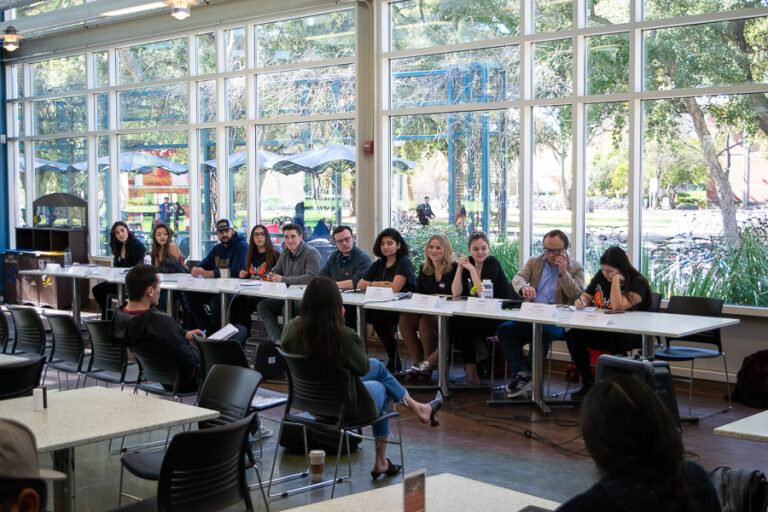
The semi-annual ASUCD Candidate Debate was held the morning of Feb. 19, the first day of the 2019 Winter Elections. There are 12 prospective senatorial candidates running for six open positions on either the Unite! or BASED slates. There are also two executive tickets running for the presidential and vice presidential positions from both slates.

The debate, which took place at the CoHo, began with the candidates present introducing themselves and explaining their platforms. Candidates addressed questions such as “what is the difference between a committee and a commission” and asked about working with the association’s budget.

Third-year managerial economic major Andre Spinoglio, running on the Unite! slate, serves as the current ASUCD Business and Finance chair and has extensive experience working with the budget. In this position, he has witnessed first-hand the lack of knowledge there is in the association about the handling of the budget. He emphasized the importance of budget hearings and said, if elected, he wants to make the hearings process run more smoothly and ensure elected officials are better informed about financial operations.

Questions were taken from the audience, the first of which accused the Unite! slate of being anti-Black and of other discriminatory acts and behaviors. Second-year English major Victoria Choi, running on the Unite! slate said she felt the question was hostile but also said she supports UC Davis students.

Another member of the audience asked the candidates where they would like to see changes made in the association. Fourth-year English major George Liao, running with Unite!, said he wants to see more of an effort made by elected officials to attend community meetings.

Third-year political science major Perla Ornelas, running with the BASED slate, also addressed the question, saying that as a member of the Chicanx/Latinx community, she would like to see greater outreach to underserved communities.

“There’s a lack of presence of ASUCD at the Chi center,” Ornelas said. “I’ve been here for three years and it really took me three years to know that I could […] run [as a] candidate or vote and have my voice heard.”

Third-year sociology and Chicana/o Studies double major Anna Estrada, running with BASED, said she would like to see a greater push for more mental health resources.

A member from the audience asked the candidates to address an action taken by the association they disagreed with.

“Something I really disagreed with was the way the Ethnic and Cultural Affairs Commission handled the reaction to the Natalie Corona officer shooting,” said third-year managerial economics major Arjan Singh Heer, running on the Unite! Slate. “As a person of color, I totally understand the fear of law enforcement because I share that fear sometimes. But the fact of the matter is a young woman, not too much older to us and local to the area died.”

The candidates were asked how they would show support for undocumented students on campus if elected.

Karolina Rodriguez, a first-year political science and Chicana/o studies double major running on the BASED slate, said ASUCD should be aware that a lot of undocumented students don’t feel comfortable and safe with a police presence on campus and this presence should be limited.

During Liao’s answer to this question about undocumented students, a group of student protesters began chanting “What do we do when we’re under attack? Stand up fight back.” Liao stopped speaking, and the protesters began chanting “Join us.”

“We want the candidates to speak on the anti-Blackness within the association, so as students running, what will you do to ensure that black students on this campus feel safe?” one of the student protesters, holding a large banner with the words “F*** ICE,” said into a megaphone.

The same student protester referenced an executive candidate who they claimed had made racist comments.

“I really want to thank y’all for showing up, this is amazing and this is exactly the type of student advocacy and student activism that needs to be supported on this campus,” said third-year cognitive science and sociology double major Shreya Deshpande, running for vice president on the BASED slate. “No hatred should be tolerated. I’m here in solidarity and I’m going to walk out with this entire rally right now.”

Deshpande then stood up and left the table.

Shondreya Landrum, a third-year political science and cognitive science double major running on the BASED slate, then addressed the protesters.

“Thank you all for coming out, as you can see, I am Black,” she said. “Being on campus is so hard sometimes, it’s so hard to walk around and not feel safe. If I don’t speak up, if we don’t speak up, nothing will ever be said.”

Estrada, a self-identified Latina, also said she stands in solidarity with every student on campus and left the table.

“As a white man, I can’t really claim to be an ally if I don’t stand up for this type of thing and join y’all,” said fourth-year evolution and international relations double major Justin Hurst, running for president on the BASED slate.

One by one, members of the BASED voiced their support with the protesters and left in solidarity.

“You ask us how we’re going to be different, I’m going to show you how we’re going to be different,” Hacker said. “I’m joining too.”

After Hacker left, all of the Unite! candidates followed suit. The last to leave was Liao, who finished his response to the question about undocumented students, saying every student has a right to study at UC Davis, “no matter where you come from.”

With no candidates left sitting at the table, the debate was cancelled. The group of student protesters and the candidates exited the CoHo, chanting “What do we want? Justice. When do we want it? Now. And if we don’t get it? Shut it down.”

Written by: Alexis Lopez-Perez and Hannah Holzer — campus@theaggie.org


Arrest of intruder living in Art Building who may have also sexually assaulted, harassed, stolen, vandalized

Police found stolen art supplies, projects, citation for trespassing in ransacked professor’s office

An individual by the name of Nicholas Chavez was arrested on Feb. 21 on charges of felony vandalism. Prior to his arrest, Chavez had been occupying a professor’s office in the Art Building on campus for several weeks without notice, according to several accounts from students and staff in the Art Department who work in or attend class in the Art Building on campus, located near Mrak Hall and Shields Library.

Chavez, identified as a “transient person” and neither a UC Davis student or staff member, had also loitered in the Music Building and Wright Hall. UC Davis police responded to a report at 4 a.m. on Feb. 21 after a student reported “damage to an office door” in the Art Building, according to a UC Davis news article.

“Nicholas Chavez was found asleep in the office and arrested and transported to Yolo County jail,” the article states.

Chavez first attracted attention when he allegedly sexually assaulted fourth-year art studio major Stephanie Lee while she was in the building last Fall Quarter. The police arrested Chavez soon after the sexual assault incident occurred, but Lee said she did not know she had to decide to press charges only moments after identifying Chavez at the police station. Since she took time to decide whether or not to press charges, the police released Chavez.

Throughout this quarter, art students’ art supplies and projects have gone missing, a second, separate student was sexually harassed and the bathrooms were graffitied, according to students in the Art Department. Shortly after the sexual harassment incident with a separate female student, Lee received emails about an unauthorized visitor in the art building that matched the name of the individual she identified at the police station. The unauthorized visitor has been living in the office of Professor Julie Wyman, who is currently on sabbatical.

Individuals in the art department were given a description of Chavez: a 5’10” white male with shoulder-length curly hair.

Lee said she later realized there was a connection between her assault and certain incidents occurring in the Art Building this quarter. But once she came to that realization, Chavez was no longer in police custody.

A town hall was held in Wright Theatre on Feb. 13 to address the recent events regarding Chavez.
Among the speakers present were Lieutenants Bill Beermann and Mike Green of the UC Davis Campus Police Department, Danesha Nichols from the Harassment and Discrimination Assistance and Prevention Program, interim counseling director Paul Kim and Jennifer Chow, an assistant director at the Office of Student Support and Judicial Affairs.
Beermann began the town hall by recapping the events that began in November of last year, referencing the Lee’s assault by Chavez. Chavez had previously been kicked off campus property and was told to not return for seven days. That agreement was broken, leading to their arrest, but not for the crime committed against the student.

Lee notified advisors about the re-emergence of this individual who sexually assaulted her last quarter, yet she said that there has been no significant response to her report.

“The university released an email last quarter to me, specifically saying that because this unauthorized visitor — Nick — is not a member of staff, faculty or students, they don’t have any jurisdiction over him and his actions,” Lee said. “I believe the police issued a seven-day restraining order on him, but, to my knowledge, those are pretty much useless because the only consequence for breaking those is getting one reissued.”

Before the Feb. 21 arrest, Lee said she had decided to move forward with pressing charges against Chavez because she thought police would not be able to arrest him for the recent incidents of stealing, allegedly sexually harassing a separate student and living on the third floor of the Art Building because the evidence linking him to these allegations is circumstantial.

“I decided to prosecute even though it’s kind of difficult and it’s going to cost me time and money and transportation and all that, which I don’t have, but it’s something that needs to be done,” she said.

And Beermann said the case is still open with hopes that a resolution will be reached soon, as a warrent for the subject’s arrest was placed the week before this town hall.
Since the assault, Lee said her life has been significantly affected, especially in light of the recurring emergence of Chavez. She stopped staying late after classes and working overnight in the studio. This affected her ability to get her work done and achieve academic success. Professionally, Lee’s job in the art office has her feeling uncomfortable in fear that Chavez will walk in someday.

“Everyone’s just really scared and we just want to know that something’s being done,” Lee said. “We want to make sure that people aren’t just walking around in danger.”

An art student who wished to remain anonymous said that they no longer felt safe in the building after police were unable to locate Chavez after he reportedly made slurping and kissing sounds at a female student.

“I still went back days and days after the event occurred but I’m not the same afterwards because I’ll be in there and it’ll be quiet and I’ll just hear the slightest sound and it’ll trigger me,” the student said. “I’ll turn around, and I’ll be freaked out and I’ll be expecting to see somebody. Even when I take my friend with me and she’ll be just spacing out looking in the direction of the door, I’ll get freaked out because I’ll think she’s looking at him.”

Jesse Vasquez, the lab assistant for the photo areas in the Art Building, echoed concerns that not enough has been done to resolve this situation even after staff and students have followed police directions.

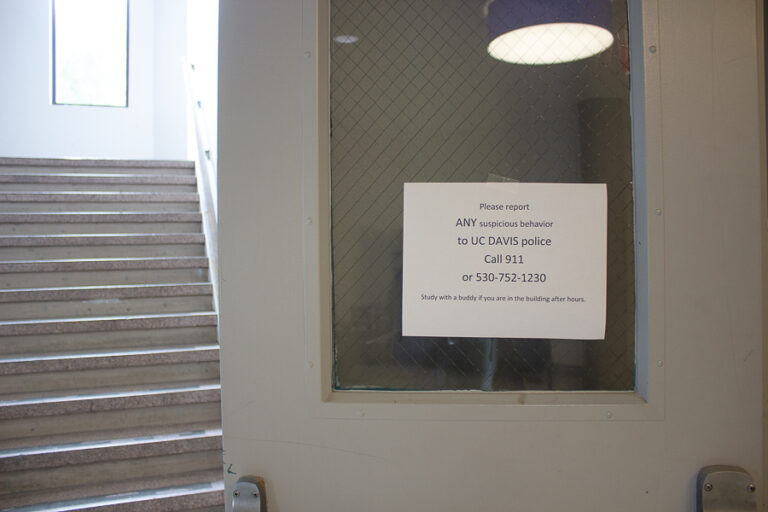
“It doesn’t seem like they’re taking the severity of this [into consideration],” Vasquez said. “The student body’s been very upset and they’re feeling quite abandoned. [The police have] been putting out these alerts that aren’t really getting to anybody. We put up a bunch of signs saying call the police if you see anything suspicious. I wanted to have something that had this guy’s description, his full name and a picture — which the cops have — which they haven’t released.”

Students expressed frustration during the town hall with the lack of information being shared by campus police. At the town hall on Feb. 13, Beermann and Green repeatedly told students that since it’s an open case, not much can be said about it. Beermann agreed to try and increase foot patrols in and around the art building, but explained it simply isn’t possible for someone to be there constantly.

Another reason students felt uneasy is the fact they don’t know what the intruder looked like, but again, police were unwilling to share such information from an open case. What Green and Beermann proposed instead is a line up containing several photographs so as not to single out the intruder.

In an interview with The California Aggie, Vasquez explained that students were scared because of the access Chavez has to their studio and the disregard he displayed of the no-trespassing citation issued before many of the incidents occured this quarter.

None of the emails informing the Art Department of the situation included information about the sexual assault and harassment incidents and only mentioned that Chavez is an unauthorized visitor, Vasquez said.

After a female supervisor sent out an email, Vasquez followed up with an email of his own, acknowledging the sexual assault and harassment aspect that was being left out.

“She got back to me immediately saying that she felt like I’m undermining her,” Vasquez said. “That’s not my intention, but the information is not out and people are not going to be taking it for the urgency. I think it deserves if the information is not there.”

Only students within the art department received a notification about an unauthorized visitor, despite the fact that classes for many different departments are scheduled in the Art Building.

In response to the lack of a campus-wide email sent out to inform students and staff about the situation, UC Davis’ Director of News and Media Relations Melissa Blouin said via email that a campus-wide notification was not sent because the individual was not viewed as a current threat.

“A transient person has been causing some issues in the Art and Music buildings as well as Wright Hall,” Blouin said. “Recently, it was discovered that this same person had been in the Art building a few months ago and allegedly grabbed a student. At that time, he was taken to jail for trespassing. No campus notification was sent at the time because the person was in jail and therefore not an imminent threat.”

Blouin was unable to provide additional details because the investigation is ongoing. UCDPD did not respond to request for comment at the time of publication of this article.

Written by: Sabrina Habchi — campus@theaggie.org

Campus News reporter Deana Medina also contributed to this report. Portions of this story which appear here, reflecting the most recent updates concerning this situation, were not included in the print edition.

Couch Concert: Lillian Frances

Filmed and Edited by: Trevor Goodman – tmgoodman@ucdavis.edu

Contribution by: Susannah Zellers, Myranda Gudino, and Justin Han

Ignorance is no excuse for blackface

It’s time to educate ourselves about black history

At the beginning of February, a month dedicated to paying tribute to the oft-unrecognized achievements of black people throughout American history, Gucci’s website displayed a model donning a sweater that was sourly reminiscent of blackface. The distasteful sweater, a black turtleneck that extended to the bridge of the nose and featured a red-lined cutout for the mouth, rightfully caused uproar on social media, compelling Gucci to remove the sweater from its physical and online stores and issue an apology to consumers. In its apology, the Gucci team stated that it is transforming this incident of racism into a “powerful learning moment.”

This is an all-too-familiar refrain. Earlier this month, Virginia’s governor admitted to having unknowingly worn blackface at a college party and last year, a daytime talk show host casually normalized wearing blackface on Halloween. The chronic and recurring nature of these incidents, as well as the continually recycled excuse of blissful ignorance, is alarming. Even more alarming, the person accused usually chalks the incident up to an enlightening learning experience, a problematic trend due to its underlying presumption that there is some sort of rigorous learning curve when it comes to refraining from blatant racism.

If the use of blackface, which once prospered on the American stage in minstrel shows and fully immersed white audiences in a repulsive cocktail of racial subjugation and offensive stereotypes for comedic entertainment, persists to this day, what does that say about our awareness of black identity? What does it say about the usefulness of American education in closing the gap in knowledge between historical and contemporary racism? If the apologies administered by Gucci and others are any indication, American educational institutions have been lax in teaching black history in its entirety, and Americans have been equally as complacent in accepting these meager helpings of history.

The instances of racist imagery that rear their ugly head every other month cannot be dismissed as mere ignorance or as simply being “out of touch.” The perpetuation of blackface by powerful brands, such as Gucci, are instead reflective of an active willingness to be ignorant.

Many on social media called for more hiring of black people to prevent this and similar instances from happening again, and Gucci has also vowed to implement more diversity hiring for their design team after the incident. While it is absolutely critical for companies to be inclusive and employ a diverse team of staff and Gucci is no exception, it is also problematic to depend on staffers of color to serve as the sole filter for potentially racist imagery that could be propagated by the brand. Everyone, no matter their racial or cultural background, should know and understand that blackface is wrong.

There is no admissible excuse for being culturally insensitive. In light of Black History Month, let’s devote more energy and resources into having conversations acknowledging and vehemently condemning blackface, as well as learning more about the pivotal black figures who have shaped our world. If you feel that cultural awareness is an area in which you are lacking, The Editorial Board urges you to be proactive. Consider signing up for an African American studies class next quarter or do independent research at home. Now is the time to combat America’s lingering racism.

Written by: The Editorial Board