55.4 F
Davis

Davis, California

Monday, December 22, 2025
Home Blog Page 454

2019 ASUCD Winter Elections: Meet the candidates

Two executive tickets, 14 senatorial candidates running this quarter

The following candidates are running in ASUCD’s 2019 Winter Elections for elected official positions in student government. Two senatorial candidates were not interviewed — one plans to drop out of the race and the other did not respond to interview requests. There are two executive tickets from the slates BASED and Unite! and every Senate candidate is running with either of these two slates.

In addition to the candidates running for elected office, the Unitrans Undergraduate Fee Referendum will also appear on the ballot. Students will have the opportunity to vote on whether or not to increase the quarterly fee they pay to fund Unitrans, which is facing a mounting budget deficit and might be forced to cut services if the referendum is unsuccessful.

Elections will take place from Feb. 19 to 22.

Alisha Hacker & Sydney Hack — Unite!

Second-year political science — public service major Alisha Hacker, a current ASUCD senator who has served as pro tempore for two quarters, and third-year political science — public service major Sydney Hack, who has previously served as a Senate staffer, vice chair of the Judicial Council and, most recently, an interim senator, are running as the Unite! slate’s executive ticket as president and vice president, respectively.

Hacker and Hack’s platforms are focused on addressing students’ basic needs by improving transportation to and from campus, working with the city to increase affordable housing options and expanding what The Pantry provides in terms of basic needs by stocking feminine hygiene products and school supplies.

“The two of us would be ready to hit the ground running the first day of office,” Hacker said.

Justin Hurst & Shreya Deshpande — BASED

Justin Hurst, a fourth-year evolution and international relations double major, and Shreya Deshpande, a third-year cognitive science and sociology double major, are running as the BASED slate’s executive ticket as president and vice president, respectively. Hurst is the chair of the Academic Affairs Commission and Deshpande as the former chief of staff for a senator and is currently a member of the Ethnic and Cultural Affairs Commission Chair. Their main objectives if elected include implementing both structural and priority changes within ASUCD.

Hurst and Deshpande both feel that the opinions of students are underrepresented in student government, particularly those of minority groups. They would like to implement a culture change within ASUCD by working more with student communities instead of against them.

“Students really are the backbone of this school,” Deshpande said. “We need to be there, giving them the platform to say what it is they believe in. That’s what we’re here to try and change.”

Rebecca Gonzalez

Running on the BASED slate, Rebecca Gonzalez is a fourth-year international relations major. Her platforms include reliable and accessible transportation to and from campus, transparency in UC Davis administration and wellbeing of students. She supports the Unitrans fee referendum and expressed interest in adopting either Unitrans or The Pantry.

As a former intern at the California State Capitol, Gonzalez said she has a “passion for public service.” In this position, she advocated for more representation of women and people of color in ASUCD and a culture of respect and communication on the table. Gonzalez said she is not active in many spheres on campus, but highlighted her capitol internship and time she spends off campus working on her family ranch. As a senior, Gonzalez would have to resign if she were to graduate before her term ends — she said via email that she will work to achieve her platforms “in the time frame I am given.”

Anna Estrada

Third-year sociology and Chicana/Chicano Studies double major Anna Estrada is running with the BASED slate on three platforms focused on promoting mental wellness, destigmatizing the terms “transfer student” and “first-generation” and combatting discrimination on campus.

If elected, Estrada has plans to work alongside the Mental Health Initiative to create a designated mental wellness room where students can go to decompress and also hopes to collaborate with the Ethnic and Cultural Affairs Commission and the Academic Affairs Commission to support transfer and first-generation students more.

Estrada, involved on campus in a number of ways including with La Raza Pre-Law Student Association, the Latina interest sorority Sigma Omega Nu, the Youth Empowerment Program and Scholars Promoting Education Awareness and Knowledge, is running for Senate because she thinks the Chicanx/Latinx community needs a representative. She hopes to “ensure there’s justice across every community and space.”

Victoria Choi

Second-year English major Victoria Choi is running on the Unite! slate with three major platforms: increasing ASUCD outreach efforts to the greater student body, increasing awareness and resources for philanthropic programs and supporting registered student organizations.

Choi has both internal and external experience working with ASUCD. She worked as a staffer for former Senator Jake Sedgley and is the Student Organization Fair and Special Events Director of Picnic Day this year, previously serving as assistant director.

By utilizing the ways students interact with ASUCD on an everyday basis — at the CoHo, Bike Barn and on Unitrans buses — Choi hopes to establish a more positive image for the association. Working to establish herself as a moderate candidate, Choi also hopes to establish greater collaboration on the table and move away from the toxicity and divisiveness seen in the past.

Justin Weiner

Justin Weiner is a second-year neurobiology-physiology-behavior major running on the Unite! slate with a focus on student health. With the majority of candidates coming from social science backgrounds, Weiner hopes to apply both his STEM perspective and his specialized knowledge as an emergency medical technician when advocating for student health.

One of Weiner’s platform goals includes getting Tipsy Taxi drivers first-aid certified. As an EMT, Weiner regularly deals with intoxicated individuals and knows Tipsy Taxi drivers handle high-risk populations. While current procedure requires that drivers call an ambulance in the event of injury or over-intoxication, Weiner believes first-aid training could help save lives.

Additionally, Weiner wants to create a drug safety course and teach students about drug overdose and over-intoxication. Weiner hopes to tackle the issues associated with drug use by creating a program to educate students to recognize signs of over-intoxication requiring medical attention.

George Liao

George Liao is a fourth-year English major running on the Unite! slate. His three platforms focus on addressing food insecurity on campus, advocating for students with disabilities and improving the college experience for transfer and reentry students.

Liao is a re-entry student and sees himself as a, “very different kind of candidate.” Liao wants to keep the students of UC Davis at the heart of his campaign and focus on his ability to serve the student community.

While Liao does not have experience working directly with ASUCD, he previously worked as a campus news writer for The California Aggie for the past year. As a writer, Liao had a great deal of experience covering Senate meetings and writing about both internal and external issues facing the association.

Karolina Rodriguez

Karolina Rodriguez is a first-year political science and Chicana/Chicano studies double major running on the BASED slate. She has three platforms based on advocacy: advocating for marginalized communities, advocating for student health and wellness and advocating for transparency. Already active in the Student Resource and Retention Center, Rodriguez said that she is exposed to the problems students of various backgrounds face. On her second platform, she specifically mentioned the negative feelings that a large police presence can have on certain communities on campus. Finally, she wants ASUCD to be transparent and work for students, saying she sees the Senate as “an outlet for [students] to be heard.”

Rodriguez’s other campus involvements include being a member in MEChA, the Chi Omega sorority, and United Students Against Sweatshops.

Jamila Alani

Fourth-year international relations major Jamila Alani is running on the BASED slate in the hopes of creating a more inclusive environment within UC Davis. Her platforms include increasing support for first-generation college students and developing workshops for campus leaders to help them express their opinions.

Alani is a participant in several campus organizations, which she feels has prepared her for the role of senator. She is the director of inclusion and diversity and treasurer for the American Association of University Women, a United Nations Millennium Fellow at the UC Davis cohort, a member of Davis Women in Business and a member of the student steering committee for the Global Education For All initiative.

As a first-generation college student, she says that navigating the college system was difficult both academically and emotionally. If elected, she plans to work with the First Generation Initiative and the undergraduate research center to find an effective support solution for these students.  

Perla Ornelas

Perla Ornelas is a third-year political science major running with the BASED slate. Ornelas also identifies as a member of the Chicanx/Latinx community. Her platforms include improving safety on campus, improving transparency between ASUCD and the student body and bringing a Chicanx/Latinx perspective to Senate.

Although she is new to the world of student government, Ornelas has been learning about the process through different workshops and commission meetings. She wants to implement a series of free self-defense workshops and distribute pepper spray to the student body.

“Davis is now officially a Hispanic Serving Institute, and to not have someone on ASUCD is crazy to me,” Ornelas said. “We’re such a big part of the student body, and there’s no one representing or translating our thoughts and opinions [currently].”

Arjan Singh Heer

Arjan Singh Heer, a third-year managerial economics is running on the Unite! slate with three major platforms focused food security, connecting with students through the association and financial accountability. Singh hopes to work with The Pantry and the Yolo Food Bank to expand the food products currently offered to students who are food insecure.

On campus, Singh is the vice president of the Sikh Cultural Association, a brother in the fraternity Alpha Gamma Rho and a TA for applied biotechnology classes. Singh wants students to know he is goal-oriented and pragmatic.

Andre Spinoglio

Andre Spinoglio is a third-year managerial economic major running on the Unite! slate. Spinoglio currently serves as ASUCD Business and Finance Commission Chair and, going forward, he hopes to translate his experience working in this position to the Senate table to increase fiscal understanding. As B&F chair, he is currently working with ASUCD units to establish their long-range plans.

Spinoglio’s platform focuses on increasing ASUCD outreach on campus. As a member of Greek life, Spinoglio hopes to increase collaboration between ASUCD and the Office of Sorority and Fraternity Life. Spinoglio has been meeting with leaders of Greek Life to collaborate on future philanthropic events to raise money and awareness for ASUCD on campus.

Spinoglio is passionate about changing the culture of the ASUCD Senate. As B&F chair, Spinoglio has seen conflict on the table first-hand and hopes to recenter the Senate’s main focus back to solving the issues affecting students.

Shondreya Landrum

Shondreya Landrum is a third-year political science and cognitive science double major running on the BASED slate. She has a four-pronged platform focused on ensuring the safety of all students on campus, promoting zero hate and discrimination on campus, protecting underrepresented communities and maintaining ASUCD accountability.

Landrum hopes to increase the number of Blue Lights on campus. Currently, UC Davis has the fewest number of blue lights of any UC campus despite being the largest UC campus in terms of acreage. Landrum also wants to create a more visible space on campus where students can access safety resources.

Sahiba Kaur

Third-year managerial economics major Sahiba Kaur is a transfer student running on the BASED slate. Her platforms include students success and wellness, increasing transfer student engagement and environmental justice. Kaur was previously the president of the Associated Students of Delta College where she found value in engaging with the campus community and, upon coming to UC Davis, knew she wanted to join ASUCD.

Her specific platform action items include increasing awareness and efforts to help students who live in their vehicles, working with the External Affairs Commission and Ethnic and Cultural Affairs Commission to tackle housing discrimination in Davis, building a transfer student resource coalition and working with the Environmental Policy and Planning Commission toward making UC Davis herbicide free. Since coming to Davis in Fall Quarter, Kaur has revived the UC Davis chapter of the American Association of University Women, an organization she has been involved with since seventh grade.

Written by: Ally Russell, Claire Dodd and Kenton Goldsby

Campus News Editor Hannah Holzer also contributed to this report.

Comeback victory gives Aggies fifth win in a row

0

Fueled by clutch play from senior forward Garrison Goode, UC Davis able to overcome double-digit deficit in surge toward March playoffs

Heading into Saturday night’s game against Long Beach State, the UC Davis men’s basketball team had won its previous four matchups. After starting off conference play with a 1-4 record, the Aggies had bounced back to 5-4, climbing to fifth in the Big West standings.

The previous bout against Long Beach State did not go in UC Davis’ favor, and the team lost at the very end of regulation in Southern California. Saturday night, however, the Aggies got their chance at redemption.

Senior forward AJ John checked into the game only three minutes after the beginning of regulation, providing Davis with an instant spark off the bench. In his first offensive possession, John beat his defender, cutting to the basket and hitting an easy layup.

In the ensuing minutes, John racked up a block, a three pointer, a tough rebound and an assist to senior guard TJ Shorts II, who was able to put up his only points of the night. Shorts suffered an injury in the first half and was not able to return to the ballgame but did witness most of the second half from the bench while wearing a brace on his left leg, supporting and helping in any way possible.

Despite plenty of energy from across the lineup, the Aggies were outmatched in the first period by a spirited 49er squad. At halftime, UC Davis trailed 41-33.

Senior guard Siler Schneider started off the second half on a positive note for the Aggies, hitting a three and then forcing a travel on Long Beach. Behind the tough defense and three-point shooting of junior guards Rogers Printup and Stefan Gonzalez, UC Davis crawled its way back into contention.

With the lead going back and forth, UC Davis trailed by two points with two and a half minutes left. Senior forward Garrison Goode sunk two free throws to tie the game and was fouled again on the following possession, giving him another pair of free throws, one of which he made.

On the ensuing Long Beach possession, Schneider was able to force a turnover and come up with the steal. He eventually found Goode standing all alone underneath the basket for a wide-open layup to put the Aggies ahead by three.

Goode came up big a minute later, when he was able to swat the ball to the top of the key following a missed shot by Schneider. Junior guard Joe Mooney was able to collect the loose ball and closed the game out with a pair of free throws. The Aggies emerged victorious, 77-73, following a 44-point second half.

After the game, Mooney remarked that he wasn’t surprised that the Aggies were at the line as much as they were.

“That’s kind of a thing when we play Long Beach: a lot of fouls,” Mooney said.

He added that the win was important and that it’s “all about playing well at the right time.”

Head Coach Jim Les was beaming with pride after Saturday’s come-from-behind victory. Les believed that it was the Aggies’ uncharacteristic defensive mistakes in the first half that caused them to fall behind early.

“To start the game […] I thought we were really passive defensively,” Les said. “We gave them way too much room, way too much space and they got into a real comfort zone. It was all about our defense; we were just a little out of character with our defensive pressure, execution and energy at the end of the floor and it cost us.”

Only when the Aggies locked in for the second half did they find success shutting down the Long Beach offense. Once they did, Les couldn’t have been happier with the way his team responded after Shorts’ injury and came away with a much-needed win. He was thrilled with how many different contributors there were, highlighted by junior guard Stefan Gonzalez’s career-high scoring night.

“I’m really proud of this team,” Les said. “It was an emotional group in the locker room at halftime seeing TJ and how emotional and distraught he was, rightfully so, knowing that he wasn’t going to be back on the floor.”

“I thought the guys, in honor of TJ — who’s been a warrior for them and for us the last year and a half — tried to pay him back with their response in the second half, because they had every excuse to lay down and maybe give this game away, but they fought and executed and made some tough plays,” Les said. “As I told them, ‘Good teams find a way to win when they don’t play well’ and I didnt think we played well at all. To scratch and claw and win a game, that’s what they did tonight and we haven’t done that all year so that was a step in the right direction.”

With this win under their belt and now sitting fourth in the Big West standings, the Aggies will travel to Cal State Fullerton on Thursday night.

Reflecting on the future and expectations for this team going forward, Goode said he looks forward to the next contest.

“It’s gonna be a good game on Thursday, looking forward to that one,” he said. “When it comes down to it, we just gotta play our basketball and we’ll play pretty well.”

UC Davis will play their last two away games of the regular season in the upcoming two games, then will close the season out with four consecutive home games. The next home game will be against top-ranked UC Irvine on Feb. 28.

Written by: AJ Seymour — sports@theaggie.org

ASUCD office hours

ALLYSON KO / AGGIE

Humor: Woman with crush on Ted Bundy has deathly fear of ladybugs

President of the Bundy fan club shares her undying love

It seems as though everyone these days is buzzing about Bundy. In an effort to stay hip with the kids, The California Aggie secured an interview with Siri Ullman, president of the Ted Bundy fan club. We asked Ullman for her opinion on the media’s recent obsession with the famed serial killer.

“I’m just glad people are finally recognizing my dear Teddy’s impact on society,” Ullman swooned. “The fact that it took this long for people to take an interest in Bundy — now that’s the true crime. I was obsessed with him before it was cool. But of corpse, er, of course I am dying to share my love of Ted with everyone else.”

Ullman showed us her Bundy collectibles, including pins, photographs and restraining orders from Bundy’s daughter.

We asked Ullman for her opinion on the controversial casting of Zac Efron in the upcoming Bundy biopic.

“I think Zac is the perfect actor to play Ted! Ted was known for his good looks, and I think Efron’s got the face and acting skills to give a heart-stopping performance. I’m sure he’ll take our breath away. I don’t see a problem with Zac Efron being too buff, either. My Teddy was a real strong guy. I wish he was still around today, so he could protect me from…” Ullman’s voice trailed off, and she shivered before continuing: “…from them.”

“From whom?”

At that moment, Ullman let out a bloodcurdling scream and pointed behind us.

“THEM!”

Two ladybugs had landed on the windowpane and were milling about the glass.

“Those are the devil’s creatures,” Ullman whispered. “They are extremely wicked, shockingly evil and vile!”

We asked Ullman how she became a lady bugged by ladybugs.

“It all started in the first grade. I was reading ‘The Grouchy Ladybug,’ and I found out that ladybugs murder and eat dozens of aphids for their own gratification. The horror! Can you imagine how all those poor little aphids felt, being the victims of said buggy’s lunch? Think of their families! They’ll never see their aphid daughters ever again!”

“Oh, and before I forget, go see the new Bundy flick. I’m sure it’s going to be very accurate to how Ted really was. I really hope he takes his shirt off, so we can see some killer abs!”

Written by: Madeline Kumagai — mskumagai@ucdavis.edu

(This article is humor and/or satire, and its content is purely fictional. The story and the names of “sources” are fictionalized.)

It’s not about hugging trees

Events in Joshua Tree National Park show how little we care about our environment

Imagine this headline: Off-roading vehicle enters restricted area during middle of night at full speed, crashes and kills innocent bystander.

Gut-wrenching, right? You’d probably think, “Arrest this lunatic!”

What if I were to tell you that this innocent bystander was not a person, but a Joshua tree? Do you feel less sympathetic now? You wouldn’t be alone — it’s human nature.

Perhaps one of the reasons we’ve made it so far as a species is our selfishness. But at what point does it go too far? Where is the line between appreciating nature and ruining it?

Perhaps technology is to blame for our distant relationship with nature. Social media blinds us from seeing the value of these magnificent beings. Some of these veteran trees have been standing on this earth since Columbus set foot in North America. Instead of admiring them, we treat these Joshua trees like they’re our playground and destroy them merely for the instant gratification of likes on social media. We have lost touch with what it means to not only appreciate, but respect nature.

Our entertainment includes TV shows about people surviving in the wilderness, pitting humans against nature. Modern appreciation of nature no longer resembles the reverence of the past, when people like Theodore Roosevelt stood in awe at “the wonderful grandeur, the sublimity, the loneliness and beauty” of the Grand Canyon, which he declared a national monument in 1908.

In the wake of the government shutdown, National Park rangers all over the country returned to their posts to find destruction everywhere: graffiti, vandalism, bathrooms covered in human feces, animal theft and destroyed habitats and trees.

The government shutdown came at an inopportune time for Joshua Tree National Park. The park was surging in popularity with 2.8 million visitors in 2017, and 22,000 visitors just on Thanksgiving. The influx of people is great for surrounding communities, pumping $123 million into local businesses like restaurants and hotels.

While these local economic benefits are important, keeping the park closed could have prevented these damages. The park’s management ultimately decided to side with monetary motives over the health of the park.

The damages done to Joshua Tree National Park in the 35-day government shutdown will take 200 to 300 years to recover, according to the park’s Superintendent Curt Sauer.

Joshua trees may look sturdy, but they actually have shallow root systems that depend on healthy soil and microorganisms to grow. So, you can see how an off-roading vehicle might affect this delicate ecosystem, especially when driving through 24 miles of restricted park area.

Additionally, Joshua trees are going through what might be their last years on Earth because of climate change. Rising temperatures are pushing organisms further up north toward cooler climates, leaving the Joshua tree behind in inhospitable conditions.  

One of the species leaving is the yucca moth. This moth works all of its adult life pollinating the Joshua trees’ flowers without getting any benefit in return. The yucca moth — already a weak flier — struggles taking the Joshua tree seed to other habitats, leaving their young to nourish off the Joshua tree’s flower.

This beautiful coexistence is hanging on a thread because of our inability to value our environment. And you’d be a fool to think we’re any different.

Written by: Daniel Oropeza — daoropeza@ucdavis.edu

Disclaimer: The views and opinions expressed by individual columnists belong to the columnists alone and do not necessarily indicate the views and opinions held by The California Aggie.

How do you solve a problem like Maduro?

So long, farewell? Or is Maduro not the problem?

Since National Assembly leader Juan Guaidó declared himself interim president of Venezuela last month, news of Venezuela’s escalating political and economic crisis has been difficult to avoid.

While writing this piece, I attempted to avoid it for just a little while, choosing to rest my exhausted mind and clean the muck off of my geopolitical-deep-wading boots by visiting a favorite Facebook group of mine called “Pretentious Classical Music Elitists,” where I giddily clicked on a post that read, “Most pretentious opinions of Brahms?”

To my disappointment and bemusement, the first comment said, “Maduro was democratically elected and Guaidó is an [sic] US puppet.”

This comment sums up one of two general interpretations of what is currently playing out in Venezuela, the other being that President Nicolás Maduro is an oppressive authoritarian dictator who must be ousted, while Guaidó is Venezuelan democracy’s only hope. Well, which is it? As BBC asked, is Maduro a dictator or a defender of socialism?

Many elements of both arguments ring true, creating an exceedingly difficult situation for the international community to properly handle. Nations are divided over whether to support Guaidó and the Venezuelan opposition or Maduro, who was elected to a second term in 2018. However, a collapsing economy, massive protests and allegations of increasingly autocratic behavior from Maduro have made it difficult for nations and individuals to remain neutral.

It’s interesting to note the change in rhetoric from Gustavo Dudamel, the world-renowned charismatic conductor of the Los Angeles Philharmonic and one of Venezuela’s most successful and well-known expats. In the past, Dudamel has proudly not talked politics and been criticized for not distancing himself from the government. However, Dudamel chose to speak out in May 2017, saying “enough is enough,” after a young violist was killed in street protests by Venezuelan security forces.

In July 2017, Dudamel followed-up with a piece in the New York Times criticizing the Venezuelan government’s call for a national constituent assembly that would have the power “not only to rewrite the Constitution but also to dissolve state institutions.” Maduro promptly cancelled a tour Dudamel had planned in the United States with the National Youth Orchestra of Venezuela, adding, “I hope God forgives you.”

In his piece, Dudamel expressed great “anguish and pain” over at least 90 protestors being killed during the 2017 protests (dozens more have been killed this year, and the UN reports that security forces killed hundreds in 2018). It’s easy to sympathize with Dudamel’s sadness over these killings, but a different quote of his from 2017 stands out most to me because of its relevance to today’s conversation about Venezuelan sovereignty. Dudamel says that the government’s call for a national constituent assembly “exacerbates the existing conflict and social tensions” and demonstrates that the Venezuelan Constitution “has not been respected.”

This quote is particularly interesting because Dudamel identifies where all the ambiguity lies today: what actions best respect the Venezuelan Constitution and Venezuelan sovereignty? This ambiguity is what has caused split opinions within the United States over whether Maduro should stay or be removed from power. While the United States government has now formally recognized Guaidó as the interim president of Venezuela, many Americans think that this move compromises Venezuelan sovereignty.

***

On Friday, Feb. 8, there was an event held in Sacramento called, “Hands off Venezuela! Rally against Trump’s Coup,” hosted by eight different groups, including the Party for Socialism and Liberation and ANSWER Coalition. A national march is planned for March 16. During the week before the Sacramento event, ANSWER Coalition organizer Patricia Gorky spoke about the groups’ objectives and reasons for being against U.S. intervention in Venezuela.

“Venezuela as a country has been so demonized that even people who consider themselves very liberal or progressive are aligning themselves with the likes of Trump, Pompeo and Bolton,” Gorky said. “We must explain that the Venezuelan people have the right to choose their own leaders, and that the U.S. needs to immediately lift the sanctions and blockade they have slammed onto the Venezuelan people.”

It’s true that the long-running demonization of Venezuela has made it easier for Americans to find themselves siding with those who want Maduro out, but these people must remember that U.S. policies, not just “EVIL SOCIALISM,” are largely responsible for the current economic crisis. Thus, U.S. actions in Venezuela are most likely motivated far more strongly by American corporate and economic interests than Venezuelan democratic interests. However, people who support Maduro need to keep in mind that even if democratic socialism is good for Venezuela, Maduro and his authoritarian tendencies may not be.

In other words, people holding these opposing opinions have much to learn from each other. Unfortunately, the tendency toward swift and decisive decision-making has already left no room in the polarized media conversation for learning, or for my view that you can support democratic socialism in Venezuela while being skeptical of both Maduro and U.S. intervention. While this triad of opinions is rhetorically and realistically impractical, I hold them because they account for what I see as gaps in the arguments of both sides. Nonetheless, these opinions also lead me to the conclusion that U.S. intervention is not what is best for the Venezuelan people.

First, how could democratic socialism be good for the country when the economy is tanking, with inflation at over 1 million percent? Again, it’s crucial to remember that since the grass roots Bolivarian Revolution began two decades ago, there have been many successful social policies, and that much of the economic crisis has been caused by outside influences. Gorky helped make this case.

“Under Chavez there have been major improvements in the quality of life for the country’s poor,” Gorky said. “The Gini-coefficient (measuring the income difference between the rich and poor) has been lowered and social improvements in the form of health, education, alimentation, sports, culture and on a range of other fields have been significant.”

Gustavo Dudamel wrote of how the government has recently expanded the reach of El Sistema, the government-financed classical music education program, increasing the number of children participating from 500,000 to 700,000.

Gorky says that these good efforts have occurred despite long-running campaigns by the U.S. to sabotage Venezuela’s socialist government and economy — campaigns that they think the U.S. media has neglected to properly cover.

“Today in the news the corporate media is in a tizzy because Venezuela blocked ‘aid’ coming from Colombia, never mentioning that such aid is a pittance compared to what the Venezuela has been deprived of by the economic war against it being waged by the U.S. and its own billionaires,” Gorky said.

Gorky says that this is part of a long pattern of the U.S. “clearly” trying to overthrow Venezuela’s government, citing U.S. sanctions and alleging U.S. involvement in past coup and assassination attempts against both Maduro and his predecessor Hugo Chavez. Jamier Sale, another organizer for ANSWER Coalition, said that this continued U.S. intervention is directly tied to U.S. economic interests, supporting my argument that the current U.S. actions are probably not primarily about democracy.

“The U.S. is attempting a coup because it has economic interests in Venezuela’s oil and gold reserves that are among the largest in the world,” Sale said. “Continued U.S. interference in Venezuela is preventing the economic benefits of these natural resources from going to the Venezuelan people.”

Sale also explained why U.S. meddling of any sort is bad for Venezuela, regardless of whether Maduro should or shouldn’t be president, and why the U.S. needs to recognize Venezuelan sovereignty.

“For other nations to recognize Guaidó, the leader of the National Assembly, as the president, after Maduro was elected would be like if other countries suddenly decided to recognize Nancy Pelosi as the President of the U.S.,” Sale said. “I think that even Americans who don’t like Trump would not want that type of confusion to happen here.”

Gorky says that Guaidó represents a “violent right-wing” and that he has “plans to privatize Venezuela’s vast oil, gold and gas wealth and hand them over to Exxon.” Gorky also discussed the “manufacturing” of Guaidó and dismissively referred to the “opposition” with quotation marks, saying that the “disillusioned” Venezuelans are just the “tiny elite” of “rich and wealthy capitalists” who can no longer “make exorbitant profits off of the backs of the Venezuelan working class.”

But it’s dangerous to dismiss opposition when there clearly are other reasons for being disillusioned with Maduro. For example, many family members and political allies of Maduro have been either accused or convicted of colluding with cartels while the U.S. Treasury has said that Maduro’s government is using the drug trade to enrich itself. While many have been skeptical of the allegations of rigged national elections due to insufficient evidence, clearer corroboration has emerged on the local scale, which could suggest a fraudulent pattern. Additionally, Maduro’s special police force, the FAES, has been extrajudicially killing dozens in nightly raids to crush dissent in poor neighborhoods. And at hospitals across the country, the government has “enforced a near-total blackout of health statistics” and “culture in which doctors are often afraid to register cases and deaths that may be associated with the government’s failures,” especially regarding children dying from malnutrition.

For these reasons, it is reasonable to be against Maduro but still for Venezuelan socialism and sovereignty. Both Sale and Gorky did qualify their support for the Bolivarian Revolution by saying that what’s important is not whether they support one Venezuelan candidate over the other, but that Venezuelans, not the U.S., chose their leader.

Nonetheless, Sale and Gorky did say that allegations of “authoritarianism” and “human rights abuses” from Maduro are hypocritical, citing “authoritarian” U.S. military, policing, incarceration and environmental practices, as well as the fact that the U.S. seems to be singling-out just Venezuela for “authoritarianism.”

“I think it’s hypocritical to focus on potential human rights abuses in Venezuela as a pretext for intervention when there are things just as bad or worse happening in Columbia, in Brazil, in Mexico,” Sale said. “We should work through these problems in the UN. That’s what it’s there for.”

This is a very convoluted situation, and it’s easy to get stuck debating whether the U.S. is merely facilitating to help “repressed” Venezuelans chose a new leader, or if the U.S. is actively ousting the leader Venezuelans already chose. The impossibility of answering this question again leads to the conclusion that the U.S. is more motivated by economic interests, and that a hands-off approach from the U.S. is probably what’s best for Venezuelans.

Guaidó could offer a ray of hope to Venezuelans dissatisfied with Maduro’s socialist government, but Guaidó himself may be more representative of a far-right opposition that could inflict new problems on the country. So regardless of the implications for the Venezuelan people and rule of law, the U.S. seems to be teeing up another coup-like maneuver. Whether you support this or not, it’s hard at this point to argue that democratic objectives are motivating America as much as the economic one of bringing the U.S. back to [Latin American] dough.

Written by: Benjamin Porter — bbporter@ucdavis.edu

Disclaimer: The views and opinions expressed by individual columnists belong to the columnists alone and do not necessarily indicate the views and opinions held by The California Aggie.

Designing a major just for you

0

Weighing the benefits and drawbacks of creating your own major

Creating an individual major might sound like a good idea, allowing for total autonomy over your studies and a finite understanding of subject matter that inspires you. That being said, Kate Creveling, an academic advisor from the College of Letters and Science, cautions that constructing a major is not for the faint of heart. The process of designing a major takes extensive time and energy that Creveling believes may be better spent pursuing other advancement options.

Because the major designing process is a long and grueling one, students are often unwilling to pursue this option.

“It is a lot of work for students” Creveling said. “It is almost as if they are creating their own masters course work.”

Creveling believes that students who are interested in pursuing this option often don’t know what they are getting themselves into when beginning the process. There are many negatives that coincide with a creating an individual major, one of which is its limiting nature. Students trying to create individual majors often run into the issue that the College of Letters and Science is the only college that offers the create-your-own major option, therefore the coursework chosen must be mostly offered by this particular college. Creveling believes this can be a hindering factor for students hoping to create a major which combines very different disciplines.

“We could not support a music engineering major, for example, because they would be required to take at least half of the classes in a different college” Creveling said.

According to Creveling, however, if a student can make it through the process, they will likely come out of it with new skills and opportunities. In order to design an individual major, a student must research extensively about the classes they plan to take, giving them an understanding of their subject matter and total control over their own path.

A comprehensive action plan and consistent communication are essential for success. These are skills that Creveling believes students can put to good use in future projects and careers.

“In order to do this you have to engage, think critically and come up with curriculum” Creveling said.

Designing a major is also a way to make personal relationships connections with faculty. While many students aim to avoid interaction with professors altogether, individual major students do not have this option. The key to designing a major is obtaining faculty support and finding professors who will take the steps with the student to reach the final result.

“Finding a faculty member on our campus who can support a student’s endeavor is the most important” Creveling said. “At the end of the day, it is a faculty committee that is going to vote on the major’s approval.”

Through this process, students develop personal relationships with professors which may provide opportunities that they may not have otherwise gotten.

“By making relationships with faculty they are setting themselves up for success” Creveling said.  

One reservation students have in pursuing an individual major is that their diploma won’t state the name of their designed major, but rather it will say “individual major.” For students, this provokes concern about whether or not they will be taken seriously when applying for graduate school or jobs.

“The diploma is going to say ‘individual major’,” Creveling said. “So what I often tell students is that their time may be better used applying for masters programs that has the type of program they are looking for.”

On the other hand, having ‘individual major’ on your diploma has its benefits when applying for graduate school. In a graduate school interview, a student may be asked to describe their individual major, in turn giving them an opportunity to discuss the initiative they took in pursuing their passions.

“I think creating an individual major shows a lot of initiative,” Creveling said.

According to Creveling, there is not a lot of difference between completing an individual major and pursuing a masters degree. She often prompts students to consider graduate school as their primary option, but remains sympathetic towards factors that may inhibit them.

“Certainly time and money are factors,” Creveling said. “But if you have enough passion to create this program, it seems a graduate program would be the next natural step anyway.”

Regardless, because each student is unique, Creveling maintains that this is a great option for students who passionately want to pursue it.

“If they have a distinct passion and they fit all these parameters we definitely want to give them this option,” Creveling said.

While creating an individual major has positive and negative factors, the option is there for a reason. For students who are extra motivated to determine their own path, having the ability to design their college experience is one they feel will take them further. Creveling believes that dedication and willingness to work hard are the only ways to find success in designing a major. Students who want to pursue this need to be “very self motivated and have really thought it out.”

Written by: Miki Wayne — features@theaggie.org

15-year-old alumnus receives prestigious award at Vatican

0

Tanishq Abraham awarded for outstanding achievement in STEM fields

In 2001, the International Association of Culture and Voluntary Work created the International Giuseppe Sciacca award sponsored by the Vatican, which distinguishes individuals who have contributed in the fields of science, arts, technology and humanitarian work. In addition to individual awards given out to individuals that excel in their specialties, an overall winner, Vincitore Assoluto, is chosen by the association. Over the past 17 years, the winner of the Vincitore Assoluto has been someone who has exemplified educational and moral excellence.

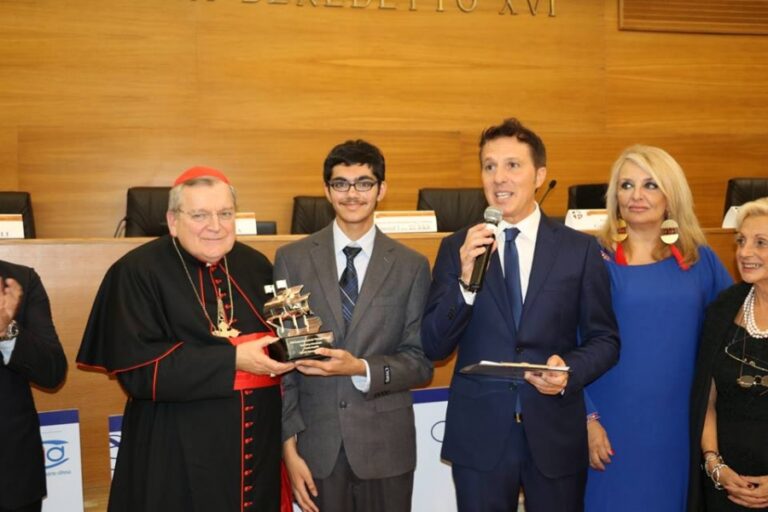
On Oct. 27, 2018 15 year-old UC Davis alumnus Tanishq Abraham was awarded the Vincitore Assoluto award. Abraham, along with his parents and his 12-year-old sister, Tiara Abraham (who also won an award), took a trip to the Vatican to receive their honors.

“There were many different categories for the awards like science, math and music and my sister actually also won an award for music,” Abraham said. “The absolute award is chosen from different categories, which is what I was nominated for and won.”

The ceremony takes place at Pontifical Urbaniana University and is attended by over 550 guest including awardees and their families, government and military officials, dignitaries and press from around the world.

Last spring, Abraham graduated from Davis with a degree in biomedical engineering. In the fall of 2018, Abraham began his higher education studies and is now pursuing a Ph.D. at UC Davis. During his two years at Davis as an undergraduate, Abraham participated in the annual make-a-thon, researched artificial cells in a campus laboratory, presented his research at multiple conference and published a literature paper. Abraham was honored as the Absolute Winner due to his inspiring determination to contribute to scientific advancement at such a young age. Abraham has influenced people around the world with his passion for science and humility.

“After graduating Davis and [having] summer break I was rotating in labs and this past fall, I completed my first quarter as a grad student at Davis and its been going really well […] it’s been exciting to get to work on projects again,” Abraham said. “I received an email in April notifying me that I had gotten a reward called the Giuseppe Sciacca award […] I was honored to receive the award, and my family and I were invited to receive the award at the Vatican in late October. It was super exciting because it was my first time visiting the Vatican, and I got to meet a lot of distinguished people at the ceremony.”

Also awarded in the youth category was Abraham’s younger sister, Tiara, a 12-year-old music prodigy. Tiara started her musical career at the age of five and has performed in multiple world-renowned concert halls such as Carnegie Hall and Musikverein (Vienna, Austria). Tiara is the youngest member of the UC Davis University Chorus and hopes to follow in her brother’s footsteps and pursue higher education at Davis.

Following the award ceremony, the Abraham family attended mass inside St. Peter’s Basilica along with the Pope and 300 cardinals. In addition to their time in the Vatican, the Abraham’s were invited to visit a bollywood set in Greece by bollywood producer Ravi Dhariyal who is another recipient of the Sciacca award.

“I got to meet some really cool people from around the world and it was an honor to be a part of the ceremony and receive the award from the Cardinal,” Abraham said. “Keep working hard and follow your passion and [know] that you are having fun doing it.”

Written by: Sneha Ramachandran — features@theaggie.org

Yard Sales

How tidying up can be fun, profitable

With the rise of minimalism and Marie Kondo’s new Netflix show “Tidying Up with Marie Kondo,” which stresses decluttering and organization, many people have begun to question the items and clothing they own. They can now ask the famous question, “Does this ‘spark joy’ in my life?” If not, Kondo advises how to get rid of those items.

While many people have turned to online marketplaces such as Davis’ “Free and For Sale” group on Facebook, an online marketplace for buying used items with over 40,000 members, some students have decided to use Facebook as a platform for advertising their own in-person sales. Since Kondo’s show, there has been a rise in sale posts that start with “Marie Kondo made me do it” or “this doesn’t spark joy,” partially joking, but very genuine. While there are subgroups such as “Clothes for Sale” and “Textbook Exchange,” it can often be daunting to post a large amount of items all at once or to organize pickups with a large amount of people.

Returning to the past, students have begun hosting yard sales, using social media to advertise their events and setting up on their lawn to sell a collection of clothes, baked goods, and a variety of other items. These events have also served as ways to engage with the community. As people walk by, chat, look at items and stop to hangout, these yard sales are a nostalgic return to the childhood excitement of finding items to cherish that other people no longer want.

Nadya Eddy, a third-year political science major, hosted a successful yard sale on her lawn that made almost five hundred dollars and plans to hold another one soon.

“I haven’t gotten rid of any clothes I’ve bought since 2015,” Eddy said. “I literally didn’t have any room, so I got rid of half of my closet. I’m a big Hayo Miyazaki movie fan, and I recently just watched “Howl’s Moving Castle,” and there’s a scene where the main character’s clunky hoarder house gets reduced to a little platform when he sheds his emotional baggage, and I felt like I could use some of that. I had the yard sale the next day and made $480 worth of my things.”

For Eddy, word about the event was spread through Facebook posts in different groups, by word of mouth and by people walking by her lawn, which is very close to campus and sits along a popular route for people to stop by on their commute.

Recently, another house had a yard sale titled “Go Yard or Go Home” that used Facebook to invite around 200 people, with the description inviting friends to share the word and invite everyone they know to join in for what was described as a “yard sale/ bake sale/ lawn party/ skill sharing for money (more to come on what this actually means)”. This yard sale took place across the street from the Davis Food Co-Op on G Street and served as a collective house effort.

Cielle Watjen Brown, a fourth-year wildlife fish and biology major, explained their yard sale was an exciting and social way to declutter and make money.

“What inspired the sale was that we have way too many things and no place to put them,” Watjen Brown said. “It went really well in part because we posted on social media and told a bunch of our friends, but a lot of random people came too. We all tried to contribute something, so whether it was clothes or chairs or fresh baked goods, we all had a part in it.”

Watjen Brown also took the opportunity to use the yard sale as gateway into entrepreneurship.

“Some special things about our sale was that it also served as the first time that my roommate and I sold our little granola business ‘Wake the Funk Up,’” Brown said. “We sold our choco-berry flavor and people really liked it, [so much] that we sold all of what we had available, and people even placed more orders for the future. We made some new friends who ended up staying all day and playing music with us towards the end of the sale and trying to make some tips, which was a great way to end the day.”

While these two yard sales differed in their planning and collectivity, they both were extremely successful in making money, decluttering and engaging with the Davis community. It seems that for college students, yard sales are not always the first option for selling clothes due to planning, organization, and the appeal of other options, such as bringing clothes to consignment stores or selling them online. Nonetheless, the yard sale has resurfaced as a reminder that decluttering can be an exciting chance to make money while having a fun event.

Haley Noble, a fourth-year communication and psychology double major, attended Watjen Brown’s yard sale and explained how it was more than just an event for buying clothes.

“I was invited on the Facebook page, and I had never been or heard of a house of Davis students having a yard sale before,” Noble said. “There were good clothes, great food and live music. It started to rain halfway through the sale, and they moved it to the porch until it stopped raining, which was exciting because everyone was having so much fun that they wanted to stay regardless. I bought some of their granola as well which was really good.”

Both Eddy and Watjen Brown plan to host other yard sales because of the popularity of their first attempts and their success may spark the idea for many other yard sales to come. As people walked away, they were heard saying, “This is such a good idea. We should really do this.”

Written by: Rosie Schwarz — arts@theaggie.org

Police Logs

0

Pizza weaponry

January 30

“Subject sleeping in front of main entrance to civic center.”

“Yolobus nearly hit reporting party while she was riding her bike. Reporting party confronted the driver who refused to apologize. Bus stopped at bus stop in area.”

February 1

“Male transient sitting on a bench near the playground with an empty bottle of vodka next to him. Reporting party attempted to provide an umbrella to him and he didn’t respond, but is awake.”

“Reporting party is in her vehicle, watching a male subject take other bike tires off bikes and putting them on his bike wearing a hat, black jacket, baggy pants, bike with red with basket on the front.”

“Transient walking around inside playing music, reporting party asked the subject to stop and the subject opened a frozen pizza and threw it.”

February 3

“Roommate entered room and started punching him, broke his glasses and other property — roommate angry with him over having a party last week no medical attention, roommate back in his own room.”

February 6

“Male subject refusing to leave the bathroom, has been locked inside for over 30 minutes.”

What’s a union? Here’s what you need to know.

General functions, benefits of a labor union

Better working conditions, higher pay, health insurance, job security and a voice in the employment process — these are some of the benefits that unions aim to secure for the employees they represent.

There are myriad unions across the country that look out for the best interests of their members. The American Federation of State, County and Municipal Employees Local 3299 (AFSCME), which represents over 25,000 UC employees, is one such union.

John de Los Angeles, a PR representative for AFSCME 3299, said that a union is “working people standing together for the purposes of ensuring that their best interests are being represented.” This is achieved through collective bargaining with employers.

Last October, AFSCME 3299-represented employees participated in their second three-day strike after over a year and a half of negotiations with the UC failed to result in a mutually-agreeable contract. Strikes are a last-ditch effort by unions in which employees withhold labor and forego pay to place pressure on employers in hopes that their demands will be met.

“In [regard] to the UC situation, one of the biggest issues is job security itself: what good is a wage or a benefit if your job is outsourced?” de Los Angeles said. “We want to make sure that the university is committed to equal opportunity standards and address outsourcing.”

AFSCME 3299 in particular is fighting for job security and against outsourcing. When the UC outsources labor, “they push the average market wage down outside,” de Los Angeles explained. He added that when jobs are outsourced, the individuals who obtain these jobs without representation are negatively affected as well.

“When we are advocating for represented workers, we are fighting for underrepresented workers; when we get a good deal, they get a good deal,” he said.

When asked about the benefits that come with being unionized, John Rundin, a classics lecturer and a site representative coordinator for University Council-American Federation of Teachers Unit 17 (UC-AFT), which represents UC librarians, said that “without unions it’s just up to the whim of the boss” and workers have no say in how they are treated.

“If you don’t have a union and if your boss doesn’t violate a law, the boss can do whatever they want,” Rundin said. “There is no recourse if they don’t break the law.”

Labor unions have a simple structure in that they function like a democracy. Workers hold elections and vote for officers who will make decisions on their behalf. Many unions also engage in lobbying efforts and participate in local or even national elections.

The work that union officers do as part of their positions, as well as other union expenditures, are typically covered by union fees — monthly fees that all members of the union are required to pay.

Rundin explained that although there are certain employees who choose not to be involved in a union’s activities, they might still benefit from the union’s work because, “by law, unions typically must represent everyone who is in a given job.”

No matter the size of the union, the rights of the union members and the responsibilities of the union officers are protected and outlined by the Labor Management Reporting Disclosure Act (LMDRA). These rights include freedom of speech, a say in the rates of dues and fees and the right to elect officers and representatives as well as remove them.

Even if an employee has the option to join a union, they might not choose to do so or may have hesitations. Lucy Joseph, the vice president of UC Davis’ local University Professional and Technical Employees (UPTE) CWA 9119, said an individual might be hesitant to join because they are ideologically opposed to the mission of a union.

In response, Joseph said that “everyone should have a say in what happens in their workplace.”

“Relying on the good will of your employer doesn’t always work,” she said.

Rundin, however, had a different approach.

“If you are in a position and you choose not to be in a union, you tell the people that are doing the work in the union [that] their work is worthless,” he said.

Employees might also be hesitant about participating in strikes, but strikes “are always a last resort for unions,” Joseph said.

“When our voices are not being heard, all we can do is withhold our labor,” she explained. “That is our last bargaining chip.”

Written by: Alexis Lopez-Perez  — campus@theaggie.org

Unitrans, CoHo partner for “Get Out the Vote” rally on first day of ASUCD elections

$1 CoHo discount tickets will be distributed to first 1,000 undergraduates who vote

Unitrans drivers will be distributing $1 CoHo discount tickets to the first 1,000 undergraduates who say they have voted in ASUCD’s 2019 Winter Elections, taking place Feb. 19-22, as part of a partnership between Unitrans and the CoHo to get out the vote.

The tickets will be distributed beginning Feb. 19 on Unitrans buses and the elections will kick off the same day with a “Get Out the Vote” rally at 12:30 p.m. in front of the CoHo. The rally will feature a performance from Band-Uh! and Unitrans drivers will also be distributing coupons at the event.

“With only 1,000 discount tickets, supplies will be limited and are first come, first served,” said Unitrans General Manager Jeff Flynn via email. “Just tell a Unitrans driver or conductor that you voted to receive the CoHo discount ticket while supplies last.”

Students can vote for up to six prospective Senate candidates as well as choose from two executive tickets running to be the next president and vice president.

Also on the ballot is the Unitrans Undergraduate Fee Referendum. Facing a growing budget deficit, Unitrans will be forced to cut additional services, including lines and potentially jobs, if the referendum, which would increase the quarterly amount students pay to fund Unitrans, is unsuccessful.

In order for Unitrans’ fee referendum to be successful, 20 percent of the undergraduate student body must vote, and the measure must receive a 60 percent “yes” vote to pass.

Students can vote at https://elections.ucdavis.edu/vote/.

Written by: Hannah Holzer — campus@theaggie.org

Humor: Congress approves federally-funded “Border Wall Tycoon” video game to appease Trump

Build the wall! Virtually!

With the recent government shutdown still on everyone’s minds and Donald Trump recently declaring a national emergency over border security, Congress is under substantial pressure to make a move that appeases all sides. Fortunately, this week, they did just that.

On Monday, Congress approved a single budgetary clause which they believe will solve the border crisis: the “Border Wall Tycoon” clause. This iteration of the United States budget will not only cost Americans less but will also grant Trump the ability to build the wall — or frankly, any wall — he’s always wanted.

The “Border Wall Tycoon” clause ignores previous cost estimates and instead proposes a stipend of $120,000 to an indie game company, entitled Toddler Trump Games. In return, this company will design and release a wall-building simulation game similar to the popular “Tycoon” series of video games. Features will include choosing between different wall materials, such as bricks or steel slats, and deciding whether to use American wall craftsmen, under-the-table illegal immigrant workers or a bonus option, Russian slave laborers sent by Putin himself.

With Border Wall Tycoon, Trump will have full control over the wall-building process like he’s always wanted, allowing him to ignore environmental regulations and force virtual Mexico to pay for it. The simulation will also work in real time, meaning Trump can return to check his computer every day to see how much progress is being made without the stress of actually being present.

“This clause is a shoutout to all the wall-lovers,” said Speaker of the House Nancy Pelosi. “We’ve heard your unnecessarily loud cries about border security, and this Congress is confident that this measure will make everyone happy.”

And based on voting so far, she’s right. Only one Congressman voted “No” on this otherwise unanimously supported version of the budget: House Minority Leader and Certified Douchebag Kevin McCarthy.

“Yes, I voted ‘No,’” McCarthy said. “So what? I can do whatever I want. You think I give a shit about Americans? Get the f*ck out of my face before I strangle you to death, you little nerd.”

The budget will move to the Senate on Wednesday, where it is expected to pass almost unanimously, disregarding Lindsay “Flipflop” Graham’s likely “No” vote due to his natural tendency to say one thing and do another. Many senators are reportedly discussing an addition to the clause — a line stating that if “Trump is a good boy and his wall looks pretty enough,” they’ll “strongly consider” building a real wall along the Southern Border “at already-planned locations.”

Written by: Conner Shaw — cjshaw@ucdavis.edu

(This article is humor and/or satire, and its content is purely fictional. The story and the names of “sources” are fictionalized.)

Review: Russian Doll

Lyonne delves into the universal human experience

Netflix’s new dark comedy “Russian Doll” aired on Feb. 1 and was met with critical acclaim. The show was created by a powerhouse trio including writer and director Leslye Headland, “Orange is the New Black” star Natasha Lyonne and the award winning actress and producer Amy Poehler. Lyonne stars as Nadia Vulvokov, a snarky, loud New Yorker type who, after leaving her 36th birthday party, gets hit by a taxi and dies — all within the first 10 minutes of the series’ pilot episode.

“Russian Doll” loosely follows the format of the 1993 film “Groundhog Day.” Nadia is forced to relive the same day over and over again, stuck in a constant loop that recycles each time she “dies.” With every cycle, she ends up right back where she started — at the bathroom sink in the middle of her birthday party, with Harry Nilsson’s upbeat “Gotta Get Up” playing in the background. The song becomes more ominous and threatening with every loop, instilling dread in the viewer for Nadia’s fate.

The “Groundhog Day” format was recently made popular with the “Happy Death Day” franchise, but this bizarre creation pushes the format beyond what has been seen before. “Russian Doll” is complex, exploring deep and personal quandaries such as the repression of trauma, the intricacies of interpersonal relationships and the profound sense of existential dread one feels as they age.

The complexity of the series relies on constant layering of characterization, which explains the metaphor behind the series title. The concept of the show comes from the Matryoshka doll, or the Russian nesting doll. Matryoshka dolls come in sets, where each wooden figure fits within one another until they are all stacked within the largest doll. The concept of having layers within oneself drives this Netflix original series. As Nadia tries to find a way out of the perpetual loop she is stuck in, she is forced to wrestle with aspects of herself that she buried behind a successful career, loving friends and a strong personality.

One of the highlights of the series is Lyonne’s expert portrayal of Nadia. After six years of playing a compassionate drug addict on “Orange,” Lyonne seems to have mastered the craft of dark comedy. Lyonne can bring weight and levity to particularly bleak scenes and is able to get the audience to laugh when they know they really shouldn’t. While Lyonne’s talent has always been undeniable, “Russian Doll” pushes her to new depths. Lyonne carries the narrative and much of the show’s success can be attributed to her New Yorker charm and expert delivery of both dramatic and comedic lines.

In an interview with the LA Times, Poehler praised Lyonne’s performance.

“She is one of my favorite actors, and I think that this show is a complete tour de force from beginning to end,” Poehler said. “In showing her range, in showing her vulnerability and showing her real, true comedy chops. It’s very hard to have those three.”

The show also stands out due to its all-female writing and directing staff. While Nadia is an incredibly likeable character, the writers ensure that she is also complicated and flawed. They don’t rely on typical stereotypes of femininity; gender does not seem to play a role at all in the series. At its core, the show is about deeply human quandaries, and how Nadia deals with them.

While she works as a software engineer in a male-dominated office, she never feels inferior; though she may be having a midlife crisis, it is not due to the fact that she is single or childless. All the struggles the viewer expects Nadia to have, as a female character, are quickly deflected in the series in order to get to more profound questions about life and the experience of trauma. She seeks to find the meaning of life that transcends typical male or female exploration.

“It was really important to explore a show about a female protagonist that asked spiritual and existential questions,” Headland explained in an interview with Variety.

Although the series constantly loops one day over and over again, it’s undeniably fresh. Lyonne and the writers keep viewers on their toes as each episode never quite plays out the way viewers expect. While Lyonne carries the show, the supporting cast is brilliant as well. Charlie Barnett plays Alan Zaveri, a man Nadia meets halfway through the series when the two literally die in an elevator together. Alan’s humorous indifference to being in a plummeting elevator tips Nadia off, and she discovers that Alan is stuck in the same loop that she is.

Barnett’s performance is subtle, and may be overlooked at times behind Lyonne’s scene-stealing energy, but is nonetheless intricate and poignant. The two become an unassuming duo, and develop a sweet relationship that, refreshingly, does not become romantic.

“[Alan’s] basically a child that the universe has tasked me with babysitting” Nadia explains in one episode to a confused friend. Alan concedes that it is a fair description.

The two seek to understand why the universe has lined their fates together, while also managing their own traumas and personal issues.

The series also stars Greta Lee as Nadia’s friend and the host of Nadia’s birthday party. Yul Vazquez is Nadia’s ex-boyfriend who, while not literally, seems to be stuck in his own cycle of destruction as he desperately tries to win Nadia back.

The show is delightful, poignant and deeply frustrating. The viewer feels the most satisfying form of dread as they experience Nadia’s perpetual loops. One can sympathize with Nadia’s and Alan’s trauma but also hope desperately that they overcome their circumstances by dealing with their problems.

Elizabeth Ashley plays Ruth Brenner in the series, a therapist and Nadia’s surrogate mother. She has known Nadia since she was a child and upon noticing her distress in one of the many loops, she sits Nadia down and the two discuss a traumatic moment in Nadia’s childhood.

“You were this tiny seed buried in the darkness fighting your way to the light,” Ruth explained to Nadia. “Where is that gorgeous piece of you pushing to be a part of this world?”

At its core, that is what this bizarre and utterly unexplainable show is about: Nadia discovering what it is about life that made her once want to live it so desperately. Lyonne herself is open about her almost fatal struggles with addiction, and Nadia seems to reflect the desire to find a purpose and meaning behind the daily minutiae of life. Just like a Matryoshka doll, that small part of her that once found meaning in it all still dwells within. The ultimate battle in the series is trying to uncover it.

Written by: Alyssa Ilsley — arts@theaggie.org

Review: Chay Corner

Vegan take on Asian cuisine opens inside Lazi Cow

Chay Corner, a pop-up eatery located inside of the popular boba and dessert shop Lazi Cow on G Street, had its grand opening on Jan. 19. Chay Corner specializes in Asian cuisine that is entirely free of animal products. Menus for the vegan eatery are available alongside Lazi Cow’s menus at the front register, and purchases for both can be made in one order.

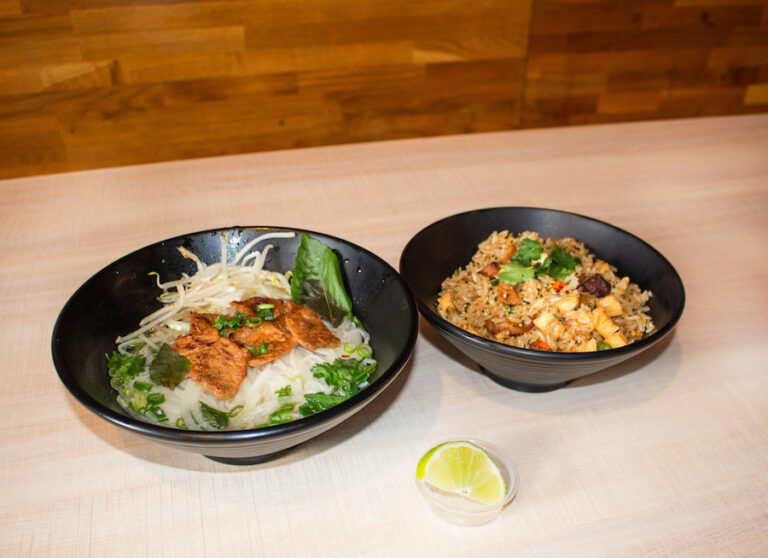
Chay Corner offers fried spring rolls, five different spice-fried tofu appetizers and three types of bánh mì, a Vietnamese sandwich. The spring rolls were fresh and perfectly crispy, pairing nicely with the sweet chili sauce. The Grilled Goodness bánh mì was especially delicious. Unlike many meat substitutes, the bánh mì’s garlic and lemongrass-marinated imitation pork had a convincing texture and packed a surprising amount of flavor. All three bánh mì are served with vegan mayo-butter, jalapeños, pickled vegetables, cilantro and house marinade.

In addition to bánh mì, Chay Corner serves imitation beef phở, miso ramen, Japanese curry and fried rice. Chay Corner also offers four vegan drinks including Vietnamese coffee and milk teas, all prepared with organic soy creamer.

Chay Corner is refreshing because it offers more options for those with dietary restrictions. While their food is prepared in the same kitchen as Lazi Cow’s non-vegan menu, the kitchen area is divided and cleaned to avoid cross-contamination.

Chay Corner is reasonably priced for the freshness and high quality of ingredients. Both appetizers are $6 and the bánh mì and rice dishes are $9 each. Both noodle dishes cost $11. Drinks are $5 without toppings, making them comparable to what Lazi Cow charges for its non-vegan tea drinks.

With the addition of Chay Corner, Lazi Cow is a great place for mixed company. Lazi Cow serves an array of creative boba milk teas, rolled ice cream and brick toast, as well as alcoholic tea drinks for those over 21. Lazi Cow previously did not offer many vegan food options, but Chay Corner fixes that.

The atmosphere of Lazi Cow and Chay Corner is relaxed. Customers can sip tea on an indoor swing or savor a bánh mì on a bench shaped like a cow, making the restaurant café a popular hangout spot. Lazi Cow has ample seating and space. Students are welcome to study, collaborate on projects, and socialize.

Lazi Cow is already a Davis favorite, and so far, Chay Corner has been well-received by the Davis community. Its Yelp reviews are positive. Those who have had bad experiences with vegan cuisine or have never been exposed to it may be hesitant to try Chay Corner. However, considering how flavorful their food is, it’s surprising that there’s no meat or dairy in it at all. Anyone who is uneasy about trying meat substitutes can’t go wrong ordering one of the tofu dishes.

As Davis becomes increasingly involved in healthy and environmentally-conscious practices, Chay Corner represents a general shift toward meat-free and dairy-free eating. A hidden gem, Chay Corner is a fantastic addition to Lazi Cow and the community in general. It has the same hours as Lazi Cow — open from 3 p.m. to 12 a.m. on weekdays, and 12 p.m. to 12 a.m. on weekends.

Written by: Cheyenne Wiseman  – arts@theaggie.org