58.6 F
Davis

Davis, California

Monday, December 22, 2025
Home Blog Page 455

Student survival guide: Mykaiah Clermont

0

The five-year journey of Mykaiah Clermont

When Mykaiah Clermont started his journey as a first-year, he described himself as a “yes man,” looking to be involved in every and any way possible. Now a fifth-year civil and environmental engineering major, Clermont has experienced the ups and downs that have humbled him and kept him in line. He hopes his story will shed light on the realities and remedies of the college experience.

“I did everything I possibly could have wanted to do,” Clermont said. “I made the one mistake of taking 18 units my first quarter — not a good choice. I joined seven different clubs; I would spend so many hours outside of my dorm, and I was doing so much. I was with club soccer, club tennis, I also got involved in Band-Uh, all these different clubs.”

One of Clermont’s biggest challenges was finding time to be with his core group of friends. Being so involved meant he was meeting so many new people. With classes to juggle and a social life to maintain, Clermont struggled with giving everyone a share of his time.

“The hardest thing was that I didn’t have much down time,” Clermont said. “I would get maybe four or five hours of sleep. I didn’t really take care of myself. I wanted to do everything and please everyone. Looking back, I can definitely say that I did everything I wanted to do, but I should have taken my time and spaced things out throughout my entire year.”

Though Clermont learned valuable lessons about balance his first year, he still finds that, in his fifth year, he is learning more about himself and using the extra time he has in school to get what he wants out of the experience.

“This year has been the most revealing year of what I feel like I’m capable of,” Clermont said. “Mental health is a real big thing that people don’t take into consideration. In high school, we used to be able to do it all: wake up at 5:30, get to school by 7, go all the way through your day until 3, do any extracurriculars and still manage to get A’s in all our classes. In college, it’s a lot more stressful in the aspect of there being a lot more work with less class time to do it in. I feel like I push a lot of stuff off in order to take care of other things, and I get behind and feel overwhelmed.”

Clermont stressed that students should look into campus resources including Student Counseling and Health Services, something he believes is a huge benefit for anyone that needs to let off some steam in the midst of a stressful quarter. He described his fourth and fifth years as revelations, and this crucial year has allowed him to allocate time where he sees fit, taking care of what’s important to him and his well-being.

During his academic journey, Clermont was planning to graduate on time alongside his peers but described the hardship that lead to his fifth-year position.

“I originally was a triple major in my sophomore and junior year, doing mechanical engineering, aerospace engineering, and biological system engineering, and that was not fun,” Clermont said. “As I was going through those processes, I was taking 18 to 19 units per quarter, and still trying to find time by lowering my extracurriculars a lot […] I eventually switched from the triple major to just being in civil engineering.”

Clermont’s original plan, like many students, was completely rearranged, leading to stress over a lot of the stereotypes that surround taking a fifth year.

“I was thinking, ‘I’m not gonna graduate in four years. What are people going to think of me?,” Clermont said. “Am I gonna be a failure that has to take a fifth year?’ Being a fifth-year is about timing and spacing. Taking this extra year has been beneficial because I’ve been able to take less units and also I’m able to make a great amount of friends. Yes, there’s that stigma that I’m a little bit older, but I have wisdom that I can share with people who are on my same level.”

Clermont is fully aware of the difficulties of entering a fifth year. He lost some friendships along the way and had to take on more adult responsibilities on his own time, but he embraced these challenges and used them to fuel his desire to be better. Joining clubs early on helped Clermont find the confidence to make new connections and guide others along in their own journeys.

In the middle of his fifth year, Clermont still finds himself indulging in the activities he has enjoyed since his first year, while also making time to take on new opportunities.

“Currently, I’m involved in billiards club,” Clermont said. “I play a lot of pool, it’s one of my favorite pastimes. I still play club soccer. I have two jobs in undergraduate admissions, I’m a tour guide and a public advisor, and I’m looking for a job at a microbrewery. Overall, I’m trying to be involved as much as I can while also maintaining friendships.”

In making strong connections, Clermont found that taking time both inside and outside of the classroom to find new friends has been an integral part of maintaining a healthy social life.

“Within my undergraduate years, I ended up meeting my core group of friends; I call them my physics squad because I met them in physics class,” Clermont said. “We all came together for a study group, became really good friends and did great things together after that quarter.”

Clermont’s friend-making strategy echoes one that many students live by: You have to reach out first.  

“I had to reach out to them, I had to be charismatic,” Clermont said. “You have to get over that whole ‘I don’t wanna talk to anyone’ phase. In the club aspect, especially with club sports, I’m living with a couple guys I met through club sports. I maintained those friendships through games, practices, all those different outlets. I also joined a fraternity and I made really good friends in that experience as well. Overall, clubs are a great way to find people with similar interests, and classes are great to find people with similar knowledge.”

While discussing his career goals, Clermont’s one indisputable pursuit was to make the world a happier place. By taking his degree with him into the beer industry and investigating water quality inside of beer, Clermont believes he can make the world better by creating changes in areas he sees fit. The happiness spread in a nearby pub can eventually make its way to someone dearly in need of a smile to change their day.

Clermont shared a mantra that has since changed his life for the better and set him on the path of creating a happier world. He attributed it to Dr. Charles Bamforth, a professor in the food science and technology field: “The life of one candle will not be shortened by lighting other candles. Happiness cannot be diminished by being shared.”

Written by: Vincent Sanchez – features@theaggie.org

Students discuss how they spice up the DC with elements of their culture

0

Students echo taste of home even within the confines of a dining commons menu

Coming back from winter break is hard for some students — the end of vacation means leaving friends behind, getting back into the academic mindset (which, let’s be honest, wasn’t too hard to put on pause in the first place) and the most devastating of all, not having home-cooked meals.

Food is a key part of our identity. Certain foods with their distinct aromas and tastes bring up specific sentiments tied to one’s definition or image of home. The feelings associated with home and it’s meals is one of closeness and intimacy, unlike any other.

First-year design major Anoud Dabbass explained that by combining za’atar, a native Middle Eastern spice, with toast, olive oil or with vegetables in the Dining Commons, she can find a piece of Jordan in the United States.
“It’s a little piece from home that I’ve got with me, because it kind of reminds me of Arabic food since there isn’t much here in Davis,” Dabbass said.

The taste of the spice also reminds her of shared morning rituals with her mom, bringing a feeling of home to Davis and alleviating her homesickness. Like Dabbass, first-year environmental policy analysis and planning major Arianna Sanchez brings her own spices to the DC; she often brings Tajin, a popular Mexican seasoning powder, to pair with fruits or other dishes to spice them to her liking.

“Whenever my mom would cut oranges, she would always put Tajin, and it just reminds me of my mom and then home, especially home,” Sanchez said. “Tajin makes everything better, my Tajin is my mom.”

Even foods that are commonly found in the DC pantry can mend students’ feelings of homesickness by reminding them of the strong bonds they hold with special people back home.

First-year animal science major Aracely Moreno frequently combines ingredients found at the DC, such as a banana, a slice of bread and some Nutella to create a sandwich that reminds her of her sister, who introduced her to the combination.

“The kind of bond we have when we eat Nutella [makes me feel less homesick],” Moreno said.

For many students — especially those in their first year of college — leaving home and its comforts is a difficult and stressful process. Having food to remind them of home is essential in lessening the hardships that departing brings. The Dining Commons tries to recreate home cooked meals, such as mac-and-cheese and various chicken dishes. Additionally, multiple events are held each quarter that serve traditional dishes from various cultures to celebrate different cultures and ethnicities.

Written by: Isabella Beristain — features@theaggie.org

The Student Debt Trap: Why millennials are settling down later

Mounting student loans are pushing back the prospect of marriage

There was a lot of talk about America’s improved economic status during President Donald Trump’s State of the Union address last week, but curiously missing from the dialogue was one particular $1.5 trillion elephant in the room — student debt.

Unsurprisingly, the ongoing student debt crisis was a major talking point in the official Democratic response. Delivered by former Georgia gubernatorial candidate and rising political star Stacey Abrams, the response called for leaders to “face the crippling effect of educational loans.” Regardless of where you stand politically, it is becoming increasingly undeniable that the U.S. is on the precipice of a major debt crisis. U.S. student loan debt outstanding reached a record $1.465 trillion last month, affecting all aspects of American society.

The institution of marriage has been hit particularly hard. According to a study published in the Journal of Family and Economic Issues, student loan debt is driving down the prospects of marriage for young Americans, while simultaneously increasing rates of cohabitation. The study, conducted by Fenaba Addo of the University of Wisconsin, compared data from the 1979 and 1997 National Longitudinal Study of Youth in order to determine changes in attitudes towards marriage, debt and cohabitation. While nearly 70 percent of the 1979 cohort had married by the age of 34, less than 50 percent of the 1997 group had done the same. Researchers also noted a stark drop in the number of people who married prior to living together; in contrast, they observed an increase in unmarried cohabitation, a logical consequence of the burden of debt preventing couples from marrying early. The cost of weddings and concerns over the financial prospects of incurring combined debt has dissuaded couples from the traditional timeline of marriage.

Unsurprisingly, this decline in partnerships is having tremendous residual effects beyond simply delaying marriage. According to one study, over one-in-eight divorcees now blame outstanding student loan debt for terminating their relationship. American birth rates are now at a 30-year low, and the housing market has been especially weakened by cash-strapped millennials.

After decades of rhetoric emphasizing a college education as the only effective ticket to the middle class, millions of Americans now find their prospects of upward mobility significantly wounded. Those affected by massive student debt belong disproportionately to the lower and middle classes. The primary goal of economic policies should be to ensure the safety and welfare of the American people. Solving student debt and the crisis of a declining middle class is part of that responsibility.

This will require a variety of different tactics. Financially secure universities should prevent the growth of student debt by gradually transitioning to no-debt based programs. This has been implemented by institutions such as Yale and Stanford, where grants have entirely replaced loans for students below a certain income.

Beyond the university, the collective bargaining rights of white-collar workers should be expanded in order to negotiate higher wages. Furthermore, stricter regulations should be placed on the visa system, which companies currently utilize to replace domestic American workers with cheaper foreign labor. The implementation of these practices would simultaneously prevent future debt from accruing and allow Americans to pay off what they currently owe more quickly.

Only then will traditional components of society be able to undergo restoration, allowing Americans to settle down, marry and have children when they want to, instead of drowning in the sorrows of their debts.

Written by: Brandon Jetter — brjetter@ucdavis.edu

Disclaimer: The views and opinions expressed by individual columnists belong to the columnists alone and do not necessarily indicate the views and opinions held by The California Aggie.

Put down the phone: An increase in California drivers utilizing cell phones while driving

0

Study conducted at California State University, Fresno showed more drivers behind the wheel using phones

In a 2018 report, the California Office of Traffic Safety found that cell phone usage behind the wheel had gone up since 2017, but down compared to the percentage of that in 2016. California State University, Fresno helped conduct the study between August and September of 2018, and discovered that 4.52 percent of drivers in California were spotted using or picking up their phone while driving. In 2017, 3.48 percent were seen utilizing their devices, resulting in over a 1 percent increase between 2017 and 2018.

“When it comes to distracted driving, social norms are changing,” said Tim Weisberg, the public information officer for the Office of Traffic Safety. “Like carpool violators, tailgaters, speeders and drivers who are under the influence, drivers are also frowned upon when others see them on their phones. Having said that, I think many drivers still believe they can handle sending or reading a text, punching in directions, you name it, themselves.”

Before the most recent cell phone law, the study concluded that 7.6 percent of California drivers in 2016 could be on their mobile device while operating a vehicle. With many laws being implemented and tickets being threatened for those who break these laws, this percentage has been cut nearly in half.

“It’s hard to pinpoint the exact cause, but we do know that drivers are using their phones in more dangerous ways,” Weisburg said. “Instead of holding the phone to their ear or talking on speakerphone, they are more likely texting, emailing, scrolling through social media or performing another function on the phone that does not involve calling someone. These are all actions that take their eyes off the road.”

In 2016, the results of the study exemplified the need for a new law. The 2017 hands-free cell phone law does not allow drivers to hold their phone for any reason. This new law led to a huge decrease in the number of drivers found on their phones in 2017.

“We are also so reliant on phones for performing everyday tasks,” Weisburg said. “They allow us to do a lot of things in the palm of our hand. Everything is immediate. In that sense, we are glued to them, making it hard to resist the urge to grab the phone when we shouldn’t, like when we are driving.”

Cell phone laws have now been in effect for over 10 years, and OTS hopes to continuously urge people to stay off their phones.

OTS is not the only group trying to educate drivers on the dangers behind cell phone use behind the wheel. The Parkview Adult and Pediatric Trauma Center has an a more in-depth program on the consequences that follow. The program, called “Don’t Text and Drive!”, serves as a tool to offer a public service campaign against texting and driving. The website offers statistics, help and more in line with their campaign to persuade people to make the choice against texting and driving.

“Nearly everyone, down to new drivers, have a smart phone with access to texting, calling, internet, camera, GPS, etc,” said Lisa Hollister, the director of Don’t Text and Drive! for Trauma and Acute Surgery, via email. “This is vastly different than when only a portion of society had flip-phones. There are no adverse consequences for usage (look at seatbelt usage) and it’s an addiction.”

Drivers today are only allowed to tap or swipe their phone once if needed to disable or start up a specific function such as directions. The phone must also be mounted. If drivers choose not to abide by this law, a $162 ticket will be cited for first-time offenders, and a $285 for second-time offenders.

“I was actually hit by a girl texting and driving while heading home from school,” said Danielle Itani, a second-year communication and psychology major at UC Davis. “I remember how shocking and surreal it was to step out of my car and see the whole back of my car completely destroyed while hers was totaled. Her airbags deployed, and she broke her arm and definitely faced major repercussions. After that traumatizing experience, I cannot even have my phone nearby me while driving.”

OTS found that cell phone use was eight times higher for drivers with no passenger versus a driver with someone else in the car. Another part of the study conducted concluded that cell phone use was much higher on local roads than on freeways.

OTS is urging people to direct their attention to what is ahead of them rather than any screen that could result in a fine or accident. It hopes that the study will inspire drivers to put their phones down.

Written by: Lauren Tropio — city@theaggie.org

Volunteer Income Tax Assistance supplies Davis community with free tax assistance

0

IRS-certified student organization looks to expand tax services

Volunteer Income Tax Assistance (VITA) is a nonprofit student organization that provides free tax assistance to the Davis community, including students, who need their taxes filed. It is IRS-certified and centered in the city.

Carrie Cho, a fourth-year managerial economics major, is a part of VITA as one of its marketing directors. Cho elaborated on how the program started.

“It started as this IRS-sponsored program,” Cho said. “We partner with them, and they provide us with all the materials to certify all the interns to make sure that we’re doing everything correctly so that we are qualified to file tax returns for clients.”

Second-year managerial economics major Noah Bassi is VITA’s marketing director. Bassi explained that its members are interns who must pass an exam in order to help with the process.

“As an intern, you will be paired with someone in the community who is filing for their tax return,” Bassi said. “Through Fall Quarter, we train interns to be ready for the tax season. We tell them all about types of credit and how much they’re allowed to claim, as well as deductions. We basically teach them everything about how to do a tax return, and that allows for the interns to be prepared for their examinations for IRS certification to pass with an 80 percent or more. Every intern will be IRS-certified so that when they start doing tax returns, they will be fluent in taxes and accounting.”

“The Volunteer Income Tax Assistance (VITA) program offers free tax help to people who generally make $55,000 or less, persons with disabilities and limited English speaking taxpayers who need assistance in preparing their own tax returns. IRS-certified volunteers provide free basic income tax return preparation with electronic filing to qualified individuals,” according to the IRS’s description of the program.

Since the student organization has successfully filed under the IRS, it has been able to attain sponsorships.

“I think that because we were successfully filed, we were able to get sponsorships from other companies like [PricewaterhouseCoopers] that see the girth that we do and want to expand on VITA,” Cho said.

Cho also mentioned that the organization has been recognized for their impact on the community.

“Just last year, we were able to prepare 393 tax returns and give back over $330,835 in tax refunds to the community,” Cho said. “I think this is a pretty great accomplishment, considering that this is a lot of money that is going back to the people of Davis or the community in general. We also received the UC Davis community service award as the gold recipient for 2017-2018. This recognized our organization’s generous dedication to serving the community.”

Bassi noted that they have been working on new strategies to get the word out and help more people file for their taxes.

“We’re actually working on a new marketing strategy, where the school district will be sending out newsletters instead of flyers,” Bassi said. “Instead of posting flyers, we were actually able to send an email out to parents over the next few months for people who are interested to do tax returns with us. We plan to open more sites with available times. We’re working with more community centers so that we can have more dates opened and clients. We’ve actually seen so many people trying to file their returns earlier in the year.”

Bassi added that similar organizations have personally impacted his life, so he had faith the program would be effective.

“I’m really proud to be a part of the organization that is so beneficial for anyone to benefit from the program,” Bassi said. “I am low income as well — when I was in elementary school and middle school, my mom would benefit from these programs. It’s always nice to have someone who is knowledgeable to help out at no cost. It really is a program for the community. We’re really an all-around great program, and the only thing we need to do more is to get more people. We’re always trying to get our name out there and reach out.”

Written by: Stella Tran — city@theaggie.org

Guest: We can’t live in a lawsuit

In light of housing insecurity, an ASUCD senator criticizes approved housing projects currently held in limbo

As the rainy weather saturates our city, I can’t help but think of my fellow students who have no protection from it. These are some of the students who inspired me to run for my Senate seat.

When we came to UC Davis, we never expected finding housing to be an integral part of our college experience, yet all too often it is. Housing insecurity and homelessness are a real problem for UC Davis students. In fact, in a recent survey, nearly a fifth of students reported experiencing homelessness at some point during the last school year — whether that be couchsurfing, sleeping in a car or in a public restroom somewhere or worse.

While I’m energized about the recent passing of a few key student-oriented housing projects, it’s important to remember that our housing crisis in Davis is far from over. I’m frustrated when I drive by sites with approved projects that are in limbo by lawsuits. Lincoln40 is a perfect example of this — an otherwise shovel-ready project that has been stymied now for the better part of a year because one person doesn’t want us to live in her backyard.

So I write this letter both as a reminder and a thank you to the people of Davis and the surrounding region. I thank those that have been sympathetic and supportive of our situation — those who wrote letters, made public comment and voted for the entitlements of key projects. And I remind those who stymie the efforts of the city of Davis and developers to build critically needed housing that we are cold, wet and tired.

Written by: Alisha Hacker

The writer is an ASUCD senator and second-year political science-public service major at UC Davis. She is currently running for ASUCD President.

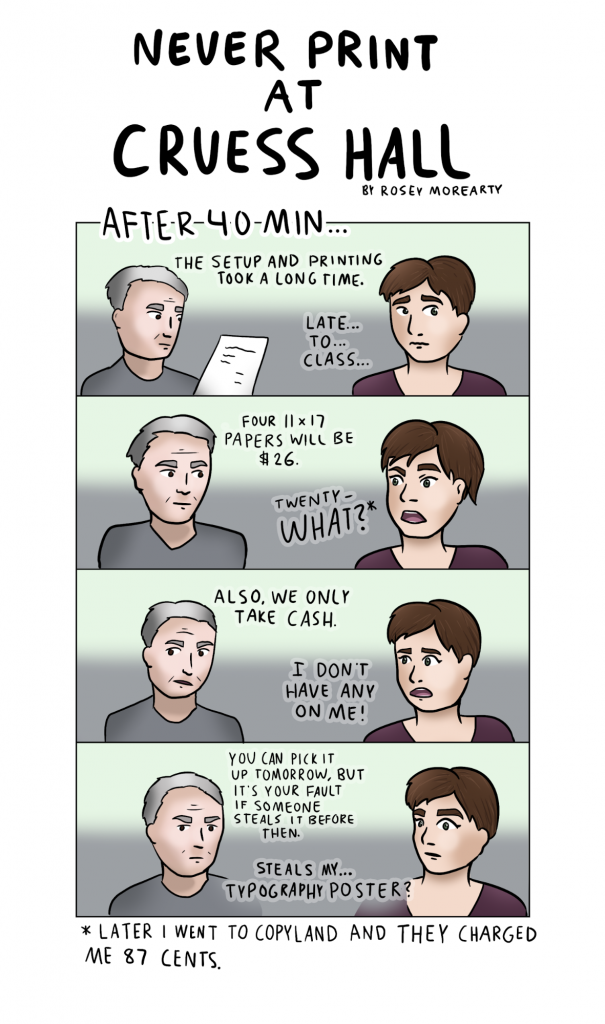
Cartoon: Never Print at Cruess Hall

ROSEY MOREARTY / AGGIE

Written by: Rosey Morearty — rosey@morearty.org

Finding a healthy load of iron

Iron consumption in infants and youth shapes early development.

As infants grow up, they take in nutrients to build the foundation for their social, motor and cognitive development. Formula milk and weaning foods, among other nutrient sources, are fortified with micronutrients to support this process. Iron, among other micronutrients, is critical for neural development, a rapidly-occurring process during the first three years of life.

According to the World Health Organization, over one billion people are affected by anemia, a condition where blood cells are not able to properly carry oxygen and nutrients through the body. Over a half million of the affected individuals are children.

During pregnancy, a mother’s blood volume increases to meet supply demands for growing fetuses. An increased blood volume needs an accompanying increased iron consumption as iron is used by hemoglobin proteins — oxygen-carrying proteins — in red blood cells. The World Health Organization recommends iron and folic acid intake during pregnancy to promote fetal and infant development and reduce the risk of the child developing anemia.

“Iron supplementation is recommended for undernourished populations, but it is universally practiced,” said Peng Ji, an assistant professor in the UC Davis Department of Nutrition. “In the United States, formula milk is iron fortified, containing about 10mg of iron per liter.”

Another source of iron and iron-carrying proteins is found in breast milk. Breastfed infants also have lower rates of diabetes and obesity compared to formula-fed infants. Pregnant women frequently take prenatal multivitamins containing iron.

“Too much iron during pregnancy creates oxidative stress,” said Elizabeth Prado, an assistant professor in the UC Davis Department of Nutrition. “It leads to low birth weight babies and impaired brain development.”

Breast milk contains proteins supporting infant development, including lactoferrin — an iron-binding protein.

“Lactoferrin serves as an antibacterial defense and promotes immune system development,” said Bo Lönnerdal, a distinguished professor emeritus of the UC Davis Department of Nutrition and Department of Internal Medicine. “It perforates harmful bacterial membranes to promote the growth of good bacteria inside infants. It also turns down inflammatory cytokines, which control fever response, while increasing anti-inflammatory cytokines. It helps guide immune development and responses when infants get sick.”

Lactoferrin remains intact throughout the digestive tract, latching onto lactoferrin-specific binding receptors residing in the small intestine or in excrement.

Lönnerdal’s previous research in Chilean infants suggests formula milk that contains high iron supplementation may lead to cognitive impairment.

Ji’s research found similar results in a nursing piglet model. Piglets have a similar brain development pattern as human infants and come with a shorter growth spurt. Two years in infant brain development equates to 24 weeks in piglets, allowing piglets to serve as a functional model for human infants in their development response to iron and excess iron. Additionally, the swine industry provides iron supplementation during early development. Iron injections accumulate iron in the liver for use by other organs in the body. However, piglets have difficulty regulating iron absorption during their early lives.

“When there is excess iron in the human body, there are mechanisms to regulate iron absorption,” Lönnerdal said. “You absorb less iron. Infants, however, lack this mechanism.”

Ji conducted a social novelty experiment with piglets and stranger piglets, finding that excess iron in nursing piglets impaired their cognitive, motor and social development. Piglets have a social and cognitive behavior to explore the unknown and meet new strangers.

In the first phase of the experiment, piglets befriended a new piglet. When introduced to a new piglet and a befriended piglet, the piglet’s social novelty behavior would encourage them to spend more time befriending the stranger piglet. In the experimental groups that were supplemented with iron, the excess iron negatively impacted the piglets’ behavior to discern the two piglets and engage in social novelty behavior.

“The control piglet groups met stranger piglets, but moderate and high iron dosage piglet groups would move between both the stranger and friend piglet,” Ji said.

Ji also conducted a bioinformatic assessment of metabolism in the piglet hippocampus – a region of the brain involved in learning and memory.

“Purine metabolism was altered by excessive iron supplementation,” Ji said.

Purine can be either salvaged or completely degraded during metabolism. Purine salvation provides energy for neuron cells in the piglet hippocampus to function. Purine degradation creates a reactive oxygen byproduct, which can create oxidative stress in the developing brain.

“We noticed there was a significant iron content in the developing hippocampus,” Ji said. “We found increased lipid peroxidation [in] the hippocampus in response to high iron supplementation.”

Lipid peroxidation also creates reactive oxygen and oxidative stress.

Though iron availability shapes the development of infants and piglets, too much iron may severely impact their development in life. A strategy to navigate iron supplementation may call for reflection by a mother on her child’s needs.

“If you’re getting too much iron in your diet, that could lead to toxicity,” Prado said. “If you are iron-deficient, then you should take supplements. A lot of people fall in that area of this range.”

Written By: Foxy Robinson – science@theaggie.org

2019 Oscar Predictions

Who will bring it home?

The 91st Academy Awards will air Feb. 24 on ABC with no host. After Kevin Hart stepped down from the position because of controversy surrounding his 2010 stand-up performance involving jokes about the LGBTQ community, ABC Entertainment president Karey Burke announced that there will only be presenters. Despite all the controversy, several performances and creative visions from 2018 are Academy Award-worthy.

Best Director: Alfonso Cuarón

The director of “Gravity” and “Harry Potter and the Prisoner of Azkaban” created a black-and-white picture that tugs on the heart strings. “Roma” depicts the life of an indigenous maid and the middle-class family she works for in a Mexico City neighborhood in the 1970’s.

Best Actor: Rami Malek, “Bohemian Rhapsody”

Freddie Mercury represents an important piece of music history, and playing him on the big screen was a grandiose task to undertake. Malek channeled Mercury’s understanding and ability to use music as a way to create common ground between marginalized groups and the masses.

Best Actress: Glenn Close, “The Wife”

Glenn Close is a “king maker” in this film: poised, brilliant and strong. “The Wife” focuses on the difficulties of marriage and legacy. Close’s performance was a true testament to female resilience.

Best Original Screenplay: “The Favourite”

“The Favourite” exemplified how conversation can be just as captivating as action and crazy visuals. The entire screenplay makes the audience question their morals, beliefs and influence.

Best Picture: “Green Book”

A true story about the humanity that rests within us all. Two men from very different worlds realize that there is more than meets the eye — an example for our current political state.

Cinematography: “A Star is Born”

The film has many settings, and each one makes the audience feel immersed by the multitude of camera angles, color and background. Country and pop music genres are seamlessly meshed in this film.

Best Original Song: “Shallow” from “A Star is Born”

After climbing the charts, “Shallow” seems to be far from losing this award. Filled with powerful lyrics and impressive vocals, Lady Gaga and Bradley Cooper enshrined “A Star is Born” in cinematic history with this song. Listeners can’t avoid the heavy feeling that is seated in their chest as the song progresses.

Written by: Josh Madrid – arts@theaggie.org

First-year student athletes balance practices, games, classes

0

NCAA Division 1 athletes must learn to manage practices, games, classes and homework in addition to adjusting to college life.

In addition to moving away from home, becoming accustomed to the college experience and having practices and games up to seven days a week, first-year NCAA Division 1 (D1) student athletes must also find the time to go to class, finish their homework and study for exams.

According to Eline Van Den Bosch, a first-year undeclared major and field hockey player, when her team is in season in the fall, they practice six days a week for three hours each day. Practices are held during the day, which she prefers instead of night practices like she had in high school.

“I just go to class, have practice, then go back to class,” Van Den Bosch said. “I invest a lot of time definitely during season into field hockey. It’s a good combination.”

Due to student athletes’ busy schedules, learning to manage one’s time is important. According to first-year communication major and softball player Megan Bower, learning this balance was difficult in the beginning.

“Having the motivation to want to do my best in my classes, do my best in softball, make new friends and sleep was hard,” Bower said. “It was hard to jump right in at the beginning, but I took it one day at a time, so I didn’t get so overwhelmed.”

For Bower, Fall Quarter was an adjustment period, but she thinks in Winter Quarter she has been more on top of her academics and has learned how to balance her busy schedule better.

Christopher Venable, a first-year human development major and football player, took a summer class to balance his schedule, which helped him learn how to manage his time and create an outline of his weekly schedule. He creates a schedule week-by-week and fills in the information to help him stay on top of his work.

“In my free time, I’ll do extra tutoring and try not to miss out on academics because the coaches are big on that,” Venable said. “During finals, we are in playoffs, so studying football and studying school was hard to balance since we wanted to perform our best in both.”

Student athletes receive extra support to help them with their academics and balance their busy schedules, as they must keep a 2.0 GPA in order to stay in UC Davis’s NCAA athletic programs. According to Venable, Intercollegiate Athletics (ICA) tutoring is mandatory for specific classes for athletes. Drop-in tutoring with academic advisors is also available and many teams have study halls together.

“We have a really supportive team and school system that makes sure we stay on top of our studies and prioritize that over athletics,” said first-year communication major and cross-country and track runner Alexa Bolanos. “They make sure we put in the time we need in both areas, and it’s nice to have that support because without it, it would be really hard to manage.”

Venable’s advice for other athletes is to not get behind in their schoolwork while also constantly communicating with professors and TAs to keep them updated on when their team is traveling and when they’ll miss class.

“If you approach them in the right and respectful way, they are very understanding and will help you be proactive about making a plan,” Bower said. “You can tell them a day you could make the work up.”

Because of the extra support student athletes receive and due to the athletic recruitment that brings many of them to UC Davis, other students may see athletes as having a more privileged collegiate experience, according to Bower. However, she thinks there is a misunderstanding since student athletes work very hard and sometimes need that extra support due to their busy schedules.

“What a student athlete is, is misunderstood,” Bower said. “Sometimes, we are not as smart, but we want to work hard to be in this sport. I have immense respect for the people who got into this school, but athletes work really hard and also want to get a good education.”

Because student athletes are all under similar pressures, it creates a strong bond between team members. According to Bolanos, she had an instant family when she came to Davis early in the school year. She said it was nice to have that large ingrained support system right away.

“My favorite part is the brotherhood,” Venable said. “The relationship on the team, that is where you meet your best friends. Everything you do is with the football team. Sweat, tears, determination, we all bond together.”

According to Bower, even athletes who play different sports all share the same stressors, and can bond over it.  

“We all kind of understand what each other are going through,” Bower said. “Even if we play a different sport, we all know how it is to manage sports and be a part of this community. It’s been nice to be a part of a community of athletes.”

According to Bower, athletes have to really love the sport if they are going to play it at the collegiate level. Especially at a D1 school, it is difficult to manage busy schedules and wake up early in the morning to go to practice.

“We are all here because we love the sport, and that’s what we want to do,” Bolanos said. “Knowing that is our motive, on top of getting a great education and loving our classes, it’s so worth it.”

Written by: Margo Rosenbaum — features@theaggie.org

Black History and Multicultural Event celebrates diverse culture, perspectives

0

18th annual Black History and Multicultural Event hosted in Guigna Guange Hall

On Feb. 6, the Guigna Guange Hall hosted its 18th Annual Black History and  Multicultural Event. The event was filled with music, free food and inspirational speeches and stories from all perspectives of life. The thought of the event thrilled Vicky Ma, a first-year mechanical engineering student at UC Davis.

“It’s a good introduction to the rich and diverse culture for people who know nothing ‘bout it,” Ma said. “[The event] really brings awareness to something undermined in the past. It gives an opportunity to learn more about it and its connections to part of our community.”

The event, which took place on Saturday, Feb. 9 from 10 a.m. to 3 p.m., attracted many people who came for the musical performances, exhibits, speeches and free lunch provided by Cache Creek Casino. Many guests also brought in their own side dishes to share.

Musical performances were conducted by Clarence Van Hook, one of the events founders, along with a local mariachi band. There were also cultural dance performances by the groups Praise Dance and Native American Pomo Dances.

Guest speakers included UC Davis’ Chancellor Gary May. His talks were titled “Price of being Born Black in America” and “Why.” Other speeches made by other guest speakers included “The Multicultural History of Capay Valley.”

Along with the many festivities, the multicultural event included an essay contest for high school seniors. The prompt this year was “Cultural History in Yolo County.” The winner of the contest was announced and awarded $500 at the event.

Exhibits also dotted the event area, sponsored by Yolo County Historical Society and the Yolo County Archives.

 Following a long tradition, the 18th annual celebration is organized by Van Hook, Judge Dave Reed and a group of dedicated community volunteers.

The event started about 17 years ago as a black history celebration. Since then, the event has gained more popularity and evolved into a multicultural celebration recognizing other cultures and their contributions to the region. The event is always celebrated on the second Saturday of February.

The Greater Capay Valley Historical Society has extensively documented and recorded African American history in the region. In 1890, Green Berry Logan, the first African American to homestead in the region, blazed the trail for the small, growing community. Since the Logan family’s arrival, many other African Americans from across the country came to the frontier, and the once small, unknown town became rich with diversity. The location soon became known as “The Hill, The Heaven or the Summit.”

“California also did not encourage Blacks to settle here — but things were different in the Capay Valley. Our schools were never segregated,” according to the website.

Eui Hyung, a first-year economics major at UC Davis, emphasized the importance of the event on the greater community, as well as on rich cultural diversity.

“It is important, and needed as it’s a month needed to celebrate the significant contribution that African Americans made throughout our history,” Hyung said. “It’s important to celebrate this because it’s important to remember them and their achievements, and this event really captures that.”
Written by: John Regidor — city@theaggie.org

Sacramento Area Council of Governments launches Youth Leadership Academy

0

Cohort of high schoolers begins pilot civic engagement program

The Sacramento Area Council of Government kicked off its Youth Leadership Academy on Jan. 26 with the pilot program’s first training. Over the next five months, the program’s cohort of 29 high school participants from across SACOG’s six counties — El Dorado, Placer, Sacramento, Sutter, Yolo and Yuba — will engage with SACOG through board meetings and trainings.

Throughout the program, Youth Leadership Academy participants will learn about and discuss issues that SACOG deals with, which include topics around transportation, land use and housing. Then, the program will culminate in a mock Civic Lab, in which students will participate in the development of a short-term innovation project. Ideally, the students will serve as part of the cohort for one- to two-year terms.

Jay Schenirer, a council member for Sacramento’s fifth district, initiated the vision for Youth Leadership Academy when he was SACOG’s board chair last year after recognizing a need for the region to better engage youth with governmental planning.

“I’ve been working on these issues for quite a while, and a lot of them have to do with how we engage young people to be involved with their own futures, and how we can be advocates for those futures,” Schenirer said. “It really came to my mind that […] we’re planning for the future of the region, which absolutely includes young people, and we had no structure or venue to engage those young people in the decisions that we were making.”

The SACOG board voted to go through with Youth Leadership Academy. The current session of the program is funded by The California Endowment, Sacramento Regional Community Foundation and Bank of America. In terms of execution, the program operates through a partnership between SACOG and PRO Youth and Families, a Sacramento-based youth development organization.

One key goal for Youth Leadership Academy is to facilitate a two-way learning process between youth and SACOG.

Rosie Ramos, a communications analyst for SACOG who is running the program alongside Pro Youth and Families’ Youth Engagement Coordinator Taylor Buck, commented on how important this two-way element is.

“What would be amazing as we continue to grow this program is that what comes out of the cohort is not just [students] learning more about what we do and how the politics work, but also […] for us to hear what’s really important to our group,” Ramos said.

The ultimate goal, according to Ramos, is to find ways to make sure that those priorities are incorporated into SACOG’s daily work.

In addition to connecting students with SACOG, the program will also connect students from several geographic areas with each other. Buck sees the program as innovative in this regard.

“A big hope is that it will not only just bring those folks together in the same room but also make sure that young people [develop] — as they move forward as community leaders and potential political advocates — that understanding of our region more broadly,” Buck said.

Buck believes it’s important for students to engage with SACOG issues.

“SACOG deals with transportation, affordable housing, ratio of population and resources that we have in our region, climate change and infrastructure — there’s a lot of things that sometimes don’t get mentioned in your high school civics classes,” Buck said. “So, [Youth Leadership Academy is] really providing an outlet for students to learn about it.”

In recruiting students to participate, SACOG wanted to ensure that students were representative of the region and encourage recruitment of students who were not the “usual suspects” — that is, “youth who are already highly engaged in their schools and community,” according to the program’s proposal.

To this end, Buck said that PRO Youth and Families took a multi-pronged approach to strive for a broad outreach. PRO Youth and Families tabled at individual schools and paid particular attention to schools in cities where it saw a more limited response. PRO Youth and Families also recruited through partner groups. SACOG board members were asked to distribute information through their networks as well.

Ramos confirmed that despite time constraints for the recruitment period, she feels confident in the group of students who make up the cohort.

“They have all kinds of backgrounds — they’re from all over the region, and it’s a diverse group,” Ramos said. “We have a great group of kids.”

Over the next several months, Ramos and Buck will be looking for ways to adjust the program for future years.

“One of the biggest piece[s] of feedback that we received from the students is that they wanted more discussion time,” Buck said. “These kids are highly engaged and are just really ready to sink their teeth into the policy issues that are impacting our region.”

Though this is a pilot session, Ramos expressed hopes for the program to be a continued element of SACOG.

“Ideally, we’re going to plan for the next year,” Ramos said. “We need funding and all of that, so that’ll be an important part. But that’s the goal — that we would continuously have it.”

Written by: Anne Fey — city@theaggie.org

NOchella

Go to any other music festival that’s not Coachella

Excitement for Coachella seems to be divided in 2019. In the 20 years of its busy life, Coachella has undergone some changes that have proven to be not so great. Rising costs and a CEO with questionable intentions have something to do with it, but so does climate change and the inevitable battle festival-goers will face in the extreme weather of the California desert.

Home to some of the most iconic musical acts of the twenty-first century, Coachella has become one of the most famous music festivals in the world, yet most attendees don’t spend copious amounts of money on a wristband just for the music. The art shows and crowds of people add to the mass appeal of the desert gathering, turning it into the year’s biggest can’t-miss party.

For those that have already purchased their tickets, be sure to consult the endless libraries of vlogs on Youtube by former festival-goers stressing the importance of getting those Instagram posts in before the sun takes center stage and melts those carefully positioned face gems. But if you’re still on the hunt for those sold-out tickets, there is hope yet — at other music festivals.

To be a part of Coachella is to be one of the same breed: a young and inclusive crowd of modern-day hippies. Lose the hedonistic social media tendencies, and this crowd can be referred to as authentic hippies. Despite the inclusivity of the crowds every year, the same cannot be said for Philip Anschutz, the owner of The Anschutz Entertainment Group (which owns the Coachella Valley Music and Arts Festival). The billionaire has donated hundreds of thousands of dollars to pro-gun, pro-life and anti-gay organizations and individuals.

And the list is long to entertain, for Anschutz’s donations have been taking place since pre-2015. But the most recent donations include $30,000 to the Family Research Council and $110,000 to the Alliance Defending Freedom (ADF), which fights against LGBT equality in court. Plus, he has made smaller contributions to Senator Cory Gardner, who is pro-gun, and Congressman Scott Tipton, who opposes same-sex marriage and abortions.

It’s Anschutz’s own prerogative to donate to whomever he desires, but with the crowd he entertains at Coachella both on stage and off, one would image a different approach. Anschutz did make an attempt to clear his name with a million dollar donation to the Elton John AIDS Foundation LGBT fund. Anschutz said at the time of his donation, “My gift to the Elton John Foundation is intended to emphasize that we support freedom of all people to live their lives peacefully, without interference from others.”

Despite Anschutz’s monetary repentance of all binary dispositions, his wallet has still been opening up for GOP state party organizations. Rather than cashing out donations to politicians who are more open about their bigotry — such as Paul Ryan and Orrin Hatch (both of whom received substantial donations from Anschutz, though they returned it after no longer seeking re-elections) — Anschutz is now focused on the National Republican Senatorial Committee, to whom he has made a $134,400 donation.

It’s donations like these that have musicians and music-lovers alike taking up the call sign #NOchella. But what are the options for those who need music festivals in their lives?

Since the middle-of-the-desert theme seems to be so popular, take Desert Daze, for example, a three-day music festival set in Joshua Tree, Calif. during the month of October. In 2018, Tame Impala (who is headlining Coachella 2019) was the main act at Desert Daze, performing a psychedelic set next to a waterfront area that allowed the attendees to swim while jamming out to Kevin Parker’s angelic vocals. Although their set was cut short due to an unexpected rainstorm, it was a memorable fourteen minutes nonetheless.

And what about Outside Lands? Another three-day festival that has hosted a near similar lineup to that of Coachella in its most recent years — Gorillaz, Kanye West, Elton John. Taking place in a chilly-summer setting in San Francisco, there are a number of stages that host musicians, artists and even political discussion (last year the Barberry Stage hosted a Q&A with then-Gubernatorial candidate Gavin Newsom). The entertainment runs plenty, and so does the food and drink, all at a fraction of the cost of Coachella.

There is also Snowglobe in Lake Tahoe during the winter months, which features more of an electro and rap feel for their venue. Bottlerock in Napa Valley occurs during the month of May and is a three-day festival that offers more performers than wine selections. Last year, names like Billy Idol, Bruno Mars and Earth, Wind & Fire headlined.

Another notable mention is Lightning in a Bottle, which is a five-day festival in the San Antonio desert during the month of May. The music stays in the realms of electro, but the art structures and the overall aesthetic of the festival look like an extra trippy version of Coachella — a real psychedelic dreamscape.

Sure, Coachella is the one and only; the music festival has entertaining acts that have secured their place in history. From Prince taking the stage and performing Radiohead songs, to Rogers Waters from Pink Floyd performing all those classic existential hits, to Snoop Dogg standing side-by-side with a Tupac hologram, these performances would not have been possible without the outdoor stages of Coachella.

But iconic as these performances may be, is it worth the steep $500 ticket plus the cost of all the accompanied expenses, including travel, lodging and parking, to attend such a weekend in the desert? Possibly not. Consider this: Childish Gambino (one of the headliners of this year’s Coachella) recently performed at the Oracle arena in Oakland and tickets went on sale for under $100. At this Oracle show, Bam-B was unveiled by two other big name rap groups and then proceeded to perform with the original recording ensemble that produced “Awaken, My Love.” The show was out of this world. The tickets were cheap and the water was not $9 a bottle.

One way or another, in attending any big name concert there’s a possibility of inadvertently funding elitists who contradict the political morale of the future. However, the owner of Coachella unequivocally wears his morality on his sleeve, which is but another factor to consider before cashing out a lump sum of money to attend the famed festival. Ultimately, Coachella funnels its profits from the hands of its attendees to the pockets of those who work to advocate a detrimental and hypocritical political agenda.

Written by: Clay Allen Rogers — arts@theaggie.org

Sea stars shine light on the urgency of climate change

Alarming decrease of the sunflower sea star population associated with ocean warming

A recent study led by UC Davis and Cornell University on the correlation between warmer ocean temperatures and the increased effects of an epidemic serves as a reminder that climate change is an increasingly dangerous issue. In investigating the relationship between these raised temperatures and the prevalence of P. helianthoides, or sunflower sea stars, researchers discovered that warming ocean temperatures contributes to the increased susceptibility of the population to the sea star wasting disease.

According to Joe Gaydos, a wildlife veterinarian and science director for SeaDoc Society, the team started their research back in 2013 when the outbreak began. As stated by Diego Montecino, a current Ph.D. graduate student at UC Davis, 10,000 recreation-trained divers helped collect data on the prevalence of sea stars in areas ranging from California to British Columbia over more than a decade.

After comparing this data, a team including Gaydos, Montecino and Drew Harvell, a professor of ecology and evolutionary biology at Cornell University, published a paper titled “Devastating Transboundary Impacts of Sea Star Wasting Disease on Subtidal Asteroids” in 2016. It soon became apparent to them that the sunflower sea star population had decreased at unprecedented levels, leading them to conduct further research on the species. In order to examine the possibility of the sunflower sea stars retreating to deeper levels of the ocean to escape the SSWD, the team obtained trawl data from the National Oceanic and Atmospheric Administration in addition to data from scientific transects conducted by the Hakai Institute.

“The idea was to compare in both habitats, near shore and deep waters, the trend of sunflower star abundance over time, pre outbreak and post outbreak,” Montecino said.

The data’s confirmation of the species’ poor condition led the researchers to examine the sea surface temperature, as the data suggested that this outbreak spread from California up the coast. What the team found was a tight correlation between the increase in water temperature and the sunflower star’s susceptibility to disease. However, according to Gaydos, this knowledge was not surprising, as the increase in water temperature would change the coelomic fluid of the sea star and put stress on their simple immune systems. In addition, previous research conducted on the ochre star, an intertidal sea star, demonstrated how spikes in warm ocean temperatures were associated with a worsening of the disease.

“The main takeaway is the speed with which a multi-host infectious disease can cause decline in the most susceptible host and that warming temperatures can field bigger impacts of disease outbreaks,” Harvell said.

The effect of warm ocean waters on the increased mortality of the sunflower star does not only affect this population, but additionally threatens the sea urchin population in surrounding areas. Since the sunflower sea star is a predator of the sea urchin, the decreasing prevalence of this predation results in an increase in the number of sea urchins, leading to the overgrazing of kelp. Gaydos stated that abalone fisheries have had to close along the coast of California due to the disappearance of kelp. Furthermore, with the increased movement of marine populations accompanying the changes in water temperature, Gaydos predicts that many diseases will be transferred throughout the ocean along with the animals. These consequences, along with the stress put on the animals, led the team to predict that similar scenarios will continue to occur.

“I think the important thing here is that, you know, we think a lot about climate change and we think it’s going to raise sea level and stuff like that, but I think what a lot of people don’t think about is it’s going to change things in ways that we don’t necessarily expect and these disease epidemics are one way that shows the complexity of the way that that works,” Gaydos said.  

In addition to listing the sunflower sea star as an endangered species, the team

recognizes a need to rescue the population. Harvell stated that convening a team of experts to discuss the priorities for recovery and considering a captive breeding program may be helpful in the road toward increasing the sunflower sea star population. Montecino also attested to this and pointed to the need for further research on the cause of SSWD and the relationship between its pathogen with other sea star species. Climate change, however, remains the vital issue to be addressed.

“It’s a huge task, but this is just a reminder that we can’t stop thinking about that,” Gaydos said.

Written by: Michelle Wong⸺science@theaggie.org

Gov. Newsom’s proposed increase in funding for UC conditional on tuition freeze

UC system does not expect tuition increase in near future

On Jan. 10, 2019, newly-elected California Gov. Gavin Newsom released his state budget proposal for the 2019-20 year. In the $209 billion budget, he included a funding increase for California public school systems — as long as tuition costs remain frozen at their current levels.

But first, what does this mean for the UC system? In his budget breakdown for higher education, he proposed to increase total funding to the University of California by $274.6 million, reflecting a 3 percent increase from the 2018-19 budget.

This raise comes with several expectations for the institution.

“These investments are provided with the expectation that tuition will remain flat, access will be increased, and time to degree will improve,” Newsom’s budget summary stated. “The significant investments proposed for the UC should begin an in-depth conversation between the Administration and the Regents regarding the short- and long-term goals and expectations of the state and the UC.”

Back in April of 2018, the Los Angeles Times reported that the UC Regents were holding off on voting for a tuition increase in the hopes that the state government would come through with increased funding.

It is still unclear if this 3 percent boost for the UC system will be enough to hold tuition steady for the next few years. Claire Doan, the director of media relations for the UC Office of the President, said the institution is fairly certain on how much tuition will cost for the coming school year.

“At this time, UC does not anticipate a tuition increase for the 2019-20 academic year,” Doan said via email. “Discussions about the university budget will continue in the coming months.”

Doan did not comment on what this funding might mean for the coming years.

The UC Davis Department of Financial Aid and Scholarships declined to comment on the matter, stating that this tuition discussion “involves policies and decisions that impact the UC system, not just UC Davis, therefore a response must also be cleared at the system-wide level.”

Written by: Claire Dodd — campus@theaggie.org