55.7 F
Davis

Davis, California

Monday, December 22, 2025
Home Blog Page 468

Review: Welcome to Marwen

Zemeckis drama leaves too much unexplored

The well-intentioned but ultimately disappointing “Welcome to Marwen” was released on Dec. 21. The film is based on the life of artist Mark Hogancamp, who was brutally beaten outside of a bar after revealing to a group of men that he enjoys crossdressing. The assault leaves Hogancamp comatose for nine days and erases almost all of his memories before the attack. Hogancamp was an illustrator, but after recovery, his brain injuries left him unable to draw. In order to cope with the trauma, Hogancamp created a 1:6 scale world in his backyard where he narrates and photographs images of dolls in a fictional World War II town called Marwencol.

The film, directed by Robert Zemeckis, takes place during the trial of Hogancamp’s abusers, while Hogancamp is still mentally and physically struggling to grapple with what has happened to him. A major theme in the film is the use of art as therapy. Hogancamp uses his dolls and the world of Marwencol to try to overcome his trauma. Throughout the film, however, he struggles with integrating himself back into the real world and often conflates the events occurring in Marwencol with reality. Hogancamp bases his dolls on people in his life. The film splits the narrative between Hogancamp’s real life and that of his alter ego, Hogie of Marwencol. His attackers take the form of Nazis, who frequently attack Hogie. A band of women, based on supportive influences in Hogancamp’s life, always come to his rescue. Meanwhile, the real Hogancamp, played by Steve Carell, battles the effects of PTSD and a growing addiction to pain medication.

The film truly had potential for greatness. The combination of live action and animation in the film, which highlighted Hogancamp’s suffering, could have been poignant and exciting. The expertise of director Robert Zemeckis, who created critically-acclaimed films such as “Forrest Gump” and “Back to the Future” should have led the film in the right direction. Seasoned actors Steve Carell and Leslie Mann in leading roles should have carried the film on performance alone. Mark Hogancamp’s life and story are inspiring and powerful, but the film simply never gets off its feet in order to do the real Hogancamp any justice. With many great elements, the film fails to come together cohesively, leaving the viewer dissatisfied and a bit confused.

The film’s weakest point, by far, is the writing. While the duality of live action and animation as a vehicle for narration is intriguing at first, the film struggles to balance the two and make them equally compelling. Just as the viewer starts to feel connected to Hogancamp, the narrative shifts to the animated Hogie and his gratuitously violent battles with the Nazis in Marwencol. There are certain times when this tactic is effective, such as when Hogancamp’s PTSD is triggered and he immediately resorts to Marwencol as a coping mechanism. However, more often than not, the transitions are too jarring and ill-timed for the viewer to appreciate. These animated scenes mostly occur when the viewer would rather learn more about the real world in the film. This also leaves less time for either world or the characters in them to feel fully developed or fleshed out. In the end, the film is simply doing too much, leaving both Hogancamp and Hogie’s journey in a state of incompletion.

The writers were also lacking in subtlety. Every theme of the film is basically spelled out for the viewer in either direct dialogue or conspicuous metaphors. One of Hogancamp’s dolls, a blue-haired witch, appears to be the main villain of the film. Named Deja, the doll is constantly looming over both the characters in Marwencol and Hogancamp himself, who keeps the doll propped up in his living room. Within the first few encounters with Deja, the doll’s symbolism for Hogancamp’s addiction to pain pills and his struggles with PTSD is made clear. Deja’s hair color exactly matches the color of the pills Hogancamp is addicted to. In the climax of the animated narrative, Hogie realizes that it is Deja who continues to bring back the Nazis, even after the other dolls defeat them. Actually, Hogie does not just realize this but announces it for the entire audience. Hogie basically tells the viewer exactly how Deja represents Hogancamp’s inner demons and explains how vanquishing her (pouring out his pills) will stop his psychosis and control his flashbacks when triggered. Not only does this oversimplify the mental effects of PTSD, but it also underestimates the viewer by explaining what has been so obvious throughout the film.

The film also lacks focus and a clear point of view. While it is ultimately the story of Hogancamp rediscovering his place in the world outside of Marwencol and overcoming his demons, this resolution takes an excessive, complex route to come to over the course of the film.

Besides Hogancamp, every character feels underdeveloped and one-dimensional. While Marwencol is filled with strong, empowered women who help Hogie, it would have been nice to see who the women were in real life as well. Leslie Mann’s character, Nicol, moves into the house next to Hogancamp. She is introduced as having a tumultuous relationship with a former partner, who appears twice in the film. However, that is the extent of her personal biography in the film. She mainly exists as a puppet to react to Hogancamp and what he is going through. Her past with her ex is never truly explored, and the character is left underdeveloped. Carell and Mann have great chemistry, and their sweet friendship is believable. The film would have been better off exploring more of what these actors could have done with their characters.

That being said, the severe criticism that the film is facing may be a bit extreme. The movie may not be award-winning, but it has its merits. It is endearing and imaginative, and Carell gives a poignant performance. The film also handles Hogancamp’s passion for wearing women’s shoes with elegance and respect. The final scene of Carell dragging his dolls along the road, wearing his war cap and a pair of heels, is triumphant and heartwarming. Hogancamp is an inspiring character, and Carell does an excellent job getting the viewer to root for him.

The film has its moments and manages to tug on heartstrings with its undeniable quirks and charm. While the film may be a bit disappointing in that it fails to live up to its potential, it is still a creative movie that entertains and informs through a fascinating story of triumph and art.

Written by: Alyssa Ilsley — arts@theaggie.org

Maximizing Memes: Discussing UC Davis Memes for Egghead Teens

0

Students comment on privacy settings and more regarding the UC Davis meme page

Home to cows, turkeys, squirrels, bikes, late buses and meme-filled individuals, UC Davis has a place for memes to thrive: the Facebook group UC Davis Memes for Egghead Teens (UCDMFET).
Unlike other college meme groups, such as the nearly 200,000 member group UC Berkeley Memes for Edgy Teens (UCBMFET), the Davis group, with almost 12 times fewer members, is exclusive to the UC Davis community. Second-year biochemical engineering major Christina Jumalon is an administrator for the Davis group, and explained why it’s been decided that only people who have a UC Davis email can join.

“We want to keep it more relatable for us, since we’re already kind of a small college,” Jumalon said. “A little bit of a small college. We don’t want outside content that makes it unrelatable. I know that [UCBMFET] is very popular because people can see it wherever or whatever age they are, but it kind of takes away the relatability and the connection, like school pride.”

Third-year design major Alana Joldersma disagreed with this viewpoint. She considered UCBMFET to be successful due to its inclusivity and said that the added diversity of it makes it significantly more “fun.”

“I’m personally not really a fan of [having to enter the group with a UC Davis email],” Joldersma said. “This sounds a little pathetic, but memes have really become a way for our generation to react to a lot of issues going on in our lives, even if it’s just a bunch of us complaining about finals at this or that UC […] Like I’m always tagging my friends at [the University of Chicago] and Yale in the UCBMFET page, and I wish I could do the same for the Davis page. Thank goodness for screenshots though!”

Joldersma first joined the group as a first-year after joining UCBMFET. She generally gets a good laugh looking at the page, but interacts with the content most during times of large campus events, such as campus closures due to wildfires.

During the closures, Joldersma spoke with friends about the great photo opportunities because of the haziness. Initially, she was joking with a friend about actually taking her grad pictures, but they ended up doing it the next day and posting a picture in UCDMFET. In the picture, captioned “Graduating from Davis fall quarter be like”. Joldersma’s friend is wearing a smoke mask and is standing next to an Egghead with a mask over its nose. Since being posted on Nov. 18, it has gained more than 2,000 reactions.

First-year biochemistry and molecular biology major Dawson Diaz believes that the group’s privacy settings should be up to the discretion of the group administrators, but he thinks there isn’t really a need for it to be a private group. In part, because there are so many people in the group already, the memes are likely to be seen by individuals who aren’t directly inside the UC Davis community anyway.

“It’s applicable to other schools, so I think it’s okay to have a meme page be open for everyone,” Diaz said. “But people have to understand that they may not always understand the memes, but they’re still applicable […] I think the meme community is much bigger, it shouldn’t have to be constricted. Whether or not it should be closed, I think, is up to the discretion of the administrators who are running the page.”

He spoke specifically about how different parts that are seemingly unique to Davis are relevant on other campuses. Bike memes, he says, can be relatable for students at other campuses, such as Arizona State University and UC Berkeley, which are both gold-level Bicycle Friendly Universities. He also raised a point about the individuals posting the memes.

“People who join the page probably know that it’s going to be Davis restricted,” Diaz said. “They may feel more comfortable posting random things that only Davis students will get.”

In order for a meme to be posted in the group, it has to be approved by administrators first. With regards to the many memes about the campus closure, which was caused by the poor air quality resulting from the Butte County fires, Jumalon discussed the administrator’s decisions on how to approve memes.

“We are very aware that this is a sensitive topic, that a lot of people were hurt by the Butte fires, and we are sorry for that,” Jumalon said. “But we love making fun of admin, that is always okay […] we like anything that isn’t directly correlated to people being affected […] We’re very much towards making fun of the school [and] of our worries.”

In the past, according to Jumalon, the administrators of the group have had to reprimand certain individuals who repeatedly tried to post inappropriate memes and have even warned them about the possibility of being removed. Diaz thinks that it’s important the administrators approve of the memes that go up for similar reasons.

“Memes shouldn’t be used to put people down,” Diaz said. “They should be used to bring people up and sort of encourage positive dialogue of change, or of just humor.”

Diaz joined the group the summer before he started at UC Davis in order to see what the culture of the school was like. He spoke about how the memes reflect a more general culture, and about their impact, both on a personal and a wider level.

“There’s definitely a lot of issues that [UCDMFET] touches on that are really specific to college students,” Diaz said. “I think it’s really a reflection of what college life is like […] It shows UC Davis as a college campus, a group of college students trying to get their degree [while] also acknowledging they have issues. They’re acknowledging the campus has flaws, which is really important because it’s not always easy to say ‘Hey this is a huge problem, let’s fix it.’ Memes poke fun at it to get people aware of the issue.”

Written by: Anjini Venugopal — features@theaggie.org

Davis, community partners receive three competitive transportation grants

Sacramento Area Council of Governments awards $8.1 million to Davis projects

On Dec. 6, the Sacramento Area Council of Governments (SACOG) announced that three Davis transportation and green energy projects won grants totalling $8.1 million. The projects awarded include the I-80/Richards Boulevard Interchange Improvement Project, the Electrify Yolo Project and the County Road 32A Railroad Crossing Relocation Study.

The I-80/Richards Boulevard Interchange Improvement Project will receive $5 million through SACOG’s Regional Program, which is SACOG’s largest competitive program.

According to Mayor Brett Lee, the I-80/Richards Boulevard Interchange Improvement Project should bring welcome change for both drivers and cyclists. As the interchange operates now, traffic can at times back up onto the interstate.

“There is planned to be a small redesign in how cars exit and there will be a light there,” Lee said. “So, the traffic flow off [of] the exit should be a little better.”

City Manager Mike Webb explained that the city has been working with Caltrans in the project’s design phase for the last year and a half, meaning the changes are well on their way. Construction is expected to begin in 2020.

“The next stage really is to complete construction drawings, and get the remainder of the funds and funding package in place for going out to bid,” Webb said. “We [will] be going out for construction bids at the end of this year, 2019.”

In addition to reconfiguring the Richards Boulevard westbound I-80 ramps, the city and  Caltrans will work to add a pathway beneath the onramp to promote bicyclist and pedestrian safety and will close the Olive Drive exit to improve safety in the Olive Drive neighborhood. Changes will affect students and faculty who commute from outside of Davis as well as those who ride their bikes and drive to the UC Davis campus from South Davis.

“The redesign is really important because it will make [the interchange] a much safer way for people from South Davis to ride their bikes to the downtown or campus,” Lee said. “[The project] actually should improve the traffic flow as well.”

The other safety project, the County Road 32A Railroad Crossing Relocation Study, is a joint proposal between the City of Davis and Yolo County and will receive $200,000 through the community design program.

The study will consist of “developing a project scope and cost estimate for a potential crossing enhancement and/or relocation,” and “reviewing alternatives and identifying the preferred option,”according to a city press release. Presently, the road’s current sharp turns near the railroad crossing affect cyclists on their way to the Yolo Causeway bike path, cyclists commuting between Sacramento and Davis and vehicles including trucks driving to the landfill.

Accidents have occured, prompting relocation disputes and subsequently a memorandum of understanding between the Union Pacific Railroad and the city, wherein parties agreed to pursue a long-term solution to the railroad crossing problems.

Lee sees redesign as necessary for the crossing.

“The visibility is not ideal, and then also, cars try and go a little too fast for the turn,” Lee said. “Ideally, we would have a better way of slowing people down and having them stay in their lane.”

The Electrify Yolo Project will receive $2.9 million as a green region program grant. Valley Clean Energy — with the City of Davis, the City of Woodland and the County of Yolo — will use the grant funding for this project to add electric vehicle charging stations throughout Yolo County as well as an electric shuttle service in Davis.
Grant project lead and director of customer care and marketing, Jim Parks, anticipates that the project will promote green energy in the region.

“If people can see that there’s charging infrastructure around … [and] as more chargers become available in public locations, people will reduce the range anxiety and be more open to purchasing electric vehicles,” Parks said. “We want to lay the foundation for future growth, which we expect will then facilitate more people adopting electric vehicles.”

Electrify Yolo will install approximately 20 level two charging stations, up to 10 mobile, solar-powered chargers and two to five direct current fast chargers in Davis. The charging infrastructure in Davis, Woodland and Yolo County will be publicly available, networked and credit card enabled, although functionality details have not yet been decided.

The grant gives Electrify Yolo four years for completion, and has an 11.6 percent cost-share.

“It’s exciting for us to get a grant of this magnitude in our county,” Parks said. “Now that the grant has been approved, now the rubber meets the road.”

Webb feels positively about the success of these grant proposals as a whole.

“This recent round of grants — of grant funding we’ve received from SACOG — is a real testament to our commitment to leveraging our local dollars and stretching them and making them go as far as we can,” Webb said. “I’m really proud of the work that our staff and our supporters put into making these grants’ applications successful, really pleased to see the work result in a very positive [outcome.]”

Written by: Anne Fey — city@theaggie.org

New law requires students to be notified about timely degree completion

Students to receive financial aid for only four years

New legislation for the California state school systems directly impacts students receiving state financial aid. On Jan. 1, a new law was enacted which requires that students be notified about timely degree completion status while receiving financial aid because Cal Grants are limited to four academic years.

“AB 2248, authored by Assembly Member Kevin McCarty, refers to notifying higher education students receiving financial aid about how many units must be taken per semester or quarter to graduate within four years and also to clarify to those students that Cal Grant is limited to four academic years,” said Kristen Timarche, the media relations officer for the California Student Aid Commission.

The California Student Aid Commission and institution of higher education must provide those who receive state financial aid further information on the known prerequisites in order to graduate. Many students are under the impression that 12 units are necessary to be considered a full-time student, but aren’t necessarily aware that an average of 15 units are mandatory to graduate within four years.

Something many students may be unaware of, however, is that financial aid, including Cal Grants, are limited to four academic years. This could potentially leave a fifth-year student in debt or unable to attain aid for the extra year necessary to complete their degree.

“Currently, there is a disconnect between the 120 units or 15 units per semester, necessary for graduation in four years and the commonly used definition of ‘full-time,’ which is 12 units per semester,” Timarche said. “The new law requires both the California Student Aid Commission and institutions of higher education to provide this notification to recipients of state financial aid to avoid expanding their financial aid before being graduated.”

On average, a University of California student will have a net impact of $80,000 for one additional year of attendance, while California State University students will have an impact of $70,000.

“The Commission supports providing students with as much information as possible at the earliest time so that they understand that if they don’t take at least 15 units per semester to graduate in four years, they may not have financial aid for their fifth or sixth year,” said Lupita Cortez Alcalá, the executive director of the California Student Aid Commission.

This new law will assist students who were uninformed about precisely how many units are needed to graduate within four years. It will also enforce postsecondary institutions notifying Cal Grant recipients on the steps needed to graduate within the time restraint.

“With an impacted major and being practically the millionth person on a waitlist for a science class, I always assumed a fifth-year would just be a given for me when it comes to NPB,” said Hannah Sjolund, a second-year neurobiology, physiology, and behavior major. “It was not until after I could barely manage 12 units per quarter that I realized I needed to step it up and take more [units] to graduate on time and not have to take out loans with my financial aid leaving me no support for an extra year.”

Written by: Lauren Tropio — city@theaggie.org

UC’s demand for open access to academic publications stalls renewed contract with Elsevier

UC, Elsevier in deliberation over policies which would make scholarly journal articles available to general public free of charge

The UC and the online journal publisher Elsevier are struggling to reach a consensual agreement in the process of renewing the UC’s contract with the company.

Currently, the UC is on a subscription-based policy with the publishing company and pays roughly $11 million a year to allow all of the UC campuses access to content published by Elsevier.

The UC is pushing for a shift in policy to favor open access content. Under open access, once Elsevier publishes an article written by a UC-affiliated researcher, any reader — within the university or not — would have the ability to read it, free of charge. As it stands now, open access for UC-published articles can only be acquired through a supplemental fee.

“Our objectives are twofold — to reduce the price paid by UC, and to ensure that by default all research published by UC authors would be immediately and completely available, in its final published form, to everyone in the world,” explained Ivy Anderson, the associate executive director of the UC’s California Digital Library and co-chair of the UC’s Publisher Negotiation Task Force, via email.

The UC and Elsevier’s five-year contract expired on Dec. 31, and an agreement wasn’t reached by the end of the year. The deadline for contract negotiations, however, has been extended until Jan. 31. This deadline extension was announced Dec. 21, just 10 days before the expiration.

Dennis Ventry Jr., a UC Davis law professor and vice chair of the Academic Senate University Committee on Library and Scholarly Communication, said in addition to the estimated $11 million yearly subscription fees, there are additional fees required to ensure that articles are made available without a paywall.

“If you want your article made available by open access — that it’ll be available for everyone to see and not behind a paywall — […] then the researcher has to pay Elsevier again in the form of something called APCs or Article Processing Charges,” Ventry Jr. said. “Those charges can run from $2-5,000 and the UC author has to come up with that money.”

Elsevier, a major distributor of content ranging from science, medicine and humanities, has been in partnership with the UC for 20 years, according to Anderson. Negotiations began in July with face-to-face meetings with Elsevier’s negotiations team.

Tom Reller, the vice president of global communications and head of global media relations at Elsevier, referred The California Aggie to a joint statement from Elsevier and the UC posted via his Twitter account when reached for comment.

“The University of California and Elsevier are continuing discussions in January in a good-faith effort to conclude negotiations by January 31,” the statement reads. “As part of both parties’ good-faith efforts, in January UC and Elsevier have agreed that access will be extended to the University of California during this time, to allow one more month to conclude discussions.”

Students and faculty covered under the previous five-year contract are assured they will still have access to Elsevier’s journals during the extension.

“During that time, UC scholars will see no change to their access to Elsevier journal article,” Jeff MacKie-Mason, a UC Berkeley librarian and co-chair of the UC’s Publisher Negotiation Task Force, said. “What happens after January 31 depends on the progress of the negotiations. With that said, no matter what happens moving forward, UC scholars will still be able to use Elsevier’s ScienceDirect platform to access most articles with a publication date prior to January 1, 2019, because UC has permanent access rights to them.”

The first push for open access policies came with the UC Systemwide Academic Senate Open Access Policy adopted on April 24, 2013. In 2015, the UC Presidential Open Access policy was issued which was subsequently followed by two committees: the University Committee on Library and Scholarly Communication and the Systemwide Library and Scholarly Information Committee.

Both committees called “for the UC to include open access goals in its agreements with publishers,” Anderson said.

According to MacKenzie Smith, the UC Davis librarian and vice provost of digital scholarship, the UC’s aims for UC authors’ research to be made available to anyone upon publication would extend to undergraduate, graduate and faculty authors.

“We are a public institution, we get paid by the public,” Ventry said. “Taxes pay our salary and [are] funding our research, but that research is not freely available to the public that actually pays our salary. And we view that as a problem.”

Smith said the UC’s negotiations with Elsevier would lead to similar negotiations with other publishers to successfully shift from a subscription-based system to a default open access system.

Written by: Elizabeth Mercado — campus@theaggie.org

Editor’s note: A previous version of this article stated that open access policy was issued by two committees: the University Committee on Library and Scholarly Communication and the University Committee on Library and Scholarly Communication. That is incorrect. The policy was issued by the University Committee on Library and Scholarly Communication and the Systemwide Library and Scholarly Information Committee. The Aggie regrets the error.

UC Davis students take action to combat sexual assault

DCD drafts resolution in support of survivors, Title IX Advisory Board responds to proposed sexual misconduct guidelines from DOE

From on-campus political groups, including the Davis College Democrats (DCD), to student representatives of the official UC Title IX Advisory Board, UC Davis students are taking action to combat and address sexual assault and violence.

The DCD drafted a public resolution in support of sexual assault survivors on Dec. 5, in large part due to recent revelations about California Democratic Party Chair Eric Bauman.

According to the DCD, Bauman “is the subject of multiple allegations of sexual harassment, including inappropriate comments and unwanted touching.”

According to a Nov. 29 article in The Sacramento Bee, Bauman resigned from his position. In response to the allegations, Bauman praised those who came forward and has said that he will be taking time off to address medical issues as well as “a problem with alcohol.”

The DCD’s stance is that the structure of the state Democratic party has “failed to create a safe and inclusive environment.”

“This resolution was jointly drafted by DCD’s LGBTQ+ and Womxn Caucuses in response to the inability of the California Democratic Party leadership to stand up for survivors of sexual misconduct at the highest level of our state party,” a statement released by the DCD to The California Aggie read.

The resolution effectively creates a new committee — the Bylaw Drafting Committee — which aims to update the bylaws to allow for the removal of members in instances of sexual misconduct.

“I feel that our bylaws do not currently have an adequate system in place to handle sexual misconduct,” said Daniel Tillman, the DCD LGBTQ+ Caucus chair, via email. “The allegations against the former CDP [chair] have served as a reminder that we can improve and that we must adapt our responses in the wake of the #MeToo movement.”

Tillman added that it was important for DCD members to reaffirm their commitment to sexual assault survivors.

“We felt that we needed to make it clear that sexual misconduct and those who participate in it hold no place in our organization,” Tillman said.

The revelations about Bauman’s actions have reverberated throughout the California Democratic Party.

According to the LA Times, Allan Acevedo, LGBTQ Caucus chair for the Young Democrats and a “political consultant for the youth arm of the party,” was directly affected by Bauman’s behavior.

According to their website, The Young Democrats are “the official youth arm of the Democratic Party made up of Democrats age 14-35 committed to activating the youth vote, empowering Young Democrats in their community, electing Democrats to office and building a new generation of progressive leadership.”

Acevedo spoke to The California Aggie via email about the allegations made regarding Bauman.

“The first people to complain were younger activists, just 21 and getting their start in politics,” Acevedo said. “They saw some behavior on a bus and complained about it. That lead others to sort of say, ‘Oh that? Do you know what else he does?’ And then other people came forward. There is strength in numbers.”

Bauman’s behavior also impacted Acevedo personally.

“For me, it was knowing Eric engaged in this behavior before and was now doing it in front of a new generation of activists,” Acevedo said. “I knew I should have said something sooner and it was better now than never.”

Acevedo believes that the allegations, and Bauman’s subsequent response, will have a profound impact on the way that the CDP operates.

“Indelibly, the Party will be changed,” Acevedo said. “How and in what way will depend on the members that will vote for a new Chair in May 2019. The previous race saw candidates compete for the youth vote. I expect that will happen again.”

Acevedo also expressed hope that those who have remained silent about their experiences with Bauman will come to the CDP — “we need all of our time and talents working together to advance our values,” he said.

When asked about what advice he would give to individuals who have experienced sexual misconduct at the hands of those in positions of political power, Acevedo said, ultimately, he hopes survivors remember that any incident of sexual harassment is not their fault.

“You, not anyone else, can define experiences for yourself,” he said. “Telling someone about an incident might seem scarier than the actual incident but will free you from holding on.”

This advice comes at a time of upheaval regarding sexual harassment and assault policies in the U.S. educational system.

The United States Department of Education is considering changes to Title IX-based rules, specifically in the way universities handle cases of sexual harassment, assault and other sexual misconduct.

The UC Davis Chief Compliance Officer and Title IX Officer, Wendi Delmendo, took a firm stance against the proposed changes, expressing concern that the new guidelines would undermine due process procedures already has in place. Further, the policies could potentially impose harsher regulations about how universities are able to constructively address sexual harassment claims.

Claire Chevallier, a UC Davis undergraduate representative for the UC Title IX Advisory Board, said via email that the ASUCD Sexual Assault Awareness Advocacy Committee will host two workshops in January aimed at educating students about the proposed policy changes.

The Department of Education has allowed for a 60-day public comment period, which is currently open, allowing for feedback regarding the proposed changes. Chevallier referred to this comment period, saying the workshops will allow participants to craft responses to the controversial new rules that Secretary of Education Betsy DeVos is seeking to put in place.

“The workshop is something we’d like to have as many students as possible join in,” she said, adding that the goal is for attendees to submit comments and thus delay the implementation of the proposed changes for at least a year.

Chevallier noted that the proposed changes may seem “intimidating,” but that the controversial proposal has also contributed to increased mobilization regarding the issue of sexual assault and harassment in the United States.

“Students can write [their comments] as individuals or can write on behalf of their organization and have their constituents sign it electronically,” Chevallier said. “Parents and alums can also participate.”

Written by: Rebecca Bihn-Wallace — campus@theaggie.org

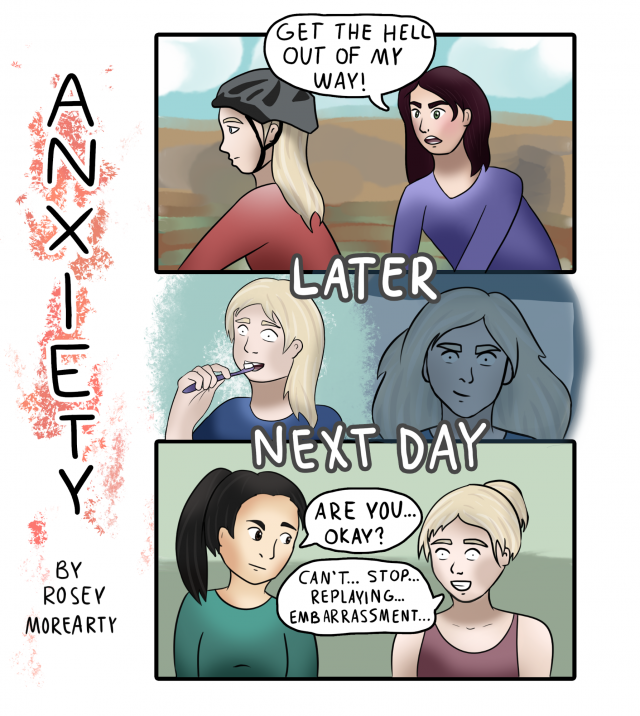
Cartoon: Anxiety

By: ROSEY MOREARTY — rosey@morearty.org

ROSEY MOREARTY / AGGIE

School board explores other ways to honor Dolcini, no name change for elementary school

Community opposition overturns unanimous decision to rename North Davis Elementary

The proposal to rename North Davis Elementary School in honor of Dr. Mary Ellen Dolcini has been tabled to allow for more discussion. On Dec. 20, after facing opposition from the community, the school board called for the formation of a committee to explore other ways of celebrating Dolcini’s contributions.

Dolcini held many administrative positions in the Davis Joint Unified School District, serving as assistant superintendent, principal of the then-East Davis School and North Davis Elementary School, which she successfully advocated to become a full inclusion site. The idea of renaming North Davis Elementary School emerged after Dolcini’s passing in April 2018.

“[Dolcini] was formative in the activity at the school, and we felt that it’d be an appropriate honoring of her,” said Janice Bridge, an organizer of the proposal and former school board trustee. “We also wanted the students in Davis to have some connection with her.”

Earlier, on Oct. 23, the Davis branch of the American Association of University Women hosted a public forum for discussion of the renaming, which was mostly in support of the name change. Bridge noted the abrupt shift in support, given the initial positive responses to the renaming.

“There was no conflict and no one from the school raised any objections whatsoever,” Bridge said.

The school board unanimously voted for the name change on Dec. 6. Between that initial meeting and the Board of Education Meeting on Dec. 20 — in which the renaming appeared on the Consent Calendar — opposition from parents and community members arose.

Parents took to posting on online forums such as NextDoor, emailing the BOE and attending school board meetings to voice their concerns over the necessity of the change and the anticipated costs.

“We absolutely want to recognize what Dr. Dolcini has done for the school and for the city, but there are many other ways to recognize her contribution without something as dramatic as changing the school name,” said Loris Degioanni, a North Davis parent.

Tricia Tomiyoshi-Marsom, another North Davis parent who attended the Dec. 20 meeting, expressed feeling left out of the decision-making process.

“Certainly the people who are the biggest stakeholders are the parents and teachers and staff members who work and attend North Davis elementary everyday,” Tomiyoshi-Marsom said. “So we would hope that our opinions would be taken into consideration before a move like that was ever even approved, but that was part of the source of frustration.”

With much of the opposition rooted in concern over the cost of a name change, the initial proposal group consulted an IT specialist. They concluded that if the change were made over time, the overall cost would not increase.

“Electronic media is what they use today,” Bridge said. “We don’t have to ditch whole bales of paper with the logo on it, you just make a major change to the logo.”

Aside from concerns over digitally altering the school’s logo, the other major cost would have been altering the various physical badges bearing the North Davis name.

“North Davis school has a large number of ceramic plaques and installations throughout the campus that have been done over time with involving a local ceramic artist,” Bridge said. “We would have applied for grants to pay for that.”

Despite accounting for such costs, parents were still dissatisfied with the decision.

“Any amount of funding that would be diverted to a name change or signage that would have benefited the teachers and the students was also a sore point for some members of our community,” Tomiyoshi-Marsom said.

On Dec. 20, trustee Alan Fernandes proposed the formation of a committee that will return later with a recommendation. The meetings will be public and hosted by board-appointed representatives.

While the name change is technically still in contention, Bridge sees it as highly unlikely given the circumstances.

“We’re not interested in engaging in that kind of battle, nor would [Dolcini] have been interested in that,” Bridge said.

Ongoing discussions include implementing a Mary Dolcini Day celebrated by the District, a statue of her likeness or naming the new multipurpose room at North Davis after Dolcini. The proposal group hopes that Dolcini can be celebrated by all — not just North Davis students — which may not be fulfilled by only renaming the multipurpose room.

“It really opens up possibilities where we can come to a compromise,” Tomiyoshi-Marsom said. “Hopefully with this committee they’ll be able to hear other opinions and make a thoughtful decision that will make [all] sides happy.”

Written by: Renee Hoh — city@theaggie.org

State Senator re-introduces bill requiring public universities to offer abortion pill

Abortion pill bill previously vetoed by Gov. Jerry Brown re-introduced

State Senator Connie Leyva reintroduced a bill to the California legislature that would require the health centers of public universities in California to offer abortion-inducing medication.

After Governor Brown previously vetoed the bill, Levya became committed to its reintroduction.

“According to a study sponsored by supporters of this legislation, the average distance to abortion providers in campus communities varies from five to seven miles, not an unreasonable distance,” Brown wrote in his veto message for the bill. “Because the services required by this bill are widely available off-campus, this bill is not necessary.”

Shabira Rogers, a third-year political science and Chinese double major and the event coordinator for the California Women’s List chapter at UC Davis, however, said that this is not always the case. She described a number of factors which often prevent access to abortion services.

“You can’t get any abortion care in Davis,” Rogers said. “The closest place you could go is Woodland. The problem is [that] getting there is an issue. If you don’t have a car, you have to take the bus. If you’re a low-income student especially, you might not be able to afford to take time off work to go to Woodland.”

A statement from Leyva’s office pointed to research done by UCSF that found students at public universities in California obtain 1,038 abortions every month. Medication abortions account for 519 of the 1,038.

“This bill will ensure that once a student has decided to end a pregnancy, they will not be forced to go off campus and face barriers such as additional cost, traveling long distances, or even missing class or work to get the care they need,” Leyva said in the statement.

The California Women’s List is an organization which supports and fundraises for pro-choice Democratic women who are seeking election, and the chapter at UC Davis sponsored the original bill when it was first introduced. According to Rogers, the chapter supports the reintroduction of the bill.

Rogers said the chapter believes this bill is important because it supports the right for individuals to choose want they want to do with their bodies.

“We just believe that everyone should have a right to choose […] whether they want to have children or not and when they want to have children,” Rogers said. “We think that public universities with health centers should be like any other health center or hospital — they should provide access to safe abortion medication, especially first trimester. We think it’s a human right to be able to do what you want to do with your body and take care of yourself however you would like to.”

The bill, according to Rogers, would ease the stress students and Davis residents face regarding reproductive care and support for women’s right to abortions.

“For students, you could just go to a health center and hopefully you’ll be covered by the insurance you’re on or the UC Davis insurance,” Rogers said. “It would be pretty easy to go to it if you do require to take the abortion pill, so it’s simpler and less complicated if it is given in Davis. As women, it will entrench the fact that women will have the right to choose, and if the bill is passed, it will be concrete, and people will hopefully continue to make sure women’s reproductive rights and women’s health in general isn’t attacked.”

Written by: Sabrina Habchi — campus@theaggie.org  

Book vs. Netflix Series: The Haunting of Hill House Review

How the show relates to, differs from the book

“The Haunting of Hill House” is a new Netflix original series loosely based on Shirley Jackson’s novel of the same name. The novel, published in 1959, follows a woman named Eleanor “Nell” Vance, who lives unhappily with her sister and brother-in-law after the death of her mother, whom she took care of for many miserable years. Eleanor is excited for a new start when she is invited to live in Hill House along with the future heir Luke Sanderson and the psychic Theodora. The three are lead by researcher Dr. Montague to observe the house and make note of any supernatural occurrences.

The 10-hour Netflix series follows a different plot. Set in the present day, the series features the Crain family as it deals with painful memories of the brief summer they lived at Hill House. Told through flashbacks, the story of the family begins when they move into the house with the goal of renovating and reselling it. Hugh Crain and his wife Olivia raise five young children: Steven, Shirley, Theo, Luke and Nell.

As in Shirley Jackson’s novel, Hill House is undeniably evil, a fact that becomes apparent to some of the Crains faster than others. Though as adults they live far away from one another and Hill House, the house’s malice continues to haunt the Crain family with both literal manifestations and dealings of grief, mental illness and addiction.

While the story of the series diverges greatly from that of the novel, there are several similarities that pay homage to Jackson’s novel. Mike Flanagan, the director of the series, based several of the Crain children on characters from the novel. Like Jackson’s Nell, Nell Crain is the family member mostaffected by Hill House’s ghosts and madness, and both struggle with intense feelings of isolation from the rest of their respective worlds. The Luke in Jackson’s novel is a liar and thief, reflected in the tendency of Flanagan’s Luke to steal money for drugs as an adult.

In her novel, Jackson depicts Theo as selfish, telepathic and possibly lesbian. Flanagan’s Theo wears gloves at all times to thwart her ability to feel the trauma of others through touch and is openly lesbian, though she has issues allowing others to get close.

Dr. Montague also makes an appearance in the series, and the character Shirley Crain is a nod to Shirley Jackson herself.

Some aspects of the adaptation remain more faithful. The form and general appearance of Hill House is left largely unchanged by Flanagan’s series. The house retains its gothic darkness and chaotic design.

“Hill House, not sane, stood by itself against its hills, holding darkness within; it had stood so for eighty years and might stand for eighty more,” begins Jackson’s “The Haunting of Hill House.” “Within, walls continued upright, bricks met neatly, floors were firm, and doors were sensibly shut; silence lay steadily against the wood and stone of Hill House, and whatever walked there, walked alone.”

The same lines are narrated in the Netflix adaptation. Other direct quotes are scattered throughout the series, though sometimes repurposed into new contexts. For example, on her way to Hill House, Jackson’s Crain observes a young girl’s tantrum at a restaurant, silently willing the girl to withstand her parents’ commands.

“Insist on your cup of stars; once they have trapped you into being like everyone else you will never see your cup of stars again; don’t do it,” Eleanor said in “The Haunting of Hill House.”

The same quote is reassigned to Mrs. Dudley in Flanagan’s adaptation, when young Nell discovers the cup and tea set among the old things of Hill House and asks Mrs. Dudley if she can have it.

The Dudleys remain mostly unchanged across the novel and adaptation. In both, the Dudleys clean Hill House, cook for guests and maintain the property, refusing to stay in the house past dark for fear of its pernicious spirits. Interestingly, the Netflix series expands the characters, providing them with their own backstories.

Like Jackson’s novel, Flanagan’s Hill House is haunted in similar ways. There are cold spots scattered throughout the house, violent knocking afflicts the walls and doors and ghostly dogs besiege the property. Though the series utilizes Jackson’s acclaimed psychological terror, ultimately the series relies on jump-scares and graphic depictions of the ghosts themselves.

The ghosts of Flanagan’s Hill House have names, faces and traceable backstories. Jackson’s Hill House is so terrifying because whatever terrorizes its inhabitants is never seen. Jackson’s poetic, intelligent prose sets the haunted house story apart from the rest. Her descriptions and characters offer frightening insight into the darkness of the human condition and evil itself.

The sources of horror in her writing often derive from the internal conflicts and personalities of Jackson’s characters.

In “The Haunting of Hill House,” Eleanor is indecisive, unfulfilled and haunted by the years she spent caring for her mother. She also is subject to anxiety — she constantly worries about being liked by Theodora, Luke and Dr. Montague, and the novel is full of hateful self-deprecation and internal judgement. The increasingly ambiguous distinction between Hill House’s hauntedness and Eleanor’s neuroses contribute to the deeply unsettling quality of Jackson’s novel.

Jackson herself suffered from anxiety and agoraphobia. She had a poor relationship with her mother, who considered her daughter a disappointment and constantly criticized her appearance, weight and writing. Because of her life experiences, it’s no surprise that Jackson’s writing often features women struggling with loneliness, alienation and anxiety that seek to escape from oppressive family situations.

“The Haunting of Hill House” is considered one of the best horror novels ever written and was a finalist for the 1960 National Book Awards. Though it cannot compete with the terror of Shirley Jackson’s novel, the Netflix adaptation is still a riveting series about ghosts and the bonds of family. While Flanagan’s take offers a message of hope and healing, Shirley’s novel provides no such thing, rightfully reveling in its tragedy and despair. Both are worth exploring.

Written by: Cheyenne Wiseman — arts@theaggie.org

Yolo County properties to go smoke-free in January

Signs to be posted for designated smoke-free areas

Yolo County declared on Jan. 1 that county-owned properties throughout the county will be smoke free, following approval by the Board of Supervisors in Aug. of 2017. These properties will include “outdoor areas of the property, such as walkways and parking lots.”

The new policy prohibits “smoking any product on property owned or leased by the county, including cigarettes, little cigars, marijuana and all electronic smoking devices.” Steven Jensen, the health program manager for the Yolo County Health and Human Services Agency, stated that the move to a smoke free county was right.

“Ultimately, the goal was to reduce the amount of second-hand smoke that both employees of Yolo County and clients are exposed to,” Jensen said. “[For] employees, the policy [enforcement] is the responsibility of the employees’ direct supervisor first. There are other policies in place where there can be negotiations and talk[s]. For clients to come, the enforcement is basically self-enforcement. The manager, department head or whatever department works in the building can ask the client of customer to stop smoking.”

Yolo County ensured that the rules would be made clear and areas would be clearly designated.

“There will be signs posted on all the buildings that clearly designate which areas are smoke free or that the property is smoke free and cite the ordinance numbers so people can access it to see what the legislation is,” Jensen said.

The current rule states that smokers can only smoke 20 feet away from the entrance of a county building or they must move to a designated smoking area. However, employees, clients and visitors were being impacted by the second-hand smoke under this old rule. This prompted the Yolo County Tobacco Prevention Program to research smoke-free policies in other counties and eventually adopt them in order to “protect people from breathing in unwanted smoke.”

Yolo County has been working toward an easy and informative transition for residents.

“Most likely, there will be questions and confusion about this,” Jensen said. “Before passing this policy, we have been advertising. The policy was adopted a year and a half ago. It was adopted with the language that it would be implemented now. We’ve had a year and a half to prepare employees and the community through press releases, email, banners on our websites so that people can prepare. We’ve been distributing where people requested tobacco ‘quit kits.’ We have website setup where people can get help quitting.”

Jensen continued to explain the support for the new policy.

“We did do a lot of survey before this was adopted, and it was overwhelmingly positive,” Jensen said. “We met with all the union [representatives] so that they were aware of it. All those parks supported [it].”

Yolo County health officer Ron Chapman explained the harmful effects second-hand smoke can have.

“Disease caused by second-hand smoke continues to kill over 40,000 people in the United States each year,” Chapman said. “Smoke-free policies that address both indoor and outdoor spaces are some of the best ways to protect our community, reduce that number and keep our county healthy.”

UC Davis has been a smoke free campus since 2014. Matt Ko, a first-year neurobiology, physiology and behavior major at UC Davis, expressed his satisfaction with the long standing smoke-free campus.

“I have noticed that not as many students smoked in college compared to high school,” Ko said. “I actually didn’t know UC Davis tried to enforce a smoke-free campus. Now it makes sense why less people smoke.”

Other counties across California have also adopted this smoke-free legislation. The nearby counties of Solano, Contra Costa and Placer have made their properties smoke free, while West Sacramento made its city-owned buildings and parks smoke free in 2017.

“The best way [to enforce the policy] is to follow the policy,” Jensen said.

Written by: John Regidor — city@theaggie.org

Crocker Art Museum in Review

Upcoming exhibits, events at the Crocker Art Museum

Located less than 30 minutes from Davis, the Crocker Museum in Sacramento offers a number of events, activities and exhibits. The museum is open Tuesday to Sunday from 10 a.m. to 5 p.m. with later hours until 9 p.m. on Thursdays. While museum tickets are regularly $12 for adults, the museum offers an $8 price for college students and hosts a “Pay As You Wish” day every third Sunday of the month. Currently the museum offers an array of different art exhibits ranging in paintings, sculpture, photography and a blend of many other mediums.

From Sept. 16 to Jan. 6, the museum exhibited the photographs of Duane Michals, a portraitist famous for capturing and documenting influential figures such as actors, musicians and writers. Within this exhibit were many different interactive mirrors and pieces that allowed the viewer to take their own portraits and experiment with the art of capturing themself or someone else on camera.

Upcoming exhibits at the museum include “History, Labor, Life” featuring the prints of Jacob Lawrence in which “Lawrence’s recording and recollection of African American and larger African diasporic histories are featured, as well as his vivid observations of the dynamic city life in his native Harlem.” The exhibit will be open from Jan. 27 to April 7. In addition, the museum will also be introducing “The Roaming Eye: International Street Photography from the Ramer Collection,” and “A Passionate Muse: the Art of Leonard Baskin.”

While the museum offers many changing exhibits, it also contains many collections. “The Crocker hosts one of California’s premier collections of art, dating from the Gold Rush to the present day, a collection of master drawings, European paintings, one of the largest international ceramics collections in the U.S. and collections of Asian, African, and Oceanic art,” according to their website.

In regards to Film and Music, the museum offers frequent lessons, concerts and viewings that range in price but often offer great discounts for students. Upcoming events include “Global Rhythms: Brasil Brazil,” a rhythms music series from “Brazilian natives Ana Gazzola and Sonia Santos [who] create invigorating musical experiences full of the fervor and excitement” on Jan. 27

In addition, inspired by the upcoming Jacob Lawrence event, the museum will host viewings of a four-part film series titled “Work, Struggle, and Emancipation,” on Feb. 7, Mar. 7 and Apr. 4. This series “bring[s] into focus the issues faced by working-class people seeking to live the American dream.”

Upcoming classes at the Crocker museum include “Clay and Chardonnay” on Jan. 19, that offers attendants a chance to drink wine while learning various sculpting techniques; “Bubbles and Brushes” on Feb. 3, another opportunity to drink wine while learning and experimenting with painting and “Mimosas and Mixed Media” a month later on Mar. 3.

The museum also offers crash courses in Art History and other modern day educational events, such as “Licensing in the Digital Age” on Feb. 7 and “Comic Books: Beyond Heroes and Capes” on Feb. 12, that do not include creating art itself.

Crocker Art Museum is welcoming and entertaining enough to occupy a day of activity whether it be solo or with a group of friends. The museum offers art for all interests and preferences, with contemporary collections exploring modern day political issues as well as modern and pastoral depictions of California landscape and daily life. With affordable prices, accessible hours and a cafe area with tables for eating, relaxing and doing work, the museum maintains its positive reputation as the first public art museum founded in the Western United States.

While the Manetti Shrem in Davis is an excellent museum, for those hoping to spend hours wandering through and reading about a wide range of exhibits, the Crocker offers just that. In addition, the Crocker features local and youth art competition winners who showcase the next generation of creative minds and thinkers. Many of these art pieces explore human rights through various lenses, and showcase the emotion, passion, depth and urge for change that children as young as seven are depicting in their art.

As winter approaches, with the rain and cold driving students to stay indoors and in the area, the Crocker Art Museum offers a warm and comfortable atmosphere to take advantage of. Why not have a fun, affordable and thought-provoking time at a place that truly attempts to present a wide array of voices, minds and artistic expression?

Written by: Rosie Schwarz — arts@theaggie.org

Best Buddies Club builds bonds between students and people with disabilities

0

UC Davis Best Buddies chapter pairs students with individuals in Yolo County that have intellectual or developmental disabilities, creating new friendships

A friend with whom one may not be able to fully communicate. A friend that looks different from one’s other peers. A friend that does not go to UC Davis. But still a friend indeed.

“Best Buddies is a nonprofit, international organization with chapters in middle schools, high schools and colleges that aims to promote self advocacy, provide job opportunities and normalize friendships between students and people with intellectual or developmental disabilities,” said Brittany Black a third-year human development major and president of the Best Buddies Club.

At UC Davis, Black said that the club focuses on the aspect of normalizing friendships by pairing college students with “buddies” or people in Yolo county with intellectual and developmental disabilities.

“The misconception is that we are helping people with disabilities, which in a way we are, since we are promoting inclusion and helping people,” Black said. “But it is friendship.”

At the beginning of the school year, the club sent out information via email to recruit members. They then interviewed each interested student one-on-one to find out their experience working with people with disabilities and what their interests were. This helped the club pair up students and buddies with similar interests, Black said.

“It’s a year-long commitment from the time we match people in November through June 15,” Black said.

Buddies have varying abilities, and some are more social and verbal than others. Buddies are not UC Davis students, but they are all members of the Davis, Woodland or Dixon community.

“Most buddies are older than the students,” said Katherine Provost, a third-year neurobiology, physiology and behavior major and activities coordinator for Best Buddies. “Many participated in Best Buddies programs in high school and moved to the UC Davis program once they graduated.”

“The club plans about two or three events each month for members to come together and socialize,” said third-year human development major and historian and publicity officer of Best Buddies Sarah Moore.

Event examples include a holiday party, a match party, a talent show, a craft day, a scavenger hunt, Valentines and Halloween dances, sport days and various fundraisers.

“I love going out and hanging out with everyone, a lot of the people in the club are my closest friends,” Provost said.

“UC Davis students and their buddies are encouraged to get together on their own in addition to attending the events,” Moore said.

Examples of activities members do include biking around the Arboretum, watching movies, going to the farmers market, going on picnics or out to dinner or playing sports together.

“It is not much different than any other friendship,” Moore said.

Approximately 120 people participate in Best Buddies at UC Davis.

“About 106 people are matched in friendships and 15 members are associate members, which means they attend events and have similar requirements, but they do not have matches,” Moore said.   

“We recommend [becoming an associate member] for people who aren’t sure how much time they will have or they are not sure about the club,” Moore said. “It still is a commitment because we have requirements for the members.”

Provost said that being a member of the club has helped her learn how to communicate with people in different ways, such as without speaking, since some buddies are non-verbal.  

“It seems like it would be different or intimidating, and people might be worried what to say to someone with Down syndrome, but it it is really like hanging out with any other friend,” Black said.

The Best Buddies club accepts members all year round. Even though most matches are made at the beginning of the year, it is still possible to get paired with a buddy in the middle of the year if people graduate or study abroad.

“I’ve met some really awesome friends through the club,” Moore said. “Everyone is so positive and a joy to be around. I am always greeted with smiles and [by] people who genuinely ask how you are doing and care about you.”

Written by: Margo Rosenbaum — features@theaggie.org

Guest: Eulogy for The California Aggie newsroom

A former Aggie opinion editor mourns his college newsroom

The California Aggie newsroom is a nostalgia machine.

Anybody who’s spent any real time in 25 Lower Freeborn knows it, but to an outside observer, the place might feel like the headquarters of an unusually bookish cult.

Then again, maybe that’s not so far off.

Get together a bunch of half-formed but dangerously smart adults. A little cynical, these kids, but they’re reporters, and they’ve got the perspective for a sense of humor. Stick them in a basement for hours on end. You’ll come up with the Aggie’s newsroom.

Unfortunately, that newsroom will soon be demolished.

UC Davis said last month that it had decided to tear down Freeborn Hall rather than spend extra money for renovations and seismic retrofitting. Other offices in Lower Freeborn, like the KDVS radio station and the Food Pantry, will also be destroyed.

I was the Aggie’s opinion editor from 2015 to 2017. The news devastated me, and many other alums of the Aggie who had spent so much time working in the basement.

You can see the characters of those alums literally written on the walls. Taped-up quotes include musings on hostile workplaces, murder, North Korea and Disneyland.

Staffers long graduated maintain a presence in the newsroom through these quotes. They’re the thing visitors point out the most and find the most entertaining.

That, or the Orgasmatron.

The Aggie newsroom will turn you on. So go ahead: Take a whirl through the Orgasmatron. Check out the half-dozen Mark Ruffalo pictures. This place leaves an impression.

I won’t miss Upper Freeborn. I only took one class in its auditorium, a several hundred student strong “Introduction to Psychology” type class. That was to please Mom, the psychology Ph.D.

But I understand the Grateful Dead played Freeborn. I’m a fan (which also pleases Mom, the Deadhead). So maybe losing the auditorium will also be a tragedy.

But let’s go back downstairs.

Here’s a trivia question: How much of the Aggie office was taken up by oversized PC monitors in the early 90s?

a.) 70%

b.) 35%

c.) 15%

d.) What’s a PC monitor?

The answer is D, but I wouldn’t knock you for picking any of the other options.

Let’s see. What else?

A stale bagel has sat for years atop one of our ventilation tubes. We call it “The Bagel.”

There was also the actual newspapering. Working with columnists, reporters and editors was the highlight of my college experience. It led to my current career in journalism.

The newsroom I knew was active, serious about covering issues like sexual violence, the resignation of Linda Katehi as chancellor, the hiring of Gary May to replace her and one of the most consequential presidential elections in United States history.

These concerns breed the kind of discussions that shape half-formed adults. It’s always painful to lose a place where you see so much intellectual and personal development.

Of course I argued in the newsroom. Had unpleasant meetings and sharp disagreements about editorial decisions. But those get lost quick in the mythology of the place. (Right, Scott? We’re good? I think Scott and I are good.)

A college newsroom is a place where people think with integrity about hard topics and respect different opinions. Leave the 280-byte Twitter disagreements to the grown-ups.

I guess this was inevitable. Time passes. Newsrooms change.

I’m sad to see this office go. But I’m excited to see what future staffs make of the next basement they get shoved into. It’ll be great, because college reporters are great people.

A few closing words:

Many of you reading this probably have never visited the Aggie newsroom. You should. Pop your head in before these school administrators get the unique satisfaction of bulldozing a newspaper. Some of the best (and weirdest) conversations I had in the Aggie were with strangers who popped in unannounced.

I also would love to hear from former Aggie staff members, or anybody who has spent any time in the Aggie newsroom. Do you have a fond memory to share? Health problems from breathing basement air? Find my contact information below.

And finally, a request for the current staff:

Save the quotes. Now. Don’t wait. After all, what are journalists without their quotes?

Written by: Eli Flesch

The writer is a reporter based in New York City. Reach him at elikafton@gmail.com.

Disclaimer: The views and opinions expressed by individual columnists belong to the columnists alone and do not necessarily indicate the views and opinions held by The California Aggie.

Cloning Crops

UC Davis researchers find a way to replicate crop plants through seeds

Researchers at UC Davis have discovered a way to clone crop plants, making resilient crops more available to farmers everywhere.

“We developed a method to make rice seeds that are clones of the mother plant,” said Venkatesan Sundaresan, a professor of plant biology and plant sciences at UC Davis. “So farmers who grow high yielding hybrid crops can use the seeds from these hybrids for the next season, instead of having to purchase them again. This is particularly important for farmers in developing countries who can’t afford the high cost of hybrid seeds.”

The key to effectively cloning the rice plants is the Baby Boom 1 or BBM1 gene. This gene allows fertilized cells to turn into embryos. By causing egg cells to express BBM1, egg cells can grow embryos that would otherwise not be possible without fertilization.

“Baby BOOM 1, or BBM1 as we call it in the lab, is a transcription factor,” said Imtiyaz Khanday, a postdoctoral researcher in the Department of Plant Sciences at UC Davis. “Transcription factors are master regulators of other genes. BBM1 is expressed in the sperm cell but not in the egg cell. If we turn on its expression in the egg cell, it leads to embryo formation, bypassing the need for fertilization. It is like befooling the egg cell that it is already fertilized.  This also makes the sperm cells obsolete for reproduction.”

The current process, however, has a lower efficiency.

“This work showed that it is possible to make clonal seeds, but it only happens about 30 percent of the time,” said Debra Skinner, a researcher in the Department of Molecular and Cellular Biology. “So the next step would be to see whether it is possible to make that number higher so that the process is more efficient.”

With sexual reproduction, beneficial traits in crops can be lost, making the discovery of effective asexual reproduction in crop plants important for global food production.

“With the world population expected to reach 10 billion by 2050, the food production has to increase in the same proportion,” Khanday said. “What can be more satisfying to work on than helping to achieve the goal of food security for the growing population, especially in the developing countries?”

Written by: Kriti Varghese — science@theaggie.org