55.7 F
Davis

Davis, California

Monday, December 22, 2025
Home Blog Page 469

Cancer on a chip

The George Lab aims to model tumor microenvironments and physiological networks for cancer patients three dimensionally.

Though two-dimensional animal modeling has provided valuable information for human cellular interactions and disease mechanisms, it faces limitations. Human cells adopt different behaviors across two-dimensional and three-dimensional models.

In the human body, cells are surrounded by other cells from all sides in a dynamic environment. These interactions are difficult to capture in a two-dimensional cell model, such as cell culture, which produces flat layers of human cells in media. In animal modeling, promising cancer and cardiovascular therapy treatments identified in mouse models have led to toxic effects in humans. Consequently, the George Lab, part of the UC Davis biomedical engineering department, uses “organ-on-a-chip” technology to model complex cellular interactions and behaviors across human tissue and organ systems with cancer.

Organ-on-a-chip technology models intricate human organs inside a palm-sized, clear and flexible chip, complete with a vascular network and cell culture media to nourish cells three-dimensionally.

“It’s the same process of design that you would see on a circuit in a computer chip, except in this case, it’s microfluidics,” said Steven George, a professor in the UC Davis Department of Biomedical Engineering. “You’re actually passing fluids, cells and other components into these chips.”

The George Lab seeks to model breast cancer among physiological networks inside these chips.

Breast cancer is the second most frequent cancer diagnosis for women in the United States. Additionally, it is the second leading cause of cancer death.

“20 percent of women diagnosed with early stage breast cancer will develop the recurrent disease,” George said. “Breast cancer recurrence drops the five-year survival rates among patients from over 80 to 20 percent.”

The George Lab aims to understand breast cancer dormancy and recurrence, along with the early steps in cancer metastasis that allows these processes to occur. In turn, organ-on-a-chip technology can be used as a clinical tool to develop personalized medicine. For breast cancer patients, chips could be generated to grow samples of tumors, administer chemotherapy trials and determine optimal chemotherapy strategies for each patient.

“Breast cancer tumors manipulate the bone marrow environment,” said Drew Glaser, a postdoctoral scholar in the George Lab. “The bone marrow is a space for white blood cells that work to remove cancers.”

Breast cancer recruits normal immunosuppressive cells and redefines the bone marrow environments.

“If you think about bone marrow, most of the time you think about the soft, squishy tissue,” Glaser said. “There is also hard pieces of bone interspersed among the soft, squishy tissue.”

Breast cancer can metastasize in either of these bone marrow microenvironments. Bones constantly and gradually remodel their environments, maintaining a balance between bone growth and clearance. Breast cancer tumors disrupt this balance, preferring active osteoclast cells, bone-clearing cells, over osteoblasts, bone-forming cells. By preferring bone clearance, the remodeled bone environment leads to bone destruction and creates a challenge for cancer treatment.

“The remodeled bone environment becomes difficult to treat,” Glaser said. “These cancers become chemorefractive, meaning they do not respond to chemotherapy. Patients can be exposed to radiation to remove the tumor, but this is when patients are at risk for developing fractures and pain, which can lead to morbid secondary outcomes.”

Glaser investigated the morphology and vessel network interactions between the two bone marrow environments through cancer migration assays, which involves physically separating the two environments inside of the chip while maintaining a small connection that links them. Glaser hopes to determine how each bone marrow environment shapes breast cancer metastasis and tumor aggression.

“Our current goal is to fabricate a representative bone marrow model of healthy patients, then we can see how cancer cells navigate in this environment,” said Aravind Anand, a fourth-year biomedical engineering major.

Organ-on-a-chip technology shows promise for mapping complex relationships between human organ environments and breast cancer cells, which could eventually lead to more ideal medical treatment for patients.

“While bone metastasis is the intended application of this project, this device may ultimately be able to model many other diseases or provide a platform to study hematopoiesis,” Anand said.

Written by: Foxy Robinson – science@theaggie.org

How climate change is altering winter sports

0

Shorter season leads to less opportunities for ski and snowboard enthusiasts

Those waiting to scratch that snow itch can finally get some relief now that winter is here. But despite healthy early season winter storms, the Sierra Nevada snowpack got off to a below average start this winter in the year’s first snow survey conducted by the Department of Water Resources.

The survey showed that the statewide average for the Sierra Nevada snowpack is at 67 percent of its normal average for this time of year.

It wasn’t too long ago that a five-year drought devastated California, which left ski resorts in Northern California reeling. Many had no choice but to make snow to fill in for the detrimental lack of water.

This dramatic decline in the Sierra Nevada snowpack has been linked to climate change. The window of time that skiers and snowboarders get to spend on the slopes will get progressively smaller, said Paul Ullrich an assistant professor in the UC Davis Climate and Global Change Group.

Part of Ullrich’s work focuses on modeling future climate change scenarios for the Sierra Nevada snowpack.

This year’s snowpack level doesn’t alarm Ullrich and he stated that the current level of precipitation, which sits at about 70 percent of its normal level, translates to a pretty healthy snowpack compared to some of California’s drier years on record.

“Over the past decade what we’ve been seeing is these anomalously warm temperatures that have just persisted through the winter season,” Ullrich said.

He has two key takeaways from the arrival of these warm temperatures.

“The snowpack just melts faster,” Ullrich said. “And it usually starts off later in the season because you are waiting for that rain to snow transition. Even during the season, you get more rain episodes than snow episodes and when the rain hits snowpack it causes a more rapid melt.”

This isn’t just a problem in California, however, nationwide ski resorts are projected to have their seasons clipped with slopes at 3,000 feet and below to be hit the hardest, according to a 2017 study. Ski bums will delight in the fact that a good chunk of the resorts in Northern California are situated anywhere from 7,000 to 9,000 feet and are more resilient to the temperature increase due to climate change.

But those resorts at higher elevations will still lose anywhere from 10 to 40 percent of their snowpack by 2050 based on Ullrich’s research.

This range comes from both the variability of the environment and human activity. Ullrich believes there isn’t really much we can do to alter our path. “On our current trajectory we are pretty much locked in,” he said.

Current assessments paint a stark view for the Sierra Nevada snowpack. This will affect not only the ski industry but also water management issues. At this point, experts believe it is not so much a problem that can be solved and is only a matter of time before weather patterns alter our way of life.  

Written by: Bobby John — sports@theaggie.org

President Trump holds nation hostage

Government shutdown to affect students, faculty

As the government shutdown nears the end of its third week, 800,000 federal workers have found themselves either furloughed or forced to work without pay for an indefinite period of time. The shutdown was initiated after Congress failed to pass a budget due to disagreement over funding for a border wall. The closure, which started on Dec. 22, is on track to break the record for longest government shutdown, with Trump warning that it could carry on for “months or even years.”

The livelihoods of hundreds of thousands of government employees from nine federal departments and a few smaller agencies, including Justice, Homeland Security, Agriculture and Transportation, have been put on hold. These workers, suffering anxiety over whether they’ll be able to pay future bills and provide for their families, have been caught in the crosshairs of a heedless political battle perpetuated by Trump and the GOP. And as the weeks drag on, all Americans — including UC Davis students and faculty — will increasingly bear the burden of Trump’s infantile squabbles. At the same time, migrants and families waiting at the border will continue to suffer the consequences of a non-functioning government.

With federal agencies like the Census Bureau and the Bureau of Economic Analysis closed indefinitely, the collection and release of data crucial to academic studies and research has nearly slowed to a stop. The scientific community has also suffered a devastating hit as laboratories across the nation have closed, including those of the Fish and Wildlife Service and the National Oceanic and Atmospheric Administration. Time-sensitive research has consequently been delayed and grant money has potentially been jeopardized. Although academic research itself has so far continued largely unscathed, a long-term shutdown could threaten universities’ ability to secure federal funding for future projects.

California’s national parks, which many Davis students visit to take a break from school, have been especially burdened by the shutdown. The parks are currently severely understaffed and visitor centers have closed, though the grounds have remained open with very little supervision and enforcement of rules. As a result, garbage cans and toilets are overflowing with trash and human waste, and off-road driving, poaching and other “lawlessness” in the parks have reportedly damaged the wildlife and environment. Popular destinations like Sequoia, Joshua Tree, Muir Woods and parts of Yosemite have consequently been forced to close their campgrounds due to health and safety concerns. Other national parks will undoubtedly follow suit if the government fails to reopen soon.

The shutdown also imperils the funding of the anti-hunger Supplemental Nutrition Assistance Program — better known on campus as CalFresh — which provides food stamps for about 40 million people and is expected to run out of money by the end of February. To further add to the chaos, the Food and Drug Administration, which supervises approximately 80 percent of the food supply in the U.S., announced that it has suspended food safety inspections of fruits, vegetables, seafood and other products considered high-risk for contamination.

It’s absurdly careless of the president and Republicans — those purportedly elected to represent the interests of Americans — to endanger such critical necessities and bring sectors of the government to a grinding halt over a ridiculous plan for a border wall. With seemingly no consideration of Americans’ lives, the Trump administration childishly and recklessly continues to hold the nation hostage.

Written by: The Editorial Board

Following anti-Semitic incident, plans to host workshops, town hall still on hold

After ASUCD-sponsored ADL workshop, Students for Justice in Palestine condemn ADL, send petition to chancellor

Following the posting of anti-Semitic fliers on campus in early October, Jewish student leaders and UC Davis administrators, including Chancellor Gary May, met and agreed to a number of tangible commitments to improve the campus climate and combat anti-Semitism. This included hosting a town hall and having the Anti-Defamation League conduct a series of workshops.

Following the submission of a petition from Students for Justice in Palestine (SJP) against the ADL workshops, however, none of the planned ADL-hosted workshops have presently been scheduled, according to Associate Vice Chancellor Sheri Atkinson.

In early December, Chancellor May mentioned in an interview with The California Aggie the mutually-agreed upon commitments made with Jewish students and administrators.

“We came up with a series of things we were going to do, including a town hall and some training from the ADL to improve the campus climate,” he said at the time. “I think after that meeting, everyone came away feeling like we were in a partnership mode rather than an adversarial mode.”

It is now unclear whether the university plans to follow through on this commitment in the near future.

SJP’s petition, which circulated on social media and received 149 signatures from UC Davis undergraduates, graduates and faculty members, condemned and criticized actions by the ADL. In a statement sent from SJP officials to The California Aggie, the group emphasized its support of the “implementation of diversity trainings” and firmly opposed anti-Semitism.

The petition called for the workshops to instead be conducted by Jewish Voice for Peace (JVP) instead of ADL. The ADL is one of the oldest civil rights groups in the country and the specific group which Jewish student leaders requested during the meeting with administrators.

“ADL […] is a pro-Israeli, anti-BDS group who work to conflate anti-Semitism and anti-Zionism,” the statement from SJP reads. “Implying that criticism and protest of Israel and Zionism always contains anti-Semitic undertones serves as a justification for the repression of people, mainly Palestinians, who protest Israel.”

A workshop, titled “Combating Anti-Semitism as Student Leaders Workshop with the ADL,” did take place on Nov. 29 in the Memorial Union aimed specifically at students and student leaders.

After SJP sent its petition to Chancellor May, he made it clear — in an email responding to the petition sent to him, which was subsequently forwarded to The California Aggie by Atkinson — that the ADL workshop on Nov. 29 was independently hosted by ASUCD.

“This engagement was not sponsored by the university administration,” May wrote in his email in response to the petition. “At this time, there are no workshops scheduled by the campus administration. I can assure you that your perspectives will be considered by the administration as we develop future campus activities related to discussions of hate and diversity.”

Vlad Khaykin, the associate director of the central Pacific region for the ADL, led the event which presented attendees with information about intolerance and bigotry toward various groups, including Jewish individuals. Khaykin referenced the anti-Semitic fliers that were posted around campus as the catalyst to his presentation.

The event was co-hosted by the ASUCD Executive Office and the Jewish interest sorority Sigma Alpha Epsilon Pi.

Arielle Zoken, a third-year economics major, the vice president of SAEPi and one of the event’s organizers, addressed concerns over the invitation of ADL to campus.

“I know there were concerns with ADL coming, but I had meetings with students who were concerned and really tried to explain what their role is here and what their work is really trying to do, which is to give a presentation,” Zoken said.

Later in his response to SJP’s petition, May wrote that UC Davis received support from myriad organizations, including both JVP and the ADL.
“Although we appreciate being reminded that there are other issues, other injustices, and other oppressions in the world, as an institution of higher education, I believe it is important for us to hear from and involve many different organizations in our efforts to promote diversity and combat hate, racism, prejudice, and persecution,” May wrote.
The Nov. 29 workshop, attended by an estimated 30 people, focused, in part, on the spike of white supremacist activity on college campuses.

Zoken said Jewish students continue to face discrimination on the UC Davis campus from both students and professors.

“On a personal level, there’s a student in my religious studies class who asked where my horns were because in the Bible it says that Moshe had rays of light and that gets confused for horns,” Zoken said. “I’ve had professors say not great things about Jews and money and making the stereotype and reinforcing it. I was speaking Hebrew on the phone with my mom, and this girl — I don’t know if it was serious or not — asked if I was speaking ‘terrorist.’”

Khayken introduced a thorough definition of anti-Semitism during his presentation in the MU.

“Anti-Semitism is a form of prejudice and/or discrimination directed toward Jews as individuals or a group,” Khayken said. “Anti-Semitism is hatred of Jews because of their religious beliefs, their group membership and sometimes the erroneous belief that Jews are a race. Anti-Semitism is based on age-old stereotypes and myths that target Jews as a people, their religious practices and beliefs or the Jewish state of Israel.”

Pointing to recently released hate crime statistics by the FBI, Khayken noted a 17 percent rise in hate crimes since 2016. Khaykin also pointed out the overrepresentation of Jews in hate crime statistics in relation to their percentage of the global population.

“For the decades the FBI has been tracking hate crimes, Jews have counted amongst the most frequently targeted categories for hate crimes in the country,” Khaykin said. “60 percent of all hate crimes where the motivation is the religion or the perceived religion of the victims are against Jews. When we look across all hate crimes on the basis of gender, sexual orientation, race, religion, national origin, although Jews are less than 2 percent of the population, they account for 13 percent of all hate crime victims, so we’re overrepresented among hate crime victims by a factor of more than six.”

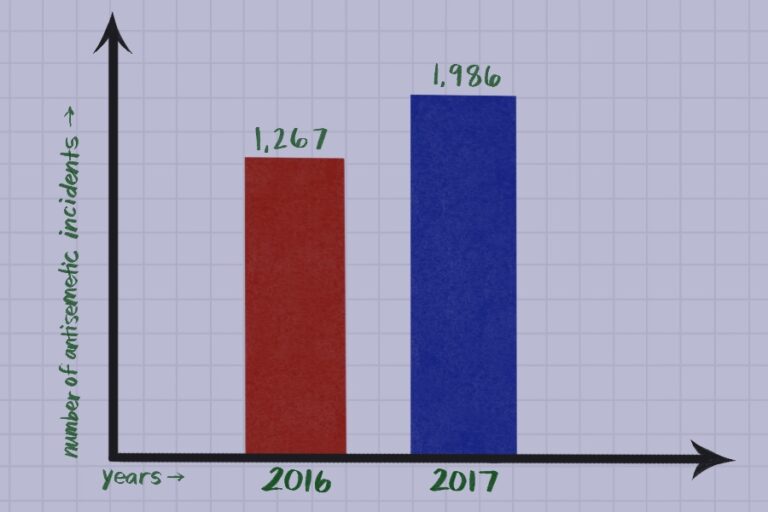
Additionally, the ADL’s own statistics show that anti-Semitic incidents have increased in recent years. Khaykin said there was a 57 percent increase in anti-Semitic incidents in 2017, “the highest single-year increase on record.”

Khaykin then introduced statistics that showed the perception of Jews worldwide. According to these statistics, 26 percent of the global population was found to have anti-Semitic beliefs, which means they answered six out of 11 anti-Semitic stereotypes in the affirmative.

Describing anti-Semitism as “lethal,” Khaykin also referred to anti-Semitism as a conspiracy theory and a political tool used by powerful individuals who want to prevent progressive reforms. This idea of scapegoating Jews for societal problems is still evident today, Khaykin said.

“Two days before Robert Bowers, a white nationalist, entered the Tree of Life synagogue in Pittsburgh and murdered 11 people during the Sabbath prayer services, […] the cover of the largest Russian language weekly in Northern California basically paints a picture of George Soros, who’s a prominent Jewish philanthropist, and blames him for being behind bringing all these immigrants into our country and crushing Uncle Sam,” Khaykin said.

While discussing anti-Semites, Khaykin noted that the justifications given for anti-Semitism are often contradictory.

“Jews are hated for being too weak and for being too powerful,” Khaykin said. “They’re hated for being too rich and ostentatious and for being too poor and penny-pinching. Jews are hated for being pacifists and for being unwilling to defend the country against its enemies and for being too militaristic, for being warmongers. They’re hated for being too nationalistic and for being rootless cosmopolitans without any allegiances. They’re hated for being too insular — sticking to their own kind — and for being a threat to our racial purity by assimilation and mixing among us.”

For Zoken, one of the reasons she immediately called the ADL to report the anti-Semitic fliers on campus was because she wants Jewish students to feel more comfortable speaking up in the face of discrimination.

“These things happen and we need to make sure that there are actions in place, that Jewish students feel comfortable even voicing the fact that this isn’t okay,” Zoken said. “Part of the reason we’re making such a push here is because we want to set an example in the future [that] it’s okay to speak up when these things happen. It’s okay to say, ‘I’m being discriminated against and I want my voice to be heard.’”

Written by: Sabrina Habchi — campus@theaggie.org

Hannah Holzer contributed reporting.

Bay Area becomes center of college football world

Levi’s Stadium plays host to Monday’s national championship

The College Football Playoff National Championship took place on Monday night at Levi’s Stadium in Santa Clara, marking the first time the game has been held in Northern California. Monday night’s game was also significant for this geographical region in another way, as it comes on the heels of Super Bowl 50 which was also played at the home of the San Francisco 49ers back in early 2016.

The University of Alabama and Clemson University squared off for the fourth year in a row, with last season being the only non-National Championship game in the sequence, and put their undefeated records to the test.

Clemson ran away with a 44-16 victory, securing its second national championship in three years and becoming the first team in FBS history to finish with a record of 15-0. The loss was also a notable one for legendary Alabama Head Coach Nick Saban, who had never previously lost a game by more than 14 points since taking over the Crimson Tide in 2007.

The Tigers and Crimson Tide lit up the scoreboard in the opening nine minutes of play, combining to score 27 points. Clemson began to pull away in the second quarter and took a 15-point lead into the locker room at halftime, before pitching a shutout in the second half and adding two more touchdowns. They took advantage of two costly interceptions thrown by Alabama sophomore quarterback Tua Tagovailoa and also torched the Crimson Tide secondary, as freshman quarterback Trevor Lawrence completed five passes of over 25 yards and threw for a total of 347 yards.

Levi’s Stadium and the Bay Area came under a large amount of criticism from the national media in the days leading up to the game, due to the perceived lack of enthusiasm for the game and historically-low ticket prices on the secondary market. Nonetheless, the atmosphere in Santa Clara was lively on Monday night, with visiting fans from Alabama and South Carolina and locals showing out for a historic night of football. In total, over 74,000 fans packed the home of the 49ers.

Despite having three FBS college football programs — San Jose State, Stanford University and the University of California, Berkeley —  in its footprint, the Bay Area has never hosted this monumental event before. While none of these teams has any experience playing for a national championship in about three quarters of a century, there’s still a rich history of the sport in this area. Cal claimed five national championships from 1920-1940, with Stanford also winning two during that same period. While neither program has reached the mountaintop of the college football world since then, each has groomed countless players and coaches into successful individuals at the NFL level.

          Similar to the Super Bowl in 2016, this year’s game had a plethora of festivities for fans leading up to the main event. Over the weekend, downtown San Jose was transformed into the “Championship Campus”, offering many attractions for the visiting Alabama and Clemson fans and Northern California residents alike.

The main attraction of the weekend was undoubtedly a two-day lineup of free concerts, where fans packed Discovery Meadow Park in the heart of downtown to enjoy the likes of Alessia Cara, Brynn Elliott, Leon Bridges, Logic and others. Heavy rainfall in the region was not enough to deter the thousands of people that showed up, many of which camped out several hours early to reserve their spot.

Another big attraction was “Playoff Fan Central”, a 100,000 square-foot interactive museum of sorts, offering many different games and drills for young fans, historic exhibits of famous college football moments over the years, autograph signings and performances from each school’s marching band. A similar event was held in San Francisco for Super Bowl 50, which welcomed tens of thousands of fans over a three-day period.

Both teams arrived on their charter flights on Friday evening and were greeted by fans and members of the media at San Jose International Airport. Players and coaches from each squad participated in Media Day the following morning, hosted at SAP Center in San Jose — the home arena of the San Jose Sharks. Over 1,000 credentialed members of the media gathered to interview the teams, while the public were allowed to watch for free.

Instead of holding a live halftime show on the field of Levi’s Stadium, event planners opted for a concert by “Imagine Dragons” on Treasure Island, situated between the Oakland and San Francisco spans of the Bay Bridge. The concert was televised live on ESPN for viewers around the globe, while the Clemson and Alabama marching bands performed for fans inside the stadium.

The main motive behind this decision was to preserve the playing surface for the second half of the game. Ever since its inception in 2014, Levi’s Stadium has struggled to provide an adequate playing surface, making it difficult for players to keep their footing and change direction when running. This has drawn a lot of complaints from players and coaches, as the field conditions have had a definite impact on the outcome of many football games. The stadium has replaced the turf dozens of times, including early last week, and experimented with a few different types of grass. None of these measures have changed the slippery nature of the surface or prevented divots from forming so easily.

Fortunately, there weren’t any noticeable issues with the field during Monday night’s contest, as the surface seemed to hold up quite well.

Overall, the 2019 College Football Playoff National Championship was an unforgettable experience for football fans in Northern California, who got to witness two of the most dominant college football programs of this generation. Many years from now, fans will look back on this game and admire all of the great individual players from each school that will likely go on to have fantastic careers at the professional level.

Written by: Brendan Ogburn — sports@theaggie.org

Letter to the Editor: Harmful Republican ideologies do not belong at UC Davis

To the Editor:

Re: “The elephant in the room” (features article, Dec. 11):

While I agree that there should always be healthy debates between different ideologies, if the ideology of one side includes repression and hatred for others, then no, it does not belong in any way as part of a dialogue on campus at Davis or anywhere else. In our current political climate, the Republican party has a reputation of xenophobia, anti-LGBTQ+ rhetoric, misogyny and oppression of women and minorities. My opinion is that the students themselves are not interested in the ideology of the Republican party, and this is causing a lackluster interest in the club and debates between differing ideologies.

These values are not the values of inclusiveness that UC Davis represents. However, I don’t see any form of repression of the Republicans on campus. UC Davis as an institution is not in any way preventing Republicans from having a voice. The professor who said the awful comment to the Republican student revealing their opinion that southerners should not be allowed to vote should absolutely be held accountable. If an overwhelming majority of students hold liberal views, I don’t hold the campus and staff accountable for that. Students who study history, economics, international relations, political science, humanities or any other social science become exposed to differing ideologies because that’s what science is.

UC Davis does not support repression or hatred. This was not mentioned in the article once. The Republicans on campus do have a necessary part of ensuring exposure to differing ideas, but not at the risk of harming others.

The writer is a 40-year-old transfer student to UC Davis and international relations major and history minor.

Written by: ANASTASIE LENOIR, DAVIS

Disclaimer: The views and opinions expressed by individual columnists belong to the columnists alone and do not necessarily indicate the views and opinions held by The California Aggie.

UC Davis’ first Animal Welfare Judging team successful at contest

The team’s process in preparing for the competition

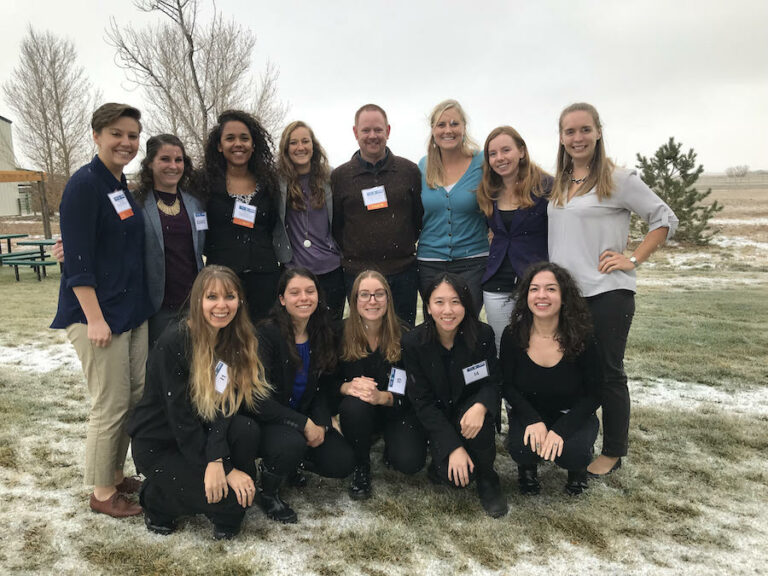
After months of reading through articles, touring various farms and listening to experts, the UC Davis Animal Welfare Judging team’s efforts paid off as they placed well at the Animal Welfare Judging Contest held by the American Veterinary Medical Association at Colorado State University. The undergraduate team placed fourth for the overall team category, while the graduate team placed second and fifth in individual categories and third in the overall team category.

Prior to this success, UC Davis didn’t even have a team to compete. Allison Pullin, a Ph.D. student in the animal behavior graduate group, was asked by her advisor, Maja Makaton, to coach UC Davis’ first team due to her prior experience in these competitions. Pullin decided to compete in this contest while working toward her Bachelor’s degree at Ohio State University in her senior year and served as a coach while working on her Master’s at OSU.

“I think that this contest is really cool because I think it really challenges students to apply a really holistic view of animal welfare and animal management,” Pullin said. “Because animal welfare isn’t just about health. It’s not just about behavior. It’s not just about nutrition. It’s really all of these factors coming together and taking this really holistic view of what actually promotes good animal welfare and gives the animal a good life.”

Pullin also added that while it may be easy to anthropomorphize animals when thinking about animal welfare, the contest reminds students that objective and scientific perspectives on animal welfare may be more beneficial to the animal than what our human points of view may assume.

Karli Chudeau, a second year Ph.D. student in the animal behavior graduate group, stated that the preparation process for the competition was more than the majority of the team had expected since none of them had prior experience in such a competition. Starting in June, the team began to review scientific articles concerning the four species that the competition would focus on: dairy goats, egg-laying ducks, green iguanas and polo ponies. Dividing up the readings, the students and coaches scourged the articles for topics important to the animals’ welfare, such as health promotion, normal and abnormal behaviors and housing and disease prevention, before coming together every week to discuss their findings. The students also listened to various experts on each of the species talk about animal welfare and toured facilities such as the UC Davis dairy goat facility.

Transitioning into the quarter, the team compiled the information they had retrieved into resource packets that would be used during the competition, as the students are required to give oral reasonings on the prompts given using scientific evidence. Once all of the information was organized, coaches Pullin and Kaleiah Schiller tested the students with mock scenarios that they would have to assess, such as being given information on two barns and having to determine which one is better for animal welfare. These mock scenarios were similar to how the contest itself is structured.

Chudeau described the atmosphere at the contest as crazy and intense, especially during the individual scenarios when the room was silent and the tension palpable as students flipped through their resource packets. The students were required to sit at large ballroom tables and assess different scenarios presented through a slideshow. As a competitive swimmer during her undergraduate years, Chudeau found the difference between athletic competitions and intellectual competitions to be very interesting. While the atmosphere was competitive, Chudeau enjoyed how everyone was working as a team.

“I get the feeling that welfare tends to be on the outskirts of animal sciences, and so it was just really nice to have the comradery of everyone who feels the same way as you do about how we should be caring for and managing animals,” Chudeau said.

According to Sabrina Mederos, who competed on the undergraduate team, the competition was nerve-wracking at times since they were surrounded by experts and competitors from other schools, but the consistency of their training during the summer led to their success. Through the training process, she believes that she not only broadened her knowledge but also improved her presentation and collaboration skills.

“To do well, we really had to hone our public speaking skills, our ability to work under pressure and really expand our knowledge of animal welfare assessment and concepts,” Mederos said.

In addition to the immense commitment and passion of the students leading up to the competition, Pullin believes that the resources the team had to their disposal contributed greatly to the team’s success. With four animal experts within the Animal Welfare Center guiding the team, the students were given access to farms and experts on the species. Furthermore, the undergraduate and graduate team also collaborated with the veterinary team coached by UC Davis’ veterinary school. This allowed the undergraduate and graduate teams to view animal welfare from a more health-centered focus, as they came from a background that was more focused on behavior. Pullin believes that all of these resources allowed the students to grasp a more holistic view on animal welfare in both the academic world and in the real world.

Mederos found it to refreshing to learn about unique species that aren’t commonly studied in general animal science courses and interact with people who are passionate in the field. She believes that the competition brings awareness to all different components of animal welfare.

“I think one thing that I learned from this whole experience is that because animal welfare is so multi-facilitated, people from different areas of specialization can contribute in their own way,” Mederos said. “Animal welfare encompasses so many different factors such as physical health, affective state and natural conditions. Depending on a person’s background, they can identify things others may not have noticed.”

Pullin hopes that people interested in improving the lives of animals can become educated on the scientific field of objectively and scientifically judging animal welfare, as it is often difficult to know where to start when trying to do what is best for animals. In addition, Chudeau believes that animal welfare applies to all animals and that everyone has a responsibility to care for the animals in our surrounding environment.

“I think welfare is something that once you start thinking about it, I think it’s very hard to not think about it,” Chudeau said. “If everyone can get in that mindset of how we can provide the best lives possible for animals that are around us, I think the better off our whole world would be.”  

Written by: Michelle Wong – science@theaggie.org

Album Review: Phoenix

British singer Rita Ora serves mature pop bliss

Rita Ora released her sophomore album, “Phoenix,” on Nov. 23 almost seven years after the release of her first album, “Ora.” The drawn-out “Phoenix” release was partly due to legal conflicts with her former record label, Roc Nation. Her latest release is thoughtful but also unapologetically pop bliss. “Phoenix” alludes to her revival after her absence, which is present throughout her lyrics.

All four singles from “Phoenix,” including “Your Song,” “Anywhere,” “Girls” and “Let You Love Me” occupied the top ten song list in the UK — earning Ora the position of being the first female artist in the UK with 13 top 10 songs.     

The album’s release was drawn out with this series of singles starting with “Your Song,” which was released in May of last year. An airy, upbeat love song that talks about proclaiming one’s love for another, the single reflects a refreshing theme that occupied a significant portion of the album. “Anywhere” is adjacent to “Your Song” with its message, but electronic sounds heavily manipulate the melody. “Anywhere” reveals Ora’s soulful vocal capabilities. “Let You Love Me” is the most anthemic song on the album with its catchy chorus.

Ora discusses her sexuality in the track titled “Girls.” She fully admits to having an equal  interest in men and women through her lyrics: “I ain’t one-sided, I’m open-minded. I’m fifty-fifty, and I’m never gonna hide it. You should know.” The song received some backlash from fellow artist, Kehlani, in the mainstream news. Kehlani argued the lyrics were harmful to the LGBTQIA community — particularly when she sang “Red wine, I just wanna kiss girls […].” Ora responded by clarifying that her intention wasn’t to offend, and the song inspiration lies in her real-life experiences.

Pop is not the dominant genre associated with meaningful lyrics, but rather a feel-good “formula” meant to attract audiences, which it does. Ora, however, brings more to the table as she demonstrates superior songwriting and storytelling abilities.

“Cashmere,” my personal favorite, tells a story about Ora purposely leaving her cashmere sweater on her new lover’s floor with the intent of seeing them again — a careful crafting of words meant to resonate.  

“Only Want You” shares that same desire that’s seated in your gut as it starts stripped back with just Ora and the guitar. The raw lyrics “I don’t want somebody like you, I only want you” are the type of lyrics someone sings with one hand waving in the air and the other over their heart.

“New Look” is the summer anthem that never was. The way the chorus bursts with each word reminds me of placing a handful of Pop Rocks on my tongue as a child and being ecstatic.

While there was no title song (a personal pet peeve), Ora played with the metaphor of a phoenix in “Soul Survivor” when she sings, “I’m a soul survivor. I made it through the fire. I started with nothing, and I’ve got nothing to lose.” Ora decided that her pain wouldn’t be in vain — out of spite she came out the other end, though not ever specifying what happened.  

Written by: Josh Madrid – arts@theaggie.org

Fire and Blood: The Targaryen Encyclopedia

George R.R. Martin’s book release wins over the true fans, but not everyone

Despite the many years since George R.R. Martin’s last installment of the “A Song of Fire and Ice” novels was published, the author has blessed his dedicated fans with a text to soften the seven-year interim period they have faced. “Fire and Blood,” the first text in a two-part saga, is a historical account of the Targaryen dynasty amidst their long and bloody reign in the land of Westeros. Beginning with Aegon the Conqueror (ancestor to the widely-known Daenerys Targaryen) and ending with his descendant Aegon III, the Dragonbane, a dark 300-year history unfolds and the reader is free to join ranks in reign of the Targaryen bloodline.

This text is a fictional histographic account inherited and narrated by the in-universe character Archmaester Gyldayn, which is merely being “translated” by Martin, thus straying far from insipid rhetoric one might expect in a history book. The text is focused through the perspective of Gyldayn, which is unreliable at times but nevertheless accurate. Regardless of the detailed accounts he provides on battlefield crusades and red weddings, the Archmaester refuses to answer every question posed by the reader.

The reader gets a taste of the Archmaester’s unreliability in one of the earlier chapters when a Targaryen Queen perishes above the battlefield while astride her dragon. Word reaches home that a “Scorpion bolt” is shot through the dragon’s eye after a period of absence from Queen Rhaenys and her dragon, Meraxes. This tragedy is noted by the Archmaester, but to give an exact account of the detail and omit the mystery is not the way of Gyldayn’s ledger; the reader is not let off that easy.

“Whether Rhaenys Targaryen outlived her dragon remains a matter of dispute,” Martin writes. “Some say that she lost her seat and fell to her death, others that she was crushed beneath Meraxes in the castle yard. A few accounts claim the queen survived her dragon’s fall, only to die a slow death by torment in the dungeons of Ullers.”

This is how most of the tales go in the book, and it is quite brilliant because the reader forms their own conclusions about the history presented, much like the populous of Westeros.

A common phrase of Gyldayn arises more often than not: “It’s been said,” or “Some say.” When the reader is met with these lines, intrigue follows. Gyldayn was not present at every historic event in Westeros. He inherited 300-years worth of detail accounts on the Targaryens.

So who is to say that Aegon Targaryen’s truce with the Kingdom of Dorne was — or was not — brought about by a letter from the Faceless Men? Or, whether or not the king’s guard of Jaehaerys Targaryen stood seven strong against a host of a thousand hostile soldiers? It has been said, it has been rumored, but none have been proven. Therein lies the deepest mysteries of “Fire and Blood.”

Some of the greatest aspects of this novel are the dialogue between characters, which  only takes place when an Archmaester is present to observe and record the conversation. And although the reader is neglected much dialogue in their 700 page read, the few conversations they do get turn out to be some of the be the most important parts of the book.

These recorded conversations are important because every character portrayed in the book is a legend of Westeros. Throughout “The Song of Fire and Ice” novels and the “Game of Thrones” television show, the ancient Targaryens (e.g., Aegon the Conqueror, Maegor the Cruel, Jaehaerys the Conciliator, etc) are consistently mentioned. While legends and actions of their reign impact events of the show and novels, the audience is never given a flashback to these characters in the show or book. The 24 chapters of “Fire and Blood” serve as this flashback, filled with countless stories that make us feel at home with these famed characters, something unlike Martin has ever produced before.

Another benefit of the text is being united with the favored kingdoms of Westeros  (Starks, Lannisters, Baratheons, etc.) and learning their origins. The reader will not be met with any characters they know from the show or previous novels. Instead they are introduced to iconic ancestors of their favorite houses. For example, Samwell Tarly (ancestor to the modern Samwell Tarly) comes out to play with the dragons in their conquest, and so do the line of Snows. It is obvious that Martin’s intentions were to give his fans a historical background on the whole of the Westeros families; but, whether it be ancestors or descendants, it still pangs the heart when he rips characters from us in a bloody battle or an unexpected assassination.

At times the reading does feel a bit tedious and can get frustrating as there is so much information to register. If a single sentence is misread, there is a chance that it will lead to some confusion down the road. That being said, it is vital to pay close attention to names, relationships, deaths and demises because it all comes into play, one way or another, in the game of thrones.

“Fire and Blood,” will keep impatient fans in an enthralled stasis until “The Winds of Winter” (hopefully) is released in 2019. This latest work from Martin has has been a gift to some and a slap in the face for others since he has been promising “The Winds of Winter,” the sixth installment to “The Song of Fire and Ice” series, for almost a decade now.

Realistically, only die-hard fans will read the book and love every minute of it. But whether it be the fervent fan or the passing reader, “Fire and Blood” provides an inquisitive look into the deep culture of the Seven Kingdoms.

Written By: Clay Allen Rogers — arts@theaggie.org

The Artist: Pete Scully discusses urban sketching

0

Pete Scully talks about his life as an artist

Ever since urban sketch artist Pete Scully was able to pick up a pen in his self-proclaimed “funny way,” he remembers drawing. The earliest drawings Scully remembers creating depict America through skyscrapers in New York. When Scully was around five years old in Burnt Oak of North London, his idea of a skyscraper was slightly different from what they are: he drew extremely tall buildings with broomsticks sticking out from the top in order to scrape the sky. Scully’s fascination with drawing and with drawing cities, started from this young age — despite the slight confusion regarding skyscrapers.

Scully, who previously worked as a graduate programs coordinator, is currently in the Department of Statistics as the management services officer. He left North London and has lived in Davis for the past 13 years, providing him ample opportunity to draw locations all over the city. His sketches started as a way to document and remember everything exciting and novel about the new place in which he lived and worked.

“It doesn’t feel so exciting now after 13 years of drawing the same buildings,” Scully said. “However, I haven’t stopped drawing Davis. I’m still finding things to draw […] When I’m drawing the same thing for several years, I’m drawing it differently. I’m drawing a different stage in its existence — it might look different. I’m also drawing it at a different stage in my existence.”

Take the Davis Farmers’ Market. When Scully first saw it, he sketched it to reflect his excitement at how it was bursting with color. In a recent sketch from 2018, only the people are in color.

In 2007, Urban Sketchers was founded and Scully was selected to be a Davis correspondent. The group was small in its inception, about 20 to 25 correspondents around the globe, and was set up to encourage on-location drawing. He has quite a few urban sketching heroes whose work has inspired him greatly, including Portland-based UC Davis alumna Rita Sabler, whose work he described as “vibrant and energetic with lots of storytelling.” Despite the name, urban sketching doesn’t necessarily need to be in an “urban” setting, which Davis definitely isn’t.

“I joked at the time, ‘it’s going to be more urbane sketching than urban sketching,’” Scully said. “It’s not exactly gritty here.”

Scully described urban sketching as “the art of going out and drawing your world,” something he tries to do on an almost daily basis during his lunch hour. Close to his office in the Mathematical Sciences Building is the Silo, where he enjoys eating the “gorgeous” food from the Shah’s Halal food truck. The Silo also houses his favorite spot to sketch — the Bike Barn.

“I think I’ve probably sketched the Bike Barn more than any other building on campus,” Scully said. “I have watched as that’s changed over the years. It’s still got its classic Bike Barn  element look to it […] that’s one of the first buildings I drew on campus. I wasn’t drawing as much back then but it was my very first fall quarter here on campus after I was working here for a few months […] it was a good stress reliever. I went to the Bike Barn […] I still hate drawing bikes, to be honest, I’ve never liked drawing bikes, but I’ve found myself drawn to that building more than any other.”

Scully generally uses pen for his sketches, his current favorite being the brown black uni-ball Signo DX. His backpack holds sketchbooks and a pencil case, full of a variety of materials including his pencils, pens, water brushes, brushes and a small watercolor set.

“I always carry a sketchbook with me,” Scully said. “Whenever I feel the need, I whip it out and draw stuff.”

Scully has worked on multiple large-scale projects; he has documented the redevelopment of the Boiler Building into what is now the Pitzer Center, the construction of the Manetti Shrem Museum and currently the renovation of Walker Hall. The Boiler Building was one of Scully’s favorite buildings on campus, and he sketched it from a variety of different angles and was there almost every day of construction.

“Now I’ve got this record of this old building going down and a new building coming up on the same spot,” Scully said. “It’s recording a period of Davis’, specifically UC Davis’, history. I was just really proud of that.”

Ten years of Scully’s sketchbooks were featured in “Conversations with the City” in 2016 through the UC Davis Design Museum, which interestingly enough was previously housed in Walker Hall. His Walker Hall sketch series started as a personal project, but Graduate Studies has requested that he continue it for them. With the Walker Hall construction, Scully gets to see parts of the building’s history that will never be seen again, just as he noted when he worked on sketching the construction of the Manetti Shrem Museum.

“I wouldn’t get an opportunity to see that building [mid-construction] again,” Scully said. “It will never look like that again. It will look like the finished product for a long while, but it’ll never look like that again […] so that was really exciting. I really wanted to make sure I drew that. It was important [to me] to draw it rather than just take photos because then I’ve got my personal view of it. When you draw something, you’re having a relationship with it.”

In 2010, Scully started a monthly sketchcrawl called Let’s Draw Davis. Through it, he’s been able to reach out to the local art community and meet other sketchers and artists. By offering monthly meetings, he believes it allows people who can’t attend every session to remain involved whenever they have the time.

“I want to encourage people to draw,” Scully said, “I want to encourage kids to draw, encourage adults to draw [… ] it’s nice because we have a regular group of people that come most months and we’ll go somewhere in Davis and sketch around.”

Scully says his attitude toward sketching has changed since he first came to Davis and was urban sketching, in his words, “all the time.”

“It was about recording the world I lived in,” Scully said. “I want[ed] to record this place, I want[ed] to record it so I [would] remember it, and 13 years later, I remember it because I’m passing by it every day. It hasn’t gone anywhere.”

Scully has been in Davis long enough to see significant changes in and around the city of Davis, particularly on the UC Davis campus. More than drawing for the sake of remembrance, he hopes to capture a moment in time. Though similar, he considers his new goal to be subtly different.

“The point is that it [is] personal,” Scully said. “I was trying to draw things as I was experiencing them, but my experiences are going to be different from the next person […] I’m trying to create a record, but it’s really a record from my perspective.”

Beyond the mechanics of perspective, Scully concluded with his thoughts on the intimate relationship he has with drawing.

“I’m just obsessed with drawing,” Scully said. “It’s something I have to do.”

Flying high: A student’s lifelong passion for planes expanded in the classroom

0

Muhannad Mohammad finds passion for flight in and out of the classroom

While most students find themselves in their dorm rooms or apartments enjoying video games or other online entertainment, some students choose to participate in activities specific to  their career interests, academic interests or cultural interests as well as certain and sometimes obscure hobbies. These activities help students find a place in sme of the many distinct backgrounds that make up the large campus. By honing in on what they know and what is familiar to them, students find a more enjoyable college experience that is tailored to themselves.

Muhannad Mohammad, a second-year aerospace engineer major, enjoys flying planes in his free time. His interest in planes began when he was five, captivated by the flying objects he saw in the sky.

“Another thing that really got me into considering studying [flying] was my uncle,” Mohammad said. “He was always on these flight simulators back in the day, and one time I walked in and he showed me a few things. I was like, ‘I need to do this.’”

Mohammad began experimenting with his own flight simulators, gaining experience he would eventually need to fly planes himself. Upon entering high school, he had come to the decision that he wanted to dedicate his time to learning the intricacies behind flight.

“From then on, I started building a simulator at home and flying it,” Mohammad said. “Then I worked on getting my flight license.”

This license process is not the same as the typical driving test. Mohammad had to prove he could maneuver several different types of planes before being permitted to fly. His instructor created specific situations for him to handle safely. Mastering landings was an additional challenge, but hours of practice and learning helped Mohammad achieve his goal. With the necessary tools in hand, he was ready to fly his own plane, something he was eager to do.

“The first time flying, I was nervous,” Mohammad said. “It was the best feeling in the world. After [flying simulations] for so long and then getting into the real thing, it was crazy. It felt like pure peace. I was in the moment; nothing else mattered, and I was just doing it.”

Since amassing nearly 900 hours of training, Mohammad has flown over 30 times in California. While the butterflies may have been present in his stomach the first few times, now flying has become somewhat of second nature for Mohammad.

“From the first flight to the last, it becomes almost like driving a car,” Mohammad said. “Of course you’re following a lot of things, like checklists and procedures, but it becomes so much easier. It’s like a normal thing: you get in, do this, do that and you’re flying. You don’t want to lose yourself in that, though. If you do, you can mess up and actually hurt yourself and people with you, so it’s not a joke.”

Here at UC Davis, Mohammad has enjoyed the aerospace engineering major and gained much more valuable knowledge about how planes fly and interact with other elements.

“When I was doing my flying course, I had some knowledge of ideas like lift, but looking at the math behind it and the intricacies of how things worked, that was definitely something I learned through courses here,” Mohammad said. “It’s crazy because, when you fly with this knowledge, you start to trust things even more. You know the science. It changed my whole view on flying.”

With a few more years of schooling left, Mohammad remains committed to learning everything he can about flying. Currently he wishes to obtain an Air Transport pilot license to fly other aircrafts, such as jets. His other goals involve his great admiration for the aerospace engineering field.

“I want to work with other aerospace engineers and really on the space side of things,” Mohammad said. “I want to take my flight experience into something like a space agency and fly research airplanes. I would also like use my engineering experience to work as an engineer for one of those companies. Hopefully, I want to one day build my way up to become an astronaut.”

Written By: Vincent Sanchez — features@theaggie.org

Camp Fire victims gauging their rights, losses

Lawsuits against PG&E for misleading ads

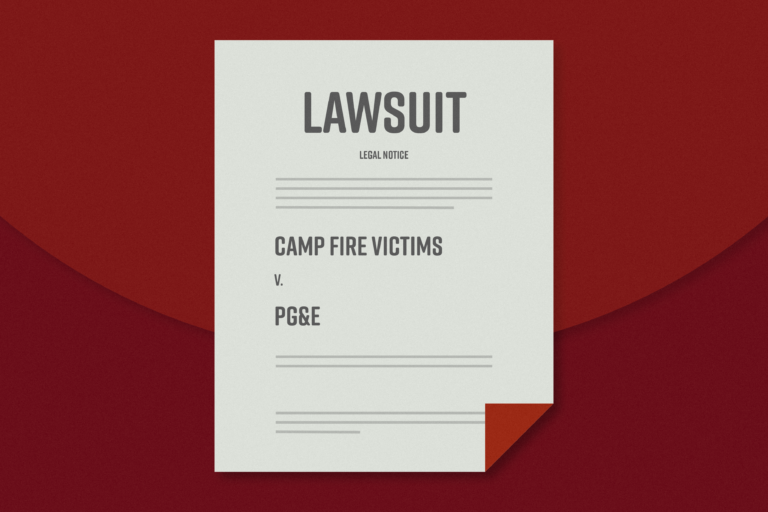
Lawsuits have been filed against The Pacific Gas and Electric Company for misleading the public on their claim of safety as a priority due to recent fires. So far, four California law firms have filed lawsuits on behalf of campfire victims to challenge PG&E’s false ads concerning customer safety.

One of the law firms involved in the cases, Walkup, Melodia, Kelly & Schoenberger, represents some of those victims. Khaldoun Baghdadi, a shareholder and partner of the law firm in San Francisco, explained how they got involved.

“We are one of the lead counsels in the north bay fires,” Baghdadi said. “A lot of clients also have friends or relatives in the campfire litigation or tragedy, and given that we were already actively involved with the fire cases, felt that it was natural to get more involved.”

Frank Pitre of Cotchett, Pitre, & McCarthy suggested that PG&E could have prevented threats to safety if they spent their profits on prevention rather than promoting ads.

“If PG&E had spent their monopolistic profits on infrastructure upgrades instead of promoting a false image of safety, this incident would never have happened,” Pitre said to Business Wire.

One of the complaints considers more than just damages to victims, according to a Camp Fire press conference.The complainant also seeks to “stop PG&E officers and directors from spending the company’s monopolistic profits and ratepayer assessments on advertising to promote a false and misleading picture of safety,” and to “recoup all monies spent by PG&E for advertising to promote their false image of safety since September 9, 2010.”

Baghdadi elaborated on how much loss people faced due to these fires.

“It depends on the circumstance, some people were severely injured [and] some people were killed — others lost their homes and property value,” Baghdadi said. “The typical measure of what the damages are would be the difference from the amount of whatever their insurance company pays them for property damage along with whatever emotional distress they could recover if they actually leave the fire. It’s a pretty broad category of damages depending on the specific person and their specific circumstances. It’s an enormous amount of harms and losses.”

People didn’t just lose their lives or their property. Another claim in the lawsuit was that PG&E had misleading advertising without considering public safety.

“One of the claims in our lawsuit was that while PG&E was engaged in an advertising campaign to convince people, but in reality little has changed in terms of the culture of safety,” Baghdadi said. “The culture requires real change — that’s still in effect until this day, as shown through the current federal prosecution of PG&E.”

The California Public Utilities Commission assessed PG&E’s adequate safety resources starting in Aug. 27, 2015, with an open investigation.

“While PG&E is committed to safety and efforts have been made to reduce incidents and increase the organizational focus on safety, these efforts have been somewhat reactionary — driven by immediate needs and an understandable sense of urgency, rather than a comprehensive enterprise-wide approach to addressing safety,” the assessment reads. “PG&E moved quickly to address the issues with its gas system surfaced by San Bruno, but was slower in addressing its safety culture.”

Baghdadi noted that PG&E cannot gloss over its past any longer because people are getting hurt.

“I think the bottom line here is that there is a number of people who paid their bills, tried to raise a family and did nothing wrong, and are now displaced or injured because a company chose to ignore the lessons of the past,” Baghdadi said.

Written by: Stella Tran — city@theaggie.org

Video shows alleged UC Davis employee attack AFSCME 3299 strikers in October

Pressure placed on administration to act decisively following release of video

During the American Federation of State, County and Municipal Employees Local 3299’s three-day strike last fall, a truck drove close to the picket line and an altercation ensued between an alleged UC Davis managerial worker and picketers near the Tercero Dining Commons, according to video footage. The altercation took place at approximately 6:25 a.m. on Oct. 25, 2018.

A video of the incident was released on Facebook by The United Students Against Sweatshops (USAS) on Dec. 5 alongside a demand letter that requested action by the UC Davis administration. The letter emphasized the need to preserve safety for strikers and students who support union efforts.

The letter reported that “an individual aggressively attempted to drive his truck through the picket line as he repeatedly honked to scare the picketers.” The individual was apparently seen making a phone call and a short while later a second car, a UC Davis pick-up truck, arrived.

“The individual driving the UC Davis pickup truck came driving full speed towards the picket line with his truck,” the letter stated. “This UC Davis pickup driver nearly ran us over, using his vehicle as a weapon which forced us to scramble and run to avoid being severely injured.”

The driver exited his vehicle, according to the letter, “to attack and assault students, workers, and AFSCME Local 3299 representatives.” When a student called 911, the pick-up truck driver returned to his vehicle and left the area.

The video shows the alleged attacker, a middle-aged male, wearing what appears to be an official work shirt with “Facilities Management, Utilities” printed on the back. The man argued and wrestled with the picketers in the video. An angry exchange ensued between the man and the group and, at one point, the alleged attacker picked up a wooden stake from a broken picket sign and threatened the strikers.

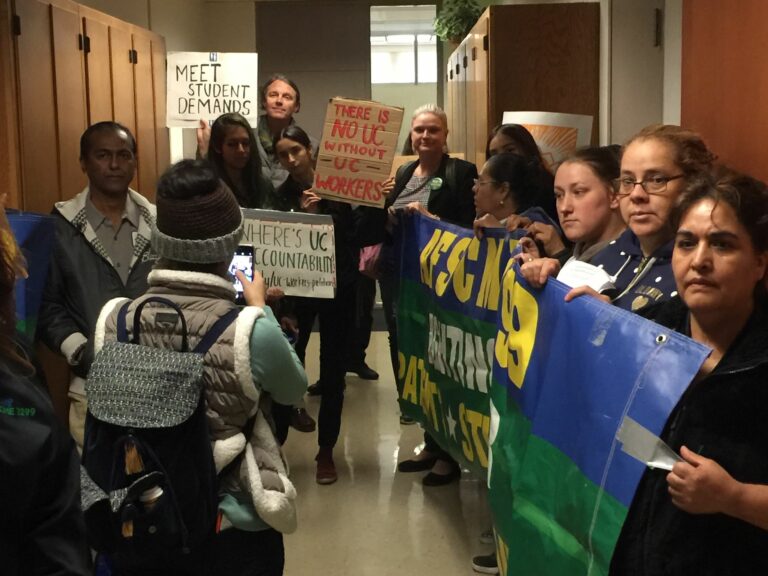
On Dec. 13 at 3:30 p.m., in response to the incident and the USAS demand letter, an estimated 40 AFSCME 3299 members and UC Davis students held a protest in the chancellor’s office at Mrak Hall. The protesters delivered a set of demands regarding the Oct. 25 incident and the union’s ongoing contract negotiation.

The workers gathered into a circle in the office and an opening in the center allowed union representatives to speak with a university official who came out to meet them. The official later called Chancellor Gary May via cell phone and he spoke on speakerphone with the protesters. The chancellor, the official and the protesters later agreed to a follow-up meeting on Dec. 18 to discuss the demands.

Melissa Blouin, the director of news and media relations at UC Davis, did not respond to requests for the name of the specific administration official who met with the protesters on Dec. 13, a statement regarding the Dec. 13 meeting or the results of the Dec. 18 meeting.

Blouin did provide The California Aggie with an email from Chancellor May in response to the incident addressed to the Cross Cultural Center.

“Our campus has launched investigations into the incident described in your email,” May wrote. “We have turned video footage over to the Yolo County District Attorney for their review and consideration of legal actions that could be taken.”

May also added that the UC Davis Compliance Office is managing an official administrative investigation of the matter.

“We will update the campus on these as appropriate,” May wrote.

It was unclear, however, whether the statement was in direct response to the USAS’ set of demands or in response to a separate demand regarding an investigation of the incident.

Yeimi Lopez, an AFSCME 3299 organizer and union member, was involved in the incident. She spoke specifically about the Dec. 13 organized action.

“We had a supervisor attack the picket line violently,” Lopez said. “He assaulted and injured staff and students and myself. He put his hands around my neck. And then I was able to break the chokehold with my hands. Some of the workers blocked him and just blocked him away from me.”

When asked how she was doing, Lopez said she was “doing better.”

Regarding the status of the alleged attacker from the video, Blouin said via email that “the matter is still under investigation, so we have nothing further to say at this time, other than what the chancellor said in the message that we shared with you.”

Following the organized protest on Dec. 13 in the chancellor’s office, protesters assembled outside of Mrak Hall.

Refilwe Gqajela, an organizer with AFSCME 3299, spoke about what she saw as the result of the meeting.

“We got an acknowledgement of the incident, an acknowledgement of our statement and acknowledgement of the demands and what happened,” Gqajela said. “For a very long time, the isolation and the continued violence from the incident was the silence of the university, and the silencing that students and workers have felt.”

Gqajela discussed how the protest was associated with the picket line incident and the contract negotiation.  

“The visit today [is due to] the incident that happened in Oct. 25, it is now Dec. 13,” she said. “Students released their statement and the demand over a week ago now. Before that, there was a larger system-wide student demand that spoke to the incident here and also to larger student worker issues.”

Gqajela then spoke about a statement the chancellor made regarding the incident.

“The chancellor, prior to today, released a statement acknowledging the student statement,” Gqajela said. “But it was an empty statement — an empty statement that did very little for the students and workers who feel unsafe to feel safe. It did very little to address the incident in and of itself and the violence that happened.”

Zach Freels, the lead organizer for AFSCME 3299 for UC Davis’ campus and medical center, said the alleged attacker from the video has resumed work.

“We know that two weeks ago this individual was working, he was seen on site at the wastewater treatment center continuing to work as if nothing happened,” Freels said. “We have had employees who were terminated for as little as dirty looks, and this guy engaged in an assault of students, employees of the university and AFSCME staff. The university has failed its obligation to hold people accountable for acts of workplace violence.”

According to Freels, the video was released as an act of direct action to “escalate the situation” after “the university failed to hold him accountable” and “failed to meaningfully respond to student demands.”

Though the incident has been referred to the Yolo County district attorney’s office, Freels believes there is more the university can do regarding the incident.

“Not every instance of workplace violence involves a district attorney,” Freels said.
“When it does arise to that level, in every instance that I am aware of in the time I have been here with this organization, the university has placed that person on administrative leave and almost always, they ended up with a termination.”

Written by: George Liao — campus@theaggie.org

Shooter in downtown Davis fires several times after three-car collision

Active manhunt concluded, 22-year-old police officer pronounced dead

On Thursday, Jan. 10, an officer from the City of Davis Police Department responded to a three-car collision around 6:43 p.m. in downtown Davis near Fifth and D streets. For unknown reasons, shots were fired and the officer, 22-year-old Natalie Corona, was pronounced dead after being transported to UC Davis Medical Center.

The alleged shooter was initially described as a white male with average build and was said to be wearing a black baseball cap, black jacket, blue or tan jeans and black tactical boots. A later report by the Davis PD described him as a white male with short brown hair, brown eyes, six foot two and 190 pounds with a thin build.

UC Davis was on lockdown and advised students to shelter in place. WarnMe alerts were supposedly also sent out, although many students received them much later, if even at all. Downtown streets were blocked by dozens of police cars, SWAT units and sheriff cars and were mostly empty, other than the dispatch units patrolling the area for the suspect. The active manhunt lasted for over six hours, and streets and highways were shut down. Multiple law enforcement agencies — including Sacramento, Solano and Yolo counties — were involved in the search efforts, while UC Berkeley, UC Santa Cruz and UC San Francisco police assisted the UC Davis police in patrolling the campus and escorting students back to their dorms.

All resources were allocated toward the manhunt, and as of approximately 10:08 p.m. Thursday night, it was a fluid tactical situation. The Davis PD did not give any new insight as to how the investigation was going at that time, as not to give up any possible tactical leads. Just before 1 a.m., officers surrounded a home downtown on Fifth and E streets. There was no sign of movement, and the officers found the suspect dead around 1:28 a.m. Friday morning with “what appears to be a self-inflicted gunshot wound.” The name of the suspect has not been released, and the investigation is being taken over by the Sacramento County Sheriff’s Department.

A UC Davis WarnMe message was sent out at 12:21 a.m. Friday morning, lifting the shelter-in-place request and stating that the Davis PD reported that the suspect is “no longer a threat.” The lack of messages informing students at the initial time of the shooting was attributed to “an unanticipated glitch in the WarnMe system.”

Officer Corona investigated the car crash downtown was shot and rushed to the UC Davis Medical Center, where she remained in critical condition until being pronounced dead. Corona was sworn in to the Davis Police Department just two weeks prior to her death. Merced Corona, her father, was a law enforcement officer at the Colusa County Sheriff’s Office for 26 years, passing along the responsibility as he pinned his daughter’s badge on Aug. 2, 2018. According to Davis Police Chief Darren Pytel, Davis PD hasn’t lost an officer since 1959, about 60 years ago.

“I haven’t seen anybody be more motivated to be a police officer than Natalie,” Davis Police Chief Darren Pytel said in a late press conference.

Mayor Brett Lee and officers from the Davis PD offered their sincerest of condolences for Corona’s family. Lieutenant Paul Doroshov, the public information officer for the City of Davis PD, spoke about the closeness of the department that consisted of approximately 61 sworn officers.

“It’s a small department — it’s a family unit in a lot of ways,” Doroshov said. “Everybody’s shocked. We’re all trying to hold it together, but it’s hard.”

Written by: Kaelyn Tuermer-Lee — city@theaggie.org

Proposed Title IX changes puts victims second

Public comment period open until Jan. 28

One of the jobs of the U.S. Department of Education, led by Betsy DeVos, is to enforce a pivotal statute in the Education Amendments of 1972 called Title IX. This statute was established to protect people from sex-based discrimination in education programs that receive federal funding. Title IX mandates that educational institutions fulfill their legal obligation to protect victims of sexual harassment, sexual assault or rape, and provide an educational environment that is free of sexual misconduct and hostility.

Recently, however, the Trump administration has chosen to interpret this statute in a different light — one that disempowers accusers and aggressively asserts the due process rights of the accused. The proposed changes uproot the years of progress made under former President Barack Obama, who attempted to respond to sexual harassment claims in schools with swiftness, vigor and fairness for all parties involved.

The Department of Education issued a set of policy changes to Title IX in November under the guise of “encouraging more students to turn to their schools for support in the wake of sexual harassment.” But it is apparent that the proposed changes reek of a heavy and persistent bias, and the sympathy and support lies unmistakably on the side of the accused.

Under the proposed regulations, sexual harassment is defined as “unwelcome conduct on the basis of sex that is so severe, pervasive, and objectively offensive that it effectively denies a person equal access to the recipient’s education program or activity.” This narrow and lax definition thoroughly undermines the spectrum of sexual offenses that ranges from verbal to physical abuse. It also presumes that there is a universal standard of suffering that must be felt by the victim before sexual misconduct is deemed “objectively offensive” and therefore punishable by law.

Perhaps one of the more blatantly egregious requirements by the Department of Education states that live hearings with cross examinations must be held by schools. This form of interrogation is unnecessary, inherently intimidating, and can further traumatize a victim. Most universities, including the University of California, already ensure due process by having the accused question complainants and witnesses through a non-threatening neutral intermediary.

A mere 15.8 to 35 percent of all sexual assaults are reported to the police, and only 3 percent of rapists spend a day in prison. While there are a multitude of reasons for these staggering statistics, one reasonable explanation is that victims may feel re-victimized and invalidated by the same legal process that is supposed to give them uncompromised justice. Prioritizing the accused in fear of false accusations has damaging consequences for the mental health of victims and sets a precarious precedent for the effective administration of justice in all cases.

The law shouldn’t serve as another assailant. Those who suffer the emotional and physical distress of sexual trauma should not be subjected to unnecessary legal wrangling by the justice system. If these policy changes are implemented, they will completely stifle the voice of victims who may already be reluctant to come forward.

The Editorial Board urges students, faculty and staff to provide feedback on the proposed changes at Regulations.gov by Jan. 28.

Written by: The Editorial Board