58.6 F
Davis

Davis, California

Monday, December 22, 2025
Home Blog Page 82

New art exhibits debut at Manetti Shrem’s fall opening ceremony

Famous art pieces by Salvador Dalí, Francis Bacon and others on display for the first time in decades


By NOAH HARRIS — features@theaggie.org


On Sept. 26, hundreds of people gathered at our local museum to view two new art exhibitions that opened the previous week. Works from famous artists are currently showing that have not been displayed in a gallery setting in decades. In addition, a ceramic exhibit is currently showcasing the history and culture of those who created it. While displays like these are usually found in large museums in big cities, the Manetti Shrem Museum on the UC Davis campus has the honor of hosting these recent exhibits. 

Preparing for what the museum says will be  “an extraordinary fall season,” the fall season celebration aimed to bring the community together to celebrate new pieces on display. There was a catering staff, games for children to play and plenty of space to draw. While the event in its entirety lasted from 10 a.m. to 5 p.m., the main part of the festivities occurred between 12 and 4 p.m. During this time, a Q&A was held with the curators of two exhibitions, including four students who helped create an exhibition titled “Light into Density.

The exhibit opened to the public on Sept. 19 and will be on display until May 5, 2025. This exhibit is a first for the museum, as it is the first student-curated and student-designed exhibition. In total, there were 32 students involved in the curation and design of the exhibit; with the names and pictures of those students being showcased as well.

The art itself was very well-received by the public. Featured works are from artists such as Salvador Dalí, Vassily Kandinsky, Joan Miró and Francis Bacon. There are only 15 pieces, many of which have not been viewed in public for decades, according to the museum. All works in this exhibit are from the personal collection of Jan Shrem and Maria Manetti Shrem, the namesakes of the building. 

Students did not know prior to enrolling in the class during the fall of 2023 that they were going to be curators and designers for this exhibit. The course, Art History 102: Exhibition Practicum, was supposed to have 15 people. 

 “There was an administrative snafu, so there were actually 30 students enrolled, and then a waitlist of almost 30,” Alexandra Sofroniew, the instructor of the course, said. “I took as many people as I could.”

The name of the exhibit came from a painting by the same name from Antony Tapies. Sofroniew, who is also an assistant professor in the art history and classics department at UC Davis, explained how the students chose the name “Light into Density.”

“A lot of the paintings are sort of trauma informed and can be quite dark [but] students found hope in the painting,” Sofroniew said. “That particular piece encapsulated the idea that there’s some darkness in these works, but that there’s also a lot of light and hope.”

As part of the Q&A, four student curators took questions from the audience and described their work. They were Kelly Kankowski, a fourth-year design major, Maev Dunning, a UC Davis alum who now works for Manetti Shrem, Madeline Furtado, a fourth-year art history and design double major, and Morgan Strong, a third-year art studio and design double major. 

Kankowski still seemed a little surprised that the exhibit was happening. 

“I was honestly shocked — I joined the class on a whim [and] did not expect to be part of an actual exhibit that was going to be at the Manetti Shrem Museum,” Kanowski said.

 Strong spent months on the waitlist before she finally was admitted into the class.

“There were a lot of people in the class, and [Sofroniew] was trying to scare away people

nicely, and I was sitting there going, ‘Leave, I need to get in this class,’” Strong said.

While working with 32 people might make it hard to collaborate, Dunning noted that the process went smoothly. 

“Everyone was really excited about it and motivated about it, which I think made all the difference,” Dunning said.

The art pieces used were set in stone, so for Furtado, the most important part of the exhibition was the guest experience. 

“A lot of the artworks were predetermined,” Furtado said. “Our main thing was amplifying visitor interpretation for this space.”

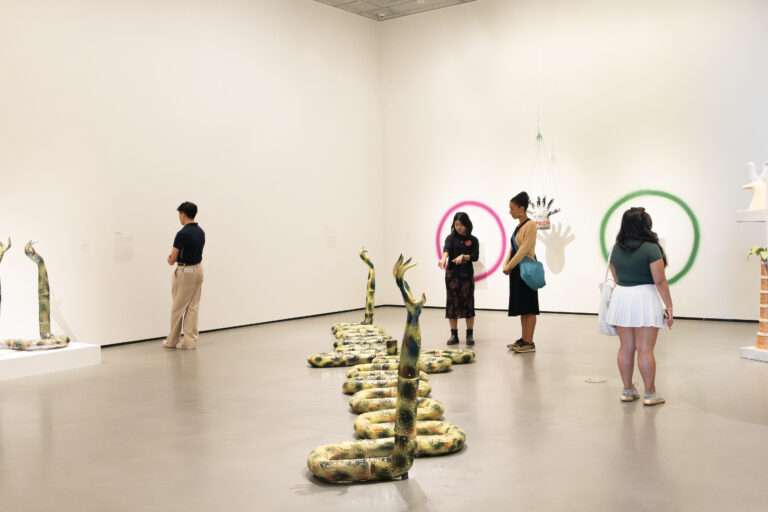
Another exhibition that opened on Sept. 19 features ceramic works by the San Francisco-based artists Cathy Lu, Paz G and Maryam Yousif. Titled “Ritual Clay,” the works share a theme of past cultures as conduits of cultural knowledge. 

The meanings of many art exhibitions can be confusing to interpret. Ginny Duncan, the curatorial assistant at the Manetti Shrem Museum and curator of “Ritual Clay,” described what the name of their exhibit means.

“‘Ritual Clay’ comes from the idea that I’m bringing together three artists that are working in ceramics — that would be the clay piece of ritual clay — [and] they’re using clay as a way to reach back to their stories, or [the ritual],” Duncan said.

Duncan also explained how the art exhibition came into existence. 

“It came out of conversations with all three artists,” Duncan said. “I realized that there was a deeper thread that connected the three of them, and that they were working with clay for a similar purpose and accessing this cultural knowledge that’s different for each of them. It was realizing that all three of them were thinking about similar themes, even though they were approaching [them] in different ways.”

Duncan was also excited about the displays on show. The exhibit features ceramics of all shapes and sizes with vivid, bold colors. 

“Hopefully people will be drawn in by the range of sculptures on show,” Duncan said. “They all look very different; they are, in their own ways, very impressive.”

A third exhibit has been open since Aug. 8, titled “Entangled Writing.” Its sculptures explore themes of immigration, ethnicity, race and gender in 21st century America. It is also said to be “the largest group of works the Manetti Shrem Museum has commissioned at one time.”

If there is no other reason to go see these exhibits, Sofroniew suggests a compelling one. 

“A Salvador Dalí is going to [be] hanging here on campus, you can see it for free until May,” Sofroniew said. “Everyone should come see it.” 

The Manetti Shrem Museum seems to be a fitting home for all types of art. UC Davis students and staff are recommending that members of this community take advantage of the museum as a resource, as well as a place to appreciate student and staff collaboration and culture. 

 

The re-emergence of digital cameras

Students share what makes digital cameras special and why they have made a comeback


By GRACIELA TIU — features@theaggie.org


If you’ve gone out with your friends, seen people taking photos on the street or even been to a party, chances are you’ve also seen a good amount of digital cameras. For the past couple of years, more and more people, primarily in the younger generations, have been purchasing and using these cameras. Once a ’90s item but now a Gen Z staple, digital cameras have significantly grown in popularity. UC Davis students describe some of their first experiences using them, as well as recommending them to others.

“The first time I was exposed to a digital camera was probably for my friend’s birthday,” Salma Ahmed, a fourth-year animal science major, said. “My other friend bought one, and we used it as a surprise birthday photoshoot with a bunch of Christmas lights because her birthday is in December. It was just really cute, because the camera photos turned out more aesthetic than a phone camera.”

Many current digital camera users first learned about them through their friends or people they know. Joya Chahine, a second-year global disease biology major, also recounted her earliest digital camera memories and explained what inspired her to purchase one.

“In my junior year of high school, one of my hometown best friends was the dedicated photo taker for the group; she was the one that always brought her digital camera everywhere,” Chahine said. “Then I went and bought one for college, and I became the dedicated person to take the photos, so I think it was her that made me want to get one for college.” 

Digital camera users also prefer the quality of a digital camera over that of a phone.

“I like the way that they look more,” Sara Pimenta, a fourth-year managerial economics major, said. “It’s not necessarily that the quality is better, but the photos are more visually appealing than they are on a phone. Sometimes iPhones put their own filters on the photo, which I don’t love, whereas digital cameras look more vintage and authentic.”

Chahine also noted how digital cameras can enhance the overall effect of the photo.

“I think iPhone photos are just too perfect,” Chahine said. “The actual photo quality itself just doesn’t look, like, in the moment — it looks like you’re taking the photo to save it for later. I feel like digital cameras take photos that are somewhat blurry, somewhat old school, and I feel like it captures the friend aspect, just being around other people’s presence, which I really like.” 

Not only do people notice a visual difference in digital camera photos, but they also feel a difference in the photo-taking experience.

“There’s a sense of community; when someone has a digital camera, everybody wants to take photos,” Chahine said. “I feel like clicking and actually holding a camera makes it fun. And you can always look back and see how they turned out, adjust people’s poses, the settings and everything.”

  If digital cameras have existed since the ‘90s, why are they suddenly coming back now? One big reason for this seems to be the excitement they bring to young people.

“For us, it’s something new,” Pimenta said. “We were kids when our parents would use them, and then we grew up using cell phones. It’s kind of like record players — we didn’t grow up with them, so now we think they’re cool. I think it has to do with that; we just didn’t grow up using it.”

The return of digital cameras also mirrors larger trends that have been coming back in recent years.

“I think it’s also just a trend in a way, where older stuff is coming back,” Ahmed said. “With the whole re-emergence of Y2K and ‘90s fashion style, I feel like digital cameras are also coming back.”

Although most trends inevitably become obsolete or shift in nature, for the time being digital cameras are making photo taking a more enjoyable activity for many. Chahine also shared her favorite times to use them.

“The most important use is just for taking photos [of your] friends and everything,” Chahine said. “But also, vacation is a big one; vacation ‘digis’ are a lot of fun. Also if someone is dressed up and they just want a cute photo of themselves, I feel like digital cameras just give that aesthetic — it’s fun, you know?”

Written by: Graciela Tiu — features@theaggie.org

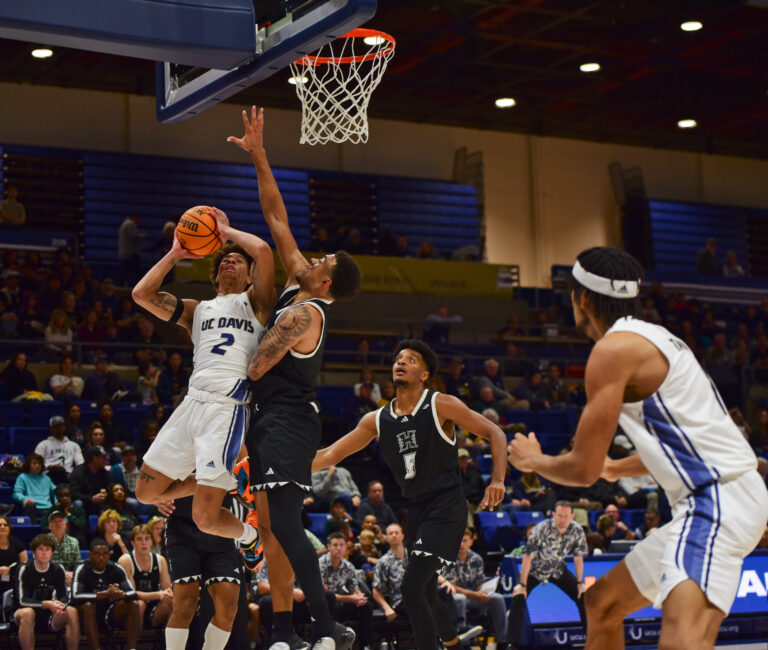
TY Johnson comes back to the Aggies ready to win a championship

An inside look into the UC Davis basketball team


By Krista Hajjar — sports@theaggie.org


As the basketball season is approaching, the UC Davis men’s basketball team has started solidifying their roster. One of the strongest players on the team in the 2024 season has decided to stay for another year, despite entering the transfer portal last spring. The California Aggie recently had a chance to sit down with TY Johnson, a fourth-year communications major, to ask him about what he learned from his last season at UC Davis, what he’s looking forward to in the upcoming season and why he put his name in the transfer portal. 

In the position of lead guard, Johnson believes he had to achieve a greater understanding of the game in order to advance his team.

“I learned a lot from being in that role, because I had to come in and produce more for our team,” Johnson said. “I knew that I had to give in and to buy in more of the system for us to be where we want to be and to put us into the position where we were at last year.” 

Johnson continued to note that it took a mixture of intense film watching and consistently working with the men’s basketball coaches to make that huge stride between his first and second year as an Aggie. Although he is reaching great heights now, Johnson said the journey to becoming a lead guard wasn’t easy with the new pressure that came along with it.

“In all honesty, I started the season off really rocky,” Johnson said. “I was putting too much pressure on myself.” 

But, that rocky start didn’t deter Johnson from playing his best as he continues to stay true to himself on the court and break records. His goals for this season include winning Player of the Year, Defensive Player of the Year and securing first place in the conference. His ambitions go past that of the Big West League as Johnson continues to note his bigger ambitions of being on the All-American stage. 

“I know my expectations, and I know my coaches’ expectations and what it takes to get there,” Johnson said. 

After discussing the off-season and how the team has been using this past summer to strengthen their defense — what makes the team special and unique — Johnson also commented on the team as a whole. 

“I feel like our team bonding, the things that we do off the court with our coaches and how much time that we spend with each other makes us unique,” Johnson said. “Schools normally don’t do that, because I feel like a lot of college coaches are just happy to do their jobs. […] Our coaches actually invest into us as humans before basketball players. They really want to get that […] brotherly connection within [the] whole team.” 

Johnson reflected on a specific moment in his career from his fourth year of high school that stays with him. Due to COVID-19, he had a shortened year and season — yet that was when he and his past team had their best season. 

Even with less time competing on the field, his team was able to take part in the Chipotle Clash of Champions with the top eight schools in Illinois. Johnson and his team were first up against the No. 1 team, with his team the underdogs at No. 7. They proved everyone wrong as they not only beat the No. 1 team but went on to win the entire tournament. 

“[My team] played on ESPN, which was the first time our high school was featured on there,” Johnson said. “I knew that was my [breakthrough] and I was going to take off.” 

The Chipotle Clash of Champions isn’t the only fond memory that Johnson keeps with him — a saying from his dad has also remained important in his life. Before every game, Johnson’s dad always tells him, “A lot of people will fall under pressure when the lights are bright.” 

Johnson admitted that he didn’t really understand what his dad meant until recent years.

 “People tend to fall under pressure in the biggest moments, but I’m never one to shy away from it,” Johnson said.

Earlier this year, Johnson placed a transfer portal request, informing his coaches of his willingness to transfer schools and play for another team. 

“There was a lot that went into it,” Johnson said. “With me coming off a great year and season, I knew that I could play with anyone in this country […] I love being tested and playing against the best.” 

After speaking with Head Coach Jim Les, Johnson said that he wanted to explore his options and see where he stood. If Johnson were to leave UC Davis, he would need the school to match what he was receiving: being lead guard, playing 30 minutes a night and having a similar team culture and coaching staff.

Johnson ultimately made the decision in early summer to stay with the Aggies. After speaking to coaches at other schools, he failed to find a similar connection with the coaches, as well as other drawbacks, that ultimately led him to stay at UC Davis for his fourth year. 

“It was a tough decision, but it really wasn’t,” Johnson said. “After talking to these coaches and stating what I was looking for, I was able to make a pros and cons list which made it easy for me to come back and make my last year my best year at Davis.” 


By Krista Hajjar — sports@theaggie.org

Politics go deeper than debate highlight reels

While both candidates were cordial, it is still important to not let performative politics cloud your judgment 


By THE EDITORIAL BOARD


On Oct. 1, Minnesota Governor Tim Walz and Ohio Senator JD Vance engaged in civil discourse and policy-driven conversation as they shared the stage during the vice presidential debate. The debate, hosted at the CBS Broadcast Center, covered topics such as immigration, housing, the economy, reproductive rights and much more. Many noted that this debate differed drastically from the ABC News Presidential Debate with Donald Trump and Kamala Harris. Walz and Vance engaged in a somewhat-collegial affair, yet still disagreed on some of their counterparts’ policy positions. 

While the debate appeared more professional — with candidates generally respecting their opponents and the rules set in place by moderators — the Editorial Board urges voters to recognize that the debates only give voters a glimpse into a candidate’s policy. Rather than focusing on political performances to support your decision, it is extremely important to look for sources that give voters detailed information on the actual policy positions of both the Harris and Trump campaigns. 

We see so much performance in our everyday media, making it increasingly difficult to decipher whether the content we are receiving is genuinely informing us or making an emotional spectacle for viewers to latch onto. News outlets and social media work in tandem with public perception to frame the concept of the debates to clearly point to one “winner” — fueling polarization between candidates and parties alike over who “did better.”  

Similarly, viewers pay close attention to which candidate is speaking in a concise and reasonable manner because of the standards set by past presidential debates. The first widely televised debate showcased presidential candidates, John F. Kennedy and Richard Nixon, engaged in civil exchanges with one another and focused on policy differences over personal attacks. This doesn’t go to say that there weren’t tension-filled moments, but the overall atmosphere was notably less combative than contemporary debates. Even in the first televised presidential debate, the character and appearance of the candidates still played a major role in voters’ decisions. 

It is common to focus on how tone and mannerisms factor into the way a candidate is presenting their material, but public attention is often drawn to how candidates frame their arguments rather than the information within them. It’s understandable to feel relieved that Walz and Vance were respectful and empathetic toward one another, given the recent history of tense discussion by their running mates. 

Modern U.S. democracy is inherently divisive. Voters cannot lose sight of the fact that two opposing parties are fighting to sway the American people toward their respective candidates. While we understand that seeing candidates speak respectfully to each other reminds us of a “simpler time,” it is important to understand the drastic differences between the two choices on the ballot. 


Written by: The Editorial Board

Davis Cemetery District opens memorial dedicated to COVID-19 victims

Three years in the making, the new memorial includes doorways, mosaic and a mural to honor those affected by COVID-19 


By RORY CONLON — city@theaggie.org


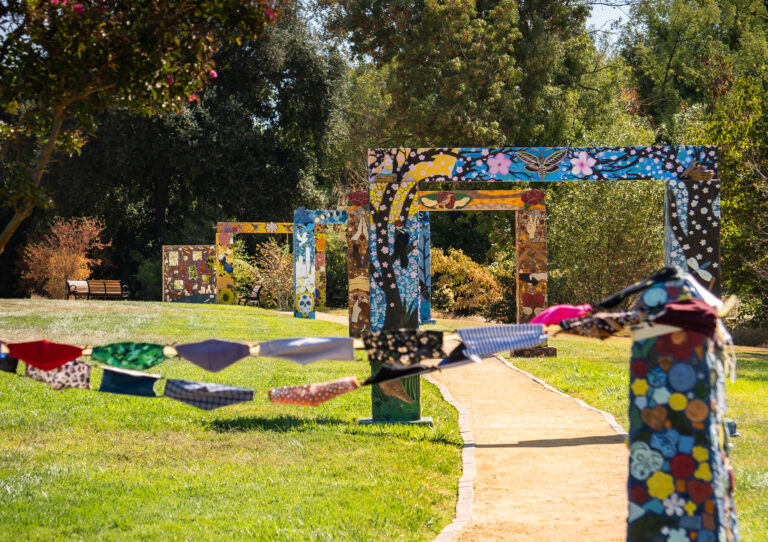
The Davis Cemetery District opened a new memorial dedicated to victims of the COVID-19 pandemic on Sept. 22. 

Located near the back of the cemetery, the memorial includes four doorways decorated to match different themes, a “reflecting wall” with mirrors and mosaic and a mural painted by community members. Davis Cemetery Trustee Vice Chair Stephen Souza spearheaded construction of the project. 

“Three years ago, [Davis Cemetery Trustee] Heidy Kellison came to the board with the idea of building a COVID-19 memorial, and the board said, ‘We think we can do it,’” Souza said. “We proceeded to plan, and two years in, we issued a call to artists. That’s when I really started to feel as though we could make this happen.” 

The four doorways, made of concrete and overlaid with colorful ceramic tiles, represent different themes selected by members of the Davis community: home, community, loss and hope. Wesley Horn, the lead artist on the memorial, recognized local Davis artists and community members that contributed to the final product.

“Jennifer Nachmanoff and Donna Lemongello, two fixtures and heavy weights in the Davis arts scene, spent countless hours in the studio making a lot of these tiles and hosting community build workshops,” Horn said. “300 plus community members are represented physically in the tiles and handmade ceramics on these portals. We had a number of open, free community build sessions in places like the Davis Craft and Vintage Fair, the International House and the Davis School of Independent Study.” 

Once visitors of the memorial pass through the four doorways, they encounter a “reflecting wall” complete with mirrors and colorful glass mosaic. Sheila Allen, the supervisor elect for District 4, said her reflection in the glass emphasized how she, as well as everyone at the memorial, was impacted by the COVID-19 pandemic. 

“Every person here, every person who’s not here and some of the people whose bodies now lie in this cemetery, were all affected by the pandemic,” Allen said. “Whereas it might feel better to say, ‘Yeah, let’s move on,’ I think taking a moment to remember is an important thing to do.” 

District 2 Supervisor Lucas Frerichs also highlighted the mental health struggles community members continue to face in light of the pandemic. 

“Mental health indicators were at epidemic levels prior to the pandemic,” Frerichs said. “They have only been exacerbated since that time, and it’s no wonder […] why. There is so much work to do in reducing stigma and barriers to [begin] acceptance and healing.” 

Some of the sponsors of the memorial included the Yolo County Board of Supervisors, the city of Davis and Davis Firefighters Local 3494. Davis Firefighters Local 3494 President Matt Fix said that, while firefighters are used to responding in moments of crisis, confronting the pandemic was different. 

“During those long months, we found ourselves on the front lines in ways that we hadn’t before, knowing that each call we responded to carried new risks and who knows what else,” Fix said. “We weren’t looking for praise then, and I don’t think any of us are looking for praise now. We responded when the calls came in.” 

Davis Mayor Josh Chapman also spoke about efforts the city of Davis took to combat the pandemic. He said that the Healthy Davis Together program, a collaboration between several organizations aimed at preventing the spread of COVID-19, helped support struggling Davis businesses through the Business Partner Program. 

“The program supported businesses and local economy through a variety of resources and means, including free PPE [personal protective equipment], grant reimbursements of up to $5,000 for items that aided businesses in safely reopening, free COVID-19 testing for employees and their families [and] access to business ambassadors and public health specialists,” Chapman said. “During the program’s eight-month run, a total of 424 Davis businesses participated, which is about 30% of the customer-facing businesses in the community.” 

Chapman said the pandemic emphasized how strong the Davis community can be in the face of adversity. 

 “When it comes to our families, our friends and our businesses, we are ready to step up every single time,” Chapman said. “That is what it means to live in Davis and to call this our home. Let’s hope that nothing like COVID-19 ever happens again, but if by chance it does, I know that we’re going to be okay.” 


Written By: Rory Conlon — city@theaggie.org


Monkeypox has been declared a public health emergency

The disease is rapidly transmissible and can cause complications in vulnerable populations


By ZAFREEN SHAIK— science@theaggie.org


Last month, the World Health Organization (WHO) Director-General Dr. Tedros Adhanom Ghebreyesus declared the mpox outbreak, formerly known as monkeypox, a global public health emergency. Once limited to certain regions of Africa, the virus has now spread to over 122 countries, 115 of which had never seen a case before. With more than 100,000 confirmed infections globally, the resurgence — driven by the Clade IIb strain — intensified concerns, prompting public health officials to mobilize efforts worldwide to contain the virus.

Dr. Dean Blumberg, the chief of pediatric infectious diseases at UC Davis Children’s Hospital, commented on the spread of mpox in an interview with UC Davis Health.

“Mpox clade 1 is what is circulating now in Africa — including African countries that haven’t reported cases of mpox in the past,” the article reads. “As of Sept. 3, 2024, cases have also been reported in Sweden, Thailand and Pakistan after travel to Africa.”

Mpox is caused by the monkeypox virus, which is part of the Orthopoxvirus genus and closely related to the smallpox virus (Variola virus). While mpox generally results in milder symptoms compared to smallpox, its ability to spread rapidly and infect vulnerable populations underscores its significance as a public health threat. Transmission primarily occurs through direct contact with an infected person’s bodily fluids, respiratory droplets or contaminated materials such as bedding or clothing. Human-to-human transmission has been highlighted in recent outbreaks, particularly through close or intimate physical contact, making it a crucial component of the global spread in 2022 to 2023.

Clinically, mpox manifests with symptoms such as fever, swollen lymph nodes and a distinct rash that typically starts on the face or genital area. The rash progresses through several stages, forming vesicles, pustules and eventually scabs. Infected individuals may also experience body aches and fatigue. Although the disease is often self-limiting, complications can arise, particularly in vulnerable populations such as children, immunocompromised individuals and those in regions with limited healthcare access. This makes controlling the spread even more critical.

First identified in monkeys in 1958, mpox was recognized as a zoonotic disease that could also infect humans. Its endemic presence in Central and West Africa is well documented; thousands of cases are reported each year in the Democratic Republic of the Congo (DRC). A notable event occurred in 2003 when an outbreak in the United States, linked to the importation of wild animals, highlighted mpox’s potential to spread beyond Africa. Though this outbreak was quickly contained, it served as an early warning of the virus’ global reach.

Fast forward to 2024 and the ongoing global outbreak of Clade II mpox, particularly the IIb subclade, has led to widespread transmission. Although Clade I mpox has not been reported in the U.S., Clade II continues to circulate at low levels in the country, raising concerns about sustained transmission. Global health efforts now focus on curbing the spread, especially in regions with fragile healthcare systems.

Testing is key for people to get treatment and care as early as possible and prevent further spread,” WHO states. “Since 2022, WHO has delivered around 150,000 diagnostic tests for mpox globally, of which over a quarter have gone to countries in the African Region. In the coming weeks, WHO will deliver another 30,000 tests to African countries.”

At UC Davis and other healthcare institutions, telehealth appointments are available for individuals concerned about mpox exposure. UC Davis Health has also made mpox vaccinations available to high-risk groups, including patients, faculty and staff. 

Blumberg confirmed that JYNNEOS is approved for use in both adults and children, though it is not part of the routine vaccine schedule for children. In addition to vaccines, antiviral treatments and immunoglobulins are available, particularly for vulnerable groups like infants under six months old. The JYNNEOS vaccine, administered in two doses, provides about 85% protection if given within four days of exposure and can lessen the severity of the disease if administered up to two weeks later.

As mpox continues to spread globally, UC Davis and other institutions across the US are responding by promoting vaccinations, increasing awareness and providing medical support to those at risk. While the overall risk remains low for the general population, vigilance, timely vaccination and adherence to public health guidelines are essential to keeping the campus and broader community safe from mpox.

Expanding access to diagnostic services is urgently needed as tests are essential to critical measures such as strengthened laboratory capacity, improved case investigation, contact tracing, surveillance data collection, and timely reporting,” WHO states. “As a package, these help countries identify chains of transmission, detect cases early, prevent further spread, and monitor the virus in real-time.”


Written by: Zafreen Shaik— science@theaggie.org

Ride-sharing services are contributing to greenhouse gas emissions

Customers often use popular companies like Uber to replace more sustainable forms of transportation


By KATIE HELLMAN — science@theaggie.org


Ride-sharing services like Uber and Lyft are known for their convenience and accessibility. They have gained immense popularity in the last few years, but their extensive use comes with a hidden drawback: they often replace more sustainable forms of transportation.

The study, which was conducted in accordance with a state regulation aiming to reduce greenhouse gas emissions from transportation services, was published in Sage Journals.

“We found that over 50% of ridehailing trips in our sample were replacing more sustainable modes (i.e., public transit, active modes, and carpooling) or were creating new vehicle miles, with a 5.8% rate of induced travel, with public transit being the most frequently substituted mode,” the study reads.

Over half of trips taken by California survey respondents were substitutes for activities like walking, biking and public transportation due to their ease of use, which is one of their main selling points.

The study gathered data from individuals located in San Francisco, San Diego, Los Angeles and Orange County within the span of a year, and overall, 7,333 trips among 2,458 respondents were analyzed.

Only 5.8% of the trips were made by respondents who said that they would only have been able to get to their destination with the help of ride-sharing services, whereas almost half of the respondents were using these services to replace potentially more sustainable modes of transportation.

James Giller, a Ph.D. candidate in the Transportation Technology & Policy program at the Institute of Transportation Studies at UC Davis, commented on these equity issues in an interview with UC Davis Health.

“Hopefully, the results of this study can be used to increase the sustainability of ride-hailing and also address potential equity issues that are apparent,” Giller said. 

The study has also revealed findings revolving around equity issues. Respondents without a car and who identified as a racial or ethnic minority were found to be least likely to cancel their trip even without transportation services, showing that these services were essential to their travel plans. The wide use of these services can therefore increase these social impacts, in addition to increasing traffic and greenhouse gas emissions that could be avoided with other modes of transport.

“It’s all about making sure [ride-hailing services are] used in the most efficient way by increasing the occupancy of the vehicles; by making sure these trips connect people to transit stations for longer distance travel; that they’re done in efficient, clean cars; and that we can reduce as much as possible the inefficiencies associated with finding passengers and going to pick them up,” Giller said.


Written by: Katie Hellman — science@theaggie.org

Shakti: Who is the Indian-Western fusion band that won Best Global Music Album at the 2024 Grammys?

Shakti shares the brilliance of Indian music and its impact on the world


By INDRANIL BASU — arts@theaggie.org


Shakti won Best Global Music Album for “This Moment” at the 66th Annual Grammy Awards, which was telecast earlier this year on Feb. 4, 2024 on CBS, marking a historic moment for Indian music and musicians across the world. September marks not only one year of the completion of the 50th Anniversary Tour of Shakti but also their performance at UC Davis as part of the tour.

“Shakti,” which means fundamental cosmic energy, manifests its meaning in the way it brings together eastern classical music — North India’s Hindustani and South India’s Carnatic — and Western music. The band expertly combines these varied streams into a global music of universal emotion that emanates a transcendental spiritual expression.

Shakti was first formed in 1973 by virtuoso British guitarist John McLaughlin and Indian tabla maestro Ustad Zakir Hussain based on their experimental jam sessions. They were joined by Indian violinist Lakshminarayana Shankar and percussionist T. H. “Vikku” Vinayakram, forming an “unprecedented transcontinental collaboration.”

They released three albums and toured extensively until disbanding in 1978. In 1997, McLaughlin and Hussain reconstituted the band as “Remember Shakti,” with V. Selvaganesh — son of Vinayakram — mandolin player U. Shrinivas and vocalist Shankar Mahadevan. Again, they disbanded for another two decades.

The band finally reformed in 2020, this time with Mahadevan, Selvaganesh and violinist Ganesh Rajagopalan. After sold-out concerts in India, they released their first studio album as Shakti in more than 45 years in 2023:  “This Moment.” Supporting their album, they set out on a world tour including India, the United States and Europe under the name Shakti50

One of the stops on their world tour was none other than the Mondavi Center for the Performing Arts at UC Davis on Sep. 8, 2023, marking the Center’s opening event of that season that featured guest performer Bill Frisell.

The audience waited with great anticipation for Shakti to come on stage, with many Indian audience members coming from along the West Coast to witness the special appearance of the maestros of Indian music. 

Many Indians across generations have grown up with the music of the various band members and know of them as some of the greatest and most popular Indian musicians. Hussain is regarded as India’s most famous tabla virtuoso in the post-independence era while Mahadevan is known as a leading composer and singer in Hindi films. Rajagopalan is one half of renowned violin maestros The Kumaresh Brothers, and Selvaganesh is a celebrated Carnatic percussionist. Most of these musicians come from rich and eminent generational legacies of Indian music, and getting a chance to see them perform live around one’s own Northern California hometown was a paramount opportunity for many in the audience.

The musicians sat cross-legged on the stage in the traditional Indian style of musical practice. The strings and percussion were concentrically placed in order to communicate and improvise throughout the performance. Percussionists Hussain and Selvaganesh utilized a variety of traditional percussion instruments: the Hindustani tabla, chanda and nadal; the Carnatic kanjira, mridangam and ghatam; as well as konnakol — vocally performed percussion syllables. 

Mahadevan opened with their song “Giriraj Sudha,” a devotional piece for auspicious beginnings. The music’s playfulness, combined with McLaughlin and Hussain’s introductions of the pieces, infused the performance with humor and engaged the audience further. 

The band also performed expanded, improvised versions of pieces from the album, including “Shrini’s Dream” and “Bending the Rules,” as well as non-album pieces such as their versions of Hindustani semi-classical “thumri,” titled “Sakhi” and “Manmohana Madhusudana.”

As in traditional Indian recitals, each of the musicians delved into their own solo spotlights as well as playfully competitive instrumental duets — “jugalbandis” — that peaked in tempo and musical complexity before returning back to the base of the song.

During the two-hour performance, the crowd gave multiple standing ovations and called the musicians back for an encore, prompting a surprise appearance from Hussain’s granddaughter who came from backstage to be greeted by the band and audience. Following the performance, Mahadevan shared the band’s emotional outlook on their performance with The California Aggie.

“It is happy music, it brings us a lot of joy — that joy we have on stage gets transmitted to the audience,” Mahadevan said. “It is a happy experience, besides it being very musically intense, very deep, very complicated, at the same time very soulful. It’s a very unique group, which is a combination of so many emotions together. But what we do is: on stage, we have so much fun that that gets transmitted to the audience, that they feel happy at the end, and it changes people’s lives.”

Selvaganesh discussed how the band brings about their own musical fusion. 

“If a band feels like a family, you are there,” Selvaganesh said. “You will hold hands and walk together. Like sometimes your brother says something and you stand for it, or if I say something he stands for me — it is similar in the band.”

Shakti does truly feel like a group of people that have a great love and understanding for each other, through and perhaps beyond music. 

The Grammy for “This Moment” was accepted by band members Mahadevan, Rajagopalan and Selvaganesh, and as part of their acceptance speech, they thanked India, exclaiming, “We love you India!” which extracted a huge cheer from the audience.

Hussian also won two other Grammys the same night: Best Contemporary Instrumental Album for “As We Speak” and Best Global Music Performance for “Pashto,” making a huge landmark for Indian music on the global platform.

Reflecting on the Grammy win in an exclusive interview for The Aggie, violinist Rajagopalan expressed gratitude to the band and acknowledged the “faith bestowed upon him by Zakir Hussain ji and John McLaughlin ji.”

“Indian Classical Music has been integral to my journey, and this win is its crowning glory as we continue to create musical masterpieces for global audiences,” Rajagopalan said.

The widespread and international acclaim of Shakti has revitalized Indian classical music as world music, giving it the global cultural platform it deserves. It inspires South Asian musicians and students of music and introduces the rich legacy and heritage of Indian music to an international audience.

If you’re interested in exploring music akin to Shakti, check out UC Davis’ own South Asian music groups, including the Hindustani Vocal Ensemble under the Music Department or student organizations such as the Carnatic Dhvani and South Asian-Western fusion a cappella group, Jhankaar. These groups foster a similar legacy of Indian music within its Western diaspora on campus, becoming the passion and pride of its students and creating a harmonious community through its musical fusion.


Written by: Indranil Basu — arts@theaggie.org 

Was the peak of 2024 ‘Pop Girl Summer?’

Amidst all of the 2024 releases, four pop albums stand out as major playlist staples 


By AALIYAH ESPAÑOL-RIVAS — arts@theaggie.org 


If I had to use one word to describe the musical landscape of summer 2024, all obvious signs point to pop. From Charli XCX’s “Apple” dance trend taking over everyone’s Tik Tok For You Page and Sabrina Carpenter’s “Espresso” still stuck in everyone’s heads months later, there is no denying the resurgence of pop music made by female artists has ruled this past summer. 

While it is hard to highlight all of the amazing female artists whose pop albums were released this summer (and Chappell Roan’s “The Rise and Fall of a Midwest Princess,” the 2023 album that broke the internet), four stand-out pop albums have dominated everyone’s playlist this summer.


“BRAT” by Charli XCX

It is almost impossible to talk about this summer without discussing the cultural impact of “Brat” by Charli XCX. Above the context of music, “Brat” has not only become a staple in pop culture but has reached beyond to organizations such as the North Atlantic Treaty Organization (NATO), and a theme used by presidential candidate Kamala Harris on her Instagram. The simple neon green album cover with just four letters has made itself a staple for 2024 summer.

Examining the album as a whole, there is no surprise as to why the album became popular. With songs like “Girl, so confusing,” to “365,” the entire album makes you feel like you’re in a strobe light-filled nightclub. Even more so, after the skyrocketing popularity of “Brat,” Charli XCX released two deluxe versions of the album, one featuring three additional songs and one with remixes of all of the songs on the original album. 

The “Brat” album has changed the current pop genre. Straying away from the typical bubblegum pop girl sound, Charli XCX has brought the subgenre of hyper-pop back into the spotlight, hopefully encouraging more artists to go beyond their comfort zone to create fresh albums that are more than just radio hits.


“The Secret of Us” by Gracie Abrams

Leaning away from the hyper-pop music lies an underrated album for all of the girls who by day are bumpin’ that but are the journaling thought daughters by night. “The Secret of Us” by Gracie Abrams has it all. From songs like “I Love You, I’m Sorry,” for the girls who miss their ex, “Tough Love,” for the girls who are living, laughing and loving with their best friends, the album is an understated choice amongst the rest of the summer albums. The stand-out song, “Close to You” is more akin to the other radio hits from this summer, with an uptempo beat and catchy chorus.

With 13 songs, Abrams delves into the world of situationships, secret relationships and the liberation from leaving said relationships. Produced by Jack Antonoff and Aaron Dessner and featuring a collaboration with Taylor Swift, the album serves as a nice palate cleanser for the post nightclub vibe of other music made this summer. 


“Short n’ Sweet” by Sabrina Carpenter

“Hit after hit” is the only way I can describe this album. “Short n’ Sweet,” released by Sabrina Carpenter toward the end of summer, has cemented itself into the 2024 pop scene. Though its main single, “Espresso,” came out in April, the song itself is still as popular as ever, with its sister song “Please Please Please” equally as popular. While many people quickly grew tired of these two songs despite their overwhelming catchiness, there was an element of creativity that was ever present. 

Not only does the album delve into a catchy pop summer sound reminiscent of Katy Perry’s “Teenage Dream” era, but it goes beyond it into hints of country and R&B. Mixed with Carpenter’s sultry voice and strut-worthy tempo, the album is a fun, innuendo-filled collection that at times even gets a bit vulnerable. “Short n’ Sweet” is the perfect summer album of songs you can dance to, cry to and scream your heart out to. 


“Charm” by Clairo

Similar to “The Secret of Us,” the “Charm” album by Clairo has not been as prominent as a whole, beneath all of the glitter and hyper-pop from this summer. Rather, “Charm” is an unsung light for all of the thought daughters who chose to relax this summer. “Charm” is a mellow, feminine, alternative pop album with songs that delve into both individuality and a blossoming relationship. A perfect example of this is the breakout song “Juna.” The song itself embodies the overall mood of the album: soft, girly and whimsical. 

Listening to the album, all I wanted to do was cry, frolic in a field with a three-tiered white maxi skirt and invest in high-quality matcha. Going hand in hand with the mellow, whimsical theme of the album, Clairo delivers in every song with her soft vocals amidst melodic instrumentals. “Charm” is exactly what its title says: charming, endearing and bewitching with the subtlety of the album itself. It is not loud, in your face or all-consuming, it is the perfect balance of quaint and thought-provoking. 


Overall, the surge of pop music this summer has been electrifying. Regardless of the album’s release year, there is no denying pop has been occupying the charts. Whether it’s songs from the albums above, Chappell Roan or Remi Wolf, pop music slayed this summer.

Written by: Aaliyah Español-Rivas — arts@theaggie.org 

Dive into Downtown 2024

0

Davis Downtown Business Association holds annual booth for orientation 


By OLIVIA HOKR — city@theaggie.org 


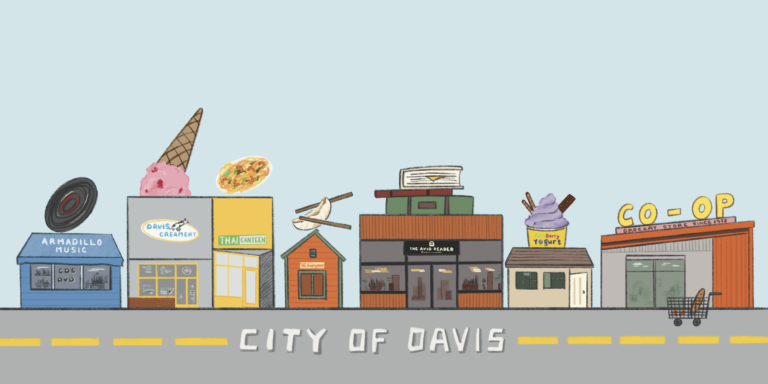
On Wednesday, Sept. 18 and Sunday, Sept. 22, the Davis Downtown Business Association set up their annual information booth to educate the transfer and incoming UC Davis students about the various businesses and opportunities available in the downtown area. 

The Davis Downtown Business Association is a group that helps promote the businesses downtown. Brett Lee, the executive director of Davis Downtown, was one of the workers managing the booth and informing orientation groups about the downtown area. 

“Dive into Downtown is a partnered event with UC Davis, and today [Sept. 18] the transfer students are having their orientation,” Lee said. “So part of their orientation involves them coming downtown and seeing some of the shops and getting a general tour. Sunday [Sept. 22] will be the orientation for all the freshmen, so groups will go and be introduced to various things on campus as well as off campus. We are very fortunate that part of their tour is of the Davis downtown.”

As part of Dive into Downtown, many businesses provide discounts and promotional deals for new students. Between Sept.18 and Sept. 29, locations such as Armadillo Music, Avid Reader, the Davis Food Co-op and Yesterday Vintage all offer different kinds of deals that can be found on the Davis Downtown website.

Armadillo Music is a popular store among students that is known for its wide selection of new and used CDs, vinyl records and more. Paul Wilber, the manager of Armadillo Music, shared that they participate in Dive into Downtown annually. This year, they offered 50% off bargain bin CDs and increased their inventory of popular genres. 

“We have found that many students go through their college experience rarely exploring their downtown Davis area,” Wilber said. “We love the energy the students bring to our store and we feel the program brings them here.”

Armadillo Music is also known for hosting listening parties, in-store shows from musicians and bands and, most uniquely, serving beer on-tap to provide a fun and welcoming shopping experience. 

The businesses of downtown Davis and those who run them put significant effort into ensuring the community has an enjoyable and exciting place to explore. From coffee shops to bars to vintage clothing stores, the downtown Davis area aims to provide something for everyone. 

“As most of us know, for a while you’re on campus and it feels pretty self-contained, but at some point you’re like, ‘I want something different,’” Lee said. “So everyone eventually heads downtown and the idea is to give people a headstart so they can see where it is and all the different things that are available.”


Written by: Olivia Hokr — city@theaggie.org

Culture Corner

The Arts Desk’s weekly picks for movies, TV, music and more 


By Alyssa Crevoiserat – arts@theaggie.org


Book: “One Dark Window” by Rachel Gillig (2022)


As we approach the cooler months and see fogged-up windows, leafless trees and rainy days, it’s time to prepare your reading selection for the fall. “The Shepherd King” duology — “One Dark Window” and “Two Twisted Crowns” — is an adult gothic fantasy series written by UC Davis alumna Rachel Gillig. The former follows Elspeth Spindle, a woman with an ancient spirit trapped in her head, as she works alongside the King’s nephew to cure the kingdom of Blunder from an infectious mist and save herself from the deterioration of her mind. With a unique magic system, there are 12 Providence Cards: a deck of cards that grant special abilities to the wielder. The Nightmare, notably, allows the wielder to enter minds and reveal the victim’s deepest fears. This duology blurs the line between the girl and the monster and highlights themes of trust, sacrifice and acceptance of even the darkest parts of ourselves. As one of the most atmospheric fantasy novels I’ve ever read, Gillig’s mysterious worldbuilding draws you into the dark, mist-locked world of Blunder from the very first page.


Song: “Pier 4” by Clairo (2024)


At the risk of oversharing, we’ve arrived at one of my top tracks of the year. Clairo, well-known for songs like “Bags” and “Sofia,” has recently released her third studio album, “Charm.” Among the record’s 11 songs is “Pier 4” — an almost-sister to “Harbor” off of Clairo’s sophomore album, “Sling.” All focus is on the lyrics as Clairo’s songwriting abilities take center stage. With only gentle strumming patterns and soothing humming in the background, listeners are able to easily connect with the song’s themes. The track itself is an introspective view on loneliness, self-isolation and the fear of what it would really mean to connect with someone else. With lyrics like, “Where’s the fun in it? And now I’m too tough,” Clairo explores the consequences of fortifying a hard exterior and not letting any emotion out or any love through. If you’re looking for a song that feels like staring in the mirror for far too long, look no further than “Pier 4.” 


Movie: “Twisters” dir. by Lee Isaac Chung (2024) 


While heartthrob of the summer Glen Powell (Tyler Owens) is a selling point for this movie, Daisy Edgar Jones’ portrayal of Kate Cooper is the beating heart of the film. Set in Oklahoma, “Twisters” follows two competing groups of storm chasers: Storm Par, a tornado radar company focused on scientific advancement, and a thrill-seeking YouTube sensation led by self-proclaimed “Tornado Wrangler” Tyler Owens. After trying and failing to diffuse a tornado, and one traumatic, deadly run-in with a storm later, Kate has traded storm chasing in Oklahoma with meteorology in New York City. Kate’s grief and survivor’s guilt kept her away from storm chasing, but she is ultimately convinced to accept a week-long position at Storm Par following a tornado outbreak in Oklahoma. Kate and Tyler begin as competitors but, as the storms increase in intensity and destruction, are forced to work together to continue what Kate started five years ago. While you can no longer view the film in 4DX, watching the movie on its own is just as thrilling without shaking seats, water in your face and a windy theater to accompany you — I promise. 


TV Show: “Tell Me Lies” by Meaghan Oppenheimer (2022-2024)  


Who doesn’t love the 2000s? Set in Baird College, a fictional university in Upstate New York, viewers get a little bit of everything: unparalleled toxicity, complicated family dynamics and surprising flashbacks. The show follows Lucy Albright (Grace Van Patten) at the start of her freshman year as she forms her first friend group, deals with the fallout of her roommate’s death and — the worst part of it all — begins an unfortunate situationship with Stephen DeMarco (Jackson White). This show takes unreliable narration to a new level; not only does every single character lie to each other, but they also lie to themselves and the viewer. At its core, “Tell Me Lies” is a drama set over the course of eight years with backstabbing, manipulation and morally grey decision making. With borderline unlikeable characters, messy relationships and unpredictable twists, Oppenheimer spins a web of lies that it seems even the characters have a hard time escaping. The show’s second season is currently being released, and you can view both new and old episodes on Hulu. 


City Council presents proposed outdoor dining program to Davis Downtown business owners

0

The new Downtown Outdoor Dining Program plan will charge businesses between $750 and $3,500 to set up outdoor dining spaces


By RORY CONLON — city@theaggie.org


On Sept. 12, Councilmember Dara Dungworth presented the proposed Downtown Outdoor Dining Program to the Davis Downtown board of directors. It would mandate businesses to pay between $750 and $3,500 to get outdoor dining spaces approved by the city. 

The program is being spearheaded by Katie Yancey, the city of Davis’ economic director. Since Yancey couldn’t attend the Davis Downtown meeting, Dungworth, the city of Davis’ principal planner, presented the plan in her absence. 

“The first part of this effort […] is trying to tidy things up and put a bookend on COVID-19-era outdoor dining,” Dungworth said. “[It’s] putting in place a really structured, predictable, reasonable program that was initially identified for outdoor dining. We are going to look at expanding it to general retail uses.” 

The plan will charge businessowners on the types of facilities they want to set up and the place they put them. Dungworth outlined the four sidewalk zones that expand from the building facade to the public right of way in the street. 

“Zones A, C and D in this graphic are eligible for private use under the proposed outdoor dining program,” Dungworth said. “Zone B is the public sidewalk and the most accessible mode of travel, [so] that will need to be maintained.”

There are three types of outdoor dining plans, according to Dungworth. The first, which would cost businesses a $750 application deposit, allows a fence and furnishings like tables, chairs and benches in Zones A and C. Dungworth also discussed what was covered by the deposit. 

“It includes the processing of the application checklist, the review and execution of the licensing agreement, verifying insurance and coordinating ABC compliance if needed,” Dungworth said. “We coordinate with the city attorney for legal review, and the city staff also reviews the fence and furnishings based on the design standards Katie [Yancey] is working on.” 

If businesses want to add in facilities like outdoor heaters and lighting, it would require an application deposit of $1,500. Dungworth said she attributed the higher fee to the need for public works and the fire department to ensure its safety. 

The third type of outdoor dining includes fencing, utilities and a larger structure like

a wooden awning. It allows business owners to expand into zones A, C and D in exchange for a $3,500 application deposit. 

“Because there is quite a bit more review and it’s a permanent structure, the deposit is $3,500,” Dungworth said. “[Also], if you’re in realm D, which would be in the public right of way, public works is looking at whether there are underground utilities, like a storm drain or drain inlet, that we might have to work around.” 

If the program is passed, businesses would be required to pay a $349 renewal fee for any outdoor dining facilities. They would also have to pay rent based on either a yearly or monthly basis on the sidewalk zones their facilities occupy. 

“In zones A and C, based on the cost of additional wear and tear to the sidewalk, it works out to $1.92 per square foot per year,” Dungworth said. “[Rent] in civic spaces and zone D are based on comparable retail and restaurant rates in the Downtown Davis area and they’ve been addressed to account for the seasonality of outdoor dining. It’s only applied to usable space and it comes out to $1.10 per square foot per month.” 

Dungworth said that the Outdoor Dining Program is still in early stages, and she invited community members to give feedback.

Janis Lott, who has owned the downtown Davis business Newsbeat for 35 years, said she looks forward to hearing more about the plan as it’s developed. 

“I do appreciate the focus on dining, because even pre-COVID-19, it’s been a little bit Wild West,” Lott said. “When it gets to the point of expanding to retail, I would be really interested in what that looks like.” 

Brett Lee, the executive director of the Davis Downtown Business Association, said he urged businessowners to spread the word about the proposed program.
“It’s very important to emphasize that this format applies throughout the downtown,” Lee said. “For instance, if you’re one of the entities that has something like this already, or you’ve wondered about how you might like something like this in the future, this is not G-Street specific. These are proposed fees, so it’s going to go through a couple of iterations and there’s plenty of time for us to give feedback.” 

Community members can give feedback at the upcoming Oct. 1 city council meeting, where the proposal will be officially pitched to council members and the wider Davis community. 


Written by: Rory Conlon — city@theaggie.org


UC Davis’ orientation welcomes new students

0

First-year and transfer students participated in a variety of activities to help them get oriented with Aggie life


By RAGAVI GOYAL — campus@theaggie.org 


From Sep. 17 to 22, transfer and first-year students were welcomed into the new academic year with Aggie Orientation. Orientation Leaders, assigned to a group of students to guide and teach, led the incoming Aggies through various activities to help them get settled on campus.

For first-year students, orientation is a three-day program where the new Aggies undergo a variety of workshops, get acquainted with the campus and have the opportunity to connect with other peers through planned events. Transfer students have a slightly longer orientation that lasts five days, yet the program consists of many of the same preparation activities. 

Many student participants shared positive thoughts about their orientation experience.

“It helped you create that mental map about how UC Davis is, where you can find the stuff [and] what you have to do,” Hrithik Tabaki, a first-year history major, said. “You can ask people what are they doing, what are their classes [and] how they are.” 

Orientation activities ranged from mingling, games and city/campus tours to an academic preparation program in which seasoned Aggies gave advice on how to succeed in classes.

One activity called the “Violence Intervention and Prevention Program” hosted by representatives from the Center for Advocacy Resources and Education (CARE) taught the incoming students about the health and safety resources available on campus.

Another popular activity included the “Davisfest Resource Fair,” a tabling event in which students roamed the Quad to explore the various clubs and organizations that the UC Davis community has to offer. 

For both groups of students, orientation ended with a free football game at the UC Davis Health Stadium. 

One anonymous student said that they thought the program was very informative.

“Orientation got me used to the surroundings [and] where everything is,” the student said. “I didn’t know more about the university until after the orientation.”

Despite many positive experiences, some students shared unsatisfied opinions about the orientation as well. 

“I mean, the orientation experience […] was useful to a point,” Jared Bunweba, a first-year chemical engineering major, said. “After the first day, the next two days were kind of repetitive.”

 Alekya Veluri, a second-year computer science major, commented on the overall significance of orientation.

“Despite its challenges, orientation promotes community,” Veluri said.

Written by: Ragavi Goyalcampus@theaggie.org

The 2024 men’s and women’s US Open Tennis Championships takes over the sports world

0

Sinner and Sabalenka secure their first-place victories yet again


By Diego Cerna, sports@theaggie.org


New York City held its 144th US Open Tennis Championships from Aug. 26 to Sept. 9. The Open held multiple upsets and showcased many rising stars that make up the new generation of both men’s and women’s tennis.

For the men’s side, Italy’s No. 1-ranked Jannik Sinner defeated the United States’ No. 12-ranked Taylor Fritz in The US Open finale on Sept. 9. The 23-year-old Sinner beat the 26-year-old Fritz in three straight sets — winning 6-3, 6-4 and 7-5 — to complete a dominant tournament run. 

This is Sinner’s second grand slam title of his young career. Additionally, this is also his second title of the year after beating No. 3-ranked Daniil Medvedev in the 2024 Australian Open. Sinner was ranked No. 4 at the time but has taken his place as the highest-ranked tennis player in the world after his dominant performance and back-to-back wins.

For the women’s side, Belarus’ No. 2-ranked Aryna Sabalenka defeated the United States’ No. 6-ranked Jessica Pegula on Sept. 8. The 26-year-old Sabalenka fended off the 30-year-old Buffalo native Pegula in a competitive two set match, winning 7-5 and 7-5. 

This is Sabalenka’s third Slam title and first US Open win, as she won the 2023 and 2024 Australian Opens. Formerly ranked No. 1 in 2023, she has maintained her place as one of the top women’s tennis players in the world. Sabalenka has established herself as one of the most powerful players on the Women’s Tennis Association (WTA) circuit, demonstrating her ability to succeed on different surfaces. 

The US Open also displayed many upsets for star players. The most shocking upset may be Spain’s No. 3-ranked Carlos Alcaraz losing to the Netherlands’ Botic Van De Zandschulp in three straight sets in the second round of the tournament. Alcaraz just came off of winning silver in the 2024 Olympic Games, only coming in second to Serbia’s No. 4-ranked Novak Djokovic who won gold.

Djokovic was also caught in the upsets, as he lost to No. 28-ranked Alexi Popyrin in four sets in the third round. While this may look like a surprise on paper, some fans thought the match would be up for grabs given the competitive history of matches between Popyrin and Djokovic. 

One of the closest and most exciting matches of the tournament came with the intensely awaited rematch of US tennis players No. 13-ranked Ben Shelton and No. 20-ranked Frances Tiafoe. In the 2023 US Open, an unranked Shelton upset No.10-ranked Tiafoe in four sets. This year, Tiafoe beat Shelton in a close five-set match. Being good friends outside of the game, the men gave each other a hug at the net after the game. 

This was also the first US Open to feature multiple US tennis players in the semi-finals for both men’s and women’s tennis in 21 years. No. 13-ranked Emma Navarro and Pegula representing the women and Fritz and Tiafoe representing the men. 

Regardless, the 2024 US Open entertained over 1 million attending fans throughout the three weeks and millions more on television. The US Open also broke the opening day single-match record with 74,641 fans attending the Billie Jean King National Tennis Center. Overall, the 2024 US Open demonstrated tennis’ growing worldwide impact, while also strengthening the sport’s growing popularity and reach.


The magic of the campus novel

Explore four contemporary book recommendations within the subgenre that will have you, for once, looking forward to the start of fall quarter


By SAVANNAH ANNO — arts@theaggie.org

While it’s decidedly unhealthy to romanticize the more difficult bits of life — a past relationship, working too much, the 1950s — your college experience is most certainly the exception. How else is anyone meant to survive all four years? A famous escape from reality, books set around college campuses give us the chance to translate our experiences into something captivating, full of plot points that could only ever be worthy of a main character.

Beyond the (understandable) popularity of works like Sally Rooney’s “Normal People” (2020) and Donna Tartt’s dark academia poster-child “The Secret History” (1992), an entire subgenre is to be discovered: the campus novel. 

With endless possibilities — tales filled with friendship, academic rivals and the occasional murder — campus novels are solely defined by their setting and all it entails. Balancing classes, parties, mysterious professors and strange peers, you’ll be able to find at least one story synonymous with your undergrad experience in the following list. 


“Babel” (2022) by R.F. Kuang

As a recent survivor of “The Poppy War” trilogy, I cannot stress the talent of R.F. Kuang enough. Her second work, “Babel: Or the Necessity of Violence: An Arcane History of the Oxford Translator’s Revolution,” chronicles the life and education of Robin Swift. Brought to London at a young age from his home of Canton, Swift is chosen to study at Oxford’s Royal Institute of Translation. Here, Kuang highlights the source of the novel’s fantastical element: silver bars inscribed with the same word in two different languages. As 1830s England harnesses this power, Swift comes to realize his work at the university ultimately aids in imperialism. 

Swift struggles with similar challenges Kuang has faced as an international student, immigrant and literary translator. Once an Oxford student herself — earning a master’s degree in Contemporary Chinese Studies — Kuang paints a familiar and loving portrait of the campus, even including her favorite café despite it not existing until 2003. You can feel her simultaneous amazement and sharp criticism of the school’s rich history in this magically complex read.


“The Idiot” (2017) by Elif Batuman

A finalist for the Pulitzer Prize in fiction, “The Idiot” remains a quintessential novel for anyone beginning their undergrad years. The novel zones in on Selin Karadağ, who begins studying linguistics at 1990s Harvard and soon after forms a close relationship with an older mathematics student, Ivan. 


Semi-autobiographical, “The Idiot” details many of Batuman’s small observations and strange experiences during her time on campus, making it relatable with Selin’s awkward encounters and existential confusion as she’s faced with adulthood. For anyone that feels a little confused or, perhaps, like an idiot going into their first year, Batuman has you covered with this introspective and meticulous piece of work. 


“Real Life” (2020) by Brandon Taylor 

Similar to the previous authors, Taylor’s debut novel is largely a reflection of his own time at university. But unlike most of his peers, Taylor originally sought after a career as a scientist, studying chemistry until making the switch to creative writing postgrad. His main character, Wallace, faces a similar challenge in struggling to decide his future as a scientific researcher after leaving Alabama for a job in the Midwest. 

One of the most interesting aspects of “Real Life” is its timeline, spanning just one singular weekend of Wallace’s life as he’s faced with the reality of his present situation: his father has passed away, he’s in a complicated relationship with a straight man and he feels like an outsider on his predominantly white campus. Will he persevere, change courses, quit? 

Both Black and queer, Taylor wrote “Real Life” with the intent of seeing more of himself and his community within the sphere of campus-set, academia-focused novels. Providing a fresh pair of eyes, Taylor spins an emotional and well-crafted story to read as you experience your own academic overthinking or potential feelings of not belonging.  


“Ninth House” (2019) by Leigh Bardugo 

With the release of “Ninth House,” Leigh Bardugo graduated along with her young adult “Six of Crows” fans into the university setting. Taking place at Yale, the first novel of the dark fantasy series follows 20-year-old and incoming freshman Alex Stern, chosen to watch over the university’s secret societies for her ability to see ghosts. 

Based on Bardugo’s discovery of Yale’s real-life secret society tombs, “Ninth House” details the mythology of the eight Houses of the Veil, which are groups of students that study arcane magic. A member of the secret ninth house, Alex is immediately thrown into an unraveling mystery involving the disappearance of her mentor, Daniel Arlington, and a strange murder that takes place on the edge of campus. 

A dark academia novel with magically charged conflict, Bardugo provides the perfect series to start as the sky starts to darken along with the seasons. This October, curl up with “Ninth House” and continue on to the second book of the trilogy, “Hell Bent.” 


Between fantasizing about tea time at Oxford, attending Harvard at the same time as Barack Obama and practicing dark magic underneath the Yale campus grounds, who has time to stress over midterms? Stretching your imagination to its limit, campus-set novels are able to transform the everyday trials of college into something Pulitzer Prize worthy. 

Written by: Savannah Anno — arts@theaggie.org