55.7 F
Davis

Davis, California

Wednesday, December 24, 2025
Home Blog Page 855

Man and Woman Theatre presents Gruesome Playground Injuries

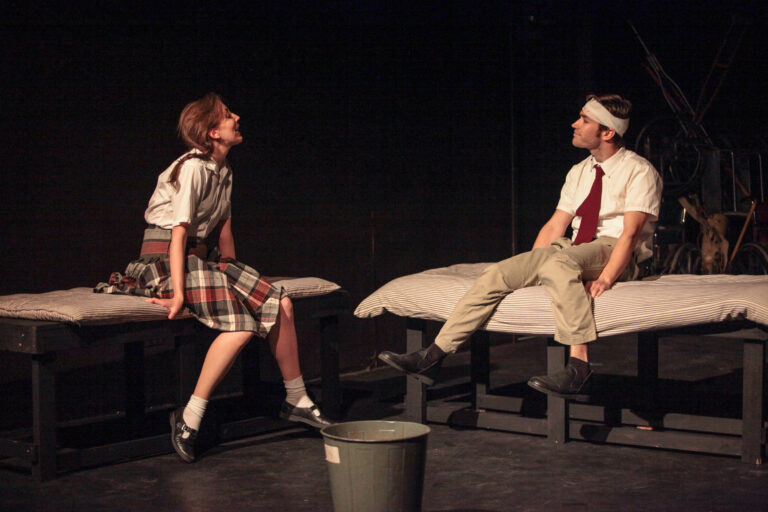
Man and Woman Theatre, a new theatre company that will focus on one-man, one-woman plays, will perform their first production in Wright Hall’s Arena Theatre from May 2 through May 4.

The play, Gruesome Playground Injuries, written by 2010 Pulitzer finalist Rajiv Joseph, focuses on the relationship between two people, Doug and Kayleen. This is shown through eight vignettes, presented at different points in their lives.

Megan Caton, a fourth-year dramatic art major who plays Kayleen, was drawn to the play for its realism.

“It’s about two real humans that are walking through life and trying to cope, trying to be okay,” Caton said. “The characters are relatable and not polished people, and the play shows the gruesome and messy aspects of what it takes to grow up.”

Cooper Wise, a fourth-year dramatic art major who plays Doug, was also drawn to the characters in the play.

“These characters are unhealthy, flawed, kind of crazy, disgusting people, but also very human and beautiful,” Wise said. “Certain qualities of myself are similar to Doug while certain qualities aren’t, so finding those connections was part of the acting process. So much of Doug is a risk taker and a crazy person, while my public life is reserved and appropriate, so I needed to connect to that other side of myself.”

Man and Woman Theatre, which consists solely of Caton and Wise, began as a way for the two to make opportunities for themselves in the dramatic world.

“Cooper and I are both graduating and going into the real world after this quarter,” Caton said. “People kept saying to us, ‘If you don’t get the roles you want, create your own opportunities,’ which works in all fields. However, Cooper said one day, ‘Let’s make Man and Woman Theatre,’ which was was a joke at first but after some thought ended up making the whole thing legitimate.”

Wise views the company’s small size as an asset.

“There are a lot of one-man, one-woman shows that are interesting to us,” Wise said. “This is also a way to explore gender issues, which we’re both very interested in.”

Their production of Gruesome Playground Injuries came about when Caton and Wise noticed that there wasn’t a play being produced by the Theater and Dance Department during Spring Quarter.

After asking for approval from the department manager and receiving a major advisor, Caton and Wise enlisted help from the tech department, borrowed costumes from the costume department and brought in MFA candidates, including Lindsay Beamish and Jan Lee Marshall, to direct different vignettes in the play.

“As a director this has been a rewarding experience,” Marshall said in an email. “Since both Megan and Cooper come to rehearsals with their actor homework complete we have lots of material with which to experiment. They have chosen a wonderful piece of theatre that is filled with nuances for both actors and directors to explore.”

Both Caton and Wise have found the experience to be informative.

“In addition to acting, I was also figuring out the logistical aspects of producing a play with two people,” Wise said. “I’ve learned so much about acting and theatre by doing this that I wouldn’t have gotten from signing up for a class.”

Gruesome Playground Injuries will play in the Arena Theatre of Wright Hall on May 2 and May 3 at 8 p.m. and on May 4 at 2 p.m. Admission is free with a suggested donation of $5. The play contains blood, strong language and adult themes.

JOHN KESLER can be reached at arts@theaggie.org.

Photos by Abby Alcala.

Arts Week: May 2, 2014

MUSIC

UC Davis Symphony Orchestra: Berlin, Leipzig and Stockholm
May 3, 7 p.m., Prices vary
Mondavi Center, Jackson Hall
The UC Davis Symphony Orchestra will be performing works by Weber, Mika Pelo and Mahler for a performance that will offer a sampling of compositions from the titled European cities.

LITERATURE AND POETRY

SickSpits Poetry Slam FEAT Buddy Wakefield
May 7, 7 p.m., $1 suggested donation
TCS Building (Art Annex)
In this annual event held by SickSpits, World Poetry Slam Champion Buddy Wakefield will be presenting his amazing works of poetic dexterity, and 10 to 15 student poets will be competing for prizes.

ART

Careers in Visual Arts: Brown Bag Lunch Series — Brenna Chapman
May 6, 12 to 1 p.m., Free
148 Everson Hall
Sierra College professor and UC Davis alumna Brenna Chapman will be speaking at the Brown Bag Lunch Series to discuss her own career path in art history, which includes developing forms of online instruction and co-curating galleries.

DRAMA

Gruesome Playground Injuries
May 2-3 at 8 p.m., May 4 at 2 p.m., Free
Wright Hall Theatre
MFA students Cooper Wise and Megan Caton will present their story of two childhood friends whose lives proceed to converge under strange conditions, leaving the two to compare the scars they’ve picked up along their respective journeys.

SickSpits to host annual poetry slam

Editor’s note: Tanya Azari is the SickSpits’ president in addition to the opinion editor at The Aggie.

On May 7, UC Davis’ Spoken Word Collective, SickSpits, will host their annual Poetry Slam, a competitive spoken word reading. The event boasts special guest and two-time World Poetry Slam champion Buddy Wakefield, as well as spoken word pieces from both students and community members in a competitive format.

Poetry Slams aren’t just your average poetry readings. Tanya Azari, a second-year Spanish major and SickSpits’ president, explained that spoken word has a key advantage — the reader, who adds style to each piece.

“What comes to mind when most people think poetry is Walt Whitman and Robert Frost,” Azari said. “But slam or spoken word is expressive and it has to do with not only what words you say, but how you say them and your presence. It is less like a poem as much as it is a performance piece.”

With the five SickSpits’ members as judges, performers will have three minutes to captivate the audience. Any poem exceeding the allotted time will be docked points.

“It is a competition so points matter, but mostly the poets are there to share their work,” Azari said. “No one actively goes up and tries to beat everyone out. It’s more like, ‘I’m going to go up there and give it my all and see what happens.’”

That’s exactly what Alyson Sagala, a UC Davis graduate and last year’s third-place winner did. Having performed in several of SickSpits’ monthly open mics, she decided to enter the slam.

“Spoken word was just a natural evolution of my poetry into something more,” Sagala said. “I don’t shy away from public speaking, so when I realized there was a way to express my poetry in a raw, emotional, performance-oriented way, I knew it was worth trying to see if I would like it, and more importantly if I’d be good at it.”

Sagala also mentioned how the event is a great opportunity for aspiring poets to show off their work.

“I know so many people who hesitate to perform their poetry because they’re shy or not sure if they can handle the pressure,” Sagala said. “Ripping the band-aid off and performing for the first time will take all the insecurity away. After that, you’ll feel invincible.”

There is no limit to the topics of the poems but recurring themes do tend to come up in slams. Politics, social justice, equality and self-actualization typically make the docket. Highly-anticipated performer, Buddy Wakefield, is no stranger to these themes.

“I have been writing about ideal self all these years and my goal is to move closer and closer to that,” Wakefield said. “I consistently model that ideal self and try to leave writing on the wall for people who have a similar goal.”

According to Wakefield, college events are some of his most comfortable stops.

“I’ve been doing this for 13 years on tour and some of that time has been doing nothing but colleges so I actually have quite a home at colleges around the country,” Wakefield said. “I expect to perform at the poetry venues, the theaters and the galleries but I’m always excited to be performing at colleges.”

The event starts at 7 p.m. in the Art Annex, also known as the Technocultural Studies Building. A suggested donation of one dollar will be collected at the door. SickSpits is also welcoming entries; for more information visit facebook.com/SickSpits. Videos and information on Buddy Wakefield can be found at buddywakefield.com.

COLEMAN PERKINS can be reached at arts@theaggie.org.

News in brief: Women’s Health Club to hold march against sexual assault

On May 5, the UC Davis Women’s Health Club will hold its second annual Men’s March Against Sexual Violence. The event will be held in order to raise awareness on the issue of sexual assault on college campuses. The march will begin at 12:15 p.m. on the Quad and continue throughout campus.

According to Mimi Wyatt, member of the Women’s Health Club, the march was named “Men’s March” in order to highlight the fact sexual assault affects people of all gender identities. Additionally, Wyatt said the event provides an opportunity for men, who she said are typically left out of this conversation, to have a chance to participate in the fight against sexual assault.

“We are formally inviting men to the march in the title because men play an important positive role in sexual assault prevention,” Wyatt said via email. “The issue of sexual assault has been a space that men do not generally get an opportunity to participate in, and we want to make it clear that men are able to speak and engage on this issue and should. We all live in this community together, and we should all be facilitators and participators in the prevention of sexual assault.”

Prior to the march, State Senator Kevin de Leόn (D-Los Angeles) will give a speech concerning sexual violence on college campuses at 11:30 a.m. on the West Quad. De Leόn helped write Senate Bill 967, which would require California colleges and universities to follow specific victim-centered policies and protocols when addressing sexual violence on campus.

The first 100 people who pre-register for the march on the event’s Facebook page will receive a free T-shirt. Pre-registered marchers will be able to check in at 11 a.m. at the MU patio. Additionally, the student organization that brings in the most marchers will receive a $200 prize.

“We thought that it was necessary to bring this event to our campus because we believe that the issue of sexual assault on college campuses is one that requires institutional and legal change as well as a cultural shift of understanding sexual violence among our own student body,” said Sarah Yang, Women’s Health Club president, via email. “Especially because a lot of other events are happening right now, like sexual assault awareness month and the publication of the White House Task Force’s first report to protect students from sexual assault, we are amidst a national campaign against sexual assault and violence.”

— Jason Pham

Editorial: University apartment shutdowns — Save the Parks Now

1

Biking around town, it seems the only type of building more popular in Davis than Thai food restaurants is apartment complexes. But two years from now, two whole complexes will be gone — Solano Park Apartments in July 2016, and Orchard Park Apartments on July 31 of this year.

With this move, UC Davis is displacing families, disadvantaging student parents and reducing affordable housing options.

Orchard Park and Solano Park, respectively located northwest and southeast of campus, are affordable housing complexes designated for graduate students and students with families. Benefits for residents of both complexes include campus proximity, safe spaces away from traffic for children to play, a community network of other student parents and families and a relatively low rent that is manageable under their student-worker salaries.

According to Student Housing, the buildings are being torn down because they are old and need to be improved, and repairs are more expensive than renovations. We’re all for making sure that buildings are safe and comfortable for their residents, but the end product of these renovations is questionable at best.

While the University has not yet announced its plans for Solano Park, the ones it has for Orchard Park make it seem as if it is trying to build West Village 2.0. The 476 one- and two-bedroom units will be converted to 69 two-bedroom units in a complex equipped with unnecessarily extravagant amenities, like a fitness center and tanning salon. Each unit will be priced at $1,400/month, a $500 monthly increase from the current rate. What this means for the UC Davis TAs and Graduate Student Researchers living in Orchard Park is that their rent would cost 95 percent of their salary.

The University has given residents few options and little say in the matter, barely taking into account their needs or their pleas to stop the demolition, and not giving residents a complete detail of their plan until January 2014. Student Housing stated that it “encourages” residents to move from Orchard Park to Solano Park before the closure this summer, and told them to take out loans, use credit cards or apply for financial aid if they were having difficulty paying for other housing. This is an unacceptable response.

Other ways in which the University has claimed they are facilitating the displacement of Orchard and Solano Park residents is by providing 8th and Wake, the former Castilian dorm building that was closed in June 2011, as a replacement option. 8th and Wake is set to open in Fall Quarter 2014. However, 8th and Wake only provides 59 four-bedroom units, not to mention the fact that the closest green area is a park surrounded by fraternities and freshman dorms, and often reeks of weed. Not a very suitable atmosphere for children.

The renovations also go against proposed goals of the 2020 initiative, which not only needs more housing units to hold the 5,000-plus students it plans to take on, but also claims, in a March 7, 2013 press release, that its goals include “significant increase in graduate student enrollment” and “‘investing in graduate education.’” Taking away their housing doesn’t seem the best way to do that. But, as we’ve seen by the UC Student-Workers Union UAW 2865’s demands and their recent TA and graduate student strike, the University’s support for its graduate students hasn’t been as strong as we would like it to be.

Many have been working hard to stop the Orchard Park and Solano Park renovations, such as the group Save the Parks Now. Theirs and others’ objections led the University to state that they will halt Orchard Park redevelopment plans, but will still demolish the buildings in July; other outcry led to the lowering of the rents for proposed units to $1,026, but that is still 65 percent of a grad student’s salary.

If the University is concerned in any way for the well-being of its student body, it would not demolish the Orchard Park and Solano Park Apartments, and it would use alternative funding sources to repair the complexes without further cost to their residents.

For more information and to sign the Save the Parks Now group’s petition, go to http://housingclosure.wordpress.com/ or https://www.facebook.com/savetheparksnow.


Weather Post

0

Mostly sunny with temperatures steady or falling to near 83F. Winds WSW at 5 to 10 mph.

Guest Opinion: Cinco de Drinko

24

cinco de drinko

We, as concerned students of UC Davis and community members, would like to declare our utter offense and disgust with an off campus event organized by UC Davis students.

It has been brought to our attention that a “Cinco de Drinko Sloshball” Facebook event page was created by UC Davis Coffee House (CoHo) student employees earlier this week. The event is a party intended to have attendees dress in “festive” attire, meaning stereotypical “Mexican” dress (a sombrero and sarape, fake mustache, etc.). In addition, attendees are given an image that demonstrates the attire they should wear, which includes a border patrol officer costume. These images are hurtful to our community and only serve to create a hostile campus climate by sending a message of disregard and disrespect for the Chican@/Latin@ and Undocumented/Immigrant campus community.

Cinco de Mayo is a holiday that marks and celebrates the victory over French rule that was momentous for the state of Puebla, Mexico. This holiday is often manipulated by individuals who use inaccurate images of Mexican culture and affiliate it strongly with alcoholic consumption, despite the fact that there is no real correlation between the two. Many student organizations around the nation, including UC Davis’s own Delta Chi Fraternity, host these types of events and encourage the student community to engage in these racist actions. Many justify it by saying that these are “harmless” events and that attendees are “just trying to have fun.” However, when the communities that are mocked are communities that struggle on a daily basis to have to prove their worth at academic institutions, they are indeed harmful. They invisibilize and make a joke of the lives of students that are historically underrepresented and underserved at the University. The fact that the student employees, who represent the face of the University, planned this event, are perpetuating this ignorance with no sensitivity towards the Chican@/Latin@ and undocumented/immigrant community on our campus, is a reflection of the lack of respect for different cultures and student experiences.

Lastly, it is ironic that this event is scheduled to take place on the same day as La Gran Tardeada (the culmination of La Raza Cultural Days), which in turn marginalizes the Chican@/Latin@ community on campus even further. It is also an indication of where the campuswide community stands when it comes to cultural competency and understanding and upholding our UC Davis Principles of Community. La Raza Cultural Days and other cultural celebrations during the year are often denied adequate support. Regretful events, such as this “party,” tell us that we have not come as far as we’d like to claim with cultural competency and need to support these programs every opportunity possible. This “Cinco de Drinko Sloshball” event invalidates years of work from multiple organizations, student centers, departments and students on a day that ironically is meant to celebrate and unite the community.

Students planning and participating in this event should be trained to understand why these events are hurtful, offensive, and backward. Despite the years of progress that have been made by strides in the Chican@/Latin@ community at UC Davis, these racist actions remind us that there is still much work to be done. We urge UC Davis and the CoHo to hold its student employees accountable for their actions and take appropriate and effective steps forward to ensure that these types of events will not take place again.

Sincerely,

Concerned Students and Community Members of UC Davis

Michelle Villegas
Chicana/o Studies & Psychology Major
UC Davis Alumni 2012
mvillegas@ucdavis.edu

Mac DeMarco’s “Salad Days” review

The first time I heard the name Mac DeMarco, I was listening to a friend rave about the Canadian musician’s show at Scala in London, last October. DeMarco’s wild enthusiasm and insane genius led to his losing shoes and screaming comedy covers on stage.

Previously recording as Makeout Videotape, Salad Days is Mac DeMarco’s second full-length solo album under his own name. The album was released on April 1, 2014 through Captured Tracks and garnered a “Best New Music” accolade from Pitchfork.

DeMarco plays and records all the instruments himself in his box room in Brooklyn. DeMarco’s cut and paste style gives him an irreverent appeal. It’s nice to see an artist who isn’t precious about imperfections in his process. DeMarco is the gap-toothed, laid back voice of reason we all need.

The title track, “Salad Days,” allows DeMarco to acknowledge his youth from the off. The message lies somewhere between a love ballad and telling everyone to chill out. It’s hard to escape the fluid rhythm and guitar flicks but the album is not overpowering. All 11 tracks complement each other perfectly.

The album is fitting for long, lazy days in the sun; it worked very well on a recent road trip. The slow mixture of guitar, bass, drums, keyboards and relaxed lyric tone will keep everyone happy. DeMarco switches down to an even softer tone in “Let My Baby Stay,” probably my favorite track.

DeMarco knows exactly where to place a lyric in his rolling melody. The words are a combination of wistful recollections and sound life advice. “Chamber Of Reflection” introduces synths to the mix, which are always healthy. At the end of “Jonny’s Odyssey,” Mac thanks us for listening to the album with a final flourish. The entire album is infused with this kind of personal touch. DeMarco’s songs feel accessible because they are homemade and from the heart.

DeMarco has so much more to offer than simply the slacker aesthetic he has so far been labelled with. I give this album an 8 out of 10. May his Salad Days continue.

If you’re a fan of Salad Days, check out Deerhunter, Foxygen and Unknown Mortal Orchestra for a similar sound.

— ZOE SHARPLES

Custodial Services members share experiences at UC Davis

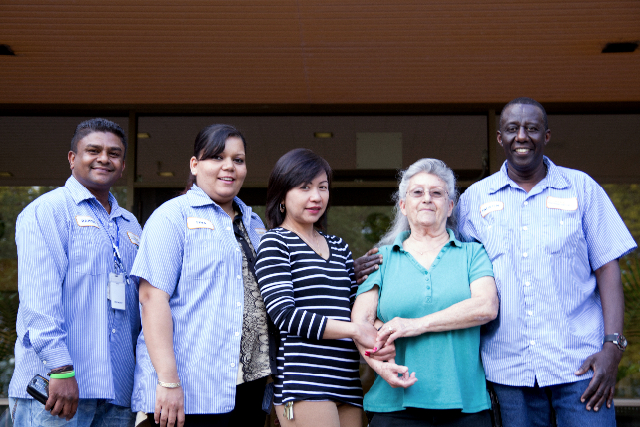
Whether it be during the daily bustle or dwindling nighttime, 183 custodians work to ensure that both cleanliness and safety are continuously maintained throughout the entire UC Davis campus.

From classrooms and lecture halls to laboratories and offices, the daily experience of custodians drastically differs based upon their stationed location.

“Every day is different for custodians depending on where they work,” said Remedios Sarabias, principal supervisor of Custodial Services.

Each custodian is stationed at one of the nine different cores on campus, and according to Sarabias, the average custodian has worked in his or her core for anywhere from five to 10 years, some staying in the same building for nearly 20.

Along with Sarabias, Bill Rumley, the director of Custodial Services, pointed out the perseverance and steadfast dedication that custodians demonstrate on a daily basis.

“They are really good, hardworking people and it’s much more than just vacuuming and cleaning,” Rumley said. “The custodians make the environment friendly and they are a central part of this campus.”

Walking into a custodial staff meeting, the presence of camaraderie and friendship was inherently apparent in the room.

Before heading off to their night shift from 5 p.m. to 1:30 in the morning, the custodians of core five gathered with cookies and coffee in a Tupper Hall conference room to discuss the key to successful customer service.

“It is important to work in a place with a nice environment. You don’t want to work in a place where everyone is grumpy and no one smiles,” said Shafeena Shah, a custodian currently working in core five.

Starting off as a floater, Shah found it extremely challenging to work from building to building without a routine schedule. Now a member of core five, Shah enjoys having a familiar, yet flexible schedule and finds that it is much less tedious.

“You don’t get bored. I do the second floor in Tupper Hall and it is big enough so there is something different to do every day,” Shah said. “You can work yourself around and do different things so you don’t get bored.”

Along with the variation in work, Shah repeatedly stressed the overall togetherness of core five.

“It is a nice experience being pregnant and working with people that really care and always offer their help,” Shah said.

Recently promoted as the assistant supervisor of core five, Rajesh Kumar said that they continually hold potlucks to celebrate birthdays each month, to appreciate the hard work of the custodians.

“It is a recognition day for us and we in core five do that every month just to be together,” Kumar said. “We here in core five always say that we are a small family.”

After working in another core on campus, Janet Tonel, a custodian who currently works in core five, said she too realized just how tight-knit the group was.

While reflecting on her overall experience, Tonel explained the drastic differences between the two cores she experienced.

“There was a lot of drama in there, jealousy. I came here [to core five] first when I got hired and moved over to another core after three or four years. The environment here is different,” Tonel said. “There is no communication there.”

The four custodians from core five share a similar sentiment regarding the positive, family-oriented atmosphere of their own core, and Donna Chachere, a custodian of 12 years who is also referred to as “Mama Donna,” was quick to chime in.

“Oh this is a wonderful core. One other thing is that we always help each other,” Chachere said. “Now, Shafeena is going to have a lovely baby, so we are always helping her. We communicate very well.”

Although the custodians of core five said they enjoy working with each other, they face challenges in regard to everyday responsibilities and tasks.

Each custodian recalled some of their individual experiences with the customers who work in the offices, laboratories and departments across campus.

“You know sometimes it is hard to please them. Even though you do everything, still they are going to complain,” Tonel said. “Something is missing, then they are going to blame you. It’s always the custodian. Sometimes, they are very dismissive.”

Additionally, Shah reflected on some experiences in which she felt that customers have looked down on her.

Although some customers have challenged the work of the custodians, several of the custodians mutually agreed upon how appreciative they feel when recognized.

“One of my favorite moments is when some of the customers tell you things like they have been here for 12 years and that they see the difference when you came here,” Tonel said.

Bimal Karan, a member of core two who has been working on campus for eight years, recalled a time in which a customer wrote a letter of appreciation on behalf of his work.

“Three months ago, a professor sent a nice letter to the Director, and that was one of the most important things, that somebody recognizes while you are as a custodian,” Karan said. “People recognize you, but you don’t see them. It was very nice.”

Due to the fact that the custodians are also responsible in ensuring the safety of the campus, constant pressure is placed upon their shoulders.

According to Kumar, custodians hold the master key and would be the first contact if something were to go awry.

“We have more responsibility than the police because custodians are in the building for 24 hours, and we have the responsibility of keeping those buildings safe more than anybody else,” Kumar said.

After being called in to work on a weekend, Faustin Rusanganwa, a custodian of core five, was shocked to find a group of people breaking into a building.

As Rusanganwa recollected his memories of the catastrophic event, he recalled that shards of glass covered every nook and cranny of the building. For hours upon hours, Rusanganwa remained in the building cleaning the floors, keyboards, chairs and remaining glass.

“I am telling you it brought back memories from my life. I am from Rwanda and it reminded me of war in my country. It was exactly the same thing,” Rusanganwa said. “It was a bad memory even today, and when I stepped on the glass I was injured. I don’t understand why people do that. It was scary just to look at. It was like a war zone.”

Ever since starting in 1988, Rusanganwa has witnessed the increasing expansion of UC Davis for 26 years. Rusanganwa believes that the University will continue to grow and recognizes that this change is beautiful.

“When I first started working here, the campus was really small. We can see how it has been a success,” Rusanganwa said. “All those buildings, those parking structures were not here and we are just seeing the University growing.”

Although Rusanganwa is thankful to have his job for his family, he frequently feels unconnected and disassociated from the rest of the University.

When the custodians of core five arrive for their shifts at 5 p.m., the majority of departments and offices begin to close.

Since the payroll office closes before their shifts, custodians must purchase parking permits. Shah chuckled as she spoke of a time in which she received two tickets in the same spot in a parking lot.

“We don’t have a connection at all with the campus. When we are here, everyone has already left,” Rusanganwa said. “Sometimes on campus they have a party, but us — we don’t have any of this. We don’t even have a connection with Human Resources. You go there and come back, you’ll have a ticket.”

As the University continues to grow, Rusanganwa believes that custodians should be included more on campus.

“Look at how much the University has grown. We need to grow,” Rusanganwa said. “I think I should get sauce on my gravy.”

While there are some aspects Rusanganwa believes are in need of change, he said that he is pleased to work here and that it is truly one of the best places to be.

“A custodian’s life is really hard. You have got to go through a lot. But I love my work. There are some good days and there are some bad days,” Kumar said. “We have to go through customer complaints and we have to handle some dirty stuff. But no complaints.”

LUJAIN AL-SALEH can be reached at features@theaggie.org.

Photo by Rousseau Gleitsman.


UC Davis partners with Honda to build smart home in West Village

2

On March 25, Honda and UC Davis opened the Honda Smart Home US, which demonstrates “green living” with technologies that provide zero-net energy living and transportation.

The smart home in the West Village complex is able to produce more renewable source energy than it uses. That means it has enough energy to fuel a Honda Fit EV for the average commute.

West Village itself is on its way to reaching its goal of operating as a zero net energy community. As of the report issued in November 2013, it produced 87 percent of the energy consumed in a one-year period.

This started as a sustainable living project nearly a year ago in April 2013. It was meant to go beyond the family’s personal mobility and address the two most significant sources of carbon dioxide emissions: cars and homes.

Currently, the amount of energy used to power homes is dramatically high, and fully powering homes and light duty vehicles account for approximately 45 percent of the greenhouse gas emissions across the nation.

Technology that enables distributed renewable energy generation to supply power to homes and cars is one of the key potential pathways to address climate change.

“As an academic leader in sustainability research, UC Davis is proud to be the site of this innovative research home, which will take us to the next level of energy research and deployment,” said UC Davis Energy Efficiency Center Director Nicole Woolsey Biggart. “We are excited by the opportunity for our scientists to test new ideas for integrated and commercially viable carbon-reduction technologies.”

In a typical home, the toilet alone can use 27 percent of household water consumption. However, the Honda Smart Home is three times more water-efficient than a typical U.S. household.

“Dual-flush toilets with WaterSense certification, along with low-flow faucets in the sinks and showers and a high-efficiency washing machine and dishwasher all contribute to water savings,” said Matt Sloustcher, the supervisor for Corporate Affairs and Communication at the American Honda Company.

Moreover, for each year — in comparison to the typical home’s consumption of 13.3 megawatts — the smart house is predicted to produce a 2.6 megawatt-hour surplus. Honda is anticipated to go above and beyond the standards of California’s energy plan by 2020.

“Honda Smart Home is being developed as a ‘living laboratory’ to test ideas and innovations for zero net energy living and transportation, so its contribution is more in carrying out research and developing technology for future use in housing developments than in directly contributing to West Village’s energy balance — obviously West Village is much larger,” said Andy Fell, a representative of UC Davis Strategic Communications.

Fell said he hopes that it will generate technology that will be used in housing in California and throughout the U.S.

West Village is also home to many other research centers. The community contains the Energy and Transportation Hub, which has the purpose of fostering collaboration among research groups and transferring green technology from the University to the marketplace.

UC Davis researchers are currently carrying out research and development on lighting and HVAC systems at the home.

Honda is not disclosing the exact project costs. But given the home’s innovative and experimental technologies, it costs more than the typical home in Davis.

“We’re conducting research on these experimental technologies, including the Home Energy Management System, thermal heat pumps and boreholes and stationary energy storage, to determine their cost effectiveness and study ways to drive down costs over time,” said Marcos Frommer, corporate manager of the American Honda Company. “No UC Davis or taxpayer money was used to build the home. Honda is financing 100 percent of the construction.”

The project will run for at least three years and may extend up to 10 years. Once the project is completed, UC Davis will take possession of the home and may use it as housing or continue research there.

“With Honda Smart Home US we will showcase our vision for a lifestyle that produces zero CO2 and that could even save consumers money,” said Steve Center, vice president of the Environmental Business Development Office of American Honda Motor Co., Inc.

ROHIT TIGGA can be reached at city@theaggie.org.

Coffee Tour of Davis

For anyone familiar with 7:30 a.m. classes, all nighters and lounging for hours on end in a cafe with a laptop, solace can be found in a steaming, iced or blended cup of joe.

Thankfully, Davis provides a number of locations to get that necessary caffeine fix. Instead of spending time and money figuring out what coffee shop is right for you, we did the heavy lifting and compiled a definitive list of the best coffee in town — there is so much more to life than Starbucks.

The cafes and coffee shops chosen in our review were within one mile of campus. We would also like to stress that different audiences want different experiences out of their daily cup. As a result, the locations were judged on a variety of categories including price, ambiance, location, speed and the overall taste and quality of black coffee to-go.

Cloud Forest Cafe

Price of a small coffee: $1.85
Coffee hotness: “Just” hot
Variety: Medium
Speed: Self-serve for black coffee
Crowd: Quiet, people studying with laptops or reading novels
Seating: Plentiful two-chaired tables indoors. Outdoor patio offers additional seating.

The naturally-lit interior is brightened up by a large, cheery chalkboard menu and picture windows. If you despise fluorescents and prefer lighting comparable to being underneath a tree, Cloud Forest is for you. To-go coffee is self-serve, and was noted as having low acidity and a smooth, mild taste.

Mishka’s Cafe

Price of a small coffee: $1.95
Coffee Hotness: Lawsuit scalding
Variety: High
Speed: 1-5 minutes, fluctuates with crowd
Crowd: A cross-section of Davis’ hip elite, all chatting and studying
Seating: Tight quarters, not the best place to spread out. Tables near the entrance are designated as “no school work” zones — great for socialization, if you’re into that.

Rotating local art hangs on the wall. French music plays over the din of people chatting. Headphones are a necessity for those who wish to study. Black coffee was so hot that our tongues were burned; noted that it may be a social experiment in order to stimulate conversation with others while the liquid fire is cooling. The coffee was made behind the counter by the always friendly baristas. Tasters appreciated the smoothness, strong flavor and aroma.

Peet’s Coffee & Tea

Price of a small coffee: $1.80
Coffee Hotness: Teetered on the precipice of hot and too hot
Variety: Low
Speed: Instantaneous over-the-counter service
Crowd: Loud classical music enthusiasts and people on laptops
Seating: Packed. At 11 a.m. on a Tuesday, there was no indoor seating available. Fortunately, an outdoor patio provides extra space.

Peet’s was the only cafe which offered soymilk at their drink station; other cafes required vegans and dairy haters to ask for soy. As our photographer put it, “It’s nice, because it means less interaction with strangers for me.” The coffee itself was given an acidity ranking of six out of 10.

Barista Brew

Price of a small coffee: $1.39
Coffee Hotness: “Perf” — not scalding, the first sip didn’t kill reviewers
Variety: High
Speed: Slow over-the-counter service, but only because a new pot was being brewed for us
Crowd: A handful of focused newspaper readers and laptoppers
Seating: Couches, lounge chairs, indoor and outdoor tables were available

Located next door to Taco Bell, Barista Brew provides a family-owned and -operated hideaway a bit farther from campus. The cafe is ideal for those who want a quiet, comfortable atmosphere in which to study, relax or read. The pace is slower than at other coffee shops — there is less hustle and bustle and more pensive sipping of coffee and nibbling at baked goods. The small coffee was huge for the price, and it took this reviewer 40 minutes to get through one cup. The coffee was strong, but did not leave a nasty throat residue.

UC Davis CoHo

Price of a small coffee: $1.50
Coffee Hotness: Five minutes to cool to drinking temperature
Variety: Medium-high
Speed: Self-serve for black coffee, 3-5 minutes for specialty drinks
Crowd: You will see every person you’ve ever known
Seating: Relatively full from 9:30 a.m. on

One of the more convenient coffee choices for students, the CoHo provides seven varieties of self-serve coffee at a modest price point, all while significantly increasing the probability of running into every person you have ever met. The CoHo’s ambiance boasts a variety of seating options in high chairs, booths or tables, but during school hours (10 a.m. – 4 p.m.) seating is minimal. Upon sampling the House Blend, reviewers disliked the overt acidity, watery taste and the foul back-of-the-throat feeling hours after drinking it, but enjoyed the significant pick-me-up.

Trader Joe’s

Price of a small coffee: Free
Coffee Hotness: Hot, but not aggressively so
Variety: Low
Speed: Self-serve
Crowd: Employee eyeing you as you go back for your third cup
Seating: None

As strange as it may seem, Trader Joe’s free sample of coffee provides a practical shot of energy for shoppers or students looking for a quick buzz while nursing a shoestring budget. Coffee, half-and-half, sugar packets and tiny “shot” cups are provided in the back of the store to the left of the food samples. The coffee was surprisingly smooth and tasty, and rotates every few weeks to a new blend. The only word of warning to those hoping to take advantage of the free samples: there is an employee standing directly across the counter and awkward eye contact will be made. On the other hand, that employee is serving you a free snack.

World Market

Price of a small coffee: Free
Coffee Hotness: Around the fifth layer of hell, but it was cold out so it worked
Variety: Low
Speed: Self-serve
Crowd: Judgmental shoppers whose browsing led them to the back of the store
Seating: None

 Like Trader Joe’s, World Market offers rotating coffee samples to shoppers. Located in the very back of the store, tucked behind an aisle, it offers more privacy for coffee drinkers. Regular black coffee, flavored coffee and tea are available, as is powdered creamer and sugar packets. Reviewers enjoyed the privacy, relative quiet and the hot mouthful after mouthful of free coffee, but were turned off by the watery consistency.

Cargo Coffee

Price of a small coffee: $2.15
Coffee Hotness: You’re gonna want to wait a bit
Variety: Medium
Speed: Self-serve
Crowd: Students rushing to class
Seating: Whatever bench you find around

Cargo Coffee has a decent selection of coffee types for how small the place is, and probably offers the strongest flavor of any coffee on campus. The line gets long before and after classes, creating a trade-off between proximity to class and wait time. Luckily the wait for a regular coffee doesn’t take long at all. They offer the normal cream and sugar, as well as packets of honey for getting your coffee to your desired color and taste.

Dutch Bros. Coffee

Price of a small coffee: $1.75
Coffee Hotness: Immediately drinkable
Variety: High
Speed: 1-2 minutes for a specialty drink, though there are usually long lines
Crowd: Mostly cars
Seating: Inside your own car

Dutch Bros. Coffee is across the street from In-N-Out, and it is the shining example of selection as far as Davis coffee shops go. Their popular drinks have interesting names and flavors, but they also lack any hint of coffee taste. The cup is thick and won’t burn your hand, and the lid is smartly designed to allow a smooth flow of the tasty beverage.

Delta Of Venus

Price of a small coffee: $2.00
Coffee Hotness: Ready to drink
Variety: Low
Speed: 1-2 minutes depending on the drink
Crowd: Studying students and conversationalists
Seating: Small amount of chairs and tables indoors and plenty outdoors

You might drink coffee from a glass, and you’ll enjoy it. Delta of Venus serves Pachamama Fair Trade coffee and brews it well. The people behind the counter are welcoming and helpful. Here, you’ll find the normal selection of coffee as well as a variety of foods for all types of dietary needs (including vegan and vegetarian options). You won’t find any daring specialty drinks but the classic stuff gets the job done.

BioBrew

Price of a small coffee: $1.60
Coffee hotness: Warm
Variety: High
Speed: 1-2 minutes
Crowd: Students going to or leaving lab
Seating: A few indoor tables

BioBrew serves Starbucks coffee just as well as Starbucks does. The selection is similar to Starbucks, which means you can expect a good amount of variety and the same flavor of a Starbucks coffee. The employees are mostly students and mostly friendly, and the place acts as a small retreat from the sterile atmosphere of the lab.

HANNAH KRAMER and NICHOLAS FREDERICI can be reached at features@theaggie.org.

Photo by Amelia Evard.

UC Davis students, Davis community sponsor Chile neighborhood ravaged by fire

0

Over a dozen people died and thousands were forced to relocate after a massive overnight fire broke out in the Chilean city of Valparaiso on April 12. One of the neighborhoods affected was Cerro Merced, where current Davis resident Jorge Loyola’s childhood home burned down.

“My daughter is living in Chile now. She called me saying that a fire started. A couple hours later the fire got bigger,” Loyola said. “Four hours later, it was in my neighborhood. Five hours later and my neighborhood was gone.”

Loyola said he contacted the UC Davis Chilean Student Association and the Chilean Cultural Association of Davis, asking them to assist that neighborhood where his sister and niece still currently live. The associations are now working together to raise money for Cerro Merced residents, focusing their efforts on just a few families.

“[We’re] trying to raise some money to help the neighbors,” Loyola said. “My family has me to help them, but my neighbors have no one.”

According to viticulture and enology Ph.D. student Italo Cuneo, who worked as a firefighter in Chile for over a decade, a great percentage of the people affected are very poor, and raising money is the associations’ priority.

The Chilean Student Association’s goal is to raise $50,000 for 45 people. The families will be given the money directly and will be free to use it for whatever they need. So far, the association has raised $3,000.

“We always try and do this type of thing. When someone needs something — it is one of our purposes: to help each other,” said food science and technology Ph.D. student Valarie Weinborn, who works with the Chilean Student Association.

The association is working with a community center in Cerro Merced so that they can get in touch with the families and find those that are most in need. Even though the fire affected many people, active members in the association think focusing their efforts will be more effective than distributing the money to a larger number of people.

The UC Davis International Agricultural Development (IAD) program is also hosting a public fundraising event on May 17 for the fire victims. According to its website, the IAD program prepares students for careers in global agricultural and rural development and has an annual fundraiser for a cause, this year’s cause being the victims of the Chile fires.

“They usually do fundraising every year in spring and they choose an institution to give the money to,” Weinborn said. “This year they are giving the money to us.”

According to Cuneo, fires in Valparaiso are not unusual. In fact, during the summer season there can be around 500 fires in the forest located behind the city’s hills. Normally though, these fires are contained before they breach the houses in the city.

“This one had terrible wind conditions that were too strong,” Cuneo said. “It was basically impossible to stop this fire. When the fire got to the houses, it took everything.”

Cuneo said the fire was able to spread quickly because of the geographical nature of Valparaiso. He compared the area to San Francisco, because of its many hills and clustered houses.

The fire was only one of the events on a list of unfortunate events in Chile recently, as an 8.2 earthquake had hit Chile’s northern region in early April.

“We have earthquakes, we have tsunamis, we have fires and we have volcanoes,” Loyola said. “Everything happens in Chile.”

The lightweight wooden houses in Valparaiso are built to withstand earthquakes. Unfortunately, these wooden houses cannot withstand fires.

“It is not the best material because it burns very quickly. Most of the firefighters said there was nothing they could do,” Cuneo said.

According to Loyola, the larger buildings in the area are made with concrete and reinforced with steel, but most people living in the hills of Valparaiso can’t use those costly materials.

Many people in the area also don’t have fire insurance because it is also too expensive. Cuneo said that many people get caught in the vicious cycle of having to rebuild their houses after every fire.

“I grew up in that neighborhood and know everyone,” Loyola said. “My town was burnt down, my high school. My sister had just finished building the house and now it is completely gone with the fire.”

For more information about contributing money for the UC Davis Chilean Student Association’s efforts, go to http://www.gofundme.com/8dlekk.

LEYLA KAPLAN can be reached at features@theaggie.org.

Quarterly career fair brings hundreds of companies to UC Davis

0

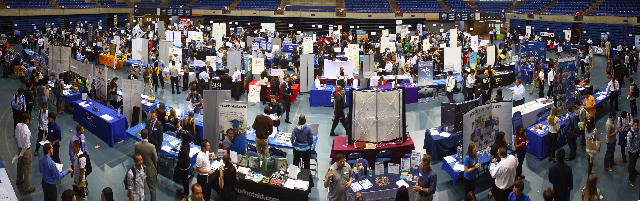
On April 17, UC Davis hosted its quarterly career fair in the ARC Pavilion. The Internship and Career Center (ICC) put together this event by inviting businesses to advertise and recruit students to join their companies.

From 10 a.m. to 2 p.m., over 130 companies from a variety of industries provided information to students who hoped to gain knowledge and make positive impressions.

According to ICC Project Manager Marcie Holland, the fair is a chance to get students thinking about where they stand entering the professional world.

“Coming out to the career fair, you get to practice being in the professional mode,” Holland said. “At the fair, you get to see what other people’s professional styles are, and where you might fit.  It’s developing a part of yourself you haven’t had to yet.”

Even though there is a fair each quarter, students can experience something new each time that they attend.

“I have worked here a long time, but every fair feels new to me,” Holland said. “There is a mix of different companies and students. If someone has been to a fair once, and it wasn’t a positive experience, they need to come again. Students have such a wide variety of interests, so we want to make sure there’s something for everybody.”

Janelle Auyeng, a UC Davis alumna and current CalRecycle employee, has a different perspective on the fair now that she has returned as one of the recruiters.

“When I was a student at UC Davis, I remember I was so clueless and didn’t know what I wanted,” Auyeng said. “I just knew that I needed a job. The best part of this event is that there are so many businesses in one place. You can see so many different potential employers and get information.”

Larisa Arambula, Human Resources coordinator of J.G. Boswell Tomato Company, believes networking to be an essential part of participating in the fair.

“Networking is the best thing students can take away from the career fair,” Arambula said. “Telling the companies what they’re interested in, getting to know the different companies because there are a bunch of companies that you might not know about. Students need to get out of their shell. I know it’s hard because I’ve been there too.”

According to Josh Diedesch, a CalSters employee and UC Davis alumnus, much preparation goes into making the fair happen.

“As a recruiter, we spend time getting together materials because we know that we have a limited amount of time with each student. We also spend some time thinking about the messages we want to give them and what materials to help to reinforce that, and how quickly and clearly we can communicate to them what it is that we do,” Diedesch said.

Expressing interest and following up afterwards are key ways for students to make the most out of the experience.

“I think that the best thing is to come up and be as confident as you can in introducing yourself and why you have an interest in that company,” Diedesch said. “It’s always a good idea to send a note and email to say thank you. If students have questions, they can follow up to reach out with the questions they have to find out more.”

JASMINE MANGABAY can be reached at campus@theaggie.org.

Photo by Kenneth Cunningham.

UC Davis softball nabs two more wins in Big West play

0

After dropping two games to UC Santa Barbara in league play and a mid-week loss to Pacific on April 23, the UC Davis softball team was in dire need of a couple of wins.

They would have their chance this past weekend, April 26 and April 27, when they faced UC Riverside in a three-game Big West Conference series at home on La Rue Field.

April 26 was a solid day for the Aggies, as they took on the Highlanders in a doubleheader, winning both games, 3-0 and 4-1. Unfortunately, the athletes were unable to snag a sweep from UC Riverside, as they dropped their last matchup  on April 27, 8-2.

However, with two of three wins on the weekend, UC Davis betters its conference record to 6-9, and their overall record to 17-29.

Securing those two wins on April 26 was a team effort, as multiple players flashed their skills defensively, on the mound and at the plate.

First up on the mound for the Aggies was freshman standout Dana Cruse, who threw a complete game, giving up only three hits on two walks with three strikeouts and most importantly no runs, picking up her first win of the day. With that win, Cruse recorded her third complete-game shutout victory on the season.

Offensively, the Aggies also dominated the Highlanders. In game one senior Chandler Wagner recorded her first-ever home run at UC Davis, putting the team up with an early lead of 1-0.

“I just saw the pitch and wanted to reach base safely,” Wagner said. “I was excited [about the home run] to say the least.”

Another standout at-bat came from sophomore Christa Castello, who knocked a triple into right center, recording two RBIs in the game and giving the Aggies the 3-0 lead that would hold for the rest of the first match-up.

Starting game two of the doubleheader was game one’s starter Cruse, pitching another outstanding five innings, giving up two hits on no walks with one strike out.

“I went with the hot pitcher,” said UC Davis head coach Karen Yoder.

Following Cruse was freshman Andrea Reynolds who shut the Highlanders’ offense down, giving up one run in two innings with no walks, recording her third save of the year.

Unfortunately, the Aggies were unable to come away with a sweep on the weekend, as UC Riverside came back on April 27 to spoil the Aggies’ hopes of a perfect weekend, defeating UC Davis 8-2.

Cruse started once again, but was unable to match her marks from the previous day, throwing only 2.2 innings, giving up six hits with five earned runs. Sophomore Alicia Paine came in to relieve Cruse and gave up three earned runs in 1.2 innings, followed by sophomore Marissa Chapa, who threw three innings giving up only two hits and no runs.

However, the Highlanders’ early run production would be too much for the Aggies, as UC Davis was unable to answer back at the plate, only scoring two runs to UC Riverside’s eight.

The Aggies still have several conference games to play to get themselves to an even .500. First, they face off against always talented Cal State Fullerton in Fullerton, Calif. on April 3 and April 4. First pitch is at 4 p.m. and will be broadcasted on ESPN3.

SLOAN BOETTCHER can be reached at sports@theaggie.org.

The Gould standard

0

The offense shined during the spring scrimmage as the Aggies closed out their spring football practice. Incoming senior London Lacy led all quarterbacks with 280 passing yards and two touchdown receptions. Lacy is battling with sophomore Ben Scott and senior Turner Baty for the starting position next year.

“Overall, I thought the offense did really well. We came out and started pretty fast and executed,” Lacy said. “I give thanks to my o-line and my receivers and running backs for just being there and executing for me. The defense gave us a lot of good looks but overall I thought it was a good day.”

Lacy and the offense found rhythm early on, scoring a total of five touchdowns. The offense’s first play was an 11-yard pass to senior wideout T.J. King. King stood out in his performance and led all receivers with 83 yards and one touchdown in five receptions.

The running game also triumphed over the defense, gaining 172 yards and scoring three touchdowns. Senior fullback Dalton Turay and sophomore Manusamoa Luuga ran for 85 and 65 yards respectively, with Luuga scoring one of the three rushing touchdowns.

Head coach Ron Gould was content with the overall performance, but expressed slight disappointment in the defense.

“Our defense has played extremely well the first 14 [practices],” Gould said. “Today, we didn’t play as well as we had been but, all in all, I’m very, very pleased with both sides of the ball. The offense moved the ball well which was great to see.”

Although this is just spring practice the players and coaching staff are pleased with the way that their regular season preparation is shaping up so far. Coming off a 5-7 record in his first year as head coach, Gould holds the team to high standards. Since his introduction as the head coach, Gould has implemented a new system; the foundation of this new system is trust. For Gould, trust is everything.

After the 2013 transition season, the players have adjusted from former head coach Bob Biggs to coach Gould and his new coaching staff. Now that the players are familiar with the playbook Gould, and the players themselves expect big things this season.

“The guys are doing a great job embracing the changes, and the expectations in everything that they’re doing,” Gould said. “One of the things that we talk about is that it is about family, not about individuals, not about me as the head football coach, but it is about these young men and each and every one of us, the coaches and players come together. And I am very, very pleased in my second year to say that things are coming along great.”

The team and the coaching staff are excited for one of the toughest schedules that UC Davis football has ever had. The whole team is on the same page, they are focused and are aiming for a common goal.

“I love it,” King said. “I’m blessed that on my senior year we get to play the toughest schedule we’ve ever had. Its’ a blessing cause Stanford’s our first game, obviously that’s what everyone has their eyes on, but every single game, our conference is the real deal.”

UC Davis opens its season on the road versus Stanford who was ranked No. 13 in the AP Post-season poll in 2013. The Aggie home opener will be on Sept. 6 against Fort Lewis in Aggie Stadium.

OSCAR DUENAS can be reached at sports@theaggie.org.