59.1 F
Davis

Davis, California

Wednesday, December 24, 2025
Home Blog Page 854

UC Davis hosts fourth annual TEDxUCDavis

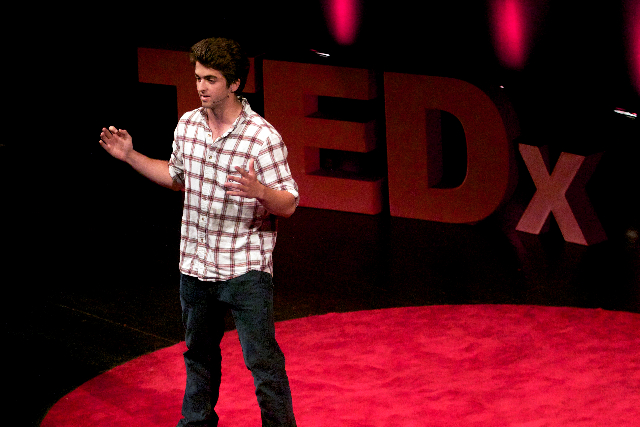
On May 4, students and community members alike joined together at the Mondavi Center to attend the fourth annual TEDxUCDavis event. Based on the well-known TED talks, which has the motto of “Ideas Worth Doing,” TEDxUCDavis is just one of many independently organized TED events that occurs often all over the world.

Director of Speaker Relations David Smotherman said that the UC Davis event has grown larger every year.

“Cory Warshaw started this from scratch about four years ago and is now an alumni,” Smotherman said. “It’s slowly progressed in size up to where we are now, where this is the first time we’ve ever been in Mondavi.”

The theme of this year’s TEDxUCDavis was “Pause or Press Play?” The host of the event and event programs encouraged the audience to consider at what times in their lives they should take the time for reflection, and at what times they should jump right in to the unknown without looking back.

The event featured a variety of speakers, including UC Davis Ergonomics Program Administrator Danny Nou, physician Dr. Richard Pan, UC Davis freshman Harley Litzelman and UC Davis Chancellor Linda P.B. Katehi. Topics ranged from the making of beer to the democratization of education to new technological advances.

“I have been watching TED talks since high school, and I had always found their mix of deep ideas and creative presentations appealing,” said Cory Warshaw, the founder of TEDxUCDavis, via email. “I felt if we could bring that style of conference to Davis, we could create a space on campus where people could share their own passions and dare I say it, make ideas cool.”

The event also featured performances by UC Davis student groups Jadoo and Danzantes del Alma to further emphasize the diversity in the Davis community.

TEDxUCDavis Director of Marketing Shavika Singha believes that the conference also gives the Davis community a chance to see the talents of UC Davis researchers.

“It’s an opportunity for the community to see what the real heart is in the UC system and what the real purpose of researchers and research is,” Singha said.

Although hosted on the UC Davis campus at the Mondavi Center, TEDxUCDavis promoters encouraged the greater Davis community to attend the event as well.

“I wanted to bridge the gap between the University and the community of Davis,” Singha said. “I want to make it less of an exclusive UC-attended event and encourage community members to come.”

The TEDxUCDavis team worked for months before the conference in order to ensure the event’s success.

“The speaker process is what really takes up most of the time because we start right at the beginning of the year,” said Allison Butler, TEDxUCDavis director of speaker relations. “We have a speaker selection committee, and right from the get-go we use connections we have from different TED events, and then we start contacting those people to see if they’re interested. Then we start meeting in person with these people. We go from emailing 100 people to breaking it down to 11 or 12. It’s cool because we get to work closely with the speakers.”

The TEDxUCDavis team has also worked on previous projects to bring TED projects to the UC Davis campus. Earlier this year, the team held the Davis Inside Out project, in which 400 photos of UC Davis students and community members were posted on the outside of the Social Sciences and Humanities building in order to recognize the individuality of campus members.

“This originally comes from a French artist called JR,” Butler said. “In 2011, he won an award for TED. After his recognition with TED, this project is going up all over the world. It’s really kind of a global art project.”

According to the TEDxUCDavis team, TED talks are the perfect way to engage students and community members to make a change.

“TED is the perfect place to bring brilliant, innovative new ideas and get people thinking,” Butler said. “TED is an amazing venue for that. Get people thinking, get people inspired.”

Warshaw’s goal is for event attendees to take what they learned from the event into their daily lives.

“I hope that the students and community find inspiration in the talks they hear, but more importantly I hope that they take that inspiration into action,” Warshaw said.

ALYSSA VANDENBERG can be reached at campus@theaggie.org.

Photo by Katie Lin.

Homelessness problem on rise in Yolo County

0

Homelessness has been a chronic problem not just on the national level, but also for Yolo County and the City of Davis.

A study conducted by the National Alliance to End Homelessness called “The State of Homelessness in America 2013” said that the nation’s homeless population decreased by 0.4 percent, though the number of people in homeless families increased by 1.4 percent in 2011. Additionally, they state that between 2010 and 2011, the national median household income decreased by 1.3 percent and the poverty rate increased by 0.6 percent.

Yolo County conducted its own study in 2010, “One
 Piece
at a
 Time:
 Ending 
and
 Preventing
 Homelessness
 for
 Yolo
 County
 Residents
.” The 10-year plan intended to mobilize non-profit organizations, rental property owners, community members and city officials to implement productive change in the homeless community.

The study cites a 20 percent increase in homelessness in Yolo County since 2007. Furthermore, it claims that the cost of preventing one person going into homelessness is one-sixth the average cost of staying at a shelter. The study also says that the current system makes it difficult for individuals to know what services are accessible to them.

One such service is Fourth and Hope, a denominational Woodland-based non-profit that aims to feed, clothe and shelter the homeless community. A unique aspect of the organization is their workforce development program that helps 73 percent of participants find employment later on. Their emergency services shelter holds up to 72 individuals where they provide rehabilitations and job training.

Chief operations officer of Fourth and Hope Doug Zeck said the biggest challenges that perpetuate homelessness are the high cost of market rate housing, gainful employment and life-skills training.

“There are also those that may battle with drug and alcohol dependency issues. We can assist with drug and alcohol dependency issues through our residential substance abuse program that can treat up to 44 clients,” Zeck said.

He adds that many individuals are close to homelessness due to inadequate savings reserves and lack of solid support systems, though they may not realize it.

“In many cases we see families that have one income earner that has lost his or her job, sometimes through illness and who then can’t make it on a single income. The resulting snowball of bills, rent and utilities overcomes them. Once evicted and with no other support system to help, they become homeless. Fortunately, they can turn to us for direction, assistance and new hope,” Zeck said.

One organization providing services for the homeless community in the City of Davis itself is the nonprofit, non-denominational organization Davis Community Meals (DCM). Their mission is to provide the low-income and homeless community with housing and food, among other resources. The organization provides a Resource Center, Emergency Shelter and Transitional Housing Program, free meals, Supportive Housing Program and Cold Weather Shelter.

DCM spends $300 to $400 per week for providing free meals, though much of the food such as bread, pastries, fruit and produce come from donations.

Executive director and long-time volunteer of DCM Bill Pride said that over the last 20 years the homeless community has not seemed to have changed much, though it may have increased more in the last couple of years due to a decrease in federal funding.

“It may have skewed a lot younger. The homeless group in Davis [used to be] a lot older and that’s the one big change. It’s been rather — I don’t want to say steady. Some of the older people have moved into housing,” Pride said.

Additionally, he said that mental health funds in the county have gone down which has proven detrimental to getting individuals into treatment.

“The two main problems are mental health issues and/or methamphetamine or prescription drug abuse … As a general rule everyone in the world experiences problems, homelessness is sometimes the end result of what happens over the years,” Pride said.

A UC Davis student-run non-denominational community service club, Help and Education Leading to the Prevention of Poverty (HELP) also provides free meals to the Davis homeless community. Their programs include two free meal nights per week, bringing awareness to local Davis elementary students, Thanksgiving Dinner and an annual Empathy not Apathy program.

For current HELP president Steven Reeves, a fifth-year landscape architecture major, what started as a decision on a whim turned into four years of dedicated community service work.

He says people should try not to judge homeless people, and he encourages people to say hi and treat them like human beings.

“On Picnic Day by Central Park, there was a group of people I know from the meals, an older guy named Kevin. They were sitting on the steps with all their luggage and there were all these people that are walking past them. I just want students to know they don’t have to be afraid … Don’t judge them. Some of them were in college and now they’re homeless. Don’t assume what they’re going to do; some of them can be really nice,” Reeves said.

From his experience, he’s found that big challenges among the Davis homeless community are drug use and family issues.

“I know a couple [people] that come from foster backgrounds. Also people don’t realize some of them have mental disabilities … We try to find local middle schools and high schools to educate the class on homelessness to raise awareness,” Reeves said.

Davis resident and DCM volunteer Robb Davis, currently running for City Council, said that while all these programs are vital to supporting the homeless community in Davis, he feels that more can be done to ameliorate the prevalence of homelessness in Yolo County. He said that homelessness is rarely about a single thing and is much more complex — it is often the effect of multiple problems such as addiction, mental health and broken families.

“With fairly small nonprofit organizations, their funding is always tenuous. They’re all doing a great job but I wouldn’t say anyone is really dealing with the problem in a fully comprehensive way … We don’t have, at the county level and certainly not at the city level, a comprehensive drug or alcohol rehab program that’s widely available,” Davis said.

He adds that people need more than a place to live — they need counseling and support, and that in our county individuals tend to pass from one program to another.

“We dont really have programs with long term housing. These people can have serious problems… I don’t want to discount the work they do because I’m part of it,” Davis said.

For the programs to be more cohesive, Davis said, they would have to spend a lot of extra time and resources to change, which is a huge challenge in itself. That being said, he believes that the work the programs are doing is invaluable and necessary to move forward.

Zeck held similar sentiments. He said that we need to realize handouts don’t solve problems, and that homelessness is everyone’s responsibility and we can all play a part in ending it.

“The policy changes need to be focused on real outcomes quantified by lives changed through supportive services that are run effectively and efficiently,” Zeck said. “Policies that encourage more affordable housing, fair paying jobs and that eliminate the barriers to obtaining them.”

GABRIELLA HAMLETT can be reached at city@theaggie.org.


Students complete #77DaysofDavis to mark last quarter of college

Students fill their 10-week quarters with academics: lecture, study, jobs, internships and if they’re lucky maybe a few social events here and there. The quarter system is wrought with chaotic deadlines, exams and constant scheduling. However, an online platform called 77 Days of Davis is spreading throughout campus to motivate students to be spontaneous and introspective, and to take advantage of their Spring Quarter.

Fourth-year political science major Ting Jung (TJ) Lee was inspired during finals week last winter to create a bucket list of activities she had always wanted to do. The bucket list would be for her last quarter of college. With the design and advertising help of friends and her own determination, she was able to launch the website, social media and checklist design for students to fill out.

“I’m a senior so I started to feel the senior anxiety of worrying so much about what I was going to do after college. It was about mid-March when I [realized] I worried two-thirds of my senior year away,” Lee said. “I was faced with a quarter and a half left so I thought of writing a bucket list of things I actually want to do in college that I would share with a friend. Then I thought how fun it would be if everyone had their own bucket list so we could share one with everyone and be inspired by things they want to do.”

Students participating in 77 Days of Davis fill out their own checklist of activities or goals, take pictures to document each accomplishment and then upload and share that moment on Facebook, Twitter or Instagram, including the hashtag #77DaysofDavis. Ideally, each student will complete his or her checklist by the end of Spring Quarter on June 12.

According to Lee, the name was inspired by the fact there are only 77 days in Spring Quarter, and this “movement” is to make students aware of their limited time, not only in school but in life. Though the activities might range from vague to specific and complex, she hopes the process is meaningful to students and a simple checklist is a starting point for challenging themselves in the future.

“This whole [event] is to show students that yes you need to study but you also need to dedicate time towards things like this, you need to create unforgettable memories, you need to dedicate time to yourself,” Lee said. “[It feels like] everyone in college develops a habit of procrastinating on homework but what we do with homework we also do on living. We procrastinate on living. Our happiness in college and life in general is not something we can postpone for the future or procrastinate on like our homework. It’s something we have to design for the present.”

Fourth-year psychology and communications double major and 77 Days of Davis participant, Lana Luong, said the name and the reason behind this event is important, especially for seniors.

“I didn’t know that there were 77 days left until graduation and when you put that number out there it sounds so much shorter than having a whole quarter,” Luong said. “It’s made me reflect back on how I actually don’t have much time left so it’s motivated me to do more things other than school and work. I think this is a really great way to make something very ordinary like a regular quarter into something that could be very memorable. For me I’ll always remember this 77 Days of Davis, even if it wasn’t my last quarter, as the time when I joined that and got that list done full of things I’ve wanted to do and it wasn’t just a random quarter passing by.”

According to third-year design and economics double major and designer of the 77 Days of Davis website Christine Gan, Lee reached out to her over a bowl of pho and was instantly interested in aiding her in the design process.

“TJ did an absolutely wonderful job capturing the ‘handmade’ and ‘student-started’ atmosphere in the design of the website, I simply helped fine tune the color scheme and design the checklist [but] overall, [we] just wanted something that looked like it was created by a student and created for a student!” Gan said in an email.

She also agrees with Lee that a platform like this is to share experiences in response to the notion that students are busy and often don’t make time for themselves.

“I really believe #77DaysofDavis exists to help students realize that in these four years they should not only gain a college education, but also a true college experience,” Gan said. “Whether it be a freshman, a senior, a student or a professor — I think we all sometimes forget to really cherish the time we spend in college and we forget to make the most of each and everyday that we have. The college quarter can be a chaotic whirlwind at times, but I feel that it’s really important to slow down and focus on our own small little goals every now and then.”

This motivating and mobilizing aspect of 77 Days of Davis is exactly what has Lee calling it a “movement.”

“I call it a ‘movement’ because the idea is to get students to move towards spending time for themselves, doing things that will make them happy as opposed to staying where they are right now, doing the same exact thing, focusing on school and then the next thing you know it’s the end of the quarter. Then in between just doing regular things like studying, partying, drinking, studying, partying, drinking; just doing the very basic thing and never ever stepping out of it,” Lee said.

Lee has already collaborated with AggieTV to put together a short advertisement with clips full of students participating in activities from the Davis Trinity to skydiving. Lee gave examples of people interpreting the list in a variety of ways, from small visits to a local restaurant to making a list of people they want to meet. Students are already becoming motivated to try new things, herself included.

“I always wanted to study abroad but I never applied for it,” Lee said. “So I put it on the list and that actually pushed me to fill out the application and get the pieces together so now I’m studying abroad in the UK this summer. For a lot of people you just need a little push and a little motivation to get you to start doing things.”

Designed checklists are available online through the website, downtown at Pachamama, and Teabo as well as on campus at the Memorial Union Corral and Pro-Shop at the ARC.

SEAN GUERRA can be reached at features@theaggie.org.

UC Davis softball blasts Titans to avoid sweep

The UC Davis softball team struggled early in the weekend series against the Cal State Fullerton Titans, dropping both games of their May 3 doubleheader, 5-4 and 10-5 respectively.

However, UC Davis avoided the sweep and defeated Cal State Fullerton 9-6, on the series finale.

After trailing the Titans 3-0, the Aggies managed to score eight runs in two innings to gain the lead. The rally began as sophomore Christina Guidry blasted a home run over the left field wall, which brought in her sister, sophomore Cat Guidry, who had singled in the previous at-bat.

“I knew I made solid contact when I hit the ball, I had no idea it would land on the other side of the fence,” Christina said. “When I turned second, I saw my teammates circle the plate and could not contain myself when I scored.”

UC Davis continued to hit the ball well in the fourth inning where they scored six runs. Leadoff hitter, freshman Lauryn Saunders hit an opposite side home run over the right field wall to start that inning for the Aggies.

Senior Chandler Wagner was able to reach base after she was hit by a pitch and Cat later singled, which allowed Wagner to advance to third. Cat Guidry would later steal second base. With runners in scoring position, the Titans decided to intentionally walk sophomore Crista Castello, who is batting .309 this season.

With the bases loaded, pinch hitter senior Kimberly Pena hit a ground ball to the Titan’s shortstop and reached first base safely as Wagner and Cat were brought home.

With runners on first and second, junior Amy Nunez hit a three-run home run that brought in Castello and Pena. This was Nunez’s fourth home run of the year.

Even after Cal State Fullerton scored three runs in the fourth inning, they were unable to take back the lead. Saunders blasted another home run for insurance in the fifth inning and sealed the game’s fate, 9-6.

The Aggies’ win improves their record to 18-31 overall, and 7-11 in conference play. Despite the win, UC Davis remains in sixth place in the Big West Conference.

UC Davis closes out the season at home, as it faces Saint Mary’s for a doubleheader on May 7. The final weekend series of the season starts with a doubleheader against Hawai’i on May 9 at La Rue Field in Davis, Calif.

OSCAR DUEÑAS can be reached at sports@theaggie.org.

UC Davis men’s golf team lands bid at Regionals

After a one-year hiatus, the UC Davis men’s golf team is back in the NCAA Regional tournament. The Aggies heard about their at-large bid after it was announced on the Golf Channel early on May 5.

UC Davis knew that they had a great shot at getting into the tournament, especially after winning the El Macero Classic and finishing second in the Big West tournament. The Aggies were also ranked No. 62 in the nation. Eighty-one teams were selected for the NCAA tournament.

On May 15, the Aggies will head to Auburn, Ala. to compete in the regional round. They will face competitors like No. 1 Alabama, No. 12 Virginia Tech, and No. 13 Texas.

Resident Big West champion senior Matt Hansen didn’t seem worried about making it into the tournament.

“I knew where our ranking was and I wasn’t too worried,” Hansen said. “Because of where our ranking was, we would have to be really unlucky to not get in.”

Hansen represents the Aggies’ best hope for a victory in the NCAA tournament, especially given his experience in postseason play. The senior golfer won the regional round in his first year on the UC Davis golf team.

After such great play over the last two tournaments, the UC Davis men’s golf team has a lot of momentum moving into the NCAA tournament’s regional round.

RYAN REED can be reached at sports@theaggie.org.


UC Davis students protest Coffee House Cinco de Drinko Sloshball game

On May 2 at 11:30 a.m., around 100 students gathered at the Memorial Union flagpole, wearing red in solidarity and holding signs and banners with phrases like “We’re a culture! Not a costume!”

The students were protesting the ASUCD Coffee House (CoHo) in reaction to a recent Facebook event called “Cinco de Drinko Sloshball,” which was apparently made by and for CoHo employees. The event cover photo depicted four people in sombreros, ponchos and mustaches standing behind a fence, and two others dressed as border patrol police. In the description, the event planners wrote, “come drink a few cervesas and siesta out on the grass…grab those sombreros, and we’ll see you all there bright and early!” The event was scheduled for May 3, falling on the same day as La Gran Tardeada, the culmination of the week-long celebration of La Raza Cultural Days.

“Students are having a sit-in to peacefully get the message across to the University and CoHo employees to stop racially insensitive parties,” said Armando Figueroa, ASUCD president and a fourth-year Chicana/o studies and sociology double major. “The CoHo seems to be a platform [for racial insensitivity] because this is the second time that this has happened this month, [following] an event called “Holy Land” which had racially charged depictions of Muslims.”

According to Figueroa, the Holy Land event resulted in racially charged depictions of a Muslim dressed as a terrorist.

The May 2 protest was organized via a Facebook event arranged by Jackie Santizo, a fourth-year Chicana/o studies and sociology double major, and included a 40-minute sit-in inside the CoHo and a boycott of all CoHo items until one or more of the group’s demands were met.

Multiple members of the UC Davis administration observed the event, including Chancellor Linda P.B. Katehi, who voiced her support for the protesting students.

“That event that was organized was inappropriate and it was an event that really promotes stereotypes,” Katehi said. “I’m against any effort to stereotype any group and I‘m going to be sympathizing with those who object to it.”

The students chanted “UC Davis isn’t safe!” as they entered the CoHo from the south side at 11:45 a.m., and then gathered in the main walking area and waited for the organizers to speak.

The demands presented during the speech included creating a forum or safe space for CoHo employees and all other ASUCD units where they can share concerns, involving UC Davis Counseling Services as an accessible resource to those student employees, meeting with the chancellor and others to discuss the climate of racism on campus and documenting the consequences of student employee actions violating UC Davis policy not only within the CoHo, but within all ASUCD units.

The leaders of the sit-in held that the boycott would cease when one or more of the 12 demands were met.

The protest spanned beyond the UC Davis Chicano community, according toMichelle Villegas, a 2012 alumna who majored in Chicana/o studies and sociology and is a major voice behind the protest.

“The purpose of this was to let folks see that we are here, we are upset about this and we’re not just going to sit back and let these things happen,” Villegas said. “That doesn’t just include Chicano, Latino students, it includes students of all different types of backgrounds.”

Adriana Arrambide, a fourth-year majoring in environmental policy analysis and planning, expressed her disappointment with the lack of change in climate throughout her time at UC Davis, and recalled how in her sophomore year she had gone into an administrative building for advising and was mistaken for a cleaning lady by an office administrator.

“Here I am [in] my fourth year, and it’s still happening. When I see pictures of Cinco de Drinko, when I see pictures of someone mocking border patrol, not knowing remotely how hard it is to cross the border … it just disgusts me,” Arrambide said. “I see this list of demands that we’re making and I think it’s the minimum. That’s the least the administration could do for us.”

Outside the CoHo, close to where the protesters initially gathered, a group of four students were wearing sombreros, including Dylan, a fourth-year civil engineering major, who requested his last name not be mentioned.

“It’s comfortable and keeps the sun off my neck,” Dylan said. “I understand people are offended, people are hurt, just in my opinion it’s not racist or anything.”

According to Villegas, however, those students were an example of an instance of racism on campus.

“That just shows that on this campus, that’s the mentality. People don’t want to be open-minded, people don’t want to sit and dialogue,” Villegas said. “It’s upsetting obviously, like you want to go up and say like ‘hey what the hell are you doing wearing that,’ but in this case, you know, we wanted to make sure that it remained peaceful.”

Sabrina Sanchez, a first-year student majoring in political science and another organizer of the protest, agreed with Villegas and said that it put on display what needs to change.

“I definitely think we had a really good turnout,” Sanchez said. “But there definitely needs to be more done, and this is just the beginning.”

ELLY OLTERSDORF can be reached at features@theaggie.org.

[Photos by Misha Velasquez, Ciera Pasturel and Brian Nguyen.]

The Horrors shine on ‘Luminous’: an album review

Luminous, the fourth album by UK rock band The Horrors, sounds like a light show, thanks to its spacey synths, foggy guitars and distant, indistinct vocals.

The Horrors began as a horror punk band in 2006. This was when I first heard of them, although I’m going to destroy my hipster cred by adding that I did not care for them and wrote them off for six years. When I rediscovered them, they had changed completely.

Luminous, much like 2011’s Skying and 2009’s Primary Colours, sounds like the work of shoegaze bands of the late 1980s and early 1990s. These bands, such as Ride, Slowdive and (of course) My Bloody Valentine, made music that sounded ghostly yet monolithic.

However, The Horrors add an element of danciness that a lot of those bands lacked. Songs like “I See You” (which begins with what has to be an homage to “I Feel Love” by Donna Summer) and “Chasing Shadows” feature shimmery synths and bouncing drums that would fit in at a club more than on Loveless.

The best song on Luminous, “In And Out Of Sight,” really shows what makes the album enjoyable as a whole. The song features a strong bass groove, a great drumbeat that pops right out of the mix and a wall of sound formed by a bright synth, an ethereal guitar and Faris Badwan’s distant vocals.

One issue with the album is that many of the songs somewhat bleed into each other, which is a major weakness with shoegazing as a whole. Although a few songs (namely “Change Your Mind,” which is different from the rest of the album) have a coherent vocal performance, the production generally under-emphasizes the vocals, making the lyrics hard to decipher. However, this is a matter of personal preference, since the lyrics on those songs were probably chosen more for their sound than for their meaning.

In the end, Luminous is a solid album. The songs are well crafted, although they’re the auditory equivalent of a Cubist painting. This isn’t for everyone, but it will appeal to you if you’re a fan of the genre.

— John Kesler

Divestment bill to go to senate

IMG_3770_nguyen
A member of the public speaks against SR #20 during the Business and Finance Commission meeting on May 6 in Giedt Hall. Photo by Brian Nguyen.

On April 17, Senate Resolution (SR) #20 was introduced to ASUCD senate. SR #20 urges the UC Regents to divest from companies assisting in the Israeli occupation of Palestine and illegal settlements in Palestinian territories, which violate international human rights. In particular, the bill specifies divesting from Caterpillar Inc., G4S PLC and Veolia Environment due to their active involvement in violating human rights. The entire resolution can be read here.

SR #20 was seen by the Ethnic & Cultural Affairs Commission on April 28 at 6:30 p.m. in Hunt 100. The resolution passed the commission with a 5-4 vote.

On April 29, the resolution was seen by the External Affairs Commission at 6:10 p.m. in Wellman 26. It failed with a 2-4-3 vote.

The Business & Finance Commission voted to allot only two hours to public discussion. The commission reviewed the bill on May 6 at 8:10 p.m. in Giedt 1001; the resolution passed with a 4-3-2 vote.

Since SR #20 passed with a majority vote by the commissions, it will be voted on by senate on May 8 at Freeborn Hall. The senate meeting will begin at 6:10 p.m.

Last year, a similar divestment resolution was introduced (SR #30) but failed to move forward to senate.

More updates regarding SR #20 are to come.

— Claire Tan


Students protest Napolitano visit to UC Davis

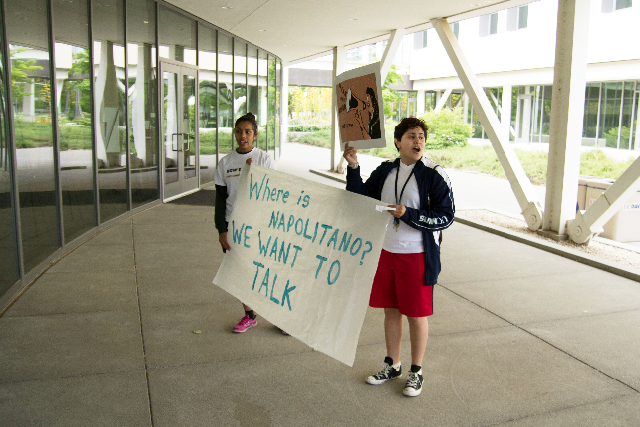
On April 26, UC Davis undergraduate and graduate students gathered in front of the Student Community Center (SCC) to protest a campus visit from University of California (UC) President Janet Napolitano. Napolitano was visiting the school to speak at the Fourth Annual UC Global Health Day.

Maria Salazar, a third-year chicano/a studies and psychology double major who was participating in the protest, said that the visit was not publicly announced to students.

“A lot of student leaders, like the student chancellors and leaders in ASUCD, had no idea she was coming,” Salazar said. “We had to be told by other student leaders on other campuses.”

Salazar said that they were first notified of Napolitano’s visit from a post on the UC Irvine website that she would be at UC Davis. According to Salazar, the public is supposed to be notified when Napolitano makes campus visits.

The Global Health Day website did list Napolitano as a speaker weeks prior to the event.

Abrahan Tapia, a fifth-year psychology and chicano/a studies double major, said the purpose of the protest was to show that the students do not understand or agree with the decision to have Napolitano as UC president.

“We’re trying to show we’re still opposing her appointment,” Tapia said. “We want to know why they picked her over other, more qualified people.”

Tapia said that another reason for the protest is Napolitano’s previous experience as the U.S. Homeland Security secretary. Many students worry about how her past experience with deportation will affect current students.

“She was the chief deporter of immigrants,” Tapia said. “She’s responsible for breaking a lot of families apart.”

Guadalupe Espinoza, a second-year psychology and human development double major,said Napolitano’s high security when visiting campuses and supposed cover-up of her visit was another reason for concern. Espinoza said that the police presence at her events appears as if she finds students to be threatening.

“We want to know why she needs so much security and why she is considering us a threat,” Espinoza said. “The police presence at the schools also affects how the media frames her.”

Students at the protest said that they wanted to talk to Napolitano regarding her position as UC president. One of the main goals of the protest was to speak with Napolitano.

“We want to get her attention and show that we’ll always be there,” Tapia said. “If she’s willing to talk to us, we would like to talk.”

Protesters handed out fliers during the protest to address its purpose and goals. A list of questions addressed to Napolitano were on the fliers and included, “Why do you need so much security when coming onto campus?” and “Given that you have no educational background, why do you think that you’re qualified to run such a large educational institution?”

During the UC Global Health Day, protesters marched from the SCC on campus to the Conference Center, where the Global Health Day event was being held. Students taped posters onto the windows of the Conference Center so that attendees inside who were leaving for lunch could see them.

Tapia said that the protest was broadcasted via social media with the hashtag, “#no2napolitano.”

Brooke Converse, a UC Office of the President (UCOP) spokesperson, said that UCOP did not know what the purpose of the protest was.

“We are aware that there was a very small protest at Global Health Day, but we do not know what they were protesting about,” Converse said via email.

MELISSA DITTRICH  can be reached at campus@theaggie.org.

[Photo by Rousseau Gleitsman]

Men’s golf takes second in shortened Big West Tournament

Threatened by winds reaching 40 miles per hour, the third day of the men’s golf Big West Tournament was canceled, leaving the Aggies with a second place finish.

UC Davis was led by senior Matt Hansen, who built on a victory in the El Macero Classic by taking first place honors. Hansen ended the two days of play eight under par, led by 12 birdies and just four bogies. He finished with an impressive five-shot lead over the second place finisher. The individual win gave Hansen three for his impressive career as an Aggie.

“That was an absolutely dominant performance,” said head coach Cy Williams. “I’m very proud what he’s done the last two weeks. He’s really put the team on his shoulders.”

The Aggies’ first day was led by a strong 5-under 67 by Hansen as well as a 2-under 70 by freshman Nicholas Noya who finished the day tied for fourth place. Noya, like Hansen, is coming off of an extremely strong performance in the El Macero Classic.

The Aggies quickly took the lead on the second day of play, but fell back into second place. Noya fell slightly, but maintained his top-10 status with a 2-over 74. Hansen continued his strong play with a 3-under 69, while sophomore Ben Corfee, sophomore Luke Vivolo and senior Joshua Granger all finished with better scores than their first days. Each finished strong down the stretch, with Vivolo birdying his last two holes.

The tournament ended early after wind delays reached over 90 minutes. With the early finish, Hansen remained in first place. However, the Aggies were not given the chance to claim a first place finish.

With the Big West Tournament over, UC Davis now has to wait and see if they will receive an at-large to the NCAA Tournament.

“I think we’re very deserving for an at-large bid,” Williams said.

At-large bids will be announced live on May 5 from 10 a.m. to 11 a.m. on the Golf Channel. Regardless, the Aggies can rest well knowing that they did all that they could to close out the season on a high note.

RYAN REED can be reached at sports@theaggie.org.


Eligible Phi Beta Kappa initiates pass opportunity

UC Davis students get a lot of emails, and sometimes an opportunity can get lost in the shuffle. As it turns out, not all mail from faculty members is meant for the masses. Some, like an invitation to join Phi Beta Kappa (PBK), is only sent out to a select few. And to those that are eligible, it might benefit them to keep an eye out for it.

PBK is the United States’ oldest honor society and is considered the most prestigious, dating back almost as far as the founding of the country in the late 18th century. It recognizes outstanding academic success in multiple fields of study.

UC Davis contributes its fair share of students to the society every year: 140 on average according to the secretary of the Davis chapter, religious studies professor Naomi Janowitz. Several students this year are being elected to the society at a ceremony taking place on May 7, but a good number of eligible students won’t be showing up.

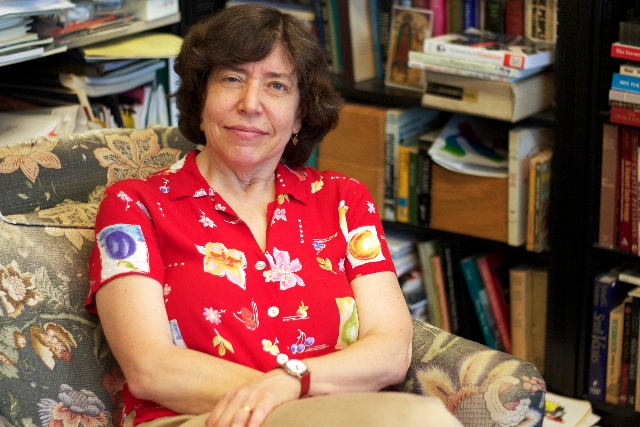
“One of the things that’s interesting about Davis is the number of students who are first generation Phi Beta Kappas,” Janowitz said.

She went on to explain that, unfortunately, this means that not everyone who is eligible is aware of the society, and that perhaps they might end up ignoring their invitation.

“At other schools people will be very competitive about it, whereas I think sometimes people here don’t necessarily know what it is, and I think that serves them poorly because it’s useful and helpful for them,” Janowitz said.

The president of the chapter this year is MLA president and UC Davis English professor Margaret Ferguson. She agreed with Janowitz and noted that being able to put PBK on a resume is one of the major benefits for students.

“I think it’s a way to honor students for hard work, and for signaling that to future employers and/or members of admissions committees,” Ferguson said.

She also mentioned the possibility of receiving fellowships and networking through the society.

Beyond that, Janowitz emphasized that being part of PBK encourages members to keep an academic mindset after graduation.

“For those of us that are academics, it’s nice to be connected,” Janowitz said.  “But I think for people who are not academics, it’s even more, because it’s a connection to a life of the mind. It’s an organization that has conferences, a journal, book reviews, all kinds of stuff.”

Ferguson and Janowitz expressed concern at the number of people who are not informed about PBK, and one of their goals this year is to change that.

“I think, especially in a public university, it’s important to make sure that access to these kinds of honors is available to any student who earns it,” Ferguson said.

Access is made easier by the fact that UC Davis students do not have to pay a fee to join, as that fee is subsidized by the chapter. Access is hindered by students’ lack of awareness of the society.

“We would like the criteria for admission and the honor that comes to this student to be better known in the Davis undergraduate community,” Ferguson said.

Janowitz said the criteria to be eligible at UC Davis includes a overall grade point average of 3.8 for juniors and 3.7 for seniors. But that is just the beginning.

“We look at a huge number of transcripts, based first on grade point average, and then it’s narrowed down to those that fit the requirements,” Janowitz said.

She went on to explain that there is a specialist and committee dedicated to finding everyone who might be eligible. If you have a high GPA, you may be wondering why you haven’t been contacted. It might be because the committee also looks at the amount of variety in your course load.

“If you’ve only done one kind of class and you have a 4.0 that isn’t going to work,” Janowitz said.

She commented that the society recognizes hard work in a broad range of fields, requiring students to earn a high GPA while tackling courses in humanities and science. A program listing the students elected last year reveals the large variety of majors students might belong to, including mathematics, chemistry, political science, English, psychology and many more.

“You do have to be someone who’s looked at the world from many different points of view,” Janowitz said.

Gordon Allen is a third-year philosophy major and a recently elected member of PBK. He spelled out his philosophy when it comes to choosing classes, which happened to be perfectly aligned with what the society wanted.

“I don’t think I’ve ever looked at my major requirements,” Allen said. “I just take what looks interesting, and I’ve taken classes in almost every college here. I also don’t particularly care whether they are hard or easy.”

His interest in this particular honors society stems from his respect for the criteria, which requires students to challenge themselves with learning outside of their particular field of study.

“What that means is doing shit that you didn’t have to do, because it was interesting or fun or cool or probably a good idea,” Allen said. “That sounds like a community of people that I’d be interested in talking to.”

NICK FREDERICI can be reached at features@theaggie.org.

[Photo by Katie Lin]

Police briefs: April 21, 2014 to April 25, 2014

0

MONDAY 4/21

May the odds be ever in your favor
A kid was playing chicken with passing trains on Fifth Street.

I demand a shrubbery
Someone’s front and side shrubs were ripped out of her yard on North Campus Way.

TUESDAY 4/22

Busted
Somebody reported her son was almost hit by a Unitrans bus in the crosswalk in front of his school on Drexel Drive and the bus driver yelled at him to move out of the way.

THURSDAY 4/24

Peace out
Someone called to report two greenpeace activists on the property who refused to leave on First Street.

Squirrel away
On Luz Place, somebody reported her neighbor was shooting squirrels and found two of them in her yard.

FRIDAY 4/25

Grandiose
Someone reported her 10-year-old grandson was throwing items in the hallway on Ecuador Place.

Police briefs are compiled from the City of Davis daily crime bulletins. Contact EINAT GILBOA at city@theaggie.org.


UC Davis student among youngest Boston Marathon participants

0

Christy Larson, a fourth-year exercise biology major from UC Davis, was one of the youngest participants in the Boston Marathon on March 21.

Larson qualified for the Boston Marathon at the Nike Women’s Marathon in San Francisco in 2012, with a time of three hours and 17 minutes, finishing in 10th place. This year, at the Boston Marathon, she brought her time down to three hours, nine minutes and 20 seconds. Larson claims that she’s never been a “technical” runner.

“I don’t time my mile splits, I just run,” Larson said. “At the Boston Marathon, I went out way too fast and at mile 13 I thought I was going to die. I just wanted to finish at that point.”

Larson didn’t spend the day before the marathon carbo loading and resting her feet. She spent the day touring the city with her family.

“The day before the Boston Marathon, my family and I walked probably eight miles around the city and found a hole-in-the-wall place to eat,” Larson said.

Larson qualified for the Boston Marathon in 2012, but was unable to run in 2013 because registration had already closed. The tragedies of the 2013 event made it even more important for her to run in the 2014 marathon.

She trained for the Boston Marathon without any coaching, running in between classes at UC Davis when she had time. Larson said that she runs between 60 and 70 miles a week.

Just weeks before the marathon, in early April, Larson’s grandfather died unexpectedly of pulmonary fibrosis, exacerbated by pneumonia. Larson was very close to him, according to her father, Nils Larson.

“At first she called me and said that she didn’t want to run after that,” Nils said. “But I told her to think about Grandpa and what he would want her to do. I think she turned that into inner strength and it made her push harder.”

James Sena, Larson’s high school cross country and track coach, said that he was a little surprised when he heard that Larson was going to run the Boston Marathon, but that she’d always been a strong long distance runner.

“She always took her athletics very seriously,” Sena said. “She’s very outgoing and friendly, but as soon as she put her soccer shoes on she was very competitive.”

A lot of high school athletes go all out and are pretty burnt out by the time that they get to college, Sena said. What set Larson apart was that she had so much stamina and ability to “make it happen.”

“She was different than the big group of kids in high school as far as work ethic, attention to detail and competitiveness,” Sena said. “She was going to challenge you. She’s not a quitter, and she just gutted it out.”

Larson realized that she was fast in the third grade when her teacher made the students run laps. She continued to run during middle and high school, and ran 500 miles the summer after her junior year.

Larson’s parents were amazed by her success at the Nike Women’s Marathon in San Francisco. They thought that her running was purely recreational, and her father mentioned that no one else in the family is a runner.

Larson said that running marathons gives her confidence in human nature.

“If you get the chance to run a marathon, do it,” Larson said. “Everyone is chasing the same goal, and crossing that finish line is such a rewarding experience.”

TAYLOR CUNNINGHAM can be reached at city@theaggie.org.

Courtesy photo.

UC Davis freshman class halts dropping admit rate

According to information released by the University of California Office of the President (UCOP), UC Davis admitted a total of 24,551 students to its incoming freshman class out of 60,536 applications. The 40.6 percent admit rate was slightly higher than last year’s 39.4 percent. UC Davis has targeted to enroll approximately 5,200 freshmen for fall 2014.

The average 4.07 grade point average (GPA) remains about the same from last year’s 4.08. The average SAT or converted ACT score rose from 1932 to 1950 for this year’s admits.

The University saw an increase in international and out-of-state admits from previous years. Of the recent admits, 17,813 are California residents, 2,454 are from out-of-state and 4,284 are international students. International and out-of-state admits rose from last year by 1,066 and 616 admits, respectively. California admits also increased by 871 admits from 2013. According to statistics provided by UCOP, international and out-of-state admits have risen steadily over the past few years.

According to Walter Robinson, executive director of Undergraduate Admissions at UC Davis, the increase of international admits was made in order to bring more global diversity to the campus. However, he maintains that California residents remain the overwhelming majority of students admitted to UC Davis.

“Global diversity is a value added to the undergraduate educational experience,” Robinson said. “Not everyone has an opportunity to go abroad, but for us to be able to bring abroad here is very important. I think at the end of the day, we’re still probably around 92 percent Californians in our undergraduate student body. Even though this year our percentage of nonresidents is higher than what it was last year and last year was higher than the year before, still the vast majority, the overwhelming majority of undergraduates enrolled here are from California.”

According to Wesley Young, director for Services For International Students and Scholars, the increase in international students support the University financially for the money no longer provided by the state of California. However, Young maintains that the population of international students, who only make up six percent of the undergraduate population, is not as large as many people perceive.

“California residents don’t pay for the full cost of their education; it’s subsidized by the state of California,” Young said. “I know it doesn’t feel like a good deal, but you’re paying less than what your education costs. In the past, it was primarily the state of California that makes up that difference, but because state money has fallen off so much in the last several years, international students are paying full fare. If we didn’t have international students, California residents would be paying a lot more tuition I’d think.”

Of the recent admits, 2.8 percent identify as African American, 0.7 percent identify as American Indian, 41.5 percent identify as Asian American, 21.2 percent identify as Hispanic/Latino, 0.2 percent identify as Pacific Islander, 29.7 percent identify as white and 3.7 percent did not provide a racial report. Most racial groups stayed relatively the same from last year. White admits saw a dip in 199 admits and Asian American and Hispanic/Latino admits increased in numbers of 494 and 541, respectively.

While 2014 marked the first time Hispanic/Latino students outnumbered white students in terms of total UC admissions, Alma Martinez, UC Davis Student Affairs coordinator for Chicano/a studies, still sees potential growth in order to match UC Davis’ Hispanic/Latino population with state demographics.

“When looking at the percentages of Chicano/Latino students on our campus it is clear that there is a lot more work to do if the demographics on the University are going to reflect the demographics of the state and on the K-12 pipeline in California,” Martinez said.

Of the 2014 admits, 35.3 percent are first-generation college students, 31.8 percent are from low-income families and 19.4 percent are from high schools with a low Academic Performance Indicator. Each of these numbers saw an increase from the previous year.

“I think this class has the strongest academic indicators as well as the strongest diversity that we’ve had in a single class in maybe the last 10 years,” Robinson said.

While Robinson doesn’t believe the incoming class has made a huge contribution to the 2020 initiative, he said it is heading in the right direction. The 2020 Initiative is a plan designed to build excellence and diversity at UC Davis by expanding the student population by approximately 5,000 students by the year 2020. Robinson said the slow progression was due to the remaining buildings needing to be built and faculty needing to be hired in order to accommodate an increase in students.

“I don’t know that we have hit full stride on the 2020 Initiative, but it’s moving in the correct direction for this spirit and intent of the 2020 Initiative,” Robinson said. “I think that next year we might see a bigger number than this year and it may become steeper, but we don’t want to bring in more students than we are in a position to support at this time.”

According to Robinson, undergraduate admissions uses a holistic review based on policy and guidelines provided by the Board of Admissions and Relations with Schools and the UC Davis Admissions and Enrollment Committee. After reviewing applications, admissions consults with the university budget office, academic department deans and the Office of Institutional Analysis in order to determine an admit range. According to Robinson, there is a distinct admit range for each college and some majors.

In order to expand geographical diversity, Robinson said admissions will look at California high schools, usually in low-resource or rural areas, where no students were accepted and accept students that fit the admission criteria. Additionally, Robinson said extra review will be given to students who are comparable to other students from their high school who were already admitted.

In addition to academics, Robinson emphasizes the importance of extracurriculars, volunteerism and personal statements in order to set students apart from other students who may have similar academic scores. According to Robinson, personal statements are reviewed based on how well the student tied it in to the rest of the application.

“We have so many students with great grades and great test scores, so some students can tell their story in a way that’s very compelling and coupled with strong academic performance,” Robinson said. “We take a look at upward trends of improvement. So a lot of times there’s students who are better than their numbers and there are some students who had tremendous numbers, but not much of a story.”

For students applying for the 2015-16 school year, the UC undergraduate admissions application will open on Aug. 1, two months earlier than previous years.

Students admitted to UC Davis’ incoming freshmen class have until May 1 to return their statement of intent to register.

Alexandria Zaydhar, an incoming first-year chemistry major, was attracted to UC Davis for its agricultural environment.

“I chose Davis because of the farm life. It’s basically my home away from home,” Zaydhar said.

JASON PHAM can be reached at campus@theaggie.org.

Photo by Kenneth Cunningham.

Studio 301 presents Seussical the Musical

From May 9 to May 18, Davis’ undergraduate theater group Studio 301 will be presenting the Tony Award-nominated Broadway hit Seussical the Musical (Seussical). This show will mark Studio 301’s annual musical production.

Seussical is based off of multiple children’s books by the late author Dr. Seuss. The musical incorporates bits and pieces from Horton Hears a Who!, Horton Hatches an Egg, The One Feather Tail of Gertrude McFuzz and is narrated by the infamous Cat in the Hat.

The production is jam-packed with narrative songs that bring you into the Jungle of Nool, one of Dr. Seuss’ wacky, imaginative worlds in which important journeys are taken and lessons are learned. Seussical garnered a fan-base quickly when it was first released due to the familiarity and popularity of Dr. Seuss’ children’s books among the American public. Studio 301 will likely attract many local fans of the author’s work.

Zoë Samborski, a fourth-year dramatic art major, is the director of this production of the musical. She said she chose Seussical because most actors would be familiar with the characters and would be able to comfortably dive deeper into their roles.

“It [familiarity] allows for the actors to excel since they are playing roles that they are familiar with and a storyline that they understand,” Samborski said. “There can be more time [spent] going in depth with their characters and less time just trying to figure out the basics [of their role].”

The cast is made up of UC Davis students from a range of different majors. Studio 301 has been in pre-production for the musical since January and started rehearsals at the beginning of Spring Quarter. The cast and crew rehearse Tuesday through Saturday around four to five hours a night. A lot of focused rehearsal is required for the show as it features over 20 musical numbers with choreography.

To some people it might seem odd that a college theater group would produce a show aimed towards children, but Seussical’s lessons are much more complex than they first appear and transcend a typical “children’s” musical.

Jason Moscato, a second-year double major in dramatic art and linguistics, is the show’s choreographer. Moscato said he believes that though the musical is originally aimed towards children, there are important messages nuanced in the production for adults as well.

“Many prevalent social issues, including perceptions of mental illness, body dysmorphia and child abandonment is played through these iconic Seuss characters,” Moscato said. “The balance is very effective, and makes the show more than just a show for children. The substance of the show and the high contrast between the lighthearted and serious content make the show a must-see.”

The show will feature silly, over-the-top costumes and props to properly reflect Dr. Seuss’ zany world. Rachel Wagner, a fourth-year dramatic art major, is the assistant director of the production and said she is looking forward to putting on a show in which all people can attend, regardless of age.

“I’m most excited about giving a chance for young kids to experience live theater, especially because they get so little exposure to the arts in school,” Wagner said. “It gives a chance for families to come and all enjoy live theater together on a budget.”

The show will run May 9, 10, 16 and 17 at 8 p.m. and May 10, 11, 17 and 18 at 2 p.m. It will be located at the Wyatt Pavilion Theatre. Tickets are $12 general admission, $10 for students and $5 for children 10 years old and under.

AKIRA OLIVIA KUMAMOTO can be reached at arts@theaggie.org.