59.1 F
Davis

Davis, California

Wednesday, December 24, 2025
Home Blog Page 853

Drought in California increases costs for farmers

0

Beginning Jan. 14, California has been in a drought emergency. Since then, Gov. Jerry Brown has encouraged all citizens to cut back at least 20 percent of their water use.

Moreover, since the agricultural industry in California alone produces over 50 percent of the nation’s vegetables and fruits, along with dairy and wine, the consumer market will be drastically affected.

Ken Shackel, a tree crop expert in the Department of Plant Science at UC Davis, studied many non-irrigated almond trees in dry soil for approximately a year starting in 2009. The trees did not die, but their yield was around 50 percent. The next year was around 10 percent.

“However bad this year, it will be worse next especially for the farmers today. Really bad this year means really, really bad next year,” Shackel said. “The most vulnerable crops are probably stone fruits like plums, cherries, peaches and apricots, which are adapted to wetter climates.”

The government has already taken action to tackle this issue. They have asked citizens to conserve water and use it more efficiently.

“What is needed is to pass a law that requires that every user of groundwater have a meter and report their water consumption to the SWRCB (State Water Resources Control Board)”, said Samuel Sandoval, an assistant professor and UC Cooperative Extension specialist and expert in water resources planning and management, in an email.

Sandoval added, as of now, this is not mandatory.

“The government (water agencies), practitioners and scientist are always guessing how much water farmers are using from groundwater. This change in law can help have a better understanding and as a [consequence] to better conserve groundwater,” Sandoval said.

Agriculture represents two to three percent of the state economy. While the economy will do relatively well during drought, the sector that will be more affected is agriculture.

In some places like the Central Valley and the Imperial Valley, a large part of the population relies on agriculture. Unfortunately, low-income communities are more vulnerable and are more likely to be affected.

Low water allocation will reduce food production in California and increase costs of producing that food. Low water availability will mean low flows and reduced recreational opportunities in the state’s reservoirs.

Terrestrial biodiversity is negatively affected by drought, but California is an environment that is adapted to periodic drought. There are reduced wildflowers, and this is hard on pollinators, for example, but for the most part our native species have been through this before and will go through it again. There are undoubtedly cases where the interaction with human landscapes makes this impact particularly severe.

“We worry about how the demand for water is driving increased groundwater use. Increased groundwater use results in decreased water tables,” said Mark Schwartz, director of the John Muir Institute for the Environment at UC Davis, a plant ecologist and a professor of environmental science and policy.

“Decreased water tables change streamflow patterns in some cases. This has already resulted in a number of the conversion of annually running streams to seasonally running streams. Obviously, a seasonal stream is not a good place for fish and other aquatic organisms,” Schwartz said.

This is one of the driest years, but perhaps more significantly, California has witnessed a strong shift from annual plants like tomatoes to perennial crops like almonds over the past two decades.

Whereas formerly a tomato grower could forego planting in a dry year, no irrigation water means that an almond grower could lose their trees. Hence the impact of this drought is likely unprecedented in its economic scale.

“There are several communities that are close due to limited supplies to increased costs to purchase water at a municipal level, to increased draw-down from the aquifer which can lead to subsidence and costly infrastructure repairs,” said Andrew Fulks, assistant director of the UC Davis Arboretum and Public Garden. “If the families live in rural areas and have wells, there is always the possibility of the wells going dry. In Yolo County, we have pretty healthy groundwater supplies, so this will only be an issue with a sustained multi-year drought.”

ROHIT TIGGA can be reached at city@theaggie.org.
UC Davis ranks 19th among top Peace Corps volunteer-producing schools

It seems that the spirit of giving back runs in the blood of UC Davis students. According to the 2014 Peace Corps rankings of top volunteer-producing universities across the nation, UC Davis ranked No. 19 among large schools, and currently has 41 alumni serving worldwide. For the past 12 years, UC Davis has made the top-25 rankings among large schools.

There are numerous obvious reasons for graduates to join the Peace Corps: all-expenses paid travel, the once-in-a-lifetime experience, professional development, resume building and academic and professional opportunities such as the Returned Volunteer network.

“We interview and send 25 to 30 volunteers abroad, straight from campus,” said Daniel Quinn, the UC Davis campus recruiter. “The interest in international work and in the Peace Corps has been rising, and we’re always getting more applications than ever before.”

The high number of UC Davis volunteers can be attributed to a service-oriented, globally-minded student body, according to Lorry Marvin, the Sacramento Peace Corps recruiter.

“There is also a great international student population at UC Davis, which helps expose all students to a variety of ideas, cultures and languages,” Marvin said. “That helps students see that the world is a very diverse, immensely interesting place.”

To find out what sets the Peace Corps apart from other post graduation options, The Aggie sat down with Gabriel LaHue, returned volunteer and UC Davis graduate student in international agricultural development, to hear some of the lesser known aspects of volunteering.

According to LaHue, students should apply for the Peace Corps nine to 12 months before they actually hope to leave. There are various components of the application process that need to be completed before they receive an invitation to go. They also won’t know where they’re going until they receive the invitation, which will be a few months before their departure date.

LaHue ventured to Paraguay after completing his undergraduate degree in plant science at Cornell University. The Santa Cruz native said that he’d been planning to join the Peace Corps since high school, when his cousin joined the service.

His cousin didn’t end up going abroad due to a strong reaction to an antimalarial drug that he needed to take for his planned trip to Nepal. He was medically separated from the Peace Corps while attending the three-month pre-departure training, which is an additional three months not included in the planned two years of service.

Applicants are matched to countries based on their skill sets. UC Davis has had a huge number of Peace Corps volunteers in agricultural projects compared to other universities, according to Quinn.

Globally, only four percent of volunteers work in agriculture-related projects, while at UC Davis over a quarter of applicants go into agriculture. Education and health care are other popular areas of service.

LaHue said that the village that he stayed in had an incredibly open and generous culture. People were polite, and “are you happy” was a more common question than “how are you.” They based their choice of activities on how happy they made them, and LaHue said that people would leave jobs because they weren’t happy in them, a contrast to what it seems the typical American would do. Their happiness was based mainly on social collateral.

This cultural difference led to some accountability issues, however.

“If they didn’t want to do something, they’d say ‘another day,’” LaHue said. “They had these polite ways of saying no, but I didn’t realize that at first.”

LaHue said that as a volunteer he had to learn to roll with the punches, and not be too worried about what didn’t get done.

“If it rains when you have a big event planned, everything is canceled,” LaHue said. “If it rains and the roads are terrible, you’re stuck.”

One of the goals of the Peace Corps is to help volunteers appreciate the culture of their host country, and in turn to have the citizens of that country appreciate the country of their volunteer.

LaHue said that at the beginning of their time, volunteers can get frustrated because they have an ideal of how everything should be going, and want a more concrete job description. They’ll say that they’re bored or don’t have any work to do, but LaHue said that he always felt really busy because he didn’t wait for things to come to him.

“The first year, you learn a lot more than you’re giving back,” LaHue said. “The second year, you give a lot more back.”

LaHue also said that whether a person wishing they could stay a third year, like he was, or happy to go home, depends largely on the relationship they form with the people in the area.

LaHue lived in a tiny village of only 150 people, most of whom spoke a mix of Spanish and the indigenous language, Guarani. The village was mostly a small family, with only probably two families out of 25 that weren’t related by blood.

LaHue said that the most important thing that he did at the beginning of his trip was to spend time working with the villagers, trying to build relationships with them.

“The day that I left was one of the hardest days of my life,” LaHue said.

TAYLOR CUNNINGHAM can be reached at features@theaggie.org.

Photo by Rosa Furneaux.

This Week In Science

The Indian superbug

A new paper in the Journal of Antimicrobial Chemotherapy sheds more light on the terrifying gene factor named NDM, also known as “the Indian superbug” for its resistance to virtually all antibiotics. NDM travels in gut bacteria and can spread between people through the fecal-oral route. Because only a few known drugs are able to treat infections caused by NDM, the research staff at Public Health England state that it presents a huge challenge to medicine as we know it.

Rethinking Neanderthals

A recent paper published in the journal PLOS ONE argues against the conventional notion that the Neanderthals went extinct because they were cognitively inferior to modern humans. Study authors Paolo Villa and Wil Roebroeks say that the Neanderthals were accomplished big game hunters and used pitch to make their own weapons, demonstrating an abstract reasoning ability. There were more complex factors involved in their disappearance, such as male sterility from interbreeding with Homo sapiens.

Ivy League students and their need for speed

A new study from the American Academy of Pediatrics finds that 18 percent of Ivy League students misuse ADHD medication when studying. While colleges often wage campaigns against drug and alcohol abuse, they often neglect to emphasize the harm of prescription drug abuse. Natalie Colaneri, a research assistant at Cohen Children’s Medical Center, hopes that these findings will raise awareness about this important medical and ethical problem.

The price of being unfit

Michigan State University researchers found that college students who were less fit had more difficulty retaining information than their healthier counterparts. The study is published in Cognitive, Affective & Behavioral Neuroscienceand is one of the first to focus on young adults in the field of fitness and memory. Kimberly Fenn, a study co-author, says that a surprising number of students were out of shape and had more trouble with memory, representing the increasingly sedentary lifestyles in the U.S.


UC Davis holds annual UC Global Health Day

On April 26, UC Davis held the fourth annual University of California (UC) Global Health Day (UCGHD). The event brought up issues such as environmental global health, maternal and child health, animal health and illness and epidemics around the world. Students and faculty from all 10 UC campuses were present at the event.

Patricia Conrad, a professor in the UC Davis School of Veterinary Medicine and co-director of the One Health Center of Expertise, led the event planning and served as the chair of the UCGHD. Conrad said that the idea for UCGHD was initiated by the UC Global Health Institutes on each of the UC campuses in an effort to bring the campuses together.

The event has previously been held at UC Irvine, UC Berkeley and UC Riverside.

“We volunteered to host this year, but everybody wanted to have it at Davis,” Conrad said.

One reason for this was to follow the pattern of rotating holding the event from a school in southern California to northern California. Conrad said that UC Davis also has a lot to offer in terms of global health.

“UC Davis values the importance of humans and animals, especially with the veterinary medicine program,” Conrad said. “We also have strong environmental policies that apply to agriculture and human health.”

Speakers at the event included professors from UC Davis, Director of the UC Global Health Institute Haile T. Devas, UC Davis Chancellor Linda P.B. Katehi and UC President Janet Napolitano.

During her speech, Napolitano addressed the importance of student and faculty research in contributing to global health.

“We teach for California and research for the world,” Napolitano said. “We need you to work together and solve these most complex and urgent problems.”

Napolitano said that she hoped to use her position as UC president to help students gain funding for their projects from other sources. Much of the research that students do may be looked over or not noticed because of the lack of funding.

“We need to educate funding sources about how they can help fund research all throughout the University,” Napolitano said. “That’s something the UC president can do.”

Conrad said that although this is the fourth Global Health Day, it is the first one to include participation from all 10 of the UCs. She said there was enthusiastic support from student health committees through embarking on research related to global health, creating videos for a video competition and helping to plan the event.

“We want everyone to know about the importance of global health, but also to know that it starts locally,” Conrad said.

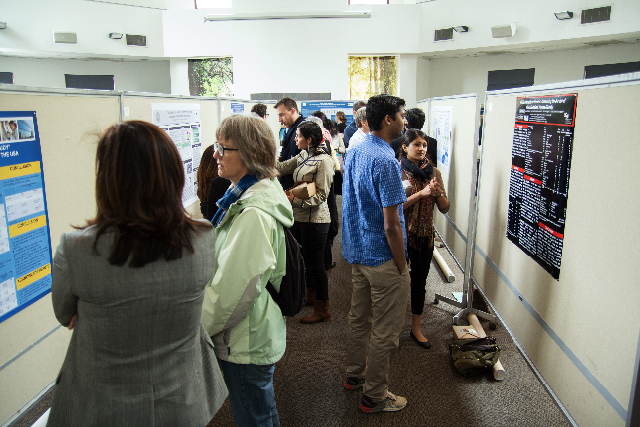
A poster session during the event included a variety of students from all of the UCs exhibiting the research they had done relating to global health.

Shashank Anand, a third-year bioengineering and biomedical engineering major at UC San Diego, presented his poster entitled “Engineering Low Cost Diagnostic Medical Equipment for the Detection of Antiretroviral Therapy Failure for HIV Positive Patients in Mozambique, Africa.” He said the purpose of the research was to enhance already-created equipment to help detect HIV in patients in Africa. The research aimed to specifically create low-cost equipment to make it easier for patients to get tested.

Anand said that it was his second year at UCGHD and that he was thrilled to be there. He said that, as an engineer, it was beneficial to get a different perspective of the event’s topics.

“Considering people’s cultural background and seeing how we can adapt it into our design process is really helpful,” Anand said.

Jonna Mazet, a professor in the Department of Epidemiology and Disease Ecology at UC Davis and executive director of One Health Institute, was one of the presenters. She discussed how collaboration and creativity can be implemented in efforts to combat widespread diseases across the globe.

She has also spoken at UC Riverside and finds it an honor to speak at the UC Davis Conference Center. She said that teamwork is one of the most important aspects of her job, as it forms the basis of her principles.

“I think that being here together with our colleagues and understanding what’s going on on all our campuses and then having the opportunity to discuss and build collaborations so we can really solve problems is critical,” Mazet said. “UC Global Health Day gives us the opportunity to do that.”

Mazet hopes that people will take away the idea that a combination of networking and innovation is the most effective strategy in combating disease and solving global health issues.

“We need innovations to solve global health problems, and to do that we need to form partnerships and to really commit to solution-oriented science,” Mazet said.

Andrew Hargadon, a professor of technology management at the UC Davis Graduate School of Management and the founding director of the Energy Efficiency Center, presented with Mazet and emphasized the need to take action. According to him, there are endless issues that need to be investigated and resolved.

“When we find real solutions to the problem, we think we’ve done the job,” Hargadon said. “That is rarely ever the case.”

MELISSA DITTRICH and JASMINE MANGABAY can be reached at campus@theaggie.org.

Photos by Rousseau Gleitsman.

Whole Earth Festival’s must-see events

The 45th annual Whole Earth Festival (WEF) will take place this Mother’s Day weekend, May 9, 10 and 11. The event, which aims to celebrate health, the environment and expression, will be hosted on the Quad and will showcase a variety of local and visiting artists, dancers and musicians.

Whole Earth manages to pack the weekend with 40 bands and 20 dance acts, in addition to offering vegetarian dining, movie screenings, artist vendors and a variety of workshops. Here are a few interesting activities to check out.

MUSIC

Lazertooth — Davis local, Derrek Warren G. mixes heavy bass and synthetic melodies that are reminiscent of dubstep but distinctly original.
Set time: Friday, May 9; 9 to 10 p.m.

SambaDá — The self-proclaimed “Afro-Samba-Dance” band brings an energy completely unique to Davis. The Brazilian band draws from samba, reggae, funk and cumbia influences and will have even the most reserved spectators dancing.
Set time: Sunday, May 11; 3:35 to 5 p.m.

Thick As Thieves — This L.A.-based band fuses hip hop and rock into a seamless and catchy creation. The band adds to this contrast with two powerful vocalists backed by classic rock guitar riffs.
Set time: Saturday, May 10; 4:30 to 5:25 p.m.

Ideateam — The Ideateam is a 9-piece funk/psych/jazz band that hails from Sacramento. The group, influenced heavily by jam bands like Snarky Puppy, masterfully weaves jazz and funk with effortless skill and energy.
Set time: Friday, May 9; 8:45 to 9:45 p.m.

DANCE

Yoga-Hip — Yoga Hip takes yoga, dance and martial arts and forms a synergetic, fitness-based yoga that is set to music. The program emphasizes spiritual oneness and physical fitness.
Performance time: Saturday, May 10; 11 a.m. to 12 p.m.

Capoeira Água de Beber — Capoeira is a style of martial arts that mixes aspects of dance and acrobatics and sets it to music. The studio, which is based in Sacramento, teaches both children and adults the art of Capoeria.
Performance time: Saturday, May 10; 6 to 7 p.m.

OTHER

Flow movie screening
Irena Salina investigates the world’s dwindling water supply and its implications for society in this award-winning 2008 documentary.
Screening time: Sunday, May 11; 10 to 11:30 a.m. in Young Hall

FOOD

WEF will host more than 20 food and beverage vendors. Coachella vendor, Gourmet Faire will serve vegetarian corn dogs while Lydia’s Organics will offer vegan and gluten-free snacks. Davis local business, Fat Face will be selling handcrafted popsicles and Frozen Fantasies will offer chocolate-dipped fresh fruit.

ART DISPLAYS

More than 30 artists will be showing off their hand-crafted designs. Mellow Mud Pottery to see artist Susan Tate’s blending of stoneware clays and unique textures. Imps and Monsters will display artist Justin Hillgrove’s whimsical but eerie paintings, comics, and prints of cartoonish creatures.

EXPERIMENTAL SPACE WORKSHOPS

The northwest Quad’s Experimental Space will host a series of workshops including Sexuality in Intentional Communities, Medicinal Plants and Aromatherapy, Birth into Being and many more.

SACRED SPACE WORKSHOPS

The southwest Quad’s Sacred Space will host a variety of workshops to help you feel spiritually awakened. Come check out Intro to Acro Yoga, Tapping Into Your Divine Purpose, and Loving Oneself.

For a more information and the complete schedule of events visit wef.ucdavis.edu

UC Davis names 2014 Community Service Award winners

Many hardworking UC Davis clubs and individuals were recently recognized in the 2014 Community Service Awards.

Each year, the Community Service Resource Center (CSRC) holds the UC Davis Community Service Awards in order to recognize students, staff, faculty and student organizations that have gone above and beyond.

After being nominated, the participants were required to fill out a short application that the CSRC then reviewed. The recipients received certificates for their assigned category — which were determined by various aspects of their work in the community. The categories for the awards are Outstanding, Gold, Silver and Bronze, in order of prestige.

Third-year communication major Viktoriya Mlonchina won an Outstanding award for her organization “Stories for Success (SFS),” a nonprofit tutoring program for English as a Second Language (ESL) students at an elementary school in San Francisco.

As a Ukrainian immigrant herself, Mlonchina began elementary school as a student in the ESL program.

“In my teen years, I became aware of the severely depleting resources allocated to ESL students and chose to make a change,” Mlonchina said. “At age 15, I, along with my friend and business partner Mikhail Vysotskiy, created SFS. Mikhail and I also created a free curriculum based on the California Public Schools English-Language Arts Content Standards.”

SFS officially launched in November 2009 with 26 students, and has now expanded to 15 tutors and 40 students.

“Our progress is traceable through parents and teachers’ personal accounts and our students’ rising grades and test scores,” Mlonchina said. “I’m so proud of SFS’s evolution and its positive impact on our students’ personal and educational paths.”

Mlonchina said that receiving the award reassured her that her organization is still making a visible impact on students’ lives.

“It puts a huge smile on my face to visit the program when I’m in San Francisco and see how actively our students and tutors engage with one another,” Mlonchina said. “The program meets on Fridays after a long week of school, but I can see that the kids really enjoy being there. It doesn’t feel like a chore for them.”

Along with Mlonchina is two-time Outstanding recipient, fourth-year international relations major Mana Azarmi. Azarmi was rewarded for her work in two organizations: Bottles for Poverty and the Human Rights Brigade.

“Bottles for Poverty is a club on campus that is seeking to combat poverty by providing communities with access to education,” Azarmi said. “People donate and drop off their recyclables at 688 Bianco Court in Davis, and we redeem those for cash.”

The organization has successfully built their first school in Gondar, Ethiopia and is now just $800 short of building a well for the school.

The other organization Azarmi participates in is the Human Rights Brigade, which has grown tremendously since its start in 2012.

“We send brigades — groups of about 20 to 25 people – to Panama and work with lawyers and world communities there, and we try to facilitate empowerment of the communities by providing them with legal workshops, access to lawyers and providing human right workshops,” Azarmi said.

Azarmi also emphasized that she would not have been as successful in her volunteer work without the support of the organizations and especially the help of her two vice presidents at Bottles for Poverty.

“Coming to Davis I was looking to do something and the service community here is very welcoming and it’s great fun — you meet a lot of people and get to do good things. It’s definitely rewarding,” Azarmi said.

The community service work that Azarmi does through the two organizations has had quite an impact on her future career plans as well.

“For me, I always knew I wanted to do human rights work,” Azarmi said. “Working with these two organizations has solidified that yes, this is definitely the path I want to go down, and it’s just the kind of work I like doing.”

A third Outstanding recipient, fourth-year animal science major Ciara Main, received the award through her work with Get on the Bus.

“Get on the Bus is a statewide, non-profit organization that was started in 2000,” Main said. “The organization as a whole caters to children of incarcerated parents. We go to about 17 of the state prisons here.”

Main said Get on the Bus has grown tremendously since she brought it to Davis in her third year.

“We started with just myself, then with three people kind of collectively just going over ideas, and it’s really blossomed,” Main said. “It’s crazy how much it’s grown. When I say it’s grown, not necessarily in numbers but in passion. The people in our club are really what make it.”

Get on the Bus not only makes travel bags for children visiting their parents, but they write letters, facilitate visits and hold various other events.

“The very first meeting I had for Get on the Bus was in Geidt 1001; I walked in and expected something big,” Main said. “I thought ‘Oh everyone understands children of incarcerated parents,’ but there were only four people in that big old lecture hall. I felt so small in that moment — I thought ‘I can’t do this.’ Now, just me being a fourth-year and seeing how big it’s grown and what we’ve accomplished, it’s definitely amazing.”

Fourth-year biological sciences major Iqra Ahmad received an Outstanding award for her nonprofit project titled “No Pad, No School.”

“Inspired by my mother’s own hardships growing up as a woman in rural Pakistan, I decided to take action and work to make even a small change if possible,” Ahmad said. “I would like to give women and girls a greater sense of Azaadi — which means freedom and independence in Urdu — to pursue life’s opportunities through making menstruation a non-issue so that girls can stop missing school.”

Each month due to the lack of women’s hygienic products, females in Pakistan continuously miss school and some even end up dropping out. To raise awareness in the community regarding this issue, Ahmad collects donations.

“I aim to empower women through providing them with sexual and health education and skills on how to care for themselves while on their menstrual cycles,” Ahmad said.

Ahmad says that the work she does for her project is very fulfilling, and is very thankful to her parents for their unconditional support.

“Love is like a flame, and when it spreads it has the power to heal and energize our spirits. I feel good inside and that’s when I know I’m doing good and want to do more,” Ahmad said. “I keep to myself mostly, but when there’s a need for help, I find myself going out of my way to help whoever is in need.”

One last Outstanding recipient for this year’s Community Service Award, Zita Demaree, has worked in student housing for 24 years after moving to Davis from the Philippines. She received the Outstanding award for her charity “AJD Angels of Hope” this year, and won one for it back in 2012 as well.

“It was my daughter who came up with the idea when she was 14,”  Demaree said. “It was so inspirational that she was even able to think about it. When we visited the Philippines, I brought my daughter to the sites where there’s a lot of slums and she said ‘Mommy we should send them my clothing and toys’ — we just started sending them our own things.”

Demaree said at first it began with her calling garage sales and neighbors to ask if they could have their leftover items; it was never intended to become a charity. Initially, she was able to ship eight boxes to the Philippines where she and her brother distributed them to impoverished areas.

In 2012, she started a “project bear” with the intention of helping children with cancer here in California. However, due to various complications she ended up donating the bears to the Philippines as well.

“I went there and distributed it myself,” Demaree said. “To me that was so close to my heart because you’re actually there and you see kids that are dying.”

Not only does AJD Angels of Hope give aid to the Philippines, but they also have events here every December where they give food, canned goods and clothing to people in Davis. Demaree says she’s very thankful for the help she receives from volunteers in the Davis community.

“I’m very grateful for any accomplishments we achieve and thankful for what UC Davis does for us,” Demaree said. “My organization helps students in the area when they come to volunteer as well. They not only come to get leadership, but they need it for their schooling. Because I’m here, I’m accessible — a lot of students call me to volunteer. I like it! I like it because I get to build all the students’ leadership and community service skills.”

ELLIE DIERKING can be reached at features@theaggie.org.

Photos by Anna de Benedictis. 

Growing With Film: Wising Up With “The Iron Giant”

0

Eli Flesch

My column thus far has dealt with adult issues that include, but are not limited, to the power of stereotypes, drug use and sexual maturation. Today, we’ll take a step back from the ‘R’ rated movies and look at Brad Bird’s 1999 The Iron Giant. I have seen this film twice in my life — once as a thumb-sucking five year old, the other as a head-in-the-clouds college student. I’ve got to say, the movie got my tears a-flowin’. This came mainly as a result of its surprisingly candid look at the power of death in childhood, themes regarding the importance of self-determinism and inner peace, which help demonstrate one of the most illustrious themes in coming of age: the wisdom of children.

But how can children be wise, Eli? Good question. The only wise thing I could tell you as a youngling would be to avoid girls and, in turn, the scourge of cooties. I kid (pun definitely intended). Kids seem to have a mind that while not fully abstracted is certainly adept to understanding certain moral truths. In The Iron Giant, our praise goes to nine-year-old Hogarth Hughes. When the boy’s alliterative name is found at the scene of an investigation, Hogarth is put under the eyes of evil government agent Kent Mansley.

Through the course of the film, Hogarth develops a friendship with the eponymous Iron Giant. In a sense, the giant is a towering and metallic Baby Huey — clumsy and naive. The giant’s coming of age results directly from the wisdom Hogarth imparts to it. Above all else, the message that “You are who you choose to be” is what the giant learns from Hogarth. His philosophy helps the giant attain his greatest feat: saving an entire town from a nuclear holocaust through self-destruction. The giant’s final wish is to be “Superman.”

Growing up we don’t often find ourselves in movie moments like this, where all of our beliefs and desires can be reduced to one defining action. Aging is a process in which these ideas of self constantly evolve. Childhood provides a grain of salt to the idea that we may be completely different when we reach maturity. For example, it’s a pretty widely-held truth that murder is wrong. Most people know this at all stages in life. So the challenge then is determining what other moral truths are worth holding on to.

It may be more than you think. If we can accredit children to having a degree of wisdom, then we can subsequently agree that it may be in our benefit to follow beliefs that we held to be true in childhood. American culture highly values the giant’s sacrifice because it simultaneously puts the individual before and behind the good of the group. Before in the sense that it was sacrificing one for the whole. Behind in that it represented the giant’s self-fulfillment to exhibit superhero qualities.

Striking this balance in any age would be a remarkable accomplishment. It requires a conscious desire to do good by self and others. Often, and especially in adolescence, we trade one for another. Our self-serving actions can come to be detrimental to others. Alternately, we may help someone for the wrong reasons, something that does not go far to improving self-esteem. Ultimately, we have to truly ask ourselves who we want to be. Guess when these feelings are sharpest.

Failing to answer this question is surprisingly easy. Loosey goosey answers fall to the wayside quickly. Are you worried yet? You should be. Don’t worry, you’ve got a paranoid, anxious and self-deprecating 18 year old talking you through the process. But maybe I find that giving myself those labels helps me determine what I want for myself. Looking at yourself honestly is a great way of determining faults and ways to change. Humor is always welcome; I for one could not get by if I did not have daily har-hars at my own expense.

We have not extrapolated ideas too far from that core message of The Iron Giant. The argument for honest self introspection is associative — drawn from the movie and put into an age appropriate context. What we can learn from a clinking assemblage of nuts and bolts is truly remarkable, and a testament to tender writing and direction. It would be remiss for me to not close with a joke. So, in good form: What would one call an iron cat? A Fe-line.

To congratulate ELI FLESCH on that indubitably incredible pun, you can reach him at ekflesch@ucdavis.net or tweet him @eliflesch.


Campus Judicial Review

The “Meet a Student Judicial Affairs Officer” series begins this week! It will feature a different Student Judicial Affairs Officer each week.

As the director of SJA, Donald Dudley has a jam-packed schedule, but graciously took the time to be interviewed and featured in this week’s “Meet a Student Judicial Affairs Officer.”

Mr. Dudley is from Buffalo, N.Y. Years ago, he came to UC Davis to pursue a master’s degree with the math department. Not only does he have a Master’s in math, he also holds a law degree from King Hall. Before he became a SJA officer, he was a math instructor, the president of the Graduate Student Association and a DJ at KDVS. He has been here at Davis for over 20 years! Mr. Dudley’s favorite spot on campus is his office and he enjoys eating at Hunan Bar & Restaurant on D Street.

As the director, Mr. Dudley’s typical duties consist of managing the staff, working closely with administrators, handling highly sensitive cases and assuming overall responsibility for the department. Mr. Dudley wants to ensure that SJA is providing the best service possible. There are a variety of issues that SJA addresses that touch on fundamental questions of an individual’s rights and rule of law in society. He finds that working with these issues is his favorite part about being a SJA officer. When asked what the most complicated case he has ever dealt with was, he said the most difficult cases are the ones that involve sexual assault.

According to Mr. Dudley, the most common reasons students give for cheating is grade pressure and being unprepared. He finds that the most common rule broken by students who are unaware that they are doing so is that one cannot submit the same work in more than one class without the permission of the instructor. His advice to students who are stressed about school, life, etc. is to not be afraid to ask for help. For students who are reported to SJA, he advises students to be honest if they say anything.

Police briefs: 4/28-5/5

0

Monday 4/28

Low-key
A guy on E Street opened someone’s door with a key and claimed he was going to spend the night. The person asked him to leave but he returned in the morning asking to sleep at the residence again because he was cold.

Saturday 5/3

Waffle around
Somebody jumped the fence on Olive Street and rearranged the construction cones, causing a traffic jam.

Beat to a pulp
Someone threw a tomato at a guy’s car when he was stopped at a stop sign on Marina Circle.

Sunday 5/4

Up to speed
The speed limit sign on Russell Boulevard was turned upside down.

Monday 5/5

Pottymouth
Someone on Chestnut Lane asked a woman if she needed a bag for her dog poop, and she responded by cussing at him.

Bull in a china shop
A guy was trying to shop on E Street and asked the employee for an item. Before the employee answered he told him to get the “F” out of the store.

Police briefs are compiled from the City of Davis daily crime bulletins. Contact EINAT GILBOA at city@theaggie.org.

Smells like the Nineties

Live Through This

Twenty years ago, Hole released what would be their definitive record: Live Through This. Live through what, exactly? Well, just about everything you can imagine: being ripped into doll parts, resisting kill me pills, struggling with abandonment, breaking, burning, being walked on, disrespected, taunted, threatened and coping with suicide. Death and life particularly reverberates from every growled syllable on Live Through This.

“If you live through this with me, I swear that I will die for you,” promises frontwoman Courtney Love in the riveting track “Asking For It,” a sacred oath binding the listener and singer together. Love wrote the track after her experience of being physically and psychologically abused by a crowd that ripped her apart after a stage dive. To those who don’t know the story, or perhaps do, the line also resonates as a tongue-in-cheek reversal of the unforgivable, pathetic excuse criminals have utilized to justify assault: “She, or he, was asking for it.”

A punk record with a pop heart, Live Through This is very much a document of survival that managed to pierce through the confines of mainstream radio. The phrase “live through this” is itself a phrase of empowerment for survivors and activists, especially those working to de-stigmatize issues of suicide and rape as social constructs.

Thematically and conceptually, Live Through This is the natural extension of Hole’s first record, Pretty on the Inside. Musically, the band evolved and matured, becoming a taut rock outfit, largely extracting many of the same concepts about objectification, insecurity and subverting gender constructs.

Even with the contemporary ability to incite and promote global discourses as well as the increasing accessibility of resources as a culture, we are predisposed to insecurity about approaching challenging social issues — notably suicide, race, misogyny and rape. Often, efforts at addressing these uncomfortable issues result in silence. Love subverts the cowardice on Live Through This, forcing the listener to swallow these issues whole, but in a way that brilliantly injects them into tight hooks and thrashing drum lines that make you move.

Lyrically antagonistic, vitriolic instrumentally, and yet still managing to extract a curious beauty at the core, Live Through This is one of the most fearless, feminist-surged rock records recorded in the ’90s, up there with PJ Harvey’s Rid of Me and Liz Phair’s Exile in Guyville.

To me personally, one of the most enlightening moments on Live Through This happens right at the end, on “Rock Star.” The music fades and the lyrics slow, then Love says firmly: “No, we’re not done.” Presumably, she’s using that as a cue for her bandmates to continue, but I think this exchange gestures towards just how pivotal Live Through This remains now and will continue to be as long as people are still spurred to thrash on guitars and make noise, inciting cultural change.

So no, Courtney Love won’t shut up, and we won’t shut up — not until misogyny and sexism are firmly dis-entrenched from our society’s collective consciousness. She did it for you, for the kids, for me, as we continue to live through shit, love through this and ultimately live through this.

Breaking Norms: “Alien” invasion

SAVANNAH HOLMES

As I hovered near her hunched-over body at a nook in the library and read aloud the words on her screen, she automatically did a quick 180 spin and gave me a mixed look of confusion and awe. It was then established that, yeah, maybe people don’t like it when strangers invade their personal space. They basically look at you like you’re an alien from outer space.

But aren’t we all just one big, happy family dispersed across this Earth? Nope, I guess not. Personal space is a big deal to most people and when you get too close (especially without actually knowing the person), they tend to respond rather hastily.

The girl in the library whose identity shall not be released seemed a little shaken at the idea of someone standing close to her while she studied. That’s not an uncommon feeling, which prompted me to go observe other students and their reactions.

I ventured through and around campus these past few weeks — stalking my prey, leaning in closer and closer and eventually breaking into that little bubble we like to call our personal space.

In line for the ATM, I tested the simple norm of standing too close to someone when there was plenty of other space available. Considering that I’m not a polar bear seeking warmth and comfort from its mother in the winter, the guy I “crossed boundaries” with slowly stepped away until the “weird” girl got the hint.

If you’ve ever accidentally gotten too close to someone you didn’t know, they probably (a) said something (b) looked at you oddly or (c) discreetly moved as far away from you as possible.

It’s a bit extreme when people assume that someone isn’t “all there” if they get too close. The way it seems, at least to me, is that we’ve classified the invasion of personal space as not only breaking a social norm, but as a deviation from manners and standard human behavior.

When I was waiting in line for food at the CoHo, I decided to stand at a socially awkward proximity to the person in front of me. After becoming aware that I was there, this person kept inching forward to regain their personal space … like I had on a ski-mask and was going to pick-pocket them and run away or something.

To further illustrate this social norm, while dining with the cronies at the ever-famous Cuarto DC, I nonchalantly crept my chair closer and closer to the person next to me until we were nearly touching. People don’t like shoving food into their face when there’s someone an inch away from them. That makes sense in this day and age, but when was our dining etiquette instilled with the rule that we must eat at least two feet away from one another? Intriguing.

The social norm that probably got the most and best feedback was when I sniffed people. Yes, I actually sniffed people like a freakin’ dog.

Put it this way: We all hug people. However, when I went in for a hug, I just lingered a little longer and audibly sniffed them. It’s confirmed that people don’t necessarily like it when you inhale their essence. It’s not like I was sucking out their soul, but that’s the type of reaction I typically gathered.

In the movies, when a couple hugs and one of them lingers to sniff the other’s hair or whatever, it’s like “Aww how romannnntic,” but when I do it, it’s more like “Ugh back off, you freakazoid.”

People treated me like I had just graduated from the school of creepily sniffing people, with honors, and was sharing my skills with every unwilling person around me.

That sounds exaggerated, but the thing is that there are just so many social norms that aren’t even a big deal, but people treat them as such.

So, I’m just here to spread the word. And if it takes me having to sniff you to get the message across, then so be it.

If you have the desire to creep people out around campus, then retire into the life of luxury with SAVANNAH HOLMES and contact her at skholmes@ucdavis.edu.

Guest Opinion: You Can’t Fight Bigotry with Bigotry

1

As many of you have probably heard, there was a recent controversy surrounding a planned but canceled Cinco de Mayo party by CoHo employees that turned into a huge uproar here at UC Davis. This is not the first time something like this has happened; according to some people who have been on campus longer than I have, the usual protocol is to quietly reprimand people who do such culturally insensitive acts for fun rather than out them in public. I understand that perhaps people think that quiet discipline is not enough and everyone needs to know that such acts are not okay; the result this time may have led to unintended consequences that also revealed other kinds of unsavory attitudes on campus.

First of all, I want to say that I realize that Cinco de Mayo is primarily a Mexican-American and Northern Mexican holiday brought over to the United States to celebrate cultural roots by Mexican-Americans, and has served as an important symbol of cultural unity. We also need to realize that issues surrounding undocumented immigrants from Latin America and border patrol are serious, and one should be very cautious and mindful when applying humor to an issue that involves a lot of violence and racism (but humor has been used to examine the issue and as a coping mechanism).

While I agree that the event planned and similar events are inconsiderate, I think that it has its own complexities. From what I understand, the donning of costumes that are caricatures of Mexicans seems to be a common way that people celebrate Cinco de Mayo in America, especially in colleges when it involves heavy drinking (or so I have been told). Therefore, people who engage in such activities may view it as tradition or normal. Even some Mexican Americans I have spoken to engage in these activities, not because they hate their culture but because they interpret these activities in a different light. The latter case highlights that not everyone in a single ethnic group agrees on what is offensive and what is not.

According to some people I have talked to about the issue, the concern for personal safety by CoHo staff was raised in the last ASUCD senate meeting, but not much response was given. There are people I have talked to who wondered if the protests were a bit too much, but I am personally unsure about that. There was word of some staff members who have been threatened, insulted on the bus and even had private and personal information leaked. This is a behavior that is often seen online with the extremists among social justice activist groups; social networking sites like Tumblr and LiveJournal are notorious for it. Thankfully most activists for equality here at UC Davis are polite and rational, but it is still disturbing to think that some harmful extremist behavior could be here as well.

It is sad that this behavior is seen in our fellow Aggies, if this is indeed happening. This is not how activism of any kind should be conducted and is an example of how sometimes people can become the very thing they oppose. Some have even said online that the CoHo staff shouldn’t complain because minorities face this kind of harassment every day and they deserve it. Nobody deserves to be bullied, and quite frankly this assumes that none of the CoHo staff are minorities themselves, and that they have never faced discrimination.

Violence only begets violence. When people are caught in the zeal of their activism they easily become extremists and can become worse than the people they oppose. We need to be reminded about the value of non-violence, peace and forgiveness for the sake of everyone including ourselves. In order to have any meaningful dialogue and discussion about these issues we need to be mindful about those who are violent or insensitive on both sides of the issue and look where we (or at least most of us) can agree on common ground. I recognize that not everyone who opposes what the CoHo staff were trying to do are violent and hateful toward them, but we need to recognize and stop any of this kind of extremist behavior, especially when done in the name of social equality.


Co-op Bonanza: That’s my milk!

0

mug_monizAbout six months ago, I moved into a cooperative community and I couldn’t be more thankful. Sure, I’m living with 16 people in one house and sometimes I camp at the library to get a breather, but all these eccentric people have taught me quite a bit.

Some of their lessons seem relatively simple: how to fry an egg, what goes/doesn’t go into compost and how to make beans (Hint: soak them. Forever.). However, while I’ve learned heaps of useful life skills like cooking, the most valuable lesson I believe I’ve learned is how to communicate.

It sounds somewhat simple. Communicating is just speaking, right? Saying what’s on your mind? It’s a little more than that, if you ask me. My favorite definition, courtesy of the ever-fantastic Oxford English Dictionary, is as follows: an “interchange of speech, conferring, discussion, debate; an instance of this, a conversation, a conference.” This definition manages to capture the interactive bit of communicating that I’ve come to know and respect. Living in a co-op has showed me that, in order to effectively communicate my feelings, needs and desires, I need to start a conversation and not just make orders or demands. Instead, I need to find a way to open the discussion.

Let me try to provide an example of communication as I’ve come to understand it.

Person A (we’ll call them…Claire) sees that Person B (Gerald) has been drinking the milk she bought a few days ago that Claire was saving for yummy breakfast granola with diced almonds and dried cranberries. If Claire were to ineffectively communicate her distress at this situation she might say something along the lines of, “YOU! Gerald! You drank my cream on top, organic, glass-bottled milk! You awful annoying person, you!” This is an accusatory statement that may cause Gerald to be defensive or retaliate. Claire’s accusation doesn’t inform Gerald of why it’s an issue, or help fix the problem in the future.

A more effective way of communicating Claire’s distress might be, “Gerald, I noticed you drank some of my milk. Could you ask to use some in the future? I hoped to have it with my breakfast.” This is a much more polite, less accusatory comment, and the question has the potential to open a discussion. Maybe Gerald was extra super hungry and is willing to remedy the situation somehow. Gerald could respond, “Sure. I was starving before class. I’ll buy you some more milk.”

In weekly house meetings at the Tri Co-ops, we encourage the second style of communication. It is applicable to something as simple as milk or as complex as our applicant process. Since discussing applicants requires talking about a specific person, we have to be careful not to gossip, be rude or make overly personal comments. Sometimes, when emotions get in the way and hinder communication, a facilitator can help smooth things out. The facilitator’s goal is to keep the conversation moving and productive so when someone gets a filibuster going, such as a long summary of something already said, the facilitator can step in, ask for clarification/encourage a conclusion and make sure the comments lead to further discussion. However, emotions and feelings are completely valid and can lead to great discussions, regardless of the potentially fragile topics they touch upon.

With that in mind, patience, open-mindedness, a willingness to compromise and honesty are the aspects of communication that I see as most important in the cooperative community that I’m a part of. Being honest with others leads to fewer arguments and better solutions because problems are addressed before they blow up, and all the issues are on the table at once. With everything out in the open like that, there are, admittedly, personal sensitivities that come up, so patience, compromise and understanding are valuable once open communication is established.

Now that I’ve established that communication is less about speaking and more about understanding and respect, I encourage you to give it a go. Try to use a “when…I feel…” statement, maybe just once. Yeah, it’s a tad cheesy but it could be something as simple as “when you suggest I do this, I feel like a kindergartener.”

Okay. Fair. I can accept that.

Cry over spilled milk with ISABEL MONIZ at irmoniz@ucdavis.edu.

Aggies pick up rare series win against Cal State Northridge

0

After a span in which the Aggies lost 11 of 14 games and fell into the cellar of the Big West Conference, the team responded with a rare series victory over the Cal State Northridge Matadors from May 2 to May 4.

The Aggies (19-25, 5-13 Big West) moved up one spot in the Big West standings, from ninth (last place) to eighth.

On May 2, the Aggies opened up the series with a 13-6 loss to the Matadors (5-10, 17-30). UC Davis put together 13 hits — eight of them doubles — but its pitching was not strong enough to pull out the win. Five Aggies recorded two hits, and junior right fielder John Williams — one of the five with two hits — led the way with two RBI. Senior right-hander Harry Stanwyck (2-6) didn’t have his best stuff on the mound, giving up 10 hits and nine earned runs in just four innings.

The Aggies finally pulled out a win on May 3, as their bats came alive to the tune of an 11-0 drubbing. Senior third baseman Adam Young led the Aggies with two hits and three RBI, and the 11 runs matched a season-high. Junior right hander Spencer Koopmans (4-1) was dominant on the hill, allowing just four hits over six scoreless frames, and he threw only 66 pitches in the process. He was followed by junior right-hander Raul Jacobson, who preserved the shutout with three dominant innings. He struck out two and allowed just two baserunners.

In the rubber game on May 4, the Aggies narrowly escaped with a 3-2 win, securing their first series victory since April 13 and their first two-game winning streak since April 3 and April 4. Young and sophomore first baseman Spencer Henderson provided the late-inning heroics for UC Davis, as Henderson’s RBI single with two outs in the ninth brought the tying run — junior centerfielder Kevin Barker — to the plate. Young put the Aggies up in the tenth with a two-run double. Senior right-hander Evan Wolf was phenomenal, allowing six hits and a run in eight-and-two-thirds innings of work. He walked two and struck out five.

The Aggies fell 6-5 to Nevada on May 6, and they travel to Spokane, Wash. next to face Gonzaga (18-24, 13-8 WCC) from May 9 to May 11.

SCOTT DRESSER can be reached at sports@theaggie.org.

Cannery Development Project construction begins

The Cannery Development Project, a housing project that will include public parks, green belts, urban gardens and a pool began the construction process on May 2 with a groundbreaking ceremony.

The development will be built on the former Hunt-Wesson tomato cannery site located at 1111 East Covell Blvd. The lot is approximately 100 acres — approximately 20 of which will be attributed for open space.

The buildings that are expected to go up inside the development include 540 single family lots and a business park.

According to Katherine Hess, the community development administrator for the City of Davis, the project was required to suit the surrounding agricultural area as well as the environmental and aesthetic sensibility of Davis.

“As the first development to be approved in Davis in nearly 25 years, there is a need for new homes in order to accommodate new families as well as for empty-nesters in Davis,” said Kevin Carson, Northern California president for the New Home Company, in an email.

Further, The Cannery will redevelop the former tomato cannery site, vacant since its closure in 1999, into a mixed-use multi-generational neighborhood.

New Home Company bought the vacant lot from Conagra Foods on April 15 of this year; however, tentative plans for the site were approved by the city in 2013, according to Jennifer Border, associate civil engineer for the City of Davis.

Demolition of the tomato cannery that was in operation for nearly 40 years until its closure has begun and is scheduled to continue until June of this year. Demolition is expected to continue through the summer. Homes will be available in 2015 and build out will continue through the year, according to Carson.

“We always say that construction activities are noisy, dusty and can impact traffic, those are the three things that neighbors can expect,” Border said.

According to a press release from the City of Davis, the construction of housing is scheduled to begin in spring of 2015 and the end date of the project is yet to be determined. Construction will take place from 7 a.m. to 5 p.m. Mondays through Fridays.

Border said that neighbors may not see any of the improvements until connective construction begins along Covell.

“The project has been through a nearly 10-year planning effort, during which the New Home Company have worked closely with local community groups, individual members of the community, city staff and decision makers to ensure that the neighborhood being planned was right for Davis in terms of integrating bicycle amenities, understanding the demographics in order to provide the right mix of home choices and incorporating sustainability features into the homes and the neighborhood,” Carson said.

Additionally, the homes will be energy efficient and solar powered, according to Carson.

Seven acres have been allotted for an urban farm that will act as a buffer between the surrounding agricultural lands and the development. The urban farm will be operated by Yolo County-based Center for Land-Based Learning’s graduates who are aspiring to begin their own farming businesses.

According to Hess, the fiscal analysis of the Cannery Development Project showed a net-positive to the City of Davis once the project is completed. Additionally, construction taxes will contribute to the funding of city projects.

The project includes a wide variety of homes that are geared to accommodate different kinds of residents. The housing styles range from elevator-served stacked flat condominiums to alley-loaded homes with above garage units, and attached row homes to single-family homes with detached accessory units, Carson said.

According to Border, the parks, greenbelts and model homes should be finished by next spring.

SYDNEY COHEN can be reached at city@theaggie.org.

Photo by Jennifer Wu.