60.8 F
Davis

Davis, California

Wednesday, December 24, 2025
Home Blog Page 852

Police Chaplain Program to come to UC Davis

A unique relationship between the UC Davis Police Department (UCDPD) and the University Religious Council (URC) has helped establish the first multi-faith Police Chaplain Program on campus.

The URC is a group of ministries that serve as a connection between UC Davis administration and other ethical and spiritual organizations to discuss campus issues.

Last fall, UC Davis Police Chief Matthew Carmichael presented the URC with a draft of the program and collaborated with the UCDPD Chaplain, Rev. Jocelynn Hughes and Muslim Student Association President Maheen Ahmed. Together, they revised the wording of the policy draft to make it more inclusive of all religious communities.

“We’re very mindful of the fact that we’re a public agency,” Carmichael said. “We do not promote any one particular religion or nonreligion. The unique part of this program is that multi-faith dimension.”

In other police chaplain programs, a chaplain typically accompanies a police officer as a spiritual presence at the site of an incident to provide support. Although all chaplain programs do not focus on faith, most are Christian-based, according to Carmichael.

However, the program on campus will administer to people of all faiths and non-faiths and will be student-oriented.

“For me the key to the success of this program is the use of students not only because of the immense benefit it will have on both police and students, but because it will serve as another source of positive interaction between the two,” said Ben Marchman, chair of the Student Police Relations Committee. “… victims of a crime will feel safe going to the police knowing that members of the community and the police are here for them as a resource to use.”

Students will serve a crucial role in the program as they make up the majority of the campus community and accompany chaplains as a peer presence.

The multi-faith ministry will be on a volunteer basis, and members are to be on-call for seven days during each month in case of emergency. Candidates for the Chaplain Program must be certified, ordained or licensed by a recognized religious body and should have completed one unit of Clinical Pastoral Education (CPE). Additional requirements include a successful background investigation by the police department and at least five years of ministry experience.

During the drafting process, Hughes stressed the importance of members being able to minister to everyone in need regardless of faith.

“One thing I know for sure is you can do a lot of damage to people in crisis with bad ministry,” Hughes said.

In addition to the chaplains serving voluntarily, the usage of the program is voluntary as well. If the person at the incident does not want to utilize the service, the chaplain will at least leave brochures and inform the person in question that resources are available if needed.

As the program is in its early stages, some key points that remain rooted in its mission include being non-intrusive and completely inclusive of all members of the community, including police officers themselves, who often deal with high-pressure situations.

An increase in volunteers is also crucial to the program’s success by ensuring that there is always someone available to help when called.

“From talking with the chief, I am confident that as a committee we can provide volunteer support and raise awareness of the program while also making sure that the program stays inclusive, representative of the campus community and is made available to a wide range of students,” Marchman said.

As a completely new concept on campus, the program’s logistics and the specifics of volunteer time commitments are still being developed. Although the policy has been approved, the program itself won’t be fully functioning until mid-2014 to January 2015.

“I think it’s important for the students and this is an interesting partnership that I really want to see work,” Hughes said.

NICOLE YI can be reached at campus@theaggie.org.

Photo by Rousseau Gleitsman.
This week in senate

ASUCD Vice President Maxwell Kappes presided over the senate meeting held on May 1 in the Mee Room on the third floor of the Memorial Union. The meeting was called to order at 6:22 p.m.

The first order of business was presentations, during which Senator Gareth Smythe announced that the ASUCD Marketing Committee had its first meeting that week and that it went well. Smythe said that senators who assisted ASUCD units should remind their unit directors to work with the marketing committee to enhance social media presence.

After presentations, the senate moved into committee reports. Smythe announced that students should participate in the Champagne Award, which involved nominating an ASUCD hourly employee to receive the award for outstanding customer service. Senator Eugenia Chung said that the ASUCD Scholarship application had been put up and that senators should try to advertise for the scholarship.

Senator Mariah Watson announced during public announcements that she had brought cake for three senators’ birthdays taking place that week. The senate then moved into public discussion to sing happy birthday to the senators.

ASUCD confirmed five new members to the Business and Finance Commission. The senators went over the legitimate and illegitimate questions to ask commissioners during confirmation. Senator Jonathan Mitchell asked what each members’ majors were, which was deemed inappropriate and out of context by the rest of the senate.

Afterwards, senate moved into consideration of old legislation. The senate went over Senate Bill #71, which would change public speaking time from five minutes to three minutes. Senator Katie Sherman, who introduced the bill, said that it would help increase efficiency during public discussions. The table voted 9-1-0 on passing the bill, with an abstain by Senator Artem Senchev, but the table, except for Mitchell, voted against allowing the bill to go into effect the same night.

The senate then moved into unit director reports. The first to issue a report was ASUCD Coffee House (CoHo) Director Darin Schleup. Schleup announced that the CoHo is doing well financially and will either break even or increase profit by the end of Spring Quarter 2014.

After continuing into a public discussion, Schleup read aloud an apology statement issued on the CoHo Facebook page. The apology accounted for the recent “Cinco de Drinko” event that six CoHo employees planned. The event was said to be an appropriation of the holiday Cinco de Mayo by several students and diversity groups on campus. Schleup said that all of the CoHo employees are now scheduled to go through diversity training with campus officials.

ASUCD President Armando Figueroa was present at the meeting. He said he was at the meeting to support Schleup.

“I’ve never been more impressed with a unit director,” Figueroa said.

Figueroa also said he was disappointed that this event was created on the same week as La Raza Culture Days, a week to celebrate the Chicano/a culture.

A member of the public spoke out afterwards to say that she had been involved with a lot of diversity groups on campus, and that it is not okay to perpetuate stereotypes like CoHo employees did in the party invitation. Kriti Garg, chair of the Ethnic and Cultural Affairs Commission, said that not knowing about diversity was not an excuse to perpetuate stereotypes. Other senators also said they were concerned that this type of event had happened before and still had not been stopped.

Schleup said that peer training for incoming CoHo employees was being developed to prevent this from happening again.

Senator Azka Fayyaz said that another CoHo event similar to “Cinco de Drinko” had happened earlier in April and was called “Holy Land.” According to Fayyaz, this event was equally insulting to the Muslim community but had not gotten as much publicity or an apology as the more recent event had.

“Personally, I really feel that my community and I have been completely ignored and neglected,” Fayyaz said to Schleup.

Senator Nicholas Sanchez said that, during an apology that the CoHo employees made to the student organization Me.Ch.A, which represents the Chicano/a movement, many of the students blamed the event on their ignorance of diversity. Sanchez said that the apologies did not seem genuine because students blamed the event on their unfamiliarity with the culture.

Mitchell said that this event did not have to do with ASUCD affairs. He said that the Facebook event, which is still active, is bad press and will discourage diverse students from coming to Davis, to which Fayyaz disagreed.

A break was then called at 9:19 p.m.

Public discussion continued after the break. A student who said she identifies as Mexican American said that she felt safe at the CoHo before this event. After the event, she said she felt marginalized by the community outside of the CoHo. She said many of her co-workers felt unsafe coming to work because of the anger regarding the event.

“There are people who work at the CoHo that were not involved with this event who will be punished anyway,” the member of the public said.

Zach Griffiths, chair of the Business and Finance Commission, said that another break should be called.

The senate resumed at 9:55 p.m. Smythe asked a member of the public, a student who is involved with several diversity groups on campus, to help direct senate on things she would like to see done to increase cultural diversity and awareness on the campus. Among the things she and senators wrote down were mandatory diversity classes in general education, mandatory cultural competency training for all UC Davis employees and a meeting with Chancellor Linda P.B. Katehi and other student leaders on campus to discuss these issues.

A counselor from Counseling and Psychological Services (CAPS) was called by a member of the public. She and another counselor came in during the meeting to offer free support until 11:30 p.m. for anyone who needed it.

Fayyaz said that during the break, she and Mitchell talked together to resolve their issues.

“We dealt with it and I think we have grown closer because of it,” Mitchell said.

The house was then divided to vote on whether or not to adjourn the meeting early. The vote passed 8-1-3 with Senchev voting no and abstentions from Sherman, Fayyaz and Senator Robyn Huey. Further deliberation on how to proceed with the list on cultural training was discussed before the meeting was adjourned.

The meeting was adjourned at 12:06 a.m.

— Melissa Dittrich

California senator introduces DREAM loan act

0

On Feb. 20, Sen. Ricardo Lara (D-Bell Gardens) introduced Senate Bill (SB) 1210, which if enacted would establish the California DREAM loan program.

DREAM (Development, Relief and Education for Alien Minors) programs focus specifically on aid to undocumented individuals who arrive in American borders as minors and continue undocumented residency into adulthood. Qualifying individuals fulfill conditional requirements and exhibit potential to succeed as established residents.

According to the original bill text, the DREAM loan program would enable a student attending a participating UC or CSU campus to receive a loan, referred to as a DREAM loan, through the program if the student satisfies specified requirements. These would include that the student be exempt from paying nonresident tuition or meet equivalent requirements adopted by the regents.

The DREAM loan program shares the ideas originated in the DREAM Act, which would provide conditional permanent residency to certain immigrants of good moral character who graduate from U.S. high schools, arrived in the U.S. as minors and lived in the country continuously for at least five years (prior to the bill’s enactment). If they were to complete two years in the military or two years at a four-year institution of higher learning, they would obtain temporary residency for a six-year period.

“We invest in California students from an early age and many of them have done what we’ve asked them to do: work hard, study and pursue a higher education,” Lara said in a press release. “If we’re serious about strengthening our economy then we must remove obstacles for our future workforce when they’re close to the graduation finish line.  Continuing to invest in our future and ensuring that all students have access to the funding resources they need to succeed should be a top priority.”

This bill has raised controversy regarding general immigration rights issues and qualms about illegal citizenship.

“Personally I am not a big fan of the DREAM Act,” said Max Endepanz, a fourth-year philosophy major. “While I understand that this helps a lot of people who haven’t had a fair hand in life, as someone with parents who had to go through a lot for many years to legally immigrate, I just believe that the money could be more fairly spent on actual U.S. citizens.”

Some common arguments against the DREAM programs include that it fulfills the parents’ initial purpose for breaking the law originally, encourages more illegal immigration, absolves illegal aliens of their fundamental responsibilities as parents and that it doesn’t teach future adults to make correct decisions in place of their parents’ unwise choices.

“I think any bill involving undocumented people can be a contentious subject. However, with regards to higher education there is nothing more important than ensuring that those who want to attend a university for the betterment of society and themselves should be able to do so,” said Rafaela Bustamante, a second-year economics and international relations double major.

The students would, in fact, also be held accountable for repaying these fees. Should the recipient of DREAM loan funds be found in default of their loan, or failing to make a payment installation when due, the administrative body is obligated to withhold institutional services.

Lobby Corps, the research and lobbying arm of ASUCD, has decided to support SB 1210 and urges UC Davis as a whole to do the same.

“I think this is a fantastic bill,” said David Kuwabara, director of ASUCD Lobby Corps. “SB 1210 is exactly what Lobby Corps stands for, which is maximizing the accessibility of California Public Higher Education. I look forward to supporting this bill for the 2014 legislative session.”

However, their concerns tend to lie with possible textual and monetary discrepancies that the undocumented students are being treated unfairly.

“Our main concern with the bill was that debtors would be charged at an interest rate two percentage points higher than the federal student loan interest rate,” said Harley Litzelman, legislative aid for ASUCD Lobby Corps. “Undocumented students would be charged a higher interest rate than their documented peers. However, the most recent bill analysis criticized this fact, and after corresponding with UC State Governmental Relations, they also believe that that language will be removed. But we’d rather there be some loan program for undocumented students than none at all.”

“I think that the loan program is a great temporary program but does not meet many of the undocumented students’ needs,” said Steve Li, who asked to be identified as an ASPIRE student leader. “Many undocumented students live under the poverty line and this will only put them in debt after they graduate from college. In addition, not all undocumented students qualify for DACA [Deferred Action for Childhood Arrivals] and have a work permit. Without being able to work legally they will not be able to pay back the loan after college and this program does not take that into consideration. What we need are more resources and scholarships for students to navigate different financial options that will not put them in debt to finish college.”

Equalizing the undocumented and documented students would similarly promote an idea of inter-party mutualism, of everyone benefitting by assistance to the undocumented.

According to Maris Kali, a fourth-year history and political science double major, immigrants have a stereotype that they tend to choose more technical majors, compensating for a deficiency in the U.S. workforce.

“[Undocumented immigrants] are here regardless. Denying them federal aid and making higher education less accessible increases the likelihood of their living in poverty or turning to a life of crime,” Kali said. “If we can assist in collegiate funding, we can integrate them into the workforce instead.”

Some opinions regarding the DREAM loans are positive by interpreting them as making the situation beneficial for an otherwise helpless and controversial situation that cannot be alleviated for the time being.

“For many of the undocumented student cases, most came here without input and without a choice, and so I do not see why students who are qualified and students who want to pursue higher education should not be able to do so,” Bustamante said. “Putting aside the politics behind immigration and only focusing on education as a whole for the betterment of the country, this in my opinion is a good idea.”

SHANNON SMITH can be reached at city@theaggie.org.


Once, twice, sold

Broken, forgotten and weather worn, bikes are abandoned as students graduate, purchase new ones or deem broken ones not worth fixing. If not for Transportation and Parking Services (TAPS) these once-coveted velocipedes would crowd parking areas, their carcasses slowly picked clean by looters. “We are picking up abandoned bikes constantly, it’s a year round process,” said TAPS Bicycle Program Coordinator David Takemoto-Weerts. “We pick up around 1,000 bikes a year.” TAPS surveys campus and removes abandoned bikes as they crop up — but instead of scrapping them, they put them back into the local community through their bi-annual auction. Tucked away from the ever-shifting elements inside the ground level of the ARC parking structure, the vault where the impounded bikes are held is opened the morning of the auction. A small bleacher and stage goes up and prospective buyers register and are allowed to examine the bikes, which range in all forms of disrepair, with some rolling on their own right while others limp up the ramp to the auctioneer. Once the viewing period closes, the bidding wars begin. “We get a whole range of people looking to buy. Some are students looking for a cheap bike [and] I usually get a few people who run bike shops in the Sacramento area that sell used bikes,” Takemoto-Weerts said. “The average price is between $40 and $50 —but it depends entirely on how much people bid.” In this spring’s auction, the first bike presented was a Peugeot sporting what appeared to be very broken brakes. It sold for $220 after an unprecedented escalation of bidding. Later, a lonely frame sold for over $100. These were the exceptional cases, however, as most bikes sold for much less. “They go for as cheap as two dollars, and you might get a bike for two dollars [where] the only thing good on it is a seat. But a good seat will cost you around $20 anywhere else, so that’s a deal.” Seeing the hidden values in a derelict bike is a talent held by experienced bidders, who were in no short supply at last Saturday’s auction. More than once, a concerned murmur swept the crowd as over and over, a bidder relentlessly outbid everyone else on a lot that didn’t seem like much. For most students casually shopping, such as first-year biochemistry major Ina Lagat and first-year environmental science major Dana Yu, the process is more straightforward: the goal is to find nearly whole bikes. “We both already have bikes but are looking [to upgrade to] road bikes,” Lagat said. Potential bidders are allowed to touch, examine and otherwise test bikes during the viewing period and record the ones they deem easy enough to fix. For Lagat and Yu, broken chains and popped tires were not deterrents, although both were content with walking away with nothing. “I saw three bikes that I wanted to bid on, but it’s okay if I don’t get them; I already have a bike,” Yu said. “I’m just so surprised at how many road bikes there are — they are in high demand.” And if a bidding war was to form between the two of them, Lagat yielded. “She can have it if it comes down to that!” Other students come into the auction with more determination. “I’m looking for a bike that’s functional, or nearly so. I check to see if it works, or if it doesn’t, if it has issues that are easily fixed,” said fourth-year biological sciences major Sina Azadi. “I’ll ride a functional girl’s bike. I don’t care if it has flowers on it, I can rock anything. It’s less likely to be stolen if it looks like that.” Azadi was certain that he didn’t want to go above his $50 price point, but realized that the spirit of bidding could get the best of him. “I can get caught up, sometimes my ego gets in the way. I also may end up paying too much, because I’m still waking up,” Azadi said. Along with the community benefit associated with recycling used bikes, TAPS receives monetary incentive to continue auctioning. “The revenue from the bike auctions is a major source of funding for our bicycle program, which is entirely self sufficient,” Takemoto-Weerts said. For those worried that a bolt-cutter happy employee will be targeting their seemingly-abandoned bike next, comfort is found in TAPS’ purposefully slow process of getting a bike up onto the auctioneer’s block. “We make a concerted effort to contact the owners of the bikes that are registered, to see if they had misplaced their bike, or if it was stolen and now we’ve found it, or if they lost the key to their lock and they don’t know about our free lock cutting service,” Takemoto-Weerts said. First, the abandoned bikes are checked for obvious signs of disrepair and age, then they are marked with a notice signifying that the bike has been identified as abandoned. “[In determining if a bike is abandoned] typically, if a bike sits there unused long enough, the tires lose air, rust forms, if it hasn’t rained a lot, dust collects on them. With bike parking locations near trees, leaves will blow into the parking area and get stuck in the wheels. We also look for things like missing parts [due to theft],” Takemoto-Weerts said. After a number of days, the abandoned bike’s lock is cut and it is impounded. This point, however, signifies only the beginnings of the attempts to find the owner and return the bike. “If the bike is registered, I send an email to the owner and a postcard to the address they registered as their home address, in case they had graduated or left the school. We also try to identify any stolen bikes that we pick up. For every bike we impound, we write a description of the bike, its license number and serial number, and we send that information to the police department,” Takemoto-Weerts said. From there, the information is run through the statewide database of stolen bikes. “If a cop in Chula Vista pulls over some lowlife riding without a light, and they run the number and the bike is stolen, it gets recovered. A few days before the auction, I send that list again to the police department for the bikes that are to be sold and they run them a second time — just in case the owner reports their bike stolen after we impound it,” Takemoto-Weerts said. HANNAH KRAMER can be reached at features@theaggie.org.

Photo by Anna de Benedictis.

Gates Foundation chooses 11 UC Davis sophomores as Gates Millennium Scholars

Each year, the Gates Millennium Scholars (GMS) Program selects 1,000 students, 11 of whom are in UC Davis’ Class of 2016.

Provided by the Bill and Melinda Gates Foundation, the students receive unmet need and self-help aid funding throughout their years at a university of their choice, and the program also offers graduate school funding for continuing Gates Millennium Scholars in certain areas of study. According to their website, the goal of GMS is to “promote academic excellence and to provide an opportunity for outstanding minority students with significant need to reach their highest potential.”

Although consisting of a lengthy application process that included eight essays, many of the 11 sophomore recipients said the outcome was definitely rewarding.

“From the class I came from there were a lot of really outstanding GPAs and a lot of studious people that weren’t awarded it,” said Lilia Moncada, a second-year animal science major. “The way I see it is what you wrote in those eight essays had to stand out in some way. I think they’re looking for individuals who have gone through a lot of hardships and have found a silver lining and just stuck to it no matter what.”

Originally from Arizona, the scholarship determined whether Moncada would attend an in-state university, or her top choice, which was UC Davis.

“It most definitely changed my life,” Moncada said. “Thanks to the scholarship I got to come here, if it wasn’t for that I probably would’ve stayed in Arizona.”

Moncada’s hometown, Nogales, Ariz., was recognized for having the most Gates Scholars in the U.S. Though there were only two her year, Moncada said that in years before there have been up to 10 recipients.

“Usually there’s a lot of applicants since it’s such a normal thing to get it at our school,” Moncada said. “I had so much hope, but then when I saw people getting denials I thought oh, maybe it’s not as easy.”

Moncada said finding out she had been awarded the scholarship was one of the most exciting moments of her life. She said that her friends were receiving rejection letters, but when Moncada’s arrived it was a package instead.

“And the moment I see it’s not an envelope and instead a package I started crying, my mom started crying and my grandma was there, she started crying — everyone started crying. We were so happy,” Moncada said.

Another recipient, second-year civil engineering major Brandon Brown-Maddox, believes GMS’ mission is to recognize underrepresented students.

“I feel like they basically went to find the unrepresented students who don’t necessarily have the resources that others do have,” Brown-Maddox said. “There are a lot of minority students who have the potential to do certain things but they can’t go to school because they don’t have the money for it.”

Brown-Maddox works to reach out to high school students who might qualify as Gates Scholars.

“When I talk to these students some of them have 4.0 GPAs but they don’t want to go to college because they don’t think they can afford it,” Brown-Maddox said. “So I think the people that put together the scholarship — Bill Gates and those involved — they know that there are all these brilliant students who can really contribute to the world but don’t necessarily have the funding to do so.”

Brown-Maddox was involved in various community service organizations in high school that proved his leadership abilities, including the Boys and Girls Club and the Business Academy.

“People that have gone through stuff, they’re more likely to want to help other people,” Brown-Maddox said. “The thing with this scholarship is that they want a leader who’s gone through stuff, and has been able to get through it, because they’ll be able to give back to other people.”

A third recipient, second-year biological sciences major Alexis Reyes, said she had heard about the scholarship previously from her uncle who worked at a school in Compton, Calif.

“My uncle’s a teacher in Compton and it’s not that great of an area,” Reyes said. “One day he was telling me about this student that went to Compton High School and won the Gates Scholarship and he told me, ‘You should do it when you get to that point in your life!’ And I did and I ended up getting it — I was surprised because it’s like a two to four percent chance of winning.”

Reyes not only founded the Red Cross Club at her high school, but she was also captain of her cross country and track team, an active member of the National Honor’s Society and participated in an internship at Kaiser Permanente.

“They’re looking for people who are going to be strong leaders,” Reyes said. “They want those who will make impacts in their communities whether it’s at your own university or in the workforce in the future.”

Reyes said she’s also had the chance to meet and be inspired by many other Gates Scholars.

“I met the guy from Compton that my uncle was talking about; this past winter break I helped him out at his conference,” Reyes said. “These kids from Las Vegas came and we were telling them how to pursue their education. I feel like right now the scholarship is helping me speak publicly and try things outside of my comfort zone.”

Second-year communication major Willa Kurland is yet another Gates Scholar from the Class of 2016.

“I think the scholarship shows that even from any background there are resources available for you and there are ways you can learn and grow and do really big things,” Kurland said. “You have to reach out and be willing to put yourself out there and take chances. For me, it shows me I do have leadership abilities, and I’ve always had a drive to help other people and this just eliminates any other financial worries I would have otherwise.”

The year she applied, there were over 40,000 applicants with only 1,000 receiving the scholarship.

“It’s kind of one of those things where you’re just like, wow there are 40,000 people applying and I guess I’ll apply but I can’t really expect that much. But it was worth it,” Kurland said.

The scholars also have the choice of becoming “ambassadors”: helping other hopeful recipients with their application and essays.

“I signed up to be an ambassador, and one girl I talked to applied and actually received it last year,” Kurland said. “I feel like it’s an inspiration to do everything that you can because you’ve been given so much opportunity by receiving this scholarship.”

In November of their first year at UC Davis, all 11 Class of 2016 recipients attended a mandatory conference in San Jose, Calif. where they participated in various workshops, listened to motivational speakers and got a chance to meet other Gates Scholars.

“It was really inspirational,” Kurland said. “Because at the beginning of your freshman year you’re like, ‘I’m at this giant school, I don’t know what I’m going to major in,’ so it was just cool to meet everyone and be inspired by all the new things that you learn.”

ELLIE DIERKING can be reached at features@theaggie.org.

Photo by Rosa Furneaux.

Current, former ASUCD presidents weigh in on trials of position

With election season over, Armando Figueroa settling into his position as the new ASUCD president and former president Carly Sandstrom working as an ASUCD Coffee House (CoHo) employee, the two students respectively discuss and reflect on the presidency and the sacrifices that go along with it.

As dictated by the ASUCD Constitution, the president’s job is to serve as CEO of ASUCD and to organize the office’s operations. The president must serve as an ex-officio member of all commissions, and is the only member of ASUCD who is able to make treaties, memorandums of understanding or other legally binding contracts on behalf of the association.

He or she is required to lead and sit on various committees that require student membership and appoint the ASUCD controller and most ASUCD unit directors, with the exception of The California Aggie and KDVS. The president does not, however, have the power to introduce any legislation, except for ASUCD’s annual operating budget.

Adam Thongsavat, a UC Davis alumnus who majored in history and served as ASUCD president from 2011-12, believes that students do not always understand the nature of the position and the time and energy commitments that it requires.

“For whatever reason people think that just because you’re the president everything is so cool, and everything is so sexy and everything is so perfect, but it’s the complete opposite,” Thongsavat said.

Any student who has held a full-time job in addition to his or her studies understands that there are tremendous sacrifices that have to be made, he said.

During her term, former ASUCD president and fourth-year international relations and economics double major Carly Sandstrom sacrificed sleep, friendships, exercise and pay. As a current CoHo employee, she makes more money working the cash registers than she did as president of the association that oversees it.

With the current weekly presidential stipend at $119, the 20 to 30-hour work week Sandstrom and Figueroa, who is a fourth-year Chicana/o studies and sociology double major, report has them earning less than $6 an hour.

In her role as ASUCD business manager, Janice Corbett has worked with both Sandstrom and Figueroa. Corbett sees the time commitment of the position as the most pressing challenge to the officers.

“The President, Vice President and Controller all are involved in a variety of meetings throughout the day in addition to their course load of academic work,” Corbett said in an email. “Many of the students in these roles have historically held other student employment positions, as well.”

Figueroa, Sandstrom and Thongsavat all admit to putting their studies on a backburner during their time in office.

“It’s hard to feel like a student when you have to represent all of the students,” Sandstrom said. “Is it more important to go to class and sit and hopefully learn something, or is it more important to make sure that the students are being represented at every single conversation?”

According to Sandstrom, the only way that the student voice can be heard in administrative meetings is if the president shows up and speaks up to advocate on the student body’s behalf. For Figueroa, it is when he is doing just this that he feels he is able to use his position to make a positive impact.

As president, Figueroa believes that acting as the liaison between the administration, the senate and the students has proved to be both his most important and most frustrating role in the short time he’s been in office.

“I wish I could write a book about how to negotiate with the administration,” Figueroa said. “It’s a really hard balancing act.”

Sandstrom agreed. In furthering students’ interests, sometimes a strong arm is necessary in dialogues, she contends, while other times it is more important to be on the administration or the faculty’s side.

“It’s a really humbling job because you’re put in so many circumstances where you’re supposed to be a student expert in everything,” Thongsavat said. “But for the 22-year-old college student who’s just trying to figure things out like everyone else on campus, it can be overwhelming at times.”

It is important, Thongsavat said, that current and future presidents remember that they are students first, both at school and in the real world. From his experience, being open to learning new things and admitting to not always having the answer is one of the most important qualities of a successful president.

Additionally, all three stress the importance of cultivating a life outside of the position.

“ASUCD can eat you up and spit you out. But I think the strongest student leaders can take their leader hats off and just be students,” Sandstrom said.

SAMANTHA SPARGO can be reached at features@theaggie.org.

TEDxUCDavis features freshman student speaker

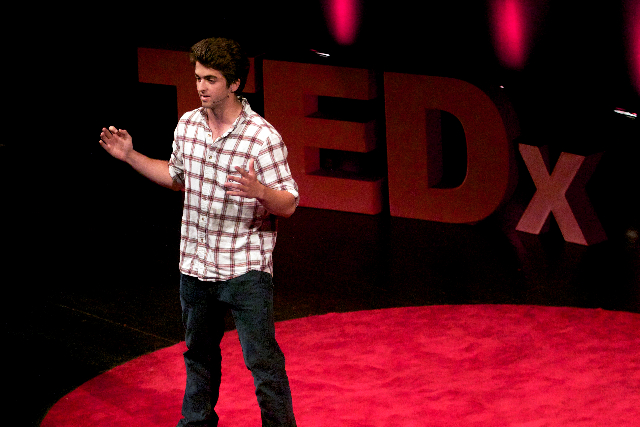
First-year Harley Litzelman, who is double majoring in American studies and sociology and minoring in education as well as working as a legislative aid for the ASUCD Lobby Corps, was chosen to be this year’s student speaker at the annual TEDxUCDavis event.

TED, an online video nonprofit that aims to spread ideas, is not directly involved with managing TEDxUCDavis. Instead, a small group of students were responsible for setting up the event, only needing to get a stamp of approval from the TED company.

This year’s event, themed “Pause or Press Play,” was held on May 4 at the Mondavi Center featuring talks from 10 speakers, each lasting about 20 minutes.

“We feel sometimes you need to pause and have further consideration. Then there are times you just need to get it over with and just do it,” said Cory Warshaw, who is a recent graduate from UC Davis with a degree in biology and the curator of the event. “We take our theme as a real question. We don’t think that you need to press play or pause all the time.”

Warshaw said that they decided to go with the Pause or Press Play theme because they felt it was a more earnest idea than more traditional conference themes like inspiration and innovation.

However, inspiration and innovation were not absent from the talks. Danny Nou, the ergonomics program administrator at UC Davis, talked about the design of user-friendly interfaces and products. Dr. Richard Pan, a pediatrician and educator who currently serves on the California State Assembly, advocated for a new health care system.

Perhaps one of the most well-received speakers at this year’s event was student speaker Litzelman, who went into detail about his critiques of the current educational system.

“For 13 years of education, and then college, our first and longest exposure to a public institution is tyranny, fear and obedience,” Litzelman said. “Then we come out of that and we are supposed to be democratic citizens and understand checks and balances.”

His piece is titled “A Case for Student Citizenship,” and the gist of his talk was that the core of a democratic society is the participation of all its members. He said that the first exposure that many children get to society is through the school system. He believes that while students are attending school, they are encouraged to curb their opinions and remain submissive. In the future, he hopes that schools will become places where students’ voices are valued, better reflecting the values of democracy.

Apparently this topic of student citizenship is one that Litzelman has been chewing over for a while. While he was writing as a columnist and later as an editor of his high school’s newspaper, it was an issue that he delved into frequently.

“Almost every editorial tangentially involved this idea that students aren’t involved,” Litzelman said.

Because of this, he said that the topic of student citizenship seemed like the natural option for his TED talk. However, various students have expressed surprise that a freshman landed the role.

According to Sonam Mahawar, who is the head of the Speaker Selection Committee and a third-year economics and sociology double major, the selection process is a long one.

“Our whole team was sort of involved in selecting Harley as our final speaker,” Mahawar said.

First, students were asked to submit a one to two-minute video. According to Mahawar, they received about 15 submissions this year. Then the pool was narrowed down to four students. Those four then had an additional audition before the pool was narrowed down to two people. The final two students were asked to give five-minute versions of their talk and from there the committee made its final selection.

“We select the person who has the best idea and the best presentation,” Warshaw said. “We weren’t aware Harley was a freshman. He had the best idea, so we chose him.”

According to Mahawar, the reason they include a student speaker in their event is because they want to represent the diverse variety of the Davis community. While the majority of the other speakers are already distinguished in their fields, he said that a student speaker allows for the audience, consisting of a great number of students, to see that they don’t have to be accomplished in a field to have a great idea.

“Though Harley doesn’t fit into that category,” Mahawar said. “He’s already a lobbyist. He’s already really accomplished.”

The primary trait that they look for in speakers, including in non-student speakers, is passion. Warshaw said since most of the audience members are being introduced to a topic for the first time, passionate presenters are a must. Infectious passion encourages the audience to pay attention and be just as interested in a topic.

“Yes, we are looking for ideas worth spreading and yes, we are looking for great innovations,” Warshaw said. “We need people who can convey their passion for a project.”

Though the next TEDxUCDavis event is still some ways away, they hope that more people will apply for the student speaker position.

“Not all the UCs have a TEDx organization,” Mahawar said.“It would be nice to have more people submit applications just because it is such a great opportunity.”

LEYLA KAPLAN can be reached at features@theaggie.org.

Photo by Katie Lin

Nevada rallies past Aggies for 6-5 victory

0

With two runs scored in the bottom of the 10th inning, Nevada defeated UC Davis, 6-5, on May 6 at Peccole Park. After this loss, the Aggies fell to 19-25 on the year, while Nevada improved to a 20-25 overall record.

It was the second time the Aggies played against the Wolf Pack this season. Last time, UC Davis hosted Nevada and posted a come-from-behind 4-3 victory.

In the May 6 matchup, the Aggies started off strong, scoring two runs in the second inning on three hits including a pair of doubles to gain an early 2-0 lead.

The Wolf Pack scored a run, bringing the score to 2-1, when Kewby Meyer doubled with two down in third inning and scored on Austin Byler. In the fifth inning, Nevada’s Byler and Jordan Devencenzi each hit a solo home run to put the Wolf Pack on top, 3-2.

Both teams were held without runs in the sixth and seventh innings. However, in the top of the eighth inning, UC Davis junior Tino Lipson scored on a wild patch and senior Adam Young added another run. With a pair of runs, UC Davis regained the lead, 4-3. However, Nevada scored in the bottom of the eighth on Byler’s RBI single to tie the game at four.

The ninth inning saw both teams failing to bring home the winning run, which set up an exciting 10th inning. The Aggies first scored on a go-ahead run in the top of the 10th to take a 5-4 advantage. Young was hit by pitch to start the inning and junior Kevin Barker walked. After a strike out, junior Nick Lynch was hit by pitch to load the bases. A ground out off of the bat of junior Austin March helped the Aggies drive home a run and head into the bottom of the inning with a 5-4 lead.

The Wolf Pack’s reserve outfielder TJ Friedl got a rally started with a double to right field. He was eventually driven in by a sacrifice fly from Byler, which tied the game at 5-5.

Later in the bottom of the 10th, an error and a single loaded the bases and put Meyer at third. With Jordan Dunatov at the plate, Meyer scored on a wild pitch to give Nevada a 6-5 victory.

With this loss, the Aggies suffered their sixth loss in their seventh trip to Reno. UC Davis will continue its road trip and play against Gonzaga University for a three-game series.

JANET ZENG can be reached at sports@theaggie.org.

Senior Matt Hansen rounds out successful Aggie career

0

Senior men’s golfer Matt Hansen was determined to finish his time at UC Davis with a bang after four great years of play.

The last few weeks have not disappointed as Hansen won two straight tournaments, earned a spot on the All-Big West First Team and led his team to a NCAA tournament bid.

Hansen came to UC Davis in 2010, spurning hometown Cal Poly in favor of becoming an Aggie.

“I think the golf team was ranked in the top 30 in the nation [when he committed], and then the education [was another factor],” said Hansen regarding his selection of UC Davis.

Hansen opened up his Aggie career with a phenomenal freshman year, winning Big West Freshman of the Year honors before dominating the field for a victory in the Regional round of the NCAA tournament.

“It was pretty special,” Hansen said of his first year. “I was told by a lot of people that you want to go somewhere where you can play for all four years.”

Hansen believed that UC Davis was a premier option for him to gain experience and playing time right away as a freshman. This opportunity was something which Hansen could not pass up and was a deciding factor in his decision to play at UC Davis.

Nothing changed over the next two years, as Hansen continued to rack up awards, being named to the All-Big West Second Team for two straight years. Still, a regular season tournament victory eluded Hansen for his first three collegiate years. That goal was finally achieved in the last regular season tournament of his career, fittingly on the Aggies’ home course.

After dominating the Big West Championships, finishing five strokes ahead of the second place finisher, Hansen is looking forward to another chance in the NCAA tournament. With all of the momentum in his favor from the last two tournaments, Hansen is in pretty good shape.

Matt Hansen will be moving on from UC Davis after the NCAA tournament. Still, he hopes to represent UC Davis as a pro.

“I’m going to be pursuing professional golf,” Hansen said. “I’ll be turning pro in August, playing the amateur schedule and travel[ing] to four or five tournaments over the country in preparation for starting [qualifying school] and start the process there.”

Entering the professional ranks is something that Hansen has aspired to since childhood and will be a dream come true. Given all of the success that Hansen has enjoyed at UC Davis, expect to continue seeing his name in the news at the next level.

RYAN REED can be reached at sports@theaggie.org.

UC Davis softball splits in midweek matchup

0

After falling in their first two games versus Cal State Fullerton in a doubleheader on May 3, the UC Davis softball team answered back and defeated the always solid Titans in a 9-6 victory on May 4.

Hoping to use that momentum, the Aggies took on Saint Mary’s in a midweek doubleheader matchup on May 7. Coming into the games, the Gaels sat at 15-27 overall as the Aggies held an 18-31 record on the year.

The first game in the non-conference match went in UC Davis‘ favor, as they took down Saint Mary’s, 3-2. Several players stood out in that first game on the day.

Establishing herself as one of the top hurlers for the Aggies, freshman standout Dana Cruse went six innings giving up only two hits and two earned runs. She recorded four walks and four strikeouts, leading the Aggies to the victory. Sophomore Leah Munden then came into the game to close it out, giving up no hits and no walks, throwing a clean inning, facing a mere three batters. This marked a league-high third save for Munden this 2014 season.

Offensively, the Aggies were slow out of the gates in game one as the game went scoreless until the second half of the fifth inning. But back-to-back doubles from freshman Brianna Warner and junior Amy Nunez in the fifth finally woke up the team’s bats. Singles from sophomore Christina Guidry and sophomore Kelly Zboralske also contributed to the team’s three runs scored in the fifth. The Gaels could not answer back, as UC Davis cruised to their first win of the day.

Unfortunately, game two did not go in the Aggies’ favor, as the Gaels took the win, 2-1. In a close match, Saint Mary’s came out on top, scoring two runs to Davis’ one. Munden started the game, throwing two and two thirds innings, giving up four hits and two earned runs and ultimately taking the loss.

However, on a more positive note, freshman Andrea Reynolds came in relief of Munden, and threw four and one thirds innings, giving up only one hit and no earned runs with one base on balls.

Overall the two games were close and well-played and the Aggies should be satisfied with their midweek split. Next up for UC Davis is Hawai’i.

The Aggies will face the Rainbow Warriors at La Rue Field in Davis, Calif. on May 9 and May 10. These games mark the final conference games for the team, and the last regular season games for the Aggies as well. A sweep this weekend will be essential if the team looks to finish their season on a high note.

SLOAN BOETTCHER can be reached at sports@theaggie.org.

Photo by Bijan Agahi.

Coffee cooperative fights for small farmers

A great cup of coffee is more than your morning caffeine fix. At Pachamama Coffee Cooperative, a great cup means a high-quality drink sold directly from producer to consumer.

Pachamama Coffee Cooperative (Pachamama) occupies the corner of First and E streets in downtown Davis, and to the unsuspecting consumer seems like a typical college town coffee shop. A friendly barista, complete coffee menu and great patio complete the image.

What Pachamama’s customers may not initially realize is that by purchasing that cup of Guatemalan drip coffee instead of their usual Starbucks Americano, they’re voting for social change.

Pachamama Coffee Cooperative is owned by over 140,000 farmers in five different countries: Ethiopia, Peru, Guatemala, Nicaragua and Mexico. Pachamama is the only company in the United States that’s 100 percent owned by coffee farmers, said Thaleon Tremain, the general manager of Pachamama.

That means that the profits made from Pachamama coffee go directly back to the farmers themselves, because they’re the ones selling it. Many similarly advertised companies have a middle man that skims the profit and gives only the wholesale prices to producers.

For instance, ‘fair trade’ coffee may be sold by farmers for $2 a pound to someone who turns around and marks it up to $16 a pound, ending with a tidy $14 profit margin.

By giving the farmers direct access to coffee sales, instead of making only $2 a pound for their coffee they’re able to sell it for three to four dollars a cup at coffee shops, which equates to more than $60 for a pound of coffee.

Across the board, consumers are looking for higher quality coffee, and the coffee engineering class offered by UC Davis is proof of that fact. But the point that many people miss is that you can’t make high quality coffee without high quality beans. Sure, Tremain mentions, you need a good barista and a good roaster as well, but it all starts with the beans.

In Ethiopia, one of the countries that Pachamama’s coffee is grown in, farmers are still growing beans like they did 3,000 years ago, said Stanley Kuehn, the regional director of the Latin American and Caribbean National Cooperative Business Association who works to promote Pachamama and other similar Co-Op businesses.

This old-fashioned growing technique means that coffee plants aren’t pounded with synthetic chemicals, and growers don’t become rich overnight by using seeds that produce ‘Cadillac’ crops in one cycle. The result is better tasting, higher quality beans that become more than a scalding shot of caffeine, according to Tremain.

These Co-Op farmers can’t grow the high quality coffee that consumers have grown to expect if they’re not supported and paid fair prices for their product.

Coffee rust fungus has destroyed coffee plants worldwide and put strain on small farms, forcing them to close. Alexa Marin, a farmer from Nicaragua, lost 90 percent of her normal production this year due to the fungus. Across the board, coffee production in Nicaragua is down by 40 percent.

Marin is optimistic about replanting, however she said that other farmers who experienced similar devastation are being forced out of their homes because they don’t have the means to recover.

In order to move forward, Marin has to change coffee varieties and improve her growing practices to keep the problem from repeating itself. It’s a serious reinvestment in her plantation that she’s only able to make because of the financial stability that her involvement in the Pachamama Co-Op has given her.

“It’s not charity, it’s an investment. They care because they built it and paid for it. It’s not cheap or easy for them, but that’s why it works, they have skin in the game,” Tremain said of the farmers that make up the Pachamama Co-Op.

In the indigenous language of Central and South America, Quechua, “Pachamama” means Mother Earth. A common phrase used in these areas is “Salud la Pachamama.” It means to share with Mother Earth so that she continues to produce for you.

During the month of May, a small percentage of Pachamama’s sales will go back to preventing cervical cancer in local Nicaraguan communities by bringing mobile examination equipment directly to women. According to Marin, this is a simple, cost effective strategy that will pay huge dividends for the health of these communities.

Marin says that this Co-Op is the best alternative for small farmers.

“It gives small producers the ability to improve their incomes,” Marin said. “It improves the quality of the coffee and the quality life. Small Co-Ops have always been marginalized by bigger estate farms, but this is a way to dignify the work that we do.”

TAYLOR CUNNINGHAM can be reached at features@theaggie.org.

Photos by Katie Lin.

Senate Resolution #20 fails at senate with 5-5-3 vote

At 2 a.m. on May 9 at Freeborn Hall, ASUCD senate failed to pass Senate Resolution (SR) #20 with a 5-5-3 vote. ASUCD Senators Mariah Watson, Nicholas Sanchez, Robyn Huey, Azka Fayyaz and Shehzad Lokhandwalla voted yes. ASUCD Senators Jonathan Mitchell, Eugenia Chung, Amelia Helland, Katherine Sherman and Artem Senchev voted no. ASUCD Senators Gareth Smythe and Janesh Gupta abstained. The initial vote was 5-5-2.

According to ASUCD Court Case 13 Hoskinson v. Bloom, “The ASUCD Vice President shall act as the presiding officer over all Senate meetings, but shall have no voted [sic], unless the Senate be equally divided [(same number of affirmative votes as any combination of negative votes and/or abstentions).].” ASUCD Vice President Maxwell Kappes voted abstain to make the final vote 5-5-3.

The UC Davis Divest Twitter account tweeted out that they aim to put the resolution on a ballot.

More updates on SR #20 are to follow.

— Claire Tan and Paayal Zaveri

— Photo by Brian Nguyen


Arts Week: May 8, 2014

Music

Ross Hammond
May 14, 6.30 p.m., free
The Corin Courtyard
Jazz guitarist Ross Hammond’s 11th and most recent album, Cathedrals, was released in June 2013.

Finish Ticket
May 10, 7.30 p.m., free
West Village Apartments
See indie pop rock group from San Francisco, Finish Ticket. The band was recently signed to Atlantic Records.

Literature and Poetry

The Poetry Night Reading Series presents Joe Wenderoth
May 8, 8 p.m., free
Celeste Turner Wright Hall
Joe Wenderoth will be reading from his new book of poetry, If I Don’t Breathe How Do I Sleep (2014).

Celeste Turner reading featuring Elizabeth McCracken
May 15, 7.30 p.m., free
126 Voorhies Hall
Elizabeth McCracken, National Book Award Finalist and author of the newly published Thunderstruck and Other Stories, will be the Celeste Turner reader this year. There will be a book signing after the reading. The event is sponsored by Creative Writing Program Reading Series.

Art

Dumpstir Dive: A First Year MFA Art Show
Reception: May 9, 6 p.m., free
The Pence Gallery
The UC Davis Master of Fine Arts First Year student exhibit returns to The Pence Gallery. New work in photography, painting, sculpture and printmaking by seven MFA students at UC Davis.

Theater

Seussical the Musical
May 9, 8 p.m., $12 general admission/$10 student/$5 under 10.
UC Davis Wyatt Pavilion Theater
Studio 301′s Spring musical brings Dr. Seuss characters to life.

Dead Arts Society DAStravaganza
May 9-10, free
Wright Hall Lab A
Dead Arts Society members will be grouped into teams and given 24 hours to write and rehearse a scene. Finished scenes will be performed and judged in Wright Hall.

Finish Ticket to play free show at West Village

On May 10, Finish Ticket will be performing at UC Davis West Village. The free show begins at 7:30 p.m. The San Francisco-based band has been storming the West Coast and recently signed to Atlantic Records. Finish Ticket was started by twins Brendan and Michael Hoye and their friend Alex DiDonato. In 2012, brothers Gabe and Nick Stein joined. In a phone interview, MUSE caught up with Brendan and Michael Hoye to find out about their success.

MUSE: How does it feel to be signed to Atlantic Records?

Brendan: It’s cool. It didn’t ever sink in the way you expect it to. There were months of figuring it out and that night it felt really good.

Michael: What we’re noticing now is it’s really cool to have so many people on our team. We’re [active] on social media and now we have a graphics department. We can get everything done really fast. Before, it would take us a week and we’d have to track down a freshman to get our posters done. We are a lot more efficient now; a whole new door of connections has opened.

Your album Tears You Apart will be re-released on May 20. What changes have you made?

B: The digital will come out on the 19th [May]. There were a few changes. We recorded one of the later tracks “Bring the Rain.” That’s one we never played live before but we recorded and it became our strongest live song. It just felt wrong and we wished we could change it. We’re a lot happier with it. We re-recorded another song that Gabe has been on. There was a track that he really wanted to drum on, “Catch You On My Way Out.”

M: We got the whole record mastered by Ted Jensen; he did Green Day and all of our favorite records when we were growing up. He’s done everything, so much stuff, it’s crazy. We were all like, ha, sure, then we actually realized he could remaster it [Tears You Apart] and it all worked out.

Where did you film the video for In “The Summer”?

M: I sort of compiled random footage that we had from hanging out on the road. It’s more of a compilation of a few years. It took a really long time to track down some of those videos. A lot of the footage was from these video projects that we filmed and never finished.

You’re playing at Amoeba Records to coincide with the release. What’s the most recent album you’ve bought?

B: Yesterday I went with my girlfriend and got the new Lykke Li, which is an amazing album. I’m in Berkeley a lot so I go there whenever I have some cash and have a look around. One of the first times we went to LA as a band, we drove to LA and we couldn’t afford a hotel. To kill a few hours we hung out there [Amoeba Records] but we couldn’t buy anything because we were broke but it was fun. So being in a record store kept us motivated. Back in the day, we saw a few bands perform there; that was really cool to go see.

What’s been your favorite moment of your tour with The Kin?

B: We got to play The Bowery Ballroom in New York City, a fairly historic venue, The Strokes played there. That’s one of the key places to play in New York City. We got to play there again recently; we just did a little two week tour with The Mowgli’s, that was a lot of fun. We went into it knowing The Mowgli’s and we also got to play with Misterwives. Their record could be one of the best I’ve heard in a while. So playing The Bowery Ballroom twice was just amazing.

How would you describe your own style of music?

B: We used to say indie pop but everyone says it now so I feel like it’s got a negative connotation. We consider ourselves alt rock. We have a big emphasis on melody and on song meaning as well. Throughout our music there’s no particular emphasis on one particular style. We like it to be interesting.

What’s the story behind your name?

B: It’s some old inside joke we had as teenagers and we never really revealed the meaning. It was never intended to get that far out. We didn’t really realize we’d be stuck with it.

M: Yeah, some of the members involved in the original inside joke aren’t even in the band anymore.

Have you played in Davis before?

M: Yeah actually, I went to UC Davis for two years and we played a lot of places. We went there the same week as the Whole Earth Festival last year. So we love Davis. We’re pretty excited that the show we’re doing on May 10 is outside too.

You can see Finish Ticket on stage at UC Davis West Village on May 10. The free show begins at 7:30 p.m.


UC Davis celebrates 45th annual La Raza Cultural Days

From April 28 to May 3, UC Davis celebrated the 45th annual La Raza Cultural Days, which showcased a variety of events hosted by the Cross Cultural Center (CCC).

A few of these events included Dreamers Workshop, in which UC Davis and high school students performed spoken-word poems and spoke about the struggles faced by undocumented immigrants, and La Gran Tardeada, an all-day event on May 3 with live music, food, activities for children and a health fair.

Another one of the events was Women of Color Poetry Night, which was held at the Student Community Center Multipurpose Room on April 29. During the event, students shared and recited a wide range of poems in both English and Spanish.

Iliana Rodriguez, a fifth-year biological sciences major with an emphasis in neurology, physiology and biology, felt that this event allowed students to break out of their comfort zone.

“My favorite part is hearing the poems,” Rodriguez said. “You just hear all these poems that are so beautiful and you get inspired. It’s really neat to see the poems that touch someone and the reasoning behind it.”

According to Rodriguez, the whole week is designed to provide underrepresented students with a voice.

“I feel like there are a lot of minority groups here on campus that go unrecognized,” Rodriguez said. “This week is our turn to be recognized here on campus for being part of UC Davis and making up some percentage of it.”

Doris Hernandez-Morales, a UC Davis alumna, said that La Raza Cultural Days is a celebration that creates a sense of unity.

“This is our time for Chicano/Latinos for a whole week to do different programs,” Hernandez-Morales said. “There are so many students when you go to school all the time, and you don’t see that Chicanos and Latinos together, and this is when everyone comes together — a lot of professors, staff and students.”

Luis Corrales, a second-year English and psychology double major and Chicana/o studies minor, is a community relations intern of the Chicana/o Department, a member of Movimiento Estudianil Chican@ de Aztlán, Scholars Promoting Education Awareness and Knowledge and Yik’al Kuyum at the Student Recruitment and Retention Center. Corrales helped put together the Chicano Symposium event, which emphasized contemporary issues, especially feminism, within the community.

Corrales found that in the end, despite a few difficulties that came up, being one of the planners and participants proved to be very rewarding.

“It was really nice to see that my hard work paid off,” Corrales said. “I loved the lectures and the people that presented because they seemed so knowledgeable and passionate about the subject. They really got into it and the students were really interactive.”

According to Corrales, being a part of La Raza Cultural Days gave the opportunity to grow as an individual.

“The most difficult part [behind planning the event] was breaking my silence and being an open person by talking to the community and putting my face out there,” Corrales said. “It was a big learning process.”

Although La Raza Cultural Days only lasts a week, the coordinators begin their planning way in advance, and a lot of time and effort is involved in making sure things run smoothly.

Mayra Tostada, a fourth-yearhuman development and Chicana/o studies major and education minor and co-coordinator of La Raza Cultural Days, said that there is a lot of behind-the-scenes work involved in bringing the programs to life, but she finds the process exciting.

“For our cultural days, we have a meeting every Friday since the beginning of the year,” Tostada said. “We take time to get to know each other as a committee and we have representatives of each organization within the ChiLat community.”

According to Tostada, the possibilities are endless when students put themselves out there throughout the week and embrace whichever culture they belong to.

“By attending these events, students can take away knowledge, and above all, cultural awareness,” Tostada said. “I want to encourage people to get involved. Even if they’re not in organization from the ChiLat community, everyone is welcome to our committee meetings and welcome to put on an event throughout the week. There are a lot of opportunities to build leadership and event-planning skills.”

JASMINE MANGABAY can be reached at campus@theaggie.org.