55.5 F
Davis

Davis, California

Wednesday, December 24, 2025
Home Blog Page 856

Aggies continue free-fall against UC Irvine

0

After the UC Davis baseball team broke a four-game losing streak with win over Saint Mary’s on April 22, the team seemed poised to emerge out of its midseason funk. However, the Aggies’ tailspin picked up right where it left off before the Saint Mary’s game, as they were swept by first-place UC Irvine on April 26 and April 27. The Aggies have now lost seven of eight, and they have won just three times in their last 14 games.

The UC Davis weekend MVP was the weather, which caused the April 25 series opener to be rained out. The teams then played a doubleheader on April 26.

UC Davis (17-23, 3-12 Big West) was actually set to win the morning game, as senior Harry Stanwyck pitched a gem. The right-hander allowed just four hits and an earned run over eight dominant innings, striking out six. He retired the first 11 batters he faced, and he left the game in the ninth with a runner on and the Aggies up 2-0. However, UC Irvine (28-14, 11-1) rallied off closer Zach Stone, sending seven batters to the plate and scoring four. The Aggies lost 4-2.

In the nightcap, UC Davis was once again doomed by its bullpen, falling 4-1 on three late runs. Aggie starter Spencer Koopmans tossed six innings of three-hit ball, and the junior righty allowed only an unearned run. Junior Raul Jacobson, who came in relief of Koopmans, allowed three earned runs in two and one-third innings of work on five hits. All three runs came in the eighth and ninth innings. Junior Nick Lynch led UC Davis with two hits on the game.

On April 27, UC Davis once more received an incredible performance by its starter and once again couldn’t get anything going offensively to pull out a win. Senior right-hander Evan Wolf threw his first career complete game, but he was doomed by a bloop single with the bases loaded in the top of the ninth, and the Aggies fell 3-1, completing the three-game sweep for the Anteaters. Wolf was dominant all day, allowing just five hits and efficiently managing his pitch count. The loss dropped Wolf to 3-4 on the season. The UC Davis offense continued to struggle at the plate, getting just six runners on base.

UC Davis, tied for last place in the Big West, should have an opportunity to get off the schneid and pick up a win or two over Cal State Northridge, who is just 4-8 in conference play and 15-28 overall. The teams will meet in Northridge, Calif. from May 2 to May 4.

SCOTT DRESSER can be reached at sports@theaggie.org.

Photos by Shazib Haq.
UC Davis falls to UC Santa Barbara in Big West Quarterfinals

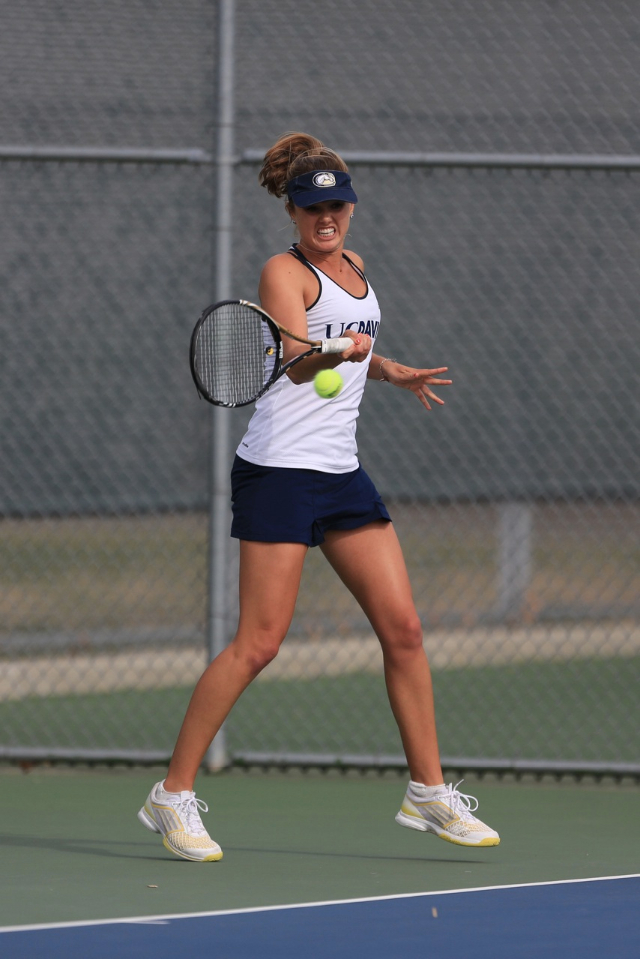
By finishing fourth in the conference standings, UC Davis was slotted to face the fifth-seeded UC Santa Barbara in its opening matches at the Big West women’s tennis championship on April 25. The Gauchos started off strong and recorded three straight sets to post a 4-0 victory over the Aggies.

It was the second time in recent history that UC Davis faced UC Santa Barbara at Indian Wells in quarterfinals; in the 2010 tournament, the Gauchos defeated the Aggies by the score of 4-1. This time, much like the last time the two teams faced off, UC Santa Barbara once again was victorious against UC Davis.

UC Santa Barbara set the tone early into the game. In the first doubles match, the Gauchos posted a lopsided 8-1 victory over the pairing of freshman Samantha Martino and sophomore Tiffany Pham. Although down 4-1 in their second doubles game, the Aggies rallied back from the early deficit. The duo of seniors Megan Heneghan and Melissa Kobayakawa defeated the Gaucho’s pair of Priscilla Garcia and Jaimee Gilbertson, 8-7.

The final doubles match was also intensesly contested. However, the Gauchos eventually secured an 8-7 win and gained a 1-0 lead in team points.

UC Santa Barbara continued its momentum in the singles matches. Garcia won over freshman Kamila Kecki in straight set, 6-3, 6-2. This was followed up with a victory by Stacy Yam over senior Nicole Koehly, 6-0, 6-3. And finally, in the last singles match, April Scatliffe for the Gauchos defeated junior Layla Sanders with the score of 6-1, 6-3. With the 4-0 defeat of UC Davis, UC Santa Barbara entered the semifinal rounds.

With this loss, the Aggies end the season with a 12-10 overall record.

The Big West tournament ended on April 27 and No. 1 seed Long Beach State claimed its 11th women’s tennis title with a 4-2 victory over No. 2 seed UC Irvine.

This season was filled with impressive victories, tough losses and injuries for the Aggies. Hopefully, they will be able to build off from this year and improve on this year’s results in the next season.

JANET ZENG can be reached at sports@theaggie.org.

UC Davis softball fails to halt Pacific’s hot bats

0

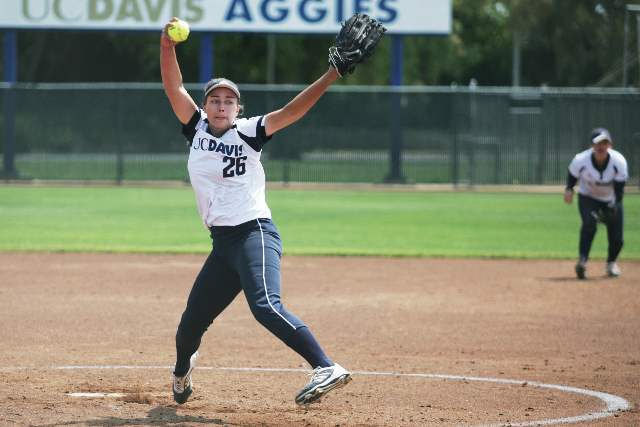
UC Davis softball took on Pacific in a mid-week non-conference game on April 23 in Stockton, Calif. Unfortunately, the results did not end in the Aggies’ favor. Although the athletes were able to post up a strong three-run third inning to tie the game at 3-3, it would not be enough as the Tigers answered back, and ended up on top with a 10-4 victory.

After falling in two of the past three Big West conference games versus UC Santa Barbara on April 18 and April 19, UC Davis looked to turn their luck around versus Pacific.  However, three errors for UC Davis and hot bats from Pacific made that a challenge for the Aggies.

Some positives can still be taken from the match-up. Several UC Davis players continued to display their skills out on the diamond. Sophomore shortstop Christa Castello went 2-for-4 with two runs scored, putting her season batting average at .279. Sophomore Cat Guidry also posted one hit on the day, along with one RBI and one run scored in four at-bats, putting her season average at .225.

Freshman Dana Cruse started on the mound for the Aggies, going three innings and giving up six hits on seven runs, only four of which, however, were earned. Following Cruse, freshman Andrea Reynolds came into the game to throw the final three innings, giving up five hits on three runs, again with only two being earned.

The loss versus the Tigers puts the Aggies’ overall record at 15-28. The athletes now must look ahead to their next series, as they come back to Davis, Calif. this weekend to face UC Riverside. They hope to snap a three-game losing streak, and come away with three victories versus the Highlanders. UC Davis is currently 4-8 in conference play, and with three wins this weekend they would put themselves closer to that .500 mark with the season quickly coming to a close.

SLOAN BOETTCHER can be reached at sports@theaggie.org.

Photos by Ciera Pasturel.

Hot pitching leads UC Davis to victory against Gaels

0

Coming off a rough week, which included losses to Sacramento State and a series sweep on the the road against UC Riverside, UC Davis snapped a four-game losing streak against the Saint Mary’s Gaels.

Redshirt sophomore, right-handed pitcher Max Corby (1-3, 4.80 ERA) pitched a gem for the UC Davis Aggies, striking out 11 of 26 batters faced. Corby only allowed one run and one hit throughout seven innings. Although Corby did not record the win, he led the Aggies to the win that broke a four-game losing streak.

Without two of their best hitters in the lineup, seniors Adam Young and Steven Patterson, UC Davis still managed to get on base early.

The Aggies threatened to score early in the first inning after junior Kevin Barker hit a line drive down the center field gap and sophomore Tanner Bily and redshirt junior Tino Lipson walked. UC Davis, however, failed to score with bases loaded as senior Spencer Brann grounded out the Gaels’ second baseman.

Saint Mary’s took a 1-0 lead off a double steal in the third inning, the Gaels’ Anthony Gonsolin stole second as the throw to second base by sophomore Spencer Henderson was late and Ian McLoughlin stole home.

The Aggies tied it all up in the sixth inning with a line drive to left field by senior catcher  Brann that brought in Bily home from second base. Brann extended his hitting streak to six games.

With the game tied at one apiece in the eighth inning, Saint Mary’s pitcher Jacob Valdez (1-4) hit Barker with a pitch, sending him to first base. Junior Nick Lynch bunted towards the first base line and moved Barker into second. With the winning run in scoring position, Bily hit a line drive through the right infield gap, allowing Barker to score.

Valdez was later relieved by Brad Neese, who struck out Lipson, while pinch-runner, junior John Williams stole second base. Brann hit a triple to deep right field and batted in Williams, who had advanced to third after a wild pitch, to expand the lead to 3-1.

The Aggies’ right-handed pitcher, redshirt junior Raul Jacobson recorded the win, improving his record to 4-0. True freshman Zach Stone earned his ninth save of the year. UC Davis improved to 17-20 overall after the win.

After struggling in his last outing against Sacramento State, Corby proved his ability to make adjustments and bounce back after a bad performance.

“This weekend I spent some time, looked at some video, tried to diagnose some problems and, you know, just looking for anything mechanically cause it’s not a mental problem, it’s just something mechanical,” Corby said.

The Aggies win the season series against the Gaels. The last time they went head-to-head, UC Davis won, 4-1, on April 2 in Davis, Calif. Prior to that win, the Gaels defeated the Aggies 5-1 on Feb. 20.

The Aggies return to conference play on April 25 at 2:30 p.m. as they face the UC Irvine Anteaters for a three-game series at the Dobbins Baseball Complex in Davis, Calif.

OSCAR DUENAS can be reached at sports@theaggie.org.

Photo by Ciera Pasturel.

Softball loses rubber match against Gauchos

0

The Aggies came into the weekend series against the UC Santa Barbara Gauchos with a bit of confidence. After two wins in the weekend series against Cal Poly over the April 12 to 13 weekend, UC Davis hoped to maintain its winning ways against the Gauchos.

However, the Gauchos were able to get an early start in the series, going up 2-0 by the third inning of the first game.

The Aggies would not accept defeat though, as they went off for a monstrous five-run fourth inning. The bottom of the fourth was led off by UC Davis’ junior first baseman Amy Nunez’s homer to right field, her third of the season. Right after, sophomore designated player Kelly Zboralske hit her sixth home run of the year to left center, tying the game at 2-2.

Zboralske continued to prove that she is the Aggies’ best offensive option. Her .317 batting average, six home runs and 21 RBI leads the team.

The power hitting of Nunez and Zboralske opened the floodgates and the Aggies pounced on the Gauchos’ pitching for three more runs, giving UC Davis a 5-2 lead. From there, the relief pitching combination of sophomore Leah Munden and freshman Andrea Reynolds pitched 2.2 innings of shutout baseball to seal the game.

Game two of the doubleheader was the complete opposite of game one. The Aggies quickly jumped out to an early 2-0 lead in the first inning. Zboralske once again came up big, hitting a single and driving in the two runs home.

UC Davis seemed to be set up for a high-scoring game after it scored those two runs in the first. However, this was not the case, as Gauchos pitcher Shelby Wisdom settled down and pitched six innings of shutout softball after the rough first inning.

Meanwhile, the Gauchos’ bats began to heat up and runs began to flow. The Aggies gave up three runs in the fourth inning, one run in the fifth inning and was battered for five runs in the sixth inning.

Munden, who pitched well in relief earlier in the day, struggled. She gave up five runs in four innings pitched, four of them earned. With the Aggies’ offense struggling to hit against Wisdom, who pitched a complete game, and the pitching staff bleeding runs, the Gauchos were able to cruise to an easy 9-2 win.

With the series tied up at 1-1, UC Davis headed into the rubber match on April 20 hoping to get yet another series victory against a conference opponent. Unfortunately, this was not meant to be, as the Gauchos squeezed out a tight 1-0 victory.

Both the pitchers for UC Santa Barbara and UC Davis were excellent. Wisdom once again pitched for the Gauchos and once again completed the game. This time however, she pitched a shutout as well.

Freshman Dana Cruse had one of her best pitching performances of the season. She went all seven innings and only gave up three hits. Unfortunately, this outstanding performance was not enough to give her the win.

In the top of the sixth inning, UC Santa Barbara’s Stacy Cavazos was hit by a pitch. She then proceeded to steal second and was bunted over to third by Kristen Clark. Arianna Palomares took a pitch by Cruse and drove it to center field, which allowed Cavazos to score off of the sacrifice fly. This put the Gauchos up, 1-0, where they would stay for the rest of the game.

After losing the series, the Aggies fell to 15-27 overall and 4-8 in the Big West conference. UC Davis will head to Stockton, Calif. to face off with the Pacific Tigers for a quick one-game matchup on April 23.

KENNETH LING can be reached at sports@theaggie.org.

Photo by Brian Nguyen.

UC Davis women’s tennis team enters Big West tournament

The UC Davis Aggies gained an early 1-0 lead against the San Jose State Spartans by winning two straight doubles matches on April 19. However, UC Davis was not able to keep up the torrid pace and the Spartans won four straight singles matches, defeating UC Davis 4-3 in their last game of the regular season.

The game started tough for the Aggies. They lost in their first doubles, 8-1, but soon they bounced back and took the other two doubles matches. This gave them a 1-0 lead in team points. In the last doubles, seniors Megan Heneghan and Melissa Kobayakawa defeated their counterparts, 8-6. This match was the last regular season doubles match for their college careers.

In singles matches, San Jose State’s Julianna Bacelar defeated senior Nicole Koehly in straight sets, 6-1, 6-1, and the Spartans tied the team points at 1-1. Freshman Kamila Kecki helped the Aggies regain their lead by beating her opponent in two sets, 6-2, 6-4, putting UC Davis up to 2-1 lead in team points.

However, the Aggies did not continue their good form in the next singles matches. Kobayakawa lost to San Jose State’s Sabastiani Leon Chao in a 6-3, 6-1 match. After losing the first set 6-1, junior Layla Sanders battled back, topping Gaelle Rey from the Spartans, 5-7, in the second set. But Sanders fell short to in the third set, 6-0, for the final match point.

With a 3-2 lead in team points, the Spartans played even better. By winning the match against sophomore Tiffany Pham, 6-4, 7-6 (7-3), Jessica Willet helped the Spartans gain a 4-2 lead and earned the official decision. Although she fell short in the second set of the match, Heneghan bounced back and won the last match of the day for UC Davis. The final score in team points saw the Spartans come away with a 4-3 victory.

Although the Aggies lost the game, they enter next week’s Big West tournament with a 12-9 overall record and 4-3 record in conference play. The Spartans end their season with an 11-13 record on the season.

The women’s tennis team finished its regular season with two consecutive losses, but UC Davis’ head coach Bill Maze trusts his team to rebound.

“I think we have a chance to make it to the end,” coach Maze said.

On April 24, UC Davis will have its first game of the tournament in Indian Wells, Calif. Since there is one league match that remains, the Aggies’ opponent in the tournament is still unknown.

JANET ZENG can be reached at sports@theaggie.org.

Courtesy photo.

For better or for worse, couples directly influence each other’s dietary lifestyles

It’s often hard to say no to one more chip, one more cookie or whatever your guilty food pleasure might be. Ninety percent of U.S. adults have a poor lifestyle due to smoking, lack of exercise, lack of maintaining a healthy weight and a poor diet. Dr. Thomas Bradbury, a psychology professor and co-director of the Relationship Institute at UCLA, shed some important insights on effective ways of communicating with our partners in order to have positive impacts on each other.

Bradbury and his research team interviewed and analyzed conversation recordings between 1,000 newlywed couples who expressed a desire to lose weight and exercise more. The research revealed that when couples genuinely tried to have discussions with each other about losing weight, the conversations went astray.

“A reason why conversations oftentimes go awry is because when one partner recognizes that it is time to make a change, the other partner can feel threatened,” Bradbury said in an email.

They discovered that the most common reasons for the couples’ lack of effort and motivation to get healthy were long commutes, demanding jobs, caring for children, and for some, caring for older parents.

The couples had difficulty effectively communicating with each other, due to the fact that weight and one’s appearance are delicate topics. This in turn, made it difficult to address the issue of whether or not they still found each other attractive. For instance, if you tell your partner that they look incredible the way they are, they may actually use that as an excuse to continue on the path of negative habits, such as not exercising and eating right.

“Knowing how to respond when our partner raises a health concern is a real skill, and often it involves waiting until the partner brings it up as a concern, and then asking a sensitive question to keep the conversation moving forward,” Bradbury said.

As social beings, we have the tendency to naturally imitate things that are in our surrounding environment. For instance, we tend to eat just as much food as the very people around us.

 “I have interviewed many couples in which one partner became a vegetarian after they started dating, because the other person was a vegetarian. This goes in the opposite direction too: if my partner drinks or does unhealthy things, I will tend to adopt that habit too,” Bradbury said.

Luckily, Bradbury’s research found that couples can take advantage of many strategies to encourage a healthier lifestyle. For example, to ensure that their partner gets exercise, the other partner can volunteer to do some chores. Another way is to make sure that healthy foods are readily available in the home.

According to Dr. Liz Applegate, a senior lecturer in the Department of Nutrition and director of Sports Nutrition for the Intercollegiate Athletics at UC Davis, individual change is often enough to spark change within our partners.

“Oftentimes we make too big of a commitment. Just start out with a change. For example, you can tell yourself that you’re going to walk at least once during your lunch break this week and then meet that goal. When done for six to eight weeks, these small changes become habits,” Applegate said.

Applegate recognizes that trying to change our health habits is often times indeed challenging, but we must motivate ourselves to ensure a healthier lifestyle.

“My research has found that not a lot of adults are going in for check-ups. Just like your car needs to be checked after every 20,000 miles, your body needs a check-up as well,” Applegate said.

Written in hopes to improve communication strategies between couples, Bradbury is also the co-author of the book “Love Me Slender: How Smart Couples Team Up to Lose Weight, Exercise More, and Stay Healthy Together.” You can also visit his YouTube channel for more information.

JASBIR KAUR can be reached at science@theaggie.org.


Modern Bey Feminism: Does pretty hurt feminism?

0
Hannah Strumwasser
Hannah Strumwasser

In 2012, People Magazine announced that Beyoncé was the “Most Beautiful Woman In the World.”

As a feminist, I would argue that women should not be judged on what they look like, and thus should not worry about society’s (or People Magazine’s) beauty standards. But this is all much easier said than done, especially when Beyoncé’s flawless face is staring at you in the grocery store.

In her latest album, Beyoncé examines the idea of beauty and how it is formed and encouraged by the society we live in, specifically in her song “Pretty Hurts.” The music video shows Beyoncé as a pageant contestant, preparing for the competition, picking out outfits, throwing up in the bathroom and then losing the pageant. The video is a clear criticism of the beauty ideals that our society encourages women to strive for. Beyoncé sings, “We try to fix something but you can’t fix what you can’t see/ It’s the soul that needs the surgery.”

While Beyoncé criticizes this form of beauty, I don’t think she is saying that beauty is bad. What she, I and feminism believe is that self-worth should not be based on the value that others place on your beauty.

Another one of her songs, “Flawless,” touches on the idea that women should embrace the way they look, as Beyoncé claims “I woke up like this.” This song gives women the power to love themselves for who they are, and feel confident with the way they look naturally, because it emphasizes the idea that women don’t need to change to be beautiful.

While Beyoncé’s music and videos seem to promote the idea that women should find themselves beautiful, I would argue that Beyoncé also plays a part in the unrealistic beauty ideals that are transmitted to women through the media.

Her music videos are the epitome of glamour, and her makeup and wardrobe play a large part in her self-expression. In her documentary, she can be seen wearing hair curlers in the hospital bed right before she gives birth to her daughter.

With the advent of “selfie vehicles” — Facebook, Instagram, etc. — some have criticized Beyoncé for the pictures she shows to her fans. There is no way anyone looks that perfect all the time, but Beyoncé seems to suggest that it is possible.

While this dichotomy between singing about self-love and promoting unattainable ideals of beauty can be difficult to understand, I see the beauty aspect of feminism as just another choice that women should be allowed to make — makeup or no makeup, hair done or not, women should be able to choose what makes themselves feel beautiful, not forced by society to conform to them.

What if you slip up? Is it OK to shave your legs? What if you like putting on makeup?

I argue that none of that makes you any less of a feminist.

In the well-known feminist book The Beauty Myth, author Naomi Wolf asserts that “the enemy is not lipstick, but guilt itself; that we deserve lipstick, if we want it, and free speech; we deserve to be sexual and serious — or whatever we please; we we are entitled to wear cowboy boots to our own revolution.”

In her documentary, Beyoncé included many personal videos when she was at home, in bed or in front of the mirror, clearly wearing no makeup and truly being herself. The interview that is woven throughout the documentary with clips of her celebrity life features an all-natural Beyoncé, sitting on her couch with jeans, a T-shirt and minimal makeup.

Beyoncé is happy to embrace her natural beauty and encourage others to do the same, suggesting that you can be a powerful and successful women and blow-dry your hair. If you are aware of the pressure that society inflicts on women to be a certain kind of beautiful, you can make decisions regarding your appearance based on what makes YOU feel good, not what will get you on People’s list of the most beautiful women in the world.

Basically, if you choose to wear makeup or high heels, you should do it  because these things make you feel good and sexy and wonderful. Your motivation should not be based on the idea that blow-drying your hair makes you more beautiful. There are days when we style our bangs so we can face the day with a kick-ass attitude, and there are days when it feels just as good to let it air-dry, frizzies and all.

Just remember, ladies, we flawless. And if you want to wear nail polish sometimes to feel that way, that’s OK.

If you’re looking for someone to go to the Beyoncé/Jay-Z tour this summer, HANNAH STRUMWASSER can be reached at hstrumwasser@gmail.com. 

The Maturing Moviegoer: Growing Pains and American Beauty

0
Eli Flesch
Eli Flesch

Before Kevin Spacey was ruthless United States Congressman Frank Underwood, preying on girls half his age, he was Lester Burnham, a middle class American man — who also preyed on girls half his age.

“American Beauty” is a 1999 Best Picture film by Sam Mendes. It’s up there on my list of greatest movies ever made. This great piece of work instructs us to “look closer” into what gives ordinary lives meaning, and how we react to truths about ourselves and others. Such themes are persistent throughout life, but they hold a certain weight in youth.

Lester’s in the throes of a mid-life crisis. Morning masturbation sessions are the highlight of his days. He’s a man with a family, but that doesn’t make him a family man. His materialistic wife hates his guts, and his daughter thinks he’s a “lame-o.” It’s dysfunctional.

We’ll focus on the daughter, Jane. She’s an insecure girl who finds no anchor in her family. She turns to others in her life. But even these others betray her needs. When her best friend, Angela, becomes the object of Lester’s desire, she finds herself in the hands of the mysterious, wonderstruck Ricky Fitts. And finally, to tie the main cast together, we have Ricky’s father, Frank, a strict, abusive man who hates gay people more than Donald Sterling hates black people.

Jane’s insecurity stems from many reasons — a preoccupation with image, a struggle to embrace sexuality and the disconnect she experiences with her parents. In other words, she’s a teenager. In one of the most famous scenes of the movie, she and Ricky admire a video Ricky shot of a plastic bag being tossed and turned by the wind. Maybe it’s Ricky’s intoxicating voice, maybe it’s the haunting score, but this bag takes on a life of its own. In these moments, we find beauty in something mundane. Perhaps Jane’s own turns and tosses can be viewed similarly.

What would the consequences of our coming-of-age look like if we viewed our growing pains as something of beauty? It would be tough. Just as it’s tough to elicit emotion from watching a plastic bag in the wind. But it may be worth it. Who says there can’t be humors in angst? I fucking love wallowing in despair.

Okay, it’s more complicated than that. Out of all the characters, Ricky’s arc is very minor, only slightly dictated by Jane. He seems to have an understanding of these latent beauties of life. He has a whole library of video recording, with subjects ranging from strangers to dead animals. What a creep. Or at least that’s how society would judge him. In reality, he has a mature sensitivity that is to be admired. And while he sells marijuana to Lester, we do not see him as a drug dealer.

To transfigure pain into something of beauty would help young adults gain an appreciation for the process of aging. For many, this process is less growing up, and more leaving the past behind. Everyone feels some sense that childhood was simpler. Many may have a wish to revert to those hey-days.

These people seem to romanticize. Yeah, childhood was simpler, it was a time of near total dependence on authority figures. Food was put in front of you. Bills were paid on your behalf. But it wasn’t all daisies and lollipops. It was a lot of rules, follow this person and that person, do what you’re told. That kind of sucked if I recall.

Once a person recognizes this, it becomes easier to be an active participant in one’s current state. Now, you may think this is an argument that’s going to culminate in the old adage that you shouldn’t dwell in the past. I would disagree. You should be aware of how the past influences your development.

For Ricky, a past of military school and a father who beats him has left him wary but smart. He has a wisdom that is beyond his age. This leads us to the final truth that “American Beauty” illustrates so profoundly. The painful parts of our aging should not be shied away from.

If you ever find yourself bored in class, think about those dreary moments where nothing seemed like it was going your way. It will help you deal with the future when that inevitably comes. You probably have no idea what I’m talking about. Don’t worry. One day you will.

To understand that last reference, you can either watch the movie or reach ELI FLESCH at ekflesch@ucdavis.edu or tweet him @eliflesch.


UC Davis TAs break down reasons behind strikes

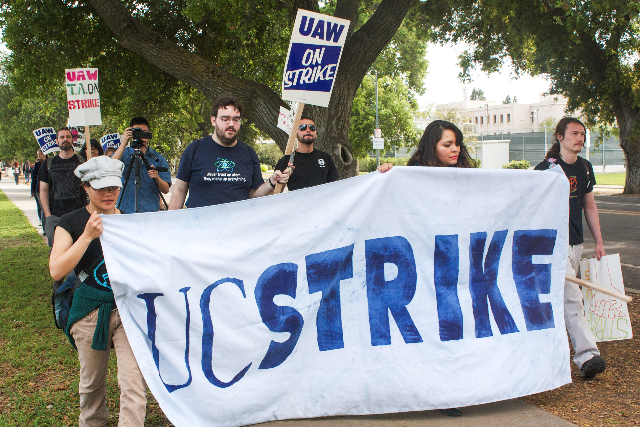
Dissatisfied, UC Davis teaching assistants (TAs) congregated near the corner of Russell Boulevard and Howard Way on April 3 to protest ongoing labor practices that the University of California (UC) system has yet to address.

Since June 2013, the members of the UC Student Workers Union (UAW 2865) have been bargaining with the UC over topics including, but not limited to, various intimidation tactics used by the University, larger classroom sizes and the limited number of quarters a graduate student is allowed to work as a TA.

“We struck in order to tell the University that they should not commit unfair labor practices, specifically when dealing with the unions,” said UAW 2865 UC Davis current unit chair Marco Rosales. “The University has been committing a few illegal practices such as intimidation, and we’re trying to express to the University that we’re not going to take that anymore.”

The strike took place on several UC campuses, and according to Rosales, various intimidation practices were used against the protestors during the strikes themselves, like filming, stating that the strike was illegal, arresting protesters at the Santa Cruz campus and threatening to take visas away from international students.

“That was one of the reasons why we went on strike,” Rosales said in response to the threat regarding international student visas. “That was a pretty plain form of intimidation that’s completely unethical.”

The issue of classroom size not only affects graduate students, but undergraduates as well.

“It’s about pedagogic authority,” said UAW 2865 UC Davis former unit chair Duane Wright. “When they are increasing class sizes that makes it so that the options of what we can do in the classroom become fewer and fewer. We can’t do as much interactive teaching. Even though we’re supposed to be these highly skilled workers, they’re limiting how we can exercise our pedagogical authority.”

According to Wright, most graduate students agree that class size has a lot to do with the quality of education. Depending on the department, class sizes can range from a somewhat manageable size of about 50 students to a considerably larger amount exceeding 100.

“What happens with larger classroom sizes is, we’re forced to make choices,” said second-year Ph.D. student in history Nathalie Collin. “Either we work ourselves into the ground and put in way more hours than we’re supposed to, which then affects our own work that’s supposed to be completed at a certain time, or we neglect the quality of the education that we’re giving our undergraduate students by [writing] ‘Nice Job, A’ on a paper, instead of giving detailed feedback.”

Fourth-year Ph.D. student in geography Bidita Tithi finds the larger classroom sizes to be especially difficult when grappling between the time she devotes to her students versus the time she devotes to her research.

“Now we have larger sections with more students, and that puts stress on the TAs’ jobs because we have to hold longer office hours,” Tithi said. “If we hold office hours for only one hour, then the students may be deprived. At the same time it’s more grating, it’s more time devoted to connecting with students. It creates a lot of stress.”

Another important issue for many graduate students is the limited funding the University provides.

“My research involves going to another country, I research Argentina,” Collin said. “I’m not going to get a Ph.D. in five years, it’s impossible. Depending on what you’re studying, it’s no surprise to take six, seven, eight, nine years. The University has this expectation of using us as labor essentially for however many quarters and if we don’t do everything plus the work they want us to do, we’re out. It’s a very tough position for us to be in.”

The University stops funding students after 18 quarters of work. If they are not finished with their research in the six years that are allotted, then they must find another way of funding their studies.

“I am an international student — I cannot legally work outside of UC Davis,” Tithi said. “This is basically the only way that I can fund my education and feed myself. So for me, that’s very problematic — there’s this limited number of quarters that I can work and it creates lot of stress.”

The time commitment requirement was another significant part of the protest. TAs usually have around a 20-hour per week commitment. However, this is not always the case with increasing class sizes and responsibilities.

“Three hours for lecture, two hours for section, two-hour office hours — that’s already seven hours out of the 20 that are burnt up on specific required tasks,” Collin said. “The other time in the week you have to spend doing the reading (which take a while) and then the assignments and grading vary. So that’s an issue — there’s no consistency for us.”

Recently, the UC Student Workers Union won two landmark decisions: safe bathroom access for people of all genders, including those who fall outside of the gender binary, and guaranteed lactation stations for graduate workers with children. Apart from these developments, there have not been any apparent decisions made on other issues.

“Every undergraduate that I’ve spoken to about this has been very supportive once they hear what’s going on,” Collin said. “I think it’s important for people to know the whole story. One of the big concerns of the graduate students is how this is also affecting [the undergrads], because most of us don’t feel we can give you the education that you are paying for — and that is a very big issue.”

ELLIE DIERKING can be reached at features@theaggie.org.

Photo by Misha Velasquez. 

UC Davis history professor wins Pulitzer Prize

0

UC Davis history professor Alan Taylor recently won the 2014 Pulitzer Prize in history for his book “The Internal Enemy: Slavery and War in Virginia: 1771-1832.”

The book explains why runaway slaves in this colonial time period felt motivated to help the British cause during the War of 1812. Hoping to be liberated, escaped slaves helped the British military as sailors and guides throughout the sea and country. In return for their aid, the slaves were granted freedom by the British.

“The novel is about how slavery changed in the wake of the American Revolution and the worsened conditions for enslaved people,” Taylor said. “The War of 1812 presented an opportunity for some to escape together by British warships and reunited families.”

Taylor’s inspiration for writing the book originated 12 years ago. While working on research for another project, Taylor discovered documents regarding how slaves helped the British gain Washington, D.C., during the War of 1812. In 2010, Taylor returned to these documents for further research.

Taylor says that the book proves that the U.S. was not as freedom-oriented as citizens would often like to believe.

“We usually think of the United States of being founded in freedom, but it’s not,” Taylor said.

Although this is Taylor’s second time winning the Pulitzer Prize, he still felt shocked when he received the award for his book.

“I felt surprised, pleased and gratified,” Taylor said.

Dean of Social Sciences George R. Mangun said that he too felt elated that Taylor won the prize.

“I was more than thrilled,” Mangun said. “This is a tremendous accomplishment. We were at least as stunned as he [Taylor] said he was.”

Mangun also believes that Taylor’s accomplishment shows the quality of faculty at UC Davis.

“It’s another of many, many examples of high quality faculty at UC Davis,” Mangun said. “It’s not really surprising considering our reputation and that we are one of the top universities. This is another example of what our faculty achieves and what it brings to the table.”

A teacher at UC Davis since 1994, Taylor has written many other books, including “William Cooper’s Town: Power and Persuasion on the Frontier of the Early American Republic,” which details the settling of Cooperstown, N.Y., as well as the lives of founder William Cooper and his son, author James Fenimore Cooper, who created fictionalized stories about Cooperstown. This book won Taylor his first Pulitzer Prize in 1996.

In August, Taylor will become chair of the Thomas Jefferson Memorial Foundation in the Corcoran Department of History at the University of Virginia.

ALYSSA VANDENBERG can be reached at campus@theaggie.org.

Courtesy photo.

UC Davis Model United Nations makes program history

0

The UC Davis Model United Nations (MUN) team returned from the UCLA MUN national conference, held from April 3 to April 6, with seven individually-won awards, the most Davis MUN has ever earned at an away conference.

MUN promotes debates and public speaking in its student-led organization, and conferences resemble the format of the United Nations.

“Our club is a great resource for anyone who wishes to become more informed in global news, advance their interpersonal skills through public speaking and debate and for simply expanding their social circle and meeting new people,” said David Robinson, head of delegate preparations.

The team also took home seven awards at the UC Berkeley MUN national conference in San Francisco from March 5 to March 9. Every UC Davis delegate earned an honorable mention, each beating out the rest of the delegates within their committees.

At both the UCLA MUN and UCB MUN, the UC Davis team competed against schools from all over the country, such as Georgetown, Harvard and University of Pennsylvania.

More than half of UC Davis’ awards were earned by some of the newest members of their team.

“Out of the seven awards in LA, four of them went to underclassmen and that is something I am so excited to see where they’re going,” said Sana Sareshwala, the DMUN vice president who also earned a third place Commendation award at both conferences.

With such success, the team decided to come up with a new strategy to strengthen underclassmen members as well as intensify practices to maintain progress.

“There will be more rigorous training and preparation in the future so as to more fully prepare everyone,” said Daniel Goldstein, DMUN president. “Specifically, we will likely have a simulated debate each week where club members can practice debating and hone their skills.”

Although previous conference results proved to be based on politics and favored schools traveling greater lengths, the UC Davis delegates’ undeniable talents were difficult to ignore this time around.

“People have started noticing that Davis Model UN is very reputable and is a very good team so we are earning more of a prestige from other schools,” Sareshwala said.

According to Sareshwala, the team has never won as many awards in at least the past seven years and is confident that its tremendous victory was a first in UC Davis MUN history.

Compared to past conferences, the delegates attended the UCLA and UCB conferences with more of a competitive mindset, reflecting their high spirits from rigorous training and practice.

“MUN at UC Davis has a lot of potential but until recently, we approached conferences in a slightly more relaxed manner,” said Hannah Neil, head of college conference and winner of second place Outstanding award. “This time around, we were confident in ourselves and knew we could step up to the plate.”

The team attends five to six conferences each year, and the recent UCLA delegation marked the final one. However, delegates Robinson, Goldstein and Neil will attend the Paris International Model United Nations (PIMUN) conference from May 22 to May 25.

The team will also host its first national conference in January 2015 in Sacramento.

“This will be our first year providing a conference at this level of competition, and will hopefully be the foundation for a national-level conference in years to come,” Neil said.

NICOLE YI can be reached at campus@theaggie.org.

UC Davis celebrates Native American Culture Days

0

From April 14 to 18, UC Davis celebrated Native American Culture Days, an annual week of events that creates an opportunity for both Native American students and the Davis community as a whole to explore and celebrate Native American culture.

The event, which was put on by the Cross Cultural Center (CCC), has been going on for more than 30 years. The activities during the week are planned by a committee of Native American students at UC Davis.

“Native American Culture Days is important to the Davis community because of the significance of indigenous cultures and connecting culture and place,” said Crystal Marich, program coordinator and advisor at the CCC. “Also, it helps in recognizing and respecting the culture that really came before UC Davis. It really gives voice to our native students on campus. A lot of times they feel invisible or that their culture is invisible. It’s really empowering and a way for them to share their culture.”

According to Marich, the students have a lot of creative freedom in planning the week’s events.

Events are planned based on the political climate, campus climate and the priorities of the students in the committee. Several events are also planned in conjunction with the LGBTQIAQ Resource Center and Native American Studies Department at UC Davis.

Monique Merritt, a committee intern at the LGBTQIAQ Resource Center and a second-year psychology and women and gender studies double major, participated in the Native American Culture Days committee in planning.

“I really feel like there is not enough awareness or knowledge about Native American people, which is really problematic because these were the people taking care of the land we all live on now,” Merritt said. “Far too often the Native American people are tokenized and made fun of. Their culture is constantly appropriated. Native American Culture Days are an opportunity to share their community and the aspects people need to know to understand the culture better. It also provides a space for those who identify as Native American on campus to feel accepted.”

This year’s events included a hand-drum making workshop, a discussion on environmental activism in Native American territory and a presentation on indigenous oral storytelling traditions.

“Aside from the cultural aspect, we gained a tremendous insight into the necessity of environmental activism in today’s age for the healing and prolonging of life on this planet,” said Adit Dixit, another member of the Native American Culture Days committee. “For those who participated, it was quite a great experience from the ordinary, calm college town bubble that Davis usually feels like.”

The week began with the annual sunrise ceremony on April 14, and ended with the annual sunset ceremony on April 18.

“People will gather to greet the sun as it rises with songs, dances, words, thoughts and good energy,” Marich said. “We watch the sun rise and set out our intentions for the week. We set out good energy for the week and take a moment to reflect and meditate.”

Additionally, though not considered part of Native American Culture Days, the 42nd annual Powwow occurred on April 19.  However, both Native American Culture Days and Powwow give an opportunity for students to learn more about Native American culture, and Native American Culture Days is usually planned for the week leading up to Powwow.

ALYSSA VANDENBERG can be reached at campus@theaggie.org.

Photos by Ciera Pasturel.

The Maturing Moviegoer: “Traffic” and Drugs Today

0
Eli Flesch
Eli Flesch

Pot. Weed. Devil’s grass. Hell shrub. MJ. Doug. These nicknames (several of which are unique to my own vernacular) are among the many terms used to refer to the common drug, marijuana. In this column, we’ll look at Steven Soderbergh’s 2000 drama “Traffic” and how drugs are now, more than ever, a poignant part of coming of age. It’s my hope that we can create compromise on the effects of drugs, an area so devoid of middle ground. So go ahead, light a bowl of Doug. Relax. We’ll get started.

Drug culture can be extreme. Not in the Nancy Grace sense, where a puff of hell shrub makes a person hungry to murder. But in the sense that drugs have the tremendous power to underscore the thoughts and actions of young adults.

In “Traffic,” they do just this, dramatizing the relationship between the United States Drug Czar, Robert Wakefield, and his heroin addicted daughter, Caroline. The film feels like a documentary that has access to an uncanny truth on the power of drugs. It examines bloodshed from the border to the inner city.

Going through adolescence with the disease of addiction certainly won’t happen to the majority of kids (at least not the ones portrayed in the movie), and is certainly not conducive to arriving at adulthood in a beneficial way. But there might be something to say about some experimentation. This is old news. What’s interesting is what constitutes experimenting and how that affects a person’s thinking.

To write to the broadest area, I will focus on marijuana. Today, teens are subject to tremendous pressures from their friends, family and society. It’s only natural to want an escape. The biggest bone I have to pick with this reason for drug use is that it ignores the fact that life only gets tougher. The biggest tolerance humans have may be the tolerance to endure greater personal challenge as we age. If relied upon, drugs can to a large extent reduce the autonomy by which we dictate how we deal with increasing pressure.

In “Traffic,” Caroline’s mother, Barbara, gets into an argument with Robert over an appropriate way to discipline Caroline after a boy overdosed in her company. Barbara talks about “[taking] the quotes off ‘experimentation.’” She recognizes the danger in her daughter’s addiction. Yet she is the proponent of giving Caroline leniency. This contradiction reflects her understanding of pressure, yet an unstable grasp of how to deal with it. If she, a grown woman, cannot understand the best course of action, Caroline certainly can’t either.

When young adults experiment with drugs, it doesn’t necessarily follow the steps of the scientific method. We don’t structure how we use drugs and how we detect differences between using them and not using them.

It seems we possess a youthful amnesia when it comes to remembering the second requirement of experimentation, that we must pause from use to detect a difference. Many people do stop, not because of crippling addiction, but because the drug loses its luster, and the potency of the first time you really got high. Maybe you don’t feel like a better person for using. Others keep up their habits far into adulthood.

What happens if you stumble upon a perfect balance while experimenting? I’m not sure. “Traffic” doesn’t help too much either, relying heavily upon dramatic situations with high stakes. “The Dude” from the Coen Brothers’ “Big Lebowski” in 1998. There’s a man who’s got himself figured out. But then again, drugs are a huge component of his identity, something many wouldn’t desire.

My final thought on the matter may be anti-climactic. I say everyone should experiment with a lighter drug like LSD or marijuana, but at a point in physical and mental maturity. Yeah, things in high school and college are tough. Deal with it. When you feel like you’ve reached some sort of stasis, play around a little. Many smart, influential people have. Get comfortable. Then get high.

To recommend other hip marijuana names like ‘Gnarly Garden,’ you can reach ELI FLESCH at ekflesch@ucdavis.edu and tweet him @eliflesch.

Words Take Wing brings 1,200 kids to Freeborn Hall

0

For the last 10 years, Words Take Wing, an organization affiliated with the UC Davis School of Education, has been committed to bringing in a diverse range of children’s book authors and illustrators to its annual event at Freeborn Hall.

The group’s yearly event is primarily geared toward children, who are able to attend for free, in the hopes that they will be encouraged to read and write more.

“By engaging with the author and his or her books, children develop empathy for a variety of perspectives. From this, I believe that students become potential agents of change as they grow in their knowledge of diverse cultures,” said Joanne Banducci, founder of the event. “Additionally, each child gains insight into the power of written, spoken and illustrated ideas that express the unique voice of the individual.”

The organization makes an effort to bring in ethnically diverse authors, hoping to resonate with children who may be the same ethnicity and to open other children to different viewpoints.

“For kids of color we have a wide variety of ethnic authors so that they can see people in roles that they can imagine themselves in later. It’s so important to have representation,” said Sandi Redenbach, who is one the group’s committee members.

Some authors who have come in the past include Pam Muñoz Ryan in 2006, Joyce Carol Thomas in 2011 and Andrea Davis and Brian Pinkney in 2014. During the event, the authors are asked to talk about their life stories and how they go about crafting their books.

The process for finding the right author takes approximately a year or more of work. According to Redenbach, everyone on the committee does their own research and brings forward an idea, and from there they narrow the list down. Each committee member brings their own past experiences to help them in the process.

Wendy Chase, another committee member, works as a librarian outside of the organization. Her expertise with children and books helps with the selection process.

“I help them find authors primarily since I still work with the age group that we usually have our event geared to,” Chase said.

Being a librarian also helps her appreciate the impact that Words Take Wing has on the attendees of the event.

“I guess being a librarian, it’s very special to me, and being an educator I’m very much involved with diversity in my school, so it means that children who would normally never get the opportunity to hear an author speak get to meet them and get their autograph,” Chase said.

All the other committee members also have close ties to literature and education. These ties not only help them select authors, but also help them reach out to the public.

“We all do different things. I promote in this area [Davis]. We also have people in Woodland and Sacramento. The group is made up of librarians and teachers,” Redenbach said.

Redenbach, for instance, used to teach Shakespeare and literature before retiring. Banducci is a recently retired faculty member from the UC Davis School of Education, and Shannon Cannon, who is a co-chair for Words Take Wing, works as a member of the Teacher Education Faculty in the UC Davis School of Education as well. In total there are about 12 members on their committee.

“It’s a great committee because we are all diverse and have different ideas about what’s important,” Redenbach said.

In 2004, when Words Take Wing was first started, there were just four committee members.

“I presented an idea to Dean Harold Levine of the School of Education about developing an event that would feature authors to amplify the role of reading multicultural literature in the classroom,” Banducci said.

Since starting, the goals of the committee haven’t changed much — to promote reading, writing and diversity — but its location has. The event has only recently moved to Freeborn Hall after switching from the Mondavi Center.

“The authors used to come to the Mondavi Center, but then it just got too expensive. It’s just complicated with them so we came to Freeborn,” Chase said.

However, the upcoming MU renovations threw a wrench into their future plans. Chase said that it put them at crossroads since it was one of the few faculties on campus that could hold all 1,200 kids who attend the event. Right now she said they are looking to holding the event at the ARC, but once again fees could be an issue.

Words Take Wing is a completely nonprofit organization, and hopes to remain so to keep its free-admission status.

“In the earlier years, some of our funding was derived from ticket sales, but based on the support of our donors, we have turned our focus to reaching the most deserving children in the region,” Cannon said.

Despite many generous donors like Sutter Children’s Center, Western Health Advantage, Raley’s, Children’s Miracle Network, UC Davis School of Education and the UC Davis Children’s Hospital, the program still needs more funding for its future plans.

“We hope to raise enough funding to move the program to a larger venue, which will allow us to expand our reach to include even more students,” Banducci said.

Though their plans for expansion are still murky, they are already courting Joseph Bruchac, a Native American author from the East Coast, for next year’s event.

LEYLA KAPLAN can be reached at features@theaggie.org.

Courtesy photo.