55.5 F
Davis

Davis, California

Wednesday, December 24, 2025
Home Blog Page 857

Police Briefs

0

Tuesday 4/15

Crash and burn
Someone sent a text message to her academic advisor threatening to “burn them all down” on Glacier Drive.

 Noose-ance
On Mercedes Avenue, someone reported a rope hanging down from a tree with a small loop.

Thursday 4/17

Totally buggin’
Someone on Klee Place reported a neighbor for using a loud bug zapper and causing a noise disturbance at night.

Friday 4/18

I scream for…
An elderly male on Chesapeake Bay Avenue stated his life was in danger, but his daughter stated he was just acting up because he wanted ice cream.

Song that gets on everybody’s nerves
Someone on Drexel Drive called the police and it was unknown whether they were singing or moaning.

Sunday 4/20

Bi-bicycling
On Russell Boulevard, an unknown male was riding two bikes at once.

Police briefs are compiled from the City of Davis daily crime bulletins. Contact EINAT GILBOA at city@theaggie.org.


WASC accreditation team reviews UC Davis

1

From April 9 to 11, the Accrediting Commision for Schools (ASC), Western Association for Schools and Colleges (WASC) evaluated UC Davis to review and accredit the school. WASC goes to a large number of elementary, secondary and higher education schools in California at least once every 10 years to review school processes, students, staff and faculty.

Throughout the week, several forums were held with staff, faculty and students to discuss their opinions on the state of the school. The members of the WASC review team attended the forums to ask questions and evaluate the different parts of the UC Davis campus.

Cecilia Conrad, the assistant chair for the WASC review team, asked students general questions about the school and their experiences during the 45-minute forum on April 10.

“Every institution gets reviewed every two to 10 years,” Conrad said at the forum. “We then prepare essays about what the school would like to improve upon.”

Conrad said that the forum was part of an informal sampling process that is conducted with the different groups of people on campus. The answers to the review team’s questions are kept in confidentiality and the identities of the students were anonymous. The questions Conrad asked were directed towards both graduate and undergraduate students and ranged from “What attracted you to UC Davis?” to “What are your sources of advice here?”

Bradley Bottoms, former ASUCD vice president and the student representative for the WASC Steering Committee, said that having WASC create essays on what the school is doing well and what they need to improve upon helps get issues fixed.

“The most important part of the accreditation process is looking at what we’ve done 10 years ago and making sure we’ve improved,” Bottoms said.

Carolyn de la Peña, the liaison for the WASC Steering Committee at UC Davis, said that gaining improvements on what was previously reported by WASC reviewers is a bigger part of the process than the accreditation itself.

“UC Davis has a long history of being accredited,” de la Peña said.

Before the visit, an assortment of reports are written by a steering committee to show the WASC team what has improved since previous visits. The steering committee coordinates with the UC Davis Academic Senate, staff and students to write how the school has advanced since previous years. De la Peña said her job is to coordinate these reports.

“I make sure we understand what [the WASC reviewers] want,” de la Peña said. “That involves coordinating material with faculty, staff and students and looking that all students are having a good, high-quality experience.”

André Knoesen, UC Davis Academic Senate divisional vice chair of the steering committee, also said that the most important part of the WASC visit is to help find issues to fix during the process of creating the reports. Through focusing on issues that WASC previously reported, Knoesen said that they could be improved when the reports were being made.

“The issues are raised to a higher level of attention,” Knoesen said. “One issue we saw was that more student advising was needed, and steps have been taken to improve that.”

The accreditation process does not just happen for general WASC reviews every 10 years. De la Peña said there is often behind-the-scenes accrediting for different divisions of campus.

“Accreditation happens all the time,” said de la Peña. “For example, the College of Engineering is accredited, which is something people might not know.”

Knoesen said that there are also many other processes that the school goes through to ensure improvement with their services. He said that all school majors are reviewed every seven years by the UC Davis Academic Senate and that the general education requirements are also reviewed often.

Knoesen said that feedback from the WASC team on April 11 was generally positive. The team commented that the campus is on the right path to improving the school overall.

“It’s a very worthwhile exercise for the campus to go through,” Knoesen said. “It serves both campus and the students.”

MELISSA DITTRICH can be reached at campus@theaggie.org.

This Week in Senate: April 17, 2014

ASUCD Vice President Maxwell Kappes presided over the senate meeting held on April 17 in the Mee Room on the third floor of the MU. The meeting was called to order at 6:15 p.m.

Senate began with presentations by Vice Chancellor of Student Affairs Adela de la Torre and Associate Vice C hancellor Milton Lang. Janice Corbett, ASUCD business manager, and Tracy Bennett, Student Affairs controller, were also included. They each discussed the preferred ways for ASUCD members to contact them.

During the committee reports, Ben Marchman, the Student-Police Relations chairperson, updated senate on the open letter for Assembly Bill 540 undocumented students to allow engagement between these students and both campus police and City of Davis police without negative repercussions. The letter intends to encourage victims of crime to turn to the police unafraid. Next, Senator Azka Fayyaz announced that the “Each Aggie Matters” movement to raise mental health awareness began a grant system. Grants will be available to students, faculty and staff.

Senate then motioned to move to Senate Bill #65, which updates the relationship between ASUCD and The California Aggie. Since The Aggie no longer prints weekly, the ASUCD president pro tempore will no longer be required to provide information from weekly senate meetings every Monday. The bill passed in a 12-0-0 vote.

Next, senate moved on to consider Senate Resolution #18, which formally endorses CA AB 1977 and appropriates funding from the State General Fund to the Regents. The resolution increases financial support and representation for Student Academic Preparation and Educational Partnerships programs and passed 12-0-0.

The meeting proceeded to appointments and confirmations in which senate confirmed Liam Burke to the Student-Police Relations Committee.

Senate motioned to move to Senate Bill #57, which limits the duration of weekly senate meetings to six hours. The bill failed in a 4-7-0 vote.

Senator Katie Sherman then motioned to move into public announcements that included the upcoming TEDx event and Global Health Day which UC Davis was chosen to hold this year by UC Regents.

Senator Mariah Watson motioned to move back to old legislation and senate then discussed Senate Bill #62. The bill passed updating Chapter 16 of the ASUCD Bylaws to unify ASUCD marketing in social media and its services, as well as govern Creative Media’s new marketing department. Senate Bill #61, which prohibits active campaigning during academic time in a classroom, passed in a 9-1-2 vote.

After elected officer reports, the meeting proceeded to public discussion, in which a member of the public announced the cancellation of the May 1 Holy Ghost! concert scheduled to take place at Freeborn Hall. President Pro Tempore Gareth Smythe also mentioned a letter he was presented with by Wooju Kim, chief justice of the ASUCD Court, regarding a judicial code violation by Associate Justice Jason Trinidad (whose name had been released earlier in the meeting), who missed a hearing. A motion for an indictment hearing passed.

Senate then approved April 10 senate meeting minutes and the meeting adjourned at 12:19 a.m.

NICOLE YI can be reached at campus@theaggie.org.

Safety remains top priority in Picnic Day preparations

0

As the Davis campus and community prepared for the centennial Picnic Day, safety remained a top concern.

The Picnic Day Unit under ASUCD prepared a large array of the usual festivities, including a scavenger hunt, parade, exhibits, fairs and more. The City of Davis, Picnic Day, ASUCD and the UC Davis Police Department (UCDPD) collaborated to ensure safety among the masses of partying Davis residents.

 “Our role in the next Picnic Day typically starts after the last Picnic Day,” UC Davis Police Chief Matt Carmichael said. “We do a lot of preparation in advance. We really try to spread information and share the concept of keeping each other safe.”

 The UCDPD and campus officials have been heavily advocating the “see something, say something” policy. Attendants of Picnic Day are encouraged to call UCDPD if they see anything dangerous or suspicious.

 “There are certain groups of students who haven’t felt welcome or included on Picnic Day,”  ASUCD President Armando Figueroa said.

 The “see something, say something” policy extends to instances of harassment as well.

 “If you see someone harassing another member of the community we really want you to call us,” Carmichael said. “We’re not going to stand for that behavior. Picnic Day is for everyone.”

 Approximately 60 officers  were patrolling the campus and town, including officers from San Francisco State University, UC San Francisco, UC Irvine and UC Riverside.

 “We really try to utilize mutual aid from other school’s police departments,” Carmichael said.

Partnership has been a theme in preparation for this year’s Picnic Day. Unitrans partnered with UCDPD, having officers ride some of the buses to assure that passengers do not distract the drivers.

The Safe Party Initiative, a collaboration between the City of Davis and the University, has been working to get information out to students about how to drink responsibly. A new feature on the Safe Party website allows users to download the Safe Party app onto their phones. The app includes tips for drinking responsibly, the four signs of alcohol poisoning and one touch dialing for safe, sober transportation.

“The most important thing is to remember if [students] choose to consume alcohol, is that they do it in such a way that will minimize the risks to their health and well-being,” said Polly Paulson, health promotion supervisor with Student Health and Counseling Services.

Paulson suggested tips for staying safe on Picnic Day, including never drinking on an empty stomach, staying with the same group of friends, alternating water with alcoholic beverages and setting a limit for yourself.

 “Safety Enhancement Zones will be in effect downtown this year,” said Jacquelyn Kong, Picnic Day chair.

Citable violations in Safety Enhancement Zones include general noise, public urination, carrying open containers of alcohol and smoking violations. Fines will be roughly double the normal amount in those areas.

 Davis residents are encouraged to know where these zones are to avoid any unwanted police involvement.

 “Student responsibility needs to be a big part of this Picnic Day,”  Figueroa said.

 Ultimately, those who prepared for Picnic Day made the necessary precautions, anticipating a day of fun without unnecessary problems.

 “Remember who we are,”  Carmichael said. “This is a wonderful community. We take care of one another. The rules are pretty simple and they’re fair. Let’s have a great Picnic Day!”

 Visit http://safeparty.ucdavis.edu for tips on partying safe.

 LAUREN MASCARENHAS can be reached at campus@theaggie.org.

Downtown Davis celebrates Californian ceramics

0

The California Conference for the Advancement of Ceramic Art (CCACA) is returning to Davi

s for the 26th time. Lectures, demonstrations and 45 major shows of both student and professional ceramic work will take place in Davis from April 25 to 27.

The conference is the legacy of Robert Arneson who was a renowned ceramics professor at UC Davis for nearly three

decades. Arneson was instrumental in making ceramics a fine art as well as a craft.

John Natsoulas has coordinated the conference each year since its inception. Natsoulas and Arneson wanted to advance the field of ceramics by bringing people together to learn from each other.

“I believe that the greatest thing about the conference is that you can’t do anything but walk in downtown Davis on Friday, [April] 25,” Natsoulas said. “You can’t drive a car; we stop the traffic. So that’s a really special thing to have that many people coming to Davis for ceramics.”

A program of two-hour demonstrations and 50-minute lectures by the artists will be offered over the weekend. Visitors will be able to view works on show around downtown Davis for free. Like the Natsoulas Gallery, Davis’ other galleries will be involved in this year’s conference. The Artery, an artists’ cooperative, will host the statewide California Clay Competition.

Artists and presenters include Arthur González, Paolo Porelli, Wesley Anderegg and Esther Shimazu among others. Artists and visitors come from all over the world but the conference prides itself on being a celebration of Californian art.

“Ultimately, what people will get out of this weekend is they’ll be able to see so many different types of ceramics and ceramic sculpture. They’ll see the whole state,” Natsoulas said.

As well as established names, the conference initiates students further into the world of ceramics. Students will be able to interact with artists and professors from the many California colleges. Natsoulas believes there is no competition amongst artists, only good will and a sharing of experience.

“[Students] are so proud of their work, they’re so interested in being a part of what we’re doing and they’re so enthralled with the ideas that we are demonstrating,” Natsoulas said.

Don Fritz studied under Arneson and has been an associate professor at Santa Clara University for over 10 years. Fritz will be bringing students from Santa Clara University to display their work in Davis. In a phone interview, Fritz echoed Natsoulas’ emphasis on the opportunity for young artists to interact with established names.

“It’s really cool for the students to have a bit more of a professional experience, having their work seen and possibly collected,” Fritz said. “I’ve sold work out of the show for students before.”

Fritz’s own work will be on display. This year he is also a juror responsible for selecting work at The Artery.

“UC Davis was probably the best school to go to in the ‘70s for a degree in art. You had Rob Arneson heading the ceramics and there were a lot of students who went on to get famous. It was quite an exciting place to be for clay,” Fritz said. “John [Natsoulas] is keeping that legacy alive and this is the center point for ceramics in Northern California.”

Donna Billick was also taught by Arneson. For the last 16 years, she has founded and taught the Art/Science Fusion Program at UC Davis, alongside Diane Ullman. Billick’s work will be on display and she will be giving a lecture on April 25 about the creation of public art. In a phone interview, Billick spoke about her experience with CCACA.

“I’m really impressed with the magnitude of the ceramics brought into Davis, which will be shown both at the Natsoulas [Gallery] and at extensive venues around the town,” Billick said. “[The conference] is unique, it’s free to go around the exhibits and will change the way you see art.”

Visitors will be able to see the sculptures on display around downtown Davis for free. Tickets for lectures and demonstrations range from $177 to $199 and discounts are available for students. Registration is online at http://www.natsoulas.com/.

 ZOE SHARPLES can be reached at arts@theaggie.org.

Photos by Jennifer Wu.

Aggie Arcade: Your weekly dose of video games

0

Mobile Metamorphosis

Last December, I joined the exclusive club of hip, cool kids and their fancy smart phones. More specifically, I acquired an iPhone, and in turn gained access to an extensive library of mobile games. Two years ago I wouldn’t have cared about that, but perspectives shift over time.

Apathy best describes my past feelings on the mobile games field. The fact that I didn’t have an iPhone played a big part in the thought process, but I also equated the platform to inherently lesser experiences. I still don’t feel mobile games reach the heights of console/handheld releases, but I did unfairly judge the platform.

Now that I have experience with games on the iPhone, I can understand the appeal. As I find myself consumed more and more by schoolwork and other responsibilities, I look to mobile games as a brief diversion. I may not be able to play Dark Souls II while I wait 20 minutes for my next class, but I can easily load up some Ridiculous Fishing on my phone.

The pick-up-and-play mechanics that define numerous mobile games create a niche in which busy individuals can still find video game experiences to remedy boredom and malaise. Again, these games don’t capture the thrill and excitement of playing the best games on a PlayStation 4 or 3DS, but they don’t need to — their goals are largely different.

But my shift in perspective only represents one part of the equation. Mobile games themselves have also changed over time. They grow and adapt based on the market, and that adaptability allows developers to take greater risks.

The first example that comes to mind is Monument Valley, a puzzle game released on iOS earlier this month. It uses artist M.C. Escher and Japanese art as key sources of inspiration in order to craft a distinctive world. Impossible structures and beautifully vibrant colors coexist with each other which establishes a mysterious tone as players solve increasingly complex puzzles.

Monument Valley is not a perfect game — it’s rather short at 90 minutes and falls on the easy side of things. But it made a huge impression on me as I played it, and it presented a unique experience that one might not expect to find on a phone. Others felt the same way, as the game shot to the top of the App Store in numerous countries.

Games like Monument Valley signify a metamorphosis in the mobile games field. Mobile developers understand that part of their audience wants to see creative risk which helps the platform grow and appeal to initially skeptical people like myself. I don’t think mobile games will dominate the industry five years from now, but they have the potential to sit comfortably right alongside titles on other platforms.

ANTHONY LABELLA can be reached at arts@theaggie.org.


Column: Smells Like the ‘90s

0

THE Albums of the Nineties

The ‘90s were the Golden Age of alternative rock, with MTV and powerful radio stations like Los Angeles’ KROQ delivering to large audiences music that didn’t fit into mainstream formats.

Now with the benefit of years of hindsight, it’s a good time to look back and appreciate what I believe are the two best “alternative” albums that came out in the ‘90s.

2. Nirvana — Nevermind (1991)

Very few albums in rock history can match the enormous impact of Nevermind. It wasn’t a tiny stone rippling the placid waters of the record industry — it was a massive boulder that sent waves crashing in every direction, completely altering the trajectory of alternative music. Suddenly, anything out of Seattle, any raw, visceral garage band with a sense of melody, was signed to a record deal.

Alternative radio shifted toward more edgy material. The key to Nevermind’s impact are songs that are melodic and accessible while still smoldering with an amazing potency. Kurt Cobain’s fierce vocals and guitar, Krist Novoselic’s versatile bass and Dave Grohl’s thunderous drumming together create a sound that blows the doors off your stereo.

They had influences, sure — plenty of them. They were not the first to make this kind of music. It was just a matter of filling a void, of being the right band with the right song at the right time. Nirvana was able to distill their influences and present their material in such a way that it had an electrifying impact on an entire generation who wanted something new and exciting (even if they didn’t know they had wanted it).

“Smells Like Teen Spirit” is an anthem for the disillusioned — the boredom and apathy, the sardonic humor, the relentlessly dour outlook, the restless pent-up energy. It resonated so strongly, particularly with young adults and adolescents who understood the song’s message to the core of their being because they were living it.

The rest of the album is great as well, with plenty of strong hooks. “In Bloom,” “Come As You Are” and “Lithium” are all undisputed classics. Album tracks like “Drain You,” “Polly,” “On a Plain” and “Breed” all received airplay and are every bit as strong as the singles. Nevermind is a time capsule of sorts, as it vividly captures the era in which it was released. But it’s also timeless, because the desperate call for something … anything … in “Smells Like Teen Spirit” is never going to lose its relevance.

1. Radiohead — OK Computer (1997)

Fitter … Happier … More productive … The angst and apathy that Kurt Cobain expressed in his jaggedly cathartic sonic blasts have much in common with the gripping tales of cold isolation that make up Radiohead’s epic masterpiece OK Computer, but the method of delivery is quite different.

Radiohead wraps their forlorn, heartsick pieces in majestic grandeur, sometimes punctuated by bursts of searing guitar to allow momentary release from the pent-up tension. There are moments of unsurpassed beauty amongst the disillusionment — consider the chiming guitars and sublime multi-tracked harmonies on “Let Down” or “No Surprises,” a gorgeous but haunted lullaby that’s taut with repressed anguish.

There is the chilling and obsessive “Climbing up the Walls,” and the space-rock majesty of “Lucky” and “Subterranean Homesick Alien.” “Karma Police” is sheer genius — unsettling and utterly fascinating. Most compelling of all is their multi-part epic “Paranoid Android,” the album’s first single and signature song. The disillusionment alternately seethes under the surface and breaks through in moments of manic catharsis.

Radiohead has always used dramatic changes in dynamics to their advantage, and it’s a device they use time and time again on OK Computer. Listen to Thom Yorke’s unhinged vocal during the one brief segment of “Exit Music” in which he allows the anger and despair to escape untethered.

OK Computer is an album that becomes more relevant with each passing year. The struggle for an individual to connect on a personal level in an increasingly digital world, the search for meaning among the meaningless, the desultory routine of everyday existence, the ease with which we can retreat into an outwardly emotionless shell — OK Computer is a masterpiece of unsurpassed beauty and power. As a complete piece of work, no other album in the ‘90s can match it.

Editorial: Blood drive boycott — Bloodclot

0

On April 22 and April 23, the UC Davis Community Service Resource Center and Clinica Tepati sponsored the spring blood drive. BloodSource “bloodmobiles” were on the Quad from 9:30 a.m. to 5:00 p.m. both days, and students and community members with a valid ID could stop by any time to donate blood.

Because of a Food and Drug Administration (FDA) policy created in 1983 that bans gay and bisexual identified people from donating blood, the ASUCD Gender and Sexuality Commission (GASC) is leading a boycott against the blood drive. On its Facebook page “UNBAN THE BLOOD: Boycott the Policy,” GASC claims the boycott is a response to the outdated and discriminatory FDA policy. Volunteers will be distributing flyers and brochures with “#bloodboycott” and other information regarding the ban and the boycott leading up to and during the blood drive.

While we fully support equal rights for all LGBTQIQA communities, we believe that this blood drive boycott is an ineffective method of obtaining these rights. The opposition to the ban is not in question here — we completely agree with GASC that the FDA policy should be changed — however, we disagree with GASC for its proposed method of instituting these changes.

First of all, the ban is by the FDA, not BloodSource, so the boycott is not addressing the root of the problem. Instead, it only hurts BloodSource — a nonprofit organization collecting blood to the best of its abilities despite donor restrictions — and the receivers of the blood, some of whom desperately need it.

Furthermore, while small-scale boycotts are often productive mediums of practicing free speech — something we obviously endorse — in this case, GASC would have been much better served working with and writing letters to state and federal legislators to effect change within the FDA’s policies. The flyers say that the boycott is a method that “demands” change, but how is the FDA affected by this? The boycott takes a stand against the wrong people.

Advocates against the ban, not necessarily GASC members, have pointed out that temporary setbacks in blood donation resulting from boycotts are miniscule compared to the additional blood that could be collected from newly eligible donors. This may be the case; however, it seems irresponsible to “punish” people unrelated to a certain issue, no matter how temporary, in order to push across one’s agenda.

We realize that, in this case, the “agenda” is something that we completely support, but GASC’s method of pursuing it is doing more harm than good. Because of this, we do not support the GASC’s boycott of the blood drive or similar movements against blood-collecting organizations, and we encourage people to donate in any way they can to this life-saving cause.


Arts Week: April 24, 2014

0

LITERATURE AND POETRY

Poetry in the Garden
April 24, 12 p.m. to 1 p.m., free
UC Davis Wyatt Deck
Local poets Heera Kulkarni and Kenya Mitchell are set to perform original readings at this daytime event. There will be an open mic for anyone who would like to participate after the featured poets.

Author Event: Patchwork
April 26, 7:30 p.m., free
The Avid Reader
Local author Lena McNicholas will be reading from her new book Patchwork and will be discussing her life growing up in the Appalachia.

MUSIC

 Jonathan Nadel and I-Hui Chen
April 24, 12 p.m. to 1 p.m., free
The Mondavi Center, Grand Lobby
Renowned tenor Jonathan Nadel and professional pianist I-Hui Chen will be teaming up to perform pieces from Tchaikovsky, Rachmaninov and Prokofiev as part of the Shinkoskey Noon Concert series.

ART

CA Conference for the Advancement of Ceramic Arts
April 25 to 27, all day
John Natsoulas Gallery
This year marks the conference’s 26th anniversary. The event will host a variety of lectures on ceramics as well as highlight multiple artists and movements in the ceramics world. The event lasts all day and all ages are welcome to attend.

THEATRE

A Chorus Line
April 25 to May 18, times vary, $9 to $18
Davis Musical Theatre Company (DMTC) Performing Arts Center
DMTC is set to present their production of the Pulitzer Prize-winning musical, A Chorus Line. The exciting musical follows the audition process of stage performers attempting to be hired as chorus members in a Broadway production.

FILM

Free Voice — Free Spirit
April 26, 10 a.m., $10 presale/$15 at door
Varsity Theatre
This documentary follows the work of Mouna Wilson, the creator of famous vocal workshop “Singing for Power.” The movie will highlight Wilson’s belief that everyone has the potential to sing. Wilson will hold a Q&A after the film screening.

DANCE

Danzantes del Alma Annual Show
April 26, 7 p.m., $10 presale/$15 day of/$13 student/$6 children
UC Davis Freeborn Hall
This event will feature four Mexican regional dances by UC Davis student-run Mexican Folklorico dance group Danzantes del Alma. All ages are welcome, including families and young children.


UC Davis men’s golf takes first in El Macero Classic

0

Just a week removed from a fifth place finish at the Wyoming Cowboy Classic, the UC Davis men’s golf team took first place honors at the El Macero Classic, played on their home golf course. The Aggies were led by senior Matt Hansen, who won the individual first place trophy.

UC Davis led the tournament from the first round, squeaking by Cal State Fullerton for a two-stroke lead after the end of play on April 18. Senior Joshua Granger led UC Davis with an outstanding 5-under 67, two shy of the individual lead. He was helped by a clean round in which he shot no bogeys. Sophomore Luke Vivolo shot a 2-under 70 to add to the lead, while Hansen finished at an even 72.

The second day saw the Aggies significantly widen their lead, jumping a full 18 strokes ahead of second-place Cal State Fullerton. Vivolo led the way after scoring three birdies on the front nine, finishing at a 4-under 68. Hansen, meanwhile, placed himself in contention for the individual award after shooting a relatively mistake free 3-under 69.

The final day belonged to Hansen, who clinched his second career individual win after shooting a 3-under 69 with no bogeys to end the tournament at six under par. Hansen’s last win was in 2011, giving the senior a great victory to close out his career.

“I’m so happy for him. He’s been close a lot and it’s good to see him get a win,” said UC Davis coach Cy Williams after the win.

The great play of Hansen was complemented by top 10 finishes for several other Aggies, including Vivolo and redshirt freshman Nicholas Noya who tied for sixth. UC Davis finished the weekend 16 strokes ahead of second place Cal State Fullerton, while beating the third place team by 26.

“I’ve been really proud of our guys all week,” said coach Williams. “Everyone contributed big.”

With the win, the Aggies will hopefully have scored some added confidence heading into the Big West Championships in San Jacinto, Calif. from April 27 to April 29. UC Davis has had some success at the Championships over the past two years, finishing in third place last year and taking home the first place trophy two seasons ago.

RYAN REED can be reached at sports@theaggie.org.


Highlanders hand Aggies three-game sweep

0

After taking two of three against a decent Long Beach State team a week prior, the UC Davis baseball team lost all its momentum in Riverside over the weekend, getting swept by UC Riverside from April 17 to April 19.

The Aggies fell to 16-20 (3-9 Big West) on the year, while UCR improved 17-18 (6-3). UC Davis now resides in the Big West cellar, tied for last in the conference with Hawai’i.

In the series opener on April 17, the teams combined for 21 runs and 32 hits, but the Aggies fell just short, losing 12-9. Junior center fielder Kevin Barker was the star of this one for UC Davis, as he collected five hits and scored two runs in the losing effort. Senior Harry Stanwyck (2-5) started on the mound for the Aggies, but the lanky right-hander was shelled early, allowing seven earned runs on five hits and four walks in an inning and two-third.

The Aggie bats came to life in the top of the sixth. In the inning, UC Davis sent 11 batters to the plate, scoring seven runs and cutting the deficit to two, 10-8. However, the runs weren’t enough, as UCR plated runs in the seventh and eighth to put the game out of reach.

On April 18, the Aggies once again mounted a late-inning comeback, but, once again, the runs were too little too late. Barker kept his hot streak alive, going two for five on the afternoon, and sophomore Tanner Bily made the most of his fifth start of the season in right field, going two for two and drawing two walks.

Trailing 7-1 after the sixth, UC Davis made it interesting, scoring three in sixth and two in the eighth. However, junior Spencer Koopmans was hit hard, and the deficit proved to be too much to overcome. The righty surrendered five runs in four and two-thirds innings, allowing nine baserunners (eight hits and a walk) in picking up his first loss of the year. His record moved to 3-1.

In the series finale, UC Davis lost narrowly again, falling 4-2 in this one. Bily led the Aggies with two hits. Having just three hits on eight at bats entering the series, Bily more than tripled his hit total over the weekend, going seven for 11 and notching four RBI. He and Barker both knocked in runs in the second inning to put the Aggies up 2-0.

Freshman reliever Orlando Razo (1-4) picked up the loss for the Aggies, blowing senior Evan Wolf’s stellar performance by giving up three runs in the bottom of the sixth. Wolf tossed five four-hit innings, striking out three and allowing just a run.

Up next, the Aggies host a non-conference game against Saint Mary’s (13-25) on April 22 before staying at home to take on second-place UC Irvine (25-14, 8-1 Big West) in a three-game series from April 25 to April 27.

SCOTT DRESSER can be reached at sports@theaggie.org.

Five City Council candidates vie for two seats

0

Elections for the open Davis City Council seats will take place on June 3, and five candidates are running for two four-year terms. The Aggie interviewed the five candidates about their experiences and goals.

John Munn

John Munn, a resident of the City of Davis since 1978 and a UC Davis grad who spends his free time working on his family ranch outside of Davis, believes that Davis City Council needs to evaluate the city’s budget before throwing more money at it.

“Davis has become a very expensive place, and additional state service fees and taxes will make it very difficult for middle income families and fixed income residents to stay here,” Munn said.

Munn has spent time looking at the highly disputed Davis surface water project and is concerned that there is no definitive information that says that Davis’ groundwater resources aren’t adequate as they are.

He described the project as a luxury car. In theory appealing to voters, the project would at least double or triple the amount that Davis residents would pay for water, which some people may not be able to afford. He added that this cost would be passed on renters, like the college students that make up about half of the population of the City of Davis.

Alzada Knickerbocker, owner of The Avid Reader bookstore in downtown Davis, has known Munn for many years.

She mentioned his work on the school board when Munn came into a situation with impending deficits in 1997. By the time he left the school board in 2001, income gaps had been closed, and the budget was transparent to the public and staff.

“He has a record of accomplishment and paying attention to citizens,” Knickerbocker said. “You can’t ask for more from an elected official.”

Robb Davis

Since Robb Davis did part of his public health dissertation on the back of a camel in Mauritania, he has worked tirelessly on public health issues.

In the short term, Davis wants to focus on bringing fiscal sustainability to the City of Davis through expanding the revenue base and containing our current costs. Looking more long term, Davis wants to work on social and environmental sustainability, as well as improving public health, especially homelessness.

Current City Council Member Brett Lee said that through his experience working with Davis on the Bicycle Advisory Commission, he found Davis to be good at analyzing information.

“I like the way he approaches problem solving,” Lee said. “He’s trying to get facts and information. He’s less emotional and more thought out.”

Davis has lived in the City of Davis since 1999 when he moved with his wife, Nancy, who got a job at the UC Davis College of Engineering. Davis has worked in public health and taken on volunteer roles in the City of Davis, including the Bike Advisory Commission, Neighborhood Courts and Davis Community Meals. They’ve raised two kids of their own in the City of Davis, and now have grandkids in the city as well.

Davis said that he has no interest in climbing the political ladder beyond City Council.

“He wants to help make Davis a better place,” Lee said. “He’s a community-based candidate.”

Sheila Allen

Sheila Allen, who holds a Ph.D. in nursing, moved to the City of Davis in 1993 when her husband, Mitch Sutter, got a teaching position at UC Davis. She loves the Farmers Market, and specifically the “gauntlet” — that area towards the end of the market where people stop to talk about the “issue du jour.”

If you see Allen at the “gauntlet,” know that she’s happy to chat with you. Specifically, Allen is interested in making the City of Davis a “caring community,” increasing retail in downtown Davis and balancing the budget of the City of Davis. She supports the 0.5 percent sales tax increase and wants to build a research park in the city for UC Davis graduates to get good jobs that will keep them in the area.

Allen mentioned that she’s on the most committees of any of the candidates, and loves policy. In the past, she has created a tax on cigarettes which goes towards helping children between the ages of zero and five, and brought the Head Start Program to Davis, a preschool for low income children. She’s also been involved with the school board for a number of years.

Lucas Frerichs, a current City Council member, said that Allen is the collaborator that the City of Davis needs to make tough decisions.

“She has a real strong track record of leadership and public service,” Frerichs said. “Plus, on day one she will come in knowing how local government works and can hit the ground running.”

Daniel Parrella

Daniel Parrella was born and raised in Davis and attended UC Santa Barbara until he was forced to drop out due to the cost of living. Now, Parrella is running for City Council to save other students from falling into a similar situation.

“Eventually, I want to start a family here,” Parrella said. “But I realized that I could never afford the house that I grew up in.”

Parrella is focused on creating high paying jobs for graduates through a business park, generating more revenue to avoid raising taxes and setting clear budget priorities to avoid frivolous spending.

Since coming back from UC Santa Barbara, Parrella has started Spearhead Solar, a company which markets and sells solar panels primarily in the Davis, Walnut Creek and Concord areas. While attending UC Santa Barbara, Parrella was involved in Congresswoman Lois Capps’ campaign.

Parrella’s campaign manager, Mario Salvagno, said that Parrella has the spine to say no to projects that don’t make sense and is the change that the City of Davis needs to move forward.

“He knows how to manage money, he’s responsible and he’s well informed,” Salvagno said. “The City of Davis needs to grow responsibly.”

Salvagno, who has known Parrella since high school, said that he’s the kind of guy who will put his mind to something and dive into it as if it’s the only thing that matters.

According to Salvagno, he and Parrella have seen the city led on a course counter to what they know and love about it.

“We need to shuffle the deck here,” Salvagno said. “We don’t want to rock the boat too much, but it’s adapt or die.”

Rochelle Swanson

Rochelle Swanson, originally elected to Davis City Council in 2010, is running for a second term to continue her work on fiscal health, innovation and neighborhood cohesion.

Swanson has lived in the City of Davis for 22 years, and loves running down Russell Boulevard along UC property and looking south of Montgomery Boulevard across farms. But she is concerned that the city’s unbalanced budget puts the city’s services, parks and greenbelts in jeopardy.

As a fellow Aggie, she wants to see the City of Davis and UC Davis get closer.

“We need to forge a true dynamic partnership in which UC Davis drives a regional innovation economy, with the City of Davis as its center of gravity,” Swanson said in an email.

Swanson’s campaign manager Neil Ruud, also a UC Davis graduate, said that Swanson is the candidate most likely to encourage economic growth in the City of Davis. Swanson helped to establish Davis Roots, a local organization that helps young entrepreneurs get their businesses off the ground.

When Ruud was still a student at UC Davis, he lobbied the City Council in favor of a new radio tower, and saw Swanson at work.

“I saw Rochelle’s passion, rationality and commitment to Davis’ values,” Ruud said in an email. “I’ve witnessed the vital and unique role that she plays on the City Council.”

TAYLOR CUNNINGHAM  can be reached at city@theaggie.org.

Campus Judicial Report

0

Hazing

Joining a sports team or perhaps a social or professional fraternity or sorority on campus is a goal that many students share when arriving at UC Davis. For many students, this is an exciting time and an opportunity to become a part of something bigger than themselves. Unfortunately, some organizations on campus may take the initiation of new members too far through what is commonly known as hazing. Hazing is the process by which new members are subjected to abuse, harassment or humiliation in order to become part of a group or team.

Many students who are hazed feel helpless and lost. Often, hazing can pose serious psychological risks as well as physical damage. Some methods of hazing include excessive alcohol consumption, sleep deprivation, isolation and criminal and sexual acts. The consequences of hazing include hospitalization, police charges and in some cases death. Because of all the dangers associated with hazing, all students are encouraged to report any conduct that they deem as dangerous or humiliating to Student Judicial Affairs as soon as possible. While for some students reporting hazing may seem less important than becoming a part of their organization, reporting hazing can save lives.

Resources for students who are being or have been hazed:

Stop Hazing
http://www.stophazing.org/

Student Judicial Affairs
http://www.sja.ucdavis.edu/

Counseling and Psychological Services
https://shcs.ucdavis.edu/services/counseling.html

New coffee course leads to exploration of coffee major

0

During Winter Quarter 2014, UC Davis offered its first coffee course to students. Students could enroll in ECM 1: The Design of Coffee, taught by Professor William Ristenpart of the Chemical Engineering Department.

According to ECM 1 teaching assistant (TA) Jerry Sanborn, the class allowed students to breach out from the more typical college classes and subjects.

“The course offers students a chance to explore into numerous avenues beyond a student’s areas of study,” Sanborn said. “Coffee is a big topic, so I’m not sure how a major would work, but studying it engages people from separate backgrounds and provides a full-rounded educational experience.”

The steady increase in coffee consumption could explain the need for further research and study. Sanborn attributed the class’ popularity to the broad appeal of coffee.

“More industrialization has led to more coffee makers,” Sanborn said.

Tom Whim, one of the other TAs of the class, previously taught other chemical engineering classes, and he thinks that ECM 1 offers students a positive introduction to chemical engineering.

“I think it’s great for students to get a taste of chemical engineering early on in their career,” Whim said. “Every college student needs to drink some caffeine.”

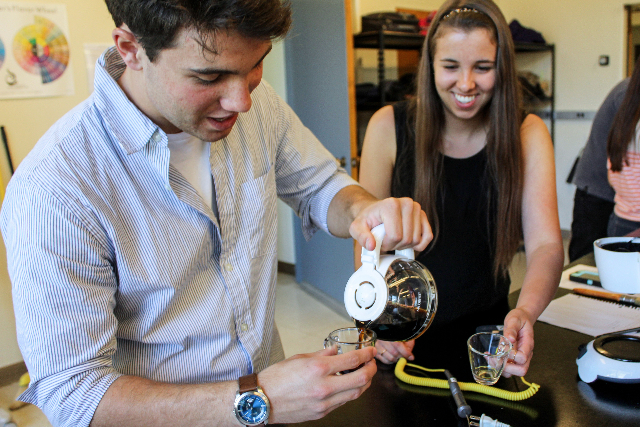
In the class, students have a hands-on experience making coffee. Their experiments involve measuring temperature, recording observations, finding ingredient ratios and tasting the final product. Students are able to see which types of mixtures are effective and which are unsuccessful.

Corey Ching, a second-year computer science major, was interested in the course because it seemed fun, fairly simple and relevant.

“I definitely feel like a lot of people would be interested in a coffee emphasis, particularly people who wanted something specific because sometimes majors are very broad in terms of what you want to do,” Ching said. “The engineering of coffee is relative to a lot of our lives. It gets people interested and thinking about what’s behind a lot of the process.”

Ching said that he would like to see more in-depth coffee courses offered.

“It would be interesting to see if these types of classes could move things forward,” Ching said. “I know this is just an introduction to the design of coffee, but if it would get into more like the scientific aspect of the perfection of brewing, that would change my decision on taking more courses.”

According to Ristenpart, no further coffee courses have been designed yet, and there is no timeline for UC Davis to offer a coffee major.

“Nothing has officially been proposed yet, we are just in the exploratory stages for now, but there has been a tremendous amount of interest [regarding the major],” Ristenpart said. “Students won’t be able to sign up for a coffee major anytime soon, but as a starting point, they can all sign up for ECM 1.”

Ristenpart said that further investigation behind the science of coffee would benefit both the coffee industry and academia.

“It would be a tremendous resource for the coffee industry,” he said. “Up until now, coffee has not formally been represented in academia at all.”

Although prospective study behind the science of coffee remains a work in progress, exploring such a topic is a step towards creating and sustaining an even more diverse university.

“I think students drink a lot of coffee, but know nothing about it,” Ristenpart said. “Last quarter we had students that didn’t even know that coffee grew on trees or that it was green before you roasted it. Studying coffee involves several disciplinary fields, such as food chemistry and learning about dairy physics. There is a lot of enthusiasm for coffee, but very little knowledge.”

JASMINE MANGABAY can be reached at campus@theaggie.org.

 Photo by Jennifer Wu.

Changes to be expected for comprehensive Health Sciences Advising Center

2

In March, a forum was held between administration and students to discuss and clarify coming changes concerning Health Sciences Advising (HSA) on campus.

Under the proposed changes, HSA would serve as its own entity separate from any specific college, with its own program director still yet to be hired. The forum was one of many to come, held to inform and receive feedback from students concerning the decision-making and progress of the Health Advising Center.

The changes will be made through a collaborative effort between Student Affairs and the College of Biological Sciences (CBS), and Vice Chancellor of Student Affairs Adela de la Torre and Dean of CBS James E.K. Hildreth — two of the the main faculty members spearheading this cooperative process.

According to Hildreth, his position as Dean of CBS, where an estimated 60 percent of incoming students are pre-health, has made it a mission of his to create an independent Health Advising Center. This, along with the pre-health experience of de la Torre, director of the Center for Transnational Health at Davis, made a mutual “epiphany” to combine efforts.

“The basic premise is that CBS is partnering with the Vice Chancellor’s Office to pool our resources and provide what we hope will be an advanced pre-health advising [experience] … for not just CBS students but all the students on campus,” Hildreth said. “In the past, the pre-health advising unit was solely the responsibility of the vice chancellor and associate vice chancellor. I had intended as dean to add to my staff advisors whose whole focus was pre-health advising, but with the vice chancellor’s initiative we can now take the resources [we were] going to commit to hire a senior person to be the anchor [of HSA] plus add additional staff around that person to create a whole team whose job it will be to make sure our advising is the best it could be.”

However, when students and current HSA staff were informed of the changes in early March there was misinformation between administration and students.

HSA peer advisor and third-year biochemistry and molecular biology major Candace Matsunaga said that from the information presented, staff were under the impression HSA would be absorbed by the Biological Academic Success Center (BASC) and would lead to the loss of their jobs. This led them to create the “Save UCD Health Sciences Advising” petition, aimed at de la Torre, Hildreth and Chancellor Linda P.B. Katehi, which garnered an estimated 593 supporters online.

“We were given very vague information on what was happening and not given the complete details,” Matsunaga said. “So that led [HSA staff] to make this petition because we thought we were losing our jobs and that they were taking away a very important advising service on campus. It wasn’t until the petition had blown up and people had started talking more about it that they released more details on what was actually going [on]. I think the petition helped students get more informed and may have spurred [administration] to talk about what they were doing to students out loud.”

ASUCD senator and third-year computer science major Shehzad Lokhandwalla said he had heard concerns about the HSA changes from pre-health friends and started to reach out to administration about the issue.

“I first decided to talk to the students leading the campaign to save HSA, and then I decided to bring this issue to the administration [office of Vice Chancellor Student Affairs],” Lokhandwalla said in an email. “I learnt that there was a misunderstanding on the students’ end, and that the students didn’t fully understand the nature of the initiative. I and many other student leaders recommended the office of the vice chancellor to hold a forum to eliminate all sorts of misinformation among the students.”

Both Hildreth and de la Torre agree that the message could have been communicated more effectively and that it was not their intention to take away but add to student resources and opportunities in the health sciences.

“I didn’t mean to belittle the role of the peer advisors but … the whole basis of this advising is to help students be successful in getting into medical school or whatever school they want [and] they’re being advised by people who have never done it before, so by its very nature there’s a problem there,” Hildreth said. “We want to make sure peer advisors have a role but it might be slightly different than what they’ve been accustomed to … so we’re going to have some trained professionals who are experts in this who are going to be leading the efforts in training the peers. This is not to say that the people who have been doing this have done a bad job, we’re just saying we’re hoping to make it even better.”

Components of the proposed health advising center include an emphasis on freshmen exposure to faculty, advising and other academic resources as well as a broadened perception of the health sciences in terms of careers and an encouragement of diverse extracurricular activities critical for applying to professional schools.

According to de la Torre, there were many initiatives that acted as precursors for the change before Hildreth approached her for the merger, one of them being the pre-existing health service infrastructure of the UC Davis Pre-Health and Pre-Medical Professions National Conference that has been coordinated by pre-health student organizations for the past 11 years and boasts a base of 400 student volunteers.

Similarly, Associate Dean of CBS Susan Keen said the college had already developed integrated advising initiatives through their implementation of BASC along with a cohort program which divided the first year class of 2017 into groups named after the tree of life. A complementary course BIS 98 was also created as a one-unit seminar for first-years to take with their cohorts to develop research skills and relationships with faculty. All of these programs, along with a policy to make advising appointments mandatory for CBS students,  began this academic year.

“All these [initiatives] are ways to reach out to the freshmen, break down their isolation and bring them into both the community with each other and community with the scientists,” Keen said. “Hopefully at the end of this year they’ll have met a bunch of people, they’ll have an idea about research, what it’s like to be a scientist and I think they’ll have a good idea of where they belong in the system so they can start thinking about their own lives.”

However, according to Hildreth these changes were also to make sure students get the right information about pre-health professional schools as well as diversify career awareness in the health sciences due to the fact that medical schools are becoming more selective. Nationally, there are also far more pre-med students than seats in these schools.

“This real intense attention we are paying to freshmen as they come in [is] because there are some myths and the thinking people bring [to Davis] with them about medical school, what’s required and what they need to do, some of which is just totally wrong,” Hildreth said. “Your major is immaterial to being a medical school applicant as long as you do certain [requirements] … Medical schools are looking for students who are well-rounded. It’s required to be academically gifted but medicine requires you to be a humanist, a great communicator, you have to empathize with people and their problems. So we want students to understand that those things they have a passion for beyond the academics are very important to their development as an attractive candidate for pre-health, whatever [profession] it might be.”

Along with “myths” that may pervade student discourse, there is also a stigma advising can bring to students concerning their comfort in discussing their potential to attend professional schools.

According to an anonymous fourth-year biochemistry major and transfer student, she and many of her friends who are pre-health have not taken advantage of the resources at HSA due to their previous experiences.

“I have always wanted to go to advising but a lot of people told me not to go,” she said. “They always said that advisors bring students down. It’s already scary going up to somebody and saying, ‘Here are my grades, what do you think about my chances?’ The first month I was at Davis I was told not to go to them, so I just never went … I know they have peer advising but I feel I would be more intimidated by them because they’re also pre-med, [since] pre-meds in general are super competitive even though I try not to be that way. I think that the whole process is just scary.”

Hildreth, Keen and de la Torre all said that starting interactions between students and faculty as well as advising resources early in their college career may reduce intimidation or fear and allow more student involvement and outreach.

“The goal is to make [advising] more transparent and to allow for greater choices and opportunities earlier on,” de la Torre said. “One of the big issues across the campus is that if you ask a lot of students when they learned about certain opportunities generally most of them would say their junior or senior year … Some of the more professional development and major trajectory [components of advising] are not fully discussed [with incoming students].”

De la Torre further stated that before this partnership between CBS and Student Affairs there was an informal relationship between the two in terms of handling resources, thus the services depended heavy on staff who knew the information.

“By Student Affairs [coordinating with CBS] it creates a different type of relationship of expectations,” de la Torre said. “[Right now] when someone leaves, that relationship goes. I think that formalizing these relationships makes it institutionalized so that students always have those types of opportunities. The good news is now that we’re making more formal relationships with the medical school, and with CBS and Student Affairs we’re going to be able to do programs that in the long run will be sustainable and not dependent on any certain individual.”

According to de la Torre, there will be forums and surveys held to receive feedback from students and peer advisors concerning the new health advising center. One metric that Student Affairs will analyze the initial results of the change will be the acceptance rate of students to professional programs which is expected to be assessed in either 2015 or 2016.

Hildreth said the job description for this key faculty member is still being written and will likely be a national search since they will head the comprehensive health science services for undergraduates with funds sourced from both CBS and Student Affairs.

“Since this is a pivotal hire for all of this, this person is key to making the whole thing work,” Hildreth said. “They have to be a good communicator, they have to be able to interact with students effectively and also with other senior staff members on campus. It’s going to take a very special person to pull this off so we are very intentional on making sure we find the right person.”

SEAN GUERRA can be reached at features@theaggie.org.

Photo by Ciera Pasturel.