55.7 F
Davis

Davis, California

Wednesday, December 24, 2025
Home Blog Page 870

Men’s basketball graces ESPN2 against top-ranked Gauchos

0

Teams: UC Davis vs. Cal Poly; vs. UC Santa Barbara

Records: Aggies 8-19 (3-9); Mustangs 10-16 (6-7); Gauchos 18-7 (9-3)

Where: The ARC Pavilion — Davis, Calif.

When: Thursday, Feb. 27 at 7 p.m.; Saturday, March 1 at 5 p.m.

What to watch for:

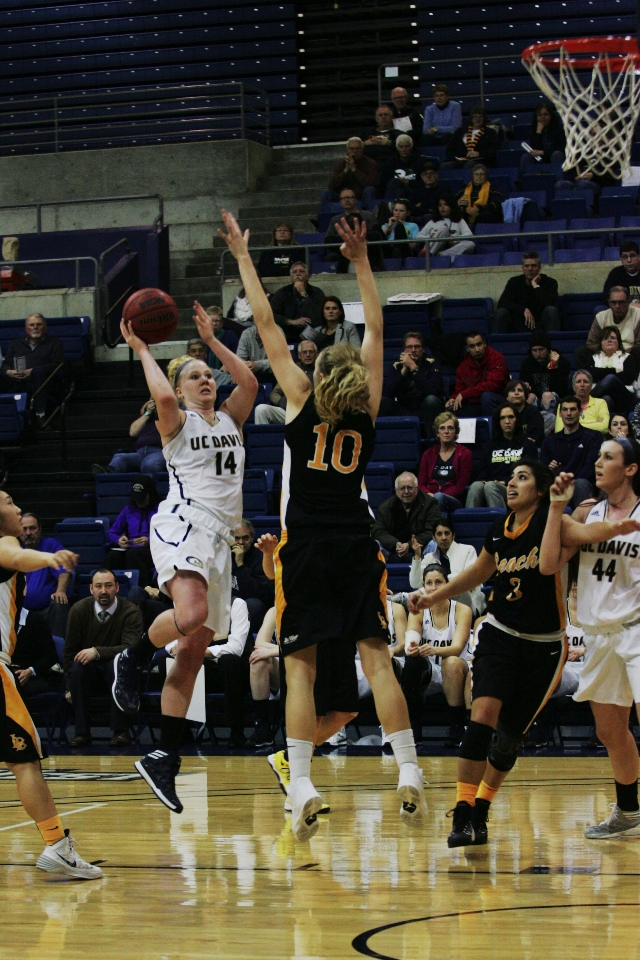
UC Davis men’s basketball is back on the national stage, with their game against the UC Santa Barbara Gauchos being broadcasted nationally on ESPN2.

The Aggies were featured on ESPN a season ago and played a thriller, losing to Big West Conference No. 1 Long Beach State after a game-winning jump shot circled the rim and fell out with time expiring.

Watch UC Davis bring energy in front of what will likely be another sold out crowd as they hope to upset the now top-ranked Gauchos.

Preview:

The last time that UC Davis and Cal Poly met, the Aggies came away with their lone conference road win. UC Davis came out ahead due to an outstanding shooting night, making 48.9 percent of their shots and 45.5 percent of their three-point attempts.

The Aggies held the Mustangs to 30 percent shooting from beyond the arc and managed to win despite being outrebounded by five and allowing Cal Poly to get eight steals.

The Mustangs have proven to be a poor offensive team, with just two players scoring in double figures on the season. As a team, they shoot a bumbling 41.2 percent from the field and 33.9 percent from beyond the arc, something that should be an exploitable advantage for UC Davis.

The Aggies, meanwhile, have continued to play efficiently offensively, shooting 44.3 percent from the field. While they have also found success from beyond the arc, the team has seen a recent significant drop-off in three-point shooting. Despite a strong performance against Hawai’i by junior guard Corey Hawkins, the team endured a mini slump over the previous few games. This includes a night against Long Beach State in which the team made only three of their 22 attempts.

Against Hawai’i, UC Davis was able to get surprisingly strong production out of its big men, including a season-high 16 points for junior forward Clint Bozner.

“I just wanted to run our offense and score whenever I saw Hawai’i send the wrong player to guard me,” Bozner said.

The team has been missing the play of rangy junior forward Iggy Nujic, who was not present for the game against Long Beach State and did not travel to Hawaii for unknown reasons.

UC Davis seems to be the superior team in this game, which they must win if they want to make the Big West tournament.

The second game of the week, against UC Santa Barbara, will prove to be a much harder test.

The last time the two teams met, the Aggies were unable to contain junior forward Alan Williams, who has been outstanding all year. He totaled 27 points and a ridiculous 20 rebounds in the game, only seven fewer than the entire UC Davis squad.

On the season, Williams is averaging 22.5 points, 12 rebounds and 2.5 blocks while shooting 54.3 percent from the field and solidifying himself as a pro prospect.

The Gauchos have also been efficient from the three-point range, making 37.5 percent of their attempts from that range on the season. They have been led in this category by senior guard Kyle Boswell, who makes 2.5 threes per game on 43.4 percent shooting.

To score a win, a few things will have to happen for the Aggies. First, they are going to have to come out with a ton of energy, which should be no problem in the likely sold-out Pavilion. More importantly, they will have to force the rest of the Gauchos, beyond Williams, to have bad shooting nights. When UC Santa Barbara lost to Cal Poly, Williams scored 33 points on 57 percent shooting. It was the rest of his teammates shooting 30 percent from the field that sunk the Gauchos.

The strategy of keying in on the supplemental parts of the Gaucho’s squad is the Aggies’ best hope, especially given their season-long struggles against post players.


— Ryan Reed
 

Inside the Game with Georgi Funtarov

0

As one of the Aggies’ top recruits this season, freshman Georgi Funtarov has been given quite a lot of responsibility. Averaging 24 minutes per game, 8.4 points per game and leading the team with 4.6 rebounds per game, Funtarov has delivered for UC Davis this season.

Due to time conflict and the Aggies’ trip to Hawaii for a road game, assistant director Eric Bankston asked the questions for The Aggie.

How has the experience been transitioning to college life?
In the beginning it was really different. I went to high school here in America, but college is totally different. Classes are different, it is lectures and school is a little different. Basketball-wise, the game is faster and more athletic. It took me awhile but now I feel more adjusted and comfortable.

What are the differences between the college game and the high school game?
In high school, you might have two or three guys who might be D-1 prospects. I went to prep school, we had six or seven. But in college, you have all 12 guys — everyone is on a high level and can play fast. Everyone has game. But as a freshman, I feel like I have adjusted pretty [well].

How have you managed to balance school work and athletics?
It’s probably one of the areas I struggled the most to balance everything, especially in a school like UC Davis, school is not easy. You have to be able to do your homework on the plane or on the road and still focus on the game. It is something that I have to work on, but I think I will be doing better.

What are your pre-game routines, if you have any.
It is definitely different depending [on] if you are home or away. At home, you have to deal more with school. You have to go to classes and think about that. Once you go to pre-game meal, which you have right before the game, you only think about the game. [You have to] read [scouting reports] and making sure you remember everything.

When you are away, it is a little different. You don’t necessarily need to do homework if you don’t want to. You [get] to mainly focus on the game, so you have more time to prepare for the game.

What is your favorite pre-game snack? Why?
Not necessarily, I know that as a team we usually eat a lot of pasta and stuff like that to give us carbs, so we can have energy for the game. But me personally, nothing special.

Do you manage to regularly interact with people who are not on the basketball team or part of UC Davis athletics?
Yeah, definitely. Especially when I get to go to class, it’s pretty much like a regular day, we’re regular students, like everyone else. In class you get to see your friends and talk to the people you sit next to. It’s a regular day for us on [home] game days too.

Have there been any valuable lessons which you have gained from playing in Bulgaria’s U-16 and U-18 teams? Has playing internationally helped you prepare for Jim Les’ demands of you on the basketball court?
When I was on the national team I had the chance to play against a lot of older guys. So for me that was a good experience. The competition was really competitive and I got to learn how to play physically with the older guys who were stronger and bigger than me. So it was definitely a good experience.

What is the difference between the college game and the international game?
When you play for the national team there is a [larger] factor of pride. You want to [play] for your country and not yourself. You want to show that you can play, but it is more [about] winning for your country and putting your country on the map.

Heading forward, what are your goals for the rest of the season and next year?
My main personal goal is to get as good as I can and to reach my highest ceiling. [My goal] is to be the best player I can be. My other goal is to win as many championships as I can here. When next season comes, I want to get as many wins as I can and get UC Davis on the map. I want people to know who UC Davis is and respect us every time.

Aggies head south to face Mustangs, Gauchos

0

Teams: UC Davis vs. Cal Poly San Luis Obispo; vs. UC Santa Barbara

Records: Aggies, 11-14 (6-6); Mustangs, 15-11 (9-4); Gauchos, 8-17 (3-9)

Where: Mott Athletics Center — San Luis Obispo, Calif.; The Thunderdome — Santa Barbara, Calif.

When: Thursday, Feb. 27 at 7 p.m.; Saturday, March 1 at 2 p.m.

Did you know?

Sophomore forward Alyson Doherty and Cal Poly’s Molly Schlemer lead the Big West in field goal percentage, 56.2 and 55.3 respectively.

Junior forward Sydnee Fipps is second in the Big West in points per game. After scoring 22 points against Hawai’i, she is now averaging 18.0 points per game.

Who to watch:

Sydnee Fipps has been on a scoring frenzy. She leads UC Davis in points and rebounds per game, with 18 points and six rebounds, and has scored 20-plus points in four of the last five games. Fipps has been dominant in February, and looks to lead the Aggies to victory this week.

Junior guard Kelsey Harris has been shooting 47.3 percent behind the arc in the month of February. After struggling against Hawai’i, Harris hopes to finish the season on a high note. After sitting out last season due to the NCAA transfer rules, Harris has been the third scoring option for the Aggies this season.

Preview:

Currently sixth in the Big West Conference, UC Davis looks to improve their conference standing when they face No. 1 Cal Poly on Feb. 27 and No. 8 UC Santa Barbara on March 1, as they head into the home-stretch of the season.

The Aggies face a tough opponent against Cal Poly. The Mustangs currently average 76.8 points per game, while the Aggies only average 66.9. The Aggies’ frontcourt must limit Cal Poly’s leading scorer, Molly Schlemer, offensively, and not allow her to get to the basket. The 6’5” center is averaging a double-double with 17.8 points per game and 10.5 rebounds per game. The Aggies should force themselves into the paint, and get Schlemer into foul trouble. The matchup against Schlemer will be imperative, and confining her will lead the Aggies to victory.

UC Davis must protect the ball. The Aggies have the highest turnovers per game in the Big West with 19. Limiting their turnovers will allow the Aggies to create more opportunities offensively. UC Davis must rely on its top scorers, sophomore forward Alyson Doherty, junior guard Kelsey Harris and junior forward Sydnee Fipps to keep them in the game.

Against UC Santa Barbara, UC Davis must take advantage of the lowly Gauchos. UC Santa Barbara has been struggling all season long and UC Davis defeated UC Santa Barbara earlier this month, 82-70.

Limiting UC Santa Barbara’s guards is key, especially Melissa Zornig, a streaky shooter who is able to score from anywhere behind the arc. Zornig is shooting 39.3 percent from behind the arc. UC Santa Barbara is the best three-point shooting team in the Big West with a 35.2 three-point shooting percentage.

The Aggies must capitalize on the advantage of their bigger and stronger forwards. The UC Davis frontcourt must dominate the Gauchos in rebounds and work their way in the paint. If the Aggies control the points in the paint, they will win.

This will be a great chance for the Aggies to gain some ground in the Big West standings. Expect Fipps and Doherty to have huge games.

— Oscar Dueñas


News in Brief: Men’s basketball game to be televised on ESPN2 on March 1

0

The UC Davis men’s basketball team will host UC Santa Barbara, the top team in the Big West Conference, on March 1.

The Aggies are 8-19 overall, with a 3-9 conference record at the publishing of this brief. The Gauchos are 18-7 overall, with a 9-3 conference record.

Junior guard Corey Hawkins has been on a tear lately, leading the Aggies in scoring in the past five games, scoring 19 or more points per game in each.

The matchup between the Aggies and Gauchos will be a real-life showdown between David and Goliath. Tip-off is at 5 p.m. at the ARC Pavilion, doors open at 3:30 p.m. The game will be aired on ESPN2 at 5 p.m.

— Kenneth Ling  


Outreach Assembly holds Funding and Resource Program for clubs

0

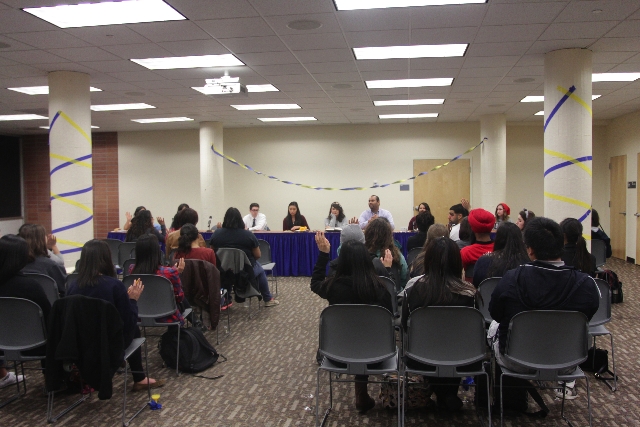
On Feb. 19, the ASUCD Outreach Assembly held its Funding and Resource Program to facilitate club funding on campus in MU II. A panel of representatives from various ASUCD units presented to show club members options for club funding as well as other aspects of club organization for student groups.

ASUCD Outreach Assembly aims to work with clubs on the UC Davis campus to minimize the gap between student clubs and student government. The assembly also works to inform students of the resources available for organizations on campus through ASUCD.

Representatives from Campus Copies, Picnic Day, the Center for Student Involvement, the Cross Cultural Center, the Student Recruitment and Retention Center, the Student Assistant to the Chancellor, the Ethnic and Cultural Affairs Commission and the External Affairs Commission were present at the resource program.

Sara Okholm, the unit director for Campus Copies and Classical Notes, mentioned the various resources that both offer students. These resources include printing, faxing, laminating, scanning and copying. She mentioned that they are an excellent resource for clubs in regards to printing flyers or other materials in large quantities.

Maddie Lai, the volunteer director for Picnic Day, described the various volunteer and leadership opportunities that Picnic Day has for students in clubs. According to Lai, students can volunteer through their respective clubs at the Student Organization Fair on Picnic Day, in which volunteers lead food booths on the Quad during Picnic Day.

Heather Prandini from the Center for Student Involvement described her office’s role of helping student organizations on campus with fundraising, reservations on campus, advising and leadership workshops. The office also offers a funding source called Beyond Tolerance grant funding where students can earn up to $200 for hosting an event that supports the Hate Free Initiative on campus. The Center for Student Involvement also registers clubs on campus.

The Cross Cultural Center presented to inform students about its leadership conferences that focus on social and political identity as well as awareness. The Cross Cultural Center allocates funds for grants, and these grants are given to student groups that host cultural events and also to sponsor various groups on campus.

The Student Recruitment and Retention Center (SRRC) also provides various resources for student organizations on campus. According to the representative present on the panel, the Student Recruitment and Retention Center holds study hours on Tuesdays from 6 p.m. to 9 p.m. for students to study and get testing materials, including scantrons and blue books. Student organizations can also apply for grants worth up to $1,000 through the SRRC.

One of the student assistants to Chancellor Linda P.B. Katehi presented to emphasize his role as a voice for students to the administration. He also mentioned that the student assistants to the chancellor have a $5,000 budget, meaning that they are able to provide grant money to organizations that do not fit the requirements for other grants that contain more specific requirements.

A representative from the Ethnic and Cultural Affairs Commission (ECAC) presented regarding its role as a voice for minorities on campus and working to combat discrimination and racism on campus. ECAC also offers grants for student groups.

The chair of the External Affairs Commission (EAC) also presented to describe EAC’s role of bridging the gap between UC Davis students and the Davis community to the overall community of Yolo County. The commission works to create events that foster the relationship between students and the Yolo community in general. The EAC helps student organizations get involved in events and causes outside of the immediate circle of UC Davis.

The Environmental Policy and Planning Commission also provides grant money for organizations putting on events related to the well-being of the environment of sustainability.

Ritu Parekh, a second-year mechanical engineering major, attended the Funding and Resource Program on behalf of Design for America.

Design for America is a nationwide organization that started up on the UC Davis campus during Fall Quarter. The organization works to tackle problems in each chapter’s community, in this case Yolo County.

According to Parekh, members have six local focuses: working to assess food security, safety and transportation, workers on small farms, Alzheimers, disaster relief and water conservation. Parekh mentioned that Design for America is still trying to establish itself at UC Davis.

According to Parekh, she attended the Resource and Funding Program because, “in order to work on our projects, we need a little bit more money, so just to see what there is on campus for us to get that.”

Lauren Ashe, the speaker of the ASUCD Outreach Assembly, said she organized the Funding and Resource Program in the hopes of informing clubs on the variety of funding options that are available to them through ASUCD.

“Many clubs don’t know that there are hidden pockets of funds within ASUCD and just from other places on campus,” Ashe said.

According to Ashe, the Outreach Assembly hopes to be able to meet with more student clubs, for it is currently difficult to promote its available resources. The Funding and Resource Program was part of Outreach Assembly’s efforts to close the gap between student groups and both organization and funding resources on campus.

Violence Intervention & Prevention orientation presentation to move online

0

The UC Davis Summer Orientation program will experience changes in summer 2014. One such change is a shift of the popular Violence Interpretation & Prevention (VIP) presentation from in-person to online.

The VIP presentation, which includes the popular “How to Be Sexcessful” handbook, is a mandatory workshop that educates students on topics regarding sexual assault, dating, domestic violence, stalking, reporting options and campus and community resources for support. The presentation has been offered at summer orientations and throughout the year for students unable to attend orientation since 2011. It is presented by Sarah Meredith, Campus Violence Prevention Program Education and Outreach coordinator.

According to Meredith, the VIP presentation is part of a mandatory requirement by the AB 1088 Law and a Department of Justice grant received by the UC system in 2010. AB 1088 requires college campuses in California to educate students and staff about violent crimes and information regarding sexual assault, either in written form or in-person.

“The curriculum for VIP was designed by Campus Violence Prevention Program (CVPP) staff, with input from UC Davis students and campus and community partners,” Meredith said in an email interview. “In 2010, the format for delivering the VIP workshop to all incoming undergraduate students, first-year and transfer students, was to offer several in-person sessions during the first week of school.”

The workshops then changed to be included at new student orientations in 2011.

Undeclared life sciences major and first-year Kendall Frisoli said that she enjoyed the VIP presentation when she went to orientation during summer 2013.

“I think it livened up the monotonous talks,” Frisoli said. “It added variety and I also saw a positive response from other kids. It’s good to assure that everyone will get the information online, but I think that in-person interactions are more beneficial.”

Meredith said registration holds were issued to students who did not complete the orientation program, thus also not completing the mandatory VIP workshop. The decision to go online was made because of the difficulty of gathering students and requiring them to attend the workshop if they had not attended orientation.

“While I can say that I really like having the opportunity to present the workshop in-person, and interact with students face-to-face, I do not have any evidence that the in-person workshop is more effective in its educational goals than an online format,” Meredith said. “I also know that there are significant challenges in the way of tracking students’ attendance [at orientation], as well as barriers with regards to student access to the in-person program.”

Meredith said that the change from in-person to online format will not affect the content of the presentation. The goal is to continue the presentation as being both interactive and informative, and the presentation will continue to be mandatory for all students.

“Currently, there is a team of very talented design staff working to make the online VIP program highly interactive and informative on the topics of sexual assault, consent, intimate partner violence, stalking, resources, UC Davis policies, reporting options [and] bystander intervention,” Meredith said. “In addition to the mandatory VIP program, various campus resources currently offer comprehensive education on these topics.”

Since 2011, the presentation has included a booklet illustrating “How to be Sexcessful” and a campus resource crisis card for every student.

“The ‘Sexcessful’ booklet was created by a group of students participating in the Davis Honors Challenge under the guidance of the Health Education & Promotion (HEP) sexual health educator,” Meredith said. “There was also significant student and campus partner input on the development of this resource.”

Teaching students how to be “sexcessful” is currently a campaign that is part of the HEP services on campus. The campaign is utilized by the VIP staff but is run separately by HEP during the rest of the year. Being “sexcessful” can be defined subjectively by anyone who uses the term, but it has a basis around maintaining healthy and consensual sexual relationships.

“Having a healthy sexual relationship and good foundation in a relationship is what being ‘sexcessful’ is to me,” said Sammy Lee, an HEP intern. “College is a time for new experiences, specifically exploring new sexual experiences. I think it’s important to teach incoming students about this topic and to respect themselves and others.”

The VIP presentation is not the only one that will be changing to an online format for upcoming and future orientations. Catrina Wagner, director for New Student Academic Services,  said that other presentations are changing to an online format, including ones on Financial Aid, Student Accounting and Student Health and Counseling Services. Unlike the VIP presentation, these programs are not required by law and will not be mandatory.

“The goal is to allow students to watch these presentations online and think of questions to bring to orientation,” Wagner said. “This will also allow family members to think of more focused questions to ask in-person.”

Wagner said that the decision to change these presentations to an online format was made after looking at responses from surveys given to students and family members who attended orientation. Because this is the first time that the orientation program is trying the new format, the orientation staff is waiting to look at upcoming surveys to decide how the procedure will happen in future orientations.

According to Wagner, the now-online presentations will remain in the in-person family program schedule and will allow for students “more time for advising, class scheduling and social activities.”

Campus Chic: Palmira Muniz

0

A New York State of Mind.

Hailing from the Bronx, Palmira Muniz, a third-year English and film studies double major, tells MUSE how she combines her lived experiences both in New York and Los Angeles to create her own unique personal style and how to DIY (do it yourself)!
As I was strolling through the Memorial Union bookstore on a semi-relaxed Thursday afternoon, I came across a full head of curly locks paired with a bold, red lip and thought to myself, “I think I’ve just found my next Muse of the Week.”
Something that struck me about Palmira was not only the hair, but also a grunge-y and urban-chic, yet very much sophisticated look that I normally don’t see too often around campus. She thrifted her denim jacket at Goodwill for a mere two dollars and appliqued a part of a tank top that she found on a rack at a local church in Manhattan to create an edgy, original and Bronx streetwear-inspired outerwear piece. To complete her outfit, she paired her jacket with a spiked-toed boot to give another dimension and some tomboy attitude to her head-to-toe look.

James’ Notes: Like Palmira, instead of purchasing entirely new clothing, why not try repurposing your old clothes and incorporate thrifted pieces from second-hand stores to create your own original look? Not only can you give a personal touch to your clothing, but you can also tell a story and inspire discussion through these DIY pieces that you create for yourself, by yourself. Cheers!

Interview with Palmira Muniz:

1. If you could describe your personal style in three words, what would they be?
“Tomboy-chic,” artistic and eccentric — very much similar to my personality to be honest.

2. Who or what is your style icon?
I get a lot of my inspirations from different music scenes and the attire that is associated with parts of these music cultures. Specifically, I look up to Kat Von D and how DIY she is with her clothing, Michelle Obama when I want to look sophisticated and oddly enough all the cast members from Fresh Prince of Bel-Air when I want an outfit to stand out.

3. What are your three must-have items in your wardrobe?
Denim jackets or denim men’s shirts: super comfy and you can literally throw it on top of anything: dresses, T-shirts and leggings, etc.
Band T-shirts: My style is really influenced by music, so sporting my favorite bands is always fun, especially on a lazy day. It’s also a great conversation starter with people who dig the same band as you.
White V-necks: The best article of clothing to wear when you just want to throw things together, but because there won’t be any color clashing, the outfit will work 99 percent of the time if the white V-neck is used properly.

4. What is your favorite accessory and why?
As weird as it sounds, my hair is my favorite accessory. I know many people don’t consider “hair” as having the ability to complement an outfit, but don’t underestimate its power. Since my hair is so big and curly, it’s the first thing people see when I walk into a room or when I’m strolling on campus, so if my hair is on point, my outfit will follow suit. I like to use Garnier Fructis leave-in conditioner and a Revlon blow dryer to create this humongous look, which I like a lot. Washing it takes out the curls, so I don’t wash it as often because curlier hair tends to be a lot drier than straight hair. Besides my hair, rings, earrings and scarves are always a subtle way to liven up a neutral-colored outfit and are always fun to mix and match.

5. Where do you love to shop and why?
I love thrift shopping and bargain hunting, especially because I make and alter a lot of my own clothing. I like to tear pieces apart and put them together or make something awesome, and of course since it’s custom made, no one else will have it. I do enjoy the Forever 21, H&M, Torrid, TJ Maxx and the like, but my favorite places are the random boutiques in LA or New York that are privately owned because the clothes they carry are so interesting and different.

6. What is your most treasured item in your wardrobe?
I would have to say my brown spiked boots my best friend got for me a couple of birthdays ago. One of the reasons, of course, is because my best friend, who is like my sister soul mate, got them for me and I love anything she gets me, but they just represent my style all together. The huge spikes to represent my “tomboy/tough girl” look, but the brown leather boot to go with any kind of style. I feel like a badass when I wear them, but cute at the same time.

7. How has your style changed since high school?
I learned to not care what other people think or other’s people’s opinions on my outfits. I figured, “If they’re not spending money on my wardrobe, why let them have any say as to what I wear?” I learned to take chances and risks with my wardrobe and have fun, and nine out of 10 times I get A LOT of compliments, even with just particular pieces of clothing. I also learned to incorporate makeup into helping create a look I’m going for, I was kind of a late bloomer when it came to makeup in high school.

8. What does fashion mean to you?
Fashion is a way to express yourself, but not just superficially. Your style can depend on your mood, it can be inspired by a film you saw or song you heard, any number of things. A person’s fashion sense changes just like a person changes, and can be used to represent different dimensions in a person’s personality. Fashion doesn’t define you, it simply is what you choose to portray yourself as to the rest of the world. As a full-figured female, I know fashion has not always been kind, but I use it as a tool to feel awesome through what I’m wearing. Feeling good about what you’re wearing is the primary goal, looking good will come secondary.

9. What items would you recommend our readers to incorporate into their wardrobes for the upcoming spring season?
I do recommend some white, off-white, cream or eggshell-colored lace articles of clothing. Some of the pieces have the lace patterns in the shape of flowers — very spring-friendly but without the overwhelming actual flower patterned print. Lace dresses are just so adorable, and lace tops can be thrown over any color tank top and a cardigan to top it off.
For spring, I do favor the light wash denim jeans, jackets, shorts, vests, etc. (denim that is medium to light blue). The light blues tend to pair better with pastels and other light colors, normally worn in the season.
Makeup: Nude lipsticks during the daytime, wine-colored or dark red (blue-red) for night time. Sometimes the bright red (orange-red or fire engine red) is not flattering to everyone, but the darker red is a little more forgiving.

10. What final tips can you give to our fashion-forward readers?
TRY TO STAY AWAY FROM WEARING ALL OF THE SAME COLOR IN ONE OUTFIT. Black is usually my go-to color for pretty much any occasion, but I religiously break the black up with different colors, textures and fabrics. Same goes for all colors; have a wide range of a color palette!
Makeup: Less is more. If you are wearing a dark lipstick, wear light eye makeup and vise versa.
Dress with comfort in mind: In the morning, think, “Will I still be happy in this outfit eight hours from now?” And if the answer is no, go back to the drawing board.
And above all, don’t let anyone tell you that you can’t pull something off because you don’t look a certain way. If you dress yourself in the morning, YOUR opinion is the only one that matters.

IMG_1431

IMG_1429

IMG_1390

IMG_1386

IMG_1377

Sustainable Agriculture: Gut feelings

1

I like to think of myself as more than just human. It’s not that I have super powers or robotic limbs, but rather that my body can be considered an ecosystem in itself. New research on the microscopic organisms living inside and on our bodies has painted humans as human/bacteria/fungi superorganisms. Such a shift in self-identity has made me reconsider the sterile, Western lifestyle that I was raised with. From hand sanitizer to antibiotics to processed foods — I find myself asking why have I been enlisted in this invisible war against germs, and when can peace accords begin?

Such questions were first borne by the Human Genome Project, an international, collaborative, biological experiment started in 1990 that aimed to sequence the entire human genome. When the project was imagined in the 1980s, researchers hypothesized that the human genome would be made of nearly 100,000 genes. The hypothesis reflected our own anthropocentric ideas of ourselves as magnificently complex organisms. The results of the project actually found that the human genome consists of about 20,000 protein-coding genes, which researchers have remarked is not too different from a fruit fly.

If our genomes are not as intricately complex as we once thought, then what accounts for the differences between humans and the creatures circling above our week-old trash bins? This question then spawned a research project called the Human Microbiome Project that is examining the organisms that exist within our body — sometimes called our “secondary biome” — that may be responsible for the complexity of our species.

Microbiologists around the world are beginning to sample and sequence the bacterial communities within our bodies to determine what a robust and balanced microbiota looks like. Because research and analysis in this field has just begun, scientists are wary to raise any definitive flags on the links between the human microbiota and health, environmental toxicology, medicine or food.

However, some overall trends are becoming clear that make us revalue conventional wisdom. The adage “You are what you eat” might soon be reworded to “You are what eats what you eat” when you consider that much of our diet is only beneficial if the bacteria inside our gut prefer it.

Researchers in Brussels have succeeded in reproducing inflammation in mice fed “junk food” similar to that of inflammation in obese individuals. The junk food diet feeds a select population of gut bacteria that thrive on those foods while essentially starving out other bacteria that thrive on food sources like fiber. The bacteria that are starved out in our junk food binges are often the ones that help maintain balance within our guts and digestive systems.

Additionally, researchers from Washington State University have evidence that supports that plants grown in soil with a rich microbiota will produce food that has more antioxidants and phytonutrients than their conventional counterparts. The controversy over the link between soil health and nutritional quality is well-placed, because it would support the argument that organic practices are not only better for the environment, but they are better for our health, too.

What if we extended the logic that “quality ingredients produce quality end products” to soil? Soil is unmistakably an ingredient in the production of our food. It is not merely a container or holding space from which the food bursts forth, but rather a vital component.

The work of the Human Microbiome Project and associated inquiries is pushing us to redefine the limits of ourselves. If the soil becomes part of the plant, and the plant becomes part of the microbes in our gut, then through the transitive property of equality, soil is a part of us.

It helps me to imagine my gut fauna as a social network. When I eat processed foods that lack a diversity of microbes, the bacterial party inside my body turns into one of those awkward gatherings with only a handful of attendees. But when I garden outside, interact with animals or eat fermented foods like yogurt and miso, I am essentially enlivening that same bacterial party with a diverse guest list and bumpin’ tunes.

To be invited to one of ELLEN PEARSON’S bacterial gut parties, email her at erpearson@ucdavis.edu.


Literary Lessons: Fashionable Reading

0

I would love to be an artist. I would go to a pond with my easel and beret and I would oil paint still-lifes of the ladybugs and water lilies. I would also have to learn French and dye my hair jet black with short bangs. It would be the classiest version of myself that I could possibly attain.

Unfortunately, I can neither draw nor pull off jet-black hair without looking surprisingly similar to a vampire, so my dreams of being absolutely and utterly cultured are out the window. And in terms of art, because stick figures are about as good as it gets for me, I have found that fashion is a good middle point for my artistic endeavors. Someone else makes the art, and I get to piece it together and put it on display.

I have to admit I put a lot of value on what other people do and do not wear. Every morning, a person makes a decision on how the vast majority of people are going to perceive them. I personally know about 0.1 percent of people at UC Davis. That means that when I’m piddle-paddling around campus, 99.9 percent of people only know me based on what I’m wearing and how I present myself. What we put on tells others a surprising amount about our values, what we find important, what kind of a phase we are going through and our general aesthetic of life. Whether it’s actively choosing not to get nicely dressed up in the morning, needing to wake up at 5 a.m. to get everything in order or somewhere in between, the way we look is a big part of the impression we give to others.

I also think that certain outfits are drawn to certain books. When I see what someone wears, I often categorize them under a genre of literature. Not that I have done anything close to an experiment on this; it’s just that I often bring up the topic of books during conversations, so I’ve had plenty of opportunities to associate fashion with genre choices.

So, for everyone who wants to make assumptions about other people without getting to know them, here is my list of literary genres according to people’s fashion choices.

Exciting leggings: This person likes confusing books. She last read Faulkner’s Absalom, Absalom and was one of the few people who knew what was happening the whole time. Her exciting leggings are an ironic metaphor for the banality of regular existence: in a world void of imagination, her leggings with intergalactic kittens contrast the sea of jeans and white T-shirts. Just like the twisted tale of a civil war patriarch, her leggings — and her outlook on life — are intense.

Clothes with holes/stains: Dude, he just finished Hesse’s Siddhartha and he’s realizing that his old attachment to early objects is really ruining, like, his vibe, you know? Everything is just so contrived and he wants to move past materialism and place greater importance on the real issues — like how to keep his kombucha from dying. Real talk.

Uggs with shorts: Whatever books these people read must not have any seasonal settings, because it seems as if they’ve never run across an explanation of winter, and how that’s different from a thing called summer. Or maybe they just have really cold feet and then really warm legs. I heard humans lose heat from their extremities, but I’m still pretty skeptical on the mismatched combination.

Super expensive clothes: This person just finished Tina Fey’s Bossypants and found it super relatable. She also just bought Mindy Kaling’s Is Everyone Hanging Out Without Me?. She’s really smart, but for whatever reason she just refuses to read substantive books. Not saying that Tina Fey isn’t substantive, it’s just that this person is selling herself short. She would probably like Bronte’s Wuthering Heights if she gave it a chance, but she won’t because the copy you gave her was from a thrift store and smells like old cigarettes.

Interesting glasses: After finishing Vonnegut’s Breakfast of Champions, this guy couldn’t trust his girlfriend anymore because he was almost convinced she was a robot. Like his glasses, he’s a little strange, and he reads sci-fi because it fills his need for weirdness.

I hope that instead of relying on my very comprehensive list, you go and actually talk to these people before deciding a bunch of things about them. On the other hand, if during this conversation they tell you their favorite book is The Catcher in the Rye, let the judgment commence.


To make clothes out of books with EREN KAVVAS, you should email her at ebkavvas@ucdavis.edu.


Guest Opinion: Playing by the Rules

0

What is the real value of sports? For me, above all, sports are about respect. Respect for one’s self, one’s teammates, coaches, fans and, yes, one’s opponents. But also respect for the rules. You can change them, but no one gets to simply ignore them.

Did you know that as an undergraduate you pay $650/year extra to fund the Intercollegiate Athletics Department (ICA)? All tolled that comes to $18 million each and every year. It’s the cash flow equivalent of a $400 million endowment. At no other D-1 institution is a self-imposed contribution by students as high. If UC Davis distinguishes itself from the usual approach to D-1, then in my opinion that investment is worth every penny. But it does so only to the extent it complies with the conditions of the 1994 Student Activities and Services Initiative (SASI) and 2003 Campus Expansion Initiative (CEI) ballot initiatives.

Yet since 2010 this administration has not seen fit to respect those conditions. In fact, when mentioned at all they are characterized as being somehow vague, open to interpretation or merely nice sounding goals. They are none of those things.

Consider the following:

Per the CEI they were not to cut entire teams, but they did anyway in spite of ASUCD’s objections.

Per the CEI they were not to value one sport above another, but the guaranteed salaries, incentive bonuses and perks of the new athletic director (AD), football and men’s basketball coaches are a dead giveaway.

Per the SASI they were not to reduce support of the teacher/coach model (the PE program), but in 2010 they slipped away and left you to pick up the tab.

Per the CEI they were not to put undue pressure on coaches and student-athletes to win and fundraise, but they do so anyway. Coaches of so called “non-revenue” sports can be readily dismissed for any such reason under the “at will” clauses in their annual contracts.

Per the CEI they were not to lower academic standards, but they have. In 2007-08 the number of athletes admitted by exception (ABE) was exactly one. By 2011-12 the number had risen to 23.

Despite all this, students continue to pay and Aggie student-athletes continue to do their utterly amazing best balancing top-flight academics and terrific athletic performance. But the stage is set to get even worse. The obvious intent of the administration’s actions is to raise the profile of certain sports so that donations will pour in. This ignores the clear warnings of the Knight Commission on College Sports and the vast body of data which show that most D-1 institutions lose money.

Sure enough, since 2010 program expenses are up and donations are down. To add to the irony, the very teams that were cut, including women’s rowing, men’s swimming and wrestling, were among the most successful on campus. They featured conference champions, national champions, even a U.S. Olympian. We’re told no more sports will be cut, but they’ve already broken that promise. Fool me once, right?  Before anyone can afford to believe them again the teams already cut must be reinstated and paid for by reducing excessive ICA admin spending, which at nearly $5 million/year is more than that of rivals Cal Poly and Sac State combined.

Call it what you will, the students of UC Davis voted to pay for one type of program and this administration now delivers another. It’s like buying a ticket for one destination and being taken somewhere else — with no apology, no refund and no way back.

Fellow Aggies, this is about much more than just sports. It’s about playing by the rules.

Paul Medved

1978 Alumnus

In Transition: C-C-Student

0

Remember the day you found out you had been accepted into UC Davis? I do — it was a Friday afternoon and I was at work. I got the email and immediately freaked out. I couldn’t believe it had actually happened!

I decided to wait about a week to tell my parents. They had decided I needed to go to community college for a few years, so the least I could do was punish them with the old “I didn’t pass my last semester of community college classes — just kidding I actually got into UC Davis” fake-out.

Anyway, once they had both gotten over their “near heart attacks,” time felt like it flew by. I was packing, moving, taking classes, studying for finals and now I’m filing to graduate.

It’s been a wonderful whirlwind and has given me a lot to say.

Just like Grandpa at every Thanksgiving dinner, let me tell you some stories and give you some advice — here are some things you should and shouldn’t do once you’ve officially become part of a university system (whether it’s undergraduate or graduate).

1. Do come up with a really cool way to tell your parents you’ve been accepted, but also anticipate that telling them you’ve “failed some classes this semester or whatever” will lead to a pretty intense, and loud, lecture — even if you’re in a restaurant. And yes, that’s from personal experience.

2. Do join some clubs and find ways to get involved on campus. I was never particularly “school-spirited” in high school — though I do have some particularly horrifying high school Dance Team memories that may make me appear so — and I never assumed that would change once I got to college.

But it did. As soon as I found out I was accepted into UC Davis, I immediately tracked down a list of all the on-campus organizations and clubs.

I was so excited to actually have something school-related to be excited about.

Even as a senior, I love having that opportunity. UC Davis students are lucky to have access to tons of interest groups, intramural and club athletics and a huge Greek life. Take advantage of what’s around … which brings me to say,

3. Do utilize on-campus resources. Take a day to check out the Student Academic Success Center in the SCC, or the Student Health and Counseling Services website. Go to your professor’s office hours. Join the various Facebook groups. Why not?

You’ve got nothing to lose by going, and if your CCC was anything like mine, then surely you’ve already wasted time with stuff like this — except now, the difference is that it will actually help.

So don’t let those old CCC flashbacks stop you. Following on,

4. Don’t just think of UC Davis as a more difficult version of your CCC. Your CCC wasn’t just an improved version of your high school, or an extended version of your high school experience, so this won’t be like that.

5. Don’t waste too much of your time dabbling in different subjects. This may be the pot calling the kettle black, as I was the girl who planned to major in dance and English and minor in writing and take textiles and exercise bio classes — but still. You only have about two years here, and you don’t want to be cramming in the last few classes you need in your final quarters.

6. Don’t be all work and no play. Yes, UC Davis classes are incredibly difficult, and yes every student should get their money’s worth out of their education by putting in 100 percent effort all the time, but the experience is also part of the education.

Follow me for just a second … I’m not suggesting that you go out and party every night. BUT, if you’ve never ridden the (hungover) struggle bus (or in my case, the 8 a.m. Unitrans V Line) to class the day of a midterm or had a nervous breakdown because of a caffeine high, then you’re just not prepared for the real world.


To be more like SARAH MARSHALL’s grandfather by lending her some advice or telling her funny stories, email her at smmarshall@ucdavis.edu.


Latin Americanisms: El Chapo

0

Thirteen years have gone by since Joaquin “El Chapo” Guzman managed to escape from a maximum security prison in the city of Guadalajara — rumor holds of a daytime escape in the smelly depths of a laundry cart with the aid of prison employees. In that time we have seen a troubling, but favorable, détente among the Cartels and the federal government eschewed in favor of all-out violence and a near constant state of war in several regions of Mexico.

El Chapo (as he is known for his lowness in height — equivalent to “Shorty” in English), one of the primary actors in this Narco-Tragedy, met his fate this past Saturday as he was captured overnight in a hotel in the beach city of Mazatlán, in his home state of Sinaloa. Having been one of the world’s most wanted criminals, he rose to near legendary status as the head of the Sinaloa Cartel — one of the most profitable and equally ruthless drug operations the world had ever seen.

He had been on the run (I use this term loosely since staying in multi-million dollar mansions and cavorting with beauty queens isn’t exactly my idea of “on the run”) since his escape from prison in 2001.

The next 13 years were dominated by the nagging suspicions and conspiracy theories that such true crime tales provide. The dominant belief being that anyone with that kind of money could be hiding in any country, in any place on the face of the earth. Rumors circulated of a fortified compound in the Netherlands; DEA cases were financed almost exclusively on the belief that they would yield El Chapo’s hideaways in the United States. As it turned out, he was apprehended some 140 miles from the city of Culiacan, the headquarters of the Sinaloa drug cartel.

El Chapo gained, amid his growing infamy, a reverential following in certain circles of Mexican society. Among the poorest and those most attached to his humble rags to criminal riches story, a corrupted Robin Hood narrative took hold. It coupled itself with the merciless Tony Montana persona that he had taken on as the leader of the feared Sinaloa Cartel. Stories abound of his routine “generosity,” such as the ones wherein he picked up entire restaurant tabs as diners looked on at the small man who commanded such power. The cynic — a figure so ever-present in Mexican society, out of necessity — would see this for what it was: a de facto bribe among the many he doled out in his life — “I’ll pay for your dinner, as long as you acknowledge I was never here.”

Growing up, Guzman experienced firsthand the dispiriting poverty that millions of other Mexicans face in their lives. Selling oranges just to scrape enough money together for a family meal drove him to seek a way out of that life. But what might have been the story of a Sinaloan immigrant searching for a better life in the U.S. (among the millions of others) took a criminal turn and became the story of El Chapo. This only magnifies the Robin Hood appeal that some hold of him when you account for the fact that at his height Forbes magazine ranked him as No. 701 on their list of richest billionaires among a star studded cast of tech CEOs and energy tycoons.

Mexico is a country deeply bound to a historical pessimism that mediates most everything that happens in the country. The most wanted man in Mexico finally being re-captured will not serve to change that. If anything it has heightened the prominent status of the handmaiden to such a pessimism: a national skepticism. The fact that El Chapo’s capture has come about only a few days prior to a visit from President Obama is not something to be ignored in the eyes of many. As is the popular belief that his years as a successful fugitive from the law — eluding “close encounters” from federal forces dozens of times over the years — can’t be chalked up entirely to his cunning hide-and-seek technique. There’s more to this story than meets the media eye. That much is for certain.

If you hold any interest in the intersection of society and art as it relates to the drug trade, JORGE JUAREZ at jnjuarez@ucdavis.edu will be writing on the fascinating world of Narcocorridos in his next column. 

ESPN Tailgate Competition: Failgate

0

On March 1 at the Pavilion, ESPN2 will televise the UC Davis vs. UC Santa Barbara men’s basketball game. Aggies, it’s time to put your game face, or rather, your pre-game face, on.

At noon, an “ASUCD-sponsored tailgate” competition will take place at a designated area in front of the ARC parking lot. According to the competition’s Facebook event, student organizations will compete in throwing the best tailgate, with a $200 gift card to a local grocery store on the line. The event organizers “recommend 30 racks” and “shotgunning IS encouraged,” all the while being as “discrete [sic]” as possible.

What better way to show school spirit than by going YOLO with the Solo (red cups)?

Interestingly, ASUCD is explicitly sponsoring an event that touts for the consumption of alcohol on campus, as well as “working with the police so they are more lenient.”

Bear in mind that UC Davis is a “dry” campus (minus Gunrock Pub and the classes we have on beer brewing and viticulture). We don’t want to be buzzkills and we do love to have a drink or two or three; however, we don’t believe ASUCD should be advertising and supporting such an event while asking for other public events, such as Picnic Day, to be drug and alcohol-free.

Yes, Picnic Day is known as a family-friendly event. But historically, it is also known as a time to get friendly — very friendly — with the attendees. While there have been occasions when Picnic Day was almost canceled, the University and City of Davis have continued working together to advocate safe celebrating.

So, how exactly do the organizers plan on coordinating with UC Davis Police to promote a safe environment while tailgating, when football games are typically the only times tailgating is permitted? Do the organizers have permission from the University to host the competition at the ARC parking lot? How do they plan on preventing underage drinking? And who is giving the $200 away?

According to the UC Davis Policy and Procedure Manual (Section 21, Sales, Service and Consumption of Alcoholic Beverages), the approval for service of alcoholic beverages will not be granted in open areas, unless the event is deemed out of public view (the front of the ARC parking lot is quite public). Additionally, an event cannot have the consumption of alcohol as its primary focus (did we forget to mention that it’s a tailgate competition?).

We understand — we live in Yolo County and might as well live up to its name. But having ASUCD actively sponsor an event that involves alcohol consumption on campus is hypocritical and quite frankly, stupid.

ESPN2 is already doing UC Davis a favor by televising the game. We may as well do everyone a favor and play it safe.

ASUCD Post Office closes temporarily

0

From Feb. 5 to Feb. 17, the ASUCD Post Office temporarily closed in order to attempt to install new computers. While the ASUCD Post Office Student Director, Soua Moua, only predicted the unit to be closed for three days, complications with the installations led Moua to extend the post office’s closure for two and a half weeks.

Moua said that the main issue the post office faced dealt with the unknown money source for its meter machines. Meters are postages placed onto packages, and in order to print meters, there must be money available in the meter machines. According to Moua, this money must be transferred in from an outside source, usually from the mother company that owns the computers.

According to Janice Corbett, the ASUCD business manager, the post office director orders the money for the meter machines from an account funded by the Davis Main Post Office.

Because the ASUCD Post Office is changing its computer system, Moua said that in order to print meters through the new computers, the source must be alerted of the switch so that the money can be transferred into the newer system.

“Our unit understands how frustrating it is for customers to come by the office and see a sign that does not specify a reason for the close and an exact date when the office will reopen,” Moua said. “It is also frustrating on our end when we do not know exactly when we will get these computers installed. The computers are so close, yet so far.”

After trying to identify the money source for the meter machines, Moua was advised by the postmaster for the Davis Main Post Office to open the facility with the old computers because of the demand from customers.

“We didn’t know we were missing a critical piece of information until we got into the process,” Corbett said. “We thought we had all our ducks in a row; we called everybody and then as we got into it, everybody learned there was a lot more detail into it than anybody knew.”

Moua said that she is trying to reach out to former post office directors, including the original director, in order to remedy the situation.

“All of us are unfamiliar with the new system and did not know this would happen,” Moua said. “The parties who did know about the system are retired or out of reach, and we are currently trying to communicate with these individuals to help us set up this system.”

— Jason Pham

UC Davis Motorsports Club shoots for Nationals

1

For the first time since their 2007 installation, UC Davis’ Motorsports Club (DMC) is shooting to get a race car to the Sports Car Club of America (SCCA) Nationals.

The club was founded with the intention of building a community at UC Davis around automobile and motorsport interests, and hopes to make known the opportunities that various autocross events present.

Autocross is a type of motorsport where drivers attempt to maneuver their car through a structured course in a timed competition. Nationals, which is the biggest motorsport event in the U.S., is run by the SCCA, and racers must compete in local, district and divisional competition events. After participating in a certain amount of races, the competitor can then qualify for nationals.

This year, DMC is attempting to raise enough money in order to race a car of their own.

DMC’s president, fourth-year genetics major Lori Rothmuller has been involved in autocross since she was 16.

“I do race cars. I think it’s awesome!” Rothmuller said. “Part of our project is to get as many people involved in racing as possible because it’s one of those things that people might not hear about, but I mean, I’d love to drive a car fast where it’s completely legal. I think, at least, even to do it just once is pretty cool.”

DMC holds its meetings every other Friday at Lamppost Pizza, where they discuss all things autocross and have occasional special get-togethers such as movie nights.

“We do get-togethers for “Top Gear” — their new season just aired so we have a viewing party for that,” Rothmuller said. “It’s a smaller club right now and that’s also part of why we want to do this — to get more interest.”

Vice president and second-year aerospace engineering major Ivan Pandev discovered DMC as a freshman.

“I was just walking back to my dorm, and I see a car drive by with a Davis Motorsports sticker on the window and I was like, that sounds like something I want to be a part of,” Pandev said.

Pandev said that while growing up, he had a difficult time finding a group of people who shared his intense passion for motorsports, like those at DMC do.

“Everybody has a really deep passion for it. Motorsports, by its nature is very expensive and time-consuming and involves a lot of equipment, so our goal with this project car is to make the sport accessible to a lot of people,” Pandev said.

Although DMC has been around for about seven years now, Rothmuller admits this is the first attempt at such a large-scale endeavor.

“The club has had that lingering team-car idea for a while,” Pandev said. “We started talking at one of our club meets, and we started thinking about how cool it would be if we had a project car. Again, I wasn’t expecting us to go to Nationals with it; I was just thinking it would be a car we could bond over, a symbol of the DMC. Lori brought that competitive aspect; she’s super ambitious with it. She and founding member Alex Kang — they sort of have like a fire in them. They got together and thought, let’s shoot for the moon with this.”

Kang started racing at the age of 17 and was a big initiating factor in this campaign

“Going to nationals and competing at the highest level is first an incredible experience, but it is also a way to improve your own skills by seeing and experiencing the highest level of competition,” Kang said. “Competing at a national level is something that all groups, professors, students and staff are trying to do daily for the campus. By increasing our profile in all aspects, even in the realm of amateur and club motorsports, we increase the profile of UC Davis and the values of our degrees.”

The campaign is featured on the site “Crowdtilt”, which is essentially a fundraising website that allows people to give donations, but they will not be charged unless the goal amount is reached.

“The campaign is featured on the fundraising site “Crowdtilt”, and Rothmuller said she’s doing everything she can to counteract the “buy us a car” impression that some people might mistakenly perceive their efforts to be.”

Back during founding member Kang’s presidentship, DMC had acquired a race car which participated in two Picnic Day parades. However, lack of funding forced them to give it away.

Despite this, the current campaign is aiming even higher.

“Part of it is I want to see what’s the biggest thing we can pull off,” Rothmuller said. “This is a pretty big thing obviously. It’s really beneficial for me and the other members, and if you’re involved, I think it’s a really great thing that we’ve all been working on together. It’s just this kind of: let’s see what college kids can do!”