


58.4 F
Davis

Davis, California

Tuesday, December 23, 2025
Home Blog Page 876

Social media can impact future employment

Today, almost everyone has an internet presence. Social media has grown to be a great resource for Aggies to connect with friends; however, it can be a double-edged sword.

At this moment, is there something on your Facebook that you wouldn’t want a current or future employer to see? Or even a potential grad school or professional school?

Mary Ellen Slayter is a career expert with Monster.

“Every recruiter that I know, every HR person that I know are all using tools that integrate social media into the way that companies filter through applicants for jobs. This is accelerating,” Slayter said.

It is becoming more and more common for a social media presence to be looked at to judge an applicant’s suitability. Social media has given companies a window beyond your resume into your life. Employers use it to see if you would be a good image for their company.

“Part of what companies do when they [search] for you on social media is to see how you conduct yourself. They want to know how you’ll interact with your co-workers and more importantly their customers or potential customers,” said Marcie Kirk Holland, a project manager at the UC Davis Internship & Career Center.

Putting forward the polished and honest side online can help snag that job; however, pictures of underage drinking, complaints about past jobs or anything of the sort can be enough to cause even a perfect resume to be tossed aside.

Matt Tarpey is a career advisor at CareerBuilder. In an email interview, he emphasized that social media is a great place to show off your positive qualities and your fun personality. However, he warned Aggies from oversharing as it can come back to haunt you.

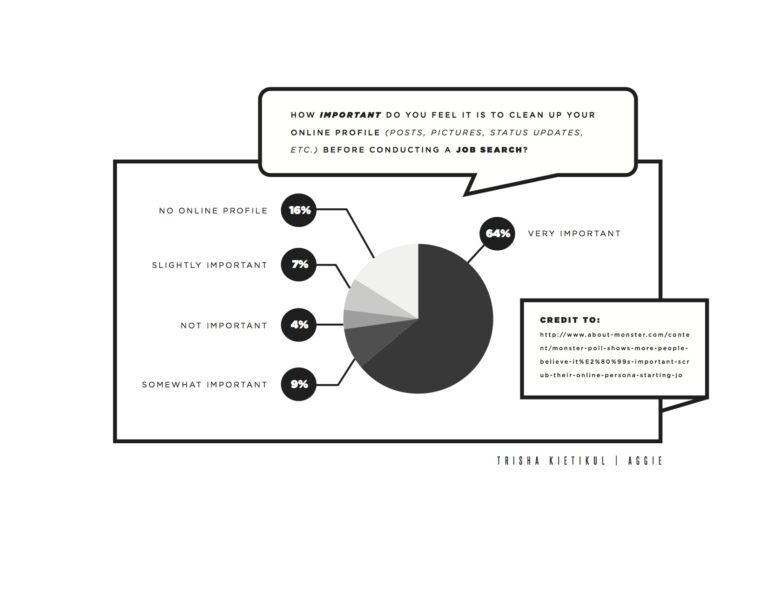
On the other hand, if they can’t find anything at all, you might be worse off.

“If I google a college student and I find nothing that is a turn-off. I am less likely to call that person,” Slayter said.

Being off the radar will add nothing to your resume.

For Aggies about to enter the professional world, cleaning up that Facebook and Twitter account and removing some embarrassing photos or that very public argument will be a step in the right direction. If you’re going to share your life with the internet, you have to manage it.

Also, manage what others have posted on your profile. There are settings that make it so you have to approve a tagged picture before it shows on your Facebook wall. Don’t let your friends compromise your goals.

Keep in mind that a lot can be deciphered about you based on what you post.

“If you can’t say something nice don’t say anything at all; especially on social media,” Kirk Holland said.

Try posting with a purpose.

“You want to make sure that you’re posting good things that present the professional, academic side of you … Post professionally-related things. Post things that show that you have interests in the work you’re hoping to pursue,” Slayter said.

Some companies are interested in your social media abilities. If you are reaching for a marketing position and dealing with a company’s social media they might ask for an in-depth look at yours.

“One of the things they want to do, in addition to checking out [the applicant’s] Facebook, companies ask for access beyond their privacy settings. They like people to ‘friend’ them so they have better access to their full page,” Kirk Holland said.

They might ask about how often you Tweet or Instagram to get a feel for your abilities.

Already have a job? Still be cautious, because according to Tarpey, data shows that 22 percent of employers have fired someone for using the internet for a non-work related activity, and 11 percent say they’ve fired an employee for something they posted on social media.

So be a social media expert. Conduct yourself in a respectable manner while being yourself. If you are applying to a job or grad school be sure to clean up your profiles because their eyes might move directly from your application to your Facebook wall. Looking for a professional social media? Try Linkedin, it can be a great resource especially if you have a portfolio to share.

Being online is a personal choice, so whether you are or not, remember that you are seen.

“Online privacy is an oxymoron,” Slayter said.

Tune In: Feb 13, 2014

0

Covers and Mashups

One of the great things about music is that it builds off of itself. As artists come and go, musicians’ influence upon each other occurs naturally. There is no question that modern music would be entirely different had it not been for classics from the ’90s, ’80s, ’70s and ’60s; even 18th-century classical music played a crucial part in paving the way for modern music’s growth.

Sometimes this influence is very indirect and hard to trace; for example, the Beatles’ influence on a band like Nirvana. The two may not sound anything alike, but I am willing to bet that among the large variety of bands directly influenced by the Beatles, at least a few found their way into a young Kurt Cobain’s headphones. From that point on, I could imagine how his understanding of music might have been slightly altered; enlightened, you could say.

Don’t get me wrong, though. Kurt Cobain is a musical genius with many, many independent ideas. I am just saying that influence is unavoidable among musical artists and listeners. What we hear develops our understanding of how music works, and then we build off of that understanding.

Sometimes, however, this influence is much more noticeable and direct. Case in point: musical artists covering or sampling each other’s songs. Sometimes the cover of a song is better than the original, according to some, and sometimes it murders the original, according to others. Often, we go long periods of time without even realizing that a song is a cover. Sometimes artists (especially rappers) sample parts of other songs, allowing a type of music to appeal to a whole new audience.

Every cover serves a different function. And with every cover or mashup comes debate. Here is my one-sided debate on a few covers:

1. “Landslide” (Original by Fleetwood Mac; covers by Smashing Pumpkins and Dixie Chicks)

One of the reasons that the original Fleetwood version of this song is so good is its simplicity. It features nothing but Stevie Nicks’ voice and an acoustic guitar. I find it perfectly made the way it is. I suppose Smashing Pumpkins and The Dixie Chicks felt so too, because both of their covers retain the simplicity by excluding bass, electric guitar, drums or any other yip yap, just like Fleetwood Mac did.
The Dixie Chicks added their country twang by using a banjo, and Smashing Pumpkins’ Billy Corgan’s rough, whiny voice gives their version its own unique spin. These covers exemplify a case in which the coverers leave the song pretty much untouched, only altering it slightly. Paying homage to the artistic style of the original is certainly a respectable way to go about covering a song.

2. “Hallelujah” (Original by Leonard Cohen; covers by Rufus Wainwright, Jeff Buckley and others)

When Leonard Cohen originally wrote this song, it was not set to music — it was spoken poetry. In his recorded version, you can tell that his singing skills are lacking, but the lyrics and melody he creates are beautiful. Jeff Buckley decided to create his own rendition featuring his awesome electric guitar. He keeps the lyrics and melody, but his guitar tone and style are amazing, and in my opinion, create a better sound than the original.

Then Rufus Wainwright took the song into his hands, creating what is possibly the most famous version of the three (you may have heard it in Shrek). He plays it on piano, accompanied by his strong voice. It sounds the cleanest and purest of the three, but I would still say that Jeff Buckley’s version is my favorite due to the flawless guitar playing.

These three versions demonstrate how a single set of lyrics and melody can shine through in many different musical styles, while retaining the spirit of the original.

3. “Thank You” (Original by Dido; sampled in “Stan” by Eminem)

The original version of this song is relaxing, and Dido’s voice is very peaceful. It has a ’90s pop beat and a totally light-rock feel. When Eminem made “Stan,” he kept the baseline and chorus of the original, slapped on a rap drum kit, and delivered a dark, distorted and lyrical rap. He twists Dido’s relaxing version into something much more ominous and disturbing. However, by doing so, he creates a song that appeals to an entirely new audience: rap fans. It’s amazing, and in my opinion Eminem’s song does complete justice to the original.

Covers exemplify how much artists are truly influenced by each other. Artists can pay homage to the brilliance and creativity of others, while displaying their own. The variety offered in covers, like the ones above, also allow songs the opportunity to reach a wider audience. Next time you listen to a great song, consider how it could be “enlightening” your overall understanding of music.

KDVS to hold Valentine’s Day event at Third Space

0

On Feb 14., Valentine’s Day, KDVS is holding an event featuring the bands Farallons, Taughtme, Pablo and Big Buff at the music, art and retail venue Third Space.

In a collaboration between KDVS and Third Space, DJ Drew Evans, host of the KDVS Monday morning radio show “Apartment 5,” and Chandler Lavin, director of materials at Third Space, worked together in scheduling the bands, who all hail from Northern California.

Both Evans and Lavin expressed excitement toward this event’s showcase of lesser known local talents whose sounds fall within the indie-rock spectrum.

“We look to exhibit and promote art that’s not already accepted or common in the community,” Lavin said. “Davis, as much as it’s diverse, is very homogenous in the [arts] culture. We’re trying to be an alternative venue, whether it’s music, theatre or performance art.”

Farallons, a band recently discovered by Evans, released their first EP Outer Sun Sets in 2013 and will be performing for the first time in Davis. They offer a hypnotizing blend of surf-rock coupled with vocal harmonies and synthesizer sounds.

Andrew Brennan, who performs vocals and guitar for the band, described his settling in the Ocean Beach neighborhood of San Francisco from the East Coast as a seminal and vital point in his musical career, whether through learning to surf or how to collaborate more seamlessly with other musicians.

“NorCal is instrumental to our music. Between the entire environment here [Northern California] and the place where we live [Ocean Beach], it’s an inspiring natural environment. It’s been really informative and eye opening, revealing a new music sensibility and a lifestyle I didn’t know growing up on the east coast,” Brennan saidj.

Brennan expressed the value of community arts venues and college radio stations because they are invaluable resources for the preservation of authentic talent in community art and music.

“They [community venues and college radio stations] are a springboard for everything music. Third Space seems like a really neat place to play … I love college radio; I think it’s the most relevant and enjoyable radio to listen to. Whether I’m on the east coast or here [Northern California], I seek out a college station for music. The DJs care about what they put out,” Brennan said.

Third Space, which recently reached nonprofit status in January, seeks to provide a venue for all artists, regardless of financial constraints or skill level. According to Lavin, their do-it-yourself, resourceful ethos has attracted a lot of enthusiasm amongst the Davis community, especially as the venue has offered an increasing amount of music and arts events, along with the availability of workshops and studio space.

“We get a lot of enthusiasm about what we’re doing here. There’s a lot of popularity for music events, of which we hold about five a month, and we’re getting art shows back on track and those have been pretty popular as well,” Lavin said.

Evans said this event is a testament to the strength of KDVS’s presence in the art community.

“KDVS is going strong — we’re holding a bunch of events,” Evans said in a phone interview. “We have DJs that hand pick music; there’s a human touch that’s very integral to our community. We’re hoping to be doing a lot more stuff with Third Space in the future.”

Third Space is located at 946 Olive Drive. The suggested donation for the event is $5.

Arts Week

0

MUSIC

Dr. Lonnie Smith Trio
Feb. 13 through Feb. 15, 8 p.m., $19 to $42
Mondavi Center
Organist Dr. Lonnie Smith, with guitarist Jonathan Kreisberg and drummer Jamire Williams, will be playing sets for three straight days this week. Smith played with guitarist George Benson in the 1960s before embarking on a solo recording career. The Jazz Journalist Association gave him “Organ Keyboardist of the Year” on five different occasions.

San Francisco Symphony
Feb. 13, 8 p.m., $50 to $94
Mondavi Center
The SF Symphony, conducted by Musical America’s 2012 Conductor of the Year Jaap van Zweden, will play two works: the Violin Concerto in D Minor by Sibelius, which will feature a solo by Simone Lamsma, and Tchaikovsky’s Symphony No. 4. There will be a pre-performance talk with Boston Conservatory Music History Coordinator Elizabeth Seitz an hour before the show.

“Lights Low” with The Afterglow
Feb. 14, 8:30 p.m., $7
Sciences Lecture Hall 123
Come spend Valentine’s Day with some a cappella groups. The concert will feature performances from two UC Davis groups: The Afterglow, a male group, and The Spokes, a female group. Also performing are The UC Men’s Octet from UC Berkeley and The Hightones from UC Santa Cruz.

UC Davis Symphony Orchestra
Feb. 16, 7 p.m., $8 students and children, $12 to $17 adults
Mondavi Center
The UC Davis Symphony Orchestra, conducted by Christian Baldini, will perform four works by Schumann, Berio, Sibelius and Ravel. Artist-in-residence Lucy Shelton, a soprano singer, will perform on the Berio and Sibelius pieces.

The Chieftains
Feb. 19, 8 p.m., $35 to $68
Mondavi Center
Acclaimed group The Chieftains has been performing traditional Irish music for over 50 years. During this time, they’ve played a concert for Pope John Paul II, won six Grammys and appeared on the soundtrack to Stanley Kubrick’s film Barry Lyndon.

ART

2nd Friday HeArtAbout
Feb. 14, 5 p.m., free
Downtown Davis
Another monthly installment of an art-themed event in which several art receptions and events happen throughout the downtown area. This month features a romantic theme. You can find a guide to the events in this month’s ArtAbout in the Davis Dirt.

Classic Film Festival — The Apartment (1960)
Feb. 16, 6:30 p.m., donations encouraged
Davis Odd Fellows Hall, 415 Second St.
The three-week long Classic Film Festival concludes with this 1960 Billy Wilder Best Picture winner. The film tells the story of C.C. Baxter, played by Jack Lemmon, a man who lets his bosses use his apartment for their affairs as well as his relationship with Fran Kubelik, played by Shirley MacLaine.

DRAMA

A Night of Shorts
Feb. 15, 8 p.m., admission by donation ($5 to $10)
Wright Hall, Lab A
Studio 301 Productions, a student-run theatre group, will present a one-act play along with two radio plays. Featured productions include “Lion Hunting” by Abbott and Costello, “Sure Thing” by David Ives and “Help Me, Doctor or: Oh The Place You Won’t Go” by Jonathan Goldstein and David Rakiff.

Studio 301 presents “A Night of Shorts!”

0

On Feb. 15, student-run theater group Studio 301 Productions will present “A Night of Shorts!” The program consists of two radio plays, Help Me, Doctor and Lion Hunting, and a one-act piece, Sure Thing, all of which are directed by undergraduates.

Studio 301 is now in its 10th season, having started in 2004. It is an entirely student-run undergraduate club, and they put on one show per quarter. Past productions have included RENT, Cabaret, The Last Five Years, Beyond Therapy and A Midsummer Night’s Dream.

“Studio 301 is known for putting on bigger productions in the past,” said Audrey Shih, a fourth-year English major and director of Sure Thing in an email. “In an effort to switch things up a bit and try new things, Kevin Adamski, one of the other directors for the show, and a few of the Studio 301 officers came up with the idea of putting together something much more free form with low time commitment.”

A radio play is a purely acoustic theater piece, usually performed by a panel of performers. The medium has seen a resurgence due to podcasting and online radio streaming. Lion Hunting is originally by Bud Abbott and Lou Costello, while Help Me, Doctor premiered on WireTap with Jonathan Goldstein.

“Usually our productions are a play or musical, so this is the first time we have ever presented a ‘festival’ of shorter pieces,” said Marissa Saravis, a fourth-year dramatic art major and president of Studio 301 in an email.

Shih said to expect a more relaxed and freeform showcase in “A Night of Shorts!” due to the less formally produced nature of the acts.

“Originally, [Adamski] expressed interest in directing a radio play and then Studio 301 felt it was a great opportunity to turn it into a ‘Night of Shorts’ to feature a few short theater pieces… [I] wanted to direct Sure Thing for a long time, and felt this was the perfect opportunity to showcase it, [so] I accepted,” Shih said.

Sure Thing’s plot watches a happenstance meeting of two characters, whose conversation is repeatedly reset by the use of a bell, the conversation correcting itself whenever one of them responds negatively to the other.

Kevin Adamski, who majored in dramatic art and graduated last year, has been sporadically involved in Studio 301 since 2009. He is directing the radio play Help Me Doctor, which is also called Oh! The Places You Won’t Go. It is based on a correspondence between Franz Kafka’s Gregor Samsa and Dr. Seuss.

“The story addresses themes of hope and despair in a unique way using recognizable characters. I really wanted a way to share this story, but due to its short length I knew it wouldn’t necessarily stand on its own as a performance,” Adamski said in an email.

Zoë Samborski, a fourth-year dramatic art major and publicity coordinator for Studio 301, said audiences can expect an evening full of laughs and quick-paced stories.

Studio 301 will be producing a large-scale performance in the spring, and auditions will take place on March 31 and April 1.

“Studio 301 will be presenting Seussical the Musical, opening May 9 in the Wyatt Pavilion Theatre, running both that weekend and the next. It’s sure to be a fun, colorful, over-the-top production,” Saravis said.

Doors for “A Night of Shorts!” will open at 7:30 p.m. on Feb. 15 in Lab A of Wright Hall. Admission is free, but it is suggested that attendees donate $5 to $10.

The Afterglow to host Valentine’s Day concert

0

Looking for something new to do with your date this Valentine’s Day? How about getting serenaded with your favorite love songs? If so, then UC Davis’ all-male a cappella group, The Afterglow, has just the event for you.

On Feb. 14, The Afterglow is hosting their third annual “Lights Low” concert, a romantic-themed annual show that is always done as close to Valentine’s Day as possible.

The group of 14 UC Davis students will be performing new songs they’ve been working on as well as some old pieces. All of the songs are performed a cappella, meaning only vocals will be used to present the songs.

Alongside The Afterglow, the concert is set to feature UC Davis’ The Spokes, UC Santa Cruz’s The Hightones and the UC Davis band Jadoo. The only group that is not performing a cappella is Jadoo. The Spokes and The Hightones are all-female groups while the Men’s Octet is an all-male group.

“The premise behind the groups we invited is that they’re single-sex groups,” said Justin Nool, a fourth-year human development major and Afterglow music director. “All-male-all-female concerts are one of our traditions.”

Jadoo was added after UC Berkeley’s Men’s Octet had to drop out. Jadoo is a five-person band that fuses Middle Eastern and Western musical perspectives, and Jadoo means “magic” in Farsi.

The Spokes and The Afterglow have worked together many times throughout the years. They expressed excitement about performing a new repertoire that will feature some new soloists from their groups. Their set list will include “Bones” by Ginny Blackmore, “I Need Your Love” by Ellie Goulding and a “Kiss Mix” mashup featuring pieces of “Kiss the Girl” by Katy Perry, “Kiss the Girl” from Disney’s The Little Mermaid and “Kiss Me” by Sixpence None the Richer.

Fourth-year English major and Spokes’ President Rachel Riley expressed her excitement about performing this setlist at “Lights Low” in an email.

“We’ve chosen songs that revolve around love, though each song features a different kind of love,” Riley said. “We’re stoked to perform our ‘Kiss Mix’ medley at a show for the first time! It’s a cool fusion of a Disney song and a 90s classic.”

The UC Berkeley Men’s Octet and UC Santa Cruz’s The Hightones have worked with The Afterglow on past occasions and said that they will likely draw some fans to the concert. The Men’s Octet is a world-renowned all-male group that performs everything from current popular hits to classic Sinatra pieces. The Hightones are known for their fun high-energy performances and repertoire.

The Afterglow has decided not to release their set list for the show as they wish to surprise their audience with what they have to offer. The group is planning on adding a unique intimate touch to the show. Fourth-year technocultural studies major and Afterglow member Otelo Contreras explained the atmosphere the group hopes to create at the concert.

“There’s a different energy we sort of bring [to a concert] than other groups,” Contreras said. “We’re all really good friends and we all interact with each other on stage. I feel like that draws people in a little more. It’s more of a show when you get to know the characters in the group.”

Whether you have a valentine or are riding solo, The Afterglow encourages anyone who enjoys a cappella music to attend the concert. Fourth-year environmental science and managerial economics double major Kevin Pelstring is the president of The Afterglow and wants everyone to know the concert is a welcoming environment for all.

“If you don’t have a date, come to our concert and you’ll have at least 14,” Pelstring said.

Tickets for “Lights Low” can be purchased $7 presale through the UC Davis Ticket Office or at the door for $12. The show will be at 123 Sciences Lecture Hall and doors open at 8 p.m.

ASUCD Elections Committee holds election debate at CoHo

0

On Feb. 11, the Elections Committee and The Aggie hosted the ASUCD 2014 Election debate at the ASUCD Coffee House. The Senate candidates were on stage from noon to 1:10 p.m. and the Executive candidates were on stage from 1:20 to 2:30 p.m. Chairperson of Elections Eric Renslo and Campus Editor Scott Dresser moderated the debates.

Dresser asked the prospective senators how they believed they would accomplish their platforms through Senate, elaboration on their platforms and how involved they are in Senate. He asked the executive candidates a series of questions such as their opinion on the relationship between the administration and ASUCD, issues they believe should be addressed at ASUCD and how they plan on carrying out their term.

Renslo asked both the senate and executive candidates their thoughts on ASUCD Ballot Measure #1.

AggieTV livestreamed the event, which can be viewed at elections.ucdavis.edu and YouTube.

Voting can be done at elections.ucdavis.edu, and begins on Feb. 18 at 8 a.m. and closes on Feb. 21 at 8 a.m.

— Claire Tan


WarnMe Alert system to be updated

0

The WarnMe system, which sends emails to notify students of emergencies happening on campus, is currently being updated to also inform students of crimes on campus.

Matt Carmichael, chief of the UC Davis Police Department, said the difference between a WarnMe alert and a timely notification is that a WarnMe is sent out to the community in emergencies to notify people to do something.

“When an incident occurs on campus we are required under the Clery Act to send out a timely warning,” Carmichael said. “A timely warning is sent out for limited events that are not expected to continue.”

Nick Crossley, the emergency manager of the UC Davis Safety Services, makes sure the WarnMe system is working and is coordinating the new updates.

“I work with students and faculty to coordinate disaster relief, responses and preparedness,” Crossley said. “The WarnMe system falls under that.”

According to Carmichael, the new updates will send timely warnings of crimes that happen on campus to students by email instead of through paper bulletins.

“We expect that sending crime bulletins via email will help solve crimes,” Carmichael said. “We already get several tips off our paper bulletins, but by reaching a wider audience, we expect to receive more tips.”

According to Crossley and Carmichael, the WarnMe alerts are sent to everyone with an @ucdavis.edu email, and the new notifications will be sent similarly.

“Everyone with an @ucdavis.edu address is sent WarnMe alerts which includes alumni and retired faculty members,” Carmichael said. “We can isolate the addresses to send emails only to people on campus.”

Students can sign into their profiles at warnme.ucdavis.edu and add other personal email addresses and cell phone numbers to be notified.

“We want 100 percent of people to add their cell phone numbers to their profiles,” Crossley said. “Right now, we are at 55 percent. Phone is the quickest way to be notified and we would only use a student’s number for emergency purposes.”

“We strongly recommend that students add their phone numbers to their WarnMe profile to make sure they are alerted,” Carmichael said.

Students Annette Miramontez, a first-year design major and Kimberly Mitchell, a first-year English major said the new updates will be helpful to the student body.

“It would be good to know because we would be more aware of what’s going on,” said Miramontez. “I have my phone on me all the time just about so if I get an alert I can just check it right then and there.”

Mitchell stressed the importance of getting timely notifications.

“I think knowing things on time or right after it happens is good. It’s good to know,” said Mitchell. “Even if it is a crime that seems isolated, it could still affect the campus because we don’t necessarily know everything about the crime. It’s better to have an idea about what’s going on.”

Asian American Association gets ready for 10th Anniversary Film Festival

1

Emily Nguyen, a fourth-year economics major, is the co-director for the Asian American Association (AAA) Film Festival, and in her film festival folder she has images of buttons featuring statements that directly deny popular Asian American stereotypes.

The buttons read: “I don’t get red when I drink,” “I am not your translator,” “My eyes are open,” “I’m not a science major,” “I’m well endowed” and “I was born here.”

The AAA Film Festival is an event held for two weeks in May every year at UC Davis. Wesley Kan, a second-year neurobiology, physiology and behavior major and the publicity coordinator for the festival, said that each year the group comes up with a general theme and finds movies that follow that theme in ways that relate to the Asian American community.

“It’s a way for people who don’t really know much about Asian Americans to see different sides. You know there’s all these stereotypes about Asian Americans, so this film festival is a way to show that they’re [not true],” Kan said.

Nguyen said that this particular film festival has been put on for the past 10 years.

“This year is going to be our 11th film fest which means it’s our 10th anniversary. Basically our theme this year is celebrating the history of [the film festival] and the things that we’ve done,” Nguyen said.

Part of that celebration will be the return of student films. Nguyen said that the AAA Film Festival is currently taking submissions of five-minute short films either made by or starring UC Davis students. The films will be judged, with the winner receiving a $100 cash reward. However, all the films submitted will be shown in the last day of the festival.

The contest is open to students of any ethnicity, but each should have either an Asian American actor, director or theme.

“A lot of people think, since we’re the AAA film fest, it has to be about the Asian community, but it actually doesn’t. It could be anything,” Nguyen said.

Although each year the festival has a different, specific theme, Nguyen said it is always under the overarching theme of defying stereotypes. The films are chosen with the goal that they will showcase the unique circumstances of the Asian American community as well as how they relate to other communities. This year’s theme will follow that same pattern.

“We just want to show that we are not just a stereotype, that we can break out of that,” said Catherine Chiang, a first-year economics major and liaison for the AAA Film Fest. “A lot of the films that we’re picking right now show that we can think for ourselves.”

The film festival is currently in the planning stages, which began Fall Quarter and include advertising, theme and film selections, fundraising and collecting student films for the contest.

A theme has not been finalized yet, but the selection process has boiled it down to two words.

“We start brainstorming the first week of Winter Quarter, and we just jot down words,” Nguyen said. “We’ll have a bunch of lists of words like ‘food,’ ‘science,’ ‘stereotypes,’ ‘respect.’ We go through it and try to think more about the words that are listed. For this year, the words that came to us were ‘dreams’ and ‘expectations.’ Our theme is going to revolve around that.”

The theme is not the only criteria for choosing films. Chiang said they prioritize independent films in order to showcase those that have been viewed less. Many of the chosen are adopted from other film festivals not affiliated with UC Davis. Kan said that they are often diverse in themselves, with a range of different but relatable topics.

“For picking the set of films we want to balance out drama and comedy,” Chiang said.

Of the films Nguyen said were currently being considered, there is at least one drama, one comedy and one documentary. Each of them are concerned with the conflict between parental or societal expectations and following your dreams, a problem that Nguyen said she has personally experienced.

“I want to be a photographer, but look at me, I’m at UC Davis doing an econ major. But that’s mostly because I have parents that are like ‘you have to go to a good university and do an academic major, you can’t just do an art major,’” Nguyen said.

According to Nguyen, the cost of showing each film ranges from $100 to $500, depending on the production company. Kan, however, emphasized that the coordinators do a lot of work to make the movies free to the viewers.

“We fundraise for the films, because the films that we bring here are not free. We want the films to be free for all students, so we raise money so people can just come and watch them for those two weeks,” Kan said.

Nguyen said they are having continuous fundraisers from now up to the date of the festival, every Thursday at the Memorial Union. The deadline for student film submissions is April 17.

UC Davis Veterinary Center to expand dog socialization program

1

For the past year, the UC Davis Veterinary Center has been holding puppy socialization classes coined “Yappy Hour” for dogs eight to 14 weeks old. The program began expanding in January.

The class, at one time free and just twice a month, now costs $80 for a package of four classes. Classes are Tuesdays and Thursdays at the Center for Companion Animal Health Lobby from 6:30 to 7:30 p.m. New puppies and their owners can drop in on the first and third Tuesday of any given month.

The class covers topics such as car safety, “novel substrate” socialization, riding in elevators and a training method called “nothing in life is free,” among other lessons.

Clinical assistant professor of Yappy Hour Tami Pierce explains that it is absolutely vital that puppies get socialized between three weeks to 14 weeks old — a critical socialization period.

“Dogs that aren’t socialized are prone to behavior problems such as fear, biting and anxiety. Dogs down the line will tend to not be as social and this is a huge problem … we give [clients] skills to go out on the rest of their days to teach the puppies to be socialized to people, places, sounds and substrates,” Pierce said.

In general, veterinarians recommend that puppies don’t interact with other dogs until they’ve received all vaccinations. To attend Yappy Hour, however, they only require one examination with the veterinarian and documentation of being dewormed and having received their first DAP vaccine. These regulations have met with some criticism, but according to Pierce, research shows that the importance of socialization outweighs the risk of contracting disease.

“A study came out of UC Davis published by Meredith Stepita that looked at puppies that go to socialization class and risk of parvo. It basically showed that dogs that go to socialization have no more risk than dogs that don’t go. We feel that it’s really an important part of raising a healthy puppy,” Pierce said.

The leading problem of premature death in dogs is not disease but actually social behavioral problems. The goal of the program is to give clients the skills and encouragement to train and socialize their puppies before the critical period has passed. Additionally, as UC Davis is one of the leading veterinary schools in the nation, the program serves as a teaching tool for resident veterinarians.

“Part of the impetus in having the program was expanding to train veterinarians in the importance of puppy socialization. We want veterinarians to offer basic information on behavior and stop behavior problems before they start. It’s the preventative method in the field to teach clients how to address these problems before they start,” Pierce said.

Additionally, one of the biggest problems with not socializing puppies is that it increases the likelihood of an owner surrendering their dog. The Yolo County Society for the Prevention of Cruelty to Animals (SPCA) anticipates this common problem by taking surrendered dogs from the Yolo County Animal Shelter and putting adoptable animals in foster homes.

Kimberly Kinnee, executive director of the Yolo County SPCA, explains that as a foster home based program, the majority of their animals come from people that didn’t have the time or the money to care for the animal, from new litters of animals or more rarely as strays.

“It can be a 10 to 20 year commitment. You have to be ready to have this animal be dependent on you emotionally and financially. You need to be able to provide for the animal for the course of its life,” Kinnee said.

This is a huge problem, Pierce explains, because when an animal is abandoned because someone cannot care for them, it is impossible to resocialize the animal.

“Dogs can’t be resocialized but they can be desensitized and counter conditioned … We have ways of decreasing their fear and anxiety but it’s not as effective,” Pierce said.

What foster animals need, Kinnee explains, is to feel part of the pack and loved. Eva Freel, a fourth-year pharmaceutical chemistry major, adopted her first dog at the SPCA and has been fostering dogs ever since.

Freel has fostered dogs since she got her first dog. Though the job is unpaid, she sees it as a “win-win” situation — the foster dog relearns that it can live in a safe environment, her dog has a companion and she gets to live with as many as four dogs at a time.

“It’s pretty common to see college students adopt an animal, and then give it away within a year or two. The foster system is really easy to get involved in, and it provides a great resource to learn how much work an animal is, and to determine whether having one fits your lifestyle,” Freel said.

Bowen Noack, a second-year biotechnology major, realized how much work taking care of a dog was. He got his German Shepherd-Siberian Husky, Reagan, when it was just eight weeks old; after two months, he realized he had to return the dog to its first owner because it wasn’t the right fit for either of them.

“Caring for another life and being fully responsible for it is a really demanding task … my advice to someone getting a dog in college comes in a series of questions — why do you want a dog?

who can you depend on to take care of it when you need to? Is your living environment suitable for the breed?” Noack said.

This situation is a common one, Pierce said. She said she believes to be successful in owning a dog as a college student, it’s important to research the breed that best matches one’s lifestyle and actually talk to a vet who can give a good recommendation.

“We are a resource for people to pick the right breed. Once they have the puppy, take it to the vet, have it examined, then sign them up for a socialization class, [they can] get some basic socialization training in that critical period,” Pierce said.

And though owning a dog as a college student can be a challenge, Freel believes it can be a good learning experience.

“Adopting is a lifelong commitment to that animal, which I think some people forget. It is not just a furry stuffed animal— you are agreeing to love and care for something for the rest of its life,” Freel said. “However, if adopting is the right thing for you, it is such a beneficial and educational experience.”

California to receive aid for drought

0

The California drought is causing “extremely dry conditions [that] have persisted since 2012” and is affecting both communities and wildlife, said Gov. Jerry Brown. According to state officials, 17 rural communities that span from Santa Cruz to Sonoma counties in California are in danger of running out of water within four months. The California Department of Public Health (CDPH) compiled a list of the communities at risk.

“As the severe drought continues, we’re working with impacted communities to identify alternative water sources and additional resources,” said CDPH director Dr. Ron Chapman.

The 17 rural drinking water systems identified serve communities that range in size from 39 to approximately 11,000 Californians. There are approximately 3,000 community water systems that provide water in California.

This announcement is following Gov. Brown’s emergency drought proclamation earlier last month on Jan. 17. This proclamation identified communities that may run out of drinking water. It also “[provides] technical and financial assistance to help these communities address drinking water shortages” and “[identifies] emergency interconnections that exist among the state’s public water systems that can help these threatened communities.”

The U.S. Bureau of Reclamation and Natural Resources Conservation Service said that another $14 million will be distributed for water management improvements in the state, a day after Agriculture Secretary Tom Vilsack had already committed $20 million. This was announced as the U.S. House of Representatives passed a bill that would temporarily stop the restoration of the San Joaquin River and allow farmers to pump delta water more freely.

The drought not only affects drinking water but also local wildlife. California’s Fish and Game Commission has continued the ban on fishing in drought-afflicted state waterways. State wildlife officials said that the drought-related fishing closures are the largest that the state has ever enforced in California.

The Steinberg Bill, proposed by Senate President Pro Tem Darrell Steinberg (D-Sacramento), would set a July 1 deadline for state agencies to approve water recycling and stormwater reuse projects. Political consultants said that the Steinberg Bill would expedite aid for communities facing the drought. This bill would also redirect millions of dollars intended for climate-change relief to water conservation projects. Senator Steinberg is currently working on this legislation.

The City of Davis is taking precautions to mitigate the effects of the drought. Both the city and campus fire departments “are being cautious with water use during [their] regularly scheduled training, but when it comes to fire ground operations there is no change,” Fire Chief Nathan J. Trauernicht of the City of Davis and UC Davis Fire Departments said.

The dangerously low drinking supply isn’t the only thing that should be worried about though.

“The drought brings an increased risk statewide for wildfire and fire in the wildland-urban interface. That translates to an elevated fire threat in the interface locally and a higher likelihood that firefighters from both agencies will be called out as part of the statewide mutual aid system for fires in other parts of California,” Trauernicht said.

The City of Davis is discussing making a drought update to the City Water Conservation Plan.

“[The] item is going to City Council [Feb. 11 regarding] drought update and conservation,” said Diana Jensen, principal civil engineer for the City of Davis. “Everything that it is recommending is voluntary.”

Some recommendations will include receiving an update on the declared California State Drought and approving a resolution proclaiming water use reduction.

The meeting will also discuss considering the addition of a Water Conservation Specialist during the budget cycle for the 2014-15 fiscal year. According to the agenda for the meeting, “this staff person would not only be the lead for education and public outreach, but also have knowledge of drought tolerant landscapes and irrigation demands of all types of landscape.”

Jason Emmons, president of the Environmental and Water Resources Institute Student Chapter at UC Davis, said that adaptation of a culture of conservation is necessary.

“Students must be conscious about the problem,” Emmons said. “[I’m] drafting a resolution that will be [submitted] [before] the ASUCD to review for the committee. Students agree that we need actions taken quickly and [we will do] as much as we can do to preserve water. It’s just informing people.”

Nathan Wright, a Davis resident, said that he is practicing good water conservation habits by shutting off the water when he showers and watering his lawn less.

“[I] wasn’t aware that the drought was this bad,” Wright said.

Additional information and resources about the current drought state may be found at CDPH.CA.gov or droughtmonitor.unl.edu.

News in Brief: UC Davis Wears Red Day falls short of world record

0

On Feb. 7, UC Davis Wears Red Day took place on Hutchison Field. The event looked to raise awareness for heart disease as a leading killer of men and women in the U.S. by attempting to break the world record for the largest human heart formation.

According to Andrew Crotto, event manager at UC Davis, 12,000 people were expected to attend the event to break the world record of 11,166 people for the largest heart formation. The total turnout for the event was approximately 2,386 people.

Crotto said in an interview that the event was a success in the sense that a variety of student organizations and faculty members were present to raise awareness together. Although the world record was not met, the event was still a success in terms of promoting education for heart disease in the United States.

“Our expectations for the event were definitely met,” Crotto said.

Among the various UC Davis groups present were members of the Cal Aggie Marching Band, a variety of sorority and fraternity chapters and members of the UC Davis faculty.

In the hopes of educating UC Davis students and faculty, Chancellor Linda P.B. Katehi spearheaded the event alongside Dr. Amparo Villablanca, director of the UC Davis Women’s Cardiovascular Medicine Program, and Adele Zhang, curator of the UC Davis Design Museum. The planning for the event began six months ago, according to the chancellor.

Katehi said that the event was created to “come together and recognize together that cardiovascular disease is really a number one killer disease among women.”

Barbara Jahn, the swim coach at UC Davis, attended the event alongside other UC Davis faculty and students. Jahn teaches an aerobics dance class through the physical education program at UC Davis.

“It’s all about getting a healthy heart, so I thought this was a perfect opportunity to promote a healthy heart and healthy living,” Jahn said.

According to Crotto, it is undecided as to whether or not UC Davis Wears Red Day will become an annual event. An ultimate decision has not been made.

Katehi stressed the importance of educating students about heart disease.

“This disease can be avoided. This is a disease that kills young people between the ages of 35 and 55 primarily, so it is very important that we educate our students,” Katehi said.


— LAURA FITZGERALD

Police Briefs: Feb 13, 2014

Tuesday 2/4

It’s all in the delivery
Someone on Kestrel Place discovered three fraudulent charges on his credit card totaling $800, then inadvertently received a package addressed to the suspect.

Thursday 2/6

Pet peeve
The reporter asked a man on Albany Street not to smoke and he became aggressive, threatening to come back later and harm the reporter’s cat.

Friday 2/7

Creepy crawlies
Someone was crawling underneath a house that is uninhabited and for sale on 11th Street.

Dog eat dog world
Someone’s roommate threatened to release the person’s dog into the street so it would get run over on Fifth Street.

Saturday 2/8

Drive up the wall
Someone on Bellows Street drove into the retaining wall of the reporter’s house and fled the scene.

Sunday 2/9

Can’t handle the truth
A woman was making customers on Richards Boulevard uncomfortable by acting odd and talking about sex trafficking in Africa.

Police briefs are compiled from the City of Davis daily crime bulletins. Contact EINAT GILBOA at city@theaggie.org.

Davis Pedicab expands toward big leagues

0

The Davis Pedicab is a human pedal-powered taxi service driven by independent contractors, and this long-trusted method of local transportation is now hoping to expand beyond Davis.

The founder, Andrew Watters, started the organization with future plans of expansion in mind. Each year the Pedicab organization has progressively broadened its network, and is now beginning to move toward working for bigger places and events instead of focusing solely on Davis.

“The whole concept [of] Davis Pedicab isn’t just about Davis itself, but it is the place that ultimately serves as our home-base,” Watters said.

Watters has attempted to get a program involving his pedicab business going with UC Davis. However, despite making presentations to ASUCD and attempting to partner with Tipsy Taxi, this ambition was not realized.

“I tried to get something going with the school formally. Davis is a good place to have this future concept of ‘people moving transportation,’” Watters said. “It’s interesting because you think that they’d be all over it, but they’re not.”

For the past few years, the pedicabs, which are essentially bikes pulling attached seating areas, have provided the people of Davis with cheap, safe rides to their desired destinations. They can be seen riding around campus and downtown on Thursday, Friday and Saturday nights, and there is no set rate for a ride as passengers and drivers negotiate a price they both agree is fair.

“I have a three-and-a-half year old, and so part of the reason I’m doing all of this is to do what I can with my experience to make the world run a little bit better. It’s a pretty simple concept,” Watters said.

Riley Sims, a first-year psychology and international relations double major, said she was playing basketball the night she twisted her ankle and needed the pedicabs to get home.

“The driver picked me up and was really nice and took me back. He was also super funny — which made the ride less painful and more enjoyable. It was a great experience, however, it was really cold!” Sims said.

Watters brought the organization to Davis in January 2011 with over eight years of previous experience.

“Davis is a local operation, but what we mainly do and what Davis Pedicab was originally started to do was to be an event-based Pedicab business that travels in and out of California doing music festivals and concerts and such,” Watters said. “So imagine 20 pedicabs at a music festival, like 30 or 40 drivers driving all day and night — that’s what we do and are going to be doing throughout the state.”

In 2011, the organization was solely in Davis, only testing out a few events. The following two years, however, they began expanding within California, and have now begun operations on the East Coast.

“Now, 2014 is about capitalizing on our experiences and basically bringing it to the big leagues,” Watters said.

During the weekend of Feb. 8 and Feb. 9 the pedicabs worked a private event in San Francisco. They are working other large events inside California, such as the Sierra Nevada Music Festival, Lightning in a Bottle and the Bloomsville Beer Festival, as well as big East Coast music festivals.

The Pedicab business is split into two separate organizations, one serving Davis and one serving places elsewhere. When the Pedicabs are running in Davis, they are officially called the Davis Pedicab. The business outside of Davis, which is called Pedicab People Movers, was more recently created to further the expansion of the Pedicab system.

Even with the growth of the organization, however, the Pedicabs will still provide rides to the students and community members of Davis.

“For the next year or two we probably won’t have solid, consistent local operations on a day-to-day basis where people can call and we’ll be there all the time. We’ll be out some weekends and we won’t be out other weekends,” Watters said.

The transition from a local focus to a broader focus is now more evident, and Watters said the cabs haven’t been getting as many calls for rides in Davis in the recent years.

“I had no idea that they existed! But one night I was walking back from my friend’s dorm and this guy just showed up and asked if I needed a ride,” said first-year psychology major Zsofia Burdsall.

Watters maintained that the Pedicabs will stay in Davis, but that they will be decreasing the local service in order to satisfy the larger events that are now on the table.

“I wish I had more time to spend locally on it — it’s ironic because I actually just moved to Davis from San Francisco, after having lived there for five years,” Watters said.

Despite this, Watters said that he did have plenty of memories from the past few years in Davis, though admittedly none as absurd as the ones from San Francisco.

“I could tell you all sorts of crazy stories, but none of them G-rated. We’re basically just dealing with the night-life and the bar scene — you deal with other people’s drama and you deal with drunk people and get them home. People puke on the side of the cab sometimes, people try and jump off it, people holler at everybody and everything,” Watters said. “I’ve had crazier stuff happen in San Francisco; Davis is pretty tame.”

Annual Pilipino/a Youth Conference celebrates thirteenth year

0

The 13th Annual Pilipino/a Youth Conference (PYC) took place at UC Davis from Feb. 7 to Feb. 9. The conference was hosted and sponsored by BRIDGE, the UC Davis Pilipino/a Outreach and Recruitment Club and the Student Recruitment and Retention Center (SRRC).

PYC is a three-day event that aims to promote higher education to high school students around the Bay Area. Students from areas in which higher education is not typically promoted are specifically contacted and asked to join the conference. Conference attendees came from areas such as Stockton, Vallejo and Union City.

Michael Baliton, a second-year biological sciences major and intern for PYC said that the conference is geared towards Pilipino/a students, but anyone is welcome.

“The goal is to promote higher education for students who may not know what their options are,” Baliton said.

The conference cost $30 to apply. Some money provided by BRIDGE was put aside for payment plans for students who could not afford the application fee. BRIDGE and the SRRC sponsored the rest of the event. The SRRC is funded through the UC Davis Facilities And Campus Enhancement (FACE) Initiative, which allocates $18 from every undergraduate student’s tuition to facilities on campus.

High school students were supplied a hotel for two nights and three days of workshops during the conference. The conference was made up of an assortment of workshops addressing art, culture, education and activism. They were based around the Pilipino/a culture and self-identity, social and political activities to help youth get involved with the community, cultural dance and verbal expression.

“The goal is to teach high school students about Fil-Am culture with an overall theme of higher education,” said Robyn Huey, the community mentorship advocacy coordinator for BRIDGE. “They come from environments that don’t promote higher education and may not have mentors who can help them. It’s awesome to see them come to UC Davis and thrive.”

Creating a sense of community for students was another one of the main goals for the conference. The community can help show students that even people in their positions can make it to college.

“Students are unaware of the resources available,” said Jessica Page, a recruitment coordinator for BRIDGE. “This gives them a space to talk about college and meet college students who have been through similar struggles.”

Abby Saavedra, a second-year psychology major and an intern for PYC, said she is happy to be a part of the conference because she wants to be able to pass on the knowledge she has gained since starting college.

“PYC is a way for us, as established college leaders, to give back to the community and high schoolers,” Saavedra said. “We’ve been there before and now it’s our turn to help them.”

Jonathan Abel, another recruitment coordinator for BRIDGE, thanked PYC for being what first brought him to Davis and leading to him apply later on.

“I got dragged to PYC. I really didn’t want to go,” Abel said. “But it gave me a voice and helped me find my own path. The community atmosphere also empowered me to think of things other than myself.”

Although this is the thirteenth year for PYC, Huey said that high school recruitment through the Pilipino/a clubs on campus has been going on since 1987. It was originally done through Mga Kapatid (MK), which is still a club on campus today.

“Outreaches give students a chance to explore campus and talk to people who come from the same places as them,” Huey said.

BRIDGE received help from many groups within the UC Davis Filipino-American community in the workshops that were put on for the conference. Roles for PYC  included volunteers and interns who helped with outreach and paperwork, organizers for the event, chaperones for high school students and speakers for workshops.

Michael Bolos, the gender and sexuality coordinator for BRIDGE, worked with PYC coordinators and counselors to ensure an equal and fair treatment for everyone attending the conference.

“I help educate people on marginal identities, different intersectionalities and how to be inclusive for all identities,” Bolos said. “I personally come from a disadvantaged background, and I’m glad that there are people to put on these conferences. I think it would have been very important for me if I had had the chance to go.”

Abel said that this year’s PYC was a great success. About 145 high school students were accepted to the conference, but 50 dropped out due to the rain. Abel said that the drop in numbers was fortunate, because there may not have been enough resources to supply for all 145 of the students.

“I couldn’t have asked for it to turn out any better,” Abel said. “The rain was actually a blessing.”

Huey said that a mural representing PYC went missing from Olson Hall on the Saturday morning of the conference.

“Since the conference is over, we aren’t as intent to find it, but we still want to try since one of our counselors spent a lot of time and effort painting it,” Huey said.

Upcoming events with BRIDGE include a benefit concert that will supply scholarships to Pilipino/a UC Davis applicants and a picnic with high school students.

“We have a lot of chances for high school students to come back and get exposed to college,” Abel said. “PYC is not just a one-time thing.”