53.5 F
Davis

Davis, California

Tuesday, December 23, 2025
Home Blog Page 894

Annual Davis Turkey Trot to take place on Nov. 23

0

On Nov. 23, the Change of Pace Foundation will host the 26th  annual Davis Turkey Trot. The Davis Turkey Trot is a marathon held each year on the Saturday before Thanksgiving in order to provide participants with a fun, healthy and positive community event. The event is open to kids and adults, and also serves as a social function to encourage fitness.

Dave Miramontes, executive director of the Change of Pace Foundation, and his wife created this race back in 1987 under the Foundation. Miramontes noted a major problem in the region — the big gap in fitness events (specifically running) across the community.

“Davis was selected as the location due to the city being such an active community. The event brought the region new features that were not present in Northern California. Such items were computerized timing, elite athletes and a high profile marketing package,” Miramontes said.

According to Miramontes, this event greatly benefits the City of Davis in various ways.

“The event promotes physical fitness and provides the community a high profile event that they don’t have to travel to,” Miramontes said. “The event promotes the City of Davis and showcases the safe roadways and numerous greenbelts that make our city so great.”

By drawing over 8,000 participants and spectators to the City of Davis during the weekend of the event, businesses, restaurants and hotels receive economic benefit.

Additionally, the event has many fraternities, sororities and service groups assisting with the production of the event.

The Change of Pace Foundation also provides scholarships to many less fortunate kids and their siblings. The goal is to enable all interested runners an opportunity.

The 5K or 10K race is priced at $25 to $35 depending on the time of purchase. The Half-Way Marathon is $45 to $55 depending on time of purchase as well. The Half-Way Marathon Two-Person Relay is $70 to $90 dollars. For kids ages 12 and under, the tickets are priced at $12 to $18.

“There are considerable costs to put on the race such as shirts, timing, bibs, closing streets, paying for police, Gatorade etc.,” said Jeannine Henderson, the controller of the Change of Pace Foundation.

Henderson considers the price to be relatively affordable. As with any event, the fees cover numerous costs associated with the production, marketing/advertising, permits and local contributions. The proceeds benefit the Change of Pace Foundation, which enables them to continue to provide free fitness programs to local organizations and schools.

As far as affordability, the Turkey Trot, in comparison to other events of its size and stature, has lower fees due to the fact the Foundation does not wish to discourage anyone from participating. Like their other events, discounts apply for those that register early.

Jennifer Miramontes, the director of marketing, said that historically the event has been extremely safe and comfortable. There are numerous hydration stations to prevent people from fainting.

“In the 27 years of our production, we pride ourselves on having a flawless safety record. Our staffs along with the local Davis Police Department are on hand to ensure all goes smoothly. We have plenty of fluid stations along the route. In fact, there is water every two miles throughout each course. This year, we will have eight fluid and energy stations along the route,” Jennifer Miramontes said.

Moreover, to ensure safety, the Change of Pace Foundation discourages the use of iPods and mp3 players. The Foundation wants participants to stay alert and be aware of their surroundings in case of emergencies that could occur throughout the city.

Weather has historically been good. Last year, it was rainy and windy, but that did not stop the participants from coming out.

Last year, 23-year-old David Chellman, a runner from Reno, won the 5k race and finished in 15 and a half minutes. Bjorn Jones won the 10k race and finished in less than 18 minutes.

Carlos Esqueda, a first-year managerial economics major, is looking to participating in the 10K race at the event.

“I know I may not be the fast runner, but it seems like a nice opportunity to enjoy the beauty of Davis and company of my friends while getting a good workout,” Esqueda said.

Dave Miramontes said he hopes to see more students participate in this event.

 “The Turkey Trot is a fun and healthy form of entertainment. We would love to see more college students embrace the event as after all, it takes place in their own backyard,” Dave Miramontes said. “While many students often tend to run on their own, running with a large field with others that value running and fitness in a race setting is addictive.”

Men’s water polo seeks conference championship

0

Event: Western Water Polo Association (WWPA) Championships

Where: Schaal Aquatic Center — Davis, Calif.

When: Friday Nov. 22, Saturday Nov. 23, Sunday Nov. 24

Who To Watch:

Senior attacker Bernie Rogers was awarded the Western Water Polo Association Player of the Week for the second consecutive week. This is the third Player of the Week award for Rogers this season.

In the two games played over the final weekend of the regular season, Rogers totaled five goals, four assists and four steals. Both performances spurred the Aggies to wins against Santa Clara and Air Force. The win against Santa Clara gave the Aggies the top overall seed in the 2013 WWPA Championships.

Rogers managed a hat trick with three assists in the victory against No. 16 Santa Clara, which clinched the league’s top seed. In the game against Air Force he scored two more goals to finish off the regular season with a flourish.

Did You Know:

In last year’s WWPA Championships the Aggies were the fourth seed in the tournament and also finished in fourth place. They won their opening game against Santa Clara 6-5 before losing in the semifinals to the top overall team UC San Diego 11-9. In the third place game the Aggies fell to Loyola Marymount 12-7.

Preview:

This year the WWPA Championships are being held in Davis at the UC Davis Schaal Aquatics Center from Nov. 22 through Nov. 24. The format has been switched from an eight team tournament to a six team competition. This gives the top two teams an opening round bye, thus advancing the Aggies into the semifinals automatically.

Right behind the top-ranked Aggies is the second seed UC San Diego, who also receives the crucial first round bye. The third seed is Santa Clara, with LMU standing at fourth. Rounding out the tournament is Air Force in the fifth position and Cal Baptist as the sixth seeded team.

LMU will open the tournament against Air Force at 12:15 p.m. on Nov. 22, followed by Santa Clara and Cal Baptist scheduled for a 2 p.m. start time. The Aggies will play the lowest advancing seed on Nov. 23 at 12:15 p.m. while UCSD plays the highest advancing seed at 2 p.m.

Nov. 24 will showcase the fifth place game at 10:30 a.m. between the two defeated teams of the opening round, followed by the third place game at 12:15 p.m. which pits the two semifinalists against each other. The championship game will take place at 2 p.m. and features the two undefeated teams vying for not only the tournament title, but also the conference’s automatic bid to play in the National Collegiate Championships on Dec. 7.

The Aggies went 5-0 in conference play this season so they are primed to make run all the way to nationals. UCSD, who was ranked tenth nationally in the Nov. 6 coaches’ poll, is the only potential roadblock between UC Davis and a conference title. The Aggies have defeated UCSD twice this year already though, in Irvine by a score of 12-10, and also in La Jolla 12-11. This should give the Aggies a huge surge of confidence that, having beaten UCSD on the road, they should be able to triumph as well here in Davis.

— Vic Anderson


Napolitano’s initiatives: A promising start

0

At the Nov.13 Board of Regents meeting at UCSF’s Mission Bay campus, University of California President Janet Napolitano announced four new initiatives that she wants the UC to undertake.

Among these ideas is a call for change in the UC’s tuition policy. She mentioned a couple of options, one of which offers both a low and predictable tuition for students. Additionally, she proposed a tuition freeze for the 2014-15 year for undergraduates. According to Napolitano, the Capitol has already given her a “good response,” so we’re happy to see that she’s already made an effort to seek change.

We appreciate that Napolitano visited each campus, although we wish she had been more accessible and inclusive to students at large. The four initiatives address some of the UC’s needs; however, we would like to see her acknowledge the current internal issues regarding union workers and TAs.

She also called for the UC to become a zero-net energy consumer by 2025, citing Gov. Jerry Brown’s recent clean energy pact as inspiration. Considering the fact that many UC campuses already try to do what they can to save the environment, it is a welcome idea of solidarity and possible future funds for such projects.

Her other proposals include a “strike team” to improve community college transfer rates as well as finding ways to increase the number of inventions, patents and other research innovations produced by UC researchers. She claims that if these four initiatives are targeted, we will once again invest in ourselves, demonstrating to the nation the unique value of a public research university system.

Although the administration plans on having a more detailed discussion about the proposed tuition changes with the regents in the future, the UC already seems to be headed in the right direction. This public school system may just transform into the one we originally signed up for.

This week in Senate

0

ASUCD Vice President Bradley Bottoms presided over the senate meeting on Nov. 14. Bottoms called the meeting to order at 6:18 p.m.

The meeting began with a call to review Senate Resolution 2. The resolution announced ASUCD’s support for the AFSCME 3299 strike. After some edits in the resolution’s literature, the senate passed the resolution.

The meeting then moved onto Unit Director Reports with Aggie TV’s director, Anna Oh. She reports that Aggie TV, a “tech heavy unit,” is in a “state of emergency.”

According to Oh, Aggie TV needs to purchase new high-definition cameras this year. The unit’s inventory is comprised of only three operating cameras, all of which still use tape.

Aggie TV hopes for a bill to be introduced to the senate to help fund their unit. Several senators and Vice President Bottoms expressed concerns about their income and hoped for the unit’s revenue to continue to increase.

Elections Committee Chair Eric Renslo gave his report, a day before the end of this quarter’s elections.

“This election is establishing good vibes,” Renslo said.

Members of the senate and of the public commented and praised this election for running smoothly.

According to Renslo, as of Nov. 14, over 3,000 people voted. “Voter turnout is directly correlated to the number of candidates,” which is correlated to how well the previous elections were conducted.

After a 10-minute break, Vice President Bottoms once again called the meeting to order. President Carly Sandstrom arrived at the meeting as the break ended.

The senate proceeded to question three justices Sandstrom nominated to the court, in order to ensure their qualifications and to later confirm them.

After many questions from several senators, in particular by Senator Miles Thomas, who expressed great hopes for a more respected and more powerful ASUCD Court, Spencer McManus, Internal Affairs Commission Chair, halted confirmations in light of an ASUCD error.

The ASUCD Court currently has two justice positions and one Chief Justice position open. The senate was to confirm three new justices to the Court, and hoped to hire a Chief Justice from among the nine justices.

However, due to bylaws, the Chief Justice position’s hiring process differs from that of Associate Justices. Thus the senate halted confirmations, delaying the hiring of new justices to the court.

Aggies basketball heads to Portland State for a three-game stretch

0

Teams: UC Davis vs. SIUE; vs. Loyola University; at Portland State

Records: Aggies 1-2 (0-0); Cougars 1-2 (0-0); Ramblers 1-2 (0-0); Vikings 1-1 (0-0)

Where: Peter Stott Center — Portland, Ore.

When:  Friday, Nov. 22 at 3 p.m.; Saturday, Nov. 23 at 3 p.m.; Sunday, Nov. 24 at 3 p.m.

Who to watch:

Junior guard Corey Hawkins has started the year off poorly, shooting only 32 percent from the field and scoring 13.5 points per game a year after scoring 20.3 points per game while making a scorching 47.4 percent of his attempts. Look for Hawkins to return to last season’s form against the SIUE Cougars who just completed their move to Division I basketball in 2012.

Did you know?

The Aggies lost their two leading rebounders from a season ago, Ryan Howley and redshirt forward J.T. Adenrele, to graduation and injury. The third leading rebounder was Hawkins, who is averaging a team high six rebounds per game this season.

Preview:

The Aggies shouldn’t have much trouble against their first opponent of the Portland State tournament, the Southern Illinois University Edwardsville (SIUE) Cougars. The Cougars have given up an average of over 91 points per game while allowing opponents to shoot over 50 percent from the field and 44.44 percent from beyond the arc.

SIUE also lacks much of an inside presence, with its leading rebounder pulling in just five boards per game. They have been outrebounded by seven rebounds per game over their past three games.

Still, the Aggies must be wary of a Cougars offense which has scored 74.3 points per game on 44.9 percent shooting from the field. Guard Tim Johnson has been the most effective Cougar, scoring 13.3 points per game. UC Davis has struggled against opposing guards in the past few games, allowing Utah Utes guard Brandon Taylor to score 21 points and Holy Names guard Tyler Fry to score 27.

As long as UC Davis is able to control the Cougars guards while regaining their scoring touch, after a rough 33.8 percent shooting game against the Utes, the Aggies should have no problem finding an early win against the SIUE Cougars.

The second game of the Aggies’ weekend comes against the Loyola University Chicago Ramblers. The Ramblers, who pose a slightly larger threat than SIUE, is coming off of two straight losses against Tennessee Tech and Tulane, both games decided by six points or less. The Ramblers, like the Cougars, have failed to put up much of a fight defensively, allowing opposing offenses to shoot 51.7 percent from the field and 42.5 percent from beyond the arc in their first three games.

Loyola has been led by the guard trio of Milton Doyle (16.7 points per game), guard Jeff White (15.3 points per game) and Christian Thomas (13.7 points and 7.7 rebounds per game). This group should pose problems for UC Davis who, as stated above, have had significant trouble defending opposing guards.

If UC Davis can limit the Ramblers trio to a poor shooting percentage while taking advantage of a porous defense, they should once again come away victorious.

On the final day of the tournament, the UC Davis Aggies will face perhaps their toughest opponent of the weekend in the Portland State Vikings. The Vikings are coming off a route of Pacific Lutheran University. Portland State has been led by guard Tim Douglas who has averaged 17 points over the last two games.

The Vikings have performed admirably on defense, forcing opponents to shoot 33.3 percent from the field while forcing 18 turnovers per game, largely due to an average of 11.5 steals each contest. They have shown weakness against the three, however, as they have allowed opponents to hit 41.2 percent of their attempts from beyond the arc and have only blocked 2.5 shots per game.

Portland State has also struggled immensely on offense, shooting only 40.6 percent from the field and 29.4 percent from beyond the arc. In two games, the Vikings have shot only 17 three-pointers while allowing opposing teams to launch 34 attempts from beyond the arc.

The strategy for a UC Davis victory is pretty clear. They need to limit turnovers and get three-point shooters open while forcing the Vikings to continue to take low percentage shots. If they can do those simple things, the Aggies should leave Portland State with three straight victories.

— Ryan Reed


UC Davis groundskeeper recovers lost wedding ring two years later

‘Oh [expletive], I lost my [important belonging]!’ is a common woe on campus. Biking during rush hour and popping in and out of constantly rotating lecture halls makes it easy to leave something behind.

According to Tyson Mantor, UC Davis Grounds Supervisor, valuable items are turned in to the police station, while clothing and sporting equipment go to the lost and found at the Memorial Union. Although the grounds department makes an effort to turn in lost articles, many are irretrievably lost.

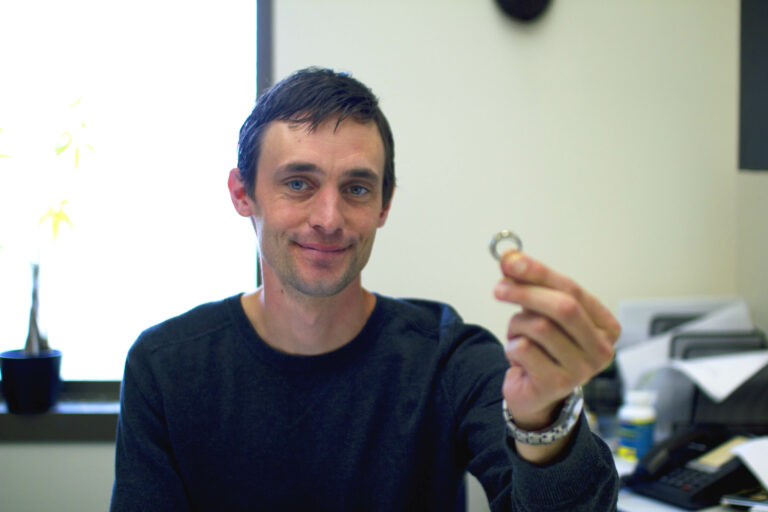
For a Davis professor, one such lost article was returned two years and a miracle later.

On a chilly day, Professor Adam Moule of the chemical engineering department took advantage of his wife being out of town and decided to play volleyball with his graduate students on the lawn near Bainer Hall after hours.

As the frosty weather began to shrink the fingers of the players, Moule set the ball and watched as his white and yellow gold wedding band slipped up off his finger and into the sky.

“I felt the ring go up and I experienced this Lord of The Rings moment when it just flew away,” Moule said. “I immediately went onto my hands and knees and started looking for it.”

Moule and his graduate students searched the lawn until the sun set, but it was too late. His wedding ring was gone.

In a frantic attempt to find the ring before his wife found out, Moule got up early the next morning and rented a metal detector.

“I was terrible at it. I dug up nothing but gum wrappers,” Moule said.

However, Moule kept at it for four hours, and even went as far as to pull up a grate in the middle of the field and sift through the muck that had accumulated there.

“As I put the grate back into place, I gave up. That Monday, I started putting up signs for a reward. As I was walking by Bainer, there was a guy, Chip, riding on a giant riding lawn mower, so I ran into the field and was like ‘Stop, stop, stop! My ring!’” Moule said. “He said that he had already mowed it, so I asked, ‘Did you hear a clank in the mower?’ Because I thought, if anything, I may as well get the gold back. And he gave me this funny look, so I told him the whole story, and we ended up talking for maybe half an hour.”

Chip Swenson, an employee of the grounds department, said that he hadn’t felt anything underneath his mower, but that he would keep an eye out. As time went on though, the reality of the loss set in.

Professor Moule began to wear the band that he and his wife used for traveling, but never replaced his original ring.

Weeks, months, years passed.

Then one day this quarter, a full two and a half years later, Swenson knocked at the door of Moule’s office.

“I asked if he remembered me and he said he didn’t, and I said, okay, stick out your hand,” Swenson said. “Without another word, I gave him his wedding ring.”

Moule said he was elated.

“I couldn’t believe that he found it, remembered me and returned it! I felt like, wow, this guy really took care of me,” Moule said.

Swenson had been collecting trash on the lawn outside Bainer Hall, and as he bent down to pick a piece up, he noticed something lying atop the grass.

“The ring was just sitting there, it hadn’t been trampled and pushed underground. The lawn mowers had gone over it for two whole years and it didn’t have a scratch on it,” Moule said.

When Swenson picked up the ring, he began to examine it, and noticed two lines on the outside and an inscription inside.

He immediately remembered that it matched the description that had been described to him so long ago, but he couldn’t recall Moule’s name.

He went about going into the buildings in the area and asking around, eventually being directed to Bainer Hall and Moule.

“The really cool thing is that he didn’t just sell it or melt it down. The metal itself is worth more than the reward. It’s really incredible that he returned it,” Moule said.

Swenson’s supervisor echoed the sentiment.

“He took it upon himself to return the ring. It’s the kind of thing that is so great to hear as a supervisor,” Mantor said. “He was quiet about it, and said he didn’t want much publicity. I think it’s awesome what he did. This story is a fantastic example of how [the employees at Grounds] really are stewards of this landscape.”

When asked, Swenson was hesitant to take too much praise, and said that he was only doing his job and doing what was right.

“You know, I have worked two places, Disneyland and Davis. When people ask me why, I say, it’s the two happiest places on Earth,” Swenson said. “I love being able to help others out. It was the right thing to do to find him and return the ring.”

This Week in Science:11/12 – 11/18

Canyon of fire appears on Sun’s surface, according to NASA

A filament of charged particles blasted away from the sun at more than 3 million kilometers per hour, leaving behind a scar in the plasma that NASA has dubbed the “Canyon of Fire.”

Interesting mating habits discovered in Australian sea slugs

It has been discovered that Australian sea slugs, a hermaphroditic mollusk, have sex by reciprocally stabbing one another in the forehead with their penises, according to Rolanda Lange from the University of Tuebingen in Germany.

Fossils suggest Asia, not Africa, as ancestral home of big cats

The oldest known fossils from a big cat were found recently in Tibet, and suggest that Asia, not Africa, is the origin of big cat ancestry. Dr. Jack Iseng authored the study along with a team of U.S. and Chinese paleontologists, and their research is published in the Royal Society Journal.

Breakthrough in invisibility cloak

Dr. George Eleftheriades from the University of Toronto has developed an invisibility cloak capable of completely concealing objects from surveillance radar.

Rare species sighted for first time in 15 years

For the first time in 15 years, a saola has been photographed in the wild, according to the World Wildlife Foundation. The saola, an extremely rare species of long-horned ox, was first discovered in Laos in 1992, and to this day, little is known about the animal and its populations.

World’s oldest animal killed while trying to determine its age

Ming the clam, the world’s oldest known animal, was killed by scientists who were attempting to determine its age. It is now known that Ming was 507 years old, thanks to a team of researchers from Bangor University.

Pregnant mice transfer stress to offspring

Expecting mice who experienced stress passed altered microbes to their offspring, affecting the babies’ brain development. Bacteria may transfer the mother’s stress to the fetus, reports Christopher Howerton and his colleagues from the University of Pennsylvania.

Rite Aid to implement training program as result of toxic dumping

0

Rite Aid agreed on Sept. 24 to pay a $12 million settlement for their toxic waste dumping. Yolo County received $420,000 for how the toxins have affected the local landfill. Of that $420,000, $162,500 of Yolo County’s portion has gone toward the Environmental Health Unit with the remainder going to the district attorney’s office to continue investigating similar crimes.

The Rite Aid lawsuit was filed by district attorneys (DA) in San Joaquin, Los Angeles and Riverside with additional attorneys representing various other cities and counties, including Yolo County. Rite Aid allegedly dumped toxic waste from over 600 outlets statewide.

In Yolo County alone, there is a Rite Aid in Davis, West Sacramento and Woodland, including the Northern California Distribution Center in Woodland.

Yolo County District Attorney Jeff Reisig was one of the DAs on the case.

“Environmental crimes attack finite resources such as landfills and our water. There is only one landfill in Yolo County and we all share it,” Reisig said in a statement.

Yolo County’s Waste Distribution Center was affected in the incident, and Waste Reduction and Sustainability Manager Marissa Juhler explained that Rite Aid is not the only store in question. The DA looks through all the trash and these investigations do have a positive impact.

“A good example is the Bel-Air grocery store … people don’t realize that now they have little garbage cans that say ‘do not throw needles or batteries in.’ Five years ago this didn’t exist, but they’ve come up with solutions both internally and externally. We always put out there that it’s not the end of the story, it’s really just the beginning starting with these organizations taking the right step to be more conscious of where their waste ends up,” Juhler said.

Vice President of California Hazardous Materials Investigation Association (CHMIA) and Vice President Senior Enforcement Officer of the Yolo County DA’s Office Heidi D’Agostino explained the investigation process.

“CHMIA basically looked through trash for unlawfully placed waste and traces of waste in streams. We weren’t the only ones that found waste and hazardous materials in dumps — these [materials] were found across the state,” D’Agostino said.

Rite Aid had dumped illegal substances such as aerosols, pesticides, bleach, paint, medicine, household cleaning solvents and other poisons into various dumps across the state. The reason for this, D’Agostino believes, is a lack of implemented training programs.

“Corporations should typically have accounts with lawful waste companies that will pick up hazardous waste. The store is responsible for proper waste disposal unless they go out by front-door sale,” D’Agostino said. “What the settlement has done is help cover the cost to correctly dispose of the waste.”

The remainder of Yolo County’s portion of the settlement, D’Agostino added, will go to continuing similar investigations and aiding in supplemental training of employees on disposal methods — training that wasn’t occurring for at least four years, if not more. These new requirements have been put into effect immediately.

Students believe that corporations such as Rite Aid do not focus on environmental repercussions of their business.

“We don’t place value on our ecosystem’s function. They’re paying for the damages but it might not take into account the scope of the damage. This is a classic example — corporations don’t regard the environment the way they should,” said Maya Argaman, a second-year environmental science and management major.

Upon hearing of this incident, some students felt a conflict of emotions because while Rite Aid was penalized, the damage is somewhat irreparable. Co-founder of the UC Davis Environmental Club Phillip Tran, a fourth-year environmental policy analysis and planning economics double major, discussed Rite Aid’s actions.

“When I hear about these events, I tend to try and not support the organization [and] business that is causing harm — in this case, Rite Aid. I’m glad that there are environmental health agencies that are in place and are able to keep companies accountable for their actions,” Tran said.

Since the settlement, Rite Aid has worked on other ways to address the issue. However, they have a long way to go in terms of making lasting changes.

“In cases like these, you can’t resolve the issue until you have  addressed the training to make the correct decisions. Since the settlement, they have started a more robust training program to identify products through a scanner to indicate the wastes in a product and proper disposal methods,” D’Agostino said.

Students have commented that justice may have prevailed in this case, though it is a complicated matter.

“This penalty might set a precedent for other companies saying that there are consequences … instilling preventative measures can protect our environment for years to come, so it’s good [Rite Aid] was held accountable,” Argaman said.

And though the sum of money has accounted for some of the damage, officials have said nothing can take back what damage has already been done. The settlement, however, will serve as a way to periodically check in on Rite Aid as well as help future investigations of hazardous waste dumping.

“The extent of the damages that may be incurred from their lack of responsible decision-making may last much longer and cause much more harm than $12 million,” Tran said. “…These damages cannot be simplified into a number … In order to make real change, we must not wait until after unfortunate events happen, but rather make sure we do everything to prevent damages from occurring.”

LASER event to bring fusion of art, science to Davis

0

 On Dec. 2, the UC Davis Art Science Fusion Program will host a Leonardo Art Science Evening Rendezvous, known as a LASER event. Consisting of four professional speakers commenting on their work, all of which generally fall on the intersection of art and science, this event will cover topics ranging from entomology and ecology to landscape art.

LASER events have previously occurred at institutions such as the University of San Francisco, Stanford University, UC Berkeley and UC Santa Cruz over the last 10 years. However, this will be the first series of LASER events to take place in UC Davis.

Anna Davidson, a PhD student in the department of plant sciences and moderator and organizer of UC Davis LASER events said that LASERs attempt to showcase a diverse set of topics and contemporary issues.

LASER is a program established by Leonardo: The International Society for Arts, Sciences and Technology. Leonardo, which began as a journal published by MIT press in the late 60s, is the longest standing advocate for the fusion of arts, science and technology. LASER events were created in recent years to help foster one of Leonardo’s main goals.

“The mission of the LASERs is to provide the general public with a snapshot of the cultural environment of the Bay Area/Davis area and to foster interdisciplinary networking with an emphasis on art and science,” Davidson said.

James Crutchfield, an employee of the physics department at UC Davis with particular interest in interdisciplinary science and a former board member at Leonardo, remarked on the importance of increased interest in science and art fusion.

“The question is why should there be this sort of seamless separation between two cultures?” Crutchfield said. “The most constructive thing about bringing arts and science is that people have a very different perspective. Those perspectives often give a unique view on contemporary problems.”

With the large turnout and success of the first of the LASER events Davidson, and the UC Davis Art Science Fusion program are excited to make LASERs part of the Davis community.

Donna Billick, cofounder of the UC Davis Art and Science Fusion program, feels that LASER event have an important function within the UC Davis community.

“Cross discipline activities are stimulating, build relationships and networks that would never be possible any other way,” Billick said in an email. “It reveals creative thinking, creative confidence and literacy,”

The LASER event will take place in Plant and Environmental Sciences 3001 from 5:30 p.m. to 9:30 p.m. The event also allots time for networking before and after the actual presentations that begin at 7 p.m. Entrance is free.

Tech Tip: Mobile app puts new spin on our four wheels

Most students are aware of the Tipsy Taxi service run by Unitrans, which brings you back home safely after one too many drinks. However, Tipsy Taxi is only available from Thursday to Saturday between the hours of 10 p.m. to 2 a.m. Wouldn’t it be nice to have other late-night modes of transportation that aren’t limited to three nights of the week?

In the near future, it could be possible to get a lift from Lyft. Lyft is an app that is available on iPhone and Android-based cell phones and is currently a popular service in San Francisco, Atlanta, Boston, Chicago, Denver, Seattle and Los Angeles.

Originally started in San Francisco, Lyft was created with the younger generation’s needs in mind, promoting peer-to-peer ridesharing when traveling to a similar destination as someone with transportation. For those who live far from home, this app finds people around you who might be headed in the same direction — like driving to L.A. for the holiday break — and allows you to tag along.

Lyft isn’t limited to only long-distance drives. It can also be used for short commutes, as well as allowing you to get as creative as you want to get with any of your travel needs.

The creators of Lyft run a background check and have strict standards for drivers before they are granted a big pink moustache to put in front of their car — a symbol that distinguishes them as a Lyft driver.

Interested drivers must be at least 23 years old, have had their license for at least a year and have had no major driving violations. Additionally, the model year of their vehicle can be no older than 2000. People with felony records are excluded from the program.

Much cheaper and eco-friendly than a taxi, this app has helped to arrange over a million rides. The cost of such rides is not a preset amount per mile like it would be with a cab. Instead, tag-a-longs make a “donation” to the driver, and Lyft takes a 20 percent commission for every ride payout.

The company plans to expand its services to 20 potential cities across the United States, yet no information has been provided as to which cities are currently being considered. A college town like Davis, where a majority of its students are far from home, could greatly benefit from this service.

UC Davis biodigester to power campus in January

In January 2014, leftover pasta and other unfinished food from the dining commons will be put to use as the newly established UC Davis Renewable Energy Anaerobic Digester (UC Davis READ) converts organic waste into campus electricity.

For nearly a decade, Professor Ruihong Zhang of the UC Davis Department of Biological and Agricultural Engineering has been researching the high solids anaerobic digestion technology necessary to create a biodigester.

“The successful development of the biodigester facility is a dream coming true for many people, including me and my graduate students and my colleagues around campus,” Zhang said.

The facility is currently in its final stages of construction, and extensive planning and collaboration have been imperative to the project’s success.

In order to move the anaerobic digestion technology from her laboratory to the commercial scale, Zhang has worked with university facilities, campus departments and Mike Fan, the Waste Program manager, for about eight years.

Zhang said that under the leadership of Fan and David Philips, the utilities director, the Facilities Department allocated research space at their wastewater treatment facility to construct a pilot digester system.

The department also provided free utilities and staff to support Zhang and her industry partners to test out the pilot system equipment, processes and different feedstocks prior to the development of a full scale biodigester system.

Sid England, associate vice chancellor of the Environmental Stewardship and Sustainability Office, is among the many faculty members who worked with Zhang on this project.

“The biodigester was explored as an option for renewable energy at West Village, and then evolved into a campuswide project,” England said.

Due to the considerable cost of implementing the biodigester facility, both Zhang and England explained that adequate funding for the project was one of the primary obstacles they faced.

Additionally, UC Davis alumnus and CEO of CleanWorld Michele Wong believes that an entirely other set of challenges made the project all the more difficult.

“Anytime you are dealing with a public entity, there are extra hurdles to jump,” Wong said.

However, by partnering with CleanWorld, “the North American leader in anaerobic digestion” according to Biomass Magazine, the prospect of building the facility began to look much brighter for Zhang and those involved in the project.

Once CleanWorld acquired the license to commercialize Zhang’s technology and agreed to operate the facility, the construction process was kicked into place. Fortunately, significant progress was made within a short timeframe.

“We were quite pleasantly surprised with how quickly we have been able to get the project done,” Wong said.

Additionally, Wong finds that the biodigester facility will be extremely beneficial for the whole campus community in terms of reducing waste and energy efficiency.

“The biggest benefit is that a lot of the waste that would be sent to the landfill will be used for renewable energy,” Wong said. “It will also be reducing greenhouse gases.”

Located at the former UC Davis landfill plot, it is estimated that 50 tons of mixed waste will be used for the facility daily and approximately 20,000 tons of waste will be diverted from local landfills each year.

According to Wong, half of this waste will be coming from campus sources such as the dining commons, animal facilities, olive oil production and winery. The rest will come from local commercial food companies and restaurants.

During the digestion process, a mix of microbes are used to quickly break down the organic waste, which is converted into biogas that mainly consists of methane and carbon dioxide.

Once the electricity is produced from the biogas, it will be directly fed into the UC Davis microgrid where it will provide power for the campus.

In a recent CleanWorld press release, the company stated that the biogas will “generate one megawatt of renewable electricity to power campus buildings — enough to power nearly 1,000 homes for a year.”

According to CleanWorld the facility will also reduce greenhouse gas emissions by 13,500 tons annually, and will be able to produce over four million gallons of fertilizer and soil amendments, which is enough to provide low cost, natural fertilizers for 145 acres of California’s farmlands daily.

The biodigester also signifies the strive toward renewable energy for all of the researchers, graduate students, faculty members and organizations involved with the project.

“[It] allows the University to demonstrate the leadership in environmental stewardship and converting waste into clean bioenergy and reducing the carbon footprint of the University’s community and facilities,” Zhang said.

Furthermore, Wong believes that the biodigester illustrates the cogent progress that UC Davis continues to achieve.

“UC Davis is leading the world in research and in alternative, renewable energy technology,” Wong said. “I expect that a lot of people around the world will want to come see the facility.”

Aggies chopped down by Cardinal

0

Swarming defense, solid execution and hot second-half shooting are usually guaranteed recipes for victory. Not against the sixth-best team in the country.

The UC Davis women’s basketball team marched into Maples Pavillion in Palo Alto, Calif. on Nov. 17, and for the most part, hung around with one of the most established programs in the history of college basketball before falling 66-48.

The Aggies (0-3) came out of the gates on fire defensively against a Stanford team coming off a 76-57 loss to reigning national champion and current No. 1 Connecticut on Nov. 11. The Cardinal (3-1), ranked sixth in the most recent Associated Press poll, weren’t able to convert on three consecutive second-chance opportunities on their first possession, and UC Davis sophomore Molly Greubel scored the game’s first points to give the Aggies a 2-0 lead.

That would be the Aggies’ only lead of the game. Junior Sydnee Fipps scored four straight to tie the score at six with 15 minutes to go in the opening half, but an 11-0 Cardinal run over the ensuing three minutes put the Aggies in a large deficit early.

However, the Aggies held tough, not allowing Stanford to extend its lead. Nine straight points for Fipps cut the lead to seven with about 10 minutes to play.

Fipps, the Aggies’ leading scorer at 15.7 points per game, scored 13 of the team’s first 17 points. She backed up her 25-point effort against Pacific on Nov. 11 with a team-high 14 in this one.

Stanford closed out the half on a 6-0 run, extending its lead to 34-20.

In the majority of the major upsets in college basketball, the underdog usually has to make a significant number of three pointers at a relatively high percentage. After shooting a dismal eight percent (1-12) on threes in the first half, UC Davis connected on 7-16 (48 percent) from long distance in the second.

Junior Kelsey Harris, who finished with nine points, scored all her points from behind the arc. Sophomore Heidi Johnson (who finished with six points) and junior Brianna Salvatore (eight points) each added two threes.

Back-to-back threes by Harris cut the deficit to 44-29 with 14:16 to play, but the Aggies had no answer for Stanford’s star forward, 6-foot-3 junior Chiney Ogwumike. Ogwumike, last year’s Pac-12 Player of the Year, recorded her fourth straight double-double, scoring a game-high 28 points on 13-22 shooting and pulling down 15 rebounds — five of them on the offensive end.

Stanford outrebounded UC Davis 49-37, but Gross was still pleased with her team’s effort on the glass.

“I think, of all the years that we have played them, this is the closest rebounding margin we’ve probably ever had,” Gross said. “We really tried to emphasize our rebounding today, but when you’ve got 6’5”, 6’4” and 6’3”, it’s tough, especially with the kind of athleticism they have. I thought we really battled inside, though. We had some stretches where we gave up a few boards that I thought we should have had but, for the most part, from start to finish, we competed on the boards.”

For the game, the Aggies went 18-53 (34 percent) from the field, including 8-28 (29 percent) on threes. On the flip side, UC Davis played spectacular defense at times to hold the high-powered Cardinal offense to just 35 percent from the field.

The flashes of offensive and defensive brilliance by the Aggies have their coach confident in their ability to hang with some of the country’s elite teams.

“I feel like we’re so close in so many different ways,” Gross said. “We have stretches of really exciting play where we’re getting it done both on offense and defense. If we put it together for 40 minutes, I think we’re going to be a tough matchup for a lot of teams on our schedule.”

Stanford might not even be the best team the Aggies face this year. The team heads to Hartford, Conn., to take on top-ranked UConn on Dec. 5.

In the meantime, the Aggies have a nine-day break before resuming their quest for their first victory. Their next game is a home contest against San Jose State on Nov. 26 at 4:45 p.m.

ITDP Presents Wigs Turn The Music On

Wigs Turn The Music On, a play by dramatic arts Master of Fine Arts candidates Lindsay Beamish and Amanda Vitiello-Jensen, begins with a Flo Rida song.

“Amanda wanted to use ‘Wild Ones’ by Flo Rida in something,” Beamish said. “I put the song on and told her to stand in front of a wall. I then gave her bizarre commands, which she acted out.”

The collaboration between Beamish and Vitiello-Jensen, which began as an assignment for class in the Department of Theater and Dance, quickly led to an 18-minute piece about captured pre-teen girls, played by the two. The play is put on through the Institute for Exploration in Theater, Dance and Performance (ITDP).

“We also play the man who kidnapped the girls,” Beamish said. “He’s never seen, as he lives behind the curtain and talks to us, but we also play him.”

The play is influenced by their childhoods and personalities, according to Vitiello-Jensen.

“A lot of the play was done through improv,” Beamish said. “The sky was really the limit in terms of our creativity.”

Part of this creativity manifested in the play’s language, which was developed through their improvisation.

“The language came about organically,” Beamish said. “I would make up commands, like ‘Bernard zipper,’ and she would just act them out.”

The play also incorporates references to the song “Wild Ones” as well as the Cleveland kidnapping case.

After the class ended, Beamish and Vitiello-Jensen decided to expand the piece. They applied for department support and received it from Peter Lichtenfels, a professor of Theatre and Dance, who had enjoyed the 18-minute piece.

“I had not seen anything like this piece,” Lichtenfels said. “I was taken by watching what happened on stage. It’s constantly transforming, it’s visually arresting and it is not sentimental. They’re performing for their captor but they’re not inhabiting the desire to do so.”

After receiving department support, Beamish and Vitiello-Jensen began to expand the piece.

“We’ve kept the original 18 minutes and have added more, including the concept of the girls escaping,” Vitiello-Jensen said.

Part of the challenge of the collaboration came from the different approaches that Vitiello-Jensen and Beamish use in regards to creative endeavours.

“When we started to work together we were trying to forge our two ways of working,” Vitiello-Jensen said. “I like to have some idea of what I’m doing while Lindsay prefers to have no idea at all.”

Beamish was surprised by the effectiveness of the collaboration, which she described as “great but weird.”

“I usually don’t collaborate well since I tend not to like other people’s ideas, but I felt like Amanda’s ideas were consistently great,” Beamish said.

Vitiello-Jensen also enjoyed working with Beamish, despite their different creative approaches.

“I felt like I wanted to learn from Lindsay,” Vitiello-Jensen said. “It was great but I was scared. It was like walking into a black hole and making something out of nothing. We ended up laughing our way through the process.”

Wigs Turn The Music On is rated R, and will be performed in Wright Hall Lab A, on Nov. 24, 25 and 26 at 7 p.m. Admission is free.

Watts Legal

0

Question: I live in a mobile home park (also known as a trailer park) in Davis. Recently, all my neighbors and I received a copy of a new rental agreement that takes effect in 60 days. The new agreement contains a bunch of new rules, which are very specific and seem to target specific tenants. Some of the new rules include:

  • “All personal plants must be in decorative containers or removable above ground planters. No buckets, nursery containers, styrofoam, or miscellaneous containers may be used. Any pots or planters more than 12″ in diameter or 36 sq. in. must be approved by management. Pots or planters in excess of 20 total items must be approved by management.”

  • “No open composting is allowed. Closed composting must have [Management’s] prior written consent.”

  • “No towels, rugs, wearing apparel or laundry of any description may be hung outside of the home at anytime. Drying lines are provided for all residents use in designated areas.”

  • “Fire pits and campfires are PROHIBITED. Outdoor fireplaces must be approved by Management.”

A lot of people in the mobile home park are very concerned about these changes and want more information before attending a park meeting the management is holding to answer questions. Are these changes legal?

— Melissa G., Davis, CA 

Answer: I know from personal experience that dealing with mobile home park management can be frustrating. The scant legal protections afforded to residents make living in a mobile home more like living in an apartment than a house. An owner of a house actually owns the land their house sits on, they do not have a landlord and do not have to tolerate a landlord micromanaging the size of their flower pots (unless they join a homeowners association, but that’s a whole other column). But as you and your neighbors can attest, a mobile home park often restricts residents’ freedom even more than a typical apartment complex would. And if you violate the rules, the landlord can go to court to evict you — even if you own the mobile home.

That bears repeating: When you buy a mobile home, you can get evicted from your own house. Mobile home owners enjoy all the drawbacks of living in an apartment coupled with the monetary investment and risks of homeownership.

There are protections for residents, though. California’s Mobilehome Residency Law restricts the landlord’s powers. Among its provisions is a restriction on rule changes like the ones you mentioned.

The law, which refers to landlords as “management,” says:

“[W]hen the management proposes an amendment to the park’s rules and regulations, the management shall meet and consult with the homeowners in the park, their representatives, or both, after written notice has been given to all the homeowners in the park 10 days or more before the meeting. The notice shall set forth the proposed amendment to the park’s rules and regulations and shall state the date, time, and location of the meeting.”

In your question, you do not mention whether the landlord gave you all notice at least 10 days before the rules meeting. If they did not, their rule change is invalid.

This section also requires the notice to include the date, time and location of the meeting. Presumably it does, but if it fails to include this information, then it is invalid.

You might wonder what counts as “notice.” Can the landlord just wave you down on the street and say, “Hey, we’re having a meeting tomorrow at 5 in the common area?” No. The Mobilehome Residency Law defines “notice,” requiring notice to be “delivered personally to the homeowner or deposited in the United States mail, postage prepaid, addressed to the homeowner at his or her site within the mobilehome park.” The landlord needs to give this notice exactly as the law specifies. If your landlord posted the meeting announcement on your front door while you were not home, the rule change is illegal because you did not receive proper notice. If the landlord mailed the notice to a resident’s P.O. Box instead of the resident’s address within the park, the notice is invalid.

Assuming the landlord gave proper notice of the meeting, there are still a few other ways to get out of the new rules.

The law states: “[F]ollowing the meeting and consultation with the homeowners, the noticed amendment to the park’s rules and regulations may be implemented, as to any homeowner, with the consent of that homeowner, or without the homeowner’s consent upon written notice of not less than six months, except for regulations applicable to recreational facilities, which may be amended without homeowner consent upon written notice of not less than 60 days.”

Plain English translation: If the residents at the meeting refuse to consent to the new rules, the landlord can still put the rules into effect six months after the meeting. But new rules that apply to recreational facilities — swimming pools, the gym, tennis courts — can be implemented in 60 days.

It sounds like your landlord is trying to trick you. Unless there was an earlier meeting you did not mention, the landlord cannot unilaterally change the rules about your potted plants without your consent. He has to give notice of a meeting, hold a meeting 10 days later, allow residents to comment on the new rules and, if the residents refuse to agree to the rules, he has to wait six months. Then and only then can he implement new rules.

Because the mobile home park’s rules are actually a part of your lease, and therefore grounds for eviction if you fail to abide by them, he cannot simply change the rules on short notice without your consent. Ask your landlord to consult with his lawyer, and refer them to Section 798.25 of the California Civil Code, where these rules are found. You can find a copy of the full Mobilehome Residency Law at hcd.ca.gov/codes/mp/2013MRL.pdf.

Daniel is a Sacramento attorney, former Davis City Council candidate and graduate of UC Davis School of Law. He’ll answer questions sent to him at governorwatts@gmail.com or tweeted to @governorwatts.

California Lecture Hall to be constructed

0

A large format lecture hall that seats more than 600 people is in the process of being planned and is expected to be completed fall 2017. The California Lecture Hall will be constructed on the UC Davis campus at the corner of Storer Hall and California Avenue. The goal of the new lecture hall is to accommodate increasing class sizes and the upsizing of impacted courses.

“The project is intended to relieve classroom backlog and alleviate current course waitlists benefitting time to degree,” said Debra Smith, senior project manager of Design and Construction Management at UC Davis.

According to Smith, the new lecture hall will include a variety of building resources to strengthen building development and public outdoor spaces, and will be careful of respecting historic trees already on campus. It will also have sufficient bike parking to accommodate the large amount of students.

There are plans to follow requirements and budget constraints to be a net-zero energy facility, and the project is also in alignment with the California Sustainability Practices Policy.

The project is in the middle of a three month programming phase during which decisions about how the lecture hall will be used are going to be made. A workshop was held on Nov. 6 that included faculty, staff and students in order to figure out what technologies and environments would be best used in the hall.

Students, faculty and all others that use main lecture halls on the UC Davis campus are encouraged to provide input on the project via a survey released on Smartsite. The link for this survey is scheduled to be released this coming week.

Students and faculty will also be able to comment on the project through other social media sites. The survey allows students to rank the importance of various lecture hall characteristics such as indoor temperature, ability to hear the professor and other students and overall size and layout.

Allison Berkowitz, a second-year biological sciences major took the survey to provide input on the project.

“It will be beneficial to all to pinpoint the flaws in order to build the perfect lecture hall to promote academic success,” Berkowitz said.