55.9 F
Davis

Davis, California

Tuesday, December 23, 2025
Home Blog Page 897

UC Student-Workers’ Union announces sympathy strike

0

UAW local 2865, the UC Student-Workers’ Union, announced that they are to join in a sympathy strike with AFSCME 3299’s campus service workers.

A Nov. 5 expiration of their contract with the UC caused an expiration of the “No Strike Clause,” which prohibits the union from calling a strike.

The union’s current position in their bargaining efforts allows them to legally engage in three different types of strikes: a sympathy strike, an unfair labor practice strike or a grievance strike.

A UAW press release quoted an anonymous member, explaining that “this is a historic moment for the labor movement and the fight for public education at UC. We are standing with AFSCME against illegal and unfair labor practices at this university.”

Caroline McKusick, a member of the union’s executive board at Davis, explained on Nov. 13 in an email to the press that “the UC Student-Workers Union UAW 2865, has announced that [they] will join the sympathy strike with AFSCME service and patient care workers at UC this November 20th.”

Members of the UC Student-Workers’ Union participated in a strike authorization vote from Oct. 31 to Nov. 6 across the University of California.

With 96 percent of those who participated voting in favor of authorizing a strike, UAW 2865 was able to call a sympathy strike with AFSCME 3299.

According to the UAW 2865 website, “turnout was record high” for the vote to authorize a strike.

Meanwhile, negotiations are currently ongoing for a new contract between the University of California and the UC Student-Workers’ Union, which represents over 13,000 graduate student instructors, readers, tutors and TAs.

Some of the union’s grievances stem from large class sizes, low compensation and affordable housing for graduate students. With continuing negotiations, the union hopes to implement new provisions on a statewide basis to improve working conditions.

“We are fighting for smaller class sizes … the right for undocumented students to be hired as TAs [and] are also fighting for competitive compensation,” said Duane Wright, chair of the UC Davis unit of UAW 2865 and a Ph.D. student studying sociology, in an email interview.

Undocumented students pursuing graduate degrees and who are required to TA are left to change their programs or to TA without compensation.

“Nobody should be working for free at this university,” Wright said.

The union is also demanding that the UC provide at least one gender neutral bathroom in each building in order to accommodate with the needs of transgender students and workers.

“Collective bargaining is the best way for the union to defend the workers’ rights,” McKusick said.

The union believes that because class sizes are too big, both the undergraduate and the graduate students’ work and education is impeded. Larger class sizes equate to less one-on-one time with each student, a detriment to the quality of education.

Affordable housing for graduate students is one of the union’s major concerns. In the U.S., affordable housing should not exceed 30 percent of a household’s gross income.

For the graduate student-workers, this is “$425 per month for pre-tax income,” which Wright notes, is nowhere near the cheapest cost of housing in Davis.

“In the case of the AFSCME sympathy strike [they] felt it was necessary to honor their picket line to send a clear message to university management: TAs will not stand by and do nothing while the administration violates the rights of service workers,” Wright said.

Though the union announced a sympathy strike to support AFSCME, Wright said that “hopefully it won’t come to [them] having to go on a ULP strike over these issues.”

Still, student response has been mixed.

Laura Harvey, a fourth-year technocultural studies major, explained that she favors larger classes.

“The TAs talk more in a larger class, and when the TAs talk more, the subject is easier to understand,” Harvey said.

The concern among union members, however, is very real.

“96 percent versus four percent — that’s something to pay attention to,” said Juan Miranda, chair of the UC Davis Graduate Student Association.

Tim Johnson, a graduate student instructor pursuing a Ph.D. in Spanish literature said that he personally has no grievances with his working conditions.

The cap on students in classes he teaches is 25, and going above the limit “has happened, but rarely,” he said.

Johnson is a member of UAW 2865 and voted in favor of strike authorization.

“I’m privileged that I’ve been provided a job for me to survive at school instead of having to look elsewhere to provide for myself; but I am worried about being exploited and that’s why I’m a member of the union,” Johnson said.

On Nov. 18, UAW 2865 plans to participate in a noon Pro-Education, Anti-Repression rally on the second anniversary of the UC Davis pepper spray incident to speak out against increasing police presence and declining educational quality at UC.

The rally, hosted by the union, will be held at the Quad on Nov. 18. Issues protested by the rally are listed on the event’s Facebook page. Among their grievances are rising tuition, UC President Janet Napolitano’s history of deportations, TAs’ low pay and high class sizes.
 

Spreading collective action through community

0

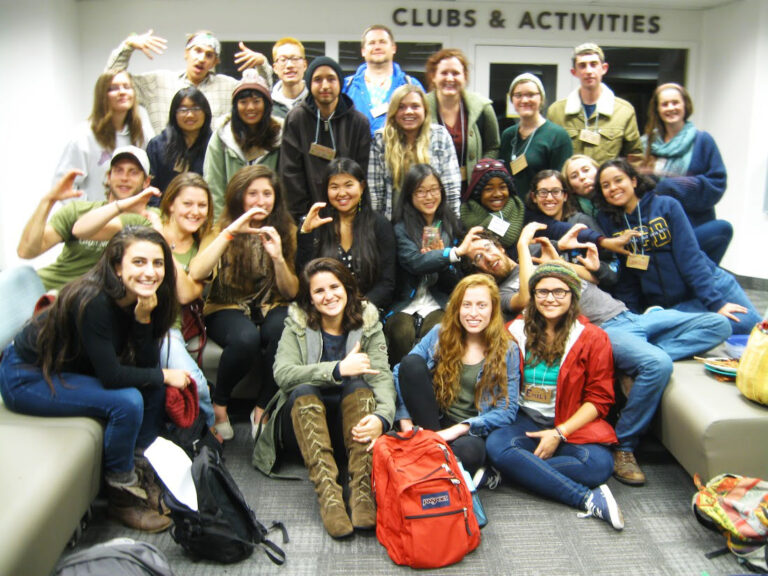
Multiple Davis students attended the California Student Sustainability Coalition (CSSC) fall convergence, hosted by Humboldt State University from Nov. 8 to 10. Attendees worked toward environmental collaboration through discussion, food and music.

Made up of current students and recent alumni representing UC, CSU and community college campuses across California, the CSSC holds a convergence twice a year in the fall and spring with different themes and workshops for students to discuss the economic, social and ecological roles of sustainability.

“If you want change, you have to think global but act local,” said Jianna Robinson, a third-year sustainable agriculture and food systems major and external convergence coordinator for the CSSC. “Convergence is a way to pull all of our resources together and support each other. We put on workshops and it’s a way for people to become educated in general about things relating to sustainability.”

The theme of the convergence this fall was Building Sustainable Communities with subtopics concerning infrastructure, community-based food production, action and social justice.

One UC Davis attendee, Benett Hannan, a third-year sustainable agriculture and food systems major, described the event as informative as well as fun and constructive for students.

“I was so stoked on getting to hear the realities of our sustainability movement from like-minded students and graduates,” Hannan said in an email. “We discussed the issues of declining environmental health in impoverished communities … analyzed current GMO laws and discussed how to shape our local legislation to serve the people … and learned a lot about the growing market for alternative energy sources.”

Though the CSSC has three branches of leadership made up of the advising Board of Directors and two voting bodies including the Council of Representatives and the Operating Team, all interns and volunteers practice horizontal leadership so all operating bodies and campus chapters have equal value and function under the similar core values of sustainability.

“Having more than just one campus involved increases awareness and provides an outlet and some capacities for different social and environmental movements,” Robinson said. “Being able to connect with partners in other parts of California, learn from them and work together is really empowering and helpful.”

The CSSC has been represented on the UC Davis campus since 2004, sprouting from members’ affiliation and involvement with the Campus Center for the Environment (CCE), which has been on campus since 2003.

Emili Abdel-Ghany, a fourth-year community and regional development major, holds positions within both organizations as external affairs coordinator for the CCE and Operating Team co-chair for the statewide CSSC organization. She also presented workshops on fossil fuel divestment and social justice during the convergence and hopes to see a broader definition of “sustainability” on campus.

“A lot more people know about the [CSSC] in a broader sense than just convergence and are thinking about ways we could enhance holistic sustainability on campus because there is a lot of emphasis on environmental aspects,” Abdel-Ghany said. “Our organization is growing to vocalize more about social justice and striving towards making it the underlying theme of everything we do. Without a discussion of these complex systems of oppression in which we live there is no way of moving forward because economic, social and environmental issues are so intertwined.”

Abdel-Ghany also hopes that the convergence brings individual as well as collaborative change for the students and their campuses.

“In our intellectual advancement and sharing interpersonal stories, I hope this convergence will bring people to a greater understanding of each other’s struggles and where new parts of our coalition can collaborate to use their resources to help each other through social and economic capital,” Abdel-Ghany said.

The Fossil Free UC campaign is one way through which the CSSC is looking to integrate a more interdisciplinary collaboration among student movements on campuses throughout the state.

“We’re pushing to have the University of California to divest their current investments in fossil fuel industries and [transfer them] to alternative investments,” Robinson said. “We have a reinvestment strategy and campaign directors who work and have meetings with different organizations while on campus we try to do a lot of outreach and explain to people what it is.”

Members have already spoken their plea to the Board of Regents through Public Comment during open sessions. However both Abdel-Ghany and Robinson agree that the process of dismantling parts of institutions like higher education or the food system will take time and effort.

“It’s hard to be an activist and a student [at the same time] because in this world we are trying to change we have to conform to other social institutional ideas that are already in place,” Robinson said. “Something we plan on doing with pushing the Fossil Free UC movement on campus is creating dialogue with other groups, having them understand how it relates to them and building a stronger presence on the Davis campus.”

Davis alum collaborates with E-40, makes “top of the line wine”

0

Assisted by a UC Davis viticulture and enology alumnus, Earl Stevens — more commonly known as Bay Area rapper E-40 — has come out with Earl Stevens Selections, a collection of high-quality wines made in Napa Valley.

Steve Burch who graduated from UC Davis in 1998, is the winemaker behind Earl Stevens Selections. Burch and his company, California Shiners, have made wines for other celebrities as well, including Michelle Branch and Adam Carolla.

In E-40’s 1992 song “Carlos Rossi,” he calls jug wine a “top of the line wine.” Now, Earl Stevens Selections features three higher quality wines: Function Red, a blend of Cabernet Sauvignon and Zinfandel grapes, a Moscato and a unique Mangoscato, which is a mango flavored Moscato, at a staggering 18% ABV.

As a former winery owner, Burch said he feels like there are many advantages for helping celebrities make their wines. Since celebrities have a large fan base, getting bottles out of the warehouse is generally never a problem.

“I have more fun with these wines because people want to buy them. The wine business is hard. It’s not about what I want to drink; it’s about what’s going to sell,” Burch said. “But obviously, it’s going to be good.”

Burch and E-40 came to the winemaking scene through different avenues.

“The first wine I ever drank was Carlos Rossi Rind. I used to see older people drinking it and I couldn’t wait to be of age to drink it myself. I liked the taste — it was sweet,” E-40 said.

E-40 also said that knowing the right people and being a good guy helped this project unfold.

Burch, however, attributes his success in the winemaking world to his education.

“UC Davis is the only reason I got where I am today. It’s the education you get at UC Davis and the science background that really prepares you for every opportunity,” Burch said. “I’ve done everything. I’ve owned my own winery. But no matter what I do, I always rely on my education.”

According to Burch, his position at California Shiners is safer than owning his own operation.

“I do a lot of cool stuff. I get to make wine and not have to worry about paying the electricity bill,” Burch said.

He claimed that this comfort relies on celebrity marketing.

“Nobody wants to drink what you want to make. Nobody cares. People want to drink a high quality product with a big name on it,” Burch said.

Shavika Singha, a fourth-year communication and philosophy double major works as a bartender and said she is familiar with hip-hop artists promoting alcoholic beverages.

“I think it’s nice to see rappers branching out from hard liquor. As a bartender, I get so many people ordering Ciroc and Armandale at clubs. It’s cool that hip-hop culture is expanding to something new and more sophisticated,” Singha said.

Singha said that wine feels like unfamiliar territory in hip-hop, and the fusion of the two is an exciting opportunity.

“I just love wine, and I wanted to hit a category that most recording artists haven’t hit yet,” E-40 said.

E-40 emphasized that being closely involved with the winemaking process is important. He said that being there for tastings, being hands-on with the process and understanding fans’ tastes will help his products succeed.

Burch is fortunate in that he can create wine comfortably, making use of his education and training without worrying as much about the marketing. With E-40 covering that side, Burch was able to focus on the brass tacks of winemaking.

Burch said that winemakers going into the business with an air of narcissism miss the point of creating a great wine. He said that the grapes tell him what to do, and that he can’t turn grapes into something they’re not.

“It’s not about the guy who crushes the grapes or adds the yeast. It’s just the fruit. You have this fruit that can naturally get to this point. It has nothing to do with some joker with a degree from UC Davis,” Burch said.

Cosmic Relevance: Prayer

0

Awaiting a midterm, I was sitting in my lecture hall freaking out. Of course I studied, but the nerves were getting to me, and I cycled through all the material in my head. I got so nervous that I decided to say a little prayer, hoping that my brain wouldn’t fail me on such an important day.

I looked around the room, and I wondered what was going on in the heads of the other students. Do my peers pray? And aside from scoring well on exams, how is prayer used on campus?

To get as many perspectives as possible, I asked various religious groups around the university, why do you participate in prayer? I received answers from members of Hillel (the student Judaic center), Davis Christian Fellowship, the UC Davis Meditation Club and the Islamic Center of Davis.

First, I asked a fourth-year why he likes to observe Shabbat (the Jewish day of rest) at Hillel. In response, he said, “It’s like a form of centering myself and removing myself from the rest of the week, setting aside problems and anxieties.” For him, prayer was finding “a moment of peace.” In addition, the communal aspect of hanging out with friends and eating Shabbat dinner added to his experience.  On the whole, respecting the tradition separates him from the worries of the week.

Second, I heard from a fifth-year psychology student and member of Davis Christian Fellowship. For him, prayer helps him focus on a righteous life. He responded, “As a Christian, I follow Christ and His life serves a model on how to live mine.” And to follow Christ’s model, he voiced, “I pray because it allows me to have a time to re-focus and I also come away with a perspective that sees things through the lens of God.” To emulate Jesus, prayer is a way to talk to “God,” and keep at the forefront his teachings.

Next, I listened to a member of our school’s meditation club. She said that she practices meditation to “untangle [herself] from the drama of everyday life.”  For her, it’s a mindset, “keeping presence in the present” and putting one’s energies in the now. The nickname of the club is “Simply Being,” and for her, that summarized the freedom and truth she knows to recognize.

Lastly, I contacted the Islamic Center of Davis, and I corresponded with the recently retired Imam.  For background information, he shared that “when Muslims say prayer, it is usually Salaa (structured prayer) that comes to mind, specifically, the five times a day required prayer.” He adds that, “the beauty of Salaa is that it comes from the Arabic root word ‘Sila,’ which means connection.” For Muslims, saying prayer at least five times a day is the “connection that we maintain with God.” And this practice is vital for the link with holiness, because “we, as people, generally tend to be distracted, busy and caught up in life to the point of losing focus or spirituality, or even becoming heedless of God and our purpose in life.”  In his opinion, we often get distracted from our goals, and reconnecting to “true reality … is a source of rest, peace, love, clarity and guidance.”  For him, “prayer is priceless.”

For all these individuals, it seems clear that their practices and beliefs hold great personal importance. Furthermore, it appears that prayer influences their frame of mind, coloring the meaning of existence.

But for those who don’t have a routine, what is a secular view on prayer?

One student said, “I can understand how prayer makes one appreciate life, but I think its repetitive nature makes [it] lose meaning.”  Acknowledging that prayer works for some, he stated, “there are ways of accomplishing the effects of prayer for different individuals.” For instance, he says he habitually contemplates the priorities in life. But overall, he makes clear that “[he] try to reflect on the beauty of life all the time.” Whether listening to music, exercising through sport or enjoying the company of others, it can be accomplished in all settings if one has the intention.

Regardless of religious affiliation, it can be said that time could be well-spent focusing on what is important in one’s life, whatever it may be.

If you want to find the meaning of life with DANIEL HERMAN, he can be reached at dsherman@ucdavis.edu.

Davis hosts its first Startup Weekend

0

From Nov. 16 to 17, Davis is hosting a Startup Weekend sponsored by Hacker Lab and Davis Roots. Hacker Lab is an organization that travels to different cities and partners with local organizations to host Startup Weekend Hackathons.

Davis Roots is the local organization that Hacker Lab has partnered with. It is a nonprofit startup business accelerator that attempts to promote early forward thinking.

A Startup Weekend is a weekend-long program that gives entrepreneurs or people with a good idea an opportunity to see if their ideas have any merit and if they could possibly succeed in the business world.

Allyson Shoemaker, a fourth-year human development major, said she believes Davis is the perfect place for a Startup Weekend because of the general attitude of UC Davis students.

“There is a large population at UC Davis that is known for involving themselves in forward thinking research and developments,” Shoemaker said. “It would be a good thing because there is no business major or school at Davis, therefore it would allow students who would have liked to be focused on business to have the opportunity to do something hands-on within their interests.”

The cofounder of Hacker Lab, Eric Ullrich, seems to agree with Shoemaker and said he believes that Davis will present exciting opportunities that other towns would not offer.

“The way Hacker Lab works is we pick a place to host the Startup Weekend and then find local people to speak at them. This is the first and only time we will probably come to Davis. We thought Davis was a good location because it is a college town and there is a big engineering program with lots of students,” Ullrich said.

When asked if most of the people signing up were Davis students Ullrich said it’s split evenly.

“We are expecting around 100 participants and they are programmers designers and more. We have a bunch of workshops all weekend and Friday night we have an opening part and that’s when ideas are formed and people start working,” Ullrich said.

U.S. News & World Report 2013 stated that the UC Davis undergraduate engineering program is ranked 32nd nationally and tied for 17th among public schools with North Carolina State University and the University of Colorado, Boulder. Their program has grown over the past several years.

Dashiel Barrett, a third-year engineering major, agrees that the engineering department will provide many participants for the program.

“Davis definitely has a large enough engineering program to support a Startup Weekend. It seems like events like this that cater to innovative students go well in Davis,” Barrett said.

Madison Monaham, a first-year communication major, has only lived in Davis for several months but believes she can already see the initiative students seem to take on in response to events such as this.

“I believe Davis students are presented with amble opportunities that help spark creativity. Our school is in fact now ranked ninth for public schools. We are lucky to be in such a strong scholastic environment. This event will provide students with the perfect opportunity to vocalize their creativity,” Monaham said.

The ticket prices vary from $34 to $54 depending on whether or not the ticket is bought before Nov. 16. The program starts Nov. 15 at 5:30 p.m. and ends Nov. 17 at 12 p.m. and is located downtown at 212 F St.


Crows flock to campus

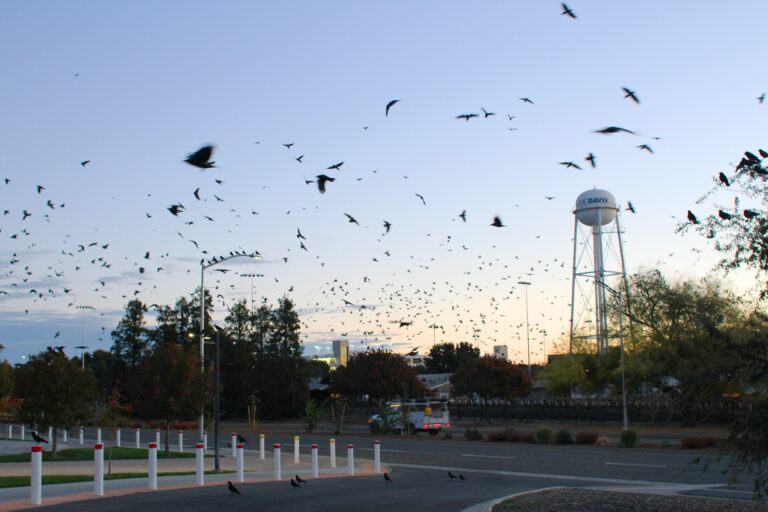
UC Davis is no stranger to the crows that hover over campus. There seems to be a colony of them in particular areas around campus, especially the Silo.

Andrea Townsend, an assistant professor of urban conservation ecology in the Department of Wildlife, Fish and Conservation Biology, studies social behavior and disease transmission in birds, including the crows on campus.

According to Townsend, crows have a communal roost in the parking lot next to the Silo. They have what are known as staging areas — where a select portion of the crows from a larger group gather while they find their way to and from their bigger roost. The Silo could be serving as one of the staging areas for them.

“The reason that crows roost (and stage) together is unclear, but they often prefer well-lit city parking lots,” Townsend said in an email. “One hypothesis for why they roost communally is information sharing: they might learn from other birds at the roost about food sources and places to avoid. The campus has many attributes that crows prefer … the climate is relatively mild, [there are] brightly-lit urban parking lots and they can forage during the day in the agricultural fields surrounding Davis.”

Aside from the pure awe of noticing a huge flock of crows over you, one tends to begin to feel a faint sense of fear. There are so many of them that it is only a matter of moments before they poop on your bike, vehicle, or sadly enough, even you. On days like these, many Aggies begin to hope they don’t become the unfortunate victims of the crows flocking around.

For instance, Angelica Hernandez, a second-year clinical nutrition major, has seen so many of these glossy black birds circulating above her when walking by the Sciences Lecture Hall.

“I have seen many people running with newspapers or books over their heads so that they won’t get pooped on. I have also noticed many cars and many bikes with bird poop on them,” Hernandez said.

Priya Tuvell, a third-year animal science major and nutrition minor, has also witnessed an incredible number of crows roosting in the trees when biking to campus. She has seen the most during the fall and winter quarters.

“The trees they would roost in are right on top of the bike paths on either side of the street, and the smell of all their droppings was pretty horrible,” Tuvell said.

Having an interest in birds, Tuvell knows that crows are aware of the food readily available to them.

“Lots of sandwiches left on benches, spilt rice or pasta are a steady source of food. Such carbohydrate-laden foods are not healthy for the birds though, and people should be careful to dispose of their leftovers in the compost, recycling or trash, instead of leaving the food out for the birds,” Tuvell said in an email.

The incredible influx of crows around campus has some costs. Carey Avery, the associate director of the Campus Planning and Community Resources and a facilitator of the Grounds and Landscape Services, stated that cost of cleaning up after the crow droppings is something the department has been trying to track for the last year, and the cost varies month to month.

“Eight hours of labor per month are spent to power wash the sidewalks from [the] crow droppings,” Avery said in an email.

The crows who don’t seem to be going anywhere anytime soon, clearly have an impact on our community, costing the UC Davis campus both money and labor.

November constellations and Comet ISON

The coming of winter means less sunlight but more starlight. The beginning of November hailed a rare solar eclipse, but the eclipse was only visible to viewers from the US East Coast to the middle east. However, Davis astronomy aficionados can still catch the highly anticipated Comet ISON.

Born from the primeval matter of the earliest days of the solar system, the ball of ice and rock is embarking on its first trip through the inner solar system. When it nears the sun, its pristine surface will ignite and form a tail of gas and dust. Experts worry that ISON has a high chance of disintegrating due to the gravitational forces, solar radiation and extremely high temperatures from the sun. If it survives skimming just 730,000 miles above the surface of the sun at its perihelion — the point of an orbit closest to the sun — it will return and blaze in northern skies as the most dazzling comet of this century.

ISON is currently only visible by binoculars or telescope in Virgo. Check your calendars and hope for ISON’s slated magnificent arrival after Thanksgiving.

The east hails the constellations of the new season while last season’s constellations begin their yearly descent in the west. Venus still beams mightily over the southwestern horizon at dusk. Nine p.m. unveils the glow of Jupiter and figure of Orion as they emerge together from the eastern horizon. The Orion Nebula, one of the few deep sky objects visible to the naked eye, hangs luminously from Orion’s belt. Using binoculars or a telescope reveals the Nebula’s blue-green tint and the very young open star cluster nestled within it (of the four most prominent stars, two are double star systems). Other important emerging constellations include Auriga and Gemini. Night owls can stay up to witness Sirius, the brightest star in our night sky, which begins its ascent around midnight. Earth’s orbit around the sun has made the Summer Triangle descend lower and lower in the sky during the night; it will disappear altogether by the end of December.

SCREENSHOT: Eastern horizon

SCREENSHOT: The Summer Triangle (will set around 11 p.m.)

SCREENSHOT: (taken by the Hubble Space Telescope) The Orion Nebula in all its glory. Sorry, it won’t look as good as this through your toys

Letter to the Editor: Remember, remember, the 18th of November

0

Two years after the pepper spray incident, it is time to gather on the Quad at noon to confront the reality of our university. In the past years, the largest unions at UC have been active in trying to preserve quality of education and service at UC in the face of increasing inequality and police repression. Although each union’s demands are specific, they have in common an opposition to the privatization of the UC, the raising of its tuition, the lowering of its standards and the stark difference in pay between those at the bottom and those at the top.

In short, the same struggles that played out in the quad two years ago as part of Occupy UC Davis continue to haunt our campus. Two years ago, the focus of protest was a massive increase in tuition. This Nov. 18, with a former law enforcement official with no educational experience now at the helm of the UC system, we must gather to oppose police repression and defend quality education at UC.

The UC depends on the work of TAs, readers and associate instructors, who are the frontline educators in most departments. And yet, even as administrators get paid more and more, and tuitions go up and up, TA wages have been stagnant (dropping, if one calculates for inflation). Class sizes have gone up, and the ability of these educators to earn a living and provide a quality education has deteriorated — even as the students they serve pay more for that education!

Monday Nov. 18 and Tuesday Nov. 19, the UC Student-Workers Union UAW 2865 will be bargaining with UC Administration here on the Davis campus for a new contract, one that pays us fairly and guarantees a quality education for our students. Join us in the Quad at noon on Nov. 18, and join us at the bargaining sessions, to show support for your frontline educators.


Steve Cox

Department of History

University of California, Davis

The Philosophy of Education: Private tutors

0

Almost all of us have seen the advertisements for paid tutors around campus charging $30 or more per hour. Frequently, those advertisements are missing many of the tear-off contact info strips, indicating interest in their services.

However, professors and TAs offer office hours for free. Why, then, do we hire private tutors who know only the general subject, not the specific material presented in the class?

While private tutors can be useful, they should be a last resort after we have tried the professor and TAs. However, many of us make excuses to ourselves instead of giving office hours a chance first.

Many of us turn to one-on-one, paid tutors out of fear that we cannot get personal assistance in office hours because we will not be the only one there. However, we do not know how many people will be there until we show up. If other students are there, most of the time, we benefit from their questions.

In addition, if we have the courage to ask, many professors will make personal appointments outside of normal office hours.

In the rare case where we go several times and office hours are constantly too full, private tutors can help. However, we should go to office hours several times before we draw that conclusion.

Sometimes, we feel or are told by friends that, while we can get personal help, a certain professor or TA cannot teach effectively and thus going to office hours wastes our time.

However, we forget that a professor’s inability to teach us in a lecture hall of hundreds of students does not mean the professor cannot teach us one-on-one. Teaching hundreds of students at once is incredibly difficult; few have that gift.

For example, if a professor has a thick accent and we cannot understand what is said in lecture, we will find it much easier to understand when we are physically closer in office hours and can ask the professor to repeat what they said if we missed a word, which we cannot do in lecture.

Some professors and TAs really cannot teach, which is where private tutors can be useful, but we should give each professor and TA a chance first instead of judging them based on past experiences, word of mouth or ratemyprofessor.com.

To give professors or TAs a chance, we must ask for help, which embarrasses many of us and makes us feel foolish. Most professors and TAs will not belittle us for our ignorance; the fear is only in our minds. Most of them sincerely want us to learn and will spend their time teaching us if we have the courage to ask.

Perhaps one in five will show that they are busy and just want us to leave, but we should give each one a fair chance and not judge them all by the actions of a few. In those rare cases, private tutors can be useful. However, if we go with the attitude of finding fault or arrogance in professors or TAs, we will find what we look for regardless of if the professor wants to help us, feeding the cycle of fear and judgment.

However, while most professors want us to learn, office hours are not for repeating what was said in lecture. When we ask for this, we show that we have not made an effort on our own first.

Our education is our responsibility; nobody can help us unless we first try to help ourselves. Showing this laziness frustrates even the best professors and TAs. When we see this frustration, we call even the most helpful ones arrogant, unhelpful or unable to teach, instead of realizing our own faults.

Thus, we think every professor and TA cannot teach, so we give up on office hours entirely for every class and turn to private tutors who will coddle us to keep us coming and paying, even though that is not in our best interest.

Instead, we should make our best effort to understand the material ourselves and only then go to office hours when we cannot understand a specific idea. By doing so, we go with specific, detailed questions that show the professor we want to learn and are trying our best to do so.

When most professors see that determination, they will go out of their way to help us. However, we must first show them our drive to learn.

To share your experiences with private tutors, contact WILLIAM CONNER at wrconner@ucdavis.edu.

News in Brief: Stilt walkers to take over campus

0

On Nov. 14 at 5 p.m., a group of UC Davis undergraduate and graduate students will move across campus on stilts as part of a performance entitled “LAKE and The Death Star Migration.” The group of eight stilt walkers will start in front of Wright Hall near the Eggheads, and travel across the Quad to the southwest corner of the Humanities building, known as the “Death Star.”

The performance will be directed and choreographed by Deidre Morris, a graduating Master of Fine Arts candidate in interdisciplinary arts who is using the piece as a “practice-as-research” project for her upcoming thesis.

Morris, who has 13 years of stilt experience herself, took students with levels of experience ranging from formal training on stilts to those with little to no experience in physical performance mediums, and provided them with five weeks of instruction on stilt walking leading up to the performance.

“It was a challenge, to different varying degrees for everyone,” Morris said. “It’s frightening to get on a pair of stilts for the first time because you’re fighting your instincts a little bit, but then once they’ve got the stilt walking and started really working with it it’s very beautiful.”

Morris also feels there is an activism component to the piece.

“The other part of this that’s sort of intriguing to me is the human impact on ecosystems,” Morris said. “I’m trying to prioritize what the performing arts can contribute to that, and contribute to the understanding of the relationships that humans have to places.”

Morris said that in her initial formulation of the piece she was intrigued by how frequently she found that urban landscapes intersect with the migratory pathways of different heard animals.

All of these elements allowed Morris to develop the piece in the current form.

“It’s not inside the theatre; it’s not a traditional performance in that way. It’s interactive in some ways and that’s intriguing,” Morris said.

The Death Star Migration is a free performance.


Men’s soccer enters postseason seeking redemption

The UC Davis men’s soccer team isn’t finished yet. After shutting out Sacramento State in a highly-fueled rematch on Oct. 9, the Aggies now enter the playoffs with an 8-8-3 overall record. Finishing the regular season with a win has given the team a much needed confidence boost.

This year has been a bit of a roller coaster for the Aggies. They entered the season with high hopes after finishing just shy of winning the championships in the 2012 season. They lost to Cal State Northridge in heartbreaking fashion at the 2012 Big West Tournament championship game by the score of 1-0.

Although the Aggies fell just short of winning it all last season, they had strong expectations for the start of their 2013 season. With six returning seniors ready to win a conference title, UC Davis expected a fast start to the season.

But the team had a bumpy first few games, starting the season off at 0-2-1. The Aggies then snapped back, clinching their first win against Seattle University at the beginning of September.

The Aggies then fell into a pattern of inconsistency both home and away. However, their victory over top-ranked New Mexico in Albuquerque, N.M. was one of the biggest victories of the season.

“One of the best moments of the season was definitely beating New Mexico at New Mexico,” senior forward Alex Aguiar said. “That was a big game for us on the road.”

Taking down New Mexico at the end of September lit a fire under the team. They went on to defeat UC Irvine at home in a huge 2-0 victory.

However, the team then continued their trend of inconsistent play, with losses to Cal State Northridge and Cal State Fullerton which was followed by a win on the road against UC Riverside.

Then, in one of the most exciting matches of the season, UC Davis took on a tough UC Santa Barbara team, which was undefeated in the league at that time. In a game that can only be described as a battle, the two teams forced the match into double overtime, where the Gauchos ended up on top, scoring the winning goal with less than a minute left in overtime.

Although the Aggies’ loss to UCSB was heartbreaking there were some highlights from the matchup, including Aguiar finally finding the back of the net, and racking up his first goal of the season.

“For me individually, finally getting the goal to put us up 2-1 against Santa Barbara … that was really cool to finally get that goal,” Aguiar said.

In the first of two Causeway Classics on Oct. 26, the Aggies were shockingly upset by Sacramento State in a 1-0 loss at home. But in the last game of the regular season, the men redeemed themselves, defeating the Hornets in Sacramento, Calif. on Nov. 9. The Aggies were coming into that match with a win streak as they had defeated Cal Poly at home on Nov. 6.

With those two wins to end the season, the team clinched a berth into the playoffs as the second seed. They also earned home field advantage in the first round of the tournament.

The Aggies head into their first round matchup with confidence, but they have much bigger goals in mind. UC Davis has big ambitions for the Big West playoffs and possibly even beyond.

“[We want to] win the conference tournament,” junior defender Ramon Del Campo said.

However, to win it all the team must first make it through the quarterfinals. They take on UC Riverside at home Nov. 12 at 2 p.m.

Aggies face off against Pac-12 giants

0

Teams: UC Davis vs. Stanford

Records: Aggies 0-2 (0-0); Cardinals 1-1 (0-0)

Where: Maples Pavilion — Stanford, Calif.

When: Sunday, Nov. 17 at 2 p.m.

Who to Watch:

In a tough loss against former conference rivals Pacific, the Aggies found quite a few bright spots. One of which was the outstanding offensive performance of junior forward Brianna Salvatore. Salvatore, who played 30 minutes against the Tigers, had an efficient offensive night.

She went six for seven from the field, including three of four from beyond the arc. Salvatore was also flawless from the free-throw line and finished the night with a career-high 18 points. She also contributed four rebounds, four assists and three steals.

The Aggies need offensive options other than junior forward Sydnee Fipps. Fipps, who has struggled from the field this season, is the offensive catalyst for the Aggies. However, players like Salvatore need to step up and shoulder some of the offensive burden.

As the schedule gets tougher, the Aggies will need continued production from all their players in order to take some of the pressure off of the preseason All-Big West nominee Sydnee Fipps. If Salvatore can continue playing at a high level, it will definitely open up opportunities for other players to score and hopefully help jump-start the Aggies’ season.

Did you know?

UC Davis has scheduled games against two of the top teams in the nation this season. The Aggies will face off against both the third-ranked Stanford Cardinals and the first-ranked Connecticut Huskies.

The Stanford game will be on Nov. 12 at the Maples Pavilion and the Connecticut game will be on Dec. 5 at the XL Center in Hartford, Conn. Both of these games will be good tests for the Aggies. A win against either of these teams would be a huge momentum boost for UC Davis’ season.

Preview:

The Aggies head into one of the biggest games of the season licking their wounds. After having a less than lackluster start to the season, UC Davis attempts to redeem itself against the perennial Pac-12 champions, Stanford Cardinals.

After two defeats at the hands of USC and Pacific respectively, UC Davis comes into the matchup with Stanford looking for its first win of the season. Part of the struggle the Aggies have had this season is due to the inefficiency of junior forward Sydnee Fipps. Fipps is shooting 28 percent from the field and has yet to make a three-pointer this season.

However, Fipps has shown signs of heating up as she managed to score an impressive 25 points in the loss to Pacific. This offensive outburst was due in large part to her efficiency from the free-throw line, where she hit 17 out of 20 attempts. She will need to continue her aggressive play against a tough Cardinals team.

The Cardinals are led by forward Chiney Ogwumike and guard Amber Orrange, who average 23.0 and 20.5 points per game respectively. Ogwumike is a double-double machine who also averages 13.5 rebounds per game. She will definitely be a handful for the Aggie defenders. Orrange is not just a scorer either, she averages 5.5 rebounds and 5.5 assists per game. Orrange is a complete player who can hurt UC Davis in multiple ways if it is not careful.

Stanford will be a test of the Aggies’ endurance and unity. Regardless of the outcome, this game could serve as the motivational catalyst that UC Davis has been looking for.


— Kenneth Ling

AB 540 concerns voiced at student meeting with Janet Napolitano

0

Following the recent appointment of Janet Napolitano as the 20th UC president, a growing number of campus organizations and students involved with AB 540 and immigration-related issues have voiced their concerns.

Record numbers of undocumented immigrants were deported during Napolitano’s reign as the Secretary of Homeland Security, and immigration activist students fear that the AB 540 advocacy movement may now be hindered across the UC system.

Passed in California on Oct. 12, 2001, Assembly Bill 540 allows undocumented students who meet eligibility requirements to pay in-state tuition at California community colleges, state universities and UCs.

Only a week after meeting with approximately 25 student representatives at UC Davis, Napolitano publicly announced that she would allocate $5 million in financial aid and resources for undocumented students. The $5 million is to be divided between all the UCs, and each university will decide how their portion is used.

The meeting prior to her announcement took place on Oct. 24 at the UC Davis Welcome Center, and Ana Maciel, a second-year political science and Chicana/o studies major went to it, hopeful that Napolitano would address AB 540 needs. After the meeting concluded, she was still skeptical.

“We need [Napolitano’s] support. Coming from a background of Homeland Security, we are a little hesitant,” Maciel said.

As a first-generation and AB 540 college student, Maciel believes many AB 540 students are unaware of the resources available to them, as she herself had been unaware until she attended a presentation about AB 540 at a Chicana/o retreat.

Also an active member of SPEAK, a student-run organization focused on supporting undocumented students, Maciel strongly advocates for a campus center for them.

“We need a place on campus with paid staff who are specifically trained,” Maciel said. “We need a safe zone for AB 540 students.”

After becoming a representative of the California Dream Network, a statewide alliance of college campus organizations that seek to advance immigration reform, Maciel believes that their mission must be enacted at the federal level as well.

“We need to escalate and make sure that our demands are listened to and that they are actually acted upon by Napolitano,” Maciel said.

In terms of the overall structure of the meeting, Maciel stated that it could have been organized in a clearer, more effective manner.


Efrain Delgado, a third-year student majoring in environmental science and management and co-chair of SPEAK, shared Maciel’s opinion that the meeting was disorganized.

About two weeks before the meeting, Delgado received an email requesting him to call a specific number. Some time later, Delgado discovered that it was an invitation to the meeting.

“There was no way to find out who would be there [at the meeting],” Delgado said. “We were not able to find out the location and time over email either.”

After the student representatives met with Associate Vice Chancellor Milton Lang at the Alumni Center, they were sent to the Welcome Center to directly connect with Napolitano.

Once Napolitano introduced herself to the group, each student had the chance to address their own concerns or specific questions.

Other than Maciel and Delgado, the meeting included a wide variety of students ranging from undergraduate to graduate to law school students. While the students each came to the meeting with individual goals in mind, Maciel and Delgado said they all worked to gain Napolitano’s assistance in solving AB 540 issues.

“I talked to Napolitano about a budget for AB 540 for a resource center, but instead of saying yes, she asked me how to establish a center,” Delgado said. “She steered away from having to answer the question and didn’t commit herself to anything.”

Delgado said that he recommended UC Davis strive to establish a center similar to UC Berkeley’s Dreamers Resource Center.

After hearing the news about the $5 million pledge, both Maciel and Delgado had mixed feelings.

“At first, I was ecstatic that she has taken the initiative to make that one of her priorities in her first couple months as President of the UC system,” Maciel said. “However, after looking into how that money has been proposed to be distributed, I believe there should be more funds.”

Similarly, Delgado is unsure that Napolitano’s pledge will be sufficient enough to establish more resources on campus.

“It’s a start. With it being so early in her term it’s impossible to tell whether this was a genuine gesture from her or whether it was just something she did to tame the waters while she settles in,” Delgado said.

Adela de la Torre is the Vice Chancellor of Student Affairs, and Delgado said that she told him that the school is waiting for the students’ input before proceeding to use the money.

“Whether that’s true will be seen,” Delgado said. “And if what we are asking for in that proposal ends up getting funded by this mone.”

Currently, Delgado and other students are brainstorming a proposal that specifically addresses how the funds can be appropriated. Along with a resource center and trained staff, the proposal includes a request for state-funded work study and a low-cost housing program at UC Davis.

According to Maciel, one of the most challenging aspects in addressing AB 540-related issues is primarily due to the fact that the AB 540 community is left unacknowledged.

“People not only need to get informed, but [need to] know what AB 540 is,” Maciel said. “If you know what it is, you are able to comprehend the experience of others.”

Mayra Llamas, a contact for AB 540 students at the Student Recruitment and Retention Center, also believes that AB 540 is in need of dire clarification among the general population.

“We need to demystify AB 540 and its definition,” Llamas said.

In addition to redefining AB 540, Delgado believes that Napolitano can directly support students by continuing to deliberate with the AB 540 community.

“[Napolitano] shouldn’t let this $5 million donation be her last effort to help this community out,” Delgado said. “It can only do so much and with it not being sustainable for the future, the need for more work is still present.”

Napolitano reveals plans for UC tuition freeze, transfers

0

University of California President Janet Napolitano has announced four new initiatives she wants the University to undertake, including a tuition freeze for the 2014-15 academic year and a significant reduction in the University’s energy consumption.

At a Board of Regents meeting at UCSF’s Mission Bay campus on Wednesday, Napolitano called for a change in the UC’s tuition policy.

“I want tuition to be as low as possible, and I want it to be as predictable as possible,” Napolitano said at Wednesday’s meeting. “Tuition cuts right to the heart of accessibility and affordability — two of the University’s guiding stars.”

Napolitano mentioned a couple of options for achieving a new approach, including cohort tuition, in which each class of undergraduates would enter the UC under the assumption their tuition will not significantly increase during their four years.

She said she wants a tuition freeze for the 2014-15 year to give the regents time to develop a new strategy for managing tuition.

Citing Governor Jerry Brown’s recent clean energy pact as inspiration, Napolitano also called on the UC to become a zero net energy consumer by 2025.

Other proposals include a “strike team” to improve transfer rates from community colleges, and finding ways to increase the number of inventions, patents and other research innovations produced by UC researchers.

“If we get tuition right, if we get access for transfers right, if we invest in our own research and change the game on energy consumption, then UC will demonstrate to the nation, and beyond, the fundamental and unique value of a world-class public research university,” Napolitano said.

At a press conference on Nov. 13, Napolitano and other UC officials answered questions about the new initiatives.

Nathan Brostrom, UC executive vice president for business operations, said Napolitano’s proposed tuition freeze would apply only to undergraduate tuition. Graduate and professional school students also pay undergraduate tuition in addition to their other fees.

She added that she has received a “good response” from Sacramento so far about the tuition freeze.

The 2014-15 year would mark the third consecutive year under a tuition freeze, Brostrom said.

The administration intends to have a more detailed discussion about a proposed tuition policy with the regents — likely months down the road — before it would be implemented, he added.

News in Brief: Talamantes’ attorney declares doubt to her mental competency

0

Court proceedings for a Davis woman accused of drowning her five-year-old daughter were halted on Nov. 8 after her attorney declared doubt to her mental competency to stand trial.

Yolo County Superior Court judge David Reed suspended Aquelin Crystal Talamantes’ case so she could go through court-appointed psychological evaluation by a mental health professional.

According to the Davis Enterprise, Reed set a court date for Dec. 9 to rule on the competency issue.

“This is part of making sure that the process is fair,” said prosecuting attorney Ryan Couzens after the trial on Nov. 8.

Authorities claim Talamantes drove from her South Davis home on Glide Drive to a relative’s house on Sept. 26 with her unresponsive daughter in the trunk. The events leading up to the daughter’s death occurred at Glide Drive, the family home in Davis. The daughter, Tatianna Garcia, died later at a local hospital.

The Sacramento County coroner’s office announced on Nov. 1 that the cause of death was drowning, according to The Davis Enterprise. Talamantes has pleaded not guilty to felony charges of murder and assault on a child resulting in death.

Currently, Talamantes is in custody at Yolo County Jail and is being held without bail.


— Paayal Zaveri