55.9 F
Davis

Davis, California

Tuesday, December 23, 2025
Home Blog Page 898

Aggies soar over visiting Hawks for a victory

0

Four days after allowing the Portland Pilots to run up 100 points against them in a road loss, the UC Davis Aggies played suffocating defense and held Holy Names University to 54 points in their first regular-season victory.

Noticeably absent from pre-game warmups was junior guard Corey Hawkins, who showed up in an Aggies polo shirt despite no prior mention of any injury.

“We just aren’t sure,” said head coach Jim Les. “We have some more testing to do, so its just at this time we aren’t quite sure when [Hawkins] will be back and when he will be ready.”

Also absent from the starting lineup were senior guard Ryan Sypkens and junior forward Iggy Nujic, who were replaced by freshman forward Georgi Funtarov and junior guard Avery Johnson.

“We are just trying to look at some different combinations,” coach Les said. “We just want to continue to put guys in roles and challenge them.”

The game began with Holy Names University showing incredibly active hands, forcing the Aggies into eight turnovers within the first eight minutes. Senior guard Tyler Fry, the star of the Hawks team, managed two steals and five points in the first five minutes alone.

For the first 15 minutes of the game, the Hawks stayed extremely competitive with the Aggies, using a zone defense to confuse the UC Davis offense while hoisting up more shots from beyond the arc than anywhere else on the floor.

In response, the Aggies began to trap the Holy Names point guard at half court and play a much more aggressive defensive style. Sypkens came in and hit two straight shots from three-point land with around three minutes left in the half, leading UC Davis to an unsteady five-point lead at halftime.

If the first half was a nail-biter, the second half was anything but, as the Aggies thoroughly dominated the Hawks.

Sypkens hit two more threes within the first few minutes of the second half and UC Davis only allowed Holy Names to take two three-pointers in the first eight minutes of the second half.

The Hawks were held scoreless for a six-and-a-half-minute stretch in the second half, allowing the Aggies to build an insurmountable lead.

“In the first half, we were letting guys shoot open shots that are shooters and once we figured that out, that helped us a lot,” senior guard Ryan Sypkens said. “I think they were kind of on fire in the beginning, making some long shots.”

Senior forward Josh Ritchart and Sypkens continually feasted upon the zone defense which had confused the Aggies throughout the first half. Ritchart had two dunks on back-to-back possessions with 11:20 left in the game, capitalizing on miscommunications within the Holy Names defense.

The final score of the contest was 80 to 54 as UC Davis outscored the Hawks by 21 points in the second half.

For the Aggies, the clear leader of the game was Ryan Sypkens who led the team with 25 points on 70 percent shooting from beyond the arc. Sypkens fell one three-point field goal short of tying the UC Davis single game record, a record he shares with redshirt senior guard Tyler Les.

UC Davis also got considerable help from Ritchart, who put up 16 points and seven rebounds, as well as freshman guard Brynton Lemar who added 11 points and six assists.

Holy Names was only able to break 50 points due to the efforts of senior guard Tyler Fry who scored 27 points to go along with five steals. Fry was the only Holy Name player to score in double digits and seemed to be the linchpin of the pesky Hawks defense.

Once again, the Aggies have had success against an inferior opponent, but must look forward towards the tougher task of taking on Utah in Salt Lake City.

 

Department of Theater and Dance presents Spring Awakening

0

The UC Davis Theatre and Dance Department is set to present Tony Award winning musical Spring Awakening under the direction of Granada Artist-in-Residence Stafford Arima.

Spring Awakening was originally a play written in late 19th century Germany by dramatist Frank Wedekind. The play covered topics that were controversial at the time including teenage pregnancy, homosexuality, institutional corruption and abortion. In 2006, a musical adaptation of the play debuted, incorporating rock ballads by composer and singer-songwriter Duncan Sheik.

The musical is a coming-of-age story following the sexual awakenings of multiple teenagers under the constraints of 19th century Germany. The characters each begin to explore their physicality and emotions all while attempting to overcome the obstacles of censorship, institutional authority and their own innocence.

The cast of the show is composed mainly of UC Davis students. The actors vary from freshmen to graduate students to staff members, each studying various majors.

The show is famous for portraying raw scenes of human struggle and emotion. Specific issues touched upon, like sexual abuse and suicide, have been carefully worked upon in order to convey serious, thought-provoking scenes.

“It deals with very challenging themes, and we’ve been very cautious and careful to talk a lot with the student actors about keeping an open environment so we’re not brushing past those difficult issues,” said Chris McCoy, who is the musical’s assistant director and choreographer.

Though the subject matter may be heavy, the lessons put forth are meant to be relatable to the audience, especially teenagers and young adults. The show is supposed to reflect the journey from childhood to adulthood, a universal experience.

“What I like about the show is that there’s something that everybody can relate to,” said fourth-year neurology, physiology and biology major Johnny Wylie, who will be playing the role of George. “The issues that we touch on in the show are things that every person has been through to a greater or lesser extent.”

Fourth-year communication major Jessica Walsh will be playing the lead role of Wendla. She has found that behind the difficult lessons, the musical really offers a message of hope.

“The show is really about relationships and how important it is to really love and accept everybody,” Walsh said. “It shows that no matter what someone is going through, all you should do is give them love and acceptance because that’s all anybody really needs.”

Even amongst some dark themes, the musical showcases an array of lively songs. The pieces include “The Bitch of Living,” a song about sexual frustration and fantasy amongst pubescent adolescents, “Totally F***ed,” an angsty ballad about the corrupted school system and “Mama Who Bore Me,” a plea to parents to stop hiding information about sexuality and reproduction from their children.

Almost all of the songs feature original choreography by McCoy and utilize a mix of props including chairs, jungle gym-like high rises and flashlights.

Second-year psychology and dramatic art double major Jen Beall is the dance captain for the show and has enjoyed the big dance pieces.

“My favorite song is ‘Totally F***ed’ because there’s lots of high energy and there’s so much going on with the dance,” Beall said. “There’s one part of the song we like to belt out as loud as we can; it’s really exciting.”

Director Arima hopes to convey all of these elements coherently in the production all while keeping the show unique to the UC Davis cast.

“One of the exciting elements of Spring Awakening is coming to rehearsal and seeing the awakenings that are happening within the actors,” Arima said. “At the end of the day the message I hope audiences take away from the show is that you’re not alone. Everybody is going through a variety of awakenings within themselves and those awakenings never stop.”

Spring Awakening opens Nov. 21 at the Main Theatre in Wright Hall. Tickets can be purchased at the Mondavi ticket office or online at tickets.mondaviarts.org. Tickets are also sold at the theater door starting one-half hour before curtain time (pending availability).

The Pantry food drive: Time to help out

0

The Pantry’s holiday canned food drive started on Nov. 4 and runs through Dec. 13. This ASUCD unit and student-run organization aims to aid UC Davis students by making sure no one has to miss a meal or go without basic necessities due to financial reasons.

As the holidays and finals approach, the costs of living can be difficult to manage, especially with the onset of a new course load and subsequent textbook costs. For those who find themselves choosing between essentials such as food and toilet paper and the required costs of college, The Pantry serves as a resource to help offset those burdens.

Operating almost entirely on donations from the community, The Pantry will depend on canned food drives to help stock up for larger crowds, especially around finals. Everyone deserves a good meal and to be equipped with basic hygienic materials.

Multiple units of ASUCD are participating by hosting canned food drive boxes in their offices, and we urge everyone to donate to the cause. Some examples of items to donate include rice, pasta, cereal, toilet paper and toothbrushes. During your next grocery run, please consider grabbing a few extra items for those in need.

The Pantry is also looking for volunteers, so email thepantryvolunteer@gmail.com or visit thepantry.ucdavis.edu to learn more about this organization and help out. Let’s work together with The Pantry to combat student hunger, one non-perishable food item and toiletry at a time.


“Davis boy publisher” completes his latest project

0

“I Heart College” is a brief documentary recently completed by Davis-bred David Johnson.

The documentary focuses on informing viewers about college and the reasons to go to college. A couple students and a faculty member from UC Davis are interviewed in it, and there are a number of references to UC Davis.

Johnson himself “hearts” college, and said that his time living in Davis inspired much of his success.

“Ever since I was young, I would go to the UC Davis campus. I would even go to classes,” Johnson said.

The city and college have always been important to him, and both are the biggest inspirations in his decision to make a documentary.

“Davis plays a major role in pretty much everything I’ve accomplished. I began playing basketball in Davis, I began writing in Davis,” Johnson said.

Johnson started his own publishing business, Davis Boy Publishing, several years ago, and named it after the city he grew up in. He has published several books, had a few short ventures into professional basketball and says he attributes much of his motivation to his time spent in the City of Davis and on the UC Davis campus.

However, Johnson said that he believes success is linked to having certain knowledge, including information about college.

“There’s so many kids that don’t know anything about college,” Johnson said. “They don’t know about academic scholarships or studying for the SATs or recommendation letters.”

Johnson said the documentary is aimed at young people in general. Its goal is to give a broad overview of the benefits of going to a university. He hopes to motivate children to learn about higher education and to eventually decide to go, as well as to help the people who are already planning to go and are confronting different struggles.

“There’s other kids that grew up in families where college is mandatory,” Johnson said. “Young adults are put under a lot of stress, ‘you have to go to this university, you have to graduate.’ I wanted to make this doc to kind of ease their fears.”

Johnson said he hopes to get people knowledgeable about and attracted to college when they are young. He wants to reach people before they get into the mindset that college isn’t an option or might not be for them.

These efforts start at the grade school level, and Johnson has already claimed his first victory for the documentary. Kris Corey, superintendent for the Fairfield-Suisun School District, said she was impressed by the documentary and plans to incorporate it into the classrooms in her district.

“We have a number of schools that are in the No Excuses University Network. It’s perfect for them to show this video for promoting college for all students,” Corey said.

The No Excuses University Network is a program in which teachers commit to preparing children for college. Corey will be distributing Johnson’s documentary to principals and administrators at these schools.

The documentary showcases an assortment of individuals in various stages of life. UC Davis students and staff talk about their experiences in school. Others give the reasons they went to college and why they are glad they did, discussing their current jobs. Some mention the necessity of education and learning specific skills to make a good living. Others talk about how college has made them a better person overall, providing them with the ability to network and communicate well with other people.

Minus a few, the selection of interviews was designed to appear random. Johnson said he believes the randomness gives the documentary a more authentic feel and a greater variety so that his viewers can see the message from different perspectives.

“My goal is to reach everyone, but I know that adults kind of fall into their own mindset,” Johnson said.

For Johnson, the success of his documentary will mean the successful spread of knowledge he feels privileged to have.

“A lot of people want to hold their information to themselves, but in reality [that’s] not benefiting anyone,” Johnson said.

Johnson’s longtime friend, Liz Chalfont, wasn’t surprised to hear he had made a documentary. According to her, he is living up to his beliefs about spreading knowledge to everyone.

“He has a lot to say, a lot to tell people and a lot of encouragement to give to anyone that will listen,” Chalfont said.


Police Briefs

0

MONDAY 11/4

Leaf well enough alone

A resident of G Street yelled at a gardener for blowing leaves into her yard and then attempted to hit him in the face.

THURSDAY 11/7

Devil’s advocate

A woman accused someone’s 15-year-old sister of being possessed by the devil on B Street.

Forbidden fruit

A woman on G Street was trying to preach at the produce department of a grocery store and was grabbing at customers and the manager.

FRIDAY 11/8

Kicking the habit

Someone is having an ongoing problem with a neighbor coming up to the door and repeatedly kicking it on Buchanan Street.

SATURDAY 11/9

Speak softly and…

A male was carrying a large stick and swinging it at people on Olive Drive.

SUNDAY 11/10

Nothing to pooh-pooh at

Someone heard a neighbor shouting for help on Inner Circle because the person was locked in the bathroom, but was unable to gain access as the exterior doors of the neighbor’s house were locked.


Police briefs are compiled from the City of Davis daily crime bulletins. Contact EINAT GILBOA at city@theaggie.org.

Stay Tuned:The Band

0

How to form a band. Well it’s no problem really. What do you need? Maybe Jimi Hendrix on guitar, Murdoc on bass, a drummer with a drum set that fills a room andthe drummer said he wasn’t sure if he could make it. No problem.  a lead singer with a presence twice that size.

Ah, well Who needs drums? You were going for more of an acoustic sound anyways. Didn’t the kid with the ukulele say he could beatbox? Close enough. Speaking of ukulele, that’s kind of like bass right? Turns out Murdoc wasn’t available.

Starting a band is easy — as long as you don’t have expectations. And why would you have any of those? You only have, oh, your entire life to build up any preconceived notions.

It’s really simpler than you think. There is only one ingredient necessary for making a band: people. As in two or more people who can stand each other long enough to pump out a song. This might sound like a pretty low standard. It’s not.

There are a few ways a band can form. Sometimes a jam sesh will go startlingly well and everyone will simultaneously realize that you’re all on to something. This, however, is rare, and waiting for it to happen isn’t a particularly strategic move. That is why I personally prefer the “joking” method.This refers to when you know some people who play instruments who you talk to on a regular basis, and you continuously suggest that you form a band. It starts out as a joke.

“Hey, we should start a band or something!”

“Haha, hell yeah!”

“Hey, but what if we start a band?”

“Heh yeah, we’d be awesome!”

“So band practice soon?”

“Oh, for sure.”

“Hey, so band practice this Saturday?”

“Oh yeah, looking forward to it, haha!”

“No, for real though.”

Whether it’s the carefully crafted subtlety of this method or fate, I can vouch that I, at least, have had a one hundred percent success rate. Of course, I’ve only tried it once, but really it only needs to work once. How many bands do you want to form anyways?

Band practice can reveal a number of important things about the band. First tip: if they don’t show up, take the hint. There’s no point trying to make music with someone who isn’t really interested. It’s like a one-sided conversation — a level down from small talk.

Another important criteria of a well-functioning band member is how well they can take criticism. Perhaps you haven’t put much thought into how to tell someone that they are playing too loud or out of key. Perhaps you won’t need to. On the other hand you might have to spend a good five minutes strategically plotting how to bring up these issues without receiving a blank look and a passive aggressive shrug. This really isn’t the best use of anyone’s time.

That is why there have to be two sides to band relationships: personal and collegial. You can’t form a band without any personal connection. Music is one of those mediums that will reflect the chemistry between the people making it. It is a blend, of course, of chemistry and effort.

Some people go into a relationship looking for their soul mate. When they find out that their partner isn’t a perfect match, they figure it’s time to move on to someone else. People often do the same with music. It’s a habit we all need to break. Don’t get me wrong, I’m all for true love. It is tempting to believe that your soul mate will one day be delivered to you in perfect condition. Reality check: relationships take work. They take compromise on both sides and a willingness to cooperate. Don’t get discouraged if things don’t work out perfectly for the first practices. Think of them as awkward dates that could totally get better with time.

However, most people who have tried to form bands will inevitably reach the question: Do I want this band to include all my friends? Or do I want it to be good? In a perfect world you wouldn’t have to choose, but it is a valid question. Do you want to have a fun activity to do with friends or do you want to perform knowing that you have perfected your show as best you can?

Let me be clear, both options are wonderful. The most important part is that you give it a shot. A few tips: love who you play with and play what you love, don’t let ego get in the way of music, and if you’re going to have a trumpet player, please find out if they’re good, preferably before the performance. But more on that later.

Hey we should totally start a band or something! Contact ELLY OLTERSDORF at eroltersdorf@ucdavis.edu.

News from Around the World

0

Supertyphoon Haiyan/Yolanda displaces thousands

According to UN reports, over 660,000 people have been displaced by Typhoon Haiyan. The death toll is currently estimated to be over 10,000 and continuing to rise. People are now struggling to find basic necessities such as food, water and blankets. The typhoon ripped through the Kabisayaans, an island group directly in the middle of the Philippines. The airport in Tacloban has been blocked with debris, hampering relief efforts, but aid officials have stated that relief organizations will soon be able to access areas in need.

US Postal Service to Deliver Amazon Packages on Sundays

Following a $16 billion budget deficit in the previous year, the United States Postal Service is partnering with Amazon to offer Sunday delivery of packages. Pilot programs will start soon in major cities, such as Dallas, Houston, New Orleans and Phoenix. This will come at no extra cost to the recipient of the package.

Number of International Students in US Swells

The number of international students in American colleges is at an all-time high, with 819,644 enrolled in the past year. According to a study by the Institute of International Education, these students are an especially important source of funds and contribute approximately $24 billion to the US economy, while comprising four percent of the overall student population. The number of American students abroad has also increased to 283,332 last year, the highest number to date. The largest portion of students hail from China, making up 28.7 percent of all international students. Other countries of origin include Saudi Arabia, India and Korea.

Following Morsi Ouster, Egypt Rewrites Constitution

Delegates of Egypt’s constitutional assembly (commonly known as the “Committee of 50”) are writing an entirely new constitution. This is the second time in the past two years that a constitution has been rewritten, with the key difference between them being the ideologies of the main contributors. Secularists were kept out of the proceedings in 2012, when an emphasis was placed on sharia and unlimited funding was allocated to the Shiekh of the Azhar. With the current military government, political Islamists and Salafis (an ultraconservative branch of Sunni Islam) are not as powerful. A few members of the committee report feel that the exclusion is unfair, regardless of whether or not they have the same ideologies. Overall, the trend for Egypt’s current constitution is heading in a more secular direction.

— Valentina Nakic


Music professor publishes new book

0

Professor of music Carol Hess recently published her fourth book, entitled Representing the Good Neighbor: Music, Difference, and the Pan American Dream.

The book investigates the reception of Latin American art music in the U.S. during the Pan American movement of the 1930s and 1940s.

MUSE: Why did you choose to write about this topic and what did you aim to accomplish through your research on the subject? 

Hess: I started my career writing about Spain. I wrote two books on Manuel de Falla, a Spanish composer who moved to Argentina as a result of the Spanish Civil War in the 1940s and that led me to become interested in Latin America and how Latin American music is understood in the United States. I decided that I would make Latin American art music my focus while keeping in mind that it is a marginalized area in music scholarship and wanted to answer the question why that is.

Can you explain the Good Neighbor policy and the role that music had in shaping inter-American relations during the period?

During the 1910s and 1920s the U.S. and Latin America had a very troubled relationship. The U.S. would go into countries and intervene militarily or set up businesses in which local labor was exploited. After Roosevelt became president, there was a push to make the U.S. and Latin America closer due to the rise of fascism in Europe and the possible threat of fascist infiltration in Latin America. The idea was that North, South and Central America had many points in common. In cultural terms, many countries in the Western Hemisphere felt they had something to say that was independent of European cultural tradition. Music was one of those cultural ties between the countries of the Western Hemisphere and played an important role in the exchange of culture between North, South and Central America.

What were some of the prominent composers and cultural icons that emerged as a result of the Good Neighbor policy?

On the U.S. side it was certainly Aaron Copland. He traveled extensively throughout Latin America conducting and performing his pieces. He handpicked composers for the Office of Inter-American Affairs and as a result they would come to the United States and perform their pieces. I specifically studied three Latin American composers — the first being Carlos Chavez from Mexico, whose ballets and orchestral arrangements were performed in the United States to large audiences. Another was the Brazilian composer Heitor Villa-Lobos. His music was performed at the 1939 World’s Fair in New York. He later began writing musicals and film scores and became very successful in the United States. The third was the Argentine Alberto Ginastera, who became popular during the Cold War years when the Good Neighbor policy had fallen off.

 How receptive were Latin American composers to the Good Neighbor policy and what were the effects it had on the careers of those composers?

Many Latin Americans were not receptive to it at all. The United States’ involvement in the internal affairs of many Latin American countries resulted in widespread discontent in the southern part of the hemisphere. When the Cold War began, the threat of communist infiltration in Latin America was a very concerning issue to the United States. As a result, the Good Neighbor policy ceased to exist due the constant subversive activities aimed at ousting communists and other leftist groups in Latin America by the United States. There was a contingent of composers that were leaning to the left and didn’t really care for the United States in that regard. However, many Latin American composers benefited from the policy. They could receive government grants and had the opportunity to circulate their music in the U.S. I imagine that many of them put their political affiliations aside and simply looked at the experience of having [a] greater number of venues for their music and a new network of musical counterparts.

How important was music in helping the U.S. obtain Latin American countries as political partners?

I’m not sure if music or culture was wholly responsible for any set of diplomatic relationships. However, in terms of soft power — the idea that you don’t always have to pursue diplomacy by addressing specific political or economic issues, but that an atmosphere of cooperation and collaboration can be fomented by other means — was important in strengthening ties within the hemisphere. So I wouldn’t say it was critical, but it was important in helping bring the U.S. and Latin America closer in terms of culture.

 What were the lasting effects that the Good Neighbor policy had on the musical development in the both the U.S. and Latin America?

I think it’s something that composers in different countries might look back on and say, what happened to Pan-Americanism? I think the period did put Latin American music on the map. Now that we live in a more globally-oriented world we will now be able to widen our view of art music and increase our sensibility to new forms of music and alternative forms of programming.

Watts Legal

0

Question: I work at an accounting firm, and I quit my job a couple weeks ago after giving my boss 30 days notice beforehand. He seemed okay with me leaving at first. But after I left, he wrote me an email accusing me of not finishing my work. This is false. I did finish my work, and I gave him plenty of time to hire my replacement, who I personally trained to take over my accounts. Still, he says he will not give me my final paycheck until I come back to work for him and finish off my accounts.

I’m afraid that if I don’t come back to work for him, he’ll lie to future employers when they call for a reference and say I was a dishonest employee or something.

Can I do anything to get my final paycheck? Can I stop him from badmouthing me to other employers?

– Jessica W.

Sacramento, CA

Answer: Yes and yes. He must give you your paycheck, and he cannot lie about you to other employers.

Giving an entire month’s notice was incredibly generous of you, and the employer should be happy to have an employee who made the transition so easy for him. You did not have to give your employer advance notice before leaving. That whole “two weeks notice” thing is just a custom; it’s not the law.

When you give more than 72 hours of notice before quitting, your employer is supposed to have your final paycheck ready for you on your last day of work. Even if you give less notice than that, he is still supposed to send you the check within 72 hours after you quit. In fact, according to section 203 of the California Labor Code, for each day he refuses to give you your final wages, he will owe you a penalty. That daily penalty will equal the same rate at which you were paid. For example, if you were paid $120 per day, the employer would owe you $120 for every day he refuses to give you your final paycheck. This penalty keeps adding up, and tops out after 30 days. And if he does wise up and offer to pay you, you cannot try to dodge the paycheck in order to rack up penalty pay. California law is a good deal for you, and a bad deal for him.

As for the badmouthing issue, you have protections there, as well. Labor Code section 1050 says that any employer whose employee has quit cannot use “misrepresentations” to attempt to prevent the former employee from getting a new job. In other words, the employer cannot lie about you to try to stop your new boss from hiring you. Even if you had been fired instead of quitting voluntarily, this law would still protect you: Your employer cannot make misrepresentations to stop you from obtaining employment, or else your employer is guilty of a misdemeanor.

In addition to the criminal penalties for an employer’s lies, an employee also has the independent right to sue the employer. After winning such a lawsuit, you would be entitled to triple the normal amount of damages (i.e. the money you lost because of your employer’s lies).

To get this started, you can file a claim with the California Department of Industrial Relations. Tell them what happened in plain English, and they will investigate your boss’s behavior. Their website is http://www.dir.ca.gov/dlse/dlseWagesAndHours.html.

But before going through with all this, an employee in your situation might want to simply discuss this with her former boss, preferably in writing. She could send him an email with a link to this column, and explain that she intentionally gave him in advance an entire month’s notice to ensure that he would not be left hanging. She only wants what is owed to her, and she would be willing to waive the daily penalties (which add up quickly!) if he immediately stops withholding wages. The employee could throw in a request for a positive letter of recommendation while she’s at it, since the employer, at this point, would probably give a negative reference if asked.

If all you want is what you are owed, he should see reason and pay you.

Aggies chop down the Oaks

0

Facing off against the Menlo College Oaks in their first exhibition game of the year, the UC Davis men’s basketball squad dominated throughout for an easy victory.

The Aggies were led by the pairing of junior forward Iggy Nujic and freshman guard Brynton Lemar, both of whom played their first game in the Pavilion.

Nujic had 12 points and eight rebounds on 50 percent shooting from the floor while Lemar scored 11 points and added four rebounds and three assists.

“Those guys — I think they were tonight who they have been in practice,” head coach Jim Les said. “They are talented, they are skilled, they bring some energy and enthusiasm. They like to play, they fit in well to our system and they have been productive in practice.”

Entering the game, the Aggies had a clear size advantage, with forward Keith Bowman being the lone Oak standing over 6’5”.  Menlo College started the game playing three guards, all of whom are 6’3” or shorter.

Both Nujic and senior forward Josh Richart feasted upon this small lineup in the first half, with Richart tallying 12 points and six rebounds to go along with three blocks and stiff interior defense.

Richart managed to rack up three and ones in the first half and seemed to score at will through a combination of post moves and jump shots.

“It has been a big focus for our team this year, just working on our inside play, so it was good to get a tune-up going against someone else,” Richart said.

Overall, the Aggies were able to take advantage of this size mismatch to the tune of 42 points in the paint, dwarfing the 18 scored by the Oaks.

The Aggies also continuously pushed the ball in transition with junior guard Corey Hawkins and freshman guard Darius Graham, the latter of whom continually sped past his defenders for easy looks at the rim. This led to 14 transition points for UC Davis.

The Oaks, likely understanding the offensive threat that Hawkins possesses, seemed to focus their defensive pressure on him. This allowed for several easy dump-off and drive-and-kick opportunities for Hawkins, who amassed five assists despite a poor scoring output of eight points.

At halftime, the Aggies had scored 46 points on 48.5 percent shooting while forcing the Oaks into 24.2 percent shooting and eight turnovers.

The second half proved to be a much closer contest as the Aggies allowed their second unit to gain experience.

The Oaks shot only 30.6 percent from the field, but hit four three pointers. More importantly, they forced UC Davis to shoot 41.9 percent, including a reproachable 22.2 percent from beyond the arc.

The Aggies managed to break out several highlight reel moments in the second half, including a steal and breakaway dunk by freshman Georgi Funtarov.

With 10:23 remaining in the game, junior forward Clint Bozner followed up a missed shot with a dunk and hung on the rim before finding Oaks player Keith Bowman for an undesired piggyback ride. Bowman promptly removed Bozner from his back and was assessed the game’s lone technical foul.

This win is a good building block for a team looking to go the distance this season.

“The one goal is to win a championship and I’ll be disappointed if we get anything less,” Richart said.

There seem to be lofty goals coming from the Aggies’ locker room after their win against Menlo College, but the competition will only get bigger and better from here.

Senate Endorsements: Consider the following

1

On Nov. 12, voting will commence for the 2013 Fall ASUCD Senate elections. Six new senators will be chosen to represent the campus community for the next academic year. The California Aggie Editorial Board interviewed and evaluated each of the 10 candidates. City Editor Paayal Zaveri and Science Editor Kyle Scroggins were not able to view all of the candidates and were not part of the endorsement process. We hereby endorse the following four candidates:

1. Mariah Watson — SMART

Mariah has an impressive history of student involvement and experience with ASUCD, ranging from her position as commissioner on the Ethnic and Cultural Affairs Commission and as Chief of Staff for former Senator Alyson Sagala. She is running on a feasible platform of implementing mid-quarter electronic evaluations as an extension of current Senator Liam Burke’s successful program launched last summer. She also aims to invest in The Pantry, a unit providing food and resources to students in need. The Aggie believes Mariah has the skills to optimize this valuable program.

2. Gareth Smythe — Independent

Gareth possesses a strong sense of the ASUCD budget and how to operate within its limits. His experience with the Internal Affairs Commission has given him a valuable working knowledge of ASUCD. Gareth has interned for current Senators Maxwell Kappes, Miles Thomas and former Senator Alyson Sagala. With a solid platform that includes bringing rentable electronics chargers to popular study spots and increased funding for Club Finance Council, we believe Gareth is an excellent choice.

3. Janesh Gupta — NOW

Janesh is well-versed in how ASUCD operates and delivered an impressive performance in the Nov. 5 debate. He plans on bringing student voices to Davis City Council and aims to bolster student involvement in their elections. Janesh has interned for current ASUCD President Carly Sandstrom, and we feel his experience will be well used.

4. Hiba Saeed — SMART

Hiba wants to reestablish the Campus Safety Unit and reinvigorate it with strong leadership. If done properly, students would benefit from an increased effort to make the campus a safer place, especially when Davis has encountered an increase in violent crime. Hiba also aims to have the University observe more religious holidays. While we acknowledge the potential for misuse, The Aggie appreciates any effort to make the campus a more accepting place.

Due to the limited number of candidates running, The Aggie has decided to reduce the number of endorsements this quarter. Additionally, The Aggie believes that many of the remaining candidates are running on unrealistic platforms, most of which surmise to lobbying facets of campus that ASUCD has no control over. We feel that Senate is not the proper medium to make realistic reform in these organizations, and that these six seats should be filled with students whose expectations align with what ASUCD can actually deliver.

News in Brief: ASUCD Elections Debate

2

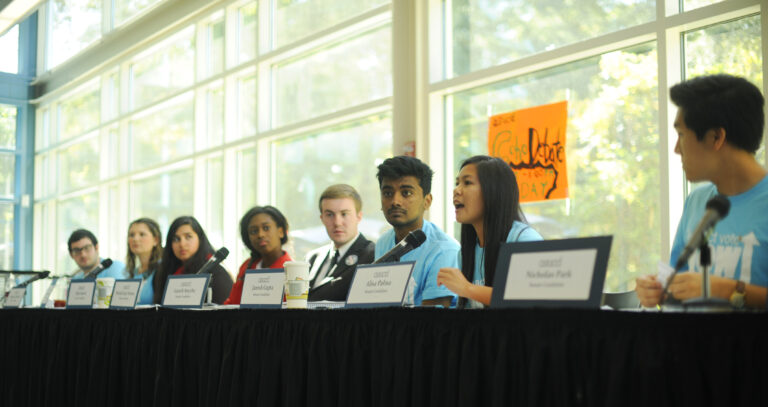
On Oct. 25, nine of the 10 candidates running for ASUCD Senate gathered in the Coffee House for a debate hosted by the ASUCD Elections Committee and The Aggie.

Independent candidate Shehzad Lokhandwalla was absent from the debate, while NOW candidate Seanne Louvet left 20 minutes in.

After The Aggie asked questions, the candidates answered in front of a live student audience. Members of the public were also allowed to ask questions. Candidates debated on issues ranging from prioritization of ASUCD grant money to the necessity of previous Senate experience.

Elections will begin on Nov. 12 at 8 a.m. online at elections.ucdavis.edu.

‘Mercy Killers’ brings political advocacy to the theater

0

At 7 p.m. on Nov. 11, the Veteran’s Memorial Center Theater, located at 203 E. 14th St., will house a one-man play that aims to shed light on social justice. The venue will be hosting a performance of Mercy Killers, written and performed by Broadway actor Michael Milligan.

Mercy Killers tells the story of Joe, a working-class Tea Party advocate who comes to reevaluate his stance on American health care after his wife is diagnosed with cancer. Joe’s story is told through a police interrogation regarding his ill wife’s death.

Though the play is not autobiographical, Milligan’s inspiration to write the play is seeded in his personal experiences. After being left without health care in a time when he needed it most, Milligan discussed feeling particularly compelled to write Mercy Killers.

“Having that situation myself further motivated me and made me want to write something,” Milligan said. “I really wanted to create work that also reflected my own beliefs, who I am as a citizen and as my own thinker.”

Additionally, Milligan said his involvement with the Occupy Wall Street movement and his arrest as a result of this involvement compelled him even further to write a play with social implications.

“That experience really changed my life,” Milligan said. “[My arrest] made me question myself. Is it enough to just do another Shakespeare play? Why don’t we also have a theater that’s more politically engaged?”

It was after these two events in Milligan’s life that he wrote and began performing Mercy Killers. For the first six months, performances were small — in classrooms and miscellaneous venues where Milligan performed for free.

The portable aspect of Mercy Killers is something Milligan said he finds very important. Without the necessity of venues or producers, Milligan is able to show his production to a wider audience. He intended Mercy Killers to be a social advocacy justice piece, and being able to perform for as many people as possible is one of his goals.

Today, much larger audiences are seeing Mercy Killers. Milligan has performed for the Minnesota House of Representatives, at the Edinburgh Theater Festival in Scotland and will be performing Mercy Killers off Broadway from January to February of 2014.

The current tour of Mercy Killers, which will be coming to Davis, is in conjunction with the Campaign for a Healthy California. The Campaign for a Healthy California is a statewide campaign seeking to bring guaranteed health care to all Californians. The campaign is hoping to use Mercy Killers as a tool to raise awareness and support for the Affordable Care Act, which Californians will have the opportunity to vote on in 2017.

“The people of California have to be ready to say yes to [The Affordable Care Act], and if we don’t provide them with an opportunity to come together, to have a vision of what [universal health care] could look like, we won’t win,” said Cindy Young, a health care reform advocate who coordinated the California tour. “This is a chance for us to start to do that.”

California performances of Mercy Killers will contain three components: the actual production, a discussion with a panel of local experts on the issues of health care reform and an opportunity for audience members to share their own personal experiences with health care. The personal storytelling element is one that Young finds particularly important.

“Data and statistics often leave us cold. The power of storytelling is what gets people to do something different,” Young said. “I’ve been a health reform advocate for 30 years, and I’ve never seen a play this compelling, to help move people to do something different.”

Those involved in the California Mercy Killers tour are excited to bring the production to a college-aged audience. They feel that with the future of health care in our country unclear, it is important for youth, as well as all ages, to begin developing their own positions on the issue.

“We believe that the opportunity to tell the story of our broken health care system is a much better way to reach people who might not know about this approach, or who might not want to get involved into what they see as a political quagmire,” said Jodi Reid, director of the California Alliance for Retired Americans, in an email.

Milligan too hopes that the storytelling component of Mercy Killers will allow the production to reach a wider audience than a traditional political campaign would.

“Adhering to facts and ideological debates is one thing, but to sit and bear witness to the human stories that give rise to those things is very important,” Milligan said.

To learn more about the Davis performance of Mercy Killers, visit mercykillerstheplay.com.

Protect your bike

A new device is poised to revolutionize the way people think about bicycle security. LOCK8, an induction-charged, keyless, alarm-secured, GPS-tracking bike lock is the first smart bike lock with sharing capabilities.

Two Oxford students, Franz Salzmann and Daniel Zajarias-Fainsod, developed LOCK8 after having both of their bikes stolen in a two-day time span.

“LOCK8 is the first integral solution for bike sharing,” Zajarias-Fainsod said. “Not only do we provide a powerful and user-friendly app, but also cutting-edge hardware that actually lets you communicate with your or someone else’s bike.”

LOCK8 features both Bluetooth and GSM communication, which means that a phone can connect to your LOCK8-equipped bicycle from a few feet or from the other side of the world. With the LOCK8 device and app, users can offer their own bikes to rent, or if you need a bicycle but don’t own one or it’s not near, you can use the LOCK8 app to rent one.

LOCK8 could provide a low-cost solution that requires little to no infrastructure when creating bike-sharing networks. The induction-charged device produces and stores power that is generated magnetically when the bike is in motion and therefore eliminates the need for an unsightly, expensive docking station.

The innovative design employs multiple sensors in the cable and the small base that attaches directly to the frame. If someone tries to use a bolt cutter, a saw, a drill or a hammer, or even if they try to freeze it or burn it off with a blowtorch, the LOCK8 will set off a 120-decibel alarm and send a notification to your smartphone. If the “painfully loud” alarm does not deter the thief, some might say that he earned it, but you will still be able to track the bike from your phone (preferably with police assistance) via the built-in GPS.

Because the LOCK8 also senses vibrations and other such movements, it can also prevent partial thefts, like the seat or wheels being stolen.

Preorders on Kickstarter began last week at the introductory price around $110. Since their launch on Kickstarter last Monday, LOCK8 has received ample support, but they are still 40 percent away from the production target with four weeks to go.

LOCK8 is compatible with 95 percent of bikes, and the app is currently available for iPhone 4S or later and will soon be coming to Android 4.3+ devices with Bluetooth 4.0.

Although the likely retail price is $150 — a little on the expensive side for the average student — the price will probably start to drop if/when it is put into mass production.

This Week in Senate

0

Senator Pamela Nonga was absent, while Senator Amrit Sahota, President Carly Sandstrom and Controller Eric Evans left early. Bradley Bottoms, ASUCD vice president, presided over the meeting.

The highlight of the meeting was the void of President Sandstrom’s veto on Senate Bill 11. The bill proposed to donate $2,500 to Aggies of Color for the 25th Annual Student of Color Conference (SoCC). SoCC provides students of color a platform to discuss issues affecting all UC students. Senator Miles Thomas criticized President Sandstrom for vetoing the bill within 24 hours, not allowing SoCC supporters enough time to prepare counter-arguments. Sandstrom urged the senators to think more critically about senate reserve spending. The veto was void because the bill’s author, Francisco Lara, was not notified about the veto. The bill was passed by a 7-3-2 vote to provide Aggies of Color funding in support of the 2013 SoCC.

CALPIRG’s Chapter Chair, Donna Farvard, presented the history behind the pledge system, its effectiveness and how its restoration is the next step. Senator Thomas also presented the issues with ASUCD money.

“I want the budget website up-to-date. We have no transparency. I want to simplify student government,” Thomas said.

University Affairs Director Dillan Hortan presented his quarterly report. It was revealed to senate that the UC Ambassadors program was stopped, which they were unaware of prior to the report.

Senate Bill 12, to permit directed comments to elected officials under Robert’s Rules of Order, was considered. While the order is in effect, ASUCD Senate cannot directly address anyone but the presiding officer. Those against were concerned that some may not be outspoken enough to provide reasoning behind their voting decisions to which Senator Maxwell Kappes responded, “If you don’t feel comfortable with speaking or voting you should probably find a new line of work. This job is tough.” The bill passed in a 9-2-1 vote.

There was no new legislation.