


37.8 F
Davis

Davis, California

Monday, December 29, 2025
Home Blog Page 966

Aggies put up 22 runs against San Jose State

0

After a beat-down of San Jose State on Tuesday, the Aggies dropped two straight games to Utah on Friday and Saturday.

UC Davis only needed eight innings to put up a season-high 22 runs on 23 hits Tuesday against the Spartans.

However, its pitching struggled in the late innings to secure wins against Utah.

The Aggies hold a record of 4-3 after Saturday’s game without having played any of their games against other teams in their conference.

Tuesday — UC Davis 22, San Jose State 4
UC Davis won the single game in a blowout victory against the Spartans, with a clicking offense that did not let up throughout the game. Sophomore Nick Lynch was impressive, hitting 3-3 from the plate with one run batted in and two runs.

Sophomore John Williams led the team with four hits and four RBI. He recorded three of the four extra-base hits the team had. He hit a two-RBI triple in the fifth.

The game was capped off by a nine-run seventh inning, in which constant pressure was applied on the Spartans. The Aggies tallied up nine hits, all singles, in the inning and two batters were hit by pitches that led to the high-scoring frame. The team’s small-ball mentality was in full effect, as 19 of the 23 hits the Aggies had were singles.

Freshman Zach Williams started the game and pitched 3 2/3 innings. He gave up three runs, two earned, and allowed six hits. Then, sophomore Robert Parucha came in from the bullpen and tossed 2 1/3 innings, allowing one run, to record the win for the Aggies.

Friday — UC Davis 8, Utah 11
After taking the lead late in the seventh, UC Davis surrendered five runs in the last two innings as Utah came back to win it.

The bottom of the seventh inning was capped off by a two-run triple by sophomore Kevin Barker.

However, Utah answered with one run in the next inning and four in the ninth to take control of the game. This game was the first of two in which the Aggies’ bullpen allowed late runs to either give up a lead or tie.

Junior Harry Stanwick started the game for UC Davis and pitched 5 1/3 innings and gave up six runs, four earned. He also walked two and struck out six batters.

Barker had a good game, going 3-5 from the plate, driving in three runs and scoring a run.

Saturday — UC Davis 3, Utah 7
This game was a battle of starting pitchers. Sophomore Spencer Koopmans and Utah’s Tanner Banks both threw seven innings and allowed two runs. The bullpens turned out to be the deciding factor.

With the game tied up at two heading into the eighth inning, Utah went on a power surge. With one out and a man on second, TJ Bennett crushed an opposite-field home run that easily cleared the left-field wall that gave the Utes the lead.

In the bottom half of the eighth, the Aggies answered by scoring a run, but could have scored more. With the bases loaded and two away, Utes catcher AJ Young allowed a passed ball that plated a run and moved the runners to second and third. With the Aggies threatening to take the lead with a hit, pitcher Case Rezac got junior Spencer Brann to ground out to second to kill the rally.

In the ninth inning, the identical situation replayed for the Utes as AJ Young pulled a ball that cleared the left-field wall with a runner on second and one out. Then, the very next batter, Cory Hunt, hit the ball down the left-field line that barely stayed fair for the third homer by the Utes.

After the tough loss, Coach Matt Vaughn would have liked to see more from his team.

“We just have to play better baseball going forward. We’re right in that game,” he said. “If we do some execution things earlier in that game, we’re in a much better position, but bottom line is we didn’t pitch well enough out of the bullpen to win that game.”

LUKE BAE can be reached at sports@theaggie.org.
Mancasola makes it happen against Northern Colorado

On Wednesday, UC Davis headed south for a matchup against the Big West Conference’s number one team, Long Beach State. If the 49ers were expecting to blow another team out at home, they were sorely mistaken.

The Aggies took the court without their three-point connoisseur, junior Ryan Sypkens. Luckily, sophomore Corey Hawkins decided it would be a great night to emulate Sypkens’ form beyond the arc. Hawkins banked four threes for 12 points in the first half alone.

UC Davis was scorching in the first half. Hawkins was not alone in frustrating the 49er defense. Junior Tyler Les also landed three three-pointers of his own, while senior Paolo Mancasola made a three, two assists and a nice steal to help continue to Aggies’ momentum.

At the end of the half, UC Davis was leading a stunned Long Beach State 33-24.

After the break, the 49ers started to pull back in it. They stepped up their defense and they were finally able to showcase that high-flying offense. Ultimately, this game came down to the wire and the Aggies were simply sapped of the energy needed to close it out.

UC Davis’ roster was severely limited that night. Sypkens was out, and several other players were held to limited minutes, meaning that Hawkins played every single minute of the game. Les and Mancasola were right there with him, tagging 38 and 36 minutes, respectively.

Long Beach managed to pull away with a 71-65 victory, but the score does not showcase the fight that went on between the teams.

“They played their tails off tonight, fought hard and battled,” Les said.

He said he felt like his players learned a lot during the loss, and he is quite certain that the Aggies will be able to bounce back and fight even harder next time.

“This was a valiant effort, hopefully we will have a big crowd turn out on March 7, when we see these guys again and take another shot at the best team in our league,” he said.

UC Davis was not able to dwell on the loss for long because they had plenty of prep to do for Saturday’s game against Northern Colorado.

This game posed an interesting challenge for the Aggies because it gave them a chance to size themselves up against a relatively unknown opponent.

To set the stage, know that the Bears are in the Big Sky conference and they have a productive offense that relies on two major players. Their defensive intensity is their strong suit and they have plenty of guys who like to jump into passing lanes for steals.

UC Davis started the game with incredible spark, going up 28-17 in the first seven minutes. However, the Bears began to creep back in and they ended the first half with a 39-34 advantage.

The second half continued the back-and-forth between the teams. Both squads shot for over 60 percent from the field and neither had the defense breakdown that usually decides who will win.

The game definitely kept fans guessing and the victor was not decided until the final second of the game.

With Davis trailing by one, sophomore J.T. Adenrele made a beastly block on defense that allowed the Aggies to have the ball back with 30 seconds left. UC Davis called a timeout to draft their final play and everyone assumed the ball would go to Mr. Red-Hot Hawkins, who had already scored 34 points that game.

Hawkins did get the ball and he took it down the court to try and set up a play for himself. As he drove into the basket, the Bears swarmed to him like bees on a hive, refusing to let Hawkins burn them again. Somehow, through the mass of blue, Hawkins managed to find another white jersey at the top of the key. He zipped the ball to a waiting Mancasola who sent up a beautiful shot with 1.8 seconds left.

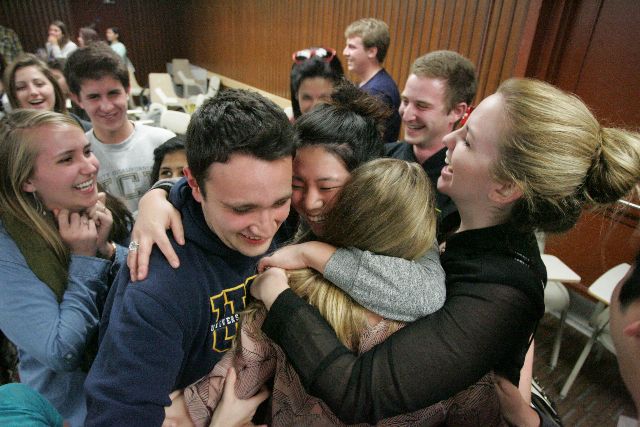
Mancasola and Co. exploded as it swished through the net, giving UC Davis the 79-78 advantage and the win.

UC Davis knew that this was not their best performance. The 18 turnovers and missed free-throws told them that, but they were ecstatic to have another buzzer-beater win.

“I was standing right under the basket when he [Mancasola] shot it, I knew it was good when it left his hands. I just did not want to celebrate too early,” Hawkins said.

Mancasola took no credit for his own, but mentioned Hawkins’ impressive sixth-sense that allowed him to dish the pass out.

“I could not believe he [Hawkins] had the awareness to find me with three guys standing all around him. I had to put it in for him,” Mancasola said.

Coach Les was proud of the resilience and maturity his team has shown over the last week, despite the setbacks.

“This team is all about finding ways to win. You can see them grow and mature as we head down the stretch with some big conference games ahead,” Les said.

KIM CARR can be reached at sports@theaggie.org.

News in Brief: Search warrant leads to five arrests

0

On Thursday at 10 p.m., Davis Police and the Yolo County Narcotics Enforcement Team served a search warrant at the 800 block of B Street.

Two people associated with the house with the search warrant fled in their vehicle, not before attempting to run down an officer who was trying to detain them.

Davis Police followed the vehicle and apprehended the two when they pulled over. According to a Davis Police press release, the driver, 20-year-old Davis resident Alfredo Ordonez, was arrested for assault with a deadly weapon on a peace officer and for felony evading and visiting a drug house. The passenger, 33-year-old Changleska Standingelk, was arrested for visiting a known drug house.

Three others were arrested at the house as well.

Sherry Harrington, a 43-year-old Davis resident, was arrested for possession of an illegal drug and narcotics paraphernalia, and maintaining a house for narcotics sales. Tanisha Schuchman, a 32-year-old Davis resident, was arrested for maintaining a house for narcotics sales. Dwayne Durant, a 21-year-old Davis resident, was arrested for maintaining a house for narcotics sales and possession of narcotics paraphernalia.

The five were booked at the Yolo County Jail.

— Claire Tan

News in Brief: We Are Aggie Pride hosts events throughout the week

0

We Are Aggie Pride, a student-run philanthropy program that aims to collect emergency funds for UC Davis students in need, is hosting a series of events this week through Thursday.

The program is currently in its second year and is the first student-run organization of its kind on the West Coast.

This week’s events will include a “Change Challenge,” promoting first-year student donations in dining commons, which will last until Friday; “Doughnuts and Donations;” “Tiny Tacos, Mucho Impacto;” the “Get It, Got It, Give It” scavenger hunt; “Cupcakes on the Quad” with The California Aggie Marching Band-uh! and “Movie Night at Rock Hall.”

More details on these events and We Are Aggie Pride can be found at weareaggiepride.ucdavis.edu.

According to a Wednesday press release, to date, We Are Aggie Pride has raised over $58,000 in donations and sponsorships.

The release also states that University administrators will be present at some of the week’s events.

— Muna Sadek

Column: Shelling ghosts

4

Geekly Weekly

“Ghost in the Shell: Stand Alone Complex,” or “GitS: SAC” for short, is an animated television show that gives an unparalleled attention of detail to human consciousness on a medium that is not made up of gray matter.

Whereas conscious machines — machines that think like humans — have been a topic of interest in many works of science fiction such as The Terminator and The Matrix, it is the way in which “GitS” is true to contemporary cognitive science’s notion of synchronous intermodal matching that really sets it apart.

Cognitive science defines synchronous intermodal matching as the process by which the human mind contextualizes itself in a spatial environment (kinesthetically) and within a specific human body (haptically). For an example of this process being manipulated in a fun, intriguing manner, look on YouTube for “The Rubber Hand Illusion.”

Several academic disciplines currently studying human consciousness would seem to be converging upon the notion that consciousness is a phenomenon that spontaneously emerges in a network of a certain degree of complexity. It would seem as though the prefrontal cortex, a portion of the forebrain and a network of immense intricacy, is what gives humans the neurological complexity to reason with abstract notions like “cause and effect,” “chaos and order” or “good and evil.”

In the “Ghost in the Shell” universe, cyberization is the process by which someone’s “ghost,” the singular entity that is an individual’s consciousness, is uploaded to a digital medium. After a person has had their consciousness uploaded onto a cyberbrain, a machine mind with storage, longevity and digital interfacing capacities far beyond those of a non-cyberized human, that person gains access to an online network that greatly exceeds the powers of today’s internet.

If, during the “GitS” cyberization process, someone perceives a break in the continuity of their consciousness, their mind rejects the upload and they die due to a disruption in synchronous intermodal matching. Cyberization therefore demands that the patient must feel as though they are constantly looking through one set of eyes, hearing with one set of ears and thinking about the world with one uninterrupted mind in order to survive the cyberization process.

The philosopher John Locke would accurately describe the workings of consciousness in “GitS” as self-reflexive processes with respect to its own affective, i.e. internal states. People are constantly aware that they are themselves from one moment to the next as long as they can reflect back on what thinking was like for them several seconds ago.

A person undergoing cyberization must keep experiencing the exterior world with what they perceive to be their own interior senses, though these senses are slowly being roboticized and digitized. Contemporary cognitive science would describe this as a necessary feedback loop between exteroceptive measures (senses of the world exterior to the mind) and interoceptive measures (senses of the world internal to the mind).

The increasingly plausible question of whether human consciousness will ever be able to leave gray matter is one that has been foreshadowed in humanity’s fictions for a very, very long time. It would seem as though notions such as ghosts, chi, astral projections, vibes, seances and the soul are humanity’s early drafts of the same question — “Will we ever be able to free our minds from the confines of our bodies?”

Though I as a humanities major lack the technical know–how to be able to answer this question, I should hope that some science majors who take an interest in it will be able to answer it for me. I’m just dying to find out.

MICHAEL FIGLOCK can be found furiously attempting to cyberize himself at mpfiglock@ucdavis.edu.

ASUCD preliminary election results announced

Results from the ASUCD Winter Election were announced today, with NOW candidates Carly Sandstrom and Bradley Bottoms voted to become the next president and vice president.

“[I feel] fantastic. All the work paid off. It was a great campaign. Everyone — from all slates — worked their butts off,” Sandstrom said.

Out of all UC Davis undergraduate students, 6,252 voted in the election — 24.2 percent. Aaron Hsu, ASUCD Elections Committee chair, said he was pleased with this voter turnout.

“Since 1991, this record has only been surpassed three times in a winter election,” he said.

Sandstrom and Bottoms garnered 2,989 votes, while independent candidates Paul Min and Sergio Cano received 1,934 and FUQ candidates Migz Espinoza and Lane Lewis received 1,327.

In the senate race, NOW candidates came out on top, with Ryan Wonders, Amrit Sahota and Pamela Nonga taking the top three slots. Yee Xiong of SMART, Miles Thomas of BEST and Reuben Torres of SMART also came away with wins.

Elections Committee still must sort out any filed complaints against candidates, which is what made these results “preliminary.” If the committee disregards all complaints, then the senators-elect will be sworn in on Thursday, Feb. 28. The president-elect and vice president-elect will take office at a later date.

Beauty & the beast: Breaking out

I don’t even care that I completely failed my midterm. No crying over spilt milk, right? I had no care in the world besides when the J-line would pick me up from the Silo, so I could celebrate.

After that and a good night’s sleep, I woke up, ready to head back home for the long weekend. I looked in the mirror and was greeted the most unsightly being in the world, a creature with unruly bed hair, raccoon under-eye circles, red irritated patchy skin, and 409832409283 new pimples. A week of stressful, sleepless nights of cramming and crying really takes a toll on one’s skin.

By now, I think it’s relatively safe to assume that most of you guys have noticed that lack of sleep and stress are correlated with breakouts. This is because stress causes the adrenal glands to secrete more of the hormone cortisol, which causes you to secrete more oil on the face, which can clog pores and cause acne.

Some factor in life stresses you out, which causes you to break out. Well speaking for myself, seeing these unattractive red blemishes on my skin stresses me out even more, so I continue to break out. It’s a pretty unforgiving cycle. Then, lack of sleep only increases stress levels. More importantly, lack of sleep also causes more inflammation. Sleep also repairs your body; it’s not called beauty sleep for no reason.

Although most people would agree that lack of sleep and stress does cause acne flare-ups, diet is more controversial. In my own opinion, maintaining a healthy diet is a key factor in having nice skin. I believe that “you are what you eat.” So if your diet consists of mostly oily and fried foods, then your skin would look, well, oily and fried.

Of course, there are exceptions, like those people who can eat anything — scarf down a whole bag of hot Cheetos for breakfast, have a gallon of mac ‘n cheese for lunch, and half a pizza for dinner and still not get a single pimple or gain a single pound.

I, for one, am definitely not blessed with that trait. Although I personally notice the correlation, I know many people have informed me that acne and diet are not intertwined. The theory behind it is that what causes acne is dirt and oils being trapped in between your pores, and that eating greasy food does not mean your body produces more oils. Now, I’m no bio major, so I won’t even try arguing that point, but whether you agree there is a correlation between having a healthy diet and having healthy skin, I’m pretty sure everyone will acknowledge that there is no harm in cutting back that bag of chips for some fruit.

So I catch myself in front of the mirror, leaning over the sink. I find myself trying to pick at and pop my pimples, as if that will make my problems disappear. It’s a really bad habit. I always end up doing this, and never fail to regret it literally the moment after. No matter what, don’t be like me and pick at your pimples. It doesn’t make it disappear.

Heck, it doesn’t even temporarily solve anything. It immediately turns redder and more irritated. Then there’ll be a scab, and maybe even permanent scarring. It’s not worth it. If you’re prone to picking at your skin, like I am, it may be helpful to keep your nails short to make it more difficult. It also helps to put post-it notes on the mirror, but I find it embarrassing if my roommate or visitors see these notes.

Well, I guess all I can do is follow a simple skin routine of cleansing with a medicated acne wash, moisturizing and applying a spot treatment. In time, my skin will eventually clear up by itself, just in time for finals…


EUGENIA CHUNG can be reached at ehchung@ucdavis.edu.


Reconfiguration considered for Davis schools

0

Over the several upcoming months, the Davis District Board of Education will look over reconfiguration options for the Davis Joint Unified School District’s (DJUSD) elementary schools, junior high schools and senior high schools. This may be up for discussion as early as March.

The current system in the Davis District consists of kindergarten to sixth grade in elementary schools, seventh to ninth grade in junior high schools and 10th to 12th grade at senior high schools. This was a common configuration in the ’70s and ’80s, and the Davis School District is one of the few remaining in the state with this setup.

The Board will review and consider several configurations. One option would be having kindergarten to eighth grade in elementary school and placing ninth to 12th graders in high school. Other options would be moving the ninth graders to high school, or not changing the current system at all.

Since ninth graders are placed at Davis junior high schools — which are considerably smaller than the high schools — they are protected from common high school social and academic pressures.

This subject has been brought up four times over the last 20 years. The reconfiguration is being discussed in order to use facilities more efficiently as well as meet long-term education and financial goals.

“The Education Code assumes that all schools are K [kindergarten] to five, six to eight and nine to 12 configurations. The rules, funding and timing are broken down by this configuration. We are considering aligning our configuration to fit these requirements,” said Pamela Mari, executive director of Student Services at DJUSD.

Mari made it clear that there is a great deal of study to be done before even considering changing the system.

“This subject requires analysis of facility use, program enrollment, educational benefit, challenges we might meet and mitigat[ion of] negative effects,” Mari said.

Former Holmes Junior High and Davis High School students expressed their opinion on the possibility of an entirely new school structure.

“I think the schools should move the ninth graders to force kids to grow up and give them more opportunities,” said Graham Daniel, a UC Davis second-year nutrition and psychology double major, and former Holmes Junior High and Davis High School student.

Caroline Petres, a Wheaton College third-year Asian studies major and former Holmes Junior High student, thought otherwise.

“I think changing the system is stupid. It’s fine how it is and Davis High School is already big enough. Plus it would only add to bullying,” Petres said.

The Board will decide what structure to implement after listening to several reports and weighing all the options.

“Whatever the decision may be, it will be well thought-out, meaningful, educationally sound and balanced with a financial benefit,” Mari said.

MELISSA GAHERTY can be reached at city@theaggie.org.

South Korean talent comes to Hollywood

1

The past two years have shown a peak in a distressingly mundane Hollywood trend: nine out of the 10 top-grossing films in each year were either sequels, prequels or remakes.

Of the two films that did not fall into those categories, one was a surefire-success book adaptation (The Hunger Games) and the other a bastardized slice of warmed-over pop culture (The Smurfs). Looking ahead at the schedule of releases for 2013, there’s good reason to fear that the industry may continue to take its gargantuan smurf over all that was once entertaining.

Thankfully, there is at least one promising development on the domestic film front: a handful of popular and adventurous directors from South Korea are taking on big-budget American projects due to be released this year.

Directors like Park Chan-Wook, whose audacious revenge thriller Oldboy (2003) found an enthusiastic international audience, will be among those at the forefront of this wave of foreign talent.

Park’s confrontational films may have initially brought outside attention to his work, but his upcoming American debut, Stoker, trades in some shock for classic chills in a psychological horror plot starring Nicole Kidman and Mia Wasikowska.

Early critical reception for the March release has been quite positive, with many reviewers pointing out atmospheric similarities to the films of Alfred Hitchcock.

“Korean directors make visceral, artistic and compelling films that many Americans will fall in love with. I can’t wait to see Stoker,” said fourth-year biochemistry and english double major Brian McGarry.

The first release this year to feature a prominent Korean director was The Last Stand, an action flick starring Arnold Schwarzenegger. While the film itself has received mixed reviews, some critics have pointed out that it benefits from director Kim Ji-Woon’s inventive visual style.

Among Kim’s additional body of work is the chilling ghost story A Tale of Two Sisters (2003), which has since been remade stateside as The Uninvited (2009) and The Good, the Bad, and the Weird (2008), a wild, spaghetti-Western-influenced adventure set in 1930s Manchuria.

Later in the year, we will see the third major South Korea/U.S crossover with Bong Joon-Ho’s sci-fi epic Snowpiercer. Bong is arguably the most compelling of the three filmmakers mentioned, with a knack for consistently widening the boundaries of whatever genre he works in, whether it’s a black comedy (Barking Dogs Never Bite, 2000), a giant monster movie (The Host, 2006) or a murder mystery (Mother, 2009).

Snowpiercer will be an adaptation of a French graphic novel, whose intriguing scenario concerns the survivors of an ice-age apocalypse who reside in a perpetually moving train.

“[Snowpiercer] sounds intriguing. It’ll be interesting to see if the movie will bring a different sensibility to the genre,” said fourth-year technocultural studies and art double major Christopher Jones.

One must commend these directors for taking on projects in an entirely new studio system — and in the case of Kim Ji-Woon — a new language. Kim revealed in recent interviews that the South Korean system is much different, with all the resources and energy on set going toward achieving the director’s vision instead of adhering strictly to the shooting script and working hours once the film is written.

One must also give props to a few Hollywood studios for trying something different.

“South Korean directors have certainly made a mark on Korean pop culture by displaying their unique style and attention to detail in movies, dramas and music videos,” said president of the K-Pop club Phancisco Doan, a third-year neurobiology, physiology and behavior and computer science double major. “This is why K-pop culture has been making its way into the states and [is] becoming ever more popular.”

One might hope that the tradition of remaking successful foreign films into slightly different copies will be curbed in favor of collaborating with international talent. In any case, it may open up domestic audiences to other varieties of popular entertainment available in world cinema.

ANDREW RUSSELL can be reached at arts@theaggie.org.

The Aggie Arcade

0

Game of the week

Metal Gear Solid fans and action aficionados alike have something to look forward to this week with the release of Metal Gear Rising: Revengeance. The latest title from developer Platinum Games features the company’s trademark enthusiasm for all things over-the-top, albeit in a far more familiar setting.

Revengeance takes place four years after the events of 2008’s Metal Gear Solid 4, and this time around Raiden finds himself in the spotlight. The katana-weilding cyborg ninja stands in stark contrast to usual protagonist Solid Snake. Revengeance does feature moments in which stealth remains an option, but more often than not Raiden prefers face-to-face confrontations.

Metal Gear Solid creator/director Hideo Kojima did oversee some of the game’s narrative development, but the real appeal of Revengeance is the adrenaline-pumping combat system, courtesy of Platinum Games. It’s fluid, fast-paced and features a unique cutting mechanic in which both enemies and environmental objects can be sliced in a number of ways.

Feedback for Revengeance has been largely positive so far, though some reviewers have mentioned the game’s short playtime as a notable downside. Personally, I value an entire video game experience over some kind of dollar-to-hour ratio, so in that sense it seems like Metal Gear Rising: Revengeance is an easy recommendation.

This week in news

By the time The Aggie readers see this column, Sony will have unveiled the PlayStation 4 (or whatever other name the company decides to call its newest console). However, at the time of this print that had not happened yet. So instead we look back to the weekend to highlight some big news from Bungie, the creators of Halo.

This past Sunday marked the first official reveal of Destiny, Bungie’s newest project. It’s another first-person shooter, but the company is referring to the game more specifically as a “shared-world shooter,” in which players cooperatively interact with each other online without traditional matchmaking menus and systems.

The term MMOFPS has been has been thrown around a lot in the wake of Destiny’s reveal, but publisher Activision did state that the game will not feature subscription fees. An internet connection will be required to play the game, though.

Few specifics were given in terms of gameplay mechanics, but Bungie did mention a class system and the inclusion of magical abilities. These abilities come from The Traveler, a huge sphere looming over the sole remaining city. Not only did The Traveler grant special powers to certain individuals, but it saved humanity from ultimate destruction.

Players will traverse the post-apocalyptic world and journey to other planets in an effort to fight off various alien species. This means access to ships, and Bungie left open the possibility of space combat.

I often admit that I’m not a huge fan of the Halo series, but Destiny strikes me as a hugely ambitious and exciting game. It won’t be coming out until 2014, but I look forward to hearing more about Bungie’s latest project in the coming months.

ANTHONY LABELLA can be reached at arts@theaggie.org.

Experimental theater lab: ‘Change(d)’

0

Created by the Department of Theatre and Dance, the experimental theater lab showcases the creative ingenuity of Davis students.

This spring, Sarah Salem, a third-year dramatic arts major, and Duskin Drum, a PhD student in performance studies, have co-opted a new experience titled Change(d).

Salem and Drum created the idea for the production while living in the cooperative living known as the Domes.

“We were influenced by communal life,” Salem said. “Taking care of the land and each other; there’s no hierarchy.”

Salem’s overarching goal is an exploration of collaboratively devised work. She wants to see different perspectives addressed in the collaborative process, and Change(d) allows for this diversity.

The performance focuses on themes of ecology and politics. In this massive framework, each participant will have the ability to bring work from their own field of study. This diversity of source material will guide the direction of production.

“I’m very interested in the message. We’ll use theater games to commune with one another. We’ll learn each other’s passions,” Salem said.

She believes the unscripted nature of the play will yield a performance crafted by the participants.

Drum believes the play will create a collaborative community.

“We were both excited about the ideas of the Brazilian performer Augusto Eoal. It’s exciting to now get a chance to work on his techniques,” Drum said.

Drum has a diverse background in theater. After a short stint in college, he dropped out, became a street performer and a puppeteer. Eventually he performed internationally till after seven years he returned to continue his collegiate career.

“There’s a tradition tied to directorial and performance roles. We wanted a model of performance and education that was less authoritarian,” Drum said.

In pursuit of this goal, their performance is wide open and process-oriented. Duskin stressed the commitment necessary for this sort of project to succeed. They intend to do three major shows and a series of public appearances. If they are able to create a serious production, their work will be time intensive.

Though Ezka Whaley-Mayda was not part of the creative force that engineered the process, she still was one of the first proponents. A third-year art studios major, Whaley-Mayda lives with the two organizers.

Whaley-Mayda looks forward to the open-minded nature of the performance. She took careful emphasis to note, though small of stature, she would provide all she could to the production.

“I expect to be really uncomfortable [but] also to be joyful, lie on the floor, hopefully not vomit. I have never done experimental theater so I am very interested,” Whaley-Mayda said.

The lab is still accepting participants. Rehearsals will take place Monday through Thursday and the lab will culminate in performances presented May 24 through 26. The first workshop takes place March 8 at 10 a.m. at Wright Hall. For more information, email dwdrum@ucdavis.edu.

BEAUGART GERBER can be reached at arts@theaggie.org.

Column: Watts Legal?

0

Q: I work in food and agriculture. We’ve got a bunch of milk crates that say, “$1,500 fine, imprisonment, or both for unauthorized possession or use — Penal Code sec. 496, 565, 566.” Can they really put me in jail for taking one of these home and using it to store DVDs? We have a lot of extras.” — Annie F., Davis.

A: Believe it or not, yes. They can put you in jail for six months and make you pay a fine if you use milk crates without “authorization,” according to California Penal Code sections 565 and 566.

Specifically, you need the owner’s permission to use any “containers (including milk cases), cabinets, or other dairy equipment” stamped with a brand.

It seems weird, but that’s what happens when industry lobbyists run our government. Those happy California cows must have been swiping a lot of milk crates.

California Penal Code 496, which bans receiving stolen property, applies to more than just milk crates, though. It applies to all stolen property; but receiving stolen property is different than theft. Theft is when you personally go out and take something that belongs to someone else. Receiving stolen property happens after the fact, when you knowingly take possession of property that you knew or should have known was stolen.

That “knowingly” element is important. If you don’t know — or had no reason to know — that the property was stolen, you have a defense to receiving stolen property. For example, if you buy a Nintendo Wii on eBay for $200, you would normally have no reason to think it’s stolen; $200 is a fair price, eBay is (usually) legitimate and unless there’s something shady about the listing you’ve got no reason to think the seller is a thief.

But imagine you encounter a meth fiend on the side of the road. He hails your car. You pull over. Twitching furtively, he offers to sell you his “hot, hot Xbox 360” for 40 bucks “or however much cash you’ve got on you.” You should realize it’s stolen. If you take the offer, you’re guilty of receiving stolen property.

Milk crates are special property, thanks to the cow industry.

Sections 565 and 566 of the Penal Code ban the use of milk crates by “unauthorized persons” when the crates are marked with a dairy company’s legally registered brand. You’re considered unauthorized unless you get the written permission of the company to use the milk crate.

Really.

And when you find what seems like an abandoned milk crate, you must return it to the owner. Can’t find the owner? Then you must write a letter to California’s Director of Food and Agriculture and tell him that you have the milk crate.

Seriously.

Look it up: California Food and Agricultural Code 34561 gives you an affirmative duty to report the discovery of all abandoned milk crates to the government. Fail to do so, and you could be fined.

And we wonder why Texans think we have too many laws.

Daniel is a Sacramento attorney, former Davis City Council candidate and graduate of UC Davis School of Law. He’ll answer questions sent to him at governorwatts@gmail.com or tweeted to @governorwatts.

Column: ‘Oz’ call

1

No big deal, but I was on a phone call this past weekend with James Franco and Sam Raimi. Sure, I was one of a dozen college reporters listening in on a conference call with two big names involved in the upcoming film Oz: The Great and Powerful. Sure, we were on mute as the moderator asked questions and we plebeians typed furiously onto our laptops. But I was on a freaking phone call with James Franco, y’all.

It all began when I received an email about a college conference call. I’ve done this before, when I had the chance to actually speak to the main comics of “Key & Peele,” a comedy show on Comedy Central. But this time, I was on a Disney conference call with a movie star and a famous director.

Oz: The Great and Powerful is a prequel to The Wizard of Oz, the original MGM film with Judy Garland. Actors such as Michelle Williams, Mila Kunis and Zach Braff star in the film, along with Franco, who plays the main character.

Just in case you live under a rock or essentially don’t particularly care about Hollywood, James Franco is tied to the Spider-Man series, Pineapple Express, 127 Hours and Rise of the Planet of the Apes. But what makes him interesting is that he’s an extreme academic on the side. A short list of his alma maters include UCLA for undergraduate studies, Columbia University’s MFA writing program, NYU for filmmaking and Brooklyn College for fiction writing.

Oh, and on top of that, he was a PhD student in English at Yale University. And if that wasn’t enough, he taught at USC and now teaches at UCLA. A question was asked about how he balances it all, and Franco gave an honest answer.

“I insist that I have a balance. It’s saved my life. I love the academic world. During the past seven years, I’ve gotten addicted to school. I love teaching and being able to focus on other people’s work,” Franco said.

There was also a question about how it was different working with Raimi this time around versus when they worked together on the Spider-Man movies. Again, Franco did not hold back.

“He’s one of my favorite directors to work with and watch. I had a supporting role in Spider-Man, and he usually identifies with the main character. He blames me for wanting to kill Peter Parker. I got a little less love, but now that I’m the protagonist in Oz, I feel more of Sam’s love.”

The other phone call I got to participate in that afternoon was with the director of Oz: The Great and Powerful. Sam Raimi is best known for his directing of the Evil Dead series and had a lot of great advice for college students interested in directing.

“Be directing now. Every day you should be writing a script or a scene. Every weekend you should be filming. Sunday, you should be editing. Monday, show it to a university audience. They won’t like your little film. Go back and fix it,” Raimi said. “You do all of this now and you’ll always be a director. Get to work, you lazy bums!”

This little pep talk can be applied to anyone in college with a dream of accomplishing something great, and it was that one response to a question about advice to aspiring directors that I identified with and believed in the most.

We’re all (hopefully) aiming to achieve more, help others and inspire with our work. It was a treat and the opportunity of a lifetime to be able to listen to two famous working professionals in Hollywood speak frankly about the business.

But I’m still angry I didn’t get to ask Raimi about his thoughts on the Spider-Man musical.

ELIZABETH ORPINA now aims to interview Beyonce. Send contact information to arts@theaggie.org.

New bike tunnel opens in South Davis

0

On Feb. 12 at 11 a.m., the City of Davis dedicated a new bike path and tunnel located near the recently opened New Harmony Mutual Housing Community in South Davis. City officials and residents were in attendance.

The tunnel that connects to the bike path was originally installed in 1990, but had been buried because funding was not available to develop it. The tunnel is located under Drummond Avenue and connects to the city’s existing network of bike paths.

“It’s amazing that back then they had a foresight to place a metal pipe under the road,” said Bob Bowen, City of Davis public relations manager. “The New Harmony Project provided funding that was able to connect the bike tunnel to the low-income housing development so families and kids can ride their bikes.”

Funding for the tunnel and improvements to the bike path were shared by city funding, grant funds and developer funds from New Harmony. It was a requirement by the city for the developers of New Harmony to contribute to funding the bike tunnel. The total project cost was $424,990.

New Harmony Mutual Housing Community is located at 3030 Cowell Blvd. Danielle Foster, City of Davis housing program manager, said residents started moving in on Feb. 1 and is about two-thirds occupied already.

Also considered an environmentally-friendly development, it is one of the first certified green developments of the Mutual Housing construction company. Construction began in 2011.

Dave Kemp, the City of Davis active transportation coordinator, said the tunnel will provide access to 50 miles of bike paths in the city.

The Davis bicycle network covers approximately 10 miles in the city and the new tunnel will be another grade-separated bicycle crossing in Davis. The City of Davis now has 20 bike tunnels and another nine bridges that contribute to the overall bicycle path network.

“It’s a significant east-west connection across Davis and it connects all the way to Dave Pelz bridge in East Davis,” Kemp said.

At the dedication ceremony, former city engineer Will Marshall recounted Davis’ history with bike paths. Davis was the first city to build official bike lanes in 1967. As a result, it has been a model for many other U.S cities in developing a safe, integrated network of bike paths in a city.

Additionally, Davis’ bicycle transportation network was named the first Platinum Bicycle Friendly Community in 2005 by the League of American Bicyclists.

The U.S. Census Bureau showed that Davis has the highest number of bicycle commuters in the U.S. About 22.1 percent of the population commutes to school and work on bicycles.

“The tunnel will bring new life and development to land that has been vacant for a long time,” Foster said. “It’s a better connection to South Davis, downtown and campus for the residents of the affordable housing units, and provides them with an alternate mode of transportation.”

PAAYAL ZAVERI can be reached at city@theaggie.org.

Column: Religion as power

0

The Anarchist

Ideology is what we don’t know that we believe.

This take on ideology comes from the Slovenian cultural theorist Slavoj Zizek. He infamously gave the example of the toilet. German toilets are built such that the waste is clearly visible, ready to be inspected. French toilets are built such that the waste simply disappears from sight. This is supposed to indicate the contrast between French and German ideology.

The Germans want to look right into the face of the fact, be pragmatic, be real. The French might only want to pontificate on the fact of the matter. At least, this is the conclusion that Zizek drew.

Now, the whole point of the analysis of the toilet is to show that ideology pops up everywhere, in everything. It pops up most of all in the places that one would not expect: in toilets, in fonts, in diets, in the preferred level of complexity of a culture’s music, etc.

Human creations of every sort have messages built into them, telling us what to value, how to think, how to live.

These also happen to be the places where the ideology of the elite class is most blatant. We live in a world where a small section of the population makes most of the decisions that affect the entire planet. They shape the world the most.

If we look at the ideology built into our world, in all the unexpected places, we will see that things are shaped to instill in us an ideology of subservience. Groups naturally do what is in their interests, even without realizing it, and so the elite classes shape the world with their ideological interests built into it.

The only way these anti-human, hierarchical structures of power can exist is if the majority of the population holds views that will prevent it from rising up against them. Elite institutions coerce the society through propaganda, but even prior to the propaganda campaigns that constantly bombard us, there is a barrage of ideology in every moment of our daily lives.

Of course, as I frequently restate, there is no group hiding in a lair under a volcano planning this. This is how power groups stay powerful. They do whatever upholds or increases power, and so they create these effects without realizing it.

This should convince us that liberation could only be possible if we resist the ideology built into every aspect of our world. We could never fully escape it, but as long as we hold general skepticism toward this barrage of the elite class’ ideology, we should be more effective in reducing it.

We want to — in Marxist terms — destroy the ideology of the capitalist and replace it with our own ideology, that of the proletariat. Where should we start then? Where can we begin this ideological unearthing? Common sense would dictate that we start with the easiest target.

Religious thought.

Religious thought deals with our core concepts of reality. It also deals with our core concepts of morality. These are the foundations of all belief. If we can be convinced of a certain concept of reality or morality, then we can be easily convinced to take the action that naturally follows. We can be controlled.

To put it bluntly and concretely, it is no coincidence that American Christian churches tend to extoll the virtues of capitalism. Churches are massively powerful groups. They are hierarchies, operating in the power interests of those at the top. The most powerful and pervasive churches set the ideological agenda for all the churches. Since those at the very top of the church hierarchy are themselves members of the capitalist class, they reshape Christian theology to be pro-capitalist.

From Mitt Romney back to Jerry Falwell, the message from these Christian leaders (yes, Mormons are Christians) is that the free enterprise system is the fourth part of the holy trinity.

Remember, Christian theology has evolved immensely over the last 2,000 years. It is no coincidence that it has evolved to endorse whatever ideology catered to the elite class at that time. Church leaders were and are of the elite class.

What if Christian theology was hostile to hierarchy, despotism and tyranny? Then elite institutions would be hostile toward it. It would be reduced. It would lose power. It would be destroyed by the propaganda machine. Christian institutions do not want to lose power. They must acquiesce to the ideology of the elite class. Furthermore, they gain power by instilling pro-hierarchical ideology themselves.

Of course, this applies to the ideology pushed by every institution, but religious institutions deal most directly with ideology. So, we have reason to be most suspect of their doctrines. Even if we did want to follow a theology, we would have to, at every turn, examine that doctrine to ensure that we are not implicitly buying the ideology of the institution that crafted or disseminated it, to ensure that we are not being beaten into ideological submission.

Of course, the easiest way to avoid such ideological manipulation is to reject any theology.

BRIAN MOEN loves Satan and heavy metal. He can be reached at bkmoen@ucdavis.edu.


Editor’s note: This article has been updated to reflect the correct spelling of Slavoj Zizek’s name.