


46.6 F
Davis

Davis, California

Thursday, January 1, 2026
Home Blog Page 985

Biking in the rain, not a walk in the park

0

During last week’s rainy days, many of us were splashed with the infamous “Freshman Stripe” — an embarrassing phenomenon that occurs when your bike tires splatter your back with muddy water. A lot of us also cringed when our buses drove up with foggy windows. Then we endured the discomfort of being tightly packed in it.

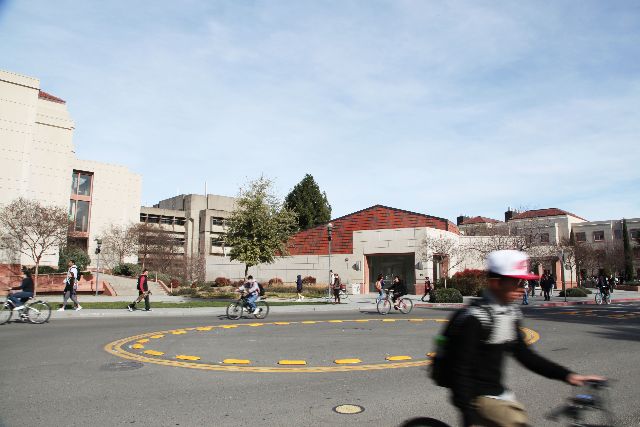
For the even more unfortunate, however, rainy days are also bike-crash season. While arguably there are fewer bicyclists on campus in the rain, the hazards of a slippery road are also greater. Some people may even argue that students lose all biking abilities when it rains. Both the transportation and police departments are working to minimize the risks of accidents through roundabouts and other features.

With over 22,000 bicycles on campus every day, the probability of accidents seem great. However, there have only been approximately 600 reported bicycle accidents in the past 10 years (five per month) according to a report from the fire department. Still, this does not account for minor accidents when students hit a curb or fall off their bike because they are texting. Well over 90 percent of bicycle accidents are not reported, according to Cliff Contreras, Transportation and Parking Services (TAPS) director.

“There are accidents, [but] the majority are minor,” said William Beermann, UCPD representative. “I think the majority of accidents involving vehicles are reported to the police department. The accidents that are caused by a single bike are probably not reported, but those are minor — maybe not even to a point of a scrape or a bruise. I think that as a campus, we’re very safe as far as bikes go.”

The 17 roundabouts on campus help reduce biking accidents by providing a more fluid flow of traffic. The construction of the new roundabout on Hutchison Drive and Bioletti Way replaced a stop sign, which some students seemed to disregard. Constructed during Martin Luther King Day weekend, it was in place by Tuesday, Jan. 22.

“Historically, nationwide, the replacement of standard intersections to roundabouts has greatly increased traffic safety and reduced crashes,” said David Takemoto-Weerts, TAPS bicycle coordinator. “So that’s the assumption we’re operating under.”

As Tercero South Residence Halls continues to grow, Takemoto-Weerts said he anticipates there will also be increased bicycle traffic on Bioletti Way and onto campus.

The new roundabout is only part of the project to make the Hutchison/Bioletti intersection safer. Around 400 to 500 students pour out of the Science Lecture Hall every hour onto Hutchison Drive, keeping the street busy throughout the day and adding to the constant foot and vehicle traffic.

“That area where the roundabout is now has been notoriously a problem where a lot of bicyclists don’t stop,” Contreras said. “It creates problems for traffic and pedestrian circulation, so we believe that this will mitigate some of that.”

The existing construction found at the Hutchison/Bioletti intersection is a current gate construction project and improving the parking lot. The gate on Hutchison Drive and California Avenue is the current campus-enclosed core perimeter, but the new gate will extend the boundary, where there will be little vehicular access. The project is funded by TAPS and Unitrans, and aims to create a safer environment for bicyclists and pedestrians. The gate is anticipated to go up in the next several weeks, according to Contreras.

“When you see class breaks on any day of the week, we believe that trying to go down Hutchison [Drive] is very dangerous for anybody involved in that movement, and we don’t want any vehicles in there during [breaks],” Contreras said. “So we created [the roundabout] and improved the parking lot to complement the gate.”

The only routine vehicles permitted through the gate will be transit and campus service vehicles. A kiosk will also be built to allow communication for other vehicles that need access to the core.

As part of enforcing bike safety, TAPS and the police department formed a partnership to create and implement different programs. The Bicycle Education Enforcement Program was developed through this partnership, and is an online training course about bicycle safety and regulations. Starting last October, they also implemented an ongoing bike light giveaway program. Bicyclists with no bike lights will be stopped by a police officer, talked to about bike safety and given a bike light instead of a citation.

“It’s a form of education, encouragement to ride safely and to utilize the safety equipment,” Beermann said.

Future plans to improve bicycle safety include developing a scramble phase on La Rue Road and Orchard Road, which is a light signal allowing only pedestrians and bicyclists to move. Another bicycle roundabout will also be placed at the California Avenue and Shields Avenue intersection this summer.

During the rainy days when students aren’t biking in the dark or through roundabouts, many are found in Unitrans buses complaining about how crowded it is. Some wonder aloud why Unitrans doesn’t send them a spacious double-decker bus instead.

In fact, there are only two vintage and two modern double-deckers. Buying another one would cost about $800,000.

“We don’t have that many double-deckers because they’re very expensive and they’re all diesel-powered,” said Anthony Palmere, Unitrans manager. “Because we’re in an air quality nonattainment area, we’re restricted in how many diesel buses we can have. We have the natural gas buses, so we’re on what’s called the alternative fuel path. It’s difficult for us to get diesel buses unless we’re also getting natural gas buses at the same time. We don’t have the funding to buy either kind of bus right now.”

Palmere also explained that crowded buses are one of the reasons UC Davis is a sustainable school. Dividing out the carbon footprints of the people on the bus, the emissions per person is low. They are even lower on a bicycle. But rain allows you to hold onto your environmentalist credit aboard the bus while avoiding that stripe down your back.

JOYCE BERTHELSEN can be reached at features@theaggie.org.
Regrowing a chicken

Last year, in a lab at Loyola University in New Orleans, something happened that has never been seen before — a chicken embryo regenerated a joint. We know lizards regrow their tails and salamanders are capable of growing a new leg, but never has this been seen before in a chicken.

In the case of this event, Rosalie Anderson, a professor in the department of biological sciences at Loyola University, was with her undergraduate lab when removing the elbow joint of the chick embryo’s wing.

“The project was originally initiated to develop a model to study joint-regeneration,” Anderson said. “Because of the accessibility of the chick embryo to manipulation and the many years I had worked on the chick embryo to understand the mechanisms of anterior-posterior patterning during development, I chose to work on the chick.”

Eighteen hours after Anderson removed the joint, it had regrown. In this phenomenon the embryonic cells actually migrated to the location of the missing joint and replaced it.

“While the chicken is not the most obvious choice since it had never been shown to be regenerative, we were asking it to regenerate in a context that had never been tested before,” Anderson said. “Excising the prospective joint tissue and thereby creating a “window” in the limb proved to provide the right environment for regeneration to occur.”

Surprisingly, human genes for development are the same as a chicken’s. This means it is possible to apply this research to humans one day, and our own bodies will be capable of regenerating our joints. There will no longer be problems with our bodies rejecting the new joint and the limited movement of the replacements we have today.

“Our study can only be one of the stepping stones for developing therapeutic methods of restoring joint function,” said Duygu Özpolat, a researcher from the University of Maryland. “The basic idea here is to induce a form of regeneration response in an otherwise non-regenerating structure. In this sense, a chicken embryo is similar to a human’s: We cannot regenerate easily.”

A large interest for this research project is for veteran amputees. The possibility of being able to replace a joint, or even a limb, with their own tissue would be a major discovery.

“We are focused on the joint at present, but we will definitely need to interface our work at some point with the issue of re-growing a limb,” Anderson said. “Currently, our collaborator, Dr. Ken Muneoka, and his laboratory at Tulane University, are making great strides at addressing limb regeneration using their mouse-digit-tip model.”

The model Anderson mentioned was another research project Özpolat worked on.

“One of the reasons why we wanted to understand joint regeneration specifically was due to the mouse-digit-tip regeneration model we have been working on at the Muneoka lab,” Özpolat said. “In this model, when a fingertip of an adult mouse is amputated the structure regenerates. The regenerating structure has both bone and connective tissues, as well as a part of the nail. If you make the amputation a larger one, by including the first joint from the finger tip, there is no regeneration.”

Humans regenerating joints seems like a daunting task for researchers to accomplish.

“It is important to remember that while aiming for the complete limb regeneration can be an intimidating task, even the mildest, smallest tissue regeneration response can make a big difference for somebody who is losing the integrity of their joints through degenerative joint diseases, or another patient who lost a part of their finger,” Özpolat said.

Currently, Anderson and her students are continuing research to find the cells and genes that lead to the embryo’s recovery. One of those students is Jeffrey Coote, a fourth-year undergraduate biological sciences major at Loyola University.

“I do plan on using what I have and will continue to learn about joint regeneration throughout my medical career,” he said. “[I] will definitely keep up with this study and similar studies with the hopes of using what I learn to help my patients.”

KELLY MITCHELL can be reached at science@theaggie.org.

Student government officials host first Lunch with ASUCD

0

The Lunch with ASUCD series commenced last Thursday at the Memorial Union (MU) Coffee House. This lunch series opens a gateway for the student body to access their student government officials in an informal setting.

Passed unanimously on Oct. 11, Senate Bill 7 allocates $245 to fund lunch at the ASUCD Coffee House, with seven students at each meeting.

“The goal of the program is, in essence, to create an avenue of communication in which students could more easily access student government officials,” said Roman Rivilis, author of the bill and a second-year political science major.

The idea for the lunch series branched out from the Meals with Mrak program, in which students could enjoy informal breakfasts with the University administration. Organized by former Student Assistant to the Chancellor Nick Sidney, the Meals with Mrak program received positive feedback from students, inspiring ASUCD to develop a similar program.

“Both [programs] promote outreach and provide a relaxed setting where students can interact with, and better humanize campus administrators,” Former Senator Justin Goss said in an email interview.

Goss and Rivilis first brought the idea for Lunch with ASUCD under consideration in the summer of 2012. They envisioned a program that would allow students to interact with senators over lunch, but they also wanted to avoid high costs for the meals.

By using the CoHo instead of the Dining Commons, ASUCD could keep all the costs in-house, Goss said.
“I think the MU is a more convenient meeting place for many students,” he added.

Although ASUCD senators hold public office hours, there is no consistent rate of students who come. Many students either do not know these office hours exist or do not typically visit the third floor of the MU, where most of the office hours are held.

“[Lunch with ASUCD] aims to bridge that gap by offering a source of outreach to students who want to effectively communicate with a group of ASUCD officials in an informal setting, without the hassle of figuring out office hours,” Rivilis said.

Students attended the first lunch last Thursday in the company of ASUCD Senators Bradley Bottoms and Kabir Kapur. The lunch included a discussion of the structure of ASUCD, reasons for being part of student government and where student fees go.

“It was a rewarding experience. They were excited to be a part of the first [lunch],” Kapur said. “I was excited to hear that they were interested in being a part of the program.”

The next Lunch with ASUCD is on Thursday from noon to 1 p.m. at the CoHo.

Students can register online at asucd.ucdavis.edu/2012/10/30/asucd-meals.

KELLEY DRECHSLER can be reached at campus@theaggie.org.

Column: Using Ativan

1

Some shake

The other night we were getting faded on the roof when my friend started talking about how he had broken his leg.

He went into excruciating detail about the pain he felt and the sight of his twisted leg.

While I’m sure he didn’t mean to, his story got me stressed and disturbed and sent me into a mild panic. I backed away from him and from the sight of his cast and tried to focus on something else, but it was too late.

I couldn’t stop imagining the pain he felt and I couldn’t shake the image of his leg bent at the shin.

It somehow immediately sobered me up, but then I just got lightheaded and my body started shivering and felt like it wanted to shrivel into itself. I felt like I was about to pass out or throw up or start crying, and I didn’t want to move or talk or have anyone near me.

I’ve had an anxiety problem for a while now, but it has always been an anxiety that hits me at random times and that usually is triggered inside my own head. This was the first time somebody else had directly caused my brain to slightly short-circuit.

I’d been avoiding drugs to treat my anxiety, and I thought I was doing just fine without them. But this recent experience made me realize that this might not be something I’d be able to get through on my own.

Maybe my head had been through too much and needed a little chemical assistance before it could go back to its healthy self. I was fed up with my condition, and I was ready to believe that the prescriptions that my doctor had given me were not just drugs, but that they were actual medicine intended to heal.

One reason I’d been unsure about taking drugs is because there’s always a risk of dependency when not used appropriately, and I never want to end up addicted to the stuff and thinking that I need it every day just to survive.

But the real reason I was so scared of taking the pills my doctor had recommended for me was because I already had a terrible experience a couple months back when he put me on Prozac, an antidepressant.

They made me extremely restless and emotional and had me feeling a low like no other. I flushed them down the toilet and in my drug-induced rage I swore I’d never return to that fucking doctor ever again.

But my doctor’s actually a really sweet guy who just wants to help others, so he had no problem prescribing something else when I finally did return to his office a couple days ago.

Ativan (mainly known as Lorazepam) was not at all what I expected. It is essentially an all-around relaxant and it is normally used to treat anxiety, insomnia and even acute seizures.

I was expecting it to have a heavy, druggy effect, and I thought it would leave me numb and distant. But really I didn’t feel anything at all.

Before I took the half-milligram pill, I was extremely nervous and sensitive and felt sick to my stomach. But after about 20 minutes I felt fine and perfectly normal.

I didn’t feel “floaty” or out of it or forcedly happy. I just felt like all the nerves in my head that were previously tangled and heated were now calm and smoothed out.

I was able to return to my friend with the broken leg and was no longer as bothered by the gory stories.

As a student, I am weary of taking pills since I have to be constantly reading or writing and cannot afford to have my brain in a drunken fog.

Unfortunately, anxiety can be very debilitating and trying to study while in a panic is just as futile as trying to read in the dark.

The simple thought of taking pills for my anxiety used to make me even more anxious, but I am now a little more trusting in them and feel comforted in knowing I could treat my nerves without getting hazy or slow.

As awful and as scary as anxiety can be, it still somehow tricks you into thinking you don’t need help.

Many are embarrassed to seek help for their anxiety because it does not seem as much of a health concern as a broken leg.

However, your brain should be your priority, and this first-hand experience was with just one of the many options out there designed to keep it in good health.

LEO OCAMPO feels a lot better after sharing all this and invites you to do the same at gocampo@ucdavis.edu.

Column: Déjà vu

0

Memory

I watched Groundhog Day five times this past weekend. Like most exercises, it was an act of repetition.

Groundhog Day tells the story of Phil Connors, a sarcastic TV weatherman who is mysteriously made to relive the same Feb. 2, again and again. He wakes that morning at 6 a.m. in a wintery Punxsutawney, Pa., no matter what.

Watching it on repeat was my entirely naïve attempt to empathize with the character.

Although I could not live with no tomorrow, I thought maybe I could gain a sliver of wisdom that comes from eternity.

Initial encounters with Bill Murray’s Phil, and the small-town residents of Punxsutawney, induced alarmingly loud laughter — more than one housemate threw a concerned look my direction. It was then, mid-guffaw, I knew I needed to watch again.

Somewhere between the second and third time, my discreet snickers deflated to a tired recitation of the lines in my head. I felt reluctant to go on, but a rom-com this profound was surely worth the time.

By end of the fifth time, the movie’s repetition — my own repetition — seemed much more intentional. I was smiling, not just because of Phil’s crackling dry wit, but because a sort of cosmic truth had revealed itself.

The character of Phil arrives at the same truth from an analogous path.

At the beginning of the film he dismisses others with a glib irony, his insurance against unhappiness.

As he realizes he is reliving Groundhog Day, he responds with utter bemusement. This is followed by a series of gleeful romps — bank robbing, joyriding, womanizing — there are no consequences. But life has no meaning either, and he settles into a suicidal malaise.

Only by dedicating his time to self-improvement and establishing substantial relationships to others does he gain freedom.

Accepting that he cannot leave, he learns everything in his small world. He knows everyone, and he knows what will happen to them. He uses this knowledge to help — like saving a kid falling from a tree. He also cultivates absurdly specific skills, such as ice-sculpting. He becomes omniscient.

That my own experience did not contain supernatural elements is somewhat less important than I anticipated — the lesson is the same:

It is a sad truth that we must repeat ourselves to learn and live better. When experiencing déjà vu, it’s likely you have been there before, in one way or another.

Sometimes we can’t know when we’re wrong either — the universe isn’t always going to tell us right away. Living the adage, “learn from past mistakes” is somehow insufficient.

As many have pointed out, this embodies the concept of “eternal return,” given voice by Friedrich Nietzsche. Eternal return suggests that the universe (and all human beings), with infinite time, will inevitably repeat.

Nietzsche’s remedy to this existential problem is called “amor fati,” or loving fate. By affirming every moment in his life, good and bad, Phil conquers the acrimony he exudes on his first Groundhog Day. This awareness allows him to connect with those around him and live happily.

Nietzsche (Mr. “God is dead”), is not the only one with ties to the film. Proponents of Buddhism, Judaism and Christianity preach Groundhog Day, with its themes of enlightenment and salvation.

This recurrence, this selfish paralysis, is not a problem bound by culture. Nor is it bound by time or space. Those laws don’t apply in the film, do they?

So how do we embrace our lives today? What can we take seriously when we are constantly inundated with messages from our phone, Twitter, Facebook, Instagram, email, our TVs and our game consoles? It can be hard to tell how the present moment is more significant than the one just past, or the one coming.

These are questions worth repeating. With the answers we may be able to live more deliberate, meaningful lives in the present.

This Saturday happens to be Groundhog Day. If you keep your TV on, you are almost certain to meet Phil Connors. He’ll give you a philosophy lesson dressed up as a Bill Murray comedy.

If you are smart enough, you may only have to watch it once.

SEAN LENEHAN has programmed his alarm clock to play Sonny and Cher. He can be reached at splenehan@ucdavis.edu.

News in Brief: Finance Workshop scheduled at Student Community Center

0

A Finance Workshop for students is scheduled Thursday, Feb. 7.

The event will be hosted by the UC Davis Senior Class Challenge in conjunction with River City Bank; it will feature alumni Bryen Alperin and Yulia Yevsukova, credit analysts for River City Bank.

The event will address how students can manage school-related debt before and after they graduate, according to a Jan. 29 press release.

The UC Davis Senior Class Challenge is a philanthropic opportunity for graduating UC Davis seniors to give back to the University or their College. This year, the graduating class of 2013 is encouraged to give $20.13 to either their college, the UC Davis Annual Fund or We Are Aggie Pride, which provides emergency funding to students that are in need of it.

For more information on the Challenge visit seniorchallenge.ucdavis.edu.

— Muna Sadek

Get tatted, fight cancer

0

If you walk into Primary Concepts on Feb. 2, it’ll seem just like a normal day for one of Davis’ neighborhood tattoo shops. You’ll see various pieces of art and tattoo flash sheets adorning the walls, hear the buzzing of tattoo guns and the murmur of conversation between artists and customers.

Only one thing will seem strange: Everyone there will be getting the same tattoo. A cancer ribbon. They’re all there for Primary Concepts’ “Tattoos Fighting Cancer” event, in support of little Jeffrey Matthew Fagan.

“I’ve known Jeffrey’s dad for a long time,” says Phil Geck, owner of Primary Concepts. “We went to high school together and I’ve been tattooing him for about five or 10 years. About six months ago, he called me to cancel his tattoo appointment because they had found a lump in his son’s chest.”

The lump turned out to be cancer, and Jeffrey was diagnosed with lymphoma at the age of two. Since the tumor is too close to his trachea, surgery is not an option, and he will undergo two years of chemotherapy. Jeffrey is already several months into his treatment.

“It’s been a bumpy road,” said Jeff Fagan, Jeffrey’s dad. “But he’s a strong, tough, happy kid. When he’s feeling OK, you wouldn’t even know he was sick, other than his bald head.”

Jeffrey’s parents, Jeff and Brianne Fagan, are having difficulties paying for Jeffrey’s medical bills while still supporting themselves and their five-year-old daughter Zoey. Jeff hasn’t been able to work since the diagnosis, and the two juggle watching the children with almost daily trips from Vacaville to Sacramento for their son’s treatments.

Thankfully, the Fagan family has received nothing but care and support from those closest to them.
“Friends have put together fundraisers before, and that’s what’s really keeping us afloat,” Fagan said.

What makes Geck’s fundraising event stand out from the others is that when you give, you get something permanent in return. “Tattoos Fighting Cancer” will feature ten different artists, all available to tattoo any color cancer ribbon for only $20.

“People want to show support with these tattoos for their loved ones that are suffering from or have passed away from cancer,” Geck said. “Our tattoos are usually a minimum of $70 or $80, but we chose to offer these for $20 to make it more accessible for those interested.”

The money paid for each tattoo will go directly to Jeffrey’s family.

Primary Concepts is also holding an art auction at the same time and place as the tattoo event, for individuals who don’t want tattoos but wish to contribute.

“We’re going to have a lot of handmade art pieces, and we’ll be selling them off via raffle,” Geck said.

For those who can’t make it on Saturday but still want to show their support, Geck has set up a fundraising website on gofundme.com to help Jeffrey’s cause.

“I think it’ll be the first of many,” Geck said of the event. “There are a lot of people out there with cancer, and I think we can try and help some of them.”

The Fagan family is thankful for the support.

“We really appreciate the help that we’ve received from Phil and everybody that’s stepped up for us during this hard part in our life,” Fagan said. “I’d just like to convey that we don’t want people to feel sorry for us. It’s something that happens that’s hard for our family, but at the same time we’re trying to stay positive, beat the cancer and move on with our lives.”

“Tattoos Fighting Cancer” will be taking place from noon to 9 p.m. on Saturday at Primary Concepts on 219 E Street. To donate online, go to gofundme.com/1v3e54. For any questions, call (530) 400-9622.

TANYA AZARI can be reached at arts@theaggie.org.

Chief of Police to oversee Davis Fire Department

0

Davis Chief of Police Landy Black has been tasked with temporarily supervising the Davis Fire Department while the city explores a range of options to foment more cooperation and efficiency between the UC Davis Fire Department and the Davis Fire Department.

The appointment, which was made on Jan. 8 by City Manager Steve Pinkerton, follows the departure of Interim Fire Chief Scott Kenley. Kenley left the post because he had reached the maximum number of hours permitted to work for the city as determined by state regulation.

“It makes a lot of sense to merge the public safety departments on a temporary basis during this period of transition and Chief Black was the logical choice to oversee this process,” Pinkerton said.

The appointment is expected to last between six and nine months, during which time the city will comprehensively assess the prospect of shared management to oversee both fire departments.

“We don’t have any prior expectations. We’re considering a range of options and we’ll be using this time constructively so we can reach the outcome that makes the most sense,” Pinkerton said.

The priority for the city is to find a cost-effective management model that encourages greater cooperation, thereby improving response times to emergency calls. Black said he considers his appointment to be a move toward achieving this level of collaboration.

“It reflects that both departments believe there is a lot of lost efficiency by standing separately. It’s not efficient and doesn’t provide the highest-quality service. Our goal is to provide a better service for the people asking for help,” Black said.

It is thought that this level of efficiency can be attained by dropping logistical boundaries that currently exist between the two departments.

“Dropping these boundaries would statistically improve response times to emergencies,” Black said. “We want an operation that enables us to respond in the fastest, most effective way possible while reducing the risk of any serious injury or casualty.”

Discussion over the coming months will focus on the budgetary, staffing, logistical and management considerations before a decision can be made. While the culmination of the projected six- to nine-month period is by no means a strict deadline, it is hoped that a permanent solution will be reached within this timeframe.

“We have to find a solution that everyone will be comfortable with. Our task is to work out the most effective way of delivering public safety services while maintaining our responsibility to be good stewards of public money,” Black said.

The appointment, however, has not been unanimously well received. Reservations have been voiced with regard to Black’s qualifications for the role due to limited experience in the firefighting field.

“Chief Black has done a fine job with the police department, but there’s quite a difference between firefighters and police officers. It’s a completely different mindset. It’s not an administrative person we need; it’s someone that has the knowledge of what the fire department entails,” said Bobby Weist, fire captain and 3rd District vice president of the California Professional Firefighters (CPF). “This isn’t something that would have been done with any other department that has public safety in mind.”

Weist, furthermore, raised questions surrounding the legitimacy of Black’s appointment, given that California’s government code 38611 stipulates that “the fire department shall be under the charge of a chief who shall have had previous training and experience as a fireman.”

Frustration was also expressed with the length of time taken to reach a permanent solution.

“The Davis Fire Department has been without a permanent chief for almost four years. We need a Chief, and this is the person that leads the department as well as makes decisions on operational issues,” Weist said.

Weist said while he has no issues with Chief Black, the city’s priority should be to find a permanent chief.

“He’s [Chief Black] very personable and all my dealings with him, whether on a professional or personal level, have been fantastic. But in order to carry out this role you have to have the relevant expertise in managing the day-to-day operation of the fire department,” Weist said.

While Chief Black’s appointment could be interpreted as suggesting the contrary, the city is not considering a joint management model between the police and fire departments at present.

“The discussion regarding police and fire relations has been in limbo for some time, but at this stage the city is not ready to explore what a combined model would mean for both communities,” Black said.

The City Manager’s office says that during this transitional period there will be no noticeable difference to fire services provided for the community.

JOE STEPTOE can be reached at city@theaggie.org.

Inside the Game with Corey Hawkins

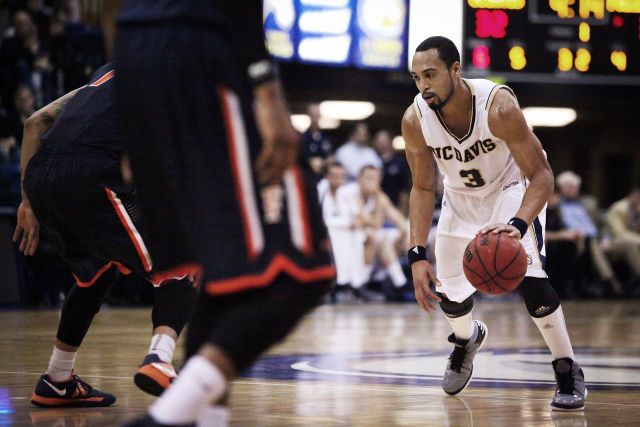
The UC Davis men’s basketball team has brought an entirely new look to the courts this season after a disappointing 2011-12 campaign.

Part of that fresh start has been from the revitalizing spark that sophomore Corey Hawkins has provided for them.

It can be said that basketball is in his blood, as his two brothers also play basketball and his father, Hershey Hawkins, was a successful 13-year NBA player.

Hawkins has been a force on offense and hit the game-winning shot against Cal Poly in a thrilling game at home.

He recently sat down with Aggie Sports Writer Kim Carr and discussed his new career at UC Davis, life with a former NBA player as a father and what it is like being in a family passionate about basketball.

Aggie: You played your freshman year at ASU. How is the atmosphere different here?
Hawkins: ASU is a bigger school with more people and bigger facilities so it’s a little different than here. There’s a different energy here though. People definitely take academics way more seriously here at Davis though.

What pushed you to transfer to Davis?
Actually, when I transferred I ended up transferring late. Coach Les called my dad to tell him he had gotten a coaching job here and he had played with my dad in college so it just worked out for me.

How much did your dad coach you as a kid?
He definitely helped me. When I was starting off he guided me but he was also playing [in the NBA] at the time. So he was away for games quite a bit. But even just being able to go to his practices and use those facilities was a huge advantage.

Obviously he’s helped me but I’ve gotten a lot of help from my teams and playing [with] my brothers. It was a nice combination of both.

How is Coach Les as a mentor?
Oh, he’s awesome. He’s a player’s coach and he knows when guys get tired during the season and need some rest but he knows when to push you too. He really has everybody’s best interests at heart.

Do you have aspirations for the NBA?
Definitely. That’s what I’m in it for. I have to keep working on it. I’m not there yet but I’ve still got two more years and I need to keep progressing within the team and individually and just keep on winning.

What would you like to do after the NBA then? Would you still want to be involved in basketball in some way?
Absolutely. My dad works for the Portland Trailblazers in the player development department. My major revolves around social media and mass marketing so I would like to use that. You know, I love the game too much to not be around it.

You have a weird knack for taking off-balance shots and Coach Les has touched on your gift for landing the fade-away jumper. Have you always had that ability?
Yeah. I mean honestly when I was a kid I would go to the gym and throw up shots, run over to the ball and throw it up again.

I saw when you were warming up for the game against Cal State Fullerton you just lobbed it up in the air from half court and it swished right in.
That was just luck. I don’t know how to explain it. I just try and keep focused on the shot all the way through, I guess.

What are your warm-up songs?
Honestly it depends on what kind of mood I’m in. If I’m tired when I hit the gym I want to listen to something that’s going to pump me up. Usually some kind of hip-hop or rap — I don’t like slow songs. A lot of Kendrick Lamar, The Game and anything with a pump-up feel to it.

You’re currently shooting 92 percent from the free throw line. What is your mental process when you’re getting ready to take the shot?
I set my feet, spin the ball, take three dribbles and then I spin again. I spin it for me and take my dribbles for my mom and each of my two brothers then I spin it again for my dad. Then I tell myself “Good shooters make their free throws every single time.”

What’s been your favorite basketball moment at UC Davis so far?
It had to be the game winner against Cal Poly. Yeah, for sure. That was, that was … well, I’ve never hit a game winner like that.

KIM CARR can be reached at sports@theaggie.org.

Glowing brain cell reactivation

The basic assumption of researchers dealing with memory, including Brian Wiltgen, an assistant professor of UC Davis’s department of psychology and the Center for Neuroscience, is that memory retrieval involves the activation of the same neurons that were engaged during learning. He is in charge of a neuroscience laboratory focused on various topics such as memory circuit activation and memory consolidation. Recently, using genetically modified mice, Wiltgen and his group tested this assumption.

In the past, psychologists would study various cases such as humans with their hippocampuses removed, or animal tests.

“In humans, several patients have had the hippocampus removed and it produced dense amnesia,” Wiltgen said. “In animals, the hippocampus is important for learning about places. If this structure is removed, the animals will not recognize a familiar place.”

In humans, the hippocampus serves a similar role. Researchers call the role of the hippocampus a storage center for “trace” memories. This means that if we smell, taste, hear or feel something similar to the stored trace in the hippocampus, the entire associated memory will be reactivated.

“By studying patients with brain damage produced by medical conditions such as strokes, and brain damage induced in experimental animals, [psychologists detected where memories are stored],” said Arne Ekstrom, an assistant professor of the department of psychology and UC-Davis Human Spatial Cognition Lab.

Researchers have identified the importance of the hippocampus by doing brain scans of test subjects, and recording which areas of the brain were most active during memory retrieval.

“Other information has come from functional brain imaging (fMRI) studies that identify areas of the brain that are active when people retrieve memories of past events,” said Charan Ranganath, a professor of the department of psychology at UC Davis and the Dynamic Memory Lab.

In other cases, electrodes were used in place of an fMRI to help track learning and memory locations in the brain.

“Researchers sometimes insert electrodes into the brain of epileptic patients to find the foci [focus] of their seizures,” Wiltgen said. “It’s been found that some neurons in the hippocampus are activated when a specific video clip is watched and then reactivated when the person recalls that same clip.”

To further cement psychologists’ basic assumption and add more data to the evidence already backing the assumption, Wiltgen conducted his study on mice.

“In our experiment, we use genetically modified mice to permanently label neurons that are activated during learning,” he said.

Out of the many types of mice generated from the various scientific research interests, Wiltgen picked mice with green fluorescent nerve cells.

“In our mice, cellular activity leads to the expression of a protein called tTA. This protein [produces] a fluorescent marker, called green fluorescent protein (GFP), which allows us to identify the activated neurons,” Wiltgen said. “Mice were essential for our experiments because they are the only animal with the genetic changes that allowed us to tag neurons.”

Wiltgen and his colleagues could track what neurons were active while mice learned. In particular, the mice learned about the danger of electrical shock. When they sensed that they were in the same cage where the initial electrical shock originated, they tensed up in fear, and the neurons during the learning process reactivated. However, in a new environment, there was no reactivation. The results were similar to what was found in the prior research with epileptic patients.

The hippocampus is not by any means the only part of the brain associated with memory storage and retrieval. Other areas assist in learning and memory storage.

“It appears that there is a division of labor, with different areas supporting different kinds of memories. So, for instance, the amygdala seems to be responsible for learning about the salience (importance) of objects or places, such as whether they are associated with danger or reward,” Ranganath said.

According to Ekstrom, cortical areas such as the parietal cortex and prefrontal cortex are also important.

“Parts of the thalamus are also involved, but their exact functions in memory are unclear,” Ekstrom said.

Researchers have differentiated between areas that are responsible for forming memories and areas responsible for recalling memories. In mice, reactivation of memories decreased over time in brain regions such as the amygdala, which is responsible for forming memories.

The study has opened many new possibilities and has greatly added to researchers’ understanding of how memory works.

“Prior to Wiltgen’s study, we thought that when a memory is retrieved, most of the cells representing the original memory trace are reactivated. Wiltgen’s study shows that while many of the cells active during encoding are active during retrieval, many are not,” Ekstrom said. “This begs the question of what these additional neurons are doing and opens the door to better understanding the role of individual neurons in representing memories, at least in [animal] models,” Ekstrom said.

According to Ranganath, Wiltgen’s research has provided the strongest evidence to date showing that the hippocampus is involved in storing memories and the context of those memories.

In the future, this research could help current and future researchers investigate ways to reactivate neurons in patients with Alzheimer’s disease or other memory-degenerative disorders.

VICTORIA TRANG can be reached at science@theaggie.org.

News in Brief: Arrest made in sexual assault and robbery case

0

On Monday at 2:20 p.m., the Davis Police was notified of a possible sighting of the suspect in the sexual assault and robbery case that occurred on Saturday at the Davis Community Church.

The Davis Police arrested 25-year-old transient Christopher Turk at a shopping center in West Davis. The police found physical evidence that connected Turk to the case.

Turk is currently being held at the Yolo County Jail for sexual assault, robbery, burglary, false imprisonment and sexual battery, according to a Davis Police press release.

— Claire Tan

Paleo with a Purpose: Spicy Cocoa Cauli-Poppers

Super Bowl Sunday is coming up, and if there’s one thing I am thinking about, it’s snacks. What am I going to eat during the Super Bowl? I mean, don’t get me wrong, the football thing is cool too, but I’m a food blogger. Food. Is. Always. On. My. Mind.

It seems as though everyone is beginning to load up on chips, salsa, guacamole and seven-layer dip in a football-shaped bowl. But I’m going to stray away from these snacking norms and make my own homemade goodies while watching Kaepernick win it. (Yes, I said it… go Niners! No, I’m not from the Bay. I’m from Colin Kaepernick’s hometown, Turlock.)

Because cauliflower is cheap and highly versatile, it is the main component of my snacking this Sunday. But cocoa powder, really? On cauliflower? Unsweetened cocoa is usually used in hot chocolate, truffles or marble swirl cake — not on veggies.

Sounds like an abomination to put it on a vegetable — don’t worry that’s what I thought too until I tried it. Beware: these spicy cocoa cauli-poppers are very addictive.

1 head of cauliflower
1 ½ tbs. coconut oil, melted
1 tbs. unsweetened cocoa powder
½ tbs. cayenne pepper
Black pepper, to taste

Directions: Preheat oven to 350 degrees (f). Cut up your cauliflower into bite-size florets. Clean well with warm water and dry completely. Toss florets with coconut oil in a large mixing bowl. Use your fingers to get the florets evenly covered in oil.

Toss in cocoa powder and use your fingers to coat evenly.

Place cocoa florets, in a single layer, on a parchment-lined baking sheet.

Sprinkle cayenne and cracked black pepper over florets.

Place in oven and bake for 25 minutes (or until cauliflower is soft).

Take them out and enjoy while warm.

DEMSINA BABAZADEH invites you to send your favorite recipes to undergo the Paleo treatment to dbabazadeh@ucdavis.edu

On your plate

0

You’ve just gotten back from a massive house party, it’s 3:43 a.m., and you’re only now beginning to realize that you haven’t eaten since 3:43 p.m. Yeah, you drank massive amounts of alcohol on an empty stomach, but that can’t be helped at this point. At least you didn’t end up praying to the porcelain god tonight, right? Well, the night isn’t over yet.

Now your addled, hazy mind is presented with another make-or-break decision. Should you haphazardly throw together a dilapidated mish mosh of foodstuffs extracted from the nethermost regions of your fridge? Or should you opt for the slightly easier, albeit costlier, route of swinging by the local McJack in the King for your “drunchie” fix — who the fuck invented the word drunchies anyway? One could argue that the food in your fridge cost you money, but those are simply sunk costs; as in you won’t get the money back regardless of whether you eat that food or not, so you may as well eat it, if able.

In the aforementioned case, it’s probably a better idea to get yourself the fast food, assuming you’re capable of getting your ass over there. If not, then you’ll probably end up making something along the lines of raw broccoli florets with a half cooked runny egg on a soggy piece of toast garnished with some flavorless ramen.

Alas, it probably isn’t the case that you’re out getting hammered every night, so there will be days when it isn’t such a great idea to be eating out. As my venerable father always put it, “You never know what they put in your food at restaurants, so it’s always best to make your own food.” And of course, you’ll probably save some dough. Even big ballers like to save money where they can, right?

When I cook, I just cook for myself. I know that some of you guys out there have got some intricate roommate-meal-sharing type deal going on. And others have got dining hall swipes. That’s all fine and dandy. But for the rest of you, if you’ve ever cooked a meal for you to eat by yourself — not ramen or a fucking ham sandwich — then you should know the struggles that come along with it.

I tried to make a burger the other day. Sounds simple enough, right? I mean, the fine folks over at Burger King can pop those bad boys out in less than five minutes, lickity split. I get to it with a fine gusto, and I quickly realize that there’s a lot more prep work involved than I thought. For one thing, all my accoutrements are in their natural, God-given forms. My lettuce isn’t leafed, my onions aren’t sliced (let alone chopped) and my beef is just a pink, unctuous paste.

Not to mention the fact that after prepping my ingredients, I’d still have to put them together in a cohesive manner. To top it all off, after the 30 to 35 minutes of preparing the food and the three to five minutes of frenzied, frantic eating comes the most dreaded part of the entire ordeal: doing the dishes.

In my case, I’d have a cutting board, knives, a plate, a pan and miscellaneous utensils that would need to be cleaned afterward, and I’m not living under mama’s roof anymore so I can’t expect the dishes to be lovingly cleaned and scrubbed of my disgusting detritus come dawn.

The whole affair will run me about an hour in total, and if you take that and multiply by three for the number of meals you’ve got to eat in a day, and then by seven for the days in the week, you’re going to get a total of 21 hours spent on eating/making food. Quoting the late and great Benny Franklin himself, “Time is money.” In economics, we call it opportunity cost.

So how does one strike the balance between saving time and saving money? My philosophy is that I don’t mind eating out once in a while, but only by keeping the following two reasons in mind: convenience and enjoyment. If I’ve got 30 minutes between now and my next class and my stomach is rumbling up a storm, then I’m going to swing by the nearest food-serving receptacle and sate my hunger. Also, if I’ve got friends that want to eat out and have a good time, then I’ll oblige and would also be willing to splurge a little more than I would on a solo meal.

And for anything and everything else, just eat in! It doesn’t have to be anything involved like a foie gras-stuffed steak tartare confit with braised figs and an elderberry aioli. It can just be a simple sandwich or some cereal. Your wallet will appreciate it, and you can save up towards that Drake concert later in the year.

ANDREW POH would like to know what your easiest to make/best/most affordable food options are, so please let him know at apoh@ucdavis.edu.

The magic of the Central Park Gardens

If you step onto the gravel-covered paths within the Davis Central Park Gardens, do note that there is a high probability of a sensory explosion.
Split into seven parts by theme, the Central Park Gardens are located in the park parallel to B street and act as a place for Davis residents to relax and enjoy the sights and smells the garden offers.

“We are providing a habitat for birds and insects, but it’s also a refreshing place for people to come to,” said Emily Griswold, Central Park Gardens steering committee chair and director of GATEways horticulture for the UC Davis Arboretum. “A lot of people enjoy sitting in the garden to just enjoy the setting.”

The garden is run by a steering committee which is made up of people from the Davis community and “master gardeners” from the Yolo County Master Gardening Program, among other members.

“The goal of the Yolo County Master Gardeners (YCMG) program is to promote adult education in horticulture,” said master gardener and steering committee member Peg Smith. “No site in Davis has a hands-on teaching experience for adults. [The garden] just seemed like an ideal opportunity [for the YCMG to help out with] for its beauty, but predominantly for an outdoor education classroom.”

Smith said that even when there is no one from the steering committee present at the garden, it still serves as an educational spot because of how it is laid out.

“We wanted to start with the bones of what was here already, and build off [of] that foundation,” Griswold said. “[The signs in the garden] provide information about why the plants are here and about the basic themes of the garden.”

Although the steering committee does much of the administrative planning and garden layout, the public, including UC Davis students, are encouraged to participate in garden workdays and workshops every month.

“We provide the tools and the know-how, and we teach people what needs to be done,” Smith said of the programs. “The only thing you need to bring with you is curiosity.”

There are two free garden workdays every month, with the next two scheduled for Saturday and Feb. 16. Some activities include weeding, pruning, planting, path renovation and cleaning up debris.

In addition to the workdays, there are various educational gardening workshops offered at the park as well. Classes range from the basics, like pruning, composting and viniculture, to more advanced topics like growing orchids at home or distilling lavender oil.

“We try to range from basic gardening for the beginner to things that are more esoteric,” Smith said. “We are really cognizant of the fact that it’s a moveable population in Davis. There’s always new people coming in, so we try to do things that someone more advanced would be interested in as well.”
These free workshops are usually offered on one Saturday every month for people of all ages to attend. The next two classes are scheduled for Saturday from 9:30 to 10:30 a.m. and 11 a.m. to noon.

Smith said that many nonprofit organizations and UC Davis clubs participate in the programs, providing valuable community service time to the garden.
“UC Davis students have contributed greatly to the garden,” Griswold said. “If there is a student who is really interested in garden education or horticulture, or even marketing or graphic design, we would love to have help from people in those areas.”

One UC Davis-affiliated community service fraternity, Alpha Phi Omega, has helped out in the garden on many occasions.

“It was definitely one of my more enjoyable service events,” said UC Davis graduate and former Alpha Phi Omega president Aaron Manley. “It makes for a very close experience. [Emily] has proven time and again that she and the gardens are just great.”

However, before the steering committee was established in 2006 and any volunteer efforts began, Griswold said the garden was deteriorating from lack of care.

“In the early ’90s, when they expanded the park, they thought of having gardens,” Griswold said. “The idea from the beginning was to have volunteers take care of it, but there wasn’t really a good system or mechanism to have volunteers engaged for a long time.”

Griswold thought it would be easy to get volunteers for the effort because of how many visitors Central Park gets every week.

“The plantings were not being very well cared for and the garden just wasn’t being loved,” Griswold said. “You can’t just call a garden finished. Plants die, and if you don’t replant, the garden just starts to empty out.”

After getting permission from the City of Davis for the creation of a volunteer group, the steering committee began to meet monthly to discuss changes to the garden, plant maintenance and budgeting. Since then, the garden has been flourishing.

“Everything we teach is taught from an ecological point of view. Composting, irrigation and putting the right plant in the right place,” Smith said. “If people learn how to do this in one place, they can transport that knowledge wherever they go and be successful.”

Manley said he believes student community service work is important because it helps people connect to the community around them and see the places and things that bring people together.

“Taking care of the garden is important for the idea of environmental stewardship and for keeping that public space open to people,” Manley said. “It may not seem like it directly affects something, but the very aspect of a person giving their time to the community is indicative of the culture that we live in.”

For UC Davis students specifically, Griswold believes that volunteering at the garden can be a stress reliever amid school work.

“Doing physical work in the garden and seeing a tangible result from your effort is a rewarding break from all the studying and brain work associated with being a student,” Griswold said. “Many people find gardening to be a meditative release from other stressors in their lives.”

To Griswold and Smith, the reasons to be involved in the garden are endless, whether it be interacting with people of different ages and backgrounds or contributing to an environmentally-friendly project.

“If you are growing anything, you are a custodian of the earth,” Smith said. “What students learn here, they can take to their own gardens, and if you can do that ecologically, then it’s a great thing to give someone to take with them for the rest of their lives.”

For more information about the Central Park Gardens and for a detailed schedule of garden events, visit centralparkgardens.org.

RITIKA IYER can be reached at features@theaggie.org.

Multiple school records broken in Washington

The UC Davis Track and Field team competed over the weekend on Friday and Saturday at the University of Washington Invitational. The event is the first official meet of the season and included some of the best collegiate and professional athletes in the country. UC Davis had 14 competitors in events and performed solidly overall as a unit.

Dempsey Indoor is one of the premier indoor tracks in the NCAA and it seems as if the athletes enjoy performing there. With this event being the first chance to compete in a national setting, the Aggies made the most of their opportunities.

Senior Melanise Chapman set the school record in the 200-meter dash, breaking her own previous record of 24.93. She finished first in her heat and sixth overall with a mark of 24.80 seconds. Sophomore Cekarri Nixon finished second in their heat with a time of 25.07 seconds to round out a solid 1-2 punch for the Aggies in the race.

Senior Sarah Sumpter won the 5,000-meter with a school record of 16:28.21, beating Kaitlin Gregg’s previous record of 16:51.27 set in 2009.

On Saturday, sophomore Ashley Marshall finished fifth overall in the 60-meter dash with another school record of 7.51 seconds. Entering the race, Marshall held the second fastest 60-meter time in the school’s history, running a 7.74.

In the 800-meter, junior Shanie Landen placed fourth (2:10.30) and is now second all time in the school record books trailing senior teammate Lauren Wallace who ran a 2:07.48 last season. Coach Drew Wartenburg mentioned Wallace as one of the best female distance runners for the Aggies.

Junior Alycia Cridebring finished 12th (9:26.13) in the 3,000-meter and is also second in the program’s history.

Nixon finished fourth (56.27) in the 400-meter and now holds the third fastest time in school history in the event.

Under Wartenburg, the team has improved greatly and it is evident by all the school records having been broken. Coming into the season without any Aggies competing for the NCAA Division I championships, they want to make a lot of noise this season to accomplish such a feat. Hopefully, the team can use this successful weekend to build off of and become even more of a competitive force in the future.

The UC Davis Track and Field team will return to the University of Washington again for the Husky Invitational on Feb. 8 to 9. An all-comers meet hosted by UC Davis will take place on Saturday at Woody Wilson Track with a variety of events scheduled.

LUKE BAE can be reached at sports@theaggie.org.