






Tackling the mysteries of universe expansion
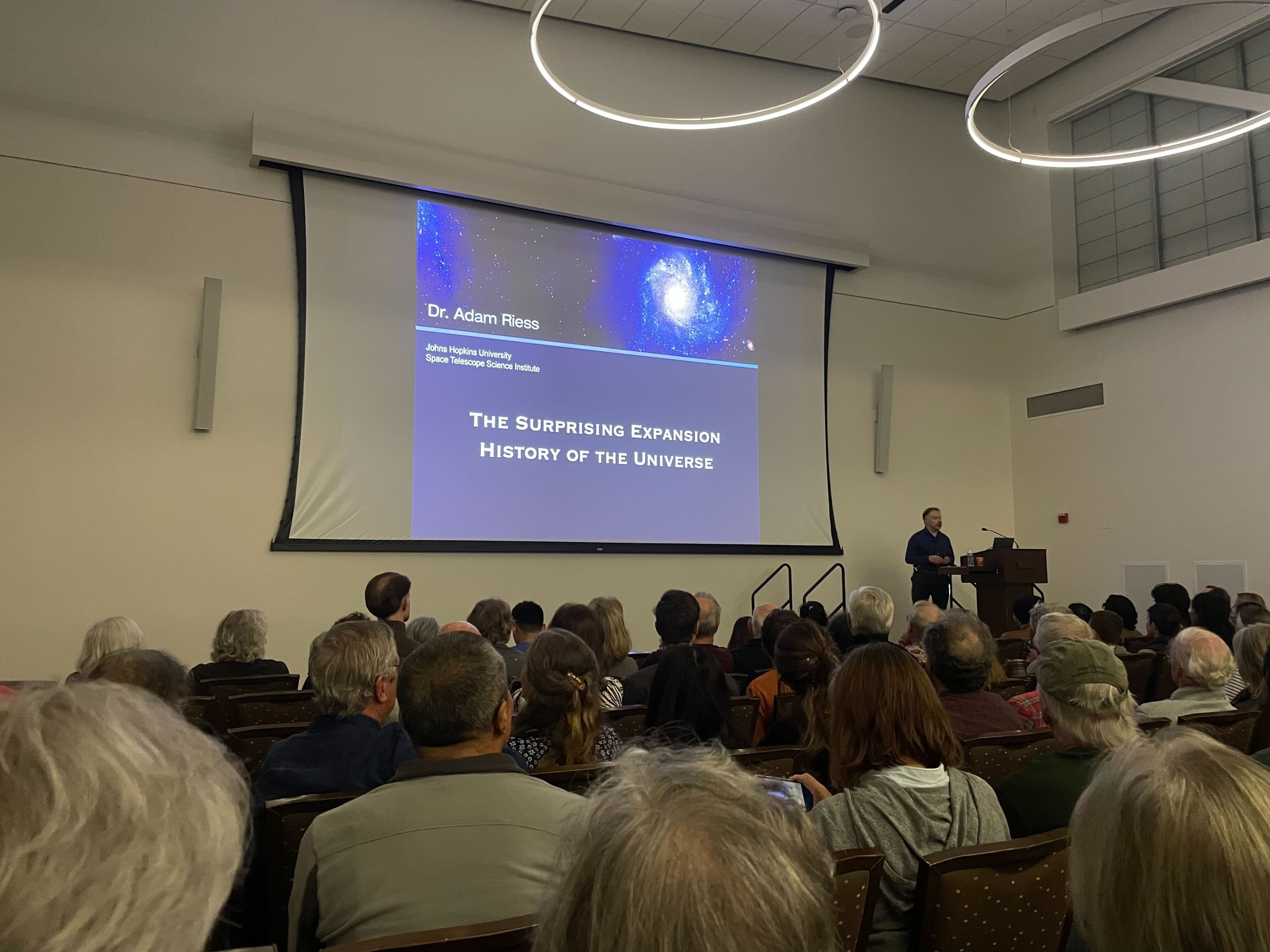
Nobel Prize Laureate in Physics, Adam Riess, leads two lectures at UC Davis during the start of November
By EKATERINA MEDVEDEVA— science@theaggie.org
The beginning of November marked a particularly exciting time for the faculty and students at the UC Davis Physics and Astronomy Department. Adam Riess, a co-winner of the 2011 Nobel Prize in Physics for his contribution to cosmology, gave two lectures at UC Davis: one on Nov. 3 at a department colloquium on the implications of data from the James Webb Space Telescope (JWST) for Hubble Tension, and another on Nov. 4 about the history and methods of the expansion of the universe.
In the 1990s, Riess, who is now a professor at Johns Hopkins University, was part of the High-z Supernova Search Team led by Brian P. Schmidt of the Australian National University. The team’s goal was to measure the rate of deceleration of the expansion of the universe by comparing the observations of close and distant Type Ia supernovae, which occur about once every 50 years within the Milky Way galaxy, according to NASA.
At the time, while it was known that the universe was expanding thanks to Edwin Hubble’s measurements, it was believed that its expansion must be slowing down due to the gravitational pull of the matter toward itself. This would imply that, at some point, the universe would stop expanding and instead would start collapsing onto itself in an event known as “The Big Crunch.”
In 1998, the High-z Supernova Search Team found that the universe was, in fact, expanding at an accelerating rate. In particular, it was Riess’ analysis of “deceleration” of the universe’s expansion that first revealed this.
“The closest to a eureka moment I had was when I was working on relating the amount of deceleration to how much matter was in the universe,” Riess said at the public lecture. “When I ran the calculation, I got something that didn’t make sense — I got a negative mass for the universe. After a few days, I injected the idea of introducing Einstein’s cosmological constant into the equations and found that they fit very well, that we had pretty good confidence that this was a necessary part of the story of the universe. In fact, that most of the universe would be in this form.”
Before it was known that the universe was expanding, it was thought to be static. This was the time when Albert Einstein was developing his theory of general relativity. In order to mathematically make the universe static, he introduced the cosmological constant that had the effect of a repulsive force that balanced out gravity. However, upon Hubble’s discovery of the expanding universe, he removed it, calling it his “biggest blunder.”
With Riess’ team’s discovery, it was reintroduced under what later became the concept of dark energy — repulsive force of empty space, marking a pivotal point in cosmology and opening numerous new avenues for research.
During the Nov. 3 colloquium, Riess discussed data from JWST; in particular, the rate of the expansion of the universe obtained from its measurements of cepheids, an alternative for supernovae for this type of calculation. This confirmed previous results from Hubble Space Telescope, while deepening the so-called Hubble Tension as it diverges from the rate calculated via measurements of the Cosmic Microwave Background (CMB).
“[The colloquium] was difficult to follow as an undergraduate, and there was so much information to digest — but it was nevertheless worth attending,” Oliver Ortiz Garcia, a fourth-year physics major with an astrophysics emphasis, said. “I was introduced to a lot of interesting physics and getting to hear a Nobel Laureate’s story from the Laureate himself felt really special. Adam Riess’ story is very inspiring.”
The public lecture presented by Riess on Nov. 4 covered the topic of the expansion of the universe more generally. It featured the story of how his team made the discovery about the accelerating expansion rate, which he supplemented with pictures of his original notebook. In this notebook, he performed the calculations and communicated with his team as they cross-checked the results.
“The introduction of the cosmological constant was the most interesting part of the presentation,” Brian Khov, a third-year physics major, said. “Riess simply used that constant out of pure ‘confusion and desperation’ which, miraculously, ended up working to help explain why the universe is expanding at an accelerated rate.”
The audience frequently engaged with the lecture, with many attendants, both students and community members, asking insightful follow-up questions.
“I found Dr. Riess’ public lecture to be extremely insightful, and it revealed a large dilemma in astrophysics that I was unaware of,” Kiran Mody, a fifth-year physics major, said. “I think it is important for students and members of the public to attend these lectures because they allow us to understand the kind of research that is being done at the highest caliber in a way that is digestible.”
Written by: Ekaterina Medvedeva — science@theaggie.org