






Davis Planning Commission discusses Village Farms housing project
Davis residents voice concerns about project safety and the need for affordable housing
By SONJA WOOLEY — city@theaggie.org
The Davis Planning Commission discussed the safety and efficacy of the proposed Village Farms housing project during a special meeting on Dec. 17. The Commission operates in an advisory capacity and ultimately voted to recommend that the Davis City Council certify the draft environmental impact report (EIR) for the project. The meeting also became a forum for public debate about whether the housing development would be beneficial in the first place. If the City of Davis approves Village Farms, a vote by the residents of Davis will be required under Measure J/R/D in order for the project to be built.
Davis residents spent two hours giving public comments in support or opposition of the project. Those in favor pointed out the need for more housing in Davis and their concern over the potential school closures as a result of the dwindling number of families who can afford to live in Davis.
Lesli Clemmens, a Davis resident, expressed her views on the project.
“We cannot keep kicking the can down the road while we wait for the perfect solution,” Clemmens said. “Delay has real consequences. Every year we wait, more families leave, more workers commute from outside the community, fewer young people see Davis as a place [where] they can build their futures.”
Norbia Kumagai, a Davis resident, spoke about the affordability of housing in Davis.
“Out of the 425 classmates at my [high school reunion], I think only a dozen of us can actually live in Davis, and most of the reason why is because we live in our family homes,” Kumagai said. “I have been diagnosed five years ago with stage 4 kidney disease, and so I feel that I really have to choose what I have to get involved in, and I have chosen to get really involved in the Village Farms project. I can’t say enough for the need to have this kind of housing.”
Other residents voiced their concerns about the project, citing the potential for flooding, risks of toxic chemicals from the former landfill on which the project would be built, concerns about increased traffic around the housing development, the large size of the project, the legitimacy of the project’s EIR approval process and whether or not the Village Homes Housing Development will be truly affordable.
Elizabeth Coolbrith, a Davis resident, expressed her views to the commission.
“This isn’t a choice between housing and no housing; there are better alternatives,” Coolbrith said. “The Village Farms marketing team and the school board have been using fearmongering to convince parents that their schools will somehow be saved tomorrow by housing that will not be up and running until at least 2035.”
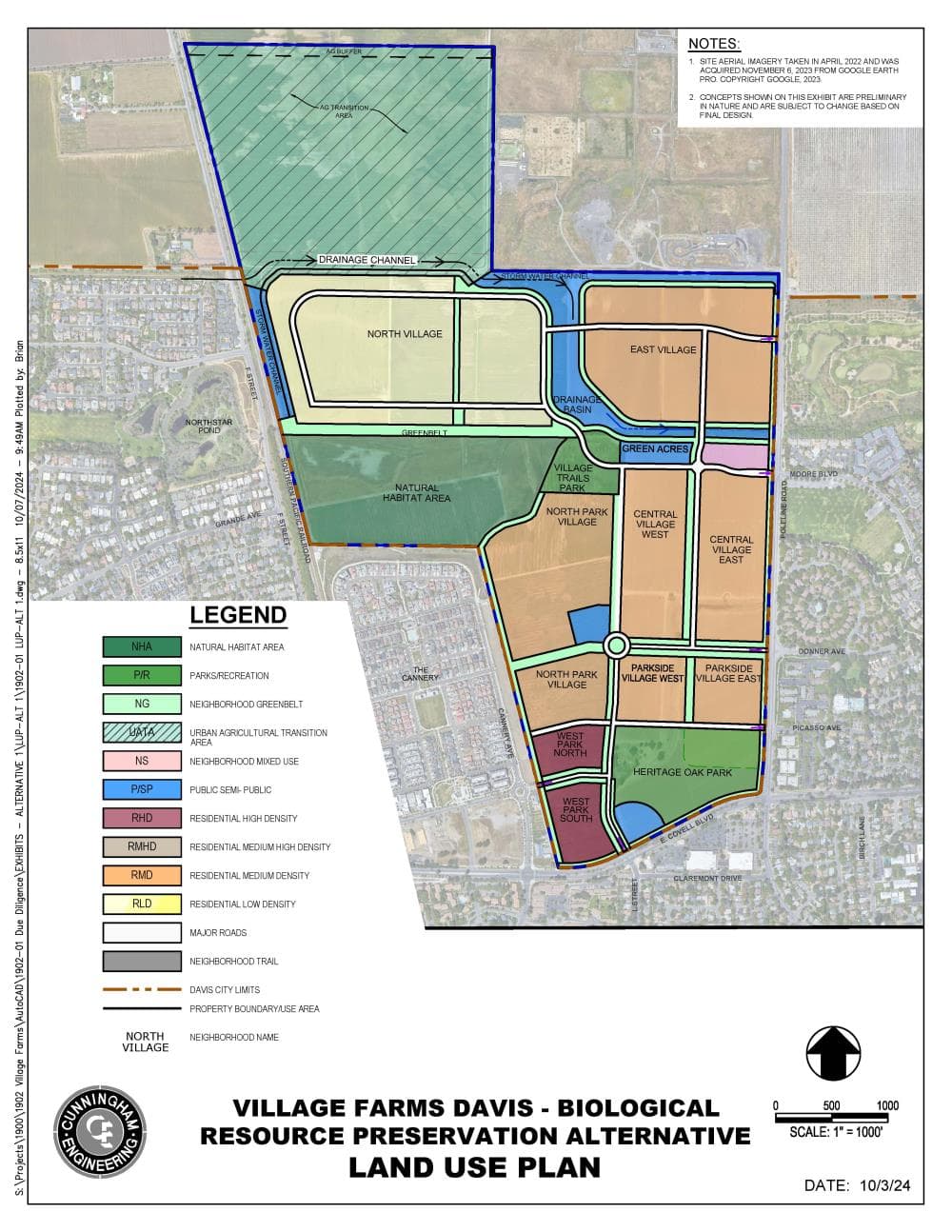
Several other commenters expressed their desire to limit the project to south of drainage Channel A — which would flow west to east through part of the Village Farms area along the east side of F Street near The Cannery neighborhood — to reduce the risk of flooding and groundwater toxins to the project.
However, the staff clarified that they did not include an option to build the project below Channel A because their task with the EIR was to examine the Village Farms project’s impact on the environment, not the environment’s danger to Village Farms.
Rochelle Swanson, a project applicant team member, emphasized that it was too late in the process to consider such a different option.
“We can have all these intellectual conversations, but the project before you, that’s what we’re willing to build, full stop,” Swanson said. “When I talk about the number of details and the math that goes into all of this, there are a lot of moving parts and the things we’ve agreed to were based on that.”
Commission-member Greg Rowe echoed the public commenters’ concerns about the potential for flooding at the proposed Village Farms site.
“Over 61% [of the project] is a [Federal Emergency Management Agency] FEMA flood hazard area,” Rowe said. “I’ve been doing a lot of research lately about the growing probability that California’s going to have big floods [due to climate change]. We’re sworn to protect the health and safety of the people of Davis. I don’t think we’re doing that by approving this project. We’re putting 1800 homes in the direct path of a possible flood.”
Planning Commissioner, Catherine Brinkley, disagreed with Rowe’s assessment.
“We’re in the Central Valley, floods are a risk [and] all development is an experiment,” Brinkley said. “Davis voters decided that they want to annex land and develop it through direct democracy, so our job is to get them there.”
Nick Pappani, vice president of Raney Planning and Management, the city’s California Environmental Quality Act (CEQA) consultant, attempted to alleviate concerns about the per- and polyfluoroalkyl (PFA) contaminants in the project site’s groundwater.
“The consultants […] evaluated the historic groundwater elevation data to ensure that the bottom of [the project’s storm drainage] channel is going to be above groundwater,” Pappani said. “But to add an extra layer of assurance, the project would install a geotextile membrane. They were testing for soil vapor, and the levels of soil vapor did not exceed applicable screening levels to human health.”
City staff also addressed concerns about an increase in traffic around the project site.
“The reality is it’s not a lot of traffic,” Ryan Chapman, Public Works Engineering and Transportation director, said. “We’re going from about 300 [cars] to about 1500 or something in the peak hour. I don’t believe people driving through it are going to experience or know much of a difference.”
The Davis Planning Commission ultimately voted 5–2 to certify the Village Farms EIR alongside a list of recommendations to the Davis City Council, many of which were aimed at increasing the density and affordability of the project. These included a recommendation to change all references to duplexes in the Village Farms project to half-plexes; a recommendation that the applicant plan for housing lot sizes expand to accommodate Accessory Dwelling Units; and that 20% of the half plex units in North Village be made eligible for downpayment assistance funded by the project applicant.
Written By: Sonja Wooley — city@theaggie.org