Students share their thoughts on Emily Henry’s first book-to-screen adaptation
By IQRA AHMAD — arts@theaggie.org
When “People We Meet on Vacation” premiered on Netflix on Jan. 9, it immediately captured audiences attention, accruing 17.2 million views over its opening weekend. However, its success is not simply a product of star power or streaming buzz; like many of today’s most popular films, it began as a book.
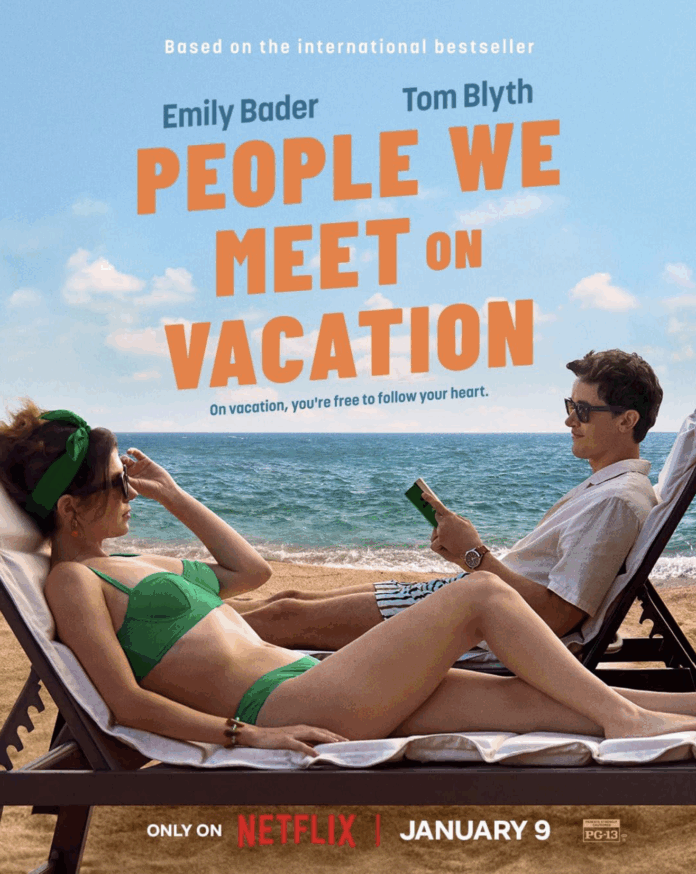
“People We Meet on Vacation” follows the long-running friendship between Poppy Wright, an outgoing and affable travel writer portrayed by Emily Bader, and Alex Nilsen, her more reserved and introspective best friend, played by Tom Blyth. Spanning across a series of annual trips, the story tracks the relationship of the characters as it changes over time, culminating in a reunion that forces both characters to confront their unresolved feelings toward one another.
What do the “Twilight” Saga (2008 to 2012), “Pride and Prejudice” (2008), “Charlie and the Chocolate Factory” (2005), “The Social Network” (2010) and “People We Meet on Vacation” (2026) all have in common? Despite spanning genres, time periods and audiences, each began on the page before making its way to the screen.
As book-to-film adaptations continue to dominate theaters and streaming platforms, viewers are increasingly drawn to stories they already know and love, raising questions about why these adaptations resonate so strongly and how faithfully they translate from novel to film.
There are many perspectives on how true adaptations should be to books. Some argue that films should be extremely accurate so as to not disrespect the author and the fans who resonated with the book, whereas others are more open to changes that occur in the process of creating adaptations.
“While being faithful to the overall plot is important, as well as keeping the narrative structure and character motivations, I don’t find it necessary to nitpick the exact methods and paths to which characters get from point A to point B,” Bianca Mojica, a third-year food sciences major, said. “I also really love character-focused media, so if a film or TV show shirks a line or plot in favor of character development, then I see it as the writers enhancing the narrative and adding layers that ultimately fuel the story.”
Similarly, viewers acknowledged that adaptations do not have to be extremely similar to the text, as there are so many differences between the forms of media.
“What works in a book might not translate well onto the big screen, and vice versa,” Bella Whitmore wrote in an article for Baylor Lariat. “When filmmakers take creative liberties with a book, they have the opportunity to breathe new life into the story. […] It can box filmmakers into a rigid framework, preventing them from taking risks or injecting fresh perspectives into the narrative.”
That openness toward the adaptation process extends to how some viewers perceived the film’s portrayal of Wright and Nilsen’s relationship.
“Overall, the film did capture the relationship between Poppy and Alex well,” Mojica said. “However, I think more of that can be attributed to the chemistry of the actors themselves rather than the writing of the script.”
For some viewers, the creative freedom afforded by adaptations is not a drawback, but a major appeal.
“I think it’s just super fun to see the director take their own artistic interpretation of the book, especially because Emily Henry’s books are super creative,” Amanda Porter, a fourth-year human development major, said. “I think it’s a very lighthearted movie, and a few things definitely seem different, but I was smiling for 1 hour and 40 minutes and laughing. It was great.”
There are, however, some contrary opinions on how book-to-screen adaptations should approach navigating plots and storylines. Some prefer slower, more intentional scenes between characters.
“At times, it seemed the film was simply trying to list all of their vacations one by one to hit the plot points,” Mojica said. “While this did the job of cementing how close the two characters were, I felt as if they could have dug deeper into the development of how they came to fall in love. They only had a couple scenes of reconnection before the ultimate love confession, which seemed a little bit rushed.”
Despite these criticisms, there is broader optimism toward adaptations as a whole.
“Whenever I watch book-to-film adaptations, I always keep a very open mind,” Mojica said. “I understand how production, filming and budget constraints can steer things in a direction that isn’t necessarily the most book-accurate. An adaptation, by definition, is meant to adapt, not replicate.”
The conversation surrounding “People We Meet on Vacation” ultimately mirrors a larger question facing modern audiences: What makes a successful adaptation?
“The truth is that writing an adaptation is a highly complicated process that will generate debate and propel people to look for new ways of telling stories,” Livia Reim wrote in an article for Rock and Art. “Many adaptations follow the book’s plot, beat by beat, but completely miss the point when it comes to what exactly the story is about. I have realised that adaptations with some changes are usually more successful in truly capturing the spirit of a book.”
For some, it is precision and loyalty to the page; for others, it is emotional authenticity and creative freedom. While the film may not satisfy every expectation, the reception of “People We Meet on Vacation” suggests that viewers are increasingly willing to embrace reinterpretation, especially when it preserves the heart of the story.
Written by: Iqra Ahmad — arts@theaggie.org