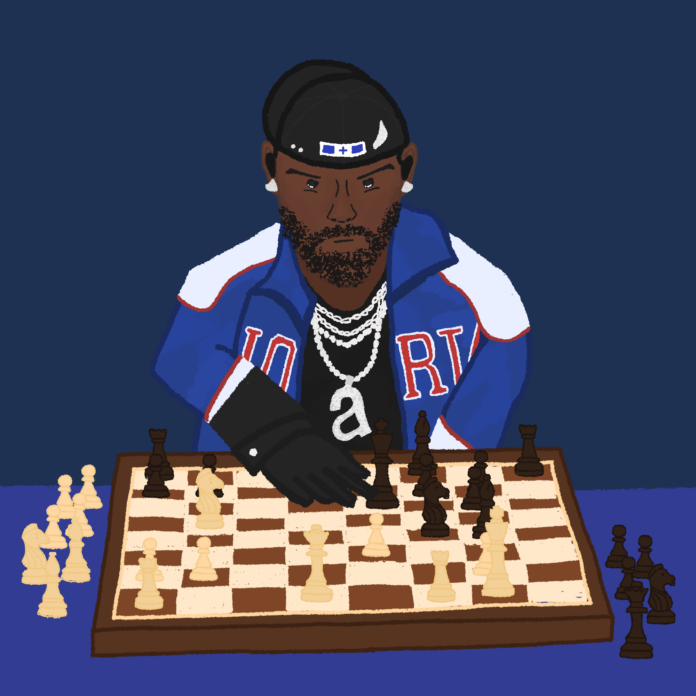
Bootcut jeans are a bold choice, eh?
By NEVAEH KARRAKER— nakarraker@ucdavis.edu
The ignition of a revolution is near: There’s a demand for justice and a cry for change, and Kendrick Lamar holds the power of unity within his grasp. His artistry is more than just songs — it’s a reflection of the complexities of identity and politics.
Each lyric, song and album is layered with rich symbolism and purpose. Kendrick’s album “To Pimp a Butterfly” acts as a testament to this, standing as a documentation of a rite of passage: an exploration of self discovery, internal conflict and discrimination.
This renowned album, along with the rest of his work, represents a paradox: Despite being criticized and undermined by the industry, Kendrick remains unfaltering in his beliefs and heritage. He aims to reinforce pride in African American culture for what it truly is and to demonstrate that it is not a trend to be exploited for popularity. It’s this quality that allows him to rise above the status quo and perfect his craft.
Through the use of unconventional techniques, he produces both captivating and thought-provoking music. After all, not many people can get a full stadium to chant an insult toward another celebrity. That’s Kendrick’s masterful ability; He doesn’t just make music to listen to, he challenges the norm, stirs the crowd and, somehow, also pleases the ear.
This distinctive trait extends beyond serving to challenge the music industry. He directly calls out institutions, artists and the system at large in an unmistakable manner. Kendrick highly values authenticity; He avoids plagiarism yet is also unafraid to express controversial themes.
His recent Super Bowl performance, for example, represented far more than a mere routine stage appearance. It was a calculated opportunity to send a powerful message to millions of viewers — to force listeners to confront the imminent, unacknowledged conflicts in America.
In this way, Kendrick uses his platform for advocacy and awareness. In particular, he highlights how our social system generates rampant political division. He also calls out how it unfairly exalts the rich, pushing the nation into a further state of poverty and unemployment.
The setup of a PlayStation controller and a split American flag is an example of this unfiltered, transparent statement. By collaborating with other Black artists like SZA, DJ Mustard and the Turffienz Dance Crew, Kendrick paves the road to amplify the voices of those desiring change.
Moreover, in dissing his “opps” on live television, Kendrick wasn’t just throwing punches, he was conquering the very forces that sought to censor him. Samuel L. Jackson’s eerie portrayal as Uncle Sam exposes this censorship and opposition to spirited outbursts, emphasizing how people often refuse to pay attention to opposing opinions. The look of triumph Kendrick wore during the performance expressed satisfaction in defeating rivals as well as the system itself — and, even more significantly, by profiting off of it.
After all, Kendrick is the epitome of transforming struggle into success. From growing up in Compton, a city overrun with crime, to becoming one of the most influential rap artists of our modern world, Kendrick projects something greater than music — dedication and perseverance.
Clearly, every decision Kendrick makes carries immense significance, even in the smallest details. His fashion choice for the Super Bowl, like his bootcut jeans, is a blunt reference to the counterculture movement of the 1960s. This, along with his “a” chain — whether to offend artists or represent his multimedia company “pgLang” — is subtle. These seemingly random choices play an effective role in a larger narrative.
When it comes down to it, Kendrick rejects partisan labels, taking an uncommon stance to convey a deeper truth: The problem is not the right side or the left side but in the very system that implements that divide — the illusion that choice gives us control. In reality, change will remain impossible unless the American people unite, regardless of race or, most importantly, political beliefs.
Maybe the people who dislike his music happen to be the ones who need to hear his message the most. After all, Kendrick pushes the boundaries for all, regardless of whether one understands or is willing to listen.
So tell me, is this really a game? Or are we all players in a system that Kendrick’s art is trying to caution and help us break free from?
Written by: Nevaeh Karraker—nakarraker@ucdavis.edu
Disclaimer: The views and opinions expressed by individual columnists belong to the columnists alone and do not necessarily indicate the views and opinions held by The California Aggie.