Learning from hindsight
By MOLLY THOMPSON – mmtthompson@ucdavis.edu
As I enter my third year at UC Davis, I can’t help but return to the memories of the early days of my first year; In fall of 2023, I fell victim to the plight of many young adults living away from home for the first time and got myself into a pretty deep eating disorder.
While this wasn’t the first time that I’d found myself in this particular state (I was diagnosed with anorexia nervosa when I was 16 years old and spent my third year of high school in recovery), I started my collegiate career extremely confident that I was beyond that part of my life and that I was no longer susceptible to the destructive habits of my high school years. Reader, I was quickly humbled.
College can be incredibly stressful: that doesn’t come as a surprise to anyone. Between fast-paced, demanding classes, a new environment, the loss of our support systems and a rapid transition to complete independence from our families, it’s inevitable that we’re all going to need some solid coping mechanisms to deal with the pressure. And, with everything being so new all at once, it’s easy to feel lost and out of control.
Food is something that is really easy to control when everything else is out of your hands. It’s a place you can direct your attention to when your brain is overwhelmed by responsibilities. Manipulating your body and your food feels like a tangible, accessible goal when everything else feels too vast or unattainable. Especially if it’s something you’ve dealt with in the past, eating feels like a familiar, reliable routine that you can rely on in the face of so much uncertainty — unlike everything else, it makes sense.
Anorexia, in particular, is especially enticing because it has the additional symptom of numbing you to the harshness of the world around you and the turmoil inside your head. When you deprive yourself of sustenance, your body shuts down a lot of its nonessential functions. Your metabolism slows down (which has a lot of side effects of its own), your reproductive system might suffer, your mental cognition wanes and your emotions become subdued — you just feel less of everything. This numbness might not be something you’re aware of, but in a time of so much overwhelming anxiety and stimulation, it can feel like relief.
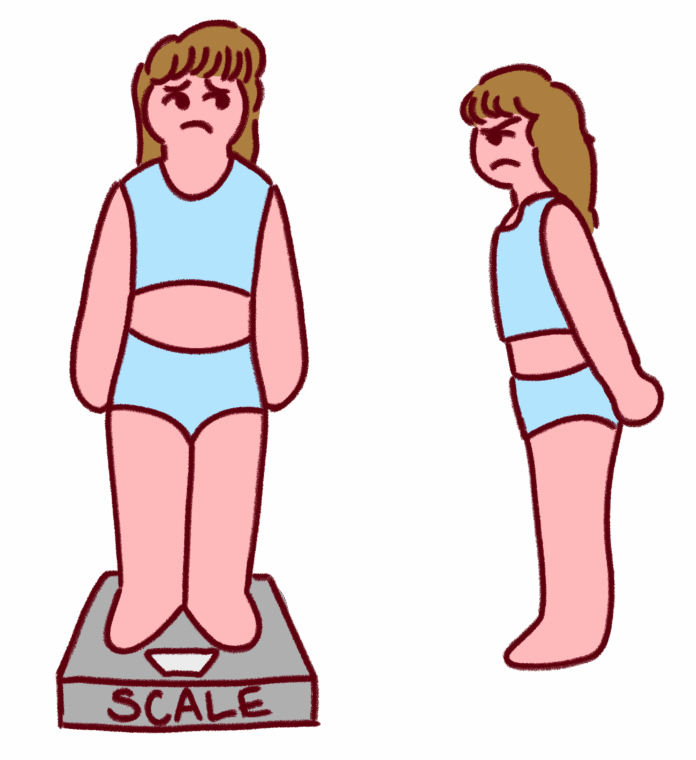
Please, under no circumstances, take this as an endorsement of eating disorders. I can confidently say that the deepest points of my eating disorder were the worst times of my life. Even though I was numbing myself from other anxieties, even though I felt a sense of success from manipulating the shape of my body or the number on the scale and even though it gave me control over a small aspect of my life, it deprived me of far more than I ever gained from it.
It took me years to relearn what my body needs and how to take care of it, skills that I was supposed to have mastered in elementary school (I’m still working on it). I permanently messed up my body in ways that I’ll never be able to fully recuperate (my metabolism will never be the same). I broke my parents’ sense of trust in me to a point that I may not be able to heal, though I’ll continue to work on it (I lied a lot). And the worst part is that I wasted so much time (days on end, if you add up all the hours) at doctors’ appointments getting my weight and vitals checked, therapy sessions recounting everything I’d eaten in a day and sitting at home, banned from exercise, while my dance teammates practiced in the studio without me. To this day I have to report my weight to my therapist every month. While it hasn’t completely stopped me from accomplishing things I’m proud of or having incredible experiences, it feels like it’s taken over the past four years of my life.
That is my biggest regret. Anorexia plagues some of my best memories; I can look at photos from February of my third year of high school or December of my first year of college and just see this gaunt, lifeless exhaustion in my eyes. Even if it’s not visible to the people around me, it haunts those pictures (and the memories behind them) to the point where I’m not thinking of all my incredible experiences and adventures, but rather how I let food define my entire life.
If I could change anything about my first-year experience — if I could give myself one piece of advice — I wouldn’t let myself become anorexic again. It was so hard because I felt like I was doing a good job. My therapist would call me and tell me I was still below my healthy weight baseline, and even though I would say, “Oh no, that’s not good, I’ll try harder,” it still felt like a win.
But hindsight is 20/20, and it just wasn’t worth it. That sense of accomplishment was short-lived and inconsequential compared to the consequences (physical health, mental health, time, opportunities). Beyond that, focusing on food or body image doesn’t actually relieve any anxieties: it simply replaces them. It’s not an outlet for stress: it’s simply a redirection. It’s not a coping mechanism: it’s just a cover — the same anxiety in masquerade. It doesn’t solve anything.
I know that now. I thought I knew it then, too, but I didn’t. Even though it’s still in my head, I understand now that it’s just not worth it. It’s tempting, sometimes, to go back there. It would be so easy to slip back into those behaviors for the instant gratification of success and numbness. But I understand now that it does far more harm than good.
College is a proverbial breeding ground for disordered eating. It’s inherently competitive, it’s overwhelming and it’s stressful — a perfect storm for unhealthy coping mechanisms. But if you take away anything from this, please learn from my mistakes. I promise you that it will cause you far more trouble than it’s worth. It’s a slippery slope — so please be careful.
Written by: Molly Thompson — mmtthompson@ucdavis.edu
Disclaimer: The views and opinions expressed by individual columnists belong to the columnists alone and do not necessarily indicate the views and opinions held by The California Aggie