Food as a form of art and storytelling
By VIOLET ZANZOT— vmzanzot@ucdavis.edu
Deciding what to get at a street market is the best problem I’ve ever encountered in my life. The tantalizing choice between one plate of sizzling delicacies or another is strenuous only because there are simply too many right answers. Each stall or stand represents a compilation of generations of work in and out of kitchens around the world, unique from all other takeout or restaurants.
I think the food the stalls produce carries a similar weight to, say, a vinyl record. It’s a piece of art that, when you consume it, makes you feel aware that it was not made for the instant gratification we’re used to today — it was made to be savored. Just like a delicate seasoning blend, each note is meant to hit our senses in a specific way, just as the spindle reaches the vinyl. Spotify might have the same lyrics, but the songs have their own sounds unique to a physical record. In the same way, Trader Joe’s frozen pad thai might go by the same name as one found in a hot wok under a vendor’s tent, but it won’t sing the same tune; it’s just not as authentic.
It isn’t that street food took many years to prepare, but that it took many years to evolve into the form you see today; embedded in everything we eat and consume is a time-honored, complicated story.
An important part of actively choosing to romanticize your life is realizing food can be an experience. I’m sure I learned this lesson in stages — probably beginning when I enjoyed my first homemade pasta at the age of eleven — but I really gained a greater appreciation for it through my studies at UC Davis. I attribute this mainly to two classes, one on toxicity (ANT 104, in which I learned that chemicals are everywhere) and the other on food in world history (HIS 012, in which I learned that food is extraordinarily telling and deeply mobile).
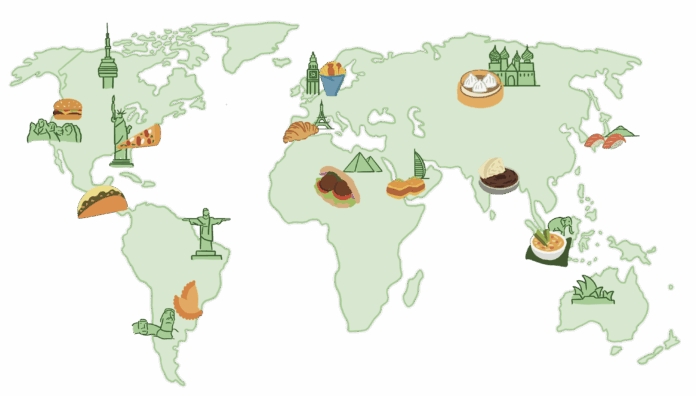
Chemicals have become a tool of greed — allowing food to be made efficiently at the expense of quality. Looking back on the past, we can see plainly that food was, at once, so much simpler and so much more complicated. It was made exclusively with real ingredients, but also moved globally, bringing onions and garlic to cast iron skillets across the world.
Matcha, once the star of Japanese tea ceremonies, is now the hottest thing served iced, with strawberry and oat milk. Globalization and commercialization have commodified classics: if we use this for good, we may all get to embrace traditional and diverse cultures that we may never otherwise have the opportunity to experience, but if we use it for evil, it becomes another example in an already negative narrative. That is, it becomes another way in which we use chemicals to synthetically make life and food convenient.
Has food become overcomplicated in that sense — as a cocktail of chemicals? Has it simultaneously become so oversimplified that we have lost our appreciation for what it’s meant to be? Food provides a way for people to connect to the world around them, to the cooks that created it and to continuing journeys. It’s more than a way to nourish ourselves; it has the potential to make us feel so much joy. If we eat without understanding and appreciating the value of the food itself, we lose its meaning. Just as music is only an art form if you listen to it with a conscious and open heart and mind, food has the same potential — it is an avenue for art and a vessel for history.
Written by: Violet Zanzot— vmzanzot@ucdavis.edu
Disclaimer: The views and opinions expressed by individual columnists belong to the columnists alone and do not necessarily indicate the views and opinions held by The California Aggie.