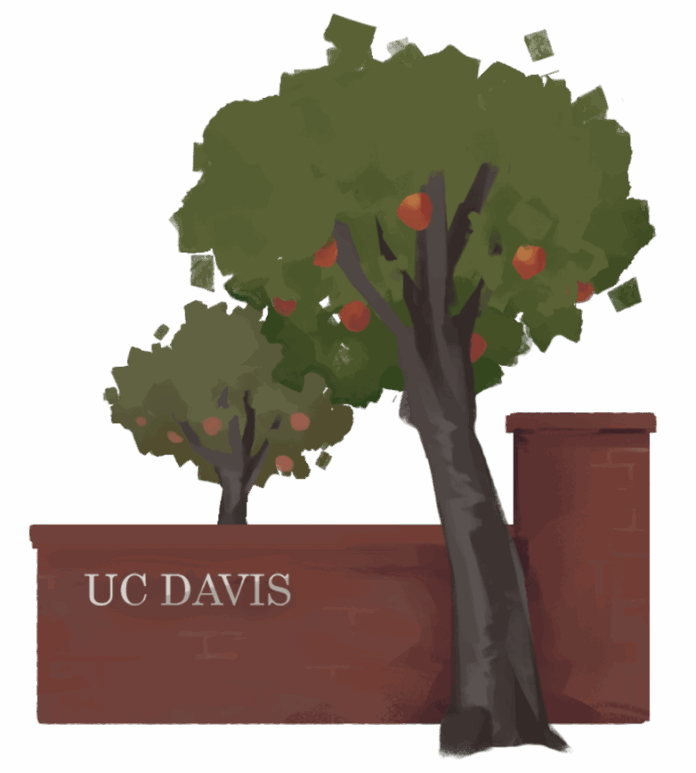
Growing more fruit trees could alleviate many common college stressors
By ANJALI IYER — amiyer@ucdavis.edu
After the gloom of Davis winters, many students earnestly await the arrival of spring quarter, as the change in seasons provides a much-needed relief from the misery of 5 p.m. sunsets. Unfortunately, the rustle of a gentle spring breeze is often accompanied by an unwelcome allergen — pollen. And so begins the cacophony of sneezes that inevitably interrupt your flow of thought during the silence of an exam or a particularly dire cram session in the library. The sounds of sniffles echo throughout lecture halls as students engage in a months-long battle against a skyrocketing pollen count. The main culprit of this nasal assault? Wind-pollinated trees.
The campus is home to a variety of oak, elm, cedar and mulberry trees — all notorious producers of airborne pollen, according to the UC Davis public tree database. It would be ludicrous to suggest that UC Davis axe these historic existing trees, so instead, I offer a proposal: focus on planting species that have even more to offer the community. I’m suggesting that UC Davis plant more insect-pollinated fruit trees. Aside from the hypoallergenic benefits, planting fruit trees would provide a free source of food for the community for seasons to come.
On a college student’s budget, increasingly expensive grocery prices can force Davis residents to compromise on the quality or quantity of produce they can buy. Access to nutritious food should be considered an inalienable right, but unfortunately, food instability is a rampant issue for half of all California college students.
An alternative to shopping at traditional grocery stores is the Davis Farmers Market, which hosts a range of vendors selling locally grown produce. However, this can be even more expensive than chain grocers like Trader Joe’s, and isn’t a sustainable solution for students working with a minimum wage budget.
One could argue that student organizations, like the Edible Gardens on campus, negate the need to plant fruit trees. The Edible Gardens project is a student-led initiative that turns existing spaces on campus into sustainable farms. They equip students with the skills needed to access the produce growing in these gardens and provide volunteer and employment opportunities for the community. These gardens already aim to promote student access to sustainable agricultural practices. However, I say that these projects only prove that UC Davis has the capacity to implement more food equity initiatives. After all, why not?
Fruit trees, especially native species, are a renewable source of food already adept to California’s harsh climate. Once established, native trees require much less upkeep compared to introduced crops in a cultivated garden, thereby diminishing the need for year-round expenditure. The trees could be planted around first-year residence halls, in the Arboretum or dotted around campus. Before the trees are ready to bear fruit, planting and caring for saplings could be used in botany courses as general education units. For students majoring in plant-related fields, the fruit trees could be used in research projects. If you’re looking for a multifaceted, long-term and sustainable way to promote access to fresh fruit, this is the best solution.
Life as a college student is a balancing act of keeping up with school, often whilst working a job and somehow finding a way to fit a social life into the mix. Exhaustion and burnout are only worsened by sickness, which is brought on by the abrupt change in seasons. Even something as seemingly small as access to free produce could be an effective way to alleviate some of the pressure that comes with being a young person in an increasingly nihilistic world. UC Davis students deserve to be able to take a break from the chaos, get together with some friends and pick some free fruit.
Written by: Anjali Iyer — amiyer@ucdavis.edu
Disclaimer: The views and opinions expressed by individual columnists belong to the columnists alone and do not necessarily indicate the views and opinions held by The California Aggie.